第16 讲 介词2026 年高考英语语法专项突破(全国通用)
(语法讲义+模拟练习+真题操练)
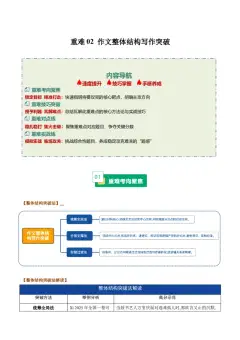
 内容提要
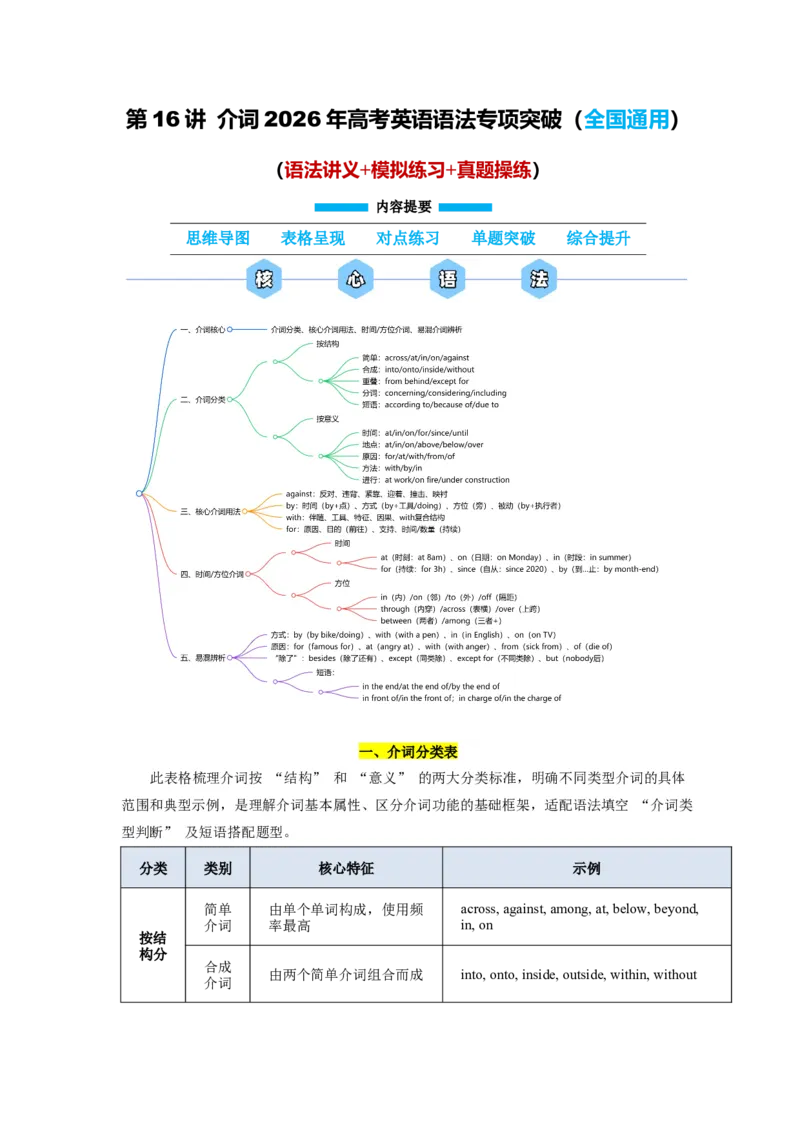
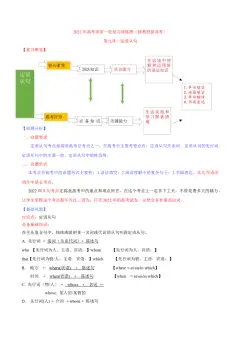
思维导图
表格呈现
对点练习
单题突破
综合提升
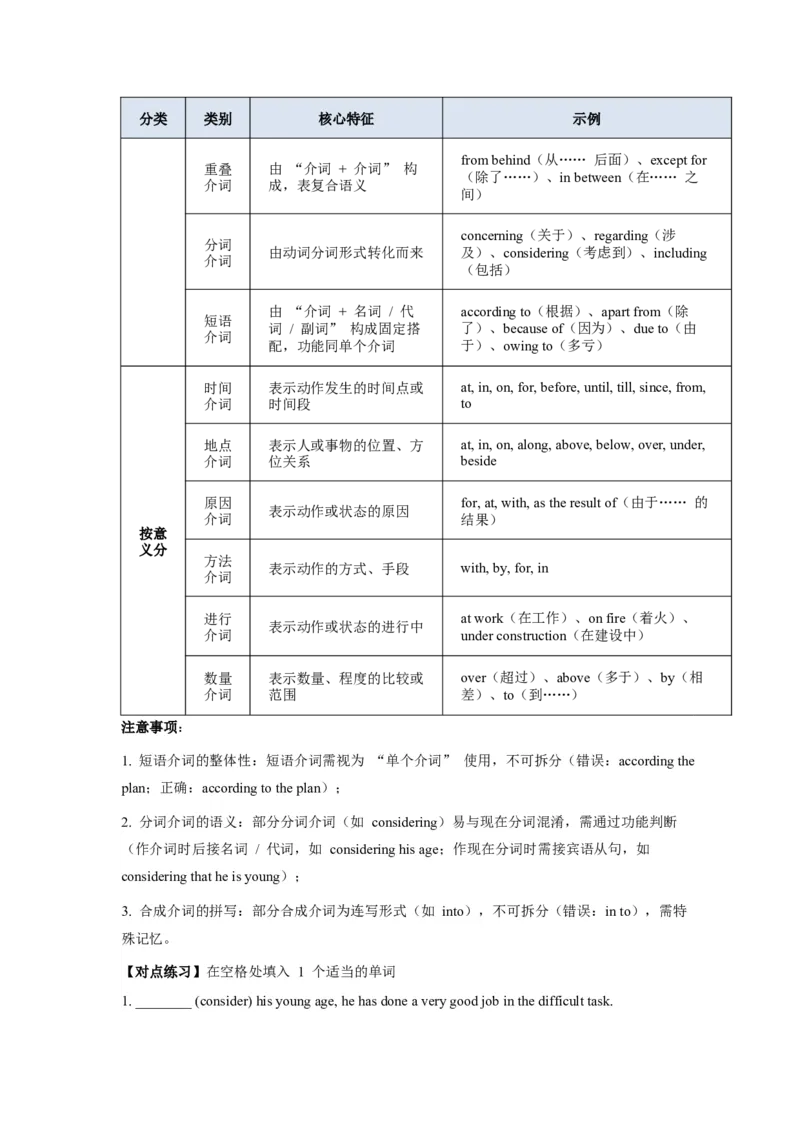
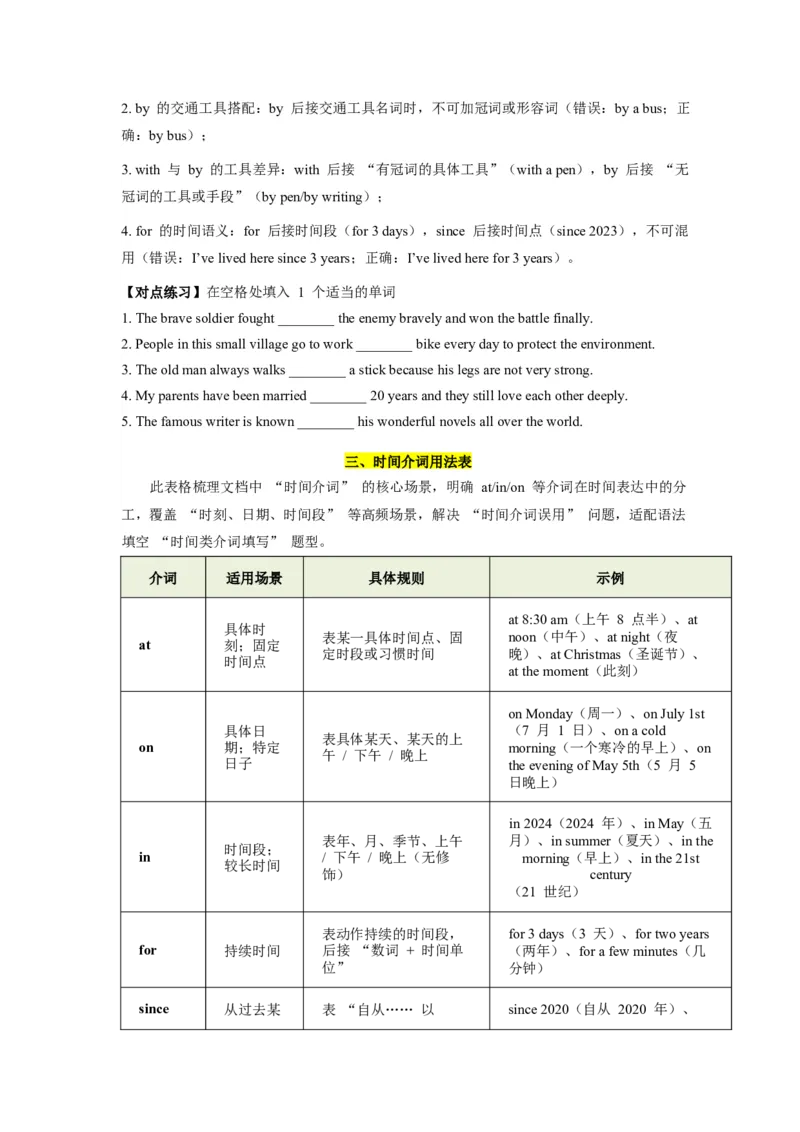
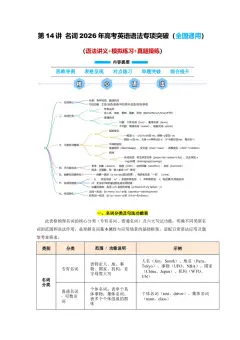
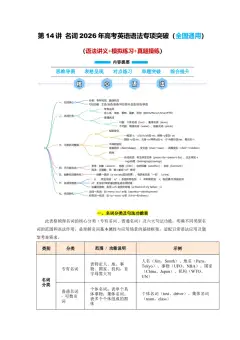
一、介词分类表
此表格梳理介词按 “结构” 和 “意义” 的两大分类标准,明确不同类型介词的具体
范围和典型示例,是理解介词基本属性、区分介词功能的基础框架,适配语法填空 “介词类
型判断” 及短语搭配题型。
分类
类别
核心特征
示例
按结
构分
简单
介词
由单个单词构成,使用频
率最高
across, against, among, at, below, beyond,
in, on
合成
介词
由两个简单介词组合而成
into, onto, inside, outside, within, without
分类
类别
核心特征
示例
重叠
介词
由 “介词 + 介词” 构
成,表复合语义
from behind(从…… 后面)、except for
(除了……)、in between(在…… 之
间)
分词
介词
由动词分词形式转化而来
concerning(关于)、regarding(涉
及)、considering(考虑到)、including
(包括)
短语
介词
由 “介词 + 名词 / 代
词 / 副词” 构成固定搭
配,功能同单个介词
according to(根据)、apart from(除
了)、because of(因为)、due to(由
于)、owing to(多亏)
按意
义分
时间
介词
表示动作发生的时间点或
时间段
at, in, on, for, before, until, till, since, from,
to
地点
介词
表示人或事物的位置、方
位关系
at, in, on, along, above, below, over, under,
beside
原因
介词
表示动作或状态的原因
for, at, with, as the result of(由于…… 的
结果)
方法
介词
表示动作的方式、手段
with, by, for, in
进行
介词
表示动作或状态的进行中
at work(在工作)、on fire(着火)、
under construction(在建设中)
数量
介词
表示数量、程度的比较或
范围
over(超过)、above(多于)、by(相
差)、to(到……)
注意事项:
1. 短语介词的整体性:短语介词需视为 “单个介词” 使用,不可拆分(错误:according the
plan;正确:according to the plan);
2. 分词介词的语义:部分分词介词(如 considering)易与现在分词混淆,需通过功能判断
(作介词时后接名词 / 代词,如 considering his age;作现在分词时需接宾语从句,如
considering that he is young);
3. 合成介词的拼写:部分合成介词为连写形式(如 into),不可拆分(错误:in to),需特
殊记忆。
【对点练习】在空格处填入 1 个适当的单词
1. ________ (consider) his young age, he has done a very good job in the difficult task.
2. All the students, ________ (include) Tom, must hand in their homework before the deadline.
3. ________ (according to) the weather forecast, there will be a heavy rain in our city tomorrow.
4. The little boy suddenly jumped out ________ behind the door and scared his sister.
5. We have to finish the project within three days, ________ (without) any delay.
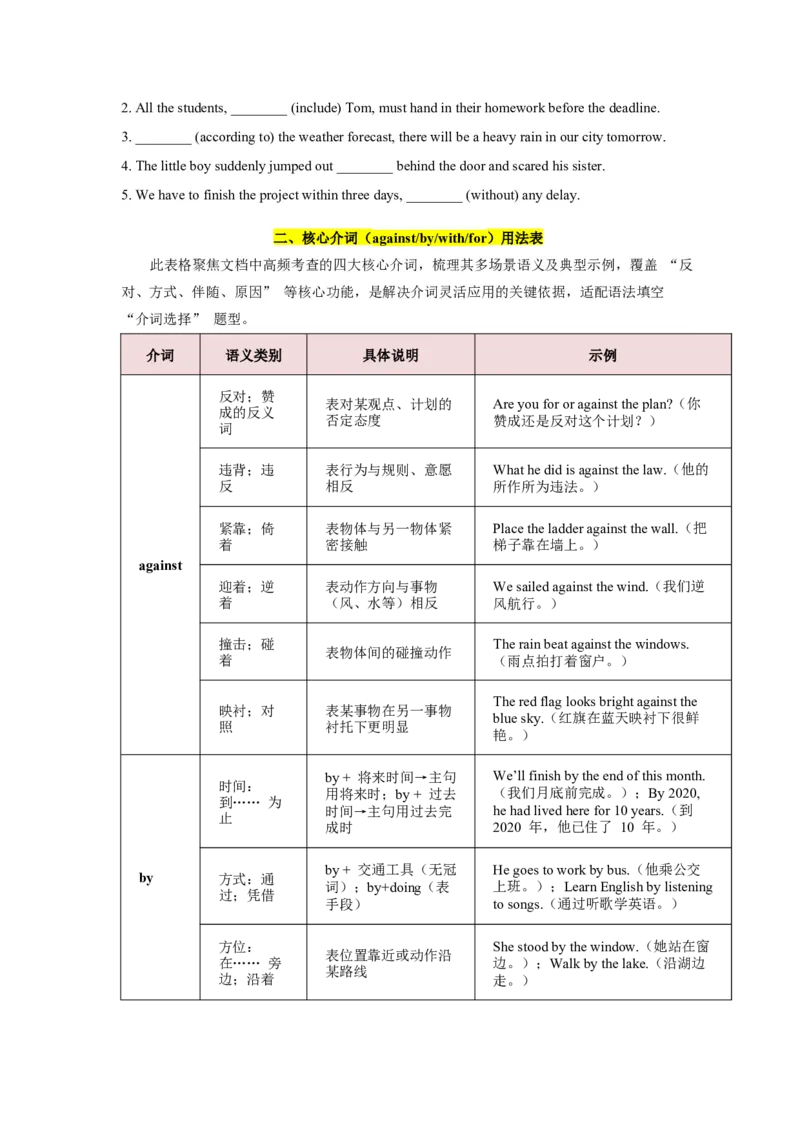
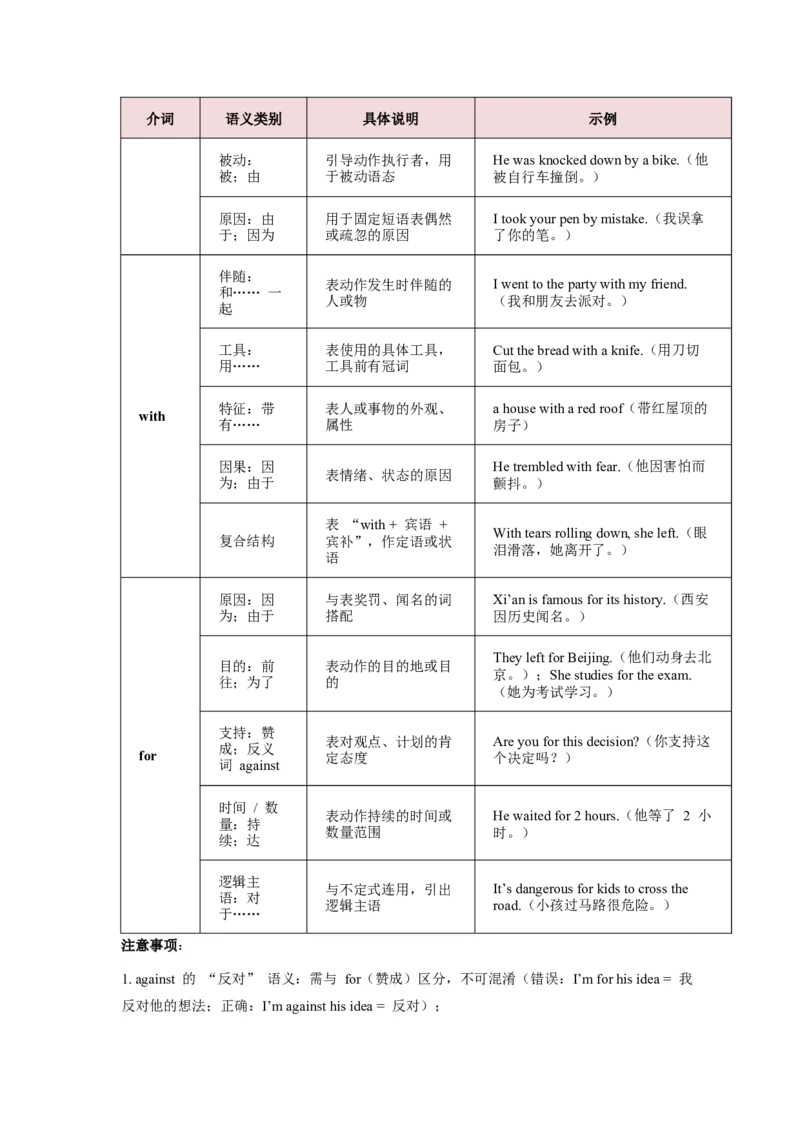
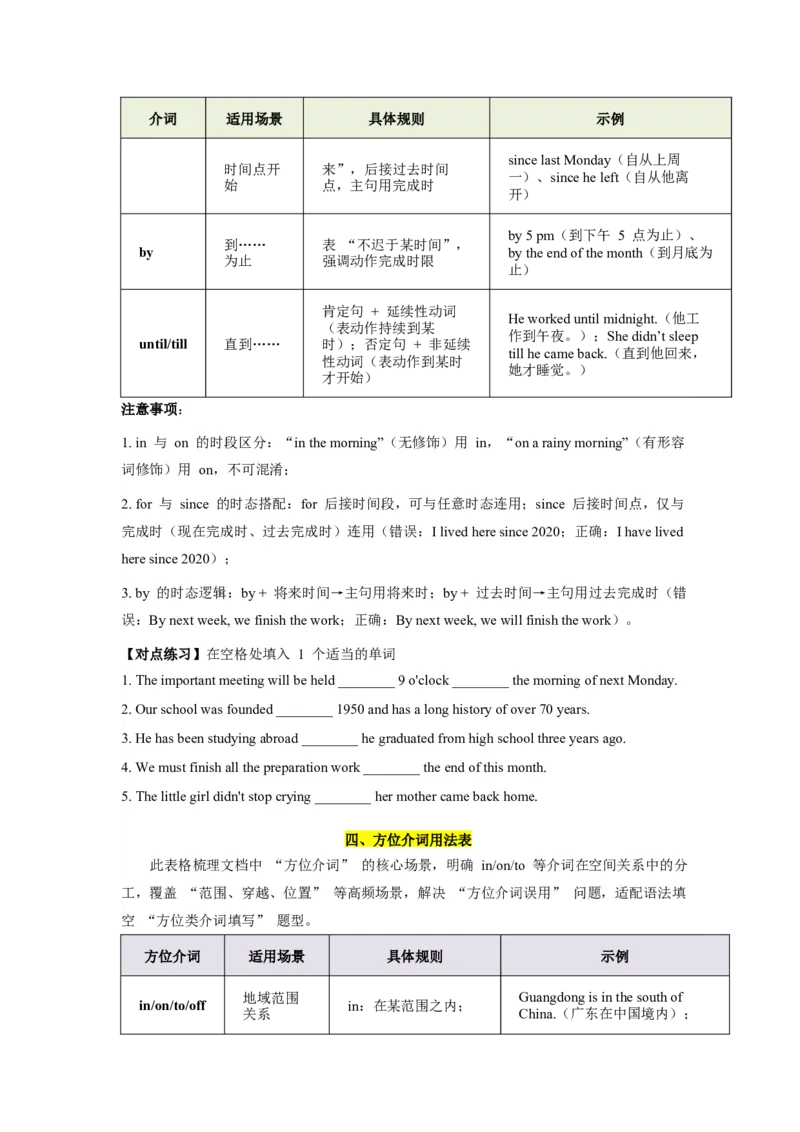
二、核心介词(against/by/with/for)用法表
此表格聚焦文档中高频考查的四大核心介词,梳理其多场景语义及典型示例,覆盖 “反
对、方式、伴随、原因” 等核心功能,是解决介词灵活应用的关键依据,适配语法填空
“介词选择” 题型。
介词
语义类别
具体说明
示例
against
反对;赞
成的反义
词
表对某观点、计划的
否定态度
Are you for or against the plan?(你
赞成还是反对这个计划?)
违背;违
反
表行为与规则、意愿
相反
What he did is against the law.(他的
所作所为违法。)
紧靠;倚
着
表物体与另一物体紧
密接触
Place the ladder against the wall.(把
梯子靠在墙上。)
迎着;逆
着
表动作方向与事物
(风、水等)相反
We sailed against the wind.(我们逆
风航行。)
撞击;碰
着
表物体间的碰撞动作
The rain beat against the windows.
(雨点拍打着窗户。)
映衬;对
照
表某事物在另一事物
衬托下更明显
The red flag looks bright against the
blue sky.(红旗在蓝天映衬下很鲜
艳。)
by
时间:
到…… 为
止
by + 将来时间→主句
用将来时;by + 过去
时间→主句用过去完
成时
We’ll finish by the end of this month.
(我们月底前完成。);By 2020,
he had lived here for 10 years.(到
2020 年,他已住了 10 年。)
方式:通
过;凭借
by + 交通工具(无冠
词);by+doing(表
手段)
He goes to work by bus.(他乘公交
上班。);Learn English by listening
to songs.(通过听歌学英语。)
方位:
在…… 旁
边;沿着
表位置靠近或动作沿
某路线
She stood by the window.(她站在窗
边。);Walk by the lake.(沿湖边
走。)
介词
语义类别
具体说明
示例
被动:
被;由
引导动作执行者,用
于被动语态
He was knocked down by a bike.(他
被自行车撞倒。)
原因:由
于;因为
用于固定短语表偶然
或疏忽的原因
I took your pen by mistake.(我误拿
了你的笔。)
with
伴随:
和…… 一
起
表动作发生时伴随的
人或物
I went to the party with my friend.
(我和朋友去派对。)
工具:
用……
表使用的具体工具,
工具前有冠词
Cut the bread with a knife.(用刀切
面包。)
特征:带
有……
表人或事物的外观、
属性
a house with a red roof(带红屋顶的
房子)
因果:因
为;由于
表情绪、状态的原因
He trembled with fear.(他因害怕而
颤抖。)
复合结构
表 “with + 宾语 +
宾补”,作定语或状
语
With tears rolling down, she left.(眼
泪滑落,她离开了。)
for
原因:因
为;由于
与表奖罚、闻名的词
搭配
Xi’an is famous for its history.(西安
因历史闻名。)
目的:前
往;为了
表动作的目的地或目
的
They left for Beijing.(他们动身去北
京。);She studies for the exam.
(她为考试学习。)
支持:赞
成;反义
词 against
表对观点、计划的肯
定态度
Are you for this decision?(你支持这
个决定吗?)
时间 / 数
量:持
续;达
表动作持续的时间或
数量范围
He waited for 2 hours.(他等了 2 小
时。)
逻辑主
语:对
于……
与不定式连用,引出
逻辑主语
It’s dangerous for kids to cross the
road.(小孩过马路很危险。)
注意事项:
1. against 的 “反对” 语义:需与 for(赞成)区分,不可混淆(错误:I’m for his idea = 我
反对他的想法;正确:I’m against his idea = 反对);
2. by 的交通工具搭配:by 后接交通工具名词时,不可加冠词或形容词(错误:by a bus;正
确:by bus);
3. with 与 by 的工具差异:with 后接 “有冠词的具体工具”(with a pen),by 后接 “无
冠词的工具或手段”(by pen/by writing);
4. for 的时间语义:for 后接时间段(for 3 days),since 后接时间点(since 2023),不可混
用(错误:I’ve lived here since 3 years;正确:I’ve lived here for 3 years)。
【对点练习】在空格处填入 1 个适当的单词
1. The brave soldier fought ________ the enemy bravely and won the battle finally.
2. People in this small village go to work ________ bike every day to protect the environment.
3. The old man always walks ________ a stick because his legs are not very strong.
4. My parents have been married ________ 20 years and they still love each other deeply.
5. The famous writer is known ________ his wonderful novels all over the world.
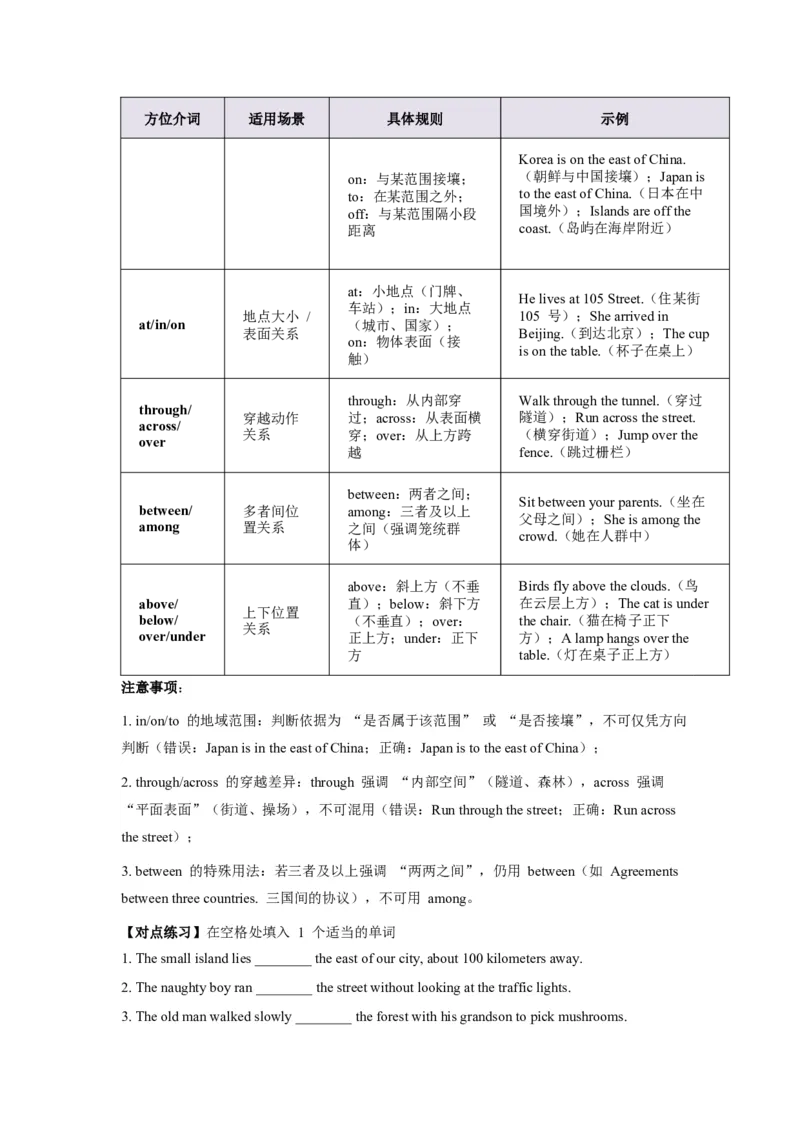
三、时间介词用法表
此表格梳理文档中 “时间介词” 的核心场景,明确 at/in/on 等介词在时间表达中的分
工,覆盖 “时刻、日期、时间段” 等高频场景,解决 “时间介词误用” 问题,适配语法
填空 “时间类介词填写” 题型。
介词
适用场景
具体规则
示例
at
具体时
刻;固定
时间点
表某一具体时间点、固
定时段或习惯时间
at 8:30 am(上午 8 点半)、at
noon(中午)、at night(夜
晚)、at Christmas(圣诞节)、
at the moment(此刻)
on
具体日
期;特定
日子
表具体某天、某天的上
午 / 下午 / 晚上
on Monday(周一)、on July 1st
(7 月 1 日)、on a cold
morning(一个寒冷的早上)、on
the evening of May 5th(5 月 5
日晚上)
in
时间段;
较长时间
表年、月、季节、上午
/ 下午 / 晚上(无修
饰)
in 2024(2024 年)、in May(五
月)、in summer(夏天)、in the
morning(早上)、in the 21st
century
(21 世纪)
for
持续时间
表动作持续的时间段,
后接 “数词 + 时间单
位”
for 3 days(3 天)、for two years
(两年)、for a few minutes(几
分钟)
since
从过去某
表 “自从…… 以
since 2020(自从 2020 年)、
介词
适用场景
具体规则
示例
时间点开
始
来”,后接过去时间
点,主句用完成时
since last Monday(自从上周
一)、since he left(自从他离
开)
by
到……
为止
表 “不迟于某时间”,
强调动作完成时限
by 5 pm(到下午 5 点为止)、
by the end of the month(到月底为
止)
until/till
直到……
肯定句 + 延续性动词
(表动作持续到某
时);否定句 + 非延续
性动词(表动作到某时
才开始)
He worked until midnight.(他工
作到午夜。);She didn’t sleep
till he came back.(直到他回来,
她才睡觉。)
注意事项:
1. in 与 on 的时段区分:“in the morning”(无修饰)用 in,“on a rainy morning”(有形容
词修饰)用 on,不可混淆;
2. for 与 since 的时态搭配:for 后接时间段,可与任意时态连用;since 后接时间点,仅与
完成时(现在完成时、过去完成时)连用(错误:I lived here since 2020;正确:I have lived
here since 2020);
3. by 的时态逻辑:by + 将来时间→主句用将来时;by + 过去时间→主句用过去完成时(错
误:By next week, we finish the work;正确:By next week, we will finish the work)。
【对点练习】在空格处填入 1 个适当的单词
1. The important meeting will be held ________ 9 o'clock ________ the morning of next Monday.
2. Our school was founded ________ 1950 and has a long history of over 70 years.
3. He has been studying abroad ________ he graduated from high school three years ago.
4. We must finish all the preparation work ________ the end of this month.
5. The little girl didn't stop crying ________ her mother came back home.
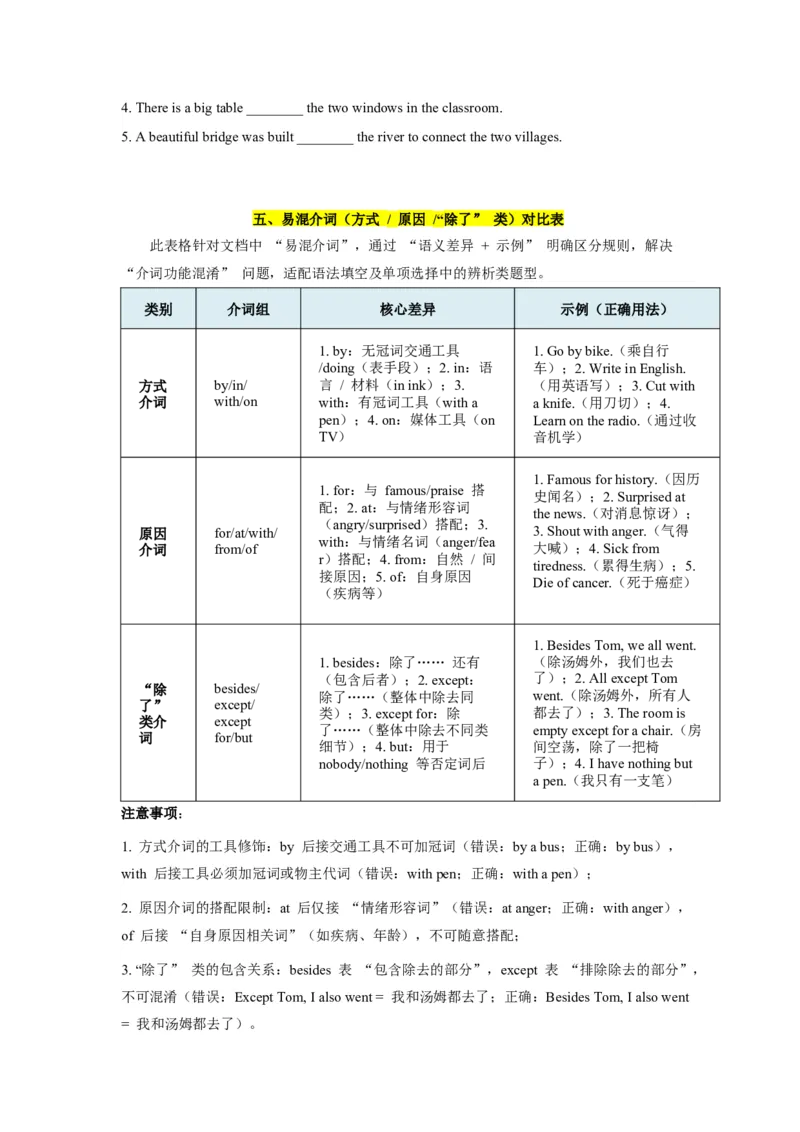
四、方位介词用法表
此表格梳理文档中 “方位介词” 的核心场景,明确 in/on/to 等介词在空间关系中的分
工,覆盖 “范围、穿越、位置” 等高频场景,解决 “方位介词误用” 问题,适配语法填
空 “方位类介词填写” 题型。
方位介词
适用场景
具体规则
示例
in/on/to/off
地域范围
关系
in:在某范围之内;
Guangdong is in the south of
China.(广东在中国境内);
方位介词
适用场景
具体规则
示例
on:与某范围接壤;
to:在某范围之外;
off:与某范围隔小段
距离
Korea is on the east of China.
(朝鲜与中国接壤);Japan is
to the east of China.(日本在中
国境外);Islands are off the
coast.(岛屿在海岸附近)
at/in/on
地点大小 /
表面关系
at:小地点(门牌、
车站);in:大地点
(城市、国家);
on:物体表面(接
触)
He lives at 105 Street.(住某街
105 号);She arrived in
Beijing.(到达北京);The cup
is on the table.(杯子在桌上)
through/
across/
over
穿越动作
关系
through:从内部穿
过;across:从表面横
穿;over:从上方跨
越
Walk through the tunnel.(穿过
隧道);Run across the street.
(横穿街道);Jump over the
fence.(跳过栅栏)
between/
among
多者间位
置关系
between:两者之间;
among:三者及以上
之间(强调笼统群
体)
Sit between your parents.(坐在
父母之间);She is among the
crowd.(她在人群中)
above/
below/
over/under
上下位置
关系
above:斜上方(不垂
直);below:斜下方
(不垂直);over:
正上方;under:正下
方
Birds fly above the clouds.(鸟
在云层上方);The cat is under
the chair.(猫在椅子正下
方);A lamp hangs over the
table.(灯在桌子正上方)
注意事项:
1. in/on/to 的地域范围:判断依据为 “是否属于该范围” 或 “是否接壤”,不可仅凭方向
判断(错误:Japan is in the east of China;正确:Japan is to the east of China);
2. through/across 的穿越差异:through 强调 “内部空间”(隧道、森林),across 强调
“平面表面”(街道、操场),不可混用(错误:Run through the street;正确:Run across
the street);
3. between 的特殊用法:若三者及以上强调 “两两之间”,仍用 between(如 Agreements
between three countries. 三国间的协议),不可用 among。
【对点练习】在空格处填入 1 个适当的单词
1. The small island lies ________ the east of our city, about 100 kilometers away.
2. The naughty boy ran ________ the street without looking at the traffic lights.
3. The old man walked slowly ________ the forest with his grandson to pick mushrooms.
4. There is a big table ________ the two windows in the classroom.
5. A beautiful bridge was built ________ the river to connect the two villages.
五、易混介词(方式 / 原因 /“除了” 类)对比表
此表格针对文档中 “易混介词”,通过 “语义差异 + 示例” 明确区分规则,解决
“介词功能混淆” 问题,适配语法填空及单项选择中的辨析类题型。
类别
介词组
核心差异
示例(正确用法)
方式
介词
by/in/
with/on
1. by:无冠词交通工具
/doing(表手段);2. in:语
言 / 材料(in ink);3.
with:有冠词工具(with a
pen);4. on:媒体工具(on
TV)
1. Go by bike.(乘自行
车);2. Write in English.
(用英语写);3. Cut with
a knife.(用刀切);4.
Learn on the radio.(通过收
音机学)
原因
介词
for/at/with/
from/of
1. for:与 famous/praise 搭
配;2. at:与情绪形容词
(angry/surprised)搭配;3.
with:与情绪名词(anger/fea
r)搭配;4. from:自然 / 间
接原因;5. of:自身原因
(疾病等)
1. Famous for history.(因历
史闻名);2. Surprised at
the news.(对消息惊讶);
3. Shout with anger.(气得
大喊);4. Sick from
tiredness.(累得生病);5.
Die of cancer.(死于癌症)
“除
了”
类介
词
besides/
except/
except
for/but
1. besides:除了…… 还有
(包含后者);2. except:
除了……(整体中除去同
类);3. except for:除
了……(整体中除去不同类
细节);4. but:用于
nobody/nothing 等否定词后
1. Besides Tom, we all went.
(除汤姆外,我们也去
了);2. All except Tom
went.(除汤姆外,所有人
都去了);3. The room is
empty except for a chair.(房
间空荡,除了一把椅
子);4. I have nothing but
a pen.(我只有一支笔)
注意事项:
1. 方式介词的工具修饰:by 后接交通工具不可加冠词(错误:by a bus;正确:by bus),
with 后接工具必须加冠词或物主代词(错误:with pen;正确:with a pen);
2. 原因介词的搭配限制:at 后仅接 “情绪形容词”(错误:at anger;正确:with anger),
of 后接 “自身原因相关词”(如疾病、年龄),不可随意搭配;
3. “除了” 类的包含关系:besides 表 “包含除去的部分”,except 表 “排除除去的部分”,
不可混淆(错误:Except Tom, I also went = 我和汤姆都去了;正确:Besides Tom, I also went
= 我和汤姆都去了)。
【对点练习】在空格处填入 1 个适当的单词
1. You can improve your oral English ________ practicing speaking with native speakers every day.
2. The little girl was angry ________ her brother because he broke her favorite toy.
3. ________ Tom, all the other students in the class have finished their homework on time.
4. ________ the bad weather, we still decided to go on the picnic as planned.
5. I have several friends in this city, ________ my classmate Lily who moved here last year.
六、高频介词短语表
此表格梳理文档中 “介词 + 名词” 固定短语及易混介词短语,明确短语语义和适用场
景,适配书面表达及短语辨析题型,帮助规避 “短语拆分或误用” 的错误。
类别
具体短语
语义
示例
“介
词
+名
词”
at + 名词
at war(交战)、at ease
(自在)、at midnight(午
夜)、at present(目前)、
at length(详细地)
He felt at ease with friends.(和
朋友在一起很自在);We are
busy at present.(我们目前很
忙)
in + 名词
in trouble(困境中)、in
danger(危险中)、in
public(公共场合)、in
advance(提前)、in turn
(依次)
She is in danger.(她处于危险
中);Book tickets in advance.
(提前订票)
on + 名词
on foot(步行)、on
purpose(故意)、on sale
(打折)、on fire(着火)
Go to school on foot.(步行上
学);He did it on purpose.(他
故意这么做)
under +
名词
under control(受控)、
under construction(建设
中)、under repair(修理
中)、under pressure(压力
下)
The project is under construction.
(项目在建设中);He works
under pressure.(他在压力下工
作)
beyond +
名词
beyond belief(难以置
信)、beyond description
(难以形容)、beyond
control(无法控制)
The beauty is beyond
description.(美景难以形
容);The fire is beyond
control.(火势无法控制)
易混
介词
短语
in the
end/at the
end of/by
the end of
in the end(最后,无宾
语);at the end of(在……
末尾,接时间 / 地点);
by the end of(到…… 末,
接时间,主句用完成时)
In the end, he succeeded.(最后
他成功了);At the end of the
street, there’s a shop.(街尾有家
店);By the end of 2023, we
had finished.(到 2023 年底,
我们已完成)
类别
具体短语
语义
示例
in front
of/in the
front of
in front of(外部前面);in
the front of(内部前面)
A tree is in front of the house.
(房子前有棵树);The driver
sits in the front of the car.(司机
在车前部)
in charge
of/in the
charge of
in charge of(负责……,主
语是人);in the charge of
(由…… 负责,主语是
物)
She is in charge of the
department.(她负责这个部
门);The department is in the
charge of her.(部门由她负
责)
注意事项:
1. 固定短语的完整性:不可遗漏介词或名词(错误:at present→at present 正确,不可说 at
the present;错误:in advance→in advance 正确,不可说 in the advance);
2. 易混短语的语境区分:in the end 无宾语,at the end of 必须接宾语(错误:at the end;正
确:at the end of the month);
3. 被动含义短语:in the charge of/in the possession of 表 “被动”,主语需为 “被负责 / 被
拥有的事物”(错误:She is in the charge of the department;正确:The department is in the
charge of her)。
【对点练习】在空格处填入 1 个适当的单词
1. The new shopping mall is still ________ construction and will open to the public next year.
2. The little boy is ________ trouble because he broke the window of his neighbor's house.
3. Our English teacher asked us to finish the composition ________ advance so that she could correct
it.
4. The driver sits ________ the front of the car to control the direction and speed.
5. My mother is ________ charge of the sales department in the big company.
一、语法填空:在空格处填入一个适当的单词
1.(2025·江苏南京·一模)         its emphasis on friendship and parting, Auld Lang Syne
expresses the spirit of New Year’s Eve, which is saying goodbye to one year so that another can
begin.
2.(2025·江苏南京·一模)         the introduction of the high-speed train service, travel
between the two major cities has become much more convenient, to the point where it feels like
you’re just a short trip away from another bustling metropolis.
3.(2025·江苏盐城·二模)She finished the difficult crossword puzzle        record time and
surprised everyone around her.
4.(2025·江苏盐城·模拟预测)These have won praise and criticism        roughly equal
measure.
5.(2024 高三·北京·专题练习)The team then repeated the experiment, this time with dogs that
were reunited with their owners          being apart for five hours.
6.(2024 高三·北京·专题练习)All of her runs have a guiding purpose: to call attention

global water issues.
7.(2024 高三·北京·专题练习)It was transformed          the “Ice Cube” for the 2022
Beijing Winter Olympic and Paralympic Games, and detachable curling tracks were built on the
swimming pool to host curling events.
8.(2024 高三·北京·专题练习)But the determined young man refused to let his condition
prevent his thirst          life and decided to take on a range of sports — tackling everything from
rock climbing, football, ice hockey to swimming.
9.(2024 高三·北京·专题练习)Their main weapons are clubs and poison-tipped arrows, used
both hunting and protecting their territory against outsiders.
10.(2022 高三·上海·专题练习)         the dozens of LEED-certified buildings in Taiwan,
Taipei 101 is the most notable recipient. That’s because it is the tallest building in the world holding
a LEED certification.
11.(2022 高三·上海·专题练习)As we emerge from the pandemic (大流行病), we’re starting to
see the return of an age-old custom: the handshake. Many of us went          shaking someone
else’s hands for about two years.
12.(2022 高三·上海·专题练习)Live, high-detail satellite mapping could probably be used to
keep tags on anybody at any time,          the person’s knowledge.
13.(2022 高三·上海·专题练习)It started with things          assessing credit risk from loan
applications, sorting the mail by reading handwritten characters from zip codes.
14.(2022 高三·上海·专题练习)76 participants          different countries walked shoulder
to shoulder through the performance zone in a program that greeted all the people around the world.
15.(2022 高三·上海·专题练习)Hundreds of thousands of people suddenly found themselves in
the dark        water, electricity, air conditioning, and internet.
Passage 1
(2024·全国甲卷·高考真题)阅读下面短文, 在空白处填入1 个适当的单词或括号内单词的正
确形式。
Although parks of all sizes and types exist at any level, the national parks, in particular, tend
1               (catch) our attention because of their large size and variety. They are     2

(treasure) of American heritage (遗产). How did the national park system come about? On a cool,
starry night in mid-September 1870, four men relaxed before a campfire along the Firehole River in
3               is now northwestern Wyoming. They     4              (be) part of a 15-
member exploring party that had spent almost five awesome weeks in witness of the natural beauties
there.
What should     5              (do) with such a beautiful place? They wondered out
loud. This area, with     6               (it) unique and breathtaking natural beauty, must be
well preserved     7               all people of the nation to enjoy — as a national park. They
all agreed and vowed (承诺) to promote the idea at the     8               (complete) of their
journey. Their promotional work paid off. Two years later, 18 years before Wyoming became a state,
Yellowstone became the first national park in the United States and the world. Yellowstone was the
9               (large) United States national park — 2.2 million acres — until Wrangell-Saint
Elias in southern Alaska,      10                became a national monument in 1978, took the
honors as a national park in 1980 with 12.3 million acres.
Passage 2
(2023·浙江·高考真题)阅读下面短文,在空白处填入1 个适当的单词或括号内单词的正确形
式。
During China’s dynastic period, emperors planned the city of Beijing
   1

arranged the residential areas according to social classes. The term “hutong”,
   2

(original)meaning “water well” in Mongolian, appeared first during the Yuan Dynasty.
In the Ming Dynasty, the center was the Forbidden City,     3               (surround)in
concentric(同心的)circles by the Inner City and Outer City. Citizens of higher social classes     4
(permit)to live closer to the center of the circles. The large siheyuan of these high-ranking officials
and wealthy businessmen often     5               (feature)beautifully carved and painted roof
beams and pillars( 柱子). The hutongs they formed were orderly, lined by
   6

(space)homes and walled gardens. Farther from the center lived the commoners and laborers. Their
siheyuan were far smaller in scale and     7               (simple)in design and decoration, and
the hutongs were narrower.
Hutongs represent an important cultural element of the city of Beijing. Thanks to Beijing’s
long history     8               capital of China, almost every hutong has its stories, and some
are even associated with historic     9               (event). In contrast to the court life and
upper-class culture represented by the Forbidden City, the Summer Palace, and the Temple of
Heaven, the hutongs reflect      10                culture of grassroots Beijingers.
Passage 3
(25-26 高三上·湖南长沙·阶段练习)阅读下面短文,在空白处填入1 个适当的单词或括号内
单词的正确形式。
Labubu, a snaggletoothed forest sprite(精灵)from Kasing Lung’s “The Monsters”, has grown
from a non-mainstream favorite to a globally    1             (collect) hit. This character,    2
gender and nine teeth serve as key identifying features, has managed to win the heart of art toy
enthusiasts with its unique blend of cuteness and rebellious(反叛的) appeal.
Pop Mart’s strategy—blind boxes, limited releases, social ads—made Labubu viral(爆火的).
Labubu’ s success,   3             (fuel) by the promotion of celebrities like Lisa and Rihanna,
shows no signs of slowing down. By 2024, The Monsters IP (centered on Labubu)   4

(earn) over 3 billion RMB, pushing Pop Mart’s global expansion.
Labubu’s appeal spans Asia, with long lines at releases and extensive

 5

(cover) in major media like BBC . The “blind box” format, plus unboxing videos and fan
communities    6             (share) their finds, has created a cross-border collecting culture.
Yet debates on overspending and gambling-like tendencies tied    7             the model exist.
Labubu’s popularity brought fakes (“Lafufus”), so checks are key: nine teeth, good paint, even
stitching, “Pop Mart/Kasing” carvings—details to avoid imitation    8              (product).
Today, Labubu sparks talks on cultural influence, which is seen as China’s
  9

(grow) soft power. Its journey from book to global icon shows design charm, storytelling power, and
a character’s ability     10               (connect) worldwide.
Passage 4
(2025·浙江·一模)阅读短文,在空白处填入适当的内容(1 个单词)或括号内单词的正确形式。
An exhibition at the Xingyun Art Gallery in Shenzhen is featuring artwork     1

(inspire) by knot-tying, or zhongguojie in Chinese, which originated in China over 2,500 years ago.
Knot-tying is one of     2               most traditional handicrafts. The interweaving
and looping of the ropes reflect the unique aesthetic and cultural connotations of the Chinese nation,
according to Liu Xin,     3               is in charge of the exhibition.
“The exhibition combines knot-tying culture, modern craftsmanship and contemporary art,”
says Liu. “We hope to present the rather delicate knot-tying art and its cultural significance in a
visual context,     4               initiate dialogues with decorative art, folk art and modernist
art.”
“In knot-tying, each step should aim for a     5               (harmony) and complete
pattern. You try to     6               (skillful) manipulate the ropes and guide them to form the
desired shape until a perfect knot is created,” explains Chen Yue, a knot-tying enthusiast among the
visitors to the exhibition.
“The crafter's patience and creativity     7               (demonstrate) during the knot-
tying process, and any carelessness might lead to flaws,” she adds. “A masterful crafter always     8
(try) to complete the knot with a sense of precision and elegance as a way of respect     9

the art form.”
Liu says that the symmetry of the knots, the beauty in the strategic arrangement of the ropes,
and the flowing lines of the finished work motivated artists     10               (create) oil
paintings, pottery sculptures, digitally-designed patterns and embroidery works for the exhibition.
Passage 5
(2025·四川达州·模拟预测)阅读下面材料,在空白处填入适当的内容(一个单词)或括号内
单词的正确形式。
Shaolin Temple, located in Dengfeng, Henan Province, is one of the most famous Buddhist
1               (temple) in China. As the birthplace of Zen Buddhism ( 禅宗), it     2

(play) an important role in China’s religious history for over 1,500 years. In 464,     3

Indian monk named Ba Tuo arrived in China to spread Buddhism with Shaolin Temple, whose
construction began in 495 under the orders of Emperor Xiaowen of Northern Wei Dynasty,     4
(prove) his success. It was from here     5               Indian scriptures were translated into
Chinese and the general rules of Zen Buddhism formed. Ba Tuo is also reputed     6

(introduce) martial arts as a complementary practice to meditation (打坐)—a practice that developed
7               the highly skilled Shaolin kung fu.
Shaolin Temple sits on the slopes of Mount Songshan, one of the Five Mountains in China.
Great care     8               (take) to preserve symmetry (对称) in the temple’s design, all
crucial buildings were constructed along the site’s central axis ( 中轴). The
   9

(large) building of the complex is the Thousand Buddhas Hall, whose interior is      10

(beautiful) decorated with exquisite, well-preserved murals. In 2010, Shaolin Temple was designated
a UNESCO World Heritage site along with several other historic monuments of Dengfeng that are
clustered at the foot of Mount Songshan.
Passage 6
(2025·浙江宁波·模拟预测)阅读下面短文,在空白处填入1 个适当的单词或括号内单词的正
确形式。
Paper is important. Almost everyone in the world uses paper on a daily basis. Now, a new
company in Ukraine, Releaf Paper, has found a way to make paper more
   1

( friend) to the environment—it uses leaves instead of tree pulp and wood to make paper.
Cities from around Europe send     2               (waste) leaf litter from their streets to
Releaf Paper. Then, using a series of mechanical and chemical     3               (process), the
company is able to create one ton of cellulose (纤维素)     4               two point three tons
of leaves. The material     5               is left over called lignin (木质素) and then is sent
back to the cities     6               (use) as a sort of fertilizer.
According to ZME Science, the process/sends out nearly 78 percent


 7

(few) greenhouse gasses than the traditional paper producing model. In addition, regular paper needs
about 270 days to decompose while paper made of leaves only     8               ( take) about
30 days.
“Really, it’s a good solution because we are keeping the balance—we get fiber for making
paper     9               return lignin for the cities to fertilize the gardens or trees. This is what
we call it a win-win model,”said Valentyn Frechka, the founder of Releaf Paper. The hope is that in
the coming years, the model will be able to expand to other countries worldwide,      10

(help) people deal with paper pollution.