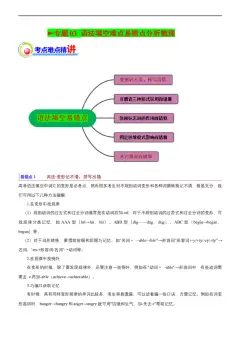
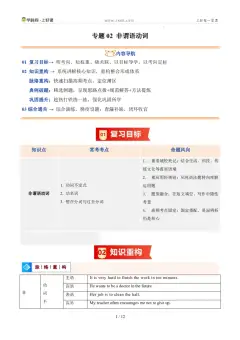
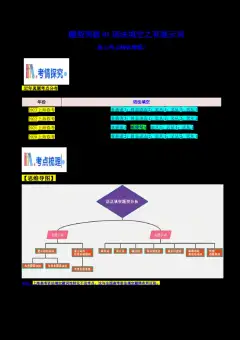
第12 讲 过去分词2026 年高考英语语法专项突破(全国通用)
(语法讲义+模拟练习+真题操练)
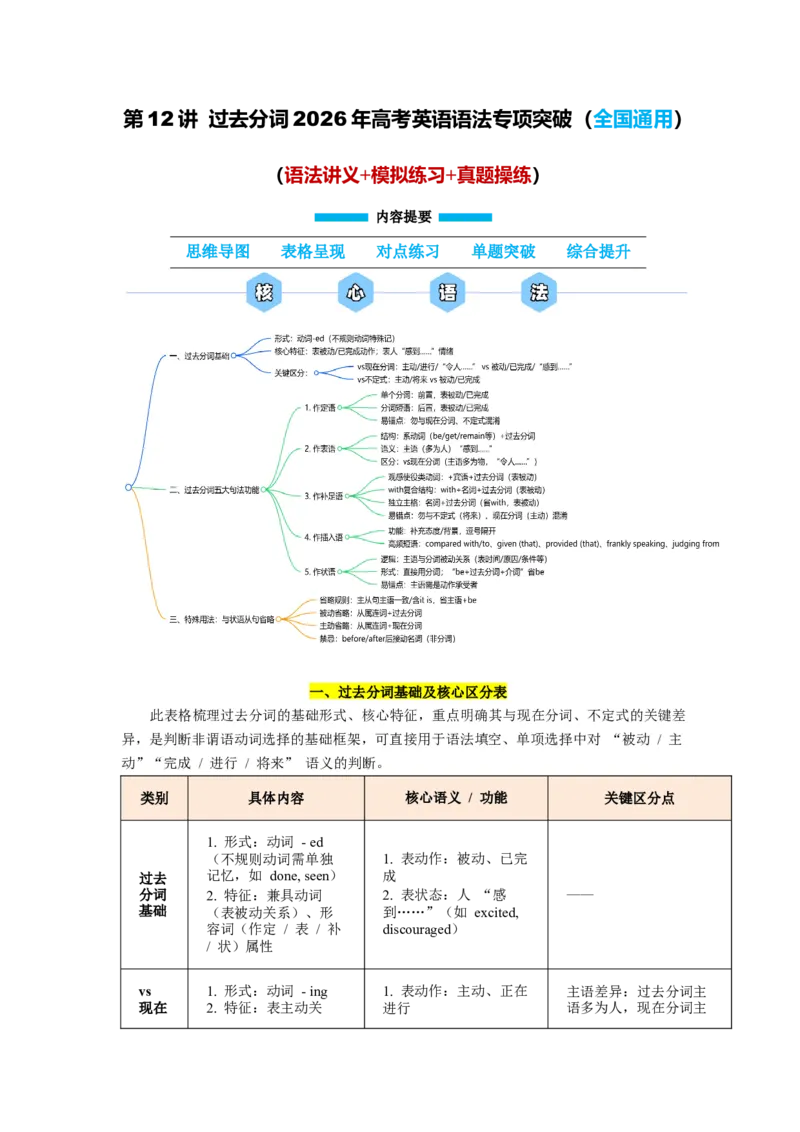
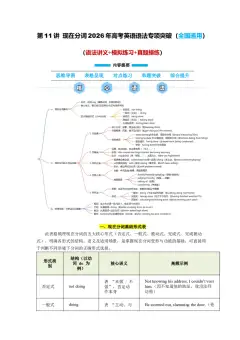
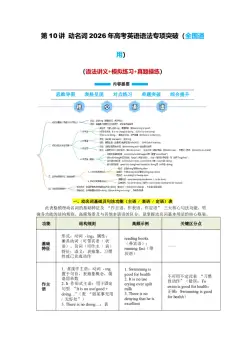
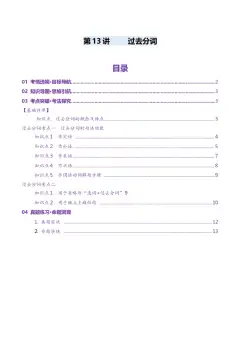
 内容提要
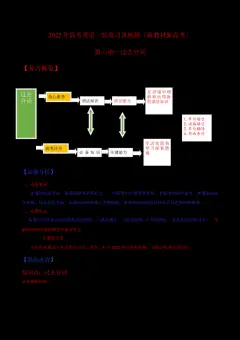
思维导图
表格呈现
对点练习
单题突破
综合提升
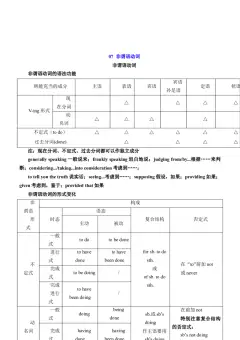
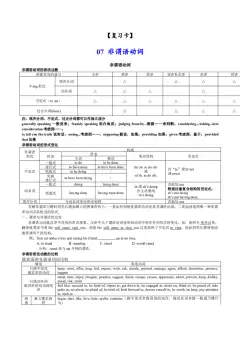
一、过去分词基础及核心区分表
此表格梳理过去分词的基础形式、核心特征,重点明确其与现在分词、不定式的关键差
异,是判断非谓语动词选择的基础框架,可直接用于语法填空、单项选择中对 “被动 / 主
动”“完成 / 进行 / 将来” 语义的判断。
类别
具体内容
核心语义 / 功能
关键区分点
过去
分词
基础
1. 形式:动词 - ed
(不规则动词需单独
记忆,如 done, seen)
2. 特征:兼具动词
(表被动关系)、形
容词(作定 / 表 / 补
/ 状)属性
1. 表动作:被动、已完
成
2. 表状态:人 “感
到……”(如 excited,
discouraged)
——
vs
现在
1. 形式:动词 - ing
2. 特征:表主动关
1. 表动作:主动、正在
进行
主语差异:过去分词主
语多为人,现在分词主
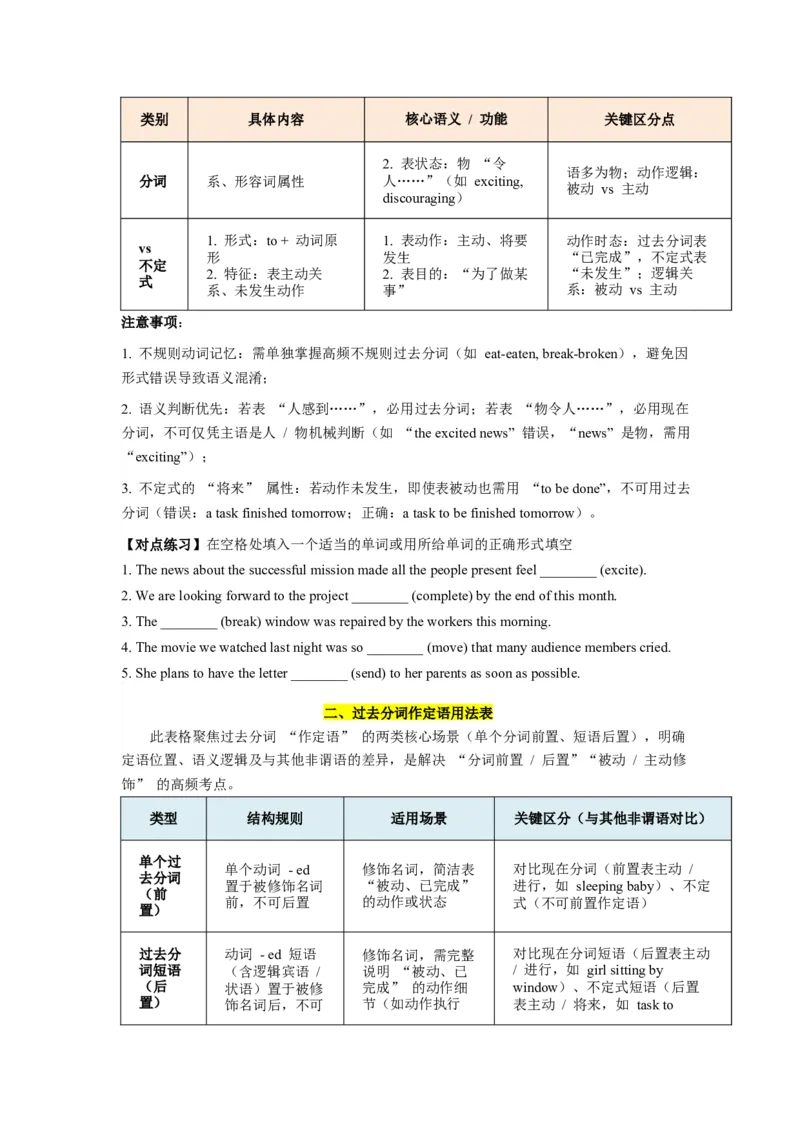
类别
具体内容
核心语义 / 功能
关键区分点
分词
系、形容词属性
2. 表状态:物 “令
人……”(如 exciting,
discouraging)
语多为物;动作逻辑:
被动 vs 主动
vs
不定
式
1. 形式:to + 动词原
形
2. 特征:表主动关
系、未发生动作
1. 表动作:主动、将要
发生
2. 表目的:“为了做某
事”
动作时态:过去分词表
“已完成”,不定式表
“未发生”;逻辑关
系:被动 vs 主动
注意事项:
1. 不规则动词记忆:需单独掌握高频不规则过去分词(如 eat-eaten, break-broken),避免因
形式错误导致语义混淆;
2. 语义判断优先:若表 “人感到……”,必用过去分词;若表 “物令人……”,必用现在
分词,不可仅凭主语是人 / 物机械判断(如 “the excited news” 错误,“news” 是物,需用
“exciting”);
3. 不定式的 “将来” 属性:若动作未发生,即使表被动也需用 “to be done”,不可用过去
分词(错误:a task finished tomorrow;正确:a task to be finished tomorrow)。
【对点练习】在空格处填入一个适当的单词或用所给单词的正确形式填空
1. The news about the successful mission made all the people present feel ________ (excite).
2. We are looking forward to the project ________ (complete) by the end of this month.
3. The ________ (break) window was repaired by the workers this morning.
4. The movie we watched last night was so ________ (move) that many audience members cried.
5. She plans to have the letter ________ (send) to her parents as soon as possible.
二、过去分词作定语用法表
此表格聚焦过去分词 “作定语” 的两类核心场景(单个分词前置、短语后置),明确
定语位置、语义逻辑及与其他非谓语的差异,是解决 “分词前置 / 后置”“被动 / 主动修
饰” 的高频考点。
类型
结构规则
适用场景
关键区分(与其他非谓语对比)
单个过
去分词
(前
置)
单个动词 - ed
置于被修饰名词
前,不可后置
修饰名词,简洁表
“被动、已完成”
的动作或状态
对比现在分词(前置表主动 /
进行,如 sleeping baby)、不定
式(不可前置作定语)
过去分
词短语
(后
置)
动词 - ed 短语
(含逻辑宾语 /
状语)置于被修
饰名词后,不可
修饰名词,需完整
说明 “被动、已
完成” 的动作细
节(如动作执行
对比现在分词短语(后置表主动
/ 进行,如 girl sitting by
window)、不定式短语(后置
表主动 / 将来,如 task to
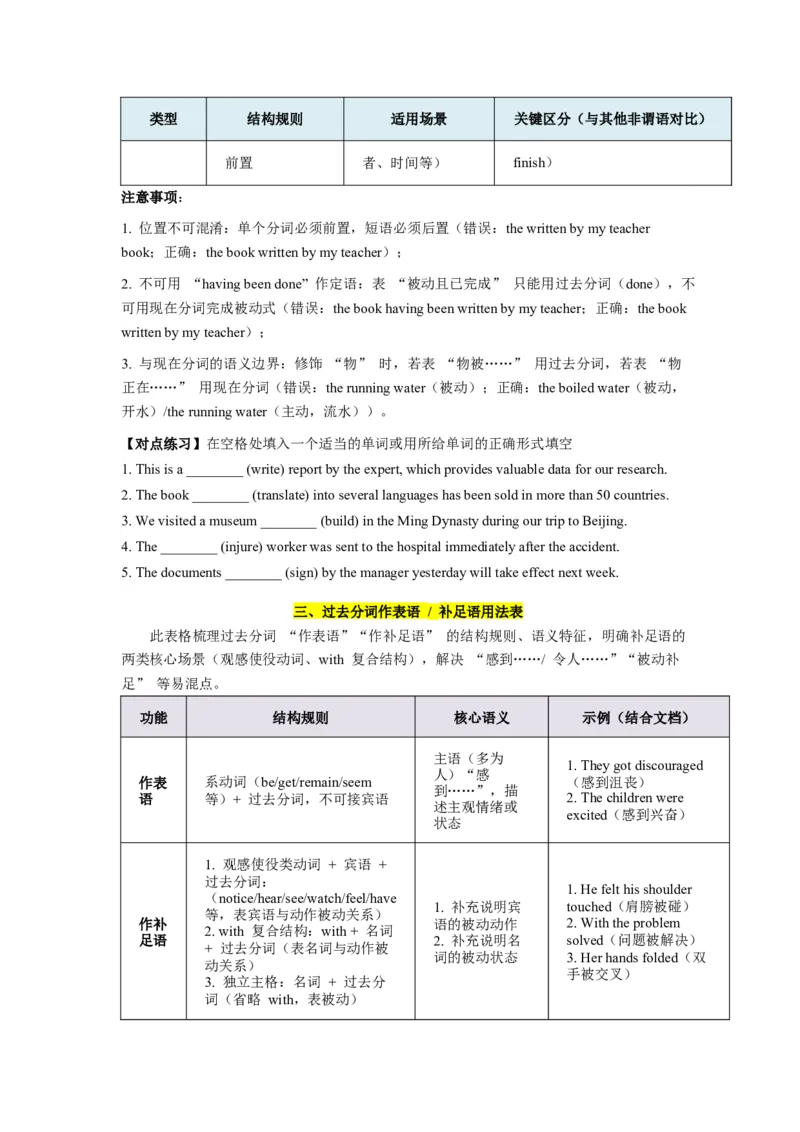
类型
结构规则
适用场景
关键区分(与其他非谓语对比)
前置
者、时间等)
finish)
注意事项:
1. 位置不可混淆:单个分词必须前置,短语必须后置(错误:the written by my teacher
book;正确:the book written by my teacher);
2. 不可用 “having been done” 作定语:表 “被动且已完成” 只能用过去分词(done),不
可用现在分词完成被动式(错误:the book having been written by my teacher;正确:the book
written by my teacher);
3. 与现在分词的语义边界:修饰 “物” 时,若表 “物被……” 用过去分词,若表 “物
正在……” 用现在分词(错误:the running water(被动);正确:the boiled water(被动,
开水)/the running water(主动,流水))。
【对点练习】在空格处填入一个适当的单词或用所给单词的正确形式填空
1. This is a ________ (write) report by the expert, which provides valuable data for our research.
2. The book ________ (translate) into several languages has been sold in more than 50 countries.
3. We visited a museum ________ (build) in the Ming Dynasty during our trip to Beijing.
4. The ________ (injure) worker was sent to the hospital immediately after the accident.
5. The documents ________ (sign) by the manager yesterday will take effect next week.
三、过去分词作表语 / 补足语用法表
此表格梳理过去分词 “作表语”“作补足语” 的结构规则、语义特征,明确补足语的
两类核心场景(观感使役动词、with 复合结构),解决 “感到……/ 令人……”“被动补
足” 等易混点。
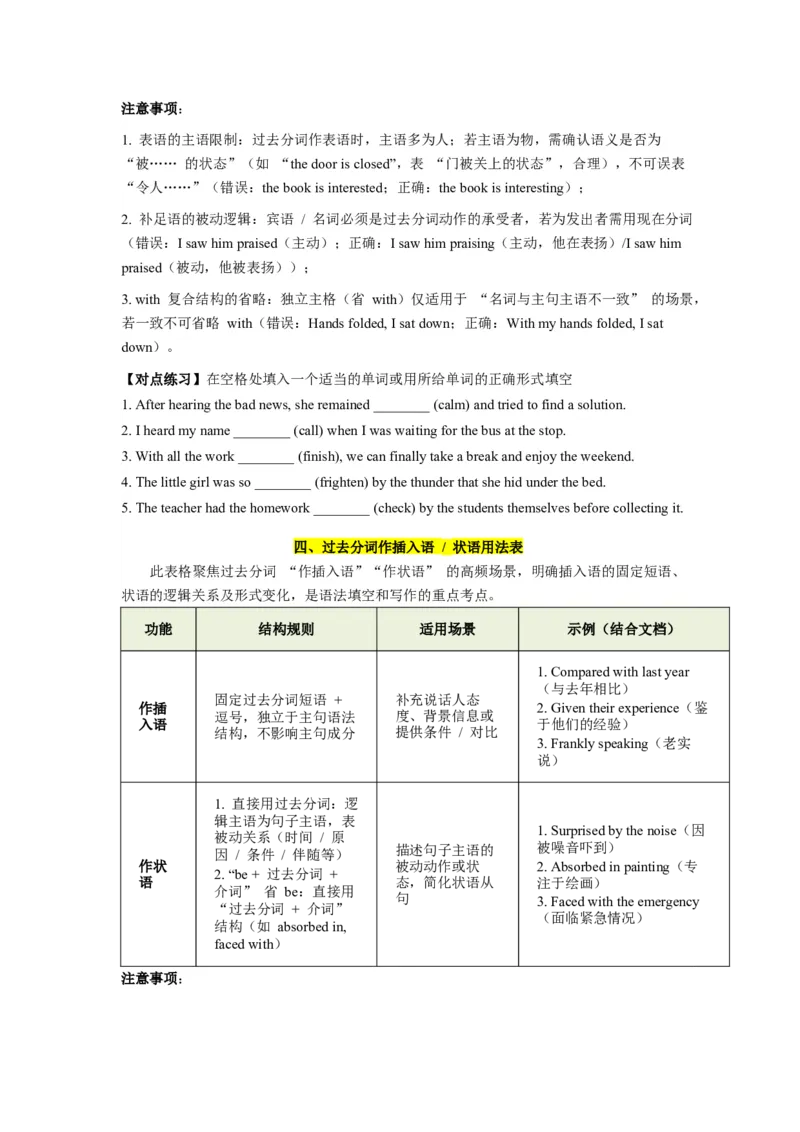
功能
结构规则
核心语义
示例(结合文档)
作表
语
系动词(be/get/remain/seem
等)+ 过去分词,不可接宾语
主语(多为
人)“感
到……”,描
述主观情绪或
状态
1. They got discouraged
(感到沮丧)
2. The children were
excited(感到兴奋)
作补
足语
1. 观感使役类动词 + 宾语 +
过去分词:
(notice/hear/see/watch/feel/have
等,表宾语与动作被动关系)
2. with 复合结构:with + 名词
+ 过去分词(表名词与动作被
动关系)
3. 独立主格:名词 + 过去分
词(省略 with,表被动)
1. 补充说明宾
语的被动动作
2. 补充说明名
词的被动状态
1. He felt his shoulder
touched(肩膀被碰)
2. With the problem
solved(问题被解决)
3. Her hands folded(双
手被交叉)
注意事项:
1. 表语的主语限制:过去分词作表语时,主语多为人;若主语为物,需确认语义是否为
“被…… 的状态”(如 “the door is closed”,表 “门被关上的状态”,合理),不可误表
“令人……”(错误:the book is interested;正确:the book is interesting);
2. 补足语的被动逻辑:宾语 / 名词必须是过去分词动作的承受者,若为发出者需用现在分词
(错误:I saw him praised(主动);正确:I saw him praising(主动,他在表扬)/I saw him
praised(被动,他被表扬));
3. with 复合结构的省略:独立主格(省 with)仅适用于 “名词与主句主语不一致” 的场景,
若一致不可省略 with(错误:Hands folded, I sat down;正确:With my hands folded, I sat
down)。
【对点练习】在空格处填入一个适当的单词或用所给单词的正确形式填空
1. After hearing the bad news, she remained ________ (calm) and tried to find a solution.
2. I heard my name ________ (call) when I was waiting for the bus at the stop.
3. With all the work ________ (finish), we can finally take a break and enjoy the weekend.
4. The little girl was so ________ (frighten) by the thunder that she hid under the bed.
5. The teacher had the homework ________ (check) by the students themselves before collecting it.
四、过去分词作插入语 / 状语用法表
此表格聚焦过去分词 “作插入语”“作状语” 的高频场景,明确插入语的固定短语、
状语的逻辑关系及形式变化,是语法填空和写作的重点考点。
功能
结构规则
适用场景
示例(结合文档)
作插
入语
固定过去分词短语 +
逗号,独立于主句语法
结构,不影响主句成分
补充说话人态
度、背景信息或
提供条件 / 对比
1. Compared with last year
(与去年相比)
2. Given their experience(鉴
于他们的经验)
3. Frankly speaking(老实
说)
作状
语
1. 直接用过去分词:逻
辑主语为句子主语,表
被动关系(时间 / 原
因 / 条件 / 伴随等)
2. “be + 过去分词 +
介词” 省 be:直接用
“过去分词 + 介词”
结构(如 absorbed in,
faced with)
描述句子主语的
被动动作或状
态,简化状语从
句
1. Surprised by the noise(因
被噪音吓到)
2. Absorbed in painting(专
注于绘画)
3. Faced with the emergency
(面临紧急情况)
注意事项:
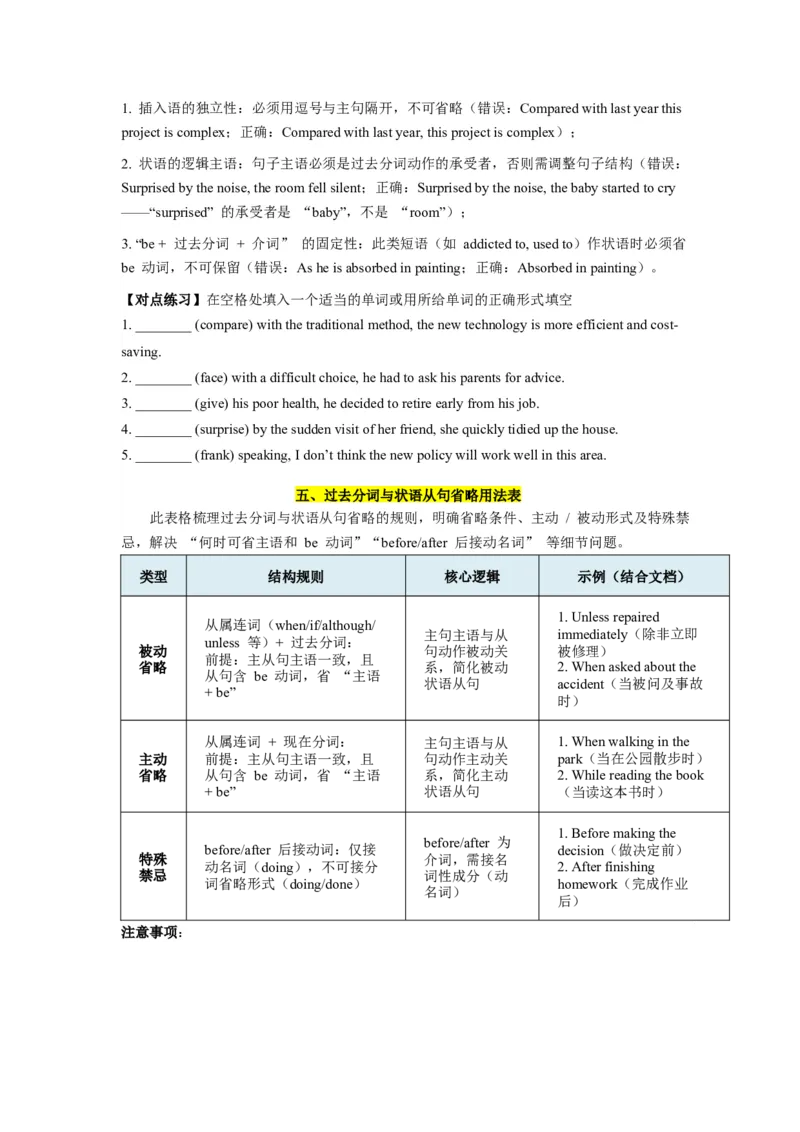
1. 插入语的独立性:必须用逗号与主句隔开,不可省略(错误:Compared with last year this
project is complex;正确:Compared with last year, this project is complex);
2. 状语的逻辑主语:句子主语必须是过去分词动作的承受者,否则需调整句子结构(错误:
Surprised by the noise, the room fell silent;正确:Surprised by the noise, the baby started to cry
——“surprised” 的承受者是 “baby”,不是 “room”);
3. “be + 过去分词 + 介词” 的固定性:此类短语(如 addicted to, used to)作状语时必须省
be 动词,不可保留(错误:As he is absorbed in painting;正确:Absorbed in painting)。
【对点练习】在空格处填入一个适当的单词或用所给单词的正确形式填空
1. ________ (compare) with the traditional method, the new technology is more efficient and cost-
saving.
2. ________ (face) with a difficult choice, he had to ask his parents for advice.
3. ________ (give) his poor health, he decided to retire early from his job.
4. ________ (surprise) by the sudden visit of her friend, she quickly tidied up the house.
5. ________ (frank) speaking, I don’t think the new policy will work well in this area.
五、过去分词与状语从句省略用法表
此表格梳理过去分词与状语从句省略的规则,明确省略条件、主动 / 被动形式及特殊禁
忌,解决 “何时可省主语和 be 动词”“before/after 后接动名词” 等细节问题。
类型
结构规则
核心逻辑
示例(结合文档)
被动
省略
从属连词(when/if/although/
unless 等)+ 过去分词:
前提:主从句主语一致,且
从句含 be 动词,省 “主语
+ be”
主句主语与从
句动作被动关
系,简化被动
状语从句
1. Unless repaired
immediately(除非立即
被修理)
2. When asked about the
accident(当被问及事故
时)
主动
省略
从属连词 + 现在分词:
前提:主从句主语一致,且
从句含 be 动词,省 “主语
+ be”
主句主语与从
句动作主动关
系,简化主动
状语从句
1. When walking in the
park(当在公园散步时)
2. While reading the book
(当读这本书时)
特殊
禁忌
before/after 后接动词:仅接
动名词(doing),不可接分
词省略形式(doing/done)
before/after 为
介词,需接名
词性成分(动
名词)
1. Before making the
decision(做决定前)
2. After finishing
homework(完成作业
后)
注意事项:
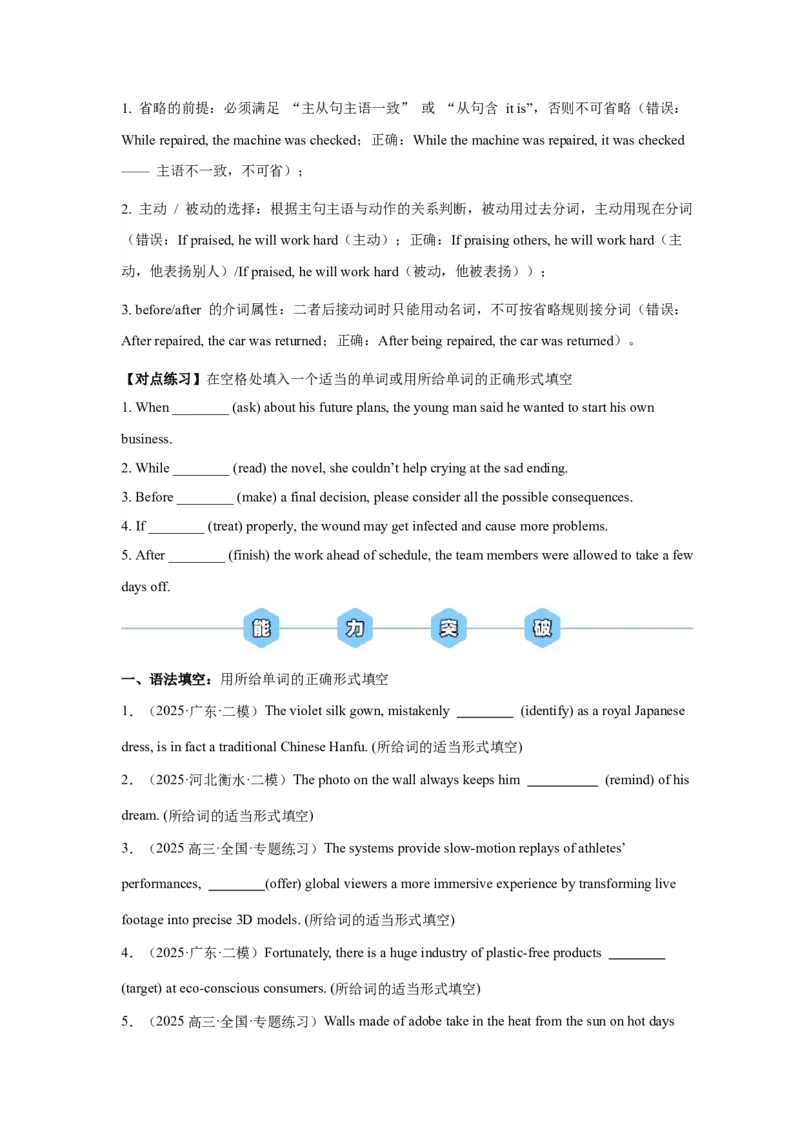
1. 省略的前提:必须满足 “主从句主语一致” 或 “从句含 it is”,否则不可省略(错误:
While repaired, the machine was checked;正确:While the machine was repaired, it was checked
—— 主语不一致,不可省);
2. 主动 / 被动的选择:根据主句主语与动作的关系判断,被动用过去分词,主动用现在分词
(错误:If praised, he will work hard(主动);正确:If praising others, he will work hard(主
动,他表扬别人)/If praised, he will work hard(被动,他被表扬));
3. before/after 的介词属性:二者后接动词时只能用动名词,不可按省略规则接分词(错误:
After repaired, the car was returned;正确:After being repaired, the car was returned)。
【对点练习】在空格处填入一个适当的单词或用所给单词的正确形式填空
1. When ________ (ask) about his future plans, the young man said he wanted to start his own
business.
2. While ________ (read) the novel, she couldn’t help crying at the sad ending.
3. Before ________ (make) a final decision, please consider all the possible consequences.
4. If ________ (treat) properly, the wound may get infected and cause more problems.
5. After ________ (finish) the work ahead of schedule, the team members were allowed to take a few
days off.
一、语法填空:用所给单词的正确形式填空
1.(2025·广东·二模)The violet silk gown, mistakenly          (identify) as a royal Japanese
dress, is in fact a traditional Chinese Hanfu. (所给词的适当形式填空)
2.(2025·河北衡水·二模)The photo on the wall always keeps him            (remind) of his
dream. (所给词的适当形式填空)
3.(2025 高三·全国·专题练习)The systems provide slow-motion replays of athletes’
performances,         (offer) global viewers a more immersive experience by transforming live
footage into precise 3D models. (所给词的适当形式填空)
4.(2025·广东·二模)Fortunately, there is a huge industry of plastic-free products
(target) at eco-conscious consumers. (所给词的适当形式填空)
5.(2025 高三·全国·专题练习)Walls made of adobe take in the heat from the sun on hot days
and give out that heat slowly during cool nights, thus        (warm) the house. (所给词的适当形
式填空)
6.(2022 高三上·浙江·专题练习)Larger amounts of caffeine can cause a problem
(call) caffeinism. (所给词的适当形式填空)
7.(2024 高三·北京·专题练习)The device could be helpful in areas         (locate) far from a
power grid (电网).(所给词的适当形式填空)
8.(2025 高三·全国·专题练习)Just then, some kids ran at him,        (knock) his books out
of his arms. (所给词的适当形式填空)
9.(2024 高三·北京·专题练习)Beijing Olympic Park, also          (know) as the Olympic
Green, is located in Chaoyang District, Beijing, with a total land area of 11.59 square kilometers.
(所给词的适当形式填空)
10.(2022 高三·上海·专题练习)After all, they are not cities            (describe) as dynamic
(充满活力的). (所给词的适当形式填空)
11.(2024 高三·北京·专题练习)Of course, each person’s comfort food largely depends on the
place where they come — for a Chinese it might be a plate of dumplings with a saucer of vinegar,
and for a native of the UK it might be the classic fish and chips,          (serve) hot, salty and
sour. (所给词的适当形式填空)
12.(2024 高三·北京·专题练习)One theory, increasingly           (support) by experts,
suggests that smell preferences are learned. (所给词的适当形式填空)
13.(2023 高三·上海·专题练习)I joined in a marathon         (host) by the city sports club.
(所给词的适当形式填空)
14.(2022 高三·上海·专题练习)Jackboot had to teach in Belgium. His pupils spoke only
Flemish, and he spoke only French. He gave his students a novel         (write) in his mother
tongue and a French dictionary. (所给词的适当形式填空)
15.(2022 高三·上海·专题练习)Whatever you define success, remember, we are born to live the
lives we truly want and deserve, but not just the lives        (settle) for us. (所给词的适当形式填
空)
Passage 1
(2024·新课标Ⅱ卷·高考真题)阅读下面短文, 在空白处填入 1 个适当的单词或括号内单词的
正确形式。
Chinese cultural elements commemorating (纪念) Tang Xianzu,    1              is
known as “the Shakespeare of Asia,” add an international character to Stratford-upon-Avon, William
Shakespeare’s hometown.
Tang and Shakespeare were contemporaries and both died in 1616. Although they could never
have met, there are common    2              (theme) in their works, said Paul Edmondson,
head of research for the Shakespeare Birthplace Trust. “Some of the things that Tang was writing
about    3              (be) also Shakespeare’s concerns. I happen to know that Tang’s play
The Peony Pavilion (《牡丹亭》) is similar in some ways    4              Romeo and
Juliet.”
A statue commemorating Shakespeare and Tang was put up at Shakespeare’s Birthplace
Garden in 2017. Two years later, a six-meter-tall pavilion,    5              (inspire)by The
Peony Pavilion,    6              (build)at the Firs Garden, just ten minutes’ walk from
Shakespeare’s birthplace.
Those cultural elements have increased Stratford’s international


 7

(visible), said Edmondson, adding that visitors walking through the Birthplace Garden were often
amazed    8              (find)the connection between the two great writers.
   9              (recall)watching a Chinese opera version of Shakespeare’s play Richard
III in Shanghai and meeting Chinese actors who came to Stratford a few years ago to perform parts
of The Peony Pavilion, Edmondson said, “It was very exciting to hear the Chinese language     10
see how Tang’s play was being performed.”
Passage 2
(2024·广东江苏·高考真题)阅读下面短文,在空白处填入1 个适当的单词或括号内单词的正
确形式。
Heatherwick Studio recently built a greenhouse at the edge of the National Trust’s Woolbeding
Gardens. This beautiful structure, named Glasshouse, is at the centre of a new garden that shows how
the Silk Road influences English gardens even in modern times.
The latest     1               (engineer) techniques are applied to create this protective
2               (function) structure that is also beautiful. The design features ten steel “sepals (萼
片)” made of glass and aluminium ( 铝). These sepals open on warm days
   3

(give) the inside plants sunshine and fresh air. In cold weather, the structure stays     4

(close) to protect the plants.
Further, the Silk Route Garden around the greenhouse     5               (walk) visitors
through a journey influenced by the ancient Silk Road, by which silk as well as many plant species
came to Britain for     6               first time. These plants included modern Western     7
(favourite) such as rosemary, lavender and fennel. The garden also contains a winding path that
guides visitors through the twelve regions of the Silk Road. The path offers over 300 plant species for
visitors to see, too.
The Glasshouse stands     8               a great achievement in contemporary design,
to house the plants of the southwestern part of China at the end of a path retracing (追溯) the steps
along the Silk Route     9               brought the plants from their native habitat in Asia to
come to define much of the      10                (rich) of gardening in England.
Passage 3
(2025·河北·二模)阅读下面短文,在空白处填入1 个适当的单词或括号内单词的正确形式。
Copper cash (铜钱) is the general term of Chinese ancient currency made of copper which
turned up in the Qin Dynasty (221 BC — 206 BC), a dynasty leaving     1               (vary)
treasures to Chinese people, such as the Great Wall and the Terracotta Army.
The copper coin originated from “huan cash”, a kind of ancient copper coin with ring shape
used in the Warring States Period     2               lasted from 475 BC to 221 BC.

 3
(general) speaking, most of the copper coins     4               (be) round and there is a square
hole in the center of the coin-hence there is another Chinese name called “fangkong cash” (fangkong
mean square hole). People can distinguish different kinds of copper coins by the letters     5

(mark) on the coins. These letters always refer to the royal title in different
   6

(dynasty), such as “Qianlong Tongbao” and “Yongzheng Tongbao” in the Qing Dynasty (1616 —
1911) .
The earliest copper coin is called “ban liang qian”, or Ban Liang coins, which emerged and
began to circulate (流通) in     7               whole country following the foundation of the
Qin Dynasty. Ban Liang coins were more material-economical     8               any other
coin circulating at that time and the square hole was easier     9               (make). This
revealed that people at that time valued efficiency, which could     10               (see) in the
wonder of the Terracotta Army as well.
Passage 4
(2025·福建泉州·一模)阅读下面短文,在空白处填入1 个适当的单词或括号内单词的正确形
式。
In 2018, a remarkable project began in Egypt’s Minya Province. The $1 billion Sugar Canal
project,    1              (lead) by Chinese, Egyptian, and UAE companies, aimed to turn
76,000 hectares of desert into farmland. Chinese firm ZPEC took on the key task of drilling wells to
bring underground water to the surface,    2              mission that seemed impossible in the
dry land.
At first, the team faced huge challenges. The first well took them nearly two months    3

(complete), but they now finish a well in just 10 to 15 days with advanced technology. Most workers
are Egyptian, trained by Chinese    4              (technician). “It’s all part of the Belt and
Road cooperation,” said Li Wei, ZPEC’s manager.
Now, over 150 wells have been drilled, watering crops like sugar beets, alfalfa, and barley.    5
(incredible), beet productivity has risen by 50% in just one year. The project also includes a sugar
factory built by Chinese companies,    6              produces 900 tons of white sugar every
year. This not only boosts Egypt’s food    7              (secure) but also creates thousands of
jobs, bringing new life to local communities.
“This project is a game-changer for desert regions,” said Ahmed Soliman, ZPEC’s base
manager. The once-deserted land turns green    8              water flowing from new wells.
It's a real-life story of hope in the heart of the desert,    9              (prove) that even the
hardest (最恶劣的) environments can eventually    10              (transform) through
international partnership and innovation.
Passage 5
(2025·福建福州·一模)阅读下面短文,在空白处填入1 个适当的单词
或括号内单词的正确形式。
Matcha (抹茶),     1               dynamic green powdered tea, traces its roots not to
Japan, but to ancient China. Its story begins in the Tang Dynasty, when tea leaves were steamed,
dried, and ground into powder for easy storage and transport.     2               the Song
Dynasty, it had flourished as a cultural icon: emperors and scholars alike embraced “diancha”
(whisked matcha), a ceremony blending with artistry mindfulness,     3               tea
masters whipped the powder with hot water to create a fragrant brew.
Crafting Chinese matcha is a labor of     4               (precise). Only young, tender
leaves from specific tea bushes     5               (harvest) in spring. They’re quickly steamed
to suspend oxidation,     6               (preserve) their vivid color and nutrients, then dried
and stone-ground into a fine powder — traditionally using granite mills ( 花岗岩磨粉机), which
gently crush the leaves      7               generating heat that would decrease flavor.
Unlike     8               (it) Japanese counterpart (对应物,指抹茶), Chinese matcha
often carries earthier flavors, reflecting diverse terroirs (风土) from Zhejiang’s misty hills to Fujian’s
fertile     9               (valley). Today, it bridges tradition and modernity: drunk in classical
tea ceremonies, stirred into lattes (拿铁), or folded into desserts, reigniting interest among younger
generations.
More than a drink, Chinese matcha is a living heritage — a sip of history     10

(steep) in centuries of craftsmanship and culture.
Passage 6
(2025·河北·三模)阅读下面短文,在空白处填入1 个适当的单词或括号内单词的正确形式。
Ru porcelain (汝瓷), celebrated for its unique light blue glaze,     1               (prize)
during the Song Dynasty (960-1279). Although Ru porcelain once     2               (flood)
the market around 1100, it has become extremely rare today. Thanks to the efforts of Ru porcelain
inheritors (继承者), people can now appreciate it much closer than before.
Li Chao, born in Ruzhou, Henan Province, has devoted ten years to
   3

(perfect) his craft. Creating Ru porcelain involves 72 steps, the first of     4               is
kneading (揉) the clay. “Any small error could lead to disaster,” the 41-year-old inheritor said. He
then highlighted the critical importance of patience in     5               process. Every item
of artwork fully deserves our admiration.
As the techniques for making Ru porcelain face the risk of being lost with the passing of     6
(experience) artisans, Li is committed to preserving and promoting this tradition. He is     7

(active) working to introduce Ru porcelain to a broader audience by integrating it into contemporary
daily supplies, particularly     8               (target) younger generations. Li’s ambition
extends beyond national     9               (border), aiming to share the beauty and
craftsmanship of Ru porcelain     10               the world.