








文档内容
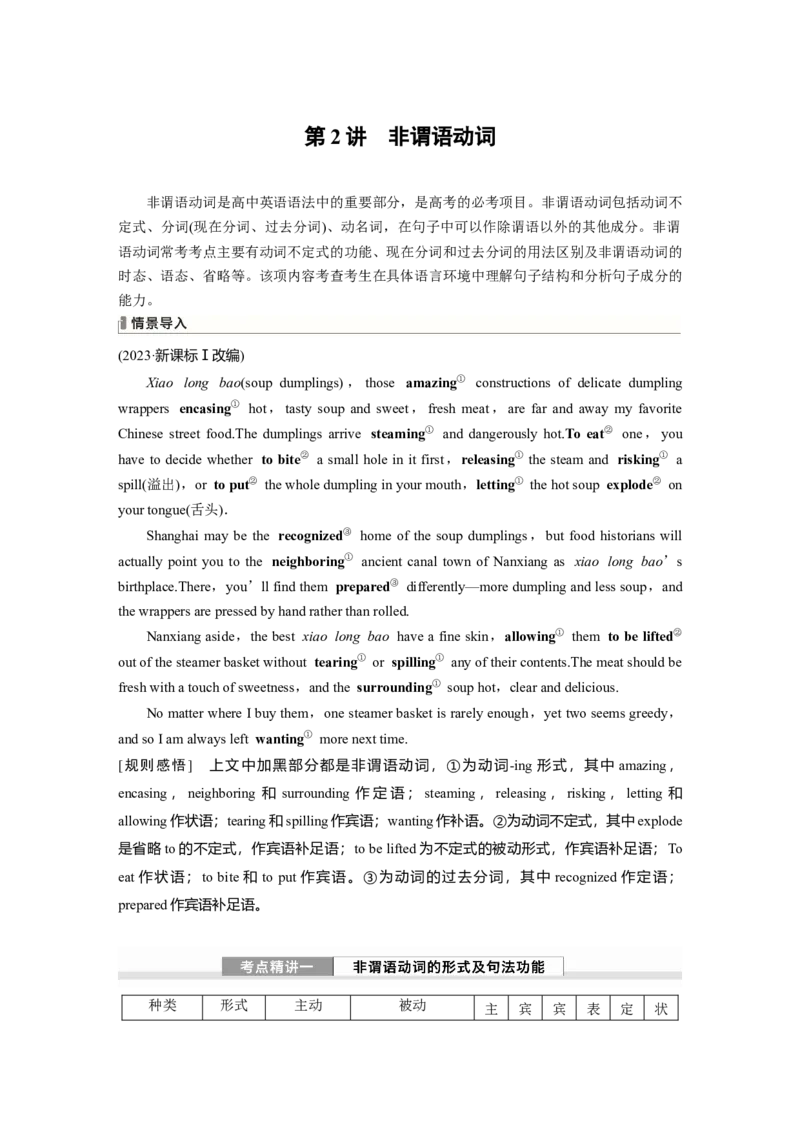
第 2 讲 非谓语动词
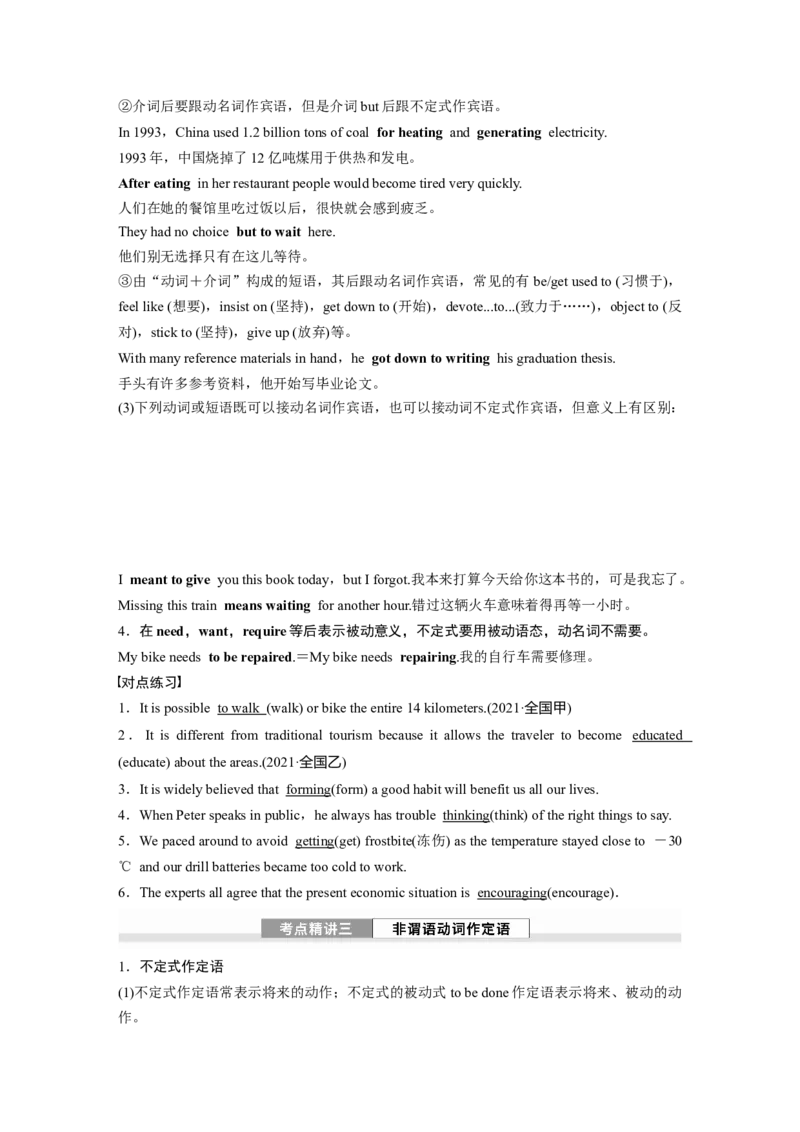
非谓语动词是高中英语语法中的重要部分,是高考的必考项目。非谓语动词包括动词不
定式、分词(现在分词、过去分词)、动名词,在句子中可以作除谓语以外的其他成分。非谓
语动词常考考点主要有动词不定式的功能、现在分词和过去分词的用法区别及非谓语动词的
时态、语态、省略等。该项内容考查考生在具体语言环境中理解句子结构和分析句子成分的
能力。
(2023·新课标Ⅰ改编)
Xiao long bao(soup dumplings),those amazing① constructions of delicate dumpling
wrappers encasing① hot,tasty soup and sweet,fresh meat,are far and away my favorite
Chinese street food.The dumplings arrive steaming① and dangerously hot.To eat② one,you
have to decide whether to bite② a small hole in it first,releasing① the steam and risking① a
spill(溢出),or to put② the whole dumpling in your mouth,letting① the hot soup explode② on
your tongue(舌头).
Shanghai may be the recognized③ home of the soup dumplings,but food historians will
actually point you to the neighboring① ancient canal town of Nanxiang as xiao long bao’s
birthplace.There,you’ll find them prepared③ differently—more dumpling and less soup,and
the wrappers are pressed by hand rather than rolled.
Nanxiang aside,the best xiao long bao have a fine skin,allowing① them to be lifted②
out of the steamer basket without tearing① or spilling① any of their contents.The meat should be
fresh with a touch of sweetness,and the surrounding① soup hot,clear and delicious.
No matter where I buy them,one steamer basket is rarely enough,yet two seems greedy,
and so I am always left wanting① more next time.
[规则感悟] 上文中加黑部分都是非谓语动词,①为动词-ing 形式,其中 amazing,
encasing,neighboring 和 surrounding 作定语;steaming,releasing,risking,letting 和
allowing作状语;tearing和spilling作宾语;wanting作补语。②为动词不定式,其中explode
是省略to的不定式,作宾语补足语;to be lifted为不定式的被动形式,作宾语补足语;To
eat 作状语;to bite 和 to put 作宾语。③为动词的过去分词,其中 recognized 作定语;
prepared作宾语补足语。
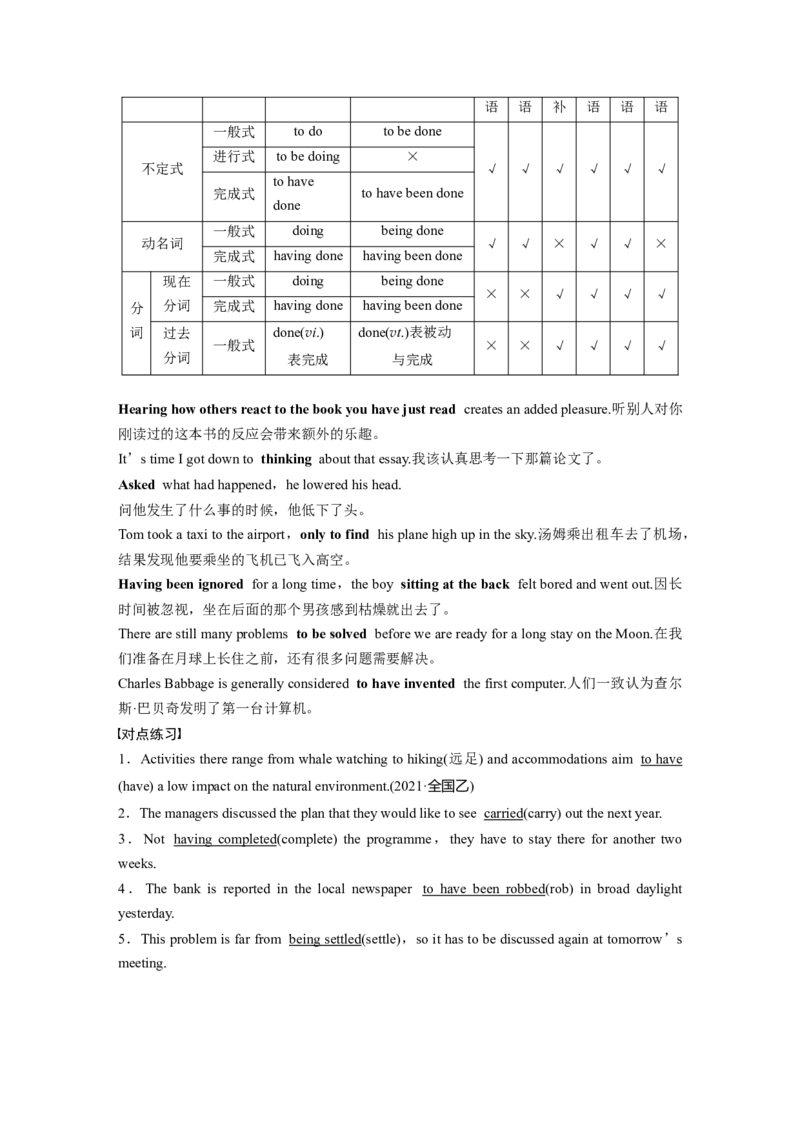
种类 形式 主动 被动 主 宾 宾 表 定 状语 语 补 语 语 语
一般式 to do to be done
进行式 to be doing ×
不定式 √ √ √ √ √ √
to have
完成式 to have been done
done
一般式 doing being done
动名词 √ √ × √ √ ×
完成式 having done having been done
现在 一般式 doing being done
× × √ √ √ √
分 分词 完成式 having done having been done
词 过去 done(vi.) done(vt.)表被动
一般式 × × √ √ √ √
分词 表完成 与完成
Hearing how others react to the book you have just read creates an added pleasure.听别人对你
刚读过的这本书的反应会带来额外的乐趣。
It’s time I got down to thinking about that essay.我该认真思考一下那篇论文了。
Asked what had happened,he lowered his head.
问他发生了什么事的时候,他低下了头。
Tom took a taxi to the airport,only to find his plane high up in the sky.汤姆乘出租车去了机场,
结果发现他要乘坐的飞机已飞入高空。
Having been ignored for a long time,the boy sitting at the back felt bored and went out.因长
时间被忽视,坐在后面的那个男孩感到枯燥就出去了。
There are still many problems to be solved before we are ready for a long stay on the Moon.在我
们准备在月球上长住之前,还有很多问题需要解决。
Charles Babbage is generally considered to have invented the first computer.人们一致认为查尔
斯·巴贝奇发明了第一台计算机。
对点练习
1.Activities there range from whale watching to hiking(远足) and accommodations aim to have
(have) a low impact on the natural environment.(2021·全国乙)
2.The managers discussed the plan that they would like to see carried(carry) out the next year.
3.Not having completed(complete) the programme,they have to stay there for another two
weeks.
4.The bank is reported in the local newspaper to have been robbed(rob) in broad daylight
yesterday.
5.This problem is far from being settled(settle),so it has to be discussed again at tomorrow’s
meeting.1.非谓语动词作主语
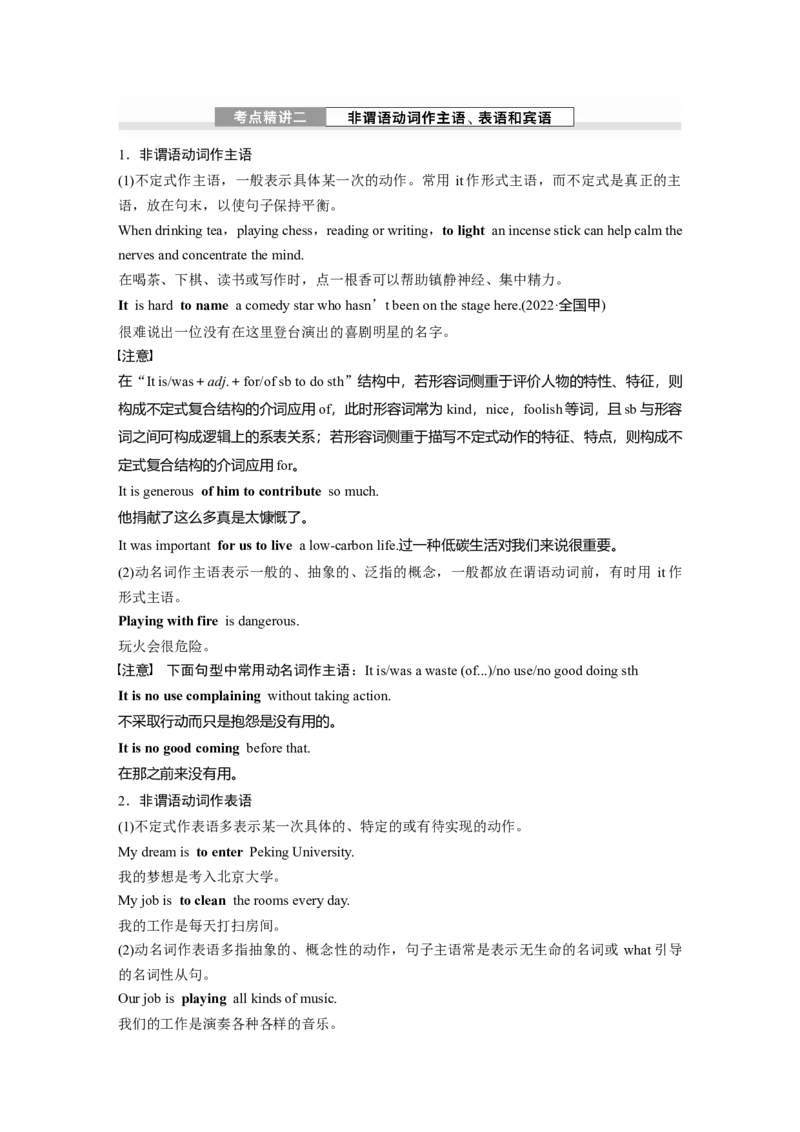
(1)不定式作主语,一般表示具体某一次的动作。常用 it作形式主语,而不定式是真正的主
语,放在句末,以使句子保持平衡。
When drinking tea,playing chess,reading or writing,to light an incense stick can help calm the
nerves and concentrate the mind.
在喝茶、下棋、读书或写作时,点一根香可以帮助镇静神经、集中精力。
It is hard to name a comedy star who hasn’t been on the stage here.(2022·全国甲)
很难说出一位没有在这里登台演出的喜剧明星的名字。
注意
在“It is/was+adj.+for/of sb to do sth”结构中,若形容词侧重于评价人物的特性、特征,则
构成不定式复合结构的介词应用of,此时形容词常为kind,nice,foolish等词,且sb与形容
词之间可构成逻辑上的系表关系;若形容词侧重于描写不定式动作的特征、特点,则构成不
定式复合结构的介词应用for。
It is generous of him to contribute so much.
他捐献了这么多真是太慷慨了。
It was important for us to live a low-carbon life.过一种低碳生活对我们来说很重要。
(2)动名词作主语表示一般的、抽象的、泛指的概念,一般都放在谓语动词前,有时用 it作
形式主语。
Playing with fire is dangerous.
玩火会很危险。
注意 下面句型中常用动名词作主语:It is/was a waste (of...)/no use/no good doing sth
It is no use complaining without taking action.
不采取行动而只是抱怨是没有用的。
It is no good coming before that.
在那之前来没有用。
2.非谓语动词作表语
(1)不定式作表语多表示某一次具体的、特定的或有待实现的动作。
My dream is to enter Peking University.
我的梦想是考入北京大学。
My job is to clean the rooms every day.
我的工作是每天打扫房间。
(2)动名词作表语多指抽象的、概念性的动作,句子主语常是表示无生命的名词或 what引导
的名词性从句。
Our job is playing all kinds of music.
我们的工作是演奏各种各样的音乐。(3)现在分词、过去分词也可以作表语,现在分词作表语意为“令人……的”;而过去分词
作表语意为“人感到……的”。
It’s well known that a tiger looks very frightening.众所周知,老虎看起来令人很害怕。
We were moved at the news that he had died for the motherland.
听到他为国捐躯的消息,我们都很感动。
3.非谓语动词作宾语
(1)不定式作宾语
①常跟不定式作宾语的动词:
decide/determine,learn,want,expect/hope/wish,
决心学会想希望,拒绝设法愿假装
refuse,manage,volunteer,pretend
主动答应选计划,同意请求帮一帮 offer,promise,choose,plan,agree,ask/beg,help
My English teacher promised to lend some books to me.我的英语老师答应借给我一些书。
We agreed to meet at the school gate.
我们一致同意在校门口见面。
②动词tell,show,understand,know,explain,teach,learn,advise等常接“疑问词+动词
不定式”作宾语。
Please tell me when to start the project.
请告诉我何时开始这个项目。
③在某些动词如find,think,consider,feel,make,believe后,常用it作形式宾语,然后加
宾语补足语,最后加不定式作真正的宾语。
We think it our duty to protect the environment.
我们认为保护环境是我们的责任。
(2)动名词作宾语
①常跟动名词作宾语的动词(短语):
consider,suggest/advise,look forward to,
考虑建议盼原谅,承认推迟没得想
excuse/pardon,admit,delay/put off,fancy
avoid,miss,go on/keep on,practise,deny,
避免错过继续练,否认完成就欣赏
finish,enjoy/appreciate
forbid,imagine,risk,can’t help,mind,
禁止想象才冒险,不禁介意准避免
allow/permit,escape
He tried to avoid answering my questions.
他试图对我的问题避而不答。
We only missed seeing each other by five minutes.我们只因差五分钟而未能见面。
My mother couldn’t help smiling when she heard the good news.
听到那个好消息,我妈妈情不自禁地笑起来。②介词后要跟动名词作宾语,但是介词but后跟不定式作宾语。
In 1993,China used 1.2 billion tons of coal for heating and generating electricity.
1993年,中国烧掉了12亿吨煤用于供热和发电。
After eating in her restaurant people would become tired very quickly.
人们在她的餐馆里吃过饭以后,很快就会感到疲乏。
They had no choice but to wait here.
他们别无选择只有在这儿等待。
③由“动词+介词”构成的短语,其后跟动名词作宾语,常见的有 be/get used to (习惯于),
feel like (想要),insist on (坚持),get down to (开始),devote...to...(致力于……),object to (反
对),stick to (坚持),give up (放弃)等。
With many reference materials in hand,he got down to writing his graduation thesis.
手头有许多参考资料,他开始写毕业论文。
(3)下列动词或短语既可以接动名词作宾语,也可以接动词不定式作宾语,但意义上有区别:
I meant to give you this book today,but I forgot.我本来打算今天给你这本书的,可是我忘了。
Missing this train means waiting for another hour.错过这辆火车意味着得再等一小时。
4.在need,want,require等后表示被动意义,不定式要用被动语态,动名词不需要。
My bike needs to be repaired.=My bike needs repairing.我的自行车需要修理。
对点练习
1.It is possible to walk (walk) or bike the entire 14 kilometers.(2021·全国甲)
2.It is different from traditional tourism because it allows the traveler to become educated
(educate) about the areas.(2021·全国乙)
3.It is widely believed that forming(form) a good habit will benefit us all our lives.
4.When Peter speaks in public,he always has trouble thinking(think) of the right things to say.
5.We paced around to avoid getting(get) frostbite(冻伤) as the temperature stayed close to -30
℃ and our drill batteries became too cold to work.
6.The experts all agree that the present economic situation is encouraging(encourage).
1.不定式作定语
(1)不定式作定语常表示将来的动作;不定式的被动式to be done作定语表示将来、被动的动
作。You are supposed to take this opportunity to realize your dream.
你应该抓住这个机会去实现你的梦想。
The question to be discussed at the meeting is very important.
将在会议上讨论的那个问题非常重要。
(2)不定式常放在某些名词或代词后作定语。如果作定语的不定式是不及物动词,或者不定
式所修饰的名词或代词是不定式动作的地点、工具等,不定式后需要加相应的介词。
He had no pen to write with so he had to borrow one from his neighbour.
他没有钢笔写字,不得不从邻居那儿借了一支。
(3)当中心词为序数词、最高级,the last,the only等或中心词被这类词修饰,且该中心词是
作定语的非谓语动词所表示的动作的执行者时,多用不定式作定语。
He is always the first to arrive at the school and the last to leave the school.
他总是第一个到校,最后一个离校。
(4)被修饰词是抽象名词时,常用不定式作定语。常见的该类名词有:ability,chance,
idea,hope,wish,fact,excuse,promise,attempt,way等。
The ability to express an idea is as important as the idea itself.
表达观点的能力与观点本身同等重要。
2.分词作定语
(1)及物动词的分词形式作定语
作定语的及物动词的分词形式有:现在分词、“being+过去分词”、过去分词。当被修饰
的名词与分词之间为主动关系时,用现在分词;当被修饰的名词与分词之间为被动关系且表
正在进行时,用“being+过去分词”;当被修饰的名词与分词之间为被动关系且表完成或
状态时,用过去分词。
The park was full of people enjoying themselves in the sunshine.
公园里人山人海,人们在阳光下玩得很快乐。(主动)
We must keep a secret of the things being discussed here.我们必须对在此讨论的问题保密。
(被动、正在进行)
The players selected from the whole country are expected to bring us honor in this summer game.
人们期待着从全国各地挑选出来的运动员能在今年夏季的赛事中给我们带来荣誉。(被动、
完成)
(2)不及物动词的分词形式作定语
作定语的不及物动词的分词形式有:现在分词和过去分词。现在分词表示动作正在进行;过
去分词只表示一个动作已完成,不表被动。
falling leaves正在下落的叶子(表正在进行)
fallen leaves落叶(表完成)
3.动名词作定语
动名词作定语常用来说明被修饰词的用途或目的。
a walking stick拐杖a reading room阅览室
a sleeping car卧铺车
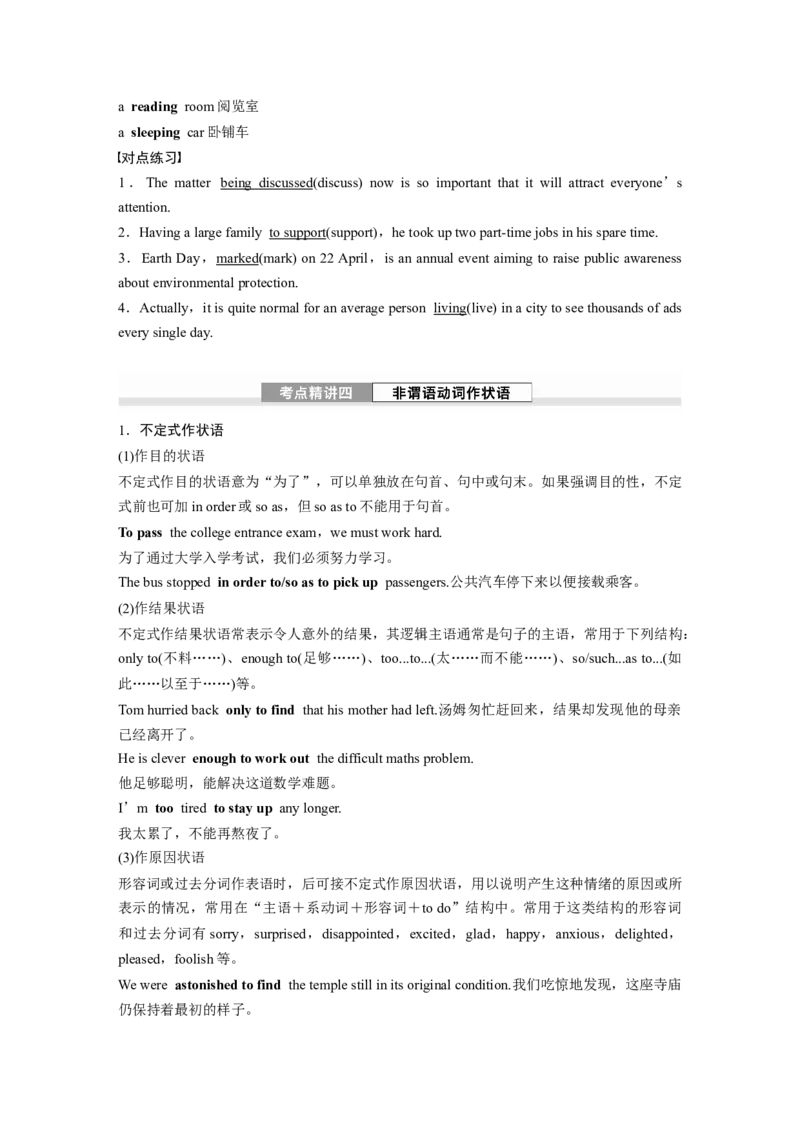
对点练习
1.The matter being discussed(discuss) now is so important that it will attract everyone’s
attention.
2.Having a large family to support(support),he took up two part-time jobs in his spare time.
3.Earth Day,marked(mark) on 22 April,is an annual event aiming to raise public awareness
about environmental protection.
4.Actually,it is quite normal for an average person living(live) in a city to see thousands of ads
every single day.
1.不定式作状语
(1)作目的状语
不定式作目的状语意为“为了”,可以单独放在句首、句中或句末。如果强调目的性,不定
式前也可加in order或so as,但so as to不能用于句首。
To pass the college entrance exam,we must work hard.
为了通过大学入学考试,我们必须努力学习。
The bus stopped in order to/so as to pick up passengers.公共汽车停下来以便接载乘客。
(2)作结果状语
不定式作结果状语常表示令人意外的结果,其逻辑主语通常是句子的主语,常用于下列结构:
only to(不料……)、enough to(足够……)、too...to...(太……而不能……)、so/such...as to...(如
此……以至于……)等。
Tom hurried back only to find that his mother had left.汤姆匆忙赶回来,结果却发现他的母亲
已经离开了。
He is clever enough to work out the difficult maths problem.
他足够聪明,能解决这道数学难题。
I’m too tired to stay up any longer.
我太累了,不能再熬夜了。
(3)作原因状语
形容词或过去分词作表语时,后可接不定式作原因状语,用以说明产生这种情绪的原因或所
表示的情况,常用在“主语+系动词+形容词+to do”结构中。常用于这类结构的形容词
和过去分词有sorry,surprised,disappointed,excited,glad,happy,anxious,delighted,
pleased,foolish等。
We were astonished to find the temple still in its original condition.我们吃惊地发现,这座寺庙
仍保持着最初的样子。注意 还有一类形容词如 easy,difficult,hard,cheap,expensive,fit,comfortable,
heavy,good,important,impossible,dangerous等,表示主语的特征或性质,后面也常用不
定式作状语,不定式和句子主语之间存在被动关系,但常用主动形式表示被动意义。
The morning air is so good to breathe that he gets up early every day.早上的空气呼吸起来很清
新,因此他每天都起得很早。
This book is difficult to understand.
这本书很难理解。
2.分词作状语
分词包括现在分词和过去分词,现在分词表示的动作与句子主语之间是主动关系,且含有进
行的意义;过去分词表示的动作与句子主语之间是被动关系,且含有完成的意义。
(1)作时间状语相当于when,while,before,since,as引导的时间状语从句。
Translated into English,the sentence was found to have an entirely different word order.
=When the sentence was translated into English,it was found to have an entirely different word
order.当这个句子被译成英语时,人们发现它有一个完全不同的语序。
(2)作原因状语相当于because,since,as引导的原因状语从句。
①Not understanding this problem,he asked the teacher about it.
=Because he didn’t understand this problem,he asked the teacher about it.
因为不理解这个问题,他问了老师。
②Defeated by his deskmate,he felt discouraged.
=Because he was defeated by his deskmate,he felt discouraged.由于被同桌打败了,他感到气
馁。
(3)作条件状语相当于if,unless等引导的条件状语从句。
Given another hour,I can also work out this problem.
=If I’m given another hour,I can also work out the problem.
如果再给我一个小时,我也能解决这个问题。
(4)作结果状语常用现在分词表示自然而然的结果,分词前可接thus。
More highways have been built in China,making it much easier for people to travel from one
place to another.中国又建了很多高速公路,这使人们的出行变得更容易了。
(5)作方式或伴随状语表示一个同时发生的次要的(或者伴随的)动作,常用逗号与句子主体部
分隔开,相当于并列句。
One evening Harry phoned me,asking me to come to his flat as soon as possible.
=One evening Harry phoned me,and he asked me to come to his flat as soon as possible.
一天晚上哈里给我打电话,要求我尽快去他的公寓。
(6)作让步状语相当于though,although,even if等引导的让步状语从句。
Warned of the danger,he still went skating on the thin ice.
=Though he was warned of the danger,he still went skating on the thin ice.虽然被警告有危险,他仍旧在薄冰上滑冰。
注意 某些动词的过去分词已经形容词化,且往往用于一些系表结构,此时这些过去分词
既不表示被动,也不表示完成,而表示一种状态,如:lost(迷路的)、seated(坐着的)、
hidden(隐瞒的)、lost/absorbed(沉迷于……的)、dressed(穿着……的)、tired(对……感到厌倦的)、
excited(兴奋的)等。
Absorbed in his book,he didn’t notice me enter the room.专心于读书,他没注意到我进入房
间。
Dressed in red,she looks more beautiful.
穿着红色的衣服,她看上去更漂亮了。
3.独立成分作状语
有些分词或不定式短语作状语,其形式的选择不受上下文的影响,称作独立成分。常见的有:
独立成分 含义
generally speaking 一般来说
frankly/honestly speaking 坦白地/老实说
judging from/by... 根据……来判断
considering.../taking...into consideration/account 考虑到……
to tell you the truth 说实话
seeing... 考虑到……
given... 考虑到……
compared to/with... 与……相比
Generally speaking,the rule is very easy to understand.一般来说,这条规则很容易懂。
Judging from his accent,he is from Hong Kong.从口音判断,他是香港人。
To tell you the truth,I am a little tired.
说实话,我有点累。
4.独立主格结构
(1)构成:名词/代词+形容词/副词/介词短语/现在分词/过去分词/不定式
(2)特点:
①独立主格结构的逻辑主语与句子的主语不同,它独立存在;
②独立主格结构中作逻辑主语的名词或代词与后面的分词、形容词、副词、不定式、介词短
语等是逻辑上的主谓或动宾关系;
③它表示谓语动词发生的时间、原因、条件或伴随情况等,相当于一个状语从句或并列句。
Much work to do tonight(=As there will be much work to do tonight),we can’t go to see the
film.今晚有很多活要干,我们不能去看电影。
Weather permitting(=If weather permits),they will go on an outing to the beach tomorrow.
如果天气允许的话,他们明天将去海滩郊游。He was lying on the grass,his hands crossed under his head(=and his hands were crossed
under his head).
他头枕着交叉的双手躺在草地上。
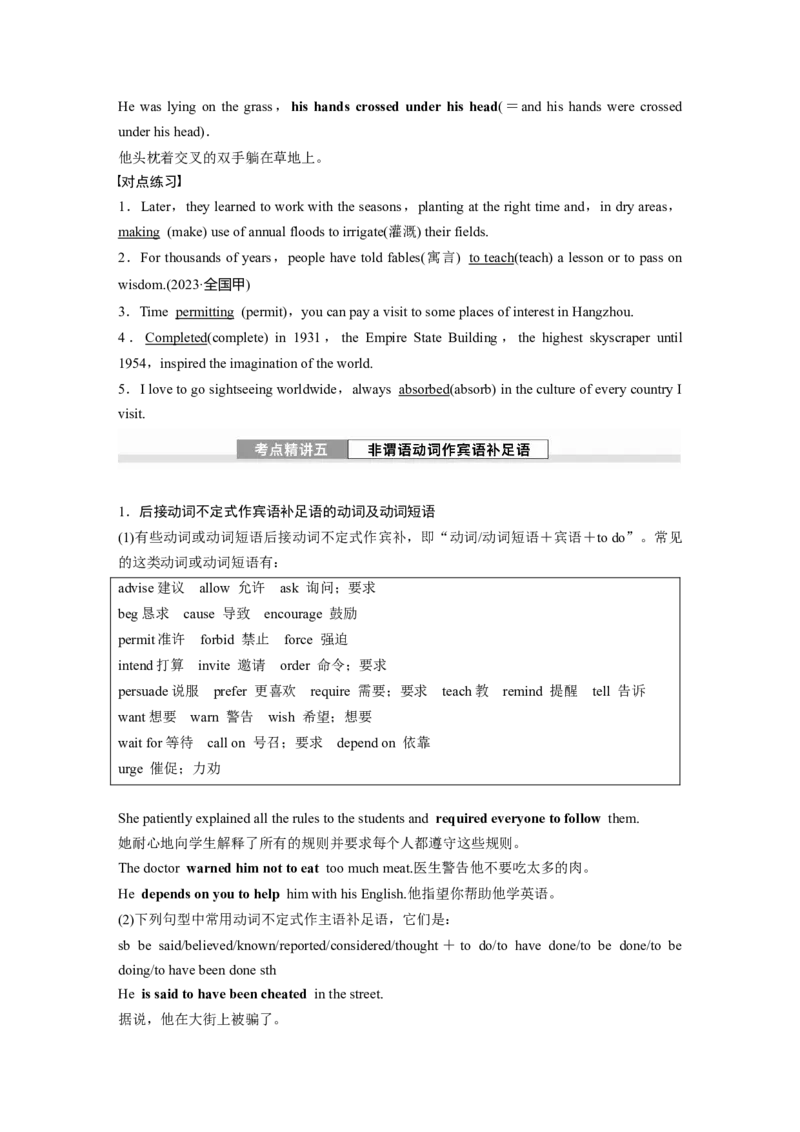
对点练习
1.Later,they learned to work with the seasons,planting at the right time and,in dry areas,
making (make) use of annual floods to irrigate(灌溉) their fields.
2.For thousands of years,people have told fables(寓言) to teach(teach) a lesson or to pass on
wisdom.(2023·全国甲)
3.Time permitting (permit),you can pay a visit to some places of interest in Hangzhou.
4.Completed(complete) in 1931,the Empire State Building,the highest skyscraper until
1954,inspired the imagination of the world.
5.I love to go sightseeing worldwide,always absorbed(absorb) in the culture of every country I
visit.
1.后接动词不定式作宾语补足语的动词及动词短语
(1)有些动词或动词短语后接动词不定式作宾补,即“动词/动词短语+宾语+to do”。常见
的这类动词或动词短语有:
advise建议 allow 允许 ask 询问;要求
beg恳求 cause 导致 encourage 鼓励
permit准许 forbid 禁止 force 强迫
intend打算 invite 邀请 order 命令;要求
persuade说服 prefer 更喜欢 require 需要;要求 teach教 remind 提醒 tell 告诉
want想要 warn 警告 wish 希望;想要
wait for等待 call on 号召;要求 depend on 依靠
urge 催促;力劝
She patiently explained all the rules to the students and required everyone to follow them.
她耐心地向学生解释了所有的规则并要求每个人都遵守这些规则。
The doctor warned him not to eat too much meat.医生警告他不要吃太多的肉。
He depends on you to help him with his English.他指望你帮助他学英语。
(2)下列句型中常用动词不定式作主语补足语,它们是:
sb be said/believed/known/reported/considered/thought +to do/to have done/to be done/to be
doing/to have been done sth
He is said to have been cheated in the street.
据说,他在大街上被骗了。The accident is reported to have killed two people.据报道,那次事故中有两人丧生。
2.非谓语动词作感官动词(短语)、使役动词的宾补
(1)感官动词(短语)see,watch,observe,look at,notice,hear,listen to,feel的宾语补足语
有四种形式, 以see为例:
see+宾语+
I saw some boys all dressed in uniforms leave the lab following a teacher a few minutes ago.
几分钟前,我看见一些穿校服的男生跟着一个老师离开了实验室。
As I got closer,I saw him kicking his legs in the air and breathing heavily.当我走近时,我看
见他的腿在空中乱踢,并且呼吸沉重。
Back from his two-year medical service in Africa,Dr Lee was very happy to see his mother
taken good care of at home.
从非洲医疗服务两年回来后,李医生十分高兴地看到家里的母亲得到了很好的照顾。
[注意] “感官动词+宾语+省略to的动词不定式作宾语补足语”在变为被动语态时需加
to。
A clerk with three strangers was observed to enter the bank hurriedly,a heavy box carried in
her arms.
有人看见一个职员抱着一个沉重的箱子和三个陌生人一起匆忙走进银行。
(2)使役动词make,let,have,get后接复合宾语的情况:
①make+宾语+
The teacher made some students stay in the classroom after school.
老师让一些学生放学后待在教室里。
The hall was so noisy that the teacher tried to speak louder to make himself heard.
大厅里如此吵闹以至于老师尽力大声说话以便别人能听到。
②let+宾语+
Don’t let your child play with matches in case a big fire breaks out.
别让你的孩子玩火柴,以防发生火灾。
Let the homework be done immediately;otherwise it’s time for you to hand it in.
请立刻完成作业,不然就该交了。
③have+宾语+
He had the light burning all night,which made his parents very angry.
他让灯着了整晚,这使他父母很生气。
My car broke down on my way to work and I will have it repaired tomorrow.
我的车在上班的路上坏了,明天要找人修一下。
注意 (1)“使役动词+宾语+省略to的动词不定式作宾语补足语”在变为被动语态时也需
加to。
He was made to work day and night,so he was very tired of the job.
他被迫日夜工作,所以他非常厌倦这项工作。(2)have sb doing sth用于否定句中,常与can’t,won’t等连用,表示“不能容忍某人做某
事”。
I won’t have you speaking to your dad like that,which is so rude.我不容许你和你父亲那样
讲话,太不礼貌了。
④get+宾语+
It’s not hard to get him talking—the problem is stopping him.
让他开始说话不难,难的是让他住口。
My bike broke down on the way back and I am going to get it repaired tomorrow.
我的自行车在回来的路上坏了,我打算明天去修。
3.动词leave,keep,find,catch后加非谓语动词作复合宾语的情况
(1)leave
(2)keep
(3)find ⇒
(4)catch sb doing sth撞见某人正在做某事
The guests left most of the dishes untouched, because they didn’t taste delicious.
大部分的菜客人们都没有动,因为它们不可口。
They use computers to keep the traffic running smoothly.他们使用电脑以使交通畅通无阻。
The hall was found thoroughly cleaned and everything arranged in good order.人们发现礼堂彻
底地被打扫了,一切都布置得井井有条。
I caught him smoking in the bathroom.
我撞见他在浴室里抽烟。
4.“with+宾语+宾补”结构
(1)with+名词/代词+现在分词,现在分词可表示主动和动作正在进行
He lay on the grass with his eyes looking at the sky.
他躺在草地上,眼睛望着天空。
(2)with+名词/代词+过去分词,过去分词可表示被动和动作已完成或表状态
With his hair cut,he looked much younger.
理了发,他看起来年轻多了。
(3)with+名词/代词+不定式,不定式表示动作尚未发生
With a lot of homework to do,I can’t go skating with you.
因为有很多作业要做,我不能和你一起去滑冰。
对点练习
1.A cook will be immediately fired if he is found smoking(smoke) in the kitchen.
2.The shop owner will get all these goods ordered delivered(deliver) to the customers today.
3.They are required to process(process) the food that we eat,to recover from injury and for
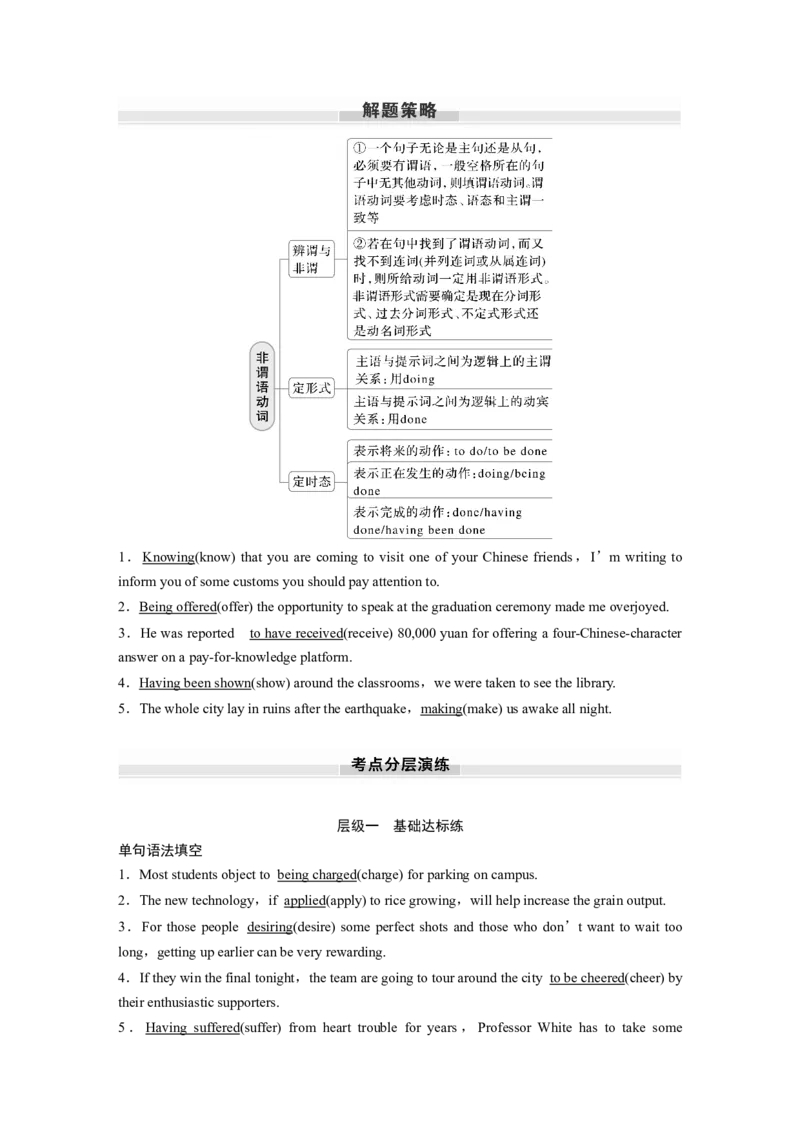
several other bodily functions.1.Knowing(know) that you are coming to visit one of your Chinese friends,I’m writing to
inform you of some customs you should pay attention to.
2.Being offered(offer) the opportunity to speak at the graduation ceremony made me overjoyed.
3.He was reported to have received(receive) 80,000 yuan for offering a four-Chinese-character
answer on a pay-for-knowledge platform.
4.Having been shown(show) around the classrooms,we were taken to see the library.
5.The whole city lay in ruins after the earthquake,making(make) us awake all night.
层级一 基础达标练
单句语法填空
1.Most students object to being charged(charge) for parking on campus.
2.The new technology,if applied(apply) to rice growing,will help increase the grain output.
3.For those people desiring(desire) some perfect shots and those who don’t want to wait too
long,getting up earlier can be very rewarding.
4.If they win the final tonight,the team are going to tour around the city to be cheered(cheer) by
their enthusiastic supporters.
5.Having suffered(suffer) from heart trouble for years,Professor White has to take somemedicine with him wherever he goes.
6.It is said to be a place that makes you forget your age and fatigue and feel so absorbed(absorb)
that you won’t leave once you’re there.
7.The powerful and natural springs associated(associate) with Yellowstone’s identity and
picture landscape brought Yellowstone its fame.
8.After taking the lesson,I now understand the difficulty of calligraphy and that it will take
efforts and commitment to master(master) this art form.
9.In recent years,biang biang noodles and its associated custom have become more widely
known across China,driven(drive) in part by social media interest in the made-up “biang”
character.
10.Getting up early in the morning,putting(put) on warm clothes and waiting in a long line
outside a store to buy newly-made yuanxiao is a ceremony for me and ensures I will have another
sweet year.
层级二 高考真题练
单句语法填空
1.“There was once a town in the heart of America where all life seemed to enjoy peaceful co-
existence with its surroundings,” her fable begins,borrowing(borrow) some familiar words
from many age-old fables.Behind the simple style , however , is a serious message
intended(intend) for everyone.(2023·全国甲)
2.From Buddhist temples to museums,narrow hutong to royal palaces,it is home to more
than 3,000 years of glorious history even down to its layout,with the city keeping its carefully
built(build) system of ring roads.(2023·全国乙)
3.Having visited(visit) several times over the last 10 years,I am amazed by the co-existence of
old and new,and how a city was able to keep such a rich heritage(遗产) while constantly
growing.As a photographer,I have spent the last two years recording(record) everything I
discovered.(2023·全国乙)
4.That approach brought Cobb’s air travel last year down by 75%,and she plans to continue
(continue) the practice.(2022·浙江1月)
5.A visually-challenged man from Beijing recently hiked(徒步) 40 days to Xi’an,as a first
step to journey (journey) the Belt and Road route(路线) by foot.(2022·全国甲)
6.Inspired by the Belt and Road Forum for International Cooperation held (hold) in Beijing,
Cao decided to cover the route by hiking as a tribute(致敬) to the ancient Silk Road.(2022·全国甲)
7.He flew 4,700 kilometers from Xi’an to Kashgar on Sept.20,planning (plan) to hike back to
Xi’an in five months.(2022·全国甲)
8. To strengthen(strengthen) the connection with young people,the event included a number ofpublic promotional activities on social media,inviting(invite) twenty-nine tea professionals from
around the world to have thirty-six hours of uninterrupted live broadcasts.(2022·全国乙)
9. Covering(cover) an area about three times the size of Yellowstone National Park,the GPNP
will be one of the first national parks in the country.(2022·新课标Ⅰ)
10.Eric woke up a little later when he heard children playing outside.He pushed a chair onto the
balcony,and climbed up to see(see) them.(2022·新课标Ⅱ)
层级三 语篇提能练
语法填空
1. (go) to Mount Huangshan reminds me of the popular Beatles’ song “The
Long and Winding Road”.What is so breathtaking about the experience is the out-of-this-world
scenes.The rolling sea of clouds you see once you are at the top will remind you how tiny we
humans 2. (be).
The hot spring at the foot of the mountain is something you must try after the climb.It will
undoubtedly help you get 3. (refresh)! The 4. (amaze) thing about the spring is
that the colder the temperature 5. (get),the hotter the spring! Strange,isn’t it? But
that’s how nature is—always leaving us 6. (astonish).
What comes next is the endless series of steps.You can’t help 7. (wonder) how hard
it was for the people then 8. (put) all those rocks into place.Though it is the only unnatural
thing on your way up the mountain,still it highlights the whole adventure and offers a place where
you can sit down to rest your 9. (ache) legs.
As the song goes,this long and winding road “will never disappear”,and it will always
stick in the visitor’s memory.It sure does in mine.While you’re in China,Mount Huangshan is
a must 10. (visit)!
1.答案 Going
解析 考查非谓语动词作主语。分析句子结构并结合语境可知,本空为主语且表示主动的、
一般性的动作,故应用动词的-ing形式作主语。
2.答案 are
解析 考查时态和主谓一致。根据语境可知用一般现在时,且主语we humans是复数,谓语
用are。
3.答案 refreshed
解析 考查非谓语动词作表语。get refreshed构成系表结构。
4.答案 amazing
解析 考查非谓语动词作定语。修饰thing表示“令人惊奇的”,故用-ing形式作定语。
5.答案 gets解析 考查动词的时态和主谓一致。根据句意以及上下文时态可知,此处用一般现在时,且
主语the temperature为第三人称单数,故填gets。
6.答案 astonished
解析 考查非谓语动词作宾补。本空在“leave+复合宾语”结构中作宾补,且根据语境可
知,这里指的是使我们“感到惊讶”,故填astonished。
7.答案 wondering
解析 考查非谓语动词作宾语。can’t help doing sth忍不住做某事。
8.答案 to put
解析 考查不定式作主语。此处为 it is/was+adj.+for sb+to do sth的变式,it为形式主语,
to do 为真正的主语。
9.答案 aching
解析 考查非谓语动词作定语。本空在句中作定语,ache与中心词legs之间是逻辑上的主
动关系,故用现在分词aching。
10.答案 to visit
解析 考查非谓语动词作定语。此处must用作名词,指“必须做的一件事”,需用动词不
定式作定语。
1.作主语或介宾用doing——不犯简单错误
(2023·新课标Ⅰ、Ⅱ)首先,随机配对学生可能会导致小组内语言能力的不平衡。
Firstly,randomly pairing up students may lead to imbalanced language abilities within the
groups.
(2022·浙江1月)说服他接受我的观点是不可能的,所以我不想浪费时间来讨论。
Persuading him into accepting my views was impossible , so I didn ’ t want to waste my time
discussing.
2.作状语用分词生动简练
(1)doing作状语,表示句子主语和该动词为主谓(主动)关系。
(2023·北京)很高兴听说你们正在策划一个以“绿色北京”为主题的社团活动,我写信是为
了给这次活动提出我的建议。
Delightedly hearing that you are planning a club activity themed “Green Beijing”,I am
writing to make my suggestions for the event.
听到这个意外的消息,她惊讶得目瞪口呆。
Hearing of the unexpected news , she was so surprised that she froze with her mouth wide open.
(2)done作状语,表示句子主语和该动词为动宾(被动)关系,或者表示主语所处的某种状态。
(2023·全国甲)孔子,又名孔丘,被认为是中国历史上最重要的人物之一,是生活在春秋时
期的中国哲学家和政治家。Considered one of the most important figures in Chinese history,Confucius,also known as
Kong Qiu,was a Chinese philosopher and politician who lived during the Spring and Autumn
Period.
(2022·新课标Ⅰ)虽然筋疲力尽,但是大卫到达了终点线,所有的学生都为他欢呼。
Worn out , David reached the finishing line and all the students cheered for him.
3.表目的,不定式适当提前
(2022·全国甲)而且,为了呼吁更多的人来保护海洋,我们还可以发传单。
What’s more,to call on more people to protect the ocean,we can also hand out leaflets.
(2021·上海)为了更高效地学习英语,你最好选择听说课程。
To learn English more efficiently , you had better choose the Listening and Speaking course .
4.having done比after从句光鲜靓丽
(2022·新课标Ⅰ)在确认了大卫想跑就跑的情况后,我转过身发现他朝我走来,他瘦小的身
体随着他的双脚向前摆动而左右摇晃。
Having made sure that David could run if he wanted to,I turned around to find him coming
towards me,his small body rocking from side to side as he swung his feet forward.
(2020·新课标Ⅰ)卖完爆米花之后,他们决定收工回家。
Having sold out all the popcorn , they decided to call it a day and go home .