高中英语887 高考核心词汇
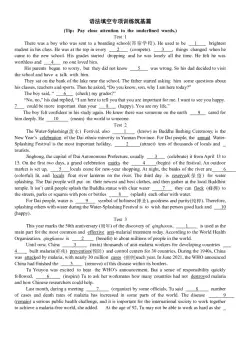
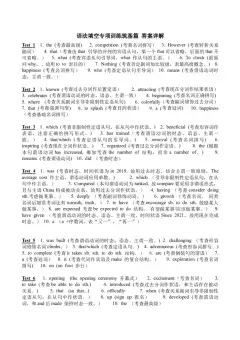
---Group 3 fall---case 小测
一、语法填空
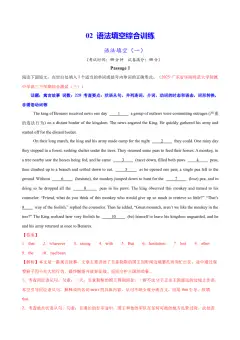
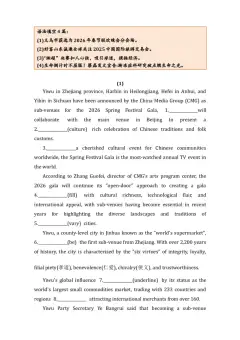
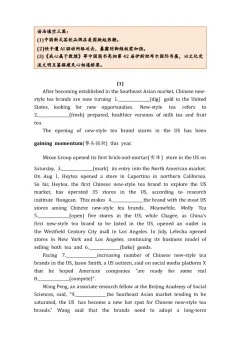
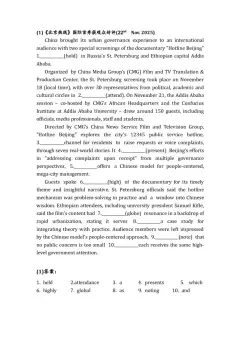
1. The Alps are the ______________(great) mountain range in Europe, which cover ________ area of
about 200,000 sq. km.
2. I came across an article about a doctor __________(call) Lin Qiaozhi, a ______________(special) in
women’s disease.
3. I _____________(lose) in thought with _______________(nature) beauty around me.
4. A great deal of _______________(science) research shows that if people _____________(tell) they
will fail, they will do so.
5.
You're
completely
_________________(mistake)
about
Jane.
Jane
is
friendly
and
______________(kindness).
6. There is no ________________(possible) that he will break the record. After all, he is a green hand.
7. Filled with ___________(angry), he stood up and __________(run) out, __________(slam) the door
behind him.
8. ________________(expected), he didn’t receive any _______________(educate) when he was young.
9. With everything _____________(take) into consideration, we finished the task _____________(smooth).
10. Though forced __________(do) what I didn't like, I set out to do it _______________(immediate).
二、根据中文提示完成句子
11. They _______________________(爱上) each other at first sight and got married only after a month.
12. Products _____________________(质量好的) are certainly popular with people.
13. As is known to all, the letters USA _________________(代表) the United States of America.
14. In my view, I should have a room _____________________(属于我自己的).
15. I ___________________(伸手去拿) the book on the table.
16. I would be grateful if you could help me finish the tough task _______________________(尽快).
17. Whenever I make a mistake, my teacher will point it out ___________________(耐心地).
18. The offer arrived __________________(出乎意料). As a result, I stood _________________(一声不吭).
19. _____________________(被认为是) best friends, they have a lot in common with each other.
20. I was the first in my family __________________(上大学), so my parents are proud of me.
三、翻译下面句子
21. 一听到这个可怕的消息,他站着不动,眼睛睁得大大的。(with 复合结构)
_____________________________________________________________________________________________
22. 英语在我们日常生活中变得越来越重要了。(play an important part in)
_____________________________________________________________________________________________
23. 每一次我靠近他,他就会后退一点,这让我很尴尬。
___________________________,
he
will
step
back
a
bit,
______________________________________________
24. 同样的错误他们犯了一次又一次,我很生气。(be filled with)
_____________________________________________________________________________________________
25. 是时候立刻采取行动来解决这个问题了。
_____________________________________________________________________________________________
26. 我们绝不能阻止他去做他感兴趣的事。(in no case)
_____________________________________________________________________________________________
四、阅读理解:
A
Getting into college is a big step for high school graduates, and it comes with a lot of changes. For most
students, it’s the first time they’re living away from home and managing their own life. Not surprisingly, adapting to
this new lifestyle can be challenging. The following four tips will make high school graduates better prepared for
college life.
Goal setting
When setting goals, whether they’re academic, career, or personal, re-member they should be attainable but not
too easy, so that you really have to push yourself to achieve them, and feel rewarded when you do. Writing down
your goals and breaking down each huge, long-term goal into smaller more practical ones can help make it feel
more real, and writing out a plan for achieving it can give you a roadmap to success.
Interpersonal skills
At college, you will interact with fellow students, professors, librarians, and many others. Strong interpersonal
skills will help you build relationships during this time, and get more out of them. If you feel that your interpersonal
skills need some work, practice asking thoughtful questions and listening closely, develop your understanding by
putting yourself in someone else’s shoes, and enhance your self-confidence.
Studying
With fewer in-class hours and more on-your-own learning, you’re required to really digest learning material
rather than simply memorize facts. To be successful in college you’ll need to learn how to integrate large amounts
of information obtained through reading, do research, and write papers. Organization is the key, so if you are not
someone who is naturally organized, set up your study schedule.
Budgeting
Managing money is a critical life skill, and for many, it is at college that they develop it for the first time. Start
by estimating your financial balance. Then give high priority to the expenses on basic needs and determine how
much money to set aside every month to cover those costs. Don’t forget about savings…and the fun stuff(movies,
dinners out), too.
27. Who is this passage most probably written for?
A.College teachers.  B.University graduates. C.High school teachers.  D.Would-be college students.
28.What is the author’s suggestion for reaching a huge goal?
A.Divide it into smaller, more achievable ones.
B.Reward oneself for each goal one has set.
C.Purchase a clear, updated road map.
D.Push oneself to an upper level.
29.One of the suggested ways to enhance your interpersonal skills is to ________.
A.prepare complicated questions
B.try on someone else’s shoes
C.listen to others carefully
D.take advantage of others
30.What is the key to successful college study according to the author?
A.Being well-organized.
B.Being well-informed.
C.Effective reading skills.
D.Reliable research methods.
31.To learn how to manage money, the first thing to do is________.
A.save money for financial investment B.estimate one’s income and expenses
C.set aside money for fun activities
D.open a personal bank account
B
Pasta and pizza were on everyone’s lunch menu in my native land of Italy. Everyone who had such a lunch was
fair-skinned and spoke Italian. A few years later, my family moved to the US. As I stood in the lunch line with my
kindergarten class in a school in Brooklyn, I realized things were no longer that simple. My classmates ranged from
those kids with pale skin and large blue eyes to those with rich brown skin and dark hair. The food choices were
almost as diverse (各种各样的) as the students. In front of me were a variety of foods I couldn’t even name in my
native language. Fearing that I would pick out something awful, I tried badly to ask the boy ahead of me for a
recommendation. Unfortunately, between us stood the barrier of language.
Although my kindergarten experience feels like a century ago, the lessons I learned will stick in my mind
forever. For the past three summers, I have worked in a government department in New York. New immigrants (移
民) —much like the little girl in the lunch line flooded our office asking for help. I often had to be an interpreter for
the Italian-speaking ones. As I served the role of vital communication link, I was reminded of my struggle to
communicate before I learned English. I watched with great sympathy as old Italians tried to hold a conversation in
Italian with people who did not speak the language. It suddenly became very clear to me how lucky I was to be
fluent in two languages.
In New York, a multicultural city, students like me are blessed with a chance to work with a diverse
population. In my English to Italian translations, I’ve learned about social programs that I didn’t know existed. This
work expanded my mind in ways that are impossible inside the four walls of a classroom. Walking through the
streets of Brooklyn today, I am no longer confused by this city’s sounds and smells. Instead, I enjoy its diversity.
32.What did the author realize after entering school in Brooklyn?
A.English was hard to learn.
B.She struggled to communicate.
C.She was an ordinary looking girl.
D.The food was terrible and strange.
33.Who does “the little girl” underlined in Paragraph 2 refer to?
A.An Italian teacher.   B.A government official.    C.The author herself.   D.The author’s classmate.
34.How did the summer job benefit the author?
A.It strengthened her love for school.
B.It helped sharpen her sense of direction.
C.It opened her eyes to the real world.
D.It made her childhood dream come true.
35.What can be the best title of the text?
A.English and Italian, Worlds Apart
B.It Takes All Sorts to Make a World
C.Pasta and Pizza, All the Same to Me
D.Don’t Judge People by Their Appearance
五、阅读下面短文,在空白处填入1 个适当的单词或括号内单词的正确形式。
( 一)The Chinese government recently finalized a plan to set up a Giant Panda National Park (GPNP).
36___________(cover) an area about three times 37       size of Yellowstone National Park, the CPNP will be
one of the first national parks in the country. The plan will extend protection to a significant number of areas that
38_________(be) previously unprotected, bringing many of the existing protected areas for giant pandas under one
authority 39_______________(increase) effectiveness and reduce inconsistencies in management.
After a three-year pilot period, the GPNP will be officially set up next year. The GPNP 40


(design) to reflect the guiding principle of “protecting the authenticity and integrity (完整性) of natural ecosystems,
preserving biological diversity, protecting ecological buffer zones, and leaving 41       precious natural assets
(资产) for future generations”. The GPNP’s main goal is 42


 (improve) connectivity between separate
populations and homes of giant pandas, and eventually achieve a desired level of population in the wild.
Giant pandas also serve 43

  an umbrella species (物种), bringing protection to a host of plants and
animals in the southwestern and northwestern parts of China. The GPNP is intended to provide 44


(strong) protection for all the species 45         live within the Giant Panda Range and significantly improve the
health of the ecosystem in the area.
(二)To understand a painting, we’re taught to look for color, composition, and light. But how can a painting
46 _____________(appreciate)by someone who’s blind? Through touch, the one thing gallery signs tell you not
47___________(do). John Olson, a former 48


 (photograph)and his team turn paintings into fully
textured 3D models.
The tactile(可触知的)paintings work as a way to show art to 49         blind because we don’t see with
just Our eyes: We see with our brains. Research in the field of neuroplasticity-the brain’s adaptability-shows that the
visual cortex(大脑皮层)is made active by touch. Blind people recognize shapes with their 50


 (exist)
senses, in a way similar to that of 51


 (sight )people, says Ella Striem-Amit, a Harvard scientist.
Luc Gandarias, who’s now thirteen, went blind suddenly 52         age seven. When he felt a 3D version
of Leonardo da Vinci’s “Mona Lisa” he 53


 (notice)her smile right away. ”I can actually feel what you
see when you look at it,” he said.
For Luc, this means 54


 (independent). "The feeling of being able to see it 55           to
form my opinion is like breaking down another wall as a blind person.”