2026 届上海市高考英语听力第三期专项训练
Listening Comprehension
Section A
Directions: In Section A, you will hear ten short conversations
between two speakers. At the end of each conversation, a question
will be asked about what was said. The conversations and the
questions will be spoken only once. After you hear a conversation
and the question about it, read the four possible answers on your
paper, and decide which one is the best answer to the question
you have heard.
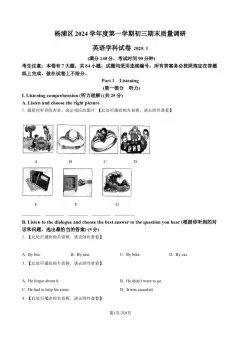
1. A. In the Student Union building
B. In the Gymnasium
C. In the teaching building
D. In the library
2. A. She parked after the restriction time
B. She didn't notice the no-parking sign
C. She parked a bit early for the restriction
D. She lost her parking permit
3. A. He missed the whole debate last night
B. He thought Professor Johnson's views were practical
C. He agreed with Professor Johnson's arguments
D. He heard the opponent's opinions on job loss
4. A. He will finish the sales figures before noon
B. He is waiting for data from Shanghai branch
C. He has sent the third quarter data to Ms. Vance
D. He will have a lunch break with the Shanghai branch
5. A. She will go to watch Casablanca tonight
B. She has to grade a lot of paperwork
C. She has finished the mid-term review materials
D. She will prepare for the cinema with the man
6. A. The apartment is far from the campus library
B. The apartment's rent is cheap for a graduate student
C. The apartment's rent includes all the utilities
D. The apartment is dark and narrow inside
7. A. Jessica is upset about losing the scholarship
B. Jessica failed to apply for a UK university
C. Jessica is very happy about her university acceptance
D. Jessica has been quiet because of her illness
8. A. The woman will order fries with grilled salmon
B. The woman always eats healthy food only
C. The man will stop the woman from eating his fries
D. The woman often eats part of the man's food
9. A. His new tablet can't connect to the correct Wi-Fi
B. He has no idea how to reset his new tablet
C. The neighbor's Wi-Fi signal is very strong
D. His tablet is broken and can't be used
10. A. He understood the quantum physics lecture well
B. He will ask the teaching assistant for help
C. He also found the lecture hard to understand
D. He has read relevant books about quantum physics
Section B
Directions: In Section B, you will hear two passages and one longer
conversation. After each passage or conversation, you will be asked
several questions. The passages and the conversation will be read
twice, but the questions will be spoken only once. When you hear
a question, read the four possible answers on your paper and
decide which one is the best answer to the question you have
heard.
Questions 11 through 13 are based on the following passage.
11. A. How to cook tomato and egg stir-fry perfectly
B. A cooking disaster that led to a precious friendship
C. Valuable cooking tips from a famous food blog
D. The difficulties of living in university dorms in Shanghai
12. A. He asked his mother for cooking oil online
B. He bought cooking oil from the university store
C. He used water instead of cooking oil in the pan
D. He borrowed oil from his familiar neighbors
13. A. Being independent is the key to living in a new place
B. We should avoid showing our weakness to strangers
C. A small cooking mistake will ruin one's social life
D. Showing vulnerability can help build social connections
Questions 14 through 16 are based on the following passage.
14. A. The traditional way of taking a gap year in Europe
B. The debate about the modern gap year for Shanghai students
C.
The
pressure
of
globalized
and
competitive
academic
environment
D. How to build an impressive resume before university
15. A. Traveling around European countries
B. Doing casual part-time jobs to earn money
C. Taking part in unstructured exploration activities
D. Doing intensive internships in multinational firms
16. A. It helps students achieve personal growth and exploration
B. It is a waste of time for students who are decisive
C. It is more structured and goal-oriented than the traditional one
D. It has been rejected by most Shanghai's top students
Questions
17
through
20
are
based
on
the
following
conversation.
17. A. She wants to ask the professor for a research topic
B. She is confused between two final-year project topics
C. She has finished her research proposal on urban ecology
D. She needs help with her statistical analysis homework
18. A. Analyzing the effect of urbanization on local birds
B. Studying the history of Shanghai's urban development
C. Exploring vertical farming in downtown repurposed spaces
D. Researching the food security of traditional farms in suburbs
19. A. She is good at statistical analysis and data collection
B. She prefers interviews and case studies in research
C. She has no personal connection with urban farming
D. She is going to do research in Century Park
20. A. Choose Option A and do long-term data collection
B. Do a broad feasibility study on urban farming in Shanghai
C. Narrow down Option B to a specific district in Shanghai
D. Combine Option A and Option B to do interdisciplinary research
听力原文
(1-10 题:短对话)
1.
M: Excuse me, could you tell me where the Career Fair is being
held? I've checked the Student Union building but it's locked.
W: It was moved to the Gymnasium an hour ago due to the crowd.
You'd better hurry; it wraps up at 4 p.m., and it's already 3:15.
Q: Where is the Career Fair being held now?
2.
W: I can't believe I got another parking ticket! The sign said "No
Parking 8 a.m. - 6 p.m." I parked there at 7:45.
M: Well, there you go. You were 15 minutes early for the
restriction, but 15 minutes late for the fine.
Q: Why did the woman get a parking ticket?
3.
M: Did you watch the debate on artificial intelligence last night?
Professor Johnson's arguments were absolutely compelling.
W: I caught the second half. I found his views a bit too idealistic,
actually. His opponent raised more practical concerns about job
displacement.
Q: What do we know about the woman?
4.
W: Tom, I need those sales figures for the third quarter on my desk
by noon.
M: No problem, Ms. Vance. But I'm still waiting for the final data
from the Shanghai branch. They promised to send it before the
lunch break.
Q: What can we learn about Tom?
5.
M: Are you coming to the cinema tonight? They're showing that
old classic, Casablanca.
W: I wish I could, but I've got a mountain of paperwork to grade.
The students have their mid-terms next week, and I haven't even
started preparing the review materials.
Q: What will the woman do tonight?
6.
W: I like this apartment. It's bright and spacious. But the rent is a
bit steep for a graduate student.
M: True. But look at it this way—it includes utilities and is only a
five-minute walk from the campus library. That saves you both time
and money on transport.
Q: What do we know about the apartment?
7.
M: Jessica has been very quiet lately. Is she still upset about not
getting the scholarship?
W: Actually, she's over the moon. She just received an acceptance
letter from her dream university in the UK.
Q: What is the truth about Jessica?
8.
W: I think I'll order the grilled salmon. It's healthier.
M: You always say that, and then you end up eating half of my
fries.
Q: What can we infer from the conversation?
9.
M: I can't seem to get the Wi-Fi to work on my new tablet. I've
tried resetting it several times.
W: Did you check if it's connected to the correct network?
Sometimes it automatically latches onto the neighbor's weak signal.
Q: What's the man's problem?
10.
W: The lecture on quantum physics was completely over my head. I
didn't understand a single thing.
M: Join the club. Even the teaching assistant looked confused. I'm
going to have to hit the library and do some serious reading
tonight.
Q: What does the man mean?
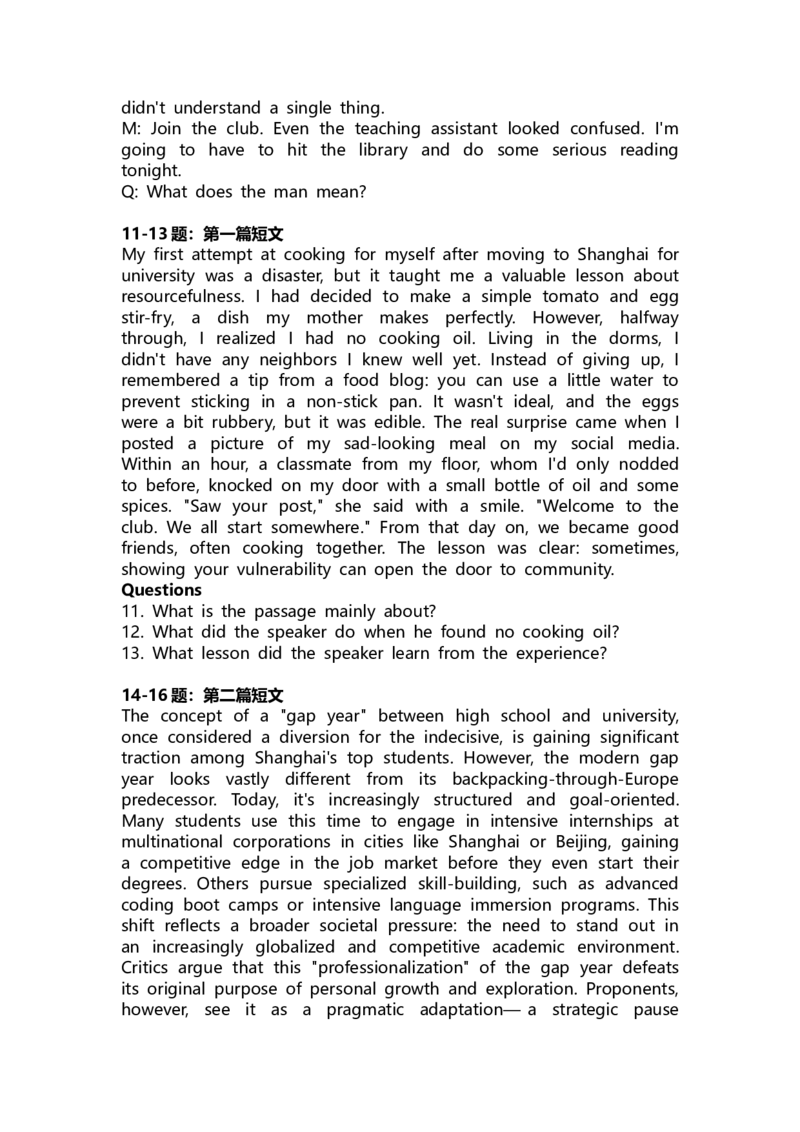
11-13 题:第一篇短文
My first attempt at cooking for myself after moving to Shanghai for
university was a disaster, but it taught me a valuable lesson about
resourcefulness. I had decided to make a simple tomato and egg
stir-fry, a dish my mother makes perfectly. However, halfway
through, I realized I had no cooking oil. Living in the dorms, I
didn't have any neighbors I knew well yet. Instead of giving up, I
remembered a tip from a food blog: you can use a little water to
prevent sticking in a non-stick pan. It wasn't ideal, and the eggs
were a bit rubbery, but it was edible. The real surprise came when I
posted a picture of my sad-looking meal on my social media.
Within an hour, a classmate from my floor, whom I'd only nodded
to before, knocked on my door with a small bottle of oil and some
spices. "Saw your post," she said with a smile. "Welcome to the
club. We all start somewhere." From that day on, we became good
friends, often cooking together. The lesson was clear: sometimes,
showing your vulnerability can open the door to community.
Questions
11. What is the passage mainly about?
12. What did the speaker do when he found no cooking oil?
13. What lesson did the speaker learn from the experience?
14-16 题:第二篇短文
The concept of a "gap year" between high school and university,
once considered a diversion for the indecisive, is gaining significant
traction among Shanghai's top students. However, the modern gap
year looks vastly different from its backpacking-through-Europe
predecessor. Today, it's increasingly structured and goal-oriented.
Many students use this time to engage in intensive internships at
multinational corporations in cities like Shanghai or Beijing, gaining
a competitive edge in the job market before they even start their
degrees. Others pursue specialized skill-building, such as advanced
coding boot camps or intensive language immersion programs. This
shift reflects a broader societal pressure: the need to stand out in
an increasingly globalized and competitive academic environment.
Critics argue that this "professionalization" of the gap year defeats
its original purpose of personal growth and exploration. Proponents,
however, see it as a pragmatic adaptation— a strategic pause
designed not to find oneself, but to build a more impressive
resume for the future.
Questions
14. What is the main topic of the passage?
15. What do many Shanghai students do during the modern gap
year?
16. What is the feature of the modern gap year?
17-20 题:长对话
W: Professor Li, thank you for meeting with me. I'm really excited
about the research proposal for my final-year project, but I'm a bit
torn between two topics.
M: That's quite common, Xiao Wang. Let's hear them. What's on
your mind?
W: Well, Option A is to analyze the impact of Shanghai's rapid
urbanization on local bird populations. I've already done some
preliminary observations in Century Park.
M: That sounds promising. Urban ecology is a growing field. What's
your second idea?
W: Option B is about urban farming. Specifically, I want to explore
the feasibility of vertical farming in repurposed downtown spaces as
a solution to food security. My family runs a small traditional farm
in the suburbs, so I have some personal connection to it.
M: Fascinating. Both topics are highly relevant. However, the key
difference lies in the methodology. For the bird population study,
you'd need strong skills in statistical analysis and long-term data
collection. For the urban farming project, it's more interdisciplinary.
You'd be looking at agricultural science, economics, and even social
policy.
W: I see. My math skills are decent, but I wouldn't say they're my
strongest asset. I'm more comfortable with interviews and case
studies.
M: That's a very honest self-assessment, and it's crucial. The urban
farming topic might allow you to leverage those strengths. You
could interview urban planners, visit existing rooftop farms, and do
a cost-benefit analysis. It's a project that could have tangible
recommendations for the city.
W: That's a good point. I hadn't thought about it in terms of
practical recommendations.
M: My suggestion would be to narrow down Option B. Instead of a
broad feasibility study, perhaps focus on a specific district, like the
Huangpu or Jing'an district. Propose a small-scale model for one
type of vacant building. That would make your research more
manageable and your argument more concrete.
W: That's excellent advice, Professor Li. It makes the whole thing
feel less daunting. I'll draft a revised proposal focusing on a pilot
project for repurposing old industrial spaces in Yangpu District for
vertical farming.
M: That sounds like a solid plan. Once you have the draft, send it
over, and we can fine-tune the research questions. Good luck!
Questions
17. Why does the woman meet with Professor Li?
18. What is Option B of the woman's research topics?
19. What do we know about the woman's research strengths?
20. What is Professor Li's suggestion for the woman?
参考答案和解析
1. 答案:B
解析:女士明确说明招聘会因人数过多一小时前搬到了体育馆
(Gymnasium),男士去过学生会大楼但那里锁门了,A 为干扰项,C、D 未
提及,故选B。
2. 答案:C
解析:女士在7:45 停车,而禁停标志是早8 点到晚6 点,她比禁停时间早到
15 分钟,还是收到了罚单,A 与原文相反,B、D 未提及,故选C。
3. 答案:D
解析:女士只看了辩论的后半段,觉得Johnson 教授的观点偏理想主义,其对
手提出了关于工作岗位流失的更实际的担忧,女士听到了对手的这一观点。A
女士未错过整场辩论,B、C 与女士观点相反,故选D。
4. 答案:B
解析:男士表示会完成销售数据统计,但目前还在等上海分公司的最终数据,
对方承诺午休前发送,A 男士无法在中午前完成,C 尚未提交数据,D 未提及
与上海分公司共进午餐,故选B。
5. 答案:B
解析:女士婉拒了看电影的邀请,因为有一大堆作业要批改,还没开始准备期
中复习资料,A 与原文相反,C、D 未提及,故选B。
6. 答案:C
解析:男士说明这套公寓的租金包含水电等杂费,且离校园图书馆只有五分钟
路程,A 与原文相反,B 女士觉得租金对研究生来说偏贵,D 女士说公寓明亮
宽敞,故选C。
7. 答案:C
解析:女士说明Jessica 并非因没拿到奖学金难过,而是收到了英国理想大学的
录取通知书,开心极了(over the moon),A、B 与原文相反,D 未提及生
病,故选C。
8. 答案:D
解析:女士说要点健康的烤三文鱼,男士则表示女士总这么说,最后还是会吃
他一半的薯条,说明女士经常会吃男士的一部分食物,A 未提及女士点薯条,B
与原文不符,C 男士未表示要阻止,故选D。
9. 答案:A
解析:男士的新平板连不上无线网,多次重置也没用,女士提醒他可能连到了
邻居的弱信号,而非正确的网络,说明问题是平板无法连接正确的Wi-Fi,B 男
士会重置平板,C 邻居信号弱,D 平板未损坏,故选A。
10. 答案:C
解析:女士表示完全听不懂量子物理的讲座,男士说“Join the club”(我也
是),甚至助教都一脸困惑,说明男士也觉得讲座难以理解,A 与原文相反,B
未提及向助教求助,D 男士打算去图书馆看书而非已经看过,故选C。
11. 答案:B
解析:文章讲述了作者来上海上大学后第一次做饭,因没有食用油陷入窘境,
用清水做饭后发社交平台,意外收到同楼层同学的帮助,进而收获珍贵友谊的
故事。A 仅为细节,C 不是文章主旨,D 未提及宿舍生活的困难,故选B。
12. 答案:C
解析:作者发现没有食用油,又不认识熟悉的邻居,于是想起美食博客的技巧,
用清水代替食用油在不粘锅里做饭,A 未向母亲求助,B 未去学校商店购买,D
没有熟悉的邻居可借油,故选C。
13. 答案:D
解析:作者从这次经历中得到的教训是:展现自己的脆弱,有时能为建立社交
联系打开大门。A 文章未强调独立,B 与原文观点相反,C 表述过于绝对,故选
D。
14. 答案:B
解析:文章介绍了上海优等生的现代间隔年与传统间隔年大不相同,变得更有
条理、有目标,同时也讲述了评论家与支持者对现代间隔年的不同看法,即关
于上海学生现代间隔年的争论。A 仅为传统间隔年的内容,C 是间隔年转变的
背景,D 非文章主旨,故选B。
15. 答案:D
解析:现代间隔年中,很多上海学生会在上海、北京等城市的跨国公司做高强
度的实习,A 是传统间隔年的做法,B、C 未提及,故选D。
16. 答案:C
解析:文章明确说明现代间隔年与过去穿越欧洲背包旅行的模式截然不同,如
今的间隔年越来越有条理、有目标,A 是传统间隔年的目的,B、D 与原文相反,
故选C。
17. 答案:B
解析:女士找到李教授,是因为自己的毕业设计研究提案有两个选题,一直犹
豫不决,想寻求教授的建议。A 教授未提供选题,C 未完成研究提案,D 未提
及统计分析作业,故选B。
18. 答案:C
解析:女士的研究选题B 是关于城市农业,具体为探索在市中心改造后的空间
开展垂直农业的可行性,以此解决粮食安全问题。A 是选题A 的内容,B、D 未
提及,故选C。
19. 答案:B
解析:女士坦言自己的数学能力一般,并非强项,更擅长在研究中做访谈和案
例分析,A 与原文不符,C 女士与城市农业有个人关联,D 世纪公园是选题A
的调研地点,故选B。
20. 答案:C
解析:李教授建议女士把选题B 的范围缩小,不要做宽泛的可行性研究,而是
聚焦上海的某个特定区域,做小规模的研究模型。A 教授未建议选选题A,B
与教授建议相反,D 未提及结合两个选题,故选C。