2025 年高考英语听力全国I 卷试题
2025 年高考英语听力全国I 卷试题
第一部分  听力
做题时,先将答案标在试卷上。录音内容结束后,你将有两分钟的时间将试卷上的答案转涂到
答题卡上。
第一节
听下面5 短对话,每段对话后有一个小题,从题中给的A、B、C 三个选项中选出最佳选项。听
完每段对话后,你都有10 秒钟的时间来回答有关小题和阅读下一小题。
每段对话仅读一遍。
1. What will the man do next?
A. Unpack his suitcase.      B. Board a flight.       C. Fill out a form.
2. What does Sarah plan to do after graduation?
A. Do volunteer work.      B. Pursue a higher degree.   C. Run the family business.
3. What are the speakers talking about?
A. Buying a car.     B. Moving house.    C. Fixing the window.
4. What does the woman think of the ski area?
A. It’s a bit crowded.  B. It has poor snow.   C. It’s too far away.
5. Where are the speakers heading?
A. The Art Centre.   B. The Grand Theatre.   C. The Stone Bridge.
第二节
听下面5 段对话或独白,每段对话或独白后有几个小题,从题中所给的A、B、C 三个选项中选
出最佳选项。听每段对话或独白前,你将有时间阅读各个小题,每小题5 秒钟;听完后,各小题将
给出5 秒钟的作答时间。每段对话或独白读两遍。
听第6 段材料,完成下面小题。
6. What did the woman do?
A. She went over the speed limit.
B. She parked in a school zone.
C. She drove through a red light.
7. What time does school finish on Wednesdays?
A. At 2:00 pm.
   B. At 2:30 pm.
  C. At 3:30 pm.
听第7 段材料,完成下面小题。
8. What is the relationship between the speakers?
A. Fellow workers.   B. Former schoolmates.    C. Family relatives.
9. Who will Grace have dinner with?
A. Fiona.
B. Jennifer.
C. David.
10. What is Kevin going to do next?
A. Buy a drink.
B. Play basketball.
C. Greet a friend.
听第8 段材料,完成下面小题。
11. What does the woman say about news programs?
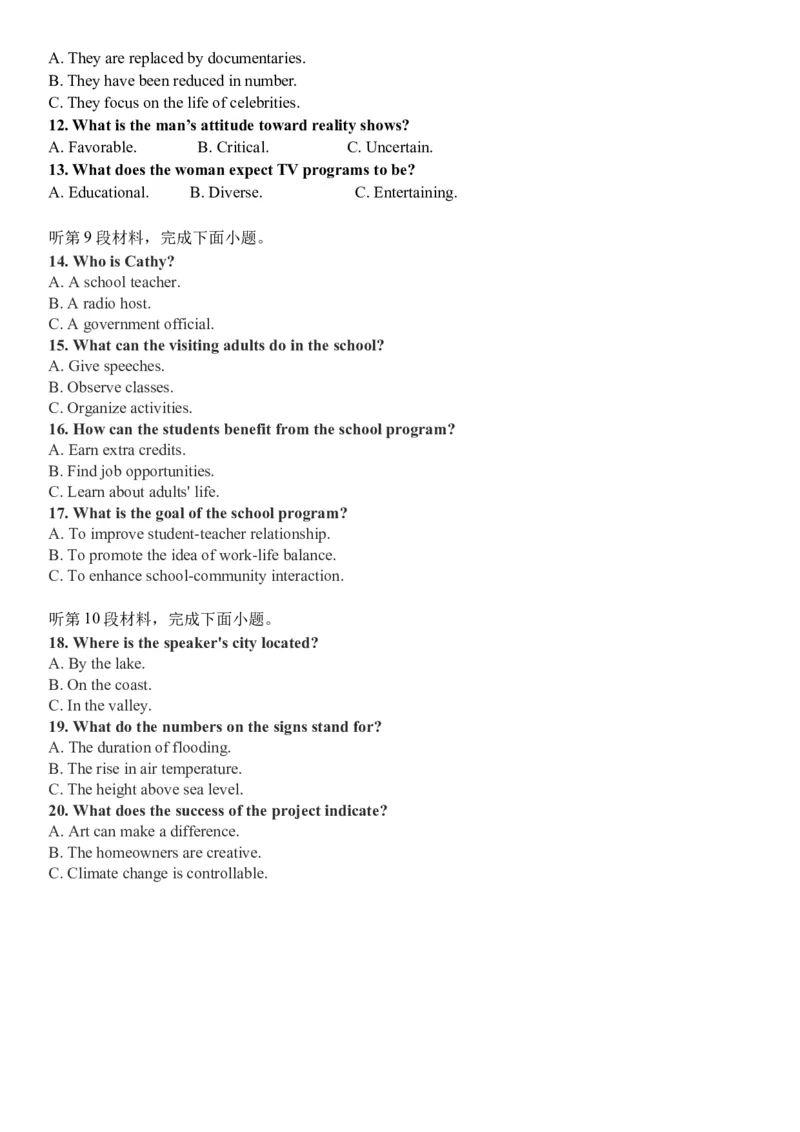
A. They are replaced by documentaries.
B. They have been reduced in number.
C. They focus on the life of celebrities.
12. What is the man’s attitude toward reality shows?
A. Favorable.
 B. Critical.
  C. Uncertain.
13. What does the woman expect TV programs to be?
A. Educational.
B. Diverse.
   C. Entertaining.
听第9 段材料,完成下面小题。
14. Who is Cathy?
A. A school teacher.
B. A radio host.
C. A government official.
15. What can the visiting adults do in the school?
A. Give speeches.
B. Observe classes.
C. Organize activities.
16. How can the students benefit from the school program?
A. Earn extra credits.
B. Find job opportunities.
C. Learn about adults' life.
17. What is the goal of the school program?
A. To improve student-teacher relationship.
B. To promote the idea of work-life balance.
C. To enhance school-community interaction.
听第10 段材料,完成下面小题。
18. Where is the speaker's city located?
A. By the lake.
B. On the coast.
C. In the valley.
19. What do the numbers on the signs stand for?
A. The duration of flooding.
B. The rise in air temperature.
C. The height above sea level.
20. What does the success of the project indicate?
A. Art can make a difference.
B. The homeowners are creative.
C. Climate change is controllable.
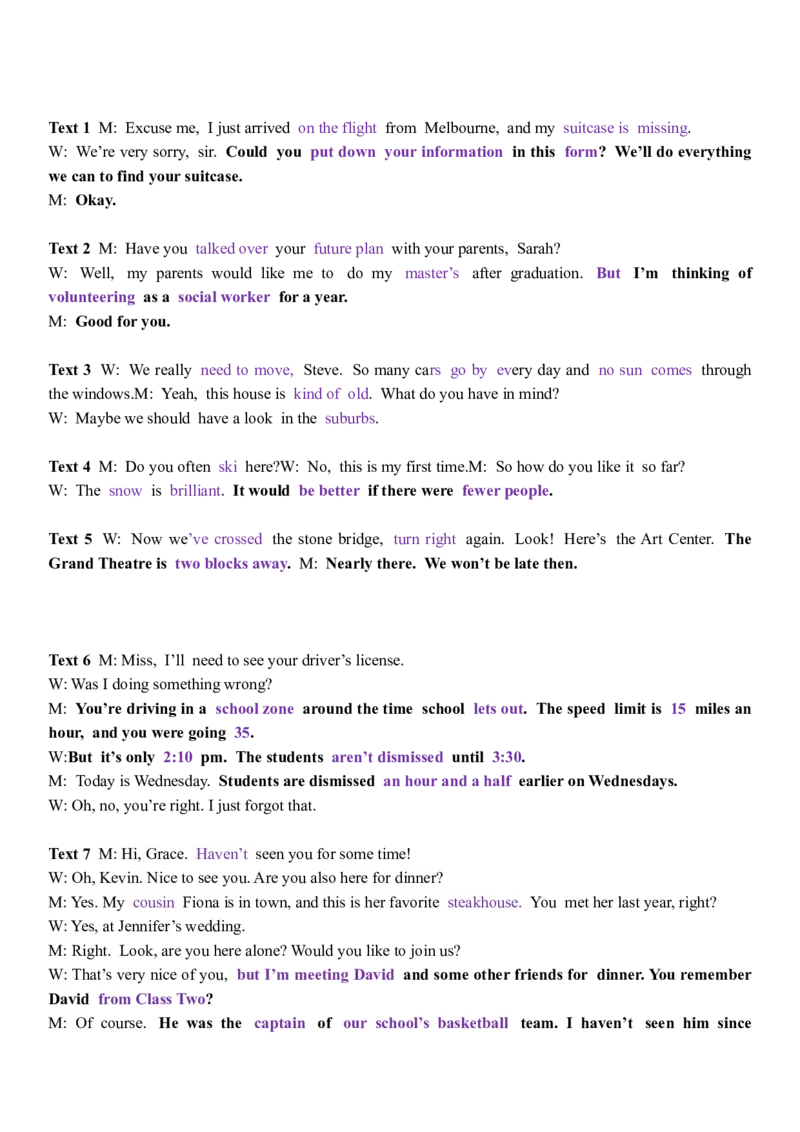
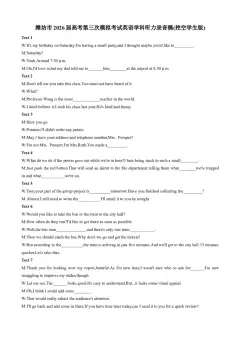
Text 1 M: Excuse me, I just arrived on the flight from Melbourne, and my suitcase is missing.
W: We’re very sorry, sir. Could you put down your information in this form? We’ll do everything
we can to find your suitcase.
M: Okay.
Text 2 M: Have you talked over your future plan with your parents, Sarah?
W: Well, my parents would like me to do my master’s after graduation. But I’m thinking of
volunteering as a social worker for a year.
M: Good for you.
Text 3 W: We really need to move, Steve. So many cars go by every day and no sun comes through
the windows.M: Yeah, this house is kind of old. What do you have in mind?
W: Maybe we should have a look in the suburbs.
Text 4 M: Do you often ski here?W: No, this is my first time.M: So how do you like it so far?
W: The snow is brilliant. It would be better if there were fewer people.
Text 5 W: Now we’ve crossed the stone bridge, turn right again. Look! Here’s the Art Center. The
Grand Theatre is two blocks away. M: Nearly there. We won’t be late then.
Text 6 M: Miss, I’ll need to see your driver’s license.
W: Was I doing something wrong?
M: You’re driving in a school zone around the time school lets out. The speed limit is 15 miles an
hour, and you were going 35.
W:But it’s only 2:10 pm. The students aren’t dismissed until 3:30.
M: Today is Wednesday. Students are dismissed an hour and a half earlier on Wednesdays.
W: Oh, no, you’re right. I just forgot that.
Text 7 M: Hi, Grace. Haven’t seen you for some time!
W: Oh, Kevin. Nice to see you. Are you also here for dinner?
M: Yes. My cousin Fiona is in town, and this is her favorite steakhouse. You met her last year, right?
W: Yes, at Jennifer’s wedding.
M: Right. Look, are you here alone? Would you like to join us?
W: That’s very nice of you, but I’m meeting David and some other friends for dinner. You remember
David from Class Two?
M: Of course. He was the captain of our school’s basketball team. I haven’t seen him since
graduation.
W: He worked abroad for 3 years and has just come back.
M: Well, I’ll go and say a quick hello. We definitely should get together sometime and have a drink.
Text 8 W: There’s nothing decent to watch these days on TV.
M: Nothing decent? There’s tons of stuff.
W: They’ve cut down on the number of news programs, and the number of documentaries. All have
been replaced by these stupid reality shows and game shows, you know.
M: Well, they often make me laugh. People want to watch that kind of thing. It’s good, you know. As
long as there’s a balance, there’s a bit of this, a bit of that.
W: Should we be giving people what they want to watch? Or should we be, you know, trying to educate
them?M: Well, TV is there for entertainment. If you want an education, you go to university or college or
something, don’t you?W: No. I really don’t think so.
Text 9W: Welcome to Education Update. This is Cathy. We have Robert Hall from Mountainside High
School with us today. Hello, Mr. Hall. Could you tell us about the service program in your school?
M: Okay. It goes like this. On certain days each month, adults from the neighborhood sit in class
with the students and see what’s going on in the school.
W: That’s interesting. What else can they do?
M: They can also take adult courses in the evenings for both fun and serious learning.
W: What about the students? What can they do in the program?
M: Well, they can change places with adults and go working on a farm or in a factory or taking care of
the housework.
W: Good. This helps them better understand the lives of their parents and know more about their
neighborhood.
M: Yes. Students have a chance to work in hospitals, nursing homes, libraries, and even in government
offices.W: So the school is not only part of the student’s lives, but also part of the neighborhood.
M: That’s exactly what our service program is for.W: Great. Thank you, Mr. Hall.
Text 10
M: Good evening. Tonight, I’ll continue to share how we can use art to spread the word about the
changing climate. In our day-to-day lives, climate change can be hard to see, but some places will feel the
changes sooner than others. The city I live in is very flat and close to the waterline. And rising sea
levels are already creating floods. So I decided to do something to make it impossible to ignore. I started
an art project called Underwater Homeowners Association and painted numbers onto thousands of large
signs. Each number showed how high someone’s house was above sea level. A one would mean that if
the sea level rose one foot, the building would flood. I gave the signs to homeowners who put them in
their yards. Kids painted more signs and put them near their schools and along busy roads. The project has
already had a real-world effect. The people who put the signs in their yards created a real homeowners
association to address climate change in their communities.
答案
1-5 CABAB
6-10 AABCC
11-15 BAABB
16-20 CCBCA