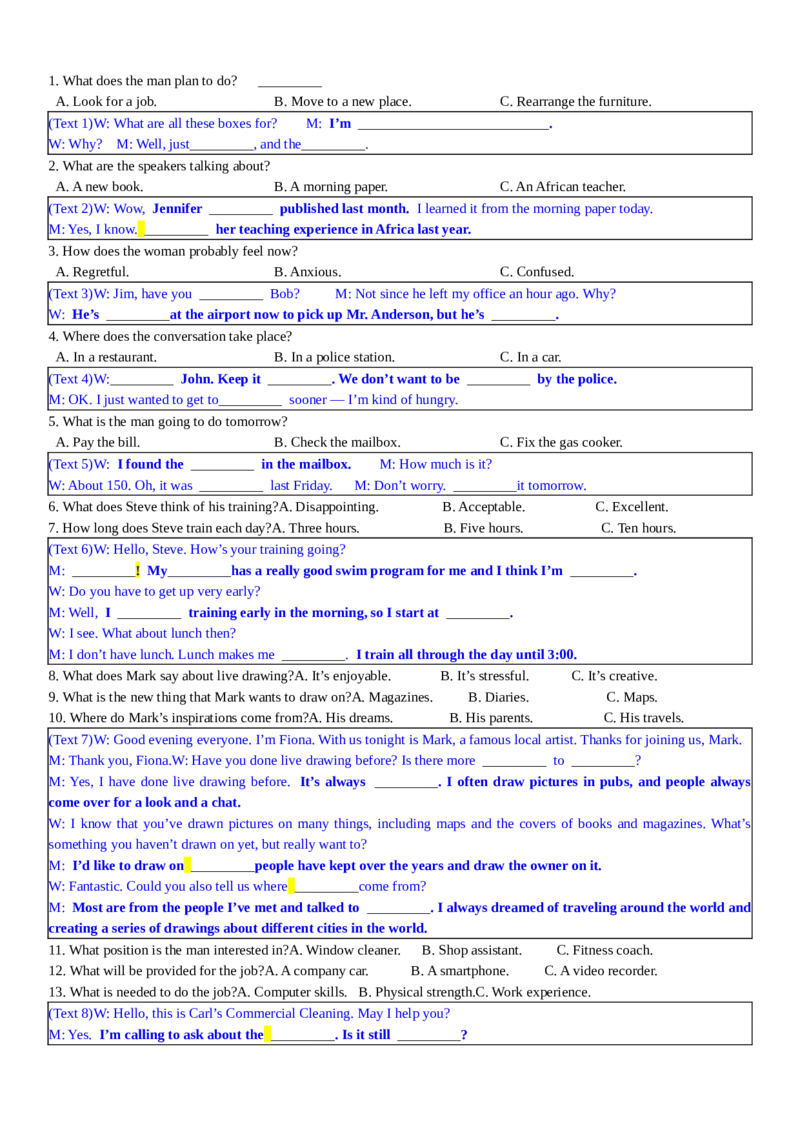
1. What does the man plan to do?   _________
A. Look for a job.
B. Move to a new place.
C. Rearrange the furniture.
(Text 1)W: What are all these boxes for?    M: I’m ___________________________.
W: Why?  M: Well, just_________, and the_________.
2. What are the speakers talking about?
A. A new book.
B. A morning paper.
C. An African teacher.
(Text 2)W: Wow, Jennifer _________ published last month. I learned it from the morning paper today.
M: Yes, I know. _________ her teaching experience in Africa last year.
3. How does the woman probably feel now?
A. Regretful.
B. Anxious.
C. Confused.
(Text 3)W: Jim, have you _________ Bob?     M: Not since he left my office an hour ago. Why?
W: He’s _________at the airport now to pick up Mr. Anderson, but he’s _________.
4. Where does the conversation take place?
A. In a restaurant.
B. In a police station.
C. In a car.
(Text 4)W:_________ John. Keep it _________. We don’t want to be _________ by the police.
M: OK. I just wanted to get to_________ sooner — I’m kind of hungry.
5. What is the man going to do tomorrow?
A. Pay the bill.
B. Check the mailbox.
C. Fix the gas cooker.
(Text 5)W: I found the _________ in the mailbox.    M: How much is it?
W: About 150. Oh, it was _________ last Friday.   M: Don’t worry. _________it tomorrow.
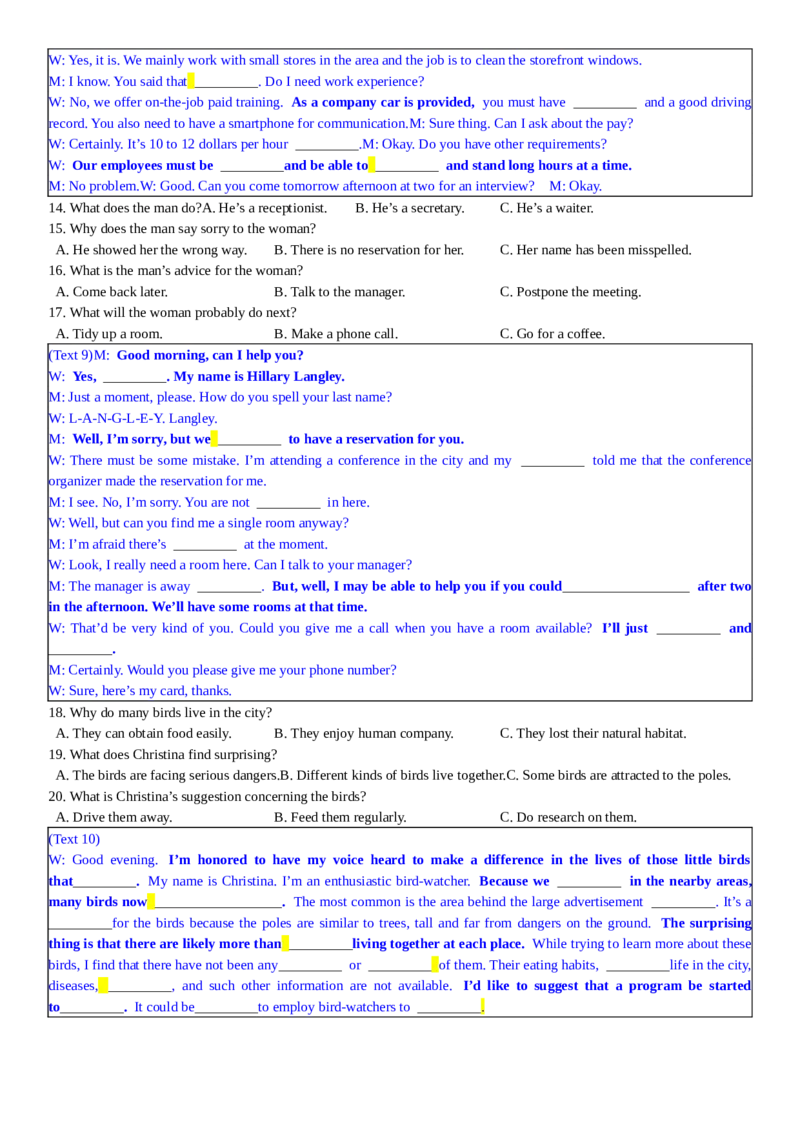
6. What does Steve think of his training?A. Disappointing.         B. Acceptable.          C. Excellent.
7. How long does Steve train each day?A. Three hours.
B. Five hours.           C. Ten hours.
(Text 6)W: Hello, Steve. How’s your training going?
M: _________! My_________has a really good swim program for me and I think I’m _________.
W: Do you have to get up very early?
M: Well, I _________ training early in the morning, so I start at _________.
W: I see. What about lunch then?
M: I don’t have lunch. Lunch makes me _________. I train all through the day until 3:00.
8. What does Mark say about live drawing?A. It’s enjoyable.       B. It’s stressful.      C. It’s creative.
9. What is the new thing that Mark wants to draw on?A. Magazines.     B. Diaries.           C. Maps.
10. Where do Mark’s inspirations come from?A. His dreams.        B. His parents.          C. His travels.
(Text 7)W: Good evening everyone. I’m Fiona. With us tonight is Mark, a famous local artist. Thanks for joining us, Mark.
M: Thank you, Fiona.W: Have you done live drawing before? Is there more _________ to _________?
M: Yes, I have done live drawing before. It’s always _________. I often draw pictures in pubs, and people always
come over for a look and a chat.
W: I know that you’ve drawn pictures on many things, including maps and the covers of books and magazines. What’s
something you haven’t drawn on yet, but really want to?
M: I’d like to draw on _________people have kept over the years and draw the owner on it.
W: Fantastic. Could you also tell us where _________come from?
M: Most are from the people I’ve met and talked to _________. I always dreamed of traveling around the world and
creating a series of drawings about different cities in the world.
11. What position is the man interested in?A. Window cleaner.   B. Shop assistant.
C. Fitness coach.
12. What will be provided for the job?A. A company car.      B. A smartphone.     C. A video recorder.
13. What is needed to do the job?A. Computer skills.
B. Physical strength.C. Work experience.
(Text 8)W: Hello, this is Carl’s Commercial Cleaning. May I help you?
M: Yes. I’m calling to ask about the _________. Is it still _________?
W: Yes, it is. We mainly work with small stores in the area and the job is to clean the storefront windows.
M: I know. You said that _________. Do I need work experience?
W: No, we offer on-the-job paid training. As a company car is provided, you must have _________ and a good driving
record. You also need to have a smartphone for communication.M: Sure thing. Can I ask about the pay?
W: Certainly. It’s 10 to 12 dollars per hour _________.M: Okay. Do you have other requirements?
W: Our employees must be _________and be able to _________ and stand long hours at a time.
M: No problem.W: Good. Can you come tomorrow afternoon at two for an interview?  M: Okay.
14. What does the man do?A. He’s a receptionist.    B. He’s a secretary.    C. He’s a waiter.
15. Why does the man say sorry to the woman?
A. He showed her the wrong way.
B. There is no reservation for her.
C. Her name has been misspelled.
16. What is the man’s advice for the woman?
A. Come back later.
B. Talk to the manager.
C. Postpone the meeting.
17. What will the woman probably do next?
A. Tidy up a room.
B. Make a phone call.
C. Go for a coffee.
(Text 9)M: Good morning, can I help you?
W: Yes, _________. My name is Hillary Langley.
M: Just a moment, please. How do you spell your last name?
W: L-A-N-G-L-E-Y. Langley.
M: Well, I’m sorry, but we _________ to have a reservation for you.
W: There must be some mistake. I’m attending a conference in the city and my _________ told me that the conference
organizer made the reservation for me.
M: I see. No, I’m sorry. You are not _________ in here.
W: Well, but can you find me a single room anyway?
M: I’m afraid there’s _________ at the moment.
W: Look, I really need a room here. Can I talk to your manager?
M: The manager is away _________. But, well, I may be able to help you if you could__________________ after two
in the afternoon. We’ll have some rooms at that time.
W: That’d be very kind of you. Could you give me a call when you have a room available? I’ll just _________ and
_________.
M: Certainly. Would you please give me your phone number?
W: Sure, here’s my card, thanks.
18. Why do many birds live in the city?
A. They can obtain food easily.
B. They enjoy human company.
C. They lost their natural habitat.
19. What does Christina find surprising?
A. The birds are facing serious dangers.B. Different kinds of birds live together.C. Some birds are attracted to the poles.
20. What is Christina’s suggestion concerning the birds?
A. Drive them away.
B. Feed them regularly.
C. Do research on them.
(Text 10)
W: Good evening. I’m honored to have my voice heard to make a difference in the lives of those little birds
that_________. My name is Christina. I’m an enthusiastic bird-watcher. Because we _________ in the nearby areas,
many birds now __________________. The most common is the area behind the large advertisement _________. It’s a
_________for the birds because the poles are similar to trees, tall and far from dangers on the ground. The surprising
thing is that there are likely more than _________living together at each place. While trying to learn more about these
birds, I find that there have not been any_________ or _________ of them. Their eating habits, _________life in the city,
diseases, _________, and such other information are not available. I’d like to suggest that a program be started
to_________. It could be_________to employ bird-watchers to _________.
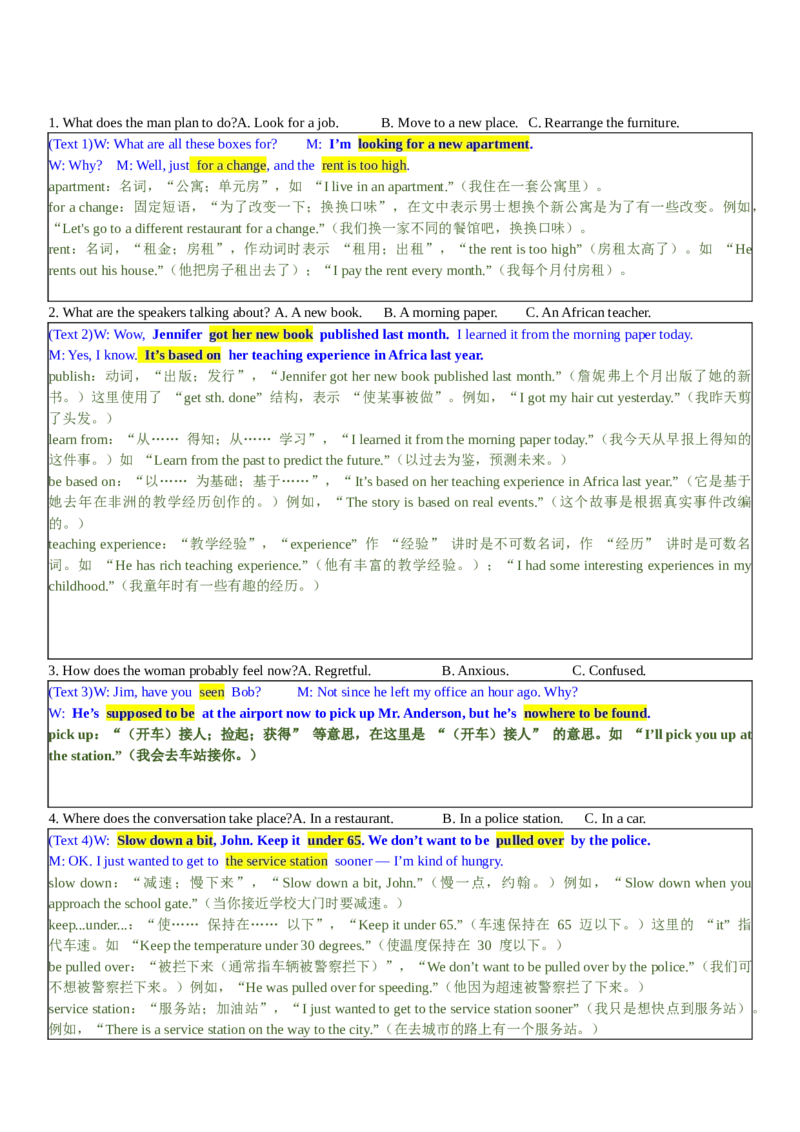
1. What does the man plan to do?A. Look for a job.      B. Move to a new place. C. Rearrange the furniture.
(Text 1)W: What are all these boxes for?    M: I’m looking for a new apartment.
W: Why?  M: Well, just for a change, and the rent is too high.
apartment:名词,“公寓;单元房”,如 “I live in an apartment.”(我住在一套公寓里)。
for a change:固定短语,“为了改变一下;换换口味”,在文中表示男士想换个新公寓是为了有一些改变。例如,
“Let's go to a different restaurant for a change.”(我们换一家不同的餐馆吧,换换口味)。
rent:名词,“租金;房租”,作动词时表示 “租用;出租”,“the rent is too high”(房租太高了)。如 “He
rents out his house.”(他把房子租出去了);“I pay the rent every month.”(我每个月付房租)。
2. What are the speakers talking about? A. A new book.   B. A morning paper.    C. An African teacher.
(Text 2)W: Wow, Jennifer got her new book published last month. I learned it from the morning paper today.
M: Yes, I know. It’s based on her teaching experience in Africa last year.
publish:动词,“出版;发行”,“Jennifer got her new book published last month.”(詹妮弗上个月出版了她的新
书。)这里使用了 “get sth. done” 结构,表示 “使某事被做”。例如,“I got my hair cut yesterday.”(我昨天剪
了头发。)
learn from:“从…… 得知;从…… 学习”,“I learned it from the morning paper today.”(我今天从早报上得知的
这件事。)如 “Learn from the past to predict the future.”(以过去为鉴,预测未来。)
be based on:“以…… 为基础;基于……”,“It’s based on her teaching experience in Africa last year.”(它是基于
她去年在非洲的教学经历创作的。)例如,“The story is based on real events.”(这个故事是根据真实事件改编
的。)
teaching experience:“教学经验”,“experience” 作 “经验” 讲时是不可数名词,作 “经历” 讲时是可数名
词。如 “He has rich teaching experience.”(他有丰富的教学经验。);“I had some interesting experiences in my
childhood.”(我童年时有一些有趣的经历。)
3. How does the woman probably feel now?A. Regretful.          B. Anxious.         C. Confused.
(Text 3)W: Jim, have you seen Bob?     M: Not since he left my office an hour ago. Why?
W: He’s supposed to be at the airport now to pick up Mr. Anderson, but he’s nowhere to be found.
pick up:“(开车)接人;捡起;获得” 等意思,在这里是 “(开车)接人” 的意思。如 “I’ll pick you up at
the station.”(我会去车站接你。)
4. Where does the conversation take place?A. In a restaurant.       B. In a police station.
C. In a car.
(Text 4)W: Slow down a bit, John. Keep it under 65. We don’t want to be pulled over by the police.
M: OK. I just wanted to get to the service station sooner — I’m kind of hungry.
slow down:“减速;慢下来”,“Slow down a bit, John.”(慢一点,约翰。)例如,“Slow down when you
approach the school gate.”(当你接近学校大门时要减速。)
keep...under...:“使…… 保持在…… 以下”,“Keep it under 65.”(车速保持在 65 迈以下。)这里的 “it” 指
代车速。如 “Keep the temperature under 30 degrees.”(使温度保持在 30 度以下。)
be pulled over:“被拦下来(通常指车辆被警察拦下)”,“We don’t want to be pulled over by the police.”(我们可
不想被警察拦下来。)例如,“He was pulled over for speeding.”(他因为超速被警察拦了下来。)
service station:“服务站;加油站”,“I just wanted to get to the service station sooner”(我只是想快点到服务站)。
例如,“There is a service station on the way to the city.”(在去城市的路上有一个服务站。)
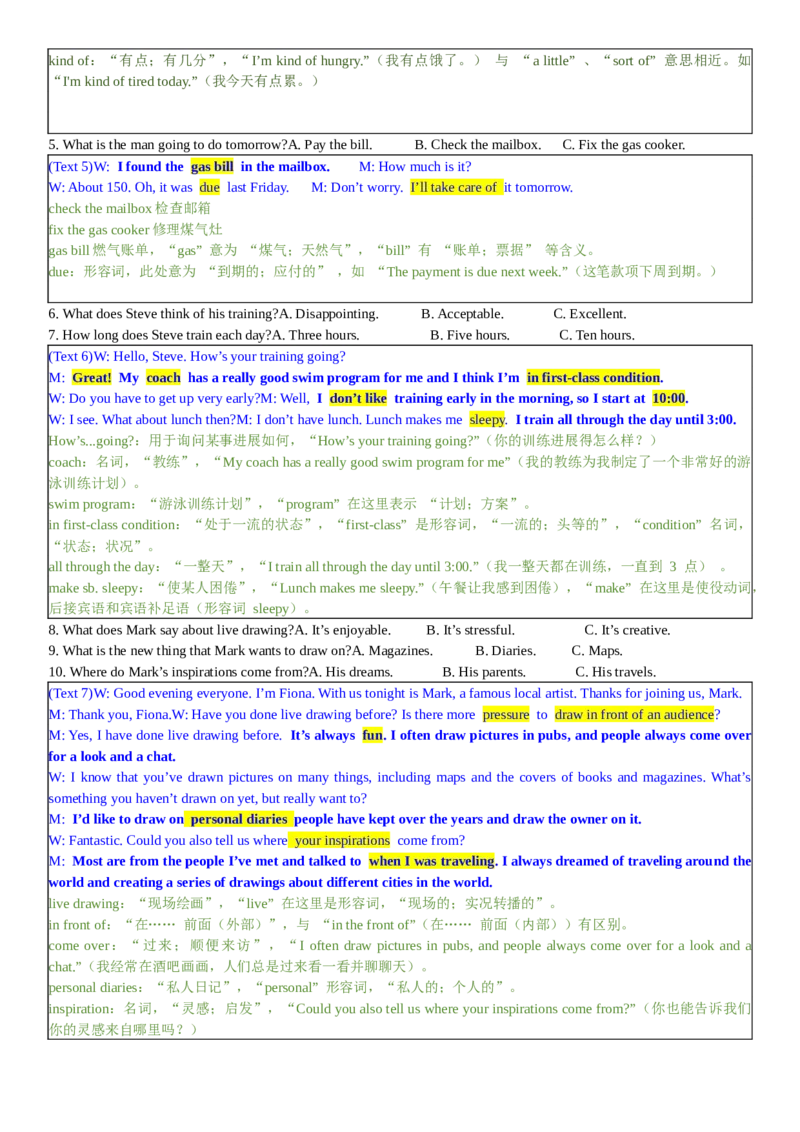
kind of:“有点;有几分”,“I’m kind of hungry.”(我有点饿了。) 与 “a little” 、“sort of” 意思相近。如
“I'm kind of tired today.”(我今天有点累。)
5. What is the man going to do tomorrow?A. Pay the bill.      B. Check the mailbox.   C. Fix the gas cooker.
(Text 5)W: I found the gas bill in the mailbox.    M: How much is it?
W: About 150. Oh, it was due last Friday.   M: Don’t worry. I’ll take care of it tomorrow.
check the mailbox 检查邮箱
fix the gas cooker 修理煤气灶
gas bill 燃气账单,“gas” 意为 “煤气;天然气”,“bill” 有 “账单;票据” 等含义。
due:形容词,此处意为 “到期的;应付的” ,如 “The payment is due next week.”(这笔款项下周到期。)
6. What does Steve think of his training?A. Disappointing.      B. Acceptable.       C. Excellent.
7. How long does Steve train each day?A. Three hours.          B. Five hours.       C. Ten hours.
(Text 6)W: Hello, Steve. How’s your training going?
M: Great! My coach has a really good swim program for me and I think I’m in first-class condition.
W: Do you have to get up very early?M: Well, I don’t like training early in the morning, so I start at 10:00.
W: I see. What about lunch then?M: I don’t have lunch. Lunch makes me sleepy. I train all through the day until 3:00.
How’s...going?:用于询问某事进展如何,“How’s your training going?”(你的训练进展得怎么样?)
coach:名词,“教练”,“My coach has a really good swim program for me”(我的教练为我制定了一个非常好的游
泳训练计划)。
swim program:“游泳训练计划”,“program” 在这里表示 “计划;方案”。
in first-class condition:“处于一流的状态”,“first-class” 是形容词,“一流的;头等的”,“condition” 名词,
“状态;状况”。
all through the day:“一整天”,“I train all through the day until 3:00.”(我一整天都在训练,一直到 3 点) 。
make sb. sleepy:“使某人困倦”,“Lunch makes me sleepy.”(午餐让我感到困倦),“make” 在这里是使役动词,
后接宾语和宾语补足语(形容词 sleepy)。
8. What does Mark say about live drawing?A. It’s enjoyable.     B. It’s stressful.
C. It’s creative.
9. What is the new thing that Mark wants to draw on?A. Magazines.      B. Diaries.     C. Maps.
10. Where do Mark’s inspirations come from?A. His dreams.       B. His parents.       C. His travels.
(Text 7)W: Good evening everyone. I’m Fiona. With us tonight is Mark, a famous local artist. Thanks for joining us, Mark.
M: Thank you, Fiona.W: Have you done live drawing before? Is there more pressure to draw in front of an audience?
M: Yes, I have done live drawing before. It’s always fun. I often draw pictures in pubs, and people always come over
for a look and a chat.
W: I know that you’ve drawn pictures on many things, including maps and the covers of books and magazines. What’s
something you haven’t drawn on yet, but really want to?
M: I’d like to draw on personal diaries people have kept over the years and draw the owner on it.
W: Fantastic. Could you also tell us where your inspirations come from?
M: Most are from the people I’ve met and talked to when I was traveling. I always dreamed of traveling around the
world and creating a series of drawings about different cities in the world.
live drawing:“现场绘画”,“live” 在这里是形容词,“现场的;实况转播的”。
in front of:“在…… 前面(外部)”,与 “in the front of”(在…… 前面(内部))有区别。
come over:“过来;顺便来访”,“I often draw pictures in pubs, and people always come over for a look and a
chat.”(我经常在酒吧画画,人们总是过来看一看并聊聊天)。
personal diaries:“私人日记”,“personal” 形容词,“私人的;个人的”。
inspiration:名词,“灵感;启发”,“Could you also tell us where your inspirations come from?”(你也能告诉我们
你的灵感来自哪里吗?)
a series of:“一系列;一连串”,“I always dreamed of traveling around the world and creating a series of drawings
about different cities in the world.”(我一直梦想着环游世界并创作一系列关于世界不同城市的画作)。
11. What position is the man interested in?A. Window cleaner.     B. Shop assistant.
C. Fitness coach.
12. What will be provided for the job?A. A company car.         B. A smartphone.
C. A video recorder.
13. What is needed to do the job?A. Computer skills.
B. Physical strength.
C. Work experience.
(Text 8)W: Hello, this is Carl’s Commercial Cleaning. May I help you?
M: Yes. I’m calling to ask about the cleaner position. Is it still available?
W: Yes, it is. We mainly work with small stores in the area and the job is to clean the storefront windows.
M: I know. You said that in the ad. Do I need work experience?
W: No, we offer on-the-job paid training. As a company car is provided, you must have a driver’s license and a good
driving record. You also need to have a smartphone for communication.
M: Sure thing. Can I ask about the pay?W: Certainly. It’s 10 to 12 dollars per hour plus tips.
M: Okay. Do you have other requirements?
W: Our employees must be dependable and be able to lift heavy things and stand long hours at a time.
M: No problem.W: Good. Can you come tomorrow afternoon at two for an interview?  M: Okay.
commercial:形容词,意为 “商业的;商务的”,如 “Carl’s Commercial Cleaning”(卡尔的商业清洁公司)。
available:形容词,“可获得的;有空的;可利用的”,“Is it still available?”(这个职位还空缺吗?)
storefront:名词,“店面;店堂”,“the job is to clean the storefront windows”(工作是清洁店面的窗户)。
ad:名词,“广告”,是 “advertisement” 的缩写,“You said that in the ad.”(你在广告里提到过那个)。
on-the-job:复合形容词,“在职的”,“on-the-job paid training”(在职带薪培训)。
license:名词,“许可证;执照”,“driver’s license”(驾照)。
dependable:形容词,“可靠的;可信赖的”,“ Our employees must be dependable...” (我们的员工必须可
靠……)。
call to do sth.:打电话做某事,“I’m calling to ask about the cleaner position.”(我打电话来询问清洁工职位的情况)。
work with:与…… 合作;在…… 工作,“We mainly work with small stores in the area...”(我们主要和这个地区的
小商店合作……)。
plus tips:加上小费,“It’s 10 to 12 dollars per hour plus tips.”(每小时 10 到 12 美元,外加小费)。
14. What does the man do?A. He’s a receptionist.    B. He’s a secretary.    C. He’s a waiter.
15. Why does the man say sorry to the woman?
A. He showed her the wrong way.
B. There is no reservation for her.
C. Her name has been misspelled.
16. What is the man’s advice for the woman?
A. Come back later.
B. Talk to the manager.
C. Postpone the meeting.
17. What will the woman probably do next?
A. Tidy up a room.
B. Make a phone call.
C. Go for a coffee.
(Text 9)M: Good morning, can I help you?
W: Yes, I’ve got a reservation. My name is Hillary Langley.
M: Just a moment, please. How do you spell your last name?
W: L-A-N-G-L-E-Y. Langley.
M: Well, I’m sorry, but we don’t seem to have a reservation for you.
W: There must be some mistake. I’m attending a conference in the city and my secretary told me that the conference
organizer made the reservation for me.
M: I see. No, I’m sorry. You are not booked in here.
W: Well, but can you find me a single room anyway?
M: I’m afraid there’s nothing available at the moment.
W: Look, I really need a room here. Can I talk to your manager?
M: The manager is away on business. But, well, I may be able to help you if you could wait and prepare to check in
after two in the afternoon. We’ll have some rooms at that time.
W: That’d be very kind of you. Could you give me a call when you have a room available? I’ll just wander around and
have some coffee.
M: Certainly. Would you please give me your phone number?
W: Sure, here’s my card, thanks.
reservation:名词,“预订;预约”,“I’ve got a reservation.”(我有一个预订)。
attend:动词,“参加;出席”,“I’m attending a conference in the city”(我要参加在这个城市的一个会议)。
organizer:名词,“组织者;主办者”,“my secretary told me that the conference organizer made the reservation for
me.”(我的秘书告诉我会议组织者为我做了预订)。
available:形容词,“可获得的;有空的;可利用的”,“I’m afraid there’s nothing available at the moment.”(恐怕
目前没有可用的房间了)。
wander:动词,“徘徊;闲逛;漫步”,“I’ll just wander around and have some coffee.”(我就四处逛逛,然后喝杯
咖啡)。
check in:“(在旅馆、机场等)登记;报到”,“prepare to check in after two in the afternoon”(准备在下午两点
之后办理入住)。
18. Why do many birds live in the city?
A. They can obtain food easily.
B. They enjoy human company.
C. They lost their natural habitat.
19. What does Christina find surprising?
A. The birds are facing serious dangers.
B. Different kinds of birds live together.
C. Some birds are attracted to the poles.
20. What is Christina’s suggestion concerning the birds?
A. Drive them away.
B. Feed them regularly.
C. Do research on them.
(Text 10)
W: Good evening. I’m honored to have my voice heard to make a difference in the lives of those little birds that
share our city. My name is Christina. I’m an enthusiastic bird-watcher. Because we cut down too many trees in the
nearby areas, many birds now find places within the city to live. The most common is the area behind the large
advertisement boards on the poles. It’s a natural choice for the birds because the poles are similar to trees, tall and far from
dangers on the ground. The surprising thing is that there are likely more than five or six kinds of birds living
together at each place. While trying to learn more about these birds, I find that there have not been any consistent studies
or monitoring of them. Their eating habits, adaptation to life in the city, diseases, death rate, and such other information
are not available. I’d like to suggest that a program be started to study these birds. It could be convenient to employ
bird-watchers to do the initial studies.
honored:形容词,“荣幸的;受尊敬的”,“I’m honored to have my voice heard...”(我很荣幸能让我的声音被听
到……)。
enthusiastic:形容词,“热情的;热心的”,“I’m an enthusiastic bird-watcher.”(我是一个热情的观鸟者)。
monitoring:名词,“监测;监视”,“there have not been any consistent studies or monitoring of them”(还没有对它
们进行任何持续的研究或监测),其动词形式是 “monitor”。
adaptation:名词,“适应;改编”,“Their eating habits, adaptation to life in the city...”(它们的饮食习惯,对城市
生活的适应……),动词形式是 “adapt”,常见搭配 “adapt to” 表示 “适应”。
initial:形容词,“最初的;开始的”,“It could be convenient to employ bird-watchers to do the initial studies.”(雇
佣观鸟者做初步研究可能会很方便)。
参考答案
1. B   2. A   3. B   4. C   5. A   6. C   7. B   8. A   9. B   10. C
11. A   12. A   13. B   14. A   15. B   16. A   17. C   18. C   19. B   20. C