文档文本内容
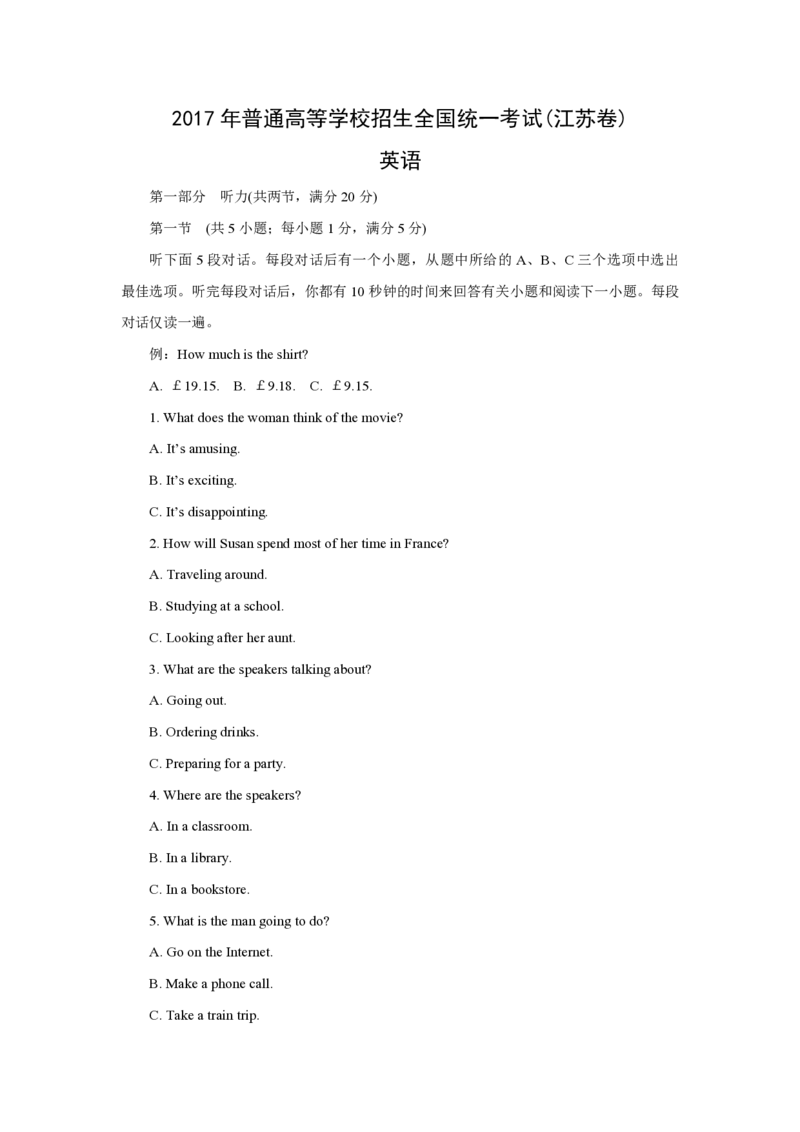
2017 年普通高等学校招生全国统一考试(江苏卷)
英语
第一部分 听力(共两节,满分20 分)
第一节 (共5 小题;每小题1 分,满分5 分)
听下面5 段对话。每段对话后有一个小题,从题中所给的A、B、C 三个选项中选出
最佳选项。听完每段对话后,你都有10 秒钟的时间来回答有关小题和阅读下一小题。每段
对话仅读一遍。
例:How much is the shirt?
A. £19.15. B. £9.18. C. £9.15.
1. What does the woman think of the movie?
A. It’s amusing.
B. It’s exciting.
C. It’s disappointing.
2. How will Susan spend most of her time in France?
A. Traveling around.
B. Studying at a school.
C. Looking after her aunt.
3. What are the speakers talking about?
A. Going out.
B. Ordering drinks.
C. Preparing for a party.
4. Where are the speakers?
A. In a classroom.
B. In a library.
C. In a bookstore.
5. What is the man going to do?
A. Go on the Internet.
B. Make a phone call.
C. Take a train trip.
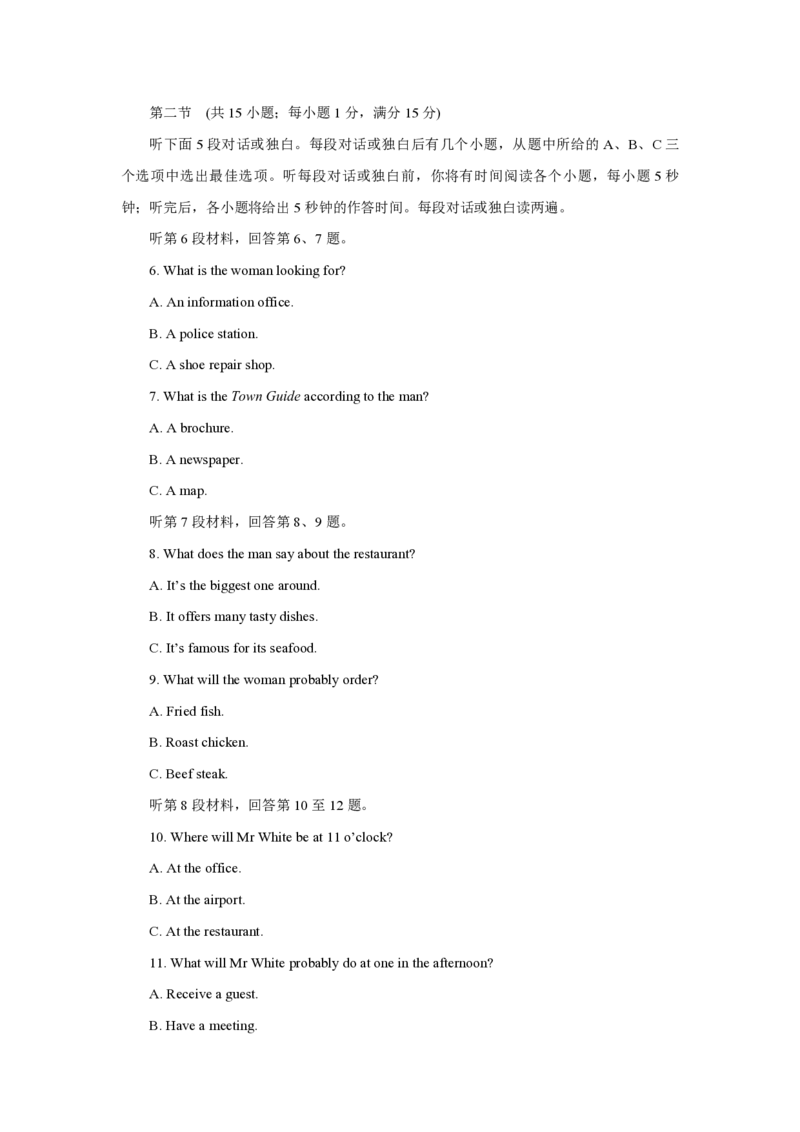
第二节 (共15 小题;每小题1 分,满分15 分)
听下面5 段对话或独白。每段对话或独白后有几个小题,从题中所给的A、B、C 三
个选项中选出最佳选项。听每段对话或独白前,你将有时间阅读各个小题,每小题5 秒
钟;听完后,各小题将给出5 秒钟的作答时间。每段对话或独白读两遍。
听第6 段材料,回答第6、7 题。
6. What is the woman looking for?
A. An information office.
B. A police station.
C. A shoe repair shop.
7. What is the Town Guide according to the man?
A. A brochure.
B. A newspaper.
C. A map.
听第7 段材料,回答第8、9 题。
8. What does the man say about the restaurant?
A. It’s the biggest one around.
B. It offers many tasty dishes.
C. It’s famous for its seafood.
9. What will the woman probably order?
A. Fried fish.
B. Roast chicken.
C. Beef steak.
听第8 段材料,回答第10 至12 题。
10. Where will Mr White be at 11 o’clock?
A. At the office.
B. At the airport.
C. At the restaurant.
11. What will Mr White probably do at one in the afternoon?
A. Receive a guest.
B. Have a meeting.
C. Read a report.
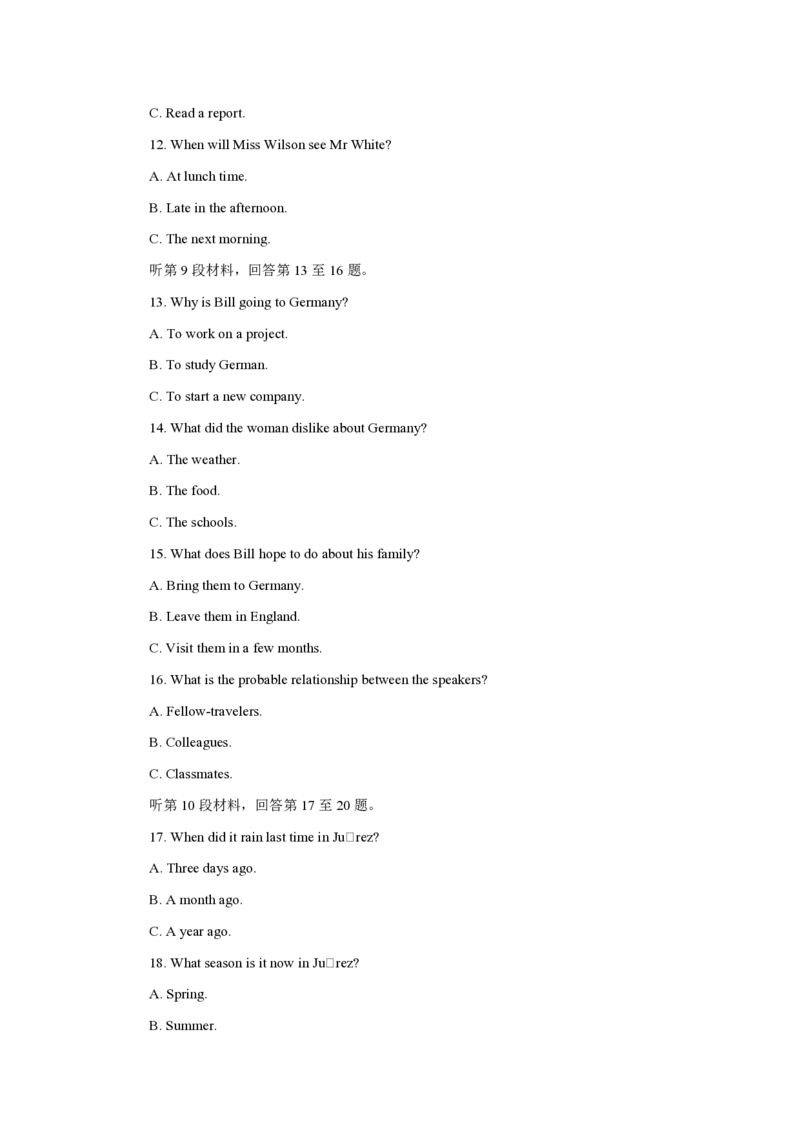
12. When will Miss Wilson see Mr White?
A. At lunch time.
B. Late in the afternoon.
C. The next morning.
听第9 段材料,回答第13 至16 题。
13. Why is Bill going to Germany?
A. To work on a project.
B. To study German.
C. To start a new company.
14. What did the woman dislike about Germany?
A. The weather.
B. The food.
C. The schools.
15. What does Bill hope to do about his family?
A. Bring them to Germany.
B. Leave them in England.
C. Visit them in a few months.
16. What is the probable relationship between the speakers?
A. Fellowtravelers.
B. Colleagues.
C. Classmates.
听第10 段材料,回答第17 至20 题。
17. When did it rain last time in Jurez?
A. Three days ago.
B. A month ago.
C. A year ago.
18. What season is it now in Jurez?
A. Spring.
B. Summer.
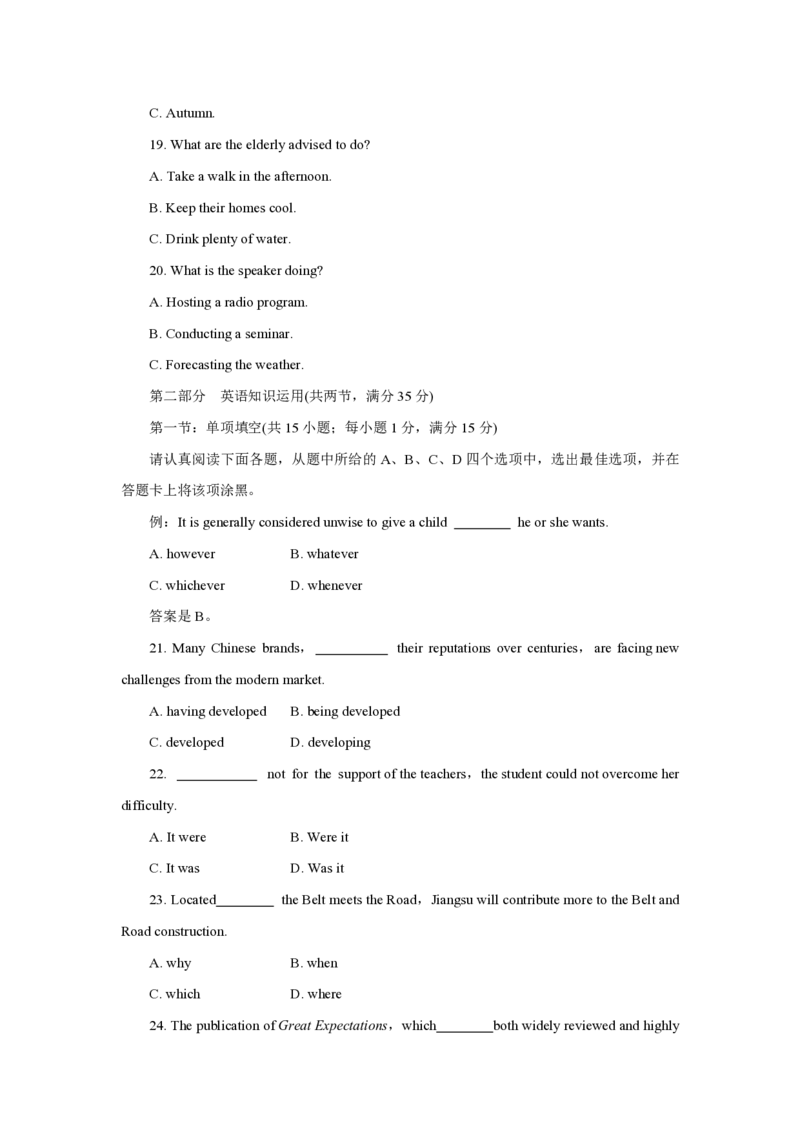
C. Autumn.
19. What are the elderly advised to do?
A. Take a walk in the afternoon.
B. Keep their homes cool.
C. Drink plenty of water.
20. What is the speaker doing?
A. Hosting a radio program.
B. Conducting a seminar.
C. Forecasting the weather.
第二部分 英语知识运用(共两节,满分35 分)
第一节:单项填空(共15 小题;每小题1 分,满分15 分)
请认真阅读下面各题,从题中所给的A、B、C、D 四个选项中,选出最佳选项,并在
答题卡上将该项涂黑。
例:It is generally considered unwise to give a child
he or she wants.
A. however
B. whatever
C. whichever
D. whenever
答案是B。
21. Many Chinese brands, their reputations over centuries,are facing new
challenges from the modern market.
A. having developed B. being developed
C. developed
D. developing
22. not for the support of the teachers,the student could not overcome her
difficulty.
A. It were
B. Were it
C. It was
D. Was it
23. Located the Belt meets the Road,Jiangsu will contribute more to the Belt and
Road construction.
A. why
B. when
C. which
D. where
24. The publication of Great Expectations,which both widely reviewed and highly
praised,strengthened Dickens’ status as a leading novelist.
A. is
B. are
C. was
D. were
25. Working with the medical team in Africa has
the best in her as a doctor.
A. held out
B. brought out
C. picked out
D. given out
26. We choose this hotel because the price for a night here is down to 20,half of
it used to charge.
A. that
B. which
C. what
D. how
27. He hurried home,never once looking back to see if he
.
A. was being followed
B. was following
C. had been followed
D. followed
28. In 1963 the UN set up the World Food Programme,one of purposes is to
relieve worldwide starvation.
A. which
B. its
C. whose
D. whom
29. Only five years after Steve Jobs’ death,smartphones defeated
PCs in sales.
A. controversial
B. contradictory
C. confidential
D. conventional
30. A quick review of successes and failures at the end of year will help your year
ahead.
A. shape
B. switch
C. stretch
D. sharpen
31. He’s been informed that he for the scholarship because of his academic
background.
A. hasn’t qualified
B. hadn’t qualified
C. doesn’t qualify
D. wasn’t qualifying
32. Determining where we are our surroundings remains an essential skill for our
survival.
A. in contrast to
B. in defense of
C. in face of
D. in relation to
33. —What does the stuff on your Tshirt mean?
—It’s nothing.Just something
.
A. as clear as day
B. off the top of my head
C. under my nose
D. beyond my wildest dreams
34. The disappearance of dinosaurs is not necessarily caused by astronomical incidents.But
explanations are hard to find.
A. alternative
B. aggressive
C. ambiguous
D. apparent
35. —Going to watch the Women’s Volleyball Match on Wednesday?
—
!Will you go with me?
A. You there
B. You bet
C. You got me
D. You know better
第二节:完形填空(共20 小题;每小题1 分,满分20 分)
请认真阅读下面短文,从短文后各题所给的A、B、C、D 四个选项中,选出最佳选
项,并在答题卡上将该项涂黑。
For a long time Gabriel didn’t want to be involved in music at all.In his first years of high
school,Gabriel would look pityingly at the music students, 36 across the campus with
their heavy instrument cases, 37 at school for practice hours 38 anyone else had to be
there.He swore to himself to 39 music,as he hated getting to school extra early.
40 ,one day,in the music class that was 41 of his school’s standard curriculum,
he was playing idly (随意地) on the piano and found it 42 to pick out tunes.With a sinking
feeling,he realized that he actually 43 doing it.He tried to hide his 44 pleasure from
the music teacher,who had 45 over to listen.He might not have done this particularly
well, 46 the teacher told Gabriel that he had a good 47 and suggested that Gabriel go
into the music storeroom to see if any of the instruments there 48 him.There he decided to
give the cello(大提琴) a 49 .When he began practicing,he took it very 50 .But he
quickly found that he loved playing this instrument,and was 51 to practicing it so that
within a couple of months he was playing reasonably well.
This 52 ,of course,that he arrived at school early in the morning, 53 his heavy
instrument case across the campus to the 54 looks of the nonmusicians he had left 55 .
36. A.travelling
B. marching
C. pacing
D. struggling
37. A.rising up
B. coming up
C. driving up
D. turning up
38. A.before
B. after
C. until
D. since
39. A.betray
B. accept
C. avoid
D. appreciate
40. A.Therefore
B. However
C. Thus
D. Moreover
41. A.part
B. nature
C. basis
D. spirit
42. A.complicated
B. safe
C. confusing
D. easy
43. A.missed
B. disliked
C. enjoyed
D. denied
44. A.transparent
B. obvious
C. false
D. similar
45. A.run
B. jogged
C. jumped
D. wandered
46. A.because
B. but
C. though
D. so
47. A.ear
B. taste
C. heart
D. voice
48. A.occurred to
B. took to
C. appealed to
D. held to
49. A.change
B. chance
C. mission
D. function
50. A.seriously
B. proudly
C. casually
D. naturally
51. A.committed
B. used
C. limited
D. admitted
52. A.proved
B. showed
C. stressed
D. meant
53. A.pushing
B. dragging
C. lifting
D. rushing
54. A.admiring
B. pitying
C. annoying D. teasing
55. A.over
B. aside
C. behind
D. out
第三部分 阅读理解(共15 小题;每小题2 分,满分30 分)
请认真阅读下列短文,从短文后各题所给的A、B、C、D 四个选项中,选出最佳选
项,并在答题卡上将该项涂黑。
A
56. What is CHRONOLOGICA according to the text?
A. A biography.
B. A travel guide.
C. A history book.
D. A science fiction.
57. How does the writer recommend CHRONOLOGICA to readers?
A. By giving details of its collection.
B. By introducing some of its contents.
C. By telling stories at the beginning.
D. By comparing it with other books.
B
Before birth,babies can tell the difference between loud sounds and voices.They can even
distinguish their mother’s voice from that of a female stranger.But when it comes to embryonic
learning(胎教),birds could rule the roost.As recently reported in The Auk:Ornithological
Advances,some mother birds may teach their young to sing even before they hatch(孵化).
Newborn chicks can then imitate their mom’s call within a few days of entering the world.
This educational method was first observed in 2012 by Sonia Kleindorfer,a biologist at
Flinders University in South Australia,and her colleagues.Female Australian superb fairy wrens
were found to repeat one sound over and over again while hatching their eggs.When the eggs were
hatched,the baby birds made the similar chirp to their mothers—a sound that served as their
regular “feed me!” call.
To find out if the special quality was more widespread in birds,the researchers sought the
redbacked fairy wren,another species of Australian songbird.First they collected sound data
from 67 nests in four sites in Queensland before and after hatching.Then they identified begging
calls by analyzing the order and number of notes.A computer analysis blindly compared calls
produced by mothers and chicks,ranking them by similarity.
It turns out that baby redbacked fairy wrens also emerge chirping like their moms.And the
more frequently mothers had called to their eggs,the more similar were the babies’ begging
calls.In addition,the team set up a separate experiment that suggested that the baby birds that
most closely imitated their mom’s voice were rewarded with the most food.
This observation hints that effective embryonic learning could signal neurological(神经系统
的) strengths of children to parents.An evolutionary inference can then be drawn.“As a parent,do
you invest in quality children,or do you invest in children that are in need?” Kleindorfer
asks.“Our results suggest that they might be going for quality.”
58. The underlined phrase in Paragraph 1 means “
”.
A. be the worst
B. be the best
C. be just as bad D. be just as good
59. What are Kleindorfer’s findings based on?
A. Similarities between the calls of moms and chicks.
B. The observation of fairy wrens across Australia.
C. The data collected from Queensland’s locals.
D. Controlled experiments on wrens and other birds.
60. Embryonic learning helps mother birds to identify the baby birds which
.
A. can receive quality signals
B. are in need of training
C. fit the environment better
D. make the loudest call
C
A new commodity brings about a highly profitable,fastgrowing industry,urging
antitrust(反垄断) regulators to step in to check those who control its flow.A century ago,the
resource in question was oil.Now similar concerns are being raised by the giants(巨头) that deal in
data,the oil of the digital age.The most valuable firms are Google,Amazon,Facebook and
Microsoft.All look unstoppable.
Such situations have led to calls for the tech giants to be broken up.But size alone is not a
crime.The giants’ success has benefited consumers.Few want to live without search engines or a
quick delivery.Far from charging consumers high prices,many of these services are free (users
pay,in effect,by handing over yet more data). And the appearance of newborn giants suggests
that newcomers can make waves,too.
But there is cause for concern.The internet has made data abundant,allpresent and far more
valuable,changing the nature of data and competition.Google initially used the data collected
from users to target advertising better.But recently it has discovered that data can be turned into
new services:translation and visual recognition,to be sold to other companies.Internet
companies’ control of data gives them enormous power.So they have a “God’s eye view” of
activities in their own markets and beyond.
This nature of data makes the antitrust measures of the past less useful.Breaking up firms like
Google into five small ones would not stop remaking themselves:in time,one of them would
become great again.A rethink is required—and as a new approach starts to become apparent,two
ideas stand out.
The first is that antitrust authorities need to move from the industrial age into the 21st
century.When considering a merger(兼并),for example,they have traditionally used size to
determine when to step in.They now need to take into account the extent of firms’ data assets(资
产) when assessing the impact of deals.The purchase price could also be a signal that an
established company is buying a newborn threat.When this takes place,especially when a
newborn company has no revenue to speak of,the regulators should raise red flags.
The second principle is to loosen the control that providers of online services have over data
and give more to those who supply them.Companies could be forced to reveal to consumers what
information they hold and how much money they make from it.Governments could order the
sharing of certain kinds of data,with users’ consent.
Restarting antitrust for the information age will not be easy.But if governments don’t want a
data economy controlled by a few giants,they must act soon.
61. Why is there a call to break up giants?
A. They have controlled the data market.
B. They collect enormous private data.
C. They no longer provide free services.
D. They dismissed some newborn giants.
62. What does the technological innovation in Paragraph 3 indicate?
A. Data giants’ technology is very expensive.
B. Google’s idea is popular among data firms.
C. Data can strengthen giants’ controlling position.
D. Data can be turned into new services or products.
63. By paying attention to firms’ data assets,antitrust regulators could
.
A. kill a new threat
B. avoid the size trap
C. favour bigger firms
D. charge higher prices
64. What is the purpose of loosening the giants’ control of data?
A. Big companies could relieve data security pressure.
B. Governments could relieve their financial pressure.
C. Consumers could better protect their privacy.
D. Small companies could get more opportunities.
D
Old Problem,New Approaches
While clean energy is increasingly used in our daily life,global warming will continue for
some decades after CO2 emissions(排放) peak.So even if emissions were to begin to decrease
today,we would still face the challenge of adapting to climate change.Here I will stress some
smarter and more creative examples of climate adaptation.
When it comes to adaptation,it is important to understand that climate change is a
process.We are therefore not talking about adapting to a new standard,but to a constantly
shifting set of conditions.This is why,in part at least,the US National Climate Assessment says
that:“There is no ‘onesize fits all’ adaptation.” Nevertheless,there are some actions that offer
much and carry little risk or cost.
Around the world,people are adapting in surprising ways,especially in some poor
countries.Floods have become more damaging in Bangladesh in recent decades.Mohammed
Rezwan saw opportunity where others saw only disaster.His notforprofit organization runs 100
river boats that serve as floating libraries,schools,and health clinics,and are equipped with
solar panels and other communicating facilities.Rezwan is creating floating connectivity(连接) to
replace flooded roads and highways.But he is also working at a far more fundamental level:his
staff show people how to make floating gardens and fish ponds to prevent starvation during the
wet season.
Elsewhere in Asia even more astonishing actions are being taken.Chewang Norphel lives in a
mountainous region in India,where he is known as the Ice Man.The loss of glaciers(冰川) there
due to global warming represents an enormous threat to agriculture.Without the glaciers,water
will arrive in the rivers at times when it can damage crops.Norphel’s inspiration came from seeing
the waste of water over winter,when it was not needed.He directed the wasted water into shallow
basins where it froze,and was stored until the spring.His fields of ice supply perfectly timed
irrigation(灌溉) water.Having created nine such ice reserves,Norphel calculates that he has
stored about 200,000m3 of water.Climate change is a continuing process,so Norphel’s ice
reserves will not last forever.Warming will overtake them.But he is providing a few years during
which the farmers will,perhaps,be able to find other means of adapting.
Increasing Earth’s reflectiveness can cool the planet.In southern Spain the sudden increase of
greenhouses (which reflect light back to space) has changed the warming trend locally,and
actually cooled the region.While Spain as a whole is heating up quickly,temperatures near the
greenhouses have decreased.This example should act as an inspiration for all cities.By painting
buildings white,cities may slow down the warming process.
In Peru,local farmers around a mountain with a glacier that has already fallen victim to
climate change have begun painting the entire mountain peak white in the hope that the added
reflectiveness will restore the lifegiving ice.The outcome is still far from clear.But the World
Bank has included the project on its list of “100 ideas to save the planet”.
More ordinary forms of adaptation are happening everywhere.A friend of mine owns an area
of land in western Victoria.Over five generations the land has been too wet for cropping.But
during the past decade declining rainfall has allowed him to plant highly profitable crops.Farmers
in many countries are also adapting like this—either by growing new produce,or by growing the
same things differently.This is common sense.But some suggestions for adapting are not.When the
polluting industries argue that we’ve lost the battle to control carbon pollution and have no choice
but to adapt,it’s a nonsense designed to make the case for business as usual.
Human beings will continue to adapt to the changing climate in both ordinary and astonishing
ways.But the most sensible form of adaptation is surely to adapt our energy systems to emit less
carbon pollution.After all,if we adapt in that way,we may avoid the need to change in so many
others.
65. The underlined part in Paragraph 2 implies
.
A. adaptation is an everchanging process
B. the cost of adaptation varies with time
C. global warming affects adaptation forms
D. adaptation to climate change is challenging
66. What is special with regard to Rezwan’s project?
A. The project receives government support.
B. Different organizations work with each other.
C. His organization makes the best of a bad situation.
D. The project connects flooded roads and highways.
67. What did the Ice Man do to reduce the effect of global warming?
A. Storing ice for future use.
B. Protecting the glaciers from melting.
C. Changing the irrigation time.
D. Postponing the melting of the glaciers.
68. What do we learn from the Peru example?
A. White paint is usually safe for buildings.
B. The global warming trend cannot be stopped.
C. This country is heating up too quickly.
D. Sunlight reflection may relieve global warming.
69. According to the author,polluting industries should
.
A. adapt to carbon pollution
B. plant highly profitable crops
C. leave carbon emission alone
D. fight against carbon pollution
70. What’s the author’s preferred solution to global warming?
A. Setting up a new standard.
B. Reducing carbon emission.
C. Adapting to climate change.
D. Monitoring polluting industries.
第四部分 任务型阅读(共10 小题;每小题1 分,满分10 分)
请认真阅读下面短文,并根据所读内容在文章后表格中的空格里填入一个最恰当的单
词。
注意:请将答案写在答题卡上相应题号的横线上。每个空格只填一个单词。
Population Change
Why is the world’s population growing?The answer is not what you might think.The reason
for the explosion is not that people have been reproducing like rabbits,but that people have
stopped dropping dead like flies.In 1900,people died at the average age of 30.By 2000 the
average age was 65.But while increasing health was a typical feature of the 20th century,
declining birth rate could be a defining one of the 21st.
Statistics show that the average number of births per woman has fallen from 4.9 in the early
1960s to 2.5 nowadays.Furthermore,around 50% of the world’s population live in regions where
the figure is now below the replacement level (i.e.2.1 births per woman) and almost all developed
nations are experiencing subreplacement birth rate.You might think that developing nations
would make up the loss(especially since 80% of the world’s people now live in such nations),but
you’d be wrong.Declining birth rate is a major problem in many developing regions too,which
might cause catastrophic global shortages of work force within a few decades.
A great decline in young work force is likely to occur in China,for instance.What does it
imply?First,China needs to undergo rapid economic development before a population decline
hits the country.Second,if other factors such as technology remain constant,economic growth
and material expectations will fall well below recent standards and this could invite trouble.
Russia is another country with population problems that could break its economic
promise.Since 1992 the number of people dying has been bigger than that of those being born by a
massive 50%.Indeed official figures suggest the country has shrunk by 5% since 1993 and people
in Russia live a shorter life now than those in 1961.Why is this occurring?Nobody is quite sure,
but poor diet and above all longtime alcoholism have much to do with it.If current trends don’t
bend,Russia’s population will be about the size of Yemen’s by the year 2050.
In the north of India,the population is booming due to high birth rates,but in the south,
where most economic development is taking place,birth rate is falling rapidly.In a further
twist,birth rate is highest in poorly educated rural areas and lowest in highly educated urban
areas.In total,25% of India’s workingage population has no education.In 2030,a sixth of the
country’s potential work force could be totally uneducated.
One solution is obviously to import foreign workers via immigration.As for the USA,it is
almost unique among developed nations in having a population that is expected to grow by 20%
from 2010-2030.Moreover,the USA has a track record of successfully accepting
immigrants.As a result it’s likely to see a rise in the size of its workingage population and to
witness strong economic growth over the longer term.
第五部分 书面表达(满分25 分)
81. 请认真阅读下面有关我国电影票房收入(boxoffice income)的柱状图及相关文字,
并按照要求用英语写一篇150 词左右的文章。
Saturday Afternoon.In a Shopping Centre.
Li Jiang:Hi,Su Hua.Which movie shall we see?
Su Hua:Whatever.We’ve got so many choices,Kung Fu Yoga,Journey to the
West...Each sounds great!
Li Jiang:Yeah!And some movie stars are fantastic.
Su Hua:And the hightech!...
Li Jiang:Perfect!Let’s get some food first.We only have 20 minutes left.
Su Hua:No hurry.The cinema is on the same floor.
One Day in 2016.At Home.
Son:Mum,shall we go and see a film tonight?
Mother:Why bother?We can stay at home and watch films online.It’s convenient with our
new and faster network.
Son:But it feels good in a cinema.
Mother:And the price...We have to pay 50 yuan a ticket.
Son:Only 10 yuan more than last year.
Mother:But still we cannot get the money’s worth.Some films are just boring...
写作内容
1. 用约30 个单词概述柱状图信息的主要内容;
2. 我国电影票房收入变化的原因有哪些,简要谈谈你的看法(上述对话仅供参考,原
因不少于两点);
3. 谈谈你对我国电影票房收入走向的看法,并简要说明理由。
写作要求
1. 写作过程中不能直接引用原文语句;
2. 作文中不能出现真实姓名和学校名称;
3. 不必写标题。
评分标准
内容完整,语言规范,语篇连贯,词数适当。