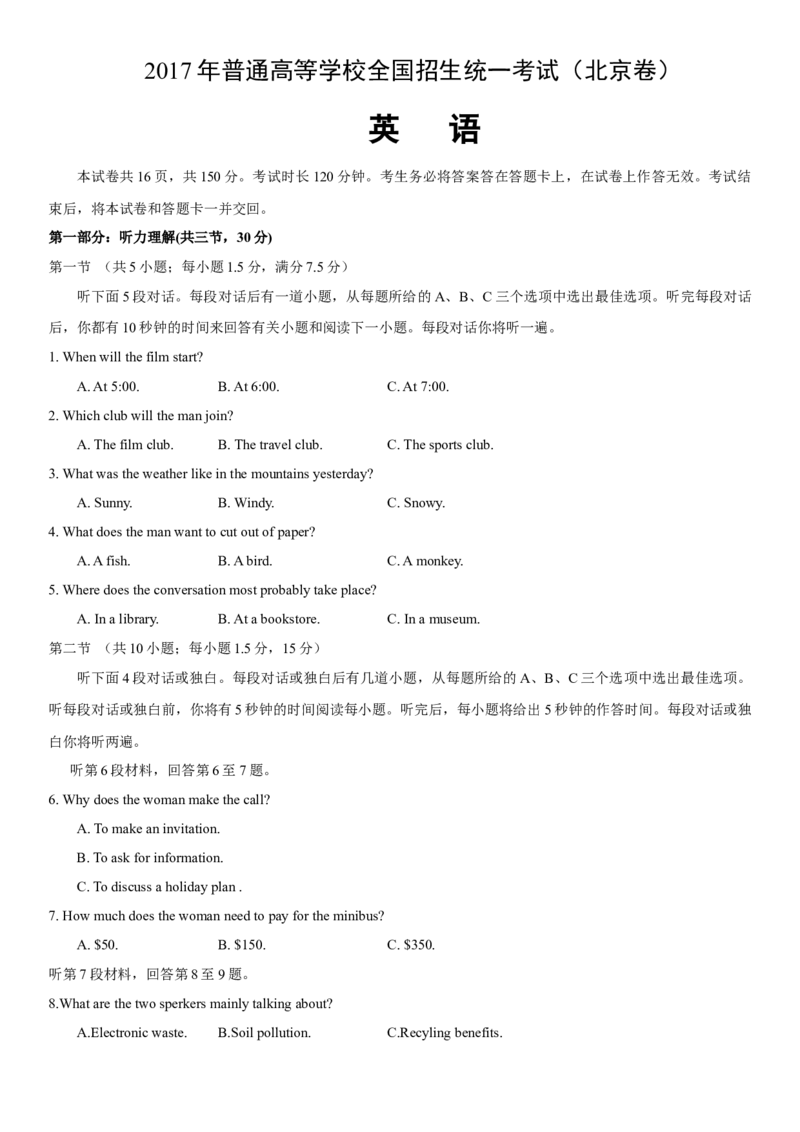
2017 年普通高等学校全国招生统一考试(北京卷)
英   语
本试卷共16 页,共150 分。考试时长120 分钟。考生务必将答案答在答题卡上,在试卷上作答无效。考试结
束后,将本试卷和答题卡一并交回。
第一部分:听力理解(共三节,30 分)
第一节 (共5 小题;每小题1.5 分,满分7.5 分)
听下面5 段对话。每段对话后有一道小题,从每题所给的A、B、C 三个选项中选出最佳选项。听完每段对话
后,你都有10 秒钟的时间来回答有关小题和阅读下一小题。每段对话你将听一遍。
1. When will the film start?
A. At 5:00.
B. At 6:00.
C. At 7:00.
2. Which club will the man join?
A. The film club.
B. The travel club.
C. The sports club.
3. What was the weather like in the mountains yesterday?
A. Sunny.
B. Windy.

C. Snowy.
4. What does the man want to cut out of paper?
A. A fish.
B. A bird.
C. A monkey.
5. Where does the conversation most probably take place?
A. In a library.
B. At a bookstore.
C. In a museum.
第二节 (共10 小题;每小题1.5 分,15 分)
听下面4 段对话或独白。每段对话或独白后有几道小题,从每题所给的A、B、C 三个选项中选出最佳选项。
听每段对话或独白前,你将有5 秒钟的时间阅读每小题。听完后,每小题将给出5 秒钟的作答时间。每段对话或独
白你将听两遍。
听第6 段材料,回答第6 至7 题。
6. Why does the woman make the call?
A. To make an invitation.
B. To ask for information.
C. To discuss a holiday plan .
7. How much does the woman need to pay for the minibus?
A. $50.
B. $150.
C. $350.
听第7 段材料,回答第8 至9 题。
8.What are the two sperkers mainly talking about?

A.Electronic waste.
B.Soil pollution.
C.Recyling benefits.
9.What does the woman decide to do with her cell phone in the end?

A.Throw it away.
B.Keep it at home.
C.Sell it to be recycled.
听第8 段材料,回答第10 至12 题。
10.What is the possible relationship between the two sperkers?
   A.Friends.
B.Wife and husband.
C.Business partners.
11.Where does the woman work now?

A.In a school.
B.In a restaurant.
C.In a travel agency.
12.What are the two sperkers going to do?

A.To take a trip.
B.To have a coffee.
C.To attend a meeting.
听第9 段材料,回答第13 至15 题。
13.What has been improved according to the speaker?

A.The train station.
B.The bus service.
C.The parking lot.
14.How does the speaker get to her office today?

A.By bus and on foot.
B.By train and by bus.
C.By train and on foot.
15. Who is the speaker?
A. A reporter.
B. A policeman.
C. A photographer.
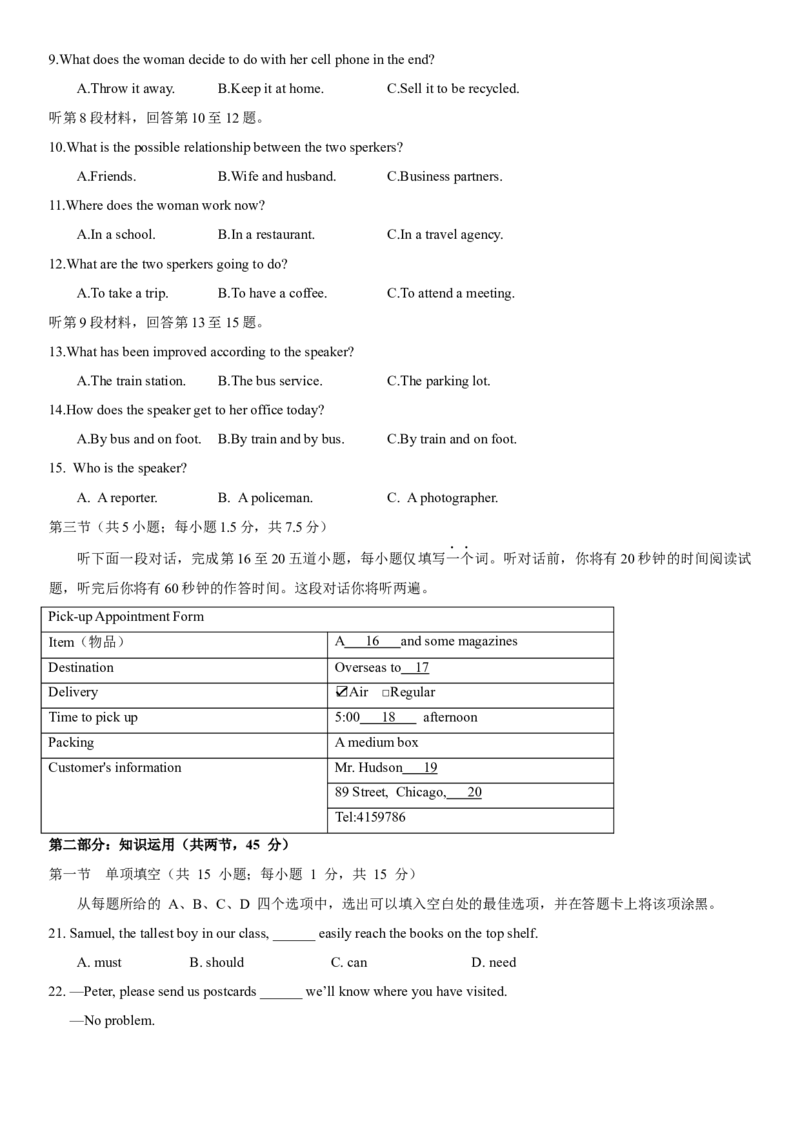
第三节(共5 小题;每小题1.5 分,共7.5 分)
听下面一段对话,完成第16 至20 五道小题,每小题仅填写一个词。听对话前,你将有20 秒钟的时间阅读试
题,听完后你将有60 秒钟的作答时间。这段对话你将听两遍。
Pick-up Appointment Form
Item(物品)
A   16   and some magazines
Destination
Overseas to  17
Delivery
☑Air  □Regular
Time to pick up
5:00   18    afternoon
Packing
A medium box
Customer's information
Mr. Hudson   19
89 Street, Chicago,   20
Tel:4159786
第二部分:知识运用(共两节,45 分)
第一节  单项填空(共 15 小题;每小题 1 分,共 15 分)
从每题所给的 A、B、C、D 四个选项中,选出可以填入空白处的最佳选项,并在答题卡上将该项涂黑。
21. Samuel, the tallest boy in our class, ______ easily reach the books on the top shelf.
A. must
B. should
C. can
D. need
22. —Peter, please send us postcards ______ we’ll know where you have visited.
—No problem.
A. but
B. or

C. for
D. so
23. Every year, ______ makes the most beautiful kite will win a prize in the Kite Festival.
A. whatever
B. whoever
C. whomever
D. whichever
24. —______ that company to see how they think of our product yesterday?
—Yes. They are happy with it.
A. Did you call   B. Have you called
C. Will you call
D. Were you calling
25. ______ birds use their feathers for flight, some of their feathers are for other purposes.
A. Once
B. If
C. Although
D. Because
26. Jane moved aimlessly down the tree-lined street, not knowing ______she was heading.
A. why
B. where
C. how
D. when
27. Many airlines now allow passengers to print their boarding passes online ______ their valuable time.
A. save
B. saving
C. to save
D. saved
28. If you don’t understand something, you may research, study, and talk to other people _______ you figure it out.
A. because
B. though
C. until
D. since
29. In the 1950s in the USA, most families had just one phone at home, and wireless phones _______ yet.
A. haven’t invented
B. haven’t been invented
C. hadn’t invented
D. hadn’t been invented
30. The national park has a large collection of wildlife, _________ from butterflies to elephants.
A. ranging
B. range
C. to range
D. ranged
31. The little problems ______ we meet in our daily lives may be inspirations for great inventions.
A. that          B. as
C. where
D. when
32.Jim has retired, but he still remember the happy time _______ with his students.
A. to spend
B. spend
C. spending
D. spent
33.People______better access to health care than they used to, and they’re living longer as a result.
A. will have
B. have
C. had
D. had had
34. If the new safety system _______ to use, the accident would never have happened.
A. had been put
B. were put
C. should be put
D. would be put
35. Many people who live along the coast make a living _______ fishing industry.
   A. at
B. in
C. on
D. by
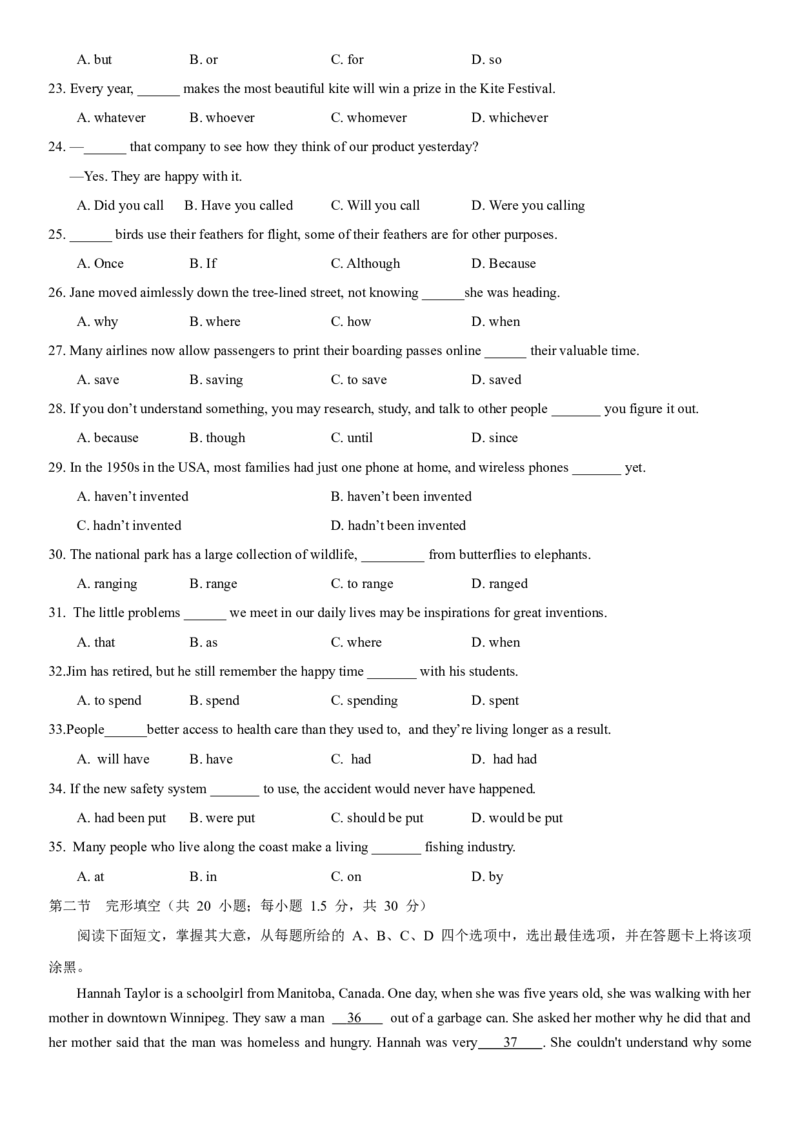
第二节  完形填空(共 20 小题;每小题 1.5 分,共 30 分)
阅读下面短文,掌握其大意,从每题所给的 A、B、C、D 四个选项中,选出最佳选项,并在答题卡上将该项
涂黑。
Hannah Taylor is a schoolgirl from Manitoba, Canada. One day, when she was five years old, she was walking with her
mother in downtown Winnipeg. They saw a man
  36

  out of a garbage can. She asked her mother why he did that and
her mother said that the man was homeless and hungry. Hannah was very   37   . She couldn't understand why some
people had to live their lives without shelter or enough food. Hannah started to think about how she could  38    , but,
of course, there is not a lot one five-year-old can do to solve (解决) the problem of homelessness.
Later, when Hannah attended school, she saw another homeless person. It was a woman,    39   an old shopping
trolley(购物车)which was piled with   40

 . It seemed that everything the woman owned was in them. This made
Hannah very sad, and even more
  41

  to do something. She had been talking to her mother about the lives of homeless
people
  42

  they first saw the homeless man. Her mother told her that if she did something to change the problem that
made her sad, she wouldn’t   43    as bad.
Hannah began to speak out about the homelessness in Manitoba and then in other provinces. She hoped to  44
    her
message of hope and awareness. She started the Ladybug Foundation, an organization aiming at getting rid of homelessness.
She began to __45__“Big Bosses” lunches, where she would try to persuade local business Leaders to
  46
     to the
cause. She also organized a fundraising (募捐) drive in “Ladybug Jars” to collect everyone’s spare change during “Make
Change” month. More recently, the foundation began another  47  called National Red Scarf Day --- a day when people
donate $20 and wear red scarves in support of Canada’s  48   and homeless.
There is an emergency shelter in Winnipeg called “Hannah’s Place”, something that Hannah is very     49
     of.
Hannah’s Place is divided into several areas, providing shelter for people when it is so cold that
  50
    outdoors can mean
death. In the more than five years since Hannah began her activities, she has received a lot of  51  .
For example, she received the 2007 BRICK Award recognizing the   52    of young people to change the world. But
53    all this, Hannah still has the   54    life of a Winnipeg schoolgirl, except that she pays regular visits to homeless
people.
Hannah is one of many examples of young people who are making a   55    in the world. You can, too!
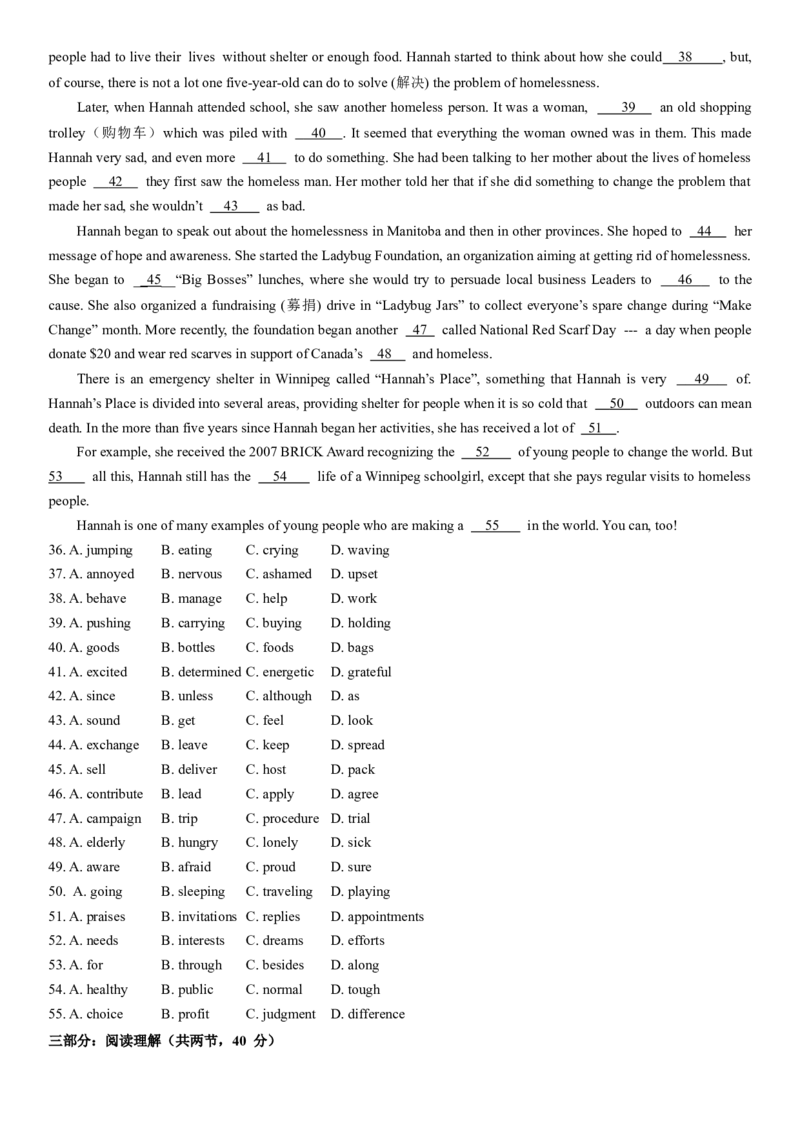
36. A. jumping
B. eating
C. crying
D. waving
37. A. annoyed
B. nervous
C. ashamed
D. upset
38. A. behave
B. manage
C. help
D. work
39. A. pushing
B. carrying
C. buying
D. holding
40. A. goods
B. bottles
C. foods
D. bags
41. A. excited
B. determined C. energetic
D. grateful
42. A. since
B. unless
C. although
D. as
43. A. sound
B. get
C. feel
D. look
44. A. exchange
B. leave
C. keep
D. spread
45. A. sell
B. deliver
C. host
D. pack
46. A. contribute
B. lead
C. apply
D. agree
47. A. campaign
B. trip
C. procedure
D. trial
48. A. elderly
B. hungry
C. lonely
D. sick
49. A. aware
B. afraid
C. proud
D. sure
50. A. going
B. sleeping
C. traveling
D. playing
51. A. praises
B. invitations C. replies
D. appointments
52. A. needs
B. interests
C. dreams
D. efforts
53. A. for
B. through
C. besides
D. along
54. A. healthy
B. public
C. normal
D. tough
55. A. choice
B. profit
C. judgment
D. difference
三部分:阅读理解(共两节,40 分)
第一节 (共 15 小题;每小题 2 分,共 30 分)
阅读下列短文,从每题所给的 A、B、C、D 四个选项中,选出最佳选项,并在答题卡上将该项涂黑。
A
    It was a cold March day in High Point, North Carolina. The girls on the Wesleyan Academy softball were waiting for
their next turns at bat during practice, stamping their feet to stay warm, Eighth-grader Taylor Bisbee shivered(发抖) a little
as she watched her teammate Paris White play. The two didn’t know each other well — Taylor had just moved to town a
month or so before.
    Suddenly, Paris fell to the ground, “Paris’s eye rolled back,” Taylor says. “She started shaking. I knew it was an
emergency.”
    It certainly was. Paris had suffered a sudden heart failure. Without immediate medical care, Paris would die. At first no
one moved. The girls were in shock. Then the softball coach shouted out, “Does anyone know CPR?”
    CPR is a life-saving technique. To do CPR, you press on the sick person’s chest so that blood moves through the body
and takes oxygen to organs. Without oxygen the brain is damaging quickly.
Amazingly, Taylor had just taken a CPR course the day before. Still, she hesitated. She didn’t think she knew it well
enough. But when no one else came forward, Taylor ran to Paris and began doing CPR, “It was scary. I knew it was the
difference between life and death.” says Taylor.
Taylor’s swift action helped her teammates calm down. One girl called 911. Two more ran to get the school nurse, who
brought a defibrillator, an electronic devices(器械) that can shock the heart back into work. Luck stayed with them; Paris’
heartbeat returned.
“I know I was really lucky,” Paris says now. “Most people don’t survive this. My team saved my life.”
Experts say Paris is right: For a sudden heart failure, the single best chance for survival is having someone nearby step
in and do CPR quickly.
Today, Paris is back on the softball team. Taylor will apply to college soon. She wants to be a nurse. “I feel more
confident in my actions now,” Taylor says. “I know I can act under pressure in a scary situation.”
56.What happened to Paris on a March day?
A. She caught a bad cold.
B. She had a sudden heart problem.
C. She was knocked down by a ball.
D. She shivered terribly during practice
57.Why does Paris say she was lucky?
A. She made a worthy friend.
B. She recovered from shock.
C. She received immediate CPR.
D. She came back on the softball team.
58.Which of the following words can best describe Taylor?
A. Enthusiastic and kind.
B. Courageous and calm.
What is so special about TOKNOW magazine?
Well, it has no ads or promotions inside—

instead it is jam-packed with serious ideas.

TOKNOW makes complex ideas attractive and
accessible to children, who can become involved in
advanced concepts and even philosophy(哲学)
—and they will soon discover that TOKNOW feels
more like a club than just a magazine.
What’s inside?
  Every month the magazine introduces a
fresh new topic with articles, experiments
and creative things to make — the magazine
also explores philosophy and wellbeing to make sure
young readers have a balanced take on life.
C. Cooperative and generous.
D. Ambitious and professional.
B
Inspiring young minds!
TOKNOW Magazine is a big hit in the world of children’s publishing, bringing a unique combination of challenging
ideas and good fun to young fans every month.
Sounds too good to be true?
Take a look online—evidence shows that thousands of teachers and parents know a good thing when they see it and
recommend TOKNOW to their friends.
Happy Birthday All Year!
What could be more fun than a gift that keeps coming through the letterbox every month? The first magazine with your
gift message will arrive in time for the special day.
SUBSCRIBE NOW
□Annual Subscription
  Europe £55    Rest of World £65
□Annual Subscription with Gift Pack
  Includes a Mammoth Map, a passport Puzzle Booklet, and Subscription
  Europe £60    Rest of World £70
Refund Policy—the subscription can be cancelled within 28 days and you can get your money back.
59. Why is TOKNOW a special magazine?
A. It entertains young parents.
B. It provides serious advertisements.
C. It publishes popular science fictions.
D. It combines fun with complex concepts.
60. What does TOKNOW offer its readers?
A. Online courses.
B. Articles on new topics.
C. Lectures on a balanced life.
D. Reports on scientific discoveries.
61. How much should you pay if you make a 12-mouth subscription to TOKNOW with gift pack from China?
A. £55.
B. £60.
C. £65.
D. £70.
62. Subscribers of TOKNOW would get             .
A. free birthday presents
B. full refund within 28 days
C. membership of the TOKNOW club
D. chances to meet the experts in person
C
Measles(麻疹), which once killed 450 children each year and disabled even more, was nearly wiped out in the United
States 14 years ago by the universal use of the MMR vaccine(疫苗). But the disease is making a comeback, caused by a
growing anti-vaccine movement and misinformation that is spreading quickly. Already this year, 115 measles cases have
been reported in the USA, compared with 189 for all of last year.
The numbers might sound small, but they are the leading edge of a dangerous trend. When vaccination rates are very
high, as they still are in the nation as a whole, everyone is protected. This is called “herd immunity”, which protects the
people who get hurt easily, including those who can’t be vaccinated for medical reasons, babies too young to get vaccinated
and people on whom the vaccine doesn’t work.
But herd immunity works only when nearly the whole herd joins in. When some refuse vaccination and seek a free
ride, immunity breaks down and everyone is in even bigger danger.
That’s exactly what is happening in small neighborhoods around the country from Orange County, California, where
22 measles cases were reported this month, to Brooklyn, N.Y., where a 17-year-old caused an outbreak last year.
The resistance to vaccine has continued for decades, and it is driven by a real but very small risk. Those who refuse to
take that risk selfishly make others suffer.
Making things worse are state laws that make it too easy to opt out(决定不参加) of what are supposed to be required
vaccines for all children entering kindergarten. Seventeen states allow parents to get an exemption(豁免), sometimes just
by signing a paper saying they personally object to a vaccine.
Now, several states are moving to tighten laws by adding new regulations for opting out. But no one does enough to
limit exemptions.
Parents ought to be able to opt out only for limited medical or religious reasons. But personal opinions? Not good
enough. Everyone enjoys the life-saving benefits vaccines provide, but they’ll exist only as long as everyone shares in the
risks.
63. The first two paragraphs suggest that ____________.
A. a small number of measles cases can start a dangerous trend
B. the outbreak of measles attracts the public attention
C. anti-vaccine movement has its medical reasons
D. information about measles spreads quickly
64. Herd immunity works well when ____________.
A. exemptions are allowed
B. several vaccines are used together
C. the whole neighborhood is involved in
D. new regulations are added to the state laws
65. What is the main reason for the comeback of measles?
A. The overuse of vaccine.
B. The lack of medical care.
C. The features of measles itself.
D. The vaccine opt-outs of some people.
66. What is the purpose of the passage?
A. To introduce the idea of exemption.
B. To discuss methods to cure measles.
C. To stress the importance of vaccination.
D. To appeal for equal rights in medical treatment.
D
   Hollywood’s theory that machines with evil(邪恶) minds will drive armies of killer robots is just silly. The real problem
relates to the possibility that artificial intelligence(AI) may become extremely good at achieving something other than what
we really want. In 1960 a well-known mathematician Norbert Wiener, who founded the field of cybernetics(控制论), put
it this way: “If we use, to achieve our purposes, a mechanical agency with whose operation we cannot effectively
interfere(干预), we had better be quite sure that the purpose put into the machine is the purpose which we really desire.”
   A machine with a specific purpose has another quality, one that we usually associate with living things: a wish to preserve
its own existence. For the machine, this quality is not in-born, nor is it something introduced by humans; it is a logical
consequence of the simple fact that the machine cannot achieve its original purpose if it is dead. So if we send out a robot
with the single instruction of fetching coffee, it will have a strong desire to secure success by disabling its own off switch or
even killing anyone who might interfere with its task. If we are not careful, then, we could face a kind of global chess match
against very determined, super intelligent machines whose objectives conflict with our own, with the real world as the
chessboard.
   The possibility of entering into and losing such a match should concentrate the minds of computer scientists. Some
researchers argue that we can seal the machines inside a kind of firewall, using them to answer difficult questions but never
allowing them to affect the real world. Unfortunately, that plan seems unlikely to work: we have yet to invent a firewall that
is secure against ordinary humans, let alone super intelligent machines.
   Solving the safety problem well enough to move forward in AI seems to be possible but not easy. There are probably
decades in which to plan for the arrival of super intelligent machines. But the problem should not be dismissed out of hand,
as it has been by some AI researchers. Some argue that humans and machines can coexist as long as they work in teams—
yet that is not possible unless machines share the goals of humans. Others say we can just “switch them off” as if super
intelligent machines are too stupid to think of that possibility. Still others think that super intelligent AI will never happen.
On September 11, 1933, famous physicist Ernest Rutherford stated, with confidence, “Anyone who expects a source of
power in the transformation of these atoms is talking moonshine.” However, on September 12, 1933, physicist Leo Szilard
invented the neutron-induced(中子诱导) nuclear chain reaction.
67. Paragraph 1 mainly tells us that artificial intelligence may         .
A. run out of human control
B. satisfy human’s real desires
C. command armies of killer robots
D. work faster than a mathematician
68. Machines with specific purposes are associated with living things partly because they might be able to        .
A. prevent themselves from being destroyed
B achieve their original goals independently
C. do anything successfully with given orders
D. beat humans in international chess matches
69. According to some researchers, we can use firewalls to           .
A. help super intelligent machines work better
B. be secure against evil human beings
C. keep machines from being harmed
D. avoid robots’ affecting the world
70. What does the author think of the safety problem of super intelligent machines?
A. It will disappear with the development of AI.
B. It will get worse with human interference.
C. It will be solved but with difficulty.
D. It will stay for a decade.
第二节 (共 5 小题;每小题 2 分,共 10 分)
根据短文内容,从短文后的七个选项中选出能填入空白处的最佳选项。选项中有两项为多余选项。

Every animal sleeps, but the reason for this has remained foggy. When lab rats are not allowed to sleep, they die within
a month.   71
    One idea is that sleep helps us strengthen new memories.   72    We  know that, while awake, fresh memories are
recorded by reinforcing (加强) connections between brain cells, but the memory processes that take place while we sleep
have been unclear.
    Support is growing for a theory that sleep evolved so that connections between neurons( 神经元) in the brain can be
weakened overnight, making room for fresh memories to form the next day.   73
Now we have the most direct evidence yet that he is right.   74   The synapses in the mice taken at the end of a
period of sleep were 18 per cent smaller than those taken before sleep, showing that the connections between neurons
weaken while sleeping.
If Tononi’s theory is right, it would explain why, when we miss a night’s, we find it harder the next day to concentrate
and learn new information — our brains may have smaller room for new experiences.
Their research also suggests how we may build lasting memories over time even though the synapses become thinner.
The team discovered that some synapses seem to be protected and stayed the same size.   75   “You keep what matters,”
Tononi says.
A. We should also try to sleep well the night before.
B. It’s as if the brain is preserving its most important memories.
C. Similarly, when people go for a few days without sleeping, they get sick.
D. The processes take place to stop our brains becoming loaded with memories.
E. That’s why students do better in tests if they get a chance to sleep after learning.
F. “Sleep is the price we pay for learning,” says Giulio Tononi, who developed the idea.
G. Tononi’s team measured the size of these connections, or synapses, in the brains of 12 mice.
第四部分:书面表达(共两节,35 分)
第一节 (15 分)
你的英国朋友Jim 所在的学校要组织学生来中国旅行,有两条线路可以选择:“长江之行”或者“泰山之
旅”。Jim 来信希望你能给些建议。请你给他回信,内容包括:
1.你建议的线路;
2.你的理由;
3.你的祝愿。
注意:1.词数不少于50;
2.开头和结尾已给出,不计入总词数。
Dear Jim,

Yours,
Li Hua
第二节 (20 分)
假设你是红星中学高三学生李华,请根据以下四幅图的先后顺序,写一篇英文周记,记录毕业前夕你们制作
以“感恩母校”为主题的毕业纪念视频的全过程。
注意:词数不少于60。
提示词:视频 video
2017 年普通高等学校全国统一考试
英语(北京卷)参考答案
第一部分:听力理解(共三节,30 分)
第一节(共 5 小题;每小题 1.5 分,共 7.5 分)
1-5 CBCBA
第二节(共10 小题;每小题1.5 分,共15 分)
6-10 BBACA    11-15 CBACA
第三节(共5 小题;每小题1.5 分,共7.5 分)
 每小题1.5 分。如果出现拼写错误不计分;出现大小写、单复数错误扣0.5 分;如每小题超过一个词不计分。
16. dictionary     17. Italy    18. Monday/Mon. 19. Acket / ACKET    20. 15374
第二部分:知识运用(共两节,45 分)
第一节 单项填空(共 15 小题;每小题 1 分,共 15 分)
21---25 CDBAC  26---30 BCCDA  31---35 ADBAB
第二节 完形填空(共 20 小题;每小题 1.5 分,共 30 分)
36-40 BDCAD
41-45 BACDC
46-50AABCB
51-55ADCCD
第三部分:阅读理解 (共两节,20 分)
第一节(共 15 小题;每小题 2 分,共 30 分)
56. B
57. C
58. B
59. D
60. B
61. D
62. B
63. A
64. C
65. D
66. C
67. A
68. A
69. D
70. C
第二节(共 5 小题;每小题 2 分。共 10 分)
71C
72E
73F 74G
75B
第四部分:书面表达(共两节,35 分)
第一节(15 分)
Dear Jim,
I’m happy receive your letter and know you’re coming to China.
Of the two trips to the Yangtze River and Mount Tai, both are highly recommended. Personally, I prefer the tour along
the Yangtze, the longest river and one of the mother rivers of Chinese civilization. You can learn a lot about the history of
China and Chinese people. Moreover, the scenery along the river is amazing, with many well-known sightseeing spots.
That’s why I think the trip along the Yangtze will be a better choice.
Hope you’ll have a good time in China.
Yours
Li Hua
第二节 ( 20 分)
 One possible version:
Graduation finally came. My classmates and I decided to do something. After a heated discussion, we agreed on
making a video to record our experiences at school.
Material collecting took us a whole week, during which we interviewed our teachers and took pictures of every aspect
of school life. The editing part after that was tough. We debated over what to put into the video. Some compromises were
unavoidable, but the video turned out perfect. Several days later, when the video was played on the graduation ceremony, it
was well received. The students and teachers shared a great time. That surely gave us a great sense of achievement.
第一节  单项填空(共 15 小题;每小题 1 分,共 15 分)
从每题所给的 A、B、C、D 四个选项中,选出可以填入空白处的最佳选项,并在答题卡上将该项涂黑。
例:It’s so nice to hear from her again, ________, we last met more than thirty years ago.
A. What’s more
B. That’s to say
C. In other words
D. Believe it or not
答案是D。
21. Samuel, the tallest boy in our class, ______ easily reach the books on the top shelf.
A. must
B. should
C. can
D. need
【答案】C
【解析】考查情态动词。句意:Samuel,我们班最高的男生,能很轻松地够着书架顶上的书。表示能力,用can。
22. —Peter, please send us postcards ______ we’ll know where you have visited.
—No problem.
A. but
B. or

C. for
 D. so
【答案】D
【解析】考查连词。上半句句意:Peter,请给我们寄明信片,因此我们就会知道你们去哪游览过。前后因果关系,
用so。
23. Every year, ______ makes the most beautiful kite will win a prize in the Kite Festival.
A. whatever
B. whoever
C. whomever
D. whichever
【答案】B
【解析】考查时态。句意:每年,任何一个做出最漂亮的风筝的人将会在风筝节获奖。_____ makes the most
beautiful kite 是主语从句,根据意思可知答案。
24. —______ that company to see how they think of our product yesterday?
—Yes. They are happy with it.
A. Did you call   B. Have you called
C. Will you call
D. Were you calling
【答案】A
【解析】考查时态。句意:你昨天有没有给那家公司打电话问问他们对我们的产品感觉怎么样?发生在过去,用
过去式,故选A。
25. ______ birds use their feathers for flight, some of their feathers are for other purposes.
A. Once
B. If
C. Although
D. Because
【答案】C
26. Jane
moved aimlessly down the tree-lined street, not knowing ______she was heading.
A. why
B. where
C. how
D. when
【答案】B
【解析】考查连词。句意:Jane 漫无目的地走在两旁栽树的街道上,不知道她将去往何方,根据句意可知选B。
27. Many airlines now allow passengers to print their boarding passes online ______ their valuable time.
A. save
B. saving
C. to save
D. saved
【答案】C
【解析】考查非谓语动词。句意:许多航空公司现在允许乘客网上打印他们的登机牌来节省时间。动词不定式表
目的,选C。
28. If you don’t understand something, you may research, study, and talk to other people _______ you figure it out.
A. because
B. though
C. until
D. since
【答案】C
【解析】考查连词。句意:如果你无法理解某个东西,你可能会研究,学习和他人探讨直到你解决为止。根据句
意可知选C。
29. In the 1950s in the USA, most families had just one phone at home, and wireless phones _______ yet.
A. haven’t invented
B. haven’t been invented
C. hadn’t invented
D. hadn’t been invented
【答案】D
【解析】考查时态。句意:在美国20 世纪50 年代的时候,大多数的家庭家里只有一部电话,并且无线电话还根本
没有发明出来。根据句意可知用被动语态,排除A 和C,事情发生在过去,与现在无关,排除B,故选D。KS5U
30. The national park has a large collection of wildlife, _________ from butterflies to elephants.
A. ranging
B. range
C. to range
D. ranged
【答案】A
31. The
little problems ______ we meet in our daily lives may be inspirations for great inventions.
A. that
B. as
C. where
D. when
【答案】A
【解析】考查关系词。句意:我们在日常生活中遇到的小问题可能就是伟大发明的灵感。此句是定语从句,从句
缺少宾语,先行词是problems,用that。
32.Jim has retired, but he still remember the happy time _______ with his students.
A. to spend
B. spend
C. spending
D. spent
【答案】D
【解析】考查非谓语动词。句意:Jim 已经退休了,但是他依然记得和学生一起度过的快乐时光。句子已经有谓语
了,逻辑主语time 和spend 之间是动宾关系,故用过去分词。
33.People______better access to health care than they used to, and they’re living longer as a result.
A.will have
B. have
C. had
D. had had
【答案】B
【解析】考查时态。句意:人们有着比过去更好的医疗保险,因此他们更长寿。与过去对比是现在,而且后一句
用的就是现在时态,故前面也用现在时态,故选B。
34. If the new safety system _______ to use, the accident would never have happened.
A. had been put
B. were put
C. should be put
D. would be put
【答案】A
35.
Many people who live along the coast make a living _______ fishing industry.
   A. at
 B. in
C. on
D. by
【答案】B
【解析】考查介词。句意:许多住在海边上的人都是靠渔业来谋生的。此处用介词in。make a living in fishing
industry“靠渔业谋生”。
第二节  完形填空(共 20 小题;每小题 1.5 分,共 30 分)
阅读下面短文,掌握其大意,从每题所给的 A、B、C、D 四个选项中,选出最佳选项,并在答题卡上将该项
涂黑。
【答案】
36-40 BDCAD
41-45 BACDC
46-50AABCB
51-55ADBCD
【解析】
【语篇解读】本文讲述Hannah Taylor 通过自己的努力来建立公益组织筹集资金帮助那些无家可归忍饥挨饿的人。
39.考查
动词。A. pushing 推;B. carrying
拿;C. buying 买;D. holding 握。购物车肯定是推着的,故选A。
40.考查名词。A. goods货物;B. bottles 瓶子;C. foods 食物;D. bags 包。车上堆满了包,选D。
41.考查形容词。A. excited 激动的;B. determined 下决心的;C. energetic 精力充沛的;D. grateful 感激的。
她更加下定决心做些事帮助这些人,故选B。
42.考查连词。A. since 自从;B. unless 除非;C. although 尽管;D. as 因为。此处是指自从他们第一次看到
无家可归的人,选A。KS5U
43.考查动词。A. sound听;B. get 获得;C. feel 感觉;D. look 看。她就不会和以前一样感觉那么糟糕了,故选C。
44.考查动词。A. exchange 交换;B. leave 离开;C. keep 保持;D. spread 传播。她希望她的希望和意识的信
息能够传播开来。故选D。
45.考查动词。由语境可知她希望信息能够传播开来。spread 传播。
46.考查动词。A. contribute 贡献,捐献;B. lead 领导;C. apply 申请,应用;D. agree 同意。她试图劝说那
些领导能为这个事业做出奉献,选A。
47.考查名词。A. campaign
运动;B. trip 旅行;C. procedure 过程;D. trial 实验。此处指又一项运动,故选A。
48.考查形容词。A. elderly 年纪大的;B. hungry 饥饿的;C. lonely 孤独的;D. sick 生病的。此处是指为那
些饥饿的人和无家可归的人,选B。
49.考查形容词。A. aware 意识的;B. afraid 害怕的;C. proud 骄傲的;D. sure 肯定的。此处是指Hannah 非
常骄傲的东西,故选C。
50.考查动词。A. going 去;B. sleeping 睡;
C. traveling 旅行;D. playing 玩。当天冷到在室外睡觉就意味
着死的时候,故选B。
51.考查名词。A. praises 赞美;B. invitations 邀请;C. replies 回复;D. appointments 约会。她收到了很多的
赞美。因为下文有这方面的举例,答案为A。
第三部
分:阅读理解(共两节,40 分)
第一节 (共 15 小题;每小题 2 分,共 30 分)
阅读下列短文,从每题所给的 A、B、C、D 四个选项中,选出最佳选项,并在答题卡上将该项涂黑。
A

【答案】56 B 57 C 58 B
【解析】
【语篇解读】讲述Taylor Bisbee 通过及时的CPR 挽救了一位学生的生命。
56.根据文章第三段It certainly was, Paris had suffered a sudden heart failure.可知答案为B。
57. 根据倒数第三段“Most people don’t survive this. My team saved my life”可知她被别人通过心脏复苏救了
回来,因此很幸运,选C。
58.通过她救Paris 这件事可知她很勇敢,很镇静,不慌不忙,故选B。
B
【答案】59.D   60.B   61.D   62.B
C
【答案】63 A 64 C 65 D 66 C
D
【答案】67 A 68 A 69 D 70 C
【解析】
【语篇解读】本文主要介绍了人工智能。
69.根据
第三段using them to answer difficult questions but never allowing them to affect the real world.可知不要
让他们影响现实世界,故选D。
70.根据最后一段Solving the safety problem well enough to move forward in AI seems to be possible but not easy.
可知作者认为可以解决但是很困难,选C。
第二节 (共 5 小题;每小题 2 分,共 10 分)
根据短文内容,从短文后的七个选项中选出能填入空白处的最佳选项。选项中有两项为多余选项。

【答案】71C 72E 73F 74G 75B
【解析】
【语篇解读】本文讲述了睡眠的重要性。
73.根据
下文中的he,可知此处要提到一个人,以及他的理论故选F。
74.根据下文中提到的关键词synapses in the  mice 可知,他肯定做了老鼠的实验,答案为G。
75.根据后一句提到的You keep what matters,你记住重要的东西,可知大脑会把最重要的记忆保存下来,故选B。
第四部分:书面表达(共两节,35 分)
第一节 (15 分)
【答案】
Dear Jim,
I’m happy receive your letter and know you’re coming to China.
Of the two trips to the Yangtze River and Mount Tai, both are highly recommended. Personally, I prefer the tour along
the Yangtze, the longest river and one of the mother rivers of Chinese civilization. You can learn a lot about the history of
China and Chinese people. Moreover, the scenery along the river is amazing, with many well-known sightseeing spots.
That’s why I think the trip along the Yangtze will be a better choice.
Hope you’ll have a good time in China.
Yours
Li Hua
第二节 (20 分)

【答案】
Graduation finally came. My classmates and I decided to do something. After a heated discussion, we agreed on
making a video to record our experiences at school.
Material collecting took us a whole week, during which we interviewed our teachers and took pictures of every aspect
of school life. The editing part after that was tough. We debated over what to put into the video. Some compromises were
unavoidable, but the video turned out perfect. Several days later, when the video was played on the graduation ceremony, it
was well received. The students and teachers shared a great time. That surely gave us a great sense of achievement.