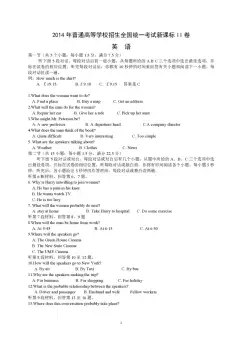
2016 年普通高等学校招生全国统一考试
英语
第Ⅰ卷
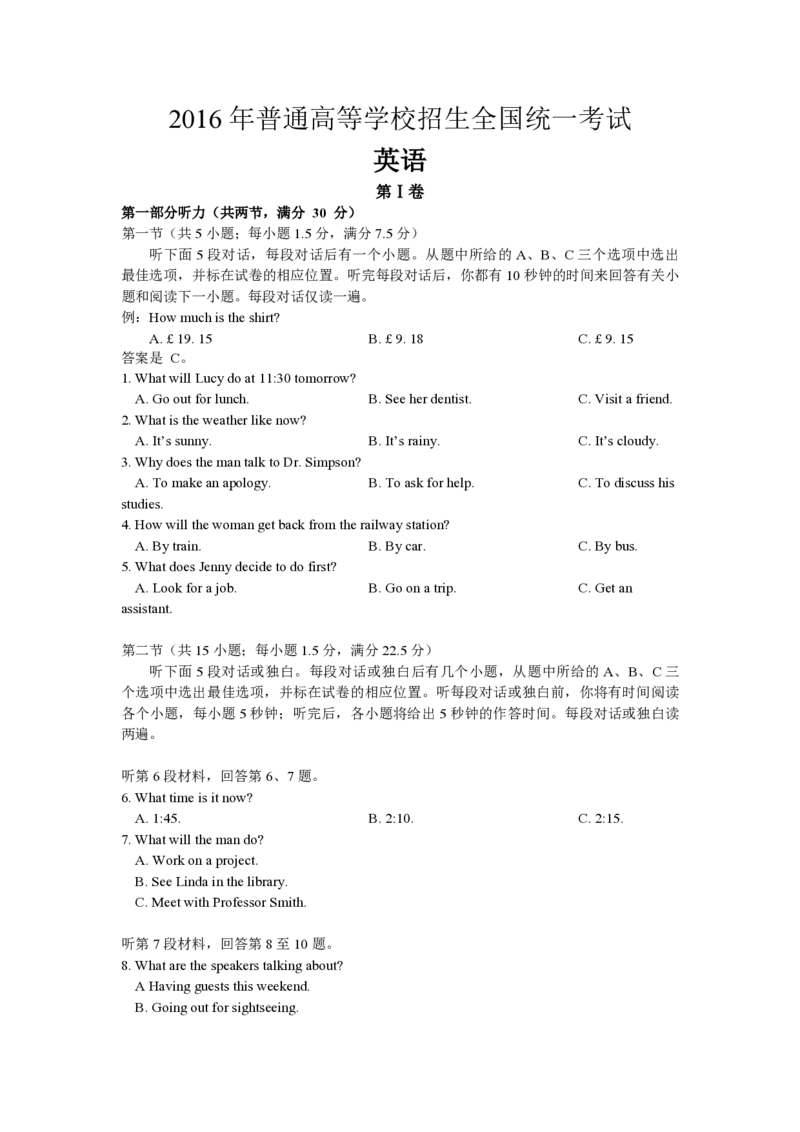
第一部分听力(共两节,满分 30 分)
第一节(共5 小题;每小题1.5 分,满分7.5 分)
听下面5 段对话,每段对话后有一个小题。从题中所给的A、B、C 三个选项中选出
最佳选项,并标在试卷的相应位置。听完每段对话后,你都有10 秒钟的时间来回答有关小
题和阅读下一小题。每段对话仅读一遍。
例:How much is the shirt?
A. £ 19. 15
B. £ 9. 18
C. £ 9. 15
答案是 C。
1. What will Lucy do at 11:30 tomorrow?
A. Go out for lunch.
B. See her dentist.
C. Visit a friend.
2. What is the weather like now?
A. It’s sunny.
B. It’s rainy.
C. It’s cloudy.
3. Why does the man talk to Dr. Simpson?
A. To make an apology.
B. To ask for help.
C. To discuss his
studies.
4. How will the woman get back from the railway station?
A. By train.
B. By car.
C. By bus.
5. What does Jenny decide to do first?
A. Look for a job.
B. Go on a trip.
C. Get an
assistant.

第二节(共15 小题;每小题1.5 分,满分22.5 分)
听下面5 段对话或独白。每段对话或独白后有几个小题,从题中所给的A、B、C 三
个选项中选出最佳选项,并标在试卷的相应位置。听每段对话或独白前,你将有时间阅读
各个小题,每小题5 秒钟;听完后,各小题将给出5 秒钟的作答时间。每段对话或独白读
两遍。

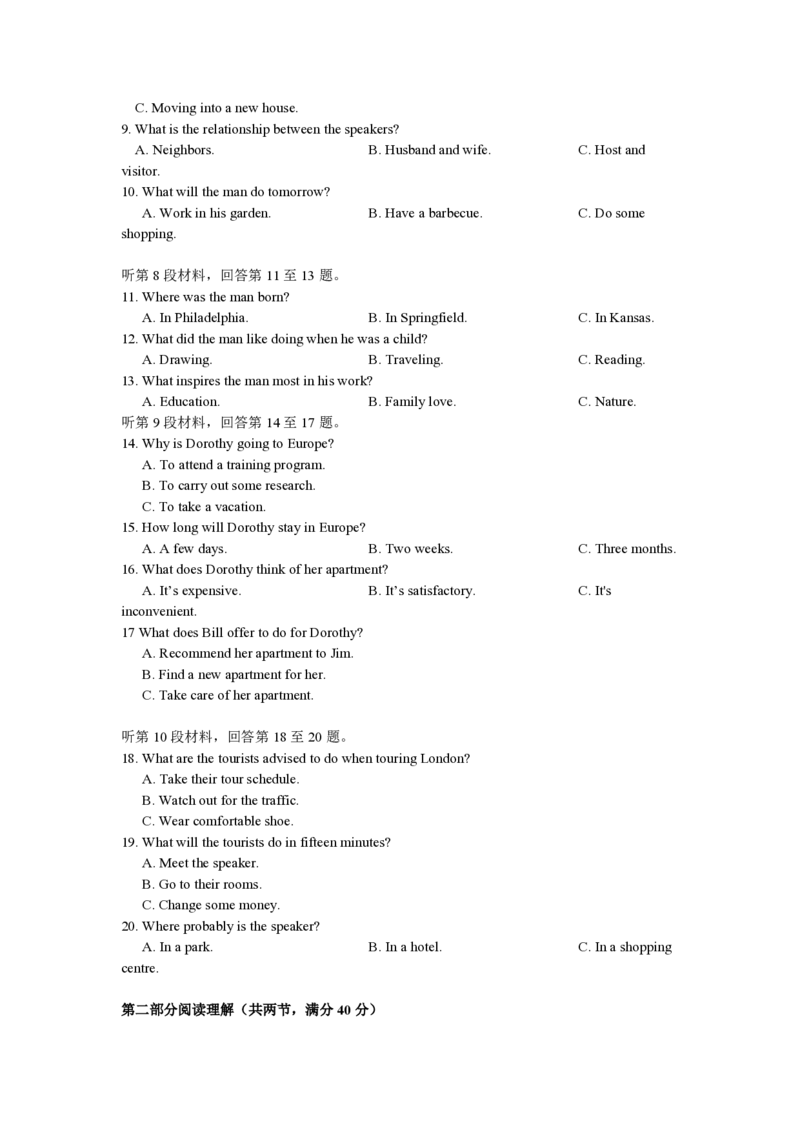
听第6 段材料,回答第6、7 题。
6. What time is it now?
A. 1:45.
B. 2:10.
C. 2:15.
7. What will the man do?
A. Work on a project.
B. See Linda in the library.
C. Meet with Professor Smith.

听第7 段材料,回答第8 至10 题。
8. What are the speakers talking about?
A Having guests this weekend.
B. Going out for sightseeing.
C. Moving into a new house.
9. What is the relationship between the speakers?
A. Neighbors.
B. Husband and wife.
C. Host and
visitor.
10. What will the man do tomorrow?
A. Work in his garden.
B. Have a barbecue.
C. Do some
shopping.

听第8 段材料,回答第11 至13 题。
11. Where was the man born?
A. In Philadelphia.
B. In Springfield.
C. In Kansas.
12. What did the man like doing when he was a child?
A. Drawing.
B. Traveling.
C. Reading.
13. What inspires the man most in his work?
A. Education.
B. Family love.
C. Nature.
听第9 段材料,回答第14 至17 题。
14. Why is Dorothy going to Europe?
A. To attend a training program.
B. To carry out some research.
C. To take a vacation.
15. How long will Dorothy stay in Europe?
A. A few days.
B. Two weeks.
C. Three months.
16. What does Dorothy think of her apartment?
A. It’s expensive.
B. It’s satisfactory.
C. It's
inconvenient.
17 What does Bill offer to do for Dorothy?
A. Recommend her apartment to Jim.
B. Find a new apartment for her.
C. Take care of her apartment.

听第10 段材料,回答第18 至20 题。
18. What are the tourists advised to do when touring London?
A. Take their tour schedule.
B. Watch out for the traffic.
C. Wear comfortable shoe.
19. What will the tourists do in fifteen minutes?
A. Meet the speaker.
B. Go to their rooms.
C. Change some money.
20. Where probably is the speaker?
A. In a park.
B. In a hotel.
C. In a shopping
centre.

第二部分阅读理解(共两节,满分40 分)
第一节(共15 题:每小题2 分,满分30 分)
阅读下列短文,从每题所给的四个选项(A、B、C 和D)中,选出最佳选项,并在答题
卡上将该项涂黑。
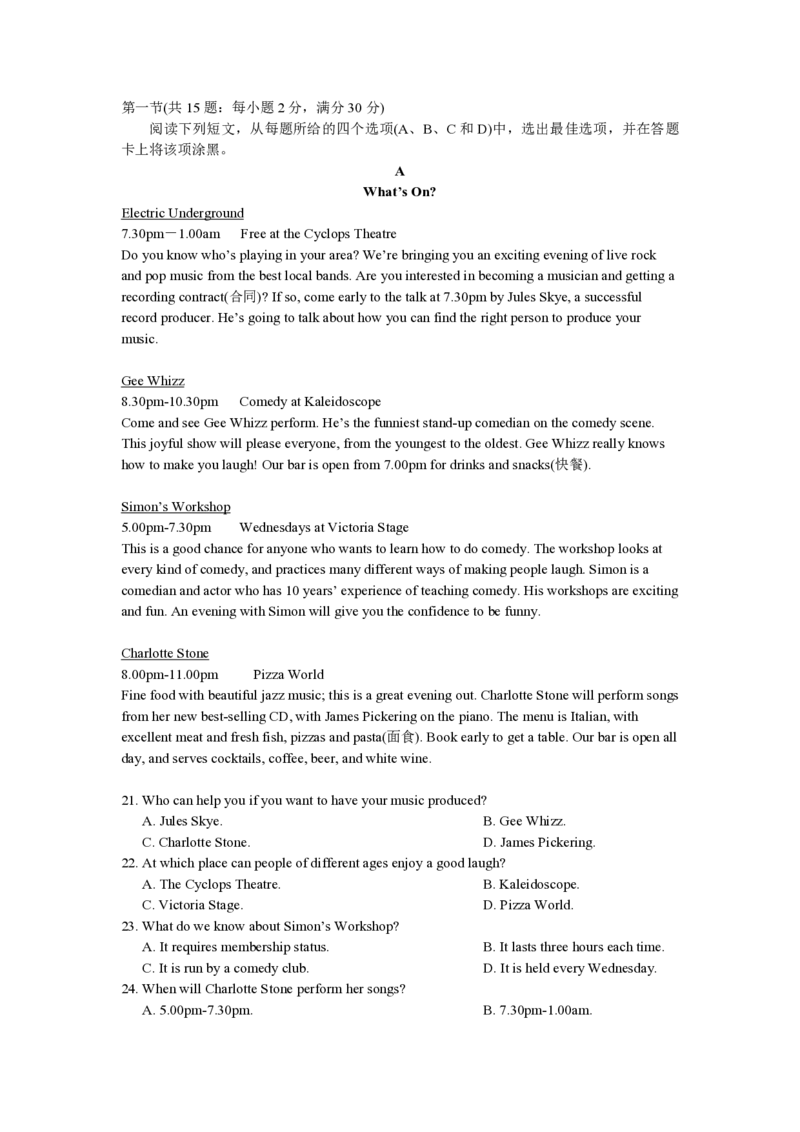
A
What’s On?
Electric Underground
7.30pm-1.00am   Free at the Cyclops Theatre
Do you know who’s playing in your area? We’re bringing you an exciting evening of live rock
and pop music from the best local bands. Are you interested in becoming a musician and getting a
recording contract(合同)? If so, come early to the talk at 7.30pm by Jules Skye, a successful
record producer. He’s going to talk about how you can find the right person to produce your
music.

Gee Whizz
8.30pm-10.30pm   Comedy at Kaleidoscope
Come and see Gee Whizz perform. He’s the funniest stand-up comedian on the comedy scene.
This joyful show will please everyone, from the youngest to the oldest. Gee Whizz really knows
how to make you laugh! Our bar is open from 7.00pm for drinks and snacks(快餐).

Simon’s Workshop
5.00pm-7.30pm
Wednesdays at Victoria Stage
This is a good chance for anyone who wants to learn how to do comedy. The workshop looks at
every kind of comedy, and practices many different ways of making people laugh. Simon is a
comedian and actor who has 10 years’ experience of teaching comedy. His workshops are exciting
and fun. An evening with Simon will give you the confidence to be funny.

Charlotte Stone
8.00pm-11.00pm
Pizza World
Fine food with beautiful jazz music; this is a great evening out. Charlotte Stone will perform songs
from her new best-selling CD, with James Pickering on the piano. The menu is Italian, with
excellent meat and fresh fish, pizzas and pasta(面食). Book early to get a table. Our bar is open all
day, and serves cocktails, coffee, beer, and white wine.

21. Who can help you if you want to have your music produced?
A. Jules Skye.

B. Gee Whizz.
C. Charlotte Stone.
D. James Pickering.
22. At which place can people of different ages enjoy a good laugh?
A. The Cyclops Theatre.
B. Kaleidoscope.
C. Victoria Stage.
D. Pizza World.
23. What do we know about Simon’s Workshop?
A. It requires membership status.
B. It lasts three hours each time.
C. It is run by a comedy club.
D. It is held every Wednesday.
24. When will Charlotte Stone perform her songs?
A. 5.00pm-7.30pm.
B. 7.30pm-1.00am.
C. 8.00pm-11.00pm.
D. 8.30pm-10.30pm.

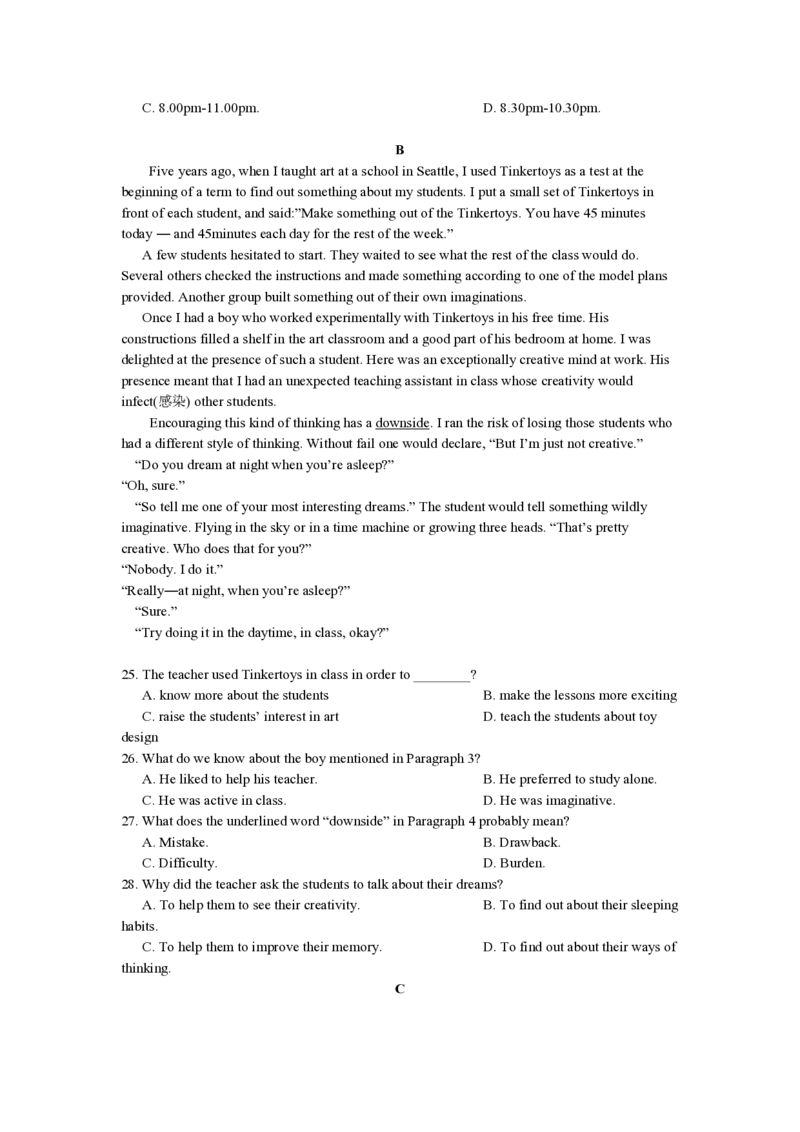
B

Five years ago, when I taught art at a school in Seattle, I used Tinkertoys as a test at the
beginning of a term to find out something about my students. I put a small set of Tinkertoys in
front of each student, and said:”Make something out of the Tinkertoys. You have 45 minutes
today ― and 45minutes each day for the rest of the week.”
   A few students hesitated to start. They waited to see what the rest of the class would do.
Several others checked the instructions and made something according to one of the model plans
provided. Another group built something out of their own imaginations.
   Once I had a boy who worked experimentally with Tinkertoys in his free time. His
constructions filled a shelf in the art classroom and a good part of his bedroom at home. I was
delighted at the presence of such a student. Here was an exceptionally creative mind at work. His
presence meant that I had an unexpected teaching assistant in class whose creativity would
infect(感染) other students.

Encouraging this kind of thinking has a downside. I ran the risk of losing those students who
had a different style of thinking. Without fail one would declare, “But I’m just not creative.”
  “Do you dream at night when you’re asleep?”
“Oh, sure.”
  “So tell me one of your most interesting dreams.” The student would tell something wildly
imaginative. Flying in the sky or in a time machine or growing three heads. “That’s pretty
creative. Who does that for you?”
“Nobody. I do it.”
“Really―at night, when you’re asleep?”
  “Sure.”
  “Try doing it in the daytime, in class, okay?”

25. The teacher used Tinkertoys in class in order to ________?
A. know more about the students
B. make the lessons more exciting
C. raise the students’ interest in art
D. teach the students about toy
design
26. What do we know about the boy mentioned in Paragraph 3?
A. He liked to help his teacher.
B. He preferred to study alone.
C. He was active in class.
D. He was imaginative.
27. What does the underlined word “downside” in Paragraph 4 probably mean?
A. Mistake.
B. Drawback.
C. Difficulty.
D. Burden.
28. Why did the teacher ask the students to talk about their dreams?
A. To help them to see their creativity.
B. To find out about their sleeping
habits.
C. To help them to improve their memory.
D. To find out about their ways of
thinking.
C
Reading can be a social activity. Think of the people who belong to book groups. They
choose books to read and then meet to discuss them. Now, the website BookCrossing.com turns
the page on the traditional idea of a book group.
Members go on the site and register the books they own and would like to share.
BookCrossing provides an identification number to stick inside the book. Then the person leaves it
in a public place, hoping that the book will have an adventure, traveling far and wide with each
new reader who finds it.

Bruce Pederson, the managing director of BookCrossing, says, “The two things that change
your life are the people you meet and books you read. BookCrossing combines both.”

Members leave books on park benches and buses, in train stations and coffee shops. Whoever
finds their book will go to the site and record where they found it.

People who find a book can also leave a journal entry describing what they thought of it. E-
mails are then sent to the BookCrossing to keep them updated about where their books have been
found. Bruce Peterson says the idea is for people not to be selfish by keeping a book to gather dust
on a shelf at home.
BookCrossing is part of a trend among people who want to get back to the “real” and not the
virtual(虚拟). The site now has more than one million members in more than one hundred thirty-
five countries.

29. Why does the author mention book groups in the first paragraph?
A. To explain what they are.
B. To introduce BookCrossing.
C. To stress the importance of reading.
D. To encourage readers to share
their ideas.
30. What does the underlined word “it” in Paragraph 2refer to?
A. The book.
B. An adventure.
C.A public place.
D. The identification number.
31. What will a BookCrosser do with a book after reading it?
A. Meet other readers to discuss it.
B. Keep it safe in his bookcase.
C. Pass it on to another reader.
D. Mail it back to its owner.
32. What is the best title for the text?
A. Online Reading: A Virtual Tour
B. Electronic Books: A new Trend
C. A Book Group Brings Tradition Back
D. A Website Links People
through Books
D
A new collection of photos brings an unsuccessful Antarctic voyage back to life.
Frank Hurley’s pictures would be outstanding―undoubtedly first-rate photo-journalism―if
they had been made last week. In fact, they were shot from 1914 through 1916, most of them after
a disastrous shipwreck(海难), by a cameraman who had no reasonable expectation of survival.
Many of the images were stored in an ice chest, under freezing water, in the damaged wooden
ship.
  The ship was the Endurance, a small, tight, Norwegian-built three-master that was intended to
take Sir Ernest Shackleton and a small crew of seamen and scientists, 27 men in all, to the
southernmost shore of Antarctica’s Weddell Sea. From that point Shackleton wanted to force a
passage by dog sled(雪橇) across the continent. The journey was intended to achieve more than
what Captain Robert Falcon Scott had done. Captain Scott had reached the South Pole early in
1912 but had died with his four companions on the march back.
   As writer Caroline Alexander makes clear in her forceful and well-researched story The
Endurance, adventuring was even then a thoroughly commercial effort. Scott’s last journey,
completed as he lay in a tent dying of cold and hunger, caught the world’s imagination, and a film
made in his honor drew crowds. Shackleton, a onetime British merchant-navy officer who had got
to within 100 miles of the South Pole in 1908, started a business before his 1914 voyage to make
money from movie and still photography. Frank Hurley, a confident and gifted Australian
photographer who knew the Antarctic, was hired to make the images, most of which have never
before been published.
33. What do we know about the photos taken by Hurley?
   A. They were made last week.
B. They showed undersea sceneries.
C. They were found by a cameraman.
D. They recorded a disastrous adventure.
34. Who reached the South Pole first according to the text?
A. Frank Hurley.
B. Ernest Shackleton.
C. Robert Falcon Scott.
D. Caroline Alexander.
35. What does Alexander think was the purpose of the 1914 voyage?
A. Artistic creation.
B. Scientific research.
C. Money making.
D. Treasure hunting.
第二节(共5 小题;每小题2 分,满分10 分)
根据短文内容,从短文后的选项中选出能填入空白处的最佳选项。选项中有两项为多
余选项。
A garden that’s just right for you
Have you ever visited a garden that seemed just right for you, where the atmosphere of the
garden appeared to total more than the sum(总和) of its parts?    36   . But it doesn’t happen
by accident. It starts with looking inside yourself and understanding who you are with respect to
the natural world and how you approach the gardening process.
●   37
Some people may think that a garden is no more than plants, flowers, patterns and masses of
color. Others are concerned about using gardening methods that require less water and fewer
fertilizers(肥料).    38   . However, there are a number of other reasons that might explain why
you want to garden. One of them comes from our earliest years.
●Recall(回忆) your childhood memories
   Our model of what a garden should be often goes back to childhood. Grandma’s rose garden
and Dad’s vegetable garden might be good or bad, but that’s not what’s important.
39   ―how being in those gardens made us feel. If you’d like to build a powerful bond with your
garden, start by taking some time to recall the gardens of your youth.    40   .Then go outside
and work out a plan to translate your childhood memories into your grown-up garden. Have fun.
A. Know why you garden
B. Find a good place for your own garden
C. It’s our experience of the garden that matters
D. It’s delightful to see so many beautiful flowers
E. Still others may simply enjoy being outdoors and close to plants
F. You can produce that kind of magical quality in your own garden, too
G. For each of those gardens, write down the strongest memory you have
第三部分:英语知识运用(共两节,满分45 分)
第一节完形填空(共20 小题;每小题1.5 分,满分30 分)
阅读下面短文,从短文后各题所给的四个选项(A、B、C 和D)中,选出可以填入空
白处的最佳选项,并在答题卡上将该项涂黑。
Hundreds of people have formed impressions of you through that little device(装置) on your
desk. And they’ve never actually   41   you. Everything they know about you   42   through
this device, sometimes from hundreds of miles away.   43   they feel they can know you   44
from the sound of your voice. That’s how powerful the   45   is.
Powerful, yes, but not always 46  . For years I dealt with my travel agent only by phone.
Rani, my faceless agent whom I’d never met 47  , got me rock-bottom prices on airfares, cars,
and hotels. But her cold voice really   48   me. I sometimes wished to   49   another agent.
One morning, I had to   50   an immediate flight home for a family emergency. I ran into
Rani’s office 51  . The woman sitting at the desk,   52   my madness, sympathetically jumped
up. She gave me a   53   smile, nodded while listening patiently, and then printed out the   54
immediately. “What a wonderful lady!” I thought.
Rushing out   55   I called out over my shoulder, “By the way, what’s your name?” “I’m
Rani,” she said. I turned around and saw a   56   woman with a big smile on her face waving to
wish me a safe trip. I was 57  ! Why had I thought she was cold? Rani was, well, so 58  .
Sitting back in the car on the way to the airport, I figured it all out. Rani’s   59  ―her
warm smile, her nods, her ‘I’m here for you’   60  ―were all silent signals that didn’t travel
through wires.
41. A. accepted


B. noticed


C. heard


D. met
42. A. came


B. moved

C. ran


D. developed
43. A. Thus


B.Yet


C.Then


D. Indeed
44. A. rather


B. also


C. just


D. already
45. A. telephone


B. voice


C. connection
D. impression
46. A. direct


B. useful

C. easy


D. accurate
47. A. in person


B. by myself

C. in public


D. on purpose
48. A. annoyed


B. interested

C. discouraged
D. confused
49. A. promote


B. train


C. find


D. know
50. A. arrange

B. postpone


C. confirm


D. book
51. A. for the first time B. at any time
C. from time to time
D. in good time
52. A. expecting


B. seeing

C. testing

D. avoiding
53. A. shy


B. comforting
C. familiar


D. forced
54. A. bill


B. form


C. ticket


D. list
55. A. hopefully


B. disappointedly C. gratefully

D. regretfully
56. A. careful

B. serious


C. nervous


D. pleasant
57. A. amused

B. worried


C. helpless


D. speechless
58. A. calm


B. nice


C. proud

D. clever
59. A. forgiveness
B. eagerness

C. friendliness
D. skillfulness
60. A. explanation
B. attitude


C. concept


D. behavior

2016 年普通高等学校招生全国统一考试
第II 卷
注意:将答案写在答题卡上。写在本试卷上无效。

第三部分英语知识运用(共两节,满分45 分)
第二节(共10 小题;每小题1.5 分,满分15 分)
阅读下面材料,在空白处填入适当的内容(1 个单词)或括号内单词的正确形式。
If you feel stressed by responsibilities at work, you should take a step back and identify (识
别) those of   61  (great)and less importance. Then, handle the most important tasks first so
you’ll feel a real sense of   62  (achieve). Leaving the less important things until tomorrow
63  (be) often acceptable.
Most of us are more focused   64   our tasks in the morning than we are later in the day.
So, get an early start and try to be as productive   65   possible before lunch. This will give you
the confidence you need to get you through the afternoon and go home feeling accomplished.
Recent   66  (study) show that we are far more productive at work if we take short breaks
67  (regular). Give your body and brain a rest by stepping outside for   68   while, exercising,
or dong something you enjoy.
If you find something you love doing outside of the office, you’ll be less likely   69
(bring) your work home. It could be anything―gardening, cooking, music, sports—but whatever
it is,   70  (make) sure it’s a relief from daily stress rather than another thing to worry about.
第四部分写作(共两节,满分35 分)
第一节短文改错(共10 小题,每小题1 分,满分10 分)
假定英语课上老师要求同桌之间交换修改作文,请你修改你同桌写的以下作文。文中
共有10 处语言错误,每句中最多有两处。每处错误仅涉及一个单词的增加、删除或修改。
增加:在缺词处加一个漏字符号(∧),并在其下面写出该加的词。
删除:把多余的词用斜线(﹨)划掉。
修改:在错的词下划一横线,并在该词下面写出修改后的词。
注意:1.每处错误及其修改均仅限一词;
2.只允许修改10 处,多者(从第11 处起)不计分。
The summer holiday is coming. My classmates and I are talking about how to do during the
holiday. We can chose between staying at home and take a trip. If we stay at home, it is
comfortable but there is no need to spend money. But in that case, we will learn little about world.
If we go on a trip abroad, we can broaden your view and gain knowledges we cannot get from
books. Some classmates suggest we can go to places of interest nearby. I thought that it is a good
idea. It does not cost many, yet we can still learn a lot.
第二节书面表达(满分25 分)
假定你是李华,你校摄影俱乐部(photography club)将举办国际中学生摄影展。请给
你的英国朋友Peter 写封信。请他提供作品。信的内容包括:
   1.主题:环境保护;
   2.展览时间;
   3.投稿邮箱:intlphotoshow@gmschool.com.
注意:
   1.词数100 左右;
   2.可以适当增加细节,以使行文连贯。