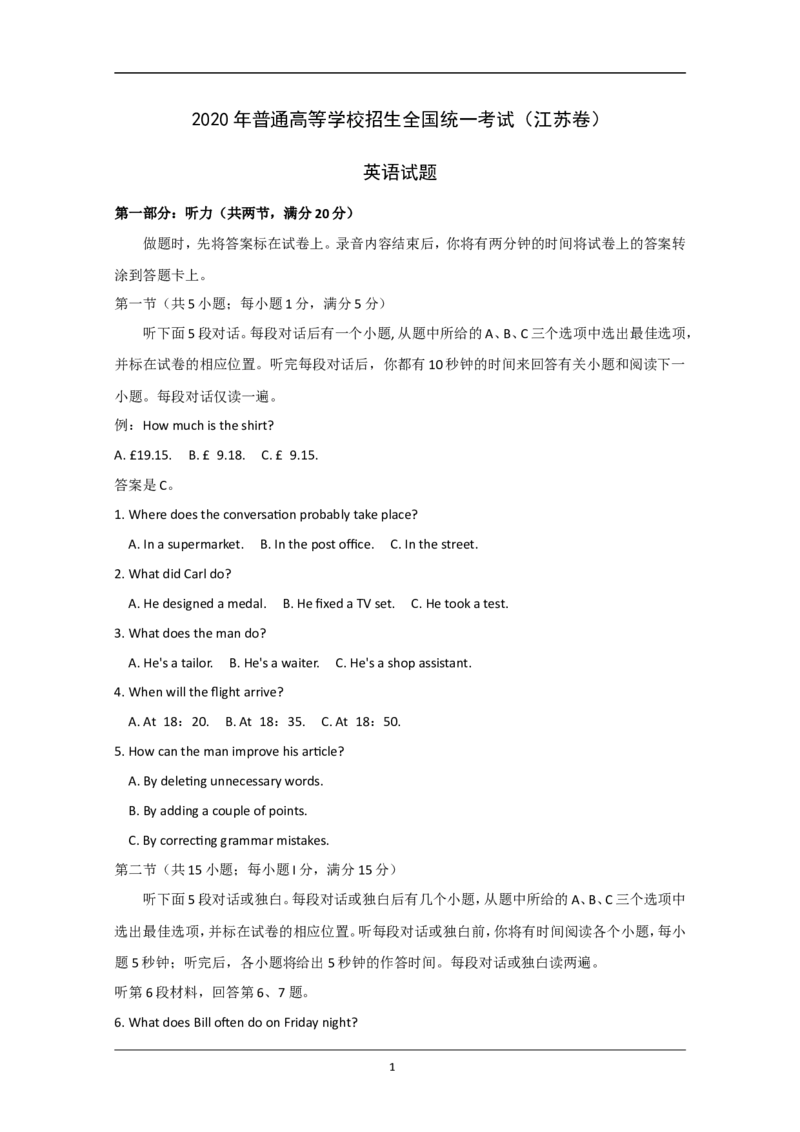
2020 年普通高等学校招生全国统一考试(江苏卷)
英语试题
第一部分:听力(共两节,满分20 分)
做题时,先将答案标在试卷上。录音内容结束后,你将有两分钟的时间将试卷上的答案转
涂到答题卡上。
第一节(共5 小题;每小题1 分,满分5 分)
听下面5 段对话。每段对话后有一个小题, 从题中所给的A、B、C 三个选项中选出最佳选项,
并标在试卷的相应位置。听完每段对话后,你都有10 秒钟的时间来回答有关小题和阅读下一
小题。每段对话仅读一遍。
例:How much is the shirt?
A. £19.15.     B. £ 9.18.     C. £ 9.15.
答案是C。
1. Where does the conversation probably take place?
A. In a supermarket.     B. In the post office.     C. In the street.
2. What did Carl do?
A. He designed a medal.     B. He fixed a TV set.     C. He took a test.
3. What does the man do?
A. He's a tailor.     B. He's a waiter.     C. He's a shop assistant.
4. When will the flight arrive?
A. At 18:20.     B. At 18:35.     C. At 18:50.
5. How can the man improve his article?
A. By deleting unnecessary words.
B. By adding a couple of points.
C. By correcting grammar mistakes.
第二节(共15 小题;每小题I 分,满分15 分)
听下面5 段对话或独白。每段对话或独白后有几个小题,从题中所给的A、B、C 三个选项中
选出最佳选项,并标在试卷的相应位置。听每段对话或独白前,你将有时间阅读各个小题,每小
题5 秒钟;听完后,各小题将给出5 秒钟的作答时间。每段对话或独白读两遍。
听第6 段材料,回答第6、7 题。
6. What does Bill often do on Friday night?

1

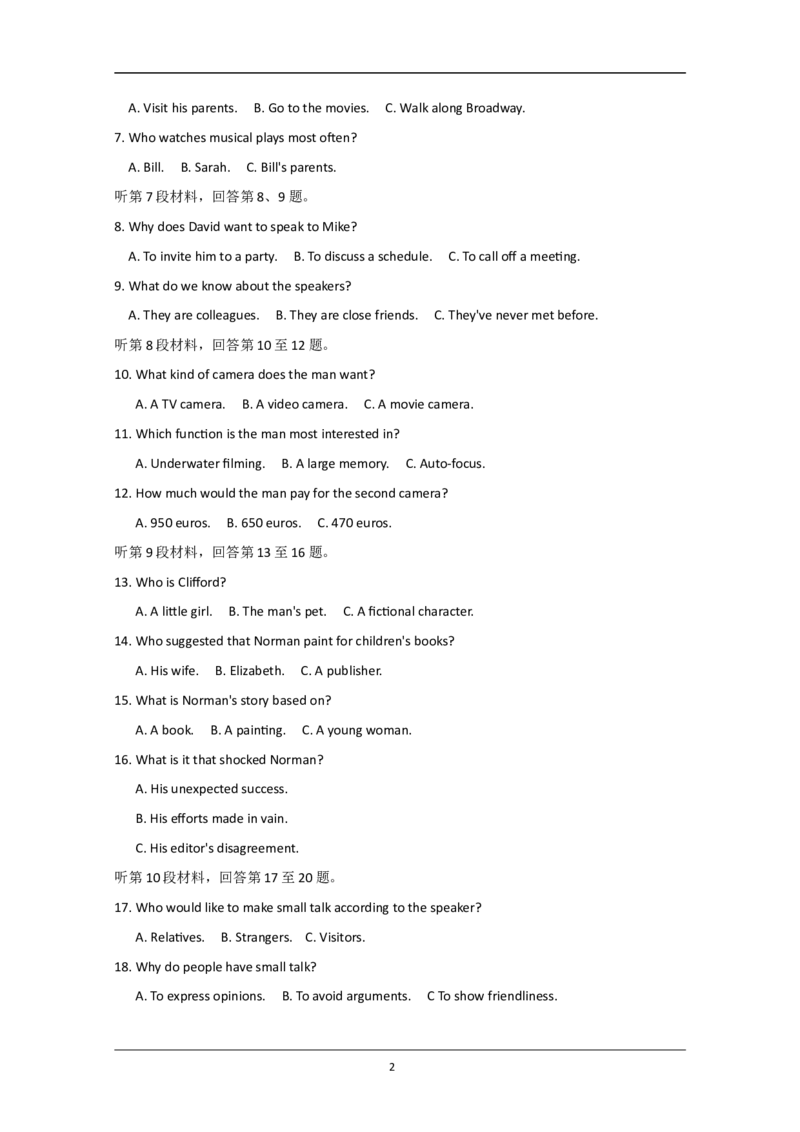
A. Visit his parents.     B. Go to the movies.     C. Walk along Broadway.
7. Who watches musical plays most often?
A. Bill.     B. Sarah.     C. Bill's parents.
听第7 段材料,回答第8、9 题。
8. Why does David want to speak to Mike?
A. To invite him to a party.     B. To discuss a schedule.     C. To call off a meeting.
9. What do we know about the speakers?
A. They are colleagues.     B. They are close friends.     C. They've never met before.
听第8 段材料,回答第10 至12 题。
10. What kind of camera does the man want?
A. A TV camera.     B. A video camera.     C. A movie camera.
11. Which function is the man most interested in?
A. Underwater filming.     B. A large memory.     C. Auto-focus.
12. How much would the man pay for the second camera?
A. 950 euros.     B. 650 euros.     C. 470 euros.
听第9 段材料,回答第13 至16 题。
13. Who is Clifford?
A. A little girl.     B. The man's pet.     C. A fictional character.
14. Who suggested that Norman paint for children's books?
A. His wife.     B. Elizabeth.     C. A publisher.
15. What is Norman's story based on?
A. A book.     B. A painting.     C. A young woman.
16. What is it that shocked Norman?
A. His unexpected success.
B. His efforts made in vain.
C. His editor's disagreement.
听第10 段材料,回答第17 至20 题。
17. Who would like to make small talk according to the speaker?
A. Relatives.     B. Strangers.    C. Visitors.
18. Why do people have small talk?
A. To express opinions.     B. To avoid arguments.     C To show friendliness.

2

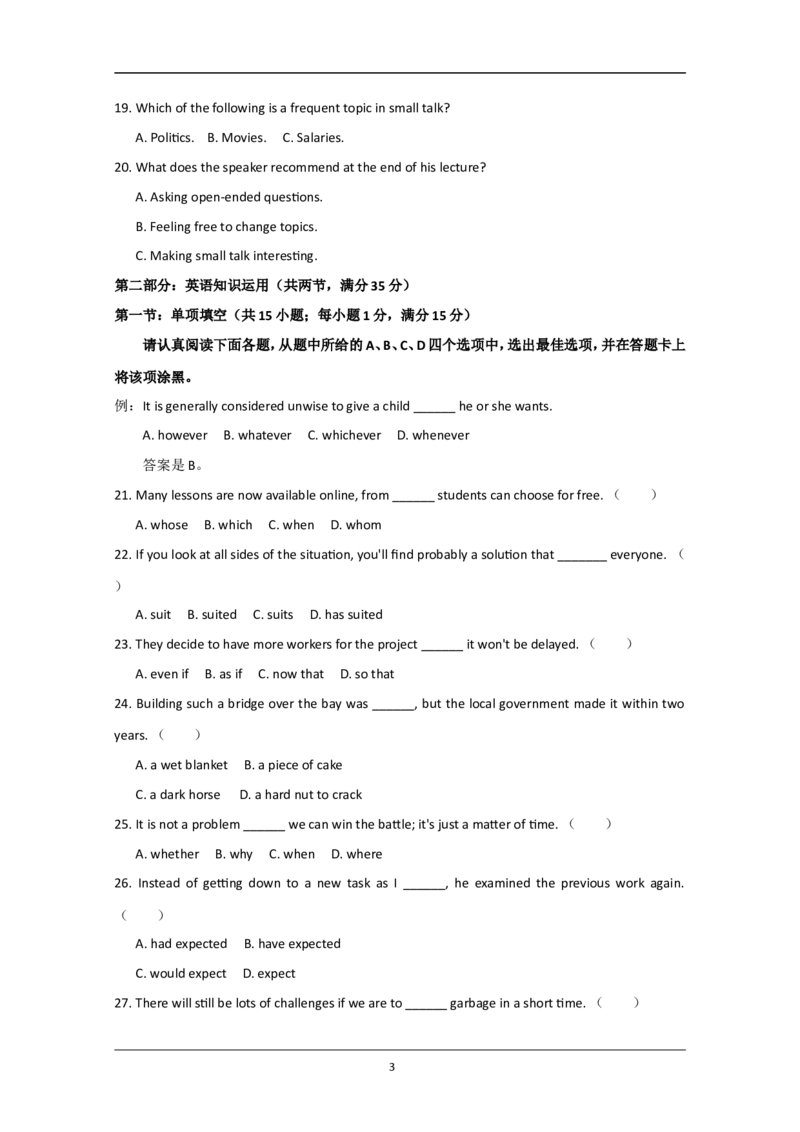
19. Which of the following is a frequent topic in small talk?
A. Politics.    B. Movies.     C. Salaries.
20. What does the speaker recommend at the end of his lecture?
A. Asking open-ended questions.
B. Feeling free to change topics.
C. Making small talk interesting.
第二部分:英语知识运用(共两节,满分35 分)
第一节:单项填空(共15 小题;每小题1 分,满分15 分)
请认真阅读下面各题,从题中所给的A、B、C、D 四个选项中,选出最佳选项,并在答题卡上
将该项涂黑。
例:It is generally considered unwise to give a child ______ he or she wants.
A. however     B. whatever     C. whichever     D. whenever
答案是B。
21. Many lessons are now available online, from ______ students can choose for free. (    )
A. whose     B. which     C. when     D. whom
22. If you look at all sides of the situation, you'll find probably a solution that _______ everyone. (
)
A. suit     B. suited     C. suits     D. has suited
23. They decide to have more workers for the project ______ it won't be delayed. (    )
A. even if     B. as if     C. now that     D. so that
24. Building such a bridge over the bay was ______, but the local government made it within two
years. (    )
A. a wet blanket     B. a piece of cake
C. a dark horse      D. a hard nut to crack
25. It is not a problem ______ we can win the battle; it's just a matter of time. (    )
A. whether     B. why     C. when     D. where
26. Instead of getting down to a new task as I ______, he examined the previous work again.
(    )
A. had expected     B. have expected
C. would expect     D. expect
27. There will still be lots of challenges if we are to ______ garbage in a short time. (    )

3

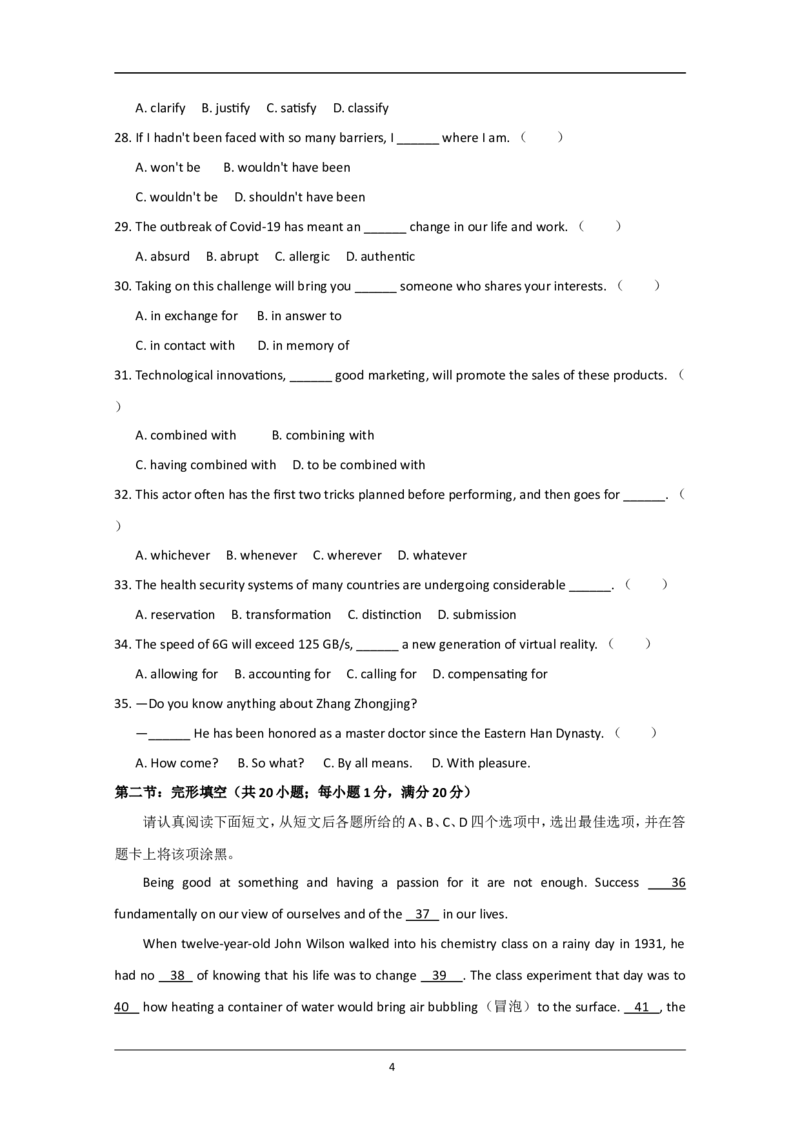
A. clarify     B. justify     C. satisfy     D. classify
28. If I hadn't been faced with so many barriers, I ______ where I am. (    )
A. won't be       B. wouldn't have been
C. wouldn't be     D. shouldn't have been
29. The outbreak of Covid-19 has meant an ______ change in our life and work. (    )
A. absurd     B. abrupt     C. allergic     D. authentic
30. Taking on this challenge will bring you ______ someone who shares your interests. (    )
A. in exchange for      B. in answer to
C. in contact with       D. in memory of
31. Technological innovations, ______ good marketing, will promote the sales of these products. (
)
A. combined with           B. combining with
C. having combined with     D. to be combined with
32. This actor often has the first two tricks planned before performing, and then goes for ______. (
)
A. whichever     B. whenever     C. wherever     D. whatever
33. The health security systems of many countries are undergoing considerable ______. (    )
A. reservation     B. transformation     C. distinction     D. submission
34. The speed of 6G will exceed 125 GB/s, ______ a new generation of virtual reality. (    )
A. allowing for     B. accounting for     C. calling for     D. compensating for
35. —Do you know anything about Zhang Zhongjing?
—______ He has been honored as a master doctor since the Eastern Han Dynasty. (    )
A. How come?      B. So what?      C. By all means.      D. With pleasure.
第二节:完形填空(共20 小题;每小题1 分,满分20 分)
请认真阅读下面短文,从短文后各题所给的A、B、C、D 四个选项中,选出最佳选项,并在答
题卡上将该项涂黑。
Being good at something and having a passion for it are not enough. Success    36
fundamentally on our view of ourselves and of the    37    in our lives.
When twelve-year-old John Wilson walked into his chemistry class on a rainy day in 1931, he
had no    38   of knowing that his life was to change    39    . The class experiment that day was to
40    how heating a container of water would bring air bubbling(冒泡)to the surface.    41   , the

4

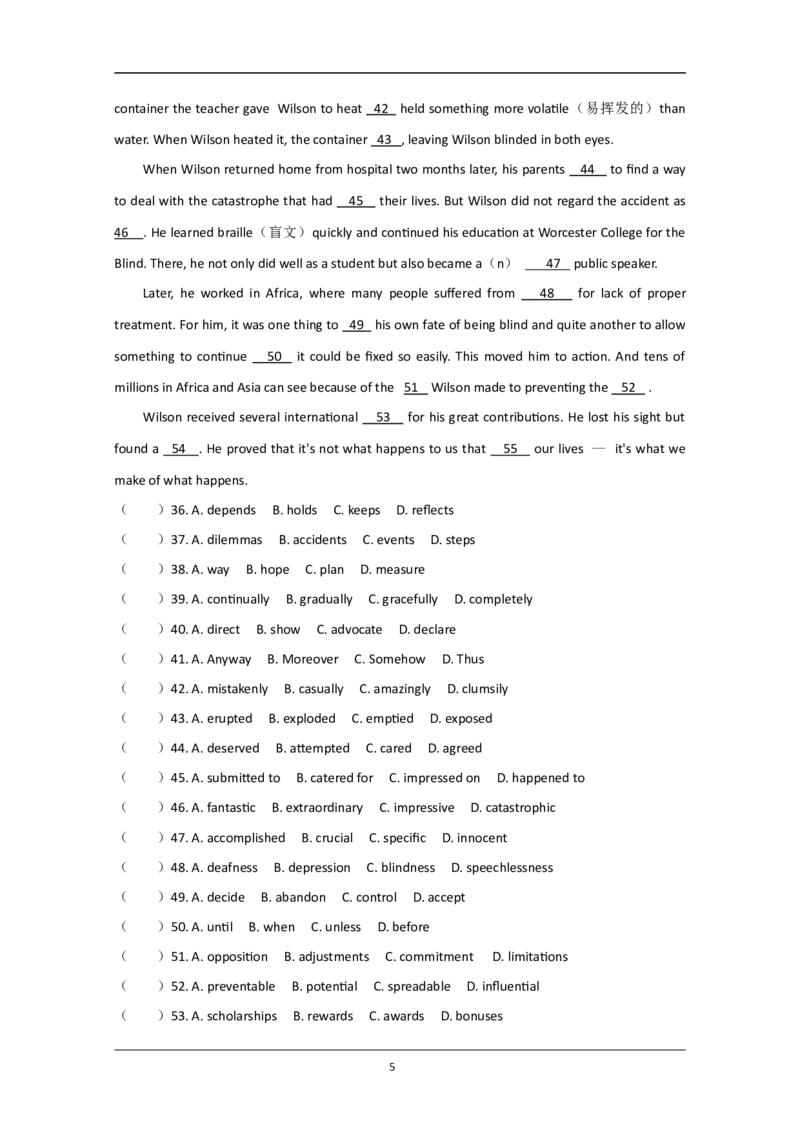
container the teacher gave Wilson to heat   42   held something more volatile(易挥发的)than
water. When Wilson heated it, the container   43   , leaving Wilson blinded in both eyes.
When Wilson returned home from hospital two months later, his parents    44    to find a way
to deal with the catastrophe that had    45    their lives. But Wilson did not regard the accident as
46    . He learned braille(盲文)quickly and continued his education at Worcester College for the
Blind. There, he not only did well as a student but also became a(n)
  47
   public speaker.
Later, he worked in Africa, where many people suffered from    48    for lack of proper
treatment. For him, it was one thing to   49   his own fate of being blind and quite another to allow
something to continue    50   it could be fixed so easily. This moved him to action. And tens of
millions in Africa and Asia can see because of the   51    Wilson made to preventing the    52    .
Wilson received several international    53    for his great contributions. He lost his sight but
found a   54   . He proved that it's not what happens to us that    55    our lives — it's what we
make of what happens.
(    )36. A. depends     B. holds     C. keeps     D. reflects
(    )37. A. dilemmas     B. accidents     C. events     D. steps
(    )38. A. way     B. hope     C. plan     D. measure
(    )39. A. continually     B. gradually     C. gracefully     D. completely
(    )40. A. direct     B. show     C. advocate     D. declare
(    )41. A. Anyway     B. Moreover     C. Somehow     D. Thus
(    )42. A. mistakenly     B. casually     C. amazingly     D. clumsily
(    )43. A. erupted     B. exploded     C. emptied     D. exposed
(    )44. A. deserved     B. attempted     C. cared     D. agreed
(    )45. A. submitted to     B. catered for     C. impressed on     D. happened to
(    )46. A. fantastic     B. extraordinary     C. impressive     D. catastrophic
(    )47. A. accomplished     B. crucial     C. specific     D. innocent
(    )48. A. deafness     B. depression     C. blindness     D. speechlessness
(    )49. A. decide     B. abandon     C. control     D. accept
(    )50. A. until     B. when     C. unless     D. before
(    )51. A. opposition     B. adjustments     C. commitment      D. limitations
(    )52. A. preventable     B. potential     C. spreadable     D. influential
(    )53. A. scholarships     B. rewards     C. awards     D. bonuses

5

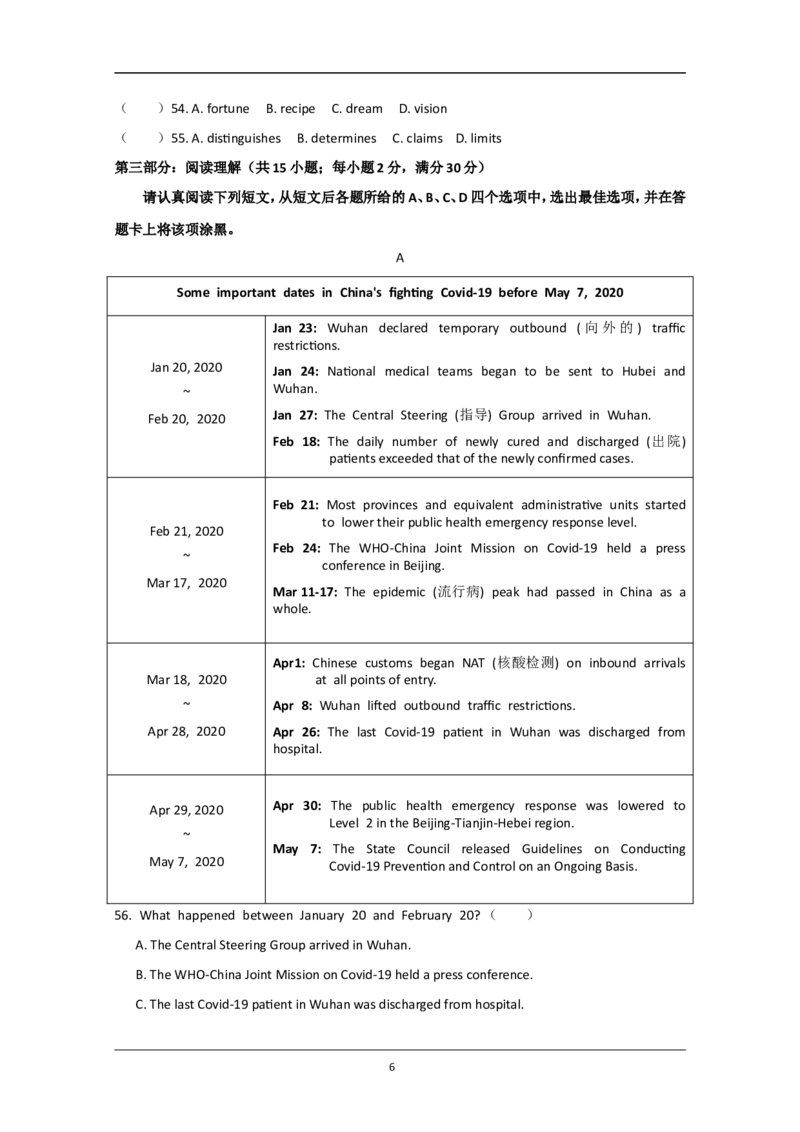
(    )54. A. fortune     B. recipe     C. dream     D. vision
(    )55. A. distinguishes     B. determines     C. claims    D. limits
第三部分:阅读理解(共15 小题;每小题2 分,满分30 分)
请认真阅读下列短文,从短文后各题所给的A、B、C、D 四个选项中,选出最佳选项,并在答
题卡上将该项涂黑。
A
Some important dates in China's fighting Covid-19 before May 7, 2020
Jan 20, 2020
~
Feb 20, 2020
Jan 23: Wuhan declared temporary outbound ( 向外的) traffic
restrictions.
Jan 24: National medical teams began to be sent to Hubei and
Wuhan.
Jan 27: The Central Steering (指导) Group arrived in Wuhan.
Feb 18: The daily number of newly cured and discharged (出院)
patients exceeded that of the newly confirmed cases.
Feb 21, 2020
~
Mar 17, 2020
Feb 21: Most provinces and equivalent administrative units started
to lower their public health emergency response level.
Feb 24: The WHO-China Joint Mission on Covid-19 held a press
conference in Beijing.
Mar 11-17: The epidemic (流行病) peak had passed in China as a
whole.
Mar 18, 2020
~
Apr 28, 2020
Apr1: Chinese customs began NAT (核酸检测) on inbound arrivals
at all points of entry.
Apr 8: Wuhan lifted outbound traffic restrictions.
Apr 26: The last Covid-19 patient in Wuhan was discharged from
hospital.
Apr 29, 2020
~
May 7, 2020
Apr 30: The public health emergency response was lowered to
Level 2 in the Beijing-Tianjin-Hebei region.
May 7: The State Council released Guidelines on Conducting
Covid-19 Prevention and Control on an Ongoing Basis.
56. What happened between January 20 and February 20? (    )
A. The Central Steering Group arrived in Wuhan.
B. The WHO-China Joint Mission on Covid-19 held a press conference.
C. The last Covid-19 patient in Wuhan was discharged from hospital.

6

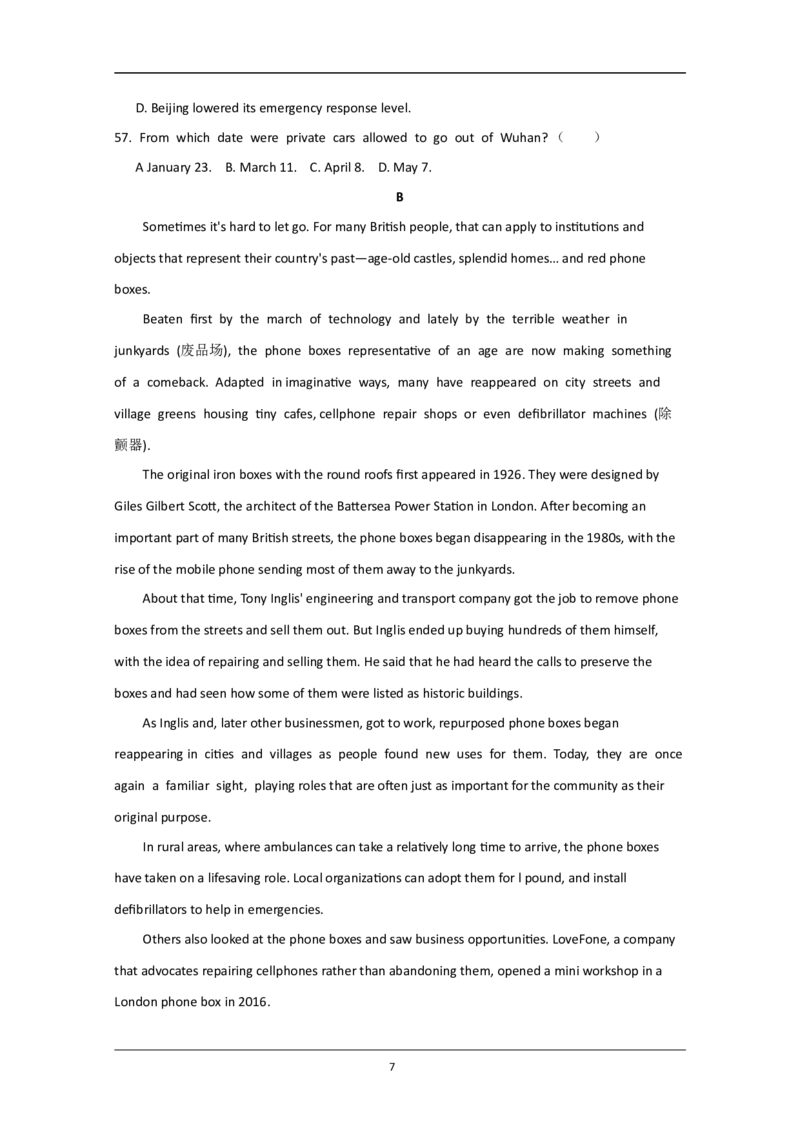
D. Beijing lowered its emergency response level.
57. From which date were private cars allowed to go out of Wuhan? (    )
A January 23.    B. March 11.    C. April 8.    D. May 7.
B
Sometimes it's hard to let go. For many British people, that can apply to institutions and
objects that represent their country's past—age-old castles, splendid homes… and red phone
boxes.
Beaten first by the march of technology and lately by the terrible weather in
junkyards (废品场), the phone boxes representative of an age are now making something
of a comeback. Adapted in imaginative ways, many have reappeared on city streets and
village greens housing tiny cafes, cellphone repair shops or even defibrillator machines (除
颤器).
The original iron boxes with the round roofs first appeared in 1926. They were designed by
Giles Gilbert Scott, the architect of the Battersea Power Station in London. After becoming an
important part of many British streets, the phone boxes began disappearing in the 1980s, with the
rise of the mobile phone sending most of them away to the junkyards.
About that time, Tony Inglis' engineering and transport company got the job to remove phone
boxes from the streets and sell them out. But Inglis ended up buying hundreds of them himself,
with the idea of repairing and selling them. He said that he had heard the calls to preserve the
boxes and had seen how some of them were listed as historic buildings.
As Inglis and, later other businessmen, got to work, repurposed phone boxes began
reappearing in cities and villages as people found new uses for them. Today, they are once
again a familiar sight, playing roles that are often just as important for the community as their
original purpose.
In rural areas, where ambulances can take a relatively long time to arrive, the phone boxes
have taken on a lifesaving role. Local organizations can adopt them for l pound, and install
defibrillators to help in emergencies.
Others also looked at the phone boxes and saw business opportunities. LoveFone, a company
that advocates repairing cellphones rather than abandoning them, opened a mini workshop in a
London phone box in 2016.

7

The tiny shops made economic sense, according to Robert Kerr, a founder of LoveFone. He said
that one of the boxes generated around $13,500 in revenue a month and cost only about
$ 400 to rent.
Inglis said phone boxes called to mind an age when things were built to last. "I like what they
are to people, and I enjoy bringing things back," he said.
58. The phone boxes are making a comeback ______. (    )
A. to form a beautiful sight of the city
B. to improve telecommunications services
C. to remind people of a historical period
D. to meet the requirement of green economy
59. Why did the phone boxes begin to go out of service in the 1980s? (    )
A. They were not well-designed.    B. They provided bad services.
C. They had too short a history.    D. They lost to new technologies.
60. The phone boxes are becoming popular mainly because of ______. (    )
A. their new appearance and lower prices    B. the push of the local organizations
C. their changed roles and functions    D. the big funding of the businessmen
C
For those who can stomach it, working out before breakfast may be more beneficial for health
than eating first, according to a study of meal timing and physical activity.
Athletes and scientists have long known that meal timing affects performance. However, far
less has been known about how meal timing and exercise might affect general health.
To find out, British scientists conducted a study. They first found 10 overweight and inactive
but otherwise healthy young men, whose lifestyles are, for better and worse, representative of
those of most of us. They tested the men's fitness and resting metabolic (新陈代谢的)
rates and took samples (样品) of their blood and fat tissue.
Then, on two separate morning visits to the scientists' lab, each man walked for an hour at an
average speed that, in theory should allow his body to rely mainly on fat for fuel. Before one of
these workouts, the men skipped breakfast, meaning that they exercised on a completely empty
stomach after a long overnight fast (禁食). On the other occasion, they ate a rich morning
meal about two hours before they started walking.
Just before and an hour after each workout, the scientists took additional samples of the men's

8

blood and fat tissue.
Then they compared the samples. There were considerable differences. Most obviously, the
men displayed lower blood sugar levels at the start of their workouts when they had skipped
breakfast than when they had eaten. As a result, they burned more fat during walks on an empty
stomach than when they had eaten first. On the other hand, they burned slightly more
calories (卡路里), on average, during the workout after breakfast than after fasting.
But it was the effects deep within the fat cells that may have been the most significant, the
researchers found, Multiple genes behaved differently, depending on whether someone had eaten
or not before walking. Many of these genes produce proteins (蛋白质) that can improve
blood sugar regulation and insulin (胰岛素) levels throughout the body and so are
associated with improved metabolic health. These genes were much more active when the men
had fasted before exercise than when they had breakfasted.
The implication of these results is that to gain the greatest health benefits from exercise, it
may be wise to skip eating first.
61. The underlined expression "stomach it" in Paragraph 1 most probably means "______". (    )
A. digest the meal easily    B. manage without breakfast
C. decide wisely what to eat    D. eat whatever is offered
62. Why were the 10 people chosen for the experiment? (    )
A. Their lifestyles were typical of ordinary people.
B. Their lack of exercise led to overweight.
C. They could walk at an average speed.
D. They had slow metabolic rates.
63. What happened to those who ate breakfast before exercise? (    )
A. They successfully lost weight.    B. They consumed a bit more calories.
C. They burned more fat on average.    D. They displayed higher insulin levels.
64. What could be learned from the research? (    )
A. A workout after breakfast improves gene performances.
B. Too much workout often slows metabolic rates.
C. Lifestyle is not as important as morning exercise.
D. Physical exercise before breakfast is better for health.
D

9

I was in the middle of the Amazon (亚马逊) with my wife, who was there as a
medical researcher. We flew on a small plane to a faraway village. We did not speak the local
language, did not know the customs, and more often than not, did not entirely recognize the food.
We could not have felt more foreign.
We were raised on books and computers, highways and cell phones, but now we were living in
a village without running water or electricity It was easy for us to go to sleep at the end of the day
feeling a little misunderstood.
Then one perfect Amazonian evening, with monkeys calling from beyond the village green, we
played soccer. I am not good at soccer, but that evening it was wonderful. Everyone knew the rules.
We all spoke the same language of passes and shots. We understood one another perfectly. As
darkness came over the field and the match ended, the goal keeper, Juan, walked over to me and
said in a matter-of-fact way, "In your home, do you have a moon too?" I was surprised.
After I explained to Juan that yes, we did have a moon and yes, it was very similar to his, I felt a
sort of awe ( 敬畏) at the possibilities that existed in his world. In Juan's world, each
village could have its own moon. In Juan's world, the unknown and undiscovered was vast and
marvelous. Anything was possible.
In our society, we know that Earth has only one moon. We have looked at our planet from
every angle and found all of the wildest things left to find. I can, from my computer at home, pull up
satellite images of Juan's village. There are no more continents and no more moons to search for,
little left to discover. At least it seems that way.
Yet, as I thought about Juan's question, I was not sure how much more we could really rule
out. I am, in part, an ant biologist, so my thoughts turned to what we know about insect life and I
knew that much in the world of insects remains unknown. How much, though? How
ignorant  (无知的) are we? The question of what we know and do not know constantly
bothered me.
I began collecting newspaper articles about new species, new monkey, new spider…, and on
and on they appear. My drawer quickly filled. I began a second drawer for more general discoveries:
new cave system discovered with dozens of nameless species, four hundred species of bacteria
found in the human stomach. The second drawer began to fill and as it did I wondered whether
there were bigger discoveries out there, not just species, but life that depends on things thought to

10

be useless, life even without DNA. I started a third drawer for these big discoveries. It fills more
slowly, but all the same, it fills.
In looking into the stories of biological discovery, I also began to find something else, a
collection of scientists, usually brilliant occasionally half-mad, who made the discoveries. Those
scientists very often see the same things that other scientists see, but they pay more attention to
them, and they focus on them to the point of exhaustion (穷尽), and at the risk of the
ridicule of their peers. In looking for the stories of discovery, I found the stories of these people and
how their lives changed our view of the world.
We are repeatedly willing to imagine we have found most of what is left to discover.
We used to think that insects were the smallest organisms (生物), and that nothing lived
deeper than six hundred meters. Yet, when something new turns up, more often than not,
we do not even know its name.
65. How did the author feel on his arrival in the Amazon? (    )
A. Out of place.         B. Full of joy.        C. Sleepy.         D. Regretful.
66. What made that Amazonian evening wonderful? (    )
A. He learned more about the local language.
B. They had a nice conversation with each other.
C. They understood each other while playing.
D. He won the soccer game with the goal keeper.
67. Why was the author surprised at Juan's question about the moon? (    )
A. The question was too straightforward.
B. Juan knew so little about the world.
C. The author didn't know how to answer.
D. The author didn't think Juan was sincere.
68. What was the author's initial purpose of collecting newspaper articles? (    )
A. To sort out what we have known.
B. To deepen his research into Amazonians.
C. To improve his reputation as a biologist.
D. To learn more about local cultures.
69. How did those brilliant scientists make great discoveries? (    )
A. They shifted their viewpoints frequently.

11

B. They followed other scientists closely.
C. They often criticized their fellow scientists.
D. They conducted in-depth and close studies.
70. What could be the most suitable title for the passage? (    )
A. The Possible and the Impossible
B. The Known and the Unknown
C. The Civilized and the Uncivilized
D. The Ignorant and the Intelligent
第四部分:任务型阅读(共10 小题;每小题1 分,满分10 分)
请认真阅读下面短文,并根据所读内容在文章后表格中的空格里填入一个最恰当的单词。
注意:请将答案写在答题卡上相应题号的横线上。每个空格只填一个单词。
Humor
If you see humor as an optional form of entertainment, you're missing some of its biggest
benefits: Humor makes average-looking people look cute and uninteresting people seem
entertaining. Studies show that a good sense of humor even makes you seem smarter.
Best of all, humor raises your energy, and that can have an effect on everything you do at
school, at work, or in your personal life. The increase of energy will even make you more willing to
exercise, and that will raise your overall energy even more.
Humor also transports your mind away from your daily troubles. Humor lets you better
understand life and sometimes helps you laugh at even the worst of your problems.
In my experience, most people think they have a sense of humor, and to some degree that's true.
But not all senses of humor are created equal. So I thought it would be useful to include some humor
tips for everyday life.
You don't have to be the joke teller in the group in order to show your sense of humor. You can
be the one who directs the conversation to fun topics that are ripe for others to add humor. Every
party needs a straight person. You'll appear fun and funny by association.
When it comes to in-person humor, effort counts a lot. When people see you trying to be funny,
it frees them to try it themselves. So even if your own efforts at humor fall short, you might be
freeing the long kept humor in others. People need permission to be funny in social settings because
there's always a risk that comes with humor. For in-person humor, quality isn't as important as you
might think. Your attitude and effort count a lot.

12

Some people — and I was one of them — believe that humorous complaints about the little
problems of life make humor, and sometimes that is the case. The problem comes when you start
doing too much complaint-based humor. One funny observation about problem in your life can be
funny, but five is just complaining, no matter how smart you think you are. Funny complaints can
wear people out.
Self-deprecating humor (自嘲式) is usually the safest type, but here again you don't want to
overshoot the target. One self-deprecating comment is a generous and even confident form of humor.
You have to be at least a bit self-assured to laugh at yourself in front of others. But if you do it too
often, you can transform in the eyes of others from a confident joker to a Chihuahua dog.
Humor
Benefits of humor
● Humor is form of (71)________. Humor can improve one's ________ and
personality.
● Humor can make one (73) ________ in his work, study, and life.
● Humor has a positive (74) ________ effect when we are in difficulties.
(75) ________to follow
● (76) ________ others for a conversation of fun is as good as telling a joke
yourself when showing your sense of humor.
● Quality counts (77) ________ than attitude and effort — even stupid joke
can (78) ________ others of risk and embarrassment.
Traps to (79) ________
● One humorous complaint makes funny person. But too many complaints
will (80) ________ your audience.
● Self-deprecating comments show one's assurance. But too much deprecation
will make a Chihuahua dog.
第五部分:书面表达(满分25 分)
81.请阅读下面有关中国题材纪录片(documentary)的对话,并按照要求用英语写一篇150 个词
左右的文章。
Su Hua: Hi, Li Jiang! Did you see the BBC documentary on CCTV 9 last week?
Li Jiang: You mean Du Fu: China's Greatest Poet? Yes, I did. Fantastic!
Su Hua: Just think an English actor recites Chinese poems.
Li Jiang: I don't really understand every line he recites, but I believe he truly loves the poems
himself.
Su Hua: Right. It is reported that the film is well received outside China.
Li Jiang: Yeah, It's my first time to hear Chinese stories told by an English speaker.
Su Hua: In fact, documentaries about our country are plentiful both at home and abroad. These films
can help foreign friends better understand this land — Chinese literature, geography
history, food...
Li Jiang: I couldn't agree more.
【写作内容】

13

1.用约30 个词概括上述对话的主要内容;
2.谈谈中国题材纪录片受到外国朋友欢迎的原因(至少两点)。
【写作要求】
1.写作过程中不能直接引用原文语句;
2.作文中不能出现真实姓名和学校名称;
3.不必写标题。

14