文档文本内容
2016 年江苏省高考英语试卷
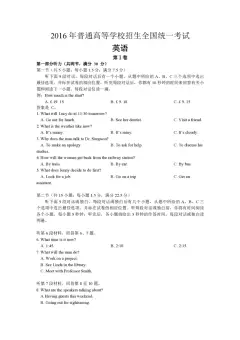
第一部分听力(共两节,满分5 分)做题时,现将答案标在试卷上,录音内容结束后,你将有两分钟的时间将
试卷上的答案转涂到答题卡上.第一节(共5 小题;每小题1 分,满分5 分)(略)听下面5 段对话,每段对话
后有一个小题.从题中所给的A,B,C 三个选项中选出最佳选项,并标在试卷的相应位置.听完每段对话
后,你都有10 秒钟的时间来回答有关小题和阅读下一小题.每段对话仅读一遍.
1.(1 分)What are the speakers talking about?
A.Having a birthday party.
B.Doing some exercise.
C.Getting Lydia a gift.
2.(1 分)What is the woman going to do?
A.Help the man.
B.Take a bus.
C.Get a camera.
3.(1 分)What does the woman suggest the man do?
A.Tell Kate's to stop.
B.Call Kate's friends.
C.Stay away from Kate.
4.(1 分)Where does the conversation probably take place?
A.In a wine shop.
B.In a supermarket.
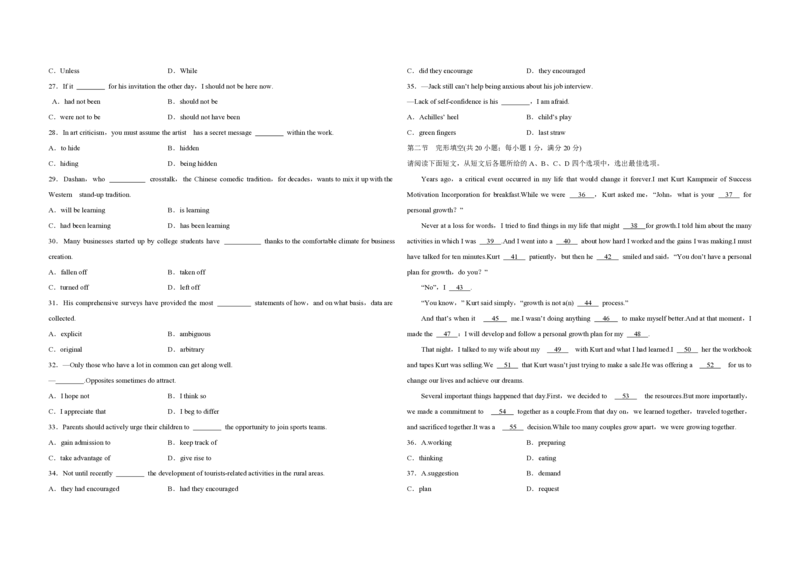
C.In a restaurant.
5.(1 分)What does the woman mean?
A.Keep the window closed.
B.Go out for fresh air.
C.Turn on the fan.
第二节(共5 小题;每小题2 分,满分15 分)听下面5 段对话或独白.每段对话或独白后有几个小题,从题中
所给的A、B、C 三个选项中选出最佳选项,并标在试卷的相应位置.听每段对话或独白前,你将有时间阅读
各个小题,每小题5 秒钟;听完后,各小题将给出5 秒钟的作答时间.每段对话或独白读两遍.
6.(2 分)听第6 段材料,回答第6、7 题.
6.What is the man going to do this summer?
A.Teach a course.
B.Repair his house.
C.Work at a hotel.
7.How will the man use the money?
A.To hire a gardener.
B.To buy books.
C.To pay for a boat trip.
7.(2 分)听第7 段材料,回答第8、9 题.
8.What is the probable relationship between the speakers?
A.Schoolmates.
B.Colleages.
C.Roommates.
9.What does Frank plan to do right after graduation?
A.Work as a programmer.
B.Travel around the world.
C.Start his own business.
8.(3 分)听第8 段材料,回答第10 至12 题.
10.Why does the woman make the call?
A.To book a hotel room.
B.To ask about the room service.
C.To make changers to a reservation.
11.When will the woman arrive at the hotel?
A.On September 15.
B.On September 16.
C.On September 23.
12.How much will the woman pay for her room per night?
A.﹩179
B.﹩199
C.﹩219.
9.(4 分)(1)What is the woman's plan for Saturday?
A.Going shopping
B.Going camping.
C.Going boating.
(2)Where will the woman stay in Keswick?
A.In a country inn.
B.In a five﹣star hotel.
C.In her aunt's home.
(3)What will Gordon do over the weekend?
A.Visit his friends.
B.Watch DVDs.
C.Join the woman.
(4)What does the woman think of Gordon's coming weekend?
A.Relaxed.
B.Boring.
C.Busy.
10.(4 分)(1)Who is Wang Ming?
A.A student
B.An employer.
C.An engineer
(2)What does the speaker say about the college job market this year?
A.It's unpredictable
B.It's quite stable
C.It's not optimistic
(3)What percentage of student job seekers have found a job by now?
A.20%
B.22%
C.50%
(4)Why are engineering graduates more likely to accept a job?
A.They need more work experience
B.The salary is usually good.
C.Their choice is limited.
第二部分 英语知识运用(共两节,满分35 分)
第一节 单项填空(共15 小题;每小题1 分,满分15 分)
请阅读下面各题,从题中所给的A、B、C、D 四个选项中,选出最佳选项。
21.It is often the case
anything is possible for those who hang on to hope.
A.why
B.what
C.as
D.that
22.More efforts,as reported,
in the years ahead to accelerate the supplyside structural reform.
A.are made
B.will be made
C.are being made
D.have been made
23.Many young people,most
were welleducated,headed for remote regions to chase their dreams.
A.of which
B.of them
C.of whom
D.of those
24.—Can you tell us your
for happiness and a long life?
—Living every day to the full,definitely.
A.recipe
B.record
C.range
D.receipt
25.He did not
easily,but was willing to accept any constructive advice for a worthy cause.
A.approach
B.wrestle
C.compromise
D.communicate
26.
some people are motivated by a need for success,others are motivated by a fear of failure.
A Because
B.If
C.Unless
D.While
27.If it
for his invitation the other day,I should not be here now.
A.had not been
B.should not be
C.were not to be
D.should not have been
28.In art criticism,you must assume the artist has a secret message
within the work.
A.to hide
B.hidden
C.hiding
D.being hidden
29.Dashan,who crosstalk,the Chinese comedic tradition,for decades,wants to mix it up with the
Western standup tradition.
A.will be learning
B.is learning
C.had been learning
D.has been learning
30.Many businesses started up by college students have thanks to the comfortable climate for business
creation.
A.fallen off
B.taken off
C.turned off
D.left off
31.His comprehensive surveys have provided the most statements of how,and on what basis,data are
collected.
A.explicit
B.ambiguous
C.original
D.arbitrary
32.—Only those who have a lot in common can get along well.
—
.Opposites sometimes do attract.
A.I hope not
B.I think so
C.I appreciate that
D.I beg to differ
33.Parents should actively urge their children to
the opportunity to join sports teams.
A.gain admission to
B.keep track of
C.take advantage of
D.give rise to
34.Not until recently
the development of touristsrelated activities in the rural areas.
A.they had encouraged
B.had they encouraged
C.did they encourage
D.they encouraged
35.—Jack still can’t help being anxious about his job interview.
—Lack of selfconfidence is his
,I am afraid.
A.Achilles’ heel
B.child’s play
C.green fingers
D.last straw
第二节 完形填空(共20 小题;每小题1 分,满分20 分)
请阅读下面短文,从短文后各题所给的A、B、C、D 四个选项中,选出最佳选项。
Years ago,a critical event occurred in my life that would change it forever.I met Kurt Kampmeir of Success
Motivation Incorporation for breakfast.While we were 36 ,Kurt asked me,“John,what is your 37 for
personal growth?”
Never at a loss for words,I tried to find things in my life that might 38 for growth.I told him about the many
activities in which I was 39 .And I went into a 40 about how hard I worked and the gains I was making.I must
have talked for ten minutes.Kurt 41 patiently,but then he 42 smiled and said,“You don’t have a personal
plan for growth,do you?”
“No”,I 43 .
“You know,” Kurt said simply,“growth is not a(n) 44 process.”
And that’s when it 45 me.I wasn’t doing anything 46 to make myself better.And at that moment,I
made the 47 :I will develop and follow a personal growth plan for my 48 .
That night,I talked to my wife about my 49 with Kurt and what I had learned.I 50 her the workbook
and tapes Kurt was selling.We 51 that Kurt wasn’t just trying to make a sale.He was offering a 52 for us to
change our lives and achieve our dreams.
Several important things happened that day.First,we decided to 53 the resources.But more importantly,
we made a commitment to 54 together as a couple.From that day on,we learned together,traveled together,
and sacrificed together.It was a 55 decision.While too many couples grow apart,we were growing together.
36.A.working
B.preparing
C.thinking
D.eating
37.A.suggestion
B.demand
C.plan
D.request
38.A.appeal
B.look
C.call
D.qualify
39.A.involved
B.trapped
C.lost
D.bathed
40.A.lecture
B.speech
C.discussion
D.debate
41.A.calculated
B.listened
C.drank
D.explained
42.A.eagerly
B.gradually
C.gratefully
D.finally
43.A.admitted
B.interrupted
C.apologized
D.complained
44.A.automatic
B.slow
C.independent
D.changing
45.A.confused
B.informed
C.pleased
D.hit
46.A.on loan
B.on purpose
C.on sale
D.on balance
47.A.comment
B.announcement
C.decision
D.arrangement
48.A.life
B.progress
C.performance
D.investment
49.A.contract
B.conversation
C.negotiation
D.argument
50.A.lent
B.sold
C.showed
D.offered
51.A.recalled
B.defined
C.recognized
D.declared
52.A.tool
B.method
C.way
D.rule
53.A.provide
B.buy
C.give
D.deliver
54.A.grow
B.survive
C.move
D.gather
55.A.difficult
B.random
C.firm
D.wise
第三部分 阅读理解(共15 小题;每小题2 分,满分30 分)
请阅读下列短文,从短文后各题所给的A、B、C、D 四个选项中,选出最佳选项。
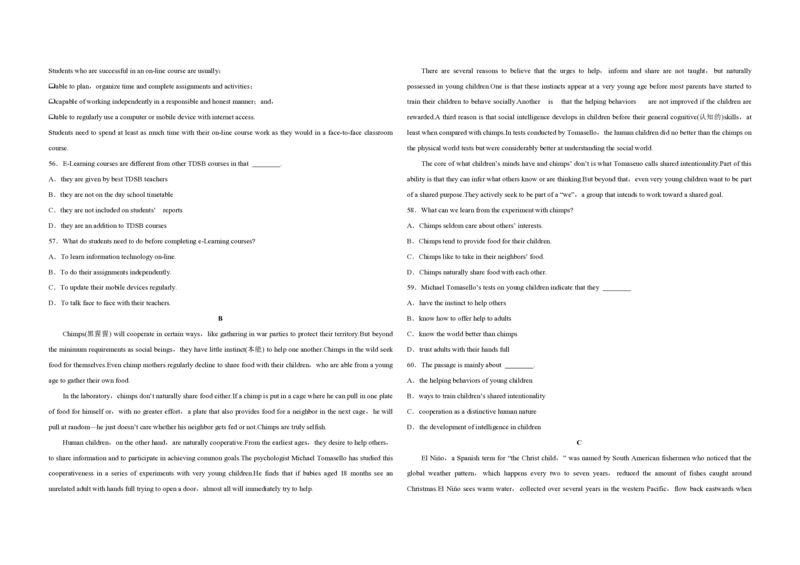
A
eLearning:An Alternative Learning
Opportunity
Day School Program
Secondary students across Toronto District School Board(TDSB) are invited to take one or two eLearning courses on
their day school timetable.Students will remain on the roll at their day school.
The online classroom provides an innovative,relevant and interactive learning environment.The courses and online
classroom are provided by the Ministry of Education.
These online courses:
are taught by TDSB secondary school teachers;
are part of the TDSB student’s timetable;and,
appear on the student’s report upon completion.
Benefits of eLearning
Include:
access to courses that may not be available at his or her TDSB school;
using technology to provide students with current information;and,
assistance to solve timetable conflicts.
Is eLearning for You?
Students who are successful in an online course are usually:
able to plan,organize time and complete assignments and activities;
capable of working independently in a responsible and honest manner;and,
able to regularly use a computer or mobile device with internet access.
Students need to spend at least as much time with their online course work as they would in a facetoface classroom
course.
56.ELearning courses are different from other TDSB courses in that
.
A.they are given by best TDSB teachers
B.they are not on the day school timetable
C.they are not included on students’ reports
D.they are an addition to TDSB courses
57.What do students need to do before completing eLearning courses?
A.To learn information technology online.
B.To do their assignments independently.
C.To update their mobile devices regularly.
D.To talk face to face with their teachers.
B
Chimps(黑猩猩) will cooperate in certain ways,like gathering in war parties to protect their territory.But beyond
the minimum requirements as social beings,they have little instinct(本能) to help one another.Chimps in the wild seek
food for themselves.Even chimp mothers regularly decline to share food with their children,who are able from a young
age to gather their own food.
In the laboratory,chimps don’t naturally share food either.If a chimp is put in a cage where he can pull in one plate
of food for himself or,with no greater effort,a plate that also provides food for a neighbor in the next cage,he will
pull at random—he just doesn’t care whether his neighbor gets fed or not.Chimps are truly selfish.
Human children,on the other hand,are naturally cooperative.From the earliest ages,they desire to help others,
to share information and to participate in achieving common goals.The psychologist Michael Tomasello has studied this
cooperativeness in a series of experiments with very young children.He finds that if babies aged 18 months see an
unrelated adult with hands full trying to open a door,almost all will immediately try to help.
There are several reasons to believe that the urges to help,inform and share are not taught,but naturally
possessed in young children.One is that these instincts appear at a very young age before most parents have started to
train their children to behave socially.Another is that the helping behaviors are not improved if the children are
rewarded.A third reason is that social intelligence develops in children before their general cognitive(认知的)skills,at
least when compared with chimps.In tests conducted by Tomasello,the human children did no better than the chimps on
the physical world tests but were considerably better at understanding the social world.
The core of what children’s minds have and chimps’ don’t is what Tomaseuo calls shared intentionality.Part of this
ability is that they can infer what others know or are thinking.But beyond that,even very young children want to be part
of a shared purpose.They actively seek to be part of a “we”,a group that intends to work toward a shared goal.
58.What can we learn from the experiment with chimps?
A.Chimps seldom care about others’ interests.
B.Chimps tend to provide food for their children.
C.Chimps like to take in their neighbors’ food.
D.Chimps naturally share food with each other.
59.Michael Tomasello’s tests on young children indicate that they
A.have the instinct to help others
B.know how to offer help to adults
C.know the world better than chimps
D.trust adults with their hands full
60.The passage is mainly about
.
A.the helping behaviors of young children
B.ways to train children’s shared intentionality
C.cooperation as a distinctive human nature
D.the development of intelligence in children
C
El Niño,a Spanish term for “the Christ child,” was named by South American fishermen who noticed that the
global weather pattern,which happens every two to seven years,reduced the amount of fishes caught around
Christmas.El Niño sees warm water,collected over several years in the western Pacific,flow back eastwards when
winds that normally blow westwards weaken,or sometimes the other way round.
The weather effects,both good and bad,are felt in many places.Rich countries gain more from powerful Niños,
on balance,than they lose.A study found that a strong Niño in 199798 helped America’s economy grow by
15
billion,partly because of better agricultural harvests:farmers in the Midwest gained from extra rain.The total rise in
agricultural incomes in rich countries is greater than the fall in poor ones.
But in Indonesia extremely dry forests are in flames.A multiyear drought(干旱) in southeast Brazil is becoming
worse.Though heavy rains brought about by El Niño may relieve the drought in California,they are likely to cause
surface flooding and other disasters.
The most recent powerful Niño,in 199798,killed around 21,000 people and caused damage worth 36 billion
around the globe.But such Niños come with months of warning,and so much is known about how they happen that
governments can prepare.According to the Overseas Development Institute (ODI),however,just 12% of disasterrelief
funding in the past two decades has gone on reducing risks in advance,rather than recovery and rebuilding
afterwards.This is despite evidence that a dollar spent on riskreduction saves at least two on reconstruction.
Simple improvements to infrastructure(基础设施) can reduce the spread of disease.Better sewers(下水道) make it
less likely that heavy rain is followed by an outbreak of the disease of bad stomach.Stronger bridges mean villages are
less likely to be left without food and medicine after floods.According to a paper in 2011 by Mr Hsiang and coauthors,
civil conflict is related to El Niño’s harmful effects—and the poorer the country,the stronger the link.Though the
relationship may not be causal,helping divided communities to prepare for disasters would at least reduce the risk that
those disasters are followed by killing and wounding people.Since the poorest are least likely to make up for their losses
from disasters linked to El Niño,reducing their losses needs to be the priority.
61.What can we learn about El Niño in Paragraph 1?
A.It is named after a South American fisherman.
B.It takes place almost every year all over the world.
C.It forces fishermen to stop catching fish around Christmas.
D.It sees the changes of water flow direction in the ocean.
62.What may El Niños bring about to the countries affected?
A.Agricultural harvests in rich countries fall.
B.Droughts become more harmful than floods.
C.Rich countries’ gains are greater than their losses.
D.Poor countries suffer less from droughts economically.
63.The data provided by ODI in Paragraph 4 suggest that
.
A.more investment should go to risk reduction
B.governments of poor countries need more aid
C.victims of El Niño deserve more compensation
D.recovery and reconstruction should come first
64.What is the author’s purpose in writing the passage?
A.To introduce El Niño and its origin.
B.To explain the consequences of El Niño.
C.To show ways of fighting against El Niño.
D.To urge people to prepare for El Niño.
D
Not so long ago,most people didn’t know who ShellyAnn FraserPryce was going to become.She was just an
average high school athlete.There was every indication that she was just another Jamaican teenager without much of a
future.However,one person wanted to change this.Stephen Francis observed then eighteenyearold ShellyAnn at a
track meet and was convinced that he had seen the beginnings of true greatness.Her times were not exactly impressive,
but even so,he sensed there was something trying to get out,something the other coaches had overlooked when they
had assessed her and found her lacking.He decided to offer ShellyAnn a place in his very strict training sessions.Their
cooperation quickly produced results,and a few years later at Jamaica’s Olympic trials in early 2008,ShellyAnn,
who at that time only ranked number 70 in the world,beat Jamaica’s unchallenged queen of the sprint(短跑).
“Where did she come from?” asked an astonished sprinting world,before concluding that she must be one of
those onehit wonders that spring up from time to time,only to disappear again without signs.But ShellyAnn was to
prove that she was anything but a onehit wonder.At the Beijing Olympics she swept away any doubts about her ability
to perform consistently by becoming the first Jamaican woman ever to win the 100 metres Olympic gold.She did it again
one year on at the World Championships in Berlin,becoming world champion with a time of 10.73—the fourth fastest
time ever.
ShellyAnn is a little woman with a big smile.She has a mental toughness that did not come about by chance.Her
journey to becoming the fastest woman on earth has been anything but smooth and effortless.She grew up in one of
Jamaica’s toughest innercity communities known as Waterhouse,where she lived in a oneroom apartment,sleeping
four in a bed with her mother and two brothers.Waterhouse,one of the poorest communities in Jamaica,is a really
violent and overpopulated place.Several of ShellyAnn’s friends and family were caught up in the killings; one of her
cousins was shot dead only a few streets away from where she lived.Sometimes her family didn’t have enough to eat.She
ran at the school championships barefooted because she couldn’t afford shoes.Her mother Maxime,one of a family of
fourteen,had been an athlete herself as a young girl but,like so many other girls in Waterhouse,had to stop after she
had her first baby.Maxime’s early entry into the adult world with its responsibilities gave her the determination to ensure
that her kids would not end up in Waterhouse’s roundabout of poverty.One of the first things Maxime used to do with
ShellyAnn was taking her to the track,and she was ready to sacrifice everything.
It didn’t take long for ShellyAnn to realize that sports could be her way out of Waterhouse.On a summer evening in
Beijing in 2008,all those long,hard hours of work and commitment finally bore fruit.The barefoot kid who just a few
years previously had been living in poverty,surrounded by criminals and violence,had written a new chapter in the
history of sports.
But ShellyAnn’s victory was far greater than that.The night she won Olympic gold in Beijing,the routine murders
in Waterhouse and the drug wars in the neighbouring streets stopped.The dark cloud above one of the world’s toughest
criminal neighbourhoods simply disappeared for a few days.“I have so much fire burning for my country,” Shelly
said.She plans to start a foundation for homeless children and wants to build a community centre in Waterhouse.She
hopes to inspire the Jamaicans to lay down their weapons.She intends to fight to make it a woman’s as well as a man’s
world.
As Muhammad Ali puts it,“Champions aren’t made in gyms.Champions are made from something they have deep
inside them.A desire,a dream,a vision.” One of the things ShellyAnn can be proud of is her understanding of this
truth.
65.Why did Stephen Francis decide to coach ShellyAnn?A.He had a strong desire to free her family from trouble.
B.He sensed a great potential in her despite her weaknesses.
C.She had big problems maintaining her performance.
D.She suffered a lot of defeats at the previous track meets.
66.What did the sprinting world think of ShellyAnn before the 2008 Olympic Games?
A.She would become a promising star.
B.She badly needed to set higher goals.
C.Her sprinting career would not last long.
D.Her talent for sprinting was known to all.
67.What made Maxime decide to train her daughter on the track?
A.Her success and lessons in her career.
B.Her interest in ShellyAnn’s quick profit.
C.Her wish to get ShellyAnn out of poverty.
D.Her early entrance into the sprinting world.
68.What can we infer from ShellyAnn’s statement underlined in Paragraph 5?
A.She was highly rewarded for her efforts.
B.She was eager to do more for her country.
C.She became an athletic star in her country.
D.She was the envy of the whole community.
69.By mentioning Muhammad Ali’s words,the author intends to tell us that
.
A.players should be highly inspired by coaches
B.great athletes need to concentrate on patience
C.hard work is necessary in one’s achievements
D.motivation allows great athletes to be on the top
70.What is the best title for the passage?
A.The Making of a Great Athlete
B.The Dream for Championship
C.The Key to High Performance
D.The Power of Full Responsibility
第四部分 任务型阅读(共10 小题;每小题1 分,满分10 分)
请阅读下面短文,并根据所读内容在文章后表格中的空格里填入一个最恰当的单词。
注意:每个空格只填一个单词。
An Extension of the Human Brain
Other people can help us compensate for our mental and emotional deficiencies(欠缺),much as a wooden leg can
compensate for a physical deficiency.To be exact,other people can extend our intelligence and help us understand and
adjust our emotions.When another person helps us in such ways,he or she is participating in what I’ve called a “social
prosthetic(义肢的) system.” Such systems do not need to operate facetoface,and it’s clear to me that the Internet is
expanding the range of my own social prosthetic systems.It’s already a big bank of many minds.Even in its current
state,the Internet has extended my memory and judgment.
Regarding memory: Once I look up something on the Internet,I don’t need to keep all the details for future use—I
know where to find that information again and can quickly and easily do so.More generally,the Internet functions as if
it were my memory.This function of the Internet is particularly striking when I’m writing; I’m no longer comfortable
writing if I’m not connected to the Internet.It’s become natural to check facts as I write,taking a minute or two to dip
into PubMed,Wikipedia,or other websites.
Regarding judgment: The Internet has made me smarter in matters small and large.For example,when I’m writing
a textbook,it has become second nature to check a dozen definitions of a key term,which helps me dig into the core
and understand its meaning.But more than that,I now regularly compare my views with those of many others.If I have a
“new idea,” I now quickly look to see whether somebody else has already thought of it,or something similar—and I
then compare what I think with what others have thought.This certainly makes my own views clearer.Moreover,I can
find out whether my reactions to an event are reasonable enough by reading about those of others on the Internet.
These effects of the Internet have become even more striking since I’ve begun using a smartphone.I now regularly
pull out my phone to check a fact,watch a video,read weibo.Such activities fill the spaces that used to be dead time
(such as waiting for somebody to arrive for a lunch meeting).
But that’s the upside(好处).The downside is that in those dead periods I often would let my thoughts flow and
sometimes would have an unexpected insight or idea.Those opportunities are now fewer and farther between.
An Extension of the Human Brain
A prosthetic nature
●The 71.
can help make up for our mental
and emotional deficiencies as a wooden leg can
compensate for a bodily deficiency.
●It 72.
in our daily events,extending
our intelligence,comprehending our feelings,and
expanding the range of social activities.
●On the Internet,we could quickly and easily locate the
details,and check facts,without 73.
them in
mind.
Wonderful aspects: memory and
judgment
●The Internet makes us smarter over 74.
kinds
of things.It provides a dozen definitions of a key term for
us to find the 75.
of the matter.
●The Internet enables us to exchange ideas with many
others to 76.
our claims,and to 77.
our
actions.
●Smartphones make it easier and more 79.
to
check reality,watch video clips,read weibo.
The 78.
sides of smartphones
●Smartphones 80.
the possibility for new and
insightful minds,and steal away our dead time.
第五部分 书面表达(满分25 分)
81.请阅读下面短文,并按照要求用英语写一篇150 词左右的文章。
In recent years,internet voting has become increasingly popular in China.People not only cast online votes
themselves,but also urge others to vote for competitions like the “Most Beautiful Teacher” and the “Cutest Baby”.
Li Jiang,a high school student,is invited to vote in the “Best Police Officer” competition,organized by the local
government to let the public have a better understanding of police officers’ daily work.Li Jiang visits the website and
reads all the stories.He is deeply moved by their glorious deeds.He is already thinking of becoming a policeman himself
in the future.
Su Hua is invited by his uncle to vote for his cousin in the “Future Singer” competition.He has already received
three similar invitations this week.His uncle tells him that if his cousin wins the competition,the family will win an
overseas tour for free.Su Hua likes his cousin very much,but he finds other singers perform even better.To vote,or not
to vote? This is a question that troubles him very much.
写作内容
1.用约30 个单词写出上文概要;
2.用约120 个单词阐述你对网络投票的看法,并用2~3 个理由或论据支撑你的看法。
写作要求
1.写作过程中不能直接引用原文语句;
2.作文中不能出现真实姓名和学校名称;
3.不必写标题。
评分标准
内容完整,语言规范,语篇连贯,词数适当。