2017 年普通高等学校招生全国统一考试
英 语
选择题部分
第一部分 听力(共两节,满分30 分)
做题时,先将答案标在试卷上。录音内容结束后,你将有两分钟的时间将试卷上的答
案转涂到答题纸上。
第一节(共5 小题;每小题1.5 分,满分7.5 分)
听下面5 段对话。每段对话后有一个小题,从题中所给的A、B、C 三个选项中选出
最佳选项,并标在试卷的相应位置。听完每段对话后,你都有10 秒钟的时间来回答有关小
题和阅读下一小题。每段对话仅读一遍。
例:How much is the shirt?
A. £19.15
B. £9.18
C. £9.15
答案是C.
1. What does the woman think of the movie?
A. It's amusing.
B. It's exciting.
C. It's disappointing.
2. How will Susan spend most of her time in France?
A. Traveling around
B. Studying at a school.
C. Looking after aunt.
3. What are the speakers talking about?
A. Going out.
B. Ordering drinks.
C. Preparing for a party.
4. Where are the speakers?
A. In a classroom
B. In a library
C. In a bookstore
5. What is the man going to do?
A. Go on the Internet.
B. Make a phone call.
C. Take a train trip.
第二节(共15 小题;每小题1.5 分,满分22.5 分)
听下面5 段对话或独白。每段对话或独白后有几个小题,从题中所给的A、B、C 三
个选项中选出最佳选项,并标在试卷的相应位置。听每段对话或独白前,你将有时间阅读
各个小题,每小题5 秒钟;听完后,各小题将给出5 秒钟的作答时间。每段对话或独白读
两遍。
听第6 段材料,回答第6、7 题。
6. What is the woman looking for?
A. An information office.
B. A police station.
C. A shoe repair shop.
7. What is the Town Guide according to the man?
A. A brochure
B. A newspaper
C. A map.
听第7 段材料,回答第8、9 题。
8. What does the man say about the restaurant?
A. It's the biggest one around.
B. It offers many tasty dishes.
C. It's famous for its seafood.
9. What will the woman probably order?
A. Fried fish
B. Roast chicken.
C. Beef steak
听第8 段材料,回答第10 到12 题。
10. Where will Mr.White be at 11 o'clock?
A. At the office.
B. At the airport
C. At the restaurant.
11. What will Mr.White probably do at one in the afternoon?
A. Receive a guest.
B. Have a meeting.
C. Read a report.
12. When will Miss Wilson see Mr.Whie?
A. At lunch time.
B. Late in the afternoon.
C. The next morning.
听第9 段材料,回答第13 到16 题。
13. Why is Bill going to Germany?
A. To work on a project.
B. To study German.
C. To start a new company.
14. What did the woman dislike about Germany?
A. The weather.
B. The food.
C. The schools.
15. What does bill hope to do about his family?
A. Bring them to Germany.
B. Leave them in England.
C. Visit them in a few
months.
16. What is the probable relationship between the speakers?
A. Fellow-travelers.
B. Colleagues.
C. Classmates.
听第10 段材料,回答第17 至20 题。
17. When did it rain last time in Juárez?
A. Three days ago
B. A month ago
C. A year ago.
18. What season is it now in Juárez?
A. Spring
B. Summer
C. Autumn.
19. What are the elderly advised to do?
A. Take a walk in the afternoon.
B. Keep their homes cool.
C. Drink plenty of water.
20. What is the speaker doing?
A. Hosting a radio program.
B. Conducting a seminar.
C. Forecasting the weather.
第二部分 阅读理解(共两节,满分35 分)
第一节(共10 小题;每小题2.5 分,满分25 分)
阅读下列短文,从每题所给的A、B、C 和D 四个选项中,选出最佳选项,并在答题
纸上将该项涂黑。
Benjamin West, the father of American painting, showed his talent for art when he was only
six years of age. But he did not know about brushes before a visitor told him he needed one. In
those days , a brush was made from camel’s hair. There were no camels nearby. Benjamin decided
that cat hair would work instead. He cut some fur from the family cat to make a brush.
The brush did not last long. Soon Benjamin needed more fur. Before long, the cat began to
look ragged (蓬乱). His father said that the cat must be sick. Benjamin was forced to admit
what he had been doing.
The cat’s lot was about to improve. That year, one of Benjamin’s cousins, Mr.Pennington,
came to visit. He was impressed with Benjamin’s drawings. When he went home, he sent
Benjamin a box of paint and some brushes. He also sent six engravings (版画)by an artist.
These were the first pictures and first real paint and brushes Benjamin had ever seen. In
1747,when Benjamin was nine years old,Mr.Pennington returned for another visit .He was
amazed at what Benjamin had done with his gift.He asked Benjamin’s parents if he might take
the boy to Philadelphia for a visit.
In the city, Mr.Pennington gave Benjamin materials for creating oil paintings.The boy
began a landscape (风景) painting.Wiliams ,a well-known painter,came to see him work . Wiliams
was impressed with Benjamin and gave him two classic books on painting to take home .The
books were long and dull. Benjamin could read only a little,having been a poor student.But he
later said,”Those two books were my companions by day,and under my pillow at night.”While it
is likely that he understood very little of the books,they were his introduction to classical
paintings.The nine-year-old boy decided then that he would be an artist.
21. What is the text mainly about?
A. Benjamin’s visit to Philadelphia.
B. Williams’ influence on Benjamin.
C. The beginning of Benjamin’s life as an artist.
D. The friendship between Benjamin and Pennington.
22. What does the underlined sentence in paragraph 3 suggest?
A. The cat would be closely watched.
B. The cat would get some medical care.
C. Benjamin would leave his home shortly.
D. Benjamin would have real brushes soon.
23. What did Pennington do to help Benjamin develop his talent?
A. He took him to see painting exhibitions.
B. He provided him with painting materials.
C. He sent him to a school in Philadelphia.
D. He taught him how to make engravings.
24. Williams’ two books helped Benjamin to ________.
A. master the use of paints
B. appreciate landscape paintings
C. get to know other painters
D. make up his mind to be a painter
B
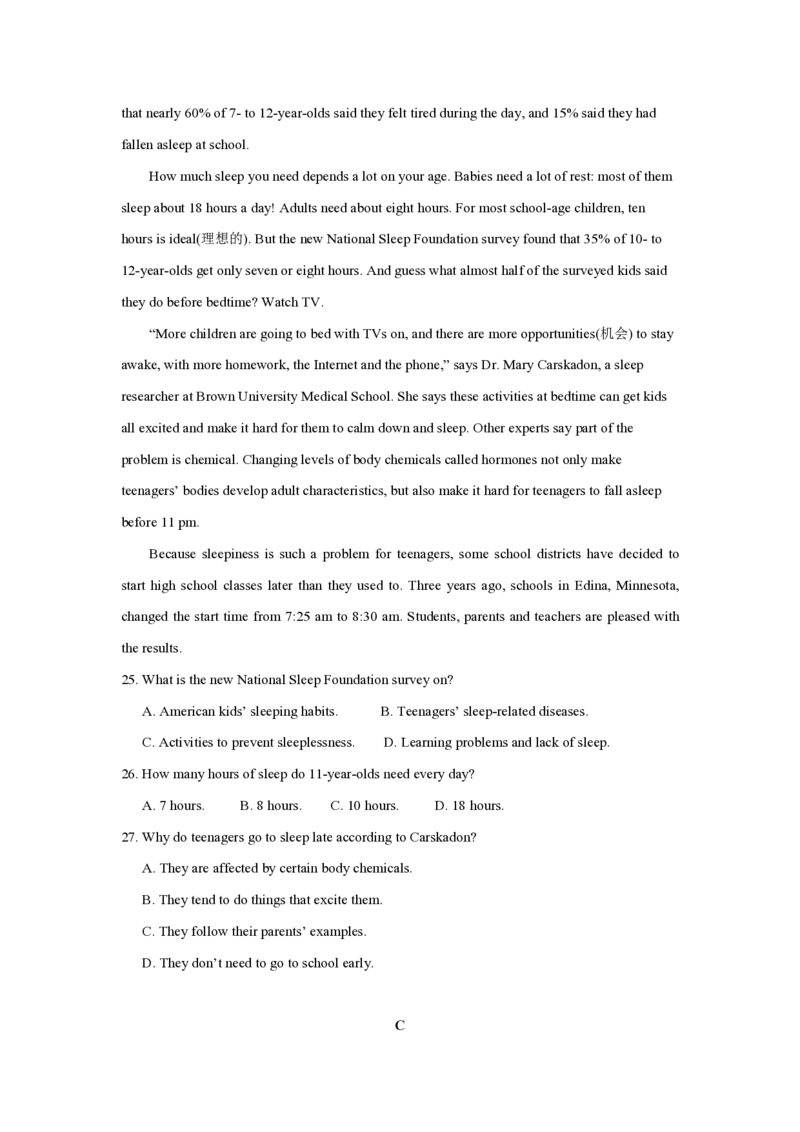
Getting less sleep has become a bad habit for most American kids. According to a new
survey(调查) by the National Sleep Foundation, 51% of kids aged 10 to 18 go to bed at 10 pm or
later on school nights, even though they have to get up early. Last year the Foundation reported
that nearly 60% of 7- to 12-year-olds said they felt tired during the day, and 15% said they had
fallen asleep at school.
How much sleep you need depends a lot on your age. Babies need a lot of rest: most of them
sleep about 18 hours a day! Adults need about eight hours. For most school-age children, ten
hours is ideal(理想的). But the new National Sleep Foundation survey found that 35% of 10- to
12-year-olds get only seven or eight hours. And guess what almost half of the surveyed kids said
they do before bedtime? Watch TV.
“More children are going to bed with TVs on, and there are more opportunities(机会) to stay
awake, with more homework, the Internet and the phone,” says Dr. Mary Carskadon, a sleep
researcher at Brown University Medical School. She says these activities at bedtime can get kids
all excited and make it hard for them to calm down and sleep. Other experts say part of the
problem is chemical. Changing levels of body chemicals called hormones not only make
teenagers’ bodies develop adult characteristics, but also make it hard for teenagers to fall asleep
before 11 pm.
Because sleepiness is such a problem for teenagers, some school districts have decided to
start high school classes later than they used to. Three years ago, schools in Edina, Minnesota,
changed the start time from 7:25 am to 8:30 am. Students, parents and teachers are pleased with
the results.
25. What is the new National Sleep Foundation survey on?
A. American kids’ sleeping habits.
B. Teenagers’ sleep-related diseases.
C. Activities to prevent sleeplessness.
D. Learning problems and lack of sleep.
26. How many hours of sleep do 11-year-olds need every day?
A. 7 hours.
B. 8 hours.
C. 10 hours.
D. 18 hours.
27. Why do teenagers go to sleep late according to Carskadon?
A. They are affected by certain body chemicals.
B. They tend to do things that excite them.
C. They follow their parents’ examples.
D. They don’t need to go to school early.
C
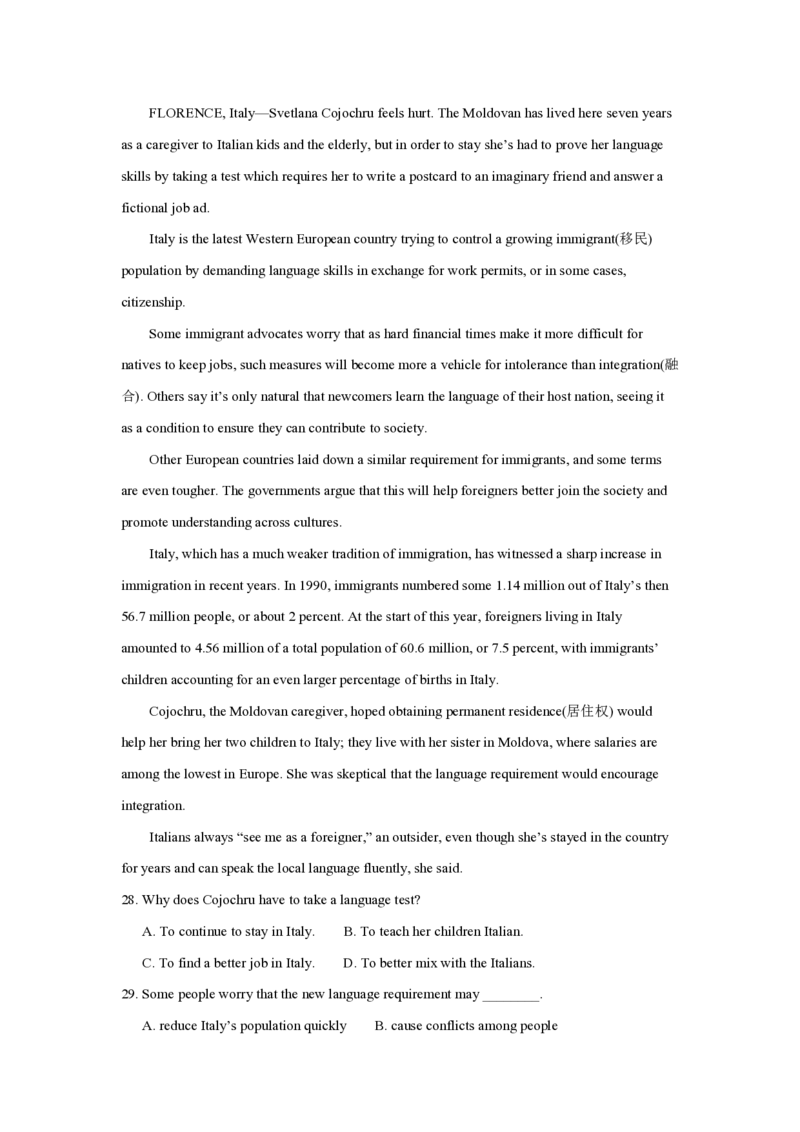
FLORENCE, Italy—Svetlana Cojochru feels hurt. The Moldovan has lived here seven years
as a caregiver to Italian kids and the elderly, but in order to stay she’s had to prove her language
skills by taking a test which requires her to write a postcard to an imaginary friend and answer a
fictional job ad.
Italy is the latest Western European country trying to control a growing immigrant(移民)
population by demanding language skills in exchange for work permits, or in some cases,
citizenship.
Some immigrant advocates worry that as hard financial times make it more difficult for
natives to keep jobs, such measures will become more a vehicle for intolerance than integration(融
合). Others say it’s only natural that newcomers learn the language of their host nation, seeing it
as a condition to ensure they can contribute to society.
Other European countries laid down a similar requirement for immigrants, and some terms
are even tougher. The governments argue that this will help foreigners better join the society and
promote understanding across cultures.
Italy, which has a much weaker tradition of immigration, has witnessed a sharp increase in
immigration in recent years. In 1990, immigrants numbered some 1.14 million out of Italy’s then
56.7 million people, or about 2 percent. At the start of this year, foreigners living in Italy
amounted to 4.56 million of a total population of 60.6 million, or 7.5 percent, with immigrants’
children accounting for an even larger percentage of births in Italy.
Cojochru, the Moldovan caregiver, hoped obtaining permanent residence(居住权) would
help her bring her two children to Italy; they live with her sister in Moldova, where salaries are
among the lowest in Europe. She was skeptical that the language requirement would encourage
integration.
Italians always “see me as a foreigner,” an outsider, even though she’s stayed in the country
for years and can speak the local language fluently, she said.
28. Why does Cojochru have to take a language test?
A. To continue to stay in Italy.
B. To teach her children Italian.
C. To find a better job in Italy.
D. To better mix with the Italians.
29. Some people worry that the new language requirement may ________.
A. reduce Italy’s population quickly
B. cause conflicts among people
C. lead to financial difficulties
D. put pressure on schools
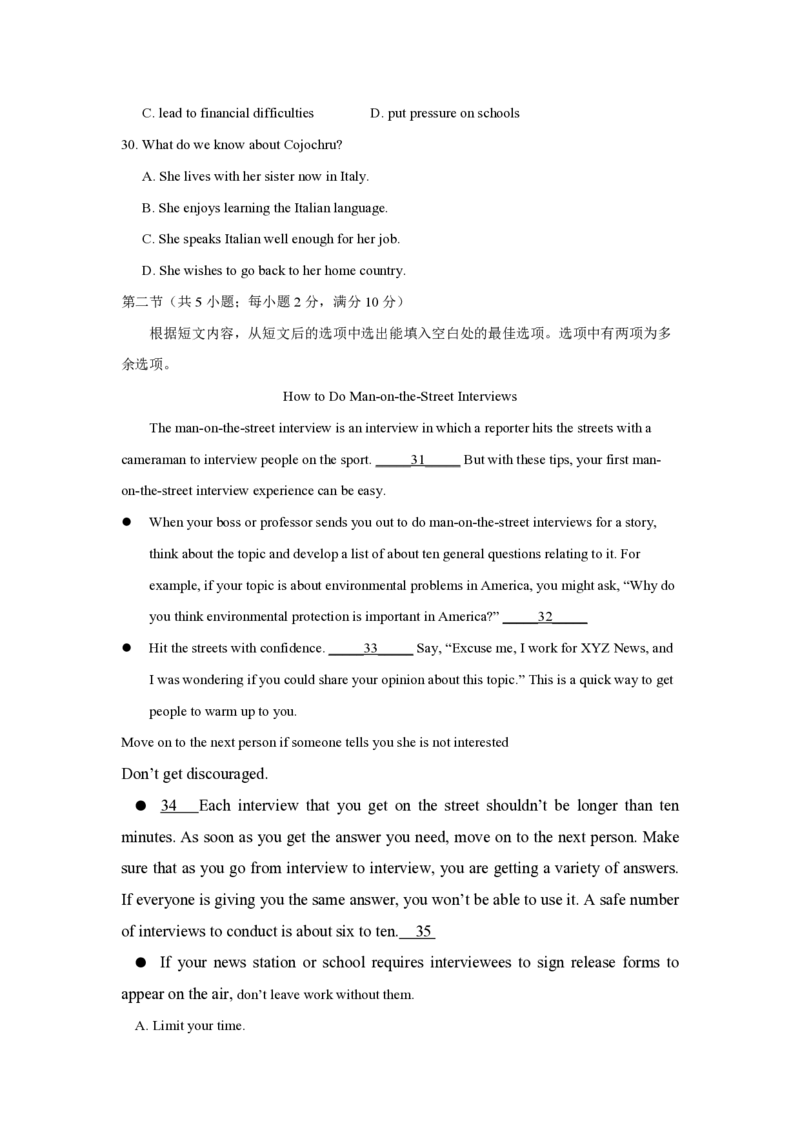
30. What do we know about Cojochru?
A. She lives with her sister now in Italy.
B. She enjoys learning the Italian language.
C. She speaks Italian well enough for her job.
D. She wishes to go back to her home country.
第二节(共5 小题;每小题2 分,满分10 分)
根据短文内容,从短文后的选项中选出能填入空白处的最佳选项。选项中有两项为多
余选项。
How to Do Man-on-the-Street Interviews
The man-on-the-street interview is an interview in which a reporter hits the streets with a
cameraman to interview people on the sport. _____31_____ But with these tips, your first man-
on-the-street interview experience can be easy.
When your boss or professor sends you out to do man-on-the-street interviews for a story,
think about the topic and develop a list of about ten general questions relating to it. For
example, if your topic is about environmental problems in America, you might ask, “Why do
you think environmental protection is important in America?” _____32_____
Hit the streets with confidence. _____33_____ Say, “Excuse me, I work for XYZ News, and
I was wondering if you could share your opinion about this topic.” This is a quick way to get
people to warm up to you.
Move on to the next person if someone tells you she is not interested
Don’t get discouraged.
● 34 Each interview that you get on the street shouldn’t be longer than ten
minutes. As soon as you get the answer you need, move on to the next person. Make
sure that as you go from interview to interview, you are getting a variety of answers.
If everyone is giving you the same answer, you won’t be able to use it. A safe number
of interviews to conduct is about six to ten. 35
● If your news station or school requires interviewees to sign release forms to
appear on the air, don’t leave work without them.
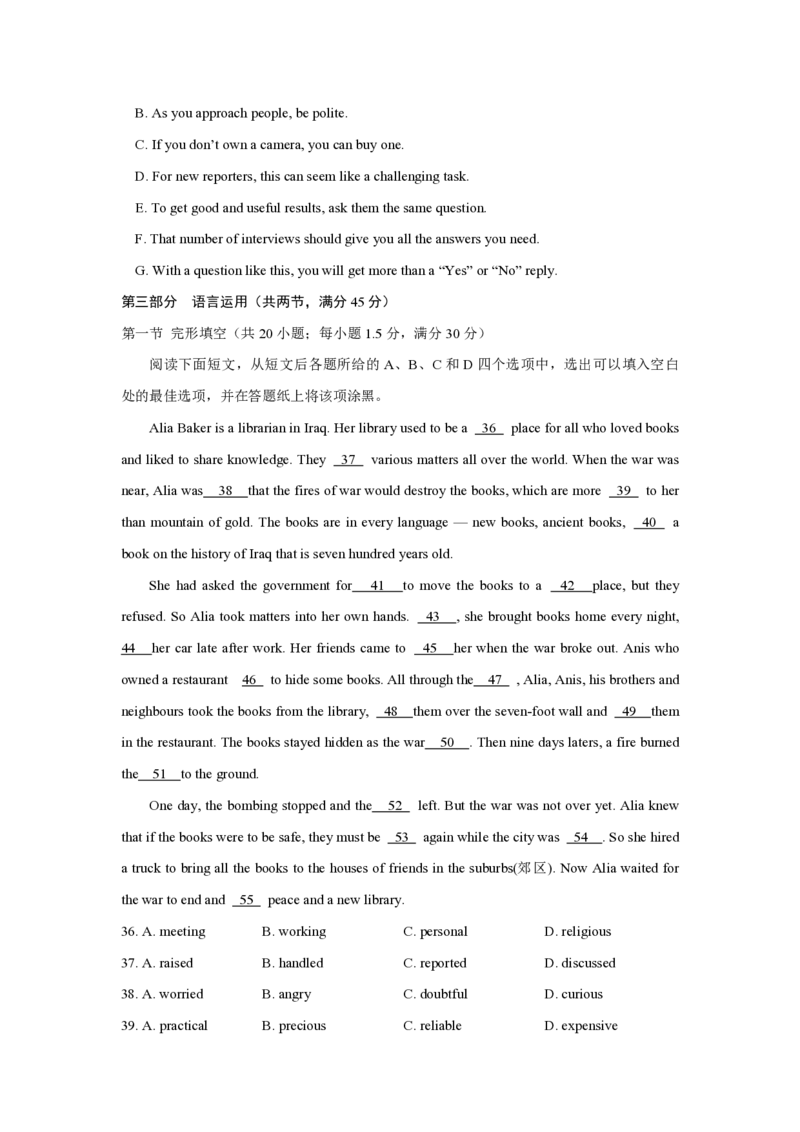
A. Limit your time.
B. As you approach people, be polite.
C. If you don’t own a camera, you can buy one.
D. For new reporters, this can seem like a challenging task.
E. To get good and useful results, ask them the same question.
F. That number of interviews should give you all the answers you need.
G. With a question like this, you will get more than a “Yes” or “No” reply.
第三部分 语言运用(共两节,满分45 分)
第一节 完形填空(共20 小题;每小题1.5 分,满分30 分)
阅读下面短文,从短文后各题所给的A、B、C 和D 四个选项中,选出可以填入空白
处的最佳选项,并在答题纸上将该项涂黑。
Alia Baker is a librarian in Iraq. Her library used to be a 36 place for all who loved books
and liked to share knowledge. They 37 various matters all over the world. When the war was
near, Alia was 38 that the fires of war would destroy the books, which are more 39 to her
than mountain of gold. The books are in every language — new books, ancient books, 40 a
book on the history of Iraq that is seven hundred years old.
She had asked the government for 41 to move the books to a 42 place, but they
refused. So Alia took matters into her own hands. 43 , she brought books home every night,
44 her car late after work. Her friends came to 45 her when the war broke out. Anis who
owned a restaurant 46 to hide some books. All through the 47 , Alia, Anis, his brothers and
neighbours took the books from the library, 48 them over the seven-foot wall and 49 them
in the restaurant. The books stayed hidden as the war 50 . Then nine days laters, a fire burned
the 51 to the ground.
One day, the bombing stopped and the 52 left. But the war was not over yet. Alia knew
that if the books were to be safe, they must be 53 again while the city was 54 . So she hired
a truck to bring all the books to the houses of friends in the suburbs(郊区). Now Alia waited for
the war to end and 55 peace and a new library.
36. A. meeting
B. working
C. personal
D. religious
37. A. raised
B. handled
C. reported
D. discussed
38. A. worried
B. angry
C. doubtful
D. curious
39. A. practical
B. precious
C. reliable
D. expensive
40. A. then
B. still
C. even
D. rather
41. A. permission
B. confirmation
C. explanation
D. information
42. A. large
B. public
C. distant
D. safe
43. A. Fortunately
B. Surprisingly
C. Seriously
D. Secretly
44. A. starting
B. parking
C. filling
D. testing
45. A. stop
B. help
C. warn
D. rescue
46. A. intended
B. pretended
C. happened
D. agreed
47. A. war
B. night
C. building
D. way
48. A. put
B. opened
C. passed
D. threw
49. A. hid
B. exchanged
C.burnt
D. distributed
50. A. approached
B. erupted
C. continued
D. ended
51. A. restaurant
B. library
C. city
D. wall
52. A. neighbours
B. soldiers
C. friends
D. customers
53. A. sold
B. read
C. saved
D. moved
54. A. occupied
B. bombed
C. quiet
D. busy
55. A. dreamed of
B. believed in
C. cared about
D. looked for
非选择题部分
第三部分 语言运用(共两节,满分45 分)
第二节(共10 小题:每小题1.5 分,满分15 分)
阅读下面材料,在空白处填入适当的内容(1 个单词)或括号内单词的正确形式。
Last October , while tending her garden in Mora , Sweden , Lena Pahlsson pulled out a
handful of small 56 (carrot) and was about to throw them away. But something made her
look closer , and she noticed a 57 (shine) object. Yes, there beneath the leafy top of one tiny
carrot was her long-lost wedding ring.
Pahlsson screamed 58 loudly that her daughter came running from the house. “she
thought I had hurt 59 (I),”says Pahlsson
Sixteen years 60 (early), Pahlsson had removed the diamond ring 61 (cook) a meal.
When she wanted to put the ring back on later, it was gone. She suspected that one of her three
daughters —then ten, eight, and six— had picked it up, but the girls said they hadn't. Pahlsson and
her husband 62 (search) the kitchen, checking every corner, but turned up nothing. “I gave up
hope of finding my ring again," she says. She never replaced it.
Pahlsson and her husband now think the ring probably got 63 (sweep) into a pile of
kitchen rubbish and was spread over the garden, 64 it remained until the carrot’s leafy top
accidentally sprouted (生长) through it. For Pahlsson, its return was 65 wonder.
第四部分 写作(共两节,满分40 分)
第一节 应用文写作(满分15 分)
假定你是李华,计划组织一次郊游,请给你的英国朋友Chris 写封邮件邀请他参加。
内容包括:
1. 参加者;
2. 时间、地点;
3. 活动:登山、野餐等。
注意:
1. 词数80 左右;
2. 可以适当增加细节,以使行文连贯。
第二节 读后续写(满分25 分)
阅读下面短文,根据所给情节进行续写,使之构成一个完整的故事。
On a bright, warm July afternoon, Mac Hollan, a primary school teacher, was cycling from
his home to Alaska with his friends. One of his friends had stopped to make a bicycle repair, but
they had encouraged Mac to carry on, and they would catch up with him soon. As Mac pedaled
(骑行) along alone, he thought fondly of his wife and two young daughters at home. He hoped to
show them this beautiful place someday.
Then Mac heard quick and loud breathing behind him. “Man, that's a big dog!” he thought.
But when he looked to the side, he saw instantly that it wasn’t a dog at all, but a wolf, quickly
catching up with him.
Mac’s heart jumped. He found out his can of hear spray. With one hand on the bars, he fired
the spray at the wolf. A bright red cloud enveloped the animal, and to Mac's relief, it fell back,
shaking its head. But a minute later, it was by his side again. Then it attacked the back of Mac's
bike, tearing open his tent bag. He fired at the wolf a second time, and again, it fell back only to
quickly restart the chase(追赶)。
Mac was pedaling hard now. He waved and yelled at passing cars but was careful not to show
down. He saw a steep uphill climb before him. He knew that zxxk once he hit the hill, he’d be
easy caught up and the wolf’s teeth would be tearing into his flesh.
At this moment, Paul and Beeky were driving their car on their way to Alaska. They didn’t
think much of it when they saw two cyclists repairing their bike on the side of the road. A bit later,
they spotted what they, too, assumed was a dog running alongside a man on a bike. As they got
closer, they realized that the dog was a wolf. Mac heard a large vehicle behind him. He pulled in
front of it as the wolf was catching up fast, just a dozen yards away now.
注意:
1. 所续写短文的词数应为150 左右;
2. 应使用5 个以上短文中标有下划线的关键词语;
3. 续写部分分为两段,每段开头语已为你写好;
4. 续写完成后,请用下划线标出你所使用的关键词语。
Paragraph 1:
The car abruptly stopped in front of him
____________________________________________________________________________________________
____________________________________________________________________________________________
____________________________________________________________________________________________
____________________________________________________________________________________________
____________________________________________________________________________________________
____________________________________________________________________________________________
______________________________________________________________
Paragraph 2:
A few minutes later,the other two cyclists arrived.
____________________________________________________________________________________________
____________________________________________________________________________________________
____________________________________________________________________________________________
____________________________________________________________________________________________
____________________________________________________________________________________________
____________________________________________________________________________________________
_____________________________________________________________________
参考答案
第一部分 听力
1. C
2. A
3. C
4. B
5.
A
6. C
7. A
8. B
9. C
10 .
B
11. B
12. C
13. A
14. B
15.
A
16. B
17. C
18. A
19. C
20 .
A
第二部分 阅读理解
21. C
22. D
23. B
24. D
25.
A
26. C
27. B
28. A
29. B
30.
C
31. D
32. C
33. B
34. A
35.
F
第三部分 语言运用
36. A
37. D
38. A
39. B
40. C
41. A
42. D
43. D
44. C
45. B
46. D
47. B
48. C
49. A
50. C
51. B
52. B
53. D
54. C
55. A
56. carrots
57. shiny/shining
58. so
59. myself
60. earlier
61. to cook
62. searched
63. Swept
64. where
65. a
第四部分 写作
(略)
第二部分 阅读理解(共两节,满分35 分)
第一节(共10 小题;每小题2.5 分,满分25 分)
阅读下列短文,从每题所给的A、B、C 和D 四个选项中,选出最佳选项,并在答题
纸上将该项涂黑。
A
【解析】
试题分析:本文属于记叙文,主要讲了美国绘画之父Benjamin 在决定要成为一名画家之前
的经历。
21.C 【解析】主旨大意题。文章主要介绍了美国绘画之父Benjamin 在成为一名画家之前
的生活经历,并介绍了Pennington 对Benjamin 在绘画道路上的一些帮助,故选C。
22.D 【解析】句意猜测题。根据第三段"These were the first pictures and first real paint and
brushes Benjamin had ever seen"可知Benjamin 在剪完猫的毛做刷子之后,就很快有
了真正的刷子,故选D。
【名师点睛】
本文后两个小题考查了细节题。在完成细节题时,要特别注意排除干扰项。如23 题中的
D 项"He taught him how to make engravings"属于"偷梁换柱"类干扰项,根据第三段第
五句"He also sent six engravings by an artist"可知"这些版画是Pennington 送给Benjamin
的",并非是Pennington 教Benjamin 如何画版画,说明D 项明显错误。
干扰项的设置通常有以下几种方式:
1. 张冠李戴。命题者把文章作者的观点与他人的观点混淆起来,题干问的是作者的观点,
选项中出现的却是他人的观点,或者题干问的是他人的观点,选项中出现的却是作者的观
点。
2. 偷梁换柱。干扰项用了与原文相似的句型结构和大部分相似的词汇,却在不易引人注意
的地方换了几个词汇,造成句意的改变。
3. 无中生有。干扰项往往是生活的基本常识和普遍接受的观点,但在原文中并无相关的信
息支持点,这种选项的设置往往与设问毫不相干。
4. 以偏概全。考生在做猜测文章中心思想、给文章添加标题或推理判断题时,往往会犯以
偏概全的错误。产生这类错误的原因是考生受思维定势的影响或考虑不周,以局部代替整
体。其具体表现为合理关联与不合理关联、准确概括与不准确概括之间的错位。不合理关
联就是表层理解与深层理解相混淆。表层理解是对文章中客观事实的感知和记忆,往往是
文章中直接表述的结论;深层理解则是对文章中的客观事实进行逻辑推理、总结或概括后
得出的结论。不准确概括是指不能准确地按题目要求概括或提取文中的表层或深层信息。
考点:考查记叙文阅读
B
【解析】
试题分析:本文属于议论文,首先用数据告诉我们美国孩子的睡眠状况堪忧,接着告诉我
们孩子在不同年龄段需要的睡眠时间不同,然后分析了孩子晚睡的原因,最后介绍了一些
学校为了让孩子们有更多的睡眠时间而推迟了上课的时间。
25. A 【解析】细节理解题。文中第一段列举了一些数据,向我们说明美国有51%的10
到18 岁的孩子上床睡觉的时间偏晚,也调查了60%的7 到12 岁的孩子在白天感到
疲惫,15%的孩子会在学校睡着,所以这些调查都是关于美国孩子的睡眠习惯的,
故选A。
【名师点睛】
本文属于议论类短文,所考查的三道题均为细节题中的直接理解题。细节事实理解题主
要考查考生对文章中某一些特定细节或文章的重要事实的理解能力。它一般包括直接理解
题和语义理解题两种。直接理解题的答案与原文直接挂钩,从阅读材料中可以找到。这种
题难度低,只要学生读懂文章,就能得分,属于低层次题。
在阅读中可以使用定位法与跳读法解决直接理解题。定位法即根据题干和选项所提供的
信息直接从原文中找到相应的句子(即定位),然后和选项进行比较和分析(尤其要注意一些
同义转换),从而找出正确答案。跳读法即根据题干和选项所提供的信息跳读原文,并找到
相关的句子(有时可能是几个句子)或段落,然后进行分析和推理等找出正确答案。
以本文26 题为例,我们根据题干中"How many hours of sleep do 11-year-olds need every
day"(11 岁的孩子每天需要多少小时的睡眠时间)直接定位到第二段第四句For most school-
age children, ten hours is ideal(理想的),由此可知上学的孩子的理想睡眠时间是10 个小时,
故选择C 项。
考点:考查议论文阅读
C
【解析】
试题分析:本文属于夹叙夹议文,首先叙述了一个叫Svetlana Cojochru 的摩尔多瓦人移民
到意大利,但为了能够继续留在意大利,她必须进行语言测试;接着向我们阐述对外来人
进行语言测试的原因以及对此的不同声音,然后介绍了意大利的移民史,最后告诉我们
Cojochru 的居住现状:工资水平很低,而且虽然在意大利生活多年,但意大利本地居民仍
会把她当作外国人来看。
28. A 【解析】细节理解题。根据第一段中的"but in order to stay she’s had to prove her
language skills by taking a test…"可知,Cojochru 是为了能够继续留在意大利才要参
加语言考试的,故选A。
29. B 【解析】推理判断题。根据第三段中的"such measures will become more a vehicle for
intolerance than integration"可知一些人担心对语言水平的要求可能会引起人与人之
间的不包容,即冲突,故选B。
30. C 【解析】细节理解题。根据最后一段中的"even though she’s stayed in the country for
years and can speak the local language fluently"可知Cojochru 的意大利语已经说的得
很流利了,故选C。
【名师点睛】
本文29 题属于推理判断题,根据题干"Some people worry that the new language requirement
may…", 抓住关键词worry,可以从文中第三段第一句话Some immigrant advocates worry
that as hard financial times make it more difficult for natives to keep jobs, such measures will
become a more vehicle for intolerance than integration(融合). 进行推断。根据关键信息
intolerance 可判断对语言的要求会造成外来居民和本地居民的不融合,即矛盾,从而选出
正确答案。
推理判断题是历届考生失分较多的题型,因为此类题不仅要求考生理解具体事实细节,也
要理解抽象含义。推理判断题的解题方法有:
1. 抓住特定的信息进行逆向或正向推理:善于抓住某一段话中的关键信息,即某些关键
词或短语去分析,利用逆向思维或正向推理,从而推断出这句话所隐藏的深层含义。
(29 小题使用的就是这种方法)
2. 结合全文(段)进行推断:做推理题时,需要在弄懂全文意思的基础上,整合与题目
相关的有用信息,综合起来进行推理判断,从而确定最佳结论。
3. 根据上下文的逻辑关系得出结论:逻辑结论是指严格根据文章中所陈述的事实、论
点、例证等一系列论据材料进行推理,从而得出合乎逻辑的结论,所以要把握作者的
写作思路,预测下文可能的内容。文章可按照事件发展的经过描写,也可按照因果关
系、对比关系来描写。
4. 结合自己已有的知识进行推断:知识推断是根据文章中所阐述的细节,运用自己掌握
的基础知识进行推敲,从而得出答案,这需要我们有一定的社会基础知识,以及充分
理解细节和有关背景知识。
考点:考查夹叙夹议文阅读
第二节(共5 小题;每小题2 分,满分10 分)
【解析】
试题分析:本文主要讲了进行街道随机采访的若干技巧。
【名师点睛】
本文34 题属于七选五阅读中最常见的设空在段首,那么选择的通常是段落主题句。认
真阅读后文内容,根据段落一致性原则,查找同义词或其他相关的词,推断出主题句。本
题我们根据空格后一句"Each interview that you get on the street shouldn’t be longer than ten
minutes."可知这段要求我们采访时要限制时间。故A 项为本段主题句。
当七选五阅读设空在句首时,还可能存在以下两种情况:
1. 属于段落间的过渡句。这时要前瞻后望找启示,即阅读上一段结尾部分,通常正确
答案与上一段结尾有机地衔接起来,并结合下一段内容,看所选的答案是否将两段内容连
贯起来。
2. 与后文是并列、转折、因果关系等。着重阅读后文第一、二句,锁定线索信号词,
然后在选项中查找相关特征词。通常正确答案的最后一句与空白后的第一句在意思上是紧
密衔接的,因此这两句间会有某种衔接手段,尤其当选项是几句话时。比如,如果选项中
出现时间年代时,往往要注意与原文中年代的前后对应关系。
考点:考查说明文阅读
第三部分 语言运用(共两节,满分45 分)
第一节 完形填空(共20 小题;每小题1.5 分,满分30 分)
【语篇解读】本文是一篇记叙文。主要讲述了Alia Baker 是伊拉克的一名图书管理
员,当伊拉克爆发战争时,Alia Baker 害怕战争会破坏图书,于是向政府求助,在遭到拒
绝后,Alia Baker 就自己动手,最后在朋友和邻居的帮助下,Alia Baker 成功地将书转移到
了安全的地方。
39. B 【解析】考查形容词。A. practical 实践的;B. precious 珍贵的;C. reliable 可靠的;
D. expensive 昂贵的。根据后文"which are more 39 to her than mountains of
gold"可知,是将书与金山作比较,指书对她来说比金山更珍贵。故选B。
47. B 【解析】考查名词。A. war 战争;B. night 夜晚;C. building 建筑物;D. way 方
法。根据前文"she brought books home every night"可知,他们每天晚上都去图书
馆搬书,故选B。
48. C 【解析】考查动词。A. put 放;B. opened 打开;C. passed 通过;D. threw 扔。根
据"over the seven-foot wall"可知,他们是越过(pass over)七英尺高的墙搬的书。
故选C。
49. A 【解析】考查动词。A. hid 隐藏;B. exchanged 交换;C. burnt 燃烧;D. distributed
分发。根据上文中的"Anis who owned a restaurant agreed to hide some books."可
知,把书藏在Anis 的饭店。故选A。
50. C 【解析】考查动词。A. approached 接近;B. erupted 爆发;C. continued 继续;D.
ended 结束。由后文"Then nine days later, a fire burned the 51 to the ground."
可知,战争仍在继续。故选C。
51. B 【解析】考查名词。A. restaurant 饭店;B. library 图书馆;C. city 城市;D. wall 墙
壁。根据后文"Now Alia waited for the war to end and 55 peace and a new
library"可知,这里指图书馆被一场大火烧毁。故选B。
52. B 【解析】考查名词。A. neighbours 邻居;B. soldiers 士兵;C. friends
朋友;D.
customers 顾客。and 连接两个并列句,轰炸停止,与之相对应的是,士兵离开了。
故选B。
【名师点睛】
本篇完形填空很好地体现出重在考查语篇理解能力,且不在情节上、词汇考查大做文章
的趋势。逐渐侧重于对语篇复现的考查。如47 题,根据前文"she brought books home
every night,"可知"All through the __47_, Alia, Anis, his brothers and neighbours took the
books from the library"他们选择晚上转移书籍,故选B。
语篇复现的信息包括原词复现、同义词和反义词复现、上义词和下义词复现、概括词复
现和代词复现等。语篇中有词汇和结构同现的现象,如与语篇话题相关、意义相关的词汇
同时出现、结构同现、同义同现、修饰同现、因果同现等。因此,利用上下文寻找解题信
息,确定正确答案。
考点:考查记叙文阅读。
非选择题部分
第三部分 语言运用(共两节,满分45 分)
第二节(共10 小题:每小题1.5 分,满分15 分)
阅读下面材料,在空白处填入适当的内容(1 个单词)或括号内单词的正确形式。
【语篇解读】本文是一篇记叙文。主要讲述了Lena Pahlsson 在花园里拔胡萝卜时,找
到了丢失已久的结婚戒指的故事。
第四部分 写作(共两节,满分40 分)
第一节 应用文写作(满分15 分)
第二节 读后续写(满分25 分)
【答案】
Paragraph 1:
The car abruptly stopped in front of him. Paul and Becky got out of the car immediately to
give help. ①But with the bare hands, they didn’t dare to fight with the wolf. However, they still
approached to the wolf bravely. At the same time, the wolf also noticed them and turned its head
back, shouting loudly at Paul and Becky. Mac then jumped off the bicycle and was ready to fight
against the wolf. That reached deadlock.