2012 年普通高等学校招生全国统一考试
英 语
注意事项:
⒈本试卷分第Ⅰ卷(选择题)和第Ⅱ卷(非选择题)两部分。答卷前,考生务必将自己的姓名、
准考证号填写在答题卡上。
⒉ 答第Ⅰ卷时,选出每小题答案后,用2B 铅笔把答题卡上对应题目的答案标号涂黑。如需改
动,用橡皮擦干净后,再选涂其他答案标号,不能答在本试卷上,否则无效。
⒊ 答第Ⅱ卷时,将答案写在答题卡上。写在本试卷上无效。
⒋ 考试结束后,将本试卷和答题卡一并交回。
第Ⅰ卷
第一部分  英语知识运用 (满分50 分)
第一节 语音知识 (共5 小题;每小题1 分,满分5 分)
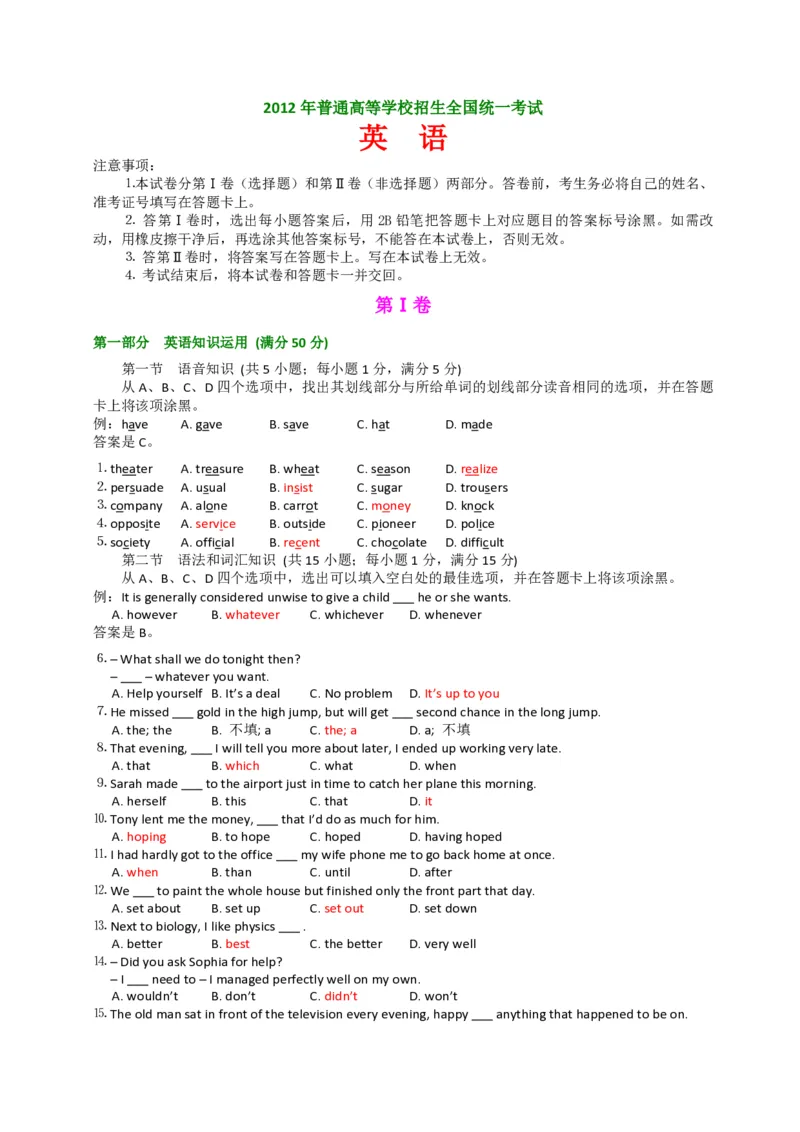
从A、B、C、D 四个选项中,找出其划线部分与所给单词的划线部分读音相同的选项,并在答题
卡上将该项涂黑。
例:have
A. gave
B. save
C. hat
D. made
答案是C。
⒈ theater
A. treasure
B. wheat
C. season
D. realize
⒉ persuade
A. usual
B. insist
C. sugar
D. trousers
⒊ company
A. alone
B. carrot
C. money
D. knock
⒋ opposite
A. service
B. outside
C. pioneer
D. police
⒌ society
A. official
B. recent
C. chocolate
D. difficult
第二节 语法和词汇知识 (共15 小题;每小题1 分,满分15 分)
从A、B、C、D 四个选项中,选出可以填入空白处的最佳选项,并在答题卡上将该项涂黑。
例:It is generally considered unwise to give a child ___ he or she wants.

A. however
B. whatever
C. whichever
D. whenever
答案是B。
⒍ – What shall we do tonight then?
– ___ – whatever you want.

A. Help yourself B. It’s a deal
C. No problem
D. It’s up to you
⒎ He missed ___ gold in the high jump, but will get ___ second chance in the long jump.

A. the; the
B. 不填; a
C. the; a
D. a; 不填
⒏ That evening, ___ I will tell you more about later, I ended up working very late.

A. that
B. which
C. what
D. when
⒐ Sarah made ___ to the airport just in time to catch her plane this morning.

A. herself
B. this
C. that
D. it
⒑ Tony lent me the money, ___ that I’d do as much for him.

A. hoping
B. to hope
C. hoped
D. having hoped
⒒ I had hardly got to the office ___ my wife phone me to go back home at once.

A. when
B. than
C. until
D. after
⒓ We ___ to paint the whole house but finished only the front part that day.

A. set about
B. set up
C. set out
D. set down
⒔ Next to biology, I like physics ___ .

A. better
B. best
C. the better
D. very well
⒕ – Did you ask Sophia for help?
– I ___ need to – I managed perfectly well on my own.

A. wouldn’t
B. don’t
C. didn’t
D. won’t
⒖ The old man sat in front of the television every evening, happy ___ anything that happened to be on.

A. to watch
B. watching
C. watched
D. to have watched
⒗ 100℃ is the temperature ___ which water will boil.

A. for
B. at
C. on
D. of
⒘ I’m going to Europe on vacation together with John if I ___ find the money.

A. can
B. might
C. would
D. need
⒙ The manager ___ the workers how to improve the program since 9 a.m.

A. has told
B. is telling
C. has been telling
D. will have told
⒚ The Harry Potter books are quite popular; they are in great ___ in this city.

A. quantity
B. progress
C. production
D. demand
⒛ – Try not to work yourself too hard. Take it easy.
– Thanks. ___

A. So what?
B. No way.
C. What for?
D. You, too.
第三节 完形填空 (每小题1. 5 分)
阅读下面短文,从短文后各题所给的四个选项 (A、B、C 和D) 中,选出可以填入空白处的最佳
选项,并在答题卡上将该项涂黑。
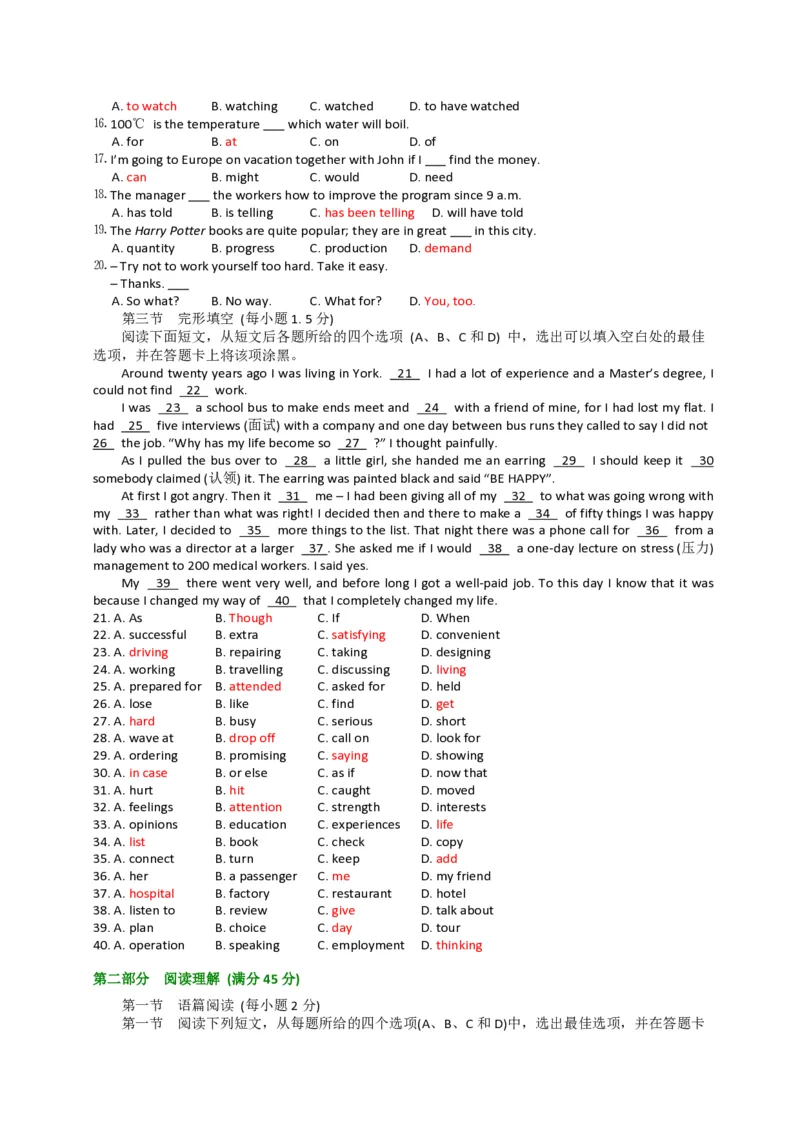
Around twenty years ago I was living in York.  21  I had a lot of experience and a Master’s degree, I
could not find  22  work.
I was  23  a school bus to make ends meet and  24  with a friend of mine, for I had lost my flat. I
had  25  five interviews (面试) with a company and one day between bus runs they called to say I did not
26  the job. “Why has my life become so  27  ?” I thought painfully.
As I pulled the bus over to  28  a little girl, she handed me an earring  29  I should keep it  30
somebody claimed (认领) it. The earring was painted black and said “BE HAPPY”.
At first I got angry. Then it  31  me – I had been giving all of my  32  to what was going wrong with
my  33  rather than what was right! I decided then and there to make a  34  of fifty things I was happy
with. Later, I decided to  35  more things to the list. That night there was a phone call for  36  from a
lady who was a director at a larger  37 . She asked me if I would  38  a one-day lecture on stress (压力)
management to 200 medical workers. I said yes.
My  39  there went very well, and before long I got a well-paid job. To this day I know that it was
because I changed my way of  40  that I completely changed my life.
21. A. As
B. Though
C. If
D. When
22. A. successful
B. extra
C. satisfying
D. convenient
23. A. driving
B. repairing
C. taking
D. designing
24. A. working
B. travelling
C. discussing
D. living
25. A. prepared for B. attended
C. asked for
D. held
26. A. lose
B. like
C. find
D. get
27. A. hard
B. busy
C. serious
D. short
28. A. wave at
B. drop off
C. call on
D. look for
29. A. ordering
B. promising
C. saying
D. showing
30. A. in case
B. or else
C. as if
D. now that
31. A. hurt
B. hit
C. caught
D. moved
32. A. feelings
B. attention
C. strength
D. interests
33. A. opinions
B. education
C. experiences
D. life
34. A. list
B. book
C. check
D. copy
35. A. connect
B. turn
C. keep
D. add
36. A. her
B. a passenger
C. me
D. my friend
37. A. hospital
B. factory
C. restaurant
D. hotel
38. A. listen to
B. review
C. give
D. talk about
39. A. plan
B. choice
C. day
D. tour
40. A. operation
B. speaking
C. employment
D. thinking
第二部分  阅读理解 (满分45 分)
第一节 语篇阅读 (每小题2 分)
第一节 阅读下列短文,从每题所给的四个选项(A、B、C 和D)中,选出最佳选项,并在答题卡
上将该项涂黑。(每小题2 分)
(A)
Cold weather can hard on pets, just like it can be hard on people. Sometimes owners forget that their
cats are just as used to the warm shelter (住所) as they are. Some owners will leave their animals outside
for a long period of time, thinking that all animals are used to living outdoors. This can put their pets in
danger of serious illness. There are things you can do to keep your animal warm and safe.
Keep your pets inside as much as you can when the weather is bad. If you have to take them out, stay
outside with them. When you’re cold enough to go inside, they probably are too. I you must leave them
outside for a long time, make sure they have a warm, solid shelter against the wind, thick bedding, and
plenty of non-frozen water.
If left alone outside, dogs and cats can be very smart in their search for warm shelter. They can dig into
snow banks or hide somewhere. Watch them closely when they are left outdoors, and provide them with
shelter of good quality. Keep an eye on your pet’s water. Sometimes owners don’t realize that a water bowl
has frozen and their pet can’t get anything to drink. Animals that don’t have clean and unfrozen water may
drink dirty water outside, which may contain something unhealthy for them.
41. What do we learn about pets from Paragraph 1?

A. They are often forgotten by their owners.

B. They are used to living outdoors.

C. They build their won shelters.

D. They like to stay in warm places.
42. Why are pet owners asked to stay with their pets when they are out in cold weather?

A. To know when to bring them inside.

B. To keep them from eating bad food.

C. To help them find shelters.

D. To keep them company.
43. If pets are left on their own outdoors in cold weather, they may ___.

A. run short of clean water
B. dig deep holes for fun

C. dirty the snow nearby
D. get lost in the wild
44. What is the purpose of this text?

A. To solve a problem.
B. To give practical advice.

C. To tell an interesting story.
D. To present a research result.
 (B)
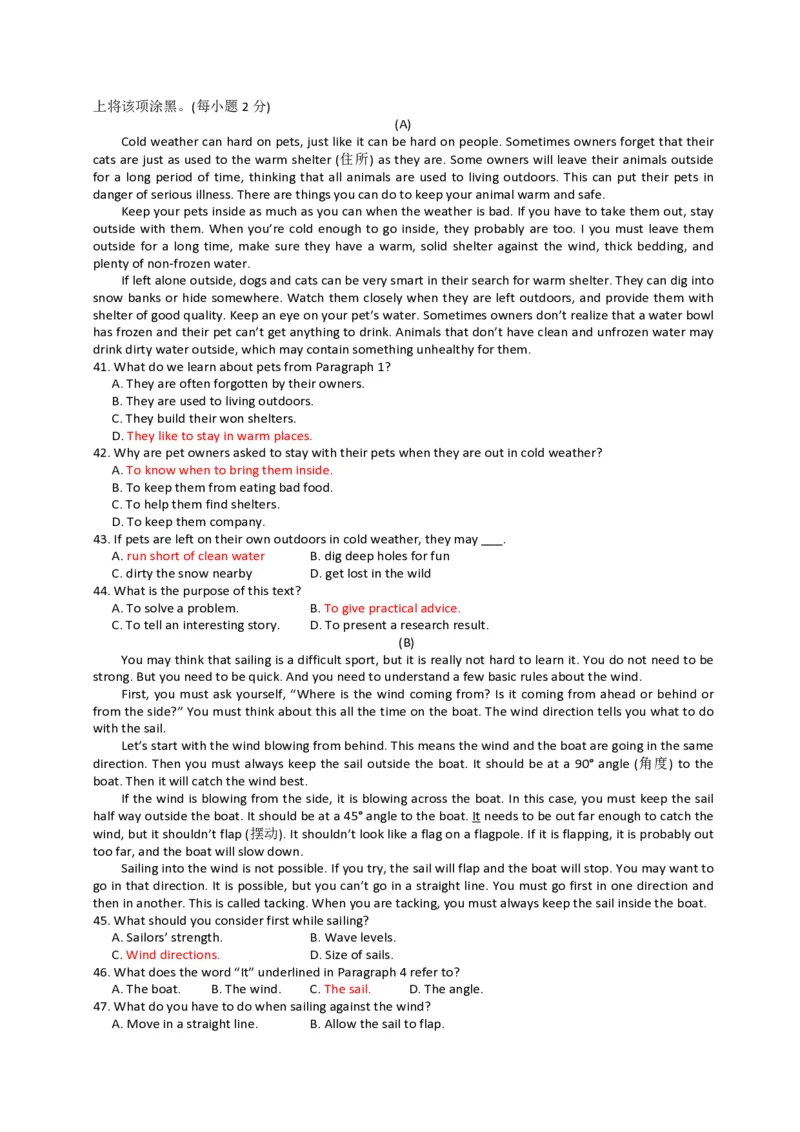
You may think that sailing is a difficult sport, but it is really not hard to learn it. You do not need to be
strong. But you need to be quick. And you need to understand a few basic rules about the wind.
First, you must ask yourself, “Where is the wind coming from? Is it coming from ahead or behind or
from the side?” You must think about this all the time on the boat. The wind direction tells you what to do
with the sail.
Let’s start with the wind blowing from behind. This means the wind and the boat are going in the same
direction. Then you must always keep the sail outside the boat. It should be at a 90° angle (角度) to the
boat. Then it will catch the wind best.
If the wind is blowing from the side, it is blowing across the boat. In this case, you must keep the sail
half way outside the boat. It should be at a 45° angle to the boat. It needs to be out far enough to catch the
wind, but it shouldn’t flap (摆动). It shouldn’t look like a flag on a flagpole. If it is flapping, it is probably out
too far, and the boat will slow down.
Sailing into the wind is not possible. If you try, the sail will flap and the boat will stop. You may want to
go in that direction. It is possible, but you can’t go in a straight line. You must go first in one direction and
then in another. This is called tacking. When you are tacking, you must always keep the sail inside the boat.
45. What should you consider first while sailing?

A. Sailors’ strength.
B. Wave levels.

C. Wind directions.
D. Size of sails.
46. What does the word “It” underlined in Paragraph 4 refer to?

A. The boat.
B. The wind.
C. The sail.
D. The angle.
47. What do you have to do when sailing against the wind?

A. Move in a straight line.
B. Allow the sail to flap.

C. Lower the sail.
D. Tack the boat.
48. Where can you probably find the text?

A. In a popular magazine.
B. In a tourist guidebook.

C. In a physics textbook.
D. In an official report.
 (C)
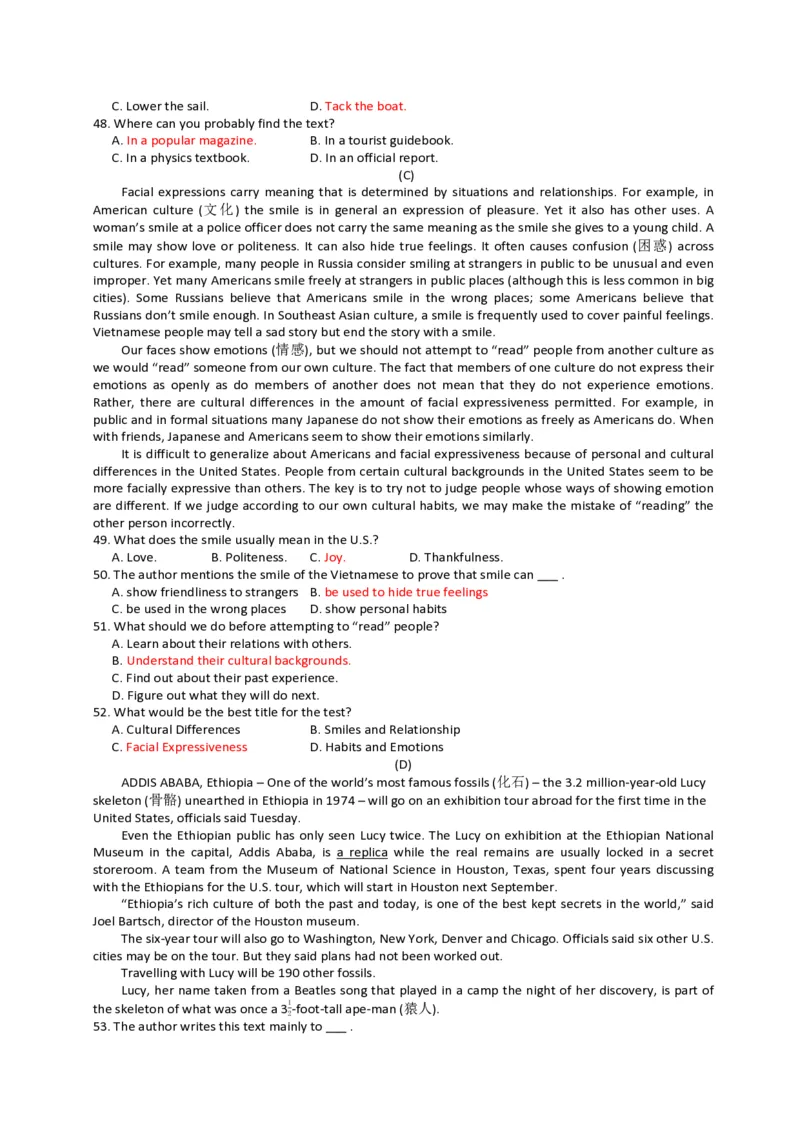
Facial expressions carry meaning that is determined by situations and relationships. For example, in
American culture (文化) the smile is in general an expression of pleasure. Yet it also has other uses. A
woman’s smile at a police officer does not carry the same meaning as the smile she gives to a young child. A
smile may show love or politeness. It can also hide true feelings. It often causes confusion (困惑) across
cultures. For example, many people in Russia consider smiling at strangers in public to be unusual and even
improper. Yet many Americans smile freely at strangers in public places (although this is less common in big
cities). Some Russians believe that Americans smile in the wrong places; some Americans believe that
Russians don’t smile enough. In Southeast Asian culture, a smile is frequently used to cover painful feelings.
Vietnamese people may tell a sad story but end the story with a smile.
Our faces show emotions (情感), but we should not attempt to “read” people from another culture as
we would “read” someone from our own culture. The fact that members of one culture do not express their
emotions as openly as do members of another does not mean that they do not experience emotions.
Rather, there are cultural differences in the amount of facial expressiveness permitted. For example, in
public and in formal situations many Japanese do not show their emotions as freely as Americans do. When
with friends, Japanese and Americans seem to show their emotions similarly.
It is difficult to generalize about Americans and facial expressiveness because of personal and cultural
differences in the United States. People from certain cultural backgrounds in the United States seem to be
more facially expressive than others. The key is to try not to judge people whose ways of showing emotion
are different. If we judge according to our own cultural habits, we may make the mistake of “reading” the
other person incorrectly.
49. What does the smile usually mean in the U.S.?

A. Love.
B. Politeness.
C. Joy.
D. Thankfulness.
50. The author mentions the smile of the Vietnamese to prove that smile can ___ .

A. show friendliness to strangers B. be used to hide true feelings

C. be used in the wrong places
D. show personal habits
51. What should we do before attempting to “read” people?

A. Learn about their relations with others.

B. Understand their cultural backgrounds.

C. Find out about their past experience.

D. Figure out what they will do next.
52. What would be the best title for the test?

A. Cultural Differences
B. Smiles and Relationship

C. Facial Expressiveness
D. Habits and Emotions
(D)
ADDIS ABABA, Ethiopia – One of the world’s most famous fossils (化石) – the 3.2 million-year-old Lucy
skeleton (骨骼) unearthed in Ethiopia in 1974 – will go on an exhibition tour abroad for the first time in the
United States, officials said Tuesday.
Even the Ethiopian public has only seen Lucy twice. The Lucy on exhibition at the Ethiopian National
Museum in the capital, Addis Ababa, is a replica while the real remains are usually locked in a secret
storeroom. A team from the Museum of National Science in Houston, Texas, spent four years discussing
with the Ethiopians for the U.S. tour, which will start in Houston next September.
“Ethiopia’s rich culture of both the past and today, is one of the best kept secrets in the world,” said
Joel Bartsch, director of the Houston museum.
The six-year tour will also go to Washington, New York, Denver and Chicago. Officials said six other U.S.
cities may be on the tour. But they said plans had not been worked out.
Travelling with Lucy will be 190 other fossils.
Lucy, her name taken from a Beatles song that played in a camp the night of her discovery, is part of
the skeleton of what was once a 3 -foot-tall ape-man (猿人).
1
2
53. The author writes this text mainly to ___ .

A. introduce a few U.S. museums

B. describe some research work

C. discuss the value of an ape-man

D. report a coming event
54. What do the words “a replica” in Paragraph 2 refer to?

A. A painting of the skeleton.
B. A photograph of Lucy

C. A copy of the skeleton.
D. A written record of Lucy.
55. How many cities has Lucy’s U.S. tour plan already included?

A. Four.
B. Five.
C. Six.
D. Eleven.
56. What was the skeleton named after?

A. An ape-man. B. A song.
C. A singer.
D. A camp.
(E)
Make Up Your Mind to Succeed
Kind-hearted parents have unknowingly left their children defenseless against failure. The generation
born between 1980 and 2001 grew up playing sports where scores and performance were played down
because “everyone’s a winner.” And their report cards sounded more positive (正面的) than ever before. As
a result, Stanford University professor Carol Dweck, PhD, calls them “the overpraised generation.”
Dweck has been studying how people deal with failure for 40 years. Her research has led her to find
out two clearly different mind-sets that have a great effect on how we react to it. Here’s how they work:
A fixed mind-set is grounded in the belief that talent (才能) is genetic – you’re a born artist, point
guard, or numbers person. The fixed mind-set believes it’s sure to succeed without much effort and regards
failure as personal shame. When things get difficult, it’s quick to blame, lie, and even stay away from future
difficulties.
On the other hand, a growth mind-set believes that no talent is entirely heaven-sent and that effort
and learning make everything possible. Because the ego (自尊) isn’t on the line as much, the growth mind-
set sees failure as a chance rather than shame. When faced with a difficulty, it’s quick to rethink, change
and try again. In fact, it enjoys this experience.
We are all born with growth mind-sets. (Otherwise, we wouldn’t be able to live in the world.) But
parents, teachers, and instructors often push us into fixed mind-sets by encouraging certain actions and
misdirecting praise. Dweck’s book, Mind-set: The New Psychology of Success, and online instructional
program explain this in depth. But she says there are many little things you can start doing today to make
sure that your children, grandchildren and even you are never defeated by failure.
57. What does the author think about the present generation?

A. They don’t do well at school.
B. They are often misunderstood.

C. They are eager to win in sports. D. They are given too much praise.
58. A fixed mind-set person is probably one who ___ .

A. doesn’t want to work hard

B. cares a lot about personal safety

C. cannot share his ideas with others

D. can succeed with the help of teachers
59. What does the growth mind-set believe?

A. Admitting failure is shameful.

B. Talent comes with one’s birth.

C. Scores should be highly valued.

D. Getting over difficulties is enjoyable.
60. What should parents do for their children based on Dweck’s study?

A. Encourage them to learn from failures.

B. Prevent them from making mistakes.

C. Guide them in doing little things.

D. Help them grow with praise.
第二节 根据对话内容,从对话后的选项中选出能填入空白处的最佳选项,选项中有两项为多余选
项。(每小题1 分)
Daughter:Dad. You love me, don’t you?
Father:Of course, I do.  61
Daughter:Well, I saw this great offer for a free phone here in the newspaper, and …
Father: 62
Daughter:Well, the phone is free … after the$50 I pay is returned to me.
Father:Ah, so that’s the catch.  63
Daughter:Dad. All my friends have one.
Father:Ah, I don’t know.  64
Daughter:But the monthly charge for this service is only$29.99, with 1,000 free weekday minutes
nationwide, and unlimited weekend minutes.
Father:I don’t know.
Daughter:Please Dad. With the new phone you won’t have to worry about me while I’m driving the new
car.
Father: 65
Daughter:The new car you’ll need to buy so I can use the phone.
A. Ah… what’s on your mind?
B. New car? What new car?
C. Free? Nothing’s ever free.
D. What did you do to the new car?
E. And why on earth do you need a phone? F. They always charge a lot for the service.
G. But what is the term of the service agreement?
第II 卷
第三部分 写作 (共三节,满分55 分)
第一节 单词拼写 (每小题1 分)
根据下列句子及所给汉语注释,在答题卡相应题号的横线上写出空缺处各单词的正确形式(每空
只写一词)。
66. Do you speak any __________ (外国) languages?
67. Rebecca was the __________ (骄傲) of her family.
68. Will you stop __________ (打断) me when I’m talking?
69. David Beckham’s __________ (国籍) is British.
70. The __________ (现代) history of Italy dates from 1860.
71. Bob’s __________ (侄子) is a freshman at Harvard University.
72. Alice wanted to borrow Jack’s computer, but he __________ (拒绝).
73. Her __________ (书架) are filled with books and photos.
74. What are you girls __________ (耳语) about?
75. Don’t __________ (咳嗽) more than you can help.
第二节 短文改错 (每小题1. 5 分)
此题要求改正所给短文中的错误。先对标有题号的每一行作出判断:如无错误,在该行右边横线
上画一个勾(√);如有错误(每行只有一个错误),则按下列情况改正:
此行多一个词:把多余的词用斜线(\)划掉,在该行右边横线上写出该词,并也用斜线划掉。
此行缺一个词:在缺词处加一个漏字符号(∧),在该行右边横线上写出该加的词。
此行错一个词:在错的词下划一横线,在该行右边横线上写出改正后的词。
注意:⒈ 原行没有错的不要改;
⒉ 答案必须写在答题卡相应的位置上。
Dear Editor,
I’m writing to tell you opinion about water saving.
76.______
Water is important. We, as well as animal, cannot live
77.______
without water and neither agriculture or industry can go
78.______
without it. Yet it seemed water is becoming less and less.
79.______
Many countries in the world find we don’t have enough water.
80.______
To deal with a problem, I think, we should first go all
81.______
out to plant trees though trees will help save water. Next, no
82.______
drinking water should be left running. Third, we should find
83.______
ways to reuse the water using in washing, especially bath
84.______
water for which is quite a lot, and that will save much water.
85.______
Sincerely,
Li Hua
第三节 书面表达 (30 分)
假定你是李华。你班同学决定为小明举办生日聚会。请你写信邀请外教Susan 参加,要点包括:
⒈ 时间:周五晚8 点至9 点
⒉ 地点:学生俱乐部
⒊ 内容:生日歌、蛋糕、游戏等
⒋ 要求:备小礼物
注意:⒈ 词数100 左右,开头语已为你写好;⒉可以适当增加细节,以便行文连贯;⒊ 答案必
须写在答题卡相应的位置上。
Hi, Susan,
We’re throwing a surprise party for Xiaoming’s birthday.