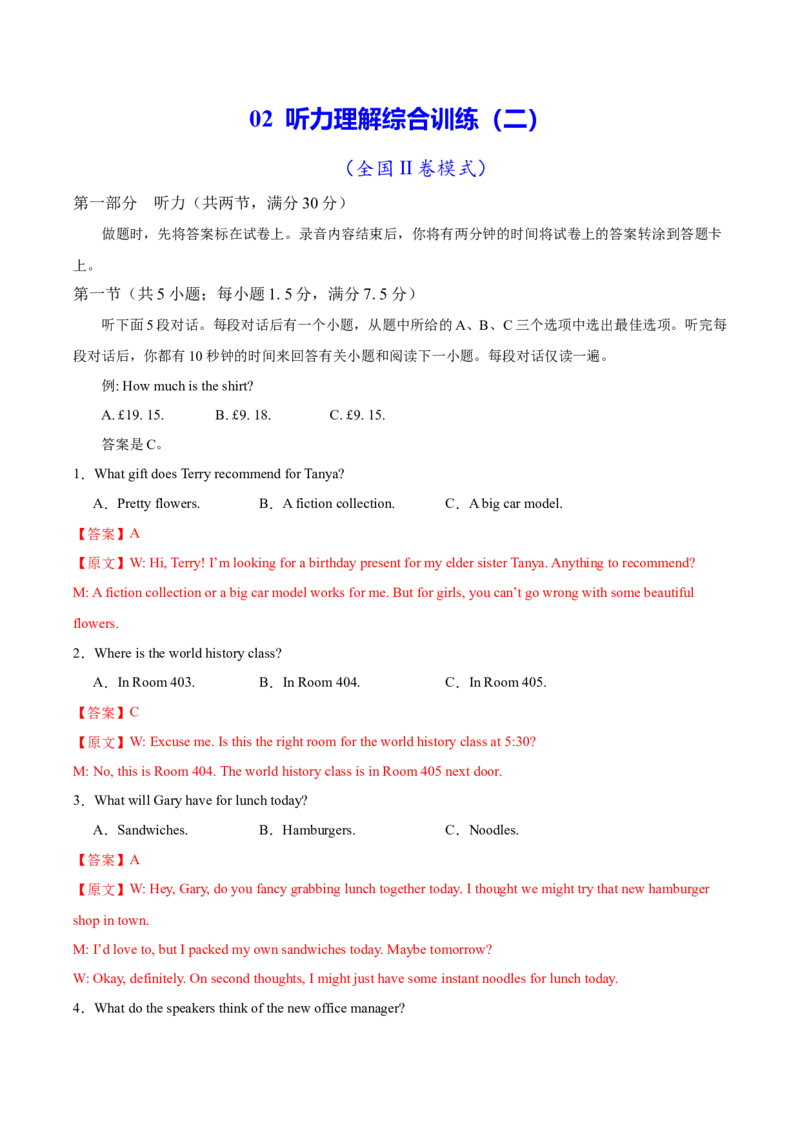
02 听力理解综合训练(二)
 (全国II 卷模式)
第一部分  听力(共两节,满分30 分)
做题时,先将答案标在试卷上。录音内容结束后,你将有两分钟的时间将试卷上的答案转涂到答题卡
上。
第一节(共5 小题;每小题1. 5 分,满分7. 5 分)
听下面5 段对话。每段对话后有一个小题,从题中所给的A、B、C 三个选项中选出最佳选项。听完每
段对话后,你都有10 秒钟的时间来回答有关小题和阅读下一小题。每段对话仅读一遍。
例: How much is the shirt?
A. £19. 15.
B. £9. 18.
C. £9. 15.
答案是C。
1.What gift does Terry recommend for Tanya?
A.Pretty flowers.
B.A fiction collection.
C.A big car model.
【答案】A
【原文】W: Hi, Terry! I’m looking for a birthday present for my elder sister Tanya. Anything to recommend?
M: A fiction collection or a big car model works for me. But for girls, you can’t go wrong with some beautiful
flowers.
2.Where is the world history class?
A.In Room 403.
B.In Room 404.
C.In Room 405.
【答案】C
【原文】W: Excuse me. Is this the right room for the world history class at 5:30?
M: No, this is Room 404. The world history class is in Room 405 next door.
3.What will Gary have for lunch today?
A.Sandwiches.
B.Hamburgers.
C.Noodles.
【答案】A
【原文】W: Hey, Gary, do you fancy grabbing lunch together today. I thought we might try that new hamburger
shop in town.
M: I’d love to, but I packed my own sandwiches today. Maybe tomorrow?
W: Okay, definitely. On second thoughts, I might just have some instant noodles for lunch today.
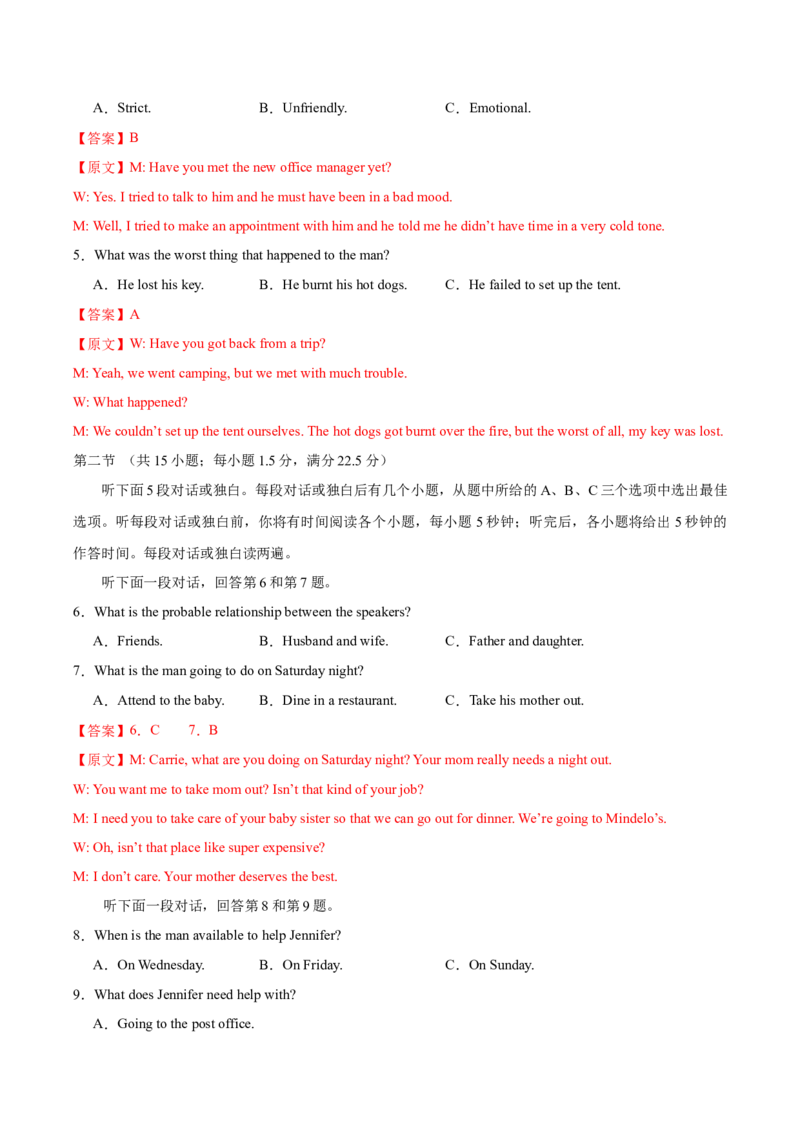
4.What do the speakers think of the new office manager?
A.Strict.
B.Unfriendly.
C.Emotional.
【答案】B
【原文】M: Have you met the new office manager yet?
W: Yes. I tried to talk to him and he must have been in a bad mood.
M: Well, I tried to make an appointment with him and he told me he didn’t have time in a very cold tone.
5.What was the worst thing that happened to the man?
A.He lost his key.
B.He burnt his hot dogs.
C.He failed to set up the tent.
【答案】A
【原文】W: Have you got back from a trip?
M: Yeah, we went camping, but we met with much trouble.
W: What happened?
M: We couldn’t set up the tent ourselves. The hot dogs got burnt over the fire, but the worst of all, my key was lost.
第二节 (共15 小题;每小题1.5 分,满分22.5 分)
听下面5 段对话或独白。每段对话或独白后有几个小题,从题中所给的A、B、C 三个选项中选出最佳
选项。听每段对话或独白前,你将有时间阅读各个小题,每小题5 秒钟;听完后,各小题将给出5 秒钟的
作答时间。每段对话或独白读两遍。
听下面一段对话,回答第6 和第7 题。
6.What is the probable relationship between the speakers?
A.Friends.
B.Husband and wife.
C.Father and daughter.
7.What is the man going to do on Saturday night?
A.Attend to the baby.
B.Dine in a restaurant.
C.Take his mother out.
【答案】6.C    7.B
【原文】M: Carrie, what are you doing on Saturday night? Your mom really needs a night out.
W: You want me to take mom out? Isn’t that kind of your job?
M: I need you to take care of your baby sister so that we can go out for dinner. We’re going to Mindelo’s.
W: Oh, isn’t that place like super expensive?
M: I don’t care. Your mother deserves the best.
听下面一段对话,回答第8 和第9 题。
8.When is the man available to help Jennifer?
A.On Wednesday.
B.On Friday.
C.On Sunday.
9.What does Jennifer need help with?
A.Going to the post office.
B.Packing her belongings.
C.Teaching classes.
【答案】8.B    9.A
【原文】M: Jennifer, are you busy this week?
W: Yes, I am busy moving home. Do you have time to help me?
M: I can help you on Friday.
W: Oh, are you also occupied on Sunday?
M: Yes, on Sunday I have to teach three classes, and then after that, I need to grade papers.
W: I see. Could you give me a ride to the post office on Friday? I almost forgot, I need to submit a form to update
my address.
M: Sure, I’ll see you on Friday. What time should we meet?
W: 11 o’clock would be best.
M: Great, see you then.
听下面一段对话,回答第10 至12 题。
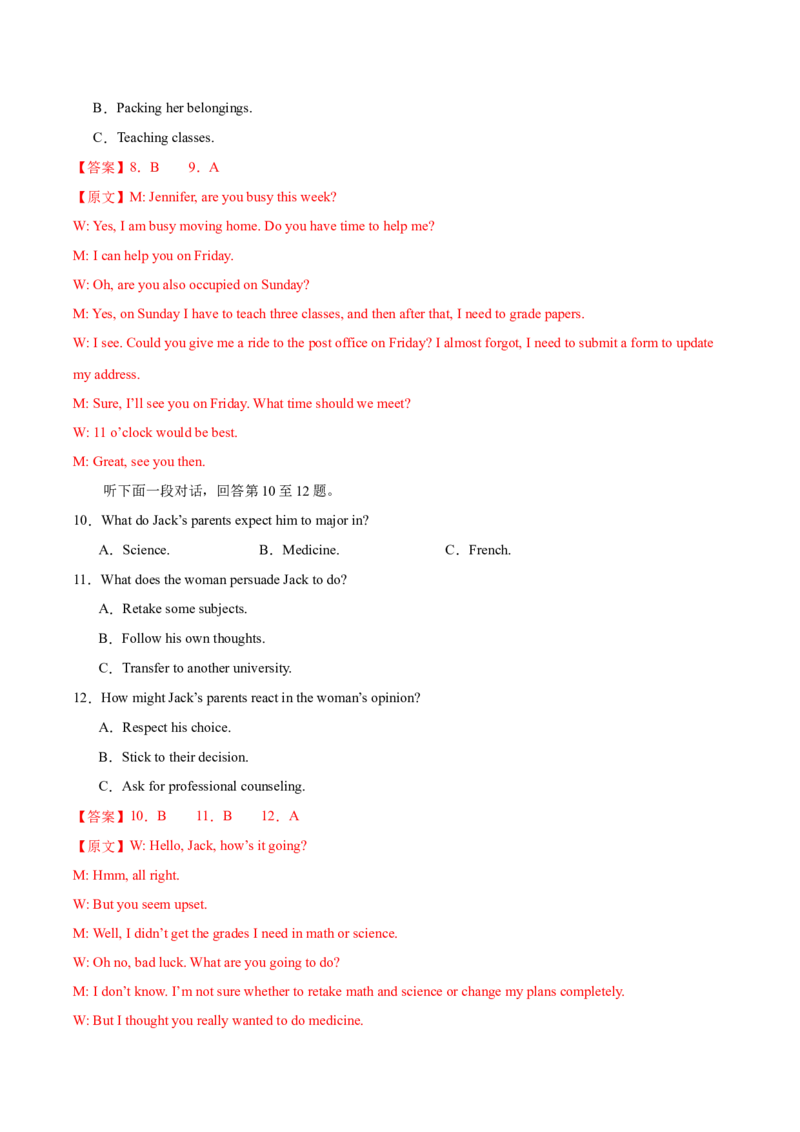
10.What do Jack’s parents expect him to major in?
A.Science.
B.Medicine.
C.French.
11.What does the woman persuade Jack to do?
A.Retake some subjects.
B.Follow his own thoughts.
C.Transfer to another university.
12.How might Jack’s parents react in the woman’s opinion?
A.Respect his choice.
B.Stick to their decision.
C.Ask for professional counseling.
【答案】10.B    11.B    12.A
【原文】W: Hello, Jack, how’s it going?
M: Hmm, all right.
W: But you seem upset.
M: Well, I didn’t get the grades I need in math or science.
W: Oh no, bad luck. What are you going to do?
M: I don’t know. I’m not sure whether to retake math and science or change my plans completely.
W: But I thought you really wanted to do medicine.
M: No, that’s what my parents want me to do.
W: Okay? And what do you want to do?
M: I don’t know exactly. I’m good at history and languages. I always get an a in French.
W: That’s great. Maybe it would be better for you to do something like that at university.
M: Even if I can get the grades for math and science, I’m still not convinced you do medicine.
W: Hmm, well, you have many talents, Jack, but maybe being a doctor isn’t for you. Anyway, you need to make the
right decision.
M: Yeah, although my parents aren’t going to be happy, I will talk to them next Monday.
W: Don’t worry, you never know. They might be more understanding than you think.
听下面一段对话,回答第13 至16 题。
13.What is the main topic of the conversation?
A.China’s history.
B.China’s achievements.
C.China’s industry.
14.Where are the speakers?
A.On a train.
B.In a restaurant.
C.In a factory.
15.What do the speakers have in common?
A.They’ve both tried Chinese medicine.
B.They both know Chinese culture well.
C.They both enjoy Chinese food.
16.How many aspects of modern Chinese contribution did the woman mention?
A.Two.
B.Three.
C.Four.
【答案】13.B    14.A    15.C    16.B
【原文】W: China has made such significant contributions to the world throughout history.
M: Really? Like what?
W: Well, for starters, the Chinese invented paper around two thousand years ago. Can you imagine life without
paper?
M: That’s incredible. But that was long ago. What about the present?
W: In modern times, China is a leader in technology. They’ve produced some of the world’s most advanced
electronics and useful devices. The train we are traveling on now is Chinese.
M: That’s impressive. What else have they contributed?
W: Chinese cuisine is another great example. Where would the world be without Chinese restaurants?
M: Ah, yes, Chinese food is especially rich and delicious. I take my family out for Chinese food several times a
month.
W: Me, too. And let’s not forget traditional Chinese medicine, which has been practiced for thousands of years and
continues to influence healthcare globally.
M: I never realized the extent of China’s contributions to the world.
W: It’s truly remarkable, from the ancient inventions that shaped civilization to the modern innovations driving
global industries.
M: Absolutely. All those things show the rich cultural heritage and the intelligence and wisdom of the Chinese
people.
听下面一段独白,回答第17 至第20 题。
17.Where does Richard Florida mention the importance of choosing a living place?
A.In a book.
B.In a program.
C.In a piece of news.
18.What is Los Angeles famous mainly for?
A.Manufacturing.
B.Financial services.
C.Film production.
19.What are residents of Boston like according to the talk?
A.Active.
B.Disciplined.
C.Hard-working.
20.What does Ellen Coyle mainly talk about in the end?
A.The industries in different cities.
B.The qualities required in the workplace.
C.The impact of residents’ personalities on urban industries.
【答案】17.A    18.C    19.A    20.C
【原文】    W: This is Ellen Coyle with Talk About the News. In today’s world, some might argue that it doesn’t
really matter where you live. That’s not true, according to Richard Florida.
    In his book Who’s Your City? Richard Florida says the decision about where to live may be the most important
one you make. Richard thinks that people tend to gather in certain cities according to the work they do and even the
type of personalities they have. Some cities, such as Boston, lead the way in technology and innovation. New York
and London are financial centers. Cities like Los Angeles make quality films. Others like Guadalajara are known
mainly for producing various products. Why are some cities centers of creativity while others are more likely to
focus on producing things? Richard uses recent research to suggest that personality may play a role. Cities like
Boston are home to people who are open to experience. They like high levels of activity and new ideas. Most
technology companies are in or near these centers of creativity. In cities like Guadalajara, residents are both hard-
working and agreeable. They tend to follow rules and work well on teams, qualities that are important in
manufacturing.