文档文本内容
高考英语七选五真题实操精讲16:用“四步法”+“先易后难”突破
2026 年浙江春季高考英语卷
各位同学,今天我们以2026 年浙江春季高考英语卷“阅读中‘回
读’习惯”的说明文为例,继续运用“画—析—找—验”四步法+“先易
后难”技巧拆解解题过程。这类文章的核心是理清“现象提出—原因分析
—解决方法—辩证说明”的逻辑结构,找准问题与原因、建议与行动、观
点与补充的衔接关系,就能精准解题。
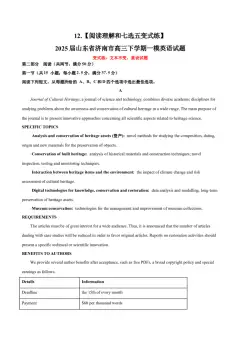
原题呈现:2026 年浙江春季高考英语卷
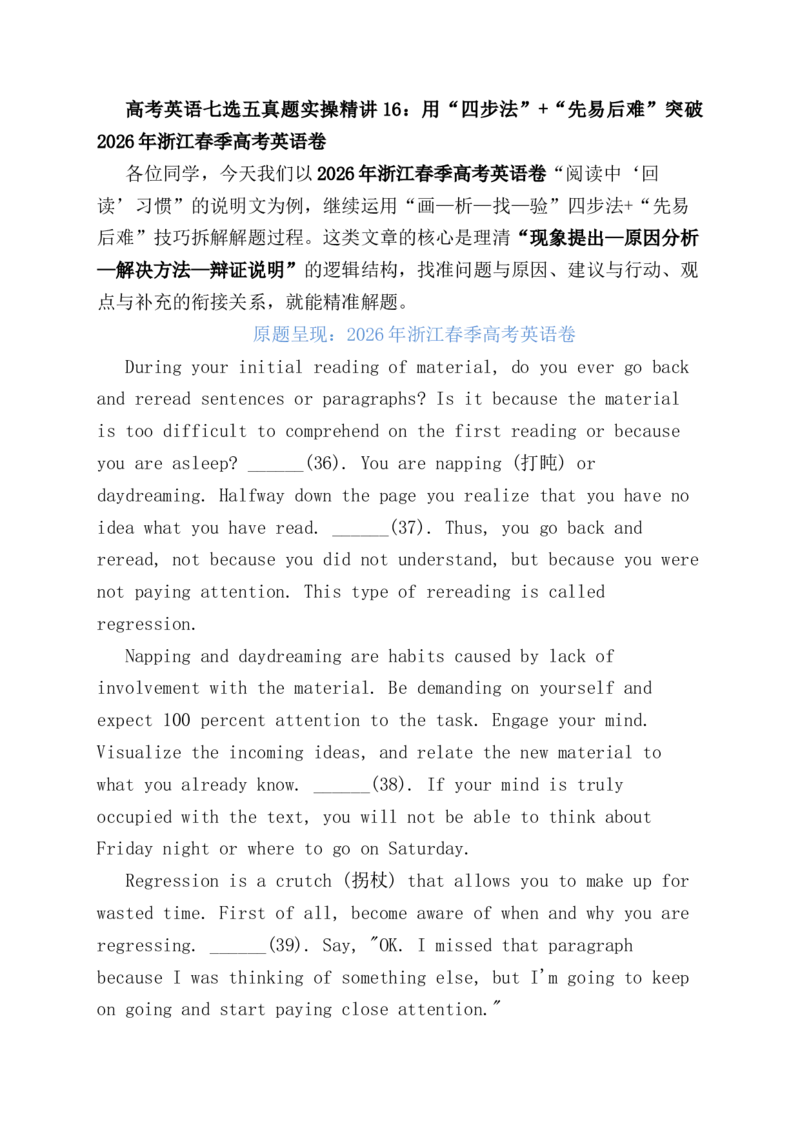
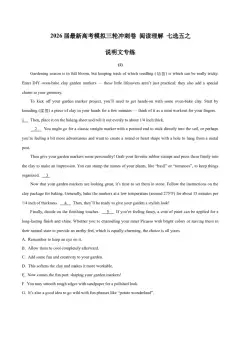
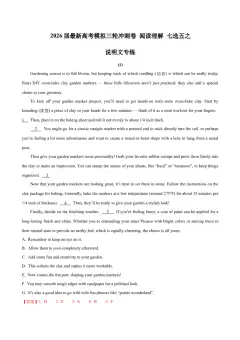
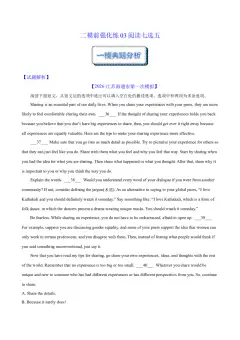
During your initial reading of material, do you ever go back
and reread sentences or paragraphs? Is it because the material
is too difficult to comprehend on the first reading or because
you are asleep? ______(36). You are napping (打盹) or
daydreaming. Halfway down the page you realize that you have no
idea what you have read. ______(37). Thus, you go back and
reread, not because you did not understand, but because you were
not paying attention. This type of rereading is called
regression.
Napping and daydreaming are habits caused by lack of
involvement with the material. Be demanding on yourself and
expect 100 percent attention to the task. Engage your mind.
Visualize the incoming ideas, and relate the new material to
what you already know. ______(38). If your mind is truly
occupied with the text, you will not be able to think about
Friday night or where to go on Saturday.
Regression is a crutch (拐杖) that allows you to make up for
wasted time. First of all, become aware of when and why you are
regressing. ______(39). Say, "OK. I missed that paragraph
because I was thinking of something else, but I'm going to keep
on going and start paying close attention."
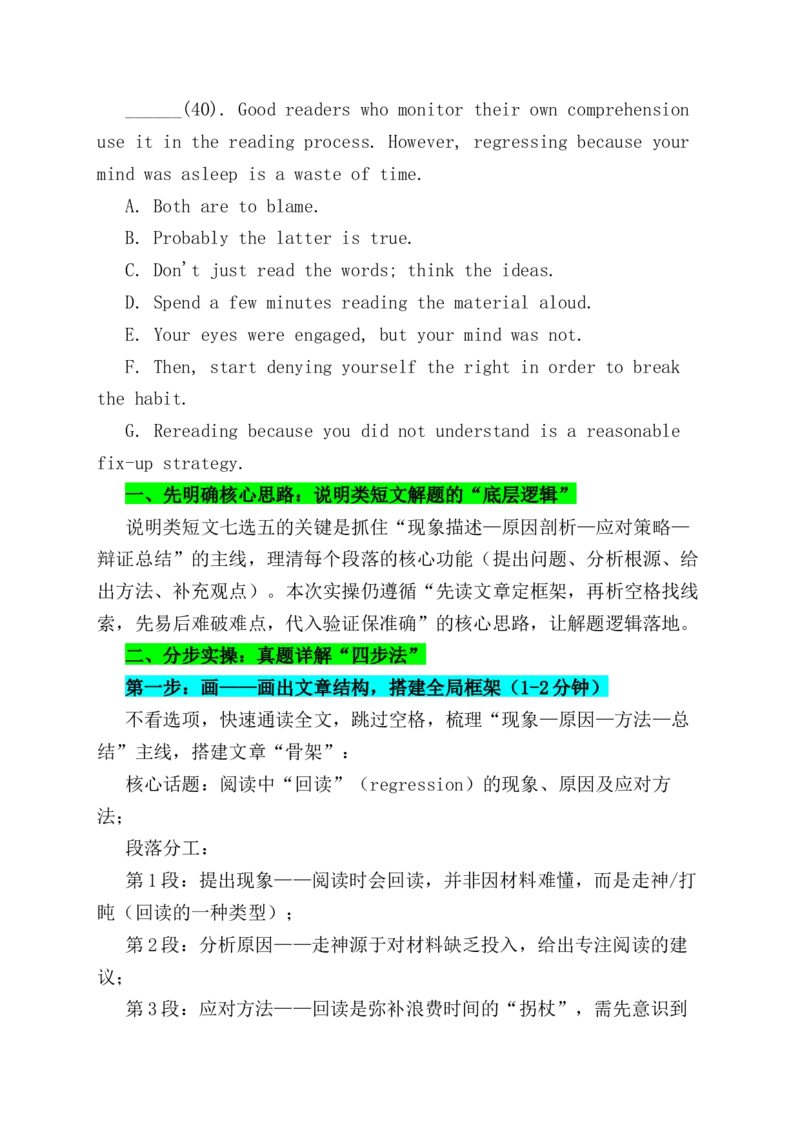
______(40). Good readers who monitor their own comprehension
use it in the reading process. However, regressing because your
mind was asleep is a waste of time.
A. Both are to blame.
B. Probably the latter is true.
C. Don't just read the words; think the ideas.
D. Spend a few minutes reading the material aloud.
E. Your eyes were engaged, but your mind was not.
F. Then, start denying yourself the right in order to break
the habit.
G. Rereading because you did not understand is a reasonable
fix-up strategy.
一、先明确核心思路:说明类短文解题的“底层逻辑”
说明类短文七选五的关键是抓住“现象描述—原因剖析—应对策略—
辩证总结”的主线,理清每个段落的核心功能(提出问题、分析根源、给
出方法、补充观点)。本次实操仍遵循“先读文章定框架,再析空格找线
索,先易后难破难点,代入验证保准确”的核心思路,让解题逻辑落地。
二、分步实操:真题详解“四步法”
第一步:画——画出文章结构,搭建全局框架(1-2 分钟)
不看选项,快速通读全文,跳过空格,梳理“现象—原因—方法—总
结”主线,搭建文章“骨架”:
核心话题:阅读中“回读”(regression)的现象、原因及应对方
法;
段落分工:
第1 段:提出现象——阅读时会回读,并非因材料难懂,而是走神/打
盹(回读的一种类型);
第2 段:分析原因——走神源于对材料缺乏投入,给出专注阅读的建
议;
第3 段:应对方法——回读是弥补浪费时间的“拐杖”,需先意识到
回读的时机和原因,再逐步戒除;
第4 段:辩证总结——因不懂而回读是合理策略,但因走神而回读是
浪费时间。
作用:明确每个空格的功能定位——36 题衔接“两种回读原
因”与“实际是走神”,37 题解释“回读的本质(走神)”,38 题补
充“专注阅读的具体做法”,39 题衔接“意识到回读”与“主动改正”,
40 题引出“合理回读”的观点,与后文辩证呼应。
第二步:析——分析空格特征,锁定解题方向
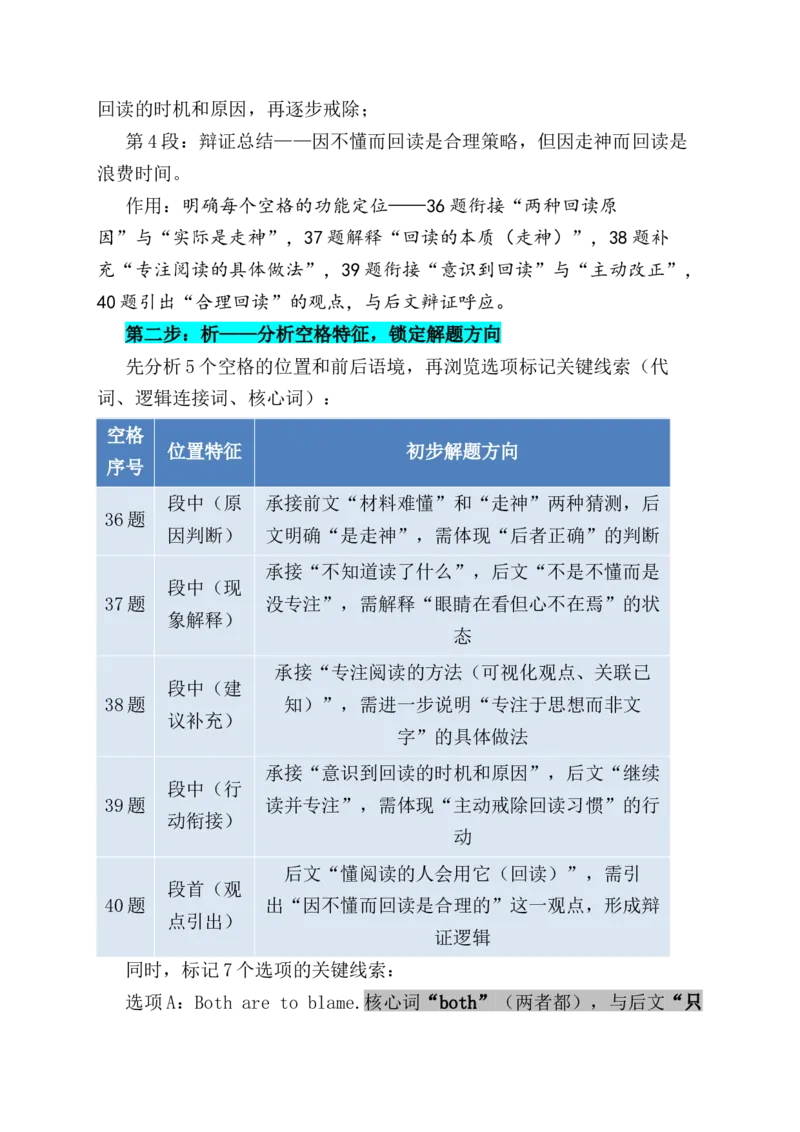
先分析5 个空格的位置和前后语境,再浏览选项标记关键线索(代
词、逻辑连接词、核心词):
空格
序号
位置特征
初步解题方向
36 题
段中(原
因判断)
承接前文“材料难懂”和“走神”两种猜测,后
文明确“是走神”,需体现“后者正确”的判断
37 题
段中(现
象解释)
承接“不知道读了什么”,后文“不是不懂而是
没专注”,需解释“眼睛在看但心不在焉”的状
态
38 题
段中(建
议补充)
承接“专注阅读的方法(可视化观点、关联已
知)”,需进一步说明“专注于思想而非文
字”的具体做法
39 题
段中(行
动衔接)
承接“意识到回读的时机和原因”,后文“继续
读并专注”,需体现“主动戒除回读习惯”的行
动
40 题
段首(观
点引出)
后文“懂阅读的人会用它(回读)”,需引
出“因不懂而回读是合理的”这一观点,形成辩
证逻辑
同时,标记7 个选项的关键线索:
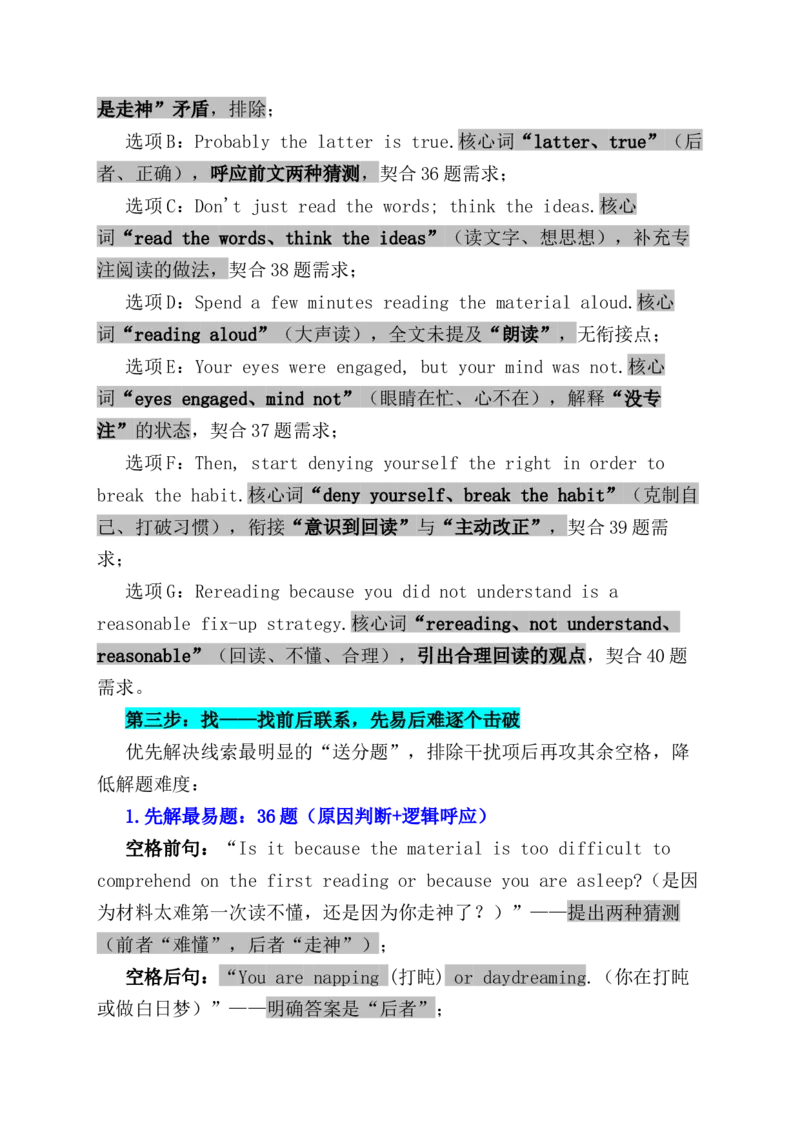
选项A:Both are to blame.核心词“both”(两者都),与后文“只
是走神”矛盾,排除;
选项B:Probably the latter is true.核心词“latter、true”(后
者、正确),呼应前文两种猜测,契合36 题需求;
选项C:Don't just read the words; think the ideas.核心
词“read the words、think the ideas”(读文字、想思想),补充专
注阅读的做法,契合38 题需求;
选项D:Spend a few minutes reading the material aloud.核心
词“reading aloud”(大声读),全文未提及“朗读”,无衔接点;
选项E:Your eyes were engaged, but your mind was not.核心
词“eyes engaged、mind not”(眼睛在忙、心不在),解释“没专
注”的状态,契合37 题需求;
选项F:Then, start denying yourself the right in order to
break the habit.核心词“deny yourself、break the habit”(克制自
己、打破习惯),衔接“意识到回读”与“主动改正”,契合39 题需
求;
选项G:Rereading because you did not understand is a
reasonable fix-up strategy.核心词“rereading、not understand、
reasonable”(回读、不懂、合理),引出合理回读的观点,契合40 题
需求。
第三步:找——找前后联系,先易后难逐个击破
优先解决线索最明显的“送分题”,排除干扰项后再攻其余空格,降
低解题难度:
1.先解最易题:36 题(原因判断+逻辑呼应)
空格前句:“Is it because the material is too difficult to
comprehend on the first reading or because you are asleep?(是因
为材料太难第一次读不懂,还是因为你走神了?)”——提出两种猜测
(前者“难懂”,后者“走神”);
空格后句:“You are napping (打盹) or daydreaming.(你在打盹
或做白日梦)”——明确答案是“后者”;
匹配选项:选项B“Probably the latter is true.(可能后者是对
的)”中“latter”直接指代“you are asleep(走神)”,与后文答案
完美呼应,锁定B 为36 题答案!
2.再解线索明确题:37 题(现象解释+语义衔接)
空格前句:“Halfway down the page you realize that you have
no idea what you have read.(读到页面中间,你意识到自己完全不知
道读了什么)”——描述回读前的状态;
空格后句:“Thus, you go back and reread, not because you did
not understand, but because you were not paying attention.(因
此,你回读不是因为不懂,而是因为没专注)”——解释回读的原因;
逻辑需求:需补充“没专注”的具体表现(眼睛看了但心没在);
匹配选项:选项E“Your eyes were engaged, but your mind was
not.(你的眼睛在忙,但心不在焉)”精准解释了“不知道读了什么”的
本质,衔接前文现象与后文原因,锁定E 为37 题答案!
3.接着解建议补充题:38 题(做法细化+语义递进)
空格前句:“Engage your mind. Visualize the incoming ideas,
and relate the new material to what you already know.(集中注意
力。想象即将接收的观点,将新材料与已知知识关联)”——给出专注阅
读的宏观方法;
逻辑需求:需进一步细化“专注”的具体做法,强调“理解思想而非
单纯读文字”;
匹配选项:选项C“Don't just read the words; think the ideas.
(不要只读文字,要思考思想)”承接“集中注意力”,细化了专注阅读
的核心,与前文“visualize ideas、relate new material”语义递进,
锁定C 为38 题答案!
4.再解行动衔接题:39 题(逻辑递进+行动指引)
空格前句:“First of all, become aware of when and why you
are regressing.(首先,要意识到自己何时、为何会回读)”——第一
步:察觉问题;
空格后句:“Say, 'OK. I missed that paragraph because I was
thinking of something else, but I'm going to keep on going and
start paying close attention.'(告诉自己:‘好吧,我因为想别的错
过了那一段,但我要继续读,开始专注’)”——第二步:主动改正;
逻辑需求:需体现“察觉问题”到“主动改正”的过渡,强调“戒除
回读习惯”;
匹配选项:选项F“Then, start denying yourself the right in
order to break the habit.(然后,开始克制自己,以打破这个习
惯)”中“Then”承接“First of all”,“deny yourself the
right”对应后文“继续读不回读”,衔接自然,锁定F 为39 题答案!
5.最后攻观点引出题:40 题(辩证衔接+主题呼应)
此时已确定4 个答案(36=B、37=E、38=C、39=F),剩余选项A、D、
G,排除无关干扰项即可:
空格后句:“Good readers who monitor their own comprehension
use it in the reading process. However, regressing because your
mind was asleep is a waste of time.(善于监控自己理解程度的优秀
读者会在阅读中使用它。但因走神而回读是浪费时间)”——“it”指
代“回读”,辩证说明“合理回读”与“无效回读”;
分析剩余选项:
选项A(两者都该怪)与后文“只是走神”矛盾,选项D(大声读)无
上下文支撑,直接排除;
选项G“Rereading because you did not understand is a
reasonable fix-up strategy.(因不懂而回读是一种合理的补救策
略)”中“reasonable fix-up strategy”呼应后文“good readers use
it”,引出“合理回读”的观点,与后文“因走神回读是浪费时间”形成
辩证对比,锁定G 为40 题答案!
第四步:验——代入验证,确保全文流畅
将5 个答案(36=B、37=E、38=C、39=F、40=G)代入原文,通读检
查:
语义连贯:全文围绕“回读现象”展开,36 题判断回读原因是走神,
37 题解释走神的本质(眼在心不在),38 题给出专注阅读的具体做法,
39 题提供戒除无效回读的步骤,40 题辩证说明合理回读的价值,逻辑链
完整闭环;
逻辑通顺:代词指代(latter=走神、it=合理回读)准确,递进关系
(First of all→Then)、转折关系(However)自然合理,观点与阐释
高度契合;
无生硬感:所有选项都贴合“回读习惯”核心主线,干扰项A、D 与主
题无关,排除后全文流畅度拉满。
验证无误,确定36=B、37=E、38=C、39=F、40=G 就是正确答案!
三、实操总结:
抓逻辑:说明类短文优先梳理“现象—原因—方法—总结”的逻辑
链,明确段落间的因果、递进、辩证关系,避免偏离核心;
找线索:重点关注代词指代(latter、it)、逻辑连接词(Then、
However)、语义呼应(专注→思考思想、回读→合理/无效),这些是解
题关键;
排干扰:快速排除与主线矛盾(如A)、无上下文支撑(如D)的“孤
立信息”,减少无效判断;
先易后难:优先解决原因判断、现象解释等线索明确的题(如36、37
题),再用逻辑递进突破其余空格,最后用排除法收尾,降低解题压力。