第14 讲 名词2026 年高考英语语法专项突破(全国通用)
(语法讲义+模拟练习+真题操练)
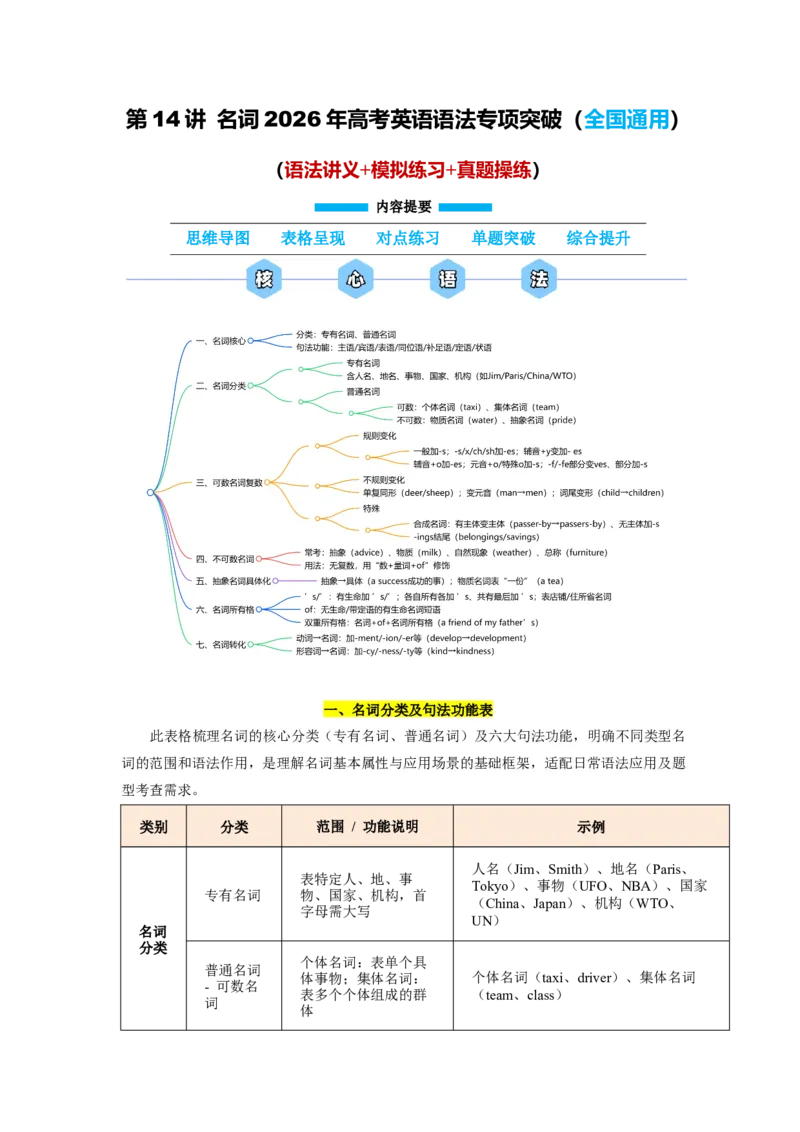
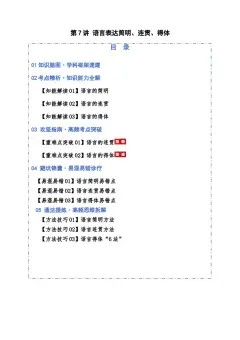
 内容提要
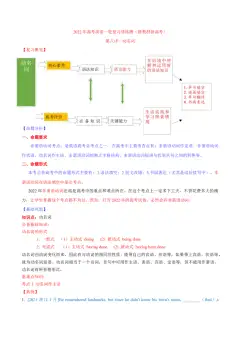
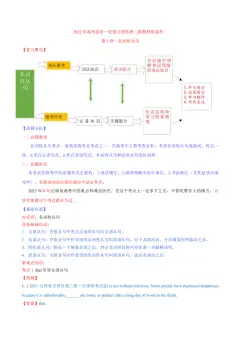
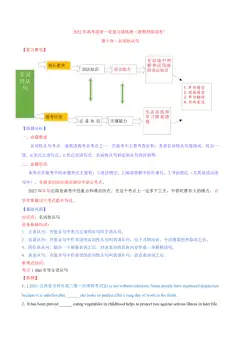
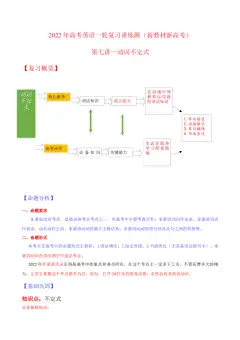
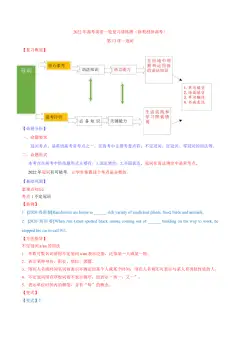
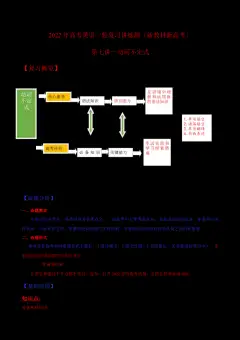
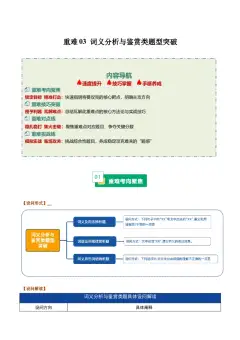
思维导图
表格呈现
对点练习
单题突破
综合提升
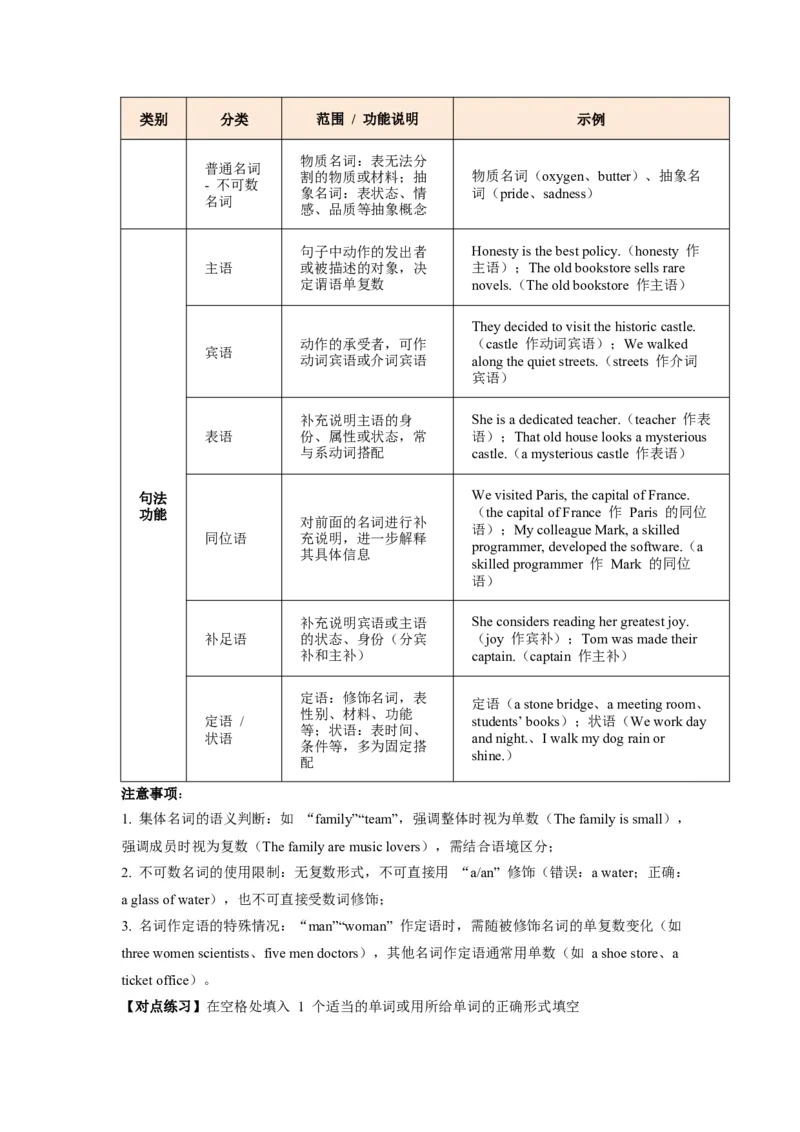
一、名词分类及句法功能表
此表格梳理名词的核心分类(专有名词、普通名词)及六大句法功能,明确不同类型名
词的范围和语法作用,是理解名词基本属性与应用场景的基础框架,适配日常语法应用及题
型考查需求。
类别
分类
范围 / 功能说明
示例
名词
分类
专有名词
表特定人、地、事
物、国家、机构,首
字母需大写
人名(Jim、Smith)、地名(Paris、
Tokyo)、事物(UFO、NBA)、国家
(China、Japan)、机构(WTO、
UN)
普通名词
- 可数名
词
个体名词:表单个具
体事物;集体名词:
表多个个体组成的群
体
个体名词(taxi、driver)、集体名词
(team、class)
类别
分类
范围 / 功能说明
示例
普通名词
- 不可数
名词
物质名词:表无法分
割的物质或材料;抽
象名词:表状态、情
感、品质等抽象概念
物质名词(oxygen、butter)、抽象名
词(pride、sadness)
句法
功能
主语
句子中动作的发出者
或被描述的对象,决
定谓语单复数
Honesty is the best policy.(honesty 作
主语);The old bookstore sells rare
novels.(The old bookstore 作主语)
宾语
动作的承受者,可作
动词宾语或介词宾语
They decided to visit the historic castle.
(castle 作动词宾语);We walked
along the quiet streets.(streets 作介词
宾语)
表语
补充说明主语的身
份、属性或状态,常
与系动词搭配
She is a dedicated teacher.(teacher 作表
语);That old house looks a mysterious
castle.(a mysterious castle 作表语)
同位语
对前面的名词进行补
充说明,进一步解释
其具体信息
We visited Paris, the capital of France.
(the capital of France 作 Paris 的同位
语);My colleague Mark, a skilled
programmer, developed the software.(a
skilled programmer 作 Mark 的同位
语)
补足语
补充说明宾语或主语
的状态、身份(分宾
补和主补)
She considers reading her greatest joy.
(joy 作宾补);Tom was made their
captain.(captain 作主补)
定语 /
状语
定语:修饰名词,表
性别、材料、功能
等;状语:表时间、
条件等,多为固定搭
配
定语(a stone bridge、a meeting room、
students’ books);状语(We work day
and night.、I walk my dog rain or
shine.)
注意事项:
1. 集体名词的语义判断:如 “family”“team”,强调整体时视为单数(The family is small),
强调成员时视为复数(The family are music lovers),需结合语境区分;
2. 不可数名词的使用限制:无复数形式,不可直接用 “a/an” 修饰(错误:a water;正确:
a glass of water),也不可直接受数词修饰;
3. 名词作定语的特殊情况:“man”“woman” 作定语时,需随被修饰名词的单复数变化(如
three women scientists、five men doctors),其他名词作定语通常用单数(如 a shoe store、a
ticket office)。
【对点练习】在空格处填入 1 个适当的单词或用所给单词的正确形式填空
1. My motherland________ (Chinese) is a great country with a long history and rich culture.
2. My brother bought two new ________ (taxi) last month to expand his business.
3. The ________ (team) are having a heated discussion about the upcoming match.
4. ________ (Honest) is the best policy, which is a valuable virtue for everyone.
5. We visited Paris, the capital of  ________ (French), during our summer vacation last year.
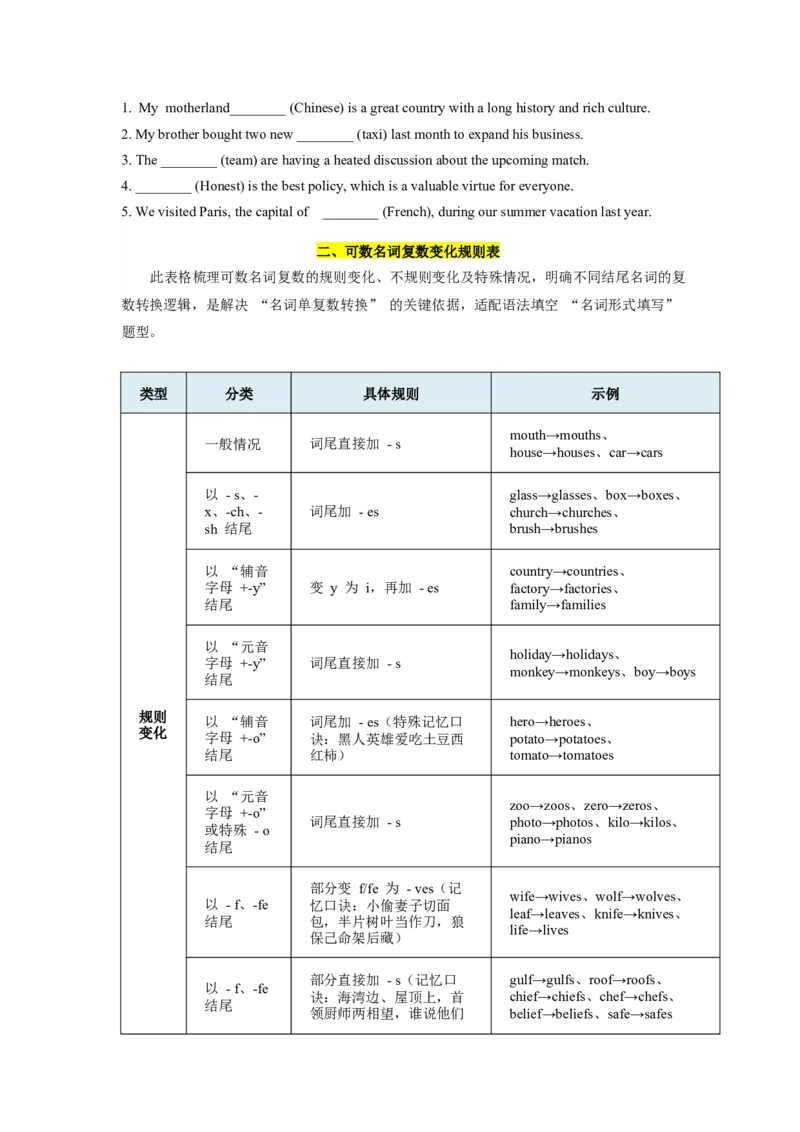
二、可数名词复数变化规则表
此表格梳理可数名词复数的规则变化、不规则变化及特殊情况,明确不同结尾名词的复
数转换逻辑,是解决 “名词单复数转换” 的关键依据,适配语法填空 “名词形式填写”
题型。
类型
分类
具体规则
示例
规则
变化
一般情况
词尾直接加 - s
mouth→mouths、
house→houses、car→cars
以 - s、-
x、-ch、-
sh 结尾
词尾加 - es
glass→glasses、box→boxes、
church→churches、
brush→brushes
以 “辅音
字母 +-y”
结尾
变 y 为 i,再加 - es
country→countries、
factory→factories、
family→families
以 “元音
字母 +-y”
结尾
词尾直接加 - s
holiday→holidays、
monkey→monkeys、boy→boys
以 “辅音
字母 +-o”
结尾
词尾加 - es(特殊记忆口
诀:黑人英雄爱吃土豆西
红柿)
hero→heroes、
potato→potatoes、
tomato→tomatoes
以 “元音
字母 +-o”
或特殊 - o
结尾
词尾直接加 - s
zoo→zoos、zero→zeros、
photo→photos、kilo→kilos、
piano→pianos
以 - f、-fe
结尾
部分变 f/fe 为 - ves(记
忆口诀:小偷妻子切面
包,半片树叶当作刀,狼
保己命架后藏)
wife→wives、wolf→wolves、
leaf→leaves、knife→knives、
life→lives
以 - f、-fe
结尾
部分直接加 - s(记忆口
诀:海湾边、屋顶上,首
领厨师两相望,谁说他们
gulf→gulfs、roof→roofs、
chief→chiefs、chef→chefs、
belief→beliefs、safe→safes
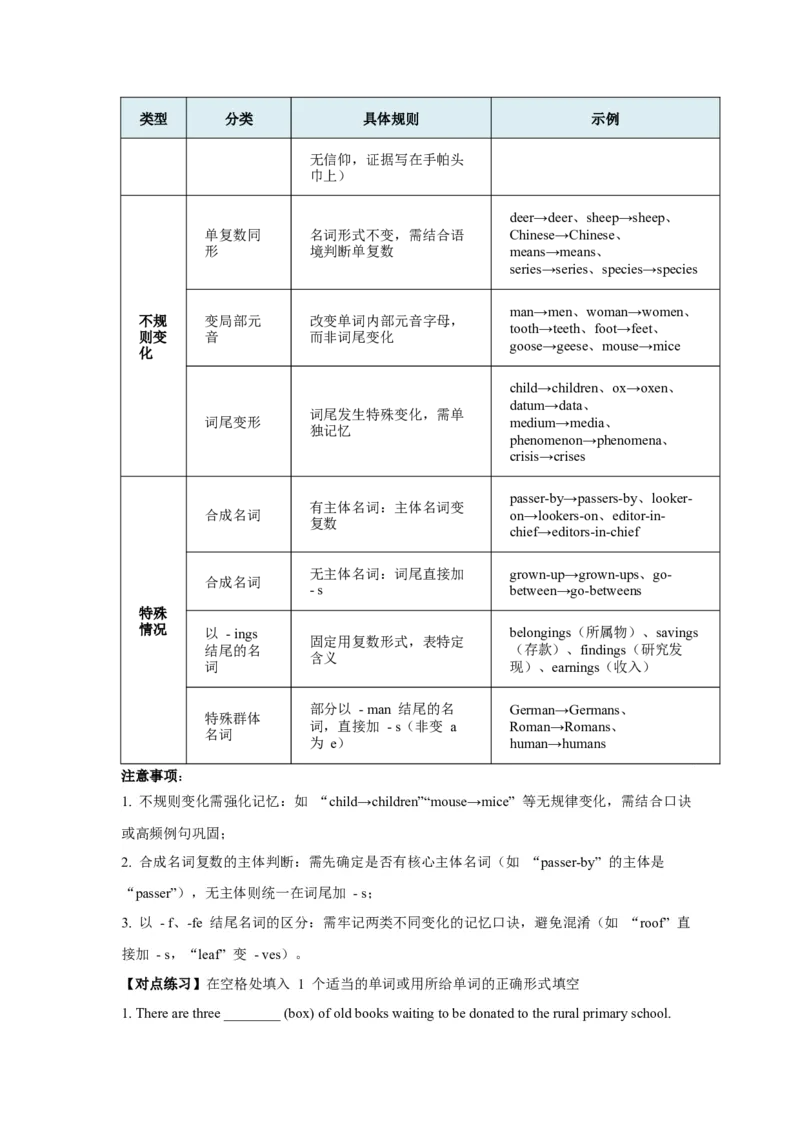
类型
分类
具体规则
示例
无信仰,证据写在手帕头
巾上)
不规
则变
化
单复数同
形
名词形式不变,需结合语
境判断单复数
deer→deer、sheep→sheep、
Chinese→Chinese、
means→means、
series→series、species→species
变局部元
音
改变单词内部元音字母,
而非词尾变化
man→men、woman→women、
tooth→teeth、foot→feet、
goose→geese、mouse→mice
词尾变形
词尾发生特殊变化,需单
独记忆
child→children、ox→oxen、
datum→data、
medium→media、
phenomenon→phenomena、
crisis→crises
特殊
情况
合成名词
有主体名词:主体名词变
复数
passer-by→passers-by、looker-
on→lookers-on、editor-in-
chief→editors-in-chief
合成名词
无主体名词:词尾直接加
- s
grown-up→grown-ups、go-
between→go-betweens
以 - ings
结尾的名
词
固定用复数形式,表特定
含义
belongings(所属物)、savings
(存款)、findings(研究发
现)、earnings(收入)
特殊群体
名词
部分以 - man 结尾的名
词,直接加 - s(非变 a
为 e)
German→Germans、
Roman→Romans、
human→humans
注意事项:
1. 不规则变化需强化记忆:如 “child→children”“mouse→mice” 等无规律变化,需结合口诀
或高频例句巩固;
2. 合成名词复数的主体判断:需先确定是否有核心主体名词(如 “passer-by” 的主体是
“passer”),无主体则统一在词尾加 - s;
3. 以 - f、-fe 结尾名词的区分:需牢记两类不同变化的记忆口诀,避免混淆(如 “roof” 直
接加 - s,“leaf” 变 - ves)。
【对点练习】在空格处填入 1 个适当的单词或用所给单词的正确形式填空
1. There are three ________ (box) of old books waiting to be donated to the rural primary school.
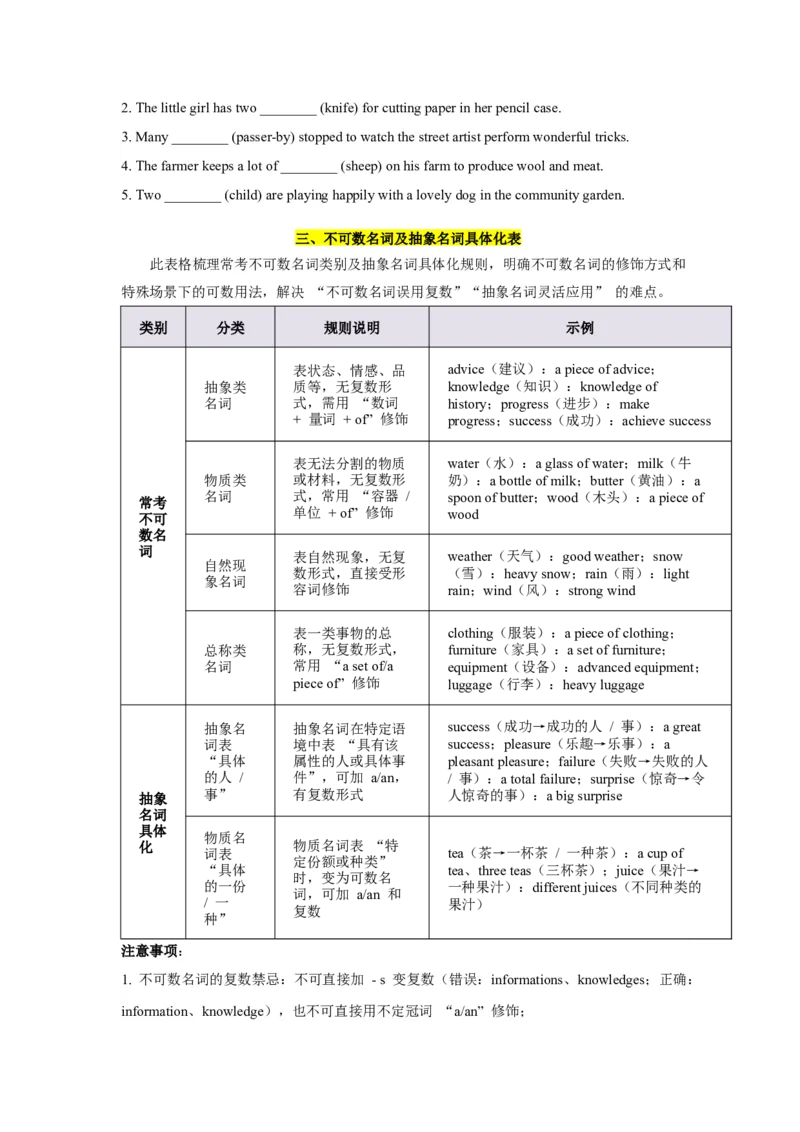
2. The little girl has two ________ (knife) for cutting paper in her pencil case.
3. Many ________ (passer-by) stopped to watch the street artist perform wonderful tricks.
4. The farmer keeps a lot of ________ (sheep) on his farm to produce wool and meat.
5. Two ________ (child) are playing happily with a lovely dog in the community garden.
三、不可数名词及抽象名词具体化表
此表格梳理常考不可数名词类别及抽象名词具体化规则,明确不可数名词的修饰方式和
特殊场景下的可数用法,解决 “不可数名词误用复数”“抽象名词灵活应用” 的难点。
类别
分类
规则说明
示例
常考
不可
数名
词
抽象类
名词
表状态、情感、品
质等,无复数形
式,需用 “数词
+ 量词 + of” 修饰
advice(建议):a piece of advice;
knowledge(知识):knowledge of
history;progress(进步):make
progress;success(成功):achieve success
物质类
名词
表无法分割的物质
或材料,无复数形
式,常用 “容器 /
单位 + of” 修饰
water(水):a glass of water;milk(牛
奶):a bottle of milk;butter(黄油):a
spoon of butter;wood(木头):a piece of
wood
自然现
象名词
表自然现象,无复
数形式,直接受形
容词修饰
weather(天气):good weather;snow
(雪):heavy snow;rain(雨):light
rain;wind(风):strong wind
总称类
名词
表一类事物的总
称,无复数形式,
常用 “a set of/a
piece of” 修饰
clothing(服装):a piece of clothing;
furniture(家具):a set of furniture;
equipment(设备):advanced equipment;
luggage(行李):heavy luggage
抽象
名词
具体
化
抽象名
词表
“具体
的人 /
事”
抽象名词在特定语
境中表 “具有该
属性的人或具体事
件”,可加 a/an,
有复数形式
success(成功→成功的人 / 事):a great
success;pleasure(乐趣→乐事):a
pleasant pleasure;failure(失败→失败的人
/ 事):a total failure;surprise(惊奇→令
人惊奇的事):a big surprise
物质名
词表
“具体
的一份
/ 一
种”
物质名词表 “特
定份额或种类”
时,变为可数名
词,可加 a/an 和
复数
tea(茶→一杯茶 / 一种茶):a cup of
tea、three teas(三杯茶);juice(果汁→
一种果汁):different juices(不同种类的
果汁)
注意事项:
1. 不可数名词的复数禁忌:不可直接加 - s 变复数(错误:informations、knowledges;正确:
information、knowledge),也不可直接用不定冠词 “a/an” 修饰;
2. 抽象名词具体化的语境限制:需结合上下文判断是否表 “具体人 / 事”,如 “success”
表 “成功” 时不可数(Success needs hard work),表 “成功的事” 时可数(The project is
a success);
3. 总称类名词的修饰搭配:如 “furniture” 不可说 “a furniture”,需说 “a piece of
furniture” 或 “a set of furniture”,需牢记固定量词搭配。
【对点练习】在空格处填入 1 个适当的单词或用所给单词的正确形式填空
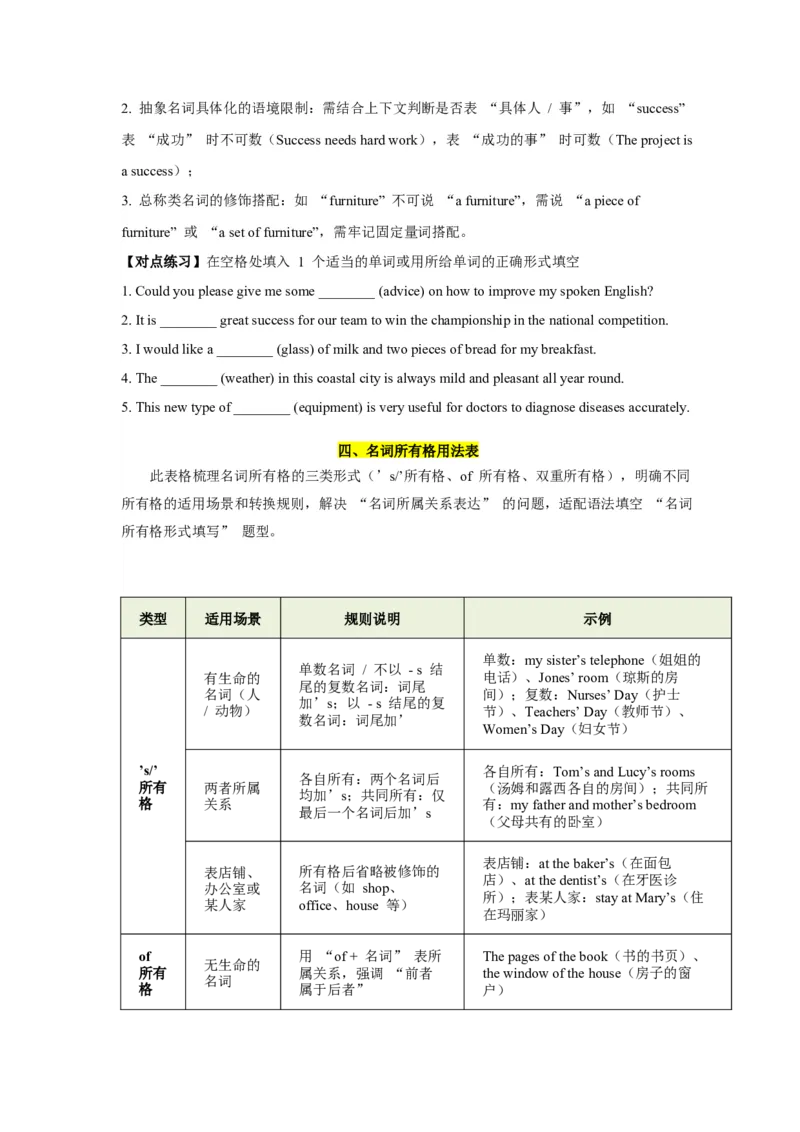
1. Could you please give me some ________ (advice) on how to improve my spoken English?
2. It is ________ great success for our team to win the championship in the national competition.
3. I would like a ________ (glass) of milk and two pieces of bread for my breakfast.
4. The ________ (weather) in this coastal city is always mild and pleasant all year round.
5. This new type of ________ (equipment) is very useful for doctors to diagnose diseases accurately.
四、名词所有格用法表
此表格梳理名词所有格的三类形式(’s/’所有格、of 所有格、双重所有格),明确不同
所有格的适用场景和转换规则,解决 “名词所属关系表达” 的问题,适配语法填空 “名词
所有格形式填写” 题型。
类型
适用场景
规则说明
示例
’s/’
所有
格
有生命的
名词(人
/ 动物)
单数名词 / 不以 - s 结
尾的复数名词:词尾
加’s;以 - s 结尾的复
数名词:词尾加’
单数:my sister’s telephone(姐姐的
电话)、Jones’ room(琼斯的房
间);复数:Nurses’ Day(护士
节)、Teachers’ Day(教师节)、
Women’s Day(妇女节)
两者所属
关系
各自所有:两个名词后
均加’s;共同所有:仅
最后一个名词后加’s
各自所有:Tom’s and Lucy’s rooms
(汤姆和露西各自的房间);共同所
有:my father and mother’s bedroom
(父母共有的卧室)
表店铺、
办公室或
某人家
所有格后省略被修饰的
名词(如 shop、
office、house 等)
表店铺:at the baker’s(在面包
店)、at the dentist’s(在牙医诊
所);表某人家:stay at Mary’s(住
在玛丽家)
of
所有
格
无生命的
名词
用 “of + 名词” 表所
属关系,强调 “前者
属于后者”
The pages of the book(书的书页)、
the window of the house(房子的窗
户)
类型
适用场景
规则说明
示例
带定语的
有生命名
词短语
名词后有定语(如介词
短语、形容词短语)
时,用 of 所有格更简
洁
The opinion of the girl with glasses(戴
眼镜女孩的观点)、the story of the
boy who saved the cat(救猫男孩的故
事)
双重
所有
格
表 “部
分所属”
或 “强
调所属”
结构:“名词 + of +
名词所有格 / 名词性物
主代词”,强调 “某
人 / 某物中的一个 /
一部分”
a friend of my father's(我父亲的一位
朋友)、that idea of yours(你的那个
想法)、a photo of Tom’s(汤姆的一
张照片)
注意事项:
1. ’s 所有格的单复数区分:不以 - s 结尾的复数名词(如 children、women)仍加’s
(children’s toys、women’s clothes),不可加’;
2. of 所有格的顺序:表达 “A 属于 B” 时,结构为 “A of B”(错误:the book’s pages;正
确:the pages of the book),不可颠倒;
3. 双重所有格的限定词:不可与 “the、this、that” 等限定词直接修饰名词所有格(错误:
the my father’s friend;正确:a friend of my father’s 或 my father’s friend)。
【对点练习】在空格处填入 1 个适当的单词或用所给单词的正确形式填空
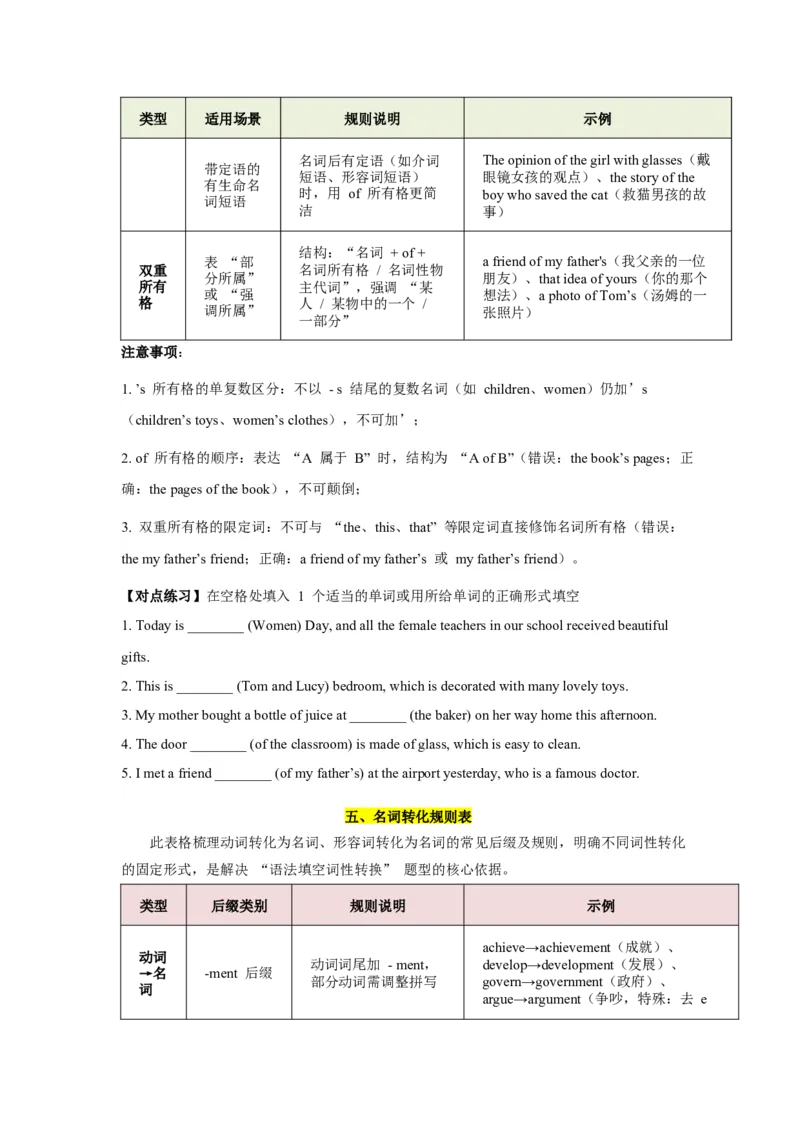
1. Today is ________ (Women) Day, and all the female teachers in our school received beautiful
gifts.
2. This is ________ (Tom and Lucy) bedroom, which is decorated with many lovely toys.
3. My mother bought a bottle of juice at ________ (the baker) on her way home this afternoon.
4. The door ________ (of the classroom) is made of glass, which is easy to clean.
5. I met a friend ________ (of my father’s) at the airport yesterday, who is a famous doctor.
五、名词转化规则表
此表格梳理动词转化为名词、形容词转化为名词的常见后缀及规则,明确不同词性转化
的固定形式,是解决 “语法填空词性转换” 题型的核心依据。
类型
后缀类别
规则说明
示例
动词
→名
词
-ment 后缀
动词词尾加 - ment,
部分动词需调整拼写
achieve→achievement(成就)、
develop→development(发展)、
govern→government(政府)、
argue→argument(争吵,特殊:去 e
类型
后缀类别
规则说明
示例
加 - ment)
-ion 后缀
动词词尾加 - ion/-
tion/-sion,部分动词
需调整拼写
attract→attraction(吸引)、
invent→invention(发明)、
decide→decision(决定)、
pronounce→pronunciation(发音,特
殊:去 e 加 - ation)
-ance/-ence
后缀
动词词尾加 - ance
(多以 a/e 结尾动
词)或 - ence(多以
i 结尾动词)
appear→appearance(外貌)、
accept→acceptance(接受)、
exist→existence(存在)、
depend→dependence(依赖)
-er/-or 后
缀
动词词尾加 - er(表
“做某事的人”)或
- or(表 “特定职业
的人”)
visit→visitor(参观者)、
teach→teacher(教师)、
operate→operator(操作员)、
conduct→conductor(售票员)
-al 后缀
动词词尾加 - al,部
分动词需去 e
arrive→arrival(到达)、
survive→survival(幸存)、
approve→approval(批准)、
refuse→refusal(拒绝)
其他后缀
加 - th/-ure/-ing 等特
殊后缀,需单独记忆
grow→growth(生长)、die→death
(死亡)、press→pressure(压力)、
begin→beginning(开始)、
believe→belief(信仰)
形容
词→
名词
-ness 后缀
形容词词尾加 -
ness,直接转化为名
词
kind→kindness(善良)、
happy→happiness(快乐)、
weak→weakness(虚弱)、
lonely→loneliness(孤独)
-ty/-cy 后
缀
形容词词尾加 - ty
(多以 e 结尾形容
词)或 - cy(多以 t
结尾形容词)
honest→honesty(诚实)、
cruel→cruelty(残忍)、
fluent→fluency(流利)、
accurate→accuracy(准确)
-ce/-dom
后缀
形容词词尾加 - ce
(多以 t 结尾形容
词)或 - dom(表
“状态 / 领域”)
important→importance(重要性)、
distant→distance(距离)、
free→freedom(自由)、wise→wisdom
(智慧)
-th 后缀
部分形容词词尾加 -
th,多为表度量的形
容词
deep→depth(深度)、long→length
(长度)、wide→width(宽度)、
strong→strength(力量)
注意事项:
1. 转化后缀的拼写变化:部分动词 / 形容词转化时需调整拼写(如 argue→argument 去 e、
pronounce→pronunciation 去 e 加 - ation),需重点记忆;
2. 同根词的含义区分:部分转化后的名词需结合语境理解(如 develop→development 表
“发展”,而 developing 表 “发展中的”,词性不同);
3. 固定转化形式:部分词无规律(如 believe→belief、behave→behavior),需单独记忆,不
可套用通用后缀规则。
【对点练习】在空格处填入 1 个适当的单词或用所给单词的正确形式填空
1. The ________ (develop) of science and technology has greatly changed people’s daily life.
2. Her ________ (kind) and patience made her very popular among the students in the class.
3. The ________ (arrive) of the flight was delayed due to the heavy fog at the airport.
4. The ________ (accurate) of the data collected from the experiment is very important for the
research.
5. The ________ (invent) of the computer has had a profound impact on the whole world.
一、语法填空:用所给单词的正确形式填空
1.(2025·河北衡水·三模)What is your          (prefer) for the weekend, playing basketball
or going swimming?
2.(2025·河北衡水·三模)After persuasion, she finally let go of her          (resist) and
accepted the team’s constructive suggestions to revise the plan.
3.(2025·河北衡水·三模)Modern education often combines learning with          (entertain)
to make lessons more engaging.
4.(2025·河北衡水·三模)These health          (advocate) encourage people to exercise
regularly and eat a balanced diet.
5.(2025·广东·二模)Our brains developed a response mechanism to these treats that reflected
their value — a feeling of reward and          (satisfy).
6.(2025·广东·二模)We’ll explore beautiful park sites while conducting invasive (侵入的) plant
(remove), winter planting, and seed collection.
7.(2025·广东·二模)Whatever the outcome, it would greatly enhance the          (likely)
that he would never again win a presidential election.
8.(2025·河北衡水·二模)Natural            (phenomenon) such as earthquakes and
volcanoes have fascinated scientists for centuries.
9.(2025·江苏盐城·二模)Please check the        (attach) of this email, which contain all the
necessary documents for the project.
10.(2025·江苏盐城·模拟预测)It takes up to five years for a tea bush to come to
(mature).
11.(2024·河北·一模)Their opponents were in                  (possess) of the ball for
most of the match.
12.(2024·河北·一模)The conventional                  (wise) is that boys mature more
slowly than girls.
13.(2022·全国·模拟预测)Drinking green tea is an especially effective way of getting rid of the
bacteria on your        (tooth) and keeping them healthy.
14.(2022·全国·模拟预测)Nushu has significance in various         (field) and represents
Chinese people’s strong spirit.
15.(2022·全国·模拟预测)A commonly used greeting in China is the question, “Have you
eaten?” It indicates the          (important) of food in China.
Passage 1
(2023·新课标Ⅱ卷·高考真题)阅读下面短文,在空白处填入1 个适当的单词或括号内单词的
正确形式。
Whenever I tell people that I teach English at the Berlin Zoo, I almost always get a
questioning look. Behind it, the person is trying to figure out who exactly I teach…the animals?
Since June 2017, right before the    1              (arrive) of the two new pandas, Meng
Meng and Jiao Qing, I have been helping the panda keepers at the zoo to feel more comfortable and
2              (confidence) speaking English. And who do they speak English    3

?
Not the pandas, even though    4              language used for the medical training
instructions is actually English. They talk to the flood of international tourists and to    5

(visit) Chinese zookeepers who often come to check on the pandas, which are on loan from China.
They also need to be ready to give    6              (interview) in English with international
journalists. This is    7              they need an English trainer.
So, what are they learning?    8              (basic), how to describe a panda’s life. It’s
been an honor to watch the panda programme develop    9              to see the pandas settle
into their new home. As a little girl, I     10               (wish) to be a zookeeper when I grew
up. Now, I’m living out that dream indirectly by helping the panda keepers do their job in English.
Passage 2
(2021·新高考全国Ⅰ卷·高考真题)阅读下面短文,在空白处填入1 个适当的单词或括号内单
词的正确形式。
Going to Mount Huangshan reminds me of the popular Beatles’ song “The Long and Winding
Road”.     1               is so breathtaking about the experience is the out-of-this-world
scenes. The rolling sea of clouds you see once you are at the top will remind you how tiny we     2
(human) are.
The hot spring at the foot of the mountain is something you must try after the climb. It will
3              (undoubted) help you get refreshed! The amazing thing about the spring is that the
colder the temperature gets, the     4               (hot) the spring! Strange, isn’t it? But that’s
how nature is — always leaving us     5               (astonish).
What comes next is the endless series of steps. You can’t help wondering how hard it     6
(be) for the people then to put all those rocks into place. Though it is the only unnatural thing on your
way up the mountain, still it highlights the whole adventure     7              offers a place
where you can sit down to rest your     8               (ache) legs.
As the song goes, this long and winding road “will never disappear”, and it will always stick in
the visitor’s memory. It sure does in     9               (I). While you’re in China, Mount
Huangshan is      10                must to visit!
Passage 3
(2025·湖南郴州·一模)阅读短文,在空白处填入1 个适当的单词或括号内单词的正确形式。
In Tijuca National Park in Rio de Janeiro, there stands a “Chinese Pavilion”. It was
constructed    1             (honour) 19th-century Chinese immigrants who boosted Brazil’s
tea industry. Between 1812 and 1888, over 1,000 farmers migrated under agreements. They
introduced advanced tea-processing    2             (technique) , which laid the foundation for
Brazil’s short-lived but    3             (influence) tea trade.
The pavilion combines Chinese architecture—styled eaves, six-sided frames, and    4

(point) roofs—with Brazilian materials. Nestled in the world’s    5             (large) urban
rainforest, it overlooks Rio’s landmarks including Corcovado Mountain and Christ the Redeemer.
In 1812, the first Chinese immigrants to Brazil planted tea trees in    6              is
now the Rio de Janeiro Botanical Garden, a witness to the China-Brazil friendship. More than 200
years later, these tea trees have become a deep-rooted part of Brazil’s cultural heritage. In 2003, on
the 100th anniversary, commemorative plaques(牌匾)were added,    7             (detail)
its history in Portuguese, English, and Chinese.
Today, visitors to Rio’s Tijuca National Park may encounter the elegant pavilion. This
landmark serves as    8              reminder of Brazil’s respect for the pioneers.    9

the vast distance between China and Brazil, the bridge built through tea has brought the two nations
closer than ever. The pavilion     10              (list) on UNESCO’s World Heritage List in
2024, attracting visitors interested in eco-cultural tourism.
Passage 4
(2025·广东广州·一模)阅读短文,在空白处填入1 个适当的单词或括号内单词的正确形式。
Mount Tai, a towering peak in Shandong province, China, is famous for its steep terrain with
over 7,000 steps. Climbing this mountain is challenging. especially for the elderly and those with
mobility issues.
Fortunately, AI-powered exoskeletons (外骨骼机器人) are making the journey simpler. These
robotic legs,     1               (weigh) only 1.8 kilograms, are designed to wrap around users’
waists and legs, offering assistance     2               (ease) the burden on legs. Users reported
feeling like someone was pulling them uphill, making the climb much easier. However, some
mentioned     3               (convenience) in using the device for activities like tying
shoelaces or using the bathroom.     4               these issues, the exoskeletons are seen as a
“true blessing” for senior citizens and the mobility-impaired visitors. This innovation not only aids
mountain climbing     5               highlights potential applications in elderly care,     6
growing market in China, in     7               the population of seniors is rapidly increasing.
The smart elderly care market     8               (estimate) at 6.8 trillion yuan last year.
Kenqing Technology, the co-developer, is eyeing this vast market now and has launched an
exoskeleton     9               (specific) designed for elderly users.
To fully unlock the potential of elderly care robots, industry insiders told Xinhua News
Agency that stronger policy support is needed to promote the large-scale application while keeping
prices      10                (afford) for all.
Passage 5
(2025·四川绵阳·一模)阅读短文,在空白处填入1 个适当的单词或括号内单词的正确形式。
The costumes of the Yi people in Chuxiong have a long history and they     1

(call) the “ethnic history worn on the body”. In 2014, the Yi costumes of Chuxiong were included in
the national intangible cultural heritage list,     2               (become) one of the symbols of
Yi culture.
The Yi people weave their understanding of the world, their love     3               life
and their memories of history into the clothes they wear. Every piece of Yi costume reveals     4
they know about the natural world. The Yi costumes of Chuxiong are known for their profound
cultural depth and beautiful patterns, which     5               (vivid) reflect the lifestyle and
customs of the locals. From ceremonial dress to everyday clothing, Yi costumes tell various     6
(story) and represent the community’s values as well as traditions.
The beauty of Yi costumes lies not only in their craftsmanship but also in the cultural, spiritual
7               emotional significance. Over the past centuries, they     8

(carry) the stories and traditions of the Yi people. Every year during major Yi festivals, these
costumes,     9               (decorate) with shiny silver ornaments (装饰品), always attract
countless visitors eager to learn about Yi culture. Their deep emotion and long-standing traditions
serve as     10               bridge connecting the Yi people’s past and present.
Passage 6
(2025·四川·一模)阅读下面短文,在空白处填入1 个适当的单词或括号内单词的正确形式。
I arrived in China from Australia as a student with a love for travel, culture, and adventure and
China did not disappoint me. My adventure, as part of my one-year Chinese language learning
program,     1               (begin) in the winter of 2014 at the country’s renowned Peking
University.
In the bustling city of Beijing, each day brought me something new. Soon, I     2

(attract) by the dedicated and hardworking students there. Beyond all the


 3

(excite), I was gaining something incredibly important: a new perspective. Being immersed in
another culture,     4               is completely different from my own, I soon realized that
there’s not just one way to live, think, and communicate.
Over the 12 years in Beijing, I witnessed firsthand the rise of phenomena like     5

(share) bikes, ride-hailing apps, and coffee culture. I saw a coffee shop open up in the nearest town, a
day care center established for the villagers,     6


  giant windmills built in field
after field. China really knows how     7              (get) things done in a short time.
Behind all these     8               (change) are the Chinese people—the most
important reason why China became such a home for me. I felt deeply inspired by their spirit and
pride in     9               they do.
China has changed     10              (rapid) itself; all the while it has also shaped my
view of the world.