专题01 人与自我(学习成长)
场景1:AI 时代的学习能力培养
目录
01 场景语料导入...................................................................................................................................1
02 核心词汇清单...................................................................................................................................2
03 题型融合训练...................................................................................................................................5
04 高考真题导航................................................................................................................................. 11
05 高考模拟助力.................................................................................................................................18
整合《时代》周刊2025 年6 月23 日报道《AI and Learning: 拐杖还是跳板?》及《中国
日报》2025 年5 月21 日文章核心内容
 (难度:中高     建议阅读时间:8 分钟)
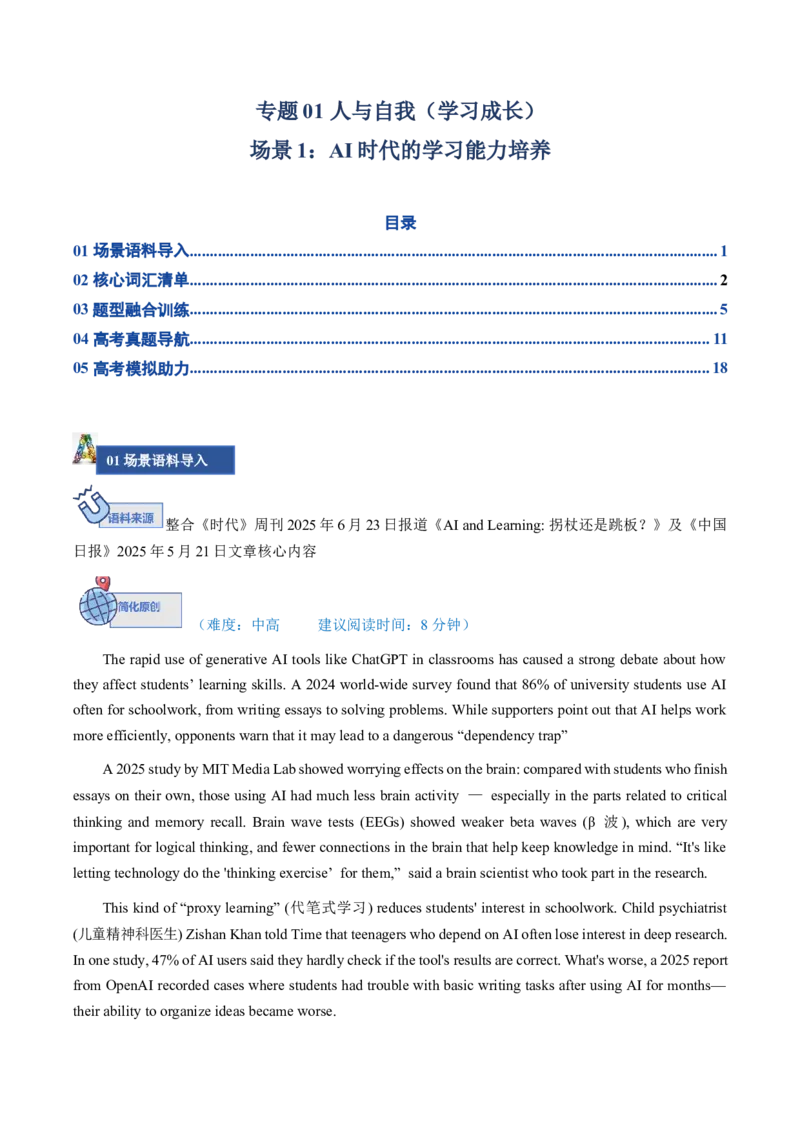
The rapid use of generative AI tools like ChatGPT in classrooms has caused a strong debate about how
they affect students’ learning skills. A 2024 world-wide survey found that 86% of university students use AI
often for schoolwork, from writing essays to solving problems. While supporters point out that AI helps work
more efficiently, opponents warn that it may lead to a dangerous “dependency trap”
A 2025 study by MIT Media Lab showed worrying effects on the brain: compared with students who finish
essays on their own, those using AI had much less brain activity — especially in the parts related to critical
thinking and memory recall. Brain wave tests (EEGs) showed weaker beta waves (β 波), which are very
important for logical thinking, and fewer connections in the brain that help keep knowledge in mind. “It's like
letting technology do the 'thinking exercise’ for them,” said a brain scientist who took part in the research.
This kind of “proxy learning” (代笔式学习) reduces students' interest in schoolwork. Child psychiatrist
(儿童精神科医生) Zishan Khan told Time that teenagers who depend on AI often lose interest in deep research.
In one study, 47% of AI users said they hardly check if the tool's results are correct. What's worse, a 2025 report
from OpenAI recorded cases where students had trouble with basic writing tasks after using AI for months—
their ability to organize ideas became worse.
01 场景语料导入
But AI itself is not harmful. A 2024 experiment by Harvard University showed that physics students who
used AI as a “cognitive scaffold” (认知支架)—to explain difficult formulas (公式) or create practice problems
—got 28% higher scores in final exams than students who used traditional methods. Chinese educator He Han
put forward the “bicycle principle” in China Daily: “AI should be like training wheels on a bike, not something
you depend on forever. The goal is to develop the ability to think on your own—critical thinking and creativity
— things that no computer program can replace.”(351)
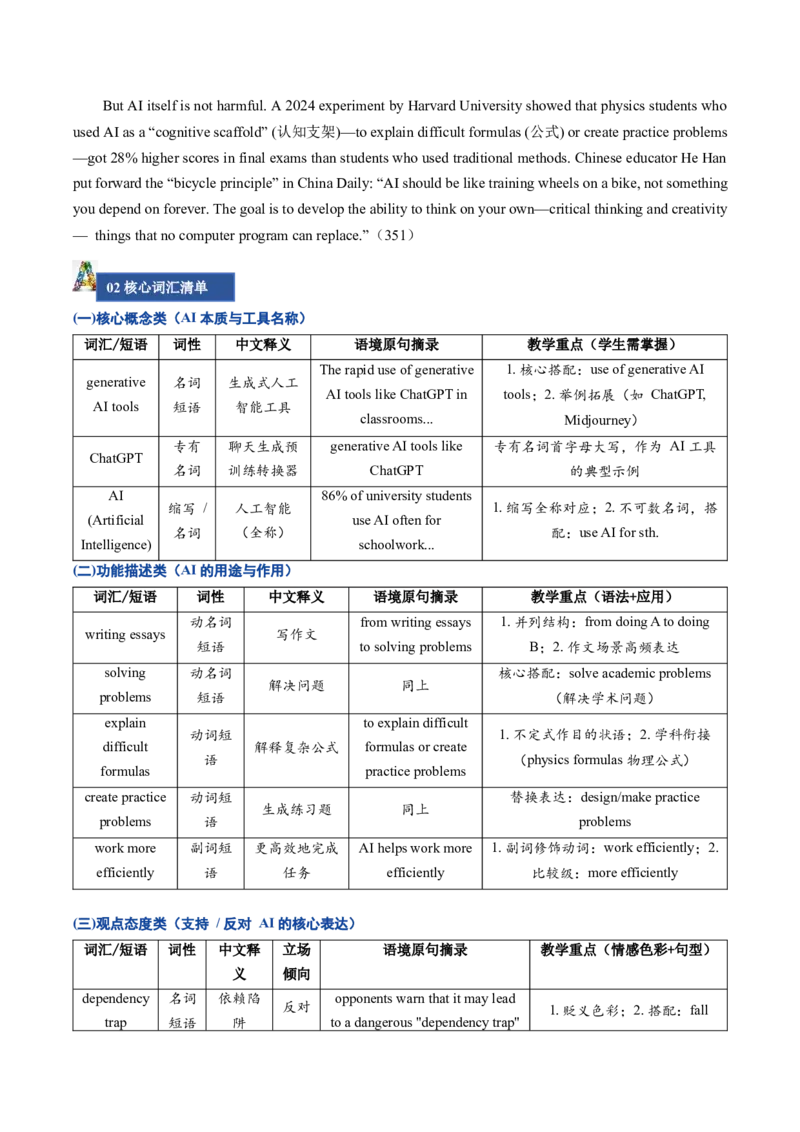
(一)核心概念类(AI 本质与工具名称)
词汇/短语
词性
中文释义
语境原句摘录
教学重点(学生需掌握)
generative
AI tools
名词
短语
生成式人工
智能工具
The rapid use of generative
AI tools like ChatGPT in
classrooms...
1. 核心搭配:use of generative AI
tools;2. 举例拓展(如 ChatGPT,
Midjourney)
ChatGPT
专有
名词
聊天生成预
训练转换器
generative AI tools like
ChatGPT
专有名词首字母大写,作为 AI 工具
的典型示例
AI
(Artificial
Intelligence)
缩写 /
名词
人工智能
(全称)
86% of university students
use AI often for
schoolwork...
1. 缩写全称对应;2. 不可数名词,搭
配:use AI for sth.
(二)功能描述类(AI 的用途与作用)
词汇/短语
词性
中文释义
语境原句摘录
教学重点(语法+应用)
writing essays
动名词
短语
写作文
from writing essays
to solving problems
1. 并列结构:from doing A to doing
B;2. 作文场景高频表达
solving
problems
动名词
短语
解决问题
同上
核心搭配:solve academic problems
(解决学术问题)
explain
difficult
formulas
动词短
语
解释复杂公式
to explain difficult
formulas or create
practice problems
1. 不定式作目的状语;2. 学科衔接
(physics formulas 物理公式)
create practice
problems
动词短
语
生成练习题
同上
替换表达:design/make practice
problems
work more
efficiently
副词短
语
更高效地完成
任务
AI helps work more
efficiently
1. 副词修饰动词:work efficiently;2.
比较级:more efficiently
(三)观点态度类(支持 / 反对 AI 的核心表达)
词汇/短语
词性
中文释
义
立场
倾向
语境原句摘录
教学重点(情感色彩+句型)
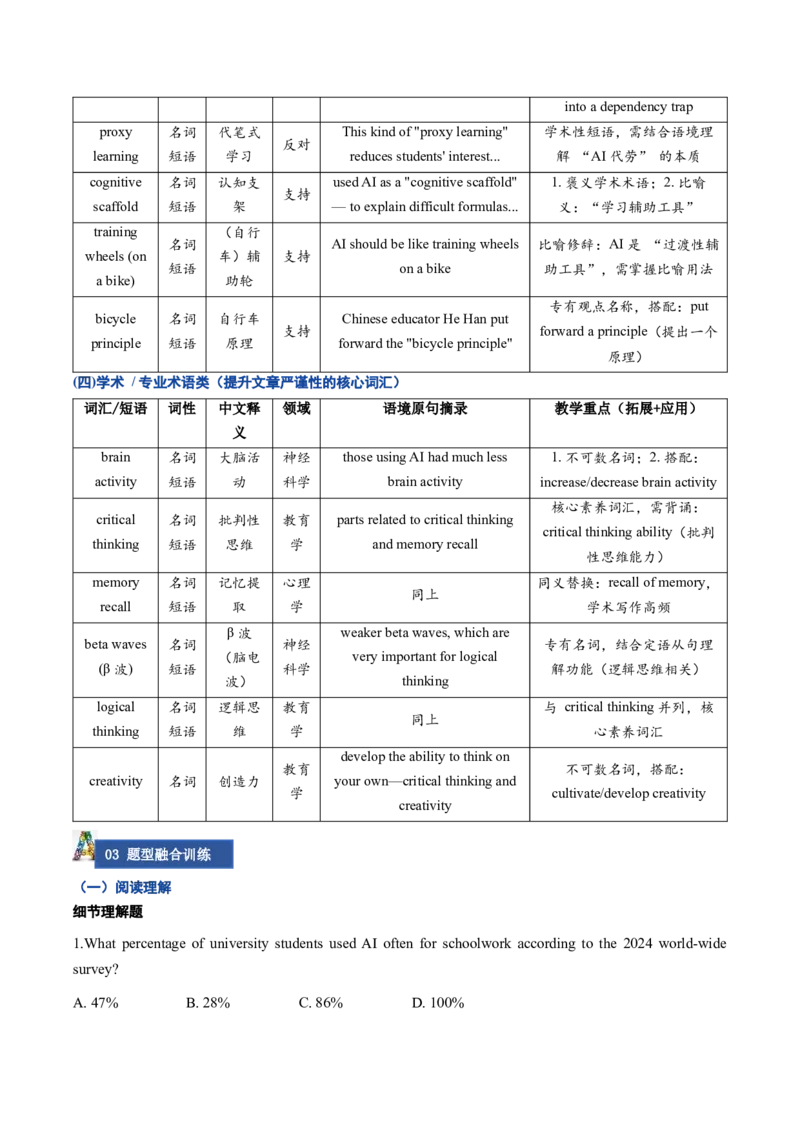
dependency
trap
名词
短语
依赖陷
阱
反对
opponents warn that it may lead
to a dangerous "dependency trap"
1. 贬义色彩;2. 搭配:fall
02 核心词汇清单
into a dependency trap
proxy
learning
名词
短语
代笔式
学习
反对
This kind of "proxy learning"
reduces students' interest...
学术性短语,需结合语境理
解 “AI 代劳” 的本质
cognitive
scaffold
名词
短语
认知支
架
支持
used AI as a "cognitive scaffold"
— to explain difficult formulas...
1. 褒义学术术语;2. 比喻
义:“学习辅助工具”
training
wheels (on
a bike)
名词
短语
(自行
车)辅
助轮
支持
AI should be like training wheels
on a bike
比喻修辞:AI 是 “过渡性辅
助工具”,需掌握比喻用法
bicycle
principle
名词
短语
自行车
原理
支持
Chinese educator He Han put
forward the "bicycle principle"
专有观点名称,搭配:put
forward a principle(提出一个
原理)
(四)学术 / 专业术语类(提升文章严谨性的核心词汇)
词汇/短语
词性
中文释
义
领域
语境原句摘录
教学重点(拓展+应用)
brain
activity
名词
短语
大脑活
动
神经
科学
those using AI had much less
brain activity
1. 不可数名词;2. 搭配:
increase/decrease brain activity
critical
thinking
名词
短语
批判性
思维
教育
学
parts related to critical thinking
and memory recall
核心素养词汇,需背诵:
critical thinking ability(批判
性思维能力)
memory
recall
名词
短语
记忆提
取
心理
学
同上
同义替换:recall of memory,
学术写作高频
beta waves
(β 波)
名词
短语
β 波
(脑电
波)
神经
科学
weaker beta waves, which are
very important for logical
thinking
专有名词,结合定语从句理
解功能(逻辑思维相关)
logical
thinking
名词
短语
逻辑思
维
教育
学
同上
与 critical thinking 并列,核
心素养词汇
creativity
名词
创造力
教育
学
develop the ability to think on
your own—critical thinking and
creativity
不可数名词,搭配:
cultivate/develop creativity
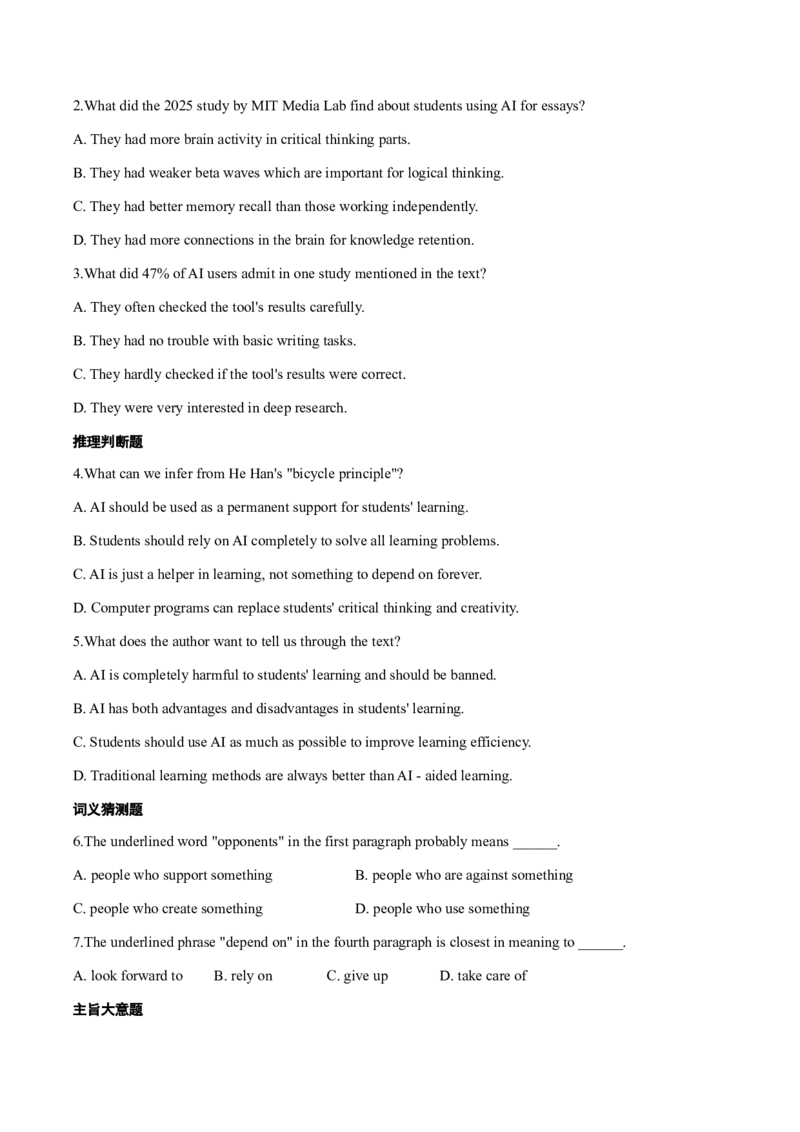
(一)阅读理解
细节理解题
1.What percentage of university students used AI often for schoolwork according to the 2024 world-wide
survey?
A. 47%
B. 28%
C. 86%
D. 100%
03 题型融合训练
2.What did the 2025 study by MIT Media Lab find about students using AI for essays?
A. They had more brain activity in critical thinking parts.
B. They had weaker beta waves which are important for logical thinking.
C. They had better memory recall than those working independently.
D. They had more connections in the brain for knowledge retention.
3.What did 47% of AI users admit in one study mentioned in the text?
A. They often checked the tool's results carefully.
B. They had no trouble with basic writing tasks.
C. They hardly checked if the tool's results were correct.
D. They were very interested in deep research.
推理判断题
4.What can we infer from He Han's "bicycle principle"?
A. AI should be used as a permanent support for students' learning.
B. Students should rely on AI completely to solve all learning problems.
C. AI is just a helper in learning, not something to depend on forever.
D. Computer programs can replace students' critical thinking and creativity.
5.What does the author want to tell us through the text?
A. AI is completely harmful to students' learning and should be banned.
B. AI has both advantages and disadvantages in students' learning.
C. Students should use AI as much as possible to improve learning efficiency.
D. Traditional learning methods are always better than AI - aided learning.
词义猜测题
6.The underlined word "opponents" in the first paragraph probably means ______.
A. people who support something
B. people who are against something
C. people who create something
D. people who use something
7.The underlined phrase "depend on" in the fourth paragraph is closest in meaning to ______.
A. look forward to
B. rely on
C. give up
D. take care of
主旨大意题
8.What is the main idea of the text?
A. It introduces a 2024 worldwide survey about students' use of AI.
B. It explains the "bicycle principle" put forward by Chinese educator He Han.
C. It discusses the effects of AI on students' learning and different views on it.
D. It describes the experiment by Harvard University on AI-aided learning.
(二)语法填空
阅读下面短文,在空白处填入 1 个适当的单词或括号内单词的正确形式。(共 10 小题,满分 15
分)
Nowadays, AI tools like ChatGPT are widely used in classrooms. This rapid use has caused a strong debate
about how they affect students' learning skills. A 2024 world-wide survey found that 86% of university students
often use AI for schoolwork, from __1__ (write) essays to solving problems.
Some supporters say AI helps students work more efficiently. However, opponents warn that it may lead to
__2__ dangerous "dependency trap". A 2025 study by MIT Media Lab gave a worrying result: students __3__
(use) AI for essays had much less brain activity than those finishing tasks on their own. Their beta waves, which
__4__ (be) important for logical thinking, were weaker. A brain scientist __5__ took part in the study said, "It's
like letting technology do the 'thinking exercise' for them."
Worse still, 47% of AI users in one study admitted they hardly check if the tool's results are correct. Some
students even had trouble with basic writing tasks after months of AI use, as their ability to organize ideas got
__6__ (bad).
But AI itself is not harmful. When __7__(use) as a "cognitive scaffold", it can help students. A 2024
experiment by Harvard University showed that physics students who used AI__8__ (understand) difficult
formulas scored 28% higher in final exams. Chinese educator He Han said AI should be like training wheels on
a bike — not something we depend __9__ forever. The real goal is to develop critical thinking and
__10__(create), which no computer program can replace.
(三)书面表达
假设你是李华,你校英语报社正在开展关于 “AI 在学习中的使用” 的讨论活动,邀请同学们分
享自己的观点。请你根据简化版语料内容,写一篇短文投稿,内容包括:
1.学生使用 AI 学习的现状;
2.AI 对学习的积极影响和潜在问题;
3.你对合理使用 AI 的建议。
注意:1. 词数 80-100;2.可适当增加细节,以使行文连贯;3. 开头和结尾已给出,不计入总词数。
Dear Editor,
I'm writing to share my views on the use of AI in learning.
________________________________________________________________________________________
________________________________________________________________________________________
________________________________________________________________________________________
________________________________________________________________________________________
________________________________________________________________________________________
I hope my views can provide some help for students to use AI properly.
Yours sincerely,
Li Hua
拓展语料
来源
拓展训练方向
《Time 》2025 年 9 月《How
Teachers Are Adapting to AI
Classrooms》
《时代》周刊
阅读理解(观点态度题:判断教师对
AI 的不同立场)
《China Daily》2025 年 8 月《AI
Literacy: A New Course for Students》
《中国日报》英
文版
七选五(补全 “AI 素养课程设计”
的逻辑段落)
UNESCO 2025 Report 《AI in
Education: Ethics Guidelines》
联合国教科文组
织
语法填空(考查与伦理规范相关的情
态动词、非谓语动词)
一、《Time》2025 年 9 月《How Teachers Are Adapting to AI Classrooms》—— 教师对 AI 的多
元立场语料
(一)积极接纳派立场
核心观点:将 AI 视为教学增效工具,主张主动融合进课堂流程。
支撑细节:
“AI automates repetitive tasks like grading objective assignments, allowing me to spend 40% more time
on one-on-one discussions with students,” said Sarah Miller, a high school English teacher in California.
04 场景拓展素材
“I use ChatGPT to generate 10 different essay prompts tailored to students' reading levels—this
personalized approach was impossible before,” noted a math teacher from Texas.
(二)审慎规制派立场
核心观点:承认 AI 价值,但强调需建立使用边界,防范学习异化。
支撑细节:
“Last semester, 15% of students submitted AI-written essays without revision. We now require draft
outlines with handwritten notes to verify original thinking,” explained a history teacher in New York.
“AI should be a 'collaborator' not a 'substitute'. I design tasks where students must critique AI outputs—
like correcting logical flaws in its science experiment proposals,” said a biology educator.
(三)观望保守派立场
核心观点:对 AI 适应性存疑,担忧技术加剧教育不公与思维惰性。
支撑细节:
“My students from low-income families lack access to premium AI tools, creating a 'digital gap' in
assignment quality,” a Chicago teacher pointed out.
“I’ve noticed students struggling to paraphrase ideas independently—they’re too used to AI rephrasing for
them,” admitted a language arts teacher with 20 years of experience.
二、《China Daily》2025 年 8 月《AI Literacy: A New Course for Students》——AI 素养课程设计
逻辑语料
(一)课程定位与核心目标
定位:面向全体学生的通识课程,聚焦 “认知 - 技能 - 伦理” 三维培养。
目标表述:
Equip students with the ability to understand AI’s working principles, use AI tools appropriately, and
identify ethical risks in AI applications.
(二)课程模块与内容逻辑
模块一:AI 认知基础(必修)
Key topics: How AI learns from data; Differences between generative AI and traditional software; Real-
life application cases (AI in medical diagnosis, smart education).
模块二:AI 实践技能(选修)
Key tasks: Using AI to organize research data; Generating and revising study notes with AI; Evaluating
the accuracy of AI-generated answers.
模块三:AI 伦理与治理(必修)
Key discussions: Issues of AI bias (e.g., gender stereotypes in recruitment AI); Copyright risks of AI-
generated content; Rules for AI use in exams.
(三)教学实施与评价方式
Teaching methods: Case studies (analyzing AI ethics scandals), group debates (Should AI be used in
homework?), hands-on practice (designing AI-aided learning plans).
Assessment focus: Not just AI tool operation, but critical thinking about AI—e.g., writing a report on
"How to avoid over-reliance on AI for writing".
三、UNESCO 2025 Report《AI in Education: Ethics Guidelines》——AI 教育伦理规范语料
(一)核心伦理原则表述
公平性原则:
Educational AI tools must not discriminate against students based on gender, ethnicity, or socioeconomic
status. Developers should conduct diversity audits before launching products.
透明性原则:
Teachers and students have the right to know when AI is used in teaching—schools ought to disclose AI
application scenarios (e.g., automated grading systems) publicly.
保护原则:
Student data collected by AI tools must be kept confidential; AI developers need to take technical measures
to prevent data leakage.
(二)实践规范与行为要求
For educators:
Avoid replacing human instruction with AI; Use AI to support personalized learning instead of
standardizing teaching content.
For education institutions:
Establish AI ethics committees to review AI tool applications; Provide training for teachers on ethical AI
use.
For AI developers:
Refrain from designing AI tools that encourage passive learning (e.g., tools that write essays without
student input); Prioritize functions that foster critical thinking.
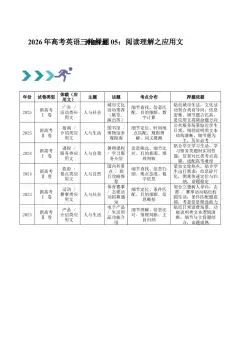
近3 年全国卷考查 2 次,北京卷1 次(2023 年北京考阅读理解D 篇 “ALife 是否
也在不断地进化”、2024 年新高考II 卷阅读理解D 篇 “强调控制AI 重要性的书评”、2025 年全国
Ⅰ 卷语法填空 “当代尖端技术与围棋艺术的结合展览”)
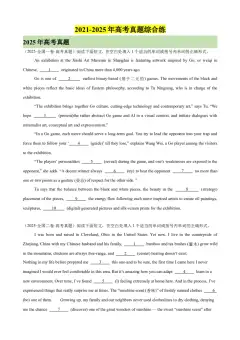
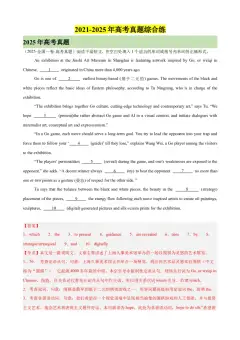
1. (2025 年全国 Ⅰ 卷 语法填空)
An exhibition at the Jiushi Art Museum in Shanghai is featuring artwork inspired by Go, or weiqi in Chinese,
56     originated in China more than 4,000 years ago.
Go is one of     57     earliest binary-based (基于二元的) games. The movements of the black and white pieces
reflect the basic ideas of Eastern philosophy, according to Tu Ningning, who is in charge of the exhibition.
“The exhibition brings together Go culture, cutting-edge technology and contemporary art,” says Tu. “We
hope     58     (present)the rather abstract Go game and AI in a visual context, and initiate dialogues with minimalist
art, conceptual art and expressionism.”
“In a Go game, each move should serve a long-term goal. You try to lead the opponent into your trap and force
them to follow your ‘    59     (guide)’ till they lose,” explains Wang Wei, a Go player among the visitors to the
exhibition.
“The players’ personalities     60     (reveal) during the game, and one’s weaknesses are exposed to the
opponent,” she adds. “A decent winner always     61     (try) to beat the opponent     62     no more than one or two
points as a gesture (姿态) of respect for the other side. ”
Tu says that the balance between the black and white pieces, the beauty in the     63     (strategy) placement of
the pieces,     64     the energy flow following each move inspired artists to create oil paintings, sculptures,     65
(digital) generated pictures and silk-screen prints for the exhibition.
2. (2024 年新高考II 卷,阅读理解D 篇)
Given the astonishing potential of AI to transform our lives, we all need to take action to deal with our AI-
powered future, and this is where AI by Design: A Plan for Living with Artificial Intelligence comes in. This absorbing
new book by Catriona Campbell is a practical roadmap addressing the challenges posed by the forthcoming AI
revolution (变革).
In the wrong hands, such a book could prove as complicated to process as the computer code (代码) that
powers AI but, thankfully, Campbell has more than two decades’ professional experience translating the heady into
the understandable. She writes from the practical angle of a business person rather than as an academic, making for
a guide which is highly accessible and informative and which, by the close, will make you feel almost as smart as
AI.
As we soon come to learn from AI by Design, AI is already super-smart and will become more capable, moving
from the current generation of “narrow-AI” to Artificial General Intelligence. From there, Campbell says, will come
04 高考真题导航
Artificial Dominant Intelligence. This is why Campbell has set out to raise awareness of AI and its future now —
several decades before these developments are expected to take place. She says it is essential that we keep control of
artificial intelligence, or risk being sidelined and perhaps even worse.
Campbell’s point is to wake up those responsible for AI-the technology companies and world leaders—so they
are on the same page as all the experts currently developing it. She explains we are at a “tipping point” in history and
must act now to prevent an extinction-level event for humanity. We need to consider how we want our future with AI
to pan out. Such structured thinking, followed by global regulation, will enable us to achieve greatness rather than
our downfall.
AI will affect us all, and if you only read one book on the subject, this is it.
12.What does the phrase “In the wrong hands” in paragraph 2 probably mean?
A.If read by someone poorly educated.
B.If reviewed by someone ill-intentioned.
C.If written by someone less competent.
D.If translated by someone unacademic.
13.What is a feature of AI by Design according to the text?
A.It is packed with complex codes.
B.It adopts a down-to-earth writing style.
C.It provides step-by-step instructions.
D.It is intended for AI professionals.
14.What does Campbell urge people to do regarding AI development?
A.Observe existing regulations on it.
B.Reconsider expert opinions about it.
C.Make joint efforts to keep it under control.
D.Learn from prior experience to slow it down.
15.What is the author’s purpose in writing the text?
A.To recommend a book on AI.
B.To give a brief account of AI history.
C.To clarify the definition of AI.
D.To honor an outstanding AI expert.
3.(2023 年北京考阅读理解D 篇)
D
What is life? Like most great questions, this one is easy to ask but difficult to answer. The reason is simple: we
know of just one type of life and it’s challenging to do science with a sample size of one. The field of artificial life-
called ALife for short — is the systematic attempt to spell out life’s fundamental principles. Many of these
practitioners, so-called ALifers, think that somehow making life is the surest way to really understand what life is.
So far no one has convincingly made artificial life. This track record makes ALife a ripe target for criticism,
such as declarations of the field’s doubtful scientific value. Alan Smith, a complexity scientist, is tired of such
complaints. Asking about “the point” of ALife might be, well, missing the point entirely, he says. “The existence of
a living system is not about the use of anything.” Alan says. “Some people ask me, ‘So what’s the worth of artificial
life?’ Do you ever think, ‘What is the worth of your grandmother?’”
As much as many ALifers hate emphasizing their research’s applications, the attempts to create artificial life
could have practical payoffs. Artificial intelligence may be considered ALife’s cousin in that researchers in both fields
are enamored by a concept called open-ended evolution (演化). This is the capacity for a system to create essentially
endless complexity, to be a sort of “novelty generator”. The only system known to exhibit this is Earth’s biosphere.
If the field of ALife manages to reproduce life’s endless “creativity” in some virtual model, those same principles
could give rise to truly inventive machines.
Compared with the developments of Al, advances in ALife are harder to recognize. One reason is that ALife is
a field in which the central concept — life itself — is undefined. The lack of agreement among ALifers doesn’t help
either. The result is a diverse line of projects that each advance along their unique paths. For better or worse, ALife
mirrors the very subject it studies. Its muddled (混乱
) progression is a striking parallel (平行线) to the evolutionary
struggles that have shaped Earth biosphere.
Undefined and uncontrolled, ALife drives its followers to repurpose old ideas and generated novelty. It may be,
of course, that these characteristics aren’t in any way surprising or singular. They may apply universally to all acts of
evolution. Ultimately ALife may be nothing special. But even this dismissal suggests something:perhaps, just like
life itself throughout the universe, the rise of ALife will prove unavoidable.
31. Regarding Alan Smith’s defence of ALife, the author is      .
A. supportive
B. puzzled
C. unconcerned
D. doubtful
32. What does the word “enamored” underlined in Paragraph 3 most probably mean?
A. Shocked.
B. Protected.
C. Attracted.
D. Challenged.
33. What can we learn from this passage?
A. ALife holds the key to human future.
B. ALife and AI share a common feature.
C. AI mirrors the developments of ALife.
D. AI speeds up the process of human evolution.
34. Which would be the best title for the passage?
A. Life Is Undefined. Can AI Be a Way Out?
B. Life Evolves. Can AI Help ALife Evolve, Too?
C. Life Is Undefined. Can ALife Be Defined One Day?
D. Life Evolves. Can Attempts to Create ALife Evolve, Too?
1.(2025-2026 安徽省高三上学期11 月质量检测)
The music industry is experiencing a major revolution as AI tools like Suno and Udio redefine creativity. By
studying millions of songs in different languages, these systems now produce complete tracks within seconds.
Modern audio models have moved beyond early robotic compositions, generating emotionally expressive music
through advanced learning systems. For example, Suno’s latest version creates human-like tracks that even experts
struggle to identify, while Udio specializes in conveying nuanced (微妙的) feelings through voices. This progress
surprises both musicians and tech companies.
Two main technologies drive this innovation. Symbolic models decode (解读) musical rules but often sound
rigid, like a beginner playing the piano. Audio models, however, generate natural-sounding music by processing raw
soundwaves. They work similarly to how humans recognize melodies. Despite producing studio-quality output, they
05 高考模拟助力
face challenges like high costs and copyright issues. Last year, three major music companies filed lawsuits against
AI developers. Researchers are addressing these through properly collected datasets, such as Zhejiang University’s
multilingual GTSinger library.
This transformation extends beyond creation. AI now helps mix tracks, gives personalized music suggestions,
and creates movie soundtracks in minutes. Chinese platforms like NetEase’s Tianyin show cultural understanding,
creating Mandarin pop with local flavours. Their AI-written song Spring Rain topped music charts for six weeks.
However, a survey found 55% of orchestra players fear job losses.
In education, AI tutors are proving helpful. Studies show students using AI piano coaches improve 15% faster
through instant advice. In Guangzhou, 20 schools now use such tools in music classes. A 2024 trial with Chinese
learners showed marked improvement in rhythm accuracy. Participants could play 30% more songs than before.
“Tools help, but true skill comes from hard work,” says a Beijing music professor.
Ethical (道德上的) debates continue as AI blurs artistic lines. While algorithms (算法) can replicate Spanish
guitar styles or Peking opera skills, critics argue they lack true artistic purpose. “Real art requires human experience,”
argues a Grammy-winning producer. Still, many praise AI’s power to protect endangered music traditions.
Researchers recently rebuilt 12 dying folk songs using AI. As technology evolves, the music world balances
innovation with human creativity.
28. What is a disadvantage of symbolic models?
A. They need very powerful computers.
B. They cannot create singing parts.
C. Their songs lack human-like expression.
D. Their music sounds less natural.
29. Why are Chinese AI music platforms popular with local audiences?
A. They produce Western-style pop music.
B. They fit local culture into their songs.
C. They employ well-known human artists.
D. They specialize in traditional opera styles.
30. What does the underlined word “replicate” in the last paragraph mean?
A. Understand.
B. Copy.
C. Improve.
D. Damage.
31. What is the author’s purpose in writing the text?
A. To warn AI’s threat to human musicians.
B. To compare different AI music technologies.
C. To discuss AI’s role in music industry.
D. To promote Chinese AI music platforms.
2.(2025-2026 山东省青岛市高三上学期期中试题)
Artificial Intelligence in Modern Life
The integration of artificial intelligence (AI) into daily life is transforming how we work and live. The first AI
program was developed in the 1950s by computer scientists. ____16____ This technology now impacts various areas
from healthcare to transportation.
In medicine, AI algorithms (算法) analyze medical images faster than human doctors, processing thousands of
scans in minutes to identify rare diseases. ____17____ For example, some systems detect early signs of diseases like
cancer with over 90% accuracy, significantly improving patient survival rates. However, these tools are designed to
assist rather than replace medical professionals, as human judgment remains critical in complex cases.
____18____ Self-driving cars use sensors and AI to navigate roads safely, interpreting traffic signals, avoiding
obstacles, and adapting to changing weather conditions. Major automakers have invested billions in this technology,
though fully autonomous vehicles still face regulatory challenges related to liability and safety standards. The change
to widespread use needs technical improvements and gradual public acceptance.
Education has also benefited from AI applications, particularly in personalized learning. AI-powered tutors offer
24/7 academic support globally, answering student questions, explaining difficult concepts, and assigning practice
exercises. These platforms adjust difficulty levels based on student performance. ____19____
Despite its advantages, AI development presents societal challenges. Ethical (道德的) concerns regarding data
privacy have arisen, as AI systems often rely on vast amounts of personal information. Additionally, unemployment
due to automation has sparked debates about workforce retraining and economic inequality. ____20____ As AI
continues to mature, finding the balance between technological advancement and human values remains crucial to
ensuring its benefits are shared equitably.
A. Transportation represents another groundbreaking application.
B. Experts predict all jobs will be automated within the next decade.
C. Many factories now use robots for dangerous manufacturing tasks.
D. Their check-ups help doctors make more informed treatment decisions.
E. It enables machines to perform human-like tasks such as learning and reasoning.
F. This provides individualized learning experiences unavailable in traditional classrooms.
G. These issues need ongoing discussion among policymakers, technologists, and the public.
3. (2025-2026 山东省德州市高三上学期期中试题)
假定你是李华,上周外教Mr. Blake 给你班上了一节“AI 翻译古诗词”课。请你为校英文报写一篇报道,
内容包括:
(1)课堂内容;
(2)你的感受。
注意:
(1)写作词数应为80 个左右;
(2)可适当增加细节,以使行文连贯。
AI Meets Ancient Poetry
____________________________________________________________________________________________
____________________________________________________________________________________________
____________________________________________________________________________________________
____________________________________________________________________________________________
____________________________________________________________________________________________