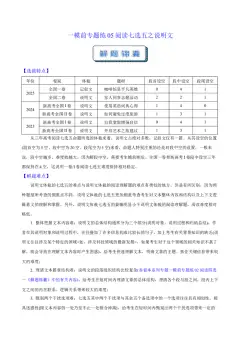
猜押专题09 阅读理解之说明文(按话题分类)
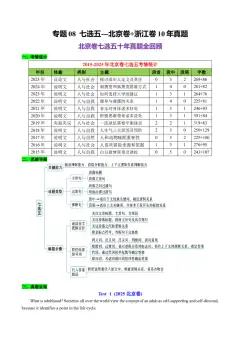
本命题依据 2026 新课程标准与高考命题新要求,是高考阅读 C 篇核心题
型,命题完全源自权威科普 + 前沿科技 + 社会现象 + 生态环保, 选自外
刊、权威媒体、科研简报等正规信息源。核心考信息定位 + 逻辑理解 + 细节
比对,长难句偏多,掌握结构规律与命题套路可稳拿高分、少丢分。
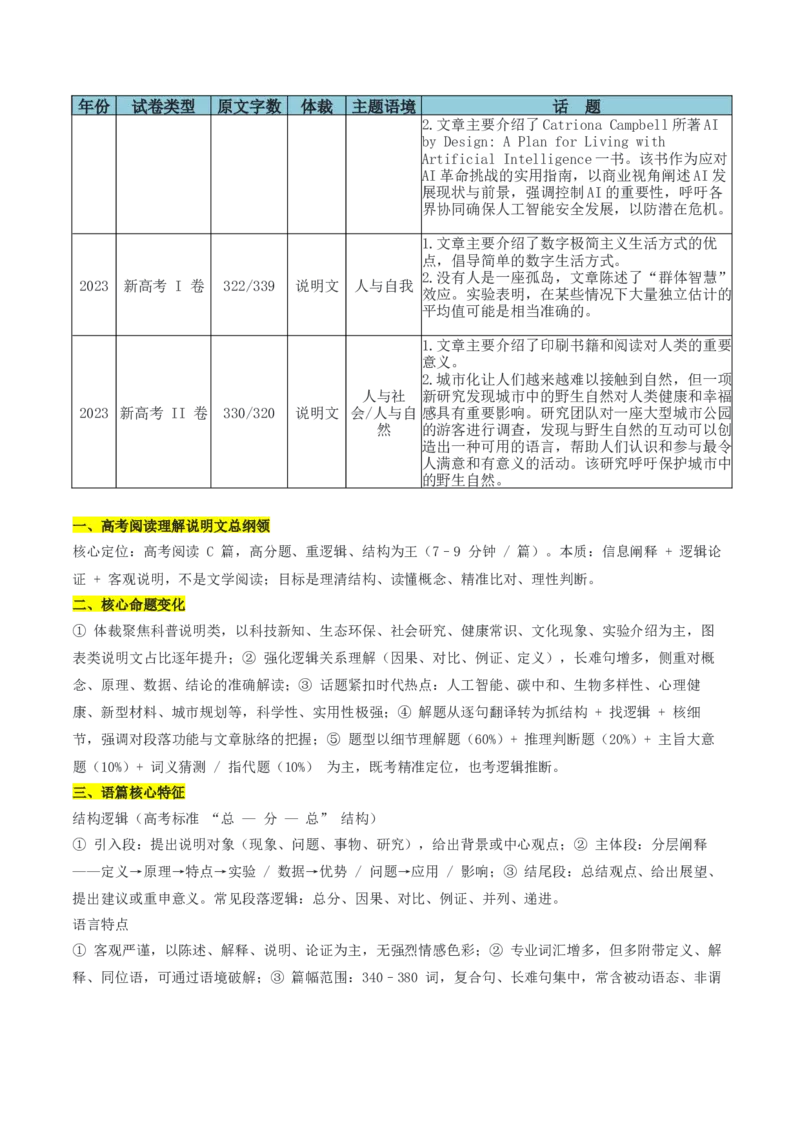
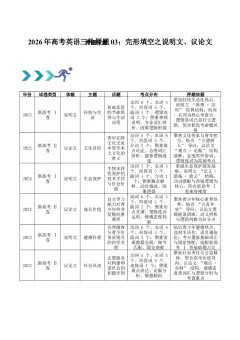
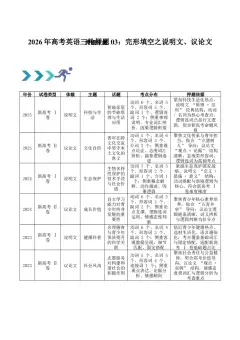
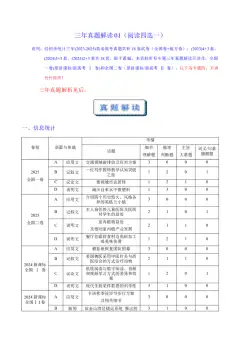
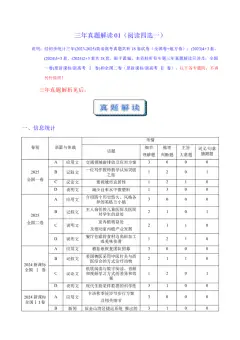
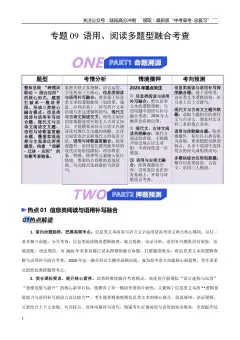
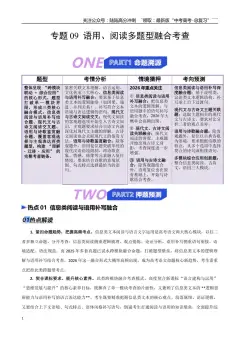
2023–2025 年高考阅读理解说明文对比表
年份
试卷类型
原文字数
体裁
主题语境
话  题
2025 全国高考一卷
338
说明文
人与社会
文章主要介绍了一项关于减少自来水中微塑料污
染的新研究。微塑料污染已遍及全球,甚至进入
人体。中国研究人员发现,将自来水煮沸五分钟
并冷却后过滤可能会显著降低自来水中的微塑料
含量。研究虽未涵盖所有塑料类型和化学物质,
但揭示了一种潜在解决方案。苏格兰环境工程师
指出,该研究展示了煮沸法的有效性,并建议升
级饮用水处理厂以推广应用。
2025 全国高考二卷
266/340
说明文
人与自然
1.文章主要通过Detrinidad 的创业经历和专家
研究,说明室内植物对人们心理健康和工作效率
的积极影响,以及近年来居家趋势推动了室内植
物产业的发展。
2.文章介绍了食物浪费问题,并以纽约一家餐厅
的短期实验项目“wastED”为例,该餐厅通过创
意改造本该被丢弃的食材制作菜品,以此提高人
们对可持续饮食的关注。
2024
新高考 I 卷
366
说明文
人与自然
文章主要介绍了斯坦福大学的一项研究发现,数
字生物多样性记录存在偏见,建议应用程序引导
公民科学家获取更好的数据。
2024 新高考 II 卷
272/323
说明文
人与社会
1.文章主要介绍了巴比伦微农场(BMF)的一些
主要优势,包括减少食物运输距离、通过云技术
远程监控、自动化系统节约水资源、减少化学污
染、以及员工的环保生活方式等。
年份
试卷类型
原文字数
体裁
主题语境
话  题
2.文章主要介绍了Catriona Campbell 所著AI
by Design: A Plan for Living with
Artificial Intelligence 一书。该书作为应对
AI 革命挑战的实用指南,以商业视角阐述AI 发
展现状与前景,强调控制AI 的重要性,呼吁各
界协同确保人工智能安全发展,以防潜在危机。
2023
新高考 I 卷
322/339
说明文
人与自我
1.文章主要介绍了数字极简主义生活方式的优
点,倡导简单的数字生活方式。
2.没有人是一座孤岛,文章陈述了“群体智慧”
效应。实验表明,在某些情况下大量独立估计的
平均值可能是相当准确的。
2023 新高考 II 卷
330/320
说明文
人与社
会/人与自
然
1.文章主要介绍了印刷书籍和阅读对人类的重要
意义。
2.城市化让人们越来越难以接触到自然,但一项
新研究发现城市中的野生自然对人类健康和幸福
感具有重要影响。研究团队对一座大型城市公园
的游客进行调查,发现与野生自然的互动可以创
造出一种可用的语言,帮助人们认识和参与最令
人满意和有意义的活动。该研究呼吁保护城市中
的野生自然。
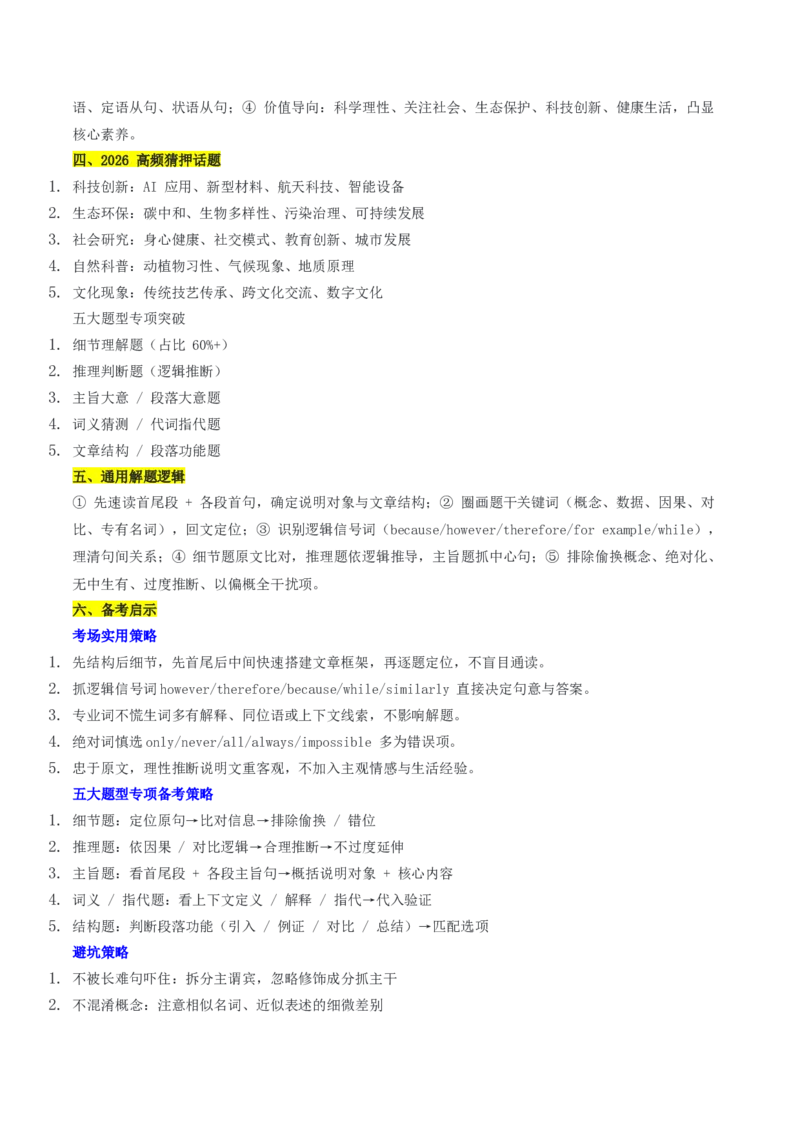
一、高考阅读理解说明文总纲领
核心定位:高考阅读 C 篇,高分题、重逻辑、结构为王(7–9 分钟 / 篇)。本质:信息阐释 + 逻辑论
证 + 客观说明,不是文学阅读;目标是理清结构、读懂概念、精准比对、理性判断。
二、核心命题变化
① 体裁聚焦科普说明类,以科技新知、生态环保、社会研究、健康常识、文化现象、实验介绍为主,图
表类说明文占比逐年提升;② 强化逻辑关系理解(因果、对比、例证、定义),长难句增多,侧重对概
念、原理、数据、结论的准确解读;③ 话题紧扣时代热点:人工智能、碳中和、生物多样性、心理健
康、新型材料、城市规划等,科学性、实用性极强;④ 解题从逐句翻译转为抓结构 + 找逻辑 + 核细
节,强调对段落功能与文章脉络的把握;⑤ 题型以细节理解题(60%)+ 推理判断题(20%)+ 主旨大意
题(10%)+ 词义猜测 / 指代题(10%) 为主,既考精准定位,也考逻辑推断。
三、语篇核心特征
结构逻辑(高考标准 “总 — 分 — 总” 结构)
① 引入段:提出说明对象(现象、问题、事物、研究),给出背景或中心观点;② 主体段:分层阐释
——定义→原理→特点→实验 / 数据→优势 / 问题→应用 / 影响;③ 结尾段:总结观点、给出展望、
提出建议或重申意义。常见段落逻辑:总分、因果、对比、例证、并列、递进。
语言特点
① 客观严谨,以陈述、解释、说明、论证为主,无强烈情感色彩;② 专业词汇增多,但多附带定义、解
释、同位语,可通过语境破解;③ 篇幅范围:340–380 词,复合句、长难句集中,常含被动语态、非谓
语、定语从句、状语从句;④ 价值导向:科学理性、关注社会、生态保护、科技创新、健康生活,凸显
核心素养。
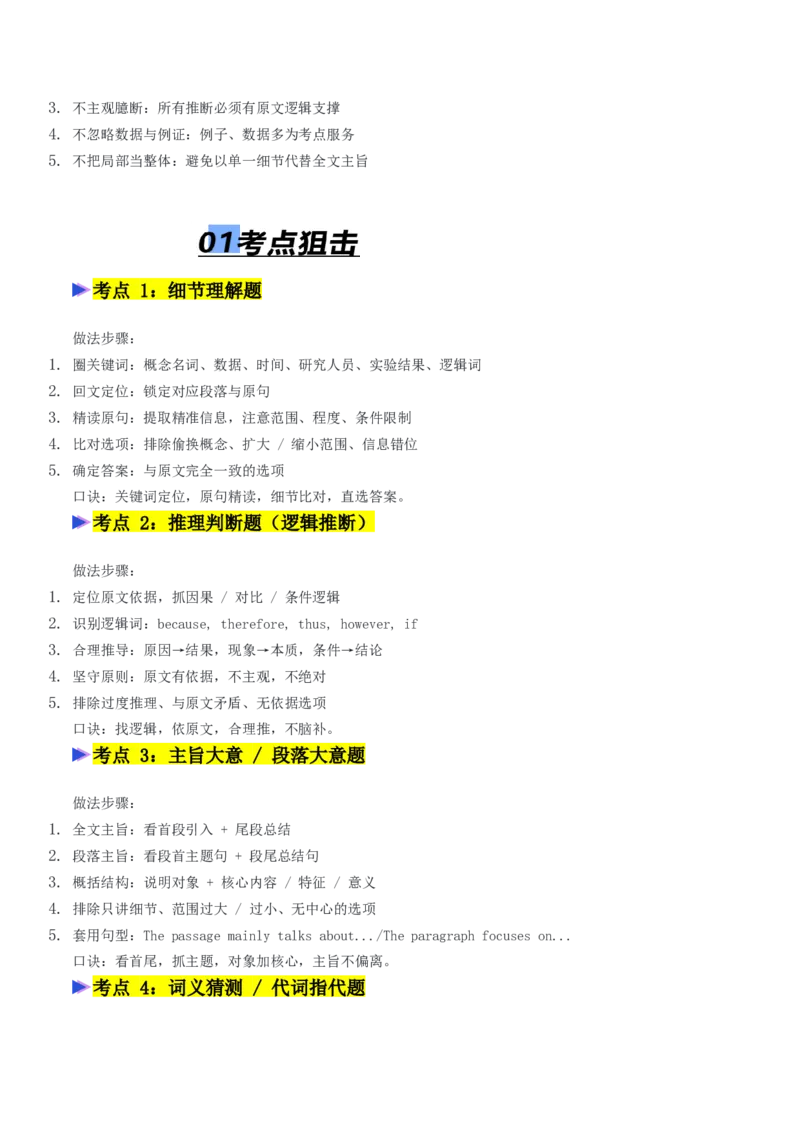
四、2026 高频猜押话题
1. 科技创新:AI 应用、新型材料、航天科技、智能设备
2. 生态环保:碳中和、生物多样性、污染治理、可持续发展
3. 社会研究:身心健康、社交模式、教育创新、城市发展
4. 自然科普:动植物习性、气候现象、地质原理
5. 文化现象:传统技艺传承、跨文化交流、数字文化
五大题型专项突破
1. 细节理解题(占比 60%+)
2. 推理判断题(逻辑推断)
3. 主旨大意 / 段落大意题
4. 词义猜测 / 代词指代题
5. 文章结构 / 段落功能题
五、通用解题逻辑
① 先速读首尾段 + 各段首句,确定说明对象与文章结构;② 圈画题干关键词(概念、数据、因果、对
比、专有名词),回文定位;③ 识别逻辑信号词(because/however/therefore/for example/while),
理清句间关系;④ 细节题原文比对,推理题依逻辑推导,主旨题抓中心句;⑤ 排除偷换概念、绝对化、
无中生有、过度推断、以偏概全干扰项。
六、备考启示
考场实用策略
1. 先结构后细节,先首尾后中间快速搭建文章框架,再逐题定位,不盲目通读。
2. 抓逻辑信号词however/therefore/because/while/similarly 直接决定句意与答案。
3. 专业词不慌生词多有解释、同位语或上下文线索,不影响解题。
4. 绝对词慎选only/never/all/always/impossible 多为错误项。
5. 忠于原文,理性推断说明文重客观,不加入主观情感与生活经验。
五大题型专项备考策略
1. 细节题:定位原句→比对信息→排除偷换 / 错位
2. 推理题:依因果 / 对比逻辑→合理推断→不过度延伸
3. 主旨题:看首尾段 + 各段主旨句→概括说明对象 + 核心内容
4. 词义 / 指代题:看上下文定义 / 解释 / 指代→代入验证
5. 结构题:判断段落功能(引入 / 例证 / 对比 / 总结)→匹配选项
避坑策略
1. 不被长难句吓住:拆分主谓宾,忽略修饰成分抓主干
2. 不混淆概念:注意相似名词、近似表述的细微差别
3. 不主观臆断:所有推断必须有原文逻辑支撑
4. 不忽略数据与例证:例子、数据多为考点服务
5. 不把局部当整体:避免以单一细节代替全文主旨
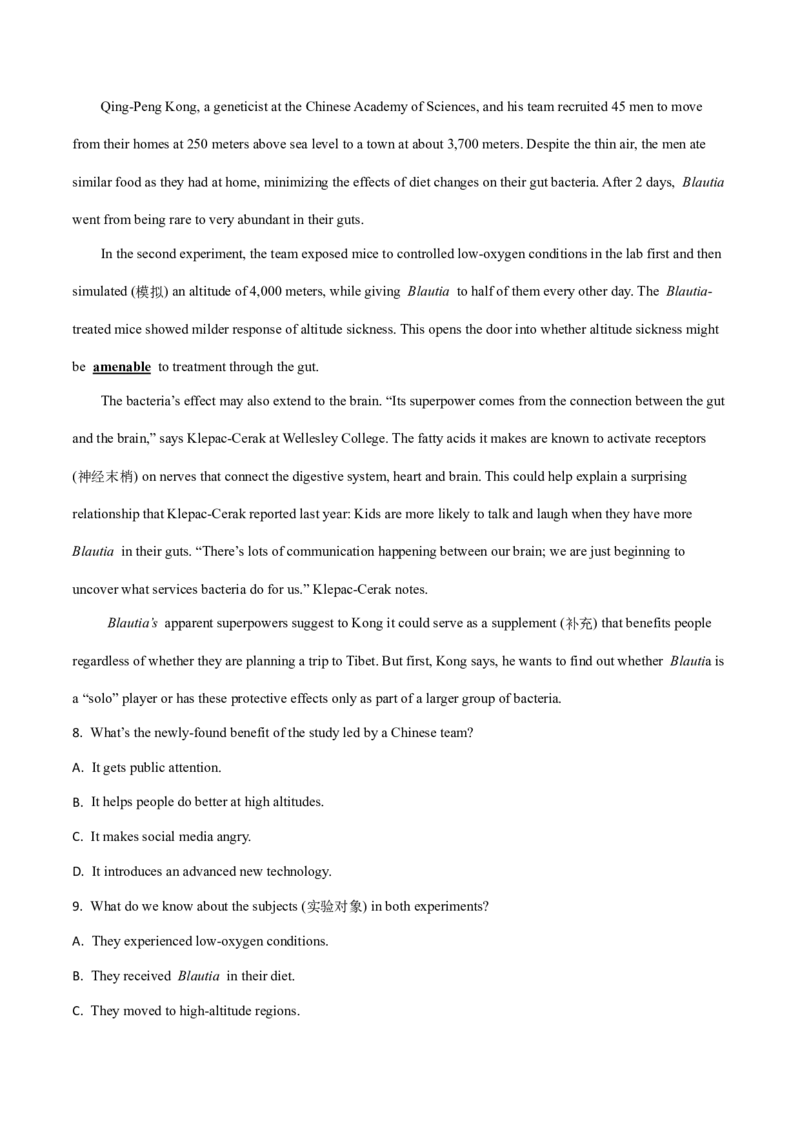
考点 1:细节理解题
做法步骤:
1. 圈关键词:概念名词、数据、时间、研究人员、实验结果、逻辑词
2. 回文定位:锁定对应段落与原句
3. 精读原句:提取精准信息,注意范围、程度、条件限制
4. 比对选项:排除偷换概念、扩大 / 缩小范围、信息错位
5. 确定答案:与原文完全一致的选项
口诀:关键词定位,原句精读,细节比对,直选答案。
考点 2:推理判断题(逻辑推断)
做法步骤:
1. 定位原文依据,抓因果 / 对比 / 条件逻辑
2. 识别逻辑词:because, therefore, thus, however, if
3. 合理推导:原因→结果,现象→本质,条件→结论
4. 坚守原则:原文有依据,不主观,不绝对
5. 排除过度推理、与原文矛盾、无依据选项
口诀:找逻辑,依原文,合理推,不脑补。
考点 3:主旨大意 / 段落大意题
做法步骤:
1. 全文主旨:看首段引入 + 尾段总结
2. 段落主旨:看段首主题句 + 段尾总结句
3. 概括结构:说明对象 + 核心内容 / 特征 / 意义
4. 排除只讲细节、范围过大 / 过小、无中心的选项
5. 套用句型:The passage mainly talks about.../The paragraph focuses on...
口诀:看首尾,抓主题,对象加核心,主旨不偏离。
考点 4:词义猜测 / 代词指代题
做法步骤:
1. 定位生词 / 代词,看上下文线索:定义、举例、因果、转折、同义 / 反义
2. 常见标志:that is, in other words, such as, but, however, or
3. 代词题:向前找最近的名词 / 名词短语
4. 代入选项验证:通顺且符合逻辑为正确答案
5. 排除字面意思、无关含义、情感偏向项
口诀:看语境,找线索,代进去,通得顺。
考点 5:文章结构 / 段落功能题
做法步骤:
1. 看段落位置:首段引入,中段论证 / 例证,尾段总结 / 展望
2. 判断功能:introduce, explain, compare, give an example, conclude, suggest
3. 识别结构:总 — 分 — 总、问题 — 解决方案、现象 — 分析 — 结论
4. 结合逻辑词,判断段落间关系
5. 排除偏离结构、功能错位选项
口诀:看位置,辨功能,理逻辑,定结构。
Passage 1
河北衡水中学2025-26 届高三年级检测(七)
The numerous bacteria that naturally inhabit the human body seem to help us in many ways. One group is
emerging as particularly beneficial: a type of gut (肠道) bacteria known as Blautia, which has made headlines
recently because it seems to produce some really remarkable effects. Now, a Chinese team is glimpsing another
potential benefit of Blautia: helping people adapt to high altitudes. Their findings suggest that providing Blautia
could help mountaineers and others perform better in these challenging environments.
Qing-Peng Kong, a geneticist at the Chinese Academy of Sciences, and his team recruited 45 men to move
from their homes at 250 meters above sea level to a town at about 3,700 meters. Despite the thin air, the men ate
similar food as they had at home, minimizing the effects of diet changes on their gut bacteria. After 2 days, Blautia
went from being rare to very abundant in their guts.
In the second experiment, the team exposed mice to controlled low-oxygen conditions in the lab first and then
simulated (模拟) an altitude of 4,000 meters, while giving Blautia to half of them every other day. The Blautia-
treated mice showed milder response of altitude sickness. This opens the door into whether altitude sickness might
be amenable to treatment through the gut.
The bacteria’s effect may also extend to the brain. “Its superpower comes from the connection between the gut
and the brain,” says Klepac-Cerak at Wellesley College. The fatty acids it makes are known to activate receptors
(神经末梢) on nerves that connect the digestive system, heart and brain. This could help explain a surprising
relationship that Klepac-Cerak reported last year: Kids are more likely to talk and laugh when they have more
Blautia in their guts. “There’s lots of communication happening between our brain; we are just beginning to
uncover what services bacteria do for us.” Klepac-Cerak notes.
 Blautia’s apparent superpowers suggest to Kong it could serve as a supplement (补充) that benefits people
regardless of whether they are planning a trip to Tibet. But first, Kong says, he wants to find out whether Blautia is
a “solo” player or has these protective effects only as part of a larger group of bacteria.
8. What’s the newly-found benefit of the study led by a Chinese team?
A. It gets public attention.
B. It helps people do better at high altitudes.
C. It makes social media angry.
D. It introduces an advanced new technology.
9. What do we know about the subjects (实验对象) in both experiments?
A. They experienced low-oxygen conditions.
B. They received Blautia in their diet.
C. They moved to high-altitude regions.
D. They suffered severe altitude sickness.
10. What does the underlined word “amenable” in Paragraph 3 mean?”.
A. Careless
B. Untreatable.
C. Unchangeable
D. Reactive.
11. How would both Kong and Klepac-Cerak describe Blautia’s role in human health?
A. double-edged sword.
B. A solo player.
C. An extremely effective solution.
D. A partially-understood influence
Passage2
吉林省松原市实验高级中学2025-2026 学年高三下学期学情调研
For many ecologists, monitoring individual animals over long periods of time is crucial to conservation
efforts. But even the experts have difficulty differentiating one bear from another.
To help wildlife biologists make sense of it all, a team at Switzerland’s EPFL and Alaska Pacific University
(APU) has developed PoseSwin, an AI program capable of telling brown bears apart from one another. PoseSwin
was trained on over 72,000 photos of 109 different brown bears taken by APU researcher Beth Rosenberg, who
took the images at all times of day and night and in various weather conditions, while also making sure to
document the bears in a variety of behaviors. She and her team then determined the handful of details that remain
relatively constant over the animal’s life. These details include their brow bone angle, ear placement, and nose and
mouth shapes. They’re more reliable than body shape alone, which changes dramatically with weight gain.
The team took PoseSwin for a field test with help from citizen scientists. After collecting more brown bear
photos from visitors to Katmai National Park and Preserve, researchers fed the photos into the machine learning
program. In multiple cases, PoseSwin successfully matched individual bears to those in its database. PoseSwin’s
designers could track how and where brown bears moved for seasonal food. “This is a concrete example of the
model’s potential,” said Rosenberg. “The technology could eventually analyze thousands of pictures visitors take
yearly and help map how brown bears use this expansive area.”
Rosenberg and her team are now using PoseSwin to monitor over 100 bears living around McNeil River State
Game Sanctuary. Early tests have indicated it’s also incredibly accurate when trained on monkeys. Anyone can
access the machine learning algorithm (算法) for their own subject — although there’s a good chance that none of
them will be harder for PoseSwin to identify. “Bears are perhaps the hardest species to recognize individually,” said
Mathis, Rosenberg’s partner. “We focused on them first with the idea that our program could be adapted to other
species.”
32. What does PoseSwin mainly depend on to identify individual bears?
A. Their facial features.
B. Their fur color and size.
C. Their weight and body shape.
D. Their behavioral patterns.
33. What were the photos from citizen scientists used to do?
A Train the AI program PoseSwin.
B. Record bears’lifelong changes.
C. Test the function of PoseSwin.
D. Design a new learning algorithm.
34. What can be inferred about PoseSwin in the last paragraph?
A. It won’t be available open-source.
B. It won’t remain so bear-centric.
C. It relies on high-quality photos.
D. It is trained on the limited data.
35. What is the best title for the text?
A. PoseSwin: A Wildlife Tool for Bear Research
B. PoseSwin: Analyzing Visitor Photos of Bears
C. PoseSwin: Tracking Bear Seasonal Movement
D. PoseSwin: An AI Program for Bear Identification
Passage3
杭州学军中学2026 首考适应性考试
A new study has found that breathing does more than just move air in and out of your lungs — it could even
be used to identify who you are. Scientists at Israel’s Weizmann Institute of Science discovered that each person has
a distinct breathing pattern, known as a nasal (鼻的) breathing “fingerprint”, a unique pattern that reveals clues
about a person’s physical and mental health. Notably, brain scientist Timna Soroka shared, “We were able to
identify differences between less depressed and non-depressed individuals.”
The researchers originally set out to better understand how our sense of smell works. In humans, the brain
processes smell during inhalation (吸入), and this close connection between the brain and breathing led the team to
wonder: could our breathing patterns reflect the way our brains are wired — and be unique to each of us? To
explore this question, they developed a lightweight, wearable device that tracks nasal airflow continuously for 24
hours.
The study, published in the journal Current Biology, tested 100 healthy young adults as they went about their
regular routines — running, studying, resting, and more. The results showed breathing patterns can identify
individuals with 96.8 percent accuracy. “I thought it would be really hard to identify someone because everyone is
doing different things,” said Soroka. “But it turns out their breathing patterns were remarkably distinct!”
Beyond individual identification, the study also found clear links between breathing patterns and body mass
index (BMI), sleep-wake cycles, and mental health traits such as anxiety and depression. For example, people who
scored higher on anxiety tests tended to have shorter inhalation periods. Importantly, the researchers noted that they
only know there is an association between breathing and mood, but they don’t know the cause-and-effect direction
— whether feeling anxious changes breathing, or a certain breathing pattern causes anxiety. If the latter is true,
changing how we breathe could potentially improve mood.
However, the current device has drawbacks: it uses soft tubes under the nose that can be uncomfortable to
wear and may slip during sleep, and it doesn’t track mouth breathing. The team is working on improving the device
and further exploring the breathing-mood connection to unlock more practical applications.
8. Why is breathing “fingerprint” mentioned?
A. To explain how the brain processes smell.
B. To introduce a newly-invented tracking device.
C. To show a link between breathing and depression.
D. To stress the uniqueness of personal breathing pattern.
9. What does the underlined word mean?
A. Connected.
B. Powered.
C. Controlled.
D. Trained.
10. What can we infer about the relationship between breathing and mood?
A. Changes in breath cure anxiety.
B. Anxiety always causes abnormal breathing.
C. Their exact relationship remains unclear.
D. Breathing is responsible for negative mood.
11. What is the main finding of this research?
A. Our fingerprints tell a lot about our health.
B. Breathing patterns link to identity and health.
C. A groundbreaking device reveals mental health.
D. Anxiety levels link to shorter inhalation periods.
Passage4
江浙高中发展共同体·2026 届高三第一次适应性考试
While technological advancements have enhanced the convenience of urban commuting in recent years,
environmental studies reveal a worrying decline in urban green spaces, especially in densely populated districts.
Many residents complain that there’s insufficient access to nature-filled areas for relaxation and exercise, so they
end up spending more time indoors, relying on virtual entertainment.
Urban planners Lila Chen and Ryan Moore are deeply troubled by such issues. In their newly released book
Green Living: Reclaim Our Cities’ Natural Spaces, they call for a fundamental rethinking of urban design and the
role greenery should play in our daily lives.
The landscape of urban living began to shift decades ago. Vast areas of natural vegetation were cleared to
make room for sprawling concrete structures and commercial centers, forcing residents to seek nature in distant
suburbs. Some grassroots groups fought back. Most notably, a community organizer from Seattle, who relocated to
the city in the early 2000s, launched a movement to save a local wetlands area from being converted into a
shopping mall. Expressing her outrage at the planned destruction, Emily Clark appealed to the city council to
“Preserve Seattle as a city where nature and urban life coexist harmoniously, not just a place of concrete and
commerce.” Similar initiatives took place in other major cities across the country in the 2010s.
Although these initiatives gained public attention, the harsh reality is that the majority of modern cities remain
overwhelmingly dominated by urban development at the expense of green spaces. The coverage of natural areas in
cities has been shrinking steadily. In California, for instance, the ratio of urban green spaces to total city area has
dropped to a record low, even as the state promotes environmental protection campaigns.
We invest substantial resources in building urban infrastructure that prioritizes speed and efficiency, yet we
neglect to consider the true value of green spaces. Do we fully comprehend the social and psychological costs when
citizens lack easy access to natural environments for mental rejuvenation? The authors of Green Living are spot-on:
it’s high time we re-evaluate the urban landscapes right outside our homes.
8. What phenomenon does the author highlight in paragraph 1?
A. Urban commuting has become overly dependent on technology.
B. The reduction of urban green spaces leads to lifestyle changes.
C. Virtual entertainment is replacing outdoor activities completely.
D. Residents in densely populated areas have limited access to jobs.
9. What were the Seattle community organizer and other activists attempting to achieve?
A. Expand commercial development in urban areas.
B. Relocate residents to distant suburbs with more greenery.
C. Safeguard urban natural spaces for a balanced lifestyle.
D. Promote the construction of more shopping malls in wetlands.
10. What can be inferred about the initiatives in California in the 2010s?
A. They successfully increased the ratio of urban green spaces.
B. They failed to reverse the trend of shrinking green areas.
C. They led to a surge in environmental protection donations.
D. They resulted in the closure of all commercial construction projects.
11. Which of the following would be the most appropriate title for the text?
A. Urban Rush: Sacrificing Nature?
B. Tech Advance: A Double-edged Sword?
C. Green Spaces: A Luxury or Necessity?
D. Community Activism: A Lost Cause?
Passage5
2026 届江苏苏州市七校联考模拟预测
Whether you’re looking for a job, a house, or a romantic partner, there’s an app for that. But as people
increasingly turn to digital platforms in search of opportunity, Daniela Saban, an associate professor of operations,
information, and technology at Stanford Graduate School of Business, says it’s time to take a critical look at the
role of algorithms ( 算法). She explores how properly designed algorithms can improve the fairness and
effectiveness of matching processes.
Saban has focused much of her research on what she calls “matching markets ” and she’s been particularly
fascinated by online dating. In one study, she and several coauthors partnered with a major U.S. dating platform to
explore how updates to the app’s algorithm could improve outcomes for romantic hopefuls looking to spark new
connections.
Analyzing data from the app, Saban developed a model that not only prioritized potential matches based on a
user’s preferences but also took into account the likelihood that the person on the other side of the potential match
would be interested. “I not only want to show you people that you will like, I also want to show you people that
will like you back,” Saban notes. Factoring in users’ history, activity levels, and this two-sided approach to
preference led to a substantial increase in matches during field experiments in Texas. “Our algorithm increased the
number of matches by 27% in Houston and by over 37% in Austin,” Saban says.
Similarly, when working with the volunteer matching platform VolunteerMatch, Saban identified an imbalance
in how volunteer opportunities were being distributed. Some organizations were receiving an overwhelming
number of sign-ups, sometimes even more than they needed, while others struggled to attract any volunteers at all.
By adjusting the search algorithm to consider the number of volunteers an organization needs and has already
received, Saban and her team were able to ensure a more reasonable distribution of volunteers across opportunities.
The technical details of algorithms may be complicated, but our commitment to fairness and equity doesn’t
have to be. If we want algorithms to work for good, we need to make conscious choices about how we design them.
12. How do people search for opportunities nowadays?
A. By learning algorithms.
B. By making use of online tools.
C. By developing critical thinking.
D. By analyzing the matching processes.
13. What do we know about the model Saban developed for the dating app?
A. It has attracted more users to the app.
B. It makes a user’s preferences a top priority.
C. It focuses on two-sided preference matching.
D. It presents more potential matches to the users.
14. On what basis did Saban adjust the algorithm of VolunteerMatch?
A. The preferences of the volunteers.
B The popularity of the organizations.
C. A match between volunteer and organization types.
D. A balance between the demand and supply of volunteers.
15. Which of the following can be a suitable title for the text?
A. The Power of Digital Matchmaking
B. A New Era of Opportunity Searching
C. Designing Algorithms for Better Matches
D. Volunteering Better with Equal Distribution
Passage6
江苏省镇江市2025-2026 学年上学期高三零模
Plants can be grown in flexible ways. Besides planting seeds, a special method allows growing new plants
from parts of other plants, like rose stems or potato tubers — these copies like the mother plant are called plant
clones.
The technique to make plant clones is known as micropropagation (微繁殖). It uses tiny pieces of plant
tissue, called explants (外植体), from a “mother plant” and raises them in a clean lab with nutrient-rich media,
under controlled light, temperature, and humidity. The key lies in the ability of a single cell to develop into a whole
organism, and dedifferentiation (去分化), where mature cells return to a dividing state before forming new tissues
and organs.
Suppose you have a favorite garden plant with unique, attractive flowers but it produces no seeds. In nature,
some plants depend on bees, insects, or birds to develop seeds — without these helpers, they may die seedless. To
grow it, you can try micropropagation. Beyond resolving the seedless plant problem, it can also efficiently
reproduce economically important species like bananas, saving time and cost. Moreover, it enables the production
of virus-free plants and helps reproduce stress-tolerant varieties that otherwise struggle to produce seeds.
You might be curious about the materials and experimental setup required for this modern technique. The
process needs a mother plant, suitable explants, and a nutrient medium. After being cleaned, explants grow into
complete plants in a room with a controlled environment. Later, they are hardened and relocated to greenhouses or
fields. Additionally, simple micropropagation, such as using stem cuttings of roses, lets people grow plants at home
without seeds, offering a convenient way to reproduce beloved plants.
28. What can people do with the special method according to paragraph 1?
A. produce plant seeds.
B. Change plant colors.
C. Grow new identical plants.
D. Protect rare plant species.
29. What does the underlined word “them” stand for in paragraph 2?
A. Explants.
B. New plants.
C. Seeds.
D. New cells.
30. What can we know about the process according to the last paragraph?
A. It is hard to reproduce roses at home.
B. Plants grow better indoors than outdoors.
C. The growth of explants needs special care.
D. Simple micropropagation needs complex procedures.
31. Which of the following is the best title for the text?
A Micropropagation: Its Trouble and Cost.
B. Explants: From Leaves to Plants.
C. Plant Cloning: Its Benefits and Procedure.
D. Nutrient Media: Energy for Plant Growth.
Passage7
山东名校联盟2026 届高三下学期2 月份核心素养评估考试
When we talk of human actions harming the environment, we often think of pollution, overuse of resources or
destruction of habitats. But introducing new species into areas where they don’t naturally live can also be
destructive. One such invasive (入侵的) species is the zebra mussel.
Zebra mussels live in fresh water and are native to the Caspian and Black Seas, which are found in between
Europe and Asia. These seas are less salty than most, so a freshwater species like the zebra mussel can live there
and in nearby lakes. By attaching onto ships, the mollusks (软体动物) have spread to much of Europe and North
America, causing a problem for the environment and humans alike.
When species are abruptly introduced to a new ecosystem, they often damage the balance of that ecosystem,
and zebra mussels are no exception. They feed by phytoplankton (浮游植物) and other nutrients out of the water
when they pass through their shells, and they do so with striking efficiency. This means that when zebra mussels
arrive in a new area, they consume so much phytoplankton that other species that also eat the same food source
struggle to get a sufficient amount of food. Since those other creatures, in turn, are a food source for still other
species, zebra mussels harm everything in the lake.
Zebra mussels also create problems for humans because they multiply so quickly. They often grow on objects
made by humans, and groups of them can prevent these objects from functioning. For example, zebra mussels have
been known to obstruct the flow of water through pipes, which can prevent communities from getting clean
drinking water. They attach to these objects firmly enough that they can prove difficult and expensive to clean.
Removal of zebra mussels is incredibly difficult, so only by stopping them from spreading can people limit the
troubles they cause. Governments of areas affected are taking steps to prevent their spread mostly by privately-
owned boats. So, boaters must clean, drain ( 排空), and dry their boats and motors before entering one lake or
another to defend against their further spread.
8. Why does the author mention the environmental problems in the beginning?
A. To introduce the topic.
B. To predict the ending.
C. To emphasize the effects.
D. To illustrate an argument.
9. What can we learn about zebra mussels?
A. They need salty water to survive.
B. They only exist in Europe and Asia.
C. They often break the balance of the ecosystem.
D. They eat less phytoplankton than any other species.
10. What does the underlined word “obstruct” in paragraph 4 mean?
A. Avoid.
B. Block.
C. Control.
D. Direct.
11. What does the last paragraph focus on?
A. The damages caused by zebra mussels.
B. The difficulties zebra mussels encounter.
C. The measures to stop zebra mussels spreading.
D. The rapid reproduction speed of zebra mussels.
Passage8
广东部分学校2026 届高三年级上学期1 月份适应性测试
Dogs have been a part of human society for over 20,000 years. Initially, they served people by supporting
hunters, and it did not take long before they became part of the home. Dogs might not help secure food, but for
years evidence has mounted that they help people in another way.
Research led by Dr. Kikusui Takefumi at Azabu University in Japan explains what might be going on. The
microbes (微生物) found elsewhere, particularly in the human gut (肠道), produce chemicals that influence how
the brain works. Those microbes are heavily affected by diet, but are also shaped by factors like stress, pollutants
and exercise. Kikusui knew from his own research that having a dog influenced the microbiota of the human gut,
too. With this in mind, he wondered if microbe movement from dogs might be helping bring psychological benefits
to owners. Eager to find out, he set up an experiment with 343 participants in Tokyo.
Kikusui specifically worked with teenagers, who are going through a crucial period of brain development,
when social interactions often have lasting mental effects; if microbes from dogs were reducing teen anxiety and
increasing teen sociality, then this would generate long-term positive effects. He and his coworkers therefore
psychologically analysed 96 teens who were dog owners and 247 teens who were not.
Kikusui and his coworkers found that dog owners suffered from fewer social problems. More specifically, they
were less likely to react strongly during conflicts, and demonstrated fewer problem behaviors and less social
withdrawal. Kikusui and his coworkers then collected saliva (唾液) samples from the participants and noted that
certain kinds of Streptococcus and Prevotella 7 were significantly more plentiful in samples from dog owners. They
further found that participants within whom these key microbes were rare also tended to have more problematic
behaviors. As anticipated before the experiment, microbes, added to the human gut by dogs, may be influencing the
brains of their owners in healthy ways.
12. What is the basis for Kikusui’s experiment?
A. Microbes determine human behavior.
B. Diet shapes the microbiota in the gut.
C. Dogs reduce mental stress in teenagers.
D. Dogs relate to microbes in the human gut.
13. Why were the teenagers chosen as participants?
A. They show more social problems.
B. Their microbes are easily changed.
C. They often tend to keep dogs as pets.
D. Their brain development is at a key stage.
14. How did the research team feel about the result of the experiment?
A. Unsurprised.
B. Unsatisfied.
C. Discouraged.
D. Confused.
15. What is the best title for the text?
A. Dogs Improve Human Health Constantly
B. Dog ownership Reduces Teen Problems
C. Microbes Link Dogs to Human Behavior
D. Gut Microbes Influence Brain Negatively
Passage9
北京市通州区2025-2026 学年高三上学期摸底考试
Curiosity is a familiar feeling among people. Yet when we examine it more deeply, curiosity reveals itself to
be a complex emotion. Consider this: Is curiosity a positive feeling or a negative one? Does it resemble frustration
or anticipation? Is it a painful reminder of what we do not (yet) know, or a thrilling signal of what we might soon
discover?
In fact, curiosity can be all of these — and more. It has two faces: one points toward what we desire, and the
other toward what we have not yet obtained — and may never obtain. Once we recognize that curiosity is not
always pleasurable, we can explore factors that influence the nature of our experience in different situations. One
such factor is time.
Researchers have investigated whether the experience of curiosity is more positive when we anticipate
satisfying it sooner rather than later. To explore this question, a paper published in Cognition and Emotion reported
three studies involving over 200 participants recruited from a university or online.
In each study, the researchers first induced (诱导) a state of curiosity by telling participants that they would
later watch a video that contained “something with different shades of brown”. Participants were invited to reflect
on what it might be, but they were not told. Crucially, half the participants were told they would watch the video
after a short delay of only one minute, and half were told that there would first be a 30-minute delay during which
they would complete other interesting tasks. At the start of the delays, everyone indicated how curious they felt
about the content of the video, as well as how much they felt negative feelings, such as discomfort, versus positive
feelings, such as happiness.
The key finding was that while both groups reported equal levels of curiosity, the curiosity was accompanied
by more negative feelings for those participants facing a long delay. The researchers argue that the finding sheds
light on the two faces of curiosity. When our curiosity will not be satisfied anytime soon, we focus on not knowing,
on the information gap itself, and this is largely aversive. But when our curiosity is on the verge of being satisfied,
we focus on almost knowing, or the anticipated resolution, which is a more positive experience.
28. What was the main difference between the two participant groups?
A. Their physical responses.
B. Their initial levels of curiosity.
C. The types of video they watched.
D. The delays before watching the video.
29. What does the word “aversive” underlined in the last paragraph mean?
A. Unpleasant.
B. Misleading.
C. Ineffective.
D. Ignored.
30. What is the main purpose of the passage?
A. To criticize the methods used in curiosity research.
B. To introduce different scientific definitions of curiosity.
C. To suggest ways to avoid the negative side of curiosity.
D. To prove curiosity can lead to different emotional experiences.
Passage10
备战2026 年高考英语模拟卷(上海卷)
Poet and Harvard Professor Henry Wadsworth Longfellow famously said, “Music is the universal language
of mankind.” A new Harvard study suggests he may have been right.
The study conducted by a research team found that people around the world could identify lullabies ( 摇篮
曲), dance songs, and comforting songs — regardless of the songs’ cultural origin — after hearing just a 14-second
clip (片段). The finding suggests that not only is music deeply rooted in human nature, but that some types of songs
break cultural boundaries.
The findings are based on a wide-reaching experiment in which 750 online participants in 60 countries
listened to brief clips of songs collected from nearly 90 small societies around the world, including hunter-gatherers
and some special farmers. Participants then answered six questions, rating each clip according to whether they
believed the song was used for dancing, calming a baby, treating illness, or expressing love. Two additional uses —
mourning (哀悼) the dead and telling a story — were included as controls.
The data showed that despite participants’ unfamiliarity with the cultures, the random sampling of each song,
and the short duration of the samples, people were able to reliably infer the songs’ functions, and that their ratings
were consistent across the world.
The findings ran counter to expert expectations. The team had also asked professionals, including
performers, composers, psychologists, and scientists about whether they believed people would be able to identify
the song types. Their answer was no. And not only that, but they predicted that people’s responses will be
inconsistent with one another. “That’s not what we found,” the researchers said.
The researchers also wanted to know whether listeners were recognizing certain non-musical characteristics
of the songs. To test that, the team conducted a second study. This time, they asked listeners about a number of
contextual and musical features, ranging from the gender of the singers to the rhythm of the song.
When data from the two studies were combined, the results showed that songs of the same function shared
similar characteristics — lullabies, for example, tended to be slower and simpler than dance music — suggesting
that something about musical characteristics crosses cultural boundaries.
43.What did the participants do in the first study?
A.They distinguished functions of the songs.
B.They identified the cultural origins of the songs.
C.They recognized the non-musical characteristics of the songs.
D.They sorted the songs according to the gender of the singers.
44.What does the underlined part “ran counter to” in paragraph 5 probably mean?
A.Were equal to.
B.Were similar to.
C.Were superior to.
D.Were opposite to.
45.Why did the researchers carry out the second study?
A.To test the musical knowledge of a wider audience.
B.To collect more diverse songs from various cultures.
C.To confirm the surprising results from the first one.
D.To explore the underlying reasons behind the findings.
46.What can we learn from the two studies?
A.Listeners recognize music by its rhythm.    B.Something about music might be universal.
C.Dance music is usually slower and simpler.
D.Cultural similarities lead to similar musical features.