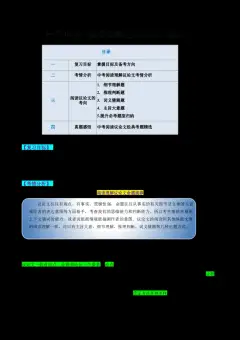
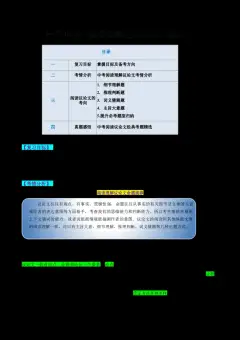
专题三 完形填空
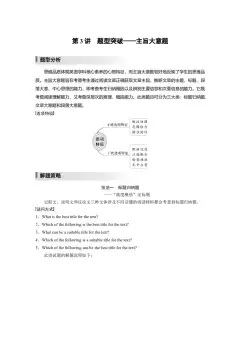
类型二 体裁破解
第4 讲 议论文
【辨明题类】
议论文是一种剖析事物、论述原理、发表见解或提出主张的说理性文章。其目
的不仅是客观地解释事物,还力图说服读者相信并接受某一观点。其特点决定
了其为高考完形填空中难度最大的一种体裁。典型的议论文一般由论点(提出问
题,即what)、论据(分析问题,即why)和论证(解决问题,即how)三部分组
成。
议论文的论点的3 种提出方式
(1)开门见山式:提出论点→引用具体的论据→总结全文;
(2)导入式:叙述具体的事情或现象→针对问题,提出论点→用论据说明论点;
(3)结尾式:列举生活中的现象→分析具体现象→得出结论。
【技法点拨】
1.抓住首句,明确论点。议论文完形填空的首句一般是主旨句,作者通常在文
章的首段提出总论点,然后在每段的首句提出分论点。
2.议论文的尾段就是结论,也是对论点的照应,不可忽视。
【真题体验】
(广东高考)
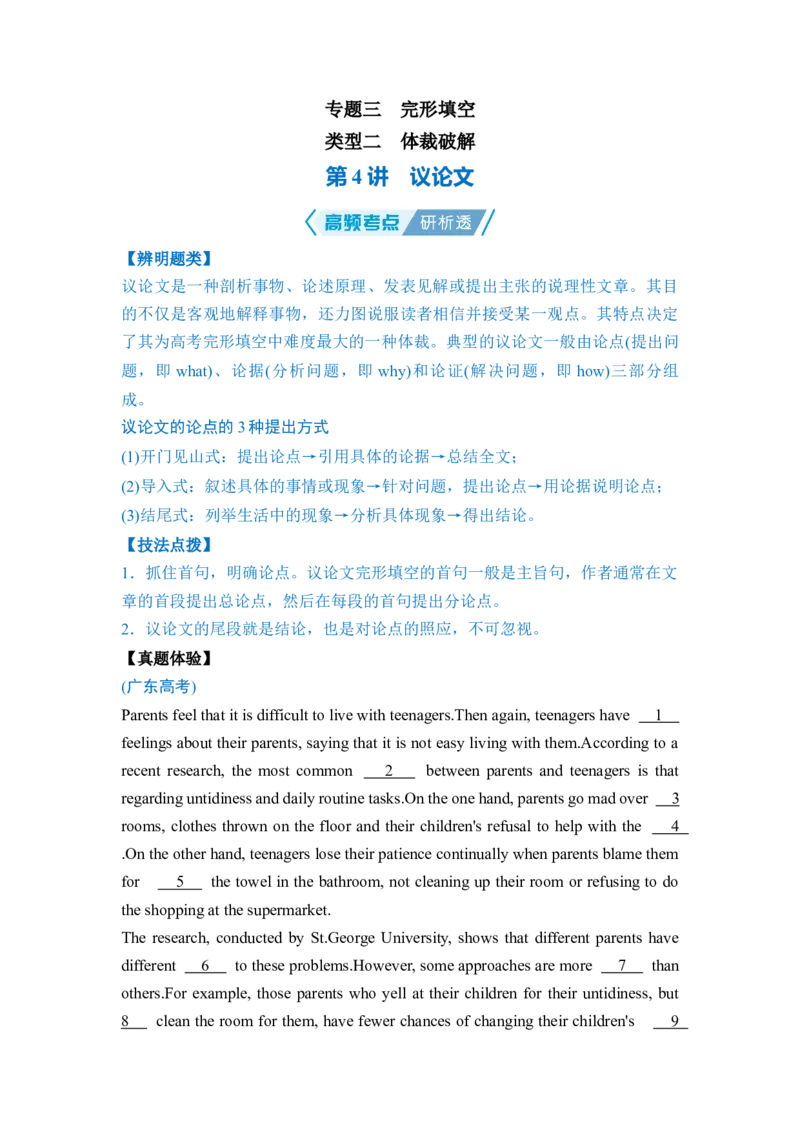
Parents feel that it is difficult to live with teenagers.Then again, teenagers have   1
feelings about their parents, saying that it is not easy living with them.According to a
recent research, the most common   2   between parents and teenagers is that
regarding untidiness and daily routine tasks.On the one hand, parents go mad over   3
rooms, clothes thrown on the floor and their children's refusal to help with the   4
.On the other hand, teenagers lose their patience continually when parents blame them
for    5   the towel in the bathroom, not cleaning up their room or refusing to do
the shopping at the supermarket.
The research, conducted by St.George University, shows that different parents have
different   6   to these problems.However, some approaches are more   7   than
others.For example, those parents who yell at their children for their untidiness, but
8   clean the room for them, have fewer chances of changing their children's    9
.On the contrary, those who let teenagers experience the   10   of their actions can
do better.For example, when teenagers who don't help their parents with the shopping
don't find their favorite drink in the refrigerator, they are forced to   11   their
actions.
Psychologists say that   12   is the most important thing in parent-child
relationships.Parents should   13   to their children but at the same time they should
lend an ear to what they have to say.Parents may   14   their children when they are
untidy but they should also understand that their room is their own private
space.Communication is a two-way process.It is only by listening to and   15   each
other that problems between parents and children can be settled.
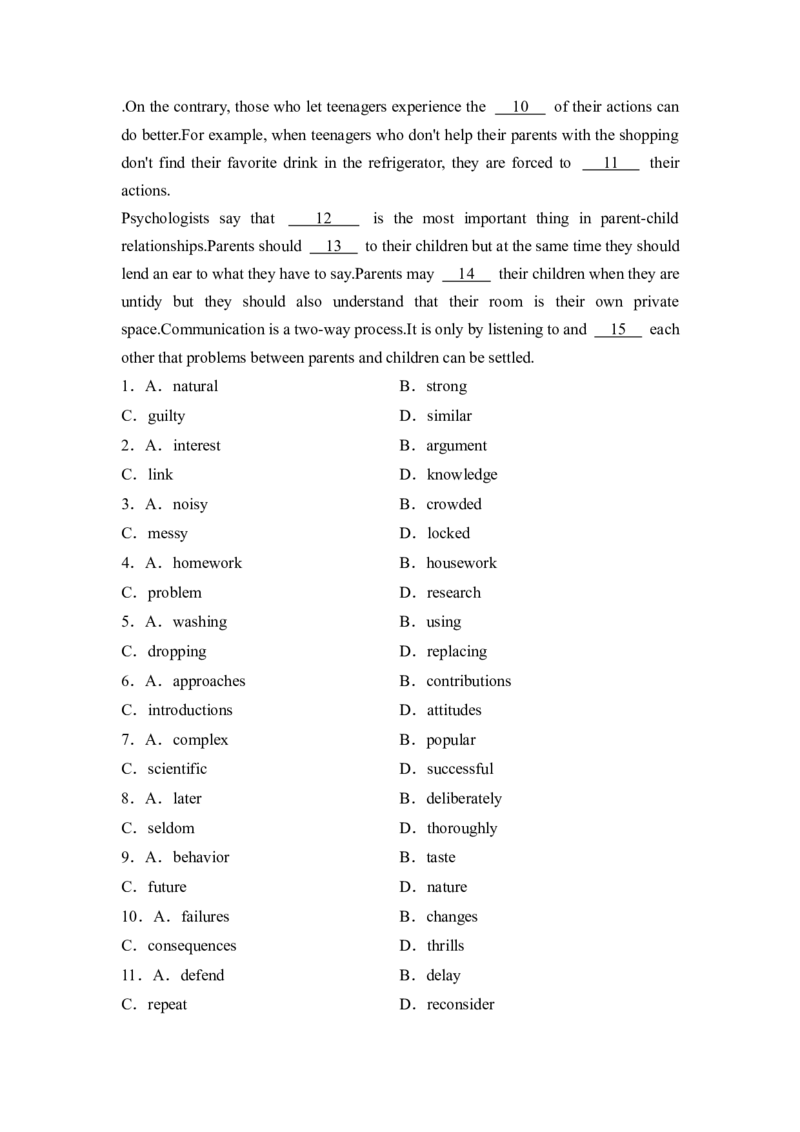
1.A.natural
B.strong
C.guilty
D.similar
2.A.interest
B.argument
C.link
D.knowledge
3.A.noisy
B.crowded
C.messy
D.locked
4.A.homework
B.housework
C.problem
D.research
5.A.washing
B.using
C.dropping
D.replacing
6.A.approaches
B.contributions
C.introductions
D.attitudes
7.A.complex
B.popular
C.scientific
D.successful
8.A.later
B.deliberately
C.seldom
D.thoroughly
9.A.behavior
B.taste
C.future
D.nature
10.A.failures
B.changes
C.consequences
D.thrills
11.A.defend
B.delay
C.repeat
D.reconsider
12.A.communication
B.bond
C.friendship
D.trust
13.A.reply
B.attend
C.attach
D.talk
14.A.hate
B.scold
C.frighten
D.stop
15.A.loving
B.observing
C.understanding
D.praising
A
(2025·安徽省合肥市庐阳区合肥八中高三三模)
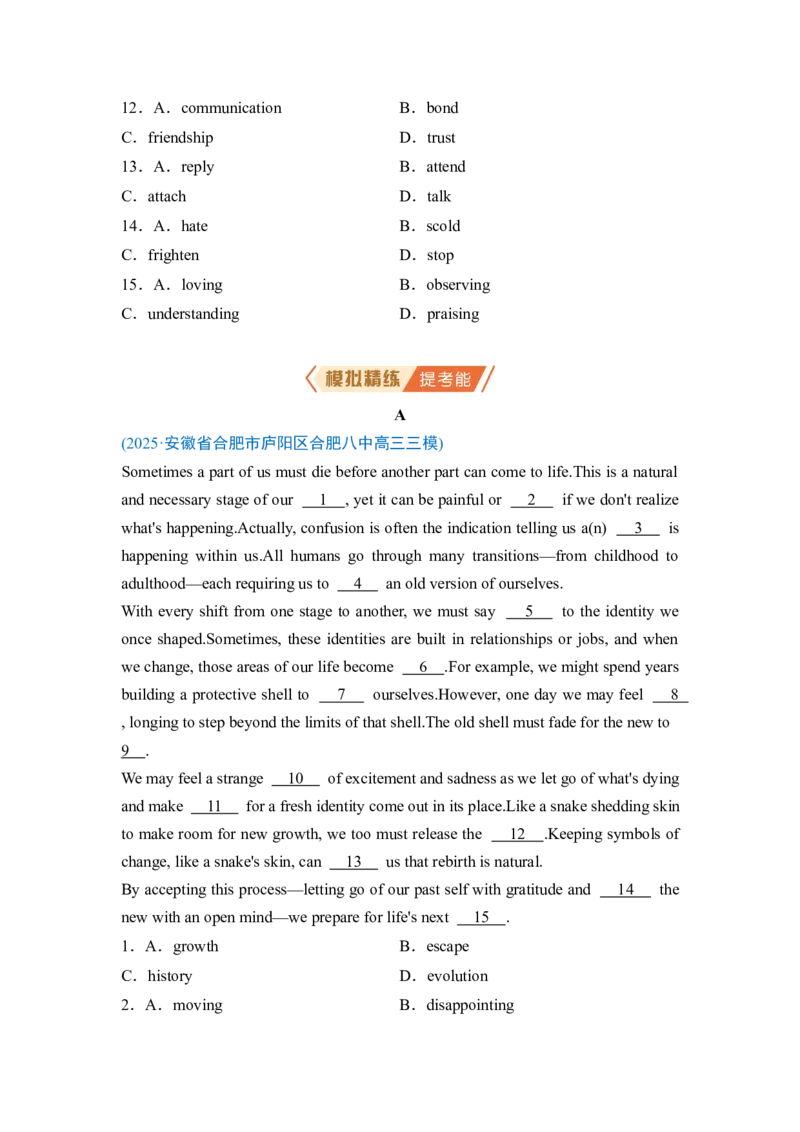
Sometimes a part of us must die before another part can come to life.This is a natural
and necessary stage of our   1  , yet it can be painful or   2   if we don't realize
what's happening.Actually, confusion is often the indication telling us a(n)   3   is
happening within us.All humans go through many transitions—from childhood to
adulthood—each requiring us to   4   an old version of ourselves.
With every shift from one stage to another, we must say   5   to the identity we
once shaped.Sometimes, these identities are built in relationships or jobs, and when
we change, those areas of our life become   6  .For example, we might spend years
building a protective shell to   7   ourselves.However, one day we may feel   8
, longing to step beyond the limits of that shell.The old shell must fade for the new to
9  .
We may feel a strange   10   of excitement and sadness as we let go of what's dying
and make   11   for a fresh identity come out in its place.Like a snake shedding skin
to make room for new growth, we too must release the   12  .Keeping symbols of
change, like a snake's skin, can   13   us that rebirth is natural.
By accepting this process—letting go of our past self with gratitude and   14   the
new with an open mind—we prepare for life's next   15  .
1.A.growth
B.escape
C.history
D.evolution
2.A.moving
B.disappointing
C.tiring
D.puzzling
3.A.idea
B.change
C.inspiration
D.notice
4.A.leave behind
B.leave out
C.let alone
D.let out
5.A.hello
B.thanks
C.goodbye
D.sorry
6.A.hurt
B.influenced
C.ignored
D.deserted
7.A.support
B.aid
C.establish
D.defend
8.A.connected
B.required
C.trapped
D.opposed
9.A.emerge
B.suspend
C.occupy
D.pose
10.A.urge
B.relief
C.need
D.mixture
11.A.time
B.way
C.sense
D.peace
12.A.past
B.tension
C.future
D.energy
13.A.convince
B.warn
C.remind
D.recall
14.A.hoping
B.revealing
C.welcoming
D.suspecting
15.A.youth
B.wonder
C.harvest
D.chapter
B
(2025·上海市奉贤中学高三三模)
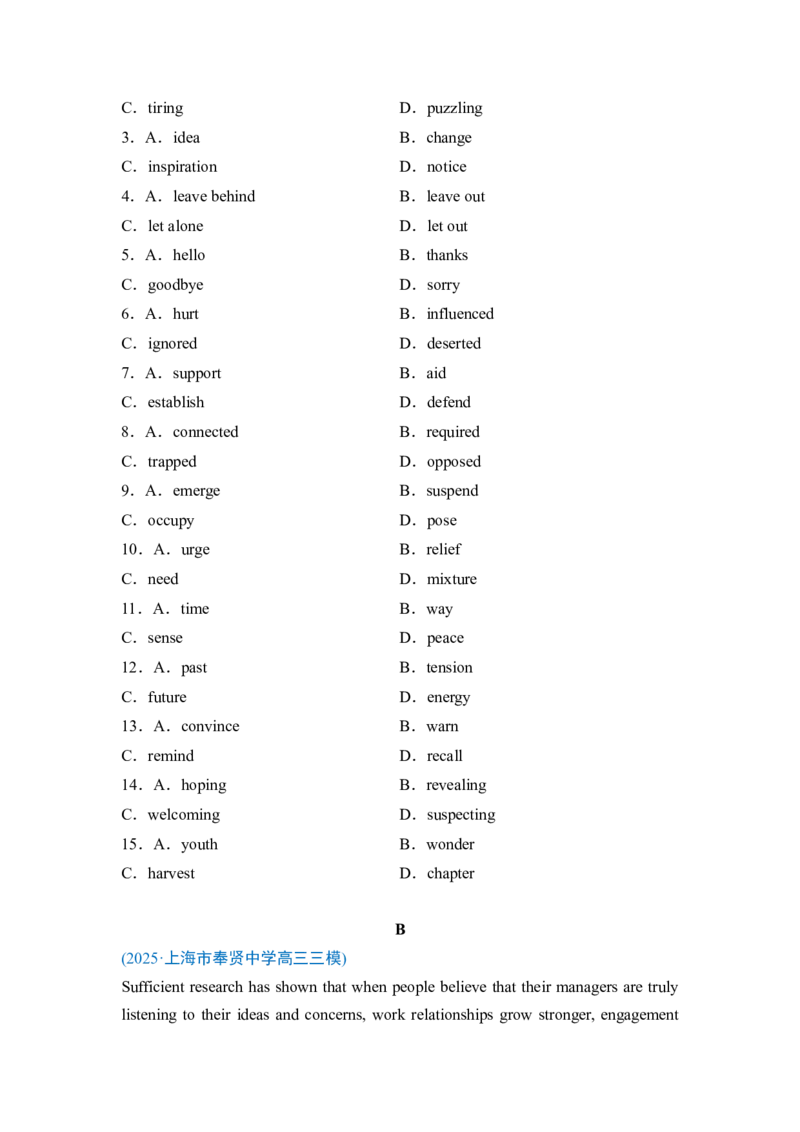
Sufficient research has shown that when people believe that their managers are truly
listening to their ideas and concerns, work relationships grow stronger, engagement
rises, and performance improves.That's why bosses have regular one-on-ones with
their   1   reports, and new division heads go on listening tours.
However, studies also show that such practices often are   2  —in part because
many managers simply aren't good listeners.When we conducted a comprehensive
review of 117 academic papers on workplace listening, we found that this skill is far
easier to describe than to   3  .
Why?Because listening is an   4   activity that requires empathy, patience, and the
ability to respond to what you hear.And because it can be so   5   demanding,
particularly when the subject matter is complex or emotionally charged, people often
take shortcuts.
Take Google's all-company Friday meetings.For years these were biweekly open
forums( 论坛) where company leaders would share   6  , discuss strategic
developments, and take questions from employees.They played a critical role in
maintaining a culture of   7   at the company.As Laszlo Bock, Google's former vice
president of people operations, once explained, they   8   “everything from
whether the mix of food in the cafés is too healthy to really significant questions
around whether our strategy with a particular country or product is good or evil”.
9  , in 2019 Sundar Pichai, Google's CEO, decided that the meetings were no longer
working.Employees wanted to talk about controversial issues like the company's
handling of hate speech, and discussions were often   10   to the press.Pichai made
them less regular and changed their   11  .It seems that listening to everyone had
gotten too difficult.
Similar situations have played out at Activision Blizzard, where an attempt to address
misconduct claims during a company town hall led to a massive strike, with workers
complaining that leaders were   12   rather than meaningfully addressing their
concerns, and at Amazon, where employees said that a daily survey designed to
evaluate staff well-being was being prejudiced by managers' direct pressure to give
13   answers and by worries that responses wouldn't be kept privately protected.
Listening without   14   action or explanation leads employees to believe their
efforts—and yours—have been pointless.There is a fix for this:Always complete the
communication cycle.Before ending a conversation, restate what you've heard,
identify the next steps for action, and   15   a timeline for checking back in.That
emphasizes forward momentum (势头) and ensures accountability.
1.A.direct
B.external
C.former
D.temporary
2.A.chaotic
B.beneficial
C.ineffective
D.innovative
3.A.document
B.debate
C.define
D.display
4.A.automatic
B.adaptive
C.instant
D.intentional
5.A.mentally
B.physically
C.financially
D.visually
6.A.policies
B.updates
C.successes
D.gossips
7.A.competition
B.trust
C.excellence
D.diversity
8.A.advocated
B.highlighted
C.covered
D.transferred
9.A.Therefore
B.However
C.Similarly
D.Alternatively
10.A.leaked
B.announced
C.recommended
D.assigned
11.A.agenda
B.duration
C.format
D.theme
12.A.denying
B.minimizing
C.justifying
D.resolving
13.A.honest
B.random
C.positive
D.vague
14.A.dynamic
B.periodic
C.urgent
D.subsequent
15.A.agree on
B.comment on
C.leave out
D.stretch out
※小贴士:完形填空五大易错点
高考是选拔性考试,试题有难度梯度。完形填空中总会有几道较难题目成为考
生取得优异成绩的“拦路虎”。导致这些题目失分的原因主要有以下几点:①
解题信息比较隐蔽;②干扰项迷惑性较强;③情感态度较难把握;④惯性思维
所致。针对这些题目,考生除了需要具备扎实的语言功底外,还应谨慎小心应
对。
易错点1 因缺乏全篇关联思维而错选
语篇层次题的解题信息不局限于某一句或某一句组,而是分散在某一段或几段
甚至全篇,这就要求考生理解整篇文章,抓住全文的脉络、作者的思想、意图
或主人公的心理,然后进行准确的推理、判断,从而做出正确的选择。对于此
类题目,一定要坚持这样一个原则:不急于解答,读完全文后综合考虑再做判
定。
易错点2 因不能正确区分形/义近词(组)而错选
完形填空题选项中经常会出现一些形近词(组)或义近词(组)让考生辨析,因为形
式相近或意义相近,无形中增加了难度,如果考生掌握得不好或不着眼于语篇
的意义便很容易选错。
易错点3 因词汇理解障碍而错选
在完形填空题的设题上,命题者往往还将一些考生平常容易忽视的词汇设置成
选项,从而造成考生错选。对于这些词汇,考生在平时必须高度重视。
易错点4 因不明一词多义或熟词生义而错选
在最近几年的高考完形填空中,对于一词多义或熟词生义的考查屡见不鲜,这
往往也是考生容易忽视的地方。很多考生由于不懂这些熟词的“新义”而出现
思维堵塞,造成了不应有的失分。
易错点5 因惯性思维而错选
在英语学习中,由于种种原因,如考生的母语、知识面、思维习惯等都有可能
使考生产生一些思维定式,即不善于思考,考虑问题不全面,从而抑制思维能
力的发展,误选一些题目。有些考生学习英语单词过于简单化,只记忆中文意
思,而不深刻理解实际用法和英汉用法之间的细微差异。例如:表示“成功做
某事”,不可以用succeed to do sth.来表达。学习词组或习惯用语时也会受到思
维定式影响。例如:学习了wait for 这个词组以后,有的考生在做题过程中只要
碰到wait,后面要接介词时就毫不犹豫地选择for。但在“He stopped his car to
wait at the red light.”中就不用for。