专题 11 阅读七选五议论文
目录
题型综述 . . . . . . . . . . . . . . . . . . . . . . . . . . . . . . . . . . . . . . . . . . . . . . . . . . . . . . . . . . . . . . . . . . . . . . . . . . . . . . . . . . . . . . . . . . . . . . . . . . . . . . . . . . . . . . . . . . . . . . . . . . . . . . . . . . . . . . . . . . . . .2
解题攻略 . . . . . . . . . . . . . . . . . . . . . . . . . . . . . . . . . . . . . . . . . . . . . . . . . . . . . . . . . . . . . . . . . . . . . . . . . . . . . . . . . . . . . . . . . . . . . . . . . . . . . . . . . . . . . . . . . . . . . . . . . . . . . . . . . . . . . . . . . . . . .3
题型 01 论点句题 . . . . . . . . . . . . . . . . . . . . . . . . . . . . . . . . . . . . . . . . . . . . . . . . . . . . . . . . . . . . . . . . . . . . . . . . . . . . . . . . . . . . . . . . . . . . . . . . . . . . . . . . . . . . . . . . . . . . . . . . . . . . 3
题型 02 论据支撑句题 . . . . . . . . . . . . . . . . . . . . . . . . . . . . . . . . . . . . . . . . . . . . . . . . . . . . . . . . . . . . . . . . . . . . . . . . . . . . . . . . . . . . . . . . . . . . . . . . . . . . . . . . . . . . . . . . . . . . . .4
题型 03 过渡衔接句题
题型 04 总结句题 . . . . . . . . . . . . . . . . . . . . . . . . . . . . . . . . . . . . . . . . . . . . . . . . . . . . . . . . . . . . . . . . . . . . . . . . . . . . . . . . . . . . . . . . . . . . . . . . . . . . . . . . . . . . . . . . . . . . . . . . . . . . . . .7
高考练场 . . . . . . . . . . . . . . . . . . . . . . . . . . . . . . . . . . . . . . . . . . . . . . . . . . . . . . . . . . . . . . . . . . . . . . . . . . . . . . . . . . . . . . . . . . . . . . . . . . . . . . . . . . . . . . . . . . . . . . . . . . . . . . . . . . . . . . . . . . . . .8
题型简介
高考英语阅读中的七选五议论文,旨在考查学生对议论性文本的语篇连贯性与逻辑性的把握。此类文章围
绕特定观点展开论述,作者运用论据、推理来支持或反驳论点,话题涉猎教育改革、社会现象剖析、道德伦理探讨等领域,行文依靠论点、论据与论证的紧密配合,语言富有逻辑性,结构层次分明,而七选五题
型要求学生从七个备选句子里挑出五个恰当的,嵌入文中空缺处,使文章语义通顺、论证连贯。
命题类型
论点句:常处于段落开头,用来明确提出该段落的核心主张,引领后续的论证阐述,为全段定下论述
基调,例如 “In addition to economic benefits, there is another crucial aspect to consider.”,旗帜鲜明开启
新论述方向。
论据支撑句:为已提出的论点补充事实依据、具体案例、统计数据、名人名言等内容,让抽象论点变
得鲜活可感,增强说服力。比如论点是 “运动有益身心”,论据句可能列举长期运动人群的健康数
据。
过渡衔接句:位于段落之间或段落内部,起到承上启下的关键作用,既总结上文关键要点,又自然流
畅地开启下文新话题,确保论证层层递进、环环相扣,就像 “However, the situation is far from perfect,
and new problems have emerged.”,在转折间推进论述。
总结句:常出现在段末,对全段论述内容进行扼要概括,再次强调论点,加深读者印象,或者对后续
论证走向做含蓄铺垫,如 “In short, we need to take immediate action to address this issue.” 。
解题思路
速览全文抓主旨:快速通读文章,尤其留意文章标题、首段以及每段首尾句,迅速提炼核心论点,明
确文章围绕什么主题、秉持什么立场在展开议论,为后续解题锚定大方向。
分析空处位置定功能:若空缺处在段首,优先考虑论点句,要能提纲挈领;位于段中,大概率是衔接
过渡或补充论据;要是在段尾,多为总结收尾,或是抛出引出下段的悬念话题。
找关键词匹配:仔细研读空缺处上下文,圈出关键实词,比对选项,找出与之匹配的词汇,像同义
词、反义词、同类词,借助语义关联锁定潜在答案,例如上文提及 “environmental protection”,选项
含 “green initiatives” 就值得关注。
依循逻辑关系选:关注文中逻辑连接词,如表示并列的 “and”“also” ,转折的 “but”“however”,因果
的 “so”“therefore” 等,据此判断选项与上下文逻辑是否契合,使文章论证行云流水。
代入通读核查:把选好的句子依次填入文中,完整通读一遍,检查文章整体语义连贯、逻辑通顺与
否,如有语义跳跃、衔接生硬的地方,需重新审视选项。题型01 论点句题
(24-25高三上·重庆·阶段练习)Worrying is just a familiar emotion that a person gets when he starts to
get concerned about the outcome of something that he cares about. 1 It’s all about the triggers (诱因).
............
4 As you might have already guessed, not giving in to the first negative thought is one of the best
strategies to deal with worrying. By pushing that negative thought away as soon as it appears you can give
yourself the chance not to fall into this worrying trap.
............
A.More worrying means more time wasted.
B.This is where the downward cycle often begins.
C.But what we may not know is its negative effects.
D.But do you know how the worrying process starts?
E.However, there are still ways to break free from this cycle.
F.You may study harder if worried about, for example, an upcoming exam.
G.The biggest problem here is that things people worry about are usually uncertain.
题型02 论据支撑句题(2024·广东广州·一模)As a baby, Jack’s remarkable swimming journey began. At ten months, he
already practised with swim aids. At six, he won his first swimming competition in a group for kids ten-and-under.
At seven, he stayed at the pool from nine in the morning till eight hours later. His mother, recognizing his gift,
took it as her duty to guide him. 11 By a young age, Jack had been ranked the number one swimmer of the
country, a title he held for a record-breaking duration.
............
In a world that demands people to specialize early, we face a challenge to keep the benefits of diverse
experiences and delayed concentration. There’s a need for those with Jack’s early focus. 15 — People who
start with many different things and accept various experiences. People with range.
A.There was no time to waste.
B.And it was all going according to plan.
C.The growing complexity of the world also calls for more Sams.
D.But it didn’t seem to hold back his development in the long run.
E.In reality, the Sam’s path to success is far more common, yet less told.
F.In contrast to Jack, Sam didn’t show significant sporting talent until later.
G.Unlike the swimming talent, Sam’s early years were filled with a variety of sports.
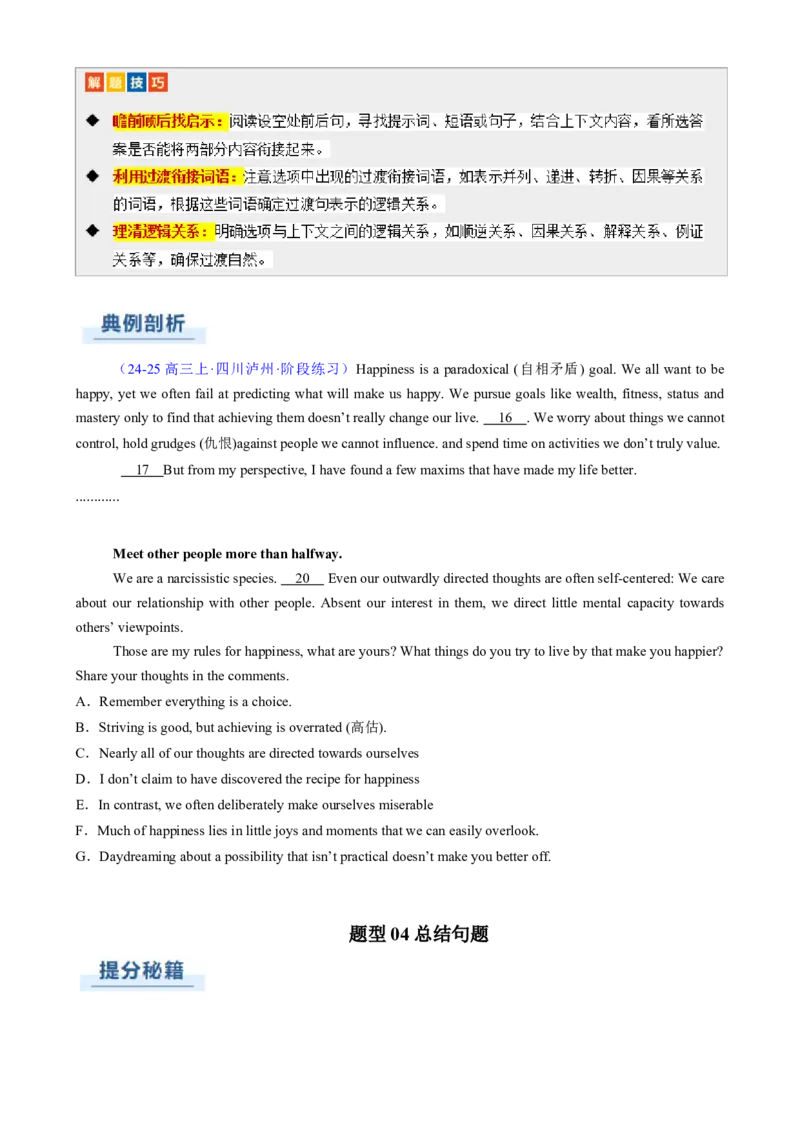
题型03 过渡衔接句题(24-25高三上·四川泸州·阶段练习)Happiness is a paradoxical (自相矛盾) goal. We all want to be
happy, yet we often fail at predicting what will make us happy. We pursue goals like wealth, fitness, status and
mastery only to find that achieving them doesn’t really change our live. 16 . We worry about things we cannot
control, hold grudges (仇恨)against people we cannot influence. and spend time on activities we don’t truly value.
17 But from my perspective, I have found a few maxims that have made my life better.
............
Meet other people more than halfway.
We are a narcissistic species. 20 Even our outwardly directed thoughts are often self-centered: We care
about our relationship with other people. Absent our interest in them, we direct little mental capacity towards
others’ viewpoints.
Those are my rules for happiness, what are yours? What things do you try to live by that make you happier?
Share your thoughts in the comments.
A.Remember everything is a choice.
B.Striving is good, but achieving is overrated (高估).
C.Nearly all of our thoughts are directed towards ourselves
D.I don’t claim to have discovered the recipe for happiness
E.In contrast, we often deliberately make ourselves miserable
F.Much of happiness lies in little joys and moments that we can easily overlook.
G.Daydreaming about a possibility that isn’t practical doesn’t make you better off.
题型04 总结句题(2024·广东湛江·一模)Many significant international projects have considered how schooling might
change to better match the changes that have taken place in the 21st century. 26 One is a shift in the meaning
of knowledge, and the other is the need to build education systems based around what we now know about
learning.
............
28 Nor does it deny the need for obvious goals for students’ knowledge development. Rather, the
future-focused education literature suggests we need to adopt a much more complex view of knowledge, one that
incorporates knowing, doing and being. Alongside this we need to rethink our ideas about how our learning
systems are organized, resourced and supported. Research clearly shows that people do not learn well as passive
recipients (接受者) of pre-packaged, bite-sized pieces of knowledge. 29
Although some of these principles are understood by many teachers, our education systems and practices
are often set up in ways that do not support these principles to operate in practice. Teachers and school leaders are
attempting paradigm (范式) shifts. 30
A.There needs to be wider public support for them.
B.There are two important ideas that support this work.
C.This does not mean that knowledge no longer matters.
D.Good learning requires active engagement in the “whole game”.
E.We are required to prepare young people for the knowledge age.
F.This is possible only when active learning approaches are applied.
G.In the knowledge age, the ability to generate value is put in the first place.
(2024年新课标高考英语甲卷)
What is moderation (适度)? Basically, it means eating only as much food as your body needs. You should
feel satisfied at the end of a meal, but not too full. ____16____ But it doesn't mean saying goodbye to the foodsyou love.
Take your time. It's important to slow down and think about food as something nutritious rather than just
something to eat in between meetings. ____17____ It actually takes a few minutes for your brain to tell your body
that it has had enough food, so eat slowly and stop eating before you feel full.
Eat with others whenever possible. Eating alone, “specially in front of the TV or computer, often leads to
mindless overeating. And be careful about the foods you keep at hand. It's more challenging to eat in moderation if
you have unhealthy snacks at the ready, like cookies. ____18____
Control emotional (情绪的) eating. ____19____ Many of us also turn to food to deal with unpleasant
emotions such as sadness, loneliness, or boredom. But by learning healthier ways to manage emotions, you can
regain control over the food you eat and your feelings.
____20____ A healthy breakfast can start your metabolism (新陈代谢), while eating small, healthy meals
keeps your energy up all day. Avoid eating late at night. Try to eat dinner earlier and fast for 14 — 16 hours until
breakfast the next morning. Studies suggest that eating only when you're most active and giving your digestive
system a long break each day may help to regulate weight.
A. Eat properly throughout the day.
B. We don't always eat just to satisfy hunger.
C. Don't swallow a meal on the way to work.
D. Most of us need to double the amount we eat.
E. Instead, surround yourself with healthy choices.
F. For many of us, moderation means eating less than we do now.
G. That won't lead to cheating or giving up on your new eating plan.
(2022年6月普通高等学校招生全国统一考试(浙江卷)英语试题)
I have a drawer full of letters to Santa. Each year my children would write up their Christmas wish lists.
They were polite requests for the latest game or toy. As the children got older, they would give Santa some
hints(提示)on where to buy their presents. 1
Those letters taught my children a valuable lesson about writing: It has a purpose. Sometimes our purpose is
to achieve something;other times it may be to entertain, inform, or persuade. 2 And when writing doesn’t
seem to have any purpose or get any kind of meaningful response, then it can be hard to get excited about doing it.
Christmas is a great time of year for children to communicate with others through writing. When children
write for real audiences and real purposes, they can learn to choose their words accordingly. 3 You write
“Dear Santa” because you don’t know him personally and you want to show him respect.
4 Texting, online messaging, live chats while playing video games all mean that they are constantly
producing written messages. However, because they are usually writing to family and friends, they use informal
language most of the time.
There is nothing wrong with this kind of writing. It suits the audience and the purpose and gets the job
done. 5 This type of writing won’t be rewarded by the school examiner, nor by a future employer or a
potential client. The very best communicators are those who know how to adjust their language to match their
audience.
A.It isn’t that these young people can’t write.B.But it is always purposeful-or at least it should be.
C.The age of pen-and-paper letter writing may have passed.
D.As a result, each year they received something they wanted.
E.You write “Hi Nanna and Pop” because you are close to them.
F.As technology develops, young people are writing more than they ever have.
G.But if this is the only kind of writing young people do, it will cause problems.
(江苏省南京市第十三中学2023-2024学年高考模拟英语试卷)
Art is all around us. It can be found everywhere, including fancy galleries, people’s living rooms, and on
the sides of buildings. So, why is art important?
It promotes expression and creativity. As humans, we’re naturally drawn to art as a form of expression and
communication. 6 It’s a way for them to express themselves before they’re able to speak. In fact,
participation in the arts may even assist kids with language, motor skills, and visual learning development.
7 . When someone applies for a job, there are certain skills they need to have like data analysis or
bookkeeping. However, many employers also understand the very important need for the skills which are hard to
measure and often difficult to define. Some examples include a person’s ability to adapt to change, think
creatively, or collaborate with team members.
It provides historical context. 8 . This is why people dedicate their lives to studying cave art,
Shakespearean plays, and so much more. When we take the time to dive into art created in the past, we can learn
about other generations and eras. We can study art to find out what those before us were facing and how they
overcame it. 9 .
In therapy (疗法) settings, art also provides an opportunity for digging deeper and expressing emotions that
are difficult to discuss. 10 . In one important study, children between 6 and 12 were asked to draw a house as
a distraction after thinking about something upsetting. This group was able to improve their mood when compared
with children who were instructed to draw the negative event or simply copy another drawing.
A.It helps all of us develop necessary soft skills.
B.These are its major benefits.
C.It can help people handle mental problems.
D.Art and human history go hand-in-hand.
E.Similarly, future generations will learn about current events by the art we leave behind.
F.How does it have an impact on our life?
G.Children love to draw, sing and dance.
A(24-25高三上·山西·阶段练习)It is not generally realized, for example, that a tale written in China in
the ninth century is the world’s oldest known version of the story of Cinderella. The next earliest was not
published until seven hundred years later — in Lyons, France, in 1544. In addition, 350 other stories that are
related in some way to Cinderella have been collected from every continent.
Those Cinderella stories fall into two main groups. In one, the focus is on the ball, while comparatively
little attention is paid to the supernatural force that helps her. This is the type most familiar to us and most
commonly found in western Europe. In those found in eastern Europe, much attention is paid to the helpful
animals. But the Chinese version contains both.
Old though it is, the Chinese version shows definite signs of having been based on still earlier — and now
lost — versions. The incident of the ball, for example, is linked with the rest of the story so unnaturally that it
seems that the author has borrowed this incident from some still earlier version, but without clearly understanding
its significance. It will also be remembered that the king who married the girl came from a country called T’o-
huan. Though this country is not identified in the story, we know from Chinese historical writings of that time that
there was a small country by that name located near a region called T’o-ho-lo. And T’o-ho-lo can be identified
with certainty as close to the modern city of Bangkok in Thailand. This makes it probable that the Chinese story of
Cinderella did not originate in China, but was taken there from Southeast Asia, perhaps by the Arabs who went as
traders to Canton in large numbers.
This story shows that the same simple virtues which are regarded as basic in the West have been
emphasized
for centuries in China and other parts of Asia. It is but one example of the way a story or an idea can travel all over
the world.
1.What phenomenon is described in the first paragraph?
A.A story usually has different origins.
B.Chinese literature has a very long history.
C.Different countries may have similar stories.
D.French literature was influenced by the Chinese.
2.What is unique about the Chinese version of Cinderella?
A.The plot develops more naturally.
B.It is centered on those helpful animals.
C.Relatively little attention is paid to the ball.
D.It stresses both the ball and the supernatural force.
3.Which evidence shows that the Chinese version originates in Southeast Asia?
A.The original writer’s identity. B.Some related historical records.
C.A newly found version of the story. D.A well-known kingdom in the story.
4.How is the text mainly developed?
A.By analyzing an example. B.By reviewing studies.
C.By telling a very old story. D.By conducting surveys.B
(24-25高三上·浙江·阶段练习)I often remind myself that Inside Out is a movie made for kids. Maybe
because I was 9 years old when I first watched it. Back then, it was just a fun movie about colorful characters
inside a girl’s head: Joy, Sadness, Fear, Anger, and Disgust. And guess what? my favorite is Joy! I admired her
sparkle and the way she made everything feel brighter. I feel like she was the only important emotion because she
made Riley happy.
Now, I am an 18-year-old grown-up. I was excited when I heard Inside Out 2 is coming out in 2024. Who
said this is just for kids? My younger self back in 2015 would definitely tease me for watching “child’s stuff.” But
this new part is adding even more depth, introducing new emotions like Embarrassment, Ennui (无聊), Envy, and
Anxiety.
It feels like the movie waited for us to grow up to launch part 2. They want us to feel what Riley’s feeling.
It’s like they knew we needed time to understand the first movie fully, and now they’re ready to take us deeper.
And yes, it did go deeper. I never expected that this movie would make me shed tears. “I don’t know how to
stop anxiety. Maybe it’s true that when you grow old, you’ll feel less happy.” And you know what? That’s
perfectly fine. It’s okay to feel anxious, it’s okay to be scared, and it’s okay to realize that this world is not only
about happiness.
Growing up, you will realize that Joy isn’t the only important emotion. All of our emotions are meant to be
felt, even the hard ones. They shape how we see the world and how we connect with each other. This showed us
that our feelings are part of what makes us who we are. They’re not something to hide or ignore—they’re the
heartbeats of our experiences, guiding us through life’s ups and downs. So, let’s embrace them, cherish them, and
remember that feeling all our emotions deeply is a beautiful part of being alive.
5.What did the author think of Inside Out when first watching it?
A.It was intended for children. B.It was difficult for kids to understand.
C.It taught important lessons about emotions.D.It offered useful advice on how to be happy.
6.Why did Inside Out 2 come out so many years later according to the author?
A.To wait for Riley to grow up.
B.To create more colorful characters.
C.To target a wider range of audience age groups.
D.To guarantee a better understanding of the movie.
7.Why did the author cry when watching Inside Out 2?
A.The author learned a bitter truth.
B.The author related deeply to the movie.
C.The movie made the author anxious and scared.
D.The movie fell short of the author’s expectations.
8.What is the message the author hopes to convey?
A.Growing up is a painful process.
B.Joy is unnecessary to a beautiful life.
C.It’s impossible to hide or ignore our emotions.
D.A mix of emotions makes us unique and beautiful.C
(24-25高三上·浙江·阶段练习)Always busy “doing” things? If so, you may be suffering from “toxic
productivity,” a destructive rather than productive behavior.
I imagine you’re thinking, “Productivity must be good, right?” But toxic productivity, in contrast with
regular productivity, is an excessive need to always be productive, regardless of the cost to your health,
relationships, and life.
If you’re driven to continuously “produce” or “do” things, whether at work or at home, the results are
frequently not your best — they’re usually delivered without any delay and without sufficient forethought,
analysis, planning or reflection. And if, in the doing, you’re also exhausted and burned out — or feeling guilty for
not doing
more or better — you are very likely suffering from toxic productivity.
Often, I see coaching clients who have a challenge in front of them, and their first response is to do
something, at once. Anything. They don’t want to sit with the problem, they don’t want to think about it, nor do
they want to take time to reflect on any options for action. All they want to do is hear what the issue is —
sometimes without even fully understanding it — and then quickly get straight on with the “doing.” Whatever
their reason, these clients, like many people, just want to get on and “do” — even if this means getting poorer
results.
There are all sorts of reasons for this toxic productivity. Number one is that “doing” often feels more
comfortable than “not doing.” There’s often a firm belief that action speaks louder than words and that it’s a virtue
to act fast. In the workplace, for example, leaders want to demonstrate that they are successful, which they usually
associate with being productive. There is also a competitive culture among junior staff wanting to stand out as
keen, hard workers in order to progress in their careers. And thus, a culture of toxic productivity can develop
throughout an organisation.
9.How is toxic productivity different from regular productivity?
A.It is harmful. B.It is flexible.
C.It is more efficient. D.It is more time-consuming.
10.Who are most likely to suffer from toxic productivity?
A.Clients avoiding challenges. B.Junior staff eager to stand out.
C.Leaders satisfied with their success. D.Workers reflecting on options before acting.
11.What is the main reason for toxic productivity?
A.A strong desire for success. B.Too much emphasis on virtues.
C.A cultural preference for action. D.Too much pressure from others.
12.Which of following best describes toxic productivity?
A.Doing is undoing. B.The sooner the better.
C.Enough is enough. D.Better safe than sorry.
D(23-24高三上·江苏南京·阶段练习)Art is all around us. It can be found everywhere, including fancy
galleries, people’s living rooms, and on the sides of buildings. So, why is art important?
It promotes expression and creativity. As humans, we’re naturally drawn to art as a form of expression and
communication. 13 It’s a way for them to express themselves before they’re able to speak. In fact,
participation in the arts may even assist kids with language, motor skills, and visual learning development.
14 . When someone applies for a job, there are certain skills they need to have like data analysis or
bookkeeping. However, many employers also understand the very important need for the skills which are hard to
measure and often difficult to define. Some examples include a person’s ability to adapt to change, think
creatively, or collaborate with team members.
It provides historical context. 15 . This is why people dedicate their lives to studying cave art,
Shakespearean plays, and so much more. When we take the time to dive into art created in the past, we can learn
about other generations and eras. We can study art to find out what those before us were facing and how they
overcame it. 16 .
In therapy (疗法) settings, art also provides an opportunity for digging deeper and expressing emotions that
are difficult to discuss. 17 . In one important study, children between 6 and 12 were asked to draw a house as
a distraction after thinking about something upsetting. This group was able to improve their mood when compared
with children who were instructed to draw the negative event or simply copy another drawing.
A.It helps all of us develop necessary soft skills.
B.These are its major benefits.
C.It can help people handle mental problems.
D.Art and human history go hand-in-hand.
E.Similarly, future generations will learn about current events by the art we leave behind.
F.How does it have an impact on our life?
G.Children love to draw, sing and dance.
E
(23-24高三·湖北·阶段练习)What a comedian can teach you about managing stress
We often accept stress as part of the cost of modern life, but it really doesn’t have to be. We all know that
laughter is the best medicine. 18 People who can laugh at their own misfortunes bounce back faster and
stronger. Here is what a comedian says about coping with stress.
You can try to find a different perspective. 19 Once a friend of mine fell asleep in the middle of a
class. His teacher decided to make fun of him by inviting students to applaud, wondering whether my friend would
applaud along when he woke up. He did and the whole class burst outlaughing. After learning everything, he was
both embarrassed and ashamed of course but after a while, my friend laughed. “If this had happened to someone
else, it would have been amusing. So it’s no less funny, just because it happened to me. “
20 There’s no doubt that we all experience great stress now and then. We’ve all been personally
affected, in some way. You might not have felt like laughing at the time But now, looking back, you could
consider all of the strange aspects of the experience and all of the things you did to keep active or simply stay sane
(神志正常的) .When you share stories with your friends, you can choose to share stories of trauma (创伤) and pain, or you
can choose to lift their spirits with stories of hope and growth. 21 Take the exact same story and change the
focus from “feel sorry for me” to “laugh with me”. Keep in mind that we’re all in this together, that we all share
the same ridiculous experiences, and that we can laugh together at whatever life throws at us. 22
A.Always share a good story.
B.Why not do what comedians do?
C.You can also look again and laugh.
D.But laughter does more than cheer you up.
E.Then you are able to make a simple choice.
F.In this way. you will say goodbye to stress forever.
G.If you have trouble seeing the funny side, you may find the following inspiring.
F
(24-25高三上·湖南·阶段练习)The London Underground, or the Tube, as it is usually known, is the
oldest underground system in the world. 23 Horse-drawn vehicles were used to transport people in and out of
the city, and this caused unbelievable traffic jams.
Something had to be done. In 1854, plans for an underground railway in central London received
government approval. 24 The first line was finally opened in 1863 and was just beneath the surface of the
ground. Passengers were transported in windowless carriages, which were pulled through the narrow tunnels by
steam engines. This required large air holes leading to the surface at regular intervals to let out smoke from the
tunnel, so that people could get fresh air and would not choke. In the following decades, more underground lines
were built.
Thanks to electricity and improved tunnelling technology, the pace of development accelerated. The first
railway tunnel under the Thames was completed in 1884, and the first electric underground railway opened in
1890. 25 Travelling on these lines was not convenient, though — the lines were very far from each other, and
each was owned by a different company. Charles Yerkes, a wealthy American businessman, decided to improve
the system by buying up the many different lines and setting up the Underground Electric Railways Company of
London in 1902. In 1933, the London Underground and the different bus and train lines passed into public
ownership.
26 When London was bombed, many underground stations served as bomb shelters. One line was
converted (转变) into an underground airplane factory, and some underground stations were used by the
government and the military as command centers and meeting rooms. After the war, there was an increase in
ridership, so more lines were added, including the Victoria Line (1968) and the Jubilee Line (1979), which was the
last line added to the network.
Today, the London Underground can carry more passengers than ever before. 27 The network now
includes eleven lines and extends 250 miles out of central London.
A.Construction of the first railway proved to be inefficient.
B.The system is used by up to five million people per day.
C.The underground system had some unusual uses during World War Ⅱ.D.In the future, the underground system may serve even more passengers.
E.Over the next twenty-five years, six independent deep underground lines were constructed.
F.However, as the railway was costly and required new train technology, construction was postponed.
G.There had been rail services in London since the 1830s, but most train lines stopped outside the city center.