第02 讲 完形填空——说明文和议论文
目录
01 课标达标练(完形填空)
考向1 说明文
考向2 议论文
02 核心突破练
   说明文和议论文创新练
03 真题溯源练
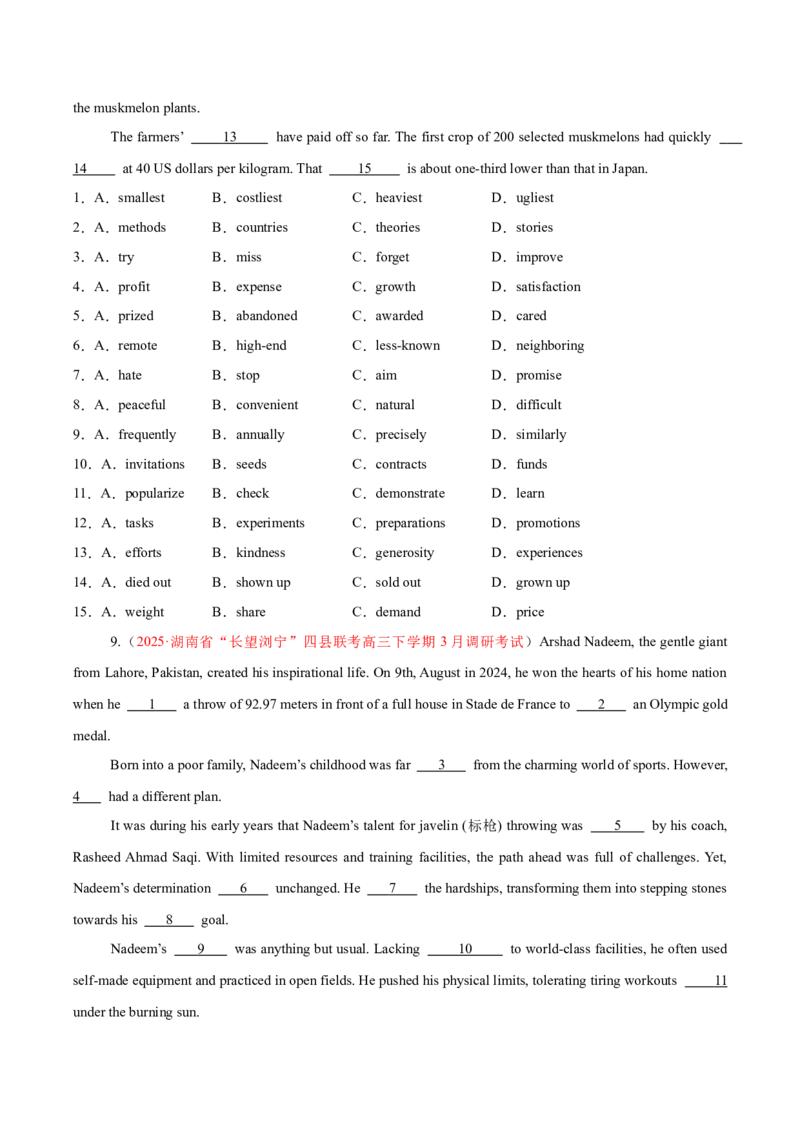
01 课标达标练(完形填空)
考向1 说明文
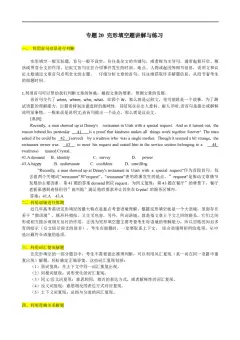
1.完形填空
Instead of enjoying the summer vacation time like most junior middle school students, Feng Boyao and
Meng Shuqi were busy     1     the Braille (布拉耶盲文) reading     2     they invented.
Feng and Meng, students at No. 37 Middle School in Taiyuan, Shanxi Province, spent nearly a year
developing a new kind of Braille reading device and won first prize at a recent provincial-level youth science and
technology innovation     3    .
The patented device was     4     for a national-level competition that     5     in Beijing. A large
number of Braille     6     dots had been set up on the device. It could translate Braille content as a cursor (光
标) moved across a computer screen via a computer application.
They said the education for those people with visual     7     was mainly based on Braille books, but
very few Braille books could be found in the marketplace, or they were     8     and couldn’t meet the needs of
the blind. And only a small number of people had access to Braille reading devices, which are very     9     and
might sell for as much as 10,000 yuan or more. “The     10     of our device is much lower, so it will be
advantageous in terms of market     11    ,” they said.
In addition, because of its magnetic structure, the content     12     on the device was said to be more
13     than others.
“We hope our device can help reduce the proportion of blind people who become poor from     14     of
education,” Meng said. “We also     15     to contribute our power to China’s poverty alleviation ( 扶贫)
strategy.”
1.A.improving
B.filling
C.arming
D.starting
2.A.book
B.device
C.engine
D.form
3.A.examination
B.meeting
C.competition
D.party
4.A.canceled
B.hunted
C.blamed
D.entered
5.A.kicked off
B.put off
C.gave off
D.took off
6.A.contact
B.connect
C.attach
D.relate
7.A.barriers
B.adaptation
C.height
D.disabilities
8.A.fashionable
B.strict
C.outdated
D.tied
9.A.advanced
B.popular
C.expensive
D.affordable
10.A.size
B.cost
C.distance
D.rate
11.A.trust
B.evidence
C.flight
D.promotion
12.A.reveal
B.displayed
C.admired
D.fired
13.A.accurate
B.lasting
C.severe
D.profound
14.A.use
B.lack
C.freedom
D.delicacy
15.A.allow
B.highlight
C.wish
D.permit
2.The Qingming Festival is popularly associated with Jie Zitui, who lived in Shanxi Province in around 600
B.C. Legend has it that Jie saved his     1     lord’s life by serving a piece of meat from his own leg. When
the lord succeeded in becoming the ruler of a small principality, he invited his     2     follower to join him.
However, Jie     3     his invitation, preferring having a hermit’s life with his mother in the mountains.
The lord didn’t want him to leave and knew Jie was obedient. Believing that he could     4     Jie out by
burning the mountain, the lord     5     his men to set the forest     6    . To his astonishment, Jie chose to
7    in the mountain and was burnt to death. The lord regretted doing this. In     8     of Jie, the lord ordered
all fires in every home to be     9     on the anniversary of Jie’s death. The story began the Cold Food Festival,
a day when no hot food could be cooked since no fire could be lit.
The Cold Food Festival occurs on the day before the Qingming Festival and is often

 1  0

  as part of
it. As time passed, the Qingming Festival replaced the Cold Food Festival. Whatever practice is

 1  1

 , the
basic observance of Qing Ming is to remember one’s elders by making a special

 1  2

  to visit their graves,
ashes or ancestral tablets. To make the visit even more meaningful, some time should be

 1  3

  to let the
young generation of family members know ancestors’ past

 1  4

  and contributions, and the story of Jie
Zitui who chose

 1  5

  over capitulation (投降).
1.A.starving
B.suffering
C.shouting
D.waiting
2.A.respectful
B.faithful
C.careful
D.meaningful
3.A.accepted
B.declined
C.received
D.noted
4.A.break
B.attack
C.force
D.depress
5.A.lowered
B.dug
C.directed
D.ordered
6.A.on fire
B.on the floor
C.in danger
D.under protection
7.A.leave
B.seize
C.remain
D.queue
8.A.honor
B.search
C.favor
D.defence
9.A.got out
B.put out
C.given out
D.figured out
10.A.considered
B.thought
C.looked
D.taken
11.A.bonded
B.observed
C.admired
D.founded
12.A.conversation
B.speech
C.happening
D.effort
13.A.cost
B.spent
C.taken
D.trusted
14.A.impressions
B.schedules
C.struggles
D.bonuses
15.A.bully
B.interest
C.death
D.profits
3.(2025·河北省秦皇岛市河北昌黎第一中学高三下学期考前最后一卷)Jeffrey Lee, a Mizzou
architectural studies graduate who formed Level Studio in 2021, just gave the charging infrastructure project an
injection of new energy. With Level Studio

 1

  Christopher Taurasi and Lexi White, Lee put forward the
electric vehicle (EV) charging station concept, Electric Oasis, which won the 2023 Forge Prize.

 2

  steel as
the primary building material, the design reimagines existing gas stations as charging

 3

  for electric
vehicles.
With the

 4

  from gas-powered vehicles — the goal is to have EVs

 5

  at least 50% of
new car sales by 2030 — conventional gas stations could be put

 6

 . But half of gas stations are on
petroleum-polluted land that requires strict

 7

 . The studio’s design features “tree-like” steel canopies (顶
篷) that

 8

  into their foundation an innovative system that removes ethanol (乙醇) pollution.
The concept also addresses the

 9

  EV charging process. Filling a tank of gas usually takes around 2
to 5 minutes,

 10


  the time required for an EV to reach a

 11


  charge can take up to 4.5 hours.
“Our solution was to create more spaces, to transform the gas station into something that’s more of a destination,”
Lee says. In their design it’s not

 12


  a charging station. “What does the community need? Can these
spaces also

 13


  them?” “The design is flexible, so it can be

 14


  to different sites.”
For now, the team is pursuing leads and is

 15


  to partnering with interested companies or
development teams to put their Electric Oasis design into practice.
1.A.applicants
B.co-founders
C.friends
D.physicians
2.A.Employing
B.Undertaking
C.Instructing
D.Deciding
3.A.approaches
B.privileges
C.inventions
D.destinations
4.A.angle
B.purpose
C.shift
D.boundary
5.A.rise to
B.make up
C.take down
D.cut down
6.A.at a loss
B.out of date
C.out of business
D.at risk
7.A.coverage
B.restoration
C.innovation
D.distribution
8.A.integrate
B.change
C.force
D.shrink
9.A.lengthy
B.delicate
C.rough
D.smooth
10.A.because
B.despite
C.though
D.while
11.A.rich
B.full
C.steady
D.typical
12.A.necessarily
B.casually
C.merely
D.slightly
13.A.ignore
B.serve
C.hold
D.please
14.A.reformed
B.justified
C.committed
D.adapted
15.A.accustomed
B.addicted
C.equal
D.open
4.(2025·江苏省前黄高级中学高三下学期第一次阶段检测)Venice has long suffered under the pressure
of overtourism, leading to endangered heritage sites. Nowadays, it is launching a(n)

 1

  campaign to
inform visitors of a pilot program announced last year.
Day-trippers to the canal city of Venice who fail to pay 5 euros to

 2

  the city’s historic center will
face

 3

  starting at 10 times the entrance fee. Officials have avoided calling it a tax, opting for

 4


words like contribution, since it also aims to come up with more money to help better

 5

  the
phenomenon.
Visitors arriving at the main train and bus stations will first be met by stewards (乘务员) who will remind
them of the new requirement and

 6

  anyone who hasn’t yet downloaded the QR code (二维码) . Payment
places will be

 7

  for anyone without a smartphone. Anyone

 8

  beyond designated (指定的)
control places without the required documentation will be

 9

  to fines. These will

 10


  from 50
to 300 euros, plus the maximum entrance fee allowed by law, set at 10 euros.
An exemption voucher (免除凭证) will be

 11


  to people who access the city for work, school or
medical care, as well as to people born in Venice and

 12


  of the region.
Mayor Luigi Brugnaro hopes the program can reduce crowds on

 13


  days, encourage longer
visits and improve the quality of life for residents.
The advertising video,

 14


  Brugnaro speaking a variety of languages aided by artificial
intelligence, has become a

 15


 .
1.A.recycling
B.advertising
C.welcoming
D.marketing
2.A.enter
B.evaluate
C.decorate
D.promote
3.A.pays
B.fines
C.rewards
D.compensations
4.A.harder
B.plainer
C.softer
D.smarter
5.A.acknowledge
B.interpret
C.manage
D.highlight
6.A.assist
B.trace
C.monitor
D.identify
7.A.set up
B.moved away
C.torn down
D.taken over
8.A.left
B.sent
C.thought
D.found
9.A.ready
B.forced
C.applied
D.subject
10.A.distinguish
B.arise
C.range
D.differ
11.A.made
B.issued
C.printed
D.collected
12.A.students
B.workers
C.stewards
D.residents
13.A.clear
B.peak
C.gloomy
D.ordinary
14.A.opposing
B.catching
C.anticipating
D.featuring
15.A.hit
B.kick
C.strike
D.beat
5.(2025·内蒙古赤峰市高三模拟)Yu Kongjian, one of China’s most distinguished urban designers, can
remember the day he nearly died in the river at the age of ten when he was swept into floodwaters.

 1

 ,
banks of willows and reeds slowed the river’s

 2

 , allowing Yu to grab the vegetation and pull himself out.
It was a(n)

 3

  moment that would impact not only Yu’s life, but the rest of China as well. He
studied landscaping in Beijing and design at Harvard, returning to China in 1997.

 4

  by its outdated basic
facilities, he

 5

  an urban design philosophy based on traditional Chinese concepts.
Yu

 6

  the sponge (海绵) city concept of managing floods. Unlike conventional flood control, Yu’s
7    , inspired by ancient Chinese farming techniques, emphasizes

 8

  rainfall and slowing down surface
run-off (地表径流). This method not only     9     flood pressure but also creates green spaces, parks, and
animal habitats, while

 10


  water with plants removing polluting nutrients.
In 2015, the Chinese government

 11


 a plan and an ambitious goal: By 2030, 80 percent of
China’s urban areas must have elements of a sponge city, and

 12


  at least 70% of rainfall. Some
cities in Singapore, the United States and Russia have started employing similar

 13


 .
The sponge city is

 14


  for using natural processes to solve the city’s problems, said
sustainable design expert Dr. Nirmal Kishnani. “We have to find our way back to seeing ourselves as a part of
15


 .”
1.A.Gradually
B.Immediately
C.Eventually
D.Fortunately
2.A.expansion
B.flow
C.wave
D.rise
3.A.defining
B.promising
C.engaging
D.alarming
4.A.Excited
B.Shocked
C.Moved
D.Embarrassed
5.A.changed
B.stopped
C.questioned
D.advocated
6.A.made up for
B.put up with
C.came up with
D.stood up for
7.A.attitude
B.approach
C.discovery
D.goal
8.A.absorbing
B.taking
C.reducing
D.wasting
9.A.causes
B.increases
C.eases
D.controls
10.A.channeling
B.pumping
C.locking
D.purifying
11.A.canceled
B.announced
C.delayed
D.revised
12.A.recycle
B.adjust
C.analyze
D.contain
13.A.meaning
B.business
C.concepts
D.activities
14.A.common
B.remarkable
C.complex
D.responsible
15.A.society
B.history
C.nature
D.culture
6.(2025·安徽省滁州市高三下学期第二次教学质量监测)
Ever wondered how many drops of water a single penny can hold before spilling? This seemingly simple
experiment reveals the invisible

 1

  governing liquids and offers a delightful “wow” moment. Let’s
2

  the science adventure with only a penny, a dropper (滴管), water, and a steady hand.
First, clean a copper penny to remove dirt or oils —

 3

  coins work best. Then fill the dropper with
water and begin

 4

  droplets onto the penny’s surface, one at a time. Watch closely as the water forms a
dome (圆丘), growing taller with each addition. Here’s

 5

  things get strange:

 6

  the penny’s flat
surface, the water won’t spill immediately. Instead, it creates a

 7

  bubble beyond expectations.
The magic lies in surface tension — water molecules (分子) holding together through cohesive forces. Like
an elastic skin, this tension

 8

  the liquid until gravity overpowers it. Count the drops until the dome
9

 ; most trials yield 25 — 40 drops.

 10


  like water temperature or cleanliness will affect results
11


 , as they change molecular bonds.
Science isn’t just for

 12


  — it often hides in

 13


  sight. By engaging with everyday
mysteries, you can cultivate a mindset that questions, explores, and

 14


 . Who knows? You might
discover a new

 15


  for physics or chemistry while having fun!
1.A.forces
B.intentions
C.features
D.patterns
2.A.look up
B.dive into
C.turn into
D.show up
3.A.round
B.heavy
C.thin
D.shiny
4.A.blocking
B.pouring
C.releasing
D.withdrawing
5.A.what
B.where
C.why
D.which
6.A.in case of
B.in terms of
C.in spite of
D.in place of
7.A.trembling
B.shrinking
C.breaking
D.flowing
8.A.reflects
B.adjusts
C.permits
D.banks
9.A.bursts
B.arises
C.attacks
D.exposes
10.A.Questions
B.Degrees
C.Factors
D.Barriers
11.A.wrongly
B.slowly
C.dramatically
D.occasionally
12.A.rules
B.labs
C.ideas
D.practices
13.A.short
B.wide
C.distant
D.plain
14.A.innovates
B.requests
C.adapts
D.appreciates
15.A.trend
B.passion
C.chance
D.option
7.(2025·黑龙江省新时代高中教育联合体高三下学期4 月考试)
How tall are you? Do you

 1

  your friends and family — or are they people you literally have to tower
over?

 2

 , we’re not all the same, and size doesn’t really

 3

 . But did you know that there’s a
possibility that we’ re all getting taller?
Of course, our height is out of our

 4

  — it’s a biological fact,

 5

  partly by genetics. The idea
that being taller gives you more power and authority might be a tall story, but according to David Robson, writing
for BBC Future, “On the basis of first impressions alone, taller people may have the

 6

 .” He adds that

 7
some slight risks to your health, various studies have found that the greater your height, the

 8

  you score on
measures of happiness and

 9

  of life.
If this makes you want to become taller, it’s good to know that all of us are taller than we were 150 years ago
— by as much as ten centimeters. Scientists have known for a long time that humans with good diets and

 10

access to food tend to grow taller and mature more quickly. Adult height in some countries has

 11


  as they
transformed into a developed society.
For those

 12


  to be taller, we need to look at the Dutch, who stand head and shoulders

 13


  the
rest of us as the tallest people in the world. But, of course tall people have to stoop through doorways and

 14

to fit in cars and can have joint problems, so maybe we should be

 15


  for what we wish for.
1.A.look back on
B.look down on
C.look up to
D.look forward to
2.A.Obviously
B.Seriously
C.Absolutely
D.Hopefully
3.A.matter
B.expand
C.fold
D.contract
4.A.place
B.control
C.question
D.reach
5.A.ignored
B.improved
C.inspired
D.influenced
6.A.pressure
B.edge
C.difference
D.disadvantage
7.A.without
B.with
C.beyond
D.despite
8.A.lower
B.tighter
C.higher
D.shorter
9.A.enjoyment
B.entertainment
C.disappointment
D.embarrassment
10.A.limited
B.free
C.remote
D.reliable
11.A.declined
B.varied
C.rocketed
D.stabilized
12.A.curious
B.eager
C.concerned
D.afraid
13.A.above
B.to
C.below
D.by
14.A.climb
B.push
C.force
D.struggle
15.A.prepared
B.responsible
C.careful
D.grateful
8.Farmers at Malaysia’s Mono Premium Melon Farm have discovered the right mix of nutrients and
treatments to successfully grow Japanese muskmelons, one of the world’s

 1

  fruits. One of the

 2
involves workers rubbing the melons with a soft cloth. The farmers believe that doing this can

 3

  the taste
of the fruit. They also play classical music around the plants, which is thought to increase

 4

 .
Since the last century, farmers in Japan have been growing the fruit which is

 5

  for their tastiness
and shape. In Japan, the costly melons are sold just in

 6

  stores as luxury products.
The farmers say they

 7

  to grow melons with the same level of quality as those sold in Japan. But
the process is more

 8

  in Malaysia because of the country’s hotter and wetter climate.
“We have to make sure that nutrition and the watering are done very consistently and

 9

 ,” says
Elaine Chow, the co-founder of the farm, in Putrajaya, south of Kuala Lumpur.
The Malaysian farmers get their

 10


  from Japan and also travel to Japanese farms to

 11

the correct growing methods. The farmers say they have done a lot of

 12


  to find out the best nutrition for
the muskmelon plants.
The farmers’

 13


  have paid off so far. The first crop of 200 selected muskmelons had quickly
14


  at 40 US dollars per kilogram. That

 15


  is about one-third lower than that in Japan.
1.A.smallest
B.costliest
C.heaviest
D.ugliest
2.A.methods
B.countries
C.theories
D.stories
3.A.try
B.miss
C.forget
D.improve
4.A.profit
B.expense
C.growth
D.satisfaction
5.A.prized
B.abandoned
C.awarded
D.cared
6.A.remote
B.high-end
C.less-known
D.neighboring
7.A.hate
B.stop
C.aim
D.promise
8.A.peaceful
B.convenient
C.natural
D.difficult
9.A.frequently
B.annually
C.precisely
D.similarly
10.A.invitations
B.seeds
C.contracts
D.funds
11.A.popularize
B.check
C.demonstrate
D.learn
12.A.tasks
B.experiments
C.preparations
D.promotions
13.A.efforts
B.kindness
C.generosity
D.experiences
14.A.died out
B.shown up
C.sold out
D.grown up
15.A.weight
B.share
C.demand
D.price
9.(2025·湖南省“长望浏宁”四县联考高三下学期3 月调研考试)Arshad Nadeem, the gentle giant
from Lahore, Pakistan, created his inspirational life. On 9th, August in 2024, he won the hearts of his home nation
when he

 1

  a throw of 92.97 meters in front of a full house in Stade de France to

 2

  an Olympic gold
medal.
Born into a poor family, Nadeem’s childhood was far

 3

  from the charming world of sports. However,
4

  had a different plan.
It was during his early years that Nadeem’s talent for javelin (标枪) throwing was

 5

  by his coach,
Rasheed Ahmad Saqi. With limited resources and training facilities, the path ahead was full of challenges. Yet,
Nadeem’s determination

 6

  unchanged. He

 7

  the hardships, transforming them into stepping stones
towards his

 8

  goal.
Nadeem’s

 9

  was anything but usual. Lacking

 10


  to world-class facilities, he often used
self-made equipment and practiced in open fields. He pushed his physical limits, tolerating tiring workouts

 11

under the burning sun.
The monumental effort saw him become his country’s first Olympic gold medalist in 40 years and their first
ever track and field gold medalist on a

 12


  night for Pakistan.
Nadeem’s story will continue to

 13


  Pakistani athletes from generation to generation, leaving an
everlasting

 14


  on the nation’s sporting field. His story is an illustration of the power of human

 15

and the unwavering pursuit of excellence.
1.A.made
B.attempted
C.displayed
D.expected
2.A.grasp
B.seize
C.secure
D.reach
3.A.banned
B.protected
C.removed
D.exhausted
4.A.luck
B.destiny
C.injustice
D.mercy
5.A.realized
B.detected
C.envied
D.recognized
6.A.remained
B.seemed
C.became
D.proved
7.A.turned to
B.put out
C.took on
D.relied on
8.A.original
B.ultimate
C.temporary
D.vital
9.A.living
B.training
C.learning
D.winning
10.A.attachment
B.entrance
C.key
D.access
11.A.constantly
B.immediately
C.occasionally
D.casually
12.A.historic
B.fantastic
C.romantic
D.magic
13.A.please
B.inspire
C.amuse
D.interest
14.A.message
B.impression
C.mark
D.signal
15.A.sense
B.principle
C.mind
D.spirit
10.(2025·山东省聊城第一中学高三下学期2 月调研)Children and adults think differently about
animals. Take my grandson Ryland. One afternoon when he was 8, we played The Moral Machine Game. It was
1

  by researchers at MIT to discover universal moral

 2

  . For example, players have to choose whether to
save a person at the

 3

  of a dog or a cat.
Over 40 million people from 233 nations and territories have played the

 4

  . The researchers found
that, worldwide, one of the strongest moral rules is “

 5

  people over animals.” But Ryland almost always
sent the car

 6

  into a person to save the dog or cat. Is something wrong with him? Or do most

 7
value the lives of animals over the lives of humans?
According to a recent study in psychology, the answer is yes. 245 kids between the ages of 5 and 9 and 224
adults

 8

  in the study. All of them were asked to imagine a situation in which two boats are

 9

  but
they can only save the people or animals in one of them. Each comparison had three

 10


  — save the people,
save the animals, or they could not decide. The differences between the decisions of the children and the adults
were

 11


  . In every comparison, the children were much more likely than adults to save dogs

 12

humans.
The question is: Why? The researchers

 13


  two reasons: evolution and socialization (社会化). And I
personally think there is another reason: 5-year-old's

 14


  ability to think rationally (理性地). However, it
doesn't mean adults' way of valuing human life over animal lives is always morally

 15


  .
1.A.followed
B.designed
C.enjoyed
D.criticized
2.A.skills
B.promises
C.dreams
D.principles
3.A.base
B.witness
C.expense
D.appearance
4.A.role
B.deal
C.game
D.trick
5.A.Spare
B.Praise
C.Push
D.Bring
6.A.parking
B.crashing
C.fitting
D.bending
7.A.kids
B.pets
C.people
D.adults
8.A.observed
B.investigated
C.hesitated
D.participated
9.A.sinking
B.floating
C.moving
D.loading
10.A.decisions
B.options
C.ideas
D.chances
11.A.striking
B.confusing
C.slight
D.accurate
12.A.apart from
B.rather than
C.due to
D.along with
13.A.questioned
B.replied
C.proposed
D.imagined
14.A.limited
B.absolute
C.typical
D.extra
15.A.unexpected
B.acceptable
C.sympathetic
D.awkward
考向2 议论文
1.(2025·江苏省高邮市高三下学期第一次联考)
Embrace Your Life with Courage
If it is possible to know the life you will be confronted with in advance, will you still have the courage to
embrace it? What you’ve seen and heard often

 1

  you. In fact, the worldly world is so

 2

  that
even the thought of making a difference seems

 3

 . But, if you were given the chance to know your life
lying ahead, knowing that youth is just these days but nothing more than that, will you still

 4

  about the
things that this worldly world expects you to do?
Like one’s glory depends on how much he or she

 5

 . Like one must own something in order to be
6

 . When you grow up one day, you’ll feel the joy of the green sprout (新芽). You’ll

 7

  for the rising
sun. You will also bring kindness and warmth to others. However, while giving your praise to others, you always
forget how

 8

  you are.
May you remember your preciousness to

 9

  malice (恶意) during hard times. May you have
endless faith in your preciousness when you

 10


  your way. Love what you love, do what you want to
do, and listen to your own heart. Embrace your life with courage and

 11


 , knowing that your worth is
not

 12


  by what you possess, but by who you are. And in the end, you will find it is your

 13

that light up the world. So stay true to yourself and

 14


  the journey, because it is in the smallest
moments that we will find the greatest

 15


 .
1.A.inspires
B.discourages
C.surprises
D.delights
2.A.solid
B.exciting
C.fascinating
D.challenging
3.A.possible
B.easy
C.impossible
D.difficult
4.A.hesitate
B.hear
C.care
D.think
5.A.possesses
B.appreciates
C.desires
D.anticipates
6.A.noticed
B.respected
C.loved
D.praised
7.A.wait
B.cheer
C.chase
D.look
8.A.valuable
B.courageous
C.worthless
D.special
9.A.ignore
B.accept
C.approach
D.resist
10.A.find
B.lose
C.make
D.take
11.A.confidence
B.sympathy
C.enthusiasm
D.perseverance
12.A.influenced
B.accomplished
C.determined
D.meant
13.A.kindness
B.generosity
C.authenticity
D.honesty
14.A.complete
B.embrace
C.admire
D.start
15.A.faith
B.success
C.achievement
D.joy
2.(2025·河南部分高中青桐鸣大联考高三下学期开学)
At a recent holiday gathering, I sat behind a row of parents watching dozens of 9-year-olds in ties and
beautiful dresses singing Sleigh Ride. Each of the parents had a

 1

  in hand, carefully and seriously
recording the

 2

 . They were working so hard to ensure they didn’t

 3

  anything — and yet I
worried that they were, in fact, missing out.
Childhood is

 4

 . This performance or soccer game will never come again. So I understand the
5

  to capture (捕捉) everything.
Parents have long sought ways to

 6

  time as their kids grow, starting with baby books containing
footprints and locks of hair. We

 7

  report cards, Halloween poems, and gold-starred spelling tests. And of
course we have taken photos and videos.
Yet the more I see parents

 8

  reaching for their phones, the more I come to believe that when we
turn our kids into the subjects of our personal documentaries, we

 9

  losing an opportunity to really
10


  our children.
So the next time you’re at a game or birthday party, try this: take a few photos at the beginning, then put
your phone away. Keep your eyes on your

 11


 , who will be looking for you. Wait for them to

 12

you in the audience. Maybe they’ll light up. Maybe they’ll cover their face in

 13


 . Either way, this is the
14


 moment: the minute they will know that you really

 15


  them.
1.A.notebook
B.camera
C.phone
D.computer
2.A.issue
B.event
C.view
D.story
3.A.forget
B.ignore
C.leave
D.miss
4.A.boring
B.lonely
C.tough
D.short
5.A.power
B.ability
C.urge
D.chance
6.A.stop
B.freeze
C.spend
D.waste
7.A.save
B.fill
C.take
D.write
8.A.dramatically
B.automatically
C.rarely
D.patiently
9.A.risk
B.appreciate
C.avoid
D.mind
10.A.connect with
B.take control of
C.contribute to
D.get rid of
11.A.friend
B.teacher
C.partner
D.child
12.A.pick
B.hear
C.follow
D.spot
13.A.embarrassmentB.pride
C.anger
D.excitement
14.A.brief
B.meaningful
C.quiet
D.historic
15.A.respect
B.judge
C.see
D.criticize
3.(2025·江苏南通·期中)Imagining a human being without historical sense is scary.      1     still is the
thought of an entire generation operating from a position of historical ignorance. And yet that is exactly the      2
in which we find ourselves today.
The people and events of history may be      3     in the past, but how we talk about those things, what
we write about them, and how we      4      them tell us a lot about who we are and what we      5

right now. Thinking of ourselves as a chapter in an unwritten history book is likely to force deep      6    .
Whose stories will we champion? What values will we defend? What models will we offer ensuing ( 随后的)
generations? No other subject helps us to understand so      7      what it is to be human.
But the     8      isn’t entirely surprising given the downgraded status of history in most schools.
History is      9     its place in the curriculum with geography, but its attention to time, place and context is
what makes it really       10      . In other words, history doesn’t simply tell us how to be good citizens. It
11       us with the knowledge we need to comprehend our world clearly, and the ability to      12     it
accurately.
Clearly, in an age of “fake news”, we need to be      13     thinkers. There is no better subject than
history to develop a(n)      14      of context and an ability to examine evidence. Just as we anticipate a math
curriculum that systematically builds on blocks of knowledge, we should also      15     a logical history
curriculum for our children.
1.A.Funnier
B.Scarier
C.Rarer
D.Harder
2.A.situation
B.atmosphere
C.relationship
D.experience
3.A.transformed
B.rooted
C.understood
D.absorbed
4.A.compose
B.design
C.teach
D.record
5.A.abandon
B.possess
C.witness
D.value
6.A.self-awareness B.self-control
C.self-reflection
D.self-management
7.A.comprehensively  B.instantly
C.readily
D.independently
8.A.argument
B.comment
C.conclusion
D.ignorance
9.A.getting back
B.fighting for
C.holding onto
D.putting aside
10.A.precise
B.convincing
C.distinct
D.boring
11.A.equips
B.connects
C.motivates
D.impresses
12.A.develop
B.control
C.analyze
D.show
13.A.leading
B.critical
C.modern
D.optimistic
14.A.appreciation
B.evaluation
C.vision
D.belief
15.A.admit
B.identify
C.follow
D.expect
说明文和议论文创新练
1.We have been educated that we have a short life, so we’d better

 1

  as many things as possible by
pushing, or even forcing ourselves to a tight schedule. Then, we could lead a fulfilling life.
However, sometimes, the more productive we are, the more

 2

  we might be. Be

 3

  about
a phenomenon called the “productivity trap”. Believe it or not, we would do far better to

 4

  if we are to
make the most of our life.
Surprisingly,

 5

  brings anxiety. Consider a basic goal, such as improving your email response. You
might think you would be

 6

  with nothing in your inbox, and reply to each message the moment it comes
in. But each email you send brings further

 7

  and more work to complete.

 8

  , the messages pile
up again.
Psychologists suggest trying “have done list”, the

 9

  of the “to do list”. Instead of starting out
10


  each morning, “have done list” fills up with tasks you completed yesterday. It gives you a greater sense of
11


  by recording your workload rather than stressing things you have yet to

 12


  .
Avoiding the productivity trap does not mean

 13


  tasks on purpose or working less efficiently.
Instead, it’s about finding a balance between personal efficiency and

 14


  . It means planning tasks
carefully and setting realistic goals, while also giving yourself enough time to

 15


  after working hard.
1.A.pack
B.donate
C.believe
D.enjoy
2.A.nervous
B.stressed
C.happy
D.successful
3.A.sorry
B.cautious
C.hopeful
D.angry
4.A.cheer up
B.go back
C.break away
D.slow down
5.A.capability
B.flexibility
C.accuracy
D.efficiency
6.A.relieved
B.inspired
C.bored
D.impressed
7.A.goals
B.surprises
C.replies
D.improvements
8.A.Initially
B.Ultimately
C.Similarly
D.Additionally
9.A.future
B.outcome
C.core
D.opposite
10.A.empty
B.sleepy
C.delightful
D.grateful
11.A.timing
B.belonging
C.commitment
D.achievement
12.A.finish
B.discover
C.assess
D.list
13.A.undervaluing
B.delaying
C.prioritizing
D.tracking
14.A.task-expectation
B.well-being
C.self-achievement D.time-
management
15.A.create
B.plan
C.relax
D.reflect
2.What price does the planet pay for a pair of jeans? It’s a question that Estonian designer Reet Aus set off to
find a

 1

 .
“I’m a fashion designer who loves my job,” Aus said. “But I’m

 2

  that we’re overproducing.” Fast
fashion refers to

 3

 , trendy clothing, and it’s the way of an industry that always has a new collection for each
season.
Fast fashion has increased clothing purchases by 400% in 20 years, with many clothes

 4

  in
landfills(填理场)where they don’t decompose. Aus visited Bangladesh to see the fabric waste and

 5

  found
tons of materials being thrown away without recycling processes. She also

 6

  that making one pair of jeans
uses 10 cubic meters of water and

 7

  chemicals that stay in the final product, affecting both the environment
and human health.
Aus believes consumers have the power to force

 8

  by demanding quality, long-lasting clothes that
9

  workers and the environment. Due to

 10


  the challenge, she decided to make a     1

 1

  by
upcycling, turning old materials into new, unique clothing. Her upcycled T-shirt project with a major manufacturer
was successful,     12     90% less water and energy than traditional production.
While upcycled clothing can be more expensive, Aus emphasizes     1

 3

  our possessions and the
impact of our consumption. She is     1

 4

  to making small changes in the industry and     1

 5

  others
to do the same.232
1.A.threat
B.secret
C.reply
D.solution
2.A.ashamed
B.curious
C.anxious
D.excited
3.A.handmade
B.cheap
C.traditional
D.costly
4.A.taking up
B.mixing up
C.ending up
D.dressing up
5.A.shockingly
B.occasionally
C.cautiously
D.frequently
6.A.ignored
B.learned
C.predicted
D.questioned
7.A.essential
B.natural
C.common
D.dangerous
8.A.design
B.alarm
C.change
D.intention
9.A.respect
B.affect
C.preserve
D.promote
10.A.overlooking
B.denying
C.avoiding
D.recognizing
11.A.living
B.plan
C.difference
D.profit
12.A.recovering
B.consuming
C.saving
D.protecting
13.A.valuing
B.replacing
C.storing
D.donating
14.A.addicted
B.exposed
C.opposed
D.committed
15.A.encourages
B.orders
C.allows
D.forces
议论文
3.(2025·河南·开学考试)At a recent holiday gathering, I sat behind a row of parents watching dozens of 9-year-
olds in ties and beautiful dresses singing Sleigh Ride. Each of the parents had a     1     in hand, carefully and
seriously recording the     2    . They were working so hard to ensure they didn’t     3     anything — and
yet I worried that they were, in fact, missing out.
Childhood is     4    . This performance or soccer game will never come again. So I understand the     5
to capture (捕捉) everything.
Parents have long sought ways to     6     time as their kids grow, starting with baby books containing
footprints and locks of hair. We     7     report cards, Halloween poems, and gold-starred spelling tests. And of
course we have taken photos and videos.
Yet the more I see parents     8     reaching for their phones, the more I come to believe that when we
turn our kids into the subjects of our personal documentaries, we     9     losing an opportunity to really     10
our children.
So the next time you’re at a game or birthday party, try this: take a few photos at the beginning, then put
your phone away. Keep your eyes on your     11    , who will be looking for you. Wait for them to     12

you in the audience. Maybe they’ll light up. Maybe they’ll cover their face in     13    . Either way, this is the
14    moment: the minute they will know that you really     15     them.
1.A.notebook
B.camera
C.phone
D.computer
2.A.issue
B.event
C.view
D.story
3.A.forget
B.ignore
C.leave
D.miss
4.A.boring
B.lonely
C.tough
D.short
5.A.power
B.ability
C.urge
D.chance
6.A.stop
B.freeze
C.spend
D.waste
7.A.save
B.fill
C.take
D.write
8.A.dramatically
B.automatically
C.rarely
D.patiently
9.A.risk
B.appreciate
C.avoid
D.mind
10.A.connect with
B.take control of
C.contribute to
D.get rid of
11.A.friend
B.teacher
C.partner
D.child
12.A.pick
B.hear
C.follow
D.spot
13.A.embarrassmentB.pride
C.anger
D.excitement
14.A.brief
B.meaningful
C.quiet
D.historic
15.A.respect
B.judge
C.see
D.criticize
4.(2025·河北秦皇岛·开学考试)In a terrible environment, most people will probably lose the battle
eventually with their willpower becoming weaker. It’s only a matter of time. So we should correctly    1   the
power of the environment around us.
Take my parents as an example. Neither of them were smokers when they entered a    2   , but it didn’t
take long for them to join their smoking co-workers. At first, they resisted it, but as the days turned into weeks,
their    3    to say no when everyone else was saying yes became weaker. Probably in order to    4    the
community around them, they finally gave in. Decades later, quitting smoking proved nearly    5    when they
turned to willpower because everyone around them still smoked. The very same force that encouraged them to start
was preventing them from    6   . They were able to    7    the habit only when they changed their
environment. They had to find new friends whose behavior was what my parents were   8    .
Rules or regulations are often a carefully created environment to encourage certain behaviors. If someone is
trying his best to use the willpower to    9    the environment, no doubt that’s a poor choice. People with the
best behavior are     10     the ones with a beneficial environment. Sometimes it’s carefully chosen, and
sometimes it’s just a kind of     11    . Either way, it’s easier for you to behave in the right environment. So if
you’re not that fortunate, it is significant to create a favourable environment     12    . If you want to read
more, be in     13     with book lovers. If you want to     14     effectively, hire a fitness trainer.
A good environment allows you to get twice the     15     with half the effort but you should put
yourself there first.
1.A.recognize
B.test
C.suspect
D.abandon
2.A.tent
B.field
C.factory
D.truck
3.A.failure
B.permission
C.standard
D.determination
4.A.fit into
B.appeal to
C.look on
D.make for
5.A.temporary
B.impossible
C.significant
D.unnecessary
6.A.panicking
B.complaining
C.applying
D.stopping
7.A.form
B.kick
C.share
D.keep
8.A.in charge of
B.strict in
C.in favour of
D.particular about
9.A.go against
B.take possession of
C.make up for
D.depend on
10.A.unfortunately B.abruptly
C.professionally
D.typically
11.A.humour
B.lie
C.luck
D.trick
12.A.naturally
B.secretly
C.distinctly
D.purposefully
13.A.comparison
B.company
C.conflict
D.sympathy
14.A.concentrate
B.resign
C.exercise
D.assist
15.A.security
B.effect
C.virtue
D.inspiration
1.(2022 年全国乙卷)
Young children across the globe enjoy playing games of hide and seek. For them, there’s something highly
exciting about ___21___ someone else’s glance and making oneself unable to be seen.
However, we all witness that preschool children are remarkably ___22___ at hiding. They often cover only
their eyes with their hands, leaving the rest of their bodies ___23___ .
For a long time, this ineffective hiding method was ___24___ as evidence that children are hopelessly
“egocentric” (自我中心的) creatures. But our ___25___ research results in child developmental psychology
___26___ that idea.
We brought young children aged 2-4 into our Minds in Development Lab at USC. Each ___27___ sat down
with an adult who covered her own eyes or ___28___ . We then asked the child if she could ___29___ or hear
the adult. Surprisingly, children replied that they couldn’t. The same ___30___ happened when the adult covered
her own mouth: ___31___ children said that they couldn’t ___32___ to her.
A number of ___33___ ruled out that the children misunderstood what they were being asked. The results
were clear: Our young subjects ___34___ the questions and knew ___35___ what was asked of them. Their
___36___ to the questions reflected their true ___37___ that “I can see you only if you can see me, too.” They
simply ___38___ mutual (相互的) recognition and regard. Our ___39___ suggest when a child “hides” by
putting a blanket over her head, it is not a result of egocentrism. In fact, children consider this method ___40___
when others use it.
21. A. following
B. taking
C. escaping
D. directing
22. A. clever
B. bad
C. scared
D. quick
23. A. exposed
B. examined
C. untouched
D. imbalanced
24. A. supported
B. guaranteed
C. imagined
D. interpreted
25. A. disappointing
B. mixed
C. surprising
D. desired
26. A. explained
B. confirmed
C. contradicted
D. tested
27. A. parent
B. child
C. researcher
D. doctor
28. A. feet
B. nose
C. hands
D. ears
29. A. see
B. help
C. reach
D. fool
30. A. event
B. thing
C. action
D. accident
31. A. Yet
B. Now
C. Soon
D. Once
32. A. speak
B. listen
C. turn
D. wave
33. A. instructions
B. descriptions
C. experiments
D. assumptions
34. A. comprehended
B. predicted
C. explored
D. ignored
35. A. partly
B. honestly
C. vaguely
D. exactly
36. A. responses
B. approaches
C. contribution
D. sensitivity
37. A. ability
B. belief
C. identity
D. purpose
38. A. hold back
B. relate to
C. insist on
D. make up
39. A. limitations
B. requirements
C. theories
D. findings
40. A. tentative
B. impressive
C. creative
D. effective
2.(2022 年浙江卷6 月)
Small children are easy to throw up in the air and catch-and they ___16___ it. “Again, Daddy, again!” Jacky
shouts as I throw him skywards and catch him on the way back down again. He throws his arms and legs out
___17___ he were flying, his eyes wide with ___18___. His trust in me is ___19___ which is quite a nice feeling,
but at the same time gives me a huge sense of ___20___ .
I hope Jacky will always trust me fully, but I know that, as he gets ___21___ , it will need more effort and
sound judgment____22____ . Trust is such an important part of a ___23___ relationship that it’s something that
can’t ___24___ to lose. Every time I ___25___ Jacky to something new, he’ll do it only because he trusts me and
feels ___26___ in the knowledge that he won’t get hurt .___27___ , teaching Jacky to swim means he has to
___28___ that, when he’s swimming in the big pool, I’ll come to his rescue if his doggy paddle lets him down.
___29___ in the workplace, trust is important for strong ___30___ . It is something that every manager
should work hard to ___31___ among their team. If people don’t trust you, they’re unlikely to ___32___ your
directions and willingly become a loyal (忠诚) team member. A ___33___ of trust can make people work against
you rather than for you. At the very least, it means that people are not going to be ___34___ you their best. Good
___35___, like good parenting, is a long-term commitment.
16. A. deserve
B. miss
C. love
D. know
17. A. as if
B. in case
C. even though
D. so that
18. A. fear
B. excitement
C. doubt
D. astonishment
19. A. reasonable
B. limited
C. absolute
D. important
20. A. relief
B. satisfaction
C. achievement
D. responsibility
21. A. older
B. busier
C. quieter
D. healthier
22. A. on my behalf
B. on my part
C. in my honor
D. in my name
23. A. long-distance
B. high-risk
C. parent-child
D. teacher-student
24. A. afford
B. choose
C. wait
D. expect
25. A. attach
B. compare
C. adjust
D. introduce
26. A. safe
B. happy
C. proud
D. grateful
27. A. Above all
B. In addition
C. At first
D. For example
28. A. admit
B. believe
C. suggest
D. imagine
29. A. However
B. Therefore
C. Similarly
D. Fortunately
30. A. affection
B. determination
C. friendship
D. leadership
31. A. assess
B. organize
C. develop
D. understand
32. A. repeat
B. follow
C. change
D. forget
33. A. gesture
B. measure
C. bond
D. lack
34. A. telling
B. giving
C. selling
D. sending
35. A. management
B. personality
C. communication
D. education