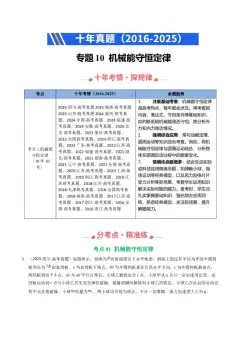
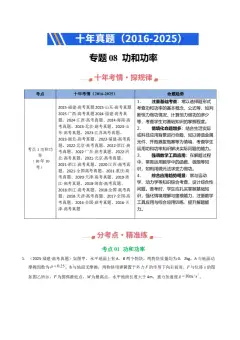
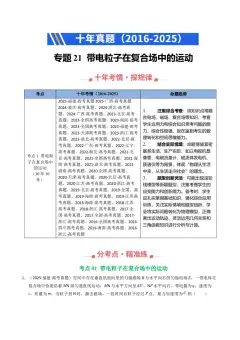
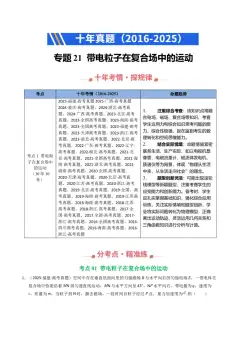
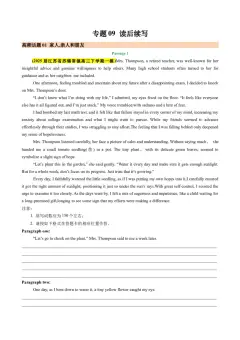
专题09 读后续写

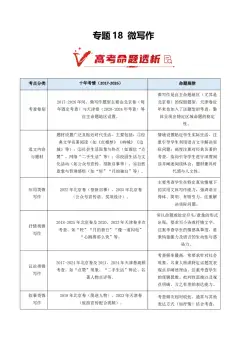
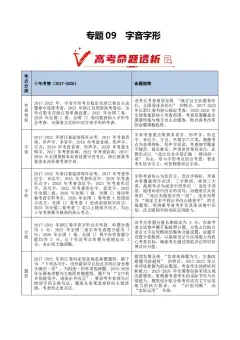
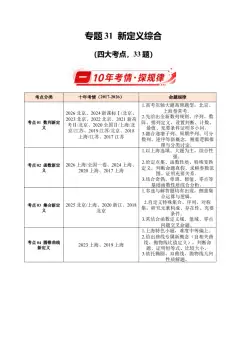
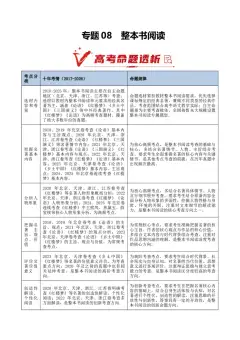
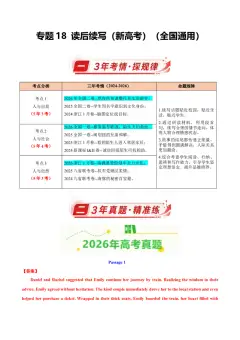
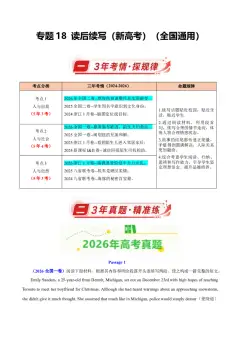
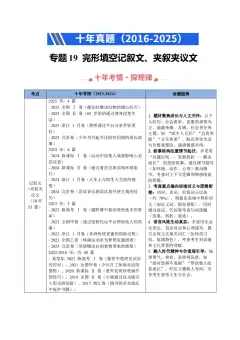
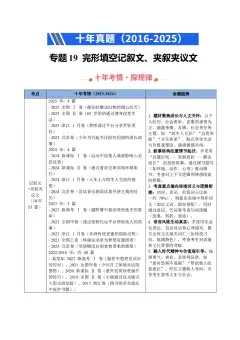
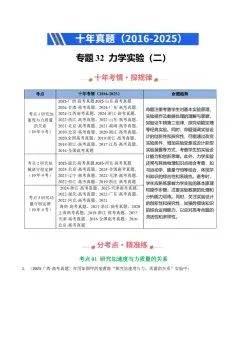
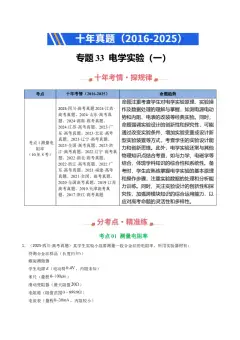
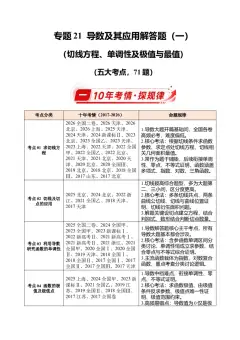
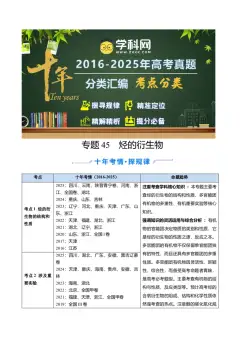
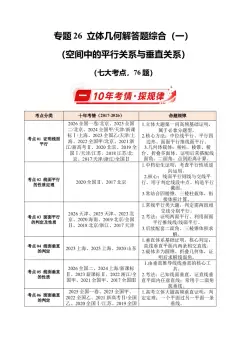
考点分类
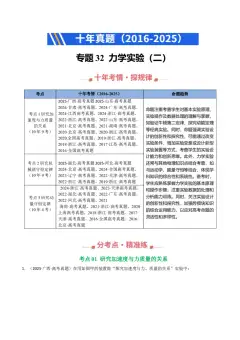
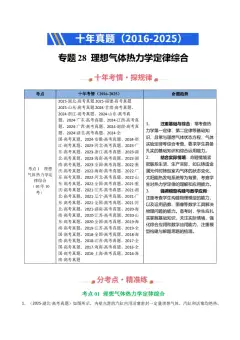
十年考情(2017-2026)
命题规律
考点 01 温情助
人类(陌生人善
意、互帮互助)
2026 全国一卷、2024 全国一卷 / 二
卷、2019 全国二卷均考查,出现频次
最高;故事主线:路人、司机、陌生居
民伸出援手
传统:救助情节简单,只写简单道谢创
新:增加心理波折、环境烘托、事后回访
报恩完整情节,突出人与人之间信任与温
暖
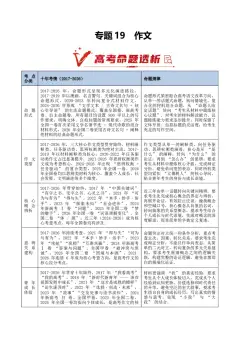
考点 02 成长反
思类(自律、坚
持、自我突破)
2026 全国二卷、2023 全国一二卷、
2022 全国一二卷高频;人物多学生、
孩童,围绕改正坏习惯、直面短板展开
传统:仅写努力坚持,道理直白生硬创
新:设置内心挣扎,前后对比人物状态,
结尾结合自身经历抒发成长感
考点 03 亲情和
解类(家人矛
盾、亲情温暖)
2025 全国一卷、2021 全国一二卷;多
产生误会后自省道歉、家人携手完成小
事
传统:矛盾快速化解,细节单薄
创新:深挖人物内心难处,加入生活化暖
心细节,用小事修复亲情隔阂
考点 04 文化交
流类(中外文
化、文化自信)
2025 全国二卷;以留学生视角讲述中
国名字、传统文化传播
传统:仅简单介绍文化内容
创新:借助日常社交场景自然输出文化内
涵,打破文化隔阂,体现包容理解

Writing 1
(2026·全国一卷·高考真题)


阅读下面材料,根据其内容和所给段落开头语续写两段,使之构成一篇完整的短文。
Emily Sanders, a 25-year-old from Detroit, Michigan, set out on December 23rd with high hopes of reaching
Toronto to meet her boyfriend for Christmas. Although she had heard warnings about an approaching snowstorm,
she didn’t give it much thought. She assumed that, much like in Michigan, police would simply detour ( 使绕道)
traffic around any closed sections of the highway. But that didn’t happen. As the snow came down more and more
heavily, Emily was directed off the highway. She drove on for a while and found herself on an unfamiliar road
toward a Canadian town.
The blinding whiteout made driving nearly impossible. At one point, Emily’s car got stuck. After a struggle,
she managed to free the vehicle and continued inching along the snow-covered road. As night fell, panic set in.
While Emily was driving on a narrow stretch of road, her car slid into a ditch (沟). She tried to call for help but
found no signal on her phone. Seeing no hope of immediate rescue, Emily decided to spend the night in her car. She
wrapped herself in a blanket, waiting for morning. To stay warm, she ran her engine for a few minutes every now
and then. Eventually, she fell asleep.
 Emily awoke to a gentle knock on her car window. Standing outside were Daniel and his wife Rachel, who
noticed the stranded (被困的) vehicle on their way home and stopped to see if they could help. When Emily rolled
down the window, Rachel asked if she was okay and told her it was not safe to stay overnight in the car. With
genuine warmth in her voice, Rachel said they could take Emily to a nearby café they knew. Grateful and relieved,
Emily accepted the offer.
In the cafe, the couple bought Emily a hot chocolate and listened patiently as she explained her desperate
situation: she was about a hundred miles from her destination, her car was completely stuck, and her entire holiday
plan could be ruined.

注意:(1)续写词数应为150

左右;
(2)请按如下格式在答题卡的相应位置作
Daniel
and Rachel
 suggested
that
Emily continue
her
journey
by train.
________________________________
____________________________________________________________________________________________
____________________________________________________________________________________________
________________________________
Three days later, Emily returned to get her car. ___________________________________________________
____________________________________________________________________________________________
______________________________________________________________________
Writing 2
(2026·全国二卷·高考真题)
阅读下面材料,根据其内容和所给段落开头语续写两段,使之构成一篇完整的短文。
As far as I can remember, I’ve always been a night owl. Even in middle school I would stay up
very late. I would feel completely at ease doing my homework in bed, with light music on. I found
comfort in keeping myself awake when everyone else had gone to bed, and I loved the silence of the
night. My parents urged me to get out of this so-called unhealthy habit, but their repeated requests fell
on deaf ears.
Fast forward to my first year of college. I still loved the night and would stay up until unruly hours
for no apparent reason, chatting online and watching videos. When I finally started to study, I would race
through the assigned work, often well past midnight. My roommates would tell me to go to bed and get
up early the following morning to do it instead. Get up early to do my homework? No way! I would
never do that.
Then, one day last term, I did exactly that. Bent over my laptop while sitting on the bed in the
corner of my room, I suddenly felt a pounding headache, and had to lie down. Unable to keep my eyes
open, I decided I had no choice but to finish my homework the next morning. I woke up at 6 am.
Hardly had I written half a page when I felt a sharp pain in my chest.
At the school clinic, a doctor, with a serious expression on his face, handed me a medical report.
“You’re 20, but your heart is 40!” he said. A cold wave went through me. I realized that years of
living as a late-night person had turned my heart into an overworked engine.
注意:
(1)续写词数应为150 左右;
(2)请按如下格式在答题卡的相应位置作答。
Struck by the doctor’s warning, I knew I had to make a change.
Slowly but surely, my efforts to adjust to the new routine paid off.
Writing 3
(2025·全国一卷·高考真题)
阅读下面材料,根据其内容和所给段落开头语续写两段,使之构成一篇完整的短文。
My wife and I wanted to share our new home with family and friends by hosting a small gathering in the early
summer. She had prepared lots of snacks, while my job was to have the backyard in order.
There was plenty of space for the kids to run and play. There was just one thing I hadn’t counted on: My
brother chose to bring his dog Toby, a 50-pound ball of fire. Though friendly, he could easily knock over my
niece’s small boys and my six-month-old granddaughter. So, when my brother showed up, I asked him to watch
Toby and keep him outside.
My plan was working out just fine. Toby was using up his energy by running back and forth in the backyard
and giving the kids plenty of room. Unexpectedly, after supper, the weather changed. It started to rain and everyone
went indoors.
It was an awkward moment. I didn’t want Toby to be running around in the house, and my brother wasn’t
happy with driving home with a wet dog. Eventually, my brother decided to leave rather than force the issue.
A few days passed, and I hadn’t heard anything from my brother. I texted him and expressed wishes for him to
come out again. His reply came as a surprise — a shock, actually: “Not a chance.” Clearly, he was unhappy over
the way we had parted. After all, I had left him little choice. Well, he’ll get over it, I reasoned.
Two months passed. My wife suggested I get in touch with my brother, but I resisted, thinking he should call
first. However, my conscience (良心) kept bothering me. I tried to put myself in my brother’s shoes. He was facing
health issues and his wife of thirty-five years had passed away a few months earlier. Toby was his constant
companion, the one who kept him going.
注意:
(1)续写词数应为150 个左右;
(2)请按如下格式在答题卡的相应位置作答。
I realized it was me who was at fault.
____________________________________________________________________________________________
____________________________________________________________________________________________
____________________________________________________________________________________________
____________________________________________________________________________________________
____________________________________________________________________________________________
_______________
With the biscuits my wife had made, I arrived at my brother’s door.
____________________________________________________________________________________________
____________________________________________________________________________________________
____________________________________________________________________________________________
____________________________________________________________________________________________
____________________________________________________________________________________________
_______________
Writing 4
(2025·全国二卷·高考真题)
阅读下面材料,根据其内容和所给段落开头语续写两段,使之构成一篇完整的短文。
“What is your name? ” is a question most frequently asked when people meet for the first time. But for me, it
was the first challenge I encountered as an international student in Ireland.
The pronunciation system of the Chinese language is quite different from that of English. For native speakers
of English, some Chinese words are rather difficult to pronounce. My given name Qiuyu (秋雨), for instance,
happened to be a great challenge for many of them. Every time I gave a self-introduction, I had to explain how to
pronounce my name at least five times, yet they still could not say it the way I did.
Once in a lecture, the professor tried repeating my name after me over and over in front of thirty classmates. I
really did not know whether I should continue correcting him or simply drop the matter. I feared that my classmates
might grow tired of my efforts or even lose patience with me. After all, I did care about how others would think of
me. I realized that if I didn’t stop, the entire lecture would be ruined. “It’s okay, professor,” I shrugged (耸肩). The
awkward moment ended with the class erupting into laughter. I forced a smile, unsure how to respond further.
After that incident, I stopped acting as a “Chinese teacher.” Instead of correcting others when they were
struggling to pronounce my name, I just smiled and nodded approvingly. This approach spared me the discomfort
of having to over-explain. However, I soon found that by doing so, I might be losing something more important: the
opportunity to share a small part of my cultural identity.
注意:
(1) 续写词数应为150 个左右;
(2) 请按如下格式在答题卡的相应位置作答。
In a class discussion, I was invited to explain the meaning of my name.
____________________________________________________________________________________________
____________________________________________________________________________________________
____________________________________________________________________________________________
____________________________________________________________________________________________
____________________________________________________________________________________________
_______________
Many of my classmates got interested and came up to me after class.
____________________________________________________________________________________________
____________________________________________________________________________________________
____________________________________________________________________________________________
____________________________________________________________________________________________
____________________________________________________________________________________________
_______________
Writing 5
(2024·全国一,二卷·高考真题)
阅读下面材料,根据其内容和所给段落开头语续写两段,使之构成一篇完整的短文。
I met Gunter on a cold, wet and unforgettable evening in September, I had planned to fly to Vienna and take a
bus to Prague for a conference, Due to a big storm, my flight had been delayed by an hour and a half, I touched
down in Vienna just 30 minutes before the departure of the last bus to Prague. The moment I got off the plane, I
ran like crazy through the airport building and jumped into the first taxi on the rank without a second thought.
That was when I met Gunter, I told him where I was going, but he said he hadn't heard of the bus station. I
thought my pronunciation was the problem, so I explained again more slowly,but he still looked confused. When I
was about to give up, Gunter fished out his little phone and rang up a friend. After a heated discussion that lasted
for what seemed like a century,Gunter put his phone down and started the car.
Finally, with just two minutes to spare we rolled into the bus station. Thankfully, there was a long queue (队
列) still waiting to board the bus. Gunter parked the taxi behind the bus,turned around, and looked at me with a big
smile on his face. “We made it," he said.
Just then I realised that I had zero cash in my wallet, I flashed him an apologetic smile as I pulled out my
Portuguese bankcard, He tried it several times, but the card machine just did not play along. A feeling of
helplessness washed over me as l saw the bus queue thinning out.At this moment, Gunter pointed towards the
waiting hall of the bus station. There, at the entrance, was a cash machine. I jumped out of the car, made a mad run
for the machine, and popped my card in, only to read the message: "Out of order. Sorry.”
注意:
(1)续写词数应为150 个左右:
(2)请按如下格式在答题纸的相应位置作答
I ran back to Gunter and told him the bad news.________________________________________________
______________________________________________________________________________________
______________________________________________________________________________________
Four days later, when I was back in Vienna, I called Gunter as promised.___________________________
______________________________________________________________________________________
______________________________________________________________________________________
Writing 6
(2023·全国一,二卷·高考真题)
阅读下面材料, 根据其内容和所给段落开头语续写两段, 使之构成一篇完整的短文。
When I was in middle school, my social studies teacher asked me to enter a writing contest. I said no without
thinking. I did not love writing. My family came from Brazil, so English was only my second language. Writing
was so difficult and painful for me that my teacher had allowed me to present my paper on the sinking of the
Titanic by acting out a play, where I played all the parts. No one laughed harder than he did.
So, why did he suddenly force me to do something at which I was sure to fail? His reply: “Because I love your
stories. If you’re willing to apply yourself, I think you have a good shot at this.” Encouraged by his words, I agreed
to give it a try.
I chose Paul Revere’s horse as my subject. Paul Revere was a silversmith (银匠) in Boston who rode a horse
at night on April 18, 1775 to Lexington to warn people that British soldiers were coming. My story would come
straight from the horse’s mouth. Not a brilliant idea, but funny; and unlikely to be anyone else’s choice.
What did the horse think, as he sped through the night? Did he get tired? Have doubts? Did he want to quit? I
sympathized immediately. I got tired. I had doubts. I wanted to quit. But, like Revere’s horse, I kept going. I
worked hard. I checked my spelling. I asked my older sister to correct my grammar. I checked out a half dozen
books on Paul Revere from the library. I even read a few of them.
When I handed in the essay to my teacher, he read it, laughed out loud, and said, “Great. Now, write it again.”
I wrote it again, and again and again. When I finally finished it, the thought of winning had given way to the
enjoyment of writing. If I didn’t win, I wouldn’t care.
注意:
1. 续写词数应为150 个左右;
2. 请按如下格式在答题卡的相应位置作答。
A few weeks later, when I almost forgot the contest, there came the news.
____________________________________________________________________________________________
____________________________________________________________________________________________
____________________________________________________________________________________________
____________________________________________________________________________________________
______________________________________________________________________________________
I went to my teacher’s office after the award presentation.
____________________________________________________________________________________________
____________________________________________________________________________________________
____________________________________________________________________________________________
____________________________________________________________________________________________
______________________________________________________________________________________
Writing 7
(2022·全国一,二卷·高考真题)
阅读下面材料,根据其内容和所给段落开头语续写两段,使之构成一篇完整的短文。
It was the day of the big cross-country run. Students from seven different primary schools in and around the
small town were warming up and walking the route(路线)through thick evergreen forest.
I looked around and finally spotted David, who was standing by himself off to the side by a fence. He was
small for ten years old. His usual big toothy smile was absent today. I walked over and asked him why he wasn't
with the other children. He hesitated and then said he had decided not to run.
What was wrong? He had worked so hard for this event!
I quickly searched the crowd for the school's coach and asked him what had happened. "I was afraid that kids
from other schools would laugh at him," he explained uncomfortably. "I gave him the choice to run or not, and let
him decide."
I bit back my frustration(懊恼). I knew the coach meant well — he thought he was doing the right thing.
After making sure that David could run if he wanted, I turned to find him coming towards me, his small body
rocking from side to side as he swung his feet forward.
David had a brain disease which prevented him from walking or running like other children, but at school
his classmates thought of him as a regular kid. He always participated to the best of his ability in whatever
they were doing. That was why none of the children thought it unusual that David had decided to join the cross-
country team. It just took him longer — that’s all. David had not missed a single practice, and although he
always finished his run long after the other children, he did always finish. As a special education teacher
at the school, I was familiar with the challenges David faced and was proud of his strong determination.
注意:
1. 续写词数应为150 左右;
2. 请按如下格式在答题卡的相应位置作答.
We sat down next to each other, but David wouldn't look at me.
I watched as David moved up to the starting line with the other runners.
Writing 8
(2021·全国一,二卷·高考真题)
阅读下面材料, 根据其内容和所给段落开头语续写两段, 使之构成一篇完整的短文。
A MOTHER’S DAY SURPRISE
The twins were filled with excitement as they thought of the surprise they were planning for Mother’s Day.
How pleased and proud Mother would be when they brought her breakfast in bed. They planned to make French
toast and chicken porridge. They had watched their mother in the kitchen. There was nothing to it. Jenna and Jeff
knew exactly what to do.
The big day came at last. The alarm rang at 6 a.m. The pair went down the stairs quietly to the kitchen. They
decided to boil the porridge first. They put some rice into a pot of water and left it to boil while they made the
French toast. Jeff broke two eggs into a plate and added in some milk. Jenna found the bread and put two slices into
the egg mixture. Next, Jeff turned on the second stove burner to heat up the frying pan. Everything was going
smoothly until Jeff started frying the bread. The pan was too hot and the bread turned black within seconds. Jenna
threw the burnt piece into the sink and put in the other slice of bread. This time, she turned down the fire so it
cooked nicely.
Then Jeff noticed steam shooting out of the pot and the lid starting to shake. The next minute, the porridge
boiled over and put out the fire. Jenna panicked. Thankfully, Jeff stayed calm and turned off the gas quickly. But
the stove was a mess now. Jenna told Jeff to clean it up so they could continue to cook the rest of the porridge. But
Jeff’s hand touched the hot burner and he gave a cry of pain. Jenna made him put his hand in cold water. Then she
caught the smell of burning. Oh dear! The piece of bread in the pan had turned black as well.
注意:
1. 续写词数应为150 左右;
2. 请按如下格式在答题卡的相应位置作答。
As the twins looked around them in disappointment, their father appeared.
The twins carried the breakfast upstairs and woke their mother up.