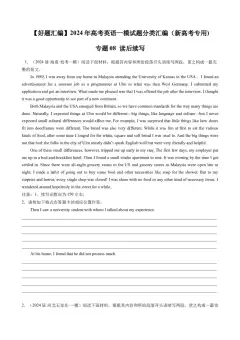
专题09 读后续写
主题01 亲情/家庭关系
Passage 1
(2026·广东佛山·一模)
Sumi’s daughter Anna had always been called “Number 23.” Every time the school released exam results, Anna
would always end up in 23rd position among 50 pupils. Always 23, regardless of topic or term. Every time Sumi
heard that nickname, it caused her concern.
When Sumi stayed with her friends, their discussion nearly always turned to their children. You know how it
goes-one parent discusses their child’s piano honors, another boasts about math olympiads or leadership
responsibilities. While others were honoring these “great youngsters,” all Sumi could think about was Anna and her
unpleasant nickname, Number 23.
Sumi had done everything to help Anna with school-hired professional tutors, bought fancy stationery, even
packed brain food. And Anna tried. She gave up sketching, paper cutouts, and many others. She moved from one
class to another, endlessly trying. But then the indicators started showing-she lost her appetite, couldn’t sleep, and
sweated all the time. Eventually, she got terribly sick. That was when Sumi gave in. She stopped pressing and Anna
bounced back to being the cheery little child they knew.
One day, Sumi and her friends went on a weekend trip with their families. During lunch, two kids got into a
heated quarrel over a single slice of dessert. No one could calm them down. Then Anna stepped in. “Let’s flip (抛) a coin
,” she said. Simple as that. Boom-problem solved. Everyone was astonished.
Later, on the journey back, they got delayed in traffic. The kids were getting restless. Anna? She started delivering
jokes like a big sister. Even the adults laughed. Then she took the leftover candy boxes and started changing them
into animals-paper elephants, lions, and birds. Before everyone said goodbye, she presented one to each youngster
as a gift. The other parents were shining with appreciation. For the first time in years, Sumi felt something well up in
her chest-pride.
注意:
1.续写词数应为150 左右;
2.请按如下格式在答题卡的相应位置作答。
Not long after, Sumi got a phone call from Anna’s class teacher.
____________________________________________________________________________________________
____________________________________________________________________________________________
____________________________________________________________________________________________
____________________________________________________________________________________________
____________________________________________________________________________________________
That afternoon, Anna returned home, the Class Star certificate in hand.
____________________________________________________________________________________________
____________________________________________________________________________________________
____________________________________________________________________________________________
____________________________________________________________________________________________
____________________________________________________________________________________________
Passage 2
(2026·广东大湾区·一模)
Jack looked out of the car window when he and his mom passed their old neighborhood. His fingers tapped
nervously on his backpack as his mom told him the moving company had found some lost boxes from their recent
move, and she could get them that afternoon.
A feeling of hope rose in Jack’ s heart. He asked quietly if Big Dog might be in the boxes. Grandpa had bought
the treasured toy dog for him at the fair three years before. Though now eight years old, Jack still needed his old
friend back on the shelf above his bed, which had been empty since they moved.
His mom said she wasn’t sure. Her voice trembled as she added that the photo albums were confirmed lost by
the company — all those precious pictures of festive occasions, birthday celebrations, and family gatherings were
gone. Jack recognized that voice, the one that she used when trying to be strong. He knew what the albums meant to
her. She promised to check the boxes carefully before picking him up, giving his shoulder a comforting pat (轻拍)。
All day at school, Jack found it hard to sit still, his eyes constantly darting (瞟) to the clock. During math class, he
missed Big Dog’s lovely eyes. At lunch, he recalled Grandma’s warm hug and bright smile from those lost photos.
On the playground, his mind wandered back to the joy of their whole family together-laughing and running along the
beach under a clear blue sky.
As the art class bell finally rang, Mr. Light announced, “Today you are free to draw anything you wish.” Jack
stared at the blank paper, memories rushing back. The sad face of his mom popped up and then an idea came to him
— maybe he could find a new way to save those memories.
注意:
(1)续写词数应为150 个左右;
(2)请按如下格式在答题纸的相应位置作答。
He knew what he could draw.
____________________________________________________________________________________________
____________________________________________________________________________________________
____________________________________________________________________________________________
____________________________________________________________________________________________
__________________________
After school, Jack rushed to his mom, with the drawing in his hand.
____________________________________________________________________________________________
____________________________________________________________________________________________
____________________________________________________________________________________________
____________________________________________________________________________________________
__________________________
Passage 3
(2026·广东汕尾·一模)
The memory of my eighth birthday remains vivid, not because of the gift itself, but because of the unforgettable
lesson it brought. That morning, my father presented me with a shiny new bicycle. Bursting with excitement, I rode
it to school early in the morning. The world was bathed in golden sunlight, and the birds were celebrating a new day
in the trees.
But my joy was short-lived. When I turned around a corner, I heard a loud, sharp sound behind me. My heart
beat fast after I realized that I had run into a car parked by the roadside and left a long, ugly scratch (划痕)on its
door.
I slowed down and jumped off my bike to have a closer look. I froze there and imagined what my dad would
do. I looked around nervously and found the street completely empty. No one had seen the accident. A tempting idea
flashed through my mind.
“Why not just run away?” I argued with myself. “No one would ever know.”
For a brief moment, I yielded (屈服)to the impulse. I jumped onto my bike and rode as fast as I could. However,
the farther I went, the heavier my heart would feel. Overcome by guilt, I made the difficult decision to return to the
scene.
I found a notebook in my backpack and wrote a note. I put down my name, address, and apologized sincerely
for what had happened. I carefully placed the note under the car’s windshield wiper (挡风玻璃刮水器).
The school day that followed seemed painfully long. When the bell eventually rang, I walked my bike home
very slowly, dreading the upcoming storm. As I got close to my home, I saw my dad waiting for me at the door.
注意:
1.续写词数应为150 个左右;
2.请按如下格式在答题卡的相应位置作答。
To my astonishment, my dad was not angry at all.
____________________________________________________________________________________________
____________________________________________________________________________________________
____________________________________________________________________________________________
____________________________________________________________________________________________
____________________________________________________________________________________________
That day, I learned one of the most important lessons in my life.
____________________________________________________________________________________________
____________________________________________________________________________________________
____________________________________________________________________________________________
____________________________________________________________________________________________
____________________________________________________________________________________________
主题02 友情/同伴关系
Passage 1
(2026·南京二十九中·一模)
I’ve been very fond of classical music since I was a kid. The soft piano melody or grand symphony always calms
my nerves after a stressful school week.
My best friend Tom is totally different, he’s a big rock music fan, with loud electric guitars and heavy drums
following him everywhere.
We’d never argued about music tastes before, but last Friday evening, things got heated.
We sat on the neighborhood park lawn, passing headphones back and forth. After Tom listened to my favorite
Chopin nocturne (肖邦夜曲), he shrugged: “It’s okay, but way too slow, where’s the energy?”
I frowned, snatching the headphones back. “Energy? Your rock music is just noise! Singers shout like they’re in
pain, and instruments hurt my ears,” I said sharply. Tom’s eyes widened, leaning forward with a raised voice: “You
don’t get it! Rock is passion, saying how you feel freely! You’re stuck in an old-fashioned circle, scared to try new
things!”
Angry, my cheeks burned. “Old-fashioned? Classical music has real artistry, not just screaming and hitting!” I
stood up, kicking a pebble hard. Tom jumped up too, fists clenched: “How dare you disrespect what I love? You’re
my best friend, I thought you’d understand!” Before I could reply, he turned and stormed off, backpack swinging. I
yelled after him: “Fine! Don’t talk to me if you’re unreasonable!” But as he disappeared around the corner, a twinge of
regret flickered, I quickly pushed it away, still angry.
For three days, we didn’t speak. We passed in the school hallway without a glance, and group chats went silent. I
missed our jokes and after-school walks, but was too stubborn to apologize. Deep down, I knew I’d gone too far.
注意:
(1)续写词数应为150 个左右;
(2)请按如下格式在答题卡的相应位置作答。
I realized my mistake.
____________________________________________________________________________________________
____________________________________________________________________________________________
____________________________________________________________________________________________
____________________________________________________________________________________________
With a nervous heart, I pressed the doorbell of Tom’s house.
____________________________________________________________________________________________
____________________________________________________________________________________________
____________________________________________________________________________________________
____________________________________________________________________________________________
Passage 2
(2026·湖北八校·一模)
The Popsicle Kids
A nearly empty box of Popsicles (棒冰) in the freezer, left from a grandchild’s visit, caught my attention. Initially,
I wanted to throw it away, but my wife suggested we give the remaining Popsicles to the neighborhood children. Her
suggestion changed our life and led us to a future full of “Popsicle Kids.” My wife and I, retired on Social Security,
live in an apartment complex. After careers in sales and nursing, our daily concerns revolved around aches, pains,
and dinner. We often wondered what good we were to the world.
That changed dramatically after we gave away the first Popsicle.
Minutes after watching a neighbor boy, a second grader, walk away with an icy treat, our doorbell rang. An
adorable blond girl, about six, smiled sweetly, “Is it true you’re giving away Popsicles?”
With the box empty, we returned to our concerns.
Early the next morning, the doorbell rang repeatedly. Standing on our porch were the four children from the
previous day. They vocalized their wants, chanting (有节奏地喊), “We want Popsicles! We want Popsicles!”
Looking into their eager young faces, I wondered, “What have I started?” Sensing a victory, they nodded eagerly
when I explained the rules: ring the bell once, one Popsicle per day, and share something good about their day. But
their thin shoulders bent downwards in disappointment when I mentioned they had to give something in return. I
came to the rescue, suggesting they share something positive about their day, like what they learned at school or
helping another student. Over time, new rules were added: “Ladies first,” “Don’t interrupt,” and “Properly get rid of
the sticks.”
On holidays, they expressed their understanding of why the day was celebrated. Over the years, about fifty
youngsters visited. Some became part of my life, like the four kids who joined me on the steps one spring to read
“Where the Red Fern Grows.” We discussed catching crawfish, loving pets, and family relationships. This simple act
of sharing Popsicles transformed our life, bringing joy and meaning to both the children and ourselves.
注意:1.续写词数应为150 个左右;
2.请按如下格式在答题卡的相应位置作答。
Paragraph1:
One night, another boy appeared at the door, saying “I don’t want a Popsicle; I just need to talk”
____________________________________________________________________________________________
____________________________________________________________________________________________
____________________________________________________________________________________________
____________________________________________________________________________________________
____________________________________________________________________________________________
Paragraph 2:
I’ve sensed it’s more than Popsicles that bring these kids to our door.
____________________________________________________________________________________________
____________________________________________________________________________________________
____________________________________________________________________________________________
____________________________________________________________________________________________
____________________________________________________________________________________________
主题03 逆境与成长
Passage 1
(2026·河北沧州·一模)
The Christmas Present
When I was a boy of nine in the little town of Doylestown, Pennsylvania, I used to mow the lawn of Mrs Long, an
elderly lady who lived across from the Presbyterian Church. She paid me very little for the chore, for she had not
much money. But she did promise me, “When Christmas comes, I shall have a present for you.” I spent much time
wondering what it would be. The boys I played with had baseball gloves and bicycles and ice skates, and I was so
eager to acquire any one of these that I convinced myself that Mrs Long intended choosing from among them.
“It would hardly be a baseball glove,” I reasoned with myself. “A woman like Mrs Long wouldnˈt know much
about baseball.” Since she was a weak and thin person, I also ruled out the bicycle, for how could she handle such a
vehicle?
On my last Saturday at work, Mrs Long said, “Now remember, because you’ve been a good boy all summer, at
Christmas I’ll have a present waiting. You come to the door and collect it.” These words clinched it. Since she was
going to have the present in her house, and since she herself would be handling it, unquestionably she was giving me
a pair of ice skates.
I became so convinced of this that I could imagine myself upon the skates. As the cold days of November arrived
and ice began to form on the ponds, I began to try my luck on the ice that would be sustaining me and my skates
through the winter.
“Get away from that ice!” a man shouted. “It’s not strong enough yet.” But soon it would be.
As Christmas approached, it was with difficulty that I restrained myself from reporting to Mrs Long and
demanding my present. My mother, who taught school, agreed that the first of December was too early for me to do
this. “She may not have it wrapped yet,” she argued, and this made sense.
注意:
(1)续写词数应为150 左右;
(2)请按如下格式在相应位置作答。
On the 21st of December, a serious cold snap froze all the ponds.
____________________________________________________________________________________________
____________________________________________________________________________________________
____________________________________________________________________________________________
____________________________________________________________________________________________
____________________________________________________________________________________________
On Christmas morning, before the sun was up, I had this box on my knees.
____________________________________________________________________________________________
____________________________________________________________________________________________
____________________________________________________________________________________________
____________________________________________________________________________________________
____________________________________________________________________________________________
Passage 2
(2026·安徽芜湖·一模)
The English writing competition drew near. Jack, who had always struggled to put his thoughts into coherent
words, determined to turn to AI for help.
He simply input the given theme of the competition, added a few key words, and hit “generate”. Much to his
delight, in less than 5 minutes, the screen lit up. A vivid and well-structured essay was presented. Jack was amazed
by how effortlessly the well-chosen words flowed on the page. Without a second thought, Jack signed his name and
submitted the piece, ignoring the tiny voice of guilt from the bottom of his heart.
His essay stood out among hundreds of entries and was selected to represent the school in the municipal-level
contest. When his English teacher, Ms. Cathy, called him to her office, Jack’s heart skipped a beat. With a gentle but
firm tone, Ms. Cathy looked straight into his eyes and asked, “Jack, I need you to tell me the truth — did you write
this essay entirely on your own?” The question hung in the air, heavy and inescapable. Jack’s mind went blank for a
moment. The thought of losing the chance to compete, of being laughed at by his classmates for cheating, overwhelmed
him. Taking a shaky breath, he kept his eyes off the teacher and nodded, “Yes, Ms. Cathy. Every word is mine.”
Ms. Cathy nodded, seemingly satisfied, and patted his shoulder, “That’s great. Your genuine hard work will pay
off. This essay has a unique perspective, and I’m sure it will shine at the municipal contest.” But Jack didn’t feel any
joy. On the contrary, a sense of guilt weighed heavily on him. That night, he tossed and turned in bed, unable to fall
asleep. The lie he had told kept echoing in his ears. He thought about Ms. Cathy’s trusting eyes, about the meaning
of the competition, and about how proud he would have felt if he had written the essay himself. He was torn between
the fear of being exposed and the desire to do the right thing.
注意:
(1)续写词数应为150 个左右;
(2)请按如下格式在答题卡的相应位置作答。
The next day, Jack went to the teacher’s office.
____________________________________________________________________________________________
____________________________________________________________________________________________
______________________________________________________________________________________
The day to announce the results of the contest came.
____________________________________________________________________________________________
____________________________________________________________________________________________
______________________________________________________________________________________
Passage 3
(2026·安徽淮北·一模)
In a beautiful coastal village lived a girl named Maya. Maya’s world was made of music: the crash of waves,
the cry of seagulls (海鸥), and the whistle of fishing boats became notes inside her mind. She collected these sounds
on a tiny recorder, then locked herself in her room, weaving them into songs that no one ever heard.
Maya was not shy in the usual way — she could help her mother sell fish at the market or joke with her friends in
the classroom — but when it came to her music, she shrank into herself, quiet and unseen.
One evening, the village posted an announcement on the noticeboard: the first “Sea-Song Competition” would
be held on June 8th. Every entry would be performed live and scored by three judges on the spot. What was more,
the winner would step onstage to receive a big seashell (贝壳) as an award, and from that night on, the winning song
would be played every night as ships returned.
Despite her excitement, her fear flooded back. That night, Maya sat among the nets, her recorder in hand, asking
the tide, “What if I’m not good enough?” The tide answered with its usual silence — neither yes nor no.
For days, Maya struggled with her doubts, but deep down, she knew she had to try. Her father found her staring at
the silent recorder. He did not offer compliments (赞美); instead, he said, “The song doesn’t need to be perfect; it
just needs to be yours.” Encouraged by her father, who always believed in her talent, she decided to enter the
competition.
For weeks, Maya rose before dawn, hiking to the beach where she captured the sound of rolling waves and the
wind whistling through broken seashells. She spent every free moment working on her piece. It began with the slow
breathing of the sea at dusk, added the beat of her mother’s old drum, then the song turned into a tune that felt like
seagulls wheeling against a rising moon. Finally, she mixed in her own voice, which was soft and beautiful. She
titled it Return.
注意:
(1)续写词数应为150 个左右;
(2)请按如下格式在答题卷
相应位置作答。
On the day of submission, Maya hesitated at the judges’ door.
____________________________________________________________________________________________
____________________________________________________________________________________________
____________________________________________________________________________________________
____________________________________________________________________________________________
___________________________________________________________________________________
Finally, it was time for the winners to be announced.
____________________________________________________________________________________________
____________________________________________________________________________________________
____________________________________________________________________________________________
____________________________________________________________________________________________
___________________________________________________________________________________
Passage 4
(2026·河北唐县·一模)
Jack was always on his smartphone, scrolling through social media, playing games and chatting with friends.
His mom, Mrs Turner, noticed that his grades had started to drop because he was spending too much time on his
smartphone instead of focusing on his schoolwork. She had tried talking to him about it many times, but Jack didn’t
listen. She knew she had to do something to help him, so one evening, she quietly took his smartphone and hid it in
a drawer. She knew Jack would be upset, but she hoped it would help him get back on track with his studies.
The next morning, Jack rushed to find his smartphone but couldn’t find it anywhere. He searched his room, the
kitchen, and even the living room, but it was gone. He felt depressed and angry.“Where is my smartphone?” he
whispered.  When he went downstairs for breakfast, his mom gave him a calm smile.“I think you might have
misplaced it,” she said.Jack was puzzled but didn’t say anything. He left for school, feeling more upset than usual.
At school, Jack’s mind kept wandering to his smartphone. He couldn’t concentrate on his lessons, and he felt a
little lost without it. During lunch, he found something unusual in his schoolbag. It was a small, handwritten card
from his mom. It read,“Jack, I know it’s hard,but you’re capable of doing great things. Stay focused, work hard, and
the results will follow.I believe in you.” Jack smiled to himself. He realized that his mom was only trying to help
him, not punish him.
He realized that he had been wasting time, and without his smartphone, he could actually pay more attention to
his schoolwork. He felt grateful for his mom’s action, even though it had upset him at first.
注意:
(1)续写词数应为150 个左右;
(2)请按如下格式在相应位置作答。
After that, Jack began to feel more focused.
____________________________________________________________________________________________
____________________________________________________________________________________________
____________________________________________________________________________________________
____________________________________________________________________________________________
____________________________________________________________________________________________
Over the next few weeks Jack’s grades started to improve.
____________________________________________________________________________________________
____________________________________________________________________________________________
____________________________________________________________________________________________
____________________________________________________________________________________________
____________________________________________________________________________________________
主题04 善良与温暖
Passage 1
(2026·广东高州·一模)
At a local high school in San Francisco. Mr. Adams was well-loved by his pupils. He taught music, something
he was passionate about ever since he was a child.
Not all students were fond of playing musical instruments and singing, but because of Mr. Adams’ fun and easy
lessons, he instantly became every pupil’s favorite teacher. He would teach them how to play instruments and have
jamming sessions (即兴演奏) with them where they performed the students’ favorite songs.
“You know, the key to making the kids love your lessons is to make it relatable to them,” he told his fellow
teachers. “Once you catch their attention, it’ll be easier for them to absorb what you’re trying to teach them.”
Mr. Adams taught Grade 11 and 12 high school students. Thanks to his fun nature, his students respected him as
a teacher but treated him like a friend. They went to him for advice and would hang out with him outside of class to
play music and exchange stories.
One day, his students scheduled a day to spend time with him to make the playlist of their upcoming prom (正
式舞会). It was such a formal dance that they would spend a lot buying dresses and suits. He was glad to help them
and scheduled their session for Friday that week.
However, that Friday, Mr. Adams didn’t show up to class for the first time. “I wonder if he’s okay,” one student
said, worried. “He’s never been absent before!”
The students waited inside the music room patiently. After a couple of minutes, though, the school director
entered the room and said that Mr. Adams would not be returning any time soon.
“I know how much you all love Mr. Adams, so I’m disclosing this information. Last night, a forest fire burned
down his house, and he was shocked and upset. He worked hard to put up that house, but he couldn’t save it. He was
only able to retrieve (找回) a few items, but other than that, everything he owned is gone,” she revealed. The news
saddened Mr. Adams’ students. “We have to help him!” the student council president said.
注意:
1.续写词数应为150 个左右;
2.请按如下格式在答题卡的相应位置作答。
The students immediately jumped into
action._______________________________________________________________________________________
____________________________________________________________________________________________
____________________________________________________________________________________________
____________________________________________________________________________________________
____________________________________________________________________________________________
___
Mr. Adams was amazed to arrive at the prom and find everyone in casual wear, not formal
clothes.______________________________________________________________________________________
____________________________________________________________________________________________
____________________________________________________________________________________________
____________________________________________________________________________________________
____________________________________________________________________________________________
____
Passage 2
(2026·广东顺德区·一模)
One morning in 2018, I was getting Talia, then three, and Weston,10 months, dressed, fed and out of the door to
take them to preschool on my way to work. It was a route we’d taken a hundred times before. I was chatting to my
husband Reuben on speakerphone with both children in the back, when I smelled something odd, like plastic melting. I
mentioned it to Reuben, but neither of us thought anything of it. There are industrial buildings nearby, so I assumed
it was coming from one of them.
A minute later, and no longer on the phone, I drove on to a bridge, which was busy with rush-hour traffic. That’s
when I saw the word “STOP” flash across my dashboard (仪表盘). Before I even had the chance to register it, I saw
smoke rising from the bonnet (引擎盖) of the car. I knew I needed to pull over, but the bridge, which is 2.5 miles
long, didn’t have a hard shoulder. I decided it was safest to get across it and then stop the car.
Holding on the steering wheel, I put my foot down, but within seconds the smoke was so thick I could no longer
see the road ahead. With cars flying past me, I managed to pull over to the side of the road. At this point, I was really
scared. I called the American Automobile Association (AAA), but, as if my luck wasn’t bad enough, my membership
had ended. As I was talking to the operator, I saw flames through the windshield — the bonnet was on fire.
Terrified, and certain the car was about to explode, I yelled that my car was on fire. Acting on pure instinct, I
jumped out, opened the door behind me, and unclipped (解开) Weston’s car seat. I could hear the woman from the
AAA shouting at me to call 911 as cars and trucks thundered past, just inches away. For a split second I froze. Was it
safe to put Weston down on the road while I grabbed Talia? Could I run to the end of the bridge with them both in
my arms?
注意:
1.续写的词数应为150 左右;
2.请按如下格式在答题卡的相应位置作答。
Just then, as I was almost overcome with fear, an arm appeared.
____________________________________________________________________________________________
____________________________________________________________________________________________
____________________________________________________________________________________________
____________________________________________________________________________________________
___________________________
We had just gotten out of the man’s car at the end of the bridge when Reuben’s pulled up.
____________________________________________________________________________________________
____________________________________________________________________________________________
____________________________________________________________________________________________
____________________________________________________________________________________________
___________________________
Passage 3
(2026·福建泉州·一模)
Mr. Hopkins’ bookstore was a quiet island in the noisy stream of the modern city. For decades, it had been a
shelter for book lovers. The wooden sign above the door, weathered but proud, read “Hopkins’ Books” in brick red.
It had been a constant place where time moved slower with the first turn of a page. Now, it was closing.
The news felt like a physical blow to David, a quiet college student who had grown up reading in the cozy
corners of the shop. The smell of old paper was the smell of his childhood, witnessing his growth. He couldn’t imagine
the street without its warm, inviting light. When the news spread throughout the entire neighborhood, worry was
written all over everyone’s faces.
The reason for the closure was a woman named Sarah Chen. Representing a large development company, she
had made a generous offer to buy the building. She saw the space not for its shelves of stories, but for its potential as
a trendy café, a profitable upgrade. To her, it was just business.
Mr. Hopkins, now old and tired, felt defeated. “Maybe it’s time, David,” he sighed, his hand resting on a dusty
copy of his favorite novel. “The world has moved on.”
On the day of the final meeting, David arrived early, his backpack filled with items he had collected over the
years from the store: a bookmark from his tenth birthday, a receipt from the first book he had bought with his own
money, a photograph of himself and Mr. Hopkins taken during a summer reading program. He walked to the children’s
section and drew a small, worn copy of The Adventures of Tom Sawyer. The cover was faded, the pages yellowed,
but the spine still held strong.
Sarah arrived precisely at 2:00 p.m. She wasted no time getting down to business, reviewing the contract with
Mr. Hopkins. David watched from the sidelines, his heart pounding in his chest.
注意:
1.续写词数应为150 个左右;
2.请按如下格式在答题卡的相应位置作答。
Paragraph 1: He couldn’t let this happen — not without trying to make his voice heard.
____________________________________________________________________________________________
____________________________________________________________________________________________
____________________________________________________________________________________________
____________________________________________________________________________________________
____________________________________________________________________
Paragraph 2: A decision was made to combine a bookstore and a café in one project, and the construction
began.
____________________________________________________________________________________________
____________________________________________________________________________________________
____________________________________________________________________________________________
____________________________________________________________________________________________
____________________________________________________________________
主题01 亲情/家庭关系
Passage 1
(2026·湖北荆州·一模)
Eva ran a business that plans small events — like weekend parties for staff and their families — where
conversations always turned to children, since most of her clients were parents. While others proudly shared stories
of piano honours, math medals, or leadership roles, Eva would just sit there quietly, thinking of her daughter Amy
and her nickname (绰号) “Number 23”.
Every time the school released exam results, Amy always ended up in 23rd place in her class of 50 regardless
of subject or term. Each time Eva heard that nickname, she was desperate with worry.
One day, Eva and Amy attended a lovely get-together. During lunch, someone playfully asked the children about
their dream jobs. One by one, they gave bold, ambitious answers — CEOs, engineers, and even a Nobel Prize winner.
The adults clapped, praising each child enthusiastically.
Amy didn’t volunteer an answer. Instead, she was happily helping out — serving drinks, passing around cookies.
When asked, Amy smiled, “I want to be a kindergarten teacher. I love little kids. I love dancing, singing, and playing
with them.” The room fell silent. Amy’s words hit Eva hard, leaving her choked up.
Eva had done everything to help Amy improve her grades — hiring professional tutors, buying piles of reference
books, and even packing “brain foods”. Amy tried hard, too. She gave up drawing, paper crafts, and weekend lie-ins.
She shifted from one evening class to another, working endlessly through question after question. Yet her ranking
never changed, which weighed heavily on Eva.
A few weeks later, Eva and her friends went hiking with their families. At lunch, two kids — one a top English
student, the other a math medalist — got into a full-blown quarrel over a single slice of dessert. No one could calm
them down. Then Amy stepped in with a sweet smile. “Let’s flip a coin,” she suggested. And just like that, the problem
was settled. Everyone stood in stunned silence.
On the way back, their bus got stuck in traffic, and the kids grew impatient. Some started complaining, others
kicked the seats, and a few even cried.
Some parents tried to calm the kids down but failed.
____________________________________________________________________________________________
____________________________________________________________________________________________
____________________________________________________________________________________________
____________________________________________________________________________________________
___________________________
Eva was proud to see Amy turn chaos into joy.
____________________________________________________________________________________________
____________________________________________________________________________________________
____________________________________________________________________________________________
____________________________________________________________________________________________
___________________________
Passage 2
(2026·河南郑州·一模)
One day, I was sitting at the breakfast table with my five-year-old son, Mateo. I was still recovering from an
operation. “Mom, let’s play,” Mateo looked at me and said. Trying hard to ignore the pain in my stomach, I shook
my head and replied, “Not today, sweetie.” These days, getting out of bed was a real struggle for me. I longed for
strength and happiness, yet the future seemed so hopeless.
All of a sudden, Mateo jumped up from where he was sitting on the kitchen floor. He shouted, “Bird!” and then
ran towards our courtyard. I looked in the direction he was looking and, sure enough, there was a white dove (鸽子)
landing in a rubber tree. It stayed there for a little while and then flew away. It was quite odd because I’d never seen a
white dove in our neighborhood before.
The next morning, I dragged myself into the kitchen. To my surprise, the dove was back, and this time it had a
mate carrying some sticks. I pointed to the tree and said to Mateo, “Look, they’re going to build a nest.” Throughout the
week, the doves flew in and out of the courtyard, building their nest on top of the rubber tree.
Mateo was extremely excited. Every morning, he would rush into the kitchen and stand by the sliding glass door.
He would talk to the birds as they worked. His joy was influential. Although feeling sad, I couldn’t help but look
forward to the doves’ visits.
However, things took a turn for the worse. The courtyard seemed like a safe place for a nest, but the rubber tree’s
small branches were not stable at all. One night, a strong wind blew, and the doves’ nest was blown to the ground. I
heard the small branches break.
I checked the damage. Nothing good ever lasts. I wouldn’t blame the doves if they never came back. But they
returned. They didn’t even look at the pile of sticks that used to be their nest. They started building all over again.
Unfortunately, the wind destroyed their work again. But day after day, they kept starting again as if nothing had
occurred.
注意:
(1)续写词数应为150 个左右;
(2)请按如下格式在答题卡的相应位置作答。
I realized that I should take some measures.
____________________________________________________________________________________________
____________________________________________________________________________________________
____________________________________________________________________________________________
____________________________________________________________________________________________
___________________________
“Look! The birds have returned!” Mateo shouted.
____________________________________________________________________________________________
____________________________________________________________________________________________
____________________________________________________________________________________________
____________________________________________________________________________________________
___________________________
主题02 友情/同伴关系
Passage 1
(2026·重庆巴蜀中学·一模)
This was West Central in the early 2000s, a neighborhood of middle-class people born and raised by the tracks,
people who never dreamed of leaving. Much has changed since then.Luxury apartments have replaced the rusted
trains. It’s barely snowed three inches this month.
Outside my window, another cold rain slaps Spofford Avenue. The park across the street is empty, a mess of
dead-brown grass and dry leaves.
In my dreams, though, I see drifts of snow that are deep and blue enough to bury the moon.These are dreams of
boyhood, of the gang of neighborhood boys who defined it. Back then, a couple feet of snow meant no school, and
we played football every day.
Snow Bowls, as I remember them, were wild, violent events, a cross between sport and warfare. Without helmets
or pads, we occasionally knocked each other unconscious. We broke wrists and bit ankles.
On snow days, we gathered on the big field behind our high school, where we’d pick teams, four or five a side.
The captains were always the same. Matt Moore was a captain because he was faster and stronger than the rest of us
and actually had experience playing organized football. Jimmy White was the other because he brought the football,
and he believed supplying the equipment somehow gave him the right.
The games were untimed and there were hardly any rules. We played until the snow melted under our feet, or
until someone got seriously hurt. The best Snow Bowls occurred when snow was still falling, covering our tracks and
silencing the world around us. In the evenings, we’d play under the field lights, feeling like pros.
Two decades later, I’m the only former Snow Bowler who still resides in Spokane. The ones who moved away
like to ask me for updates on home, as if our city is an elderly relative dying from cancer, and I’m the lone caregiver. I
always steer (引导) our conversations back to the weather, especially the startling lack of snow this winter.
注意:
1.写作词数应为150 个左右;
2.请按如下格式在答题卡的相应位置作答。
Last weekend, someone floated the idea of a 20-year high school reunion.
____________________________________________________________________________________________
____________________________________________________________________________________________
____________________________________________________________________________________________
____________________________________________________________________________________________
____________________________________________________________________________________________
____________________________________________________________________________________________
_________________________________________________________________________________
We hurried outside, and sure enough, snow was coming down in thick sheets.
____________________________________________________________________________________________
____________________________________________________________________________________________
____________________________________________________________________________________________
____________________________________________________________________________________________
____________________________________________________________________________________________
____________________________________________________________________________________________
_________________________________________________________________________________
Passage 2
(2026·湖南邵阳·一模)
The ceramic elephant felt cool and smooth in Li Wei’s palm. Its complex patterns, painted in vibrant blues and
yellows, were unlike any artwork from his Jiangxi hometown. It was a gift from his new classmate, Ravi, whose
family had just moved from India. “In my culture, the elephant symbolizes good luck and friendship,” Ravi explained
with a shy smile. Li Wei was deeply touched but also felt nervous about the upcoming school International Culture
Fair. He and Ravi were paired to create a presentation comparing China’s Spring Festival with India’s Diwali.
Their first meeting at Li Wei’s house started with awkward silence. Ravi pointed to a paper cutting of the Chinese
character ‘福’ (Fu) on the window. “Does it mean… happiness?” he asked hesitantly. Li Wei nodded, surprised by
Ravi’s interest, and showed him how to make a simple paper cut. In return, Ravi played a video of Diwali celebrations
— cities lit by countless clay lamps. “It’s like your Lantern Festival, but different,” Ravi said, his eyes shining. Li
Wei realized Diwali’s theme of light overcoming darkness agreed with the Spring Festival’s theme of welcoming a
hopeful new year.
They spent the afternoon exchanging stories. Li Wei talked about the reunion dinner and red envelopes. Ravi
explained the legends behind Diwali and sharing sweets with neighbors. They discovered surprising parallels: both
festivals were about family, hope, and the triumph of good. The initial awkwardness melted away, replaced by
excitement. They decided to combine their skills: Li Wei would create a large paper-cut backdrop blending a Chinese
dragon and Indian peacocks under lanterns and clay lamps. Ravi would work on a short film weaving their personal
stories with festival visuals. As they brainstormed, the setting sun cast a warm glow over the scattered craft materials.
They had found a common language through a shared appreciation for the stories that shaped them.
注意:
(1)词数: 150 左右;
(2)请按如下格式在答题纸的相应位置作答。
Paragraph 1:
The day before the fair, they stayed late in the classroom to put the final touches on their project.
____________________________________________________________________________________________
____________________________________________________________________________________________
____________________________________________________________________________________________
____________________________________________________________________________________________
__________________________________________________________________
Paragraph 2:
When they stepped onto the stage, the hall fell silent.
____________________________________________________________________________________________
____________________________________________________________________________________________
____________________________________________________________________________________________
____________________________________________________________________________________________
__________________________________________________________________
主题03 逆境与成长
Passage 1
(2026·湖北襄阳·一模)
My four-year-old son Tom, diagnosed with autism spectrum disorder (ASD 自闭症), once couldn’t stand the
beach due to his extreme sensitivity to sights, sounds, and touches. Therapy changed everything, and now he adored
wandering to the shore with me before dinner, a red sandcastle-shaped bucket in hand. In fact, we are able to walk
along the edge of the water almost daily in the summer months, hunting for seashells. Some days, the bucket brimmed
with shells; other days just a few odd-shaped broken shells make it into the bucket-but Tom never seem to mind.
It was a warm mid-July afternoon at the Jersey shore. Few intact shells washed up on the shore-only jagged,
broken fragments (碎片) with chipped edges and uneven surfaces. Yet Tom knelt repeatedly, his fingers brushing
each fragment carefully as if greeting a friend, picking up every piece he spotted.
I’d initially urged him to pick smooth unbroken clamshells (蚌壳), but in vain. Instead, holding up a purple-
flecked fragment or a shell curved like a smile, he turned to me with eyes sparkling and said proudly: “Mom, these
are beautiful too. Maybe we can turn those broken shells into a “shell garden” on our patio (房屋外面露台).
Shocked and lost in thought, I nodded and joined him. Just then, a few kids playing nearby with their colorful
beach toys came over, pointing at Tom’s bucket and teasing Tom loudly. They mocked the fragments as nothing but
trash, and one boy even kicked over Tom’s bucket hard. Shells scattered across the sand, some rolling into the shallow
water. Tom froze, his hands trembling and tears that threatened to spill over filling eyes. My throat tightened with
anger and sadness, and I rushed over to stand in front of him, shielding his fragile figure. I picked up a purple-flecked
fragment from the sand, holding it up to catch the sunlight on its jagged edge, saying “it is a treasure he’s collected
with care, just like your favorite toys are to you.” The kids shifted awkwardly, their playful grins fading into
embarrassed looks. They stared at their shoes, none daring to meet my eyes before turning and running off quietly.
I knelt down to gather the scattered fragments while Tom stared at the empty sand, silent and heartbroken. Back
home, though, Tom wiped his tears and threw himself into making his shell garden. He arranged each fragment with
great patience, turning jagged edges into part of a “smile”, a “sunflower” or a “butterfly wing”. Days later, kids
passing by stopped to appreciate the vivid designs on our patio. The special pictures arranged by the fragments are
so attractive that the kids can’t tear themselves away. They even started bringing their own shells to Tom.
注意:
(1) 续写词数应为150 个左右;
(2) 请按如下格式在答题卡的相应位置作答。
That night, a violent summer storm hit the Jersey shore without warning.
____________________________________________________________________________________________
____________________________________________________________________________________________
____________________________________________________________________________________________
____________________________________________________________________________________________
____________________________________________________________________________________________
Stepping onto the patio the next morning eagerly, he was frozen to see the ruins and kids with buckets in hand.
____________________________________________________________________________________________
____________________________________________________________________________________________
____________________________________________________________________________________________
____________________________________________________________________________________________
____________________________________________________________________________________________
Passage 2
(2026·山东济南·一模)
For years, Nick spent every free moment on his skateboard, riding through the streets, practicing tricks, and
laughing with friends. Skateboarding had always been his favorite sport and lifelong passion, and his love of skating
helped him build a community where he truly belonged.
Everything changed one day when Nick was suddenly paralysed (瘫痪的) by Guillain-Barré syndrome (GBS),
a rare condition where the nervous system got attacked. What started as a sore muscle in his leg quickly turned into
a medical emergency. He spent 13 weeks in intensive care at a hospital and seven months in recovery. Everything
that once felt natural had to be learned all over again, like moving, standing, or even lifting his hands.
Being unable to skateboard during this long recovery left Nick deeply frustrated. Suddenly losing that part of
himself made the days feel heavier. Learning about his struggle, Riseup, a local nonprofit organization dedicated to
helping people rebuild their lives after illness, began checking in on him regularly. Volunteers brought updates from
the skate scene, shared small stories to keep his spirits up, and guided him through exercises to regain strength and
mobility. Their steady presence gave him the courage to recover with determination and he was slowly recovering
some of his strength and mobility.
One quiet afternoon, while trying to distract (分心) himself, Nick explored Etsy, an online marketplace for
handmade goods and noticed that many people were selling wooden sculptures they had carved themselves. Their
colorful shapes caught his attention and awakened something inside him. With his old wooden boards piled in a
corner at home and his desire to stay connected to skateboarding still strong, he suddenly imagined turning those
worn-out boards into artwork. The volunteers, aware of his new idea, encouraged, “Go for it! Those boards have
stories; make something out of them. And we’ ll be here to help.”
注意:
(1)续写词数应为150 个左右;
(2)请按如下格式在答题卡的相应位置作答。
Nick soon started experimenting.
____________________________________________________________________________________________
____________________________________________________________________________________________
____________________________________________________________________________________________
____________________________________________________________________________________________
____________________________________________________________________________________
With the money he earned, Nick chose to give back.
____________________________________________________________________________________________
____________________________________________________________________________________________
____________________________________________________________________________________________
____________________________________________________________________________________________
____________________________________________________________________________________
主题04 善良与温暖
Passage 1
(2026·江苏南通·一模)
For our long-service leave, my husband and I decided to travel around Tasmania with our camper trailer (野营
拖车). We were coming all the way across Western Australia to get there — not exactly a “lap of the map”, but still
a big trip. We’d packed our bikes, surfboards and our dog.
It was all going beautifully until we got to St Helens in Tasmania. We were looking forward to hitting the bike
trails and the beach. But what was meant to be a fun day of mountain biking quickly turned into a stressful, late-night
rescue when my husband broke his leg on the trail.
Thanks to the incredible local emergency services, he was located, rescued and airlifted to hospital. As I watched
him being flown off the mountain by helicopter, relief flooded through me — and then reality hit. I was now solely
responsible for the dog, the vehicle and the camper trailer still set up back at the campsite. Packing up the trailer
was a two-person job. My family and friends were 4,000 km away in Western Australia. And my dog needed a
walk!
The next day, new neighbours arrived at the campsite. Exhausted and worried, I managed a small smile as a man
named Sam said hello and began setting up with his wife. I wondered what they thought — a solo woman with a dog,
no partner in sight, and a camper trailer full of gear (齿轮).
Eventually, Sam’s curiosity got the better of him. He asked a few gentle questions and, after two days of silent
stress, the whole story poured out.
Sam listened patiently, kindly. He nodded, said little, and returned to his own camp. That evening, he and his
wife, Hillary, did something extraordinary. With no hesitation, they told me they’d pack everything up for me.
“Tasmania has given us a warm hug, “they said. “Now we want to pass that hug on.”
注意:
1.续写词数应为150 左右;
2.请按如下格式在答题卡的相应位置作答。
The next morning, true to their word, they arrived ready to help.
____________________________________________________________________________________________
____________________________________________________________________________________________
But their kindness didn’t stop there.
____________________________________________________________________________________________
____________________________________________________________________________________________
Passage 2
(2026·湖南湘潭一中·一模)
I was cycling in rural Turkey — I couldn’t tell you where. My plan that day was to ride until I reached a village
with somewhere I could stay. If that didn’t work out, I needed to get to the next town before sunset since that was the
only spot I could really count on for a bed. Out there, finding anywhere to stay wasn’t exactly easy.
I was cycling quickly downhill, probably too fast for a gravel (碎石) road. I was riding around a blind corner
when a car came screaming around the bend. As soon as I saw it, it was in front of me. The next thing I remember is
lying in the middle of the road with the cylinder of my bike handle stuck in my leg, blood everywhere.
A week before that I had met Bryan, a bike tourist who’d ridden through more than 40 countries and settled in
Turkey. I had his number because, like countless bike tourists before me, he’d let me stay the night in his small
apartment in Antalya.
After I was discharged from hospital — a rural Turkish hospital in a town I didn’t even know the name of — I
sat outside in a wheelchair, not knowing the exact state of my injury. I thought about calling everyone besides Bryan
— Dad, Mum, best friend — but none of them could help. The only local number in my phone was Bryan’s.
I don’t remember much about the phone call. I know it wasn’t a simple request to stay a few more nights. I
essentially asked Bryan to be my carer for an indefinite period. I didn’t know anyone else in Turkey and couldn’t
walk. What I do remember is that the call was easy. There was no negotiation, just a welcoming: “Sure thing.”
注意:
1. 续写词数应为150 左右;
2. 请按如下格式在答题卡的相应位置作答。
When Bryan arrived, he greeted me like a friend, not a traveller with a sorry story.
____________________________________________________________________________________________
____________________________________________________________________________________________
____________________________________________________________________________________________
____________________________________________________________________________________________
______________________________________________________________________________________
Eventually my family organised a flight home from Antalya.
____________________________________________________________________________________________
____________________________________________________________________________________________
____________________________________________________________________________________________
____________________________________________________________________________________________
______________________________________________________________________________________
Passage 3
(2026·湖北十堰·一模)
On my first day at the new company, the boss introduced Gary, an elderly “archive (档案) specialist” working
at a corner desk with an old computer, to me. In his office, the boss explained, “We have thousands of paper records
from the 70s to the 90s. If you need anything from the older records, you can email Gary, but it may take him a day
or two to locate specific files. For anything urgent, please come directly to me.”
In the following weeks, I sent occasional emails to Gary with archive requests, as I noticed my co-workers
doing. Yet, I also observed how they would often stop by his desk for a brief, warm word in person after hitting
“send”. Though Gary’s replies were always courteous (礼貌的), they were often delayed by days. The work progressed
at a pace that seemed at odds with any business urgency. Most tellingly, I observed the boss would stop by his desk
every single day — not to check work, but to share a quiet chat or simply place a fresh cup of tea beside him.
Why would the boss, a busy businessman, entrust such a position to a man who worked so slowly? Why did he
— and indeed, the entire office — treat Gary with such consistent, personal care that went far beyond professional
courtesy?
One Friday afternoon, my curiosity finally overflowed. I cautiously voiced my confusion to a senior co-worker,
Lisa, during a coffee break. “I don’t fully understand,” I began. “The archive task doesn’t seem to have any deadline.
And everyone’s patience with Gary is remarkable.” Upon hearing my tentative words, she glanced toward Gary, then
back at me, and said gently, “Gary was the boss’s first employee. He retired from our company two years ago.
Unfortunately, he lost his wife last year and now lives alone.” My eyes were wide open, and I whispered, “But
why...”
注意:1.续写词数应为150 个左右;
2.请按如下格式在答题卡的相应位置作答。
Sensing my confusion and curiosity, Lisa decided to tell the whole story.
____________________________________________________________________________________________
____________________________________________________________________________________________
____________________________________________________________________________________________
____________________________________________________________________________________________
From that day on, I approached Gary with the same thoughtful care as others.
____________________________________________________________________________________________
____________________________________________________________________________________________
____________________________________________________________________________________________
____________________________________________________________________________________________
Passage 4
(2026·四川外国语大学附属学校·一模)
It was the start of summer. For 15-year-old Daniel, summer usually meant bike rides, basketball games, and long
afternoons at the park with his friends. But this year felt different — quieter, somehow.
Daniel’s neighbor, Mr. Wagner, had always been a big part of the neighborhood. He was the kind of adult kids
actually liked to be around. Every winter, he helped clear snow off the sidewalks, even when no one asked. In the
summer, he set up a sprinkler (洒水器) in his front yard for the kids to run through and handed out orange and grape
juice from a little cooler. When Daniel hurt his knee trying to learn a skateboard trick, it was Mr. Wagner who cleaned
the cut and covered it up. He even helped Daniel with his math homework once when he was stuck before a test. He
didn’t have kids of his own, but he treated every child on the street like family.
That was why Daniel started to worry when he didn’t see Mr. Wagner outside anymore. No more chats, no more
afternoon waves. Then one afternoon, an ambulance pulled into Mr. Wagner’s driveway. Daniel watched from his
window, his heart sinking.
Later that evening, Daniel’s parents told him that Mr. Wagner had a serious sickness. His condition had worsened
recently, and he now needed a wheelchair to get around — but there was no ramp (坡道) at his house, just three high
steps leading to the front door.
The next day, Daniel and his friends took turns visiting Mr. Wagner. They brought him books from the library,
helped water his garden, and even walked his dog. But Daniel knew that wasn’t enough. That evening, he gathered
his friends under a big apple tree. “Mr. Wagner has done so much for us,” Daniel said firmly. “It’s our turn to help
him.” The others nodded. That’s when the idea came — they would build him a ramp.
注意:
1.续写词数应为150 左右;
2.请按如下格式在答题卡的相应位置作答。
Paragraph 1:
Building the ramp wasn’t easy.
____________________________________________________________________________________________
____________________________________________________________________________________________
____________________________________________________________________________________________
____________________________________________________________________________________________
_________________________________________________________________________________________
Paragraph 2:
After a full week of hard work, the ramp was finally ready.
____________________________________________________________________________________________
____________________________________________________________________________________________
____________________________________________________________________________________________
____________________________________________________________________________________________
_________________________________________________________________________________________