专题07.态度蕴含及其理解
观点态度理解题是高三英语阅读理解的核心题型,也是拉开分数差距的关键考点。这类题目主要考
查考生对语篇中作者或特定人物情感倾向、立场态度的深层解读能力,常见提问方式如 “What is the
author's attitude towards...?”“How does the character feel about...?” 或 “The author's tone in the passage is best
described as...”。这类题目核心难点在于 “隐性信息提取”—— 作者或人物极少直接表明态度,需考生
通过词汇选择(如褒贬义词、程度副词)、逻辑关系(转折、因果、对比)、例证类型(正面案例、负
面数据)、修辞手法(反讽、夸张)等间接线索进行综合判断。例如,作者在描述某政策时频繁使用
"disastrous""short-sighted" 等贬义词,结合 but 引导的转折句,即便未出现明确态度词,也能推断出作者
的批判立场。
根据情感倾向,态度可分为三大基础类型:积极态度(如支持、赞赏、乐观)、消极态度(如反
对、批评、怀疑)、中立 / 客观态度(如理性分析、无偏向陈述),部分语境下还涉及 “谨慎乐观”
“担忧” 等复杂态度。掌握态度线索的识别与分析方法,是精准解题的关键。
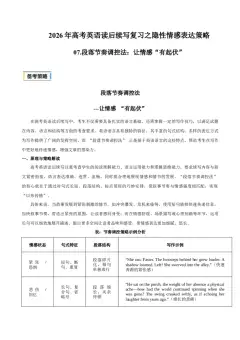
策略解析
策略 1:情感词汇定位法 —— 抓显性态度信号
【核心操作】
在英语语篇的深层结构中,形容词、副词、动词等情感色彩词构成了破译作者或人物观点态度的密
码系统。以文学评论类语篇为例,当作者使用excellent(卓越的)、remarkable(非凡的)、fascinating
(迷人的)等积极词汇,如描述某部小说 "The plot unfolds in a fascinating manner, with each character's arc
meticulously crafted"(情节以迷人的方式展开,每个角色的成长弧线都精心雕琢),往往暗含对作品艺术
性的高度赞赏;反之,当出现disappointing(令人失望的)、ridiculous(荒谬的)、destructive(破坏性
的)等消极词汇,如评价政策 "This short-sighted decision led to a series of destructive consequences"(这个
短视的决定导致了一系列破坏性后果),则清晰传递出强烈的否定立场。若语篇中反复出现neutral(中
立的)、objective(客观的)、unbiased(无偏见的)等中性词汇,如科学论文中常见的 "Based on
unbiased data analysis, the results indicate..."(基于无偏见的数据分析,结果表明...),则明确体现作者试图
策略分析
保持客观中立的学术态度。
在实际阅读场景中,需着重关注三类关键信息锚点:描述事物本质特征的定性词汇,如科技类文章
对新技术的核心评价;分析事件发展过程的动态词汇,如新闻报道中对政策实施效果的渐进式描述;以
及总结行为最终结果的结论性词汇,如历史研究中对某项运动的价值评判。这些词汇如同精准的 "态度
指南针",不仅能帮助读者快速定位观点坐标,更能通过语境关联解析隐藏在字里行间的态度梯度,有效
规避因文化差异或修辞隐喻造成的理解偏差。
【应用分析】
The new environmental policy has successfully reduced air pollution by 40% and significantly improved the
quality of life for residents in industrial areas. Local communities have expressed strong satisfaction with the
government's proactive measures.
What is the author's attitude towards the new environmental policy?
A. Critical  B. Supportive  C. Neutral  D. Doubtful
[答题解析]在分析该语篇时,我们需重点关注其中蕴含情感色彩的关键词汇。文中出现的
“successfully”(成功地)、“significantly improved”(显著改善)、“proactive”(积极主动的) 均属于
积极情感词。这些词汇从不同角度直接且有力地传递出对政策效果的高度肯定与认可。“successfully” 强
调政策实施达成目标的圆满性;“significantly improved” 突出政策带来的积极变化程度之大;
“proactive” 则表明政策推行过程中的积极主动特性。通过对这些关键词的精准把握与深入剖析,能够清
晰明确语篇对政策效果持积极态度,因此答案为 B。
策略 2:转折逻辑聚焦法 —— 辨真实态度倾向
【核心操作】
在英语阅读语篇中,"but, however, yet, nevertheless" 等转折词堪称揭示态度的关键信号。作者或人物
常常会先阐述普遍认知、他人观点,或设置铺垫性内容,为后续转折埋下伏笔。当转折词出现时,其后
的内容往往与前文形成鲜明对比,展现出作者真正想强调的核心态度、立场或观点。
从语言学角度来看,这类转折词如同语篇的 "态度路标",其功能类似道路上的方向指示牌,能瞬间
将读者的注意力导向作者的真实意图。在实际阅读中,读者需警惕 "先扬后抑" 或 "先抑后扬" 的行文模
式:
先扬后抑:在探讨社交媒体利弊的文章中,作者可能先列举其在信息传播(如疫情期间实时新闻推
送)、社交互动(跨国视频会议打破地域限制)方面的积极作用。随后用 "however" 引出深层问题,如
算法推荐导致的信息茧房、过度依赖引发的隐私泄露,以及虚拟社交对现实人际关系的侵蚀,而这些弊
端才是作者更想表达的核心立场。
先抑后扬:在评论新兴 AI 技术的文章中,作者可能先罗列公众对技术失业的担忧、数据安全隐患
等负面争议,再以 "nevertheless" 转折,强调 AI 在医疗影像诊断、气候模型预测等领域创造的不可替代
价值,借此传递对技术发展的理性支持态度。
此外,转折词的使用位置也暗藏玄机:段落首尾处的转折往往总结核心观点,而句间转折则用于细
化论证逻辑。读者可通过标注此类信号词,快速梳理语篇的态度脉络,高效完成观点提炼。
【应用分析】
“Some people praise online education for its convenience and flexibility. However, it often fails to guarantee
interaction quality and may lead to students' lack of self-discipline, which undermines learning efficiency.”
How does the author feel about online education?
A. Optimistic  B. Concerned  C. Approving  D. Indifferent
[答题解析]在语篇中,转折词 “however” 作为关键信号词,明确表明作者论述重点发生转变。在此
之后,作者相继列举了 “在线教育存在缺乏师生间、生生间实时互动”“学习者容易因自律不足而懈怠
学习”“教学环节的割裂与技术适配问题导致学习效率降低” 等多个负面现象。这些具体且详实的描
述,层层递进地展现出在线教育在实践过程中暴露出的弊端,字里行间都渗透着作者对在线教育未来发
展的深切担忧,故答案为 B。
策略 3:例证倾向分析法 —— 从案例推整体态度
【核心操作】在阅读理解中,作者或人物列举的实例往往是揭示其态度倾向的重要线索。心理学研
究表明,人类倾向于通过具体案例传递观点,这使得语篇中的案例成为态度解码的关键密钥。
正面案例:当作者选用个人通过科学备考实现成绩逆袭的成功经验,或是新教学方法显著提升班级
平均分的积极影响时,往往暗含价值认同。这类案例通常会伴随 "突破性进展"" 显著成效 "等强化性表
述,以及具体数据支撑,如" 某学生运用思维导图法后,错题率下降 40%",从实证角度佐证作者的支持
态度。
负面案例:而在呈现盲目跟风投资导致血本无归的失败教训,或是过度依赖电子设备引发专注力下
降的消极后果时,作者常使用警示性语言,如 "值得警惕的是"" 必须反思 "等。这类案例还会深入剖析
原因,例如分析" 信息茧房效应导致投资决策失误 ",通过归因过程强化批判立场。
中立视角:当语篇中正反案例交替出现,且未进行主观褒贬的强化处理时,作者通常保持中立态
度。以线上教育为例,既阐述其打破地域限制、实现优质资源共享的优势,又客观分析其缺乏师生互
动、易产生学习倦怠的弊端,并通过 "有研究指出"" 数据显示 "等客观引述方式,平衡呈现不同观点。
这类语篇往往采用对比论证结构,通过" 一方面... 另一方面..." 的表述框架,展现对事物复杂性的全面认
知。
通过建立 "案例性质识别 - 语言特征分析 - 论证结构解构" 的三维分析模型,精准捕捉案例中的情
感色彩词汇、数据使用方式及逻辑连接词,能够高效破解作者或人物的态度密码。同时需注意,部分语
篇会通过隐喻案例传递态度,如用 "温室花朵" 暗喻过度保护的教育方式,此时需结合语境进行深层语义
解读。
【应用分析】
The rise of electric vehicles (EVs) has been hailed as a major step towards reducing carbon emissions.
However, some experts point to the high energy consumption and pollution associated with battery production.
Despite these concerns, EV adoption continues to grow globally.
What is the author's attitude towards EVs?
A. Highly positive  B. Negative  C. Neutral  D. Skeptical
[答题解析]在文章的论述中,作者对电动汽车(EVs)的探讨呈现出多维视角。一方面,着重阐述了
EVs 在环保领域的积极意义,明确指出其能够显著减少碳排放,为缓解全球气候变暖、改善大气环境质
量提供了有效的解决方案,这无疑是 EVs 在可持续发展进程中极具价值的正面体现。另一方面,作者也
没有回避 EVs 发展过程中存在的问题,特别强调了电池生产环节所引发的污染现象。从原材料的开采、
加工到电池制造,每一个步骤都伴随着资源消耗与环境污染风险,这构成了 EVs 产业发展中的负面因
素。
通过对文章整体内容的细致研读可以发现,作者在呈现 EVs 相关信息时,始终保持着中立客观的态
度,没有对 EVs 的优劣进行主观评判,也未在字里行间流露出明显的情感倾向或价值偏向。其目的在于
全面、真实地向读者展现 EVs 在当下社会发展中所面临的现状与争议,引导读者基于客观事实进行理性
思考与分析。基于上述分析,结合题目所提供的选项,答案应为 C。
策略 4:语篇体裁适配法 —— 按文体定态度基调
【核心操作】
不同语篇体裁的态度表达具有固定规律。说明文以客观数据与事实为基石,通过严谨的语言架构和
专业术语传递信息,整体态度保持中立克制。例如,在科技类说明文中,作者会通过精确的实验数据、
具体的操作流程、权威的理论引用等方式,不带个人感情色彩地阐述科学现象或技术原理,避免主观情
感的介入。
议论文则如同思想的战场,作者必定持有鲜明立场,通过论点阐述、论据支撑和逻辑论证来强化观
点。在时政类议论文中,作者可能会对社会热点事件展开批判,通过分析事件的负面影响、挖掘背后的
深层原因,来表达自己的不满与担忧;而在文化类议论文中,作者可能为某种传统文化的传承与发展摇
旗呐喊,引用历史案例、专家观点等作为论据,展现坚定的支持态度;还有些议论文会对某些既定观点
提出质疑,以严密的逻辑推理和详实的数据对比,打破固有认知。这些或批判、或支持、或质疑的倾向
贯穿全文。
记叙文的态度表达最为含蓄隐晦,往往藏于细腻的场景刻画、人物对话与心理活动细节之中。在一
篇描写童年生活的记叙文中,作者对故乡老槐树的细致描绘 —— 斑驳的树皮、婆娑的树影、夏日里的
阵阵清凉,以及围绕老槐树发生的温馨故事,都暗含着对故乡深深的眷恋;人物对话中,通过角色的语
气、用词,能折射出作者对人物性格的褒贬;心理活动的细腻刻画,则将作者对事件的看法与情感倾向
娓娓道来。读者需透过字里行间的描写,捕捉作者对事件、人物的潜在情感倾向。
【应用分析】
When the old craftsman showed us his wood-carving techniques, his hands trembled but moved with
precision. He explained each step patiently, his eyes lighting up when we praised his work. The villagers told us
he had refused high-paying jobs in cities to preserve this traditional skill.
What is the author's attitude towards the old craftsman?
A. Admiring  B. Pitying  C. Critical  D. Objective
[答题解析]作为记叙文,文中通过 “precision”“patiently”“eyes lighting up” 等细节描写,以及对工匠
“坚守传统” 行为的隐性肯定,传递出赞赏态度,故答案为 A。
策略 5:态度主体区分法 —— 避 “作者与人物” 混淆
【核心操作】在观点态度类题目中,命题人常通过混淆主体设置思维陷阱,核心破题点在于精准锁
定观点主语。具体解题时,需优先圈出题干中的 “the author”“the experts”“the researchers” 等关键主语,
明确观点归属。
例如,若题干问 “the author's attitude”,需聚焦语篇中带有作者主观色彩的表达,如 “personally, I
believe”“from my perspective” 等。同时,一些隐含作者态度的词汇也不容忽视,褒义词(如 excellent、
admirable)往往暗示正面态度,贬义词(如 ridiculous、absurd)则体现负面态度,中性词汇(如
describe、report)代表客观陈述。
若考查 “the experts” 观点,则应定位到引用专家言论的段落,注意段落中诸如 "According to the
expert"、"The researchers pointed out" 等标志性引导语,避免将专家分析、研究结论等第三方观点误判为
作者态度。此外,学术类文章中常出现 "The study suggests"、"Data indicates" 等基于研究数据的客观表
述,这类内容属于研究成果,并非个体态度。
还需警惕文中人物态度的多维度呈现,部分题目会涉及不同人物的对立观点。例如在辩论类文章
中,可能前一段阐述正方专家支持某政策的观点,后一段出现反方学者的驳斥。此时需结合上下文理清
态度脉络,通过分析人物立场、引用的论据及论证逻辑,准确判断不同主体的态度倾向,确保答题方向
的准确性。
【应用分析】
Teachers argue that homework helps reinforce knowledge, but parents complain it takes too much family
time. As a researcher, I believe a balanced homework policy can address both concerns.
What is the researcher's attitude towards homework?
A. Supportive  B. Critical  C. Balanced  D. Indifferent
[答题解析]在该语篇中,教师群体基于学生实际学习需求,从教学实践角度出发,对相关举措给予了
积极肯定,展现出支持态度;家长群体则更多地考虑家庭因素与传统观念,对其持有明显的反对意见。
而作为研究者的作者,通过对各方观点及实际情况的综合考量与深入分析,并未单纯倾向任何一方,而
是提出了 “平衡政策” 的观点。这一观点既充分尊重了教师在教学过程中的专业判断,也兼顾了家长
所关注的现实问题,旨在寻求一种更为合理、全面且具有可行性的解决方案,使各方需求都能在一定程
度上得到满足,故答案为 C。
策略 6:选项验证排除法 —— 筛 “干扰项” 锁定答案
【核心操作】在解答语篇观点态度类题目时,可遵循 **“两步筛选法”** 高效解题。首先,快速排
除三大类干扰选项:
绝对化表述:诸如 “radical(激进的)”“extreme(极端的)”“absolute(绝对的)”“complete
(完全的)” 等词汇,往往会通过过度夸大或片面强调,扭曲原文的客观态度。例如,若原文仅对某一
新兴技术持谨慎乐观态度,选项中出现 “completely revolutionary(彻底革命性的)” 就属于绝对化表
述。这类选项违背了学术语篇或新闻报道常见的严谨性原则,极易偏离原文基调,考生应重点甄别。
冷漠类态度:在 “indifferent(冷漠的)”“apathetic(无动于衷的)”“unconcerned(毫不关心
的)” 等词汇表述的选项中,传递出中立漠视的态度。但在学术类语篇中,作者通常会基于严谨的研究
和论证,表达鲜明的学术立场;而叙事类语篇也会通过情节铺陈与情感描写,展现明确的价值取向。除
非语篇有明确的 “事不关己” 语境设定,否则此类选项通常为干扰项。
逻辑矛盾项:包含 “confused(困惑的)”“ambiguous(模棱两可的)”“uncertain(不确定
的)” 等词汇的选项,暗示作者观点表达混乱。在议论文中,若作者核心观点模糊,将直接削弱论证的
有效性;在说明文中,信息表述不清晰则会导致读者难以把握重点。因此,除非语篇刻意营造悬念或探
讨开放性议题,否则此类表述大概率与原文不符,应果断排除。完成首轮排除后,需结合原文关键线索
进行二次筛选,如情感色彩强烈的形容词、反复出现的核心论点、转折词后的态度倾向句等,通过精准
匹配锁定正确答案。
【应用分析】
Remote work boosts employee satisfaction but may weaken team cohesion. Thus, hybrid work—combining
in-office and remote days—could be the optimal solution.
What is the author's view on remote work?
A. It is completely superior to in-office work
B. It has both benefits and drawbacks
C. It should be abandoned entirely
D. It is irrelevant to team cohesion
[答题解析]在这道观点态度理解题中,选项 A 的表述呈现出绝对化特征,使用了诸如 “完全”“必
定” 等过于绝对的词汇,在学术类语篇中,此类绝对化表述通常不符合客观理性的表达逻辑;选项 C
属于极端否定类型,其语言色彩浓烈,带有强烈的主观批判倾向,与原文中温和客观的论述基调不符;
选项 D 的内容与原文中相关事实和观点存在明显矛盾,存在逻辑冲突。通过对这三个干扰项的逐一分析
和排除,仅剩选项 B。选项 B 的内容与原文 “提升满意度但削弱凝聚力” 的表述高度契合,在语义和
逻辑上均能准确对应,由此可确定答案为 B。
1
Getting away may be good for your soul — but is it good for everyone else?
—By BEN HEALY
If you feel like you need a vacation, you're almost certainly right Americans get far fewer paid days off than
workers in petty much any other industrialized democracy and the time we actually take off has declined
significantly, from 20.3 days in 1987 to 17.2 days in 2017.
Beyond souvenirs and suntans, the best reason to take a break may be your own health. For the Helsinki
Businessmen Study-- 40-year cardiovascular (心血管的) health study that also happens to be the working title of
the solo album I'll probably never get around 10 recording ---researchers treated men at risk of heart disease. From
1974 to 2004 those men who took at east three weeks of vacation were 379% less likely to die than those who
took fewer weeks off.
Even if we don't view time as a matter of life and death, people who take more of their allotted vacation
time tend to find their work more meaningful. Vacation can yield other benefits, too: People who took all or most
of their paid vacation time to travel were more likely than others to report a recent raise or bonus.
And time not taken depresses more than individual career prospects. In 2017, the average us worker left six
paid vacation days unused, which works out to 705 million days of travel nationally, enough to support 1.9 million
travel-related jobs.
From longevity to career growth to macroeconomic achievements, the cease for vacation seems open-and
突破演练
shut. Yet the picture's not entirely rosy. Tourism's carbon footprint grew four times as much as expected from 2009
to 2013, and accounted for 8 percent of all greenhouse gas emission in that period. What's more, the travel
industry is expected to consume 92 percent more water in 2050 than it did in 2010, and 189 percent more land. In
other environmental news, people are less likely too recycle while on vacation (both because they are unsure how
to, and because getting away with things seems to be a key part of getting away from it all)
The frisson(短暂的、突然的兴奋或恐惧) of pitching plastic is not the only thrill tempting travelers.
Interviews wit tourists returning from various international destinations revealed that they used more drugs while
on vacation than in everyday life. Other studies have found that people are more likely to eat with abandon while
traveling: On vacations of one to three weeks, tourists gain an average of 0.7 pounds, a significant portion of
average annual weight gain. Finally, a 2015 study found that "travel and leisure" provoked envy — perhaps the
single most toxic substance known to man — more than any other attribute( 特性) examined (including
"relationship and family," "appearance" and “money and material possessions"). The effect may be especially
severe on social media: 62% of people who described Facebook-caused bouts (发作) of jealousy said they'd been
triggered by travel or leisure experiences--versus less than a quarter of people whose envy had been piqued (激起)
in person.
So for your own health and sanity (心智健全),book that vacation. But for everyone else's, please travel as
sustainably as you can, and take it easy with the Instagram.
1.From the first three paragraphs, we can learn that ______.
A.souvenirs and suntans are not what people want when they go on vacation
B.not using paid vacation days has little  impact on a person’s career prospect
C.the time Americans spend on vacation has decreased by about three days from 1987 to 2017
D.the man in Helsinki Businessmen Study are more likely than others to take a vacation
2.Which of the following is closest in meaning to the underlined word “open-and shut" in paragraph 5?
A.Tricky and challenging.
B.Uncertain and doubtful.
C.Interesting and inspiring.
D.Obvious and straightforward.
3.Which of the following statement is NOT true?
A.People are more likely to gain weight when they take a vacation.
B.The booming of the tourist industry contributes to the acceleration of global warming.
C.The thrill of throwing plastic tempts travelers to travel more often.
D.Travel and leisure lead to more envious feelings compared with appearance or wealth.
4.It can be concluded that the author's tone in this passage is_____.
A.objective
B.skeptical
C.sympathetic
D.admiring
2
For two centuries, the famous University of Cambridge debating society has hosted many outstanding
figures, from world leaders to scientists to comedians.
On Nov 21, 2019, the Cambridge Union hosted its first-ever non-human guest. Designed by IBM, Project
Debater is a machine that uses Artificial Intelligence (AI) to form a spoken argument. It can even listen to and
answer opposing statements, much like a real person.
Speaking with a voice similar to Siri, Project Debater uses AI to search journals, newspapers and other
information sources. It then filters out useless information, picks the strongest arguments, and arranges them into a
persuasive argument.
In the Cambridge test debate, it argued the topic: AI will do more harm than good in the long term.
According to IBM, it is the first machine that can debate complicated topics with humans.
Before the debate, more than 1,100 arguments for the positives and negatives of AI were submitted to the
IBM website. The machine then analyzed these sources and formed the basis of its arguments in minutes. Project
Debater then showed off its AI by arguing for both sides of the debate.
Over a four-minute speech, it argued first that, “AI can only make decisions that it has been programmed to
solve, while humans can be programmed for all situations.”
In support of AI, it then argued that AI would create new jobs and “bring a lot more efficiency” to the
workplace.
According to New Scientist, on both occasions, Project Debater repeated points and didn’t always
sufficiently support them.
Speaking to Cambridge Independent, Noam Slonim, the project’s lead engineer, said, “The AI is not perfect,
but it’s going in the right direction.”
1.What can we learn about the University of Cambridge debating society?
A.It has hosted many debating parties for centuries.
B.It designed Project Debater with IBM.
C.It has invited many famous hosts to join it.
D.It has never hosted a non-human guest before.
2.What do we know about Project Debater?
A.In the Cambridge test debate, it argued for both sides.
B.AI helps it to find the useful information sources.
C.Before the debate the arguments were submitted to it.
D.It would create many new jobs in the future.
3.What’s the probable purpose of debate?
A.To find out how AI works.
B.To create a debating machine.
C.To do an experiment about AI.
D.To prove AI is better than humans.
4.How does Noam Slonim feel about AI?
A.Worried.
B.Hopeful.
C.Doubtful.
D.Nervous.
3
For several decades, there has been an extensive and organized campaign intended to generate distrust in
science, funded by those whose interests and ideologies are threatened by the findings of modern science. In
response, scientists have tended to stress the success of science. After all, scientists have been right about most
things.
Stressing successes isn’t wrong, but for many people it’s not persuasive. An alternative answer to the
question “Why trust science?” is that scientists use the so-called scientific method. If you’ve got a high school
science textbook lying around, you’ll probably find that answer in it. But what is typically thought to be the
scientific method — develop a hypothesis (假设), then design an experiment to test it — isn’t what scientists
actually do. Science is dynamic: new methods get invented; old ones get abandoned; and sometimes, scientists can
be found doing many different things.
If there is no identifiable scientific method, then what is the reason for trust in science? The answer is how
those claims are evaluated. The common element in modern science, regardless of the specific field or the
particular methods being used, is the strict scrutiny (审查) of claims. It’s this tough, sustained process that works
to make sure faulty claims are rejected. A scientific claim is never accepted as true until it has gone through a
lengthy “peer review” because the reviewers are experts in the same field who have both the right and the
obligation (责任) to find faults.
A key aspect of scientific judgment is that it is done collectively. No claim gets accepted until it has been
vetted by dozens, if not hundreds, of heads. In areas that have been contested, like climate science and vaccine
safety, it’s thousands. This is why we are generally justified in not worrying too much if a single scientist, even a
very famous one, disagrees with the claim. And this is why diversity in science — the more people looking at a
claim from different angles — is important.
Does this process ever go wrong? Of course. Scientists are humans. There is always the possibility of
revising a claim on the basis of new evidence. Some people argue that we should not trust science because
scientists are “always changing their minds.” While examples of truly settled science being overturned are far
fewer than is sometimes claimed, they do exist. But the beauty of this scientific process is that it explains what
might otherwise appear paradoxical ( 矛盾的): that science produces both novelty and stability. Scientists do
change their minds in the face of new evidence, but this is a strength of science, not a weakness.
1.How does the author think of the scientific method?
A.Stable.
B.Persuasive.
C.Unreliable.
D.Unrealistic.
2.What does the underlined word “vetted” in Paragraph 4 probably mean?
A.Explained.
B.Examined.
C.Repeated.
D.Released.
3.According to the passage, the author may agree that ______.
A.it is not persuasive to reject those faulty claims
B.settled science tends to be collectively overturned
C.a leading expert cannot play a decisive role in a scrutiny
D.diversity in knowledge is the common element in science
4.Which of the following would be the best title for the passage?
A.Put Your Faith in Science
B.Defend the Truth in Science
C.Apply Your Mind to Science
D.Explore A Dynamic Way to Science
4
Vancouver has had a crazy property ( 房地产) market since it hosted the winter Olympics in 2010. The
downtown area is forested with new apartment blocks. Prices have risen by nearly 60% in the past three years. But
until recently developers have largely avoided Chinatown. It is an underdeveloped area. Many Chinatown
residents are old and poor.
Developers now have Chinatown in their sights. Two years ago one built a 17-storey apartment building on
its edge. This alarmed many residents, who had formed a group to stop the high-rise advance, now called
SaveChinatownYVR. Ms. Melody Ma is its leader. Recently it has been successful.
The main theatre of battle is a car park known as 105 Keefer, where Beedie Living plans to build a nine-
storey brick-and-glass apartment block. The developer promises 111 luxury flats, with rooftop landscaping and
shops below.
105 Keefer is in an area rich with cultural associations. Just to the south is a monument to Chinese-Canadian
builders of the Canadian Pacific Railway and veterans of the Second Word War. Across the street is the Sun Yat-
sen Classical Chinese Garden and the Chinese Cultural Centre Museum. “A lot of people were frightened”
because of the building’s “closeness to sacred sites in the heart of Chinatown,” says Ms. Ma. Some residents also
fear that it will push up rents.
Conservationists hope that the parking lot is where they can stop development, which they say has spoilt the
charm of other Vancouver neighborhoods such as Mount Pleasant. The dispute (分歧) is part of a debate about the
city’s identity, says Andy Yan, an urban planner. Vancouverites, he says, are asking themselves, “Who are we?
And what are we building for?” The people who might want to buy the flats that do not yet exist are, of course,
not being consulted.
1.What will Ms. Melody Ma agree?
A.To preserve Chinatown.
B.To rebuild Chinatown.
C.To build skyscrapers in Chinatown.
D.To promote the property market in Chinatown.
2.What does the author intend to do in paragraph 4?
A.To state some reasons.
B.To offer some advice.
C.To make some comparisons.
D.To introduce a new topic.
3.What is Vancouverites attitude towards the recent development in Chinatown?
A.Positive.
B.Doubtful.
C.Unfavorable.
D.Divided.
4.What is the text mainly about?
A.The alarmed citizens of Vancouver.
B.The cultural associations of 105 Keefer.
C.The property battle in Vancouver’s Chinatown.
D.The identity of Vancouver.
5
It often happens that a number of applicants with almost identical qualifications and experience all apply for
the same position. In their educational background, special skills and work experience, there is little, if anything,
to choose between half a dozen candidates. How then does the employer make a choice? Usually on the basis of
an interview.
There are many arguments about the interview as a selection procedure. One argument is that it gives rise to a
wholly subjective decision. As often as not, employers do not choose the best candidate, but the one who makes a
good first impression on them. Some employers, of course, reply to this argument by saying that they have
become so experienced in interviewing staff that they are able to make a sound assessment of each candidate’s
likely performance. Unfortunately, both for the employers and applicants, there are many people of great ability
who simply do not interview well. There are also, of course, people who interview extremely well, but are later
found to be very unsatisfactory employees.
Those in favour of the interview insist that the well-structured procedure is valid in assessing a candidate’s
ability, an essential guarantee for the future job. They also argue that an employer is concerned not only with a
candidate’s ability, but with the suitability of his or her personality for the particular work situation. Many
employers, for example, will overlook occasional inefficiencies from their secretary so long as she has a pleasant
personality. Perhaps the real purpose of an interview is not to assess the assessable aspects of each candidate but
to make a guess at the more intangible things, such as personality and social ability.
Today, interview is still a common section of the entire selection procedure, though different employers have
different standards for competence. Generally speaking, candidates who interview well tend to be quietly
confident, but never boastful; direct and straight-forward in their questions and answers; cheerful and friendly, but
never over-familiar; and sincerely enthusiastic and optimistic. Candidates who interview badly tend to be at either
end of the spectrum of human behaviour. They are either very shy or over-confident. They show either a lack of
enthusiasm or an excess of it. They either talk too little or never stop talking. They are either over-polite or rudely
abrupt.
1.According to the passage, which of the following statements is TRUE?
A.Employers are experienced in assessing the interviewees’ performance.
B.Interview is not always recognized as a sensible way to choose employees.
C.The interview helps the employers to pick the desired employees.
D.The remarkable candidates often distinguish themselves in an interview.
2.Which may not be considered in an interview?
A.Personality
B.Communication skills
C.Background
D.Capability
3.What is the author’s attitude towards the interview as a selection procedure?
A.Supportive
B.Negative
C.Objective
D.Unconcerned
4.The last paragraph indicates _________________.
A.a link between success in interview and character
B.connections between work abilities and character
C.differences in interview experience
D.differences in personal behaviour
6
Nowadays, we can read almost all “truths” on social media sites. But are they really reliable? Sites such as
the micro messaging service Twitter, the social networking site Facebook and the photo-sharing app
Instagram might “misrepresent the real world,” according to a study by computer scientists from McGill
University and Carnegie Mellon University.
The scientists warn that gathering information about public views and trends from these sites is unwise.
There are still large parts of the population who do not take part in social media activities. Also, there's a risk that
many social media users are under- represented. Instagram, for example, appeals to younger adults in urban
areas while Pinterest is used mainly by females aged 25 to 34. And only 5 percent of Twitter users are over 65
years old, according Io the study.
However, this is not the only issue, according to the scientific team. The design of a website can influence
how people behave online, creating what the researchers call “Internet bias.” For example, micro-blogging sites
such as Weibo promote “popular” stories. It saves time for some, but it also limits readers' choice of what they
see. In the end, many people open those stories and make them more “popular.” But it's not because they choose
those stories. Rather, it is because the content is right in front of them.
Besides, it's possible that not everyone on your social networks is real. There might actually be a few fake
accounts among them. Fake “bots” pretend to be human and are often included when measuring or predicting
human behaviors online.
The findings might be more important than you would think, since many social media studies “are used to
inform and justify decisions and investments among the public and in industry and government,” said Derek
Ruths, assistant Professor at McGill's School of Computer Science.
If the team is right, you might have to think carefully the next time you say, “It's true, you know; I read it on
Weibo.”
1.Why does the author mention Twitter, Facebook and Instagram?
A.Because they are the best social media sites today.
B.Because they are not in favor of the current study.
C.Because the public are sharing truths on these sites.
D.Because information on these sites may not be reliable.
2.How is the passage developed?
A.By giving examples.
B.By making comparisons.
C.By dividing into groups.
D.By analyzing cause and effect.
3.Which word can best describe the author's attitude toward information on social media sites?
A.Ambiguous.
B.Favorable.
C.Disagreeable.
D.Cautious
4.What's the author's main purpose in writing the passage?
A.To analyze why information gathered from social media sites may not be trustworthy.
B.To remind readers of things they should watch out for when using social media.
C.To point out the advantages and disadvantages of social media.
D.To recommend popular social networking sites for readers.
7
A 2018 report found that food waste would increase by a third to 2. 1billion tons by 2030. Beyond the cost
of the waste itself,thrown-away food generates a gas that contributes to climate change.
Home delivery meal kits(盒)can reduce food waste by more than two-thirds,but suppliers need to switch
to reusable packaging to make them environmentally friendly.
Tailor-made meal kits cut waste by providing people with precise amounts of fresh ingredients( 烹饪原
料)for chosen recipes,meaning leftovers are minimized. But while the  delivery services score well on reducing
food waste,buying the same food ingredients from the supermarket almost always saves energy overall simply
because meal kits use so much single-use packaging. The good news is that if people have meals that are tailored
for consumption,they won’t overbuy and have less food waste. They fine-tune the amount of food to what they
will actually eat.
Meal kits can reduce transport emissions(排放)if people go to the supermarket less  frequently. If people
only go and buy such goods as soap and toilet paper,they may only have to visit once every couple of months. A
delivery truck can carry meals for a lot of people in the neighborhood. So dozens of car trips might be replaced
with one truck trip.
However,study found that even if delivery meal kits reduced food waste to zero,they would still use up
more energy overall than buying the same food from the supermarket unless the energy used for the meal kit
packaging was cut by a fifth. The packaging is a killer if it’s single-use and thrown away,which can make all the
environmental benefits lost. But if the packaging can be reused,if it’s glass bottles,like in the old days,we can
get some benefits.
1.What can we learn about home delivery meal kits?
A.They can cut down on daily expenses.
B.They will totally solve the problem of food waste.
C.They can keep energy consumption to a minimum.
D.They will benefit the environment with reusable packaging.
2.What does the underlined word“fine-tune”in paragraph 3 mean?
A.Attach.
B.Adjust.
C.Raise.
D.Compare.
3.The author suggests carrying meals with a delivery truck to__________.
A.reduce transport emissions
B.save more food
C.shop only in the supermarket
D.shorten car trip distances
4.What’s the author’s attitude to meal kits?
A.Supportive.
B.Unfavorable.
C.Objective.
D.Indifferent.
8
Screens during meals rob kids of opportunities to improve language and communication skills
(storytelling, making jokes, etc. ), as well as to develop patience and even imagination as they entertain
themselves waiting for food to arrive.
Meals are an opportunity to connect, to learn more about and enjoy each other. They strengthen the bonds
that will bring benefits to the rest of our lives. We squander that opportunity when we stick a screen in front of
our kids during dinner.
Of course, we all want to have enjoyable family meals, which is why I love Bruce Feiller's book "The Secrets
of Happy Families", in which he devotes an entire chapter to ways to make them fun and meaningful for
everyone---such as "fill in the blank" sentences you make up. Sharing something good and something challenging
makes for pleasant conversations, too. And I've had fun playing Uno with my daughters until the food arrives in a
restaurant.
The American Academy of Pediatrics (小儿科)also offers guidelines to help families manage children's
screen time. The academy recommends avoiding digital media for children under 2, except for video-chatting, and
limiting screen time to just one hour a day of high-quality programming for children ages 2 to 5.
Fundamentally, we all benefit from more human connection, not less — and that's especially true for
children. Schools, airplane trips, most jobs, games, even "social" interaction were all once done without screens
but now are filled with them. And while we have gained some advantages, including new connections, we have
lost something fundamental, as well.
Less is always more when it comes to screens, even if they are effective at keeping kids quiet. But soon after
complaining that they are "bored, ” kids have a natural tendency to fill the screenless void (空虚)with creative
games, art, exploration and conversation. There are no studies that warn against having too many hours of those
activities.
Let's all work harder to keep family meals special by getting rid of the iPads and nourishing our personal
connections as we nourish our bodies.
1.What's the author's attitude to the kids' staring at screens during meals?
A.Disapproving.
B.Favorable.
C.Cautious.
D.Unconcerned.
2.What does the underlined word "squander" in paragraph 2 probably mean?
A.Take.
B.Waste.
C.Expect.
D.Create.
3.What will kids do if they have no access to screens?
A.Keep quiet.
B.Refuse to eat.
C.Feel bored all the time.
D.Find ways to entertain themselves.
4.What is the author's purpose in writing this passage?
A.To introduce the iPads to the children.
B.To stress the importance of family meals.
C.To appeal for family meals without screens.
D.To teach parents how to punish their children.
9
Most squirrels don’t hibernate(冬眠). Instead, they store food for the cold season and spend the winter in
their nests. But the 13-lined ground squirrel, one species of squirrel in the U.S. Midwest, is not the case. For up to
8 months, the tiny mammals won’t eat or drink anything at all and the heart rate, metabolism(新陈代谢), and
body temperature dramatically drop during their long rest, which is similar to bears and other hibernating animals.
To find out how the hibernating squirrels hold back their thirst, a powerful force that could potentially wake
them up, and researchers measured the blood fluid of dozens of squirrels. Generally, a high blood
concentration( 血液浓度) makes animals, including humans, feel thirty. The sleeping squirrels' blood
concentration was low, preventing them from waking up for a drink. Even when researchers woke up the torpid
squirrels, they wouldn’t drink a drop until the team artificially increased the concentration of their blood serum.
Next, the researchers wanted to know how the squirrels’ blood concentration dropped so low. Perhaps the
squirrels drank a lot of water before hibernation to dilute( 稀释) their blood, the researchers thought. But when
they filmed squirrels preparing for their winter snooze, they found the animals actually drank less water than they
normally did.
Instead, chemical tests revealed the squirrels regulate their blood concentration by getting rid of
electrolytes(电解质)like sodium and other chemicals like glucose and urea and storing them elsewhere in the
body (possibly in the bladder), the researchers reported last month in Current Biology. The finding could also
explain how other hibernating animals stay containing water.
This new knowledge might one day help humans with conditions such as diabetes( 糖尿病), or astronauts
who have launched on long space flights. Unfortunately, even if people can figure out how to drop their blood
concentration, it’s unlikely they’ll ever be as cute as sleeping squirrels.
1.What do we know about the 13-lined ground squirrels?
A.They don’t hibernate like many other squirrels.
B.They are endangered species in the U. S. Midwest.
C.They can live for months without water during hibernation.
D.Their heart rule and body temperature are extremely abnormal.
2.The hibernating squirrels don' feel thirsty because of their___________.
A.high blood concentration
B.low blood concentration
C.low body temperature
D.high heart rate
3.Hibernating squirrels adjust their blood concentrations by_____________.
A.Drinking much water before hibernation
B.Not eating anything during hibernation
C.Drinking less water than they normally do
D.Removing certain chemicals and storing them somewhere
4.What is the author’s attitude towards the new findings?
A.Objective
B.Positive
C.Disappointing
D.Uncaring
10
You want your children to do well in school. You want them to have nice friends and interesting hobbies and
to not go out with strangers. You may even want them to be happy. But in this computer game, you can always
start over with a new digital child if things don't work out as planned.
A new game in China puts players in control of those most fearsome of characters: Mom and Dad. The
mission? Raise a son or daughter from kindergarten to college.
In a nation of famously demanding, scolding and, yes, sometimes loving mothers and fathers, the game,
Chinese Parents, is a hit. Since its release in September, it has found a huge audience on Steam, an online
marketplace run by the American game maker Valve Corporation. There are no official figures for how many
people have downloaded the game but it has caused heated discussion online while earning tens of thousands of
reviews.
Yang Gee Yelling, a founder of Moy wan Games, the independent studio that developed Chinese Parents,
said he hoped to produce an English version this year. The success of the game, which costs $9. 99 to play, does
not appear to be driven by people hoping to exact revenge for their own upbringings. Quite the opposite:  Some
fans have written that, by letting them experience childhood from their parents' perspective, it had moved them to
tears.
"I used to not understand many things my mom made me do when I was little, "said Kang Shang hero, 19, a
professional blogger in the northeastern city of Qinhuangdao. "But when I play the game and try to increase
figures for my son so he can unlock more achievements and marry the prettiest girl in school, start to understand
my parents more.
All the joys and trials of raising children are here. Players choose between pushing their digital generation to
attain conventional success and allowing them some appearance of childhood innocence. They must give career
guidance and tolerate (just barely) their teenager's first dates. Everything leads up to the gaokao, the highly
competitive college entrance exam that decides the fortunes of so many young Chinese people.
1.What's the function of the first paragraph?
A.To attract readers to the topic.
B.To present the parents' expectations.
C.To arouse argument among readers.
D.To state clear fact.
2.How do we know this computer game Chinese Parents is popular?
A.It is produced as expected.
B.It has aroused heated discussions and received many comments online.
C.Many parents have been engaged in playing this computer game.
D.It is hoped that an English version of this computer game will come out this year.
3.What's the author's attitude towards this computer game?
A.Pessimistic.
B.Cautious.
C.Supportive.
D.Disgusted.
4.What's the author's purpose in writing the text?
A.To introduce the computer game Chinese Parents.
B.To encourage children to play this computer game Chinese Parents.
C.To persuade parents to be strict with their children.
D.To let parents understand their children better.
11
When I was small,my mother and I would walk to our local library in Franklin Square. As we didn't always
have access to a reliable car,walking hand in hand was the most convenient way to get anywhere. It was at story
time for children that both my mother and I made lasting friendships.
Today,I am fortunate to live around the corner from the Cold Coast Public Library in Glen Head and a short
walk to the Sea Cliff Children's Library. My 18-imonth-old son,Colin,and I find ourselves in Sea Cliff several
times a week,meeting and making friends. Well,that is what many people don't understand-a library is more
than books;it's a community.
Sure,the library in Franklin Square was the place where I was introduced to Judy Blume novels. But it was
also the place where I got my first email address in 1997. At the library,friends and I learned how to research
colleges and search for scholarships on the Internet. The library was the place where we sometimes giggled(咯
咯笑)too loudly,and where the librarians knew us by name. Their knowing our names wasn't a bad thing.
When I came home from my first term at Binghamton University,Mary LaRosa,the librarian at the Franklin
Square library,offered me my first teaching job.
I now teach reading at Nassau Community College. My students are often amazed that they can check out
books via their smartphones and virtually(虚拟地)visit a variety of Long Island libraries. The app used by
Nassau and Suffolk county public libraries ,as well as the college library ,makes their homework easier by
helping them find resources. Even though they can't always easily visit their local libraries,the library is always
with them.
1.Why does the author consider herself lucky today?
A.She has become her mother's best friend.
B.She has access to a reliable car now.
C.She can meet friends at the library.
D.She lives close to libraries.
2.What does the underlined word “that" in Paragraph 2 refer to?
A.Socializing in a library.
B.Reading books in a library.
C.Visiting a library with a family member.
D.Building parent-child friendship in a library.
3.What is the author's attitude to her students' way of visiting libraries?
A.Cautious.
B.Favorable.
C.Doubtful.
D.Disapproving.
4.Why does the author write the text?
A.To discuss why libraries are important.
B.To express her deep love for libraries.
C.To explain how libraries change.
D.To introduce her favorite libraries.
12
As part of my research, I collected every digitized number one New York Times bestseller from 1960 to
2014 and ran the Flesch-Kincaid test* on 563 of them. Most books meant for a general audience will fall within
the fourth- to eleventh-grade range, as did all of these bestsellers. If you look at the scores over the decades, an
unmistakable trend becomes clear: The bestseller list is full of much simpler fiction today than it was 40 or 50
years ago. In the 1960s, the median (中间的,中位数的) book had a grade level of 8. Today the median
grade level is 6.
On the upper end, James Michener’s 1988 novel Alaska had a grade-level score of 11.1. Of the books I
analyzed, 25 had a grade level of 9 or higher. But just two of these were written after 2000.
On the low end, eight books tied for the lowest score of 4.4. All were written after 2000 by one of three
high-volume writers: James Patterson, Janet Evanovich, and Nora Roberts.
There’s no way around it: While prize-winning literary novels such as Jonathan Franzen’s.
The Corrections make the number one spot on occasion, overall, the books we’re reading have become
simpler. Does that mean that books-and therefore their readers-are getting “dumber” too?
It is true that today’s bestsellers have much shorter sentences than the bestsellers of the past, a drop from a
median of 17 words per sentence in the 1960s to 12 in the 2000s. Also, today’s list is much more often topped by
commercial novels than in the past.
It would be easy to associate the New York Times list of reading-level decline with the rise of arguments
that the country’s intellect is at an all-time low, but I don’t think this is fair.
Writing doesn’t need to be complicated to be considered powerful or literary. The winner of the 2014
Pulitzer Prize for fiction, The Goldfinch, was also a bestseller and has a reading level of 7.2. While many classics
have high scores (The Age of Innocence at 10.4, Oliver Twist at 10.1, The Satanic Verses at 10.1), just as many
have surprisingly low scores: To Kill a Mockingbird at 5.9, The Sun Also Rises at 4.2, and The Grapes of Wrath at
4.1. These books are highly respected, but they are also accessible enough to be taught in middle and high school.
It’s logical that our bestselling books are not complex-by definition, popular means they appeal to the
masses. For what it’s worth, plenty of successful “literary” writers have welcomed the beauty of “easy” writing.
As one bestselling writer put it,” One day I will find the right words, and they will be simple.” His name:
Jack Kerouac. By the way, Kerouac’s most popular book, On the Road, scores a reading level of 6.6.
*The following is the formula of the Flesch-Kincaid test and the resulting score is the grade level required
to understand the text.

1.What does the writer’s research find?
A.The Flesch-Kincaid test fails to reflect the truth.
B.More novels were written before 2000 than after 2000.
C.The language of best-sellers has been getting simpler.
D.High-volume writers were mostly born between 1960 and 2000.
2.By “there’s no way around it”, the writer means that what follows is _______.
A.something that we cannot deny
B.something that we think unusual
C.something that is worthy of a prize
D.something that will cause damage
3.Why does the writer mention the books To Kill a Mockingbird, The Sun Also Rises and The Grapes of Wrath?
A.To illustrate how respected books are usually like.
B.To stress the importance of being complicated to classics.
C.To remind readers that there are too many classics to name.
D.To show that books can be both respected and easy to read.
4.What does the writer think of the trend of best-sellers that is introduced in the passage?
A.It makes readers dumber.
B.It doesn’t do much harm.
C.It fails to be accepted by writers.
D.It should be paid attention to.