热点练 07 阅读理解话题生态保护
“生态环保”是普通高中英语课程标准话题之一,亦是高考英语常考话
题。本话题包括动植物保护、生态保护、自然灾害、环境污染和保护等方面。
这些话题与学生的生活息息相关,联系密切。通过对这些话题的学习以及高
考英语对这些话题的考查,可以让学生多注意身边的人和事、关注社会环境、
树立环保意识、学会与大自然和谐相处。
策略一:抓住文体特征:主题句:背景引入后\首句
四个部分:标题(简明揭示中心)、背景(引入)、主题(明确提出主题+详细说明)--通
过实验、研究、举例、对比等方式进行以及结尾--简要概括中心
策略二:抓关键句--首末句 +作者态度句;
策 略 三 : 抓 出 题 处 : ⑴ 在 列 举 处 命 题 。 ⑵ 在 例 证 处 命 题 ( 3 ) 转 折
but,yet,however,nevertheless,rather,though,although,while,in fact,as a matter of fact,on the other
hand,by contrast);。
⑷在比较处命题,无端的比较、相反的比较、偷换对象的比较,经常出现在干扰项中,考
生要标记并且关注到原文中的比较,才能顺利地排除干扰。
⑸在复杂句中命题,包括同位词、插入语、定语、从句、不定式等,命题者主要考查考生
对句子之间的指代关系和语法关系。
(6)带总结归纳(thus,so,therefor,accordingly,consequently,as a result,in a word,in summary,in
brief);
(7)表达观点,总括的动词(believe,think,assume,suggest,show,conclude,find that,draw the
conclusion that,discover that);
(8)问句--设问句\反问句(问句中的内容和答案---即文章作者要介绍的主题或观点)
策略四: 判断推理题
1. 不能夸大事实,过度推断。
2. 不能主观臆断,无中生有。
3. 文中细节,事实不是推断环境保护
动物保护
真题链接
Passage 1
(2021 全国乙卷 C 篇)You’ve heard that plastic is polluting the oceans — between 4.8 and
12.7 million tonnes enter ocean ecosystems every year. But does one plastic straw or cup really
make a difference? Artist Benjamin Von Wong wants you to know that it does. He builds massive
sculptures out of plastic garbage, forcing viewers to re-examine their relationship to single-use
plastic products.
At the beginning of the year, the artist built a piece called “Strawpocalypse,” a pair of 10-
foot-tall plastic waves, frozen mid-crash. Made of 168,000 plastic straws collected from several
volunteer beach cleanups, the sculpture made its first appearance at the Estella Place shopping
center in Ho Chi Minh City, Vietnam.
Just 9% of global plastic waste is recycled. Plastic straws are by no means the biggest source
(来源) of plastic pollution, but they’ve recently come under fire because most people don’t need
them to drink with and, because of their small size and weight, they cannot be recycled. Every
straw that’s part of Von Wong’s artwork likely came from a drink that someone used for only a
few minutes. Once the drink is gone, the straw will take centuries to disappear.
In a piece from 2018, Von Wong wanted to illustrate (说明) a specific statistic: Every 60
seconds, a truckload’s worth of plastic enters the ocean. For this work, titled “Truckload of
Plastic,” Von Wong and a group of volunteers collected more than 10,000 pieces of plastic, which
were then tied together to look like they’d been dumped (倾倒) from a truck all at once.
Von Wong hopes that his work will also help pressure big companies to reduce their plastic
footprint.
1.What are Von Wong’s artworks intended for?A.Beautifying the city he lives in. B.Introducing eco-friendly products.
C.Drawing public attention to plastic waste. D.Reducing garbage on the beach.
2.Why does the author discuss plastic straws in paragraph 3?
A.To show the difficulty of their recycling.
B.To explain why they are useful.
C.To voice his views on modern art.
D.To find a substitute for them.
3.What effect would “Truckload of Plastic” have on viewers?
A.Calming. B.Disturbing.
C.Refreshing. D.Challenging.
4.Which of the following can be the best title for the text?
A.Artists’ Opinions on Plastic Safety
B.Media Interest in Contemporary Art
C.Responsibility Demanded of Big Companies
D.Ocean Plastics Transformed into Sculptures
Passage 2
(2020 全国 II 卷 C 篇)In May 1987 the Golden Gate Bridge had a 50th birthday party. The
bridge was closed to motor traffic so people could enjoy a walk across it. Organizers expected
perhaps 50,000 people to show up. Instead, as many as 800, 000 crowded the roads to the bridge.
By the time 250,000 were on the bridge, engineers noticed something terrible:the roadway was
flattening under what turned out to be the heaviest load it had ever been asked to carry. Worse, it
was beginning to sway(晃动). The authorities closed access to the bridge and tens of thousands
of people made their way back to land. A disaster was avoided.
The story is one of scores in To Forgive Design:Understanding Failure, a book that is at
once a love letter to engineering and a paean(赞歌)to its breakdowns. Its author, Dr. Henry
Petroski, has long been writing about disasters. In this book, he includes the loss of the space
shuttles(航天飞机)Challenger and Columbia, and the sinking of the Titanic.
Though he acknowledges that engineering works can fail because the person who thought
them up or engineered them simply got things wrong, in this book Dr. Petroski widens his view to
consider the larger context in which such failures occur. Sometimes devices fail because a good
design is constructed with low quality materials incompetently applied. Or perhaps a design works
so well it is adopted elsewhere again and again, with seemingly harmless improvements, until,
suddenly, it does not work at all anymore.
Readers will encounter not only stories they have heard before, but some new stories and a
moving discussion of the responsibility of the engineer to the public and the ways young engineers
can be helped to grasp them."Success is success but that is all that it is," Dr. Petroski writes. It is failure that brings
improvement.
5.What happened to the Golden Gate Bridge on its 50th birthday?
A.It carried more weight than it could.
B.It swayed violently in a strong wind
C.Its roadway was damaged by vehicles
D.Its access was blocked by many people.
6.Which of the following is Dr. Petroski's idea according to paragraph 3?
A.No design is well received everywhere
B.Construction is more important than design.
C.Not all disasters are caused by engineering design
D.Improvements on engineering works are necessary.
7.What does the last paragraph suggest?
A.Failure can lead to progress. B.Success results in overconfidence
C.Failure should be avoided. D.Success comes from joint efforts.
8.What is the text?
A.A news report B.A short story.
C.A book review D.A research article.
Passage 3
(2020新高考II卷D篇)According to a recent study in the Journal of Consumer Research,
both the size and consumption habits of our eating companions can influence our food intake. And
contrary to existing research that says you should avoid eating with heavier people who order
large portions(份), it's the beanpoles with big appetites you really need to avoid.
To test the effect of social influence on eating habits, the researchers conducted two
experiments. In the first, 95 undergraduate women were individually invited into a lab to
ostensibly(表面上)participate in a study about movie viewership. Before the film began, each
woman was asked to help herself to a snack. An actor hired by the researchers grabbed her food
first. In her natural state, the actor weighed 105 pounds. But in half the cases she wore a specially
designed fat suit which increased her weight to 180 pounds.
Both the fat and thin versions of the actor took a large amount of food. The participants
followed suit, taking more food than they normally would have. However, they took significantly
more when the actor was thin.
For the second test, in one case the thin actor took two pieces of candy from the snack bowls.
In the other case, she took 30 pieces. The results were similar to the first test: the participants
followed suit but took significantly more candy when the thin actor took 30 pieces.
The tests show that the social environment is extremely influential when we're making
decisions. If this fellow participant is going to eat more, so will I. Call it the “I’ll have what she'shaving” effect. However, we'll adjust the influence. If an overweight person is having a large
portion, I'll hold back a bit because I see the results of his eating habits. But if a thin person eats a
lot, I'll follow suit. If he can eat much and keep slim, why can't I?
9.What is the recent study mainly about?
A.Food safety. B.Movie viewership.
C.Consumer demand. D.Eating behavior.
10.What does the underlined word “beanpoles” in paragraph 1 refer to?
A.Big eaters. B.Overweight persons.
C.Picky eaters. D.Tall thin persons.
11.Why did the researchers hire the actor?
A.To see how she would affect the participants.
B.To test if the participants could recognize her.
C.To find out what she would do in the two tests.
D.To study why she could keep her weight down.
12.On what basis do we “adjust the influence” according to the last paragraph?
A.How hungry we are. B.How slim we want to be.
C.How we perceive others. D.How we feel about the food.
Passage 4
(2020浙江1月卷B篇)Milwaukee, Wisconsin, is road testing a new way to keep winter roads
ice-free — by spreading on them cheese brine, the salty liquid used to make soft cheeses, like
mozzarella.
Wisconsin, also called “America’s Dairyland,” is famous for its cheese. The state produced
2.8 billion pounds of cheese last year! As a result, there was a lot of leftover cheese brine.
Disposing of (处置) the brine can be expensive. So what should cheese makers do with the waste?
Normally, towns use rock salt to de-ice streets. The salt lowers water’s freezing point,
causing ice to melt (融化). But using cheese brine could help both cheese producers and cities
save money, while keeping roads safe. Cheese brine has salt in it, which, like the rock salt, helps
lower water’s freezing point.
In addition to saving money, cheese brine could also be a more eco-friendly option. Many
people suspect that all the rock salt used every winter is harming the environment.
Rock salt is made of sodium chloride, the same compound (化合物) in ordinary table salt.
Sounds harmless, right? But while you probably add only a small amount of salt to your food,
road crews spread about 20 million tons of salt on U.S. roads every year!
The chemical washes off roads and goes into the ground. There it can pollute drinking water,
harm plants, and eat away soil. By spreading cheese brine on streets before adding a layer of rock
salt, Milwaukee may be able to cut its rock salt use by 30 percent.
Cheese brine has a downside too — a smell similar to that of bad milk. “I don’t really mind
it,” Emil Norby told Modern Farmer magazine. He works for one of Wisconsin’s county highway
commissions and came up with the idea of using cheese brine. “Our roads smell like Wisconsin!”
he said.
24. Why can cheese brine help keep winter roads ice-free?
A. It is soft. B. It contains salt.
C. It is warm. D. It has milk in it.
25. What is a benefit of using cheese brine on roads?A. Improving air quality. B. Increasing sales of rock salt.
C. Reducing water pollution. D. Saving the cheese industry.
26. Milwaukee’s new way to de-ice streets may be an example of ______.
A. barking up the wrong tree B. putting the cart before the horse
C. robbing Peter to pay Paul D. killing two birds with one stone
Passage 5
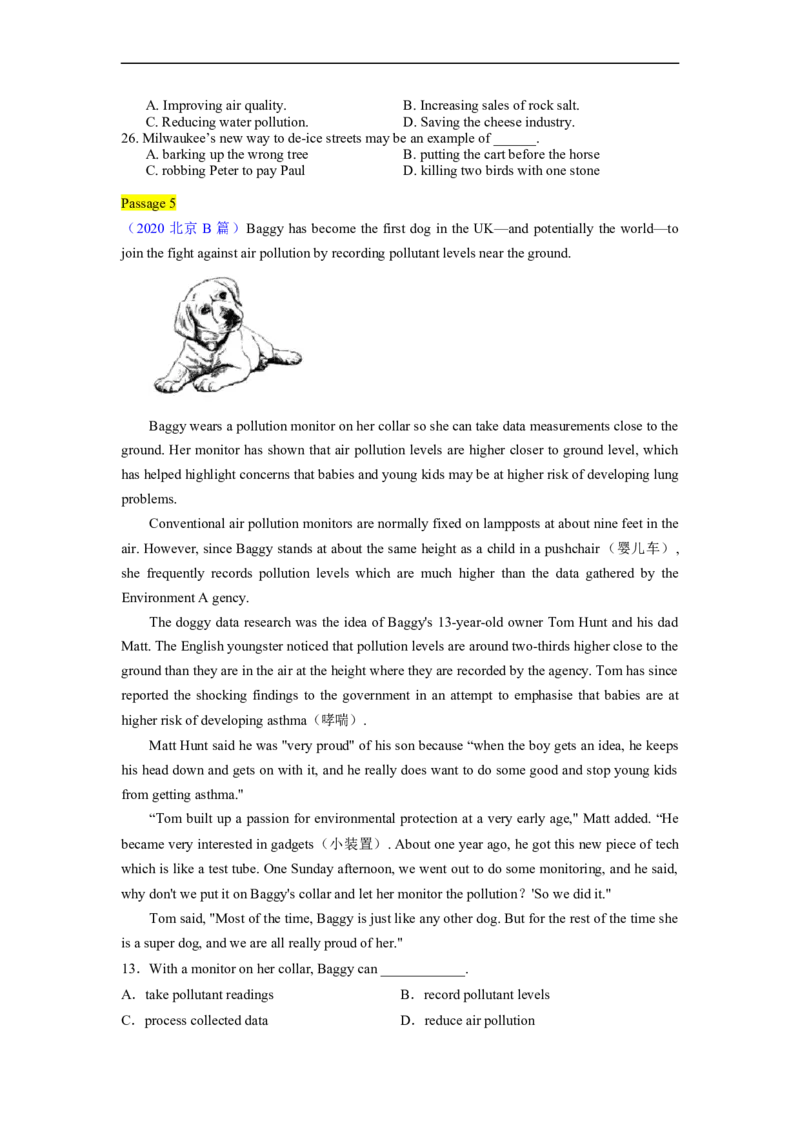
(2020 北京 B 篇)Baggy has become the first dog in the UK—and potentially the world—to
join the fight against air pollution by recording pollutant levels near the ground.
Baggy wears a pollution monitor on her collar so she can take data measurements close to the
ground. Her monitor has shown that air pollution levels are higher closer to ground level, which
has helped highlight concerns that babies and young kids may be at higher risk of developing lung
problems.
Conventional air pollution monitors are normally fixed on lampposts at about nine feet in the
air. However, since Baggy stands at about the same height as a child in a pushchair(婴儿车),
she frequently records pollution levels which are much higher than the data gathered by the
Environment A gency.
The doggy data research was the idea of Baggy's 13-year-old owner Tom Hunt and his dad
Matt. The English youngster noticed that pollution levels are around two-thirds higher close to the
ground than they are in the air at the height where they are recorded by the agency. Tom has since
reported the shocking findings to the government in an attempt to emphasise that babies are at
higher risk of developing asthma(哮喘).
Matt Hunt said he was "very proud" of his son because “when the boy gets an idea, he keeps
his head down and gets on with it, and he really does want to do some good and stop young kids
from getting asthma."
“Tom built up a passion for environmental protection at a very early age," Matt added. “He
became very interested in gadgets(小装置). About one year ago, he got this new piece of tech
which is like a test tube. One Sunday afternoon, we went out to do some monitoring, and he said,
why don't we put it on Baggy's collar and let her monitor the pollution?'So we did it."
Tom said, "Most of the time, Baggy is just like any other dog. But for the rest of the time she
is a super dog, and we are all really proud of her."
13.With a monitor on her collar, Baggy can ____________.
A.take pollutant readings B.record pollutant levels
C.process collected data D.reduce air pollution14.What can we learn from the Baggy data?
A.High places are free of air pollution.
B.Higher pushchairs are more risky for kids.
C.Conventional monitors are more reliable.
D.Air is more polluted closer to the ground.
15.What is Tom's purpose of doing the research?
A.To warn of a health risk. B.To find out pollution sources.
C.To test his new monitor. D.To prove Baggy's abilities.
16.According to the passage, which word can best describe Tom Hunt?
A.Modest. B.Generous. C.Creative. D.Outgoing.
Passage 6
(2021新高考I卷C篇)When the explorers first set foot upon the continent of North America,
the skies and lands were alive with an astonishing variety of wildlife. Native Americans had taken
care of these precious natural resources wisely. Unfortunately, it took the explorers and the settlers
who followed only a few decades to decimate a large part of these resources. Millions of
waterfowl (水禽) were killed at the hands of market hunters and a handful of overly ambitious
sportsmen. Millions of acres of wetlands were dried to feed and house the ever-increasing
populations, greatly reducing waterfowl habitat.
In 1934, with the passage of the Migratory Bird Hunting Stamp Act (Act), an increasingly
concerned nation took firm action to stop the destruction of migratory (迁徙的) waterfowl and the
wetlands so vital to their survival. Under this Act, all waterfowl hunters 16 years of age and over
must annually purchase and carry a Federal Duck Stamp. The very first Federal Duck Stamp was
designed by J.N. “Ding” Darling, a political cartoonist from Des Moines, lowa, who at that time
was appointed by President Franklin Roosevelt as Director of the Bureau of Biological Survey.
Hunters willingly pay the stamp price to ensure the survival of our natural resources.
About 98 cents of every duck stamp dollar goes directly into the Migratory Bird
Conservation Fund to purchase wetlands and wildlife habitat for inclusion into the National
Wildlife Refuge System — a fact that ensures this land will be protected and available for all
generations to come. Since 1934, better than half a billion dollars has gone into that Fund to
purchase more than 5 million acres of habitat. Little wonder the Federal Duck Stamp Program has
been called one of the most successful conservation programs ever initiated.
29.What was a cause of the waterfowl population decline in North America?
A.Loss of wetlands. B.Popularity of water sports.
C.Pollution of rivers. D.Arrival of other wild animals.
30.What does the underlined word “decimate” mean in the first paragraph?
A.Acquire. B.Export.
C.Destroy. D.Distribute.31.What is a direct result of the Act passed in 1934?
A.The stamp price has gone down. B.The migratory birds have flown away.
C.The hunters have stopped hunting. D.The government has collected money.
32.Which of the following is a suitable title for the text?
A.The Federal Duck Stamp Story B.The National Wildlife Refuge System
C.The Benefits of Saving Waterfowl D.The History of Migratory Bird Hunting
Passage7
(2021新高考 II卷B 篇)I have worked as a keeper at the National Zoo, Paris for 11 years.
Spot and Stripe are the first tiger cubs that have ever been born here. Globally, a third of Sumatran
cubs in zoos don't make it to adulthood, so I decided to give them round-the-clock care at home.
I've got two children—the younger one, Kynan, was extremely happy about the tigers
arriving - but all of us really looked forward to being part of their lives and watching them grow. I
wasn't worried about bringing them into my home with my wife and kids. These were cubs. They
weighed about 2.5 kg and were so small that there was absolutely no risk.
As they grew more mobile, we let them move freely around the house during the day, but
when we were asleep we had to contain them in a large room, otherwise they'd get up to mischief.
We'd come down in the morning to find they'd turned the room upside down, and left it looking
like a zoo.
Things quickly got very intense due to the huge amount of energy required to look after
them. There were some tough times and I just felt extremely tired. I was grateful that my family
was there to help. We had to have a bit of a production line going, making up “tiger milk”,
washing baby bottles, and cleaning the floors.
When Spot and Stripe were four months old, they were learning how to open doors and jump
fences, and we knew it really was time for them to go. It was hard for us to finally part with them.
For the first few days, Kynan was always a bit disappointed that the cubs weren't there.
I'm not sad about it. I'm hands-on with them every day at the zoo, and I do look back very
fondly on the time that we had them.
33.Why did the author bring the tiger cubs home?
A.To ensure their survival. B.To observe their differences.
C.To teach them life skills. D.To let them play with his kids.
34.What do the underlined words “get up to mischief” mean in paragraph 3?
A.Behave badly. B.Lose their way. C.Sleep soundly. D.Miss their mom.
35.What did the author think of raising the tiger cubs at home?
A.Boring. B.Tiring. C.Costly. D.Risky.
36.Why did the author decide to send Spot and Stripe back to the zoo?
A.They frightened the children. B.They became difficult to contain.
C.They annoyed the neighbours. D.They started fighting each other.Passage 9
(2020全国III卷B篇)When “Rise of the Planet of the Apes” was first shown to the public last
month, a group of excited animal activists gathered on Hollywood Boulevard. But they weren’t
there to throw red paint on fur-coat-wearing film stars. Instead, one activist, dressed in a full-body
monkey suit, had arrived with a sign praising the filmmakers: “Thanks for not using real apes
(猿)!”
The creative team behind “Apes” used motion-capture (动作捕捉) technology to create
digitalized animals, spending tens of millions of dollars on technology that records an actor’s
performance and later processes it with computer graphics to create a final image (图像). In this
case, one of a realistic-looking ape.
Yet “Apes” is more exception than the rule. In fact, Hollywood has been hot on live animals
lately. One nonprofit organization, which monitors the treatment of animals in filmed
entertainment, is keeping tabs on more than 2,000 productions this year. Already, a number of
films, including “Water for Elephants,” “The Hangover Part Ⅱ” and “Zookeeper,” have drawn the
anger of activists who say the creatures acting in them haven’t been treated properly.
In some cases, it’s not so much the treatment of the animals on set in the studio that has
activists worried; it’s the off-set training and living conditions that are raising concerns. And there
are questions about the films made outside the States, which sometimes are not monitored as
closely as productions filmed in the States.
37.Why did the animal activists gather on Hollywood Boulevard?
A.To see famous film stars.
B.To oppose wearing fur coats.
C.To raise money for animal protection.
D.To express thanks to some filmmakers.
38.What does paragraph 2 mainly talk about?
A.The cost of making “Apes.”
B.The creation of digitalized apes.
C.The publicity about “Apes.”
D.The performance of real apes.
39.What does the underlined phrase “keeping tabs on” in paragraph 3 probably mean?
A.Listing completely.
B.Directing professionally.
C.Promoting successfully.
D.Watching carefully.
40.What can we infer from the last paragraph about animal actors?
A.They may be badly treated.
B.They should take further training.C.They could be traded illegally
D.They would lose popularity.
热点练
【山西省吕梁市2021届高三5月第三次模拟】
A report has warned of a “destructive” decline in freshwater fish, with nearly a third
threatened by extinction. Conservation groups said 80 species were known to have gone extinct,
16 in the last year alone.
The report said populations of migratory fish have fallen by three-quarters in the last 50
years. Over the same time period, populations of larger species, known as “megafish”, have
crashed by 94%, In UK waters, the sturgeon and the burbot have disappeared, salmon are
disappearing and the European eel remains extremely endangered.
According to the WWF, much of the decline is driven by the poor state of rivers, mostly as a
result of pollution. Besides, dams and waste water are also the factors. It has called on the
government to restore freshwater habitats to good health through proper carrying out of existing
laws, strengthening protections in the Environment Bill and championing a strong set of global
targets for the recovery of nature.
Dave Tickner, from WWE, said freshwater habitats are some of the most full of life on earth,
but as this report shows they are in “destructive” decline around the world. “If we are to take this
government's environmental promises seriously, it must get its act together, clean up our rivers
and restore our freshwater habitats to good health,” said the organization's chief adviser on
freshwater.
Carmen Revenga of The Nature Conservancy said freshwater fish are a diverse and unique
group of species that are not only important for the healthy functioning of our rivers, lakes and
wetlands, but millions of people, particularly the poor, also depend on them for their food and
income.
“It's now more urgent than ever that we find the collective political will and effective
cooperation with private industries, governments, NGOs(Non-Governmental Organizations) and
communities, to carry out nature-based solutions that protect freshwater species, while also
ensuring human needs are met,” she said.
12.How is the second paragraph developed?
A.By examples. B.By argument. C.By explanations. D.By cause and effect.
13.What is the main reason for freshwater fish's decline?
A.Overfishing. B.River pollution. C.Global warming. D.Natural disasters.
14.What is Paragraph 5 mainly about?
A.The features of freshwater fish.B.The significance of freshwater fish.
C.The situation of freshwater habitats.
D.The functions of conservation groups.
15.What is Carmen Revenga's attitude towards freshwater fish's state?
A.Indifferent. B.Ambiguous. C.Optimistic. D.Concerned.
【福建省厦门市2021届高三毕业班第三次质量检测】
It’s mid-February and along Britain’s south coast gilt-head bream (鲷鱼) are swimming from
the open sea into the river mouths. And this summer, countryside visitors throughout southern
England will catch sight of blue flashes as small red-eyed damselflies fly across starry ponds. Both
events are happening much further north than they would have 20 years ago.
Fingers point at climate change. As areas become too hot or dry, many wildlife populations
are declining, while some species are showing up in places that were historically too cold or wet.
Our team, led by Alba Estrada, wanted to explain this phenomenon. If we could predict
which species can and can’t colonise (移居于) new locations, we could decide which are most in
need of conservation.
How far individual animals or plant seeds can move was long thought to be the most
important factor. But according to our findings, other characteristics also turned out to be highly
important. For example, how quickly plants and animals can produce, how well they can compete
with other species for resources, and what kinds of food they can eat or habitat they can live in.
The result of this is that we might be able to predict which animals will survive under climate
change. The wood mouse is found throughout continental Europe. As climate changes, we think
the mouse will move north because it can breed quickly, live in lots of habitats, has a broad diet,
and individuals can travel a long way. On the other hand, consider the European ground squirrel.
We think it might stay just in southeast Europe because it can only live in grasslands — and
climate change won’t suddenly turn farms and forests into meadows (草坪).
It’s encouraging to know that some species are doing well under climate change. There are
some headaches, however. Those gilt-head bream are feeding on the local shellfish, which might
be taking food away from the native fish. Small red-eyed damselflies look great, but they could
become all too common around British ponds and outcompete native species. Climate change is
once again posing us some tricky conservation questions.
12.We can learn from paragraphs 1 &2 that ______ .
A.people hold events to observe different species
B.visitors have damaged the homes of many species
C.species preferred extremely cold and wet environment
D.climate change makes some species move to new areas
13.What’s paragraph 4 mainly about?
A.What factors can influence colonisation.B.How far individual animals can travel.
C.Why some species are declining.
D.Where most species tend to live.
14.Which might stand the least chance of colonisation?
A.Gilt-head bream. B.Red-eyed damselflies.
C.Wood mice. D.Ground squirrels.
15.What’s the team’s attitude towards the colonisation?
A.Ambiguous. B.Doubtful. C.Objective. D.Optimistic.
【河北省衡水中学2021届高三下学期5月份第三次调研】
To deal with the lack of light so far beneath the surface of the ocean, many deep-sea creatures
employ a form of bioluminescence, a chemical reaction in their bodies that produces light but not
heat. Biologists believe bioluminescence serves several functions. First, for some fish, it acts like a
flashlight by enabling them to see as they swim while in others, it helps them attract mates. And
some creatures use their light to draw in other sea life, which is then attacked and consumed.
However, bioluminescence is a poor substitute for sunlight, so many deep-sea creatures have
developed extra sensors to assist them. For example, some have evolved stronger senses of smell
to detect the chemical scents sent out by members of the same species, which enable them to find
mates.
While going down deeper, the water places intense pressures on everything. To avoid being
crushed, many creatures have evolved by becoming smaller as opposed to the more inflexible
body structures of animals living near the surface. And some creatures have specialized molecular
structures that help them better withstand the pressure. The molecules they are made up of, are
common in all fish and are responsible for the distinct smell most fish have, but fish living at great
depths have more of them and therefore have an even more intense smell.
The temperature of the water here stays between -1℃ and 4℃, which is cold enough to
freeze most life. Some animals move at slow speeds to conserve energy. Some spots on the ocean
floor release energy from the Earth’s interior. Around these hot spots, many life forms reside, and
they have established their own unique ecosystems.
Another problem is food. There is a distinct lack of sea life for predators to catch so that
many others depend on marine snow, the remains of dead fish falling from levels above the
deepest parts of the ocean. Deep-sea creatures frequently have slower metabolisms that enable
them to survive for long periods of time on small amounts of food. Since many creatures living
deep in the ocean have multiple adaptations, they not only survive but also thrive.
12.What is bioluminescence used for?
A.Producing heat. B.Searching for food.
C.Attacking predators. D.Detecting special smells.
13.How do deep-sea creatures differ from those living near the surface of the ocean?A.They are much bigger B.They have a stronger smell.
C.They can move more swiftly. D.They are made up of fewer molecules.
14.Why does the author mention the Earth’s interior in paragraph 3?
A.To describe freezing temperatures
B.To explore the use of heat energy.
C.To stress intense water pressures.
D.To explain the special ecosystems.
15.What does the text mainly talk about?
A.How marine snow is created. B.How deep-sea creatures survive.
C.What most sea life looks like. D.Why some fish have slower metabolisms
【山东2021届高考考前押题卷(一)】
Distantly related to the larger, better-known black-and-white giant panda, the red panda is a
mere creature found in the mountains of Nepal, Myanmar, and central China.
The red panda is dwarfed by the black-and-white giant that shares its name. These pandas
typically grow to the size of a house cat, though their big, bushy tails add an additional 46
centimeters. They use their ringed tails as wraparound blankets in the cold mountain heights.
The red panda shares the giant panda’s rainy, high-altitude forest habitat, but has a wider
range. Red pandas live in the mountains of Nepal and northem Myanmar, as well as in central
China.
These animals spend most of their lives in trees and even sleep aloft. When hunting, they are
most active at night as well as in the hours ofdusk and dawn.
Red pandas have a taste for bamboo but, unlike their larger relatives, they eat many other
foods as well — fruit, acorns, roots, and eggs. Like giant pandas, they have an extended wrist
bone that functions almost like a thumb (拇指) and greatly aids their grasp.
They are shy and alone except when mating. Females give birth in the spring and summer,
typically to one to four young. Young red pandas remain in their nests for about 90 days, during
which time their mother cares for them. Males take little or no interest in their young babies.
The red panda has given scientists taxonomic (分类的) fits. It has been classified as a relative
of the giant panda, and also of the raccoon, with which it shares a ringed tail. Currently, red
pandas are considered members of their own unique family — the Ailuridae.
Red pandas are endangered, victims of deforestation. Their natural space is shrinking as more
and more forests are destroyed by logging and the spread of agriculture.
4.Which of the following best describes the red panda?
A.Big and bushy. B.Particular about food.
C.Active in the day. D.Hard to fit into a category.
5.How can we easily tell a red panda from a giant panda?
A.By their size. B.By their habitat.C.By the way they hunt. D.By their wrist bone.
6.What does the underlined word“it”in Paragraph 7 refer to?
A.The raccoon. B.The red panda.
C.The giant panda. D.The taxonomic fit.
7.What is the purpose of the text?
A.To compare a variety of pandas.
B.To explain the classification of pandas.
C.To raise awareness of protecting wildlife.
D.To make an introduction to a unique animal.
【江苏省泰州市泰州中学2021届高考四模】
The European Union (EU) has announced a broad new transport plan which aims to cut back
on carbon emissions over the next three decades. The European Commission presented its
“Sustainable and Smart Mobility Strategy" on Wednesday. According to the Commission, its
strategy focuses on making Europe’s transport system “sustainable, smart and resilient".
By 2030, aims for the strategy include: at least 30 million zero-emission cars on the road,
“market-ready" zero-emission marine vessels, and the large-scale application of automated
mobility. Other targets for the next decade include the development of more cycling infrastructure.
And by 2035, it wants “zero-emission large aircraft" to be market-ready. Further ahead, the
Commission says “nearly all cars, vans, buses as well as new heavy-duty vehicles will be zero-
emission” by the middle of this century.
“By carrying out this strategy, we’ll create a more efficient and resilient transport system,
which is on a firm pathway to slash emissions in line with our European Green Deal goals,”
said Adina Valean, the commissioner for transport. The European Green Deal refers to the
European Commission’s plan for the European Union to be climate neutral by 2050.
While authorities in Europe were eager to play up the strategy and emphasize the potential
effects of its goals, some environmental organizations offered a different viewpoint. In a statement
reacting to the plans, the European Unit of Greenpeace said the Commission’s proposal didn’t
“suggest setting a reduction target for air travel, nor the number of privately owned cars".
"While it does suggest that ‘collective travel’ (e.g. via air, rail and bus) under 500 km in the
EU be carbon neutral by 2030, it nevertheless falls short of binding measures, such as a ban on
short-distance flights where there’s a greener alternative like rail,” the group added. "It also fails
to set an end date for the sale of new cars with internal combustion engines."
Elsewhere, the European Cyclists' Federation, Cycling Industries Europe and Confederation
of the European Bicycle Industry gave what they described as a “careful welcome” to the
strategy’s "positive statements about cycling". They stated that “a lot more work" was required to
“identify how more ambitious change can be built into the Commission’s action plans”. Theassociations then went on to express their regret that the strategy had “not yet set specific
milestones for cycling as a transport mode in the transport system of the future”.
8.What does the new transport plan mainly focus on?
A.Various means of transportation.
B.People’s traffic safety awareness.
C.Chief functions of future vehicles.
D.Environmental benefits of transport.
9.What does the underlined word “slash" in Paragraph 3 probably mean?
A.remove B.affect C.reduce D.limit
10.What can we know about the Commission’s proposal?
A.It fails to satisfy the real needs of the public.
B.It meets opposition from some organizations.
C.It increases the government’s financial burden.
D.It sets many economic targets that are unrealistic.
11.What is the associations’ attitude towards the new strategy?
A.Casual. B.Cautious. C.Positive. D.Friendly.