第20 讲 动词&动词短语2026 年高考语法专项突破(全国通
用)
(语法讲义+模拟练习+真题操练)
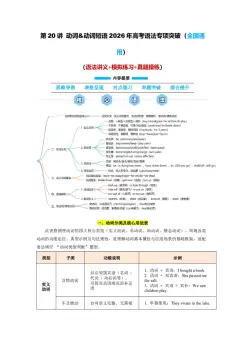
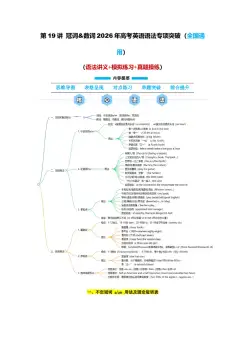
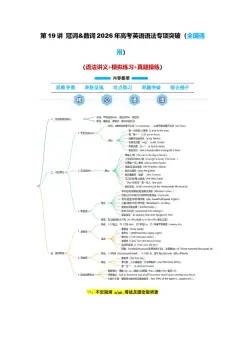
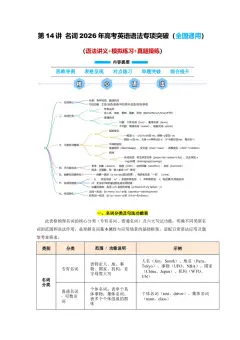
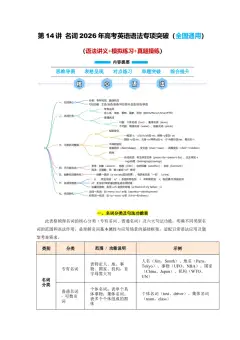
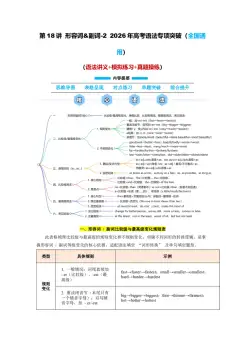
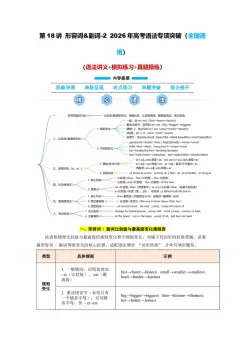
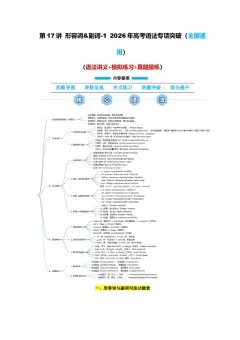
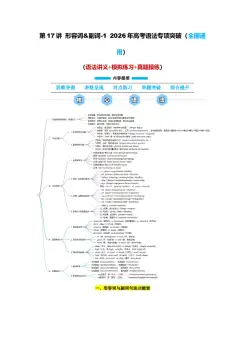
 内容提要
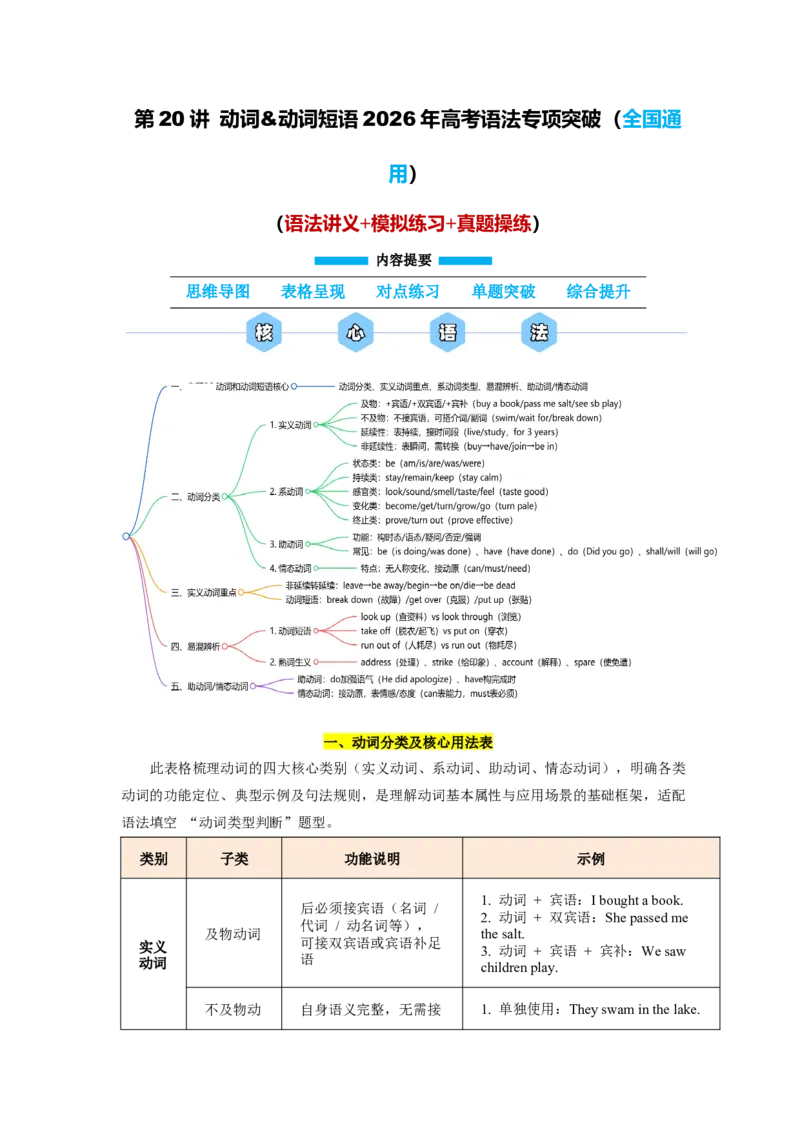
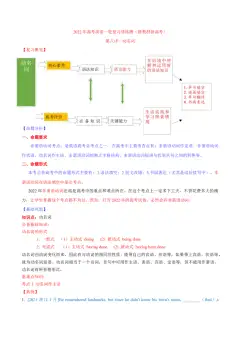
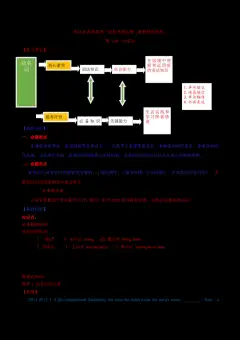
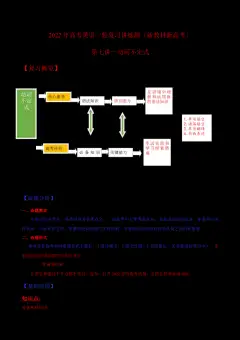
思维导图
表格呈现
对点练习
单题突破
综合提升
一、动词分类及核心用法表
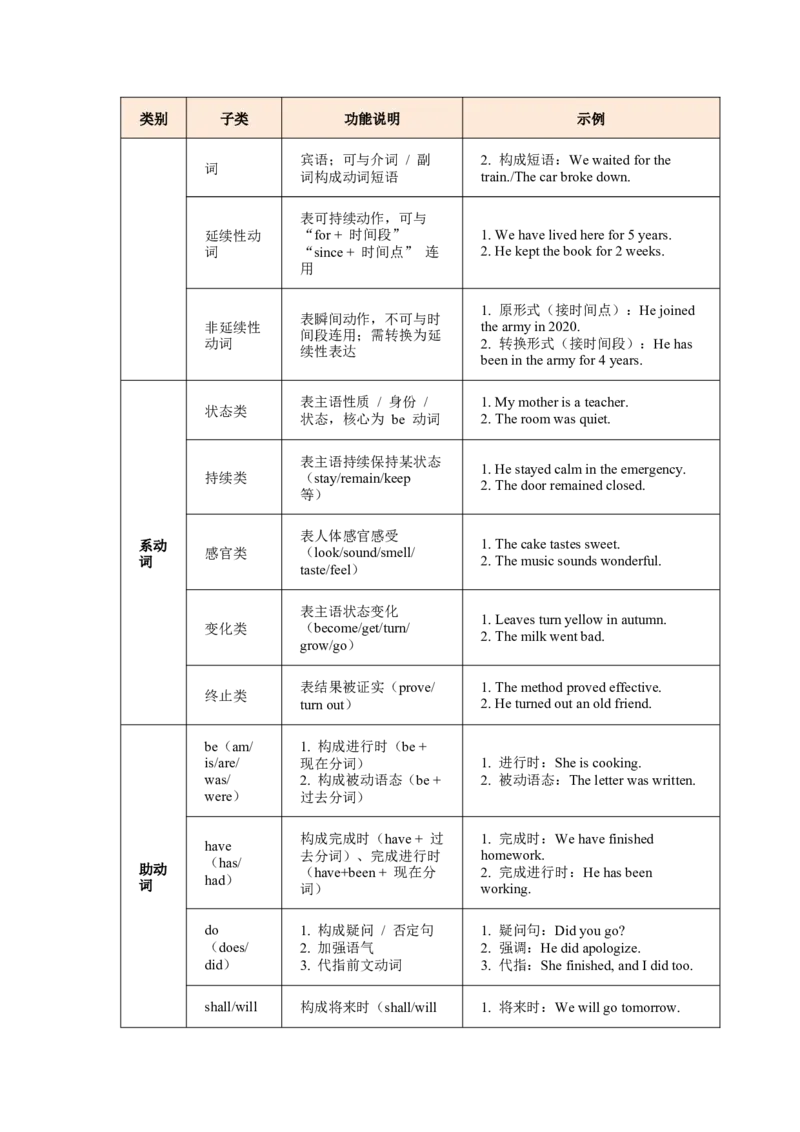
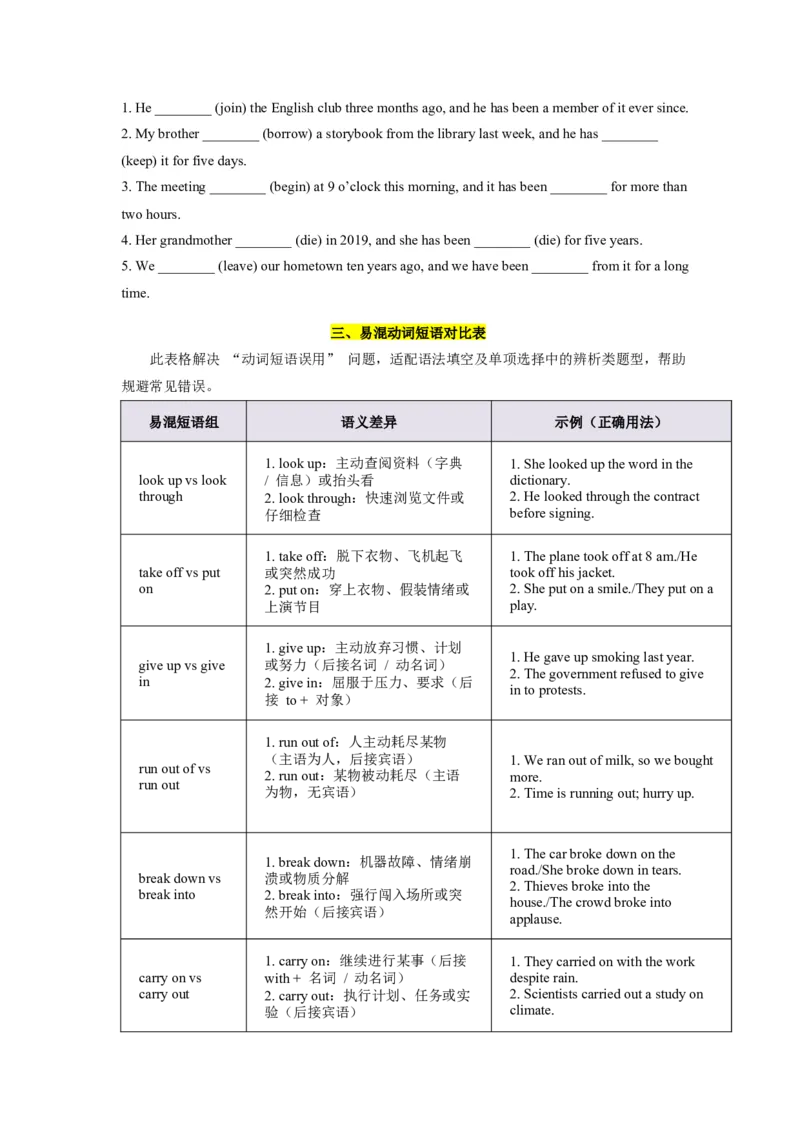
此表格梳理动词的四大核心类别(实义动词、系动词、助动词、情态动词),明确各类
动词的功能定位、典型示例及句法规则,是理解动词基本属性与应用场景的基础框架,适配
语法填空 “动词类型判断”题型。
类别
子类
功能说明
示例
实义
动词
及物动词
后必须接宾语(名词 /
代词 / 动名词等),
可接双宾语或宾语补足
语
1. 动词 + 宾语:I bought a book.
2. 动词 + 双宾语:She passed me
the salt.
3. 动词 + 宾语 + 宾补:We saw
children play.
不及物动
自身语义完整,无需接
1. 单独使用:They swam in the lake.
类别
子类
功能说明
示例
词
宾语;可与介词 / 副
词构成动词短语
2. 构成短语:We waited for the
train./The car broke down.
延续性动
词
表可持续动作,可与
“for + 时间段”
“since + 时间点” 连
用
1. We have lived here for 5 years.
2. He kept the book for 2 weeks.
非延续性
动词
表瞬间动作,不可与时
间段连用;需转换为延
续性表达
1. 原形式(接时间点):He joined
the army in 2020.
2. 转换形式(接时间段):He has
been in the army for 4 years.
系动
词
状态类
表主语性质 / 身份 /
状态,核心为 be 动词
1. My mother is a teacher.
2. The room was quiet.
持续类
表主语持续保持某状态
(stay/remain/keep
等)
1. He stayed calm in the emergency.
2. The door remained closed.
感官类
表人体感官感受
(look/sound/smell/
taste/feel)
1. The cake tastes sweet.
2. The music sounds wonderful.
变化类
表主语状态变化
(become/get/turn/
grow/go)
1. Leaves turn yellow in autumn.
2. The milk went bad.
终止类
表结果被证实(prove/
turn out)
1. The method proved effective.
2. He turned out an old friend.
助动
词
be(am/
is/are/
was/
were)
1. 构成进行时(be +
现在分词)
2. 构成被动语态(be +
过去分词)
1. 进行时:She is cooking.
2. 被动语态:The letter was written.
have
(has/
had)
构成完成时(have + 过
去分词)、完成进行时
(have+been + 现在分
词)
1. 完成时:We have finished
homework.
2. 完成进行时:He has been
working.
do
(does/
did)
1. 构成疑问 / 否定句
2. 加强语气
3. 代指前文动词
1. 疑问句:Did you go?
2. 强调:He did apologize.
3. 代指:She finished, and I did too.
shall/will
构成将来时(shall/will
1. 将来时:We will go tomorrow.
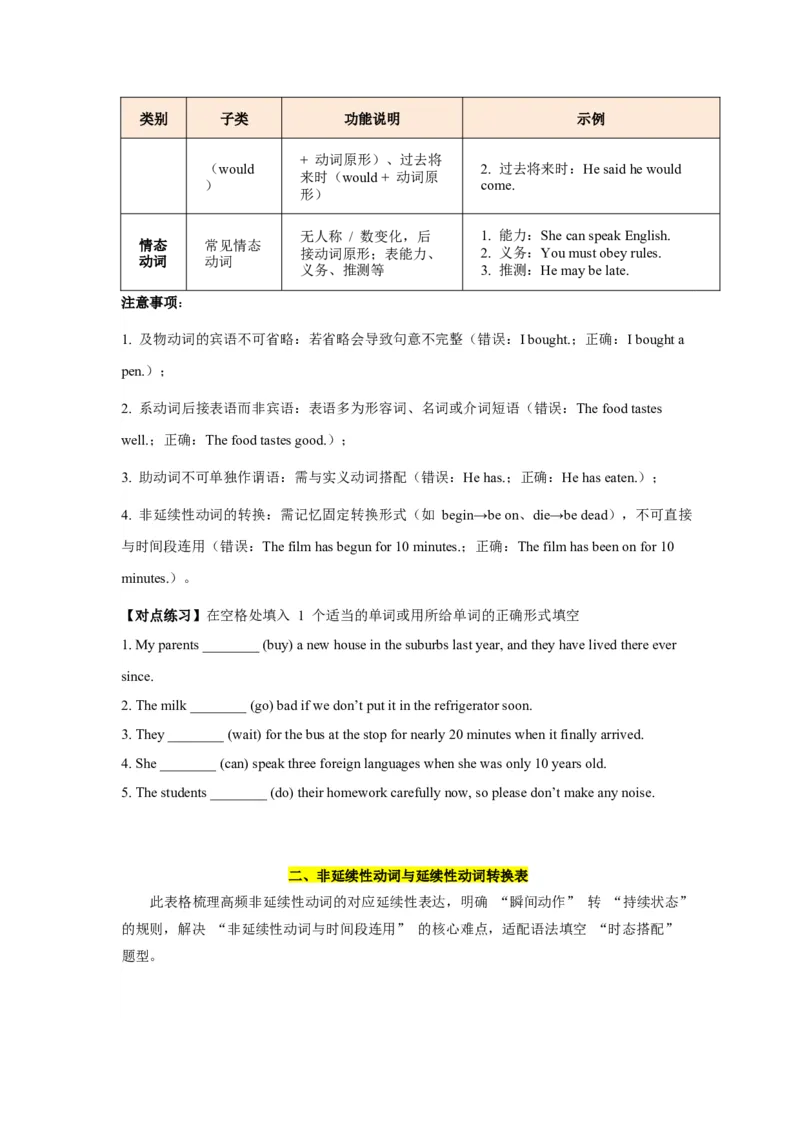
类别
子类
功能说明
示例
(would
)
+ 动词原形)、过去将
来时(would + 动词原
形)
2. 过去将来时:He said he would
come.
情态
动词
常见情态
动词
无人称 / 数变化,后
接动词原形;表能力、
义务、推测等
1. 能力:She can speak English.
2. 义务:You must obey rules.
3. 推测:He may be late.
注意事项:
1. 及物动词的宾语不可省略:若省略会导致句意不完整(错误:I bought.;正确:I bought a
pen.);
2. 系动词后接表语而非宾语:表语多为形容词、名词或介词短语(错误:The food tastes
well.;正确:The food tastes good.);
3. 助动词不可单独作谓语:需与实义动词搭配(错误:He has.;正确:He has eaten.);
4. 非延续性动词的转换:需记忆固定转换形式(如 begin→be on、die→be dead),不可直接
与时间段连用(错误:The film has begun for 10 minutes.;正确:The film has been on for 10
minutes.)。
【对点练习】在空格处填入 1 个适当的单词或用所给单词的正确形式填空
1. My parents ________ (buy) a new house in the suburbs last year, and they have lived there ever
since.
2. The milk ________ (go) bad if we don’t put it in the refrigerator soon.
3. They ________ (wait) for the bus at the stop for nearly 20 minutes when it finally arrived.
4. She ________ (can) speak three foreign languages when she was only 10 years old.
5. The students ________ (do) their homework carefully now, so please don’t make any noise.
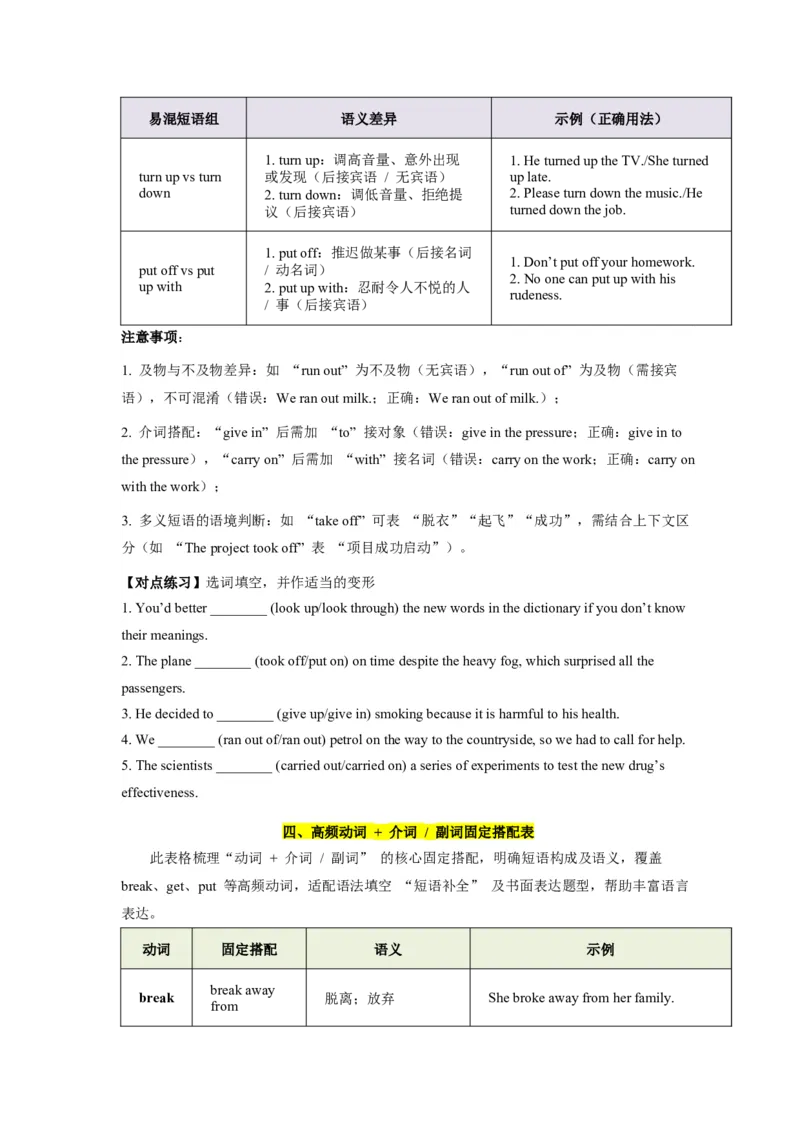
二、非延续性动词与延续性动词转换表
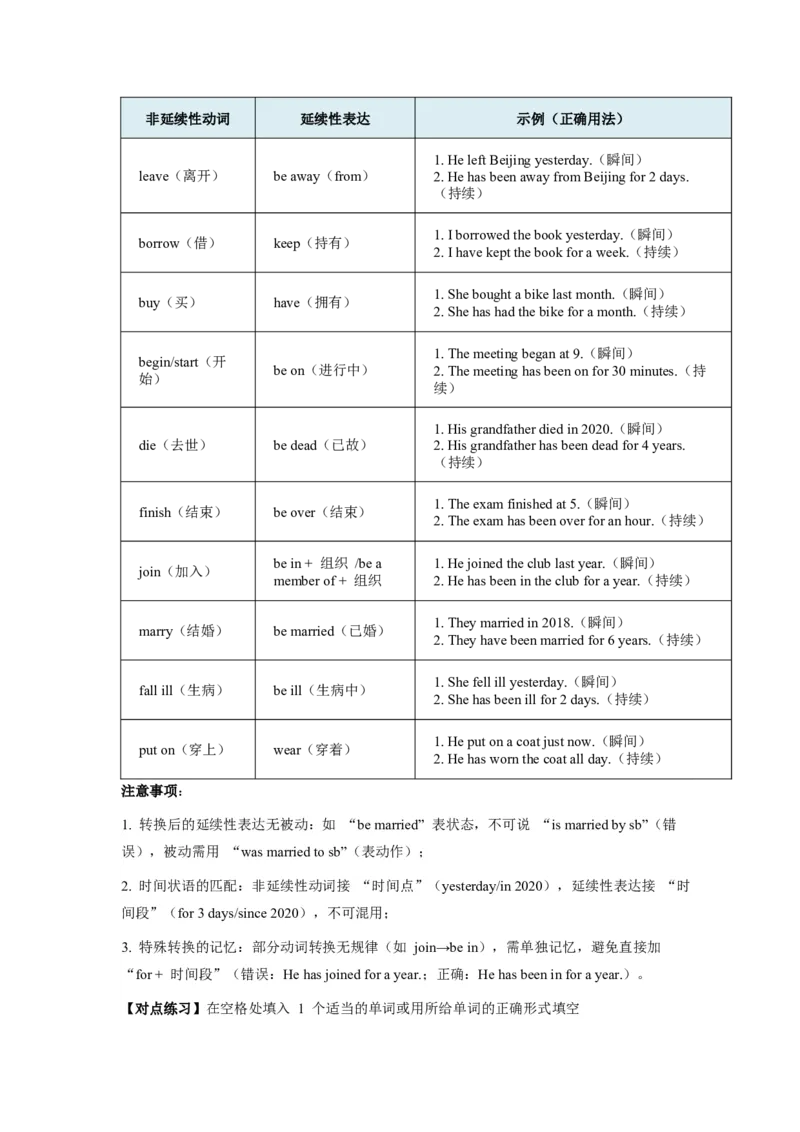
此表格梳理高频非延续性动词的对应延续性表达,明确 “瞬间动作” 转 “持续状态”
的规则,解决 “非延续性动词与时间段连用” 的核心难点,适配语法填空 “时态搭配”
题型。
非延续性动词
延续性表达
示例(正确用法)
leave(离开)
be away(from)
1. He left Beijing yesterday.(瞬间)
2. He has been away from Beijing for 2 days.
(持续)
borrow(借)
keep(持有)
1. I borrowed the book yesterday.(瞬间)
2. I have kept the book for a week.(持续)
buy(买)
have(拥有)
1. She bought a bike last month.(瞬间)
2. She has had the bike for a month.(持续)
begin/start(开
始)
be on(进行中)
1. The meeting began at 9.(瞬间)
2. The meeting has been on for 30 minutes.(持
续)
die(去世)
be dead(已故)
1. His grandfather died in 2020.(瞬间)
2. His grandfather has been dead for 4 years.
(持续)
finish(结束)
be over(结束)
1. The exam finished at 5.(瞬间)
2. The exam has been over for an hour.(持续)
join(加入)
be in + 组织 /be a
member of + 组织
1. He joined the club last year.(瞬间)
2. He has been in the club for a year.(持续)
marry(结婚)
be married(已婚)
1. They married in 2018.(瞬间)
2. They have been married for 6 years.(持续)
fall ill(生病)
be ill(生病中)
1. She fell ill yesterday.(瞬间)
2. She has been ill for 2 days.(持续)
put on(穿上)
wear(穿着)
1. He put on a coat just now.(瞬间)
2. He has worn the coat all day.(持续)
注意事项:
1. 转换后的延续性表达无被动:如 “be married” 表状态,不可说 “is married by sb”(错
误),被动需用 “was married to sb”(表动作);
2. 时间状语的匹配:非延续性动词接 “时间点”(yesterday/in 2020),延续性表达接 “时
间段”(for 3 days/since 2020),不可混用;
3. 特殊转换的记忆:部分动词转换无规律(如 join→be in),需单独记忆,避免直接加
“for + 时间段”(错误:He has joined for a year.;正确:He has been in for a year.)。
【对点练习】在空格处填入 1 个适当的单词或用所给单词的正确形式填空
1. He ________ (join) the English club three months ago, and he has been a member of it ever since.
2. My brother ________ (borrow) a storybook from the library last week, and he has ________
(keep) it for five days.
3. The meeting ________ (begin) at 9 o’clock this morning, and it has been ________ for more than
two hours.
4. Her grandmother ________ (die) in 2019, and she has been ________ (die) for five years.
5. We ________ (leave) our hometown ten years ago, and we have been ________ from it for a long
time.
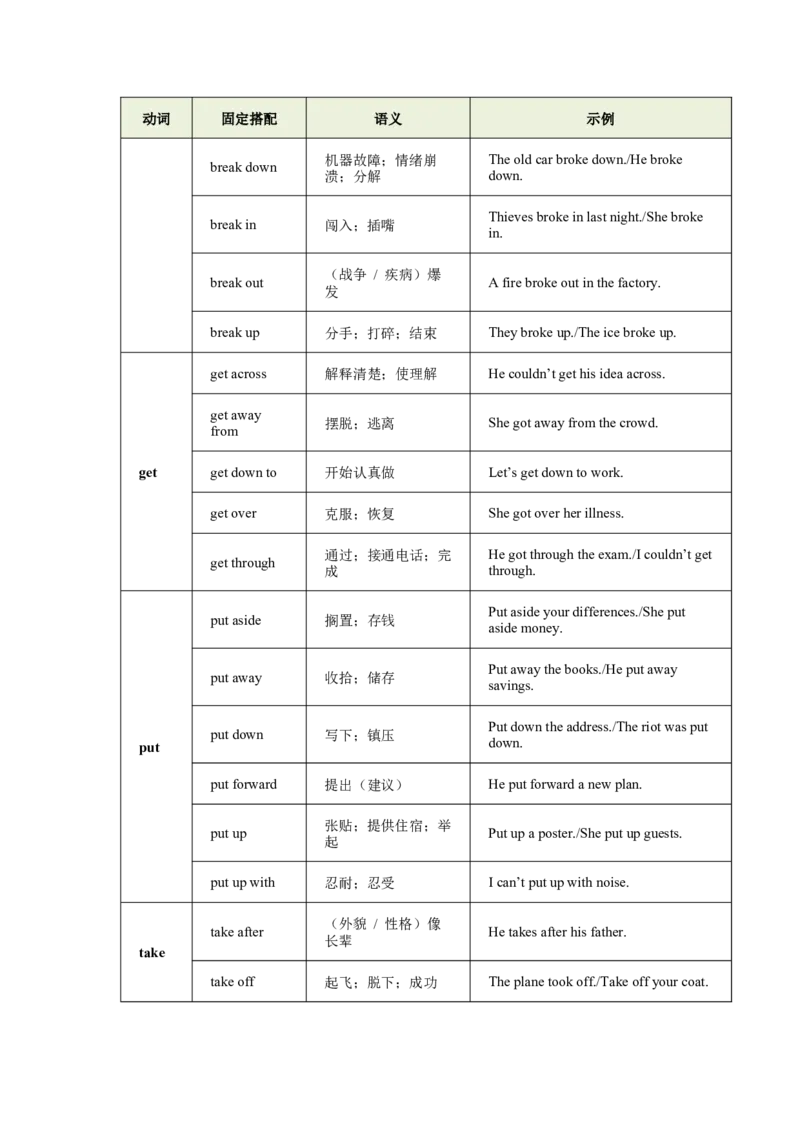
三、易混动词短语对比表
此表格解决 “动词短语误用” 问题,适配语法填空及单项选择中的辨析类题型,帮助
规避常见错误。
易混短语组
语义差异
示例(正确用法)
look up vs look
through
1. look up:主动查阅资料(字典
/ 信息)或抬头看
2. look through:快速浏览文件或
仔细检查
1. She looked up the word in the
dictionary.
2. He looked through the contract
before signing.
take off vs put
on
1. take off:脱下衣物、飞机起飞
或突然成功
2. put on:穿上衣物、假装情绪或
上演节目
1. The plane took off at 8 am./He
took off his jacket.
2. She put on a smile./They put on a
play.
give up vs give
in
1. give up:主动放弃习惯、计划
或努力(后接名词 / 动名词)
2. give in:屈服于压力、要求(后
接 to + 对象)
1. He gave up smoking last year.
2. The government refused to give
in to protests.
run out of vs
run out
1. run out of:人主动耗尽某物
(主语为人,后接宾语)
2. run out:某物被动耗尽(主语
为物,无宾语)
1. We ran out of milk, so we bought
more.
2. Time is running out; hurry up.
break down vs
break into
1. break down:机器故障、情绪崩
溃或物质分解
2. break into:强行闯入场所或突
然开始(后接宾语)
1. The car broke down on the
road./She broke down in tears.
2. Thieves broke into the
house./The crowd broke into
applause.
carry on vs
carry out
1. carry on:继续进行某事(后接
with + 名词 / 动名词)
2. carry out:执行计划、任务或实
验(后接宾语)
1. They carried on with the work
despite rain.
2. Scientists carried out a study on
climate.
易混短语组
语义差异
示例(正确用法)
turn up vs turn
down
1. turn up:调高音量、意外出现
或发现(后接宾语 / 无宾语)
2. turn down:调低音量、拒绝提
议(后接宾语)
1. He turned up the TV./She turned
up late.
2. Please turn down the music./He
turned down the job.
put off vs put
up with
1. put off:推迟做某事(后接名词
/ 动名词)
2. put up with:忍耐令人不悦的人
/ 事(后接宾语)
1. Don’t put off your homework.
2. No one can put up with his
rudeness.
注意事项:
1. 及物与不及物差异:如 “run out” 为不及物(无宾语),“run out of” 为及物(需接宾
语),不可混淆(错误:We ran out milk.;正确:We ran out of milk.);
2. 介词搭配:“give in” 后需加 “to” 接对象(错误:give in the pressure;正确:give in to
the pressure),“carry on” 后需加 “with” 接名词(错误:carry on the work;正确:carry on
with the work);
3. 多义短语的语境判断:如 “take off” 可表 “脱衣”“起飞”“成功”,需结合上下文区
分(如 “The project took off” 表 “项目成功启动”)。
【对点练习】选词填空,并作适当的变形
1. You’d better ________ (look up/look through) the new words in the dictionary if you don’t know
their meanings.
2. The plane ________ (took off/put on) on time despite the heavy fog, which surprised all the
passengers.
3. He decided to ________ (give up/give in) smoking because it is harmful to his health.
4. We ________ (ran out of/ran out) petrol on the way to the countryside, so we had to call for help.
5. The scientists ________ (carried out/carried on) a series of experiments to test the new drug’s
effectiveness.
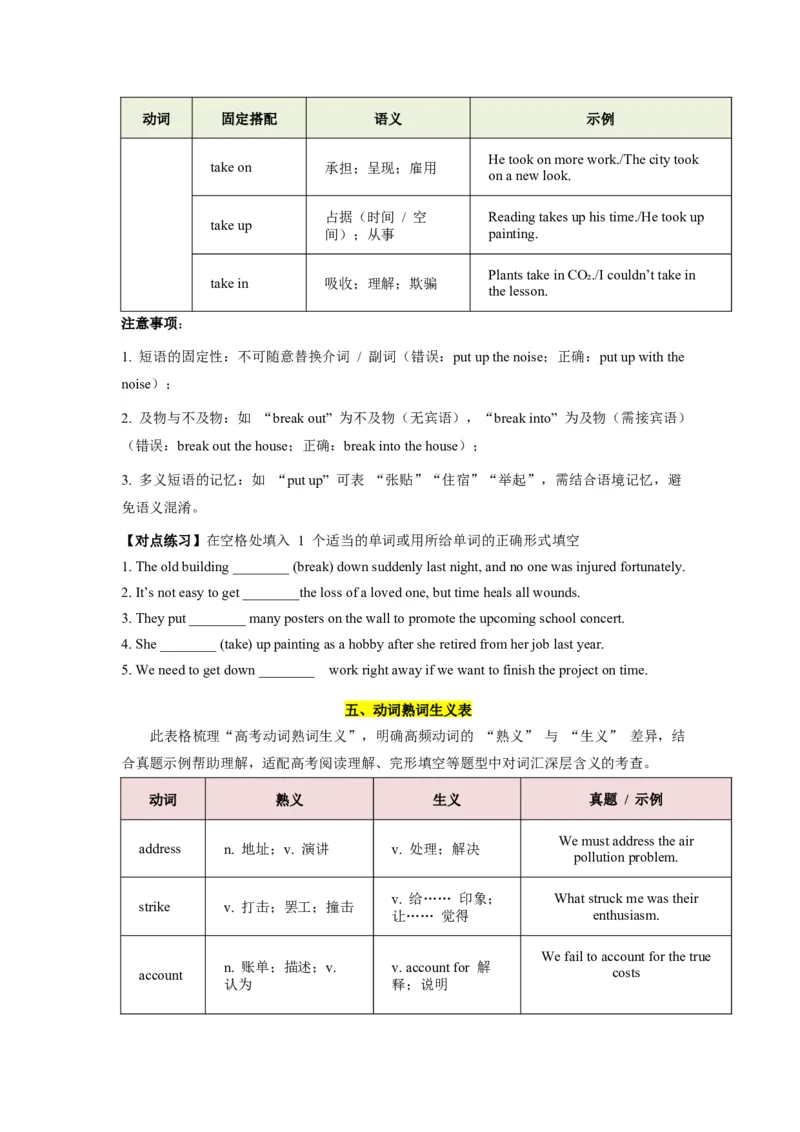
四、高频动词 + 介词 / 副词固定搭配表
此表格梳理“动词 + 介词 / 副词” 的核心固定搭配,明确短语构成及语义,覆盖
break、get、put 等高频动词,适配语法填空 “短语补全” 及书面表达题型,帮助丰富语言
表达。
动词
固定搭配
语义
示例
break
break away
from
脱离;放弃
She broke away from her family.
动词
固定搭配
语义
示例
break down
机器故障;情绪崩
溃;分解
The old car broke down./He broke
down.
break in
闯入;插嘴
Thieves broke in last night./She broke
in.
break out
(战争 / 疾病)爆
发
A fire broke out in the factory.
break up
分手;打碎;结束
They broke up./The ice broke up.
get
get across
解释清楚;使理解
He couldn’t get his idea across.
get away
from
摆脱;逃离
She got away from the crowd.
get down to
开始认真做
Let’s get down to work.
get over
克服;恢复
She got over her illness.
get through
通过;接通电话;完
成
He got through the exam./I couldn’t get
through.
put
put aside
搁置;存钱
Put aside your differences./She put
aside money.
put away
收拾;储存
Put away the books./He put away
savings.
put down
写下;镇压
Put down the address./The riot was put
down.
put forward
提出(建议)
He put forward a new plan.
put up
张贴;提供住宿;举
起
Put up a poster./She put up guests.
put up with
忍耐;忍受
I can’t put up with noise.
take
take after
(外貌 / 性格)像
长辈
He takes after his father.
take off
起飞;脱下;成功
The plane took off./Take off your coat.
动词
固定搭配
语义
示例
take on
承担;呈现;雇用
He took on more work./The city took
on a new look.
take up
占据(时间 / 空
间);从事
Reading takes up his time./He took up
painting.
take in
吸收;理解;欺骗
Plants take in CO₂./I couldn’t take in
the lesson.
注意事项:
1. 短语的固定性:不可随意替换介词 / 副词(错误:put up the noise;正确:put up with the
noise);
2. 及物与不及物:如 “break out” 为不及物(无宾语),“break into” 为及物(需接宾语)
(错误:break out the house;正确:break into the house);
3. 多义短语的记忆:如 “put up” 可表 “张贴”“住宿”“举起”,需结合语境记忆,避
免语义混淆。
【对点练习】在空格处填入 1 个适当的单词或用所给单词的正确形式填空
1. The old building ________ (break) down suddenly last night, and no one was injured fortunately.
2. It’s not easy to get ________the loss of a loved one, but time heals all wounds.
3. They put ________ many posters on the wall to promote the upcoming school concert.
4. She ________ (take) up painting as a hobby after she retired from her job last year.
5. We need to get down ________  work right away if we want to finish the project on time.
五、动词熟词生义表
此表格梳理“高考动词熟词生义”,明确高频动词的 “熟义” 与 “生义” 差异,结
合真题示例帮助理解,适配高考阅读理解、完形填空等题型中对词汇深层含义的考查。
动词
熟义
生义
真题 / 示例
address
n. 地址;v. 演讲
v. 处理;解决
We must address the air
pollution problem.
strike
v. 打击;罢工;撞击
v. 给…… 印象;
让…… 觉得
What struck me was their
enthusiasm.
account
n. 账单;描述;v.
认为
v. account for 解
释;说明
We fail to account for the true
costs
动词
熟义
生义
真题 / 示例
cut
v. 切;割;砍
v. 削减;降低
He asked for a price cut.
spare
v. 抽出(时间 / 金
钱);adj. 备用的
v. 使免遭;免去
This approach spared me
over-explaining.
count
on
指望;依靠
期待;预料到
I hadn’t counted on this
problem.
place
v. 放置;n. 地方
v. 下(订单)
I can place the order now.
skirt
n. 裙子
v. 绕过;沿……
边缘走
Skirting the square, you’ll find
shops.
line
n. 线;队列
v. 沿…… 排列
Shops line the town square.
flood
n. 洪水;v. 淹没
v. 大量涌来
Orders flooded in.
translate
v. 翻译
v. (使)转化;
适用于
This productivity translates
into the workplace.
practice
v. 练习;n. 练习
v. (医生 / 律
师)执业
Doctors practice medicine.
注意事项:
1. 生义的语境依赖性:生义需结合具体语境判断,不可脱离上下文(如 “address” 表 “处
理” 仅用于 “处理问题 / 事务” 场景);
2. 固定搭配:部分生义需搭配特定介词(如 “account for” 表 “解释”,不可说 “account
the costs”);
3. 高频生义优先记忆:如 “address(处理)”“strike(给印象)”“translate(转化)”
为高考高频考点,需重点掌握其生义及用法。
【对点练习】在空格处填入 1 个适当的单词或用所给单词的正确形式填空
1. The government must ________ (address) the problem of rising housing prices as soon as
possible.
2. What ________ (strike) me most about the movie is the deep friendship between the two main
characters.
3. The company’s new policy ________ (translate) into better working conditions for all employees.
4. She ________ (place) an order for a new dress online yesterday, and it will be delivered next
week.
5. The path ________ (skirt) the lake, offering beautiful views of the water and surrounding
mountains.
一、语法填空:用所给单词的正确形式填空
1.(2025·江苏南京·一模)This graceful dialogue, which

    (flow) from brushed
fingertips and travelling for thousands of years, is continuing to this day.
2.(2024·河北·一模)They broke my windows and


 (threat) me.
3.(2021·广东江门·一模)——That must have been a long trip. ——Yeah, it


(take) us a whole week to get there.
4.(2021·广东江门·一模)By the end of last year, another new gymnasium


(build) in Beijing
5.(2025 高三·全国·专题练习)Physical

    is important, but athletes also need to
_

    their mental resilience. (strength)
6.(2025 高三·全国·专题练习)Regular training helps athletes

    to high-
intensity workouts, and this

    is key to success. (adapt)
7.(2025 高三·全国·专题练习)Confucius,

    of Confucianism,
many educational ideas that became the

    of Chinese culture. (foundation)
8.(2022 高三上·全国·专题练习)The water


 (feel) cool when I jumped into
the pool for morning exercise.
9.(22-23 高三上·全国·专题练习)This sort of roast meat is a local super food and it

(taste)delicious.
10.(2022 高三下·全国·专题练习)In 1969, the pollution

    (be) terrible along
the Cuyahoga River near Cleveland, Ohio.
11.(23-24 高三下·重庆·开学考试)I made my decision. Nothing will make me
(change) my mind.
12.(2026 高三·全国·专题练习)Not until then

    (do)he realize the
importance of studying English.
13.(2025 高三上·全国·专题练习)If you              your task in advance,you will have a
sense of              .(fulfilment)
14.(2024 高三下·全国·专题练习)The boy can


  (memory) the data easily.
15.(23-24 高三下·重庆·开学考试)Some students agree to hold a party for Christmas, but others
(agree) because it’s not a Chinese traditional festival.
Passage 1
(2023·新课标Ⅱ卷·高考真题)阅读下面短文,在空白处填入1 个适当的单词或括号内单词的
正确形式。
Whenever I tell people that I teach English at the Berlin Zoo, I almost always get a
questioning look. Behind it, the person is trying to figure out who exactly I teach…the animals?
Since June 2017, right before the    1              (arrive) of the two new pandas, Meng
Meng and Jiao Qing, I have been helping the panda keepers at the zoo to feel more comfortable and
2              (confidence) speaking English. And who do they speak English    3

?
Not the pandas, even though    4              language used for the medical training
instructions is actually English. They talk to the flood of international tourists and to    5

(visit) Chinese zookeepers who often come to check on the pandas, which are on loan from China.
They also need to be ready to give    6              (interview) in English with international
journalists. This is    7              they need an English trainer.
So, what are they learning?    8              (basic), how to describe a panda’s life. It’s
been an honor to watch the panda programme develop    9              to see the pandas settle
into their new home. As a little girl, I     10               (wish) to be a zookeeper when I grew
up. Now, I’m living out that dream indirectly by helping the panda keepers do their job in English.
Passage 2
(2023·全国甲卷·高考真题)阅读下面短文,在空白处填入1 个适当的单词或括号内单词的正
确形式。
For thousands of years, people have told fables (寓言)    1              (teach) a lesson
or to pass on wisdom. Fables were part of the oral tradition of many early cultures, and the well-
known Aesop’s fables date to the    2              (six) century, B.C. Yet, the form of the
fable still has values today,    3              Rachel Carson says in “A Fable for Tomorrow.”
Carson uses a simple, direct style common to fable. In fact, her style and tone ( 口吻) are
seemingly directed at children. “There was once a town in the heart of America,    4

all life seemed to enjoy peaceful existence with its surroundings,” her fable begins,    5

(borrow) some familiar words from many age-old fables. Behind the simple style, however, is a
serious message    6              (intend) for everyone.
   7              (difference) from traditional fables, Carson’s story ends with an
accusation instead of a moral. She warns of the environmental dangers facing society, and she
teaches that people must take responsibility    8              saving their environment.
The themes of traditional fables often deal with simple truths about everyday life. However,
Carson’s theme is a more weighty    9              (warn) about environmental destruction.
Carson proves that a simple literal form that has been passed down through the ages can still      10
(employ) today to draw attention to important truths.
Passage 3
(2025·广东·一模)阅读下面短文,在空白处填入1 个适当的单词或括号内适当的单词形式
On the morning of October 19, 2025, a shocking theft took place at the Louvre Museum (卢浮
宫) in Paris, one of the world’s most famous art museums. At around 9:30 a.m., shortly after the
museum opened its doors to visitors, a group of four thieves carried out    1              well-
planned crime.
Two of them dressed as workers and entered the museum from the outside using a lift. The
other two waited nearby on a motorcycle, ready     2               help them escape. Within
just seven minutes, the thieves broke into the Apollo Gallery and stole eight pieces of     3

(value) jewelry.
Unluckily, a brave security guard noticed the crime and tried to stop the thieves when     4
set a small fire to distract others. This unexpected action made the thieves panic, so they     5

(flee) in a rush and left behind the “Crown of Empress Eugénie”.
After the theft, the police immediately launched an investigation. By November 3, all four
suspects were arrested. Two of them were caught on October 25, and the other two on October 29.
They were formally charged on November 1. According to Paris prosecutors, the suspects were
ordinary thieves rather than     6               (profession) criminals from organized groups,
and their previous records     7               (bear) no sign of serious crimes.
So far, the stolen jewelry remains missing. The theft has drawn worldwide attention,
reminding people     8               the importance of strengthening security     9

(measure) in famous museums. Many people hope that the precious jewelry will be returned to the
Louvre soon and that the thieves will be brought to     10               (just) for their illegal
act.
Passage 4
(2025·浙江·一模)阅读下面材料,在空白处填入适当的内容 (1 个单词) 或括号内单词的正
确形式。
Labubu, a toothy and fluffy figure toy from Chinese brand Pop Mart, has sparked a global
craze. This phenomenon demonstrates how Chinese enterprises are reshaping

 1

(they) international image through innovation, cultural storytelling, and the globalization of
homegrown ideas.
So what exactly is a Labubu? Labubu is a girl. People often assume she’s a boy, but    2

(actual) it is not the case. Labubu also isn’t a standalone character—she’s part of a larger group    3
(call) “The Monsters”, created by Hong Kong artist and author Kasing Lung. The Monsters first
appeared in a Nordic mythology-inspired picture book series in 2015, and by 2019, toy giant Pop
Mart    4              (turn) them into the popular plastic toys we know today.
Labubu is described    5              an “elvish creature (小精灵) ”, and according to
Pop Mart, “despite a naughty look, she is kind-hearted and always wants to help, but often
accidentally achieves    6              opposite.” She may look small and scary, but she means
well.
Labubu’s rise in    7              (popular) can largely be credited to Lisa from
BLACKPINK, who has expressed her love for the creature in interviews and on her social media.
Since then, demand has exploded with fans    8              (line) up overnight and paying well
over retail.
Today, The Monsters series is Pop Mart’s best-selling brand and generated $419 million in
sales last year, according to NBC News. Although the    9              (prize) items are the bag
charms, you can still get your hands on other Labubu     10               (figure) , accessories
and brand collaborations.
Passage 5
(25-26 高三上·广东·阶段练习)阅读下面短文,在空白处填入1 个适当的单词或括号内单词
的正确形式。
China Focus: China’s upscale ice creams melting hearts of consumers
Once just a simple way to cool off, ice cream is seeing a surge of new varieties to meet the
expanding tastes and preferences of Chinese consumers since its first appearance.
On the Chinese lifestyle-sharing app known internationally as RedNote, many users have
posted appealing images of upscale ice creams     1               various shapes, ranging from
blooming flowers to fresh fruits, each of     2               is the result of delicate
craftsmanship.     3               (comment) such as “adorable” and “too pretty to eat” are
very common in these posts.
Favored by today’s consumers, especially young people, such ice creams
   4

(become) commonplace in souvenir shops at tourist attractions across China since their first
appearance. Handan Museum, a well-known tourist site in Hebei in April introduced creative ice
creams that drew inspiration from two precious artifacts     5               (house) in the
museum. “Blind boxes” containing randomly flavored ice creams are also on sale to attract
customers. The museum’s ice creams have been     6               hit among visitors since
their launch, with over 100 sold daily this summer. Food industry analyst Zhu Danpeng believes the
7               (emerge) of these visually appealing ice creams reflects a thirst for emotional and
8               (spirit) well-being in consumption.
The shift to healthy eating has spurred changes in the industry. Traditional ice cream makers
are adjusting their ingredients     9               unveiling new products in response to
evolving needs, while new brands are winning customers by labeling themselves as producers of
handcrafted and      10                (fresh) made ice creams.
Passage 6
(2025·四川雅安·一模)阅读下面材料,在空白处填入适当的内容(1 个单词)或括号内单词
的正确形式。
At the seventh Silk Road(Dunhuang) International Cultural Expo, Gansu revealed a restored
Cave 57 from Mogao Grottoes.     1               (bring) to life via advanced 3D
reconstruction, this version has impressed visitors with high precision. It replicates (复制) the cave’s
original structure, mural colors and sculptural charm,     2               (make) the restoration
nearly identical to the original.
Gansu’s Digital Dunhuang initiative has also progressed. Its Digital Library Cave platform
now     3               (hold) over 74,000 entries, including documents, sutras and images.
4               makes the platform valuable is that it reunites Dunhuang relics that are dispersed
overseas.
These efforts show Gansu’s dedication     5               protecting local heritage. This
year, the province allocated 103 million yuan for relic protection and launched over 60 projects
aimed at grotto protection and exhibition.     6               (notable), Gansu has developed
Dunhuang Academy into a top heritage protection center. As a Silk Road cultural gem, the academy
explores a range of new     7              (way) in relic protection, digital preservation and
academic research.
Dunhuang Academy supervises three UNESCO World Heritage sites: the Mogao Grottoes,
Maijishan Grottoes and Bingling Temple Grottoes,     8               span over 1,500
kilometers altogether, turning it into China’s largest cultural institution and museum in terms of the
number of heritage sites and geographical scope. It is clear that such efforts safeguard local relics
9               boost global cultural exchange, reflecting Gansu’s sense of     10

(responsible) for heritage inheritance.