第17 讲  现在分词与动名词
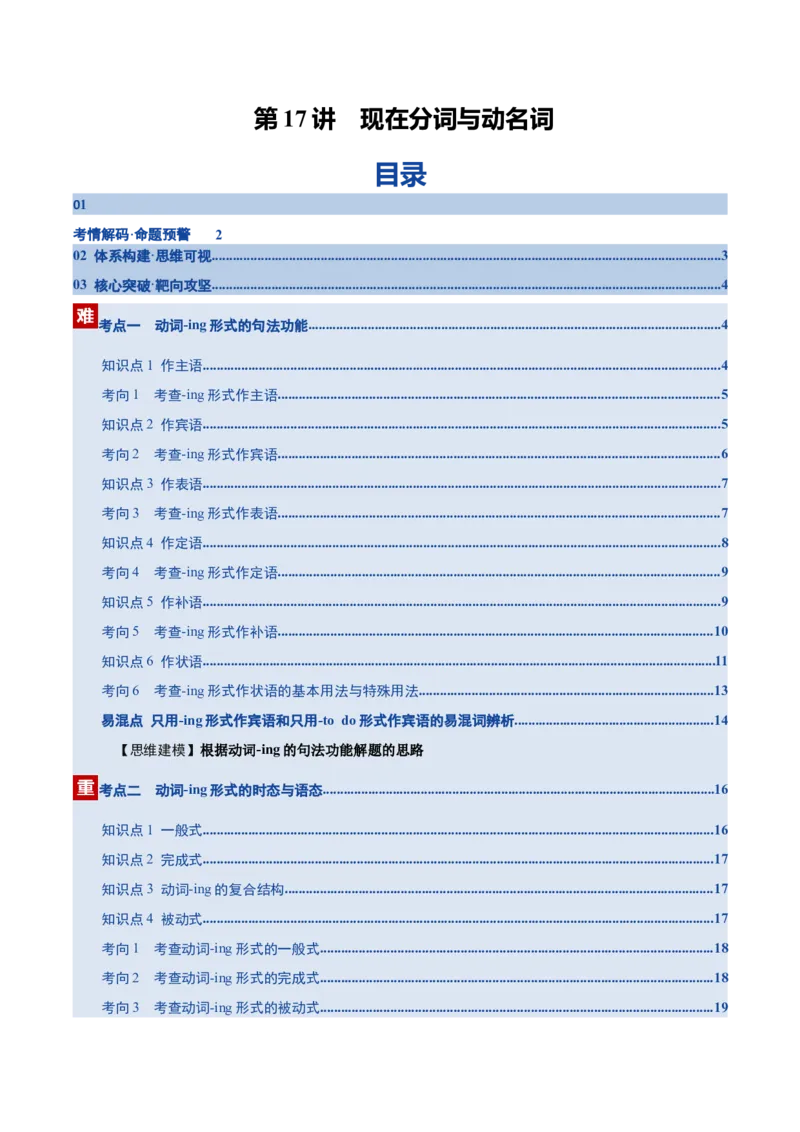
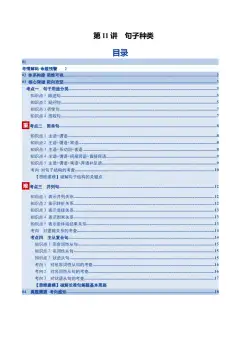
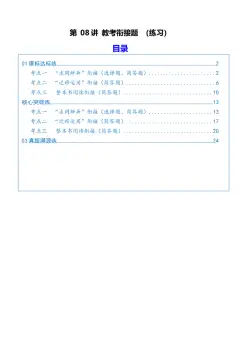
目录
01
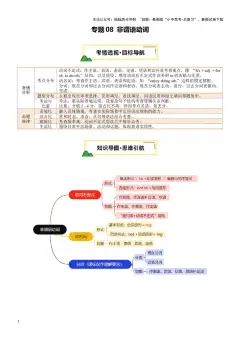
考情解码·命题预警
2
02 体系构建·思维可视.................................................................................................................................................3
03 核心突破·靶向攻坚.................................................................................................................................................4
考点一  动词-ing 形式的句法功能......................................................................................................................4
知识点1 作主语....................................................................................................................................................4
考向1  考查-ing 形式作主语..............................................................................................................................5
知识点2 作宾语....................................................................................................................................................5
考向2  考查-ing 形式作宾语..............................................................................................................................6
知识点3 作表语....................................................................................................................................................7
考向3  考查-ing 形式作表语..............................................................................................................................7
知识点4 作定语....................................................................................................................................................8
考向4  考查-ing 形式作定语..............................................................................................................................9
知识点5 作补语....................................................................................................................................................9
考向5  考查-ing 形式作补语............................................................................................................................10
知识点6 作状语..................................................................................................................................................11
考向6  考查-ing 形式作状语的基本用法与特殊用法....................................................................................13
易混点 只用-ing 形式作宾语和只用-to do 形式作宾语的易混词辨析.........................................................14
【思维建模】根据动词-ing 的句法功能解题的思路
考点二  动词-ing 形式的时态与语态................................................................................................................16
知识点1 一般式..................................................................................................................................................16
知识点2 完成式..................................................................................................................................................17
知识点3 动词-ing 的复合结构..........................................................................................................................17
知识点4 被动式..................................................................................................................................................17
考向1  考查动词-ing 形式的一般式................................................................................................................18
考向2  考查动词-ing 形式的完成式................................................................................................................18
考向3  考查动词-ing 形式的被动式................................................................................................................19
04 真题溯源 考向感知................................................................................................................................................19
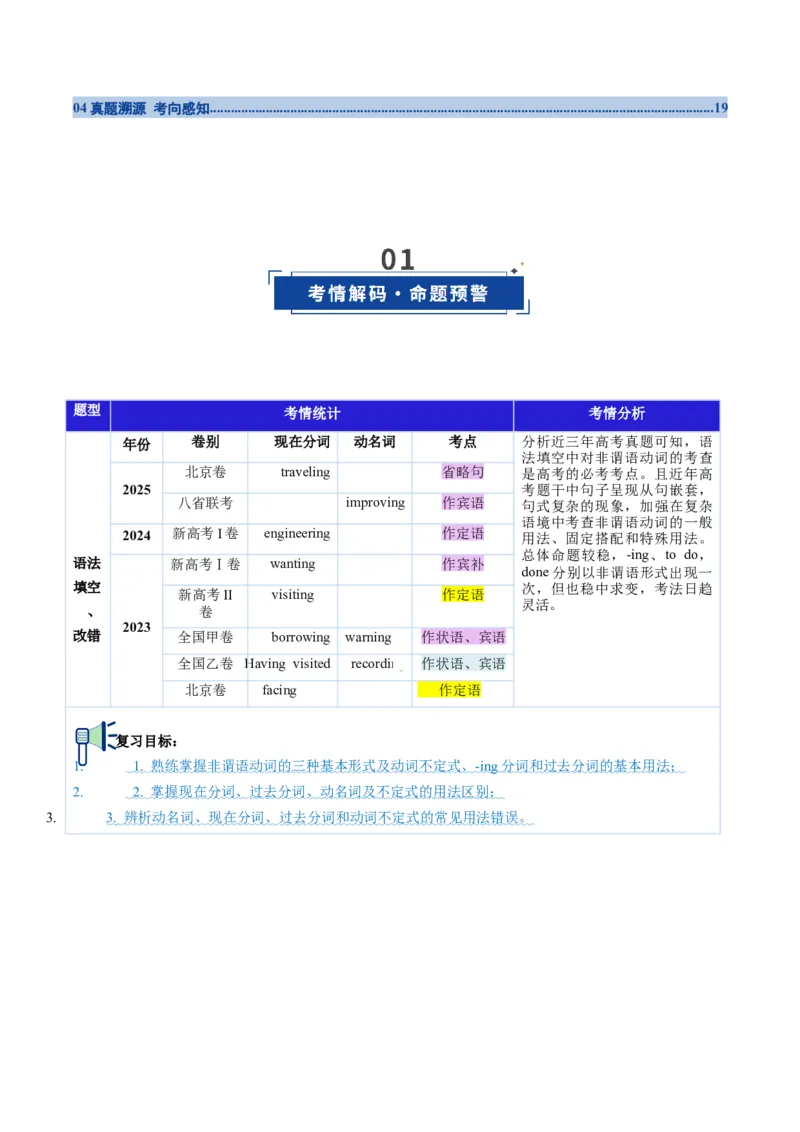
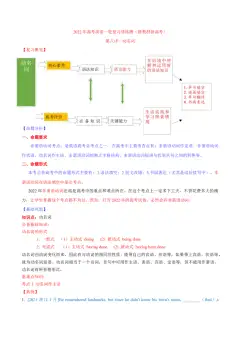
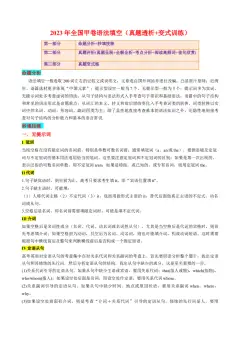
题型
考情统计
考情分析
语法
填空
、
改错
年份
卷别
现在分词
动名词
考点
分析近三年高考真题可知,语
法填空中对非谓语动词的考查
是高考的必考考点。且近年高
考题干中句子呈现从句嵌套,
句式复杂的现象,加强在复杂
语境中考查非谓语动词的一般
用法、固定搭配和特殊用法。
总体命题较稳,-ing、to do,
done 分别以非谓语形式出现一
次,但也稳中求变,考法日趋
灵活。
2025
北京卷
traveling
省略句
八省联考
improving
作宾语
2024
新高考I 卷
engineering
作定语
2023
新高考Ⅰ卷
wanting
作宾补
新高考II
卷
visiting
作定语
全国甲卷
borrowing  warning    作状语、宾语
全国乙卷Having visited
recording
    作状语、宾语
北京卷
facing
   作定语
复习目标:
1.       1.   熟练掌握非谓语动词的三种基本形式及动词不定式、

 -ing
  分词和过去分词的基本用法;


2.       2.   掌握现在分词、过去分词、动名词及不定式的用法区别;


3.       3.    辨析动名词、现在分词、过去分词和动词不定式的常见用法错误。


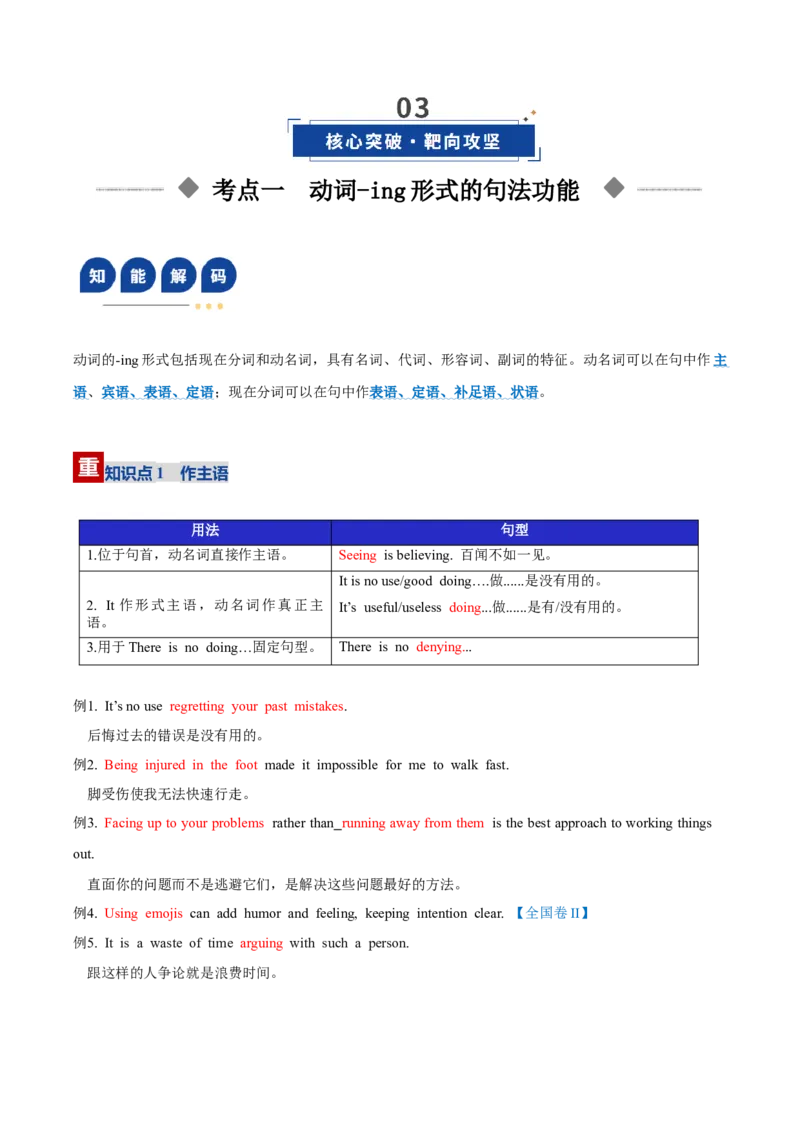
 考点一  动词-ing 形式的句法功能

动词的-ing 形式包括现在分词和动名词,具有名词、代词、形容词、副词的特征。动名词可以在句中作主
语、宾语、表语、定语;现在分词可以在句中作表语、定语、补足语、状语。
知识点1  作主语
用法
句型
1.位于句首,动名词直接作主语。
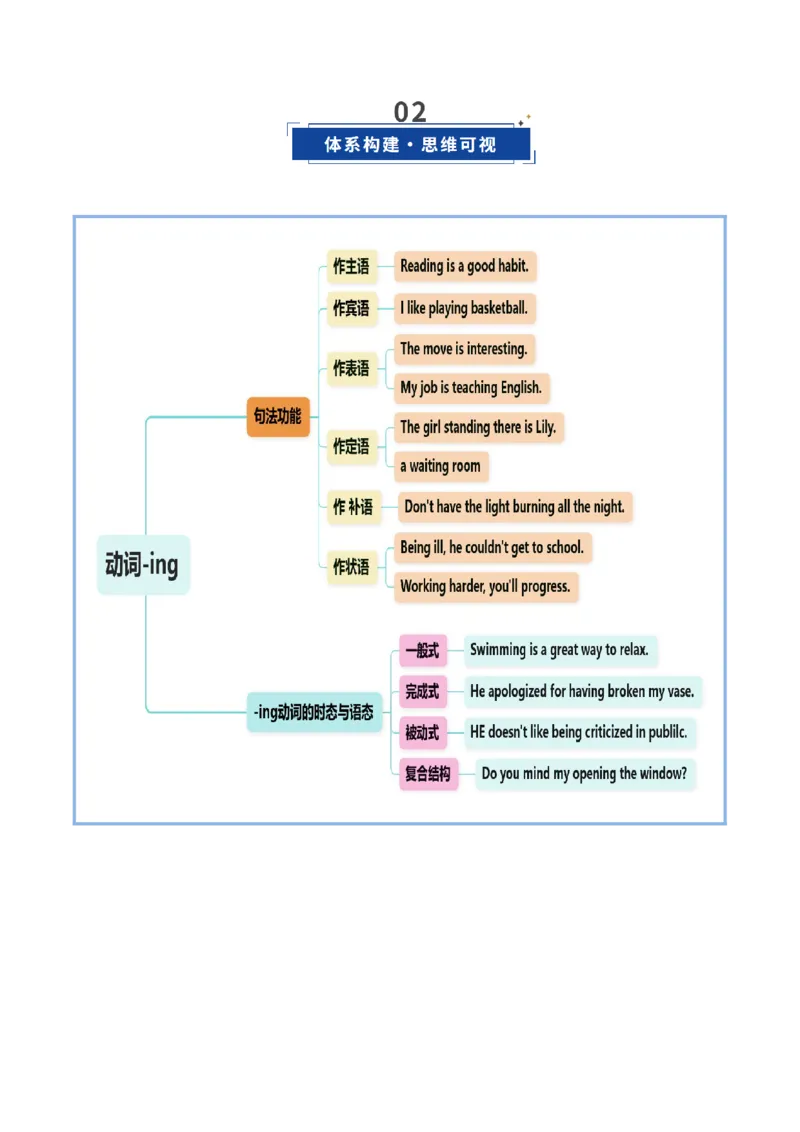
Seeing is believing. 百闻不如一见。
2. It 作形式主语,动名词作真正主
语。
It is no use/good doing….做......是没有用的。
It’s useful/useless doing...做......是有/没有用的。
3.用于There is no doing…固定句型。
There is no denying...
例1. It’s no use regretting your past mistakes.
后悔过去的错误是没有用的。
例2. Being injured in the foot made it impossible for me to walk fast.
脚受伤使我无法快速行走。
例3. Facing up to your problems rather than running away from them is the best approach to working things
out.
直面你的问题而不是逃避它们,是解决这些问题最好的方法。
例4. Using emojis can add humor and feeling, keeping intention clear. 【全国卷II】
例5. It is a waste of time arguing with such a person.
跟这样的人争论就是浪费时间。
考向1  考查ing 形式作主语
例1 It is no use          (try) to talk him into studying hard; he can only be persuaded by force.
例2          (study) a subject that you feel pointless is never a fun or easy task.
【变式训练1·变载体】         a high degree of proficiency in English as a foreign language is not a
mysterious process without scientific basis. (achieve)
【变式训练2·变情景】His           (dismiss) from the factory forced him to leave and seek job opportunities
in other cities.
知识点2  作宾语
例1. I hate lying to the kids. 我讨厌对孩子撒谎。【全国卷I】
例2. Jame is angry about not being invited to the party.
没有被邀请参加聚会,Jame 很生气。
例3. After looking at the toy for some time, he turned around and found his parents were missing.
看了那个玩具一会儿,他转身发现父母不见了。
例4. We should prevent the river from being polluted. 我们应该组织河流被污染。
例5. He tried to avoid answering my questions.他试图对我的问题避而不答。
【名师点睛】 1.动名词除了可以作动词的宾语外,还可以作介词的宾语,下列动词词组后接动名词作宾语。
be used to 习惯于,
lead to 导致,
devote to 致力于,
stick to 坚持,
object to 反对,
get down to 开始认真着手做,
pay attention to 注意,
can’t stand 不能忍受,
give up 放弃,
feel like 喜欢,
insist on 坚持
put off 付出有回报,
have difficulty/trouble (in) doing sth.; 做某事有
困难
spend...(in) doing sth.;花...做某事
look forward to 盼望着;
can’t help doing 禁不住;
burst out 突然
例1. I’m looking forward to hearing from you soon. 我盼望者很快收到你的来信。
例2. He burst our laughing .他突然大笑起来。
考向2  考查ing 形式作宾语
例1 People in the mountainous village earn a living by        (sell) produce (农产品) from their farm.
例2 Elsewhere, people favour         (shake) hands, bowing from the waist, or nodding the head when they
meet someone else.
【变式训练1·变载体】His academic achievements led to him            (elect) as an academician (院士) of
the Chinese Academy of Science.
【变式训练2·变情景】If you think that treating a woman well means always          (get) her permission for
things, think again.
知识点3  作表语
动名词做表语时和主语通常是对等的关系,主语和表语可以互换位置。
例1. Your task is cleaning the windows. = Cleaning the windows is your task. 擦窗户就是你的任务。
例2. What I hate most is being laughed at. = Being laughed at is what I hate most.
我最痛恨的就是被别人嘲笑。
例3. My job is cleaning the house three times a week.=Cleaning the house three times a week is my job.
一周三次打扫房间是我的工作。
例4. Your speech is very interesting and encouraging.
你的演讲很有趣而且很鼓舞人。
考向3  考查ing 形式作表语
例1 Her job is                  ( justify) the company’s new policy to the public.
例2 Despite its remarkable history, New York is a city with deep contradictions and deep inequality. You see
poverty everywhere and the transport system is           (crumble). There are tens of thousands of homeless
people.
【变式训练1·变载体】Progress is always        (motivate); any small progress can inspire positive emotions
that will make you work harder.
【变式训练2·变情景】So he remained         (stand) upright, and since he was tired, he yawned.
知识点4  作定语
动名词做定语往往表示被修饰名词的某种用途,一般置于被修饰词前。
a walking stick =a stick for walking=a stick which is used for walking 拐杖
a washing machine=a machine for washing 洗衣机
a fishing net=a net for fishing 渔网;
a swimming pool=a pool for swimming 游泳池;
a reading room=a room for reading 阅览室;阅览室
a sleeping car 卧铺车厢
例1.Beneath this amazing sky, we see a sleeping village and a dark, lonely tree.
在这神奇的天空下,我们看到一个沉睡的村庄和一颗黑暗孤独的树。
例2.China is a fast developing country. 中国是一个快速发展的国家。
现在分词做定语与被修饰词之间是逻辑上的主谓关系,表示动作正在进行。单个的分词作定语一般前置,
分词短语作定语一般后置。
例1. There are lots of students wishing to join us.有许多学生想加入我们。(现在分词作定语)
=There are lots of students who wish to join us.
例2. There are two teaching buildings in our school.我们学校有两座教学楼。(动名词作定语表用途)
例3. The lecture, starting at 7:00 pm last night, was followed by an observation of the moon with
telescopes. (现在分词作定语)讲座于昨晚7 点开始,接下来是用望远镜观测月球。
例4. The young man sitting between Jane and Linda is the editor of the campus newspaper.
坐在简和琳达之间的那个年轻人是校报的编辑。
得分速记
1. 现在分词作定语与所修饰词之间是逻辑上的主谓关系。
2. 动名词作定语表示所修饰名词的用途,不存在逻辑上的主谓关系。
考向4  考查ing 形式作定语
例1 The company          (consist) of 5 small factories is facing a serious financial crisis.
例2 Earth Day, marked on 22, April, is annual (每年的) event          (aim) to raise public awareness about
environmental protection (环保).
【变式训练1·变载体】They were part of a 15-member         (explore) party that had spent almost five
awesome weeks in witness of the natural beauties there.
【变式训练2·变情景】Selena became an international superstar in the 1980s and 1990s because of her warm
stage presence and emotional           (sing) style.
知识点5  作补语
1. 现在分词作宾补,动词与宾语之间有逻辑主谓关系,说明宾语的性质、特征或强调正在进行的主动动
作。变成被动语态时,宾语补足语相应的变为主语补足语。常跟现在分词作宾语补足语的动词:感官动词
(see, watch, observe, notice, hear, listen, feel),使役动词(have, get), find, leave, keep, catch 等。)
 2. with+宾语+doing 表示主动,说明动作正在发生或经常发生;with+宾语+done 表示被动或完成;
with+宾语+to do 表示将要发生的动作。
【名师点睛】 带有宾语补足语的句子如果改为被动句时,宾语补足语变为主语补足语。
例1. Jenny could hear them arguing outside. 珍妮能听到他们在外面争论。(宾语补足语)
例2. An undeserved success is like a medal that is found lying in the street.(主语补足语)
例3. If you see soldiers wearing sky-blue helmets, they are United Nations peace keepers.(宾语补足语)
如果拟看到戴着天蓝色头盔的士兵,他们就是联合国维和人员。
例4. The old couple often take a walk after supper in the park with their pet dog following them.
这老两口常常在晚饭后到公园里散步,他们的宠物狗则在后面跟着。
例5. With such a short time left before the deadline, it doesn't seem likely that John will finish the job.
截止日期之前只剩下很短的时间,约翰似乎不可能完成工作了。
例6. With a lot of work to do, she wasn't allowed to leave her office.
由于有许多工作要做,她不被允许离开办公室。
考向5  考查ing 形式作补语
例1 With several plans          (bounce) around in my head, I do wish that I decided on one now.
例2 The guard observed a young man          (steal) from the office, and he tried to approach him quietly.
【变式训练1·变载体】Next, keep the conversation          (go) by asking questions to show interest.
【变式训练2·变情景】It must have snowed last night, but our parents won’t have us              (play) with
snow outside.
知识点6  作状语
 1. 现在分词作状语时,现在分词所表示的动作与句子主语之间构成逻辑上的主动关系。在句中表示结
果、时间、原因、条件、伴随或方式等状语。
 2.如果状语从句主语和谓语是it is 或主从句主语一致且含有be 动词时,省略主语和be 动词。(即连接词
+  现在分词

 :表示与主语之间主动关系)
3.有些分词短语没有逻辑上的主语而独立存在,作为句子的独立成分修饰全句,表明说话者的态度、观
点等。如:generally speaking(一般来说), strictly speaking(严格来说), roughly speaking(大致来
说), judging from/by(由......来判断), broadly speaking 广义上来说, narrowly speaking 狭义上来
说。
A. 时间状语
例1:Do be careful when crossing the street. 过马路时一定要小心。
例2:When getting off the bus, you must be careful.当下车的时候,你必须要小心。
例3.Having finished all the work, John left for home.完成所有的工作后,约翰回家了。
例4.Hearing the exciting news, he jumped for joy.
听到这条令人激动的消息,那个小男孩高兴地跳了起来。
得分速记
3. 现在分词作状语时,分词动作与主语动作存在逻辑意义上的主谓关系。
2. 在时间、条件、让步等状语从句中,如果从句中的主语和主句的主语一致,并且从句中含有be 动词的
时候,可以把从句中的主语和be 动词同时省略,省略之后,如果从句时主动关系,则会出现conj+-doing
的形式。
B. 条件状语
例1.Going straight down the road, you will find the department store.
沿着这条路一直走,你就会发现那家百货商店。
例2.Working hard at our lessons, you are to succeed. 如果你努力学习,你就一定会成功。
C. 原因状语
例1. Not knowing her address, I might as well telephone her to come over.
由于不知道她的地址,我还是打电话让她过来为好。
例2. Living far from my company, I have to get up early every morning.
由于住的离公司太远了,我只好每天早晨早起。
例3. Having once been a healthy and successful young man to being trapped in a broken body was like a
living nightmare to him.
他曾经是一个健康、成功的年轻人,被困在一副衰弱的身体里对他来说就像一个真实的噩梦。
D. 结果状语
例1. Football is played in more than 80 countries, making it a popular sport.
八十多个国家都踢足球,使它成为一种很流行的运动。
例2.Choking victims usually have only about four minutes before they collapse and sometimes die,
leaving no time for an ambulance to arrive.
窒息的受害者通常大约四分钟后就会晕倒,有时候等不到救护车及时赶到就死亡了。
E. 让步状语
例1. Knowing all this, I still wanted to see it for myself.
尽管知道了这一切,我还是想亲自去看一看。
例4. Even if taking a taxi, I will still be late for the lecture.
即使乘出租车,我演讲仍旧迟到了。
F. 伴随或方式状语
例1. John lay on the grass, staring at the sky for a long time.
约翰躺在草地上,凝望着天空很久。
例5. I stood by the door, not daring to say a word.
我站在门口,不敢说一句话。
例6. Taking and laughing, the children walked one by one into the classroom.
孩子们有说有笑,一个接一个地进了教室。
例5. They came running all the way. 他们一路跑着过来的。
G. 评论性状语
有些现在分词形式在句子中可以没有逻辑意义上的主语而独立存在,它们往往作为句子的独立成分来修饰
全句,表明说话者的态度、观点等,这种成分被称为评论性状语。
例1. Judging from her accent, she must come from Arabian countries.
从她的口音来判断,她一定来自阿拉伯国家。
例2. Generally speaking, close friendships have three “fruits”: they may comfort the heart, advise the
head and help us achieve the goals we set for ourselves.
一般来说,亲密的友谊有三种“果实”:它们可以抚慰心灵,给头脑以建议和帮助我们实现为自己设定
的目标。
考向6  考查ing 形式作状语
例1 The great accident explosion (爆炸) caused scores of deaths,          (attract) great attention all over the
world.
例2 Deep in sorrow, the man wondered how to fetch help,          (pace) up and down in the room nervously.
【变式训练1·变载体】         (combine) your knowledge with your experience, you are sure to succeed.
【变式训练2·变情景】Successfully          (persuade) David not to quit/out of quitting the cross-country
race, I sighed a smile of relief.
易混点  只用-ing 形式作宾语和只用-to do 形式作宾语的易混词辨析
下列动词后只接动名词作宾语
consider, suggest/advise, look forward to, excuse/pardon ;      考虑建议盼原谅;
admit, delay/put off, fancy;                              承认推迟没得想;
avoid,miss, keep/keep on, practise;                        避免错过继续练;
deny, finish, enjoy/appreciate;                            否认完成就欣赏;
forbid, imagine, risk;                                   禁止想象才冒险;
can’t help, mind, allow/permit, escape;                    不禁介意准逃亡;
例1. I’m considering changing a job.我正考虑换份工作。
例2.I’m looking forward to hearing from you soon. 我盼望者很快收到你的来信。
下列动词后只接--to do 不定式形式作宾语
manage 设法,
expect 期待,
choose 选择,
afford 承受/ agree 答应/ attempt 试图,
refuse 拒绝,
fail 未能,
intend 打算,
plan 计划/pretend 假装/promise 承诺,
seem 好像, hope 希望hesitate 犹豫,
wish 希望/want 想要,
offer 主动提出,
decide 决定/desire 想要/determine 决心
例1. She managed to finish the project on time despite the difficulties.
尽管困难重重,她还是设法按时完成了项目。
例2. The climbers attempted to reach the summit before sunset.
登山者试图在日落前登上顶峰。
例3. The child pretended to be asleep when his mother came in.
妈妈进来时,孩子假装睡着了。
下列动词或词组既可以跟动名词作宾语,也可以跟不定式作宾语,意义有区别,要特别注意。
be used to do 被用来做
be used to doing 习惯于;适应于;
forget to do sth 忘记去做某事;
forget doing sth 忘记已经做过某事;
remember to do sth 记住去做某事;
regret to do sth 遗憾去做某事;
remember doing sth 记得曾经做过某事;
regret doing sth 后悔做过某事;
stop to do sth 停下来去做另一件事;
stop doing sth 停止做一件事;
try to do sth 努力/试图做某事;
try doing sth 尝试着做某事;
mean to do sth 已与/企图做某事;
mean doing sth 意味着做某事;
go on to do sth(做完某事)接着做另一件事;go
on doing sth 继续做同一件事;
can’t help to do sth 不能帮助做某事;
can’t help doing sth 情不自禁地做某事;
例1. I forget posting (having post) the letter. 我忘了寄了信了。(信已寄)
例2. I forget to post the letter. 我忘了寄信了。(信没寄)
例3. When hearing the bad news, he couldn’t help crying. 当听到这个坏消息时,他忍不住哭起来。
例4. Sorry, I am too busy now. I can’t help (to) clean the room. 很抱歉,我现在很忙,我不能帮忙打扫
房间。
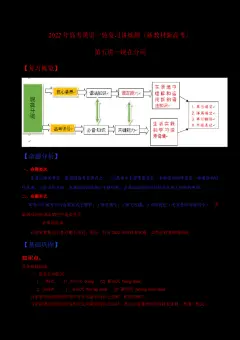
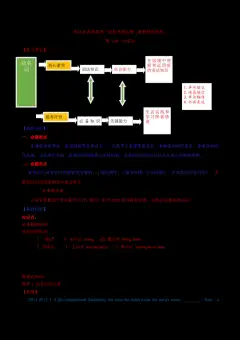
思维建模  根据动词-ing 的句法功能解题的思路

  考点二  动词-ing 形式的时态与语态

核对
答案
对照
检验
1. 判断设空处的动词的句子成分。
2. 牢记-ing 作主语的特殊句型及主谓一致。
3. 牢记-ing 作宾语的固定搭配词。
4. -ing 形式作表语时,表示逻辑意义上的主动含义。
5. -ing 形式作定语时,与所修饰名词有逻辑意义上的主谓关系。6.-
ing 形式作补语时,考虑与宾语之间的逻辑关系。
7.-ing 形式作状语,考虑与主语间的逻辑关系。
信息
提取
确定
成分
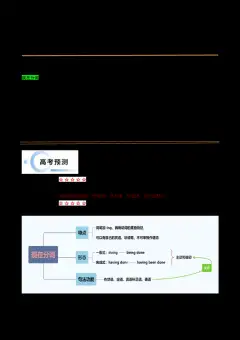
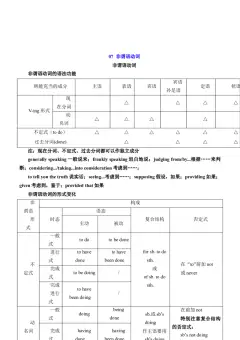
动词-ing 形式包括现在分词和动名词,具有名词、代词、形容词、副词的特征,在句中可作主语、表
语、宾语、补足语、定语、状语等。
动词-ing 形式保留着动词的部分特征,同时具有形容词、副词、名词等的特征,具有时态和语态的变
化形式。
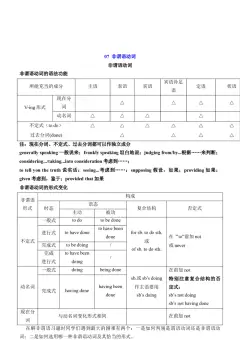
时态形式
语态形式
主动形式
被动形式
一般式
doing
being done
完成式
having done
Having been done
知识点1  一般式
动词的-ing 形式的一般式表示动作与谓语动词同时发生,也可以表示发生在谓语动词之前或之后的动作。
有时也指一般性的动作,不明确说明动作发生的先后。
例1. After working for a few years, she was sent to study in Europe and then, in 19.9, in the US.
工作了几年之后,她被派往欧洲学习,之后于1939 年又赴美学习。
例2. 例2. It would be unwise to comment on the situation without knowing all the facts.
不全面了解情况就对局势妄加评论是不明智的。
例3. The girls surrounded the teacher, listening attentively to her story.
女孩子们围着老师,认真地听她讲故事。
例4. Most doctors strongly insist on people give up smoking and taking plenty of exercise.
大多数医生强烈建议人们戒烟并多进行锻炼。
知识点2  完成式
动词的-ing 形式表示动作发生在谓语动词表示的动作之前。
例1. Having suffered from heart trouble for years, Professor White has to take some medicine with him
wherever he goes.
由于常年受到心脏病困扰,怀特教授不得不走到哪都把药带在身边。
例2. I still remember having been taken to the sea for the first time.
我依然记得第一次被带到海边的情景。
知识点3  动词-ing 的复合结构
有时为了表明动词的-ing 形式表示的动作的执行者,要在动词的-ing 形式之前加上形容词性物主代词或-’s
所有格形式,这便构成了动词的-ing 形式的复合结构。其中形容词性物主代词或- s 所有格形式表明了动词
的-ing 形式的逻辑主语。带有逻辑主语的动词的-ing 形式在句中可以作主语、宾语、表语,这种动词的-ing
形式是动名词。
例1. Her coming encouraged all of us.她的到来鼓舞了我们所有人。
例2. Lily's being careless caused so much trouble.莉莉的粗心惹来了不少麻烦。
例3. What's troubling us is their not doing away with so many cigarette ads.使我们烦恼的是他们没有去
掉这么多的香烟广告。特别提示
名师提醒1.:动词的

 -ing
  形式的复合结构作宾语时

 , 其逻辑主语可用人称代词宾格、名词普通格来代替。


例1. Would you mind my/me using your telescope?你介意我用一下你的望远镜吗?
例2. The father insisted on his son's/his son going to college.那位父亲坚决要求儿子上大学。
名师提醒2.:当逻辑主语是无生命名词、有生命名词但表示泛指或两个以上的名词并列时必须用名词的普
通格或人称代词宾格。
例1. Have you ever heard of women practising boxing? 你听说过妇女练拳击吗?
例2. Do you remember your parents and me telling you about this? 你记得你父母和我都告诉过你这事
吗?
知识点4  被动式
当动词的-ing 形式的逻辑主语同时也是动词的-ing 形式表示的动作的承受者时,动词的-ing 形式用被动形
式。例1. I hate being photographed.我讨厌被拍照。
例3. She can’t endure being defeated. 他无法忍受失败。
例3. I forgot once being taken /having been taken to the zoo. 我忘了曾经被带到过动物园。
考向1  考查动词-ing 形式的一般式
例1 1.          (look) into a mirror, we can see true images of our own; with our knowledge of the past, the
present can be better known.
例2Roughly           (speak), the festival attracts thousands of visitors each year.
【变式训练1·变载体】Over the years, the brand has also held various exhibitions and international art exchanges,
(become) a window of Chinese traditional culture to the world.
【变式训练2·变载体】4.Americans are still texting while driving, as well as                  (use) social
networks and taking photos.
考向2  考查动词-ing 形式的完成式
例1          (tell) about the risk of electric shocks, she is very careful while using the hairdryer.
例2         (overcome) the challenge of global warming, we can then build a fine world.
【变式训练1·变载体】           by many potential customers, the salesman had to gather his courage and sell
the product in different ways. (deny)
【变式训练2·变载体】          (replace) ancient dialects with a standardized national language for ten years,
the country strengthened its cultural unity.
考向3  考查动词-ing 形式的被动式
例1 As she talked, I could hear at least three different languages             at the tables around us.(speak)
例2The guest          (interview) by a reporter for the moment will give a lecture for us.
【变式训练1·变载体】       (not invite) to the farewell party by his class teacher, Tom feels disappointed now.
【变式训练2·变载体】12.The bridge          (build) will shorten the driving distance between the two
villages.
1.(2025 年浙江1 月卷)“I really want to make this work for people’s lives today, and I know that doesn’t
always mean

 ___


  (return) a dress on the Monday after a special weekend,” she says.
2.(2024 年新高考I 卷)The latest ________ (engineer) techniques are applied to create this protective
functional structure that is also beautiful.
3.(2023 年新高考I 卷)No matter where I buy them, one steamer is rarely enough, yet two seems
greedy, so I am always left ________(want) more next time.
4.(2023 年新高考II 卷)They talk to the flood of international tourists and to ___

 ___

 ___

  (visit) Chinese
zookeepers who often come to check on the pandas, which are on loan from China.
5.(2023 年全国甲卷)“There was once a town in the heart of America, where all life seemed to enjoy peaceful
existence with is surroundings,” her fable begins,        (borrow) some familiar words from many age-old
fables.
6.(2023 全国乙卷)         (visit) several times over the last 10 years, I was amazed by the co-existence of
old and new, and how a city was able to keep such a rich heritage (遗产) while constantly growing.
7.(2023 天津6 月卷)The Palace Museum has the most remarkable collection of fine clocks in the world, mainly
_________ from Europe and China.
A.originating
B.originated
C.being originated
D.having originated