文档文本内容
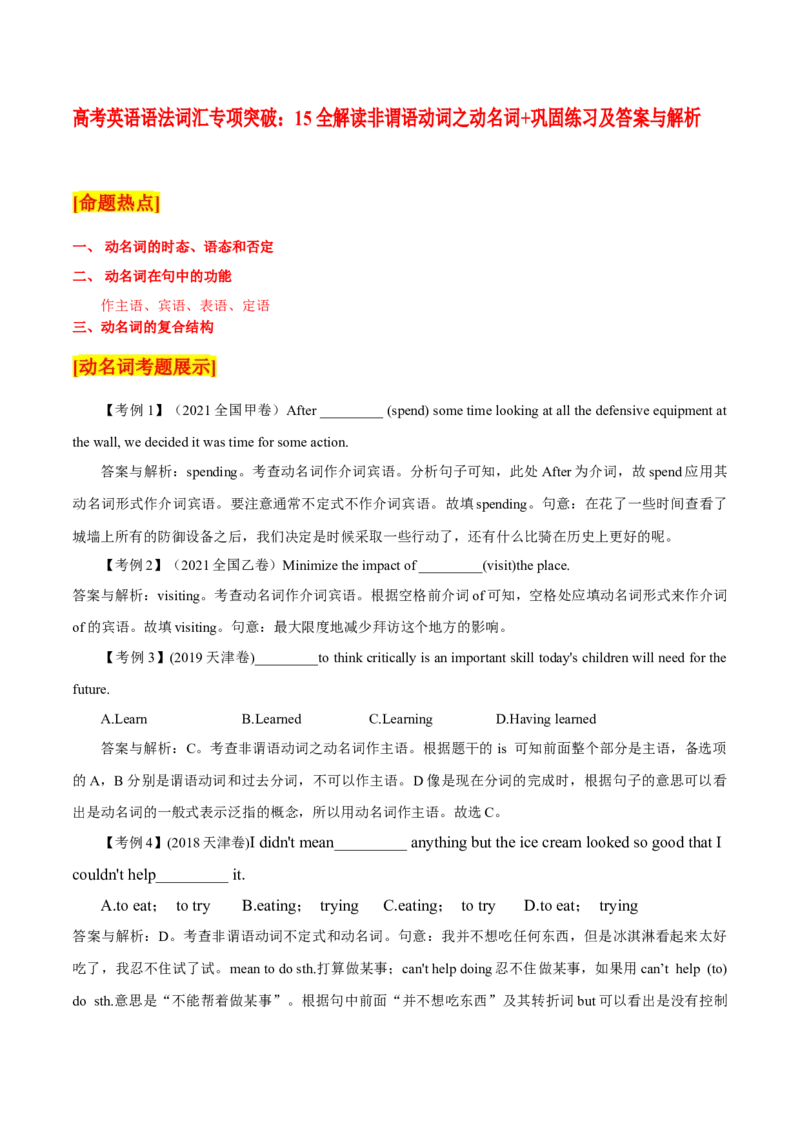
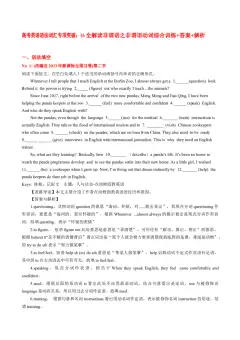
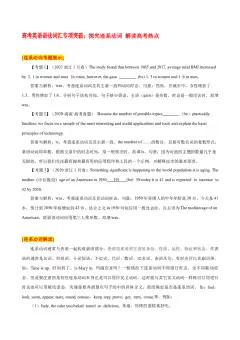
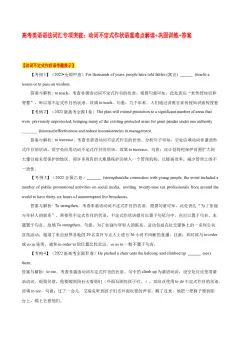
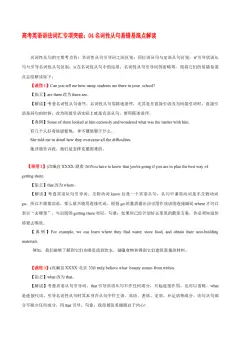
高考英语语法词汇专项突破:15 全解读非谓语动词之动名词+巩固练习及答案与解析
[命题热点]
一、动名词的时态、语态和否定
二、动名词在句中的功能
作主语、宾语、表语、定语
三、动名词的复合结构
[动名词考题展示]
【考例1】(2021全国甲卷)After _________ (spend) some time looking at all the defensive equipment at
the wall, we decided it was time for some action.
答案与解析:spending。考查动名词作介词宾语。分析句子可知,此处After为介词,故spend应用其
动名词形式作介词宾语。要注意通常不定式不作介词宾语。故填spending。句意:在花了一些时间查看了
城墙上所有的防御设备之后,我们决定是时候采取一些行动了,还有什么比骑在历史上更好的呢。
【考例2】(2021全国乙卷)Minimize the impact of _________(visit)the place.
答案与解析:visiting。考查动名词作介词宾语。根据空格前介词of可知,空格处应填动名词形式来作介词
of的宾语。故填visiting。句意:最大限度地减少拜访这个地方的影响。
【考例3】(2019天津卷)_________to think critically is an important skill today's children will need for the
future.
A.Learn B.Learned C.Learning D.Having learned
答案与解析:C。考查非谓语动词之动名词作主语。根据题干的 is 可知前面整个部分是主语,备选项
的A,B分别是谓语动词和过去分词,不可以作主语。D像是现在分词的完成时,根据句子的意思可以看
出是动名词的一般式表示泛指的概念,所以用动名词作主语。故选C。
【考例4】(2018天津卷)I didn't mean_________ anything but the ice cream looked so good that I
couldn't help_________ it.
A.to eat; to try B.eating; trying C.eating; to try D.to eat; trying
答案与解析:D。考查非谓语动词不定式和动名词。句意:我并不想吃任何东西,但是冰淇淋看起来太好
吃了,我忍不住试了试。mean to do sth.打算做某事;can't help doing忍不住做某事,如果用can’t help (to)
do sth.意思是“不能帮着做某事”。根据句中前面“并不想吃东西”及其转折词but可以看出是没有控制住,因此用can't help doing表示“忍不住做某事”。
【考例5】(XXXX年上海高考试题)According to a recent U.S. survey, children spend up to 25 hours a week
_____ TV.
A. to watch
B. to watching *C. watching D. watch
答案与解析:D。 考查动名词作介词宾语。本题是句型sb. spend time/money (in) doing sth.,考查动名
词作介词宾语。
动名词一直是历年高考试题热点,在XXXX年出现的部分省市自行命题的试题中表现也比较突出。本
文将结合部分高考试题解析近年动名词考点中的热点,以帮助广大考生把握该考点的命题思路,以不变应
万变。为了便于同学们理解,本节讲解中涉及到的部分高考试题中的正确选项已经放在了原题干上,但是
部分试题仍然给出被选项,目的是让同学们体会高考试题的命题思路(题干中的斜体部分即是原正确选
项)
动名词具有动词和名词的特点。动词特点体现在可以有自己的宾语、状语、补足语,有时态和语态的
变化;名词特点体现在可以作主语、宾语、表语和定语。
[动名词考点详解]
一、动名词的时态、语态和否定
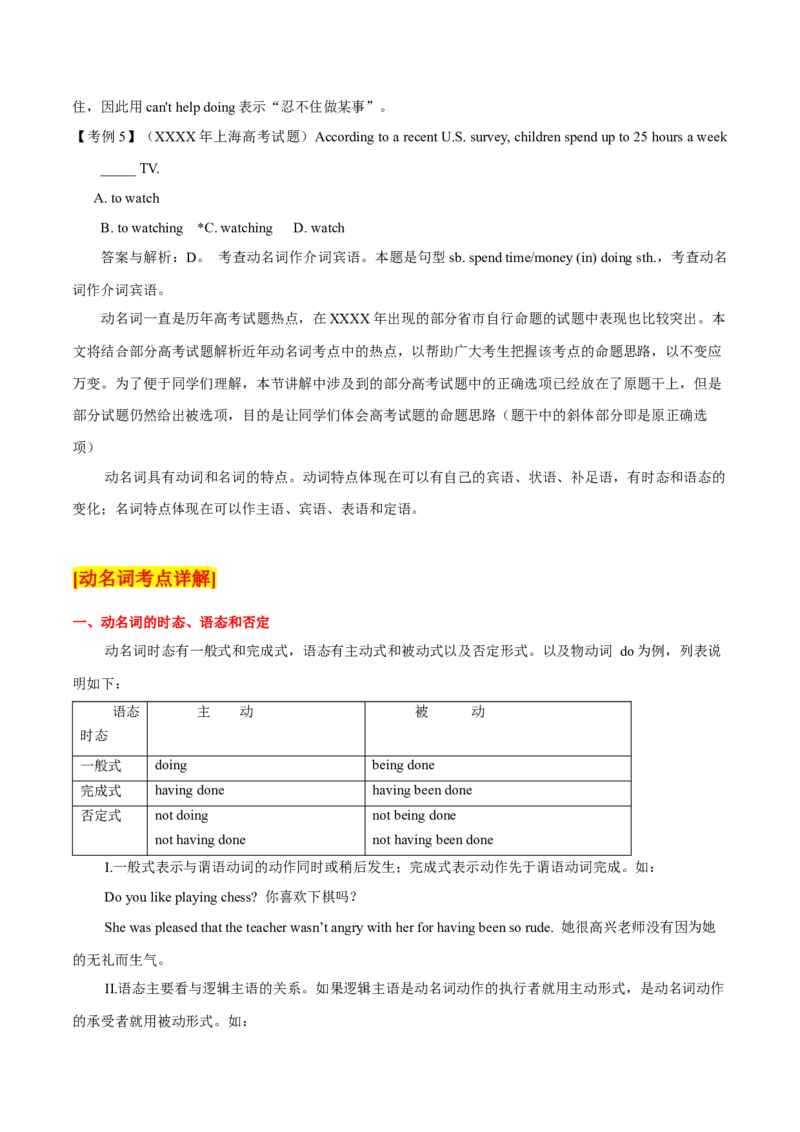
动名词时态有一般式和完成式,语态有主动式和被动式以及否定形式。以及物动词 do为例,列表说
明如下:
语态 主 动 被 动
时态
一般式 doing being done
完成式 having done having been done
否定式 not doing not being done
not having done not having been done
I.一般式表示与谓语动词的动作同时或稍后发生;完成式表示动作先于谓语动词完成。如:
Do you like playing chess? 你喜欢下棋吗?
She was pleased that the teacher wasn’t angry with her for having been so rude. 她很高兴老师没有因为她
的无礼而生气。
II.语态主要看与逻辑主语的关系。如果逻辑主语是动名词动作的执行者就用主动形式,是动名词动作
的承受者就用被动形式。如:(METXXXX) The squirrel was lucky that it just missed ________.
A. catching B. to be caught *C. being caught D. to catch
解析:miss“错过”只可以跟动名词作宾语,而逻辑主语squirrel是catch的动作对象,也就是动作的
承受者,用动名词的被动形式,所以选C。
III.否定形式是在动名词前直接加上not。如:
1) (上海春招 XXXX) Victor apologized for his not being able to inform me of the change in the
plan.
A. his being not able B. him not to be able
C. his not being able D. him to be not able
2) (NMETXXXX) I must apologize for not letting you know ahead of time.
A. letting you not know B. not letting you know
C. letting you know not D. letting not you know
二、动名词在句中的功能
I. 作主语
1.谓语动词通常用单数。如:
Reciting is necessary in learning a language.
在学习一门语言时,背诵是必需的。
Facing up to your problems rather than running away from them is the best approach to working things
out. 直面你的问题而不是逃避它们,是解决这些问题最好的方法。
2.表示经常的、习惯的动作或情况,抽象的、泛指的概念,而不定式更倾向某一次特定的、具体的
动作。而不定式作主语时,一般表示具体某一次的动作。如:
1) (NMETXXXX) Walking is a good form of exercise for both young and old.
A. The walk B. Walking C. To walk D. Walk
2) (上海XXXX) Once your business becomes international, flying constantly will be part of your life.
A. you fly B. your flight C. flight D. flying
3.为了避免“头重脚轻”,可以用it作形式主语,而把真正的动名词主语后置。常用句型是It’s a
waste (of time…)/ no(little) good/ use,It is useless doing...,另外还有一些特定句型中用动名词:
There is no point doing... ,there is no denying等。如:
1) It’s no use making an excuse for this. 为此找借口是没用的。
2) It’s a waste of time talking about such a thing.论这种事情是浪费时间。
3)It's no use complaining without taking action.不采取行动而只是抱怨是没用的。4)I'm an engine-driver, as you well may see, and there's no denying it's terribly dirty work. 我是一名火
车司机,正如你所看到的,不可否认,这是一项非常脏的工作。
5) There is no point saying you run marathons, if you are going to be out of breath arriving at
the interview on the second floor. 如果你跑到二楼面试都喘不过气来,那么你说你常跑马拉松就毫无意
义了。
II.作表语
动名词作表语主要表示主语的具体内容,基本上可以把主语与表语倒过来理解。如果表示与动名词主
语等同或类似情况,表语通常用动名词。如:
1) Seeing is believing (To see is to believe). 眼见为实
2) Denying this will be shutting one’s eyes to fact.否认这一点就是闭起眼睛不正视现实。
提示:如果表语是表示目的、愿望、计划或某一特定的行为,尤其是将来的行为或有待于实现的行为
时,表语通常用不定式。如:
My purpose(wish/ hope/ plan/ idea…) is to climb the mountain from the south. 我的目的(愿望/希望/计
划/主意……)是从南麓爬山。
III.作宾语
1.有些动词只可以跟动名词作宾语。像advise/consider(考虑)/admit/ allow/suggest(建议)/ finish/
appreciate/mind/ imagine/ deny(否认)/enjoy/ keep(on)/ practise/ understand / permit/ miss(错过)/ excuse/ escape/
avoid/ risk(冒险)/ give up/ put off/insist on/ can’t help(禁不住)等。如:
1) (江苏XXXX)The man insisted ______ a taxi for me even though I told him I lived nearby. (江苏XXXX)
A. find B. to find *C. on finding D. in finding
2)(上海XXXX) I really appreciate having time to relax with you on this nice island.
A. to have bad time B. having time C. to have time D. to having time
为了大家能够准确的记住常用的可以跟动名词作宾语的及物动词,为同学们提供一首顺口溜,以帮助
同学们记忆。诗曰:
喜欢考虑不可免,(enjoy/ consider/ escape/ avoid)
停止放弃太冒险。(stop/ give up/ risk)
承认理解很值得,(admit/ understand/ be worth)
反对想象莫推延。(mind/ imagine/ delay/ put off)要求完成是期望,(require/ finish/ look forward to)
建议继续勤操练。(suggest/ go on/ practise)
不禁原谅要坚持,(can’t help/ excuse/ insist on)
继续注意便成功。(keep on/ mind/ succeed in)
2.有些动词跟动名词和不定式作宾语意义不同
1) remember/ forget/regret 跟动名词表示动名词动作发生在谓语动词之前;跟不定式表示不定式
动作发生在谓语动词之后。如:
(1) (NMETXXXX) --- You were brave enough to raise objections at the meeting.
--- Well, now I regret having done that.
A. to do B. to be doing C. to have done D. having done
(2) (上海XXXX) --- Let me tell you something about the journalists.
--- Don’t you remember telling me the story yesterday?
2) try doing表示“试着做某事”;try to do表示“努力做某事”。如:
(METXXXX) --- I usually go there by train.
--- Why not try going by boat for a change.
A. to try going B. trying to go
C. to try and go D. try going
3) mean to do“打算做某事”;mean doing“意思是,意味着”。如:
(上海春招XXXX) In some of London, missing a bus means waiting for another hour.
A. waiting B. to wait C. wait D. to be waiting
4) stop/go on doing“停止/继续做某事”;stop/go on to do“停止/继续以便做另一件事”,不定式表
目的。如:
(METXXXX) She reached the top of the hill and stopped ______ on a big rock by the side of the
path.
A. to have rested B. resting *C. to rest D. rest
3.require/ need/ want/ deserve/ be worth跟动名词主动形式表示被动含义。如:
1) (METXXXX) The library needs cleaning, but it’ll have to wait until Sunday.
2) (METXXXX) --- What do you think of the book?
--- Oh, excellent. It’s worth reading a second time.
4.动名词也可以作介词的宾语。尤其要注意一些含介词 to的短语,要与不定式分清,像lead
to/devote to/ be used to/ object to/ look forward to/ get down to等。如:1) (上海XXXX) The discovery of new evidence led to the thief being caught.
A. the thief having caught B. catch the thief
C. the thief being caught D. the thief to be caught
2) (京皖春招XXXX) One learns a language by making mistakes and correcting them.
A. correct B. correcting C. corrects D. to correct
3) (上海春招XXXX) Mr. Reed made up his mind to devote all he had to setting up some schools for
poor children.
A. set up B. setting up C. have set up D. having set up
5. 在一些固定句型中,动名词作介词宾语,其中介词有时可以省掉。常用结构有:What about
doing sth.?
have trouble(difficulty, problem, pleasure, a good time, a hard time) doing sth.
prevent(stop, keep)…from doing
protect…from doing
spend(waste)…(in) doing sth.
be busy (in) doing sth. 如:
1) (福建XXXX) Having been ill in bed for nearly a month, he had a hard time _____ the exam.
A. pass B. to pass C. passed *D. passing
2) (METXXXX) Do you have any trouble in finding the post office?
IV.作定语
动名词作定语时,如果是单个动名词通常置于被修饰名词之前,表示被修饰名词的用途或性
能。如:
a swimming room 游泳池 a walking stick 拐杖
an answering machine 录音电话 an operating table 手术台
三、动名词的复合结构
动名词可以有自己的逻辑主语,从而构成动名词的复合结构。动名词所带的逻辑主语通常是形容
词性物主代词、宾格代词、名词所有格或普通格,如果逻辑主语是无生命物,则只用普通格(宾
格)。动名词的复合结构作主语时,通常使用名词的所有格或形容词性物主代词。如:
1. (上海春招XXXX) _______ the meeting himself gave them a great deal of encouragement.
A. The president will attend B. The president to attend
C. The president attended *D. The president’s attending
2. (上海XXXX) What worried the child most was ____ to visit his mother in the hospital.A. his not allowing *B. his not being allowed
C. his being not allowed D. having nor been allowed
巩固练习及答案与解析:
1. (上海 XXXX) While shopping, people sometimes can’t help ____ into buying something they don’t really
need.
A. to persuade B. persuading
C. being persuaded D. be persuaded
2. (北京XXXX) --- How do you deal with the disagreement between the company and the customers?
--- The key _____ the problem is to meet the demand ____ by the customers.
A. to solving; making B. to solving; made
C. to solve; making D. to solve; made
3. (上海XXXX) She looks forward every spring to ____ the flower-lined garden.
A. visit B. paying a visit C. walk in D. walking in
4. (METXXXX) How about the two of us ____ a walk down the garden?
A. to take B. take C. taking D. to be taking
5. (上海XXXX) --- What do you think made Mary so upset?
--- _______ her new bicycle.
A. As she lost B. Lost C. Losing D. Because of losing
6. All the managers present agreed that the matter required _____.
A. to look into B. being looked into
C. to be looked into D. looking into
7. We don’t allow anyone _____ here. Well, I hate to say it again. We don’t allow _____ here.
A. to smoke; smoking B. smoking; to smoke
C. to smoke; to smoke D. smoking; smoking
8. They thought there is no trouble ____ their favorite brand from other brands.
A. to tell B. telling C. tell D. told
9. Some birds finally reach home by accidentally _____ landmarks which they recognize.
A. to come across B. coming around
C. coming across D. to come around
10. Million of pounds have been spent ____ the free state education system in Britain.A. on improving B. in improving
C. to improve D. to have improved
11. A large glass of water before you eat may help ____ too excited before delicious foods.
A. to keep you from getting B. to carry you from getting
C. to prevent you to get D. to stop you to get
12. _______for school once in a while often makes Mr. Smith angry.
A. Tom being late B. Tom to be late
C. For Tom being late D. Tom’s being late
13.The final examination is coming up soon. It’s time for us to _______going over our lessons.
A. get down to B. try our best to
C. make an effort to D. make up our minds to
14.I wouldn’t advise _______ there by bus, because it is too crowded.
A. go B. to go C. to going D. going
15. We don’t allow ______ in this room.
A. smoking B. to smoke C. people smoking D. people to smoking
16. You shouldn’t allow _____ games near the classroom, for it’s too noisy.
A. students playing B. to play
C. students to play D. to playing
17. No one enjoys _____ fun of in public.
A. making B. being made C. to be made D. to make
18. Have you forgotten _____ a ruler from Betty? Please remember _____ it to her tomorrow.
A. borrowing, to return B. borrowing, returning
C. to borrow, to return D. to borrow, returning
19. The match was canceled because most of the members _____ a match without a standard court.
A. objected to having B. objected to have
C. were objected to have D. were objected to having
20. I couldn’t help _____ by the beauty of the West burst.
A. striking B. being struck C. bursting D. being Lake
21. I appreciate _____ me during the debate.
A. of your supporting B. you to support
C. your supporting D. to your supporting
22. The workers favour _____ funds to build the bridge.A. to raise B. raisingC. raised D. rising
23. After a long delay I finally got round _____ the letter.
A. to write B. writing C. to writing D. in writing
24. No one is permitted to enter the hall without first _____ his identification card.
A. having show B. being show C. showing D. having shown
25. Do you ever have any trouble _____ the path through the forest?
A. to find B. finding C. with finding D. to finding
26. They insisted on _____ a thorough rest before going back to work.
A. him to take B. he took C. his taking D. his taken
27. Who could have imagined such a sweet—tempered girl as Alice _____ such a thing!
A. doing B. to do C. will do D. does
28. He likes _____. But he doesn’t like _____today because it is too cold.
A. to swim, to swim B. swimming, swimming
C. to swim, swimming D. swimming, to swim
29. We were surprised at _____ the exam.
A. him not pass B. his passing not
C. his not passing D. him not to pass
30. It is no use _____ over split milk.
A. cry B. to cry C. crying D. be crying
31. It is no good _____ others’ shortcomings.
A. to joke about B. to joke with
C. joking withD. joking about
32. He didn’t feel like _____ so he suggested _____ the day in the garden.
A. working spending B. to work, to spend
C. working, to spend D. to work, spending
参考答案与思路点拨:KEY:1-5 CBDCC 6-10 DABCB 11-15 ADADA 16-20 CBAAB 21-25 CBCCB
26-30 AADCC 31-32 DA
1.点拨:can’t help表示“禁不住”的意思时跟动词ing形式,排除A、D。根据句意是“被说服买并不真
正需要的东西”可知用被动语态,故选C。
2.点拨:key后的to是介词,表示“……的”,所以用动词ing形式作介词宾语,排除C、D。名词demand
是make的动作对象,两者之间是动宾关系,所以当demand作被修饰词时要哟奶奶感被动语态,故选
B。
3.点拨:look forward to doing sth.的意思是“渴望做某事”,其中的to是介词,跟跟动词ing形式作宾
语,故选D。如果B项改为paying a visit to则可以选。
4.点拨:how/what about中的about是介词,所以跟名词、代词或跟动词ing形式作宾语,故选C。
5.点拨:根据特殊疑问句可知所填的词应该能代替问句中的what,而what在特殊疑问句子里作主语,
A、B、D都不可以作主语,故选C,看作是动词ing形式作主语,可以理解为:Losing her new bicycle
made Mary so upset。
6.点拨:根据句意此处的require的意思是“需要”,当其表示“需要”的意思是,跟动词ing的主动形式
表示被动意义,故选D,句意是“在场的所有经理都同意这个事情需要调查”。
7.点拨:allow跟动词ing形式作宾语,也可以跟动词不定式作宾语补足语,即allow sb. to do sth.表示“允
许某人做某事”,根据句意“我们不允许任何人在这儿抽烟,好了,我不想再说了。我们不准抽烟。”
8.点拨:本题是考查句型:sb. have trouble/ difficulty (in) doing sth.“某人做某事有困难”,其中的介词in
可以省掉,故选B。
9.点拨:介词by跟动词ing形式可以作状语,表示方式或手段,come across的意思是“v.来到, 偶遇”,
故选C。句意是:一些鸟是通过偶然的认出(树木、建筑等)明显的目标而终于到家了”。
10.点拨:本句是句型:sb. spend time/money (in) doing sth.“某人花多少时间或金钱做某事”,其中的介词
in可以省掉,故选B。
11.点拨:表示“阻止某人做某事”用stop/prevent/keep sb. from doing sth.,对于stop和prevent两个词来
说,在主动语态中可以把介词 from省掉,用stop/prevent sb. doing sth.,但是不可以用不定式,故选A。
12.点拨:根据句中的谓语动词makes可以断定用非谓语动词作主语,而句中的时间状语once in a while暗
示出迟到对Tom来说是一种习惯性、经常性的事情,所以用动词ing形式作主语,而在ing作为名词
时,作主语的动名词复合结构用所有格形式,故选D。
13. 点拨:B、C、D三个选项中的to都是不定式的标志,try our best to do sth.的意思是“努力/尽力做某
事”,make an effort to do sth.意思是同try our best to do sth.,make up our minds to的意思是“下决心做某事”,get down to (doing)sth.的意思是“开始认真考虑/做某事”,其中的to是介词,所以跟名
词、代词或动词ing形式作宾语,故选A。
14.点拨:选D 动名词作宾语
15. 点拨:选A allow跟动名词作宾语,跟不定式作宾语补足语,故选A。
16. 点拨:选C 不定式作宾补
17. 点拨:选B 动名词的被动式作宾语
18. 点拨:选A forget+动名词表示“忘记做过某事” remember+不定式表示“记得要做某事”
19. 点拨: 选A object to表示“反对” to为介词
20. 点拨:选B can’t help表示“禁不住”时跟动名词作宾语
21. 点拨:选C 动名词复合结构作宾语
22. 点拨:选B 动名词作宾语
23. 点拨:选C get around to 设法找时间干某事,to为介词
24. 点拨:选C 动名词作介宾
25. 点拨:选B have trouble(in) doing sth.
26. 点拨:选C 动名词复合结构作宾语
27. 点拨:选A 动名词的复合结构作宾语
28. 点拨:选D like+ V-ing表示习惯性动作 like+ to do表示具体的动作
29. 点拨:选C 动名词复合结构的否定式作介宾
30. 点拨:选C It is no good/no use + v-ing 表示一般性行为
31. 点拨:选D 句型“It’s no good doing sth”的意思是“做某事是没有好处的/无益的”,短语joke about
的意思是“拿……开玩笑”,故选D。
32. 点拨:选A 动名词作宾语