高考英语语法词汇专项突破:03 重点句型展示 高频考点解读+巩固练习+答案
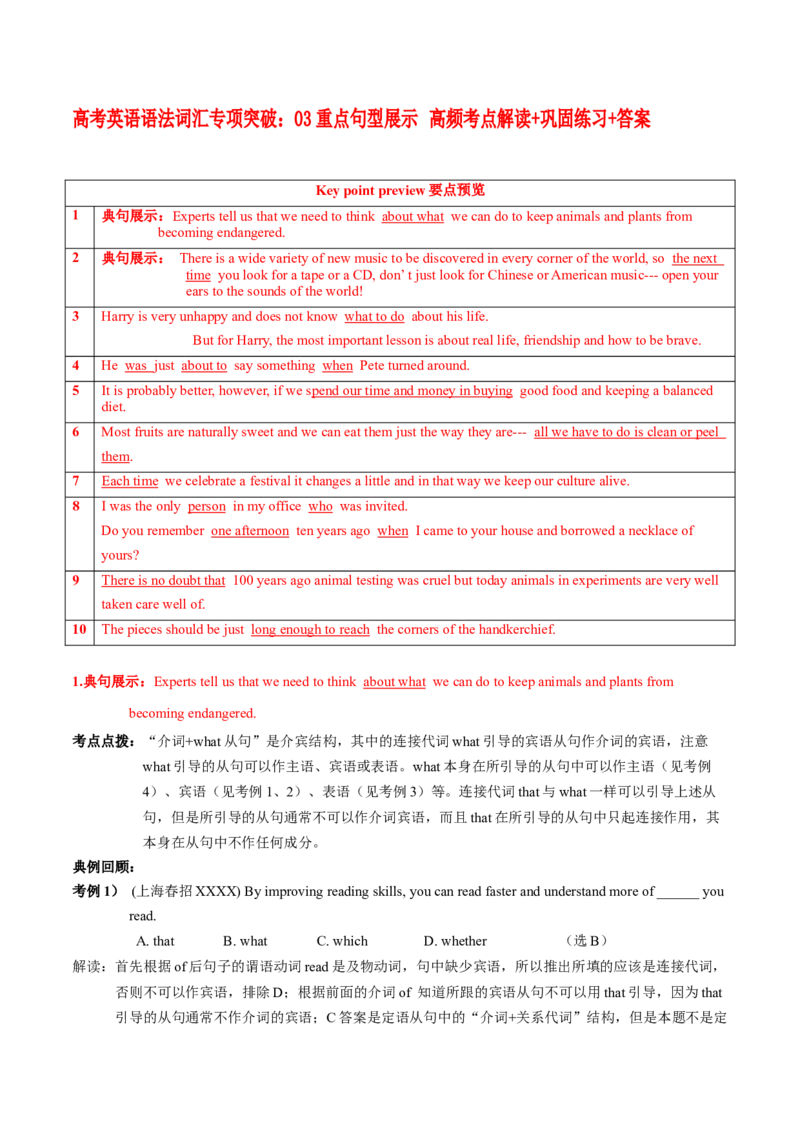
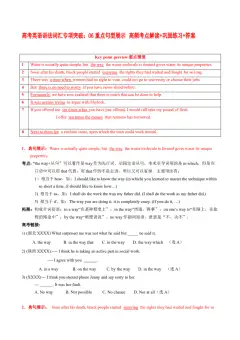
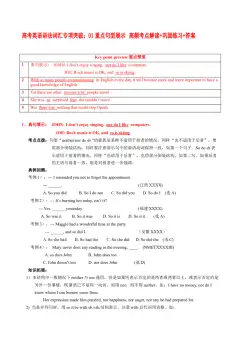
Key point preview要点预览
1 典句展示:Experts tell us that we need to think about what we can do to keep animals and plants from
becoming endangered.
2 典句展示: There is a wide variety of new music to be discovered in every corner of the world, so the next
time you look for a tape or a CD, don’ t just look for Chinese or American music--- open your
ears to the sounds of the world!
3 Harry is very unhappy and does not know what to do about his life.
But for Harry, the most important lesson is about real life, friendship and how to be brave.
4 He was just about to say something when Pete turned around.
5 It is probably better, however, if we spend our time and money in buying good food and keeping a balanced
diet.
6 Most fruits are naturally sweet and we can eat them just the way they are--- all we have to do is clean or peel
them.
7 Each time we celebrate a festival it changes a little and in that way we keep our culture alive.
8 I was the only person in my office who was invited.
Do you remember one afternoon ten years ago when I came to your house and borrowed a necklace of
yours?
9 There is no doubt that 100 years ago animal testing was cruel but today animals in experiments are very well
taken care well of.
10 The pieces should be just long enough to reach the corners of the handkerchief.
1.典句展示:Experts tell us that we need to think about what we can do to keep animals and plants from
becoming endangered.
考点点拨:“介词+what从句”是介宾结构,其中的连接代词what引导的宾语从句作介词的宾语,注意
what引导的从句可以作主语、宾语或表语。what本身在所引导的从句中可以作主语(见考例
4)、宾语(见考例1、2)、表语(见考例3)等。连接代词that与what一样可以引导上述从
句,但是所引导的从句通常不可以作介词宾语,而且that在所引导的从句中只起连接作用,其
本身在从句中不作任何成分。
典例回顾:
考例1) (上海春招XXXX) By improving reading skills, you can read faster and understand more of ______ you
read.
A. that B. what C. which D. whether (选B)
解读:首先根据of后句子的谓语动词read是及物动词,句中缺少宾语,所以推出所填的应该是连接代词,
否则不可以作宾语,排除D;根据前面的介词of 知道所跟的宾语从句不可以用that引导,因为that
引导的从句通常不作介词的宾语;C答案是定语从句中的“介词+关系代词”结构,但是本题不是定语从句。因此只有选B。
考例2)(NMETXXXX.I) See the flags on top of the building? That was______ we did this morning.
A. when B. which C. where D. What (选D)
考例3)(北京XXXX) ―Could you do me a favor?
―It depends on it is.
A. which B. whichever C. what D. whatever (选C)
考例4)(辽宁XXXX) makes this shop different is that it offers more personal services.
A. What B. Who C. Whatever D. Whoever (选A)
知识拓展:what的含义有时十分模糊,不是直接理解成“什么、东西”等,而是根据实际情况理解为“…
的事物或人物(which, who, or that)”,如It's the poor what gets the blame.是穷人们受到了责难。还
可以用于句型A it to B what C is to D ,意思是“A对于B犹如C对于D”。
考例1):(安徽XXXX) Great changes have taken place in that school. It is no longer _____ it was 20 years ago,
______ poorly equipped.
A. what; when B. that; which C. what; which D. which; that (选A)
解读:考查表语从句和定语从句。表语从句本身缺少表语,而 that引导名词性从句时其本身在从句中只起
连接作用,不可以作任何成分,排除B;再根据后一句的谓语动词过去时可以断定用when引导非限
制性定语从句,故选A。what在句中并不都是翻译成“什么”,根据一定的语境可以理解为时间、
地点、物品等模糊概念。如:China is no longer what it used to be.可译作“中国再也不是以前的中国
了”。
考例2):(山东XXXX) Engines are to machines ____ hearts are to animals.
A. as B. that C. what D. which (选C)
解读:考查特定句型,根据句子的意思知道选C,句意是“对于机器来说,发动机就像动物的心脏;发动
机对于机器犹如心脏对于动物”。
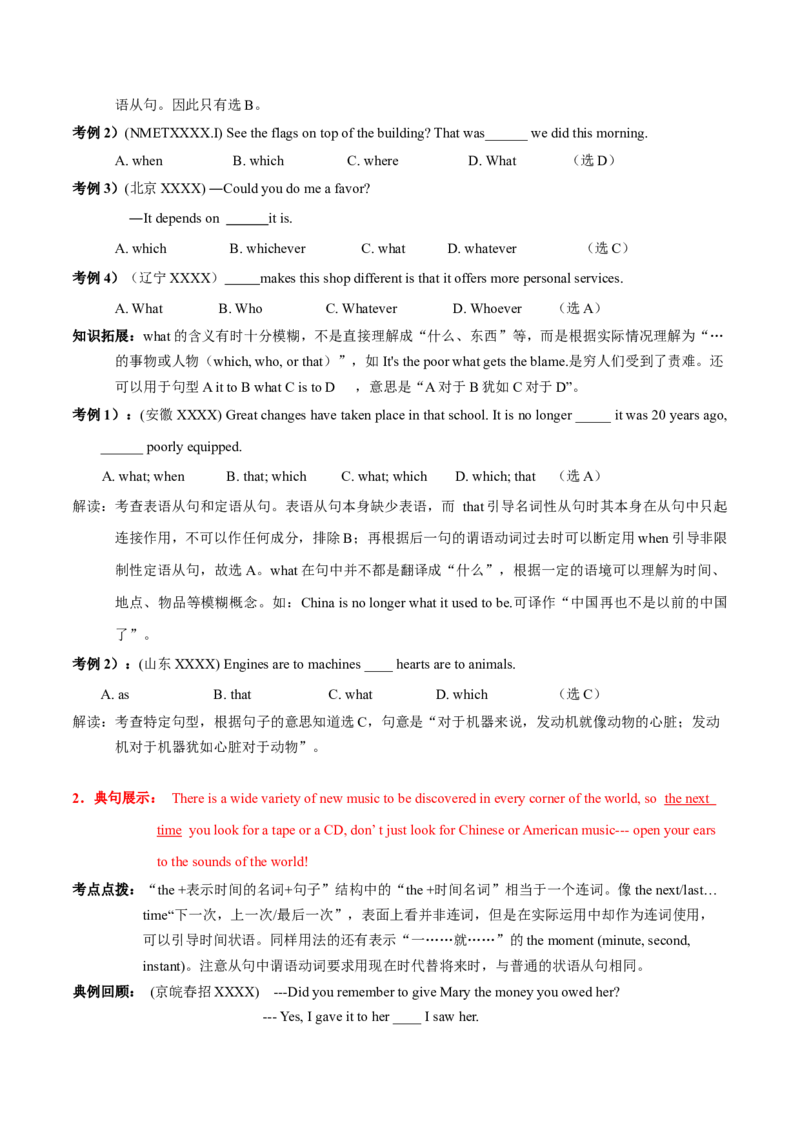
2.典句展示: There is a wide variety of new music to be discovered in every corner of the world, so the next
time you look for a tape or a CD, don’ t just look for Chinese or American music--- open your ears
to the sounds of the world!
考点点拨:“the +表示时间的名词+句子”结构中的“the +时间名词”相当于一个连词。像the next/last…
time“下一次,上一次/最后一次”,表面上看并非连词,但是在实际运用中却作为连词使用,
可以引导时间状语。同样用法的还有表示“一……就……”的the moment (minute, second,
instant)。注意从句中谓语动词要求用现在时代替将来时,与普通的状语从句相同。
典例回顾: (京皖春招XXXX) ---Did you remember to give Mary the money you owed her?
--- Yes, I gave it to her ____ I saw her.A. while B. the moment C. suddenly D. once (选B)
知识拓展:可以用the spring/summer/ autumn/ winter/ month/week等表示“某事发生在……的季节/月
份/周”,引导时间状语从句,注意定冠词the不可以省掉。
典例:The summer I stayed in Beijing, I got a job with an income of 4,000 yuan a month.
我在北京的那年夏天,我找到一一份月薪四千元的工作。
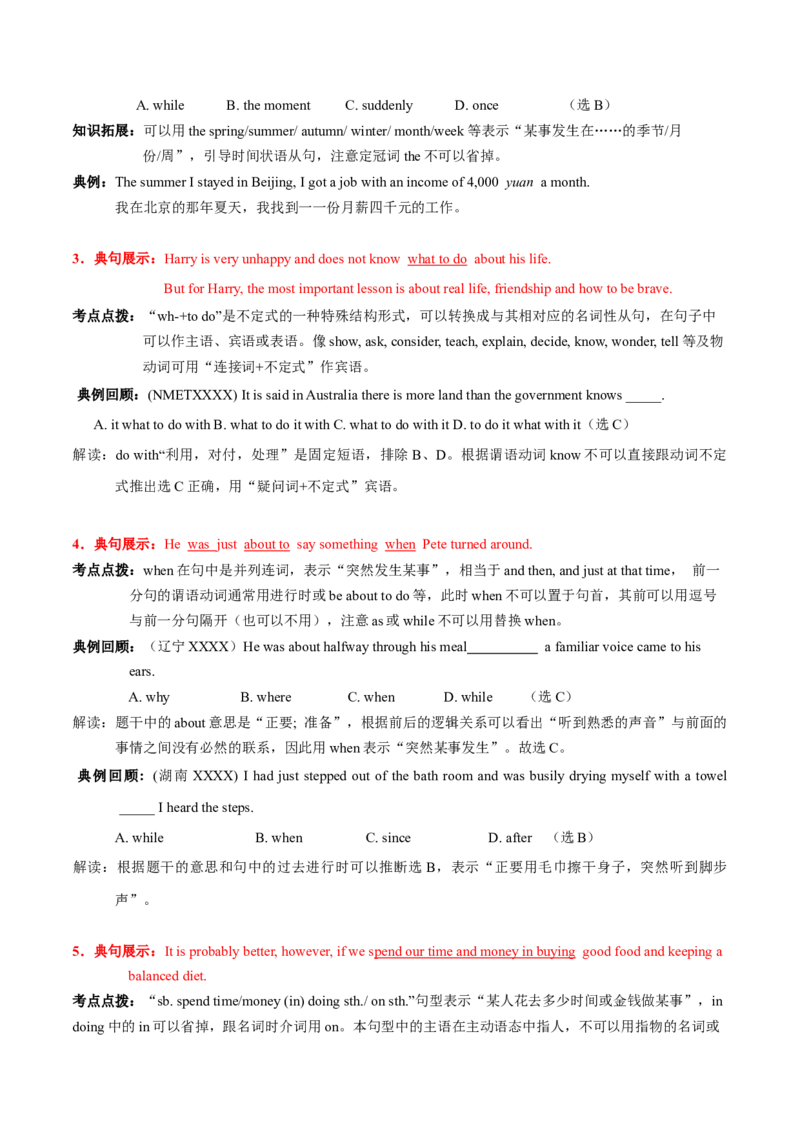
3.典句展示:Harry is very unhappy and does not know what to do about his life.
But for Harry, the most important lesson is about real life, friendship and how to be brave.
考点点拨:“wh-+to do”是不定式的一种特殊结构形式,可以转换成与其相对应的名词性从句,在句子中
可以作主语、宾语或表语。像show, ask, consider, teach, explain, decide, know, wonder, tell等及物
动词可用“连接词+不定式”作宾语。
典例回顾:(NMETXXXX) It is said in Australia there is more land than the government knows _____.
A. it what to do with B. what to do it with C. what to do with it D. to do it what with it(选C)
解读:do with“利用,对付,处理”是固定短语,排除B、D。根据谓语动词know不可以直接跟动词不定
式推出选C正确,用“疑问词+不定式”宾语。
4.典句展示:He was just about to say something when Pete turned around.
考点点拨:when在句中是并列连词,表示“突然发生某事”,相当于and then, and just at that time, 前一
分句的谓语动词通常用进行时或be about to do等,此时when不可以置于句首,其前可以用逗号
与前一分句隔开(也可以不用),注意as或while不可以用替换when。
典例回顾:(辽宁XXXX)He was about halfway through his meal a familiar voice came to his
ears.
A. why B. where C. when D. while (选C)
解读:题干中的about意思是“正要; 准备”,根据前后的逻辑关系可以看出“听到熟悉的声音”与前面的
事情之间没有必然的联系,因此用when表示“突然某事发生”。故选C。
典例回顾: (湖南 XXXX) I had just stepped out of the bath room and was busily drying myself with a towel
_____ I heard the steps.
A. while B. when C. since D. after (选B)
解读:根据题干的意思和句中的过去进行时可以推断选 B,表示“正要用毛巾擦干身子,突然听到脚步
声”。
5.典句展示:It is probably better, however, if we spend our time and money in buying good food and keeping a
balanced diet.
考点点拨:“sb. spend time/money (in) doing sth./ on sth.”句型表示“某人花去多少时间或金钱做某事”,in
doing中的in可以省掉,跟名词时介词用on。本句型中的主语在主动语态中指人,不可以用指物的名词或代词作主语,但是可以用被动语态形式,那么指时间或金钱的名词可以用在该句型的被动语态句子中充当
主语。
典例回顾:(重庆XXXX)—Do you have any idea what Paul does all day?
—As I know, he spends at least as much time playing as he _______.
A. writes B. does writing C. is writing D. does write (选B)
解读:题中的比较级把两个sb. spend time doing连接起来,后面的句子用了代动词does代替spends,以免
重复,所以does后面动词要用ing形式。故选B。
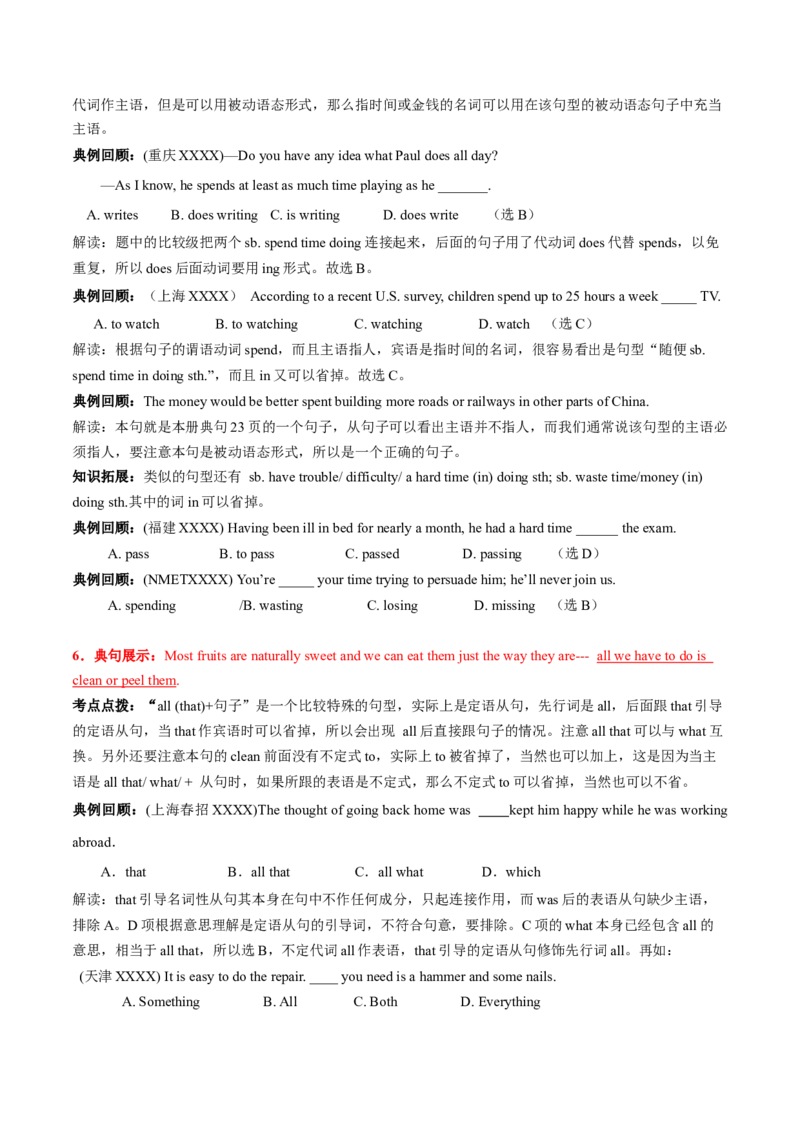
典例回顾:(上海XXXX) According to a recent U.S. survey, children spend up to 25 hours a week _____ TV.
A. to watch B. to watching C. watching D. watch (选C)
解读:根据句子的谓语动词spend,而且主语指人,宾语是指时间的名词,很容易看出是句型“随便sb.
spend time in doing sth.”,而且in又可以省掉。故选C。
典例回顾:The money would be better spent building more roads or railways in other parts of China.
解读:本句就是本册典句23页的一个句子,从句子可以看出主语并不指人,而我们通常说该句型的主语必
须指人,要注意本句是被动语态形式,所以是一个正确的句子。
知识拓展:类似的句型还有 sb. have trouble/ difficulty/ a hard time (in) doing sth; sb. waste time/money (in)
doing sth.其中的词in可以省掉。
典例回顾:(福建XXXX) Having been ill in bed for nearly a month, he had a hard time ______ the exam.
A. pass B. to pass C. passed D. passing (选D)
典例回顾:(NMETXXXX) You’re _____ your time trying to persuade him; he’ll never join us.
A. spending /B. wasting C. losing D. missing (选B)
6.典句展示:Most fruits are naturally sweet and we can eat them just the way they are--- all we have to do is
clean or peel them.
考点点拨:“all (that)+句子”是一个比较特殊的句型,实际上是定语从句,先行词是all,后面跟that引导
的定语从句,当that作宾语时可以省掉,所以会出现 all后直接跟句子的情况。注意all that可以与what互
换。另外还要注意本句的clean前面没有不定式to,实际上to被省掉了,当然也可以加上,这是因为当主
语是all that/ what/ + 从句时,如果所跟的表语是不定式,那么不定式to可以省掉,当然也可以不省。
典例回顾:(上海春招XXXX)The thought of going back home was kept him happy while he was working
abroad.
A.that B.all that C.all what D.which
解读:that引导名词性从句其本身在句中不作任何成分,只起连接作用,而was后的表语从句缺少主语,
排除A。D项根据意思理解是定语从句的引导词,不符合句意,要排除。C项的what本身已经包含all的
意思,相当于all that,所以选B,不定代词all作表语,that引导的定语从句修饰先行词all。再如:
(天津XXXX) It is easy to do the repair. ____ you need is a hammer and some nails.
A. Something B. All C. Both D. Everything7.典句展示: Each time we celebrate a festival it changes a little and in that way we keep our culture alive.
考点点拨:each time的意思是“每当”,表面是一名词的形式,但是实际上可以直接连接句子,相当于连
词,因此可以引导时间状语从句。要注意当需要表示将来时的时候谓语动词用一般现在时,这是状语从句
的要求。也可以用every time代替each time,相当于whenever。
典例:a. Every time they are in trouble we try our best to help them.
b. Each time I visit him I find him reading the same novel named GONE WITH WIND.
8.典句展示:I was the only person in my office who was invited.
Do you remember one afternoon ten years ago when I came to your house and borrowed a
necklace of yours?
考点点拨:本句型是“先行词+其它成分+定语从句”,是定语从句的一种特殊形式,称之为隔离定语从
句。通常定语从句直接置于先行词之后,但是有时候从句与先行词之间被其它成分隔开,解题时一定要找
准先行词,不能想当然地认为从句前的名词就是先行词,否则会用错关系词。典句中第一句的先行词是
person,所以后面who引导的定语从句的先行词不是office,所以如果用which就错了,一般也不用that,
因为容易引起误解;第二句的先行词是one afternoon。
典例回顾:(京皖春招XXXX) It was an exciting moment for these football fans this year, _____ for the first time
in years their team won the World Cup.
A. that B. while C. which D. when (选D)
解读:本题根据题干中的逗号知道考查非限制性定语从句,排除A、B。根据句意知道前面的先行词是
moment,并不是this year,选D,当然本题的先行词并没有影响解题。
知识拓展:同位语从句有时也会出现同位名词与同位语从句之间被其它成分隔开的现象,同位语从句试题
的解题关键是对同位语从句的正确判定。
典例回顾:(四川XXXX) --- It’s thirty years since we last met.
--- But I still remember the story, believe it or not, ____ we got lost on a rainy night.
A. which B. that C. what D. when (选B)
解读:如果把believe it or not去掉就很容易看出原来是同位语从句,B答案正确,但是实际上不少考生先
把B答案排除了,然后从剩下的三个错误答案中选出一个,根本原因就是定势思维的影响,由于插入成分
的干扰,有的同学想当然地认为是非限制性定语从句,结果选了A答案。
9.典句展示: There is no doubt that 100 years ago animal testing was cruel but today animals in experiments
are very well taken care well of.
考点点拨:there is /have no doubt that..是一个有关 doubt的重要句型,意思“毫无疑问…”。doubt后面
that引导的从句可以看作是同位语从句,如果在肯定句中则用whether引导。doubt也可以作动词,在肯定
句中跟whether或if引导的宾语从句,在否定句和疑问句中用that引导的宾语从句。
典例回顾:(广东 XXXX)Some researchers believe that there is no doubt ______ a cure for AIDS will be
found.A. which B. that C. what D. whether (选B)
解读:本题符合句型there is no doubt that.. ,用that引导同位语从句,故选B。
10.典句展示:The pieces should be just long enough to reach the corners of the handkerchief.
考点点拨:“adj./adv.+enough + to do sth.”结构中enough是副词,当其修饰形容词或副词时要置于被修饰词
之后。enough还可以作形容词,此时置于被修饰的名词前后都可以。
典例回顾:(湖南XXXX)Although she did not know Boston well, she made her way________ to the Home Circle
Building.
A. easy enough B. enough easy C. easily enough D. enough easily (选C)
解析:根据enough修饰形容词或副词需要后置,排除B、D;本题的副词easily修饰动词made. 此题要克
服思维定势,不要看成了“make+宾语+形容词+不定式”的结构了,此处的to为介词,make one’s way to
前往。试比较:The professor spoke slowly to make his words easy enough to understand.
牛刀小试
I.根据句子的意思,在括号内选出适当的连词填上在横线上,使下列各句完整。
1. The shopkeeper did not want to sell for ______(that/ what) he thought was not enough.
2. I was surprised by her words, which made me recognize ______ (what/ which) silly mistakes I had made.
3. The way he did it was different from ______(how/ what) we were used to.
4. Do you have any idea _______(what/ that) is actually going on in the classroom?
5. --- I think it’s going to be a big problem.
--- Yes, it could be.
--- I wonder _____ we can do about it. (which/ what)
II. 单句改错:下列个句都有一处错误,分多词少词错词三种,请指出并改正。(注意:要遵循高考试题中
的短文改错的改法)
1. When I asked him that he was doing, he smiled and then put the toy on the desk.
2. I can’t thank my teacher too much. She is to a student like a mother is to a daughter.
3. Is this the reason what he gave us for not attending the meeting?
4. That you see near the North Pole is nothing but ice and snow.
5. A new school will build in that used to be a temple.
6. Most people know a great scientist Edison became.
7. He was educated at a local grammar school, after what he went on to Cambridge.
8. What I explained on the phone, your request will be considered at the next meeting.III. 单句改错:下列个句都有一处错误,分多词少词错词三种,请指出并改正。(注意:要遵循高考试题中
的短文改错的改法)
1. I really don’t know to thank you.
2. He was about to tell me the secret while someone patted him on the shoulder.
3. Jasmine was holidaying with her family in a wildlife park when she was bitten on the leg by a lion.
4. “Please bring you electronic dictionary the next time you will attend my class”, said the professor.
5. Last summer I took a course on what to make dresses.
6. We were swimming in the lake suddenly the storm started.
IV.根据括号内所给的提示,把下列各句翻译成英语。
1. 我上一次见到他时,他正在写一本小说,但不知道他现在写完了没有。(the last time)
2. 我想要知道的是什么时候开始。(连接词+to do)
3. 何时到何地还没有确定下来。(连接词+to do)
4. 当她在用打字机打那封信时,突然电话响了。(when)
5. 你一到北京就要给我打电话。(The moment/ second/ minute…)
6.我在莫斯科的那年冬天,天气特别冷。 (the winter)
V.从下列所给的A、B、C、D四个答案中选出最佳答案。
1. He didn’t pass the final examination because he hadn’t spend much time _______ his homework .
A. to B. at C. in D. on
2. Now more and more city adults spend their leisure time _______ to improve themselves at school or college.
A. on trying B. to try C. trying D. tried
3. “Will you be _______ your holidays abroad this year?” I asked.
A. paying B. spending C. cost D. take
4. ________ I meet him, I can’t help remembering our old days when we worked together in a faraway village.
A. All time B. All times C. Time D. Every time
5. After the competition, all Zhoulan could do was ________ to her trainer and thank him.
A. go up B. going up C. gone up D. to be gone up
6. No one knows ________ the poor man should have said.
A. which B. what C. all what D. all which
7. ---- Why _______ time and energy ______ something so hopeless?
---- But I have no choice.
A. spend; in B. spend; / C. waste; on D. spend in
8. Students growing up from nursery school to college have trouble _______ realities.
A. on dealing with B. dealing with C. in to deal with D. how to deal with
9. At first, the government had great difficulty _______ people to leave Rio and to settle in Brasilia.
A. in persuading B. on persuading C. to persuade D. persuaded
10. ----- Do you have any difficulty ______ English?----- Yes. In fact too much.
A. in B. for C. with D. on
11.(上海 XXXX)A story goes ______ Elizabeth I of England liked nothing more than being surrounded by
clever and qualified noblemen at court.
A. when B. where C. what D. that
12. ---- Do you think it is __________ to play chess here?
---- Yes, nowhere can you find a better place.
A. light enough B. lightly enough C. enough light D. enough lightly
13. I have (my) doubts ______ he is the best man for the job.
A. that B. if C. whether D. what
14. --- Why not pay a visit to Mr. Li?
--- I doubt _______ he is at home.
A. if B. that C. whether D. Both A and C
15. --- I don’t doubt ______ he said.
--- On the country, he is always lying.
A. that B. if C. whether D. what
16. ---- Can you doubt ______ he will win?
---- Yes, he hasn’t work hard enough, I think.
A. whether B. what C. why D. that
17. We can travel to places in an hour _____ would have taken our ancestors days to reach.
A. where B. when C. which D. what
18. (重庆XXXX) Nobody believed his reason for being absent from the class ____ he had to meet his uncle at the
airport.
A. why B. that C. where D. because
19.(上海春招XXXX) _____, some famous scientists have the qualities of being both careful and careless.
A. Strangely enough B. Enough strangely C. Strange enough D. Enough strange
20. (NMETXXXX) ______ to take this adventure course will certainly learn a lot of useful skills.
A. Brave enough students B. Enough brave students
C. Students brave enough D. Students enough brave
KEYS: 1-5 DCBDA 6-10 BCBAC 11-15 DACDD 16-20 DCBAC
KEYS:
I. 1.what 2. what 3. what 4. what 5. what
II. 1. that 改为what 2. like改为what
3. 删掉what,或把what改为that/which 4. That 改为What
5. that改为what 6. 在know后加上what7. what改为which 8. What 改为As
III.1. 在to前加上how 2. while改为when 3. 把and删掉
4. 把 will删掉 5. what改为how 6. suddenly前加上when
IV.1. The last time I saw him he was writing a novel, but I don’t know whether he has finished it or not.
2. What I want to know is when to start.
3. When and where to go hasn’t been decided yet.
4. She was typing the letter, when the telephone rang.
5. The moment/ second/ minute you arrive in Beijing, please ring me up.
6. The winter I stayed in Moscow, it was extremely cold.
V. 1-5 DCBDA 6-10 BCBAC 11-15 DACDD 16-20 DCBAC