第17 讲 形容词&副词-1 2026 年高考语法专项突破(全国通
用)
(语法讲义+模拟练习+真题操练)
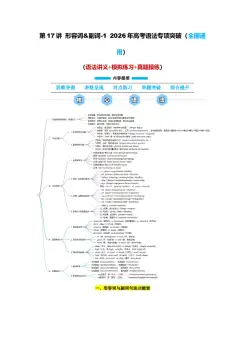
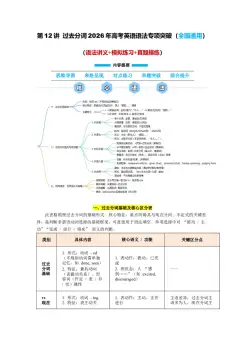
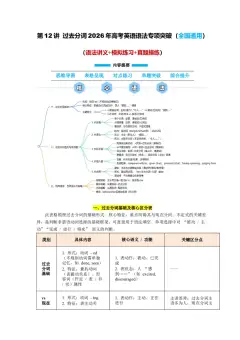
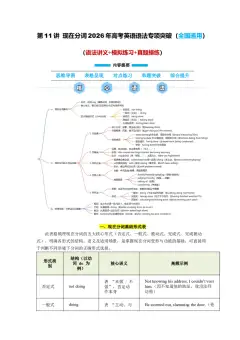
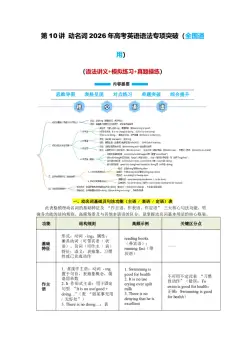
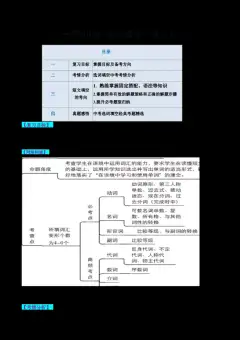
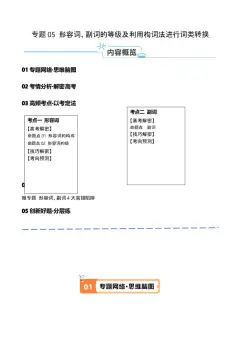
 内容提要
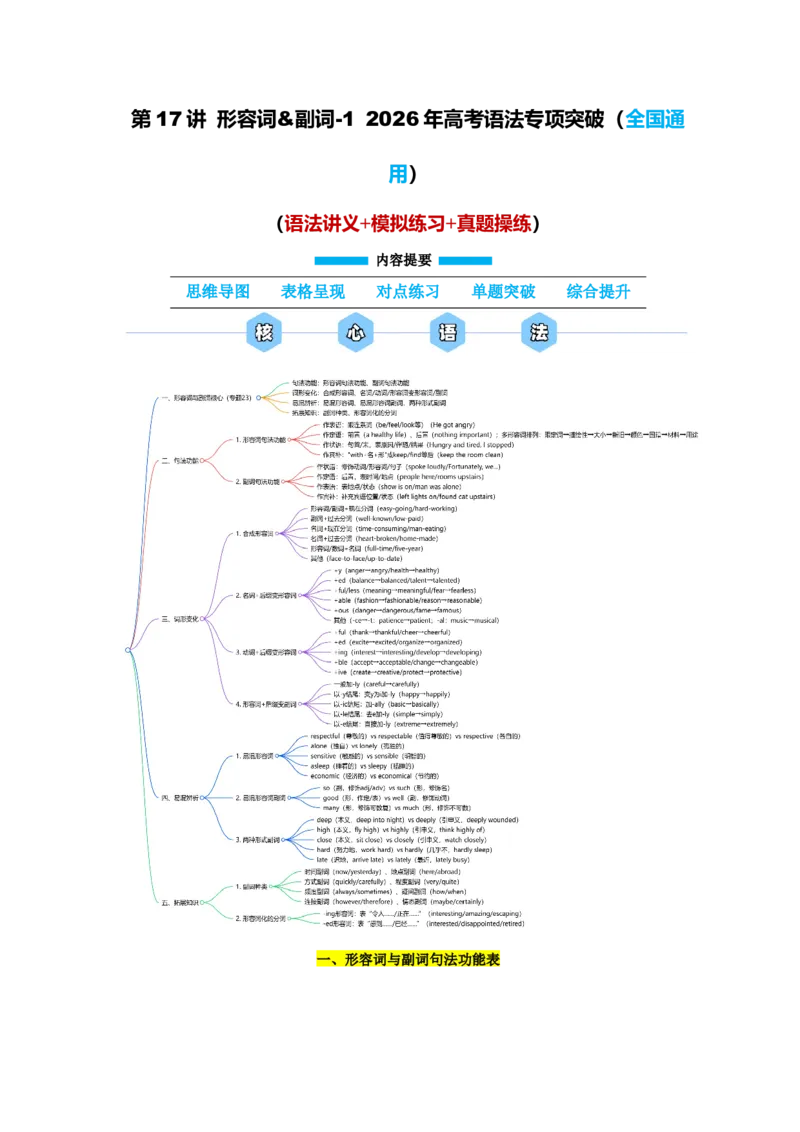
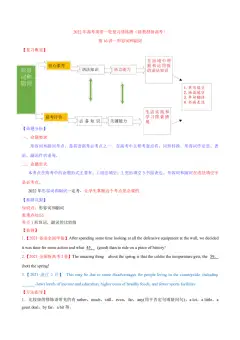
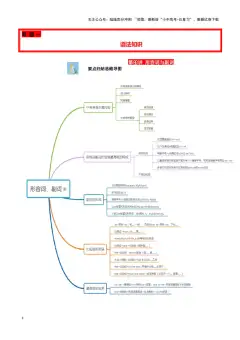
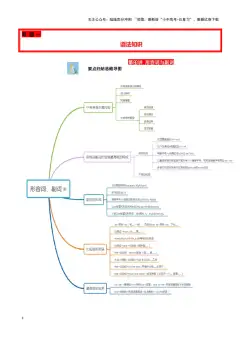
思维导图
表格呈现
对点练习
单题突破
综合提升
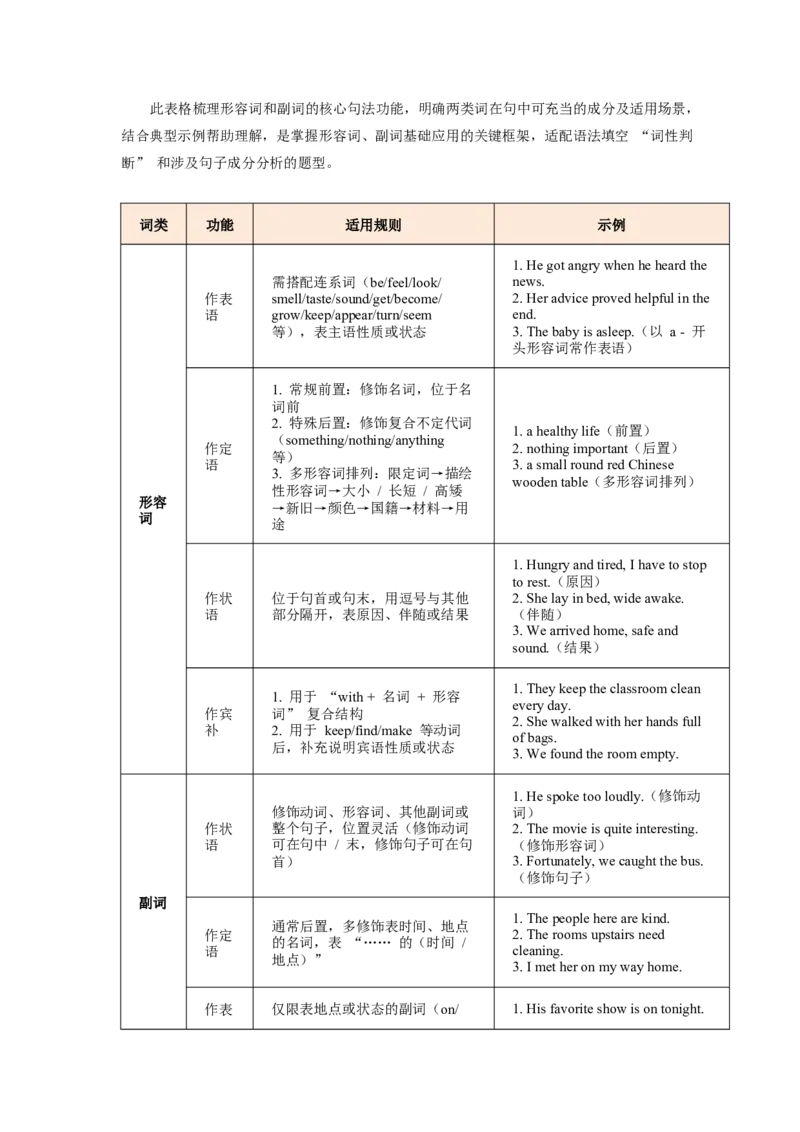
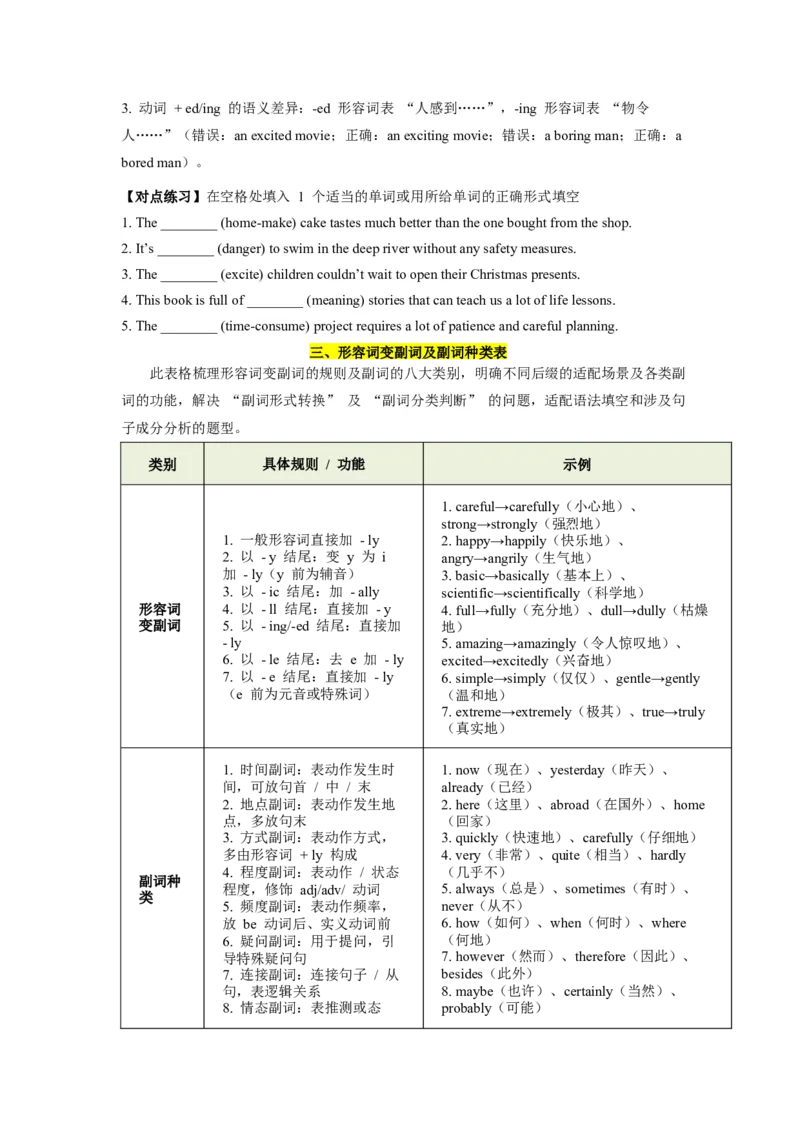
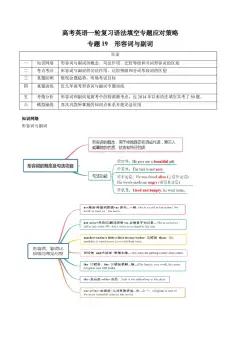
一、形容词与副词句法功能表
此表格梳理形容词和副词的核心句法功能,明确两类词在句中可充当的成分及适用场景,
结合典型示例帮助理解,是掌握形容词、副词基础应用的关键框架,适配语法填空 “词性判
断” 和涉及句子成分分析的题型。
词类
功能
适用规则
示例
形容
词
作表
语
需搭配连系词(be/feel/look/
smell/taste/sound/get/become/
grow/keep/appear/turn/seem
等),表主语性质或状态
1. He got angry when he heard the
news.
2. Her advice proved helpful in the
end.
3. The baby is asleep.(以 a - 开
头形容词常作表语)
作定
语
1. 常规前置:修饰名词,位于名
词前
2. 特殊后置:修饰复合不定代词
(something/nothing/anything
等)
3. 多形容词排列:限定词→描绘
性形容词→大小 / 长短 / 高矮
→新旧→颜色→国籍→材料→用
途
1. a healthy life(前置)
2. nothing important(后置)
3. a small round red Chinese
wooden table(多形容词排列)
作状
语
位于句首或句末,用逗号与其他
部分隔开,表原因、伴随或结果
1. Hungry and tired, I have to stop
to rest.(原因)
2. She lay in bed, wide awake.
(伴随)
3. We arrived home, safe and
sound.(结果)
作宾
补
1. 用于 “with + 名词 + 形容
词” 复合结构
2. 用于 keep/find/make 等动词
后,补充说明宾语性质或状态
1. They keep the classroom clean
every day.
2. She walked with her hands full
of bags.
3. We found the room empty.
副词
作状
语
修饰动词、形容词、其他副词或
整个句子,位置灵活(修饰动词
可在句中 / 末,修饰句子可在句
首)
1. He spoke too loudly.(修饰动
词)
2. The movie is quite interesting.
(修饰形容词)
3. Fortunately, we caught the bus.
(修饰句子)
作定
语
通常后置,多修饰表时间、地点
的名词,表 “…… 的(时间 /
地点)”
1. The people here are kind.
2. The rooms upstairs need
cleaning.
3. I met her on my way home.
作表
仅限表地点或状态的副词(on/
1. His favorite show is on tonight.
词类
功能
适用规则
示例
语
over/up/down/away/alone 等),
位于系动词后
2. The old man was alone at home.
3. The lights are off.
作宾
补
补充说明宾语的位置、状态或动
作趋向,使句意更完整
1. He left the lights on when he
left.
2. We found the cat upstairs in the
bedroom.
3. She asked him to put the books
away.
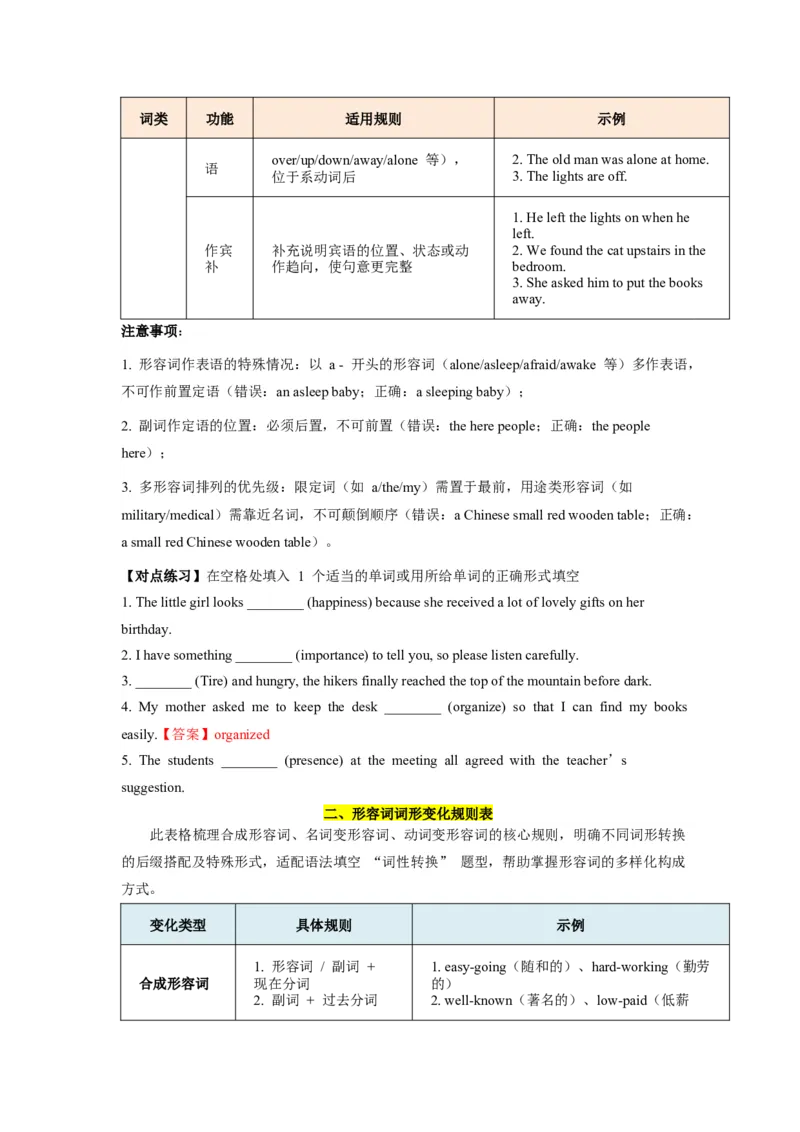
注意事项:
1. 形容词作表语的特殊情况:以 a - 开头的形容词(alone/asleep/afraid/awake 等)多作表语,
不可作前置定语(错误:an asleep baby;正确:a sleeping baby);
2. 副词作定语的位置:必须后置,不可前置(错误:the here people;正确:the people
here);
3. 多形容词排列的优先级:限定词(如 a/the/my)需置于最前,用途类形容词(如
military/medical)需靠近名词,不可颠倒顺序(错误:a Chinese small red wooden table;正确:
a small red Chinese wooden table)。
【对点练习】在空格处填入 1 个适当的单词或用所给单词的正确形式填空
1. The little girl looks ________ (happiness) because she received a lot of lovely gifts on her
birthday.
2. I have something ________ (importance) to tell you, so please listen carefully.
3. ________ (Tire) and hungry, the hikers finally reached the top of the mountain before dark.
4. My mother asked me to keep the desk ________ (organize) so that I can find my books
easily.【答案】organized
5. The students ________ (presence) at the meeting all agreed with the teacher’s
suggestion.
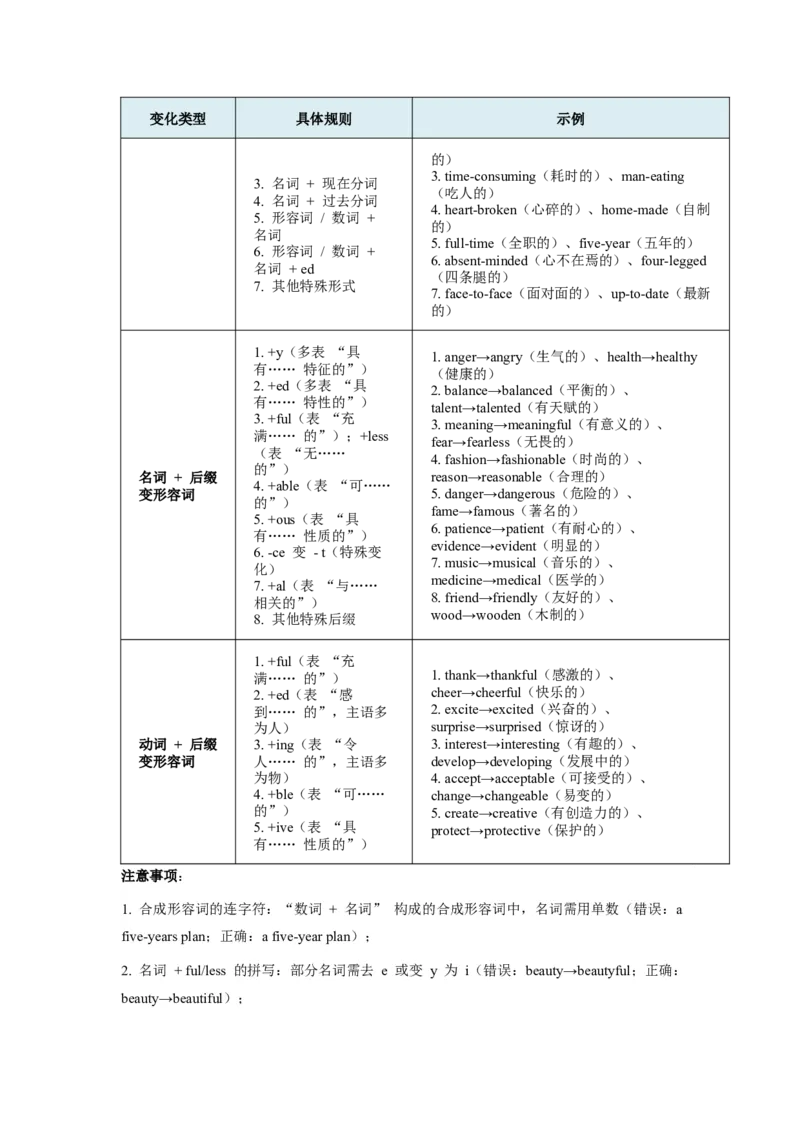
二、形容词词形变化规则表
此表格梳理合成形容词、名词变形容词、动词变形容词的核心规则,明确不同词形转换
的后缀搭配及特殊形式,适配语法填空 “词性转换” 题型,帮助掌握形容词的多样化构成
方式。
变化类型
具体规则
示例
合成形容词
1. 形容词 / 副词 +
现在分词
2. 副词 + 过去分词
1. easy-going(随和的)、hard-working(勤劳
的)
2. well-known(著名的)、low-paid(低薪
变化类型
具体规则
示例
3. 名词 + 现在分词
4. 名词 + 过去分词
5. 形容词 / 数词 +
名词
6. 形容词 / 数词 +
名词 + ed
7. 其他特殊形式
的)
3. time-consuming(耗时的)、man-eating
(吃人的)
4. heart-broken(心碎的)、home-made(自制
的)
5. full-time(全职的)、five-year(五年的)
6. absent-minded(心不在焉的)、four-legged
(四条腿的)
7. face-to-face(面对面的)、up-to-date(最新
的)
名词 + 后缀
变形容词
1. +y(多表 “具
有…… 特征的”)
2. +ed(多表 “具
有…… 特性的”)
3. +ful(表 “充
满…… 的”);+less
(表 “无……
的”)
4. +able(表 “可……
的”)
5. +ous(表 “具
有…… 性质的”)
6. -ce 变 - t(特殊变
化)
7. +al(表 “与……
相关的”)
8. 其他特殊后缀
1. anger→angry(生气的)、health→healthy
(健康的)
2. balance→balanced(平衡的)、
talent→talented(有天赋的)
3. meaning→meaningful(有意义的)、
fear→fearless(无畏的)
4. fashion→fashionable(时尚的)、
reason→reasonable(合理的)
5. danger→dangerous(危险的)、
fame→famous(著名的)
6. patience→patient(有耐心的)、
evidence→evident(明显的)
7. music→musical(音乐的)、
medicine→medical(医学的)
8. friend→friendly(友好的)、
wood→wooden(木制的)
动词 + 后缀
变形容词
1. +ful(表 “充
满…… 的”)
2. +ed(表 “感
到…… 的”,主语多
为人)
3. +ing(表 “令
人…… 的”,主语多
为物)
4. +ble(表 “可……
的”)
5. +ive(表 “具
有…… 性质的”)
1. thank→thankful(感激的)、
cheer→cheerful(快乐的)
2. excite→excited(兴奋的)、
surprise→surprised(惊讶的)
3. interest→interesting(有趣的)、
develop→developing(发展中的)
4. accept→acceptable(可接受的)、
change→changeable(易变的)
5. create→creative(有创造力的)、
protect→protective(保护的)
注意事项:
1. 合成形容词的连字符:“数词 + 名词” 构成的合成形容词中,名词需用单数(错误:a
five-years plan;正确:a five-year plan);
2. 名词 + ful/less 的拼写:部分名词需去 e 或变 y 为 i(错误:beauty→beautyful;正确:
beauty→beautiful);
3. 动词 + ed/ing 的语义差异:-ed 形容词表 “人感到……”,-ing 形容词表 “物令
人……”(错误:an excited movie;正确:an exciting movie;错误:a boring man;正确:a
bored man)。
【对点练习】在空格处填入 1 个适当的单词或用所给单词的正确形式填空
1. The ________ (home-make) cake tastes much better than the one bought from the shop.
2. It’s ________ (danger) to swim in the deep river without any safety measures.
3. The ________ (excite) children couldn’t wait to open their Christmas presents.
4. This book is full of ________ (meaning) stories that can teach us a lot of life lessons.
5. The ________ (time-consume) project requires a lot of patience and careful planning.
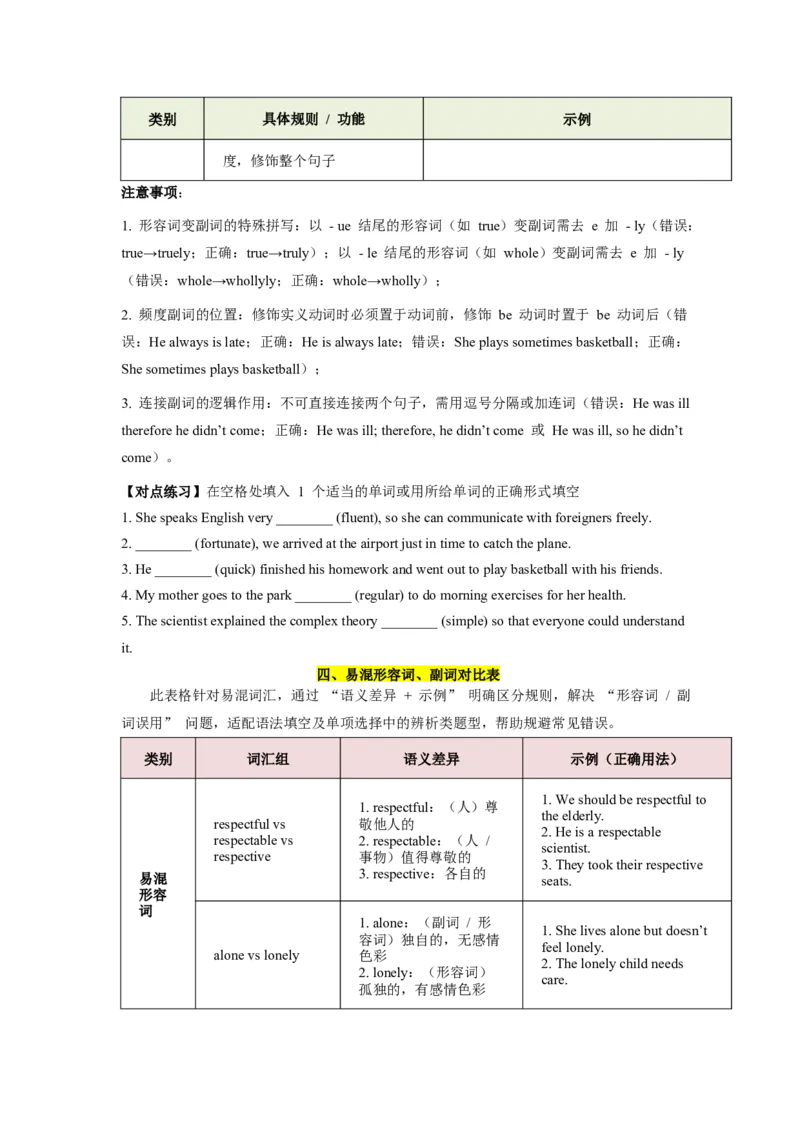
三、形容词变副词及副词种类表
此表格梳理形容词变副词的规则及副词的八大类别,明确不同后缀的适配场景及各类副
词的功能,解决 “副词形式转换” 及 “副词分类判断” 的问题,适配语法填空和涉及句
子成分分析的题型。
类别
具体规则 / 功能
示例
形容词
变副词
1. 一般形容词直接加 - ly
2. 以 - y 结尾:变 y 为 i
加 - ly(y 前为辅音)
3. 以 - ic 结尾:加 - ally
4. 以 - ll 结尾:直接加 - y
5. 以 - ing/-ed 结尾:直接加
- ly
6. 以 - le 结尾:去 e 加 - ly
7. 以 - e 结尾:直接加 - ly
(e 前为元音或特殊词)
1. careful→carefully(小心地)、
strong→strongly(强烈地)
2. happy→happily(快乐地)、
angry→angrily(生气地)
3. basic→basically(基本上)、
scientific→scientifically(科学地)
4. full→fully(充分地)、dull→dully(枯燥
地)
5. amazing→amazingly(令人惊叹地)、
excited→excitedly(兴奋地)
6. simple→simply(仅仅)、gentle→gently
(温和地)
7. extreme→extremely(极其)、true→truly
(真实地)
副词种
类
1. 时间副词:表动作发生时
间,可放句首 / 中 / 末
2. 地点副词:表动作发生地
点,多放句末
3. 方式副词:表动作方式,
多由形容词 + ly 构成
4. 程度副词:表动作 / 状态
程度,修饰 adj/adv/ 动词
5. 频度副词:表动作频率,
放 be 动词后、实义动词前
6. 疑问副词:用于提问,引
导特殊疑问句
7. 连接副词:连接句子 / 从
句,表逻辑关系
8. 情态副词:表推测或态
1. now(现在)、yesterday(昨天)、
already(已经)
2. here(这里)、abroad(在国外)、home
(回家)
3. quickly(快速地)、carefully(仔细地)
4. very(非常)、quite(相当)、hardly
(几乎不)
5. always(总是)、sometimes(有时)、
never(从不)
6. how(如何)、when(何时)、where
(何地)
7. however(然而)、therefore(因此)、
besides(此外)
8. maybe(也许)、certainly(当然)、
probably(可能)
类别
具体规则 / 功能
示例
度,修饰整个句子
注意事项:
1. 形容词变副词的特殊拼写:以 - ue 结尾的形容词(如 true)变副词需去 e 加 - ly(错误:
true→truely;正确:true→truly);以 - le 结尾的形容词(如 whole)变副词需去 e 加 - ly
(错误:whole→whollyly;正确:whole→wholly);
2. 频度副词的位置:修饰实义动词时必须置于动词前,修饰 be 动词时置于 be 动词后(错
误:He always is late;正确:He is always late;错误:She plays sometimes basketball;正确:
She sometimes plays basketball);
3. 连接副词的逻辑作用:不可直接连接两个句子,需用逗号分隔或加连词(错误:He was ill
therefore he didn’t come;正确:He was ill; therefore, he didn’t come 或 He was ill, so he didn’t
come)。
【对点练习】在空格处填入 1 个适当的单词或用所给单词的正确形式填空
1. She speaks English very ________ (fluent), so she can communicate with foreigners freely.
2. ________ (fortunate), we arrived at the airport just in time to catch the plane.
3. He ________ (quick) finished his homework and went out to play basketball with his friends.
4. My mother goes to the park ________ (regular) to do morning exercises for her health.
5. The scientist explained the complex theory ________ (simple) so that everyone could understand
it.
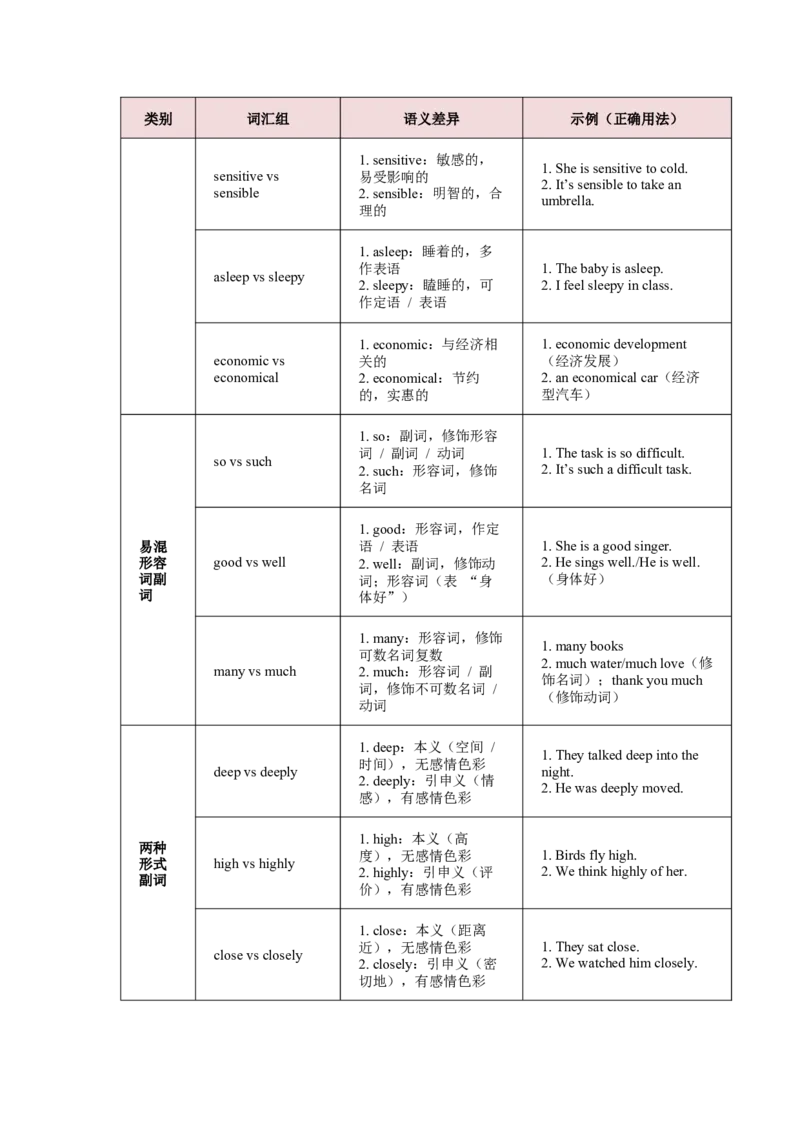
四、易混形容词、副词对比表
此表格针对易混词汇,通过 “语义差异 + 示例” 明确区分规则,解决 “形容词 / 副
词误用” 问题,适配语法填空及单项选择中的辨析类题型,帮助规避常见错误。
类别
词汇组
语义差异
示例(正确用法)
易混
形容
词
respectful vs
respectable vs
respective
1. respectful:(人)尊
敬他人的
2. respectable:(人 /
事物)值得尊敬的
3. respective:各自的
1. We should be respectful to
the elderly.
2. He is a respectable
scientist.
3. They took their respective
seats.
alone vs lonely
1. alone:(副词 / 形
容词)独自的,无感情
色彩
2. lonely:(形容词)
孤独的,有感情色彩
1. She lives alone but doesn’t
feel lonely.
2. The lonely child needs
care.
类别
词汇组
语义差异
示例(正确用法)
sensitive vs
sensible
1. sensitive:敏感的,
易受影响的
2. sensible:明智的,合
理的
1. She is sensitive to cold.
2. It’s sensible to take an
umbrella.
asleep vs sleepy
1. asleep:睡着的,多
作表语
2. sleepy:瞌睡的,可
作定语 / 表语
1. The baby is asleep.
2. I feel sleepy in class.
economic vs
economical
1. economic:与经济相
关的
2. economical:节约
的,实惠的
1. economic development
(经济发展)
2. an economical car(经济
型汽车)
易混
形容
词副
词
so vs such
1. so:副词,修饰形容
词 / 副词 / 动词
2. such:形容词,修饰
名词
1. The task is so difficult.
2. It’s such a difficult task.
good vs well
1. good:形容词,作定
语 / 表语
2. well:副词,修饰动
词;形容词(表 “身
体好”)
1. She is a good singer.
2. He sings well./He is well.
(身体好)
many vs much
1. many:形容词,修饰
可数名词复数
2. much:形容词 / 副
词,修饰不可数名词 /
动词
1. many books
2. much water/much love(修
饰名词);thank you much
(修饰动词)
两种
形式
副词
deep vs deeply
1. deep:本义(空间 /
时间),无感情色彩
2. deeply:引申义(情
感),有感情色彩
1. They talked deep into the
night.
2. He was deeply moved.
high vs highly
1. high:本义(高
度),无感情色彩
2. highly:引申义(评
价),有感情色彩
1. Birds fly high.
2. We think highly of her.
close vs closely
1. close:本义(距离
近),无感情色彩
2. closely:引申义(密
切地),有感情色彩
1. They sat close.
2. We watched him closely.
类别
词汇组
语义差异
示例(正确用法)
hard vs hardly
1. hard:努力地,猛烈
地
2. hardly:几乎不,表
否定
1. He works hard.
2. He hardly eats meat.
注意事项:
1. 易混形容词的语境适配:需结合语义判断情感色彩(如 alone 无感情,lonely 有负面情
感),不可随意替换;
2. so/such 的修饰对象:so 后接形容词 / 副词(so fast),such 后接名词(such a fast
car),不可混淆(错误:such fast;正确:so fast);
3. 两种形式副词的语义边界:本义副词(deep/high)多与具体场景相关,引申义副词
(deeply/highly)多与抽象情感或评价相关,需结合语境区分。
【对点练习】在空格处填入 1 个适当的单词或用所给单词的正确形式填空
1. We should be ________ (respect) to our parents and teachers who have given us a lot of care.
2. The old man lives alone in the small village, but he never feels ________ (alone) because of the
friendly neighbors.
3. It’s ________ (sense) of you to bring an umbrella on such a rainy day.
4. She works very hard every day, but she ________ (hard) has any time to relax.
5. The movie was so ________ (interest) that all the audience were deeply ________ (interest) in it.
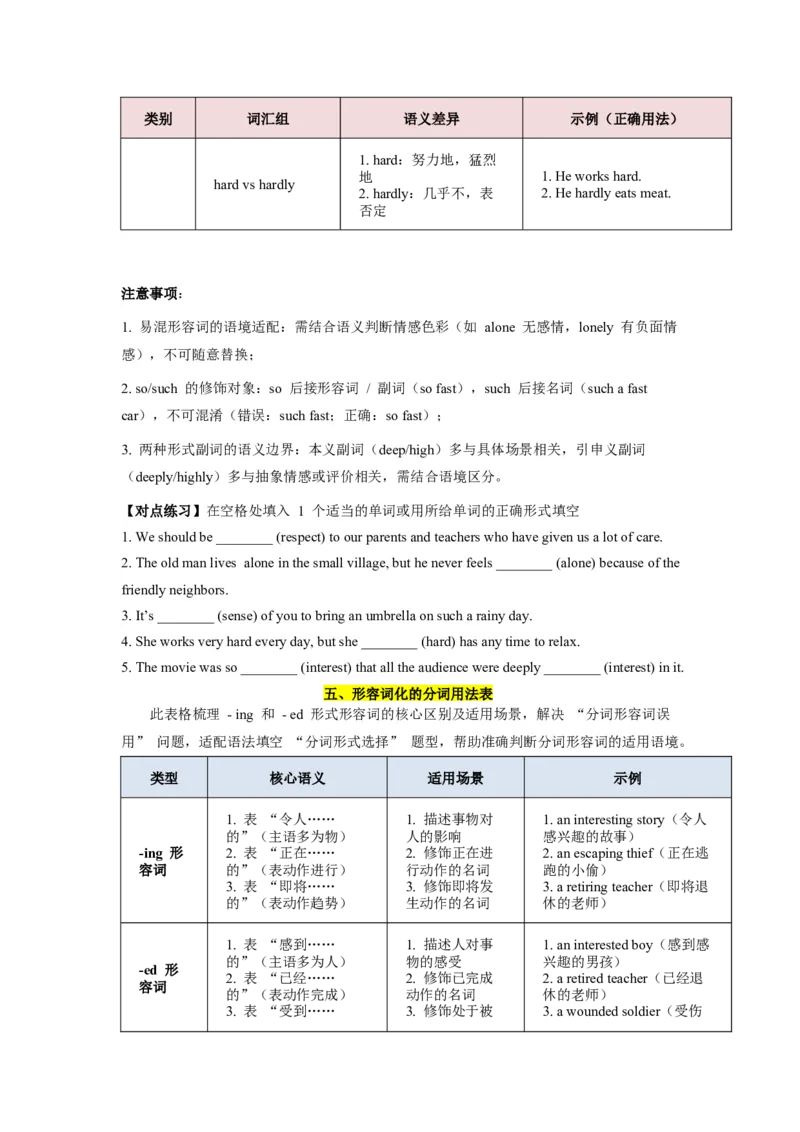
五、形容词化的分词用法表
此表格梳理 - ing 和 - ed 形式形容词的核心区别及适用场景,解决 “分词形容词误
用” 问题,适配语法填空 “分词形式选择” 题型,帮助准确判断分词形容词的适用语境。
类型
核心语义
适用场景
示例
-ing 形
容词
1. 表 “令人……
的”(主语多为物)
2. 表 “正在……
的”(表动作进行)
3. 表 “即将……
的”(表动作趋势)
1. 描述事物对
人的影响
2. 修饰正在进
行动作的名词
3. 修饰即将发
生动作的名词
1. an interesting story(令人
感兴趣的故事)
2. an escaping thief(正在逃
跑的小偷)
3. a retiring teacher(即将退
休的老师)
-ed 形
容词
1. 表 “感到……
的”(主语多为人)
2. 表 “已经……
的”(表动作完成)
3. 表 “受到……
1. 描述人对事
物的感受
2. 修饰已完成
动作的名词
3. 修饰处于被
1. an interested boy(感到感
兴趣的男孩)
2. a retired teacher(已经退
休的老师)
3. a wounded soldier(受伤
类型
核心语义
适用场景
示例
的”(表被动状态)
动状态的名词
的士兵)
注意事项:
1. 主语与人 / 物的匹配:-ing 形容词主语多为物,-ed 形容词主语多为人(错误:a bored
movie;正确:a boring movie;错误:an exciting man;正确:an excited man);
2. 特殊 - ed 形容词的语义:部分 - ed 形容词(如 broken/damaged)可修饰物,表 “处于
被动状态”(如 a broken cup),需结合语义判断;
3. 避免重复冗余:“too+ing 形容词” 表 “过于……”(如 too boring 表 “太无聊”),
不可与 “very” 混淆语义,需根据语境选择合适修饰词。
【对点练习】在空格处填入 1 个适当的单词或用所给单词的正确形式填空
1. The ________ (break) window was broken by a naughty boy who was playing football nearby.
2. The ________ (surprise) news made all of us jump with joy.
3. We saw a ________ (run) man rushing into the building with a bag in his hand.
4. The ________ (retire) teacher still often comes back to school to see the students she used to
teach.
5. The ________ (disappoint) result made the players feel very ________ (disappoint).
一、语法填空:用所给单词的正确形式填空
1.(2025·河北衡水·三模)These machines are designed to perform very          (predict)
activities.
2.(2022·河北衡水·模拟预测)Critics say these programmes are       (base) bad television,
but people watch them.
3.(2025·广东·二模)After a          (poet) and fascinating experience, they emerged from
the forest, and found themselves greeted by the familiar city lights that twinkled in the distance.
4.(2025·广东·二模)Local authorities have taken a series of measures to strengthen the
systematic protection of Li brocade (织锦缎) and the development of Li brocade, which is so

(benefit) to the survival of the traditional skills.
5.(2021·陕西西安·模拟预测)         (expect) as she had appeared, not one of them felt that
she was an intruder at all.
6.(2025·河北衡水·二模)The new park is designed to be            (access) to people with
disabilities.
7.(2021·陕西西安·模拟预测)She is still           (finance) dependent on her parents.
8.(2025·江苏盐城·二模)That was a        (degrade) experience for her.
9.(2025·河北衡水·二模)Every student should learn to solve problems            (creative)
by thinking outside the box.
10.(2025·江苏盐城·二模)Her        (infect) laughter filled the room and made everyone feel
happy.
11.(2025·江苏盐城·模拟预测)Research into the brilliant blue wings of a species of butterfly
has led to       (innovate) technologies since scientists uncovered the secret behind their bright
colour.
12.(2025·广东·二模)Therefore, I can study          (energetic) every morning, which makes
me study efficiently.
13.(2025·广东·二模)         (evident), the cashier amazes me with his inspiration and desire
to start with smaller, easily achievable goals.
14.(2021·广东江门·三模)English and German are         (close) related.
15.(2025·河北衡水·三模)The task was          (apparent) more difficult than we had
initially imagined.
Passage 1
(2025·全国一卷·高考真题)阅读下面短文, 在空白处填入1 个适当的单词或括号内单词的正
确形式。
An exhibition at the Jiushi Art Museum in Shanghai is featuring artwork inspired by Go, or
weiqi in Chinese,     1          originated in China more than 4,000 years ago.
Go is one of     2          earliest binary-based (基于二元的) games. The movements of
the black and white pieces reflect the basic ideas of Eastern philosophy, according to Tu Ningning,
who is in charge of the exhibition.
“The exhibition brings together Go culture, cutting-edge technology and contemporary art,”
says Tu. “We hope     3          (present)the rather abstract Go game and AI in a visual context,
and initiate dialogues with minimalist art, conceptual art and expressionism.”
“In a Go game, each move should serve a long-term goal. You try to lead the opponent into
your trap and force them to follow your ‘    4          (guide)’ till they lose,” explains Wang
Wei, a Go player among the visitors to the exhibition.
“The players’ personalities     5          (reveal) during the game, and one’s weaknesses
are exposed to the opponent,” she adds. “A decent winner always     6          (try) to beat the
opponent     7          no more than one or two points as a gesture (姿态) of respect for the
other side. ”
Tu says that the balance between the black and white pieces, the beauty in the     8

(strategy) placement of the pieces,     9          the energy flow following each move inspired
artists to create oil paintings, sculptures,     10          (digital) generated pictures and silk-
screen prints for the exhibition.
Passage 2
(2023·浙江·高考真题)阅读下面短文,在空白处填入1 个适当的单词或括号内单词的正确形
式。
During China’s dynastic period, emperors planned the city of Beijing
   1

arranged the residential areas according to social classes. The term “hutong”,
   2

(original)meaning “water well” in Mongolian, appeared first during the Yuan Dynasty.
In the Ming Dynasty, the center was the Forbidden City,     3          (surround)in
concentric(同心的)circles by the Inner City and Outer City. Citizens of higher social classes     4
(permit)to live closer to the center of the circles. The large siheyuan of these high-ranking officials
and wealthy businessmen often     5          (feature)beautifully carved and painted roof beams
and pillars(柱子). The hutongs they formed were orderly, lined by     6          (space)homes
and walled gardens. Farther from the center lived the commoners and laborers. Their siheyuan were
far smaller in scale and     7          (simple)in design and decoration, and the hutongs were
narrower.
Hutongs represent an important cultural element of the city of Beijing. Thanks to Beijing’s
long history     8          capital of China, almost every hutong has its stories, and some are
even associated with historic     9          (event). In contrast to the court life and upper-class
culture represented by the Forbidden City, the Summer Palace, and the Temple of Heaven, the
hutongs reflect      10           culture of grassroots Beijingers.
Passage 3
(2025·浙江宁波·一模)阅读下面短文,在空白处填入1 个适当的单词或括号内单词的正确形
式。
With profits jumping to nearly 1.3 billion yuan at the box office as of Aug 26, the ink-wash
animated film Nobody has broken    1         previous record set by Big Fish &
Begonia (2016), making it the highest-earning domestic 2D animated film in Chinese cinema
history.
The film follows four small monsters — a pig, a toad, a weasel, and an ape — who disguise
2          characters from Journey to the West, seeking to live forever before finding themselves
protecting villagers from evil     3          (force).
     4          (create) the film’s unique Chinese animation style, Yu Shui, director of the
film, and his team conducted field research from northern to southern Shanxi, bringing the beauty of
the     5          (province) ancient architecture onto the silver screen.
“During production, integrating a large number of Shanxi landmarks and elements of ancient
architecture into the film     6          (drive) primarily by the needs of the plot, as these
fantastic structures could enhance the film.     7          (additional), it’s because I am from
Taiyuan and have a deep emotional connection to these ancient buildings,” Yu said.
At the recently     8          (conclude) 7th Shanxi Cultural Industries Fair, Yu invited
moviegoers to visit the province     9          inspired its ancient architectural scenes. The
director’s invitation highlights a dynamic phenomenon in the country’s creative industries — using
advanced technology to revive cultural heritage not within the museums but through engaging and
10           (access) mediums, such as games and films.
Passage 4
(2025·广东肇庆·一模)阅读下面短文,在空白处填入1 个适当的单词或括号内单词的正确形
式。
The Giant Maiji Mountain in Tianshui, Gansu Province, is home to many ancient Buddhist
caves, collectively     1          (call) the Maijishan Grottoes (石窟).
    2          part of the World Heritage “Silk Roads: the Routes Network of Chang’ an-
Tianshan Corridor” site, Maijishan Grottoes have 221 caves, 161 of which still house Buddhist
statues or murals. The cave temple complex     3          (know) as a gallery of Eastern statues,
due to its particularly complete chronological sequence of statues, built from the Sixteen Kingdoms
period to the Qing Dynasty.
However, time has taken its toll on this old site, and heritage protectors have explored     4
(vary) ways to protect it. Over the past eight decades, from establishing files and consolidating ( 巩
固) dangerous rocks to the successful     5          (apply) for World Heritage status,
generations of heritage protectors have contributed great efforts to its protection. Mu Changyou is
one of the many professionals     6          protect the Maijishan Grottoes.
In 1985, Mu received     7          opportunity to work on the mountain where he had
grown up, becoming a restorer of the cultural relics in the caves. From an apprentice (学徒) cleaning
caves and organizing tools to a master     8          (train) students, Mu has devoted four
decades of his life to accompanying and extending the lives of his old friends.
“Technology is becoming     9          (increasing) advanced, making our protective
endeavors more precise. We want to do our best     10          (extend) the life of this cultural
heritage,” said Mu.
Passage 5
(2025·浙江湖州·一模)阅读下面短文,在空白处填入1 个适当的单词或括号内单词的正确形
式。
In Yangzhou, a city in Jiangsu Province, young people are rushing to a local traditional
Chinese medicine (TCM) hospital, not for medical care, but for bread. Since early April, the hospital
1          (gain) local fame for its special series of breads containing Chinese medicinal herbs.
The herbal bread series,     2          (develop) by the Preventive Treatment Center of
the hospital, combines culinary (烹饪的) innovation with wellness culture     3          has
attracted health-conscious youth as well as food enthusiasts. “The idea came from observing the
growing demand among young people for healthier lifestyles and foods     4          can
address health problems,” said Chen Wei, deputy director of the center.
“TCM dietary therapy is a vital part of preventive healthcare. By making ancient wisdom     5
(access) and delicious, we hope to encourage younger generations to embrace holistic wellness.
These breads follow the rising trend of wellness-focused diets,     6          (particular) for
those experiencing issues like tiredness or weak immunity. They are in line     7          TCM’s
philosophy of ‘preventive treatment’—solving health problems before they appear,” Chen explained.
    8          (perfect) the recipes, the team experimented with different methods, such as
boiling herbs into liquid blends for dough. After months of trials, six     9          (variety) of
bread were launched, priced at about 10 yuan a piece. At first, sales     10          (limit) to a
short period each afternoon. However, the subtle herbal aroma and unique flavors quickly won praise
from customers. The bread often sold out within minutes.
Passage 6
(2025·江西·模拟预测)阅读下面短文,在空白处填入1 个适当的单词或括号内单词的正确形
式。
Each human body is home to trillions (万亿) of microbes,    1         combined cells may
outnumber human cells. There’s no question    2         these microbiomes (微生物组) shape
our health. But how, exactly, do they do it?
It’s a question that    3         (interest) Sloan Devlin when she was a young researcher
fresh out of a PhD program in organic chemistry. In the early 2010s, Devlin had seen many studies
and headlines    4         (link) the microbiome with a whole series of diseases. But research
explaining why those links existed seemed    5         (increasing) rare. That knowledge gap
didn’t scare the young scientist; instead, she said, it “seemed like a breath of fresh air.” She’d been
searching for a way to put her chemistry knowledge to use    6         (solve) big, unanswered
questions in biology.
More than a decade later, she admitted that the thought was too simple. “There are huge    7
(challenge) that come with entering a field that is so    8         (complicate),” wrote Devlin,
now an associate professor at Harvard Medical School. How do we begin to study hundreds of
species of bacteria    9         (associate) with human, looking for correlations that might be
used to determine the causes of disease. It’s still an open question.
But as more chemists like Devlin enter the field, they have helped to push microbiome
research into a new stage. What they’ re discovering will be key     10          developing
treatments that target the microbiome to improve health.