第11 讲 现在分词2026 年高考英语语法专项突破(全国通用)
(语法讲义+模拟练习+真题操练)
 内容提要
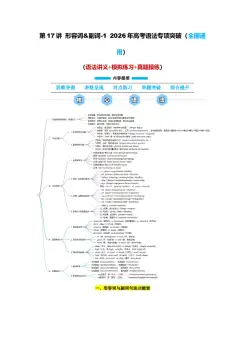
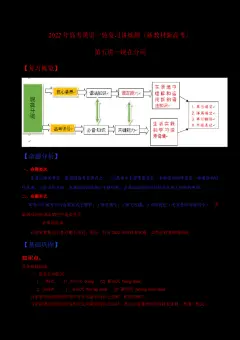
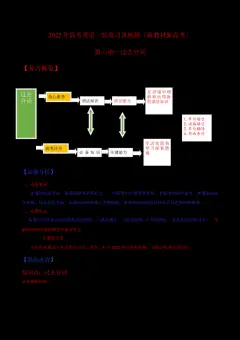
思维导图
表格呈现
对点练习
单题突破
综合提升
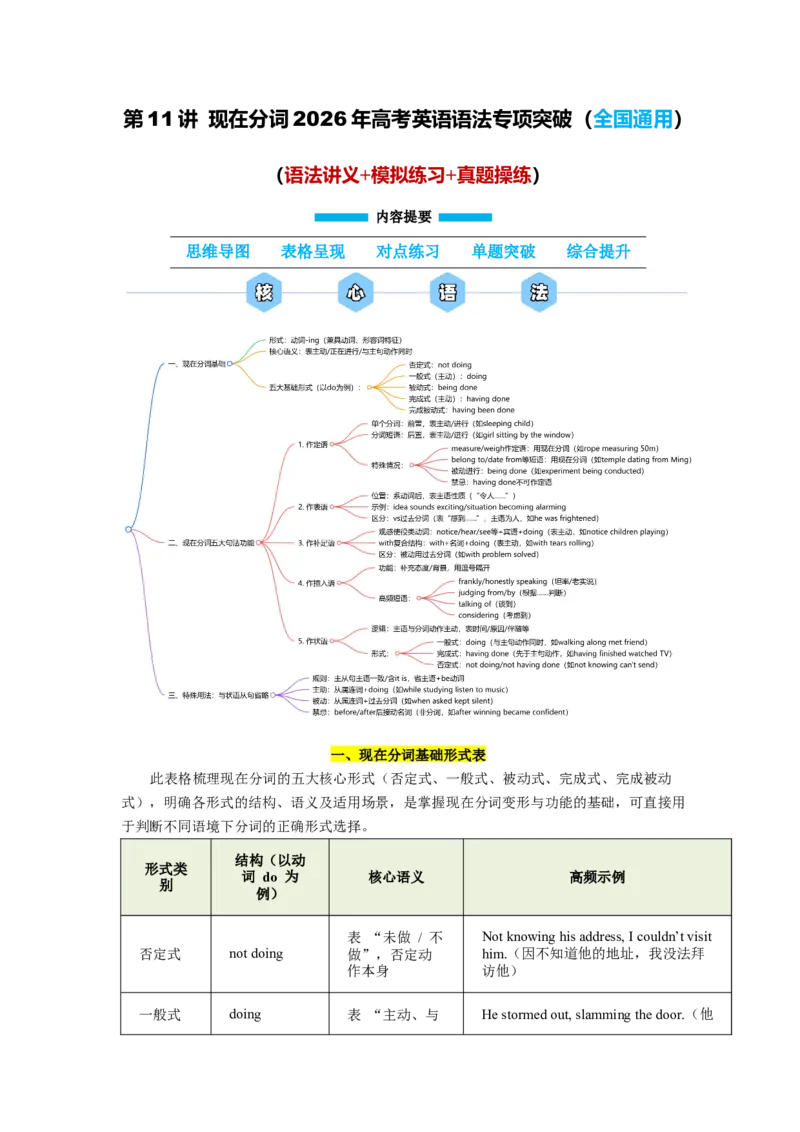
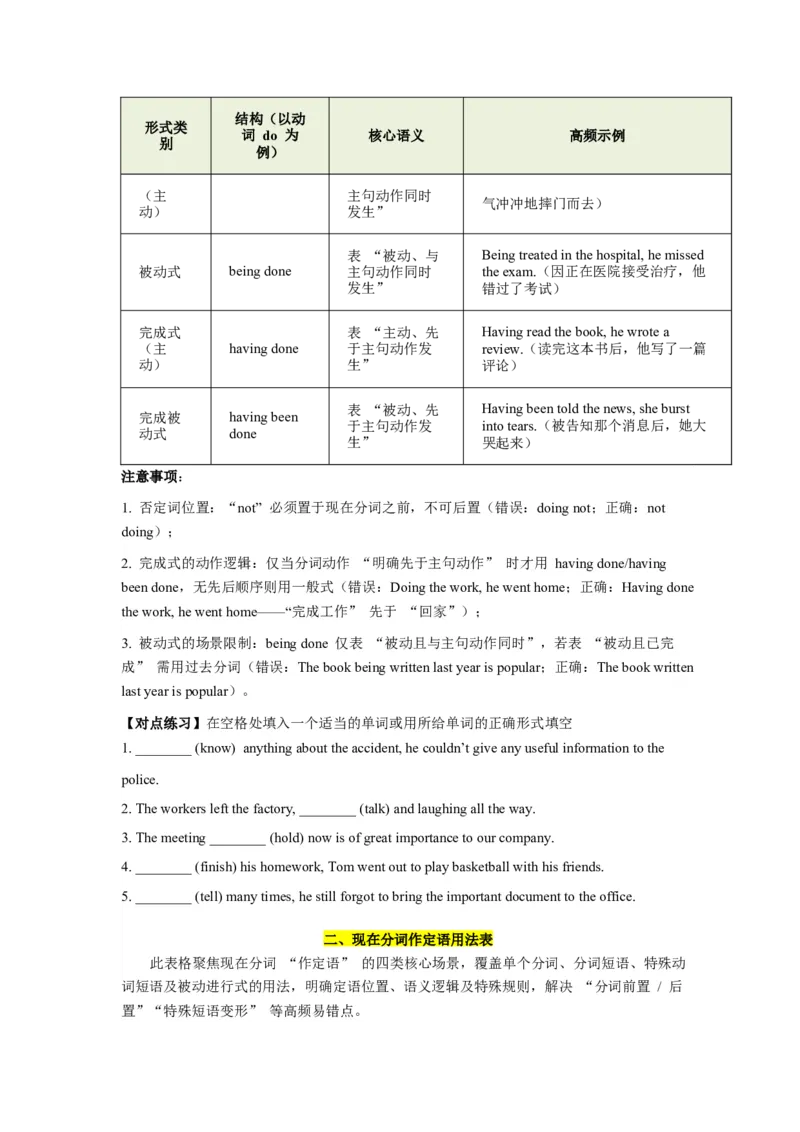
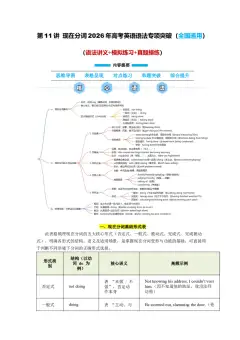
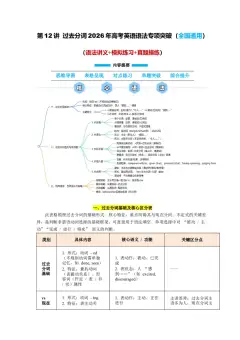
一、现在分词基础形式表
此表格梳理现在分词的五大核心形式(否定式、一般式、被动式、完成式、完成被动
式),明确各形式的结构、语义及适用场景,是掌握现在分词变形与功能的基础,可直接用
于判断不同语境下分词的正确形式选择。
形式类
别
结构(以动
词 do 为
例)
核心语义
高频示例
否定式
not doing
表 “未做 / 不
做”,否定动
作本身
Not knowing his address, I couldn’t visit
him.(因不知道他的地址,我没法拜
访他)
一般式
doing
表 “主动、与
He stormed out, slamming the door.(他
形式类
别
结构(以动
词 do 为
例)
核心语义
高频示例
(主
动)
主句动作同时
发生”
气冲冲地摔门而去)
被动式
being done
表 “被动、与
主句动作同时
发生”
Being treated in the hospital, he missed
the exam.(因正在医院接受治疗,他
错过了考试)
完成式
(主
动)
having done
表 “主动、先
于主句动作发
生”
Having read the book, he wrote a
review.(读完这本书后,他写了一篇
评论)
完成被
动式
having been
done
表 “被动、先
于主句动作发
生”
Having been told the news, she burst
into tears.(被告知那个消息后,她大
哭起来)
注意事项:
1. 否定词位置:“not” 必须置于现在分词之前,不可后置(错误:doing not;正确:not
doing);
2. 完成式的动作逻辑:仅当分词动作 “明确先于主句动作” 时才用 having done/having
been done,无先后顺序则用一般式(错误:Doing the work, he went home;正确:Having done
the work, he went home——“完成工作” 先于 “回家”);
3. 被动式的场景限制:being done 仅表 “被动且与主句动作同时”,若表 “被动且已完
成” 需用过去分词(错误:The book being written last year is popular;正确:The book written
last year is popular)。
【对点练习】在空格处填入一个适当的单词或用所给单词的正确形式填空
1. ________ (know) anything about the accident, he couldn’t give any useful information to the
police.
2. The workers left the factory, ________ (talk) and laughing all the way.
3. The meeting ________ (hold) now is of great importance to our company.
4. ________ (finish) his homework, Tom went out to play basketball with his friends.
5. ________ (tell) many times, he still forgot to bring the important document to the office.
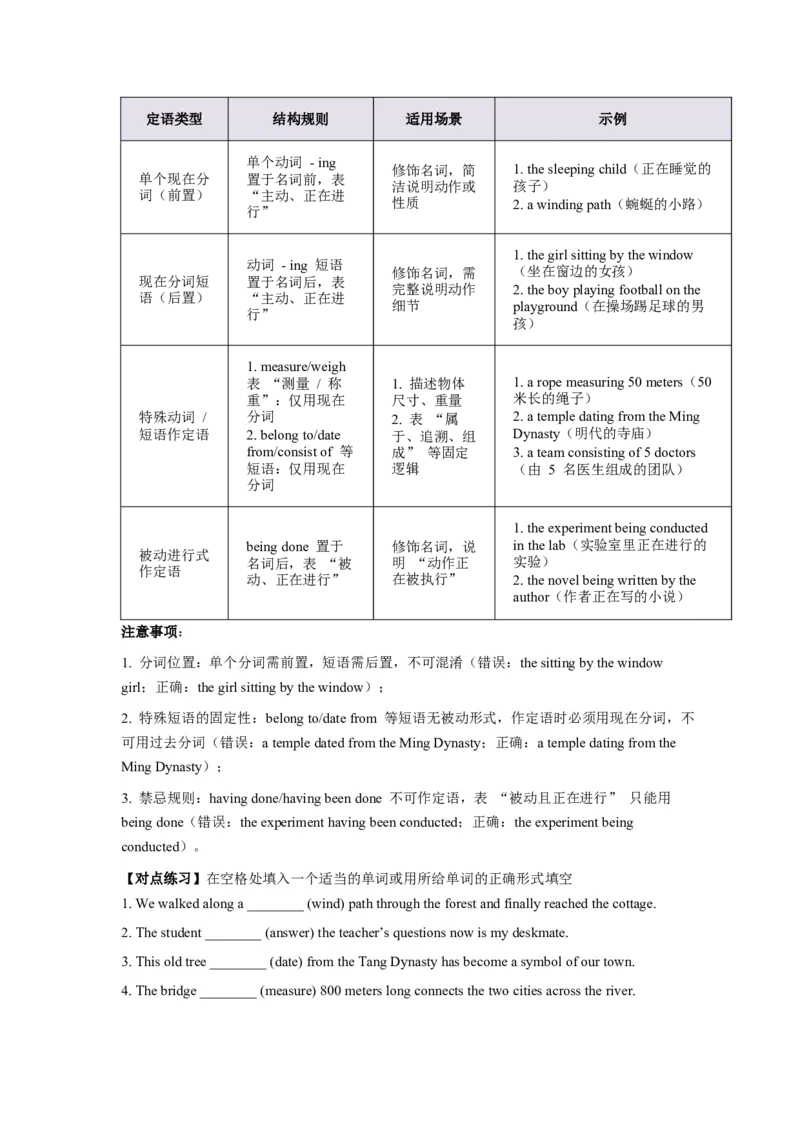
二、现在分词作定语用法表
此表格聚焦现在分词 “作定语” 的四类核心场景,覆盖单个分词、分词短语、特殊动
词短语及被动进行式的用法,明确定语位置、语义逻辑及特殊规则,解决 “分词前置 / 后
置”“特殊短语变形” 等高频易错点。
定语类型
结构规则
适用场景
示例
单个现在分
词(前置)
单个动词 - ing
置于名词前,表
“主动、正在进
行”
修饰名词,简
洁说明动作或
性质
1. the sleeping child(正在睡觉的
孩子)
2. a winding path(蜿蜒的小路)
现在分词短
语(后置)
动词 - ing 短语
置于名词后,表
“主动、正在进
行”
修饰名词,需
完整说明动作
细节
1. the girl sitting by the window
(坐在窗边的女孩)
2. the boy playing football on the
playground(在操场踢足球的男
孩)
特殊动词 /
短语作定语
1. measure/weigh
表 “测量 / 称
重”:仅用现在
分词
2. belong to/date
from/consist of 等
短语:仅用现在
分词
1. 描述物体
尺寸、重量
2. 表 “属
于、追溯、组
成” 等固定
逻辑
1. a rope measuring 50 meters(50
米长的绳子)
2. a temple dating from the Ming
Dynasty(明代的寺庙)
3. a team consisting of 5 doctors
(由 5 名医生组成的团队)
被动进行式
作定语
being done 置于
名词后,表 “被
动、正在进行”
修饰名词,说
明 “动作正
在被执行”
1. the experiment being conducted
in the lab(实验室里正在进行的
实验)
2. the novel being written by the
author(作者正在写的小说)
注意事项:
1. 分词位置:单个分词需前置,短语需后置,不可混淆(错误:the sitting by the window
girl;正确:the girl sitting by the window);
2. 特殊短语的固定性:belong to/date from 等短语无被动形式,作定语时必须用现在分词,不
可用过去分词(错误:a temple dated from the Ming Dynasty;正确:a temple dating from the
Ming Dynasty);
3. 禁忌规则:having done/having been done 不可作定语,表 “被动且正在进行” 只能用
being done(错误:the experiment having been conducted;正确:the experiment being
conducted)。
【对点练习】在空格处填入一个适当的单词或用所给单词的正确形式填空
1. We walked along a ________ (wind) path through the forest and finally reached the cottage.
2. The student ________ (answer) the teacher’s questions now is my deskmate.
3. This old tree ________ (date) from the Tang Dynasty has become a symbol of our town.
4. The bridge ________ (measure) 800 meters long connects the two cities across the river.
5. The project ________ (conduct) by the research team now will help solve the environmental
problem.
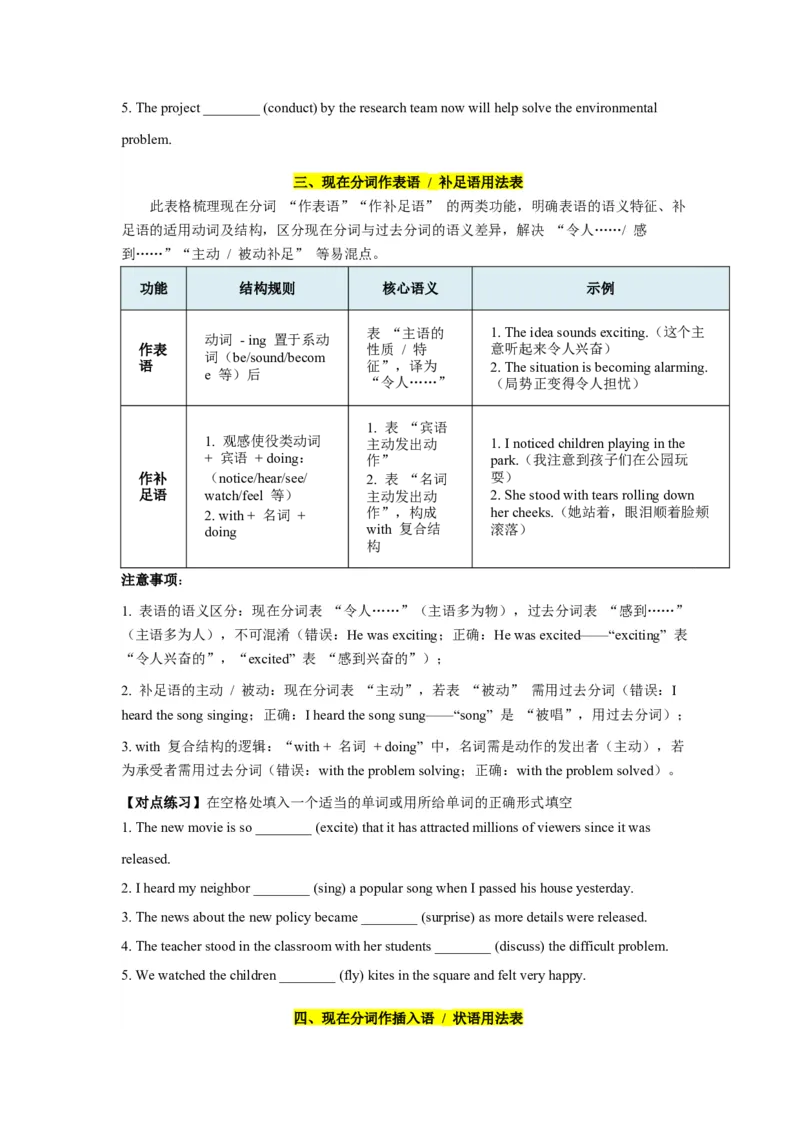
三、现在分词作表语 / 补足语用法表
此表格梳理现在分词 “作表语”“作补足语” 的两类功能,明确表语的语义特征、补
足语的适用动词及结构,区分现在分词与过去分词的语义差异,解决 “令人……/ 感
到……”“主动 / 被动补足” 等易混点。
功能
结构规则
核心语义
示例
作表
语
动词 - ing 置于系动
词(be/sound/becom
e 等)后
表 “主语的
性质 / 特
征”,译为
“令人……”
1. The idea sounds exciting.(这个主
意听起来令人兴奋)
2. The situation is becoming alarming.
(局势正变得令人担忧)
作补
足语
1. 观感使役类动词
+ 宾语 + doing:
(notice/hear/see/
watch/feel 等)
2. with + 名词 +
doing
1. 表 “宾语
主动发出动
作”
2. 表 “名词
主动发出动
作”,构成
with 复合结
构
1. I noticed children playing in the
park.(我注意到孩子们在公园玩
耍)
2. She stood with tears rolling down
her cheeks.(她站着,眼泪顺着脸颊
滚落)
注意事项:
1. 表语的语义区分:现在分词表 “令人……”(主语多为物),过去分词表 “感到……”
(主语多为人),不可混淆(错误:He was exciting;正确:He was excited——“exciting” 表
“令人兴奋的”,“excited” 表 “感到兴奋的”);
2. 补足语的主动 / 被动:现在分词表 “主动”,若表 “被动” 需用过去分词(错误:I
heard the song singing;正确:I heard the song sung——“song” 是 “被唱”,用过去分词);
3. with 复合结构的逻辑:“with + 名词 + doing” 中,名词需是动作的发出者(主动),若
为承受者需用过去分词(错误:with the problem solving;正确:with the problem solved)。
【对点练习】在空格处填入一个适当的单词或用所给单词的正确形式填空
1. The new movie is so ________ (excite) that it has attracted millions of viewers since it was
released.
2. I heard my neighbor ________ (sing) a popular song when I passed his house yesterday.
3. The news about the new policy became ________ (surprise) as more details were released.
4. The teacher stood in the classroom with her students ________ (discuss) the difficult problem.
5. We watched the children ________ (fly) kites in the square and felt very happy.
四、现在分词作插入语 / 状语用法表
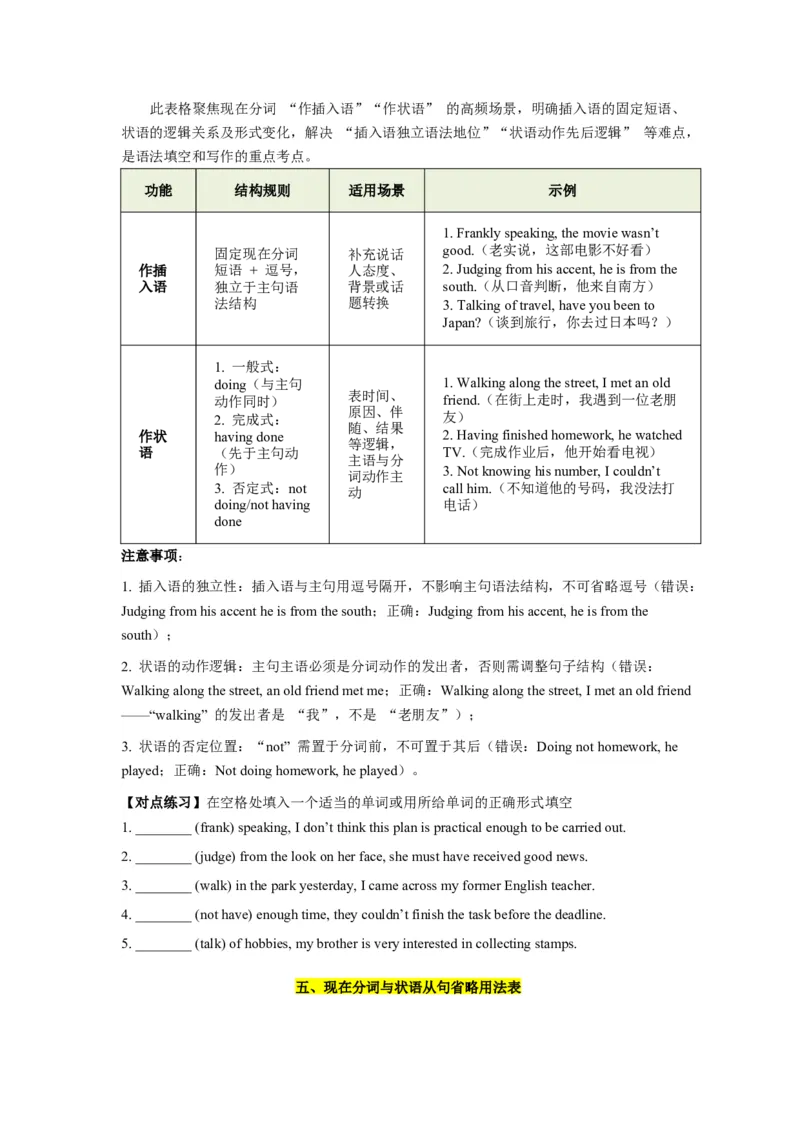
此表格聚焦现在分词 “作插入语”“作状语” 的高频场景,明确插入语的固定短语、
状语的逻辑关系及形式变化,解决 “插入语独立语法地位”“状语动作先后逻辑” 等难点,
是语法填空和写作的重点考点。
功能
结构规则
适用场景
示例
作插
入语
固定现在分词
短语 + 逗号,
独立于主句语
法结构
补充说话
人态度、
背景或话
题转换
1. Frankly speaking, the movie wasn’t
good.(老实说,这部电影不好看)
2. Judging from his accent, he is from the
south.(从口音判断,他来自南方)
3. Talking of travel, have you been to
Japan?(谈到旅行,你去过日本吗?)
作状
语
1. 一般式:
doing(与主句
动作同时)
2. 完成式:
having done
(先于主句动
作)
3. 否定式:not
doing/not having
done
表时间、
原因、伴
随、结果
等逻辑,
主语与分
词动作主
动
1. Walking along the street, I met an old
friend.(在街上走时,我遇到一位老朋
友)
2. Having finished homework, he watched
TV.(完成作业后,他开始看电视)
3. Not knowing his number, I couldn’t
call him.(不知道他的号码,我没法打
电话)
注意事项:
1. 插入语的独立性:插入语与主句用逗号隔开,不影响主句语法结构,不可省略逗号(错误:
Judging from his accent he is from the south;正确:Judging from his accent, he is from the
south);
2. 状语的动作逻辑:主句主语必须是分词动作的发出者,否则需调整句子结构(错误:
Walking along the street, an old friend met me;正确:Walking along the street, I met an old friend
——“walking” 的发出者是 “我”,不是 “老朋友”);
3. 状语的否定位置:“not” 需置于分词前,不可置于其后(错误:Doing not homework, he
played;正确:Not doing homework, he played)。
【对点练习】在空格处填入一个适当的单词或用所给单词的正确形式填空
1. ________ (frank) speaking, I don’t think this plan is practical enough to be carried out.
2. ________ (judge) from the look on her face, she must have received good news.
3. ________ (walk) in the park yesterday, I came across my former English teacher.
4. ________ (not have) enough time, they couldn’t finish the task before the deadline.
5. ________ (talk) of hobbies, my brother is very interested in collecting stamps.
五、现在分词与状语从句省略用法表
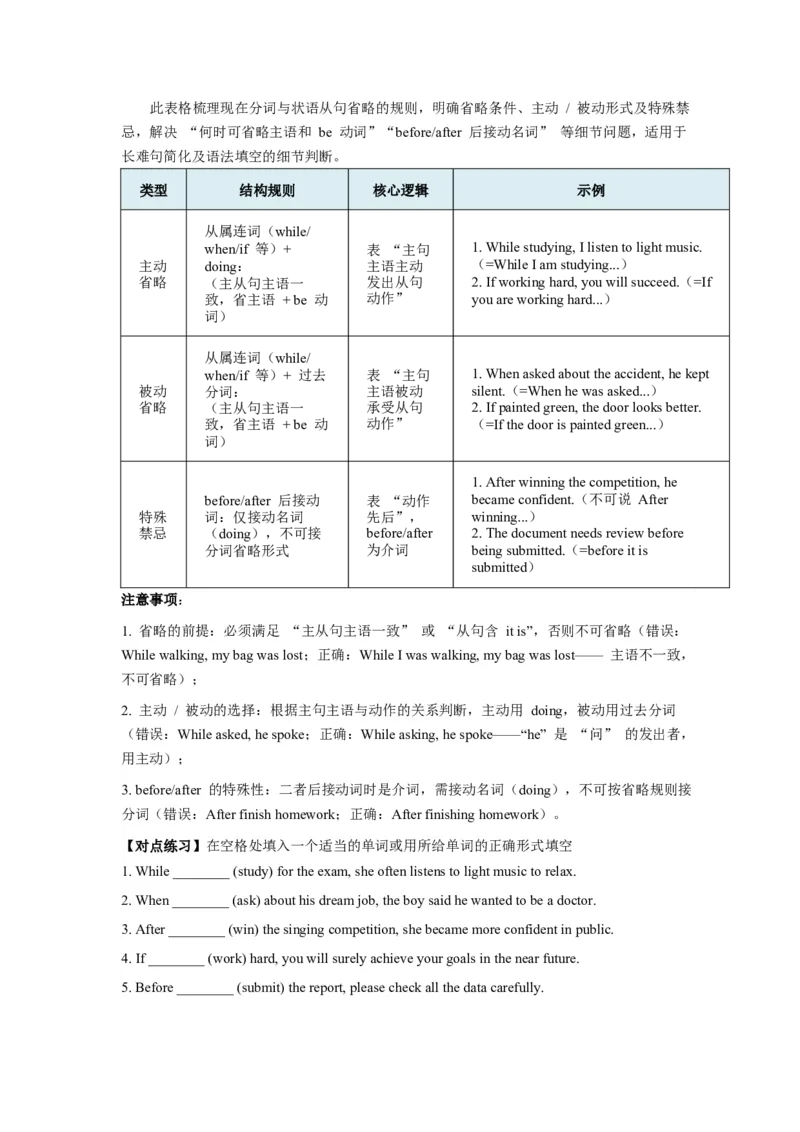
此表格梳理现在分词与状语从句省略的规则,明确省略条件、主动 / 被动形式及特殊禁
忌,解决 “何时可省略主语和 be 动词”“before/after 后接动名词” 等细节问题,适用于
长难句简化及语法填空的细节判断。
类型
结构规则
核心逻辑
示例
主动
省略
从属连词(while/
when/if 等)+
doing:
(主从句主语一
致,省主语 + be 动
词)
表 “主句
主语主动
发出从句
动作”
1. While studying, I listen to light music.
(=While I am studying...)
2. If working hard, you will succeed.(=If
you are working hard...)
被动
省略
从属连词(while/
when/if 等)+ 过去
分词:
(主从句主语一
致,省主语 + be 动
词)
表 “主句
主语被动
承受从句
动作”
1. When asked about the accident, he kept
silent.(=When he was asked...)
2. If painted green, the door looks better.
(=If the door is painted green...)
特殊
禁忌
before/after 后接动
词:仅接动名词
(doing),不可接
分词省略形式
表 “动作
先后”,
before/after
为介词
1. After winning the competition, he
became confident.(不可说 After
winning...)
2. The document needs review before
being submitted.(=before it is
submitted)
注意事项:
1. 省略的前提:必须满足 “主从句主语一致” 或 “从句含 it is”,否则不可省略(错误:
While walking, my bag was lost;正确:While I was walking, my bag was lost—— 主语不一致,
不可省略);
2. 主动 / 被动的选择:根据主句主语与动作的关系判断,主动用 doing,被动用过去分词
(错误:While asked, he spoke;正确:While asking, he spoke——“he” 是 “问” 的发出者,
用主动);
3. before/after 的特殊性:二者后接动词时是介词,需接动名词(doing),不可按省略规则接
分词(错误:After finish homework;正确:After finishing homework)。
【对点练习】在空格处填入一个适当的单词或用所给单词的正确形式填空
1. While ________ (study) for the exam, she often listens to light music to relax.
2. When ________ (ask) about his dream job, the boy said he wanted to be a doctor.
3. After ________ (win) the singing competition, she became more confident in public.
4. If ________ (work) hard, you will surely achieve your goals in the near future.
5. Before ________ (submit) the report, please check all the data carefully.
一、语法填空:在空格处填入一个适当的单词或用所给单词的正确形式填空
1.(2025·河北衡水·三模)         (obey) the teacher’s instruction, the students began the
experiment carefully.
2.(2025·河北衡水·二模)          (surround) the old castle, the river adds a touch of mystery
to the historic site.
3.(2026 高三·全国·专题练习)The manager was satisfied to see many new products
(develop) after great effort.
4.(2025 高三上·江苏·专题练习)The president agreed,           (add) that he hope for a
peaceful solution.
5.(2025 高三·全国·专题练习)Amy was so angry that she avoided talking with Jenny during the
day. She was at a loss          to do next.
6.(2025 高三上·江苏·专题练习)           (allow) for the bad weather, we should set off
right now.
7.(2022 高三上·浙江·专题练习)I saw some elderly people          (practice) Tai Chi
slowly. I stopped and watched their movements closely.
8.(2025 高三·全国·专题练习)In his lecture, he appealed to the teachers          (reduce) the
learning burden of schoolchildren.
9.(2023 高三·上海·专题练习)He passed me and then turned back,           (look) at me
with a smile.
10.(2025 高三·全国·专题练习)Try not to        your baby too much before bedtime.
(excited)
11.(2023 高三·上海·专题练习)It is the most urgent threat         (face) our entire species,
and we need to work collectively together and stop procrastinating(拖延).
12.(2023 高三·上海·专题练习)        (not do) anything like this before, I didn’t know what
kind of reaction I might receive.
13.(2022 高三·上海·专题练习)Photos of various tree leaves packaged in plastic bags and
arranged as flower bouquets went hot on social media lately,         (cause) complaints because
of the product’s price, six British pounds.
14.(2022 高三·上海·专题练习)Creator is not alone. Other robot chefs have already been
working,       (prepare) entire meals, or soon will be, in kitchens in other parts of the world.
15.(2022 高三·上海·专题练习)“         (compare) yourself with them, you might feel
devalued because you’re not very pretty.”
Passage 1
(2024·新课标Ⅱ卷·高考真题)阅读下面短文, 在空白处填入 1 个适当的单词或括号内单词的
正确形式。
Chinese cultural elements commemorating (纪念) Tang Xianzu,    1              is
known as “the Shakespeare of Asia,” add an international character to Stratford-upon-Avon, William
Shakespeare’s hometown.
Tang and Shakespeare were contemporaries and both died in 1616. Although they could never
have met, there are common    2              (theme) in their works, said Paul Edmondson,
head of research for the Shakespeare Birthplace Trust. “Some of the things that Tang was writing
about    3              (be) also Shakespeare’s concerns. I happen to know that Tang’s play
The Peony Pavilion (《牡丹亭》) is similar in some ways    4              Romeo and
Juliet.”
A statue commemorating Shakespeare and Tang was put up at Shakespeare’s Birthplace
Garden in 2017. Two years later, a six-meter-tall pavilion,    5              (inspire)by The
Peony Pavilion,    6              (build)at the Firs Garden, just ten minutes’ walk from
Shakespeare’s birthplace.
Those cultural elements have increased Stratford’s international


 7

(visible), said Edmondson, adding that visitors walking through the Birthplace Garden were often
amazed    8              (find)the connection between the two great writers.
   9              (recall)watching a Chinese opera version of Shakespeare’s play Richard
III in Shanghai and meeting Chinese actors who came to Stratford a few years ago to perform parts
of The Peony Pavilion, Edmondson said, “It was very exciting to hear the Chinese language     10
see how Tang’s play was being performed.”
Passage 2
(2023·新课标Ⅰ卷·高考真题)阅读下面短文,在空白处填入1 个适当的单词或括号内单词的
正确形式。
Xiao long bao (soup dumplings), those amazing constructions of delicate dumpling wrappers,
encasing hot,     1               (taste) soup and sweet, fresh meat, are far and away my
favorite Chinese street food. The dumplings arrive steaming and dangerously hot. To eat one, you
have to decide whether     2               (bite) a small hole in it first, releasing the stream and
risking a spill (溢出),     3               to put the whole dumpling in your mouth, letting the
hot soup explode on your tongue. Shanghai may be the     4               (recognize) home of
the soup dumplings but food historians will actually point you to the neighboring canal town of
Nanxiang as Xiao long Bao’s birthplace. There you will find them prepared differently — more
dumpling and less soup, and the wrappers are pressed     5               hand rather than
rolled. Nanxiang aside, the best Xiao long bao have a fine skin, allowing them     6

(lift) out of the steamer basket without tearing or spilling any of     7               (they)
contents. The meat should be fresh with     8               touch of sweetness and the soup
hot, clear and delicious.
No matter where I buy them, one steamer is     9               (rare) enough, yet two
seems greedy, so I am always left       10                 (want) more next time.
Passage 3
(2024·北京·高考真题)阅读下列短文,根据短文内容填空。在未给提示词的空白处仅填写1
个恰当的单词,在给出提示词的空白处用括号内所给词的正确形式填空。
One day, I saw a boy walking along George Street with an armful of books. I thought    1
myself, “Why would he carry all his books? ” Just then, some kids ran at him,
    2              (knock) his books out of his arms. His glasses went flying and landed
in the grass. My heart went out to him, and I    3              (jog) over to him. As I handed
him the glasses, he looked at me and said, “Thanks!”
Passage 4
(2025·湖南·模拟预测)阅读下面短文,在空白处填入1 个适当的单词或括号内单词的正确形
式,并将答案填写在答题卡上。
A pioneering international initiative for hadal zone (超深渊带) exploration, led by Chinese
scientists, has received official     1               (approve) from the United Nations Decade
of Ocean Science for Sustainable Development (2021-2030).
The Global Hadal Exploration Programme (GHEP), with the Institute of Deep-sea Science and
Engineering (IDSSE) serving as its head, seeks to transform fragmented hadal research into a
coordinated global mission to explore, understand     2               protect the planet’s most
inaccessible marine ecosystems.
The hadal zone,     3               is characterized by extreme depths and pressures,
darkness, low temperatures, frequent earthquakes and peculiar living forms,


 4

(comprise) ocean trenches ( 海沟), particularly from a depth of 6,000 meters
   5

the bottom of the ocean at about 11,000 meters.
For a long time, the hadal trenches have been among the most under-explored and mysterious
areas on Earth due to technological limitations.
China has been a key     6               (drive) force of deep-sea exploration over the
past decade through sustained sci-tech advancements. In 2014,     7               (follow) the
launch of the Hadal Science and Technology Programme, researchers carried out a historic dive to
the Mariana Trench’s 10,000-meter depths. Then, the Global Trench Dive and Exploration
Programme     8               (conduct), with the help of its cutting-edge manned submersible
Fendouzhe and the Tansuo research vessels.
To date, Chinese scientists have partnered 145 researchers from 10 countries, exploring nine
hadal trenches worldwide, the Mariana, the Kermadec and Puysegur trenches
   9

(include).
From this year on, GHEP will     10               (primary) integrate international
research on extreme environments, life evolution and geological ( 地质的) processes in the hadal
zone.
Passage 5
(2025·浙江·一模)阅读下面短文,在空白处填入1 个适当的单词或括号内单词的正确形式。
Woodcarving, an ancient craft with     1               (globe) cultural significance,
involves shaping wood into delicate designs and figures. Dating back thousands of years in China,
this art     2               (consider) a valuable traditional art, reflecting rich craftsmanship
and symbolism.
Craftsmen employ different techniques like relief carving and sculpture in the round, each     3
(require) distinct skills and tools. Faced with such demanding work, these craftsmen often remind
4               (they) to stay patient, as even a small mistake could ruin hours of work. At the
same time, many traditional tools like gouges (凿子) remain essential, which demonstrates the craft’s
respect for time-honored methods,     5               modern tools are gradually being adopted
for efficiency.
For example, in Chaoshan, Guangdong, woodcarving decorates furniture and temples,     6
(deep) serving both artistic and symbolic purposes. Ethnic groups like the Zhuang integrate
traditional patterns that often describe traditional stories or natural elements, conveying     7

(wish) for happiness and harmony. Dongyang woodcarving, represented by the contemporary artist
Lu Guangzheng, gains worldwide     8               (recognize).
Today, woodcarving,     9               aim is to encourage new generations of
craftsmen, adapts to modern trends when preserving tradition, standing     10               a
living example of human creativity and cultural continuity.
Passage 6
(2025·广东中山·二模)阅读下列短文,根据短文内容或括号内所给词的恰当形式填空。
In a factory workshop in Huangchuan County, central China’s Henan Province, skillful
workers stretch pieces of dough (面团) very carefully. They press and turn the dough into thin strips,
and then use wooden sticks to pull them apart gently. These strips     1               (hang) to
dry, and finally they become the famous hollow tribute noodles (空心贡面) of the area.
Liu Laiwang, representative inheritor of the noodles and boss of a local food company, says,
“Making these noodles     2               (be) my work since my childhood. They’re a special
cultural treasure of Henan, carrying the     3               (wise) of many past generations. We
must keep this skill alive and pass it on.”
    4              (date) back to the Tang Dynasty (618-907), the noodle earned its name
when it was presented     5               the emperor as a form of tribute. The noodles are
made from high-quality wheat flour, sesame oil and salt, and their production involves more than ten
steps. The noodles are very thin, with a hole in the middle. When     6               (cook),
they stay firm and don’t get soft or     7               (stick).
In recent years, Huangchuan has actively expanded its noodle industry, aiming to achieve both
social and economic benefits. Liu’s company alone operates a 5,200-square-meter standardized
facility with     8               annual production capacity of 3,000 tons. It has helped over
1,000 local families get out of poverty     9               given jobs to nearly 2,000 workers.
China has many such special cultural treasures, more than 40 of


 10

have been put on UNESCO’s important list, more than any other country in the world.