高考英语语法词汇专项突破:副词词义与功能重点难点考点“三点”全解读+巩固练习
[形容词考题展示]
【考题】(2023新高考I卷)No matter where I buy them, one steamer is (rare) enough, yet two
seems greedy, so I am always left wanting more next time.
答案与解析:rarely。考查副词。修饰形容词用副词作状语,rarely“少有”,故填rarely。句意:无论
我在哪里买,一蒸笼都不够,而两蒸笼又显得太贪心了,所以我总是想下次再买。
【考题】(2023新高考II卷)So, what are they learning? (basic), how to describe a panda’s life.
答案与解析:Basically。考查副词。分析句子结构可知,空处修饰空后整个句子,应该用副词修饰,
basic的副词形式是basically位于句首,首字母应大写。故填Basically。句意:基本上,如何描述熊猫的生
活。
【考题】(2023▪浙江1月卷)The term “hutong”, (original)meaning “water well” in Mongolian,
appeared first during the Yuan Dynasty.
答案与解析:originally。考查副词。空格处修饰动词meaning需要填副词形式。故填originally。句意:
胡同起初在蒙古语当中是“水井”的意思,首次出现在元朝。
【考题】(2022 新高考全国 I 卷)The GPNP’s main goal is to improve connectivity between separate
populations and homes of giant pandas, and (eventual) achieve a desired level of population in the wild.
答案与解析:eventually。考查副词。分析句子可知,空处后为动词achieve,空处应用副词作状语修饰
动词achieve,结合语意可知,此处意为“最终”,应用副词eventually。故填eventually。句意:GPNP的
主要目标是改善不同种群和大熊猫家园之间的联系,最终达到理想的野生大熊猫数量水平。
【考题】(2022新高考全国II卷)When he looked down, he (accidental ) slipped and fell over the
edge. He hung on for a few minutes and screamed for his father, but his father didn't hear him.
答案与解析:accidentally。考查副词。分析句子结构,设空处应该填写副词修饰动词slipped。
accidental为形容词,意为“意外的,失误的”,其副词为accidentally,意为“意外地,失误地”,符合句
意。故填accidentally。句意:当他往下看时,不小心滑了一跤,从悬崖边上掉了下去。
【考题】(2022 年浙江 1 月卷) On a website called No Fly Climate Sci, for example, 105
(rough) 200 academics - many of them climate scientists have promised to fly as little as possible since the
effort started two years ago.
答案与解析:roughly。考查副词。此处修饰数字用副词roughly“粗略地大约”,故填roughly。句意:例如,在一个叫“无飞行科学家”的网站上,自从两年前成立以来,大约有200个学者,他们中很多人承
诺尽可能少飞行。
【考题】(2021新高考I卷)It will (undoubted) help you get refreshed!
答案与解析:undoubtedly。此处修饰动词help,应用副词undoubtedly“毫无疑问地”。故填
undoubtedly。
考查副词。句意:它无疑会帮助你恢复精神!
【考题】(2021浙江1月卷) But 30 years later, the BMI difference between urban and rural people in
many countries had narrowed (sharp).
答案与解析:sharply。考查副词。分析句子结构可知,sharp是要修饰动词narrow,用sharp的副词形
式sharply。故填sharply。句意:但30年后,许多国家城市和农村人口的BMI差异大幅缩小。
【考题】(2020浙江1月卷)This is 197 (particular)true in the US. The second reason is that people
are living longer.
答案与解析:particularly。考查副词。句意:在美国尤其如此。此处修饰形容词true应用副词,故填
particularly。
一、副词的分类
种类 例词 注意事项
时 间 today, now, yesterday, then, soon, 注意与不同时态的搭配,如lately, recently多与现在完成时搭
副词 lately, recently,daily… 配等。表示确切时间的副词常用于句尾或句首。
地 点 there, here, above, indoors, outdoors, 以-s 结尾的却是副词,不要误以为是名词,如 indoors,
副词 inside, outside, upstairs, downstairs… downstairs,地点副词多置于句尾。
频 度 often, always, never, seldom, once, 置于连系动词之后,行为动词之前。
副词 twice, sometimes…
方 式 bravely, happily, shyly, fast, slowly… 可置于句尾或其它位置,在被动语态中置于过去分词之前
副词
疑 问 where, when, why, how… 用来引起特殊疑问句
副词
关 系 where, when, why… 用来引导定语从句,且本身在从句中作状语
副词
其 它 possibly, probably, maybe, not,yet, Possibly,surely等表示可能性或像certainly表示确定性的副
副词 already, sure(ly)… 词一般不置于句尾。
二、部分形容词的副词形式有两种,但是意义不同
有些副词有两种形式:一种是与其作形容词时同形,另一种是在原形容词后面加上-ly构成的,但是两
者的含义有时有所不同,要根据实际情况来确定。一般的说副词与形容词同形时,副词的意思基本同作为
形容词的意思,表示具体的概念,加上-ly时的副词有引申意义,表示较为抽象的概念。如下表:序号 例词 词义 例句
1 high 高地 They can jump high enough. 他们可以跳得足够高。
highly 高度地 They think highly of us. 他们对我们评价很高。
2 wide 宽地;宽阔 He opened his eyes wide. 他眼睛睁得大大地。
地
widely 广泛地 English is widely used. 英语被广泛运用。
3 deep 深地 They worked deep into night. 他们一直工作到深夜。
deeply 深刻;深深 We were deeply moved by his story. 我们被他的经历深深地感动了。
地
4 hard 努力地;费 Study hard and you’ll make progress. 努力学习,你就会进步。
力地
hardly 几乎不 I can hardly recognized him.我几乎认不出他。
5 short 突然地 Stop short.突然停止(固定短语)
shortly 不久 Shortly after his arrival, he found the truth. 他到达不久,就发现了事实
真相。
6 clean 完全地;彻 I clean forgot about it.我把它完全忘记了。
底地
cleanly 清洁地 He washed the dishes cleanly.他将盘子洗干净了。
7 fair 公正地;正 You must play fair.你必须公正处事。
好
fairly 相当地;公 I fairly caught sight of him.我清楚地看到他。
平地
8 just 刚刚;仅仅 He just arrived.他刚刚到达
justly 公正地 He was justly punished.他受到应有的惩罚。
9 low 低下地 Don’t think low of yourself.看低自己。
lowly 卑微地 He said lowly to his master.他谦逊地对主人说。
10 dead 终结地;全 He was dead asleep. 他睡得很死。
然地
deadly 极端地;死 His wound was deadly serious.他的伤口极其严重
一般
11 close 挨近;靠近 You’d better get close to him.你最好靠近他。
closely 认真的;仔 Watch closely.认真观察。
细地
12 late 迟到地 Five minutes late, he came.五分钟后,他来了。
lately 近来;最近 I have received two letters from him lately.最近我收到了他两封信。
13 near 不远;挨近 My birthday is drawing near.我的生日快到了。
nearly 几乎;差不 Nearly everyone is here. 大家几乎都到了。
多
14 pretty 很;非常 Pretty well.很好。prettily 漂亮地 She is prettily dressed.她穿得很漂亮。
15 most 很;最 a most interesting film 一部非常有趣的电影
mostly 多半地;主 The audience consisted mostly of women.观众主要是妇女。
要地
16 direct 直接地;一 We went direct from Beijing to Shanghai.我们直接从北京到上海
直
directly 立刻 I’ll be there directly.我马上就到那儿去。
考例:1. (北京XXXX)It was raining heavily. Little Mary felt cold, so she stood ______to her mother.
A. close B. closely C. closed D. closing
思路点拨: close to 用作副词。意为“接近地”,指具体距离的接近;closely常表示抽象意义,意为
“密切地,严密地”,故选 A。
2. (NMETXXXX.III) I must be getting fat--- I can _____ do my trousers up.
A. fairly *B. hardly C. nearly D. seldom
思路点拨:由题干中提到的“肯定是胖了”的前提可以得出“裤子几乎穿不上了”,故选 B。其它三项
与句子的意思不符。
三、副词的功能
功能 例句 注意事项
状语 The visitors were warmly welcomed by the students.来访者受到了 修饰动词
同学们的热烈欢迎。
It is a rather difficult job.这是一项相当难的工作。 修饰形容词
The bench is just behind the door.凳子就在门后。 修饰介词短语
This is exactly what I want to say.这正是我想说的。 修饰从句
表语 Is your father in? 你爸在家吗?
宾补 I saw him out with you yesterday.上周我看到他和你一起出去了 可以用于动词跟复合宾
语结构或是with跟复合
宾语
定语 On my way home I met him.在回家的途中我遇见了他。 通常置于被修饰词之后
四、副词作状语修饰整个句子时的情况
副词作状语可以修饰整个句子,可以置于句首、句中或句尾,与句子的其它成分之间通常用逗号隔
开。
1.‘Who is this woman?’ ‘Who is she, indeed!’(I wonder at your asking.)
“这个女人是谁?”“她是谁,真是!”(难道你不知道吗?)2.A friend in need is a friend indeed.患难见真交。
有些副词像fortunately, luckily, surprisingly, honestly, actually, unfortunately等修饰整个句子时,表示说
话者的态度,或者是起着连接上下文的作用,常可以和句型It+be+adj+that—进行句型转换。如:
1) (北京XXXX)Two middle-aged passengers fell into dead sea. _____, neither of them could swim.
A. In fact B. Luckily C. Unfortunately D. Naturally
思路点拨: neither of them could swim 暗示,他们两人都不会游泳,可能会遭遇不幸,故选择
unfortunately与语境相符,故选C。可以转换成:It was unfortunate that neither of them could swim.
Unfortunately修饰后面整个句子。
2)(上海XXXX) Most people on this island are recreational fishers, and _____, fishing forms an actual part
of their leisure time.
A. accidentally B. purposefully C. obviously D. formally C
思路点拨:根据前一分句中的提示词recreational“休养的, 娱乐的”后义愤句的提示词their leisure
time “休闲时光”可以推出C,意思是“显然地”。 accidentally偶然地;purposefully故意地;
formally正式地,三者都不合题意。
3)Surprisingly, no one in the classroom can work out the problem.
令人感到惊奇的是全班没有一个同学能算出这道题。
解析:副词Surprisingly用来修饰整个句子,可以转换成:
To my surprise, no one in the classroom can work out the problem.
或: It is surprising that no one in the classroom can work out the problem.
与形容词作状语比较:
He walked on the street alone, full of fear.
Luckily, he escaped from being shot.
可以看出形容词作状语与句子之间用逗号隔开,表示与句子的谓语动词(句中的 walk)之间是伴随
关系,强调在“走”时的心理状态,作伴随状语。
副词作为状语修饰整个句子时可以句型转换:It was lucky that he escaped from being shot.
五、Enough用法专题
先看NMETXXXX单项填空的第8题:
_________ to take this adventure course will certainly learn a lot of skills.
A. Brave enough students B. Enough brave students
C. Students brave enough D. Students enough brave
答案与解析:对enough作为副词修饰形容词进行考查。由于本题中的 enough是副词,所以要置于被修饰的形容词brave之后,整个形容词短语 brave enough to take this advantage course 作后置定语,修饰名词
students,全句的意思是:有足够勇气选修这门历险课程的学生将会学到很多种技能。所以本题应选C。
enough是现行教材中较为活跃的一个词,是历年教学大纲和高考考纲中的重点词汇,更是高考命题的
热点词汇。本文拟从其词性入手,结合历年高考试题对其用法进行剖析,希望同学们能更好地掌握。
一、enough可以作名词、代词,意思是“足够、充分”。作代词可以代替可数名词或不可数名词,在句中
作主语或宾语。如:
1. Enough has been said on this subject.
关于这一问题的说明已经足够了。
2. At the end of six months he had learned enough (enough Russian) to read articles and reports.
六个月以后,他就学到了足够的俄文,达到了能够阅读用俄文写的文章和报告的程度。
3. Jill: No thanks, I’ve had enough.
吉尔:不,谢谢,我已吃饱了。(enough=enough food)
4. At that time the land along the Changjiang River was becoming very crowded; there was not enough
(enough land) for the population.
那时候,长江沿岸的土地上人口越来越稠密,再也容纳不下那么多人了。
注意:当enough后的名词前有冠词、形容词性物主代词、指示代词或其本身就是代词时,要用介
词of。如:
1) We’ve had enough of your coldness. 我们已经受够了你的冷漠。
2) Did you buy enough of them? 这种原料你买的够吗?
二、enough作形容词,意思是“足够的、充分的”,常与for或不定式连用, 可以作定语或表语。作定语
置于被修饰的名词前后均可,前置时强调enough,后置时强调被修饰词。如:
1.(XXXX.第22题题干)I hope there are enough glasses for each gust to have one.
我希望杯子能够每人一个。
2. We have enough seats (seats enough) for everyone. 每个人都有座。
3. Enough is enough. 够了就是够了。
4. Five men will be quite enough. 五个人就足够了。
三、enough作副词的意思是 “十分地、充分地、足够地、充足地”,置于被修饰的形容词或副词之后,
常与不定式或介词for连用 ,在句子中作状语,表示程度。如:
1. (高考XXXX) ---Mum, I think I’m _____ to get back to school.
--- Not really, my dear. You’d better stay at home for another day or two.(key:C)A. so well B. so good C. well enough D. good enough
2. (NMETXXXX.11) If I had ______, I’d visit Europe, stopping at all the small interesting places. (key:
A)
A. a long enough holiday B. an enough long holiday
C. a holiday enough long D. a long holiday enough
3. Helicopters were sent to rescue them, but it was impossible for them to get close enough.
派直升机去援救他们,但是直升机无法靠近他们。
4.When they reached the burning building they found that their ladders were not long enough to reach the
people who were trapped.
当他们靠近烈火熊熊的大火时,他们发现梯子不够长,够不着被火围困的人。
5. (NMETXXXX.26题干) --- You were brave enough to raise objections at the meeting.
--- Well now I regret having done that.
6. I’m sorry, none of you watched carefully enough.
很遗憾,你们当中谁都观察得不够仔细。
四、enough作感叹词意思是“够了!停止! 住手! 不要再继续了!”,用以表达不耐烦或恼怒,如:
You've been practising the violin all afternoon. Enough!
你整个下午都在练小提琴。够了!
五、用在“主语+can not …+enough”句型中
该句型形式上是否定句型,实际上表达的是肯定意义,意思是“再……也不过分;越……
越……”,enough用作副词。如:
I can’t thank you enough. 我对你感激不尽。(我怎么感谢你都不算过分。)
句型中的enough还可以换成too 或over。如:
(北京XXXX)--- I was riding along the street and all of a sudden, a car cut in and knocked me down.
--- You can never be ____ careful in the street.
A. much B. very C. so D. too (D)
六、enough还可以用于以下的短语中
1.sure enough 果真;确实 如:
He said he would come, and sure enough he came. 他说要来,果然来了。
2.well enough 还不错, 还可以; 相当, 很, 极
You know well enough.[口]你明明知道; 你心里明白; 你很懂得。
3.be good /kind enough to do sth. 劳驾, 务请做某事 如:Be good /kind enough to reply early. 请早日赐复。
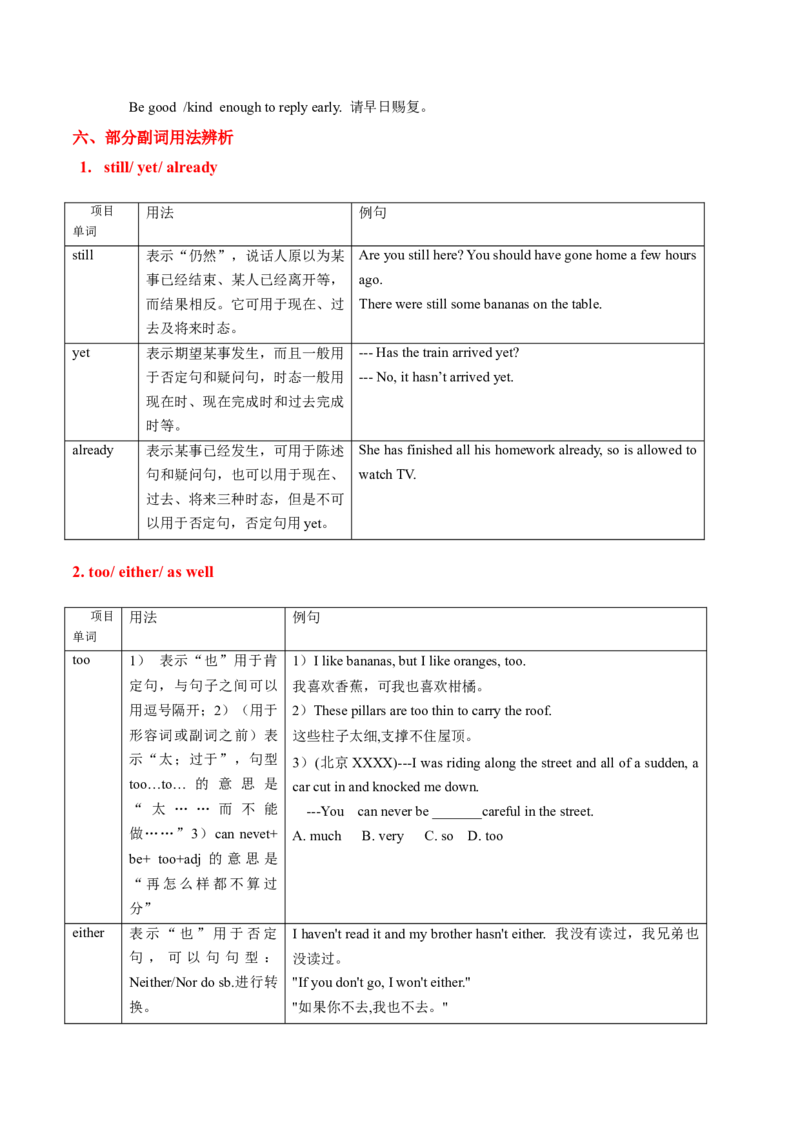
六、部分副词用法辨析
1. still/ yet/ already
项目 用法 例句
单词
still 表示“仍然”,说话人原以为某 Are you still here? You should have gone home a few hours
事已经结束、某人已经离开等, ago.
而结果相反。它可用于现在、过 There were still some bananas on the table.
去及将来时态。
yet 表示期望某事发生,而且一般用 --- Has the train arrived yet?
于否定句和疑问句,时态一般用 --- No, it hasn’t arrived yet.
现在时、现在完成时和过去完成
时等。
already 表示某事已经发生,可用于陈述 She has finished all his homework already, so is allowed to
句和疑问句,也可以用于现在、 watch TV.
过去、将来三种时态,但是不可
以用于否定句,否定句用yet。
2. too/ either/ as well
项目 用法 例句
单词
too 1) 表示“也”用于肯 1)I like bananas, but I like oranges, too.
定句,与句子之间可以 我喜欢香蕉,可我也喜欢柑橘。
用逗号隔开;2)(用于 2)These pillars are too thin to carry the roof.
形容词或副词之前)表 这些柱子太细,支撑不住屋顶。
示“太;过于”,句型 3)(北京XXXX)---I was riding along the street and all of a sudden, a
too…to… 的 意 思 是 car cut in and knocked me down.
“ 太 … … 而 不 能 ---You can never be _______careful in the street.
做……”3)can nevet+ A. much B. very C. so D. too
be+ too+adj 的 意 思 是
“再怎么样都不算过
分”
either 表示“也”用于否定 I haven't read it and my brother hasn't either. 我没有读过,我兄弟也
句 , 可 以 句 句 型 : 没读过。
Neither/Nor do sb.进行转 "If you don't go, I won't either."
换。 "如果你不去,我也不去。"as well 意思同in addition; They mentioned other matters as well.
also, 表 示 “ 另 外 ; 他们也提到了其它事情
也”。
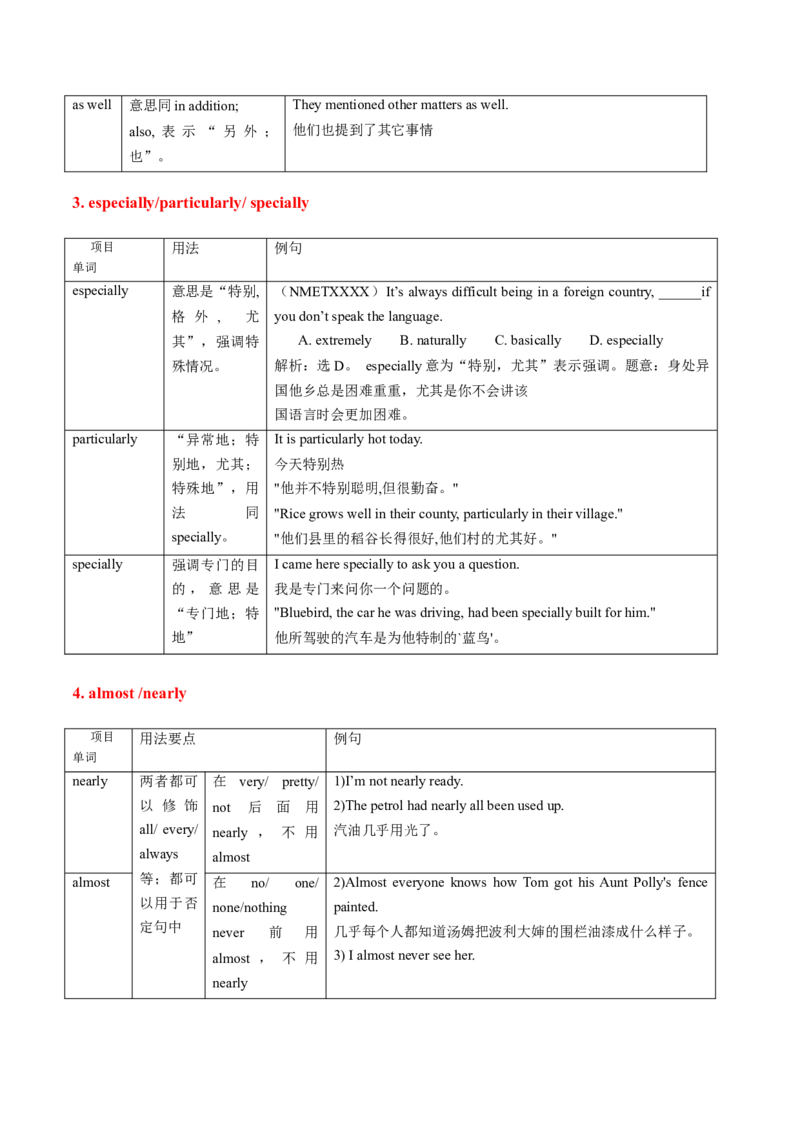
3. especially/particularly/ specially
项目 用法 例句
单词
especially 意思是“特别, (NMETXXXX)It’s always difficult being in a foreign country, ______if
格 外 , 尤 you don’t speak the language.
其”,强调特 A. extremely B. naturally C. basically D. especially
殊情况。 解析:选D。 especially意为“特别,尤其”表示强调。题意:身处异
国他乡总是困难重重,尤其是你不会讲该
国语言时会更加困难。
particularly “异常地;特 It is particularly hot today.
别地,尤其; 今天特别热
特殊地”,用 "他并不特别聪明,但很勤奋。"
法 同 "Rice grows well in their county, particularly in their village."
specially。 "他们县里的稻谷长得很好,他们村的尤其好。"
specially 强调专门的目 I came here specially to ask you a question.
的 , 意 思 是 我是专门来问你一个问题的。
“专门地;特 "Bluebird, the car he was driving, had been specially built for him."
地” 他所驾驶的汽车是为他特制的`蓝鸟'。
4. almost /nearly
项目 用法要点 例句
单词
nearly 两者都可 在 very/ pretty/ 1)I’m not nearly ready.
以 修 饰 not 后 面 用 2)The petrol had nearly all been used up.
all/ every/ nearly , 不 用 汽油几乎用光了。
always almost
almost 等;都可 在 no/ one/ 2)Almost everyone knows how Tom got his Aunt Polly's fence
以用于否
none/nothing painted.
定句中
never 前 用 几乎每个人都知道汤姆把波利大婶的围栏油漆成什么样子。
almost , 不 用 3) I almost never see her.
nearly5. too much/ much too
项目 用法要点 例句
单词
much 都可以作 修饰形容词或副 (NMETXXXX) Allen had to call a taxi because the box was ____
too 副词表示 词 to carry all the way home.
“很;非 *A.much too heavy B. too much heavy
常”,在 C. heavy too much D. too heavy much
too 句中作状 修饰动词,还可 Don’t talk too much.不要讲的过多。
much 语 以作形容词修饰 He has too much homework to do.
不可数名词或作 他有太多的家庭作业要做。
代词而代指不可 Too much of fat may do harm to your health.
数名词 太多的脂肪会对你的健康有害。
6. fairly/ rather
项目 用法要点 例句
单词
fairly “相当地;尚可”,多修饰 a fairly good dinner.相当好的一顿晚宴
具。 I was fairly sure that I would go to the party.
有积极含义的形容词或副词 我很可能去参加晚会
rather “稍微;有点;颇;相当” rather cold weather 相当冷的天气
多修饰消极意义的形容词或 She was rather hurt by his unkind words.
副词,可以修饰形容词或副 "他出言不逊,使她相当伤心。"
词的比较级,或是与副词too She runs rather faster than Tom.她比汤姆跑得快多了。
连 This book is rather easy to read. 这本书读起来太容易了
用,而fairly不可以.
7. late/ lately/ later/ latter
项目 用法要点 例句
单词
late 作副词,意 a train that arrived late; 火车晚点;
思是“比预 She woke late and had to skip breakfast. 她起床迟了,不得不不吃早点
期迟的”。 They talked late into the evening. 他们聊到很晚later 作副词意思 "Many years later, in Washington, D.C., he spoke to a crowd of 250,000 people."
是“后来, "许多年以后,在华盛顿特区,他向二十五万美国人民发表了演说。
过后 ” "But some time later it began to rain.
但过了些时候开始下雨了。
latter 是形容词, the latter half of the year下半年
看作是late的 Of the two the latter is better than the former.
比较级之一, 二者中后者比前者好。
意思是“后 in these latter days近来, 现今
者
的, 近来的”
lately 作副词意思 Have you been on a bus lately? 你最近乘过公共汽车吗?
是“不久 It is only / just lately that I got a copy of the novel.
前,近来” 最近我才弄到一本这部小说。
牛刀小试
1.The class have not started reading the new book ____.
A. still because they are yet reading the old one
B. yet because they are still reading the old one
C. for because they are still reading the old one
D. so that they still yet reading the old one
2. He _____ lives in the house where he was born.
A. yet B. ever C. still d. already
3. He isn’t young any more. His friend isn’t _______.
A. also B. neither C. too D. either
4. --- Are you going to the football game?
--- No. The tickets are ____ expensive for me.
A. very much B. so much C. far too D. highly
5. --- Let’s take a walk before we start to study.
--- Oh, I think it’s _____ for walking.
A. much too hot B. very much hot
C. too much heat D. very much heat
6. "Two months ______, some more money was sent to Sam with another note: 'Only 25 per cent a thief now!'"A. latter B. late C. lately D. later
7. (NMETXXXX.I) I don’t mind picking up your things from the store. _____ the walk will do me good.
A. Soon or later B. Still C. In time D. Besides
8. (湖南 XXXX) Everyone was on time for the meeting --_________Chris, who’s usually ten minutes late for
everything.
A. but B. only C. even D. yet
9. (北京XXXX)---I hear they aren’t pleased with the house you’ve chosen for them.
---Well, ______could they live in such comfort?
A. where else B. what else C. how D. why
10. NMETXXXX)I don’t think I’ll need any money but I’ll bring some _____.
A. at last B. in case C. once again D. in time
11.(上海XXXX) Last night I had a terrible cold and ached all _____.
A. the way B. over C. at once D. the worst
12.(NMETXXXX)We decided not to climb the mountain because it was raining _____.
A. badly B. hardly C. strongly D. heavily
13.(上海XXXX)We’re all going to the games, why don’t you come ______?
A. up B. across C. along D. to
14. (上海XXXX)We don’t care if a hunting dog smells _____, but we really don’t want him to smell ______.
A. well; well B. bad; bad C. well; badly D. badly; bad
15. ____ his outdoor activities, Paul likes fishing _____, but he doesn't enjoy eating fish.
A. For all; best B. From all; better
C. Of all; best D. About all; better
16. Alice was ____ girl to express herself.
A. a much too shy B. too much shy a
C. so shy a D. much too shy a
17. It is reported that _____ homeless children want to know who their natural parents are.
A. the most B. most of C. most D. the most of
18. History is __ a subject that only lets us know something in history; it also tells us a lot of truth.
A. not more than B. less than
C. more than D. no more than
19. I can't thank you __ much for your kindness, because without your help I wouldn't have succeeded in theexam.
A. too B. very C. quite D. that
20. The article to be read is ___ too difficult.
A. fairly B. rather C. quite D. pretty
21. He is _____ a writer as a reporter.
A. not so much B. more C. rather D. not such
22. John did _____ in the exam, and I did even.
A. good; better B. badly; more badly
C. badly; worse D. bad; more badly
23. I' m afraid this pair of shoes is __ tight; besides, the price is _______.
A. too: high B. very; expensive
C. so; low D. rather; cheap
24. He is a child, and must be treated _______.
A. as so B. such as C. as such D. such
25. -- Did all of them go to the film?
-- No. They __ went to the concert instead.
A. almost B. mostly C. most D. nearly
26. Miss Evans is _____ wise than pretty. Few people can solve such a problem.
A. no less B. no more C. less D. more
27. It's better to teach the people out of work means to earn money ______ to provide money for them.
A. as B. than C. more D. most
28. Nothing in my life moved me _____ this first visit to China.
A. so deeply as B. deeply as
C. as deep as D. so deep as
29. Your coat is smarter than mine, but mine is _____ cheaper than yours.
A. somewhat B. a lot of C. well D. so
30. China' s _______ shop for left-handed people, opened in Dalian last Wednesday, offers products made
_____left-handers from scissors to can openers.
A. ever first; specially B. ever first; specially for
C. first ever; specially D. first ever; specially for
31. -- This is a disappointing speech.
-- Yes, the speaker said ______ nothing worth listening to.A. almost B. hardly C. mainly D. nearly
32. The young lady failed the driving-test ________ because she was a bit careless while turning round the
corner.
A. simply B. easily C. hardly D. really
33. He was lying in the hospital__________ with his ribs broken.
A. half dead B. deadly C. dying D. died
34. --- It's six o'clock and your father is still at the office.
--- I know. Who else would _________ he does?
A. be as hard working as B. be working harder than
C. do harder work than D. work as hard as
35. --- ________ do we have to go?
--- Just one more mile.
A. How farther B. How long C. How far D. How much farther
36. -- That kind of computer is very expensive.
-- I'll buy one, _______.
A. as well B. though C. then D. instead
37. -- Do you regret paying ten dollars for that book?
-- No, I would _______ have paid twice as much.
A. certainly B. gladly C. hardly D. ready
38. -- Why didn't you go to the cinema last night?
-- It was something _________ interesting.
A. far less B. more or less C. much more D. as much as
39. Peter won't drive us to the station. He has ________ to take us all.
A. a very small car B. too small a car
C. a too small car D. such a small car
40. -- He isn't particular about his food.
-- Yes, he eats _______ anything.
A. nearly B. mostly C. almost D. possibly
41. People are encouraged to speak openly, but careless remarks are _____ to hurt others' feelings.
A. possible B. probable C. likely D. surely
42. ---Now that you like the car so much, why not drive it back?
--- Well, I can’t afford _____ car.A. that big a B. a that big C. that a big D. a big that
43.--- Did all of the boys go to the cinema?
---No. They ______ went to the Internet bar instead.
A. almost B. mostly C. never D. nearly
44. As it has seat at the back and a basket at the front, I can take my small daughter to school, to the library,
shopping______ in fact.
A. to anywhere B. to nowhere C. anywhere D. nowhere
45.---_____ did you sleep last night?
--- I sat up reading too late to fall asleep.
A. How long B. When C. How soon D. How
46. ________ the hidden gun was needed ________.
A. Where; discovering B. When; to find
C. How much; finding D. How; to discover
47. It's true that the old road is less direct and a bit longer. We don't take the new one, _______, because we don't
feel safe on it.
A. though B. unless C. therefore D. either
参考答案与思路点拨:
KEY:1-5 BCDCA 6-10 DDCAB 11-15 BDCDC 16-20 DCCAB 21-25 ACACB 26-30 DBAAD 31-
35 AAADD 36-40 BBABC 41-45 CABCD 46-47 AA
6. 点拨:句意是"两个月之后又送来一些钱,并附上一张字条给萨姆:`现在仅仅是个25%的小偷!'",later表
示“晚了多少时间置于数词之后”,故选D。
7. 点拨:D. 全句意为:我不介意去商店给你取东西;步行对我有好处。四个选项中,只有 D项表示递
进关系。此处besides为副词。
8. 点拨:C 副词even用来加强语气,意为“甚至(……也),连(……都)”,其后常接名词、副词或
动词;其余各项不符合题意。
9. 点拨:A.句中the house与live提示,此处选择where else才符合语境;what else不能作状语且逻辑不
通。
10. 点拨:B. in case此处用作副词,意为“以防万一”,符合题意。题意:我认为我不需要钱,但我还是带了些以防万一。
11. 点拨:B. all over意为“浑身,到处”,符合语境。题意:昨天晚上我感冒得厉害,浑身疼。
12.点拨:D.“雨下得大”常说rain heavily/hard; badly 严重地,坏地;strongly强烈地;hardly几乎不,均不
符合题意。
13. 点拨:C. come along意为“一起来,一道走”,符合本题语境;come up 走近;come across(偶然)
发现;come to达到,归结为。
14. 点拨:D.前个smell是实意动词,表示嗅觉的能力,须用副词修饰;后一个smell是连系动词,表示发
出气味,后应接形用词作表语。题意:我们并不介意猎狗的是嗅觉很差,但我们确实不想让猎狗本身
发出难闻的味道。
15. 点拨:C。like something best of all为习惯搭配。此题中of短语提到了句首。
16. 点拨:D。 由“how/so/Do+形容词+a/an+单数可数名词”可知此题选D、 在much too shy a girl
中,much用来修饰too,表程度 另外,注意此句中too…to...句型。
17. 点拨:C。 句中“大多数无家可归的儿童”应为泛指,因此 A、D均不对,而且英语中只能说most
children或most of the children,没有the most children这样的搭配。
18. 点拨:C。more than意为“超过,不只是”,no more than意为“仅仅,只不过”,不合题意。
19.点拨:A。can't ...too/over…意为“无论怎样……也不过分;越……越好”
20. 点拨:B。 rather 可以和too以及比较级连用,但fairly不行。
21.点拨:A。 not so much as意为“与其说是……,倒不如的说倒不如说是……”, 题意为“与其说他
是位作家,不如说他是位记者”,
24. 点拨:C。as such意为”作为(这样)—个”;指上文所指明的人或事。 such as意思是”诸如……之类
的”。
25. 点拨:B。 mostly意思是“大多数、大部分、主要地,在多数情况下”。almost和nearly意为“几
乎”。
26. 点拨:D。题意是“与其说Evans小姐漂亮,倒不如说她聪明。几乎没有人能解决这遭难题”。
27. 点拨:B。 由better可知此处应用than. 又如:As a student,it’s better to get up early than(to get
up)late。
28. 点拨:A。deeply常用于表示抽象意义,意为“深深地;深入地”,如:think deeply深入思考,be
deeply moved深受感动;而deep表示具体意义的深,如:did deep深挖。
29. 点拨:A。somewhat意为“稍微;有些”,可以修饰比较级。可以用来修饰比较级的词还有:a lot,
much,far,by far,a little,a bit slightly, rather及名词词组(如:three times,three years)等。30. 点拨:D。first ever shop意为“有史以来第一家商店”,ever本意为at any time,在此处起加强语气的
作用。题意为“中国有史以来第—家专为左撇子服务的商店于上星期三在大连开张,这家商店专为左
撇子提供产品,从剪刀到罐头开启器,应有尽有。”
31.点拨:A。almost与nearly修饰动词、形容词,副词、名词时,常可 换用,但在和 no,none,
nothing,never连用时,只可用almost,不能用nearly。
32. 点拨:A 根据大意排除C、D,simply"仅仅,只不过”,easily不需要费力而能做,simply因内容不
复杂而能简单地做。
33. 点拨:A half dead作方式状语修饰lying,而with his ribs broken作原因状语。34. 点拨:D 这是一个
比较句,应该前后对称,后面用一般现在时he does,因此A、B不 可选。而C
则是语序不对,应为do work harder than,只有D可选。
35. 点拨:D much用来修饰farther,意为“我们还需要走多远?”
36. 点拨:B though的意思是“尽管如此”,副词词性,as well的意思是“也”。
37. 点拨:B 根据语境分析,“我”不觉得后悔,就算付二倍的钱也愿意,所以用gladly。
38. 点拨:A 根据语境可知说话人没去,原因是认为不好看。
39.点拨:B 考查"too…to"词组的用法及多个形容词相互修饰的顺序。
40. 点拨:C nearly比almost的差距大,而B、D不符合句意,almost"几乎,差不多”。
41. 点拨:C be +adj所以D项不符,又因为possible,probable的形式主语常用 it, 即It is possible/
probable+ that从句的形式,而likely即可以用sth/sb is likely to do…也可以用It is likely +that。
42. 点拨:A that在本题是副词,相当于副词so,故选A, 要注意语序so + adj + a(an)单数名词。
43. 点拨:B almost为“几乎”之意;never显然不对;nearly"几乎”,也不对;mostly为“大多数,大
部分”之意,故选B。
44. 点拨:C anywhere,nowhere都是副词,它们前面不用介词to,可以直接与动词联用,再根据意思“我
可以带我的小女儿去学校,去图书馆,去购物,实际上任何地方”,所以该题选C。
45.点拨:D 从回答中看出是问睡觉方式,故用How。
46. 点拨:A 句子的意思是“隐藏的枪在哪儿需要发现”,而其他选项均无此意。
47.点拨:A 前一句说老路又弯又长。后—句说我们不选新的句事实因为我们觉得不安全,可以判定后句
是转折关系,只有though符合句意,故选A。