猜押专题04  读后续写(话题分类)
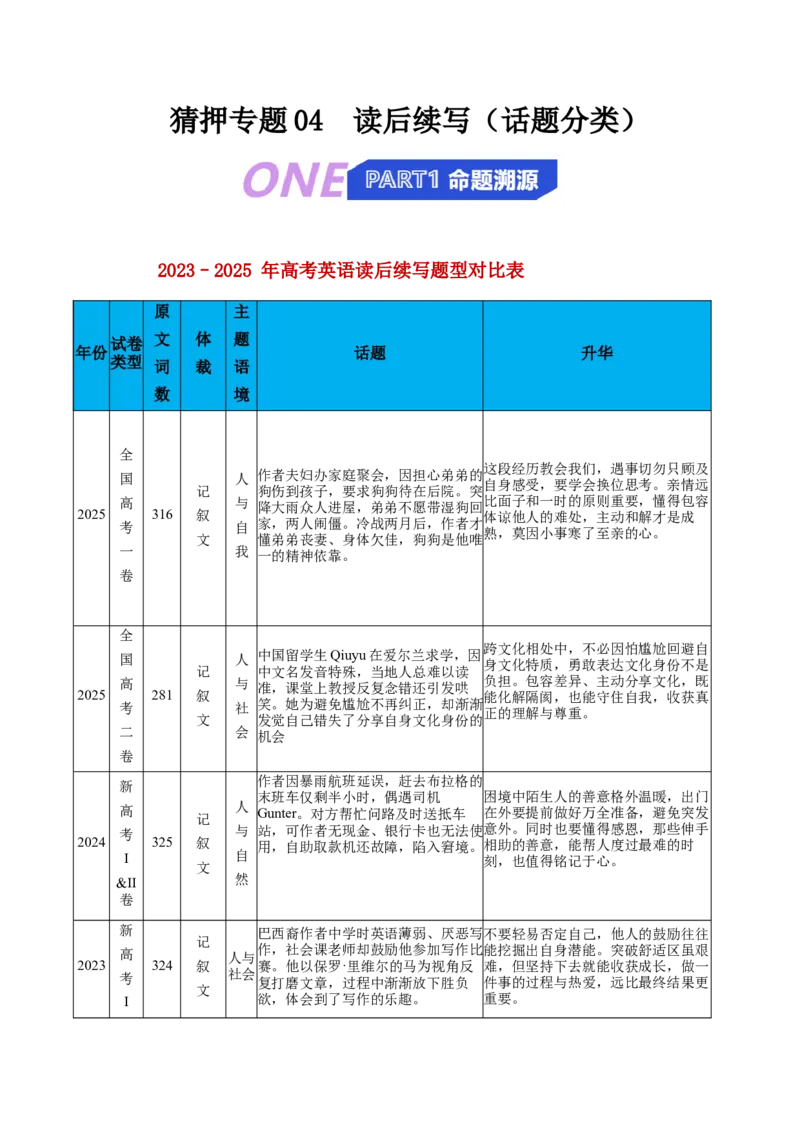
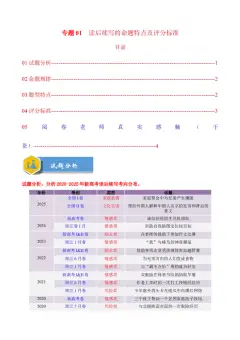
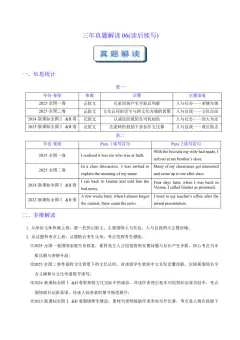
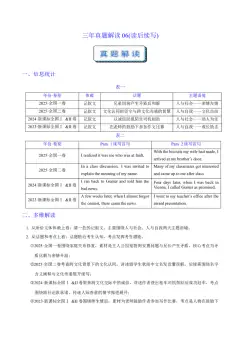
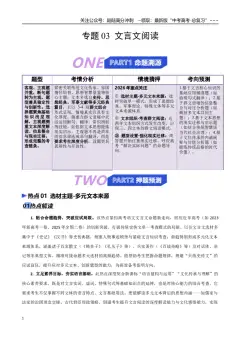
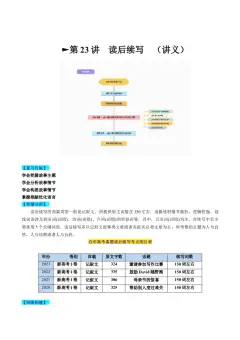
2023–2025 年高考英语读后续写题型对比表
年份试卷
类型
原
文
词
数
体
裁
主
题
语
境
话题
升华
2025
全
国
高
考
一
卷
316
记
叙
文
人
与
自
我
作者夫妇办家庭聚会,因担心弟弟的
狗伤到孩子,要求狗狗待在后院。突
降大雨众人进屋,弟弟不愿带湿狗回
家,两人闹僵。冷战两月后,作者才
懂弟弟丧妻、身体欠佳,狗狗是他唯
一的精神依靠。
这段经历教会我们,遇事切勿只顾及
自身感受,要学会换位思考。亲情远
比面子和一时的原则重要,懂得包容
体谅他人的难处,主动和解才是成
熟,莫因小事寒了至亲的心。
2025
全
国
高
考
二
卷
281
记
叙
文
人
与
社
会
中国留学生Qiuyu 在爱尔兰求学,因
中文名发音特殊,当地人总难以读
准,课堂上教授反复念错还引发哄
笑。她为避免尴尬不再纠正,却渐渐
发觉自己错失了分享自身文化身份的
机会
跨文化相处中,不必因怕尴尬回避自
身文化特质,勇敢表达文化身份不是
负担。包容差异、主动分享文化,既
能化解隔阂,也能守住自我,收获真
正的理解与尊重。
2024
新
高
考
I
&II
卷
325
记
叙
文
人
与
自
然
作者因暴雨航班延误,赶去布拉格的
末班车仅剩半小时,偶遇司机
Gunter。对方帮忙问路及时送抵车
站,可作者无现金、银行卡也无法使
用,自助取款机还故障,陷入窘境。
困境中陌生人的善意格外温暖,出门
在外要提前做好万全准备,避免突发
意外。同时也要懂得感恩,那些伸手
相助的善意,能帮人度过最难的时
刻,也值得铭记于心。
2023
新
高
考
I
324
记
叙
文
人与
社会
巴西裔作者中学时英语薄弱、厌恶写
作,社会课老师却鼓励他参加写作比
赛。他以保罗·里维尔的马为视角反
复打磨文章,过程中渐渐放下胜负
欲,体会到了写作的乐趣。
不要轻易否定自己,他人的鼓励往往
能挖掘出自身潜能。突破舒适区虽艰
难,但坚持下去就能收获成长,做一
件事的过程与热爱,远比最终结果更
重要。
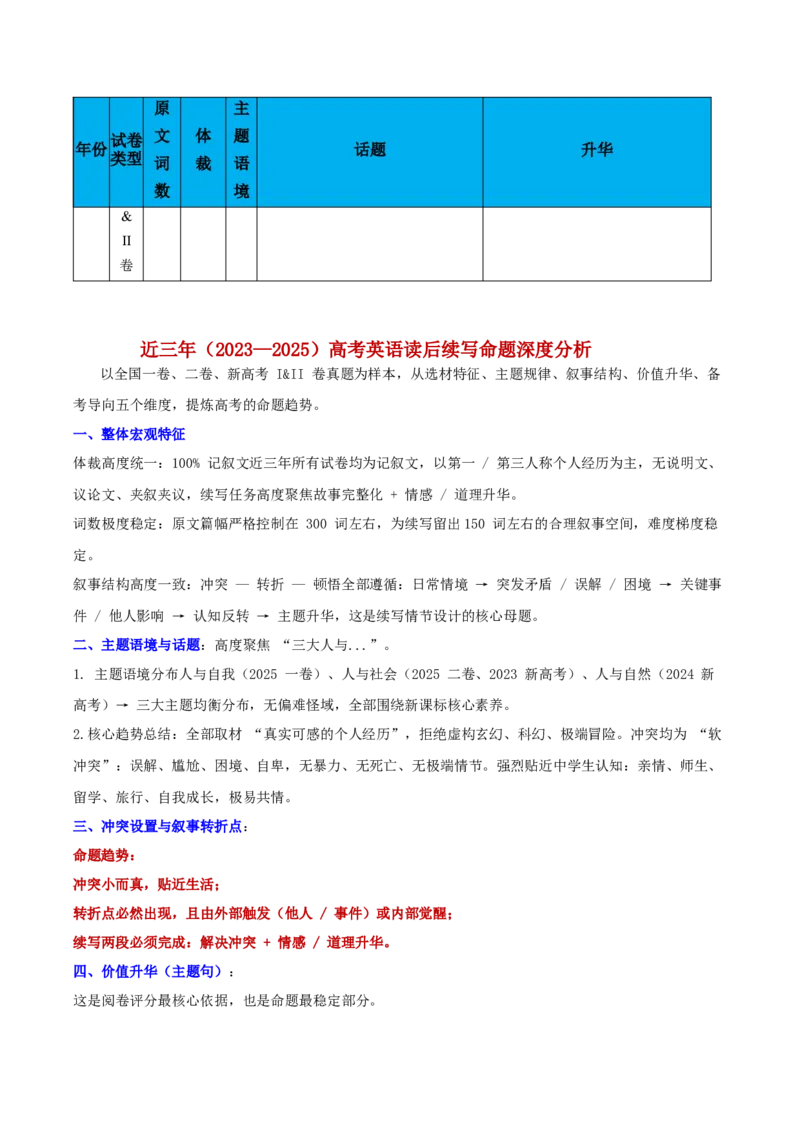
年份试卷
类型
原
文
词
数
体
裁
主
题
语
境
话题
升华
&
II
卷
近三年(2023—2025)高考英语读后续写命题深度分析
以全国一卷、二卷、新高考 I&II 卷真题为样本,从选材特征、主题规律、叙事结构、价值升华、备
考导向五个维度,提炼高考的命题趋势。
一、整体宏观特征
体裁高度统一:100% 记叙文近三年所有试卷均为记叙文,以第一 / 第三人称个人经历为主,无说明文、
议论文、夹叙夹议,续写任务高度聚焦故事完整化 + 情感 / 道理升华。
词数极度稳定:原文篇幅严格控制在 300 词左右,为续写留出150 词左右的合理叙事空间,难度梯度稳
定。
叙事结构高度一致:冲突 — 转折 — 顿悟全部遵循:日常情境 → 突发矛盾 / 误解 / 困境 → 关键事
件 / 他人影响 → 认知反转 → 主题升华,这是续写情节设计的核心母题。
二、主题语境与话题:高度聚焦 “三大人与...”。
1. 主题语境分布人与自我(2025 一卷)、人与社会(2025 二卷、2023 新高考)、人与自然(2024 新
高考)→ 三大主题均衡分布,无偏难怪域,全部围绕新课标核心素养。
2.核心趋势总结:全部取材 “真实可感的个人经历”,拒绝虚构玄幻、科幻、极端冒险。冲突均为 “软
冲突”:误解、尴尬、困境、自卑,无暴力、无死亡、无极端情节。强烈贴近中学生认知:亲情、师生、
留学、旅行、自我成长,极易共情。
三、冲突设置与叙事转折点:
命题趋势:
冲突小而真,贴近生活;
转折点必然出现,且由外部触发(他人 / 事件)或内部觉醒;
续写两段必须完成:解决冲突 + 情感 / 道理升华。
四、价值升华(主题句):
这是阅卷评分最核心依据,也是命题最稳定部分。
近三年升华主题归类:
1、换位思考与包容(亲情)
2、遇事勿只顾及自身感受,学会换位思考;亲情重于面子,主动和解是成熟。
2、文化自信与跨文化包容
4、不必回避文化特质,勇敢表达身份;包容差异,收获理解与尊重。
5、陌生人善意与感恩
6、困境中善意最温暖;懂得感恩,铭记相助。
7、自我成长与过程价值
8、不否定自己,鼓励挖掘潜能;热爱与过程远比结果重要。
极强命题规律:
所有升华均为 “正向价值观”:理解、尊重、感恩、勇敢、坚持、包容。
无一例外:从个人小事上升到人生道理 / 处世智慧。
语言风格:凝练、哲理、可直接用作结尾段。
五、近三年命题核心趋势总判断
1. 稳定性极强:体裁、词数、结构三年几乎不变
体裁:只考记叙文
词数:原文 300 词左右
结构:冲突 — 转折 — 顿悟 — 升华→ 备考无需猜体裁,只需深耕记叙文续写。
2. 选材越来越 “本土化 + 生活化”
2023:个人成长(美式校园)
2024:欧洲旅行困境
2025:中国家庭亲情、中国留学生文化身份→ 中国元素、中国情感、文化自信显著增强,更贴近国内考
生生活。
3. 冲突从 “外部困境” 转向 “内部心理”
2024:外部突发困难(偏情节)
2025:亲情误解、文化心理尴尬(偏心理与情感)→ 未来更侧重心理描写、情感变化、对话细节,对心
理、情绪词汇要求提高。
4. 主题升华从 “道理说教” 转向 “温和共情”
更强调:换位思考、自我接纳、文化认同、和解与包容→ 续写结尾不再喊口号,而是走心感悟。
5. 对续写两段的逻辑要求更高
必须满足:
第一段:推进情节、揭示真相 / 关键行动
第二段:解决矛盾、情感升华、点题严格闭环,不能开放结局。
六、对 2026 年备考的直接启示
1、重点训练四类母题:亲情误解与和解、文化身份与跨文化相处、陌生人善意与感恩、自我突破与成长
2、强化三类描写:心理描写(愧疚、尴尬、顿悟、感动)、对话描写(推动冲突与和解)、细节动作
(体现态度转变)。
3、结尾升华模板化准备围绕:understanding, empathy, tolerance, courage, gratitude, growth 构
建万能升华句。
4、重视中国元素故事家庭、亲情、文化身份、留学生活将成为主流选材方向。
5、命题特点预测
伏笔呼应常态化:续写必须严格呼应原文细节、物品、动作、心理等伏笔,无依据创作将大幅扣分。
情感描写深度化:要求多层次心理变化(如紧张→冷静→感动),搭配精准动作、神态、环境细节烘托。
逻辑严谨性提升:两段续写需形成因果、递进、转折清晰逻辑,结尾必须紧扣主题正向升华,杜绝开放式
消极结尾。
语言综合性增强:同一续写段落综合考查高级词汇、非谓语、倒装、强调句、独立主格等,语言地道性与
文采并重。
文化元素融入:可能结合传统节日、非遗体验、文化实践等中国元素,在续写中体现文化认知与价值认
同。
考点1 亲情误解与和解类
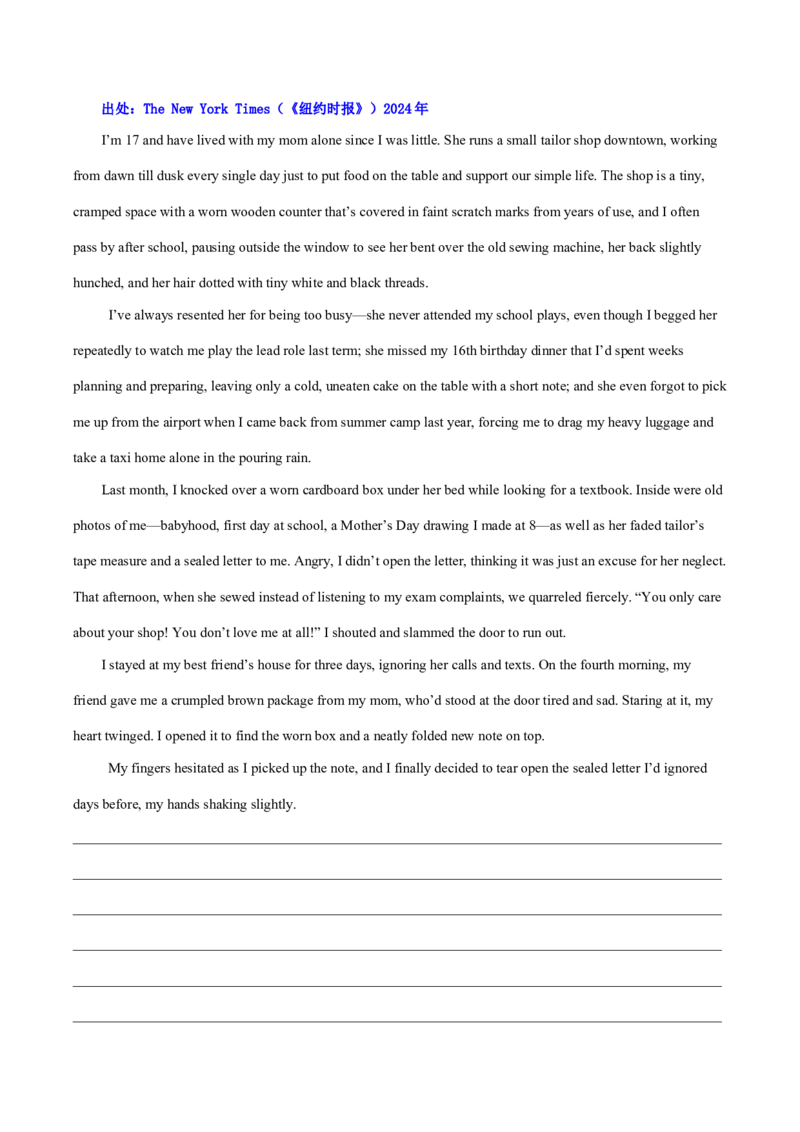
Passage 1
出处:The New York Times(《纽约时报》)2024 年
I’m 17 and have lived with my mom alone since I was little. She runs a small tailor shop downtown, working
from dawn till dusk every single day just to put food on the table and support our simple life. The shop is a tiny,
cramped space with a worn wooden counter that’s covered in faint scratch marks from years of use, and I often
pass by after school, pausing outside the window to see her bent over the old sewing machine, her back slightly
hunched, and her hair dotted with tiny white and black threads.
 I’ve always resented her for being too busy—she never attended my school plays, even though I begged her
repeatedly to watch me play the lead role last term; she missed my 16th birthday dinner that I’d spent weeks
planning and preparing, leaving only a cold, uneaten cake on the table with a short note; and she even forgot to pick
me up from the airport when I came back from summer camp last year, forcing me to drag my heavy luggage and
take a taxi home alone in the pouring rain.
Last month, I knocked over a worn cardboard box under her bed while looking for a textbook. Inside were old
photos of me—babyhood, first day at school, a Mother’s Day drawing I made at 8—as well as her faded tailor’s
tape measure and a sealed letter to me. Angry, I didn’t open the letter, thinking it was just an excuse for her neglect.
That afternoon, when she sewed instead of listening to my exam complaints, we quarreled fiercely. “You only care
about your shop! You don’t love me at all!” I shouted and slammed the door to run out.
I stayed at my best friend’s house for three days, ignoring her calls and texts. On the fourth morning, my
friend gave me a crumpled brown package from my mom, who’d stood at the door tired and sad. Staring at it, my
heart twinged. I opened it to find the worn box and a neatly folded new note on top.
 My fingers hesitated as I picked up the note, and I finally decided to tear open the sealed letter I’d ignored
days before, my hands shaking slightly.
____________________________________________________________________________________________
____________________________________________________________________________________________
____________________________________________________________________________________________
____________________________________________________________________________________________
____________________________________________________________________________________________
____________________________________________________________________________________________
____________________________________________________________________________________________
____________________________________________________________________________________________
Tears streamed down my cheeks as I finished reading. I grabbed my bag and rushed out of my friend’s house,
heading straight to my mom’s tailor shop.
____________________________________________________________________________________________
____________________________________________________________________________________________
____________________________________________________________________________________________
____________________________________________________________________________________________
____________________________________________________________________________________________
____________________________________________________________________________________________
二、续写要求
1. 所续写短文的词数应为150 左右;
2. 续写部分分为两段,每段开头已给出,不计入总词数;
3. 内容需紧扣“亲情误解与和解”主题,与原文情节、人物性格一致,逻辑连贯;
4. 合理运用心理描写、对话描写、细节动作描写,体现情感变化;
5. 结尾需完成情感升华,契合高考“换位思考、包容理解”的价值导向。
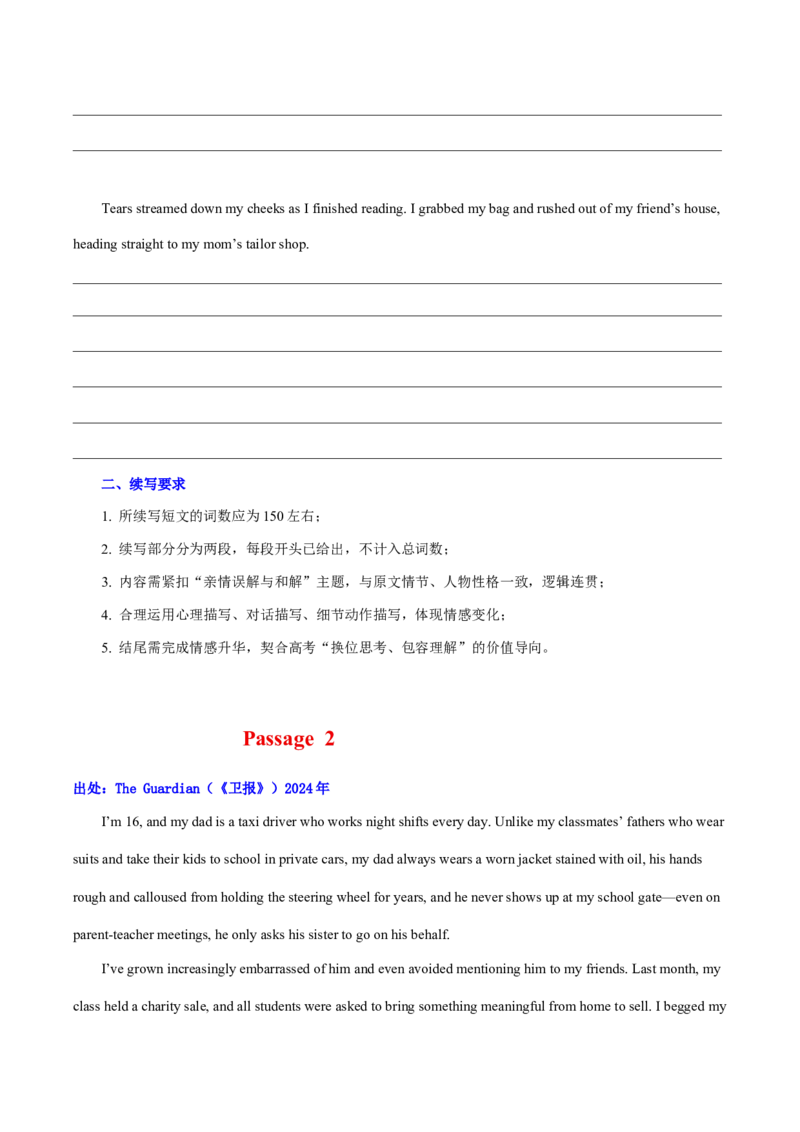
Passage 2
出处:The Guardian(《卫报》)2024 年
I’m 16, and my dad is a taxi driver who works night shifts every day. Unlike my classmates’ fathers who wear
suits and take their kids to school in private cars, my dad always wears a worn jacket stained with oil, his hands
rough and calloused from holding the steering wheel for years, and he never shows up at my school gate—even on
parent-teacher meetings, he only asks his sister to go on his behalf.
I’ve grown increasingly embarrassed of him and even avoided mentioning him to my friends. Last month, my
class held a charity sale, and all students were asked to bring something meaningful from home to sell. I begged my
dad to let me take his old watch—a gift from my late mom—but he refused firmly, saying it was “the most precious
thing he had”. I was furious, yelling at him, “You’re so selfish! You only care about your own memories, not my
feelings at all!” He opened his mouth to explain, but I turned around and ran back to my room, slamming the door
shut.
Since then, we barely spoke to each other. I avoided him whenever he came home from work, and he just
sighed quietly and left me alone. Yesterday afternoon, I accidentally knocked over his old suitcase while cleaning
the living room. Inside, I found a stack of medical bills from three years ago, a photo of my mom holding the
watch, and a diary. Curious and still angry, I flipped through the diary, and my eyes froze on the words written in
his messy handwriting.
My hands started to shake as I read on, and tears welled up in my eyes unconsciously.
__________________________________________________________________________________________
________________________________________________________________________________________
____________________________________________________________________________________________
____________________________________________________________________________________________
____________________________________________________________________________________________
____________________________________________________________________________________________
____________________________________________________________________________________________
____________________________________________________________________________________________
____________________________________________________________________________________________
I grabbed the watch from the suitcase and rushed to the taxi station where he usually waited for passengers.
____________________________________________________________________________________________
____________________________________________________________________________________________
__________________________________________________________________________________________
____________________________________________________________________________________________
____________________________________________________________________________________________
____________________________________________________________________________________________
____________________________________________________________________________________________
二、续写要求
1. 所续写短文的词数应为150 左右;
2. 续写部分分为两段,每段开头已给出,不计入总词数;
3. 内容需紧扣“亲情误解与和解”主题,与原文情节、人物性格一致,逻辑连贯;
4. 合理运用心理描写、对话描写、细节动作描写,体现情感变化;
5. 结尾需完成情感升华,契合高考“换位思考、包容理解”的价值导向。
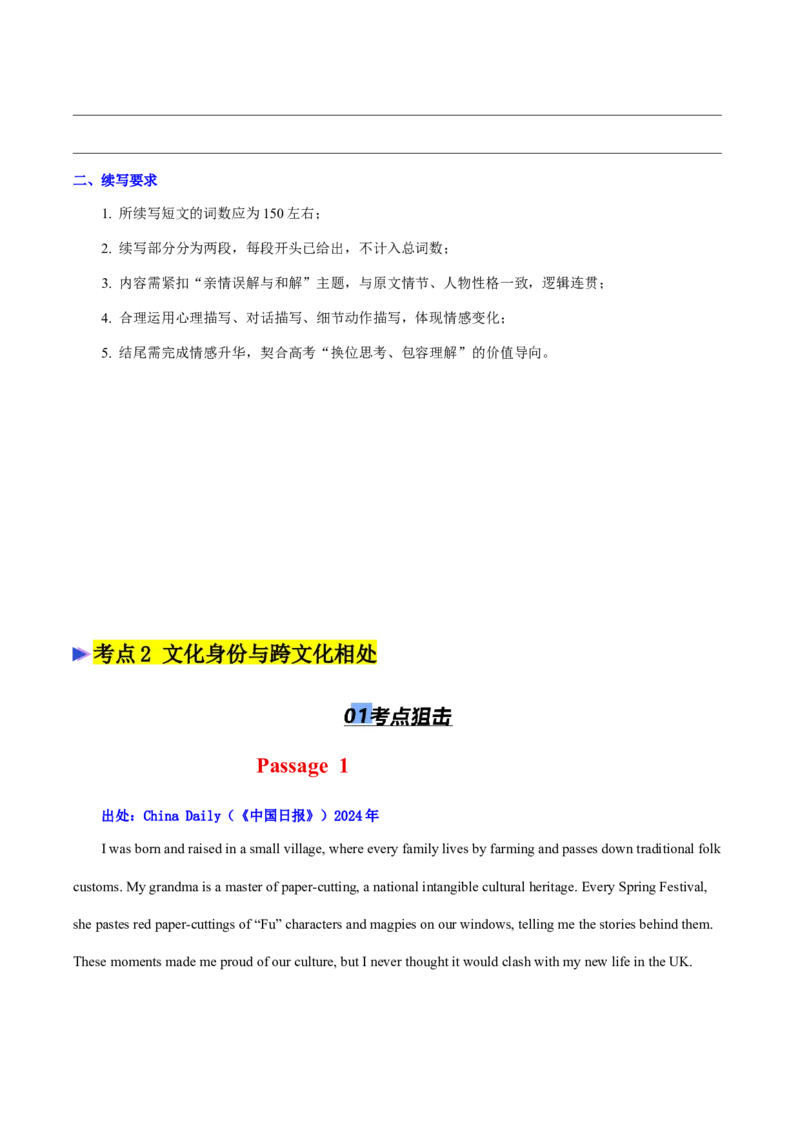
考点2 文化身份与跨文化相处
Passage 1
出处:China Daily(《中国日报》)2024 年
I was born and raised in a small village, where every family lives by farming and passes down traditional folk
customs. My grandma is a master of paper-cutting, a national intangible cultural heritage. Every Spring Festival,
she pastes red paper-cuttings of “Fu” characters and magpies on our windows, telling me the stories behind them.
These moments made me proud of our culture, but I never thought it would clash with my new life in the UK.
Last year, I went to Manchester to study abroad. At first, I was excited, but soon felt lost. In my art class, my
classmates praised my grandma’s paper-cuttings as “cute” but ignored their cultural meanings. When I hosted a
Mid-Autumn Festival party, most guests only took photos and left without asking about the festival’s origins. I felt
my culture was reduced to a “trendy snack”, beautiful but shallow, stripped of its soul and history.
Worse, my British roommate Tom often joked about my “old-fashioned” habits, laughing when I cooked
Shandong-style dishes instead of eating fast food. He said, “Why care about those old traditions? The world is
globalized.” His words made me angry and sad. I even hid my paper-cutting tools, afraid of being laughed at and
losing the little sense of belonging I had left.
One day, our art teacher assigned a “My Cultural Identity” project. As I prepared, I sorted through my
grandma’s works and read about paper-cutting history. I realized I’d given up too easily. On presentation day, I
brought a paper-cutting of a British lion and Chinese dragon, intertwined harmoniously, explaining its meaning.
When I finished, the classroom burst into applause. Tom apologized shyly: “Your culture is amazing, and I want to
learn more.” That day, I finally understood that globalization does not mean abandoning traditions, but sharing
them with confidence and respect.
On the presentation day, I brought my grandma’s latest paper-cutting
work.________________________________________________________________________________________
____________________________________________________________________________________________
____________________________________________________________________________________________
____________________________________________________________________________________________
____________________________________________________________________________________________
____________________________________________________________________________________________
____________________________________________________________________________________________
________________________________________________________________________________________
From that day on, our relationship changed.
____________________________________________________________________________________________
____________________________________________________________________________________________
____________________________________________________________________________________________
____________________________________________________________________________________________
____________________________________________________________________________________________
____________________________________________________________________________________________
____________________________________________________________________________________________
____________________________________________________________________________________________
二、续写要求
1. 所续写短文的词数应为150 左右;
2. 续写部分分为两段,每段开头已给出,不计入总词数;
3. 内容需紧扣“文化身份与跨文化相处”主题,与原文情节、人物性格一致,逻辑连贯;
4. 合理运用心理描写、对话描写、细节动作描写,体现情感与认知的转变;
5. 结尾需完成情感升华,契合高考“文化自信、包容互鉴”的价值导向。
Passage 2
出处:The Guardian(《卫报》)2025 年
Lila is a 17-year-old British girl who has lived in Shanghai for five years with her parents, who work for a
multinational company. She grew up eating dumplings and zongzi, celebrating Spring Festival and Mid-Autumn
Festival, and can speak fluent Mandarin with a slight Shandong accent, learned from her Chinese neighbor Aunt Li.
To others, Lila is a “China expert”, but she’s always confused about her cultural identity: “Am I British, Chinese,
or a mix of both?”
This confusion worsened last month, when her school held a “Cross-Cultural Family Day” and asked her to
give a speech about her cultural background. She planned to talk about both her British roots and Chinese life, and
teach others to make British shortbread and Chinese paper lanterns. But her British classmates said she should only
talk about British culture, while her Chinese friends said she wasn’t “really Chinese” for not knowing enough about
Chinese history.
Their words made Lila anxious and frustrated. She doubted whether she could belong to either culture. On the
eve of the event, she stared at a family photo: her father with a Union Jack, her mother with a Chinese fan, and
herself holding both. She remembered Aunt Li’s words: “Your two cultures are not opposites—they’re two sides of
the same coin.” Inspired, Lila reworked her speech, focusing on “Two Homes, One Heart”.
She talked about growing up in Shanghai, her love for both shortbread and dumplings, and played a video of
her baking with her dad and making lanterns with Aunt Li. She ended: “My identity is not a choice between two
worlds, but a beautiful combination. I’m proud to be a bridge between British and Chinese cultures.”
When Lila finished her speech, the audience broke into loud applause.
____________________________________________________________________________________________
____________________________________________________________________________________________
____________________________________________________________________________________________
____________________________________________________________________________________________
____________________________________________________________________________________________
____________________________________________________________________________________________
____________________________________________________________________________________________
After the event, Lila and her classmates started a “Cross-Cultural Club” at school, where they shared food,
music, and traditions from different
countries.____________________________________________________________________________________
____________________________________________________________________________________________
____________________________________________________________________________________________
____________________________________________________________________________________________
____________________________________________________________________________________________
____________________________________________________________________________________________
__________________________________________________________________________________________
二、续写要求
1. 所续写短文的词数应为150 左右;
2. 续写部分分为两段,每段开头已给出,不计入总词数;
3. 内容需紧扣“文化身份与跨文化相处”主题,与原文情节、人物性格一致,逻辑连贯;
4. 合理运用心理描写、对话描写、细节动作描写,体现文化认同的建立;
5. 结尾需完成情感升华,契合高考“文化融合、多元共生”的价值导向。
考点3 陌生人善意与感恩
Passage 1
出处:The New York Times《纽约时报》2025 年
It was a cold winter evening, and I was rushing to catch the last bus home after school. I pulled out my wallet
to pay the fare, only to find it was gone—probably dropped somewhere on my way to the bus stop. Panicked, I
searched my schoolbag repeatedly, but there was no sign of it. The bus driver looked at me with sympathy, but he
couldn’t let me board without paying. I stood there, shivering in the wind, feeling helpless and alone. I had no
phone to call my parents, and I didn’t know anyone in the neighborhood.
Just as I was about to burst into tears, an old lady standing nearby tapped me on the shoulder. She was wearing
a thick woolen coat and a warm scarf, her eyes full of kindness. “Dear, are you okay?” she asked gently. I
explained my situation, my voice trembling, tears rolling down my cheeks. I told her I had saved the money for
weeks to buy a birthday gift for my mom, and now I even couldn’t go home. The old lady patted my head softly,
her smile even warmer. She took out a tissue from her pocket and wiped my tears, her hands warm against my cold
cheeks, tears rolling down my cheeks. I told her I had saved the money for weeks to buy a birthday gift for my
mom, and now I even couldn’t go home. The old lady patted my head softly, her smile even warmer. Without
hesitation, she took out a coin from her pocket and handed it to me. “Here, take this. It’s enough for your bus fare,”
she said with a smile. I tried to refuse, saying I would pay her back, but she shook her head firmly firmly. “A little
kindness never hurts,” she said, patting my hand softly. “Go home safely, dear. Everything will be okay.” “Go
home safely, dear. Everything will be okay.” I boarded the bus, and when I turned to thank her again, she was
already walking away, her figure disappearing into the cold night, leaving a warm light in my heart. I watched her
until she was out of sight, silently vowing to never forget her kindness, leaving a warm light in my heart.
That night, I couldn’t stop thinking about the old lady’s
kindness._____________________________________________________________________________________
____________________________________________________________________________________________
____________________________________________________________________________________________
____________________________________________________________________________________________
____________________________________________________________________________________________
____________________________________________________________________________________________
A few weeks later, I was walking past the same bus stop when I saw the old lady
again._______________________________________________________________________________________
____________________________________________________________________________________________
____________________________________________________________________________________________
____________________________________________________________________________________________
____________________________________________________________________________________________
_____________________________________________________________________________
二、续写要求
1. 所续写短文的词数应为150 左右;
2. 续写部分分为两段,每段开头已给出,不计入总词数;
3. 内容需紧扣“陌生人善意与感恩”主题,与原文情节、人物性格一致,逻辑连贯;
4. 合理运用心理描写、对话描写、细节动作描写,体现情感的传递与升华;
5. 结尾需完成情感升华,契合高考“传递温暖、懂得感恩”的价值导向。
Passage 2
出处:The Washington Post(《华盛顿邮报》)2025 年
During my summer vacation, I traveled to a small coastal town with my family. One afternoon, I went for a
walk alone along the beach and got lost. The sun was setting, and the wind was getting stronger. I walked around
aimlessly, feeling more and more anxious. I didn’t have a map, and my phone had no signal. Just as I was about to
give up, a local fisherman noticed me standing by the road, looking confused. He was tall and tanned, with a
friendly smile on his face. His hands were rough and calloused, a clear sign of years of working at sea, and he wore
a faded blue work shirt and a worn straw hat that shielded his face from the setting sun.
He walked over to me at a steady pace, his boots crunching on the gravel road, and his smile never faded as he
got closer. “You look like you’ve lost your way, kid,” he said in a deep, warm voice that sounded like the gentle
roar of the waves. I nodded eagerly, my voice trembling a little as I told him I’d wandered too far from my hotel
and couldn’t find my way back. I described the hotel’s name and the red roof I’d seen earlier, but I could feel my
anxiety rising again as I struggled to remember more details.
 The fisherman listened patiently, nodding occasionally and never interrupting me. When I finished, he
scratched his head lightly and said, “Don’t worry, I know exactly where that hotel is—it’s just a ten-minute ride
from here. I was on my way home after a day’s work, so I can give you a lift.” He pointed to a small, weathered
fishing boat parked nearby, its hull covered in faint salt stains from years of sailing.
I thanked him profusely, and he waved his hand dismissively, saying it was no trouble at all. As I followed
him to the boat, I noticed the faint smell of fish and sea salt on his clothes, a smell that felt warm and reassuring,
like the town itself. He helped me climb onto the boat, steadying my arm with his rough hand to make sure I didn’t
slip, and then started the engine, which roared to life with a low rumble.
That night, I sat by the window, thinking about the fisherman’s
kindness._____________________________________________________________________________________
____________________________________________________________________________________________
____________________________________________________________________________________________
____________________________________________________________________________________________
____________________________________________________________________________________________
_______________________________________________________________________________
A week later, when I went to the beach to pick up some seashells, I unexpectedly saw the kind fisherman
who had helped me that day, preparing his fishing gear for the next day’s
voyage.______________________________________________________________________________________
____________________________________________________________________________________________
____________________________________________________________________________________________
____________________________________________________________________________________________
____________________________________________________________________________________________
_____________________________________________________________________________
二、续写要求
1、续写部分分为两段,每段开头已给出,不计入总词数;
2、合理运用心理描写、对话描写、细节动作描写,体现感恩之情与善意的传递;
考点4 自我突破与成长
Passage 1
出处:The New York Times《纽约时报》2024 年
I have always been a shy girl who is afraid of speaking in public. Whenever the teacher asked a question in
class, I would lower my head, even if I knew the answer. I was afraid of making mistakes, being laughed at, or
letting others down. Last term, our school held an English speech contest, and our teacher encouraged everyone to
take part. I wanted to try, but the thought of standing in front of the whole school made my heart race. I hesitated
for a long time, and finally decided to give up.
Every day after that, I couldn’t help but pay attention to the students who signed up. I saw them practicing
their speeches in the corner of the classroom, repeating sentences over and over again, even when they made
mistakes. Their confidence and courage made me feel a little envious, yet I still couldn’t gather the courage to sign
up. I kept thinking about what would happen if I stood on the stage: my hands might shake, my voice might crack,
and I might forget all the words I had prepared. The fear of embarrassment was like a heavy stone pressing on my
chest, making it hard for me to breathe.
One afternoon, my English teacher noticed my hesitation. She pulled me aside gently and said, “It’s okay to be
nervous, but don’t let fear stop you from trying. Making mistakes is part of growing up, and no one will laugh at
you for daring to step forward.” Her words warmed my heart, and for a moment, I wanted to rush to the office to
sign up. But when I thought about the crowd of strangers staring at me, my courage disappeared again. I thanked
the teacher and ran away, feeling guilty and disappointed in myself.
On the day of the contest, I sat in the audience and watched the participants speak confidently. They spoke
fluently, with bright smiles, and even when some of them made small mistakes, they just laughed it off and kept
going. I couldn’t help but imagine what it would be like if I were up there. I felt a twinge of regret, knowing that I
had missed a chance to challenge myself. But deep down, I still hoped that one day, I could overcome my shyness
and stand bravely in front of everyone.
In the following weeks, I practiced my speech every spare
minute..______________________________________________________________________________________
____________________________________________________________________________________________
____________________________________________________________________________________________
____________________________________________________________________________________________
____________________________________________________________________________________________
______________________________________________________________________________
On the contest day, my heart pounded loudly as I stood on stage, hands sweaty and legs slightly
trembling____________________________________________________________________________________
____________________________________________________________________________________________
____________________________________________________________________________________________
____________________________________________________________________________________________
____________________________________________________________________________________________
________________________________________________________________________________
二、续写要求
1. 续写部分分为两段,每段开头已给出,不计入总词数;
2. 合理运用心理描写、动作描写、细节描写,体现克服恐惧、突破自我的过程;
Passage 2
出处:The Guardian(《卫报》)2025 年
My elder brother noticed my low spirits and came to talk to me. I was sitting on the floor, my guitar leaning
against the wall, its strings slightly out of tune, just like my messy mood. I had spent the whole weekend practicing
a new piece, but no matter how hard I tried, I couldn’t get the rhythm right—my fingers kept slipping off the
strings, producing harsh, broken notes that made me want to throw the guitar away. Tears of frustration blurred my
eyes, and I felt like a complete failure, wondering if I would ever be able to play the guitar well.
“Learning anything takes time and patience,” he said gently, sitting down beside me and patting my shoulder.
“You can’t expect to be good at it overnight. Every great guitarist started with sore fingers and broken notes. I still
remember when I first learned to play the piano, my fingers were so sore that I couldn’t even hold a cup of water
the next day, and I messed up the simplest melodies countless times. But I kept practicing, even when I wanted to
give up.”
He picked up my guitar, adjusted the strings carefully, and played a simple, warm melody. “The difference
between those who succeed and those who don’t is that the former never give up. It’s not about how talented you
are, but about how persistent you can be. You’ve only been practicing for a month—give yourself more time, and
you’ll see progress.” His words woke me up. I realized that I had been too impatient and had given up too easily. I
looked at my brother, nodded firmly, and took the guitar from his hands. I decided to stick to it, to practice every
day no matter how difficult it was, and not let my dream of becoming a guitarist fade away. From that day on, his
words became my motivation, pushing me to keep going even when I faced difficulties.
After three months of hard practice, the school held a talent show. I summoned up my courage and signed up
to play the
guitar._______________________________________________________________________________________
____________________________________________________________________________________________
____________________________________________________________________________________________
As the lights focused on me, I took a deep breath and gently placed my fingers on the strings, my brother’s
encouraging words echoing in my
mind.._______________________________________________________________________________________
____________________________________________________________________________________________
____________________________________________________________________________________________
____________________________________________________________________________________________
二、续写要求
1. 所续写短文的词数应为150 左右;
2. 内容需紧扣“自我突破与成长”主题,与原文情节、人物性格一致,逻辑连贯;
3. 结尾需完成情感升华,契合高考“坚持不懈、突破自我、成就自我”的价值导向。