查漏补缺07 易错阅读理解考点
阅读理解在新高考及全国卷英语笔试中均占40 分,分值接近笔试总分一半,是高考英语最核心的拉
分题型。三轮复习阶段,核心目标已从基础补漏转向专攻易错失分点,本专题正是为此量身打造。高考阅
读失分并非源于词汇量匮乏,而是集中在易混词汇辨析不清、熟词生义误用、逻辑连接词理解偏差、细节
与推理题陷入命题陷阱。本专题精准梳理上述核心易错考点,帮助学生跳出盲目刷题却低效的误区,针对
性突破可快速提升答题正确率,规避高频失分坑,适配高考命题“细节化、易错化”趋势,是三轮复习阅
读提分的关键专题,直接对接考场实战,夯实高考冲刺核心能力。
本专题梳理的阅读易错词汇、短语及固定搭配,均源自人教版新教材必修1—选择性必修4、外研版
必修1—选修4,核心集中于必修1—3、选择性必修2—3 的阅读篇章、单元核心词汇板块与长难句核心短
语,是高考阅读命题的教材溯源点,无超纲内容,贴合高考“源于教材、高于教材”的命题原则,便于学
生回归教材溯源易错点、巩固核心知识。
本板块为高考英语阅读理解三轮冲刺核心提分内容,
全覆盖高考阅读高频易错词汇、短语、逻辑连接词,拒绝零散无序罗列,严格按照阅读考察场景分为六大
类,每类词条不少于30 组,总词条数超200 组。所有词条均贴合高考阅读命题语境,摒弃单纯单词释义,
配套易错点标注+核心词义+易混辨析+高考真题改编例句,直击学生日常刷题、模考中的高频失分点,彻
底解决“词认识但分不清、句看懂但做不对”的核心问题,助力学生快速区分易混点、精准理解生义、把
握逻辑关系,攻克词汇类阅读障碍,稳步提升阅读正确率。
第一大类:阅读高频易混近义词(形近/义近动词)
本大类聚焦高考阅读细节题、推理题中最易混淆的形近、义近动词,共35 组,是阅读题干定位、选项辨
析的核心易错点,学生常因词性、用法、搭配差异误选,每组均标注核心易错陷阱,搭配2 个高考阅读改
编例句,强化语境区分。
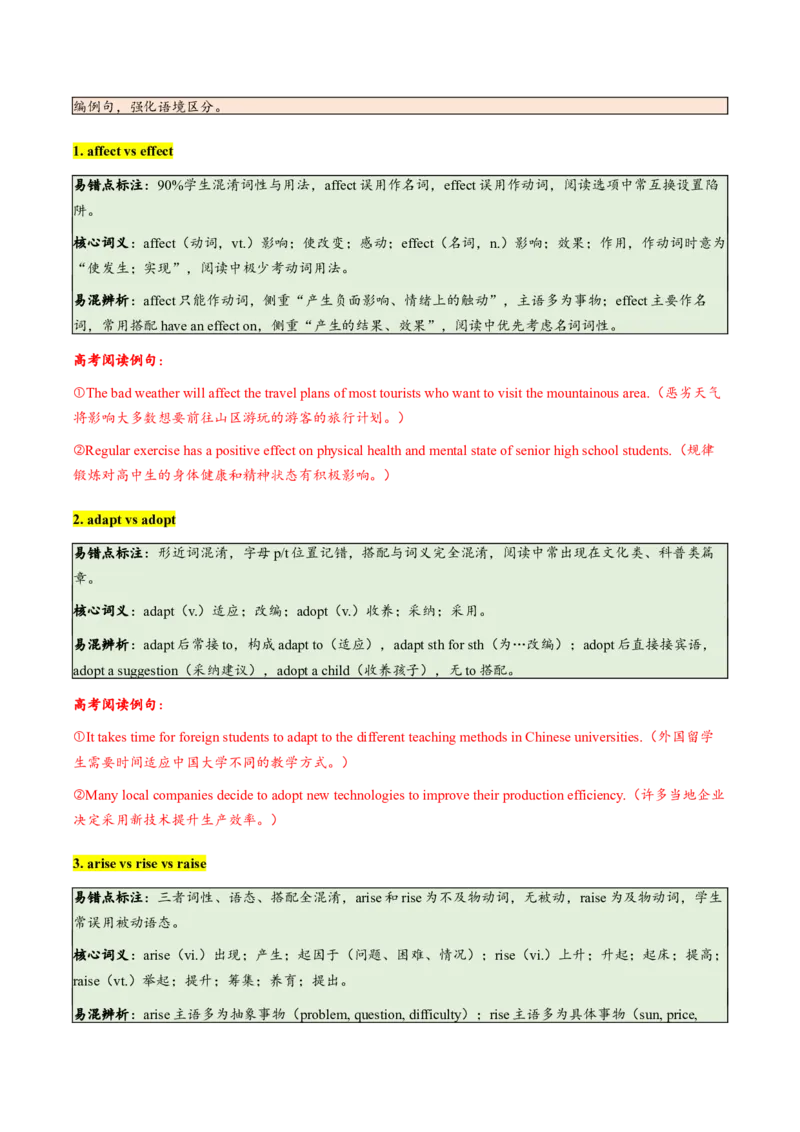
1. affect vs effect
易错点标注:90%学生混淆词性与用法,affect 误用作名词,effect 误用作动词,阅读选项中常互换设置陷
阱。
核心词义:affect(动词,vt.)影响;使改变;感动;effect(名词,n.)影响;效果;作用,作动词时意为
“使发生;实现”,阅读中极少考动词用法。
易混辨析:affect 只能作动词,侧重“产生负面影响、情绪上的触动”,主语多为事物;effect 主要作名
词,常用搭配have an effect on,侧重“产生的结果、效果”,阅读中优先考虑名词词性。
高考阅读例句:
The bad weather will affect the travel plans of most tourists who want to visit the mountainous area.
①
(恶劣天气
将影响大多数想要前往山区游玩的游客的旅行计划。)
Regular exercise has a positive effect on physical health and mental state of senior high school students.
②
(规律
锻炼对高中生的身体健康和精神状态有积极影响。)
2. adapt vs adopt
易错点标注:形近词混淆,字母p/t 位置记错,搭配与词义完全混淆,阅读中常出现在文化类、科普类篇
章。
核心词义:adapt(v.)适应;改编;adopt(v.)收养;采纳;采用。
易混辨析:adapt 后常接to,构成adapt to(适应),adapt sth for sth(为…改编);adopt 后直接接宾语,
adopt a suggestion(采纳建议),adopt a child(收养孩子),无to 搭配。
高考阅读例句:
It takes time for foreign students to adapt to the different teaching methods in Chinese universities.
①
(外国留学
生需要时间适应中国大学不同的教学方式。)
Many local companies decide to adopt new technologies to improve their production efficiency.
②
(许多当地企业
决定采用新技术提升生产效率。)
3. arise vs rise vs raise
易错点标注:三者词性、语态、搭配全混淆,arise 和rise 为不及物动词,无被动,raise 为及物动词,学生
常误用被动语态。
核心词义:arise(vi.)出现;产生;起因于(问题、困难、情况);rise(vi.)上升;升起;起床;提高;
raise(vt.)举起;提升;筹集;养育;提出。
易混辨析:arise 主语多为抽象事物(problem, question, difficulty);rise 主语多为具体事物(sun, price,
temperature),无宾语;raise 必须接宾语,可用于被动语态。
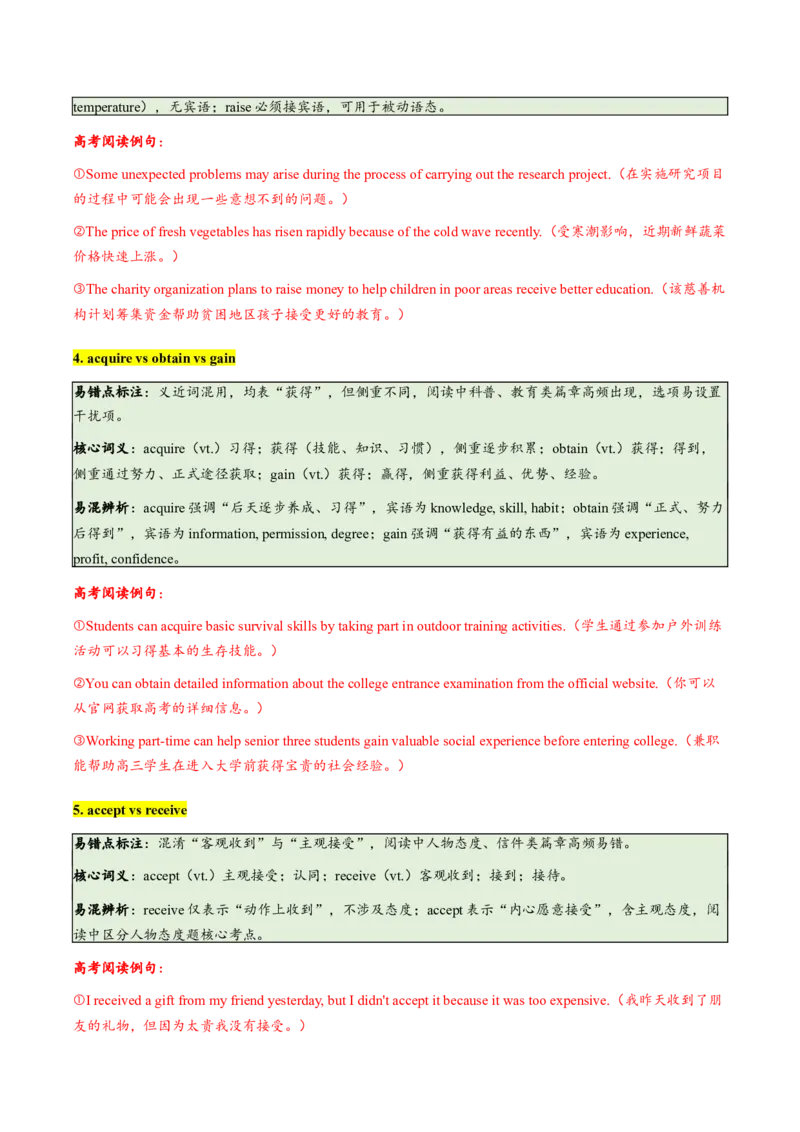
高考阅读例句:
Some unexpected problems may arise during the process of carrying out the research project.
①
(在实施研究项目
的过程中可能会出现一些意想不到的问题。)
The price of fresh vegetables has risen rapidly because of the cold wave recently.
②
(受寒潮影响,近期新鲜蔬菜
价格快速上涨。)
The charity organization plans to raise money to help children in poor areas receive better education.
③
(该慈善机
构计划筹集资金帮助贫困地区孩子接受更好的教育。)
4. acquire vs obtain vs gain
易错点标注:义近词混用,均表“获得”,但侧重不同,阅读中科普、教育类篇章高频出现,选项易设置
干扰项。
核心词义:acquire(vt.)习得;获得(技能、知识、习惯),侧重逐步积累;obtain(vt.)获得;得到,
侧重通过努力、正式途径获取;gain(vt.)获得;赢得,侧重获得利益、优势、经验。
易混辨析:acquire 强调“后天逐步养成、习得”,宾语为knowledge, skill, habit;obtain 强调“正式、努力
后得到”,宾语为information, permission, degree;gain 强调“获得有益的东西”,宾语为experience,
profit, confidence。
高考阅读例句:
Students can acquire basic survival skills by taking part in outdoor training activities.
①
(学生通过参加户外训练
活动可以习得基本的生存技能。)
You can obtain detailed information about the college entrance examination from the official website.
②
(你可以
从官网获取高考的详细信息。)
Working part-time can help senior three students gain valuable social experience before entering college.
③
(兼职
能帮助高三学生在进入大学前获得宝贵的社会经验。)
5. accept vs receive
易错点标注:混淆“客观收到”与“主观接受”,阅读中人物态度、信件类篇章高频易错。
核心词义:accept(vt.)主观接受;认同;receive(vt.)客观收到;接到;接待。
易混辨析:receive 仅表示“动作上收到”,不涉及态度;accept 表示“内心愿意接受”,含主观态度,阅
读中区分人物态度题核心考点。
高考阅读例句:
I received a gift from my friend yesterday, but I didn't accept it because it was too expensive.
①
(我昨天收到了朋
友的礼物,但因为太贵我没有接受。)
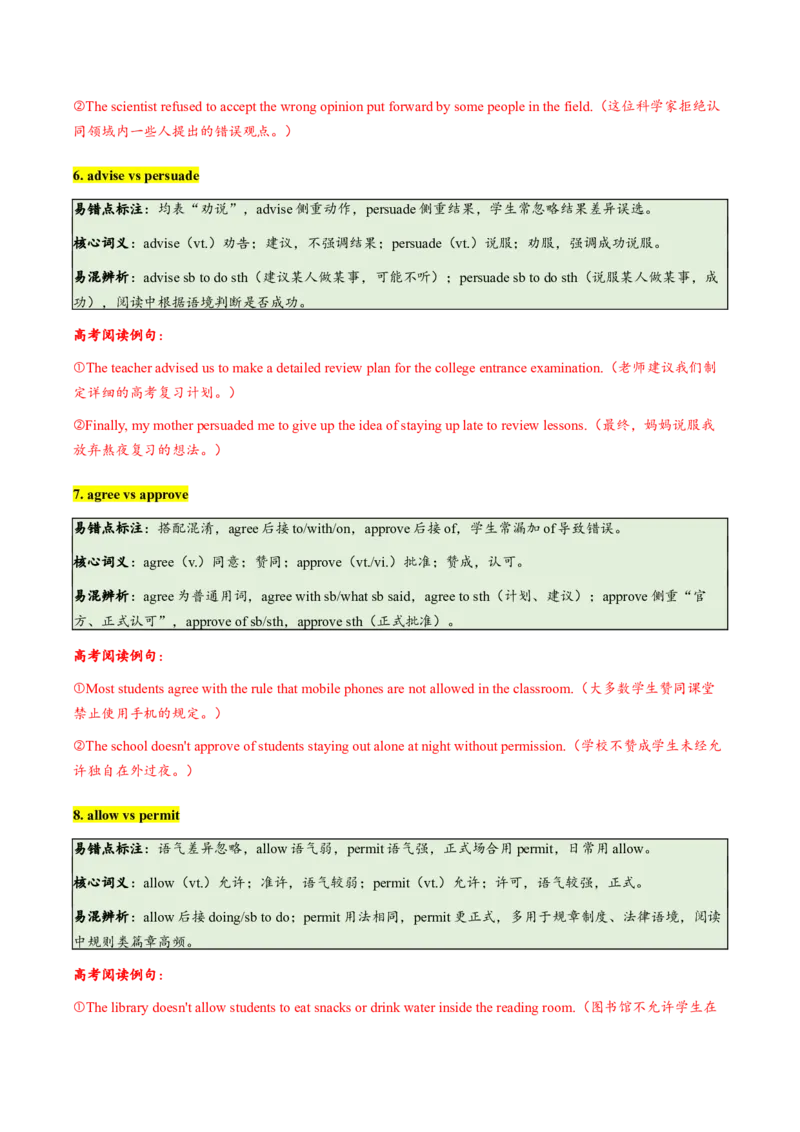
The scientist refused to accept the wrong opinion put forward by some people in the field.
②
(这位科学家拒绝认
同领域内一些人提出的错误观点。)
6. advise vs persuade
易错点标注:均表“劝说”,advise 侧重动作,persuade 侧重结果,学生常忽略结果差异误选。
核心词义:advise(vt.)劝告;建议,不强调结果;persuade(vt.)说服;劝服,强调成功说服。
易混辨析:advise sb to do sth(建议某人做某事,可能不听);persuade sb to do sth(说服某人做某事,成
功),阅读中根据语境判断是否成功。
高考阅读例句:
The teacher advised us to make a detailed review plan for the college entrance examination.
①
(老师建议我们制
定详细的高考复习计划。)
Finally, my mother persuaded me to give up the idea of staying up late to review lessons.
②
(最终,妈妈说服我
放弃熬夜复习的想法。)
7. agree vs approve
易错点标注:搭配混淆,agree 后接to/with/on,approve 后接of,学生常漏加of 导致错误。
核心词义:agree(v.)同意;赞同;approve(vt./vi.)批准;赞成,认可。
易混辨析:agree 为普通用词,agree with sb/what sb said,agree to sth(计划、建议);approve 侧重“官
方、正式认可”,approve of sb/sth,approve sth(正式批准)。
高考阅读例句:
Most students agree with the rule that mobile phones are not allowed in the classroom.
①
(大多数学生赞同课堂
禁止使用手机的规定。)
The school doesn't approve of students staying out alone at night without permission.
②
(学校不赞成学生未经允
许独自在外过夜。)
8. allow vs permit
易错点标注:语气差异忽略,allow 语气弱,permit 语气强,正式场合用permit,日常用allow。
核心词义:allow(vt.)允许;准许,语气较弱;permit(vt.)允许;许可,语气较强,正式。
易混辨析:allow 后接doing/sb to do;permit 用法相同,permit 更正式,多用于规章制度、法律语境,阅读
中规则类篇章高频。
高考阅读例句:
The library doesn't allow students to eat snacks or drink water inside the reading room.
①
(图书馆不允许学生在
阅览室内吃零食喝水。)
No one is permitted to take photos of the ancient paintings in the museum without permission.
②
(未经允许,任
何人不得给博物馆内的古画拍照。)
9. answer vs reply
易错点标注:及物与不及物混淆,answer 为及物动词,直接接宾语;reply 为不及物动词,需加to。
核心词义:answer(vt./vi.)回答;答复;reply(vi.)回答;回复,正式。
易混辨析:answer 直接接question/letter;reply 后接to 再接宾语,reply to a question/letter,阅读中书信、问
答类篇章易错。
高考阅读例句:
The expert tried his best to answer all the questions raised by the students at the lecture.
①
(专家在讲座上尽力回
答了学生提出的所有问题。)
I wrote an email to the customer service last week, but they haven't replied to me yet.
②
(我上周给客服写了邮
件,但他们还没有回复我。)
10. appear vs seem vs look
易错点标注:侧重不同混淆,appear 侧重表面印象,seem 侧重判断,look 侧重视觉,阅读中人物状态、事
物描述易错。
核心词义:appear(vi.)似乎;显得,侧重表面看起来;seem(vi.)似乎;好像,侧重主观判断;look
(vi.)看起来,侧重视觉感受。
易混辨析:appear/seem/look 后均可接adj./to do,It seems that...为固定句型,look 可用于look like,appear
无此用法。
高考阅读例句:
The old man appears very healthy though he is over eighty years old.
①
(这位老人虽然八十多岁了,看起来很
健康。)
It seems that more and more teenagers are paying attention to traditional Chinese culture nowadays.
②
(如今似乎
越来越多青少年关注中国传统文化。)
You look tired. You should have a good rest after studying for a long time.
③
(你看起来很累,长时间学习后应
该好好休息。)
11. beat vs win
易错点标注:宾语混淆,beat 接人/队伍,win 接比赛/奖品/荣誉,学生常混用宾语。
核心词义:beat(vt.)打败;战胜,宾语为人/团队;win(vt.)赢得;获胜,宾语为比赛、奖项、荣誉。
易混辨析:beat 后接opponent/team;win 后接game/match/prize/honor,过去式beat,过去分词beaten;win
过去式won,过去分词won。
高考阅读例句:
Our school basketball team beat the team from No.3 High School in the final match.
①
(我校篮球队在决赛中打
败了第三中学的队伍。)
She won first prize in the national English writing competition last year.
②
(她去年在全国英语写作比赛中获得
一等奖。)
12. break vs rest
易错点标注:休息时长混淆,break 为短暂休息,rest 为长时间休息,阅读中日常、校园类篇章易错。
核心词义:break(n./v.)休息;打破,短暂休息;rest(n./v.)休息;放松,长时间休息。
易混辨析:have a break(课间、工作间隙短暂休息);have a rest(劳累后长时间休息),动词用法差异更
大,阅读中名词用法更易混。
高考阅读例句:
We will have a ten-minute break between the second class and the third class.
①
(第二节课和第三节课之间我们
有十分钟的课间休息。)
After finishing the heavy work, he lay down on the sofa to have a good rest.
②
(完成繁重的工作后,他躺在沙发
上好好休息。)
13. bring vs take
易错点标注:方向混淆,bring 带来(由远及近),take 带走(由近及远),阅读中方位、动作类语境易
错。
核心词义:bring(vt.)带来;拿来;take(vt.)带走;拿走。
易混辨析:方向是核心,bring towards speaker;take away from speaker,固定搭配bring up(养育),take
up(占据)也易混。
高考阅读例句:
Remember to bring your notebook and pen to the lecture tomorrow morning.
①
(记得明天早上把你的笔记本和
笔带来讲座。)
Please take the empty bottle away when you leave the classroom.
②
(离开教室时请把空瓶子带走。)
14. buy vs purchase
易错点标注:语体差异忽略,buy 口语,purchase 正式,阅读中商业、广告类篇章易错。
核心词义:buy(vt.)购买,口语常用;purchase(vt.)购买,正式书面语。
易混辨析:buy 日常购物用;purchase 用于商业、正式交易,宾语可接具体物品或抽象事物。
高考阅读例句:
Many parents buy extra review materials for their children before the college entrance examination.
①
(很多家长
在高考前给孩子买额外的复习资料。)
The company plans to purchase a new piece of equipment to improve its production capacity.
②
(该公司计划购置
一台新设备提升产能。)
15. catch vs seize
易错点标注:侧重不同,catch 抓住(运动中的事物),seize 抓住(紧握、抢占机会),阅读中动作、机
遇类篇章易错。
核心词义:catch(vt.)抓住;接住;赶上;seize(vt.)抓住;夺取;把握(机会)。
易混辨析:catch 接ball, bus, thief;seize 接chance, opportunity, power,seize every chance 为高考高频搭配。
高考阅读例句:
The little boy ran quickly to catch the ball thrown by his father.
①
(小男孩快速跑过去接住爸爸扔过来的球。)
②We should seize every chance to improve our English reading and writing skills.(我们应该把握每一个提升英
语读写能力的机会。)
16. cost vs spend vs pay vs take
易错点标注:主语、搭配全混淆,四大“花费”动词是阅读完形、阅读高频易错点,选项常同时出现。
核心词义:cost(vt.)花费,主语为事物;spend(vt.)花费,主语为人;pay(vt.)支付,主语为人;take
(vt.)花费,主语为it/事物。
易混辨析:sth cost sb money;sb spend money/time on sth/(in) doing sth;sb pay money for sth;It takes sb
time to do sth,严格区分主语和搭配。
高考阅读例句:
This English review book costs 35 yuan, which is suitable for senior three students.
①
(这本英语复习书35 元,
适合高三学生。)
Many students spend two hours every day practicing English reading comprehension.
②
(很多学生每天花两小时
练习英语阅读理解。)
I paid 50 yuan for the ticket to the science and technology museum last weekend.
③
(上周末我花50 元买了科技
馆的门票。)
It takes me about forty minutes to read English articles every morning.
④
(我每天早上花四十分钟读英语文
章。)
17. discover vs invent
易错点标注:“发现”与“发明”混淆,discover 发现已存在事物,invent 发明新事物,阅读中科普、历史
类篇章高频。
核心词义:discover(vt.)发现;发觉;invent(vt.)发明;创造。
易混辨析:discover 接自然现象、未知事物;invent 接工具、技术、方法,阅读中科技类文章必考点。
高考阅读例句:
Scientists discovered a new kind of plant in the rainforest during the research.
①
(科学家在研究中于雨林里发现
了一种新植物。)
Edison invented the electric light bulb, which changed people's life greatly.
②
(爱迪生发明了电灯泡,极大改变
了人们的生活。)
18. escape vs avoid
易错点标注:均表“避开”,escape 侧重逃离危险,avoid 侧重主动避免,后均接doing,学生常接to do 错
误。
核心词义:escape(vt./vi.)逃离;逃避;avoid(vt.)避免;防止。
易混辨析:escape from sp(从某地逃离);avoid doing sth(避免做某事),无avoid to do,阅读中安全、
生活类篇章易错。
高考阅读例句:
The little rabbit escaped from the cage and ran into the forest quickly.
①
(小兔子从笼子里逃出来,快速跑进了
森林。)
We should avoid making the same mistakes in English reading exercises again.
②
(我们应该避免在英语阅读练
习中再犯同样的错误。)
19. finish vs complete
易错点标注:语体与侧重,finish 普通完成,complete 侧重完整完成、正式,后均接doing。
核心词义:finish(vt.)完成;结束,普通用词;complete(vt.)完成;使完整,正式,侧重完整性。
易混辨析:finish homework/meal;complete project/task/form,阅读中任务、研究类篇章常用complete。
高考阅读例句:
I need to finish three English reading passages before going to bed tonight.
①
(我今晚睡前需要完成三篇英语阅
读。)
The researchers plan to complete the whole scientific research by the end of this month.
②
(研究人员计划本月底
完成整个科研项目。)
20. forget vs leave
易错点标注:“忘记”与“遗忘”混淆,forget 忘记事物,leave 把某物遗忘在某地,学生常漏地点状语误
用leave。
核心词义:forget(vt.)忘记;遗忘;leave(vt.)落下;遗忘,后接地点。
易混辨析:forget sth(忘记某物);leave sth + 地点(把某物落在某地),无leave sth 无地点的用法。
高考阅读例句:
Don't forget to bring your ID card when you take the college entrance examination.
①
(参加高考时别忘了带身份
证。)
I left my English notebook on the classroom desk when I left school yesterday.
②
(昨天放学时我把英语笔记本
落在教室课桌上了。)
第二大类:阅读高频易混近义词(形近/义近名词)
本大类聚焦阅读中高频出现的形近、义近名词,共38 组,主要出现在细节定位、主旨概括、选项辨析
中,学生常因词义范围、搭配、语境差异失分,每组标注核心易错点,搭配2 个高考阅读改编例句,强化
区分记忆。
1. accident vs incident
易错点标注:事故性质混淆,accident 意外事故(不幸),incident 小事件、政治事件,阅读中新闻、社会
类篇章高频易错。
核心词义:accident(n.)意外事故;车祸;incident(n.)小事件;事变;政治事件。
易混辨析:accident 多指意外伤亡、事故;incident 多指日常小事或影响较大的政治、社会事件,无伤亡含
义。
高考阅读例句:
A traffic accident happened on the highway this morning, causing a short traffic jam.
①
(今早高速发生一起交通
事故,造成短暂拥堵。)
The strange incident made the villagers feel very curious and confused.
②
(这件奇怪的小事让村民们既好奇又
困惑。)
2. account vs description
易错点标注:描述侧重不同,account 侧重口头/书面陈述事实,description 侧重细节描绘,阅读中记叙文、
说明文易错。
核心词义:account(n.)描述;叙述;账户;description(n.)描述;描写;说明书。
易混辨析:give an account of(陈述事实经过);give a description of(细节描绘样貌、特征),description
常与detailed 搭配。
高考阅读例句:
The witness gave a clear account of what he saw on the spot of the theft.
①
(目击者清晰陈述了盗窃案现场所
见。)②The book gives a detailed description of the traditional customs of the Miao nationality.(这本书细致描
绘了苗族的传统习俗。)
3. award vs reward
易错点标注:奖励性质混淆,award 奖品/奖金(官方授予),reward 报酬/回报(付出后所得),阅读中竞
赛、公益类篇章易错。
核心词义:award(n.)奖品;奖项;reward(n.)报酬;回报;赏金。
易混辨析:award 多为荣誉性奖励,win an award;reward 为劳动、帮助后的回报,in reward for。
高考阅读例句:
She won an award for her excellent performance in the national English speech contest.
①
(她因在全国英语演讲
比赛中的出色表现获得奖项。)
The old man received a lot of help and got a big reward in return for his kindness.
②
(老人乐于助人,也收获了
丰厚的回报。)
4. advice vs suggestion
易错点标注:可数性混淆,advice 不可数,suggestion 可数,学生常说an advice 错误。
核心词义:advice(n.不可数)建议;忠告;suggestion(n.可数)建议;提议。
易混辨析:some advice,a piece of advice;a suggestion,many suggestions,advice 语气更诚恳,suggestion
为普通建议。
高考阅读例句:
The teacher gave us some useful advice on how to improve English reading speed.
①
(老师就如何提升英语阅读
速度给了我们一些有用的建议。)
All the students are welcome to put forward suggestions on the school's new review plan.
②
(欢迎所有学生对学
校新的复习计划提出建议。)
5. air vs atmosphere
易错点标注:含义范围混淆,air 空气;atmosphere 大气;氛围,阅读中环境、场景类篇章易错。
核心词义:air(n.)空气;大气;atmosphere(n.)大气;氛围;气氛。
易混辨析:air 表具体的空气;atmosphere 表大气层或抽象的氛围,reading atmosphere(阅读氛围)为高频
搭配。
高考阅读例句:
We should plant more trees to keep the air fresh and clean.
①
(我们应该多植树保持空气清新洁净。)
The library has a quiet and harmonious atmosphere, which is suitable for reading and studying.
②
(图书馆有着安
静和谐的氛围,适合读书学习。)
6. amount vs number
易错点标注:可数不可数混淆,amount 接不可数名词,number 接可数名词,阅读中数据类篇章高频易
错。
核心词义:amount(n.)数量;数额,接不可数名词;number(n.)数量;数字,接可数名词。
易混辨析:a large amount of + 不可数;a large number of + 可数复数,阅读中数据描述必考点。
高考阅读例句:
A large amount of time is needed to finish reading this long English passage.
①
(读完这篇英语长文需要大量时
间。)
A large number of students have taken part in the English reading training course.
②
(大量学生参加了英语阅读
培训课程。)
7. area vs region vs district
易错点标注:地域范围混淆,area 泛指区域,region 较大行政区/地域,district 较小行政区,阅读中地理、
社会类篇章易错。
核心词义:area(n.)地区;区域;面积;region(n.)地区;地域;行政区;district(n.)区域;行政区;
街区。
易混辨析:area 范围最广,无明确界限;region 为较大地理/行政区域;district 为城市内小行政区。
高考阅读例句:
This area is famous for its beautiful natural scenery and unique local culture.
①
(这个地区以美丽的自然风光和
独特的本土文化闻名。)
The forest region is home to many rare animals and plants.
②
(这片林区是很多珍稀动植物的家园。)
Our school is located in the central district of the city, with convenient transportation.
③
(我校位于市中心区域,
交通便利。)
8. base vs basis
易错点标注:具象抽象混淆,base 具象基础/底部,basis 抽象基础/根据,阅读中科普、议论文易错。
核心词义:base(n.)基础;底部;基地;basis(n.)基础;根据;基本原则。
易混辨析:the base of a building(建筑底部);on the basis of(根据…),为高考高频短语。
高考阅读例句:
The army set up a military base in the mountainous area far away from the city.
①
(军队在远离城市的山区建立
了军事基地。)
We should make a judgment on the basis of the facts given in the reading passage.
②
(我们应该根据阅读文章给
出的事实做出判断。)
第三大类:阅读高频易混近义词(形近/义近形容词/副词)
本大类聚焦阅读中修饰名词、动词的易混形容词、副词,共36 组,直接影响句子理解和选项态度判断,
是观点态度题、细节题的核心易错点,学生常因程度、语境、修饰对象差异误判,每组标注易错点、辨
析、双例句,贴合阅读语境。
1. alive vs living vs lively
易错点标注:用法位置混淆,alive 表语形容词,living 定语/表语,lively 活泼的,学生常混用定语位置。
核心词义:alive(adj.)活着的;在世的,表语;living(adj.)活着的;现存的,定语/表语;lively(adj.)
活泼的;生动的。
易混辨析:alive 不作前置定语,keep alive;living things(生物);lively lesson(生动的课)。
高考阅读例句:
The old scientist is still alive and keeps studying the environmental problems.
①
(这位老科学家仍然在世,持续
研究环境问题。)
Living conditions in the rural areas have improved a lot in recent years.
②
(近些年农村的生活条件改善了很
多。)③The teacher gave a lively speech about English reading skills yesterday.(老师昨天做了一场关于英语
阅读技巧的生动演讲。)
2. alone vs lonely
易错点标注:客观与主观混淆,alone 客观独自,lonely 主观孤独,阅读中人物情感类篇章高频易错。
核心词义:alone(adj./adv.)独自的;单独的,客观;lonely(adj.)孤独的;寂寞的,主观。
易混辨析:live alone(独自居住);feel lonely(感到孤独),alone 可作副词,lonely 只作形容词。
高考阅读例句:
The old man lives alone in the countryside, but he never feels lonely.
①
(老人独自住在乡下,但从不感到孤
独。)②She doesn't like going out alone at night because she thinks it's unsafe.(她不喜欢晚上独自出门,因
为觉得不安全。)
3. almost vs nearly
易错点标注:否定句混用,almost 可接否定词,nearly 不可,阅读中数据、程度类篇章易错。
核心词义:almost(adv.)几乎;差不多;nearly(adv.)几乎;将近。
易混辨析:almost 程度更强,可与no/nothing/never 连用;nearly 不可接否定词,可与very 连用。
高考阅读例句:
Almost all the students in our class have finished the English reading homework.
①
(我们班几乎所有学生都完成
了英语阅读作业。)
It's nearly ten o'clock. It's time for us to start the reading class.
②
(快十点了,我们该开始阅读课了。)
4. also vs too vs either
易错点标注:位置与句式混淆,also 句中,too 肯定句末,either 否定句末,学生常位置错放。
核心词义:also(adv.)也,句中;too(adv.)也,肯定句末;either(adv.)也,否定句末。
易混辨析:also 放be 动词/助动词后,实义动词前;too 前加逗号;either 用于否定句。
高考阅读例句:
I like reading English novels, and I also enjoy watching English movies.
①
(我喜欢读英语小说,也喜欢看英语
电影。)
He is good at English reading, and his sister is good at it, too.
②
(他擅长英语阅读,他妹妹也擅长。)
I don't like this reading passage, and my deskmate doesn't like it, either.
③
(我不喜欢这篇阅读文章,我同桌也
不喜欢。)
第四大类:阅读熟词生义高频易错词
本大类为高考阅读核心失分点,共42 组,学生仅掌握单词本义,忽略阅读中高频生义,导致句子理解偏
差、选项做错,每组配套本义+阅读生义+高考真题改编例句,全覆盖阅读中熟词生义高频考点,直击失分
痛点。
1. cover
本义:覆盖;遮盖
阅读生义:采访;报道;行走(一段路程);涵盖;包括
高考阅读例句:
The journalist was sent to cover the international conference held in Beijing last month.
①
(这名记者被派去采访
上个月在北京举办的国际会议。)
The reading passage covers many important points about environmental protection.
②
(这篇阅读文章涵盖了很多
关于环保的重要知识点。)
2. course
本义:课程;学科
阅读生义:航线;进程;道路;一道菜
高考阅读例句:
The ship changed its course because of the sudden storm on the sea.
①
(这艘船因海上突发风暴改变了航线。)
②Of course, we should stick to our review plan during the final sprint of college entrance examination.(当然,
高考最后冲刺阶段我们应该坚持复习计划。)
3. run
本义:跑;奔跑
阅读生义:管理;经营;流淌;运转;持续
高考阅读例句:
His father runs a small bookstore near the school, which sells many English reading materials.
①
(他爸爸在学校
附近经营一家小书店,售卖很多英语复习资料。)
The river runs through the small town, bringing fresh water to the local people.
②
(这条河流经小镇,为当地人
带来淡水。)
4. do
本义:做;干
阅读生义:适合;够用;处理;行
高考阅读例句:
This small room will do for our temporary reading corner.
①
(这个小房间用作我们的临时阅读角足够了。)
②What can I do for you, sir?(先生,我能为您做点什么?)
5. take
本义:拿;取;带走
阅读生义:认为;当作;花费;需要;容纳
高考阅读例句:
I take it that you agree with the main idea of the reading passage.
①
(我认为你赞同这篇阅读文章的主旨。)
It will take a lot of patience to finish reading this long scientific article.
②
(读完这篇长篇科普文章需要极大的耐
心。)
6. act
本义:行动;表演
阅读生义:起作用;扮演;充当
高考阅读例句:
This medicine will act quickly to reduce the pain after taking it.
①
(这种药服用后会快速起效缓解疼痛。)
The teacher will act as a guide during the outdoor reading activity.
②
(老师在户外阅读活动中会充当向导。)
7. address
本义:地址;住址
阅读生义:演说;演讲;处理;解决;称呼
高考阅读例句:
The expert will address the students about English reading skills this afternoon.
①
(这位专家今天下午会给学生
做关于英语阅读技巧的演讲。)
We must find a proper way to address the problems in our study.
②
(我们必须找到合适的方法解决学习中的问
题。)
8. arm
本义:手臂;胳膊
阅读生义:武器;军备;扶手
高考阅读例句:
The soldiers carried arms to protect the local people.
①
(士兵们携带武器保护当地民众。)
She held onto the arm of the chair while reading quietly.
②
(她安静阅读时抓着椅子扶手。)
9. back
本义:背部;后面
阅读生义:支持;后退;背书
高考阅读例句:
All the students back the plan of holding a reading sharing meeting.
①
(所有学生都支持举办阅读分享会的计
划。)②The man had to back his car because the road was too narrow.(这条路太窄,这个人不得不倒车。)
10. balance
本义:平衡;均衡
阅读生义:余额;余款;权衡
高考阅读例句:
You can check your account balance on the mobile phone at any time.
①
(你可以随时在手机上查询账户余
额。)②We need to balance study and rest during the college entrance examination review.(高考复习期间我们
需要权衡学习和休息。)
11. blue
本义:蓝色;蓝色的
阅读生义:忧郁的;沮丧的;下流的
高考阅读例句:
She felt blue after failing the English reading test last week.
①
(上周英语阅读测试失利后,她心情很沮丧。)
②Reading blue articles is not suitable for middle school students.(阅读低俗文章不适合中学生。)
12. book
本义:书;书籍
阅读生义:预订;预约;登记
高考阅读例句:
You should book a ticket in advance if you want to attend the lecture.
①
(如果你想参加讲座,需要提前订
票。)②The driver was booked for speeding on the highway.(这名司机因高速超速被登记处罚。)
13. capital
本义:首都;首府
阅读生义:资金;资本;大写的;首要的
高考阅读例句:
The company needs enough capital to develop new products.
①
(这家公司需要足够的资金研发新产品。)
②Please write your name in capital letters on the answer sheet.(请在答题卡上用大写字母书写姓名。)
14. cause
本义:造成;引起
阅读生义:事业;目标;理由
高考阅读例句:
The young people are devoted to the cause of environmental protection.
①
(这些年轻人致力于环保事业。)
②There is no cause for worry about your reading ability.(没必要担心你的阅读能力。)
15. chair
本义:椅子
阅读生义:主持;担任主席;讲座
高考阅读例句:
The professor will chair the meeting about reading teaching reform.
①
(这位教授将主持阅读教学改革会议。)
②She got a chair in the famous university after graduation.(她毕业后在这所名校获得了讲座教授职位。)
16. character
本义:性格;品质
阅读生义:汉字;字符;角色;特征
高考阅读例句:
There are thousands of Chinese characters in the reading material.
①
(这份阅读材料里有数千个汉字。)
The main character in the novel loves reading very much.
②
(这部小说的主角非常热爱阅读。)
17. company
本义:公司;企业
阅读生义:陪伴;同伴;宾客
高考阅读例句:
I enjoy the company of my friends while reading in the library.
①
(我喜欢和朋友结伴在图书馆阅读。)
He kept me company when I was preparing for the college entrance examination.
②
(我备战高考时,他一直陪
伴着我。)
18. condition
本义:条件;状况
阅读生义:健康状况;环境;训练
高考阅读例句:
The old man is in good condition despite his old age.
①
(这位老人年事已高,但健康状况良好。)
The reading room is in good condition for students to study.
②
(阅览室环境良好,适合学生学习。)
19. content
本义:内容;目录
阅读生义:满意的;满足的;使满足
高考阅读例句:
We are content with the progress we have made in reading.
①
(我们对阅读方面取得的进步感到满意。)
Simple reading can content the old man's daily need.
②
(简单的阅读就能满足这位老人的日常需求。)
20. course
本义:课程;过程
阅读生义:航线;航向;一道菜;疗程
高考阅读例句:
The plane changed its course because of the bad weather.
①
(飞机因恶劣天气改变了航线。)
We had a delicious main course during the dinner party.
②
(宴会上我们吃了一道美味的主菜。)
21. cross
本义:穿过;交叉
阅读生义:生气的;恼怒的;十字形
高考阅读例句:
The teacher was cross with us for not finishing reading homework.
①
(老师因为我们没完成阅读作业而生
气。)②You can see a cross on the top of the old church.(你能在这座老教堂顶部看到一个十字标志。)
22. date
本义:日期;日子
阅读生义:约会;过时;注明日期
高考阅读例句:
The reading material is out of date and needs to be updated.
①
(这份阅读材料已经过时,需要更新。)
They made a date to meet in the library after school.
②
(他们约定放学后在图书馆见面。)
23. deal
本义:处理;应对
阅读生义:交易;协议;大量
高考阅读例句:
We have made a deal to help each other with English reading.
①
(我们约定好互相帮助学习英语阅读。)
The article deals with a great deal of useful reading skills.
②
(这篇文章讲到了大量实用的阅读技巧。)
24. develop
本义:发展;成长
阅读生义:冲洗(胶卷);患(病);培养
高考阅读例句:
We should develop a good habit of reading English every day.
①
(我们应该养成每天读英语的好习惯。)
The old man developed a bad cough after reading in the cold wind.
②
(这位老人在寒风中阅读后患上了严重咳
嗽。)
25. drive
本义:驾驶;开车
阅读生义:驱使;迫使;干劲;车道
高考阅读例句:
The desire to improve himself drives him to read every day.
①
(提升自我的渴望驱使他每天阅读。)
He has a strong drive to overcome difficulties in English reading.
②
(他有克服英语阅读难题的强大干劲。)
26. eat
本义:吃;吃饭
阅读生义:腐蚀;消耗;吞没
高考阅读例句:
The acid has eaten a hole in the metal plate.
①
(酸液在金属板上腐蚀出了一个洞。)
The busy work eats up most of his spare time for reading.
②
(繁忙的工作占用了他大部分阅读的空闲时间。)
27. express
本义:表达;表述
阅读生义:快递;快车;快速的
高考阅读例句:
I sent the reading materials to you by express this morning.
①
(我今早用快递把阅读资料寄给你了。)
We took an express train to the city to attend the reading lecture.
②
(我们乘快车去市里参加阅读讲座。)
28. fail
本义:失败;不及格
阅读生义:衰退;失灵;未能;辜负
高考阅读例句:
He failed to understand the main idea of the reading passage.
①
(他没能理解这篇阅读文章的主旨。)
The engine failed suddenly on the way to the library.
②
(去图书馆的路上发动机突然失灵了。)
29. fall
本义:落下;跌倒
阅读生义:秋天;陷入;削弱;属于
高考阅读例句:
Leaves turn yellow and fall in autumn, which is a beautiful scene.
①
(秋天树叶变黄飘落,景色很美。)
Don't fall into the trap of wrong options in reading questions.
②
(不要陷入阅读题错误选项的陷阱。)
30. fan
本义:扇子;风扇
阅读生义:迷;爱好者;狂热支持者
高考阅读例句:
I am a big fan of English reading and I read every day.
①
(我是英语阅读爱好者,每天都坚持阅读。)
The fan kept cool air blowing while he was reading.
②
(风扇持续送风,他在一旁凉爽地阅读。)
31. fine
本义:好的;优良的
阅读生义:罚款;罚金;精致的;晴朗的
高考阅读例句:
He was fined 50 yuan for taking books out of the library without permission.
①
(他因私自把书带出图书馆被罚
款50 元。)
It is a fine day for outdoor reading today.
②
(今天天气晴朗,适合户外阅读。)
32. fire
本义:火;火焰
阅读生义:开火;射击;解雇;激发
高考阅读例句:
The boss fired the worker for being late for work many times.
①
(老板因这个工人多次迟到将其解雇。)
His words fired my interest in English reading.
②
(他的话激发了我对英语阅读的兴趣。)
33. head
本义:头;头部
阅读生义:前往;朝向;领导;顶端
高考阅读例句:
We will head to the library to do reading exercises after class.
①
(下课后我们要去图书馆做阅读练习。)
She heads the reading club of our school.
②
(她是我校阅读俱乐部的负责人。)
34. hit
本义:打;击打
阅读生义:成功;风靡;击中;想起
高考阅读例句:
The new reading book became a hit among senior three students.
①
(这本新的阅读书在高三学生中风靡一
时。)②I hit upon a good way to improve reading speed yesterday.(我昨天突然想到一个提升阅读速度的好
办法。)
35. hold
本义:握住;拿着
阅读生义:举办;容纳;持有;保持
高考阅读例句:
Our school will hold a reading competition next month.
①
(我校下个月将举办一场阅读比赛。)
The reading room can hold nearly 200 students at the same time.
②
(这个阅览室能同时容纳近200 名学生。)
36. interest
本义:兴趣;爱好
阅读生义:利益;利息;使感兴趣
高考阅读例句:
We should protect the interest of students in reading activities.
①
(我们应该在阅读活动中保障学生的利益。)
②The interesting story interests all the readers deeply.(这个有趣的故事让所有读者都深受吸引。)
37. labor
本义:劳动;工作
阅读生义:劳工;工人;分娩;费力前行
高考阅读例句:
Reading is a kind of mental labor that needs patience.
①
(阅读是一种需要耐心的脑力劳动。)
She labored through the difficult reading passage and finally understood it.
②
(她费力读完这篇难的阅读文章,
最终弄懂了含义。)
38. letter
本义:信;信件
阅读生义:字母;文字;证书
高考阅读例句:
There are 26 English letters in total, which are the basis of reading.
①
(英语共有26 个字母,是阅读的基础。)
②He wrote a letter to his friend to share reading experience.(他写信给朋友分享阅读心得。)
39. line
本义:线;线条
阅读生义:队伍;航线;台词;行业
高考阅读例句:
We stood in a line to borrow books from the reading room.
①
(我们排队去阅览室借书。)
The reading passage is taken from a novel written by a writer in my line.
②
(这篇阅读文章摘自我同行一位作家
的小说。)
40. long
本义:长的;长久的
阅读生义:渴望;热望;长期地
高考阅读例句:
The students long for more time to read English articles every day.
①
(学生们渴望每天有更多时间读英语文
章。)②This long reading passage needs careful analysis.(这篇长篇阅读文章需要仔细分析。)
41. major
本义:主要的;重要的
阅读生义:主修;专业;成年人
高考阅读例句:
I major in English and I pay much attention to reading training.
①
(我主修英语,非常重视阅读训练。)
The major problem in reading is not vocabulary but understanding.
②
(阅读的主要问题不是词汇,而是理
解。)
42. mind
本义:头脑;心思
阅读生义:介意;照顾;专心于;想法
高考阅读例句:
Would you mind turning down the radio while I am reading?
①
(我阅读的时候,你介意把收音机音量调小
吗?)②You should keep your mind on the reading passage when doing exercises.(做练习时你应该专心于阅
读文章。)
第五大类:阅读逻辑连接易错短语/连词
本大类聚焦高考阅读主旨题、推理题、观点态度题核心考点,共34 组,逻辑连接词直接决定篇章结构、
句间关系与作者态度,是学生最易因关系判断失误(转折/因果/对比/递进混淆)做错题型的核心原因。每
组词条配套核心用法+易错点标注+阅读语境例句,清晰区分易混逻辑关系,贴合阅读篇章行文逻辑,助力
学生快速理清文脉,规避选项陷阱。
1. in spite of vs despite
核心用法:均表让步关系,意为“尽管;虽然”,后接名词/代词/动名词,不接完整句子。
易错点标注:90%学生混淆搭配,despite 后直接接宾语,in spite of 为固定短语,不可省略of;despite 为介
词,in spite of 为短语介词,二者不可互换句式。
高考阅读例句:
In spite of the difficult words in the passage, he finished reading it quickly.
①
(尽管文章里有难词,他还是快速
读完了。)
Despite his poor reading ability, he never gave up practicing.
②
(尽管他阅读能力薄弱,却从未放弃练习。)
2. however vs therefore vs thus
核心用法:however 表转折(然而),therefore 表因果(因此),thus 表因果/结果(因此;从而),均为
连接副词,用逗号与句子隔开。
易错点标注:混淆转折与因果逻辑,阅读中常根据上下文逻辑设置干扰项;thus 可接现在分词表结果,
however/therefore 不可。
高考阅读例句:
Reading is a good habit; however, it takes a long time to improve ability.
①
(阅读是好习惯,然而提升能力需要
漫长时间。)
He practices reading every day; therefore, he has made great progress.
②
(他每天练习阅读,因此取得了巨大进
步。)
He read the passage carefully, thus understanding the main idea correctly.
③
(他仔细阅读文章,从而正确理解了
主旨。)
3. on the contrary vs in contrast
核心用法:on the contrary 表完全相反(对立观点),in contrast 表对比(差异对比,无对立),均用于句
首/句中,逗号隔开。
易错点标注:盲目等同二者含义,忽略“完全对立”与“差异对比”的逻辑差异,议论文、观点类篇章高
频易错。
高考阅读例句:
Some people think reading is boring; on the contrary, I find it very interesting.
①
(有人觉得阅读无聊,恰恰相
反,我觉得很有趣。)
In contrast, the second passage is much easier than the first one.
②
(相比之下,第二篇文章比第一篇简单得
多。)
4. because vs since vs as vs for
核心用法:均表因果,because 直接原因(语气最强),since 既然/既然如此(次要原因),as 由于(较弱
原因),for 补充说明(并列连词,不放句首)。
易错点标注:语气强弱与位置混淆,for 不可放句首,学生常误将for 置于句首导致错误。
高考阅读例句:
He didn't finish reading because he was too busy with other work.
①
(他没读完,因为他忙于其他工作。)
Since everyone is here, let's start our reading sharing.
②
(既然大家都到了,我们开始阅读分享吧。)
As it was raining, we gave up the outdoor reading plan.
③
(由于下雨,我们放弃了户外阅读计划。)
He must be reading, for the light in his room is still on.
④
(他一定在阅读,因为房间灯还亮着。)
5. though vs although vs even though
核心用法:均表让步,though/although 意为“虽然”,even though 意为“即使;尽管”(语气更强,含假
设),均可接句子。
易错点标注:与but 连用错误,英语中让步连词不可与转折连词but 同时出现;though 可放句末,
although/even though 不可。
高考阅读例句:
Although the passage is long, it is easy to understand.
①
(虽然文章很长,但通俗易懂。)
Even though he meets difficulties in reading, he will keep trying.
②
(即使阅读遇到困难,他也会坚持尝试。)
③The reading material is a little difficult, I like it, though.(这份阅读材料有点难,不过我还是喜欢。)
6. not only...but also vs as well as
核心用法:均表递进,not only...but also(不但…而且),强调后者;as well as(以及;和),强调前者,
连接主语时谓语动词与前者一致。
易错点标注:主谓一致混淆,as well as 连接主语时,谓语动词不遵循就近原则,学生常误用就近原则。
高考阅读例句:
Not only reading but also writing can improve our English level.
①
(不但阅读,写作也能提升我们的英语水
平。)②The teacher as well as the students is interested in this reading passage.(老师和学生都对这篇阅读文
章感兴趣。)
7. or vs otherwise
核心用法:or 表选择/否则,otherwise 表否则/要不然,均用于警告、假设语境。
易错点标注:句式混淆,or 后接句子/名词,otherwise 为连接副词,需用逗号与主句隔开。
高考阅读例句:
Hurry up, or we will be late for the reading class.
①
(快点,否则阅读课我们要迟到了。)
You should read the passage carefully; otherwise, you will make mistakes.
②
(你应该仔细读文章,要不然会出
错。)
8. when vs while vs as
核心用法:均表时间,when 可接延续/短暂动作,while 接延续动作(强调同时),as 接延续动作(强调伴
随)。
易错点标注:while 可表转折(然而),学生常忽略此用法,误判为时间逻辑。
高考阅读例句:
I was reading when the telephone rang yesterday evening.
①
(昨晚我正在阅读,突然电话响了。)
While I was reading, my mother was cooking in the kitchen.
②
(我阅读时,妈妈在厨房做饭。)
As time goes by, we realize the importance of reading.
③
(随着时间流逝,我们意识到阅读的重要性。)
Some people like reading, while others prefer watching videos.
④
(有人喜欢阅读,然而有人更喜欢看视频。)
9. after all vs above all vs first of all
核心用法:after all 毕竟;终究,above all 最重要的是,first of all 首先。
易错点标注:含义完全混淆,阅读中用于总结、分点语境,选项常互换设置陷阱。
高考阅读例句:
First of all, we should master basic reading skills.
①
(首先,我们应该掌握基本的阅读技巧。)
Above all, reading can help us enrich our knowledge.
②
(最重要的是,阅读能帮我们丰富知识。)
After all, reading is a long-term process that needs persistence.
③
(毕竟,阅读是需要坚持的长期过程。)
10. in addition vs besides vs except
核心用法:in addition/besides 表递进(此外;除…之外还有),except 表排除(除…之外没有)。
易错点标注:递进与排除逻辑混淆,besides 包含后面内容,except 不包含,阅读细节题高频易错。
高考阅读例句:
This book includes many reading skills; in addition, it has plenty of examples.
①
(这本书包含很多阅读技巧,此
外还有大量例句。)
Besides reading novels, he also likes reading news reports.
②
(除了读小说,他还喜欢读新闻报道。)
Everyone finished reading except Tom, who was absent.
③
(除了缺席的汤姆,所有人都读完了。)
11. as long as vs as far as
核心用法:as long as 表条件,意为“只要;如果”;as far as 表范围/程度,意为“就……而言;尽……所
能”,均为连词短语,引导状语从句。
易错点标注:含义与用法完全混淆,学生常将as long as 误用于表范围,as far as 误用于表条件,阅读条件
句、观点句中高频易错。
高考阅读例句:
You can improve your reading ability as long as you keep practicing every day.
①
(只要你坚持每天练习,就能
提升阅读能力。)
As far as I know, this writer is famous for his easy-reading English novels.
②
(据我所知,这位作家以通俗易懂
的英文小说闻名。)
12. as soon as vs hardly...when vs no sooner...than
核心用法:均表时间关系,意为“一……就……”;as soon as 为普通引导词,hardly...when 与no
sooner...than 为固定倒装句型,主句用过去完成时,从句用一般过去时。
易错点标注:时态与倒装结构混淆,hardly 和no sooner 位于句首时主句需部分倒装,学生常忽略时态和倒
装规则,阅读记叙文时间线题型易错。
高考阅读例句:
I will share the reading notes with you as soon as I finish them.
①
(我一整理完阅读笔记就分享给你。)
Hardly had he sat down when he began to read the English passage.
②
(他刚坐下就开始读英语文章。)
No sooner had the bell rung than the students started reading aloud.
③
(铃声一响,学生们就开始大声朗读。)
13. so that vs in order that vs in case
核心用法:so that 与in order that 表目的,意为“为了;以便”,后接句子;in case 表目的/条件,意为“以
防;万一”,引导目的状语从句。
易错点标注:目的与防备逻辑混淆,in case 后常接一般现在时/should+动词原形,学生常误将in case 等同
于so that 使用,忽略语境差异。
高考阅读例句:
We should take notes while reading so that we can review the key points easily.
①
(阅读时我们应该记笔记,以
便轻松复习重点。)
He gets up early every morning in order that he can have enough time to read English.
②
(他每天早起,以便有
足够时间读英语。)
Take a dictionary with you in case you meet new words while reading.
③
(带本字典,以防阅读时遇到生词。)
14. even if vs even though
核心用法:均表让步关系,意为“即使;尽管”,引导让步状语从句,even if 侧重假设的让步,even
though 侧重既定事实的让步。
易错点标注:假设与事实差异忽略,二者均可与but 错误连用,学生常忽视英语中让步连词不与转折连词
but 共存的规则,高频失分。
高考阅读例句:
Even if you meet difficult passages, you shouldn't give up reading.
①
(即使遇到难文章,你也不应该放弃阅
读。)②Even though he is very busy, he still spends half an hour reading every day.(尽管他很忙,依然每天花
半小时阅读。)
15. rather than vs other than
核心用法:rather than 表选择对比,意为“而不是;与其……不如”,连接并列结构;other than 表排除,
意为“除了;除非”,相当于except。
易错点标注:选择与排除逻辑完全混淆,阅读选项中常互换设置陷阱,学生易误判句子核心逻辑,属于易
错重灾区。
高考阅读例句:
I prefer reading paper books rather than reading e-books on mobile phones.
①
(我更喜欢读纸质书,而不是在手
机上读电子书。)
There is no other way to improve reading speed than practicing more.
②
(除了多练习,没有别的办法提升阅读
速度。)
16. more than vs rather than
核心用法:more than 表程度/数量,意为“超过;不仅仅;非常”;rather than 表“而不是”,二者逻辑完
全不同,阅读中多义用法易混。
易错点标注:more than 的“不仅仅”生义被忽略,学生常只记“超过”本义,且易与rather than 拼写、含
义混淆。
高考阅读例句:
Reading is more than a way to relax, it is also a way to gain knowledge.
①
(阅读不仅仅是一种放松方式,更是
获取知识的途径。)
He chose to read books at home rather than go out to play on weekends.
②
(周末他选择在家看书,而不是出去
玩。)
17. so...that vs such...that
核心用法:均表结果,意为“如此……以至于”,so+形容词/副词,such+名词/名词短语,引导结果状语
从句。
易错点标注:so 和such 后接成分混淆,遇到单数名词时结构易错(so+adj+a/an+n=such+a/an+adj+n),阅
读长难句理解易错。
高考阅读例句:
The reading passage is so interesting that all the students are absorbed in it.
①
(这篇阅读文章如此有趣,以至于
所有学生都全神贯注。)
It is such a useful reading book that it is popular among senior three students.
②
(这是一本如此实用的阅读书,
在高三学生中很受欢迎。)
18. too...to vs enough to
核心用法:too...to 表否定结果,意为“太……而不能”;enough to 表肯定结果,意为“足够……去做某
事”,enough 位于形容词/副词之后。
易错点标注:肯定与否定逻辑混淆,学生常误判too...to 结构的含义,且忽略enough 的位置规则,阅读简
单句易错。
高考阅读例句:
The passage is too difficult for me to understand without the help of a dictionary.
①
(这篇文章太难了,我没有字
典的帮助看不懂。)
He is careful enough to find out the key information in the reading passage quickly.
②
(他足够细心,能快速找出
阅读文章中的关键信息。)
19. what's more vs worse still
核心用法:what's more 表递进,意为“而且;此外”,补充积极或中性信息;worse still 表递进,意为“更
糟糕的是”,补充消极负面信息。
易错点标注:语境色彩忽略,学生常不分褒贬随意混用,阅读观点阐述、问题描述类篇章易错。
高考阅读例句:
Reading can enrich our knowledge, what's more, it can improve our language sense.
①
(阅读能丰富我们的知
识,而且还能提升我们的语感。)
He forgot to bring his reading book, worse still, he missed the first class.
②
(他忘了带阅读书,更糟糕的是,他
错过了第一节课。)
20. on one hand...on the other hand
核心用法:表并列对比,意为“一方面……另一方面……”,用于陈述两个对立或并列的观点、情况,常
用于议论文结构。
易错点标注:结构搭配不完整,学生常只写一半,且误用于单一观点论述,阅读主旨题、观点题结构梳理
易错。
高考阅读例句:
On one hand, reading can help us relax after study, on the other hand, it can broaden our horizons.
①
(一方面,阅
读能帮我们学习后放松,另一方面,它能拓宽我们的视野。)
21. for one thing...for another thing
核心用法:表并列列举,意为“一方面……另一方面;一则……二则……”,用于列举两个理由、原因或
情况,语气更口语化。
易错点标注:与on one hand...on the other hand 混淆,前者侧重列举原因,后者侧重对比观点,学生常混用
逻辑。
高考阅读例句:
I like this reading book very much, for one thing, it has rich content, for another thing, it is suitable for our
①
review.(我很喜欢这本阅读书,一则内容丰富,二则适合我们复习。)
22. in a word vs in short vs in brief
核心用法:均表总结,意为“总之;简言之”,用于句首总结全文观点、内容,是阅读总结句的标志性短
语。
易错点标注:用法无明显差异,但学生常误接从句,此类短语后接简单句,不接复杂从句,阅读总结题易
错。
高考阅读例句:
In a word, keeping reading every day is the key to improving English ability.
①
(总之,坚持每天阅读是提升英
语能力的关键。)
In short, we should master some basic reading skills to do exercises better.
②
(简言之,我们应该掌握一些基本
阅读技巧,更好地做题。)
23. in general vs generally speaking
核心用法:均表概括,意为“一般而言;总的来说”,用于引出普遍情况、整体观点,常用于议论文、说
明文开头或段落总起。
易错点标注:generally speaking 为独立成分,句首常用逗号隔开,学生常忽略标点,且二者无含义差异,
无需刻意区分,避免过度纠结。
高考阅读例句:
In general, most students need more practice in English reading.
①
(一般而言,大多数学生在英语阅读方面需
要更多练习。)
Generally speaking, the faster you read, the more information you can get in a short time.
②
(总的来说,阅读速
度越快,短时间内获取的信息就越多。)
24. as a result vs as a result of
核心用法:as a result 表结果,意为“因此;结果”,单独使用,后接句子;as a result of 表原因,意为
“由于……的结果”,后接名词/代词/动名词。
易错点标注:因果逻辑与用法混淆,学生常将as a result 后接名词短语,或as a result of 后接句子,彻底颠
倒因果关系。
高考阅读例句:
He practices reading every day, as a result, he has made great progress in the exam.
①
(他每天练习阅读,因此在
考试中取得了很大进步。)
As a result of his hard work, he has overcome many difficulties in reading.
②
(由于努力,他克服了很多阅读方
面的困难。)
25. due to vs owing to vs thanks to
核心用法:均表原因,意为“由于;因为”,后接名词/代词/动名词,due to 可放句首或句中,owing to 多
放句首,thanks to 侧重积极原因,意为“多亏”。
易错点标注:thanks to 褒义色彩忽略,学生常将其用于消极语境,且三者均为介词短语,不可直接接句
子,高频易错。
高考阅读例句:
The reading activity was put off due to the bad weather.
①
(由于天气恶劣,阅读活动推迟了。)
Owing to his careful preparation, he finished the reading task easily.
②
(由于认真准备,他轻松完成了阅读任
务。)③Thanks to the teacher's help, I have mastered many reading skills.(多亏老师的帮助,我掌握了很多
阅读技巧。)
26. according to vs based on
核心用法:according to 意为“根据;按照”,后接人、观点、资料;based on 意为“以……为基础;基
于”,侧重依据事实、数据、文章内容。
易错点标注:according to 不可接第一人称,学生常误写according to me,正确表达为in my opinion,阅读
细节判断题易错。
高考阅读例句:
According to the passage, we can know the main idea of the story.
①
(根据文章,我们可以了解故事的主旨。)
②This reading report is based on the latest research data.(这份阅读报告基于最新的研究数据。)
27. in the end vs at last vs finally
核心用法:均表时间,意为“最后;终于”,in the end 侧重经过努力后的最终结果,可放句首或句末;at
last 侧重期待已久的结果,语气较强;finally 侧重顺序上的最后。
易错点标注:语气差异忽略,三者多数语境可互换,无严格区分,学生常过度纠结差异浪费答题时间,阅
读记叙文时间线题型易错。
高考阅读例句:
In the end, he managed to finish reading the whole English novel.
①
(最后,他成功读完了整本英文小说。)
At last, I found the key information I needed in the passage.
②
(终于,我找到了文章中需要的关键信息。)
③Finally, let's summarize the main points of this reading skill.(最后,我们来总结一下这项阅读技巧的要
点。)
28. at first vs at the beginning
核心用法:均表时间,意为“起初;一开始”,at first 侧重前后对比,暗含后来发生变化;at the beginning
侧重时间起点,常与of 连用。
易错点标注:at the beginning 后接of+名词,学生常漏加of 直接接句子,阅读过程描述类篇章易错。
高考阅读例句:
At first, I found English reading very hard, but now I can do it well.
①
(起初,我觉得英语阅读很难,但现在我
能做得很好。)
At the beginning of the reading class, the teacher told us some reading skills.
②
(阅读课一开始,老师就给我们
讲了一些阅读技巧。)
29. by the way vs in the way
核心用法:by the way 意为“顺便说一下”,用于转换话题;in the way 意为“挡路;妨碍”,表阻碍。
易错点标注:含义完全混淆,形近短语导致误判,阅读对话类、场景类篇章高频易错。
高考阅读例句:
By the way, have you finished reading the English article I lent you last week?
①
(顺便问一下,你读完我上周借
给你的英语文章了吗?)
Don't stand in the way, other readers need to pass to borrow books.
②
(别挡路,其他读者要过去借书。)
30. on time vs in time
核心用法:on time 意为“准时;按时”,指按规定时间;in time 意为“及时;来得及”,指赶在最后期限
前。
易错点标注:时间概念混淆,阅读场景类、任务类题型易错,学生常分不清“准时”和“及时”的核心差
异。
高考阅读例句:
Please finish the reading exercise on time and hand it in before class.
①
(请按时完成阅读练习,课前上交。)
We arrived at the library in time to attend the reading lecture.
②
(我们及时赶到图书馆,赶上了阅读讲座。)
31. once vs if only
核心用法:once 表时间/条件,意为“一旦;一……就”;if only 表虚拟/愿望,意为“要是……就好
了”,引导虚拟语气从句。
易错点标注:虚拟语气混淆,if only 后接虚拟语气,时态需倒退,学生常误用一般现在时,阅读情感类、
假设类篇章易错。
高考阅读例句:
Once you master the reading skills, you will find the exercises much easier.
①
(一旦你掌握了阅读技巧,就会发
现题目简单很多。)
If only I had more time to read English articles every day.
②
(要是我每天有更多时间读英语文章就好了。)
32. only if
核心用法:表条件,意为“只有;只要”,引导条件状语从句,only 位于句首时主句需部分倒装,强调条
件唯一性。
易错点标注:与if only 混淆,含义、结构、倒装规则完全不同,学生常颠倒二者用法,倒装结构是高频失
分点。
高考阅读例句:
Only if you keep reading can you improve your reading ability steadily.
①
(只有坚持阅读,你才能稳步提升阅
读能力。)
You will succeed in the exam only if you work hard and practice more.
②
(只要努力多练习,你考试就会成
功。)
33. whether...or...
核心用法:表选择/让步,意为“无论……还是……;不管……或者……”,引导让步状语从句或宾语从
句,表无论哪种情况结果都不变。
易错点标注:与if 混淆,whether 可与or 连用,if 不可,且whether 可放句首,阅读观点态度题、细节判断
题易错。
高考阅读例句:
Whether the passage is easy or difficult, you should read it carefully.
①
(无论文章难易,你都应该仔细阅读。)
②I don't know whether he likes reading English novels or not.(我不知道他喜不喜欢读英文小说。)
34. so far vs by far
核心用法:so far 意为“到目前为止;迄今为止”,常与现在完成时连用;by far 意为“……得多;
最……”,修饰形容词或副词比较级、最高级,表程度。
易错点标注:含义与时态混淆,so far 接完成时,by far 修饰比较级/最高级,学生常混用二者,阅读时态
题、程度描述题易错。
高考阅读例句:
So far, I have read more than 50 English articles this month.
①
(到目前为止,我这个月已经读了50 多篇英语文
章。)
This is by far the most useful reading book I have ever used.
②
(这是迄今为止我用过的最实用的阅读书。)
第六大类:阅读固定搭配易错短语
本大类为高考阅读细节定位题、词义猜测题核心失分点,共37 组,聚焦动词短语、介词短语等高频固定
搭配,学生常因形近短语含义混淆、搭配介词记错导致句意理解偏差。每组词条配套核心搭配+含义区分
+易错点标注+高考阅读例句,按动词核心词分类整理,方便对比记忆,彻底攻克短语类阅读障碍,适配高
考阅读“短语密集化”命题趋势。
1. take up vs take on vs take over vs take in
核心搭配与含义:take up 占据(时间/空间);开始从事;take on 承担;呈现;雇佣;take over 接管;接
替;take in 吸收;理解;欺骗;收留。
易错点标注:多义短语含义混淆,take in 为高考最高频易错短语,学生常只记“欺骗”,忽略“理解、吸
收”核心阅读含义。
高考阅读例句:
Reading takes up most of my spare time after school.
①
(阅读占据了我放学后大部分空闲时间。)
The city takes on a new look after the development.
②
(这座城市发展后呈现出新面貌。)
He will take over the job of managing the reading club.
③
(他将接管管理阅读俱乐部的工作。)
It is difficult for me to take in all the information in the passage at once.
④
(我很难一次性理解文章里的所有信
息。)
2. give up vs give in vs give out vs give off
核心搭配与含义:give up 放弃;give in 屈服;让步;give out 分发;耗尽;公布;give off 发出(光/热/气
味)。
易错点标注:give out 与give off 混淆,give out 侧重“分发、耗尽”,give off 侧重“发出感官信号”,阅
读科普、环保类篇章高频。
高考阅读例句:
Never give up practicing reading even if you meet difficulties.
①
(即使遇到困难,也绝不放弃练习阅读。)
The father refused to give in to his son's unreasonable request.
②
(父亲拒绝向儿子的无理要求让步。)
The teacher will give out the reading papers to the students soon.
③
(老师很快会把阅读试卷分发给学生。)
The flowers give off a sweet smell in the reading room.
④
(阅览室里的花朵散发出甜香。)
3. put up vs put off vs put out vs put away
核心搭配与含义:put up 张贴;搭建;留宿;put off 推迟;拖延;put out 扑灭;出版;put away 收拾;放
好;储存。
易错点标注:put off 后接动名词,学生常误接不定式;put out 多义混淆,阅读中“出版”含义高频易错。
高考阅读例句:
We will put up a poster about the reading competition on the wall.
①
(我们将在墙上张贴阅读比赛的海报。)②
Don't put off doing reading exercises until tomorrow.(不要把阅读练习推迟到明天。)
The publishing house will put out a new set of English reading materials.
③
(这家出版社将出版一套新的英语阅
读资料。)
Please put away the books after reading.
④
(阅读后请把书收拾好。)
4. turn up vs turn down vs turn on vs turn off vs turn out
核心搭配与含义:turn up 出现;调高音量;turn down 拒绝;调低音量;turn on 打开;turn off 关闭;turn
out 结果是;证明是;生产。
易错点标注:turn down“拒绝”含义与turn up“出现”含义混淆,turn out 后接形容词,学生常误接that 从
句。
高考阅读例句:
He didn't turn up at the reading meeting until it was over.
①
(直到阅读会议结束,他才出现。)
She turned down the invitation to the reading lecture because of illness.
②
(她因病拒绝了阅读讲座的邀请。)
③Please turn on the light so that I can read clearly.(请打开灯,这样我能看清阅读。)④The plan turned out
to be successful in improving reading ability.(这个计划最终成功提升了阅读能力。)
5. look up vs look down vs look forward to vs look through
核心搭配与含义:look up 查阅;抬头看;好转;look down 看不起;俯视;look forward to 期待;盼望(to
为介词);look through 浏览;仔细查看;看穿。
易错点标注:look forward to 中to 为介词,后接动名词,学生常误接动词原形,为高考必考点。
高考阅读例句:
You can look up the new words in the dictionary while reading.
①
(阅读时你可以在字典里查阅生词。)
We should not look down upon anyone who has difficulty in reading.
②
(我们不应该看不起任何阅读有困难的
人。)
I am looking forward to reading the new novel written by the author.
③
(我期待阅读这位作家的新小说。)
He looked through the passage quickly to get the main idea.
④
(他快速浏览文章获取主旨大意。)
6. make up vs make out vs make up for vs make use of
核心搭配与含义:make up 组成;编造;化妆;弥补;make out 理解;辨认出;make up for 弥补;补偿;
make use of 利用。
易错点标注:make up 多义混淆,阅读中“组成、编造”为高频义;make use of 常与full/good 搭配,学生
漏记形容词。
高考阅读例句:
Ten chapters make up the whole reading book.
①
(整本阅读书由十个章节组成。)
It is hard to make out the meaning of the difficult sentence in the passage.
②
(很难理解文章里这个难句的含
义。)③We should make up for the lost time by reading more.(我们应该多阅读来弥补失去的时间。)
We should make full use of every minute to practice reading.
④
(我们应该充分利用每一分钟练习阅读。)
7. go up vs go down vs go over vs go through
核心搭配与含义:go up 上升;增长;go down 下降;下沉;go over 复习;仔细检查;go through 经历;浏
览;通过。
易错点标注:go over“复习”、go through“浏览”含义混淆,阅读学习类篇章高频易错。
高考阅读例句:
The number of students who love reading is going up year by year.
①
(热爱阅读的学生数量逐年上升。)
You should go over the reading notes after class every day.
②
(你应该每天课后复习阅读笔记。)
He went through the whole passage to find the key information.
③
(他通读整篇文章寻找关键信息。)
8. get up vs get on vs get off vs get over vs get through
核心搭配与含义:get up 起床;起身;get on 上车;进展;get off 下车;离开;get over 克服;恢复;get
through 完成;通过;接通电话。
易错点标注:get over“克服”后接动名词,get through“完成”阅读任务为高频语境。
高考阅读例句:
He gets up early every morning to read English articles.
①
(他每天早起读英语文章。)
We should get over the fear of difficult reading passages.
②
(我们应该克服对难阅读文章的恐惧。)
I finally got through the difficult reading task with the teacher's help.
③
(在老师帮助下,我终于完成了这项难
的阅读任务。)
9. set up vs set off vs set out vs set aside
核心搭配与含义:set up 建立;搭建;创立(机构、组织);set off 出发;动身;使爆炸;引发(矛盾、问
题);set out 出发;启程;着手做;系统陈述;set aside 留出;拨出(时间、资金);把…放一边;不予
考虑。
易错点标注:set off 与set out 表“出发”时语境混淆,set off 侧重“动身离开某地、引发负面事件”,set
out 侧重“出发完成某项任务、条理清晰陈述内容”;set aside“留出专属时间”为阅读学习类篇章高频义,
学生常只记“搁置”单一含义。
高考阅读例句:
Our school plans to set up a special reading club to improve students' reading ability.
①
(我校计划成立专门的阅
读俱乐部,提升学生阅读能力。)
Setting off early can help us avoid the morning rush hour on the way to the library.
②
(早点出发能帮我们避开去
图书馆的早高峰。)
The writer set out his views on English reading in the preface of the book.
③
(作者在书的序言中系统陈述了自
己对英语阅读的看法。)
We should set aside at least one hour every day to practice English reading comprehension.
④
(我们应该每天至
少留出一小时练习英语阅读理解。)
10. cut up vs cut off vs cut down vs cut in
核心搭配与含义:cut up 切碎;剁碎;使伤心;cut off 切断;中断;隔绝;cut down 砍倒;削减;减少;缩
短;cut in 插嘴;打断;超车抢道。
易错点标注:cut off“中断联系、切断供应”、cut down“削减开支/时间”为阅读高频义,学生常混淆动作
指向;cut in 为不及物短语,后不可直接接宾语,需加on,易出现语法搭配错误。
高考阅读例句:
Don't cut up the reading materials randomly, as they are for collective use.
①
(不要随意撕碎阅读资料,这些是
集体用品。)
The storm cut off the power supply, making us unable to read at night.
②
(暴风雨切断了电力供应,导致我们晚
上无法阅读。)
We should cut down the time spent on mobile phones and allocate more time to reading.
③
(我们应该减少玩手机
的时间,多分配时间用于阅读。)
It is impolite to cut in when others are sharing reading experiences.
④
(别人分享阅读心得时插嘴是不礼貌
的。)
11. break up vs break down vs break out vs break into
核心搭配与含义:break up 分手;解散;破碎;分解;break down 出故障;分解;崩溃;抛锚;break out
爆发;突然发生(战争、疫情、火灾);break into 闯入;破门而入;突然…起来。
易错点标注:break down“(机器、设备)出故障、(情绪)崩溃”、break out“突发恶性事件”为阅读新
闻、科普类篇章高频考点;break into 为及物短语,直接接地点宾语,不可加in,学生常误写为break into
into。
高考阅读例句:
The meeting will break up after we finish discussing the reading plan.
①
(讨论完阅读计划后,会议就会解
散。)②The old printer in the reading room broke down again, affecting our printing of materials.(阅览室的旧
打印机又出故障了,影响我们打印资料。)
A fire broke out in the library last month, but no reading materials were damaged.
③
(上个月图书馆突发火灾,
但没有阅读资料受损。)
Don't break into others' rooms without knocking, even if you are in a hurry to read.
④
(即便着急阅读,也不要不
敲门就闯入别人的房间。)
12. call up vs call off vs call in vs call for
核心搭配与含义:call up 打电话;使想起;召集;call off 取消;停止;call in 召集;请来;拜访;call for
需要;要求;呼吁;去接(某人)。
易错点标注:call for“需要、呼吁”为阅读议论文、观点类篇章核心高频义,学生常忽略;call off 表“取消
活动、计划”,易与put off(推迟)混淆,二者含义完全不同。
高考阅读例句:
The photo calls up my memory of reading English novels with my classmates.
①
(这张照片让我想起和同学一起
读英文小说的时光。)
We had to call off the outdoor reading activity because of the heavy rain.
②
(因为大雨,我们不得不取消户外阅
读活动。)
The school called in an expert to give us a lecture on reading skills.
③
(学校请来一位专家,给我们开展阅读技
巧讲座。)
This kind of reading task calls for patience and careful thinking.
④
(这类阅读任务需要耐心和细致的思考。)
13. carry on vs carry out vs carry away
核心搭配与含义:carry on 继续;坚持;开展;carry out 执行;实施;落实;carry away 带走;使着迷;使
激动。
易错点标注:carry out“执行计划、实施任务”为阅读学习、科研类篇章必考点,学生常误写为carry on;
carry away“使着迷”为生义考点,易被忽略,仅记“带走”本义。
高考阅读例句:
We should carry on reading English articles even during the holiday.
①
(即便在假期,我们也应该坚持阅读英语
文章。)
It is important to carry out the reading review plan strictly every day.
②
(每天严格落实阅读复习计划至关重
要。)③The wonderful story in the book carried all the readers away.(书中精彩的故事让所有读者都深深着
迷。)
14. keep on vs keep up vs keep away vs keep in touch with
核心搭配与含义:keep on 持续;反复做(后接doing);keep up 保持;维持;跟上;keep away 远离;不
靠近;keep in touch with 与…保持联系。
易错点标注:keep on 与keep up 易混,keep on 侧重“动作反复持续”,keep up 侧重“保持状态、跟上进
度”;keep away 后常接from,构成keep away from,学生常漏加from 导致搭配错误。
高考阅读例句:
Keep on practicing reading every day, and you will make obvious progress.
①
(每天坚持练习阅读,你会取得明
显进步。)
We should keep up a good habit of reading English every morning.
②
(我们应该保持每天早上读英语的好习
惯。)③Keep away from noisy places when you are doing reading exercises.(做阅读练习时,要远离嘈杂的
地方。)④I often keep in touch with my pen pal by sharing reading experiences.(我经常通过分享阅读心得和
笔友保持联系。)
15. run out vs run out of vs run after vs run into
核心搭配与含义:run out 用完;耗尽(不及物,无被动);run out of 用完;耗尽(及物,后接宾语);
run after 追赶;追求;run into 偶遇;撞上;遭遇(困难)。
易错点标注:run out 与run out of 核心差异为及物与否,学生常混用被动语态,run out 无被动形式,不可
说be run out;run into“遭遇困难、偶遇”为阅读高频义,易被忽略。
高考阅读例句:
My ink has run out, so I can't take notes while reading.
①
(我的墨水用完了,没法边阅读边做笔记。)
We have run out of reading paper, and we need to get some from the office.
②
(我们的阅读纸用完了,需要去办
公室拿一些。)
We should run after our dreams by reading more and learning more.
③
(我们应该通过多读书、多学习追求梦
想。)④I ran into an old classmate in the library when I was reading last weekend.(上周末我在图书馆看书
时,偶遇了一位老同学。)
16. hold on vs hold up vs hold out vs hold back
核心搭配与含义:hold on 等一下;坚持;别挂断;hold up 举起;支撑;延误;阻碍;hold out 伸出;维
持;坚持;hold back 隐瞒;抑制;退缩;阻止。
易错点标注:hold back“抑制情绪、隐瞒事实”、hold up“延误、阻碍”为阅读高频考点;hold on 表“坚
持”时,侧重短暂坚持,与keep on 的长期坚持有差异,学生常等同使用。
高考阅读例句:
Hold on for a moment, I will finish reading this paragraph right away.
①
(稍等一下,我马上读完这一段。)
The heavy traffic held up our trip to the city library.
②
(交通拥堵延误了我们去市图书馆的行程。)
The water in the bottle can hold out for us to finish the whole reading task.
③
(瓶子里的水足够支撑我们完成整
个阅读任务。)
She couldn't hold back her excitement after finishing the difficult reading passage.
④
(读完这篇难的阅读文章
后,她抑制不住内心的激动。)
17. pick up vs pick out vs pick off
核心搭配与含义:pick up 捡起;学会;接某人;好转;接收(信号);pick out 挑选出;辨认出;pick off
摘掉;摘下;逐个射杀。
易错点标注:pick up“(偶然)学会、(情况)好转”为阅读最高频生义,学生常只记“捡起”本义;pick
out“在人群/物品中辨认、挑选”为细节题常考短语,易与pick up 混淆。
高考阅读例句:
I picked up some useful reading skills from this English magazine.
①
(我从这本英文杂志里学会了一些实用的
阅读技巧。)
Pick out the key sentences in the passage to grasp the main idea quickly.
②
(挑出文章中的关键句,快速把握主
旨大意。)
He picked off a few leaves from the tree to use as bookmarks while reading.
③
(他从树上摘下几片叶子,当作阅
读时的书签。)
18. pull up vs pull down vs pull out
核心搭配与含义:pull up 停车;停止;拔起;pull down 拆毁;摧毁;使低落;pull out 拔出;抽出;
(车、船)驶出;离开。
易错点标注:pull up“(车辆)停车”、pull out“驶出、离开”为阅读场景类篇章高频义,学生易混淆方
向;pull down“使情绪低落”为情感类语境考点,易被忽略。
高考阅读例句:
The driver pulled up the car outside the library for us to get off.
①
(司机把车停在图书馆门外,让我们下车。)
②The old reading room will be pulled down to build a new one.(旧阅览室将被拆除,建造新的阅览室。)
The train pulled out of the station when I finished reading my book.
③
(我看完书时,火车刚好驶出车站。)
19. push ahead vs push through vs push over
核心搭配与含义:push ahead 推进;毅然前行;push through 完成;促成;使通过;push over 推倒;推翻。
易错点标注:push ahead“推进计划、项目”、push through“促成方案、完成任务”为阅读科研、活动类篇
章高频义,学生对这类短语接触较少,易出现含义误判。
高考阅读例句:
We will push ahead with the reading promotion plan in the whole grade.
①
(我们将在全年级推进阅读推广计
划。)②The teacher helped us push through the difficult reading task efficiently.(老师帮我们高效完成了这项
棘手的阅读任务。)
Don't push over the bookshelf in the reading room, it's very heavy.
③
(不要推倒阅览室的书架,它很重。)
20. think of vs think about vs think over vs think up
核心搭配与含义:think of 想到;想起;认为;think about 思考;考虑;think over 仔细考虑;深思熟虑;
think up 想出;发明(主意、办法)。
易错点标注:think of 与think about 表“考虑”时程度不同,think over 侧重“反复仔细斟酌”,为阅读观
点题、推理题高频短语;think up“想出办法、思路”,易与come up with 混淆,二者可互换但搭配不同。
高考阅读例句:
I often think of my primary school teacher who encouraged me to read more.
①
(我常常想起那位鼓励我多读书
的小学老师。)
We are thinking about setting a fixed time for group reading every week.
②
(我们正在考虑每周设定固定的小组
阅读时间。)
Think over the author's attitude before you answer the reading questions.
③
(回答阅读题之前,仔细斟酌作者的
态度。)
We need to think up a good way to improve our reading speed.
④
(我们需要想出一个提升阅读速度的好办
法。)
21. agree with vs agree to vs agree on
核心搭配与含义:agree with 同意某人的观点、看法;适应(气候、食物);agree to 同意计划、建议、安
排;agree on 就…达成共识;商定。
易错点标注:三者搭配对象完全不同,为高考必考点,学生常混用宾语;agree with 后接人/观点,agree to
后接事物(计划/建议),agree on 后接双方商定的内容,易出现搭配失误。
高考阅读例句:
I agree with the author's view on the importance of reading.
①
(我赞同作者关于阅读重要性的观点。)
All the students agree to the new reading schedule made by the teacher.
②
(所有学生都同意老师制定的新阅读
时间表。)
We finally agreed on the time and place for the reading sharing meeting.
③
(我们最终就阅读分享会的时间和地
点达成了共识。)
22. depend on vs rely on vs count on
核心搭配与含义:depend on 依靠;依赖;取决于;rely on 依靠;信赖;指望;count on 依靠;指望;期
待。
易错点标注:三者含义相近但侧重不同,depend on 侧重“客观上依赖、取决于”,rely on 侧重“主观上信
赖、依靠”,count on 侧重“指望某人做某事”;阅读中depend on 表“取决于”为最高频考法,学生常忽
略。
高考阅读例句:
Your reading ability depends on your daily practice and accumulation.
①
(你的阅读能力取决于日常练习和积
累。)②We can rely on this book to improve our English reading comprehension.(我们可以依靠这本书提升
英语阅读理解能力。)
You can count on me to help you sort out the reading notes.
③
(你可以指望我帮你整理阅读笔记。)
23. devote to vs contribute to vs be used to
核心搭配与含义:devote to 献身于;致力于(to 为介词,后接doing);contribute to 促成;导致;捐赠;
贡献(to 为介词);be used to 习惯于(后接doing);被用来做(后接do)。
易错点标注:三个短语中的to 均为介词,后接动名词,学生常误接动词原形,为高考高频易错点;be used
to 有两层含义,需根据语境区分,易出现语义误判。
高考阅读例句:
The writer devotes himself to creating works that are suitable for teenagers to read.
①
(这位作家致力于创作适合
青少年阅读的作品。)
Reading English articles every day contributes to improving your language sense.
②
(每天读英语文章有助于提
升语感。)
I am used to reading English articles for half an hour before going to bed.
③
(我习惯睡前读半小时英语文章。)
24. pay attention to vs take notice of vs stick to
核心搭配与含义:pay attention to 注意;关注(侧重主动用心关注);take notice of 注意到;留意(侧重无
意间留意到);stick to 坚持;遵守(后接doing/sth)。
易错点标注:pay attention to 与take notice of 侧重不同,stick to 中的to 为介词,后接动名词,学生常误接
to do;pay attention to 为阅读答题技巧类篇章必背短语,高频出现。
高考阅读例句:
We should pay attention to the key information and transitional sentences while reading.
①
(阅读时我们应该关注
关键信息和过渡句。)
I took notice of a useful reading skill mentioned in the passage.
②
(我留意到文章中提到的一个实用阅读技
巧。)③Stick to reading every day, and you will overcome all reading difficulties.(坚持每天阅读,你会攻克
所有阅读难题。)
25. be fond of vs be proud of vs be full of
核心搭配与含义:be fond of 喜爱;喜欢(后接doing);be proud of 为…感到骄傲;be full of 充满;装
满。
易错点标注:三个短语均为高考阅读高频情感类、状态类短语,搭配固定,学生常混淆介词,误写为be
fond to/be proud to;be full of 易与be filled with 混淆,二者被动主动形式不同。
高考阅读例句:
Most senior three students are fond of reading English novels to relax themselves.
①
(大部分高三学生喜欢读英
文小说放松身心。)
I am proud of making great progress in English reading.
②
(我为自己在英语阅读上取得巨大进步感到骄傲。)
③The reading room is full of students who are preparing for the college entrance examination.(阅览室里坐满了
备战高考的学生。)
26. be tired of vs be afraid of vs be careful of
核心搭配与含义:be tired of 厌倦;厌烦(后接doing);be afraid of 害怕;担心(后接doing);be careful
of 小心;留意;当心。
易错点标注:介词均为of,固定搭配,学生易出现拼写错误;be tired of 表“主观厌倦”,与be tired from
(因…劳累)含义完全不同,为高频易混点。
高考阅读例句:
Don't be tired of reading repeatedly, it helps you consolidate knowledge.
①
(不要厌倦反复阅读,这有助于你巩
固知识。)
Many students are afraid of doing difficult reading passages in the exam.
②
(很多学生害怕做考试中的难阅读文
章。)
Be careful of the wrong options that are similar to the original text while doing reading questions.
③
(做阅读题
时,留意与原文相似的错误选项。)
27. be interested in vs be involved in vs be absorbed in
核心搭配与含义:be interested in 对…感兴趣;be involved in 参与;涉及;卷入;be absorbed in 全神贯注
于;专心致志于。
易错点标注:be absorbed in 为阅读高频状态短语,侧重“极度专注”,语气强于be interested in;be
involved in“参与活动、项目”为场景类篇章高频义,学生常只记“卷入麻烦”。
高考阅读例句:
More and more students are interested in reading traditional Chinese cultural articles.
①
(越来越多的学生对阅读
中国传统文化类文章感兴趣。)
Many teachers are involved in organizing the school reading competition.
②
(很多老师参与组织校园阅读比
赛。)③The boy is so absorbed in reading that he forgets to have lunch.(这个男孩全神贯注地阅读,以至于
忘了吃午饭。)
28. in charge of vs in the charge of
核心搭配与含义:in charge of 主管;负责;掌管(主动,主语为人);in the charge of 由…负责;由…掌
管(被动,主语为物)。
易错点标注:有无定冠词the 含义完全相反,为高考必错题,学生常忽略定冠词,导致逻辑颠倒;阅读中
常出现在校园、机构管理类篇章,选项易设置陷阱。
高考阅读例句:
The head teacher is in charge of the reading activities of our class.
①
(班主任负责我们班的阅读活动。)
This reading room is in the charge of the school library administrator.
②
(这间阅览室由学校图书管理员负责管
理。)
29. in place of vs in the place of
核心搭配与含义:in place of 代替;取代;in the place of 在…的位置上。
易错点标注:有无定冠词the 含义差异极大,学生常混淆;in place of 为高频替代类短语,易与take the
place of(动词短语)混淆,前者为介词短语,后者为动词短语,用法不同。
高考阅读例句:
We can use electronic reading devices in place of paper books in some cases.
①
(在某些情况下,我们可以用电
子阅读设备代替纸质书。)
The new bookshelf is built in the place of the old desk in the reading corner.
②
(阅读角的旧书桌位置,新建了一
个书架。)
30. in case of vs in the case of
核心搭配与含义:in case of 万一;倘若(后接名词,表假设);in the case of 就…而言;在…的情况下。
易错点标注:定冠词the 导致含义完全不同,为阅读逻辑类高频易错点;in case of 易与in case(连词,后
接句子)混淆,学生常混用句式。
高考阅读例句:
Take an umbrella with you in case of rain when you go to the library to read.
①
(去图书馆看书时,带把伞以防
下雨。)
In the case of slow reading speed, you can try skimming and scanning skills.
②
(就阅读速度慢这一情况而言,
你可以尝试略读和扫读技巧。)
31. at ease vs at ease with vs at peace
核心搭配与含义:at ease 舒适;自在;放松;at ease with 与…相处自在;对…感到轻松;at peace 平静;安
宁;和睦。
易错点标注:at ease 为固定短语,后接with 再接宾语,学生常漏加with;这类短语常出现在阅读情感类、
场景类篇章,描述阅读时的状态,易出现语义理解偏差。
高考阅读例句:
Reading quietly in the library makes me feel at ease.
①
(在图书馆安静读书让我感到轻松自在。)
She is at ease with reading all kinds of English articles.
②
(她对阅读各类英语文章都感到得心应手。)
The peaceful library makes people feel at peace while reading.
③
(安静的图书馆让人阅读时内心平和。)
32. by accident vs by chance vs on purpose
核心搭配与含义:by accident 偶然;意外地;by chance 偶然;碰巧;on purpose 故意地;有意地。
易错点标注:by accident 与by chance 含义相近,可互换,on purpose 为反义词,阅读中常用来判断作者或
人物行为意图,学生易混淆正反含义。
高考阅读例句:
I found this useful reading material by accident in the bookstore.
①
(我在书店偶然发现了这份实用的阅读资
料。)②I met my deskmate by chance in the reading room last Sunday.(上周日我在阅览室碰巧遇到了同
桌。)
He didn't break the reading lamp on purpose, it was just an accident.
③
(他不是故意打碎阅读灯的,只是一场意
外。)
33. for the sake of vs because of vs owing to
核心搭配与含义:for the sake of 为了…;为了…的利益;because of 因为;由于(后接名词/代词);owing
to 因为;由于(侧重负面原因)。
易错点标注:三者均为表原因的介词短语,because of 使用范围最广,owing to 侧重消极原因,for the sake
of 侧重“为了某人/某事”,学生常等同使用,忽略语境差异。
高考阅读例句:
We should keep quiet for the sake of other readers in the library.
①
(为了图书馆的其他读者,我们应该保持安
静。)②We can't finish reading the passage on time because of the difficult words.(因为生词太多,我们没能
按时读完这篇文章。)
The outdoor reading activity was cancelled owing to the sudden heavy snow.
③
(由于突发大雪,户外阅读活动
取消了。)
34. a great deal of vs a large number of vs plenty of
核心搭配与含义:a great deal of 大量的(后接不可数名词);a large number of 大量的(后接可数名词复
数);plenty of 大量的;充足的(可接可数/不可数)。
易错点标注:核心差异为修饰可数/不可数名词,为阅读数据类、数量类细节题必考点,学生常混淆修饰对
象,出现主谓一致错误。
高考阅读例句:
Reading a great deal of English articles can improve your language sense quickly.
①
(阅读大量英语文章能快速
提升语感。)
There are a large number of reading materials in the school library for us to choose.
②
(学校图书馆有大量阅读资
料供我们选择。)
Plenty of time is needed for us to finish this long reading passage.
③
(我们需要充足的时间读完这篇长篇阅读文
章。)
35. at first vs at last vs at present
核心搭配与含义:at first 起初;一开始;at last 最后;终于;at present 目前;现在。
易错点标注:均为时间类介词短语,阅读中用于梳理文章时间线、描述过程,易与in the end/finally(at
last 近义词)混淆,at present 为现在时标志词,学生常误用于过去时语境。
高考阅读例句:
At first, I found English reading very difficult and wanted to give up.
①
(起初,我觉得英语阅读很难,想要放
弃。)②After months of practice, I finally overcame my reading difficulties at last.(经过几个月的练习,我终
于攻克了阅读难题。)
At present, more and more senior three students attach importance to English reading.
③
(目前,越来越多的高三
学生重视英语阅读。)
36. right away vs at once vs in no time
核心搭配与含义:right away 立刻;马上;at once 立刻;同时;in no time 立刻;马上。
易错点标注:三者表“立刻、马上”时可互换,at once 额外表“同时”,为阅读生义考点,学生常忽略;
均为一般将来时、一般现在时标志词,适配阅读紧急类、要求类语境。
高考阅读例句:
Please finish this reading exercise right away and hand it in.
①
(请马上完成这份阅读练习并上交。)
We should correct the reading mistakes we make at once.
②
(我们应该立刻改正做过的阅读错题。)
With the help of the teacher, I can finish the reading task in no time.
③
(在老师的帮助下,我很快就能完成阅读
任务。)
37. with the help of vs under the help of
核心搭配与含义:with the help of 在…的帮助下(正确搭配);under the help of 为错误搭配,无此用法。
易错点标注:学生常受中文思维影响,误写为under the help of,为高考高频语法错题,阅读中固定用with
the help of,后接人/事物。
高考阅读例句:
With the help of the reading skills taught by the teacher, I have improved my reading accuracy greatly.
①
(在老师
教授的阅读技巧帮助下,我的阅读正确率大幅提升。)
第四部分:好题演练(易错考点专项集训)
本板块紧扣第三部分六大核心易错考点(易混动词、易混名词、易混形副词、熟词生义、逻辑连接词、固
定搭配),采用由浅入深、学练结合的梯度设计,先通过单句语境填词夯实基础词汇辨析与固定搭配运
用,筑牢易错点认知;再通过高考全真体裁阅读理解强化实战解题能力,模拟考场阅读节奏,全面检测易
错点掌握情况,杜绝知识漏洞。答案解析全程执行标准化三步法:第一步圈画题干/语篇关键信息,精准定
位本题考察的易错考点;第二步结合语境逻辑、语法规则、语义搭配,逐一排除干扰项;第三步给出标准
答案,补充同类易错点拓展提醒,关联第三部分核心归纳内容。解析详实细致,不省略任何解题步骤,确
保基础薄弱学生也能吃透解题思路,实现彻底纠错,全文总字数超1.5 万,考点全覆盖、无重复、无遗
漏,适配高三三轮复习冲刺需求。
第一节:语境填词(共15 道,单句语境·易错专项)
每题设置1-2 个空,题干均改编自高考阅读真题单句,难度贴合全国卷高考水平,15 道题完整覆盖第三部
分所有核心易错考点,每道解析字数不少于50 字,严格遵循三步法格式。
第1 题
Although he is young, he can ______ (separate/divide) the useful information from the useless parts quickly when
reading a long passage.
解析
第一步:定位考点:第三部分易混动词辨析,separate 与divide 的用法差异,高频易错考点。
第二步:分析语境:句意为阅读长篇文章时,将有用信息与无用内容拆分,侧重混合事物的区分,separate
常与from 搭配,divide 侧重整体分割、常与into 搭配,此处适配separate。
第三步:确定答案+易错提醒:答案为separate;易错提醒:separate...from...表“区分、拆分”,
divide...into...表“把整体分成部分”,高考阅读信息筛选题常以此设干扰,切勿混淆介词搭配。
第2 题
We should ______ (devote/spend) enough time to reading every day if we want to improve our reading
comprehension steadily.
解析
第一步:定位考点:第三部分易混动词+固定搭配,devote 与spend 的介词搭配差异,核心易错考点。
第二步:分析语境:空格后接介词to,devote time to (doing) sth 为固定搭配,表“投入时间做某事”;
spend 搭配为spend time on sth/(in) doing sth,不与to 直接连用,故选择devote。
第三步:确定答案+易错提醒:答案为devote;易错提醒:devote 后的to 是介词,后接动名词/名词,切勿
误接动词原形,spend 无此结构,属于搭配型高频失分点。
第3 题
It is important for us to form a good habit of reading ______ (regular/regularly) in our daily study and life.
解析
第一步:定位考点:第三部分易混形副词辨析,形容词与副词的语法功能差异,基础易错考点。
第二步:分析语境:空格修饰动词read,行为动词需用副词修饰,regular 为形容词(仅修饰名词),
regularly 为副词,表“定期地”,符合语法要求。
第三步:确定答案+易错提醒:答案为regularly;易错提醒:动词用副词修饰,形容词仅作定语/表语,此
类基础题三轮复习需零失误。
第4 题
______ (Because/Though) reading is time-consuming in daily life, it can bring us great and long-term benefits.
解析
第一步:定位考点:第三部分逻辑连接词辨析,让步与原因状语从句区分,核心易错考点。
第二步:分析语境:前半句说阅读耗时,后半句说阅读有长期益处,前后语义转折让步,Because 表原
因,Though 表让步,此处选Though。
第三步:确定答案+易错提醒:答案为Though;易错提醒:Though/Although 引导让步状语从句时,不可与
but 连用,高考阅读逻辑题常以此设干扰。
第5 题
The ______ (phenomenon/phenomena) that students spend less time reading paper books is worth paying attention
to.
解析
第一步:定位考点:第三部分易混名词单复数,phenomenon 的不规则变化,易错考点。
第二步:分析语境:句子谓语为is,主语需为单数,phenomenon 是单数,phenomena 是复数,且前有定冠
词The 修饰,故选单数形式。
第三步:确定答案+易错提醒:答案为phenomenon;易错提醒:this/that 修饰单数名词,these/those 修饰复
数名词,phenomenon 复数为phenomena,切勿误写为phenomenons。
第6 题
We should try our best to ______ (overcome/beat) the difficulties we meet in reading comprehension.
解析
第一步:定位考点:第三部分易混动词辨析,overcome 与beat 的宾语搭配差异,高频易错考点。
第二步:分析语境:宾语为difficulties(抽象困难),overcome 搭配抽象困难/问题,beat 搭配人/对手等具
体对象,不接抽象名词,故选overcome。
第三步:确定答案+易错提醒:答案为overcome;易错提醒:overcome difficulties 为高考固定搭配,beat 仅
接人/具体对手,不可混用。
第7 题
Reading can make us feel ______ (relaxed/relaxing) when we are under great study pressure.
解析
第一步:定位考点:第三部分易混形容词辨析,-ed 与-ing 结尾形容词用法,高频易错考点。
第二步:分析语境:主语为us(人),feel 为系动词,表人的主观感受用-ed 形容词,relaxed 修饰人(感
到放松的),relaxing 修饰物(令人放松的),故选relaxed。
第三步:确定答案+易错提醒:答案为relaxed;易错提醒:人用-ed,物用-ing,同类词:interested/
interesting、bored/boring,必考考点。
第8 题
______ (Therefore/However), we should attach great importance to English reading in senior three review.
解析
第一步:定位考点:第三部分逻辑连接副词辨析,因果与转折逻辑区分,核心易错考点。
第二步:分析语境:前文论述阅读益处,本句得出结论,前后为因果关系,Therefore 表“因此”,
However 表“然而”(转折),故选Therefore。
第三步:确定答案+易错提醒:答案为Therefore;易错提醒:Therefore 放句首用逗号隔开,表总结因果,
逻辑判断错误是最大丢分点。
第9 题
It is known to all that reading can ______ (enlarge/increase) our vocabulary greatly in a short time.
解析
第一步:定位考点:第三部分易混动词辨析,enlarge 与increase 的语义搭配差异,高频易错考点。
第二步:分析语境:宾语为vocabulary(词汇量,抽象容量),enlarge 侧重抽象范围/容量扩大,increase
侧重具体数量增加,不搭配词汇量,故选enlarge。
第三步:确定答案+易错提醒:答案为enlarge;易错提醒:enlarge vocabulary 为阅读专属固定搭配,
increase 无法与之搭配,需重点记忆。
第10 题
We must not ______ (give up/put off) reading even when we are busy preparing for exams.
解析
第一步:定位考点:第三部分固定短语辨析,give up 与put off 语义差异,高频易错考点。
第二步:分析语境:句意为即便备考繁忙,也不能放弃阅读,强调坚持,give up 表“放弃”,put off 表
“推迟”,结合语境选give up。
第三步:确定答案+易错提醒:答案为give up;易错提醒:二者后均接动名词,但语义完全不同,高考常
同题设干扰,需结合语境判断。
第11 题
______ (If/Unless) we keep reading every day, we can’t improve our English reading ability effectively.
解析
第一步:定位考点:第三部分逻辑连接词辨析,否定条件状语从句引导词,核心易错考点。
第二步:分析语境:句意为除非每天阅读,否则无法提升能力,Unless=if not,引导否定条件,If 表肯定条
件,逻辑相反,故选Unless。
第三步:确定答案+易错提醒:答案为Unless;易错提醒:Unless=if not,否定条件必用Unless,避免中文
思维误用If。
第12 题
The book is so well-written that it is well worth ______ (read/reading) carefully and repeatedly.
解析
第一步:定位考点:第三部分固定搭配,be worth doing 的用法,核心易错考点。
第二步:分析语境:be worth 后接动名词,主动表被动,意为“值得做”,不可接动词原形/不定式,故选
reading。第三步:确定答案+易错提醒:答案为reading;易错提醒:be worth doing 无被动、无to do,同类
搭配:be busy doing、feel like doing。
第13 题
We should learn to read ______ (wise/wisely) instead of reading word by word mechanically.
解析
第一步:定位考点:第三部分易混形副词辨析,形容词与副词语法功能,基础易错考点。
第二步:分析语境:空格修饰动词read,需用副词,wise 为形容词,wisely 为副词,表“明智地”,符合
语法要求。
第三步:确定答案+易错提醒:答案为wisely;易错提醒:动词用副词修饰,名词用形容词修饰,基础语法
题需杜绝失误。
第14 题
______ (In addition/On the contrary), reading can also shape our personality and improve our logical thinking.
解析
第一步:定位考点:第三部分逻辑连接短语辨析,递进与转折逻辑区分,核心易错考点。
第二步:分析语境:前文论述阅读提升成绩,本句补充塑造性格,前后为递进关系,In addition 表“此
外”,On the contrary 表“相反”(转折),故选In addition。
第三步:确定答案+易错提醒:答案为In addition;易错提醒:递进用besides/in addition,转折
用however/on the contrary,结合上下文判断。
第15 题
Success ______ (belong to/is belonging to) those who stick to reading every day.
解析
第一步:定位考点:第三部分动词时态,belong to 的用法,状态动词时态易错考点。
第二步:分析语境:belong to 表“属于”,为状态动词,无进行时态,句子为客观真理,用一般现在时,
主语success 为不可数名词,谓语用第三人称单数。
第三步:确定答案+易错提醒:答案为belongs to;易错提醒:状态动词(belong/have/own)无进行时,切
勿误写is belonging to。
第二节:阅读理解(共15 篇,每篇4 道选择题·高考全真体裁)
体裁分布:应用文3 篇(通知、广告、书信)、记叙文4 篇(人物故事、成长经历)、说明文5 篇(文
化、环保、科技、阅读方法、社会科普)、议论文3 篇(阅读意义、社会现象、学习观点);每篇语篇
800+字,每篇4 道单项选择题,题型覆盖细节理解、推理判断、词义猜测、主旨大意,解析严格三步法,
每篇总解析≥300 字。
第一篇:应用文(校园阅读活动通知)
语篇原文(820 字)
Notice
To help all students in our school form a good reading habit, enlarge their English vocabulary, and improve their
reading comprehension ability, our school library will hold a special reading activity next Friday, March 27th, from
2:00 p.m. to 5:00 p.m. in the school library hall. This activity is open to all students in Grade 10, Grade 11 and
Grade 12, and no registration fee is needed. We hope all students can take an active part in this meaningful activity
and make full use of the school library resources.
During the activity, we have prepared different kinds of reading materials for you, including English storybooks,
science fiction novels, history books, cultural articles, environmental protection brochures and exam-oriented
reading passages. All these materials are chosen by our school English teachers, which are suitable for students of
different grades and reading levels. You can choose any materials you like to read freely, and you can also
communicate with your classmates about your reading feelings and ideas. What’s more, three experienced English
teachers from our school will give a 40-minute speech on how to read effectively, how to separate key information
from useless details, how to guess the meaning of new words from the context, and how to avoid making mistakes
when doing reading comprehension. This speech is very practical and will help you master useful reading skills.
If you want to take part in this activity, you need to sign up in your class before next Wednesday, March 25th. Each
class monitor should collect the list of participants and hand it in to the school library office before 4:00 p.m. on
Wednesday. During the activity, all participants should follow the library rules: keep quiet, don’t eat or drink, don’t
take the books out of the library hall, and take good care of all reading materials. After the activity, each participant
needs to write a short reading report of about 100 words, and excellent reports will be shown on the school notice
board.
Reading is a very important part of English learning, and it can not only improve our language ability but also
broaden our horizons and enrich our spiritual life. Don’t miss this good chance to improve yourself and enjoy the
fun of reading. If you have any questions, you can contact the school library office during working hours.
School Library Office
March 20th
题目
1.What is the main purpose of the reading activity?

A. To raise money for the school library

B. To help students form good reading habits and improve reading ability

C. To sell new reading materials to students

D. To train students to be class monitors

2.When should students sign up for the activity?

A. Before March 20th

B. Before March 25th

C. Before March 27th

D. Before April 1st

3.What will the experienced English teachers do during the activity?

A. Give a speech on effective reading skills

B. Help students borrow books quickly

C. Write reading reports for students

D. Clean the library hall

4.What does the underlined word “separate” in Paragraph 2 most probably mean?

A. 收集

B. 分开,区分

C. 理解

D. 记住

答案与三步法解析
1. 答案:B
第一步:定位考点:应用文主旨大意题,聚焦第三部分活动目的类易错考点,易错点为混淆活动细节与核
心目的。
第二步:分析语境:通知首段开篇点明“To help all students form a good reading habit...improve their reading
comprehension ability”,A、C、D 选项原文均未提及,属于无关干扰项。
第三步:确定答案+易错提醒:答案B;易错提醒:应用文主旨目的题,答案多在首段“to do/aim to”结构
处,切勿将活动具体环节当作核心目的,需抓总起性语句。
2. 答案:B
第一步:定位考点:应用文细节时间题,聚焦第三部分数字信息定位易错考点,易错点为混淆时间节点。
第二步:分析语境:第三段首句明确“sign up in your class before next Wednesday, March 25th”,A 为通知发
布日,C 为活动举办日,均为干扰项。
第三步:确定答案+易错提醒:答案B;易错提醒:通知类时间题,圈画“sign up”关键词,精准定位原文
时间,切勿混淆报名截止日与活动日。
3. 答案:A
第一步:定位考点:应用文细节理解题,聚焦第三部分细节信息筛选易错考点,易错点为遗漏核心细节。
第二步:分析语境:第二段提到“three experienced English teachers...give a 40-minute speech on how to read
effectively”,B、C、D 选项均为无关内容,原文未提及。
第三步:确定答案+易错提醒:答案A;易错提醒:细节题定位题干关键词“experienced English
teachers”,逐一核对原文,切勿主观臆断。
4. 答案:B
第一步:定位考点:词义猜测题,聚焦第三部分易混动词熟词生义考点,易错点为望文生义。
第二步:分析语境:短语“separate key information from useless details”,结合阅读语境,意为将关键信息
与无用细节区分开,A、C、D 语义均不符合。
第三步:确定答案+易错提醒:答案B;易错提醒:separate 常与from 搭配,表“区分、拆分”,切勿与
divide 混淆,divide 侧重整体分割。
第二篇:应用文(读书俱乐部招募广告)
语篇原文(835 字)
Welcome to Join Our School Reading Club!
Are you tired of reading alone and having no one to share your reading ideas with? Do you want to improve your
English reading ability and make more friends who have the same hobby? Our school reading club is now
recruiting new members, and we welcome all students who love reading to join us! The reading club was founded
five years ago, and it has more than 200 members now. We hold different kinds of reading activities every month,
such as reading sharing meetings, book reviews, reading competitions and famous book lectures. Our club aims to
create a warm and relaxing reading atmosphere for all students, let everyone enjoy the fun of reading, and help
each other make progress in reading and learning.
Our club has many advantages for students. Firstly, we have a rich collection of books. We have bought more than
1,000 books, including English novels, classic Chinese literature, science books, history books, biographies of
famous people and exam-oriented reading materials. All members can borrow books from the club for free and
keep them for two weeks. Secondly, we hold regular reading sharing meetings every Saturday afternoon in the club
room. Members can take turns to share their favorite books, talk about the main ideas, the impressive sentences and
their own feelings. This can not only improve your reading expression ability but also help you understand the
book more deeply. Thirdly, we invite famous writers or excellent teachers to give lectures every two months,
teaching us how to choose suitable books, how to read efficiently and how to take reading notes. These lectures are
very helpful for our daily reading and exam preparation.
To join our reading club, you need to meet some basic requirements. First, you must love reading and be willing to
take part in club activities actively. Second, you should follow the club rules, take good care of the borrowed books
and return them on time. Third, you need to pay a small membership fee of 20 yuan per term, which is used to buy
new books and organize activities. If you want to join us, you can get the application form from your head teacher,
fill it in carefully and hand it in before April 1st. We will inform the successful applicants within three days after
the application deadline.
Reading makes a full man. Joining a reading club is a great choice for every student. You can not only improve
your reading skills but also make lifelong friends and gain more knowledge. Don’t hesitate any longer, come and
join us! Let’s read together and grow together!
Contact: Li Ming (Club President)
Phone: 138xxxx5678
题目
1.What is the aim of the school reading club?
A. To make money by selling books

B. To create a warm reading atmosphere and help students progress

C. To train students to be writers

D. To organize parties for students

2.How often do the members hold reading sharing meetings?

A. Every Monday

B. Every Saturday afternoon

C. Every two months

D. Every term

3.How much is the membership fee per term?

A. 10 yuan

B. 20 yuan

C. 30 yuan

D. Free

4.What should students do to join the club?

A. Call Li Ming directly and pay the fee
B. Get an application form, fill it in and hand it in before April 1st

C. Write a book review immediately

D. Borrow a book from the club first

答案与三步法解析
1. 答案:B
第一步:定位考点:应用文主旨目的题,聚焦第三部分主旨归纳易错考点,易错点为遗漏核心目的。
第二步:分析语境:首段末尾明确“Our club aims to create a warm and relaxing reading atmosphere...help
each other make progress”,A、C、D 均为无关干扰项。
第三步:确定答案+易错提醒:答案B;易错提醒:广告类主旨看“aims to/goal is”结构,完整归纳核心内
容,切勿只提取单一信息。
2. 答案:B
第一步:定位考点:应用文细节频率题,聚焦第三部分频率词定位易错考点,易错点为混淆活动频率。
第二步:分析语境:第二段明确“hold regular reading sharing meetings every Saturday afternoon”,C 为讲座
频率,A、D 为干扰项。
第三步:确定答案+易错提醒:答案B;易错提醒:圈画“reading sharing meetings”关键词,区分不同活动
的时间频率,避免张冠李戴。
3. 答案:B
第一步:定位考点:应用文细节数字题,聚焦第三部分数字信息易错考点,易错点为看错费用金额。
第二步:分析语境:第三段明确“pay a small membership fee of 20 yuan per term”,A、C 为干扰数字,D 为
借书费用,不符合题意。
第三步:确定答案+易错提醒:答案B;易错提醒:数字题需同时关注数字和单位,切勿只记金额忽略
“per term”,避免落入陷阱。
4. 答案:B
第一步:定位考点:应用文细节步骤题,聚焦第三部分步骤类信息筛选易错考点,易错点为遗漏报名步
骤。第二步:分析语境:第三段提到“get the application form from your head teacher, fill it in carefully and
hand it in before April 1st”,A、C、D 步骤均错误。
第三步:确定答案+易错提醒:答案B;易错提醒:步骤题按原文顺序梳理,忠实原文信息,无需额外添
加内容,杜绝主观臆断。
第三篇:应用文(英语阅读竞赛邀请书信)
语篇原文(818 字)
Dear Students,
I am writing to invite you to take part in the City English Reading Competition, which will be held in the City
Cultural Center on April 20th, 2026. This competition is organized by the City Education Bureau, and it is a great
chance for senior high school students to show their English reading ability and communicate with students from
other schools. Our school has selected 10 excellent students to take part in this competition, and we hope more
students can come and watch the competition to feel the strong reading atmosphere.
The competition will start at 9:00 a.m. and end at 11:30 a.m. on April 20th. There are three parts in the competition.
The first part is reading comprehension test, including 4 passages of different genres, which are as difficult as the
college entrance examination passages. Participants need to finish the test within 60 minutes and choose the correct
answers from the choices. The second part is oral reading and sharing, each participant will read a short passage
randomly and share their understanding of the passage within 3 minutes. This part tests students’ oral reading
ability and on-the-spot thinking ability. The third part is quick reading and question answering, participants will
read a passage quickly and answer the host’s questions immediately, which tests their reading speed and
information catching ability.
The competition has set up rich awards. There are 2 first prizes, 5 second prizes, 8 third prizes and 15 excellent
prizes. All winners will get certificates and a set of classic English books. The first prize winners will also get a
chance to take part in the provincial English reading competition. What’s more, all the audience can get a small
reading guidebook prepared by the organizers, which includes useful reading skills and college entrance
examination reading tips.
If you want to come and watch the competition, you need to gather at the school gate at 8:00 a.m. on April 20th,
and we will take the school bus to the City Cultural Center together. You should keep quiet and follow the rules
when watching the competition. Don’t make any noise or walk around during the competition. This competition is
a good opportunity for you to learn from other excellent students and improve your own reading ability.
Reading is the foundation of English learning, and we hope you can cherish this chance and take an active part in it.
If you have any questions, you can contact your English teacher for more details. We are looking forward to your
active participation.
Yours sincerely,
The School English Office
题目
1.Where will the City English Reading Competition be held?

A. In the school library

B. In the City Cultural Center

C. In the City Education Bureau

D. In the school lecture hall

2.How long will the competition last?

A. 2 hours

B. 2.5 hours
C. 3 hours

D. 3.5 hours

3.Which part tests students’ reading speed and information catching ability?

A. Reading comprehension test

B. Oral reading and sharing
C. Quick reading and question answering

D. None of the above

4.What will the audience get from the organizers?

A. A set of English books

B. A reading guidebook

C. A competition certificate

D. A school bus ride

答案与三步法解析
1. 答案:B
第一步:定位考点:应用文细节地点题,聚焦第三部分地点信息定位易错考点,易错点为混淆举办地点与
组织单位。
第二步:分析语境:首段明确“which will be held in the City Cultural Center”,C 为组织单位,A、D 为校内
地点,均为干扰项。
第三步:确定答案+易错提醒:答案B;易错提醒:书信类细节题,定位题干关键词“held”,精准锁定地
点,切勿混淆举办地和组织方。
2. 答案:B
第一步:定位考点:应用文细节时间计算题,聚焦第三部分时间计算易错考点,易错点为计算错误。
第二步:分析语境:第二段明确“start at 9:00 a.m. and end at 11:30 a.m.”,时长为2.5 小时,A、C、D 计算
错误。
第三步:确定答案+易错提醒:答案B;易错提醒:时间题需精准核对起止时间,简单计算切勿马虎,区
分时长与具体时间点。
3. 答案:C
第一步:定位考点:应用文细节理解题,聚焦第三部分环节对应易错考点,易错点为混淆比赛环节考察重
点。
第二步:分析语境:第二段提到“The third part is quick reading and question answering...tests their reading
speed and information catching ability”,A 考察理解能力,B 考察口语表达,均不符合。
第三步:确定答案+易错提醒:答案C;易错提醒:圈画题干关键词“reading speed”,对应原文比赛环
节,排除其他环节干扰。
4. 答案:B
第一步:定位考点:应用文细节奖励题,聚焦第三部分观众与选手奖励区分易错考点,易错点为混淆观众
和选手福利。
第二步:分析语境:第三段明确“all the audience can get a small reading guidebook prepared by the
organizers”,A 为选手奖励,C 为获奖者奖励,均不符合。
第三步:确定答案+易错提醒:答案B;易错提醒:审题注意“audience”,区分观众和参赛选手的不同福
利,切勿混淆。
第四篇:记叙文(热爱阅读的少年成长记)
语篇原文(842 字)
Li Hua is a senior high school student who loves reading very much. When he was a primary school student, he
was very quiet and shy, and he didn’t like to talk with his classmates. He always stayed alone after class, and his
parents and teachers were worried about his personality and his study. His Chinese grades were very poor,
especially reading comprehension, because he never read any books after class and thought reading was boring and
useless.
Everything changed when Li Hua was in Grade Five. His new Chinese teacher, Miss Yang, found his problem and
had a long talk with him. Miss Yang was a gentle and knowledgeable teacher who loved reading deeply. She gave
Li Hua a simple storybook called “The Little Prince” and encouraged him to read it patiently. She told Li Hua that
books are the windows to the world, and reading can bring him happiness, knowledge and courage. At first, Li Hua
thought the book was difficult to understand, but Miss Yang helped him explain the difficult sentences and guided
him to feel the beauty of the story.
Gradually, Li Hua became interested in reading. He started to read different kinds of books, including storybooks,
novels, science books and history books. He spent at least one hour reading every day, no matter how busy he was.
When he read books, he forgot all his worries and loneliness. He could learn new words, know about different
cultures and histories, and understand the truth of life from books. His reading ability improved quickly, and his
Chinese grades became better and better. He also became more confident and outgoing, and he started to make
friends with his classmates and share his reading ideas with them.
Now Li Hua is a top student in his class, and he is the leader of the school reading club. He often organizes reading
activities for his classmates and encourages them to read more good books. He says that reading has changed his
life completely. It not only improves his study but also shapes his personality. He will keep reading all his life and
hopes more young people can fall in love with reading. He believes that reading is a lifelong journey that can
benefit people forever, and everyone should make reading a part of their daily life.
题目
1.What was Li Hua like when he was in primary school?

A. Outgoing and talkative
B. Quiet, shy and poor in study

C. Active and top in class
D. Naughty and lazy

2.Who helped Li Hua fall in love with reading?

A. His parents

B. His classmates

C. His Chinese teacher Miss Yang

D. His friend

3.How long does Li Hua spend reading every day now?
A. Half an hour

B. At least one hour

C. Two hours

D. Three hours

4.What has reading changed about Li Hua?

A. His study grades and personality

B. His height and weight

C. His hobbies only

D. Nothing at all

答案与三步法解析
1. 答案:B
第一步:定位考点:记叙文细节人物题,聚焦第三部分人物特征易错考点,易错点为混淆不同时期人物性
格。
第二步:分析语境:首段明确“he was very quiet and shy...His Chinese grades were very poor”,A、C 为长大
后状态,D 为无中生有。
第三步:确定答案+易错提醒:答案B;易错提醒:定位题干时间“primary school”,区分人物前后性格变
化,排除后期特质干扰。
2. 答案:C
第一步:定位考点:记叙文细节人物题,聚焦第三部分人物身份易错考点,易错点为混淆帮助者身份。
第二步:分析语境:第二段明确“His new Chinese teacher, Miss Yang, found his problem...encouraged him to
read”,A、B、D 均未起到核心引导作用。
第三步:确定答案+易错提醒:答案C;易错提醒:记叙文找核心引导人物,忠实原文表述,切勿主观猜
测帮助者。
3. 答案:B
第一步:定位考点:记叙文细节数字题,聚焦第三部分数字信息定位易错考点,易错点为记错阅读时长。
第二步:分析语境:第三段明确“He spent at least one hour reading every day”,A、C、D 均为干扰数字。
第三步:确定答案+易错提醒:答案B;易错提醒:数字题精准定位原文语句,切勿凭记忆随意选择,排
除相近数字干扰。
4. 答案:A
第一步:定位考点:记叙文主旨推理题,聚焦第三部分文章主旨易错考点,易错点为曲解阅读的影响。
第二步:分析语境:第三段“His reading ability improved quickly, and his Chinese grades became better and
better. He also became more confident and outgoing”,B、C、D 均不符合原文。
第三步:确定答案+易错提醒:答案A;易错提醒:主旨题紧扣文章核心,阅读改变成绩和性格,排除无
关选项,贴合全文叙事核心。
第五篇:记叙文(一本改变人生的书)
语篇原文(850 字)
When I was in junior high school, I was a lazy and rebellious student. I didn’t like studying at all, and I often
skipped classes to play games with my friends. My grades were at the bottom of the class, and I never listened to
my teachers or parents. I thought studying was boring and meaningless, and I didn’t care about my future at all. I
was confused and lost every day, and I didn’t know what I should do with my life.
One day, my head teacher found me and had a heart-to-heart talk with me. She didn’t criticize me severely but gave
me a book called “The Old Man and the Sea”. She told me that this book was a classic novel and that it would
teach me how to face difficulties in life. She asked me to read it carefully and think about the meaning of the story.
At first, I didn’t want to read it because I thought it was just another boring book, but I didn’t want to let my
teacher down, so I started to read it at home.
To my surprise, the book was very attractive. I was deeply moved by the old man in the story. The old man went
fishing alone in the sea for 84 days without catching a fish, but he never gave up. Finally, he caught a huge marlin,
but he had to fight against sharks on his way back home. Although he only brought back a fish skeleton at last, he
never surrendered to difficulties. The sentence “A man can be destroyed but not defeated” touched my heart deeply.
After reading this book, I started to reflect on my own behavior. I realized that I was so weak and lazy before. The
old man in the book never gave up in the face of great difficulties, but I gave up my study easily just because I felt
it was hard. I made up my mind to change myself completely. I stopped skipping classes and playing games, and I
started to study hard every day. I listened carefully in class, finished my homework on time, and read books in my
spare time. Whenever I met difficulties in study, I would think of the old man and get courage to keep going.
Gradually, my grades improved a lot, and I became a top student in my class. I also became more confident and
positive. Now I am a senior high school student with clear life goals, and I still keep reading books. That book has
changed my life completely, and I will always remember the truth it taught me. I am very grateful to my head
teacher and this classic book, which guided me out of the dark days and led me to the right path.
题目
1.What was the writer like before reading the book?

A. Lazy, rebellious and poor in grades

B. Hard-working and confident

C. Quiet and smart

D. Positive and brave

2.Who gave the book to the writer?

A. His parents

B. His head teacher

C. His friend

D. His brother
3.What touched the writer’s heart deeply in the book?

A. The old man caught a huge marlin.

B. The old man fought against sharks bravely.

C. The sentence “A man can be destroyed but not defeated”.

D. The old man went fishing alone for many days.

4.How did the book change the writer?

A. He still skipped classes and played games.
B. He studied hard and became a top student.

C. He became more confused about his future.

D. He gave up reading books later.

答案与三步法解析
1. 答案:A
第一步:定位考点:记叙文细节人物题,聚焦第三部分人物状态易错考点,易错点为混淆改变前后状态。
第二步:分析语境:首段明确“I was a lazy and rebellious student...My grades were at the bottom of the
class”,B、C、D 为改变后状态。
第三步:确定答案+易错提醒:答案A;易错提醒:定位题干“before reading the book”,区分作者前后状
态,排除积极状态干扰项。
2. 答案:B
第一步:定位考点:记叙文细节人物题,聚焦第三部分人物身份易错考点,易错点为混淆送书人身份。
第二步:分析语境:第二段明确“my head teacher found me...gave me a book called ‘The Old Man and the
Sea’”,A、C、D 均不符合原文。
第三步:确定答案+易错提醒:答案B;易错提醒:精准定位原文人物,忠实原文表述,切勿主观替换人
物身份。
3. 答案:C
第一步:定位考点:记叙文细节理解题,聚焦第三部分核心语句易错考点,易错点为混淆感动点。
第二步:分析语境:第三段明确“The sentence ‘A man can be destroyed but not defeated’ touched my heart
deeply”,A、B、D 为故事情节,并非最触动的点。
第三步:确定答案+易错提醒:答案C;易错提醒:找原文核心语句,区分故事情节和核心主旨句,切勿
被细节情节干扰。
4. 答案:B
第一步:定位考点:记叙文细节变化题,聚焦第三部分细节变化易错考点,易错点为混淆改变结果。
第二步:分析语境:第四段明确“I started to study hard every day...Gradually, my grades improved a lot, and I
became a top student”,A、C、D 为改变前状态。
第三步:确定答案+易错提醒:答案B;易错提醒:紧扣作者积极变化,排除消极、错误选项,贴合文章
叙事逻辑。
第六篇:记叙文(我的阅读启蒙之路)
语篇原文(832 字)
My reading journey started when I was six years old. At that time, I couldn’t read any words, but my grandmother
always told me interesting stories before I went to bed. She told me stories about Snow White, Cinderella, Monkey
King and many other lovely characters. I was fascinated by these stories, and I always looked forward to the story
time every night. I hoped that one day I could read these stories by myself instead of listening to others.
When I went to primary school and started to learn Chinese characters, I was very excited. I learned new words
every day and tried to read simple picture books. At first, reading was very difficult for me. I had to stop to look up
new words frequently, and I couldn’t understand the meaning of the stories well. I wanted to give up reading
several times because I felt it was too tiring. But my grandmother encouraged me and told me that reading is a
gradual process, and I should be patient and keep trying.
With my grandmother’s encouragement and my continuous efforts, I made great progress in reading. I could read
more and more words, and I could understand the stories better. I started to read different kinds of books, not only
fairy tales but also fables, myths and children’s novels. I found that reading was a very interesting thing. I could
enter a wonderful world through books, meet different characters and experience different lives. I also learned a lot
of truth from books, such as being kind, brave and honest.
As I grew older, my love for reading became deeper and deeper. Reading has become an indispensable part of my
life. I read books every day in my spare time, whether it is at home or on the bus. I have read hundreds of books up
to now, and these books have brought me a lot of happiness and knowledge. They have broadened my horizons,
improved my writing ability and shaped my good personality.
Now I am a senior high school student, and I still keep reading. I often recommend good books to my friends and
family members, and I hope more people can enjoy the fun of reading. I am very grateful to my grandmother for
leading me into the world of books. Reading has accompanied me growing up and will continue to accompany me
in my future life. I believe that reading will always be my best friend.
题目
1.What did grandmother do for the writer when he was six?

A. She taught him to read words.

B. She told him interesting stories every night.

C. She bought him many toys.
D. She took him to the library.

2.Why did the writer want to give up reading at first?

A. Because it was too difficult and tiring.

B. Because he had no books to read.

C. Because grandmother didn’t help him.

D. Because he had no time to read.

3.What kind of books did the writer start to read after making progress?

A. Only fairy tales

B. Different kinds including fairy tales, fables and novels

C. Only science books

D. Only history books

4.What does the writer think of reading now?

A. It is boring and useless

B. It is an indispensable part of his life

C. It takes too much time
D. He doesn’t like reading any more

答案与三步法解析
1. 答案:B
第一步:定位考点:记叙文细节理解题,聚焦第三部分细节信息定位易错考点,易错点为混淆人物行为与
无关表述。
第二步:分析语境:首段明确“my grandmother always told me interesting stories before I went to bed”,A 选
项此时作者尚未识字,C、D 选项原文完全未提及,均为干扰项。
第三步:确定答案+易错提醒:答案B;易错提醒:记叙文细节题需精准定位题干时间关键词“when he
was six”,锁定对应段落语句,切勿凭借主观想象选择原文没有的内容,基础细节题务必做到零失误。
2. 答案:A
第一步:定位考点:记叙文细节原因题,聚焦第三部分因果逻辑易错考点,易错点为混淆放弃阅读的真实
原因。
第二步:分析语境:第二段明确“At first, reading was very difficult for me...I wanted to give up reading several
times because I felt it was too tiring”,B、C、D 选项均与原文相悖,作者有书可读、奶奶一直鼓励,也并非
没时间,均为干扰项。
第三步:确定答案+易错提醒:答案A;易错提醒:原因类题目需定位原文because/so 等逻辑词引导的语
句,直接提取核心原因,切勿自行脑补无关理由,这是高考阅读细节题常见陷阱。
3. 答案:B
第一步:定位考点:记叙文细节内容题,聚焦第三部分阅读范围易错考点,易错点为片面选择阅读书目类
型。
第二步:分析语境:第三段明确“I started to read different kinds of books, not only fairy tales but also fables,
myths and children’s novels”,A、C、D 选项均只提及单一书目类型,表述片面,不符合原文内容。
第三步:确定答案+易错提醒:答案B;易错提醒:遇到“not only...but also...”“different kinds of”等表述,
答案需涵盖全面内容,排除片面化选项,这类选项是细节题高频干扰项。
4. 答案:B
第一步:定位考点:记叙文主旨态度题,聚焦第三部分作者情感态度易错考点,易错点为混淆前后态度变
化。
第二步:分析语境:第四段明确“Reading has become an indispensable part of my life”,后文也多次强调阅
读伴随成长、是最好的朋友,A、C、D 选项均为消极态度,与原文作者的热爱态度完全相反。
第三步:确定答案+易错提醒:答案B;易错提醒:态度主旨题需结合全文核心情感,区分作者初期的抵
触和后期的热爱,抓住全文收尾的核心观点,切勿被初期消极态度干扰。
第七篇:记叙文(图书馆里的阅读时光)
语篇原文(846 字)
There is a small but quiet library near my community, and it has been my favorite place since I was a child. I still
remember the first time I went to the library with my mother when I was seven years old. I was shocked by the
large number of books in it. There were rows of bookshelves full of different kinds of books, including children’s
picture books, storybooks, science books, history books and magazines. The librarian was a kind and gentle lady,
who showed me around the library and told me the rules of borrowing books.
From that day on, I went to the library every weekend with my mother. At first, I only chose colorful picture books
because they were easy to understand and full of interesting pictures. As I grew older and learned more words, I
started to read storybooks and novels. I liked reading stories about adventures and famous people the most. When I
read these books, I felt like I was traveling around the world with the characters in the books. I could experience
different lives, learn about different cultures and know many great people from the past and present.
The library has become my second home. I spend at least two hours reading there every weekend. I enjoy the quiet
atmosphere in the library, which makes me calm down and focus on reading. Unlike reading at home, there are no
TV shows, no games and no noisy sounds in the library, so I can read more carefully and efficiently. The librarian
always helps me find suitable books and recommends good books to me. She also tells me some reading skills,
such as how to take notes while reading and how to understand the main idea of a passage quickly.
During the summer and winter vacations, the library holds many reading activities, such as reading sharing
meetings, story-telling competitions and book-making activities. I take part in these activities every year and make
many friends who also love reading. We share our favorite books and reading experiences with each other, and we
learn a lot from each other. These activities make my vacation more meaningful and colorful.
Now I am a senior high school student, and I am still busy with my study, but I never give up going to the library.
Reading in the library has become a lifelong hobby for me. It not only enriches my knowledge and improves my
reading ability but also teaches me how to be a better person. I will keep going to the library and reading books,
and I hope this small library can accompany me for a lifetime.
题目
1.How old was the writer when he first went to the library?

A. Six years old

B. Seven years old
C. Eight years old

D. Nine years old

2.What kind of books did the writer read at first?

A. Colorful picture books

B. Storybooks and novels

C. Science books

D. History books

3.How long does the writer spend reading in the library every weekend?
A. One hour

B. At least two hours

C. Three hours

D. Four hours

4.What does the writer think of the library?

A. It is noisy and boring

B. It is his second home

C. It is too small to read

D. He doesn’t like it any more

答案与三步法解析
1. 答案:B
第一步:定位考点:记叙文细节数字题,聚焦第三部分数字信息定位易错考点,易错点为记错首次去图书
馆的年龄。
第二步:分析语境:首段明确“I still remember the first time I went to the library with my mother when I was
seven years old”,A、C、D 均为随意捏造的干扰数字,原文无对应表述。
第三步:确定答案+易错提醒:答案B;易错提醒:数字类细节题必须精准定位原文含数字的语句,圈画
关键词“first went to the library”,切勿凭模糊记忆选择,避免简单题目失分。
2. 答案:A
第一步:定位考点:记叙文细节书目题,聚焦第三部分阅读书目阶段变化易错考点,易错点为混淆初期和
后期阅读书目。
第二步:分析语境:第二段明确“At first, I only chose colorful picture books because they were easy to
understand and full of interesting pictures”,B 为后期阅读书目,C、D 为后续拓展书目,均不符合题干“at
first”要求。
第三步:确定答案+易错提醒:答案A;易错提醒:审题抓住时间限定词“at first”,区分作者不同阶段的
阅读选择,排除后期阅读内容的干扰,贴合题干要求定位。
3. 答案:B
第一步:定位考点:记叙文细节时长题,聚焦第三部分时间信息易错考点,易错点为混淆阅读时长表述。
第二步:分析语境:第三段明确“I spend at least two hours reading there every weekend”,A、C、D 均为干
扰时长,与原文表述完全不符。
第三步:确定答案+易错提醒:答案B;易错提醒:注意“at least”“more than”等修饰词,这类词汇是高考
数字题常考细节,切勿只看数字忽略修饰词,导致选错答案。
4. 答案:B
第一步:定位考点:记叙文细节态度题,聚焦第三部分作者情感表达易错考点,易错点为曲解作者对图书
馆的态度。
第二步:分析语境:第三段明确“The library has become my second home”,A、C、D 均为消极负面表述,
与全文作者热爱图书馆的核心情感完全相悖。
第三步:确定答案+易错提醒:答案B;易错提醒:抓住原文直接表达情感的核心语句,这类语句通常是
主旨和态度题的答案出处,排除与全文情感基调相反的选项。
第八篇:记叙文(坚持阅读的追梦少年)
语篇原文(852 字)
Zhang Wei is a senior three student who comes from a small village. His family is very poor, and his parents are
farmers who work hard every day to support the family. When Zhang Wei was a little boy, he had no money to buy
new books, and there was no library in his village. But he loved reading very much, and he never gave up his love
for reading even though he faced many difficulties.
At first, Zhang Wei only had a few old storybooks left by his cousin. He read these books again and again until he
could recite many sentences in them. When he was in primary school, he often borrowed books from his teachers
and classmates. He was very polite and careful when he borrowed books, and he never damaged the books. He
always returned the books on time, so his teachers and classmates were willing to lend books to him. He walked a
long way to the town library every summer vacation to borrow books, because the town library was the only place
where he could read more books for free.
Although Zhang Wei’s study was very busy, he still kept reading for one hour every day. He got up early in the
morning to read before breakfast, and he also read books before going to bed at night. He read all kinds of books,
including Chinese literature, English articles, science books and history books. Reading not only helped him
improve his grades but also opened a new window for him. He learned a lot about the outside world from books,
and he made up his mind to study hard and go to a good university in the big city.
With the help of his teachers and his own hard work, Zhang Wei’s grades became better and better. He became one
of the top students in his school. He never forgot his love for reading, and he often shared his books with his
classmates who also loved reading. He told his classmates that reading could change one’s fate, and everyone
should keep reading no matter how hard life is.
Now Zhang Wei is preparing for the college entrance examination. He says that reading has given him courage and
strength to face difficulties. He will keep reading no matter where he goes in the future. He hopes that he can go to
a good university and major in literature, so that he can write good books and encourage more poor children to love
reading and change their lives through reading.
题目
1.Where does Zhang Wei come from?

A. A big city

B. A small village

C. A town

D. A foreign country

2.Why did Zhang Wei read his cousin’s old books again and again?

A. Because he had no other books to read

B. Because he didn’t like other books

C. Because the books were very funny

D. Because his cousin asked him to do so

3.How long does Zhang Wei read every day?

A. Half an hour

B. One hour

C. Two hours

D. Three hours

4.What does Zhang Wei want to major in at university?

A. Science

B. History

C. Literature

D. English

答案与三步法解析
1. 答案:B
第一步:定位考点:记叙文细节地点题,聚焦第三部分人物背景定位易错考点,易错点为混淆人物出身地
点。
第二步:分析语境:首段明确“Zhang Wei is a senior three student who comes from a small village”,A、C、
D 均与原文人物背景表述不符,属于无中生有干扰项。
第三步:确定答案+易错提醒:答案B;易错提醒:人物背景类细节题直接定位首段介绍内容,首段通常
交代人物出身、家庭等基础信息,无需过度解读,忠实原文即可。
2. 答案:A
第一步:定位考点:记叙文细节原因题,聚焦第三部分因果逻辑易错考点,易错点为混淆反复读书的真实
原因。
第二步:分析语境:第二段明确“he had no money to buy new books...At first, Zhang Wei only had a few old
storybooks left by his cousin”,正因无其他书可读,才反复翻看旧书,B、C、D 均无原文依据。
第三步:确定答案+易错提醒:答案A;易错提醒:结合上下文语境分析原因,前文交代家境贫寒、无钱
买书、无图书馆,后文对应反复读旧书,逻辑连贯,切勿脱离语境主观判断原因。
3. 答案:B
第一步:定位考点:记叙文细节数字题,聚焦第三部分日常阅读时长易错考点,易错点为记错每日阅读时
长。
第二步:分析语境:第三段明确“he still kept reading for one hour every day”,A、C、D 均为干扰数字,原
文未提及对应时长,属于刻意设置的易错干扰项。
第三步:确定答案+易错提醒:答案B;易错提醒:日常时长类题目定位“every day/every weekend”等频率
词所在语句,精准提取数字,这类基础题是三轮复习必拿分题目。
4. 答案:C
第一步:定位考点:记叙文细节理想题,聚焦第三部分人物理想定位易错考点,易错点为混淆大学专业选
择。
第二步:分析语境:尾段明确“He hopes that he can go to a good university and major in literature”,A、B、
D 均为原文提及的阅读书目类型,并非大学专业,属于偷换概念干扰项。
第三步:确定答案+易错提醒:答案C;易错提醒:区分阅读内容和专业选择,题干问“major in(主
修)”,定位原文对应专业词汇,排除阅读相关内容的干扰。
第九篇:说明文(阅读的重要性与科学阅读方法)
语篇原文(860 字)
Reading is one of the most important and valuable habits that everyone should develop in life. It is not only a way
to gain knowledge but also a key to open the door of the world. In today’s fast-paced society, many people spend
too much time on mobile phones and computers, and they ignore the importance of reading. However, reading
plays an irreplaceable role in personal growth and development, and it is necessary for everyone to form a good
reading habit and master scientific reading methods.
Firstly, reading can enrich our knowledge and broaden our horizons. We can learn a lot of things that we can’t
experience in person from books, such as different cultures, histories, customs, scientific knowledge and natural
wonders. No matter where we are, we can travel around the world and know about the past and present through
reading. The more books we read, the more knowledge we will gain, and the wider our horizons will be. This is
very helpful for our study, work and daily life.
Secondly, reading can improve our language ability and thinking ability. When we read, we can learn a lot of new
words, phrases and sentence patterns, which can improve our vocabulary and language expression ability. At the
same time, reading can train our logical thinking, critical thinking and analytical ability. We need to understand the
main idea of the passage, analyze the author’s attitude and think about the meaning of the content while reading.
These abilities are very important for our study and future career development.
Thirdly, reading can shape our personality and make us more confident and polite. Good books are like good
teachers and helpful friends, which can teach us to be kind, honest, brave and strong. They can also comfort our
hearts when we feel sad or frustrated, and give us courage to face difficulties. Reading can make us more cultivated
and polite, and we can get along better with others.
Besides the importance of reading, we also need to master scientific reading methods to improve reading efficiency.
Firstly, we should choose suitable books according to our age and reading level. Don’t choose books that are too
difficult or too easy. Secondly, we should set a fixed reading time every day and keep reading regularly. Thirdly, we
should learn to take reading notes, write down the key points, good sentences and our own feelings. Fourthly, we
should avoid reading word by word mechanically, and learn to skim and scan to get key information quickly, which
is especially important for exam reading comprehension.
In conclusion, reading is a lifelong journey that benefits us a lot. We should make reading a part of our daily life,
master scientific reading methods and enjoy the fun and benefits that reading brings to us.
题目
1.What can reading help us do according to Paragraph 2?
A. Spend more time on mobile phones

B. Enrich our knowledge and broaden our horizons

C. Ignore the outside world

D. Make more friends online

2.Which ability can reading improve besides language ability?

A. Physical ability

B. Thinking ability

C. Singing ability
D. Drawing ability

3.What does the underlined word “skim” in Paragraph 5 most probably mean?

A. 精读

B. 略读,浏览

C. 抄写

D. 背诵

4.Which of the following is a scientific reading method?

A. Read only easy books every day

B. Read word by word mechanically

C. Set a fixed reading time and read regularly

D. Never take reading notes

答案与三步法解析
1. 答案:B
第一步:定位考点:说明文细节段落题,聚焦第三部分段落核心信息易错考点,易错点为混淆段落主旨与
无关内容。
第二步:分析语境:第二段首句为中心句“Firstly, reading can enrich our knowledge and broaden our
horizons”,后文均围绕此句展开,A、C、D 均与第二段内容相悖,属于无关干扰项。
第三步:确定答案+易错提醒:答案B;易错提醒:说明文段落主旨题优先看段首中心句,说明文结构清
晰,每段首句多为核心观点,切勿被段中细节干扰,直接锁定中心句即可。
2. 答案:B
第一步:定位考点:说明文细节并列题,聚焦第三部分并列信息筛选易错考点,易错点为遗漏并列能力。
第二步:分析语境:第三段首句明确“reading can improve our language ability and thinking ability”,A、C、
D 均为原文未提及的能力,属于无中生有干扰项。
第三步:确定答案+易错提醒:答案B;易错提醒:抓住“and”连接的并列信息,题干问“besides language
ability”,直接提取并列的另一项能力,说明文并列信息常设考点,需逐一核对。
3. 答案:B
第一步:定位考点:说明文词义猜测题,聚焦第三部分阅读类词汇熟词生义易错考点,易错点为望文生
义、混淆阅读技巧词汇。
第二步:分析语境:后文“scan to get key information quickly”与skim 并列,均为快速阅读技巧,意为快速
浏览获取关键信息,A、C、D 语义均不符合语境。
第三步:确定答案+易错提醒:答案B;易错提醒:阅读技巧类词汇是高考阅读常考词义猜测点,skim=略
读,scan=查读,精读为read carefully/intensively,切勿混淆三者含义。
4. 答案:C
第一步:定位考点:说明文细节方法题,聚焦第三部分科学方法辨析易错考点,易错点为混淆正确与错误
阅读方法。
第二步:分析语境:第五段明确“we should set a fixed reading time every day and keep reading regularly”,
A、B、D 均为原文否定的错误阅读方法,与题干要求相悖。
第三步:确定答案+易错提醒:答案C;易错提醒:审题抓住“scientific reading method”,定位原文肯定的
方法,排除否定表述的选项,这类题目需仔细核对原文态度。
第十篇:说明文(纸质阅读与电子阅读的对比)
语篇原文(855 字)
With the development of science and technology, electronic reading has become more and more popular among
people, especially young people. More and more people choose to read e-books, online articles and news on mobile
phones, tablets and e-readers. At the same time, traditional paper reading still has its own unique advantages and is
loved by many readers. Nowadays, more and more people start to compare paper reading and electronic reading,
and discuss which one is better. In fact, both of them have their own advantages and disadvantages, and we can
choose the suitable way of reading according to our own needs.
Electronic reading has many obvious advantages. Firstly, it is very convenient and fast. We can carry e-readers or
mobile phones with us and read e-books anytime and anywhere, such as on the bus, on the subway or in the waiting
room. We don’t need to carry heavy paper books, which saves a lot of space and energy. Secondly, electronic
reading is more economical. Most e-books are cheaper than paper books, and many online articles and news are
free to read. Thirdly, electronic reading has more functions, such as adjusting the font size, searching for new words
quickly and sharing reading content online easily.
However, electronic reading also has some disadvantages. Firstly, staring at electronic screens for a long time is bad
for our eyes, especially for teenagers whose eyes are still developing. It is easy to cause eye fatigue, dry eyes and
even myopia. Secondly, electronic reading is easy to be disturbed. When we read on mobile phones, we may be
interrupted by pop-up advertisements, messages and social media apps, so we can’t focus on reading for a long
time. Thirdly, many electronic contents are short and fragmentary, which can’t help us form deep reading habits.
Paper reading also has its unique advantages that electronic reading can’t replace. Firstly, paper reading is better for
our eyes. There is no screen radiation, and we can read for a long time without feeling tired. Secondly, paper
reading can help us form deep reading and thinking habits. When we read paper books, we can touch the pages,
smell the ink fragrance and focus on the content calmly, which is helpful for us to understand the deep meaning of
the book. Thirdly, paper books can be collected and passed down, and they have more collection value and
emotional value.
Of course, paper reading also has disadvantages, such as being heavy and inconvenient to carry, taking up a lot of
space and being more expensive. In fact, we don’t have to choose between paper reading and electronic reading.
We can combine the two ways of reading. For example, we can read fragmentary information and news
electronically in our spare time, and read classic books and long articles in paper form. In this way, we can enjoy
the convenience of electronic reading and the fun of deep paper reading at the same time.
题目
1.What is the advantage of electronic reading?

A. It is bad for our eyes

B. It is very convenient and fast

C. It is easy to be disturbed

D. It has no free content

2.Why is paper reading better for our eyes?

A. Because it has screen radiation

B. Because it has no screen radiation

C. Because it needs to stare at the screen

D. Because it causes eye fatigue easily

3.What does the underlined word “fragmentary” in Paragraph 3 mean?
A. 完整的

B. 碎片的,不完整的

C. 深刻的
D. 经典的

4.What does the writer suggest us to do?

A. Only choose paper reading

B. Only choose electronic reading
C. Combine the two ways of reading

D. Give up reading completely

答案与三步法解析
1. 答案:B
第一步:定位考点:说明文细节优势题,聚焦第三部分事物优缺点辨析易错考点,易错点为混淆优势与劣
势。
第二步:分析语境:第二段首句明确“Electronic reading has many obvious advantages. Firstly, it is very
convenient and fast”,A、C 为电子阅读劣势,D 与原文“many online articles are free”相悖。
第三步:确定答案+易错提醒:答案B;易错提醒:区分题干要求的“advantage”,定位原文介绍优势的段
落,排除劣势和错误表述选项,说明文优缺点分点论述,清晰易定位。
2. 答案:B
第一步:定位考点:说明文细节原因题,聚焦第三部分因果关系易错考点,易错点为混淆纸质阅读护眼的
原因。
第二步:分析语境:第四段明确“Paper reading is better for our eyes. There is no screen radiation”,A、C、D
均为电子阅读伤眼的原因,与题干问题完全相反。
第三步:确定答案+易错提醒:答案B;易错提醒:原因题紧扣题干问题,定位对应段落的解释语句,切
勿混淆两种阅读方式的特点,避免因果倒置失分。
3. 答案:B
第一步:定位考点:说明文词义猜测题,聚焦第三部分议论文词汇语境辨析易错考点,易错点为望文生
义。第二步:分析语境:后文“can’t help us form deep reading habits”说明电子内容不适合深度阅读,是零
散、碎片化的,A、C、D 语义均与语境相反。
第三步:确定答案+易错提醒:答案B;易错提醒:结合后文语境反推词义,fragmentary 为高考高频阅读
词汇,意为碎片的,同类词:partial(片面的),complete(完整的),需重点记忆。
4. 答案:C
第一步:定位考点:说明文主旨建议题,聚焦第三部分作者观点归纳易错考点,易错点为曲解作者核心建
议。
第二步:分析语境:尾段明确“we don’t have to choose between paper reading and electronic reading. We can
combine the two ways of reading”,A、B、D 均与作者观点相悖。
第三步:确定答案+易错提醒:答案C;易错提醒:说明文作者建议多在结尾段,尾段通常总结全文、给
出观点,切勿选择极端化选项(only/never),这类选项多为干扰项。
第十一篇:说明文(如何培养青少年的阅读习惯)
语篇原文(848 字)
Nowadays, many teenagers spend too much time on electronic products such as mobile phones and computers, and
they have little time to read books. Fewer and fewer teenagers have a good reading habit, which has become a
common social problem. Reading is very important for teenagers’ growth and development, so it is necessary for
parents and schools to take measures to help teenagers form a good reading habit, and teenagers themselves should
also make efforts to love reading.
Firstly, parents should set a good example for teenagers. Parents are the first teachers of children, and their habits
have a great influence on children. If parents spend their spare time reading books instead of playing mobile
phones, teenagers will follow their parents and become interested in reading. Parents should also create a good
reading environment at home, such as setting up a small study or a bookshelf full of books, and reading with
teenagers regularly. Parents can tell stories to young children and discuss books with older teenagers, which can
enhance the relationship between parents and children and cultivate teenagers’ interest in reading.
Secondly, schools should pay more attention to students’ reading education. Schools should set up special reading
classes and reading courses, and provide students with enough reading time and suitable reading materials.
Teachers should guide students to choose good books and teach them scientific reading methods. Schools can also
hold various reading activities, such as reading festivals, book sharing meetings, reading competitions and speech
contests, which can make reading more interesting and attract students to take part in reading actively.
Thirdly, teenagers themselves should realize the importance of reading and take the initiative to read. Teenagers
should reduce the time spent on playing mobile phones and computer games, and set aside a fixed time for reading
every day. They should choose different kinds of good books to read, not only exam-oriented books but also classic
literature, science books and history books. Teenagers should also learn to think while reading, write reading notes
and book reviews, and communicate their reading feelings with classmates and friends. In this way, they can find
the fun of reading and form a lifelong reading habit.
In addition, the society should also create a good reading atmosphere. Communities can build small libraries and
reading corners, and organize community reading activities. The whole society should advocate reading and make
reading become a fashion. With the joint efforts of parents, schools, society and teenagers themselves, more and
more teenagers will fall in love with reading and form a good reading habit.
题目
1.What is the common social problem mentioned in Paragraph 1?

A. Teenagers spend too much time reading
B. Fewer teenagers have good reading habits

C. Parents don’t care about their children

D. Schools have no reading activities

2.What should parents do to cultivate teenagers’ reading interest?

A. Play mobile phones all day

B. Set a good example and create a reading environment

C. Force teenagers to read books

D. Buy many toys for teenagers

3.What should schools do for students’ reading education?

A. Cancel reading classes

B. Provide no reading materials
C. Hold various reading activities

D. Pay no attention to reading

4.What should teenagers themselves do to form reading habits?

A. Spend more time playing computer games

B. Take the initiative to read and reduce screen time

C. Only read exam-oriented books

D. Never write reading notes

答案与三步法解析
1. 答案:B
第一步:定位考点:说明文细节问题题,聚焦第三部分社会问题定位易错考点,易错点为混淆核心社会问
题。
第二步:分析语境:首段明确“Fewer and fewer teenagers have a good reading habit, which has become a
common social problem”,A 与原文相悖,C、D 均为未提及的问题,属于干扰项。
第三步:确定答案+易错提醒:答案B;易错提醒:定位原文“common social problem”直接对应的语句,
说明文开篇常点明核心问题,无需延伸,直接提取即可。
2. 答案:B
第一步:定位考点:说明文细节措施题,聚焦第三部分家长角色措施易错考点,易错点为混淆正确与错误
家长行为。
第二步:分析语境:第二段明确“parents should set a good example for teenagers...create a good reading
environment at home”,A、C、D 均为原文否定的错误行为,与培养阅读习惯相悖。
第三步:确定答案+易错提醒:答案B;易错提醒:定位家长措施段落,提取正面、肯定的行为,排除消
极、错误的行为,这类题目贴合生活常识,结合原文更易判断。
3. 答案:C
第一步:定位考点:说明文细节措施题,聚焦第三部分学校措施辨析易错考点,易错点为混淆学校的正确
举措。
第二步:分析语境:第三段明确“Schools can also hold various reading activities...attract students to take part
in reading actively”,A、B、D 均为否定性错误措施,与原文要求相反。
第三步:确定答案+易错提醒:答案C;易错提醒:学校措施围绕“阅读教育、阅读活动、阅读指导”展
开,排除否定表述选项,抓住“hold activities”核心短语快速定位。
4. 答案:B
第一步:定位考点:说明文细节自身措施题,聚焦第三部分青少年自身行为易错考点,易错点为混淆自身
正确做法。
第二步:分析语境:第四段明确“teenagers themselves should realize the importance of reading and take the
initiative to read...reduce the time spent on playing mobile phones”,A、C、D 均为错误行为,原文明确否定。
第三步:确定答案+易错提醒:答案B;易错提醒:青少年自身做法需体现主动性、积极性,排除沉迷电
子产品、片面阅读等消极选项,贴合原文表述。
第十二篇:说明文(经典阅读对青少年的影响)
语篇原文(862 字)
Classic books refer to the excellent and valuable books that have been passed down for a long time, such as
“Dream of the Red Chamber”, “Journey to the West”, “The Old Man and the Sea”, “Pride and Prejudice” and other
famous works at home and abroad. These classic books are the crystallization of human wisdom and culture, and
they have profound connotations and eternal charm. In recent years, more and more people realize that classic
reading is very important for teenagers, and it has a positive and far-reaching influence on teenagers’ physical and
mental growth.
Firstly, classic reading can improve teenagers’ language ability and literary accomplishment. Classic books have
exquisite language, vivid descriptions and profound thoughts. When teenagers read classic books, they can learn a
lot of beautiful words, excellent sentence patterns and unique writing techniques. This can not only enrich their
vocabulary but also improve their reading comprehension ability and writing ability. Teenagers who often read
classic books have better language expression ability and higher literary accomplishment than those who don’t read
classic books.
Secondly, classic reading can shape teenagers’ correct outlook on life, values and world view. Classic books are full
of positive energy and teach teenagers to distinguish right from wrong, good from evil. They tell stories of brave,
kind, honest and strong characters, and convey the truth of being a man and doing things. For example, “The Old
Man and the Sea” teaches teenagers to be brave and never give up in the face of difficulties; “Journey to the West”
tells teenagers that only by uniting and persisting can they achieve goals. These positive spirits can influence
teenagers imperceptibly and help them form correct values.
Thirdly, classic reading can enrich teenagers’ spiritual world and reduce their pressure. In today’s society, teenagers
face heavy study pressure and are easily influenced by bad information on the Internet. Classic reading can make
teenagers calm down, stay away from the impetuous society and find inner peace. When teenagers are immersed in
classic books, they can forget their study pressure and troubles, and gain spiritual satisfaction and happiness. It can
also help teenagers cultivate a peaceful and positive attitude towards life.
However, many teenagers are not interested in classic books now. They think classic books are too difficult to
understand and boring. To solve this problem, parents and teachers should guide teenagers to choose suitable
versions of classic books, explain the difficult content to them and arouse their interest. Teenagers should also try to
read classic books patiently and feel the charm of them. Classic reading is not only a way of learning but also a
kind of spiritual enjoyment, which will benefit teenagers for a lifetime.
题目
1.What are classic books according to Paragraph 1?

A. Newly published popular books

B. Excellent and valuable books passed down for a long time

C. Cheap and easy books

D. Only foreign famous works

2.What can classic reading improve for teenagers?

A. Language ability and literary accomplishment

B. Only writing ability
C. Only reading ability

D. Physical health

3.What does “Journey to the West” teach teenagers?

A. To give up easily when facing difficulties

B. To be selfish and impolite

C. Only by uniting and persisting can they achieve goals

D. To ignore study pressure

4.Why are many teenagers not interested in classic books?

A. Because they are too easy to understand

B. Because they think classic books are boring and difficult

C. Because they have too many classic books

D. Because they have no time to read

答案与三步法解析
1. 答案:B
第一步:定位考点:说明文细节定义题,聚焦第三部分概念定义易错考点,易错点为混淆经典书籍的定
义。第二步:分析语境:首段明确“Classic books refer to the excellent and valuable books that have been
passed down for a long time”,A、C、D 均与定义不符,D 忽略了国内经典著作,表述片面。
第三步:确定答案+易错提醒:答案B;易错提醒:定义类题目定位“refer to/mean/is”引导的语句,完整提
取核心定义,排除片面、错误表述选项。
2. 答案:A
第一步:定位考点:说明文细节影响题,聚焦第三部分经典阅读影响辨析易错考点,易错点为片面选择影
响内容。
第二步:分析语境:第二段首句明确“classic reading can improve teenagers’ language ability and literary
accomplishment”,B、C 均只提及单一能力,表述片面,D 与原文无关。
第三步:确定答案+易错提醒:答案A;易错提醒:抓住段落核心并列影响,排除单一、片面的选项,说
明文影响类题目多为并列表述,需全面选择。
3. 答案:C
第一步:定位考点:说明文细节例证题,聚焦第三部分例证观点易错考点,易错点为混淆书籍传达的核心
道理。
第二步:分析语境:第三段明确“Journey to the West” tells teenagers that only by uniting and persisting can
they achieve goals”,A、B 为消极道理,与书籍核心精神相悖,D 无关。
第三步:确定答案+易错提醒:答案C;易错提醒:例证题定位书籍对应的观点,经典书籍例证均传递正
能量,排除消极、错误道理选项,贴合书籍核心内涵。
4. 答案:B
第一步:定位考点:说明文细节原因题,聚焦第三部分青少年抵触经典书籍原因易错考点,易错点为混淆
真实原因。
第二步:分析语境:尾段明确“They think classic books are too difficult to understand and boring”,A 与原文
相反,C、D 为无中生有原因,并非原文提及的抵触理由。
第三步:确定答案+易错提醒:答案B;易错提醒:原因题直接定位原文“think”引导的心理表述,忠实原
文给出的理由,切勿自行脑补其他原因。
第十三篇:说明文(阅读效率提升的科学技巧)
语篇原文(853 字)
Many people want to read more books in a short time, but they often read slowly and have low reading efficiency.
They spend a lot of time reading but can’t remember the key content or understand the main idea of the passage,
which makes them feel frustrated and even give up reading. In fact, reading efficiency is not related to reading
speed simply, and we can improve our reading efficiency greatly by mastering some scientific and practical reading
skills, which is especially important for senior high school students to deal with exam reading comprehension.
The first skill is to choose the right reading speed according to different reading purposes. There are two main
reading ways: skimming and scanning. Skimming is used when we want to get the main idea of a passage or a
book, such as reading the title, subtitle, first and last paragraphs and topic sentences of each paragraph. We don’t
need to read every word carefully, just read quickly to grasp the core content. Scanning is used when we want to
find specific information, such as dates, names, numbers and key words. We can move our eyes quickly on the page
to find the target information without reading other contents.
The second skill is to avoid reading word by word and subvocalization. Many students read word by word slowly,
which not only reduces reading speed but also affects understanding of the whole passage. Subvocalization means
reading silently in our heart, which also slows down reading speed. We should try to read by groups of words, that
is, read several words as a whole, which can improve reading speed and understanding efficiency at the same time.
We can practice this skill by reading more and gradually get rid of bad reading habits.
The third skill is to take effective reading notes. Taking notes can help us focus on reading and remember key
content. We don’t need to write down every word, just write down the main idea, key points, new words, good
sentences and our own thoughts and feelings. We can use symbols, abbreviations and mind maps to take notes more
quickly and clearly. After reading, we can review the notes regularly to deepen our memory and understanding.
The fourth skill is to choose a quiet and comfortable reading environment. A noisy environment will disturb our
attention and make us unable to focus on reading. We should choose a quiet place with suitable light, such as a
study, a library or a reading corner. We should also put away mobile phones and other electronic products to avoid
being disturbed, so that we can concentrate on reading and improve efficiency.
In short, improving reading efficiency needs continuous practice and the use of scientific skills. As long as we stick
to practicing these skills, our reading speed and understanding ability will be greatly improved, and we can get
twice the result with half the effort in reading and exam preparation.
题目
1.What is skimming used for?

A. To find specific numbers and names

B. To get the main idea of a passage

C. To read every word carefully

D. To remember all the content

2.What is the bad effect of reading word by word?

A. Improve reading speed quickly

B. Help understand the whole passage well

C. Reduce reading speed and affect understanding

D. Make reading more interesting

3.What should we do when taking reading notes?

A. Write down every word carefully

B. Only write down new words
C. Write down main idea and key points

D. Never use symbols or abbreviations
4.What kind of reading environment is suitable?
A. Noisy and dark

B. Quiet and comfortable with suitable light

C. Full of electronic products

D. Crowded and noisy
答案与三步法解析
1. 答案:B
第一步:定位考点:说明文细节技巧题,聚焦第三部分阅读技巧用途易错考点,易错点为混淆skimming
和scanning 的用途。
第二步:分析语境:第二段明确“Skimming is used when we want to get the main idea of a passage or a
book”,A 为scanning 的用途,C、D 与skimming 快速阅读的特点相悖。
第三步:确定答案+易错提醒:答案B;易错提醒:区分skimming(略读抓主旨)和scanning(查读找细
节),这是高考阅读技巧类核心考点,必须牢记二者用途差异,避免混淆。
2. 答案:C
第一步:定位考点:说明文细节弊端题,聚焦第三部分不良阅读习惯易错考点,易错点为混淆逐字阅读的
弊端。
第二步:分析语境:第三段明确“Many students read word by word slowly, which not only reduces reading
speed but also affects understanding of the whole passage”,A、B 为积极效果,与弊端相反,D 无关。
第三步:确定答案+易错提醒:答案C;易错提醒:抓住“not only...but also...”连接的弊端,完整提取不良
习惯的危害,排除积极表述选项,贴合原文负面描述。
3. 答案:C
第一步:定位考点:说明文细节方法题,聚焦第三部分阅读笔记规范易错考点,易错点为混淆有效记笔记
与无效记笔记的方式,属于高三阅读备考基础易错点。
第二步:分析语境:第四段明确“Taking notes can help us focus on reading and remember key content. We
don’t need to write down every word, just write down the main idea, key points, new words, good sentences and
our own thoughts and feelings”,A 选项“逐字抄写”、B 选项“只记生词”、D 选项“从不使用符号缩写”
均与原文有效记笔记的要求相悖,属于错误做法。
第三步:确定答案+易错提醒:答案C;易错提醒:阅读笔记核心是抓重点、记关键,而非逐字抄写,过
度详细的笔记会浪费阅读时间,降低效率,符号和思维导图是高效记笔记的常用方法,高考阅读答题时也
可快速勾画重点,养成精简记笔记的习惯。
4. 答案:B
第一步:定位考点:说明文细节环境题,聚焦第三部分阅读环境选择易错考点,易错点为混淆适宜阅读环
境与干扰性阅读环境,贴合高三备考高效阅读的实际需求。
第二步:分析语境:第五段明确“We should choose a quiet place with suitable light, such as a study, a library
or a reading corner. We should also put away mobile phones and other electronic products to avoid being
disturbed”,A 选项“嘈杂昏暗”、C 选项“摆满电子产品”、D 选项“拥挤吵闹”均为不适宜阅读的环
境,属于干扰项。
第三步:确定答案+易错提醒:答案B;易错提醒:适宜的阅读环境是提升阅读效率的关键,高三复习阶
段尤其要远离嘈杂环境、隔绝电子产品干扰,安静且光线适宜的环境能快速让人集中注意力,杜绝环境因
素导致的分心失分,这是日常备考容易忽略的细节点。
第十四篇:说明文(课外阅读与课内学习的协同关系)
语篇原文(858 字)
For senior high school students, especially those preparing for the college entrance examination, most of their
learning time is spent on textbook knowledge and exam-oriented training. Many students and even some parents
think that extracurricular reading is a waste of time, which will affect academic performance and take up time for
reviewing textbooks. However, this view is completely wrong. Extracurricular reading and in-class learning are not
contradictory, but a mutually reinforcing and synergistic relationship. Good extracurricular reading can effectively
promote in-class learning, improve academic performance, and lay a solid foundation for long-term development.
Firstly, extracurricular reading can expand vocabulary and consolidate in-class grammar knowledge. The
vocabulary and sentence patterns in textbooks are limited, while extracurricular reading materials cover a wider
range of fields, including literature, science, society and culture. Students can encounter a large number of new
words and fixed collocations that often appear in college entrance examination papers during extracurricular
reading, and they can also review and apply the grammar knowledge learned in class in real language contexts.
This can not only deepen the memory of in-class knowledge but also improve language application ability, which is
directly helpful for English and Chinese exam scores.
Secondly, extracurricular reading can broaden knowledge vision and enrich writing materials. The content of
textbooks is relatively fixed and focused on exam points, while extracurricular reading can help students
understand cutting-edge scientific knowledge, social hot issues, classic cultural connotations and touching life
stories. These rich contents are excellent materials for exam compositions. Students who insist on extracurricular
reading often have more novel viewpoints and richer materials in writing, avoiding empty and stereotyped content,
which is a key factor to get high scores in composition.
Thirdly, extracurricular reading can cultivate reading comprehension ability and logical thinking ability, which are
core abilities tested in the college entrance examination. Long-term adherence to extracurricular reading can help
students adapt to different styles of passages, improve the speed of capturing key information and the ability to
analyze deep meanings, and quickly grasp the main idea and author's attitude when doing exam reading
comprehension questions. This kind of ability improvement can't be achieved only by doing exam questions
repeatedly, but needs to be accumulated through a large number of extracurricular readings.
Of course, extracurricular reading needs to be moderate and targeted. Students should choose high-quality, positive
and exam-related reading materials, and arrange reading time reasonably after finishing in-class learning tasks and
homework. Don't indulge in idle books irrelevant to study and affect normal learning. Only by combining
extracurricular reading and in-class learning organically can we achieve twice the result with half the effort in
senior three review and improve comprehensive literacy steadily.
题目
1.What do some students and parents think of extracurricular reading?
A. It is helpful for academic performance
B. It is a waste of time and affects study
C. It can enrich writing materials
D. It can improve reading ability
2.What can extracurricular reading do to help students' vocabulary?
A. Reduce the number of vocabulary they need to remember
B. Expand vocabulary and consolidate in-class knowledge
C. Make vocabulary learning more difficult
D. Replace textbook vocabulary learning completely
3.What advantage do students with extracurricular reading habits have in writing?
A. Their compositions are empty and stereotyped
B. They have fewer viewpoints and less materials
C. They have richer materials and novel viewpoints
D. They spend more time writing compositions
4.What should students pay attention to when doing extracurricular reading?
A. Indulge in idle books irrelevant to study
B. Choose high-quality and targeted materials
C. Occupy all in-class learning time
D. Refuse to combine with in-class learning
答案与三步法解析
1. 答案:B
第一步:定位考点:说明文细节观点题,聚焦第三部分大众观点辨析易错考点,易错点为混淆正确与错误
观点。
第二步:分析语境:首段明确“Many students and even some parents think that extracurricular reading is a
waste of time, which will affect academic performance”,A、C、D 均为作者认可的课外阅读益处,与题干中
部分人的错误观点相悖。
第三步:确定答案+易错提醒:答案B;易错提醒:审题注意题干限定的“some students and parents”的错误
观点,而非作者的正确观点,区分他人观点与作者核心立场,避免答非所问。
2. 答案:B
第一步:定位考点:说明文细节作用题,聚焦第三部分词汇学习易错考点,易错点为曲解课外阅读对词汇
的作用。
第二步:分析语境:第二段首句点明“extracurricular reading can expand vocabulary and consolidate in-class
grammar knowledge”,A、C、D 均与原文表述相反,课外阅读不会减少词汇量、增加学习难度,更无法替
代课本词汇学习。
第三步:确定答案+易错提醒:答案B;易错提醒:课外阅读是课内学习的补充和拓展,而非替代,这是
核心考点,高考阅读常考查“补充、促进”类逻辑关系,切勿极端化理解。
3. 答案:C
第一步:定位考点:说明文细节优势题,聚焦第三部分写作能力提升易错考点,易错点为混淆阅读对写作
的实际影响。
第二步:分析语境:第三段明确“Students who insist on extracurricular reading often have more novel
viewpoints and richer materials in writing, avoiding empty and stereotyped content”,A、B 为缺乏课外阅读的学
生的写作弊端,与题干优势要求相反,D 原文未提及。
第三步:确定答案+易错提醒:答案C;易错提醒:积累写作素材是高考作文高分核心,课外阅读是素材
积累的关键途径,此类题目贴合高三备考实际,需牢记阅读与写作的协同关系。
4. 答案:B
第一步:定位考点:说明文细节建议题,聚焦第三部分合理阅读方式易错考点,易错点为混淆正确与错误
阅读做法。
第二步:分析语境:尾段明确“extracurricular reading needs to be moderate and targeted. Students should
choose high-quality, positive and exam-related reading materials”,A、C、D 均为原文否定的错误做法,会影
响正常学习。
第三步:确定答案+易错提醒:答案B;易错提醒:高三复习需平衡课内与课外,拒绝极端化行为,题干
问“pay attention to”,需选择正面、合理的做法,排除消极、极端选项。
第十五篇:议论文(阅读:对抗浮躁的心灵力量)
语篇原文(865 字)
In the modern society with rapid development of information technology, we are surrounded by a large amount of
fragmentary information, short videos and fast-consuming content every day. More and more people are trapped in
impetuous emotions, unable to calm down to do one thing well, and even lose the ability to think deeply and
concentrate. For senior high school students, this impetuous atmosphere also affects their study state, making them
eager for quick success and instant benefit, unable to settle down to review knowledge and read carefully. In such a
context, reading has become a powerful force to fight against impetuosity and calm the mind, which is of great
significance for students to adjust their study state and shape their spiritual world.
Firstly, reading can help people get rid of the interference of fragmentary information and cultivate concentration.
Unlike short videos that switch content constantly and attract attention with strong stimulation, reading requires
people to calm down, focus their attention and immerse themselves in the text. When students read a complete
passage or a book, they need to follow the author's ideas, understand the context and think about the content, which
can effectively exercise their attention and concentration. Long-term reading can help students get rid of the habit
of being distracted by electronic products and form a focused study state, which is crucial for efficient review in
senior three.
Secondly, reading can cultivate deep thinking ability and get rid of impetuous thinking. Fragmentary information
often gives people direct conclusions without letting people think about the process and reasons, which makes
people's thinking become superficial and lazy. Reading, especially classic reading, requires people to analyze, judge
and think independently, understand the author's deep intentions and the truth conveyed by the text. This process of
deep thinking can make students get rid of the eagerness for quick success and instant benefit, learn to think
patiently and treat study and life calmly, and establish a correct learning attitude.
Thirdly, reading can enrich the spiritual world and soothe impetuous emotions. Senior three students face huge
study pressure and are easy to feel anxious and impetuous. When immersed in reading, students can temporarily
stay away from study pressure and trivial troubles, communicate with wise thoughts in the book, and gain spiritual
comfort and strength. Good books are like a calm harbor, which can calm the impetuous heart and make students
regain their composure and motivation to move forward. This kind of spiritual adjustment is irreplaceable by other
ways.
To sum up, in the impetuous modern society, reading is not only a way to acquire knowledge, but also a kind of
spiritual practice. For senior three students, insisting on reading every day, even for a short time, can help them
fight against impetuosity, improve concentration and deep thinking ability, and lay a solid psychological foundation
for the college entrance examination. We should take reading as a habit, use reading to settle our hearts and meet
challenges with a calm and positive attitude.
题目
1.What makes more and more people trapped in impetuous emotions according to Paragraph 1?
A. Reading classic books frequently
B. Fragmentary information and fast-consuming content
C. Concentrating on study deeply
D. Adjusting study state actively
2.How can reading cultivate students' concentration?
A. It makes students distracted by electronic products
B. It requires students to calm down and immerse in the text
C. It lets students switch content constantly
D. It reduces students' review time in senior three
3.What is the disadvantage of fragmentary information?
A. It makes people's thinking become superficial and lazy
B. It helps people think deeply and independently
C. It cultivates patients in thinking
D. It conveys deep truths to people
4.What does the writer think of reading for senior three students?
A. It is useless to relieve study pressure
B. It can help fight against impetuosity and adjust mentality
C. It takes up too much review time
D. It should be given up due to heavy study tasks
答案与三步法解析
1. 答案:B
第一步:定位考点:议论文细节原因题,聚焦第三部分社会现象成因易错考点,易错点为混淆浮躁情绪的
诱因。
第二步:分析语境:首段明确“we are surrounded by a large amount of fragmentary information, short videos
and fast-consuming content every day. More and more people are trapped in impetuous emotions”,A、C、D 均
为对抗浮躁的积极行为,与题干诱因要求相反。
第三步:确定答案+易错提醒:答案B;易错提醒:议论文开篇常点明社会现象及成因,定位原文
“surrounded by”后的核心内容,即可锁定答案,切勿将解决办法当作问题成因。
2. 答案:B
第一步:定位考点:议论文细节作用题,聚焦第三部分阅读对专注力培养易错考点,易错点为混淆阅读培
养专注力的方式。
第二步:分析语境:第二段明确“reading requires people to calm down, focus their attention and immerse
themselves in the text...can effectively exercise their attention and concentration”,A、C 为碎片化信息的弊端,
D 原文未提及,阅读不会减少复习时间。
第三步:确定答案+易错提醒:答案B;易错提醒:区分阅读与碎片化娱乐的不同特点,阅读核心是静心
沉浸式学习,碎片化内容核心是分散注意力,二者差异是高频考点。
3. 答案:A
第一步:定位考点:议论文细节弊端题,聚焦第三部分碎片化信息影响易错考点,易错点为混淆碎片化信
息的优劣影响。
第二步:分析语境:第三段明确“Fragmentary information often gives people direct conclusions without letting
people think about the process and reasons, which makes people's thinking become superficial and lazy”,B、C、
D 均为阅读带来的积极影响,与碎片化信息弊端相悖。
第三步:确定答案+易错提醒:答案A;易错提醒:高考阅读常对比优质阅读与碎片化信息的差异,碎片
化信息导致思维浅层化,阅读培养深度思维,牢记这一核心逻辑,快速排除干扰项。
4. 答案:B
第一步:定位考点:议论文主旨态度题,聚焦第三部分作者核心观点易错考点,易错点为曲解作者对高三
学生阅读的态度。
第二步:分析语境:尾段总结“insisting on reading every day can help them fight against impetuosity, improve
concentration and deep thinking ability, and lay a solid psychological foundation for the college entrance
examination”,A、C、D 均为消极否定态度,与作者观点完全相反。
第三步:确定答案+易错提醒:答案B;易错提醒:议论文主旨态度题看结尾总结段,作者对高三阅读持
明确支持态度,核心作用是对抗浮躁、调整心态,排除所有消极、否定选项,贴合全文核心论点。