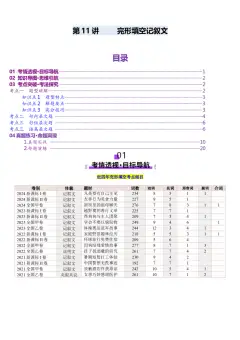
第02 讲  阅读理解——记叙文
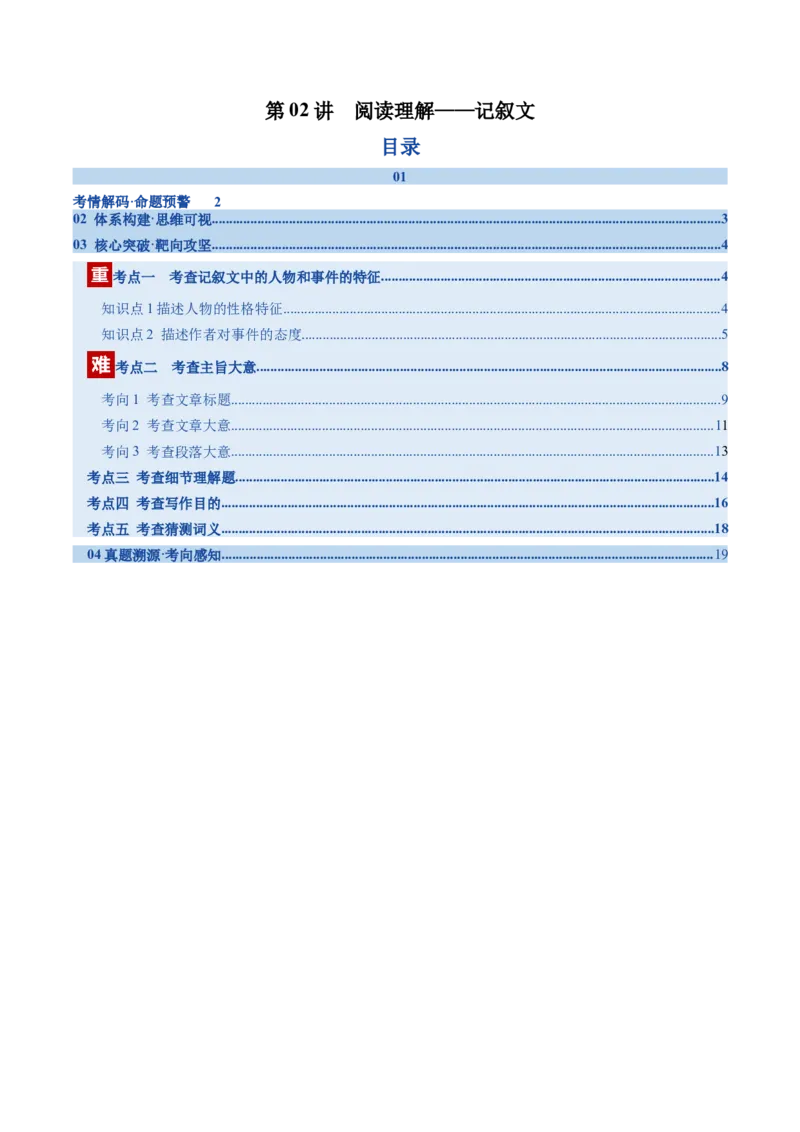
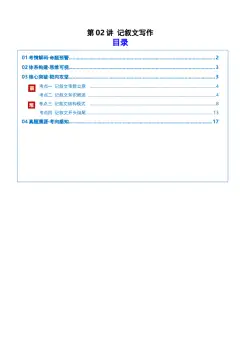
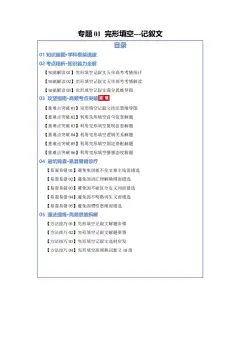
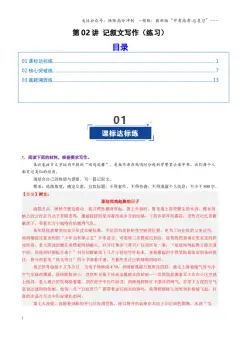
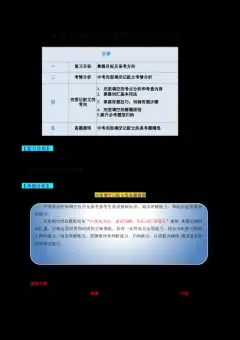
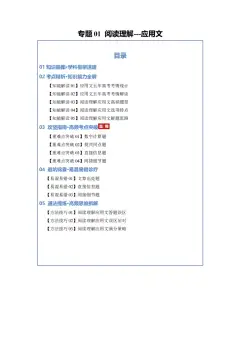
目录
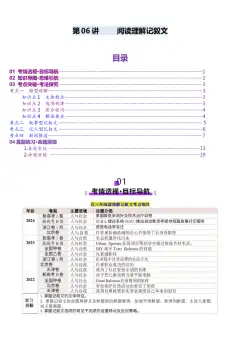
01
考情解码·命题预警
2
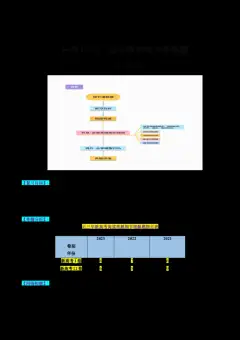
02 体系构建·思维可视.................................................................................................................................................3
03 核心突破·靶向攻坚.................................................................................................................................................4
考点一  考查记叙文中的人物和事件的特征.................................................................................................4
知识点1 描述人物的性格特征.............................................................................................................................4
知识点2 描述作者对事件的态度........................................................................................................................5
考点二  考查主旨大意.....................................................................................................................................8
考向1 考查文章标题............................................................................................................................................9
考向2 考查文章大意..........................................................................................................................................11
考向3 考查段落大意..........................................................................................................................................13
考点三 考查细节理解题.........................................................................................................................................14
考点四 考查写作目的.............................................................................................................................................16
考点五 考查猜测词义.............................................................................................................................................18
04 真题溯源·考向感知............................................................................................................................................19
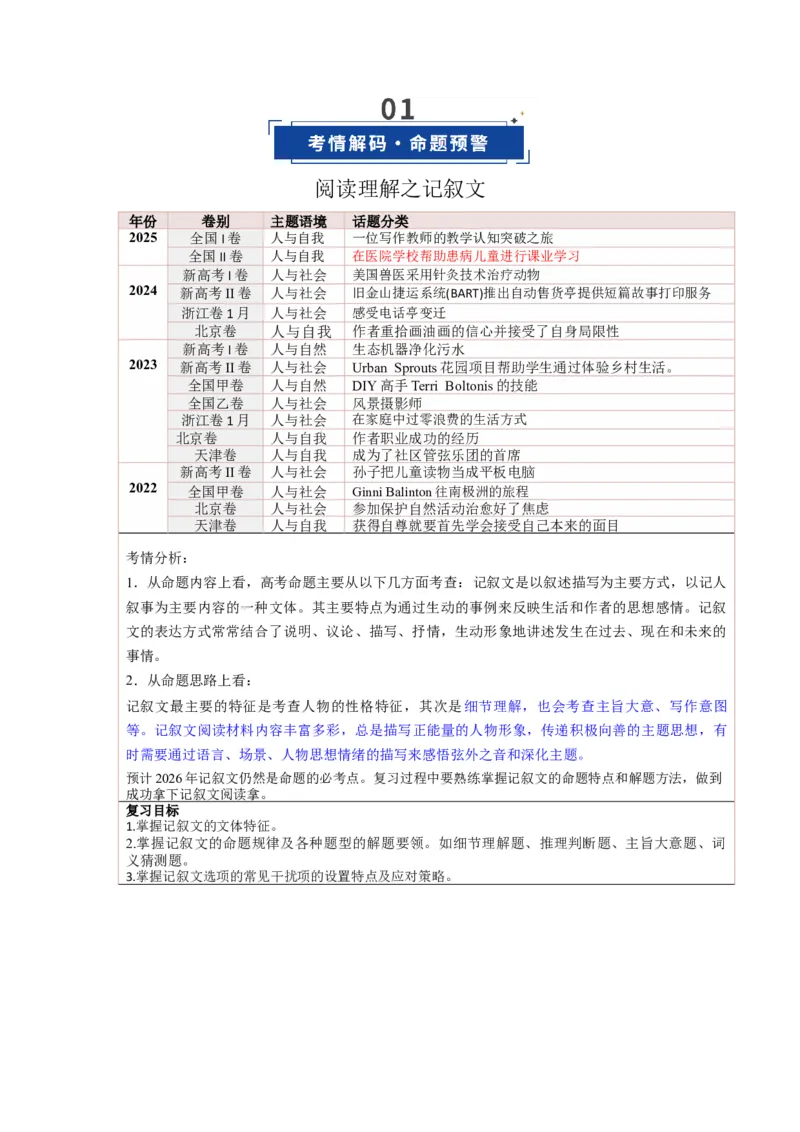
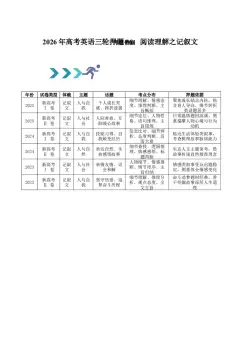
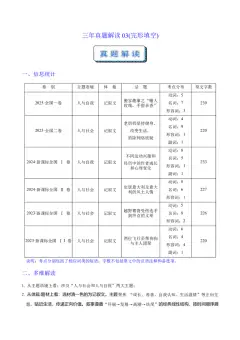
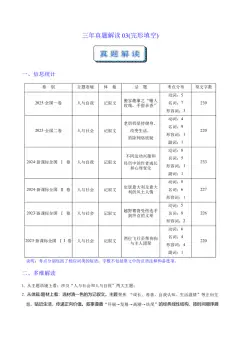
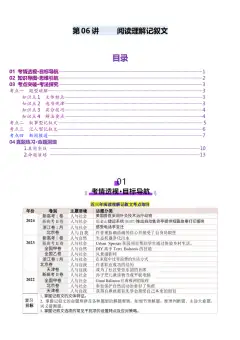
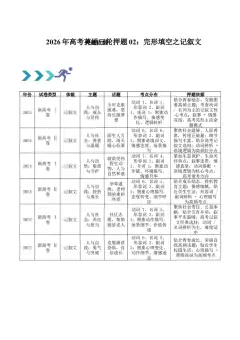
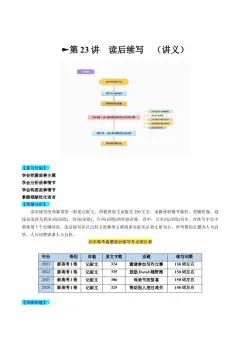
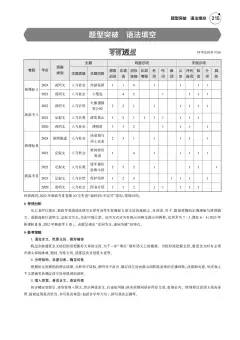
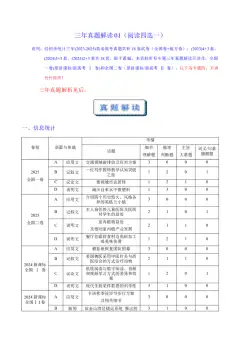
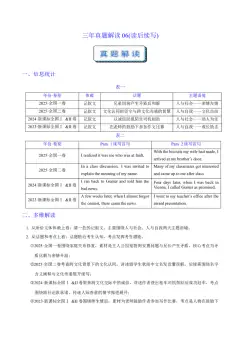
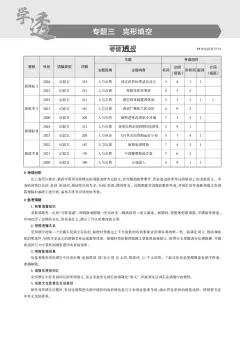
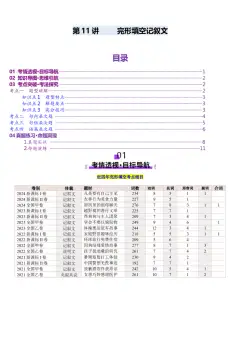
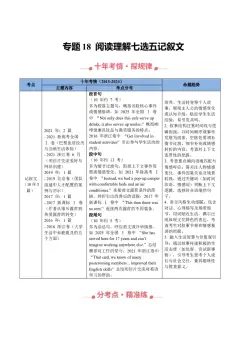
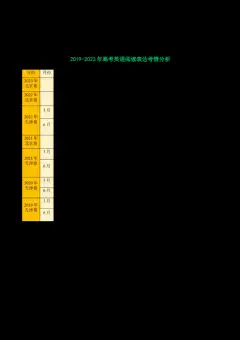
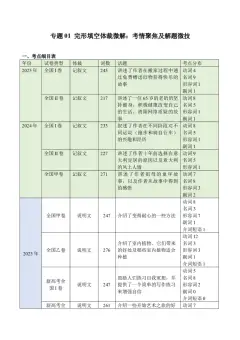
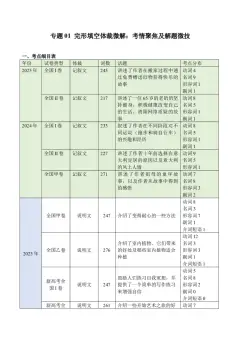
阅读理解之记叙文
年份
卷别
主题语境
话题分类
2025
全国I 卷
人与自我
一位写作教师的教学认知突破之旅
全国II 卷
人与自我
在医院学校帮助患病儿童进行课业学习
2024
新高考I 卷
人与社会
美国兽医采用针灸技术治疗动物
新高考II 卷
人与社会
旧金山捷运系统(BART)推出自动售货亭提供短篇故事打印服务
浙江卷1 月
人与社会
感受电话亭变迁
北京卷
人与自我
作者重拾画油画的信心并接受了自身局限性
2023
新高考I 卷
人与自然
生态机器净化污水
新高考II 卷
人与社会
Urban Sprouts 花园项目帮助学生通过体验乡村生活。
全国甲卷
人与自然
DIY 高手Terri Boltonis 的技能
全国乙卷
人与社会
风景摄影师
浙江卷1 月
人与社会
在家庭中过零浪费的生活方式
北京卷
人与自我
作者职业成功的经历
天津卷
人与自我
成为了社区管弦乐团的首席
2022
新高考II 卷
人与社会
孙子把儿童读物当成平板电脑
全国甲卷
人与社会
Ginni Balinton 往南极洲的旅程
北京卷
人与社会
参加保护自然活动治愈好了焦虑
天津卷
人与自我
获得自尊就要首先学会接受自己本来的面目
考情分析:
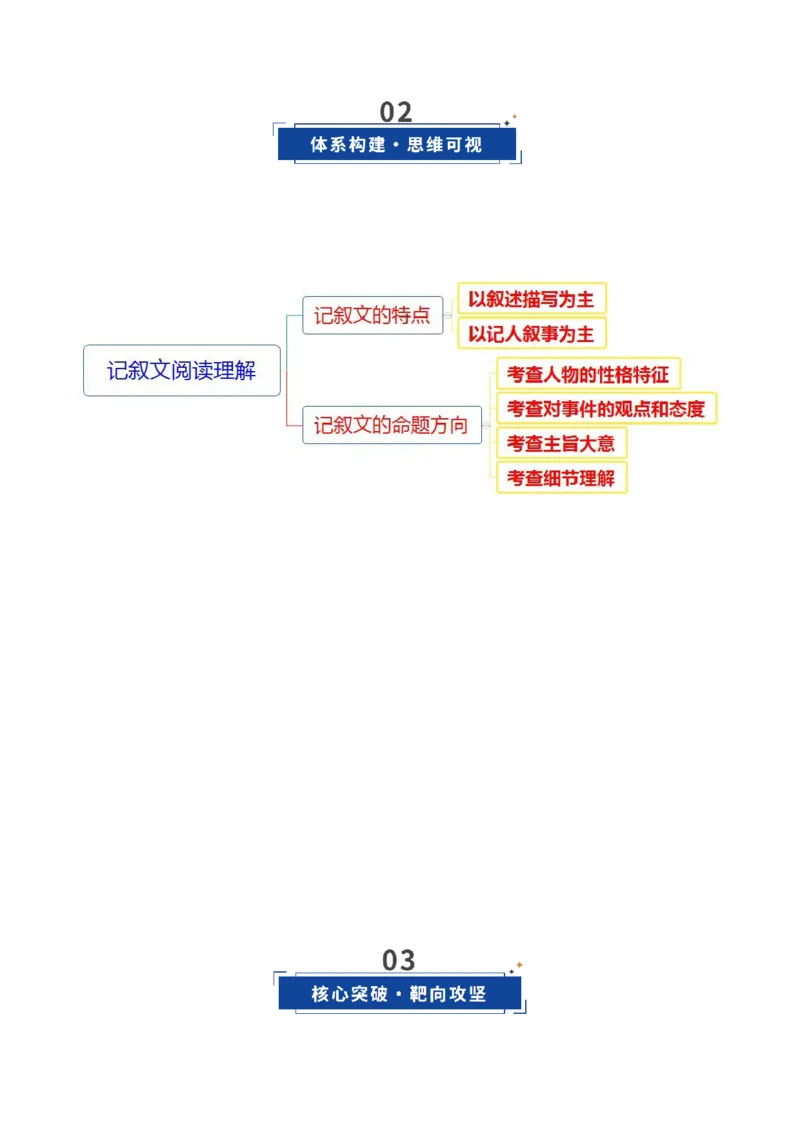
1.从命题内容上看,高考命题主要从以下几方面考查:记叙文是以叙述描写为主要方式,以记人
叙事为主要内容的一种文体。其主要特点为通过生动的事例来反映生活和作者的思想感情。记叙
文的表达方式常常结合了说明、议论、描写、抒情,生动形象地讲述发生在过去、现在和未来的
事情。
2.从命题思路上看:
记叙文最主要的特征是考查人物的性格特征,其次是细节理解,也会考查主旨大意、写作意图
等。记叙文阅读材料内容丰富多彩,总是描写正能量的人物形象,传递积极向善的主题思想,有
时需要通过语言、场景、人物思想情绪的描写来感悟弦外之音和深化主题。
预计2026 年记叙文仍然是命题的必考点。复习过程中要熟练掌握记叙文的命题特点和解题方法,做到
成功拿下记叙文阅读拿。
复习目标
1.掌握记叙文的文体特征。
2.掌握记叙文的命题规律及各种题型的解题要领。如细节理解题、推理判断题、主旨大意题、词
义猜测题。
3.掌握记叙文选项的常见干扰项的设置特点及应对策略。
 考点一 考查记叙文中的人物和事件的特征

知识点1  描述人物的性格特征
高考阅读理解中常有描述人物特点的阅读理解题。命题人通过文章中对人物的事迹、语言、心理等进
行描述,进而让考生推测人物的性格特征。
   把描述人物的性格特征的词一一列出,基本上考题不会超出这些词汇,考前把它们的意思记熟。预测
每个词需要和什么样的事迹相对应,这样在考场上就能迅速地找到答案。对这种题要迅速解决,以给其他
试题提供做题时间。
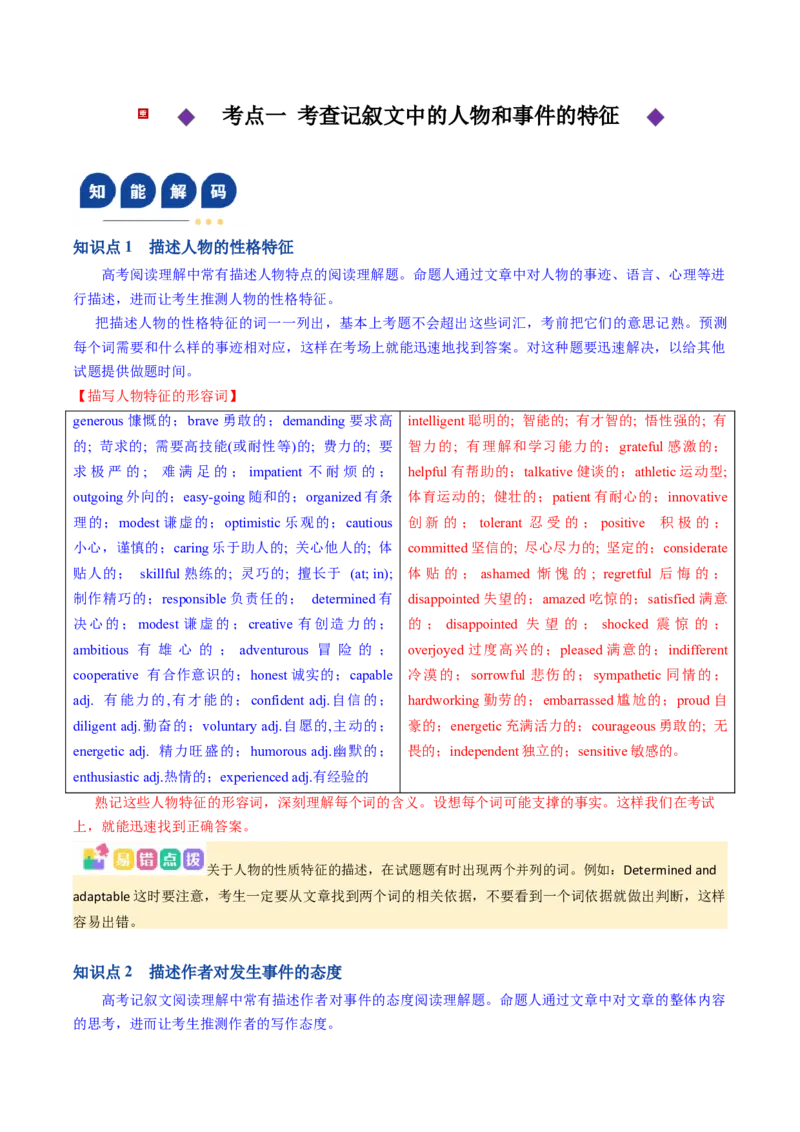
【描写人物特征的形容词】
generous 慷慨的;brave 勇敢的;demanding 要求高
的; 苛求的; 需要高技能(或耐性等)的; 费力的; 要
求极严的; 难满足的;impatient 不耐烦的;
outgoing 外向的;easy-going 随和的;organized 有条
理的;modest 谦虚的;optimistic 乐观的;cautious
小心,谨慎的;caring 乐于助人的; 关心他人的; 体
贴人的; skillful 熟练的; 灵巧的; 擅长于 (at; in);
制作精巧的;responsible 负责任的; determined 有
决心的;modest 谦虚的;creative 有创造力的;
ambitious 有雄心的;adventurous 冒险的;
cooperative 有合作意识的;honest 诚实的;capable
adj. 有能力的,有才能的;confident adj.自信的;
diligent adj.勤奋的;voluntary adj.自愿的,主动的;
energetic adj. 精力旺盛的;humorous adj.幽默的;
enthusiastic adj.热情的;experienced adj.有经验的
intelligent 聪明的; 智能的; 有才智的; 悟性强的; 有
智力的; 有理解和学习能力的;grateful 感激的;
helpful 有帮助的;talkative 健谈的;athletic 运动型;
体育运动的; 健壮的;patient 有耐心的;innovative
创新的;tolerant 忍受的;positive 积极的;
committed 坚信的; 尽心尽力的; 坚定的;considerate
体贴的;ashamed 惭愧的; regretful 后悔的;
disappointed 失望的;amazed 吃惊的;satisfied 满意
的;disappointed 失望的;shocked 震惊的;
overjoyed 过度高兴的;pleased 满意的;indifferent
冷漠的;sorrowful 悲伤的;sympathetic 同情的;
hardworking 勤劳的;embarrassed 尴尬的;proud 自
豪的;energetic 充满活力的;courageous 勇敢的; 无
畏的;independent 独立的;sensitive 敏感的。
   熟记这些人物特征的形容词,深刻理解每个词的含义。设想每个词可能支撑的事实。这样我们在考试
上,就能迅速找到正确答案。
关于人物的性质特征的描述,在试题题有时出现两个并列的词。例如:Determined and
adaptable 这时要注意,考生一定要从文章找到两个词的相关依据,不要看到一个词依据就做出判断,这样
容易出错。
知识点2  描述作者对发生事件的态度
高考记叙文阅读理解中常有描述作者对事件的态度阅读理解题。命题人通过文章中对文章的整体内容
的思考,进而让考生推测作者的写作态度。
【解题指导】
把描述作者态度的词一一列出,基本上考题不会超出这些词汇,考前把它们的意思记熟。预测每个词
需要和什么样的事实相对应,这样在考场上就能迅速地找到答案。对这种题要迅速解决,以给其他试题提
供做题时间。
【描写作者态度的形容词】(选项常用词)
ambitious 有雄心的;undoubted 无怀疑的;
indifferent 冷漠的;unconfident 没信心的;uncaring
不关心的;worried 担心的;satisfied 满意的;
cautious 谨慎的;favorable 赞同的;doubtful 怀疑
的;uninterested 不感兴趣的;frightened 害怕的;
puzzled 迷惑不解的;concerned 关心的;happy 高兴
的;tolerant 忍受的;sympathetic 同情的; delighted
高兴的;carefree 无忧无虑的; 无牵挂的; 不负责任
的
unclear 不清楚的; opposed 反对的;appreciative
adj.感激的; 感谢的; 欣赏的; 赏识的; suspicious adj.
感觉可疑的; 怀疑的; 令人怀疑的; 可疑的; 不信任
的; 持怀疑态度的;objective adj.客观的; 就事论事
的; 不带个人感情的; 客观存在的; 基于事实的;
confused 迷惑不解的;conservative adj.保守的; 守旧
的; ( 英国) 保守党的;pessimistic 悲观的;
disapproving 不同意的;ambiguous 模棱两可的;
skeptical 怀疑的
【考场上的实用方法】
熟记这些作者态度的形容词,深刻理解每个词的含义。设想每个词可能的描述事实。这样我们在考试上,
就能迅速找到正确答案。
考向1  考查描述人物的性格特征
例1 (2024 新课标Ⅰ卷)“I am not crazy,” says Dr. William Farber, shortly after performing acupuncture
(针灸) on a rabbit. “I am ahead of my time.” If he seems a little defensive, it might be because even some of his
coworkers occasionally laugh at his unusual methods. But Farber is certain he’ll have the last laugh. He’s one of a
small but growing number of American veterinarians ( 兽医) now practicing “holistic” medicine-combining
traditional Western treatments with acupuncture, chiropractic (按摩疗法) and herbal medicine.
24. What do some of Farber’s coworkers think of him?
A. He’s odd.
B. He’s strict.
C. He’s brave.
D. He’s rude.
例2(2022 年新高考全国Ⅱ卷)Sorry, kid. This book is not part of your high-tech world. It’s an outdated,
lifeless thing. An antique, like your grandfather. Well, I may be old, but I’m not hopelessly challenged, digitally
speaking. I edit video and produce audio. I use mobile payment. I’ve even built websites.
6. What does the author think of himself?
A. Socially ambitious.
B. Physically attractive.
C. Financially independent.
D. Digitally competent.
例3 (2025·河北省部分学校高三下学期二轮复习联考(三))At first, Lamm tried to put her phone in a
drawer and didn’t look at it for a whole day, which she said “was very inconvenient to everyone in my life”. It took
her about a year to sell her smartphone and fully commit to the dumbphone lifestyle. Her dumbphone offers only
basic calling and texting.
Still, there are certain things that may feel impossible to navigate without smartphones, since they are more
than just texting and scrolling (滚动) through social media. In 2025, these devices function as virtual wallets, health
trackers, identification tools, and even personal assistants. However, Lamm has found solutions for the challenges.
“You figure out these solutions by asking,” Lamm said, “like asking the parking company if they can give you
another option when you can’t use parking meter (计时器), and a lot of the time they will”
21.How can we best describe August Lamm according to the text?
A.Responsible and strict.
B.Determined and adaptable.
C.Generous and charitable.
D.Fashionable and knowledgeable.
【变式训练·变载体】(2025 届辽宁省沈阳市东北育才学校高三下学期适应性考试)节选
The idea of spending time abroad hadn’t occurred to me until my advisor suggested it during my first year.
With his support, I enjoyed a remarkable summer in a laboratory in Japan, which left me wanting more. So, I
applied for a Fulbright fellowship in Poland. To receive the fellowship, I first had to find a lab to host me, and
neither I nor my advisor had any connections to Poland.
Relying on Google to translate lab websites, I began to send cold emails. When my eventual host responded,
eager to collaborate, I was thrilled. I suddenly felt the possibilities for my research career were endless and global.
I was the first visiting scholar my research group had hosted from the United States, and my Polish
colleagues were curious about what brought me to their country. This led to many fruitful discussions about the
similarities and differences in how science is conducted across cultures. For example, much of the funding in
Poland is awarded to teams rather than individuals. The system promotes cross-disciplinary ( 跨学科的)
cooperations across the country, which in turn shapes how scientists design and carry out studies.
I learned as much about the history and culture in Central and Eastern Europe as I did scientifically.
Colleagues related firsthand accounts about challenges the region faced during the Cold War. Many laboratories
had limited resources, and they rarely published their research in English. Those conditions helped shape research
on antimicrobial treatment into bacteriophage and antibiotics, and Poland remain leaders in the former to this day.
24.Which words best describe the author?
A.Helpful and determined.
B.Cautious and innovative.
C.Adventurous and inquisitive.
D.Curious and competitive.
考向2  考查作者对事件的态度
例1 (2024 北京卷)When I was a little girl, I liked drawing, freely and joyously making marks on the
walls at home. In primary school, I learned to write using chalks. Writing seemed to be another form of drawing. I
shaped individual letters into repeating lines, which were abstract forms, delightful but meaningless patterns.
In secondary school, art was my favourite subject. Since. I loved it so much I thought I was good at it. For the
art O-level exam I had to present an oil painting. I found it difficult, but still hoped to pass. I failed, with a low
grade. I’d been over-confident. Now I’d been declared talentless.
But other channels of creativity stayed open: I went on writing poems and stories. Still, I went to exhibitions
often. I continued my habitual drawing, which I now characterised as childish doodling (乱画). In my 30s, I made
painter friends and learned new ways of looking at art. However, I couldn’t let myself have a go at actually doing it.
Though these new friends were abstract painters using oil paints, or were printmakers or sculptors, I took oil
painting as the taboo (禁忌) high form I wasn’t allowed to practice.
One night, in my early 40s, I dreamed that a big woman in red approached me, handed me a bag of paints, and
told me to start painting. The dream felt so authoritative that it shook me. It was a form of energy, giving me back
something I’d lost. Accordingly, I started by experimenting with water colours. Finally, I bought some oil paints.
Although I have enjoyed breaking my decades-long taboo about working with oil paints, I have discovered I
now prefer chalks and ink. I let my line drawings turn into cartoons I send to friends. It all feels free and easy. Un-
anxious. This time around, I can accept my limitations but keep going.
Becoming a successful painter calls for being resolute. I realised I was always afraid of wanting too much.
That dream reminded me that those fears and desires could encourage me to take risks and make experiments.
24. How did the author feel about the result of the art exam?
A. Scared.
B. Worried.
C. Discouraged.
D. Wronged.
例2 (2025·云南省昭通市三校高三期中) Owen began his exercise plan by walking, though he started huffing
and puffing after five minutes. But that didn’t discourage him. He kept at the walks every day, along with some
stretching. Once he had those basics down, he started weight lifting and hired a personal trainer to teach him and
design a routine he could follow on his own. The last piece was finding other activities he enjoyed, which turned
out to be cycling and swimming.
In less than five years, Owen was able to do three sets of 50 push-ups each and walk for miles each day. And
yes, he was free of aches and pains. “Aging well is only about 20 to 25 percent genes, and the rest is lifestyle,” he
says.
Owen used his experience to write a book called Just Move! A New Approach to Fitness After 50, in which
he details how older adults can safely get off the couch and add more movement to their lives. “Think of it as
movement, not exercise, just get started,” he says. “The key is slow and steady progress.”
10.Which of the following can best describe Owen’s exercising process?
A.Boring and painful.
B.Slow but fruitful.
C.Tough and discouraging.
D.Complex but ineffective.
【变式训练·变载体】
(2025·黑龙江省大庆实验中学高三考前仿真模拟)节选
Through the continuous stream of information now available in the modern age, the kids’ young minds were
filled with the knowledge of deforestation, forest fires, extinct species, polluted waterways, and celebrities telling
them to “do better”. Well-meaning but heavy-handed programs la id these big, scary problems at their feet, and then
offered little help to tiny hands. After participating in classes like this for years, I can confidently report that the
result of such teaching was often little more than helplessness, and continued disconnection from nature.
80.What is the author’s attitude towards the present environmental education?
A.Ambiguous.
B.Indifferent.
C.Favorable.
D.Critical.
 考点二 考查主旨大意
记叙文主旨要义题解题指导
在记叙文的阅读过程中,要注意把握人物的情感发展过程;事件的发展线索;作者思想感情的变化过
程以及时间、空间的变化。阅读时做到不漏细节,把准寓意,方能成功。
在阅读过程中,找出“5Ws 和 1H”;按照线索弄清事情的来龙去脉,理解了文章的脉络,理解整个
故事。记叙文需要事件的发展过程作支撑,一半以上的题目都会用来检测考生对故事的了解,因此,我们
必须弄明白整件事情的发展脉络。而其余像主旨大意、作者意图之类的题目,集中考查对作者所发的感触
的理解。
依附原文,切忌主观臆断
答题时把握文章的线索,结合文章的主旨大意,切勿主观臆断;
 主旨大意题
1. 避免主观臆断:在阅读原文基础上,仔细甄别选项是否与文章主题有密切联系;
2. 涵盖性强:看选项对文章的概括性或覆盖面如何。避免以偏概全,范围过大或过小。
  解题步骤
1.通览全局
2,关注首尾段落:70%的记叙文在开头点题,结尾升华
3.勾画重复出现的关键词(人物行为/情感变化/象征物)
4.分析结构 情节发展: 开端 → 发展 → 高潮 → 结局 → 感悟
5.情感曲线: 通过形容词/副词捕捉情绪变化(如:frustrated → determined → relieved)
6.定位核心要素
①主人公的关键抉择或顿悟时刻
②人物关系转折点(如:从冲突到和解)
③象征物的深层含义(如:broken watch 象征时间珍贵)
④排除干扰项 错误选项特征: □ 仅概括某个细节(出现具体人名/数字) □ 包含未提及的推论(出现must/only 等绝
对词) □ 与作者情感基调相悖(如文章悲伤却选乐观选项)
实战技巧
1.标题关联法:结合文章标题理解主旨(如标题"The Gift"多指情感馈赠而非实物)
2.三问检验法:
①主要人物经历了什么?
②这个经历带来什么改变?
③作者想通过这个变化说明什么?
④高频词统计:快速统计重复3 次以上的名词/动词
⑤视角判断:第一人称故事往往包含个人成长主题
典型错误规避
1.混淆客观事实与主观意图:避免把故事内容当主旨
2.过度解读:不添加原文未有元素
考向1  考查文章标题
例1(2023 年新高考全国Ⅱ卷)Turning soil, pulling weeds, and harvesting cabbage sound like tough work
for middle and high school kids. And at first it is, says Abby Jaramillo, who with another teacher started Urban
Sprouts, a school garden program at four low-income schools. The program aims to help students develop science
skills, environmental awareness, and healthy lifestyles.
Jaramillo’s students live in neighborhoods where fresh food and green space are not easy to find and fast food
restaurants outnumber grocery stores. “The kids literally come to school with bags of snacks and large bottles of
soft drinks,” she says. “They come to us thinking vegetables are awful, dirt is awful, insects are awful.” Though
some are initially scared of the insects and turned off by the dirt, most are eager to try something new.
Urban Sprouts’ classes, at two middle schools and two high schools, include hands-on experiments such as
soil testing, flower-and-seed dissection, tastings of fresh or dried produce, and work in the garden. Several times a
year, students cook the vegetables they grow, and they occasionally make salads for their entire schools.
Program evaluations show that kids eat more vegetables as a result of the classes. “We have students who say
they went home and talked to their parents and now they’re eating differently,” Jaramillo says.
She adds that the program’s benefits go beyond nutrition. Some students get so interested in gardening that
they bring home seeds to start their own vegetable gardens. Besides, working in the garden seems to have a
calming effect on Jaramillo’s special education students, many of whom have emotional control issues. “They get
outside,” she says, “and they feel successful.”
7. What can be a suitable title for the text?
A. Rescuing School Gardens
B. Experiencing Country Life
C. Growing Vegetable Lovers
D. Changing Local Landscape
例2(2021 年新高考全国Ⅱ 卷)A British woman who won a S1 million prize after she was named the
World's Best Teacher will use the cash to bring inspirational figures into UK schools.
Andria Zafirakou,a north London secondary school teacher, said she wanted to bring about a classroom
revolution (变革). “We are going to make a change, ”she said.“I’ve started a project to promote the teaching of
the arts in our schools.”
The project results from the difficulties many schools have in getting artists of any sort - whether an up-and-
coming local musician or a major movie star - into schools to work with and inspire children.
Zafirakou began the project at Alperton Community School, her place of work for the past twelve years. “I've
seen those magic moments when children are talking to someone they are inspired by - their eyes are shining and
their faces light up,” she said. “We need artists . more than ever in our schools."
Artist Michael Craig-Martin said: “Andria's brilliant project to bring artists from all fields into direct contact
with children is particularly welcome at a time when the arts are being downgraded in schools." It was a mistake to
see the arts as unnecessary, he added.
Historian Sir Simon Schama is also a supporter of the project. He said that arts education in schools was not
just an add-on. “It is absolutely necessary. The future depends on creativity and creativity depends on the young.
What will remain of us when artificial intelligence takes over will be our creativity, and it is our creative spirit, our
visionary sense of freshness,that has been our strength for centuries."
11. Which of the following is a suitable title for the text?
A. Bring Artists to Schools
B. When Historians Meet Artists
C. Arts Education in Britain
D. The World's Best Arts Teacher
【变式训练·变载体】(2025·广西部分学校高三模拟联考)
When it comes to the business of moving elephants, Dr. Amir Khalil and his team might be the best. The
work experience of this Egyptian animal doctor includes possibly the most famous elephant relocation ever.
In 2020, Khalil’s team saved Kaavan, an Asian elephant, from years of loneliness at a zoo in Pakistan. They
flew him to Cambodia, where he could live a happier life at an elephant reserve. The relocation project was a great
success.
After that, there was Charley, an African elephant in South Africa. Charley had been living in Pretoria Zoo
for more than 20 years. Since his partner passed away in 2020, he was extremely unhappy. Elephants are very
sensitive animals. Zoo officials hoped that he could spend his remaining years in a better place. His new home was
going to be a private game reserve 200 kilometres away.
Charley was captured (捕获) in Zimbabwe in the 1980s. He spent 16 years in a circus and then 23 years at
the zoo. It is estimated that he is 42 years old and has been in captivity for 40 years.
As an animal rescue specialist, Khalil was selected for this task. Two other doctors, who had participated in
Kaavan’s relocation, also joined in. They met Charley two years ago to assess whether he was ready for relocation
and to earn his trust.
They trained Charley to enter a transport container by using his favourite foods such as pumpkins. To
everyone’s surprise, he was ready in less than two weeks.
In late August, Charley was moved to the Shambala reserve. At first, he will be kept in a separate area to
adapt to the new environment. It is quite rare for captive elephants to be returned to the wild. Khalil praised the zoo
and the government. At Shambala, Charley will be free and might recall his early life. He has already started
communicating with other elephants.
Which of the following is the best title for the text?
A.The Difficulties Dr. Amir Khalil and His Team Have Met
B.Dr. Amir Khalil and His Team’s Success in Elephant Relocation
C.Methods of Moving Elephants from One Place to Another
D.Zoos and Elephant Conservation All Over the World
考向2  考查文章大意
例1(2023 年浙江1 月卷)Live with roommates? Have friends and family around you? Chances are that if
you’re looking to live a more sustainable lifestyle, not everyone around you will be ready to jump on that
bandwagon.
I experienced this when I started switching to a zero waste lifestyle five years ago, as I was living with my
parents, and I continue to experience this with my husband, as he is not completely zero waste like me. I’ve learned
a few things along the way though, which I hope you’ll find encouraging if you’re doing your best to figure out
how you can make the change in a not-always-supportive household.
Zero waste was a radical lifestyle movement a few years back. I remember showing my parents a video of Bea
Johnson, sharing how cool I thought it would be to buy groceries with jars, and have so little trash! A few days
later, I came back with my first jars of zero waste groceries, and my dad commented on how silly it was for me to
carry jars everywhere. It came off as a bit discouraging.
Yet as the months of reducing waste continued, I did what I could that was within my own reach. I had my
own bedroom, so I worked on removing things I didn’t need. Since I had my own toiletries (洗漱用品), I was able
to start personalising my routine to be more sustainable. I also offered to cook every so often, so I portioned out a
bit of the cupboard for my own zero waste groceries. Perhaps your household won’t entirely make the switch, but
you may have some control over your own personal spaces to make the changes you desire.
As you make your lifestyle changes, you may find yourself wanting to speak up for yourself if others
comment on what you’re doing, which can turn itself into a whole household debate. If you have individuals who
are not on board, your words probably won’t do much and can often leave you feeling more discouraged.
So here is my advice: Lead by action.
27.What is the text mainly about?
A.How to get on well with other family members.
B.How to have one’s own personal space at home.
C.How to live a zero waste lifestyle in a household.
D.How to control the budget when buying groceries.
例2(2018 年北京卷) My First Marathon(马拉松)
A month before my first marathon, one of my ankles was injured and this meant not running for two weeks,
leaving me only two weeks to train.  Yet, I was determined to go ahead.
I remember back to my 7th year in school.  In my first P. E.  class, the teacher required us to run laps and
then hit a softball.  I didn’t do either well.  He later informed me that I was "not athletic".
The idea that I was "not athletic" stuck with me for years.  When I started running in my 30s, I realized
running was a battle against myself, not about competition or whether or not I was athletic.  It was all about the
battle against my own body and mind.  A test of wills!
The night before my marathon, I dreamt that I couldn’t even find the finish line.  I woke up sweating and
nervous, but ready to prove something to myself.
Shortly after crossing the start line, my shoe laces(鞋带) became untied.  So I stopped to readjust.  Not the
start I wanted!
At mile 3, I passed a sign: "GO FOR IT, RUNNERS!"
By mile 17, I became out of breath and the once injured ankle hurt badly.  Despite the pain, I stayed the
course walking a bit and then running again.
By mile 21, I was starving!
As I approached mile 23, I could see my wife waving a sign.  She is my biggest fan.  She never minded the
alarm clock sounding at 4 a. m.  or questioned my expenses on running.
I was one of the final runners to finish.  But I finished! And I got a medal.  In fact, I got the same medal as
the one that the guy who came in first place had. zxxk
Determined to be myself, move forward, free of shame and worldly labels(世俗标签), I can now call myself a
"marathon winner".
39.  What does the story mainly tell us?
A.  A man owes his success to his family support.
B.  A winner is one with a great effort of will.
C.  Failure is the mother of success.
D.  One is never too old to learn.
【变式训练·变载体】(2025·广东省广东省两校高考临门一脚考试)
Maybe no one understands the power of imagination better than Chinese writer Liu Cixin. Until four years
ago, Liu was a full-time computer engineer at a power plant in Shanxi. He only wrote science fiction in his free
time. But it was during this time that his imagination really took off. He did things he might never get to do in real
life — like traveling in space, fighting aliens, and visiting faraway planets.
Even with such a powerful imagination, Liu, who is 55 years old, probably didn’t expect that he would
become the first Asian to win the Hugo Award in 2015. That’s the top prize in science fiction. He might also have
never imagined that former US President Barack Obama would read his book The Three-Body Problem, or that he
would win the 2018 Arthur C. Clarke Award for Imagination in Service to Society on November 9 in Washington
DC. This was the first time a Chinese writer had ever won this award.
In his speech when he accepted the award, Liu said that his imagination came from Arthur C . Clarke, a
famous UK sci-fi writer. He said that reading Clarke’s book 2001: A Space Odyssey in the early 1980s changed his
life.
“My mind opened up in a way it never had before. I felt like a small river finally seeing the ocean,” Liu said.
“That night, the night sky looked completely different to me. For the first time, I was amazed by how mysterious
the universe is.”
But even though Liu’s imagination takes him to faraway places, his books always make sense. In The Three-
Body Problem, for example, he tells a story about aliens coming to Earth. But instead of just focusing on the aliens,
he talks about how different civilizations interact, the rules of survival, and what life means. In another book, The
Wandering Earth, he thinks about what will happen when our solar system ends and humans need to find a new
home. But all his ideas are based on real science. Liu’s books aren’t just dreams — they’re grounded in facts.
What’s the text mainly about?
A.Liu Cixin’s contributions to science fiction.
B.Liu Cixin’s achievements and writing style.
C.How Liu Cixin became a sci-fi writer.
D.How Liu Cixin started a new sci-fi style.
考向3  考查段落大意
例1 (2025·江苏省盐城市盐城中学高三模拟预测)节选As every author knows, brick walls are
everywhere, and when you knock one down, there’s another one. After a few false starts, I coupled with my
wonderful agent, Nicky. We spent eight solid months editing and sent the manuscript off. Once again, we received
some dressed-up “no’s”, until Rachel, an editor I’d really wanted to work with, read it. Her vision for the book is
exactly consistent with mine!
84.What does paragraph 5 mainly discuss?
A.The role of the editor Rachel.
B.The author’s collaboration with Nicky.
C.The success of the author’s first novel.
D.The difficulties faced in getting published.
例2(2025·福建省漳州市正兴中学等三校高三最后一模)This Briton has seen many red cabins pass
through his workshop in King’s Lynn, eastern England, often broken, with missing glass in the windows or rotten
wooden doors. Once the cast iron structure is free of all its components, it is sanded to remove paint and rust (铁锈).
 The next step is to apply resin (树脂) and sand to remove faults, a tiring process done by hand that can take
several days. Finally, the phone box was painted the famous “Post Office Red”.
151.What’s Paragraph 5 mainly about?
A.The functions of the phone boxes.
B.The challenges Carl Berg faced.
C.The significance of Carl Berg’s work.
D.The detailed work of restoring ancient cabins.
【变式训练·变载体】(2025·辽宁省盘锦市名校高三下学期5 月大联考)
“The idea came from thinking many kids don’t have their own gardens and thinking of community gardens
located away in between buildings and trying to inspire them to seek them out,” Berry says. “It also gave the
opportunity to talk about sustainability as well as helping young minds think about where things come from.” The
artist even showed the kids a cotton plant to explain where jeans come from. “It was amazing to see so many
confused at the idea,” he recalls. “It enabled educators to talk about how the show turned plants to pants, then back
to plants again.”
What does Paragraph 3 mainly talk about?
A.Children’s lack of nature knowledge.
B.People’s confusion about Berry’s art.
C.Process of plant in different periods.
D.Motivation of Berry’s artistic creation.
 考点三 考查细节理解题
知识点  记叙文细节理解题解题指导
记叙文是以叙述描写为主要方式,以记人叙事为主要内容的一种文体。其主要特点为通过生动的事例
来反映生活和作者的思想感情。记叙文的表达方式常常结合了说明、议论、描写、抒情,生动形象地讲述
发生在过去、现在和未来的事情。
    常见的记叙文有小说、戏剧、传记、新闻报道和日记等类型。无论哪种记叙文,都囊括了事件的时间、
地点、人物、事情的起因、经过和结果。记叙的手法写作顺序往往以时间顺序或按照事件的发展顺序来展
开。最后升华总结作者的感悟。
  解题步骤
在解答细节理解题时,考生可采取“关键词定位法”,即“带着问题找答案”。先从题干中提取关键
词(题眼),然后以此为线索,运用略读及寻读的技巧快速在文章中寻找与此关键词相关的段落、语句,快
速定位该题与哪一段、哪一句有关,然后仔细推敲,仔细比对所给选项与文中细节的细微区别,在准确理
解细节的前提下,最后确定答案。
例1  (2025 年全国I 卷)In my ninth-grade writing class last year, I met a cowboy who saved his town, a
strict father who demanded his son earn straight A’s, and a modern-day Juliet who died of heartbreak after her
parents rejected the love of her young life. More than once, I found myself wondering just how my students, who’d
created these people, knew their subjects so well.
24. Who are the people mentioned at the beginning of paragraph 1?
A. Ninth graders.
B. Students’ parents.
C. Modern writers.
D. Fictional characters.
例2  (2025 年全国II 卷)Kathy Ho teaches high school inside Lucile Packard Children’s Hospital
Stanford (LPCH). “Sometimes I don’t like saying that I’m a teacher,” says Ho. “People get in their minds an idea of
what teachers do, but that’s not really what it is here.”
“Here” is room 386, where each year, about 500 LPCH patients also become students. The hospital school is
free of parents, doctors, and medical procedures. It’s a place of learning. About half of Ho’s students stay for a
week or less; others are there for more than a year. Most of Ho’s students will recover, which means that preparing
them to return to school is an increasingly important component of care.
Still, in room 386, academics don’t come first. Physical health and mental health are the priority. “If you’re
scared about something and thinking only about that, there’s no way you’re going to be able to learn,” Ho says.
“I’m a coach, an adviser, and a comforter, and that’s what it means to be a hospital teacher.”
24. Who does Ho teach at LPCH?
A. Sick children.
B. Young nurses.
C. Medical students.
D. Patients’ parents.
这里注意选项A 和C 区别,有些同学不清楚这两个选项的意思,导致选择出错。Sick
children 生病的孩子;Medical students 医学生
25. What is a characteristic of Ho’s job?
A. Prioritizing academics.
B. Encouraging innovation.
C. Treating various diseases.
D. Playing multiple roles.
【变式训练】(2025·河南省新乡市高三三模)
In a small village in Sindh, Pakistan, my journey began with a wooden cane, herding buffalo ( 野牛) along
the village’s edge. Life was simple, with mud homes and green fields, yet my dreams were vast. One day, a group
of students in uniforms sparked my curiosity. I demanded to see their books, and the illustrations within fueled my
imagination. I declared my dream to attend school.
The days were filled with the rhythmic sound of buffalo hooves and the earthy smell of the fields. Despite
the humble beginnings, my heart longed for the world beyond the village. Months passed in routine until my uncle,
a man of few words but great authority, convinced my parents of the value of education. I enrolled in primary
school, eager to learn, my mind absorbing every lesson like a sponge.
My academic success was met with ridicule when I desired to study in Karachi, a distant city known for its
bustling energy and educational institutions. The villagers found it amusing, a boy from the fields dreaming of such
heights. Despite depression and a near-tragic moment, my brother’s words, “Your Challenges Are Stepping-Stones
to Success,” echoed. I turned to writing, finding comfort and recognition in the pages of my notebook.
1.What contributed to the author’s enrollment in primary school?
A.His uncle’s persuasion on his parents.
B.His persistent demand for education.
C.The village’s traditional emphasis on education.
D.His outstanding academic performance in self-learning.
2.How did the villagers react when I expressed my desire to study in Karachi?
A.They were indifferent to it.
B.They made fun of it.
C.They supported it cautiously.
D.They considered it tough.
 考点四 考查写作目的
知识点  写作目的
(1)记叙文写作目的特点:
记叙文很重要的特征进行人物描写、环境描写、心理描写,作者总是通过这些手段达到通过描写抒发
情感和感慨的作用,所以,记叙文写作目的是被考查的重要特色。
(2)解题技巧:
写作意图推断题要求考生根据文章的论述,揣测作者的写作意图及作者运用某种写作手法的目的。作
者一般不直接表明自己的意图,而是通过文章所提供的事实,客观地使读者信服某种想法或观点。这种题
型要求考生不但能理解文章的大意,同时还要具备对作者阐述问题的方法进行分析和归纳总结的能力。
一般来说,我们可以通过分析文章的文体特点,理解作者的词句选择和识别文章的语气来推断出作者
的写作意图。
(3)目的意图题的设问方式
What is the main purpose of the author writing the text?
The purpose of the text is to get more people to _______.
The writer of the story wants to tell us that________.
The fact…is mentioned by the author to show________.
The author writers the last paragraph in order to ________.
考向  考查写作目的
例1(2020 年新高考全国Ⅱ 卷) The end of the school year was in sight and spirits were high. I was back
teaching after an absence of 15 years, dealing with the various kinds of "forbidden fruit" that come out of book
bags. Now was the spring of the water pistol.
I decided to think up a method of dealing with forbidden fruit.
"Please bring that pistol to me," I said. "I'm going to put it in my Grandma's Box."
"What's that?" they asked.
"It's a large wooden chest full of toys for my grandchildren," I replied,
"You don't have grandchildren," someone said.
4. What was the author's purpose in having the conversation with the students?
A. To collect the water pistol.
B. To talk about her grandchildren.
C. To recommend some toys.
D. To explain her teaching method.
例2(2018 年浙江卷6 月)In 1812, the year Charles Dickens was born, there were 66 novels published
in Britain. People had been writing novels for a century — most experts date the first novel to Robinson
Crusoe in 1719 — but nobody wanted to do it professionally. The steam-powered printing press was still in its
early stages; the literacy(识字) rate in England was under 50%. Many works of fiction appeared without
the names of the authors, often with something like “By a lady.”Novels, for the most part, were looked
upon as silly, immoral, or just plain bad.
In 1870, when Dickens died, the world mourned him as its first professional writer and publisher,
famous and beloved, who had led an explosion in both the publication of novels and their readership and whose
characters — from Oliver Twist to Tiny Tim — were held up as moral touchstones. Today Dickens’ greatness
is unchallenged. Removing him from the pantheon(名人堂) of English literature would make about as much
sense as the Louvre selling off the Mona Lisa.
How did Dickens get to the top? For all the feelings readers attach to stories, literature is a numbers game,
and the test of time is extremely difficult to pass. Some 60,000 novels were published during the Victorian
age, from 1837 to 1901; today a casual reader might be able to name a half-dozen of them. It’s partly true that
Dickens’ style of writing attracted audiences from all walks of life. It’s partly that his writings rode a wave
of social, political and scientific progress. But it’s also that he rewrote the culture of literature and put himself at the
center. No one will ever know what mix of talent, ambition, energy and luck made Dickens such a singular writer.
But as the 200th anniversary of his birth approaches, it is possible — and important for our own culture
— to understand how he made himself a lasting one.
 23. What is the author’s purpose in writing the text?
A. To remember a great writer.
B. To introduce an English novel.
C. To encourage studies on culture.
D. To promote values of the Victorian age.
【变式训练1】(2025·山东省青岛市、淄博市高三下学期二模)
The experience lit Avila Pinedo’s passion, inspiring her to serve as an advisor to primary pupils recently.
Guiding them through hands-on engineering and programming for a STEM initiative, she said. “Invention is
transformational,” witnessing its empowering influence on InvenTeamers and others who realize that applying
imagination and concepts can unlock fresh prospects, therefore motivating them to further explore education with
the belief that invention is accessible to all.
What’s the purpose of the last paragraph?
A.To introduce Avila Pinedo’s future plan.
B.To show the prospect of Heart and Sole.
C.To acknowledge the InvenTeam’s devotion.
D.To stress the nature and impact of invention.
【变式训练2】(2025·安徽省合肥市示范中学高三5 月教学质量检测三模)Hussain, a teacher for over 20
years, praised the idea. “Reading often stops in the summer months. What Adil is doing keeps the habit alive. I
haven’t seen anything quite like it.” One single mother of four said the free haircuts saved her money and got her
children excited about reading. Ten-year-old Zain, holding his favorite book, said, “Reading feels like traveling
with your mind.”
What is the purpose of paragraph 3?
A.To show how people were motivated.
B.To present community responses.
C.To highlight mobile libraries’ role.
D.To stress reading’s power for kids.
 考点五 考查猜测词义
猜测词义
猜测词义是阅读能力的一部分,也是高考阅读理解测试中重要的一项。在完整的语篇中,单词和词组
的意义总是受特定的语境、上下文限制的,因此考生可以根据上下文,并利用所掌握的语法、词汇和构词
法等知识确定它们的意义。词义猜测可以是对一个单词的意义的推断,也可以是对一个短语或句子的意义
的推断;既可以考查生词的意义,也可以考查熟词的新义,还可以是对替代词所替代内容的判断。在阅读
理解题中,所考查的词或短语的意义往往不停留在字面上,而要根据短文提供的语境,通过阅读上下文,
根据已知的信息或常识来推测尚不熟悉的词或短语的含义。
一、根据定义或上下文解释进行猜测
有时短文中出现一个需要猜测其意义的词或短语,下面接着出现其定义或解释。标点符号,如逗号后的解
释(名词同位语)、破折号后的解释、括号内的解释等。这都是判断该词或短语意义的主要依据。
二.根据同位关系进行猜测
阅读中出现的难词有时后面紧跟一个同位语,对前面的词进行解释,因此可利用同位关系对前面的词义或
句意进行猜测。
三.根据构词法(前缀、后缀、派生等)进行猜测
在英语中,有很多词可以通过增加前缀和后缀的方式,构成新词。乍看起来,这个词可能是新词,但在掌
握了一定的构词知识之后,就不难猜出它的词义。
四.根据因果关系进行猜测
在一篇阅读文章中,根据原因可以预测结果,根据结果也可以找出原因。
五.根据上下文的指代关系进行猜测
文章中的代词it, that, he, him 或them 可以指代上文提到的人或物,其中it 和that 还可以指代一件事。有
时代词指代的对象相隔较远,要认真查找;有时也需要对前面提到的内容进行总结,才能得出代词所指代
的事物。
六.根据同义或近义关系进行猜测
在同一句、同一段或同一篇文章中,作者为了避免语言的单调、重复,有时会使用意思相同或相近的
词。因此,考生只要读懂上下文,知道其中一个词的意思,就能猜出另外一个词的意思。
七.根据转折或对比关系进行猜测
根据上下句的连接词,如but, however, otherwise 等可以推断上下文之间的逻辑关系,从而可以依据
某一句的含义,来确定另一句的含义。另外,分号也可以表示转折、对比或不相干的意义。例如:
考向  考查猜测词义
例1(2025 全国I 卷)As a new unit started, I asked everyone to write a persuasive piece on a health-related
topic of their choice. This time they found the exercise much more interesting. For the next two assignments, a
personal-narrative unit followed by a creative-writing workshop, I only required that the piece meet the
specifications of its genre (体裁) and that it contain a thesis. The results were staggering. The students took on
diverse topics and turned in stories, 10 to 20 pages each, with characters that broadened my view and touched my
heart.
6. What does the underlined word “staggering” in paragraph 3 mean?
A. Mixed.
B. Amazing.
C. Similar.
D. Disturbing.
例2 (2016 年新课标Ⅱ卷)Encouraging this kind of thinking has a downside. I ran the risk of losing those
students who had a different style of thinking. Without fail one would declare, "But I’m just not creative."
7. What does the underlined word "downside" in Paragraph 4 probably mean?
A. Mistake.
B. Drawback.
C. Difficulty.
D. Burden.
【变式训练】
(2025 届湖南省邵阳市高考信息卷(二))After ten minutes on the mountain road, I looked at her
anxiously. “I thought you said three minutes.” She grinned, “This is a detour.”
Ten minutes later, we turned down a narrow track, we parked the car and got out. We walked through
towering evergreens. Then we turned a corner and stopped—and I gasped in amazement.
The word “detour” in paragraph 3 most probably means ______.
A.a shortcut
B.a sudden stop
C.a longer route
D.a straight path
1. 【2024 浙江1 月卷】When was the last time you used a telephone box? I mean to make an actual phone
call — not to shelter from the rain. Ages ago, right? The last time I used a phone box for its intended purpose
was…2006. I was conducting auditions (试演) for my play in my tiny old shared house in London. Hoping to
impress some talented actors to come and work for me for nothing, I spread some throws over the sofas and lit
candles to make it seem a bit more ”young professional”.
As I rushed outdoors to empty the wastepaper baskets, the door swung shut behind me. Suddenly I was locked
outside. My mobile phone was inside, but luckily there was a telephone box across the street. So, I called Directory
Assistance, got put through to our landlady’s managing agent, and had a spare key sent to me with just enough time
to get back in before the actors arrived.
As it has been many years since I last used one, I should hardly be surprised that then are no longer any public
telephones near my house. The last one standing has just been turn into a “mini community library”: any passer-by
can “borrow” a book from its shelves return it later, or replace it with another title from their own collection.
For a few months after the “library” opened, I didn’t bother taking a look, as I had assumed that it would be
stuffed full of cheese love stories. Then I noticed fork conducting spring cleans dropping boxes of voluminous
books on various subjects there. And these books were free. This unbeatable price-point encouraged me to
experiment with dozens of titles that I would never normally consider buying. And I’ve discovered some great
books!
If I ever get trapped outside my house again, my local telephone box will, sadly no longer be able to connect
me with my keys. But it can certainly keep me entertained while I wait for my wife to rescue me.
4. What does the underlined word “it” in the first paragraph refer to?
A. The play.
B. The shared house.
C. The sofa.
D. The telephone box.
5. Why did the author use the telephone box in 2006?
A. To place an urgent call.
B. To put up a notice.
C. To shelter from the rain.
D. To hold an audition.
6. What do we know about the “mini community library”?
A. It provides phone service for free.
B. Anyone can contribute to its collection.
C. It is popular among young readers.
D. Books must be returned within a month.
7. Why did the author start to use the “library”?
A. He wanted to borrow some love stories.
B. He was encouraged by a close neighbour.
C. He found there were excellent free books.
D. He thought it was an ideal place for reading.
2.【2023 年新高考全国Ⅰ卷】When John Todd was a child, he loved to explore the woods around his house,
observing how nature solved problems. A ditry stream, for example, often became clear after flowing through
plants and along rocks where tiny creatures lived. When he got older, John started to wonder if this process could
be used to clean up the messes people were making.
After studying agriculture, medicine, and fisheries in college, John went back to observing nature and asking
questions. Why can certain plants trap harmful bacteria (细菌)? Which kinds of fish can eat cancer-causing
chemicals? With the right combination of animals and plants, he figured, maybe he could clean up waste the way
nature did. He decided to build what he would later call an eco-machine.
The task John set for himself was to remove harmful substances from some sludge (污泥). First, he
constructed a series of clear fiberglass tanks connected to each other. Then he went around to local ponds and
streams and brought back some plants and animals. He placed them in the tanks and waited. Little by little, these
different kinds of life got used to one another and formed their own ecosystem. After a few weeks, John added the
sludge.
He was amazed at the results. The plants and animals in the eco-machine took the sludge as food and began to
eat it! Within weeks, it had all been digested, and all that was left was pure water.
Over the years, John has taken on many big jobs. He developed a greenhouse-like facility that treated sewage
(污水) from 1,600 homes in South Burlington. He also designed an eco-machine to clean canal water in Fuzhou, a
city in southeast China.
“Ecological design” is the name John gives to what he does. “Life on Earth is kind of a box of spare parts for
the inventor,” he says. “You put organisms in new relationships and observe what’s happening. Then you let these
new systems develop their own ways to self-repair.”
4. What can we learn about John from the first two paragraphs?
A. He was fond of traveling.
B. He enjoyed being alone.
C. He had an inquiring mind.
D. He longed to be a doctor.
5. Why did John put the sludge into the tanks?
A. To feed the animals.
B. To build an ecosystem.
C. To protect the plants.
D. To test the eco-machine.
6. What is the author’s purpose in mentioning Fuzhou?
A. To review John’s research plans.
B. To show an application of John’s idea.
C. To compare John’s different jobs.
D. To erase doubts about John’s invention.
7. What is the basis for John’s work?
A. Nature can repair itself.
B. Organisms need water to survive.
C. Life on Earth is diverse.
D. Most tiny creatures live in groups.
3.【2023 年全国乙卷】 Living in Iowa and trying to become a photographer specializing in landscape (风
景) can be quite a challenge, mainly because the corn state lacks geographical variation.
Although landscapes in the Midwest tend to be quite similar, either farm fields or highways, sometimes I find
distinctive character in the hills or lakes. To make some of my landscape shots, I have traveled up to four hours
away to shoot within a 10-minute time frame. I tend to travel with a few of my friends to state parks or to the
countryside to go on adventures and take photos along the way.
Being at the right place at the right time is decisive in any style of photography. I often leave early to seek the
right destinations so I can set up early to avoid missing the moment I am attempting to photograph. I have missed
plenty of beautiful sunsets/sunrises due to being on the spot only five minutes before the best moment.
One time my friends and I drove three hours to Devil’s Lake, Wisconsin, to climb the purple quartz (石英)
rock around the lake. After we found a crazy-looking road that hung over a bunch of rocks, we decided to
photograph the scene at sunset. The position enabled us to look over the lake with the sunset in the background. We
managed to leave this spot to climb higher because of the spare time until sunset. However, we did not mark the
route (路线) so we ended up almost missing the sunset entirely. Once we found the place, it was stressful getting
lights and cameras set up in the limited time. Still, looking back on the photos, they are some of my best shots
though they could have been so much better if I would have been prepared and managed my time wisely.
4. How does the author deal with the challenge as a landscape photographer in the Midwest?
A. By teaming up with other photographers.
B. By shooting in the countryside or state parks.
C. By studying the geographical conditions.
D. By creating settings in the corn fields.
5. What is the key to successful landscape photography according to the author?
A. Proper time management.
B. Good shooting techniques.
C. Adventurous spirit.
D. Distinctive styles.
6. What can we infer from the author trip with friends to Devil’s Lake?
A. They went crazy with the purple quartz rock.
B. They felt stressed while waiting for the sunset.
C. They reached the shooting spot later than expected.
D. They had problems with their equipment.
7. How does the author find his photos taken at Devil’s Lake?
A. Amusing.
B. Satisfying.
C. Encouraging.
D. Comforting.
4.【2023 年全国甲卷】Terri Bolton is a dab hand when it comes to DIY (do-it-yourself). Skilled at putting
up shelves and piecing together furniture, she never pays someone else to do a job she can do herself.
She credits these skills to her late grandfather and builder Derek Lloyd. From the age of six, Terri, now 26,
accompanied Derek to work during her school holidays. A day’s work was rewarded with £5 in pocket money. She
says: “I’m sure I wasn’t much of a help to start with, painting the rooms and putting down the flooring throughout
the house. It took weeks and is was backbreaking work, but I know he was proud of my skills.”
Terri, who now rents a house with friends in Wandsworth, South West London, says DIY also saves her from
losing any deposit when a tenancy (租期) comes to an end. She adds: “I’ve moved house many times and I always
like to personalise my room and put up pictures, so, it’s been useful to know how to cover up holes and repaint a
room to avoid any charges when I’ve moved out.”
With millions of people likely to take on DIY projects over that coming weeks, new research shows that more
than half of people are planning to make the most of the long, warm summer days to get jobs done. The average
spend per project will be around £823. Two thirds of people aim to improve their comfort while at home. Two fifth
wish to increase the value of their house. Though DIY has traditionally been seen as male hobby, the research
shows it is women now leading the charge.
24. Which is closest in meaning to “a dab hand” in paragraph 1?
A. An artist.
B. A winner.
C. A specialist.
D. A pioneer.
25. Why did Terri’s grandfather give her £5 a day?
A. For a birthday gift.
B. As a treat for her work.
C. To support her DIY projects.
D. To encourage her to take up a hobby.
26. How did Terri avoid losing the deposit on the house she rented?
A. By making it look like before.
B. By furnishing it herself.
C. By splitting the rent with a roommate.
D. By cancelling the rental agreement.
27. What trend in DIY does the research show?
A. It is becoming more costly.
B. It is getting more time-consuming.
C. It is turning into a seasonal industry.
D. It is gaining popularity among females.
5.【2023 年北京卷】Sitting in the garden for my friend’s birthday. I felt a buzz (振动) in my pocket. My
heart raced when I saw the email sender’s name. The email started off: “Dear Mr Green, thank you for your
interest” and “the review process took longer than expected.” It ended with “We are sorry to inform you…”and my
vision blurred (模糊). The position—measuring soil quality in the Sahara Desert as part of an undergraduate
research programme — had felt like the answer I had spent years looking for.
I had put so much time and emotional energy into applying, and I thought the rejection meant the end of the
road for my science career.
So I was shocked when, not long after the email, Professor Mary Devon, who was running the programme,
invited me to observe the work being done in her lab. I jumped at the chance, and a few weeks later I was equally
shocked—and overjoyed—when she invited me to talk with her about potential projects I could pursue in her lab.
What she proposed didn’t seem as exciting as the original project I had applied to, but I was going to give it my all.
I found myself working with a robotics professor on techniques for collecting data from the desert remotely.
That project, which I could complete from my sofa instead of in the burning heat of the desert, not only survived
the lockdown but worked where traditional methods didn’t. In the end, I had a new scientific interest to pursue.
When I applied to graduate school, I found three programmes promising to allow me to follow my desired
research direction. And I applied with the same anxious excitement as before. When I was rejected from one that
had seemed like a perfect fit, it was undoubtedly difficult. But this time I had the perspective (视角) to keep it from
sending me into panic. It helped that in the end I was accepted into one of the other programmes I was also excited
about.
Rather than setting plans in stone, I’ve learned that sometimes I need to take the opportunities that are offered,
even if they don’t sound perfect at the time, and make the most of them.
24. How did the author feel upon seeing the email sender’s name?
A. Anxious.
B. Angry.
C. Surprised.
D. Settled.
25. After talking with Professor Devon, the author decided to ________.
A. criticise the review process
B. stay longer in the Sahara Desert
C. apply to the original project again
D. put his heart and soul into the lab work
26. According to the author, the project with the robotics professor was ________.
A. demanding
B. inspiring
C. misleading
D. amusing
27. What can we learn from this passage?
A. An invitation is a reputation.
B. An innovation is a resolution.
C. A rejection can be a redirection.
D. A reflection can be a restriction.
6.【2022 年北京卷】My name is Alice. Early last year, I was troubled by an anxiety that crippled ( 削弱 )
my ability to do anything. I felt like a storm cloud hung over me. For almost a year I struggled on, constantly
staring at this wall that faced me. My perfectionist tendencies were the main root of this: I wanted to be perfect at
whatever I did, which obviously in life is not possible, but it consumed me.
One day, I attended a presentation by wildlife conservationist Grant Brown at my high school. His
presentation not only awed and inspired me, but also helped emerge an inner desire to make a difference in the
world. I joined a pre-presentation dinner with him and that smaller setting allowed me to slowly build up my
courage to speak one-on-one with him—an idea that had seemed completely impossible. This first contact was
where my story began.
A month later, Brown invited me to attend the World Youth Wildlife Conference. Looking back, I now see that
this would be the first in a series of timely opportunities that my old self would have let pass, but that this new and
more confident Alice enthusiastically seized. Shortly after I received his invitation, applications to join the Youth
for Nature and the Youth for Planet groups were sent around through my high school. I decided to commit to
completing the applications, and soon I was a part of a growing global team of young people working to protect
nature. Each of these new steps continued to grow my confidence.
I am writing this just six months since my journey began and I’ve realised that my biggest obstacle ( 障碍 )
this whole time was myself. It was that voice in the back of my head telling me that one phrase that has stopped so
many people from reaching their potential: I can’t. They say good things come to those who wait; I say: grab every
opportunity with everything you have and be impatient. After all, nature does not require our patience, but our
action.
24. What was the main cause for Alice’s anxiety?
A. Her inability to act her age.
B. Her habit of consumption.
C. Her desire to be perfect.
D. Her lack of inspiration.
25. How did Grant Brown’s presentation influence Alice?
A. She decided to do something for nature.
B. She tasted the sweetness of friendship.
C. She learned about the harm of desire.
D. She built up her courage to speak up.
26. The activities Alice joined in helped her to become more ________.
A. intelligent
B. confident
C. innovative
D. critical
27. What can we learn from this passage?
A. Practice makes perfect.
B. Patience is a cure of anxiety.
C. Action is worry’s worst enemy.
D. Everything comes to those who wait.
7. 【2022 年浙江卷6 月】Pasta and pizza were on everyone’s lunch menu in my native land of Italy.
Everyone who had such a lunch was fair-skinned and spoke Italian. A few years later, as I stood in the lunch line
with my kindergarten class in a school in Brooklyn, I realized things were no longer that simple. My classmates
ranged from those kids with pale skin and large blue eyes to those with rich brown skin and dark hair. The food
choices were almost as diverse as the students. In front of me was an array of foods I couldn’t even name in my
native language. Fearing that I would pick out something awful, I desperately tried to ask the boy ahead of me for a
recommendation. Unfortunately, between us stood the barrier of language.
Although my kindergarten experience feels like a century ago, the lessons I learned will stick in my mind
forever. For the past three summers, I have worked in a government agency in New York. New immigrants much
like the little girl in the lunch line flooded our office seeking help. I often had to be an interpreter for the Italian-
speaking ones. As I served the role of vital communication link, I was reminded of my desperate struggle to
converse before I learned English. I watched with great sympathy as elderly Italians tried to hold a conversation in
Italian with people who did not speak the language. It suddenly became very clear to me how lucky I was to be
fluent in two languages.
In New York, a multicultural city, students like me are blessed with a chance to work with a diverse
population. In my English to Italian translations, I’ve learned about social programs that I didn’t know existed. This
work expanded my mind in ways that are impossible inside the four walls of a classroom. Walking through the
streets of Brooklyn today, I am no longer confused by this city’s sounds and smells. Instead, enjoy its diversity.
1. What did the author realize after entering school in Brooklyn?
A. Time passed quickly.
B. English was hard to learn.
C. The food was terrible.
D. People were very different.
2. Who does “the little girl” in paragraph 2 refer to?
A. An Italian teacher.
B. A government official.
C. The author herself.
D. The author’s classmate.
3. How did the summer job benefit the author?
A. It strengthened her love for school.
B. It helped sharpen her sense of direction.
C. It opened her eyes to the real world.
D. It made her childhood dream come true.
8.【2022 年浙江卷1 月】 For nearly a decade now, Merebeth has been a self-employed pet transport
specialist. Her pet transport job was bom of the financial crisis (危机)in the late 2000s. The downturn hit the
real estate (房地产)firm where she had worked for ten years as an office manager. The firm went broke and left
her looking for a new job. One day, while driving near her home, she saw a dog wandering on the road, clearly lost.
She took it home, and her sister in Denver agreed to take it. This was a loving home for sure, but 1, 600 miles away.
It didn't take long for Merebeth to decide to drive the dog there herself. It was her first road trip to her new job.
Merebeth*s pet delivery service also satisfies her wanderlust. It has taken her to every state in the US except
Montana, Washington and Oregon, she says proudly. If she wants to visit a new place, she will simply find a pet
with transport needs there. She travels in all weathers. She has driven through 55 mph winds in Wyoming, heavy
flooding and storms in Alabama and total whiteout conditions in Kansas.
This wanderlust is inherited from her father, she says. She moved their family from Canada to California
when she was one year old, because he wanted them to explore a new place together. As soon as she graduated
from high school she left home to live on Catalina Island off the Californian coast, away from her parents, where
she enjoyed a life of sailing and off-road biking.
It turns out that pet transporting pays quite well at about $30, 000 per year before tax. She doesn't work in
summer, as it would be unpleasantly hot for the animals in the car, even with air conditioning. As autumn comes,
she gets restless—the same old wanderlust returning. It’s a call she must heed alone, though. Merebeth says,
*'When I am on the road, I'm just in my own world. I've always been independent-spirited and I just feel strongly
that I mush help animals.
1. Why did Merebeth changed her job?
A. She wanted to work near her home.
B. She was tired of working in the office.
C. Her sister asked her to move to Denver.
D. Her former employer was out of business.
2.
The word "wanderlust" in paragraph 2 means a desire to

 ?
A.
make money.
B. try various jobs.
C. be close to nature.
D. travel to different places.
3 What can we learn about Merebeth in her new job?
A.
She has chances to see rare animals.
B.
She works hard throughout the year.
C.
She relies on herself the whole time.
D.
She earns a basic and tax-free salary.
9. 【2022 年浙江卷6 月】Pasta and pizza were on everyone’s lunch menu in my native land of Italy.
Everyone who had such a lunch was fair-skinned and spoke Italian. A few years later, as I stood in the lunch line
with my kindergarten class in a school in Brooklyn, I realized things were no longer that simple. My classmates
ranged from those kids with pale skin and large blue eyes to those with rich brown skin and dark hair. The food
choices were almost as diverse as the students. In front of me was an array of foods I couldn’t even name in my
native language. Fearing that I would pick out something awful, I desperately tried to ask the boy ahead of me for a
recommendation. Unfortunately, between us stood the barrier of language.
Although my kindergarten experience feels like a century ago, the lessons I learned will stick in my mind
forever. For the past three summers, I have worked in a government agency in New York. New immigrants much
like the little girl in the lunch line flooded our office seeking help. I often had to be an interpreter for the Italian-
speaking ones. As I served the role of vital communication link, I was reminded of my desperate struggle to
converse before I learned English. I watched with great sympathy as elderly Italians tried to hold a conversation in
Italian with people who did not speak the language. It suddenly became very clear to me how lucky I was to be
fluent in two languages.
In New York, a multicultural city, students like me are blessed with a chance to work with a diverse
population. In my English to Italian translations, I’ve learned about social programs that I didn’t know existed. This
work expanded my mind in ways that are impossible inside the four walls of a classroom. Walking through the
streets of Brooklyn today, I am no longer confused by this city’s sounds and smells. Instead, enjoy its diversity.
1. What did the author realize after entering school in Brooklyn?
A. Time passed quickly.
B. English was hard to learn.
C. The food was terrible.
D. People were very different.
2. Who does “the little girl” in paragraph 2 refer to?
A. An Italian teacher.
B. A government official.
C. The author herself.
D. The author’s classmate.
3. How did the summer job benefit the author?
A. It strengthened her love for school.
B. It helped sharpen her sense of direction.
C. It opened her eyes to the real world.
D. It made her childhood dream come true.
10.【2021 年新高考全国Ⅰ 卷】By day, Robert Titterton is a lawyer. In his spare on stage beside pianist
Maria Raspopova — not as a musician but as her page turner. “I’m not a trained musician, but I’ve learnt to read
music so I can help Maria in her performance.”
Mr Titterton is chairman of the Omega Ensemble but has been the group’s official page turner for the past four
years. His job is to sit beside  the pianist and turn the pages of the score so the musician doesn’t have to break the
flow of sound by doing it themselves. He said he became just as nervous as those playing instruments on stage.
“A lot of skills are needed for the job. You have to make sure you don’t turn two pages at once and make sure
you find the repeats in the music  when you have to go back to the right spot.” Mr Titterton explained.
Being a page turner requires plenty of practice. Some pieces of music can go for 40 minutes and require up to
50 page turns, including back turns for repeat passages. Silent onstage communication is key, and each pianist has
their own style of “nodding” to indicate a page turn which they need to practise with their page turner.
But like all performances, there are moments when things go wrong. “I was turning the page to get ready for
the next page, but the draft wind from the turn caused the spare pages to fall off the stand,” Mr Titterton said,
“Luckily I was able to catch them and put them back.”
Most page turners are piano students or up-and-coming concert pianists, although Ms Raspopova has once
asked her husband to  help her out on stage.
“My husband is the worst page turner,” she laughed. “He’s interested in the music, feeling every note, and I
have to say: ‘Turn, turn!’ “Robert is the best page turner I’ve had in my entire life.”
24. What should Titterton be able to do to be a page turner?
A. Read music.
B. Play the piano.
C. Sing songs.
D. Fix the instruments.
25. Which of the following best describes Titterton’s job on stage?
A. Boring.
B. Well-paid.
C. Demanding.
D. Dangerous.
26. What does Titterton need to practise?
A. Counting the pages.
B. Recognizing the “nodding”.
C. Catching falling objects.
D. Performing in his own style.
27. Why is Ms Raspopova’s husband “the worse page turner”?
A. He has very poor eyesight.
B. He ignores the audience.
C. He has no interest in music.
D. He forgets to do his job.