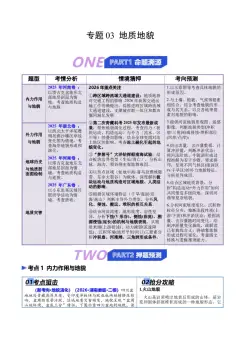
猜押专题08 阅读理解之记叙文(按话题分类)
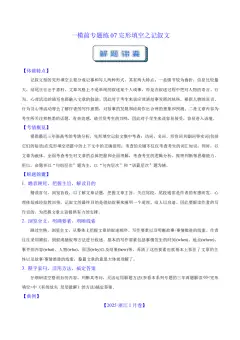
本命题依据 2026 新课程标准与高考命题新要求,是高考阅读 B 篇核心题
型,命题源自真实人物故事 + 成长经历 + 情感体验。核心考细节理解 + 情感
态度 + 主旨升华,长难句等,掌握叙事规律可少丢分、冲高分。
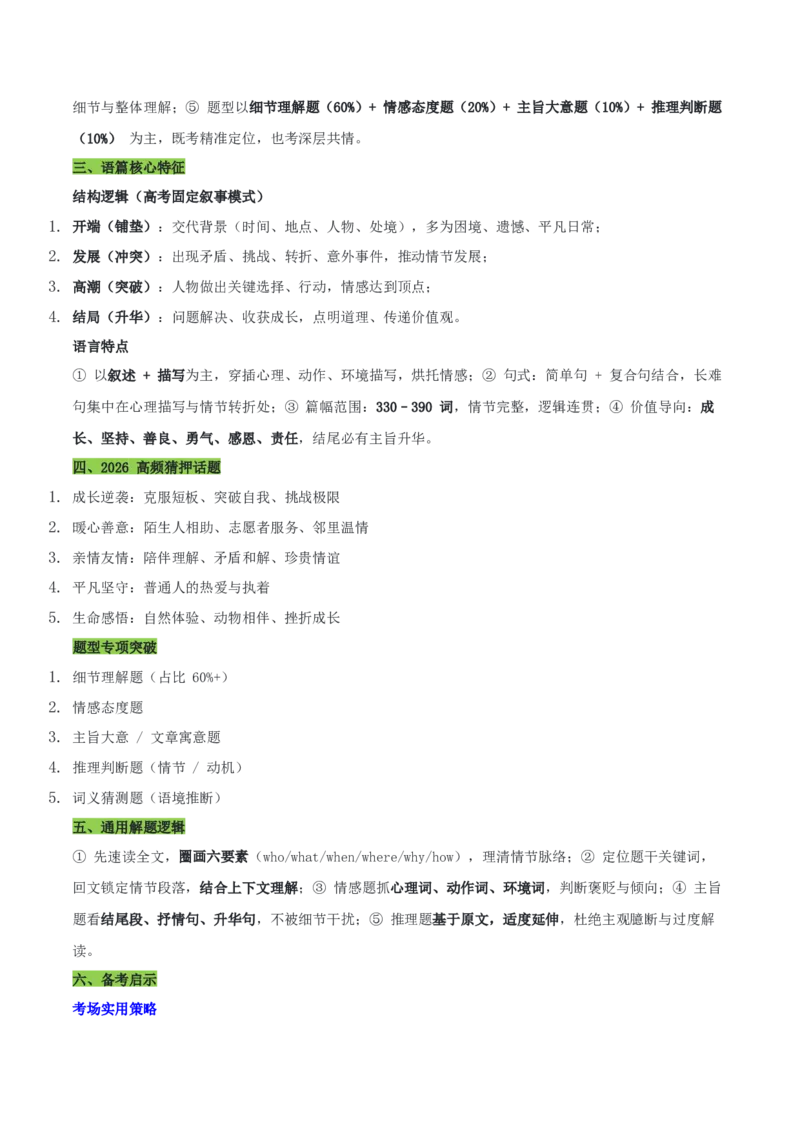
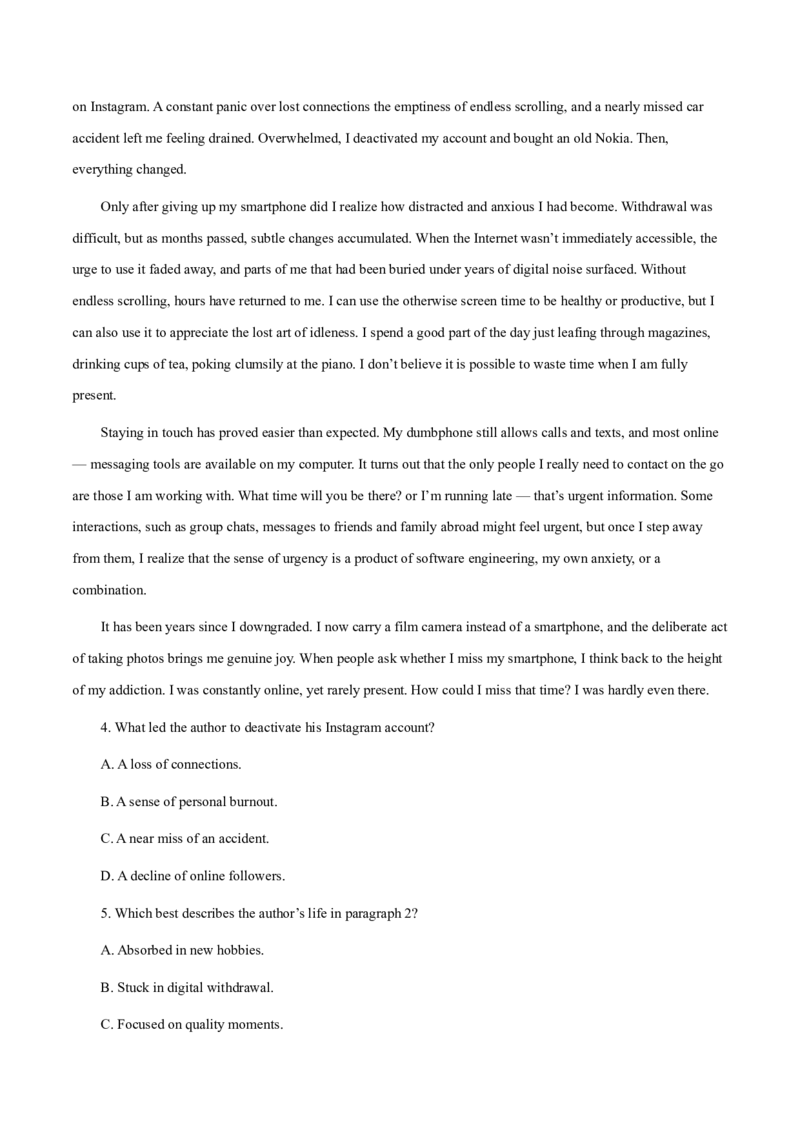
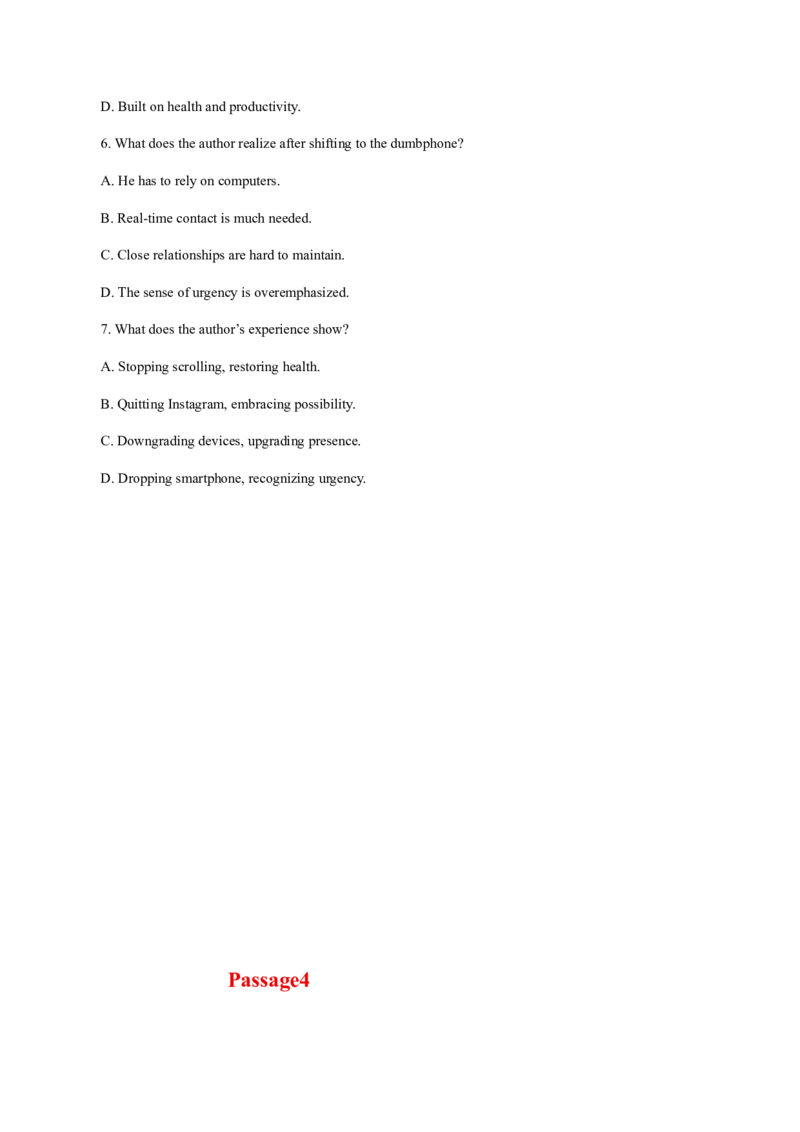
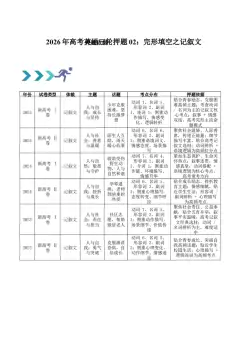
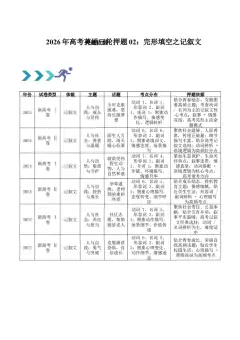
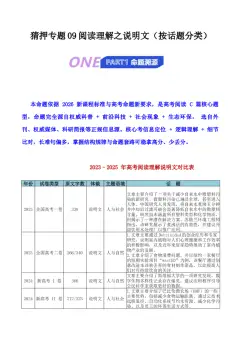
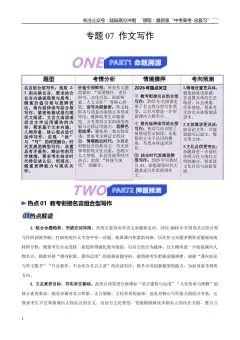
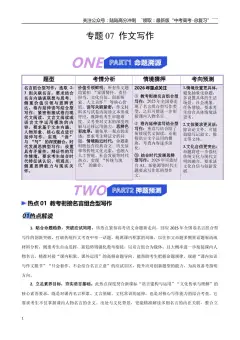
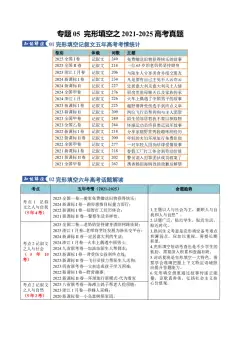
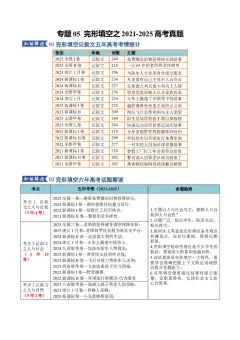
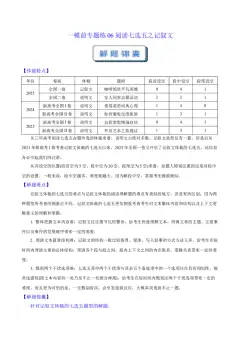
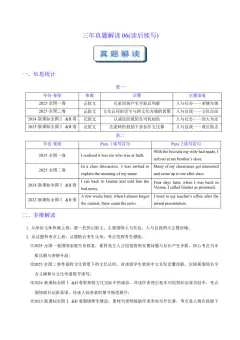
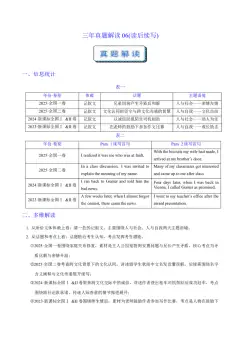
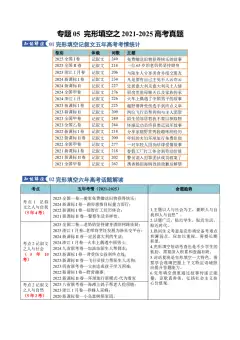
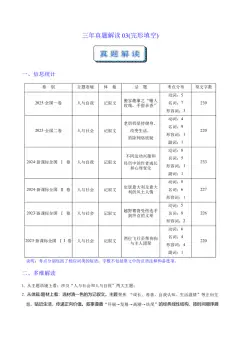
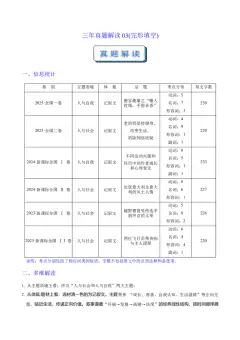
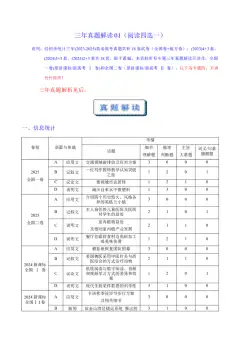
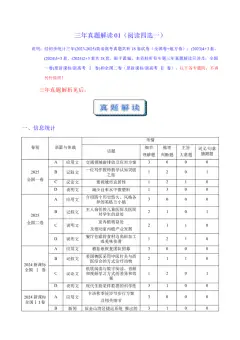
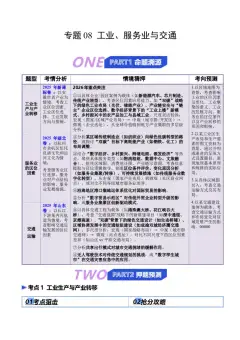
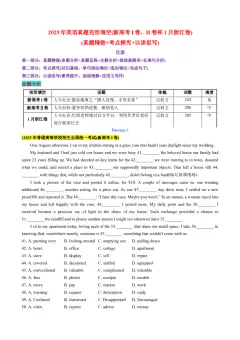
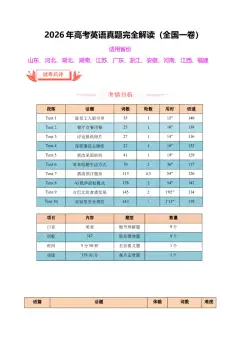
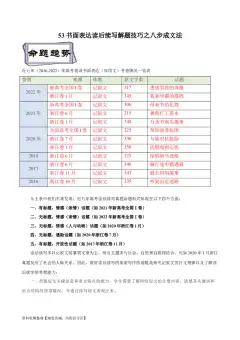
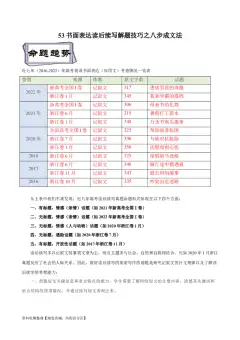
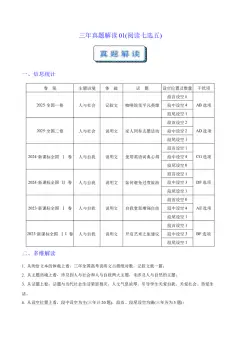
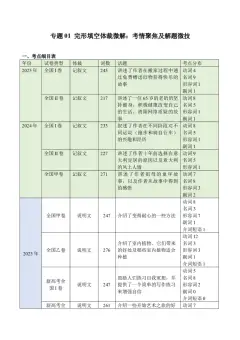
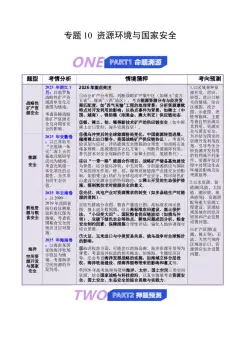
2023–2025 年高考阅读理解记叙文对比表
年份
试卷类型
原文字
数
体裁
主题语境
话  题
2025 全国高考一卷
304
记叙文
人与自我
文章主要讲述了作者作为一名写作课老师,通过教
学实践逐渐认识到学生写作动力的来源以及写作真
正意义的成长故事。
2025 全国高考二卷
309
记叙文
人与社会
主要讲述了Kathy Ho 在斯坦福露西尔
帕卡德儿童
・
医院(LPCH)担任教师的工作情况,介绍了医院学
校学生的情况、她工作的特点以及医院学校对学生
的益处。
2024
新高考 I 卷
303
记叙文
人与自然
文章讲述兽医威廉·法伯(William Farber)博士在
从针灸中受益后,将综合医疗应用于动物,并取得
了初步成效。
2024 新高考 II 卷
283
新闻报道人与社会
主要报道了旧金山湾区捷运系统(BART)推出自动售
货亭提供短篇故事打印服务,旨在满足乘客阅读需
求,提升出行体验,Trost 认为此举措能吸引更多
乘客,对BART
未来持乐观态度,预期乘客量将会
增长。
2023
新高考 I 卷
340
记叙文
人与自我
文章讲述了John Todd 从小就很爱思考且好学,他
建造了一个生态机器,利用自然可以自我修复的原
理来净化污水。
一、高考阅读理解记叙文总纲领
核心定位:高考阅读B 篇,高分题、少失误、读懂脉络(7–9 分钟 / 篇)。
本质:叙事 + 抒情 + 明理,不是单纯故事阅读;目标是理清脉络、捕捉情感、领悟主旨。
二、核心命题变化
① 体裁聚焦叙事类,以个人经历、名人轶事、暖心故事、成长感悟、回忆散文为主,真实故事占比逐年
提升,贴近高中生情感与成长认知;② 强化叙事脉络梳理 + 情感态度判断,长难句较应用文增多,侧重
理解人物心理、行为动机与情节逻辑;③ 话题聚焦个人成长、挫折突破、亲情友情、奉献善意、生命感
悟,价值导向积极,无晦涩题材;④ 解题从翻译全文转为抓叙事六要素 + 情感线索 + 主旨升华,兼顾
细节与整体理解;⑤ 题型以细节理解题(60%)+ 情感态度题(20%)+ 主旨大意题(10%)+ 推理判断题
(10%) 为主,既考精准定位,也考深层共情。
三、语篇核心特征
结构逻辑(高考固定叙事模式)
1. 开端(铺垫):交代背景(时间、地点、人物、处境),多为困境、遗憾、平凡日常;
2. 发展(冲突):出现矛盾、挑战、转折、意外事件,推动情节发展;
3. 高潮(突破):人物做出关键选择、行动,情感达到顶点;
4. 结局(升华):问题解决、收获成长,点明道理、传递价值观。
语言特点
① 以叙述 + 描写为主,穿插心理、动作、环境描写,烘托情感;② 句式:简单句 + 复合句结合,长难
句集中在心理描写与情节转折处;③ 篇幅范围:330–390 词,情节完整,逻辑连贯;④ 价值导向:成
长、坚持、善良、勇气、感恩、责任,结尾必有主旨升华。
四、2026 高频猜押话题
1. 成长逆袭:克服短板、突破自我、挑战极限
2. 暖心善意:陌生人相助、志愿者服务、邻里温情
3. 亲情友情:陪伴理解、矛盾和解、珍贵情谊
4. 平凡坚守:普通人的热爱与执着
5. 生命感悟:自然体验、动物相伴、挫折成长
题型专项突破
1. 细节理解题(占比 60%+)
2. 情感态度题
3. 主旨大意 / 文章寓意题
4. 推理判断题(情节 / 动机)
5. 词义猜测题(语境推断)
五、通用解题逻辑
① 先速读全文,圈画六要素(who/what/when/where/why/how),理清情节脉络;② 定位题干关键词,
回文锁定情节段落,结合上下文理解;③ 情感题抓心理词、动作词、环境词,判断褒贬与倾向;④ 主旨
题看结尾段、抒情句、升华句,不被细节干扰;⑤ 推理题基于原文,适度延伸,杜绝主观臆断与过度解
读。
六、备考启示
考场实用策略
1. 先通读脉络,再细做细节先理清故事起承转合,再逐题定位,避免断章取义。
2. 抓情感线索,顺情节做题人物情感随情节变化,按顺序解题,不跳跃乱找。
3. 重点盯首尾段首段定背景,尾段点主旨,是主旨题必看区域。
4. 情感词必标记happy/sad/determined/grateful 等直接对应态度题。
5. 不脱离文本共情所有情感、推理必须有原文依据,不凭生活经验脑补。
五题型专项备考策略
1. 细节题:定位原句→比对情节→排除张冠李戴
2. 情感题:抓心理 / 动作 / 环境词→判断褒贬→匹配选项
3. 主旨题:看结尾升华 + 核心事件→概括 “故事 + 道理”
4. 推断题:依情节逻辑→合理推测动机 / 结果→不绝对化
5. 词义题:看上下文因果 / 转折 / 解释→代入验证
避坑策略
1. 不被长难句困住:拆分主干,抓核心意思
2. 不混淆人物行为:分清 “谁做了什么”,防张冠李戴
3. 不主观加戏:文中未体现的情感、动机一律不选
4. 不忽略转折词:but/however/yet 后多为关键信息与主旨
5. 不把细节当主旨:避免以偏概全
考点 1:细节理解题
做法步骤:
1. 圈关键词:人物、动作、时间、地点、事件、数字
2. 回文定位:锁定情节所在段落
3. 精读原句:对照题干要求,提取精准信息
4. 比对选项:排除张冠李戴、无中生有、细节错位
5. 确定答案:与原文信息完全匹配
口诀:定位情节,核对信息,排除错位,直选答案。
考点 2:情感态度题
做法步骤:
1. 圈画情感信号词:积极:happy, grateful, determined, proud, relieved 消极:sad, anxious,
disappointed, regretful 中立:curious, objective
2. 抓描写线索:动作、神态、心理、环境烘托
3. 结合情节:判断情感变化与最终态度
4. 排除干扰:排除无关情感、极端态度
口诀:找情感词,看描写,依情节,定态度。
考点 3:主旨大意 / 文章寓意题
做法步骤:
1. 跳过细节,聚焦结尾段、抒情句、升华句
2. 概括核心:人物 + 事件 + 感悟 / 道理
3. 排除以偏概全、只讲细节、无升华的选项
4. 套用主旨句型:The story tells us that.../The author aims to show...
口诀:看结尾,抓升华,故事加道理,主旨不偏离。
考点 4:推理判断题(情节 / 动机)
做法步骤:
1. 定位相关情节,找行为依据
2. 推断逻辑:原因→结果,行为→动机
3. 坚守原则:原文有依据,不主观臆断
4. 排除绝对词、过度推理、与情节矛盾项
口诀:据情节,依逻辑,合理推,不瞎想。
考点 5:词义猜测题
做法步骤:
1. 定位生词,看上下文逻辑:因果、转折、并列、解释
2. 找同义 / 反义线索:that is, in other words, but, however
3. 结合情节与情感,代入选项验证
4. 排除字面意思、无关含义
口诀:看语境,找线索,代进去,通得顺。
Passage 1
河北衡水中学2025-26 届高三年级检测(七)
When our family was on long car trips, my kids sat forward in their seats, eyes moving quickly across
billboards. “I found an A” my daughter shouted, her voice full of excitement. Thus began our alphabet (字母) game
— a tradition I loved as a child, now bringing joy to a new generation. What always amazed me was how, once we
fixed our attention on a letter, it seemed to show up everywhere: a “B” on a bakery sign, a “C” on a coffee ad. I’d
worry we’d never spot a Q or X, but sure enough, they’d appear, making the kids cheer like we’d won a prize.
This little phenomenon hit me harder while I struggled to write a book for Angelico Press. For days, I stared at
my screen, the cursor (光标) shining with nothing there, as I fought to find fresh, poetic words for “nature’s
beauty.” Every phrase felt boring — too common, too forced. I’d delete paragraphs when I felt upset, wondering if
I’d ever catch that quiet magic of the outdoors, the kind that makes you feel amazed. It wasn’t for lack of trying; I
read poetry collections, took dawn walks, but inspiration just wouldn’t stick.
Then one afternoon, as the kids talked excitedly from the back seat about spotting a “Y” on a farm sign, it
clicked. I’d been waiting for inspiration to find me, not going out to find it. What if I approached writing like their
game? I started hunting for metaphors (隐喻) in daily life — and soon, they were everywhere: a garden rose
became “sunlight wrapped in silk,” rain on my window “the sky’s soft whisper.”
Just as Mentalist Oz Pearlman says, “we find what we seek.” Whether it’s a letter on a billboard, a meaningful
image, or even joy in small moments, focus turns the invisible into the visible. It’s a reminder to choose what we
look for wisely — because what we notice shapes the world we see.
4. What was the author’s initial concern about the game?
A. The children would soon get bored.
B. Some letters might be too hard to find.
C. The children would fight over the letters.
D. They might run out of billboards to search.
5. Why did the author delete paragraphs when writing?
A. She lacked writing materials.
B. She wanted to copy poetry styles.
C. She thought her writing was too long.
D. She couldn’t find creative expressions.
6. What made the author get inspiration for writing?
A. The poetry collections she read.
B. The way to play the alphabet game.
C. The idea of taking a family car ride.
D. The poetic sentences she created.
7. What can we learn from the author’s experience?
A. Treasures lie in distant places.
B. Inspiration comes from reading.
C. Focus helps discover life’s beauty.
D. Success depends on the right moment.
Passage2
吉林省松原市实验高级中学2025-2026 学年高三下学期学情调研
Several years ago, on a bitterly cold February day that felt particularly hopeless, I wandered the winding
streets of an unnamed small town in Vermont, seeking a quiet corner to reach a clear decision that had been
weighing on my mind for weeks: whether I should leave my teaching job — a position that offered security but felt
more and more empty — and pursue something, anything, that might bring me a sense of true fulfillment (成就),
for I was supposed to help shape young minds yet often felt no more than a paper-grader and a silent observer of
empty classrooms.
I took shelter from the cold in a local diner and noticed an old man, who I later learned was Orin, sitting alone
with a pie before him, staring out at the gray sky; after a while, he stood up, walked to a tired young waitress named
Clara who was clearing a nearby table, took a napkin, smoothed it flat, drew a sunflower with a pencil, and handed
it to her — an act that made her tired face light up with a warm smile as she thanked him softly.
Curious, I asked Clara about him. She explained Orin had lost his wife the year before and withdrawn into
silence after their small farm lost its warmth, yet still came to the diner every few days to give others such small
drawings — delicate sketches (速写) showing a skill far beyond a casual hobby. I suddenly understood: I had
sought fulfillment as if it were far-off, but Orin, who had every reason to withdraw, chose to reach out. His small
act taught me that fulfillment comes not from the job itself, but from the bonds we build through it.
When I returned to the city, I did not resign, for I finally knew that a kind word to a struggling student or a
moment of patience with a difficult class was the very meaning I’d been searching for.
24. Why did the author wander the Vermont town?
A. To escape the cold weather.
B. To take a vacation there.
C. To make a career choice.
D. To enjoy a quiet atmosphere.
25. What was the immediate effect of Orin’s drawing for Clara?
A. It brightened her day.                    B. It displayed his artistic skills.
C. It attracted more customers.
D. It reminded her of his fulfillment.
26. What can be learned about Orin from paragraph 3?
A. He considered drawing as his hobby.
B. He seemed silent but warm-hearted.
C. He hoped to withdraw from the diner.
D. He quit farming for his artistic dream.
27. What message does the text convey?
A. Job change brings personal satisfaction.
B. Quiet places offer solutions to problems.
C. Love for art is a cure for deep sadness.
D. Value in work lies in human connections.
Passage3
杭州学军中学2026 首考适应性考试
For years, as an art influencer, I lived online, documenting all aspects of my life and desiring more followers
on Instagram. A constant panic over lost connections the emptiness of endless scrolling, and a nearly missed car
accident left me feeling drained. Overwhelmed, I deactivated my account and bought an old Nokia. Then,
everything changed.
Only after giving up my smartphone did I realize how distracted and anxious I had become. Withdrawal was
difficult, but as months passed, subtle changes accumulated. When the Internet wasn’t immediately accessible, the
urge to use it faded away, and parts of me that had been buried under years of digital noise surfaced. Without
endless scrolling, hours have returned to me. I can use the otherwise screen time to be healthy or productive, but I
can also use it to appreciate the lost art of idleness. I spend a good part of the day just leafing through magazines,
drinking cups of tea, poking clumsily at the piano. I don’t believe it is possible to waste time when I am fully
present.
Staying in touch has proved easier than expected. My dumbphone still allows calls and texts, and most online
— messaging tools are available on my computer. It turns out that the only people I really need to contact on the go
are those I am working with. What time will you be there? or I’m running late — that’s urgent information. Some
interactions, such as group chats, messages to friends and family abroad might feel urgent, but once I step away
from them, I realize that the sense of urgency is a product of software engineering, my own anxiety, or a
combination.
It has been years since I downgraded. I now carry a film camera instead of a smartphone, and the deliberate act
of taking photos brings me genuine joy. When people ask whether I miss my smartphone, I think back to the height
of my addiction. I was constantly online, yet rarely present. How could I miss that time? I was hardly even there.
4. What led the author to deactivate his Instagram account?
A. A loss of connections.
B. A sense of personal burnout.
C. A near miss of an accident.
D. A decline of online followers.
5. Which best describes the author’s life in paragraph 2?
A. Absorbed in new hobbies.
B. Stuck in digital withdrawal.
C. Focused on quality moments.
D. Built on health and productivity.
6. What does the author realize after shifting to the dumbphone?
A. He has to rely on computers.
B. Real-time contact is much needed.
C. Close relationships are hard to maintain.
D. The sense of urgency is overemphasized.
7. What does the author’s experience show?
A. Stopping scrolling, restoring health.
B. Quitting Instagram, embracing possibility.
C. Downgrading devices, upgrading presence.
D. Dropping smartphone, recognizing urgency.
Passage4
江浙高中发展共同体·2026 届高三第一次适应性考试
In my senior-year literature class last term, I encountered a knight who defended a forgotten kingdom, a gentle
grandmother who healed wounds with folk tales, and a futuristic explorer who vanished in a black hole. Once, I
often found myself amazed at how my students, who brought these figures to life, grasped the essence of complex
literary themes.
But the situation was quite different with their first assignment, which centered on the question: “Why is
literature important?”
Most of the essays were barely a page long, and scarcely any had a sentence that could serve as a strong thesis
statement. I was taken aback. Then it dawned on me that the problem lay in the question itself. They could have
written volumes about the allure of social media, but literature, in its pure form, just didn’t seem significant to
them. This had to change.
As a new semester began, I asked everyone to craft a reflective essay on a literary work that had touched their
soul. This time, they found the task far more engaging. For the subsequent two tasks, a drama-analysis project was
followed by a poetry-creation workshop. I only stipulated that each piece should convey a deep-seated emotion.
The outcomes were astounding. The students delved into a wide range of literary works and produced essays and
poems, each 8 to 15 pages long, with insights that broadened my perspective and stirred my emotions.
I entered the class believing that literature is important as a mirror of humanity. However, my students
demonstrated something even more profound. When the final bell rang in June, I walked away with a year’s worth
of memories filled with the realization of literature’s most profound significance — the ability to awaken dormant
feelings, to transport us to unseen worlds, and to reveal the shared threads of our human experiences.
4. Who are the characters mentioned at the beginning of paragraph 1?
A. Senior-year students. B. The author’s relatives.
C. Famous literary critics.
D. Fictional personas.
5. Why did the students perform poorly in their first writing task?
A. They lacked writing skills.
B. They had a limited understanding of literature.
C. They misinterpreted the question’s intent.
D. They had no interest in the topic.
6. What does the underlined word “astounding” in paragraph 4 mean?
A. Confusing.
B. Impressive.
C. Ordinary.
D. Frightening.
7. What does the author’s experience illustrate?
A. Literature can awaken deep-seated human emotions.
B. Teaching literature is an easy task.
C. Students prefer creative writing to theoretical essays.
D. Classic literature is losing its appeal.
Passage5
2026 届江苏苏州市七校联考模拟预测
Last spring, my neighbor Donna and I, both in our seventies, spent several hours in the glorious sunshine
enjoying the new season. When it was time to sit down and relax, Donna pulled out her red metal chair from her
garage, and I sat on an overturned plastic bucket. It was fun to catch up on the news that we had missed during the
long winter indoors.
However, over the next few days, it turned out that we needed more than a chair and a bucket which were not
quite comfortable. Donna decided we needed a bench. After ruling out unsuitable options from local stores, she
found a perfect one online. The next day it arrived. Excitedly, she opened the box and started putting it together. We
proudly highfived each other as the pieces joined up and the bench started to look like one. After a few minutes’
assistance from a neighbour, it was assembled. What’s more, it was ideal for two 70-somethings to carry on late
afternoon chats.
Soon, the bench attracted other neighbors. One day, someone called out from the sidewalk, “What do you do
on that bench?” Quick-thinking Donna shouted back, “It’s our ‘Thinking Bench’! We think about important things
happening in our lives.” Then, the name gradually evolved — after one neighbor sat alone deep in thought, he
declared it a “Decision-Making Bench”; another time, when Donna was caught napping, she insisted she was
“meditating (冥想)”, adding yet another name.
Last fall with the temperature falling, our outdoor days come to an end. We were faced with one dilemma —
what to do about it in the winter? Well, we sat down and thought and meditated and decided to put it in Donna’s
garage for the winter.
When I glimpsed it a few times over the next months, the bench sat lonely, holding empty flower pots, and
some flat, old boxes. But now after a long winter, spring flowers are ready to bloom in the warm sunshine, and we
neighbours are ready to welcome “The Bench” back into our lives.
4. Donna decided to replace the chair and bucket to ________.
A. lighten the carrying load
B. attract more neighbours
C. get better seating for conversations
D. adapt to warmer weather
5. How did the bench get its various names?
A. From items placed on it.
B. From seasonal discussions.
C From Donna’s creative ideas.
D. From users’ activities on it.
6. Why are pots and boxes mentioned in the last paragraph?
A. To suggest the flowers would soon be planted.
B. To describe the bench’s practical use in winter.
C. To show the bench was not serving its purpose.
D. To explain why the bench needed winter storage.
7. What does “The Bench” represent by the end of the story?
A. A symbol of community bonds.
B. A marker of individual free time.
C. A reminder of the past summer.
D. A memory of a valued online order.
Passage6
江苏省镇江市2025-2026 学年上学期高三零模
At the point where charity meets sustainability, Wendy Schmidt stands out for her innovative approach to
addressing global challenges. Her work goes beyond traditional charity, rooted in a method that considers the
interconnections within ecological, social, and economic systems.
Her work began somewhat unexpectedly through her career as a room designer. It was here that she became
intensely aware of how design choices impact resource use and waste generation. This awareness grew into a
genuine commitment to addressing broader environmental challenges and led to the creation of the Schmidt Family
Foundation and initiatives aimed at encouraging systemic change.
One of the core principles guiding Schmidt’s efforts is “venture philanthropy (风险慈善),” which focuses on
original, creative solutions to environmental problems. For instance, the 11th Hour Project’s work in the
Democratic Republic of Congo helps protect gorilla habitats while providing alternative livelihoods for local
communities by supporting the construction of micro-hydropower (微型水力发电) systems.
To deepen public engagement, Schmidt advocates using new media and immersive experiences. She believes
technologies like virtual reality (VR) offer unique opportunities to engage the public in ways traditional media
cannot. Schmidt hopes to change how people relate to the natural world. In line with this vision, in April 2024,
Schmidt co-launched Agog: The Immersive Media Institute, which supports creators and nonprofit leaders in using
extended reality technologies to inspire empathy and social transformation.
Throughout her work, she had a strong commitment to ensure that the benefits of technological advancements
and environmental initiatives are accessible to all. By integrating traditional knowledge and contemporary science,
she tries to create solutions that are both innovative and deeply rooted in respect for the natural world.
24. What makes Schmidt’s work different from traditional charity?
A. Her knowledge of ecology.
B. Her strong desire for global changes.
C. Her involvement in local communities.
D. Her comprehensive approach to sustainability.
25. What does paragraph 2 mainly talk about?
A. Schmidt’s journey into charity.
B. The threat of pollution.
C. Schmidt’s goal for sustainability.
D. The significance of recycling.
26. What does the author try to illustrate by mentioning the 11th Hour Project in paragraph 3?
A. Schmidt’s personal business expansion goals.
B. Schmidt’s innovative solutions to complex issues.
C. The necessity of investing in big industrial projects.
D. The difficulty in building micro-hydropower systems.
27 What does Schmidt hope to do by using new technologies according to paragraph 4?
A. Set up nonprofit institutes.
B. Reshape people’s bond with nature.
C. Replace traditional media.
D. Increase public interest in entertainment.
Passage7
山东名校联盟2026 届高三下学期2 月份核心素养评估考试
16-year-old Jared Lepora from the UK has created a robotic arm that imitates the natural movements of a
human hand using only ready-made Lego Mindstorms parts. He showcased this invention at the 2025 International
Conference on Intelligent Robots and Systems in Hangzhou, China.
The teenager co-authored research recently published along with colleagues including his father Nathan
Lepora, a professor of robotics and artificial intelligence at the University of Bristol. Jared used Lego Mindstorms,
a Lego robotics kit, to build a Lego version of SoftHand-A, a 3D-printed robot hand introduced in an earlier study.
“My dad has always been working on robotics. He designs robotic systems with complicated mechanisms that
have lots of real-world applications,” Jared said. “My goal was to create an educational design which shows
professional mechanisms in a simple educational way understandable by children.”
The design is a playful interpretation of a serious line of robotics research. It is based on the Pisa/IIT SoftHand
model, a world-leading development in soft robotics that uses a single tendon (肌腱) system to coordinate finger
movements. Jared adapted this concept for educational purposes, replacing the 3D-printed parts and metal bearings
with standard components and over 100 plastic Lego bearings. Despite its toy origins, the Lego SoftHand performs
remarkably well. Lab tests have shown that it can grip objects with about 90% of the force of a professional 3D-
printed SoftHand, and perform open-close cycles in about one second.
Since the hand can be constructed from Lego pieces and uses state-of-the-art design concepts for robotic
hands, it has the potential to educate and inspire children to learn about the frontiers of modern robotics. “My
generation and younger are the future of robotics, so it is essential that we understand and take interest in this
field,” Jared says. “Building a robot hand with your own hands is a great way to learn about robotics.”
4. What can be learned about Jared from the first two paragraphs?
A. He has an inquiring mind.
B. He is keen on cutting-edge tech.
C. He is fond of Lego bricks.
D. He excels at hands-on projects.
5. What is Jared’s design like?
A. Rare but mind-opening.
B. User-friendly and informative.
C. Complicated but well-operated.
D. Cost-effective and professional.
6. What is the basis for Jared’s design?
A. A novel concept of movements.
B. Earlier research of Lego robotics.
C. An advanced model in soft robotics.
D. The availability of Lego components.
7. What message does the text mainly convey?
A. Like father, like son. B. Home is the first school.
C. It’s never too late to learn.
D. Think outside the Lego box.
Passage8
青岛39 中2026 届高三年级模拟考试2026.03
Mark Twain’s words strike a deep chord (心弦) with writers, “The difference between the right word and the
almost right word is the difference between lightning and a lightning bug.” This quote shows the tiring process of
rewriting a novel. The first draft feels like an exciting first date — full of promise and relaxation. You finish with a
broad smile, imagining readers applauding your brilliance.
But that honeymoon period lasts only about 48 hours. Soon, the sinking feeling sets in as you revisit your
draft, realizing the hard part has just begun. Rewriting is where real writers emerge. It’s time to dig deep, pulling
out the tools and techniques you’ve gathered over the years. You revisit your favorite authors, hoping they’ll offer
guidance for navigating the rocky road of revision.
Rewriting demands you comb through each sentence, ensuring it contains the exact right word. Every
character must earn its place in the story, and each chapter should contribute meaningfully to the narrative. Even
your beloved pieces of dialogue may need to be cut.
I learned this while working on my novel. The rewriting process haunted (萦绕) me, and I often questioned if
the effort was worth it. One night, nearing 2 a.m. after an exhausting session, I thought about abandoning my work.
That’s when I came across the film In Time, which highlighted my deepest fear: the time invested in my novel. At
that moment, I struck a deal with myself. I decided to cease the self-criticism and recapture the joy that fueled my
writing. I committed to evaluating my work page by page, asking, “Do I love it?” If not, I replaced it.
Here’s my advice: reawaken your passion and examine your work one page at a time. Writing is a journey, and
the rewriting period bridges inspiration and a satisfying finished product. Remember, the “right word” is the key to
excellence.
4. What do Mark Twain’s words imply?
A. Revising is a rocky road.
B. Readers’ feeling matters.
C. Quoting precisely is a must.
D. The first draft rarely falls short.
5. What does the author think of rewriting?
A. Time-wasting.
B. Labor-saving.
C. Heartbreaking.
D. Painstaking.
6. What is paragraph 4 mainly about?
A. Which word should be highlighted.
B. Why the writing process is questioned.
C. What the film In Time talks about.
D. How the passion for rewriting is fueled.
7. What does the author’s advice show?
A. The role of inspiration in writing.
B. The importance of proper wording.
C. The reason for making rewriting unique.
D The journey to creating an excellent product.
Passage9
北京市通州区2025-2026 学年高三上学期摸底考试
There’s a wrapper half-sunk in the mud under the bush. Each time I grab it with my litter-picker, another piece
tears off. I persist, until all the pieces are in my bin liner. Then I move on.
I’m volunteering with a group at my local park. They perform a range of tasks, but today we’re litter-picking.
When our bags are full, we gather for a break, in our yellow vests (马甲). I arrived this morning feeling depressed,
but this simple, repetitive and collective act has comforted me and pulled me away from the doom scroll of my
mind.
It’s easy to assume that the best way to lift your spirits when you’re feeling down is to do something nice for
yourself. However, research suggests that altruistic (利他的) acts work better. I did not know this when I signed up
with the conservation group.
What I did know was that I was feeling deeply upset about the ecological and climate crises. It was the
counsellor (咨询师) I was seeing who switched me on to the idea of volunteering. He gave me three rules: make it
simple, immediate and cooperative. That’s how, a week later, I found myself in a park fishing old carrier bags out of
the river.
Psychologists call the mental boost from volunteering the “helper’s high”. And I did feel that lift, which soon
led me to sign up to volunteer at other places. Every time I volunteered, I would come home feeling better — lifted
by the fresh air, the natural environment and the companion—and, perhaps most of all, by having acted in line with
my values. I didn’t mind if the tasks were exhausting or repetitive. I was taking action, learning new skills, and
feeling part of something meaningful.
That’s not to say I didn’t — and still don’t — sometimes wonder: Are we really making a difference here? But
I remind myself of my counselor’s advice that I should not be discouraged by people saying that my actions were
only a drop in the ocean, since an ocean is made up of millions upon millions of drops.
While it was my total despair with the environment that led me into volunteering, it’s the goodness and
kindness that I’ve witnessed while working alongside my fellow volunteers that have kept me coming. And I think
yellow is my color.
24. The author started volunteering because of ______.
A. the inspiration of a counsellor
B. his own confusion about life values
C. an insightful litter-picking experience
D. his desire to improve cooperative skills
25. How did the author feel after litter-picking in the park?
A. Bored.
B. Engaged.
C. Rewarded.
D. Depressed.
26. It can be inferred from the last paragraph that the author ______.
A. values the warm-heartedness of local people
B. believes the color will help her stay positive
C. feels a stronger connection to the volunteer role
D. sees the color as a warning sign of environment
27. What was the major insight the author gained from the volunteering?
A. Climate crisis needs an immediate solution.
B. Individual goodness brings about a great power.
C. People need stronger ties with local communities.
D. Helping others has a positive impact on one’s career.
Passage10
备战2026 年高考英语模拟卷(上海卷)
My adventure with pottery began unexpectedly online. I saw a video of a person making a late-night snack,
but what truly caught my eye was the plate — a beautifully simple, cream-colored piece with a unique bubbled
shape. I had never seen anything like it and immediately wanted one, I imagined all the meals I could present on it
and how lovely they would look.
However, it was quite expensive. I couldn’t justify the purchase, so a bold idea struck me: Why not make it
myself? I admitted this was a little unreasonable. My only experience with clay was from a brief encounter in
elementary school. Yet, driven by the desire for that unique plate and then a wish to learn something new, I signed
up for a pottery class last April.
I entered the first class confidently, but reality soon hit. In the beginning, handling clay — which seemed so
simple — was much harder for me, a rather carefree girl, than I had anticipated. My posture was wrong; I failed to
center the clay on the wheel; I even couldn’t control its speed properly. Once, I spun the wheel too fast and made
my piece flying across the room. I felt embarrassed and thought about quitting right then.
However, I was not the one to give up easily. I continued attending class. By the third session, a shift occurred.
I concentrated on steadying my elbows, gently applying pressure to the clay, and slowly pulling up the walls to
form a bowl. The quiet rhythmic sound of the spinning wheel had a calming effect. To my surprise, by the end of
that class, I had created my first real piece — a small, imperfect, yet completely handmade bowl.
That semester taught me more than pottery; it taught me perseverance, and how to find beauty in imperfection.
I left with several bowls and a vase. The bubble-shaped plate remained my goal in my next round of classes. This
journey reminded me that true value lies not in a perfect product, but in the rewarding process of creating
something with my own hands.
36.What was the author’s initial intention of making a piece of pottery?
A.To learn a new skill.
B.To join a pottery class.
C.To have a special plate.
D.To decorate a perfect room.
37.Why did the author almost give up pottery making?
A.She found it too tiring.
B.She was rather careless.
C.She lacked the proper instruction.
D.She struggled with the basic techniques.
38.Which of the following can best describe the author?
A.Daring and modest.
B.Cautious and sensitive.
C.Determined and patient.
D.Curious and considerate.
39.What does the author learn from her pottery experience?
A.Well begun is half done.
B.The journey is the reward.
C.Perfection is the enemy of progress.
D.A bird in the hand is worth two in the bush.