2026 年高考考前押题卷(广东卷)
英语
(考试时间:120 分钟  试卷满分:120 分)
注意事项:
1.本试卷分第Ⅰ卷(选择题)和第Ⅱ卷(非选择题)两部分。答卷前,考生务必将自己的姓名、准
考证号填写在答题卡上。
2.回答第Ⅰ卷时,选出每小题答案后,用2B 铅笔把答题卡上对应题目的答案标号涂黑。如需改动,
用橡皮擦干净后,再选涂其他答案标号。写在本试卷上无效。
3.回答第Ⅱ卷时,将答案写在答题卡上。写在本试卷上无效。
4.考试结束后,将本试卷和答题卡一并交回。
第一部分  阅读(共两节,满分50 分)
第一节(共15 小题;每小题2.5 分,满分37.5 分)
阅读下列短文,从每题所给的A、B、C、D 四个选项中选出最佳选项。
A
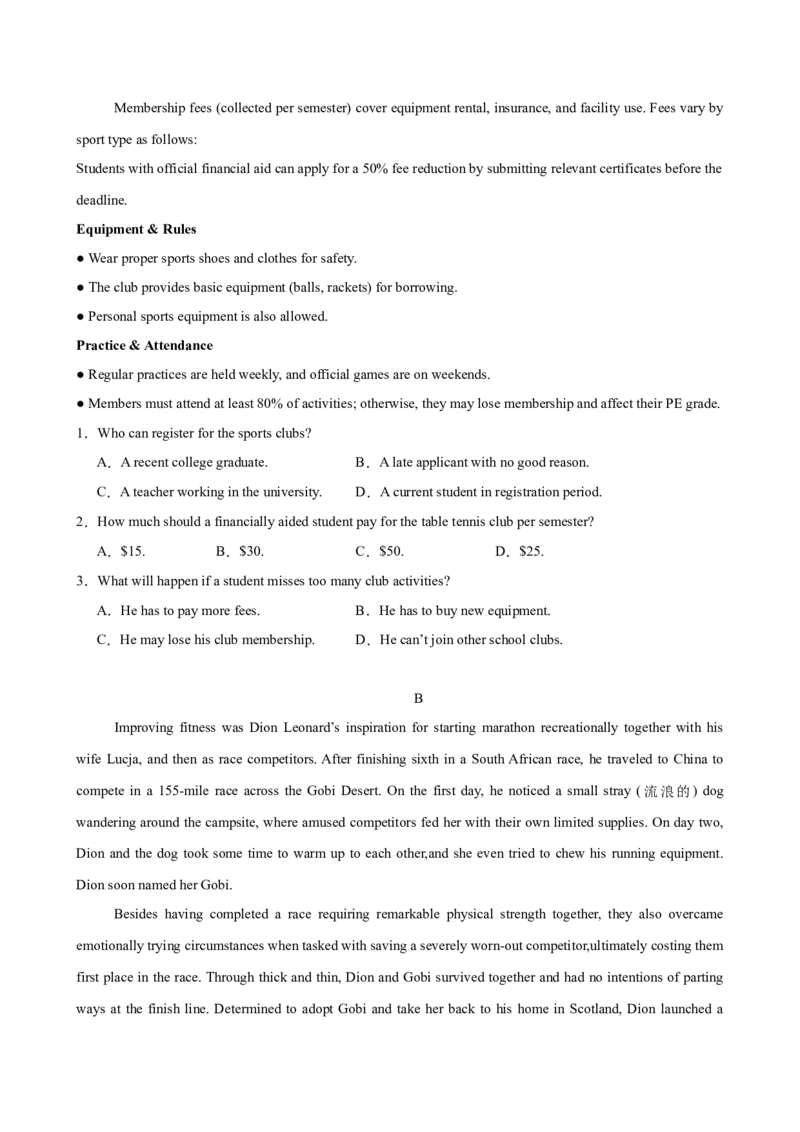
University Sports Club Registration
Are you eager to challenge yourself and make like-minded friends? Join our campus sports clubs! The
following guide will help you know about registration, fees, rules and other important information.
Registration Timeline: March 1 — March 15 (semesterly);
Late application approval required from athletic department.
Eligibility & Registration
All currently enrolled students are eligible to register. The registration period is from March 1 to 15 every
semester. You can apply online via the university portal or in person at the Student Recreation Center (SRC) office
on workdays (8:00 AM — 5:00 PM) with your student ID.
Late applications are only accepted with valid reasons (e.g. , illness) and approval from the athletic
department.
Sports Type
Examples
Fee per semester
Individual Sports
Tennis, Table Tennis
$30
Team Sports
Basketball, Soccer, Volleyball
$50
Membership Fees
Membership fees (collected per semester) cover equipment rental, insurance, and facility use. Fees vary by
sport type as follows:
Students with official financial aid can apply for a 50% fee reduction by submitting relevant certificates before the
deadline.
Equipment & Rules
● Wear proper sports shoes and clothes for safety.
● The club provides basic equipment (balls, rackets) for borrowing.
● Personal sports equipment is also allowed.
Practice & Attendance
● Regular practices are held weekly, and official games are on weekends.
● Members must attend at least 80% of activities; otherwise, they may lose membership and affect their PE grade.
1.Who can register for the sports clubs?
A.A recent college graduate.
B.A late applicant with no good reason.
C.A teacher working in the university.
D.A current student in registration period.
2.How much should a financially aided student pay for the table tennis club per semester?
A.$15.
B.$30.
C.$50.
D.$25.
3.What will happen if a student misses too many club activities?
A.He has to pay more fees.
B.He has to buy new equipment.
C.He may lose his club membership.
D.He can’t join other school clubs.
B
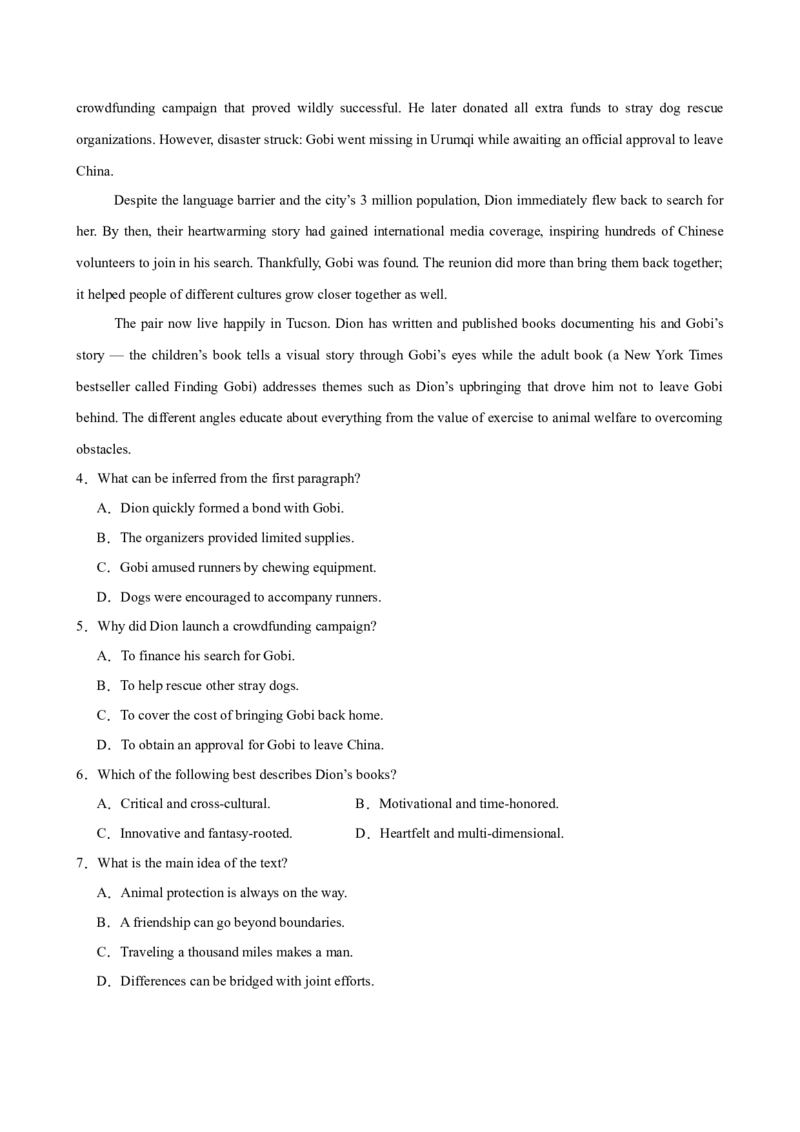
Improving fitness was Dion Leonard’s inspiration for starting marathon recreationally together with his
wife Lucja, and then as race competitors. After finishing sixth in a South African race, he traveled to China to
compete in a 155-mile race across the Gobi Desert. On the first day, he noticed a small stray ( 流浪的) dog
wandering around the campsite, where amused competitors fed her with their own limited supplies. On day two,
Dion and the dog took some time to warm up to each other,and she even tried to chew his running equipment.
Dion soon named her Gobi.
Besides having completed a race requiring remarkable physical strength together, they also overcame
emotionally trying circumstances when tasked with saving a severely worn-out competitor,ultimately costing them
first place in the race. Through thick and thin, Dion and Gobi survived together and had no intentions of parting
ways at the finish line. Determined to adopt Gobi and take her back to his home in Scotland, Dion launched a
crowdfunding campaign that proved wildly successful. He later donated all extra funds to stray dog rescue
organizations. However, disaster struck: Gobi went missing in Urumqi while awaiting an official approval to leave
China.
Despite the language barrier and the city’s 3 million population, Dion immediately flew back to search for
her. By then, their heartwarming story had gained international media coverage, inspiring hundreds of Chinese
volunteers to join in his search. Thankfully, Gobi was found. The reunion did more than bring them back together;
it helped people of different cultures grow closer together as well.
The pair now live happily in Tucson. Dion has written and published books documenting his and Gobi’s
story — the children’s book tells a visual story through Gobi’s eyes while the adult book (a New York Times
bestseller called Finding Gobi) addresses themes such as Dion’s upbringing that drove him not to leave Gobi
behind. The different angles educate about everything from the value of exercise to animal welfare to overcoming
obstacles.
4.What can be inferred from the first paragraph?
A.Dion quickly formed a bond with Gobi.
B.The organizers provided limited supplies.
C.Gobi amused runners by chewing equipment.
D.Dogs were encouraged to accompany runners.
5.Why did Dion launch a crowdfunding campaign?
A.To finance his search for Gobi.
B.To help rescue other stray dogs.
C.To cover the cost of bringing Gobi back home.
D.To obtain an approval for Gobi to leave China.
6.Which of the following best describes Dion’s books?
A.Critical and cross-cultural.
B.Motivational and time-honored.
C.Innovative and fantasy-rooted.
D.Heartfelt and multi-dimensional.
7.What is the main idea of the text?
A.Animal protection is always on the way.
B.A friendship can go beyond boundaries.
C.Traveling a thousand miles makes a man.
D.Differences can be bridged with joint efforts.
C
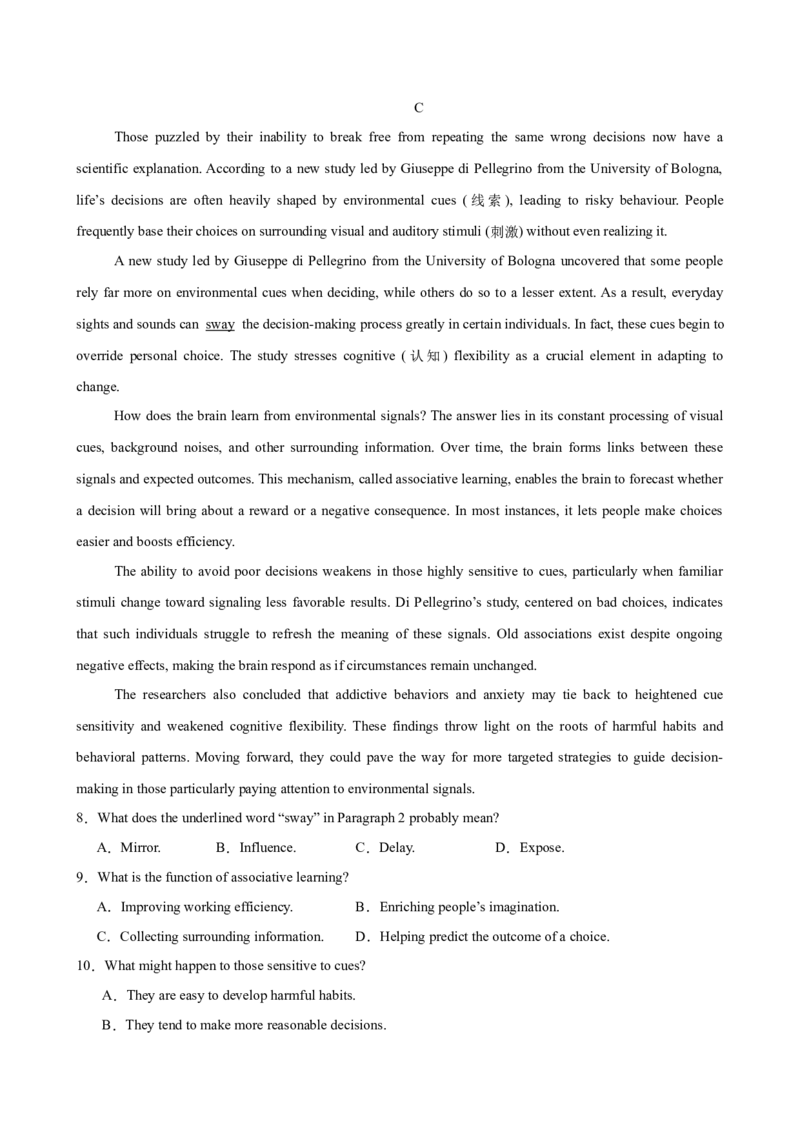
Those puzzled by their inability to break free from repeating the same wrong decisions now have a
scientific explanation. According to a new study led by Giuseppe di Pellegrino from the University of Bologna,
life’s decisions are often heavily shaped by environmental cues ( 线索), leading to risky behaviour. People
frequently base their choices on surrounding visual and auditory stimuli (刺激) without even realizing it.
A new study led by Giuseppe di Pellegrino from the University of Bologna uncovered that some people
rely far more on environmental cues when deciding, while others do so to a lesser extent. As a result, everyday
sights and sounds can sway the decision-making process greatly in certain individuals. In fact, these cues begin to
override personal choice. The study stresses cognitive ( 认知) flexibility as a crucial element in adapting to
change.
How does the brain learn from environmental signals? The answer lies in its constant processing of visual
cues, background noises, and other surrounding information. Over time, the brain forms links between these
signals and expected outcomes. This mechanism, called associative learning, enables the brain to forecast whether
a decision will bring about a reward or a negative consequence. In most instances, it lets people make choices
easier and boosts efficiency.
The ability to avoid poor decisions weakens in those highly sensitive to cues, particularly when familiar
stimuli change toward signaling less favorable results. Di Pellegrino’s study, centered on bad choices, indicates
that such individuals struggle to refresh the meaning of these signals. Old associations exist despite ongoing
negative effects, making the brain respond as if circumstances remain unchanged.
The researchers also concluded that addictive behaviors and anxiety may tie back to heightened cue
sensitivity and weakened cognitive flexibility. These findings throw light on the roots of harmful habits and
behavioral patterns. Moving forward, they could pave the way for more targeted strategies to guide decision-
making in those particularly paying attention to environmental signals.
8.What does the underlined word “sway” in Paragraph 2 probably mean?
A.Mirror.
B.Influence.
C.Delay.
D.Expose.
9.What is the function of associative learning?
A.Improving working efficiency.
B.Enriching people’s imagination.
C.Collecting surrounding information.
D.Helping predict the outcome of a choice.
10.What might happen to those sensitive to cues?
A.They are easy to develop harmful habits.
B.They tend to make more reasonable decisions.
C.They are likely to have stronger cognitive flexibility.
D.They have trouble refreshing the meaning of the cues.
11.What can be the best title for the text?
A.How People Can Make A Wise Decision.
B.What Really Lies Behind Environmental Cues.
C.Why People Keep Repeating The Same Mistaken Decisions.
D.What Is The Connection Between Surroundings And Cognitive.
D
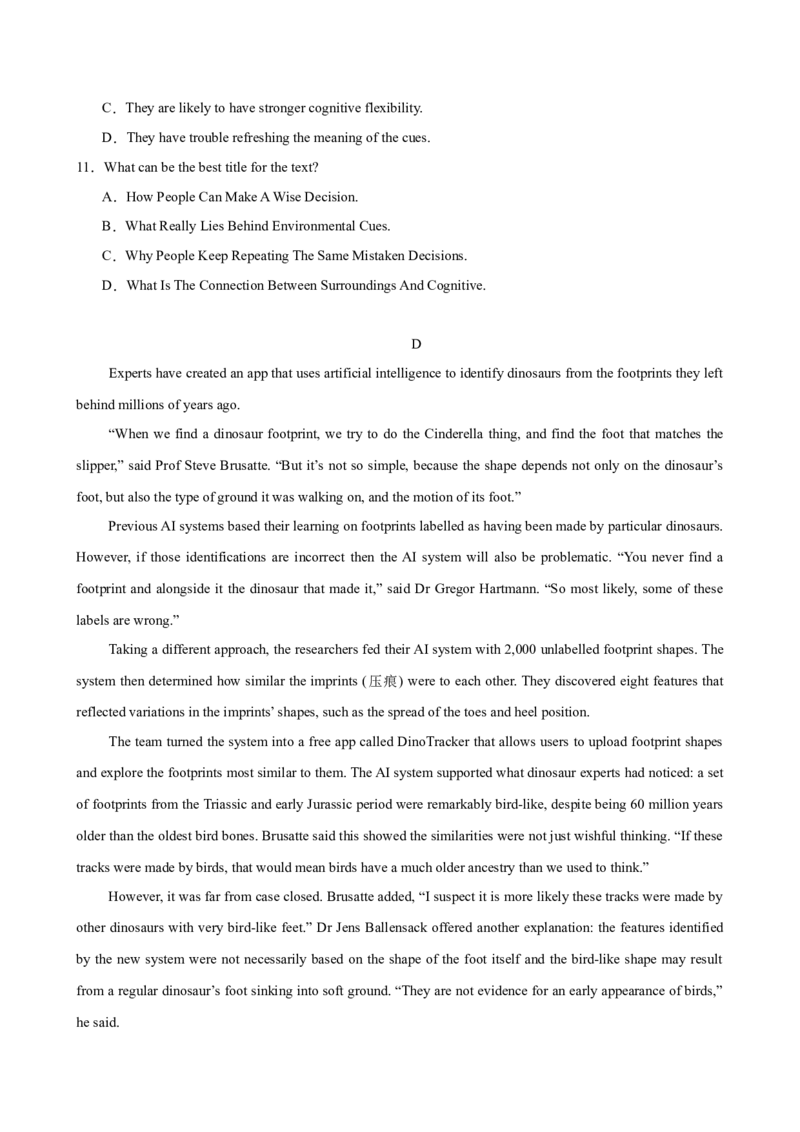
Experts have created an app that uses artificial intelligence to identify dinosaurs from the footprints they left
behind millions of years ago.
“When we find a dinosaur footprint, we try to do the Cinderella thing, and find the foot that matches the
slipper,” said Prof Steve Brusatte. “But it’s not so simple, because the shape depends not only on the dinosaur’s
foot, but also the type of ground it was walking on, and the motion of its foot.”
Previous AI systems based their learning on footprints labelled as having been made by particular dinosaurs.
However, if those identifications are incorrect then the AI system will also be problematic. “You never find a
footprint and alongside it the dinosaur that made it,” said Dr Gregor Hartmann. “So most likely, some of these
labels are wrong.”
Taking a different approach, the researchers fed their AI system with 2,000 unlabelled footprint shapes. The
system then determined how similar the imprints (压痕) were to each other. They discovered eight features that
reflected variations in the imprints’ shapes, such as the spread of the toes and heel position.
The team turned the system into a free app called DinoTracker that allows users to upload footprint shapes
and explore the footprints most similar to them. The AI system supported what dinosaur experts had noticed: a set
of footprints from the Triassic and early Jurassic period were remarkably bird-like, despite being 60 million years
older than the oldest bird bones. Brusatte said this showed the similarities were not just wishful thinking. “If these
tracks were made by birds, that would mean birds have a much older ancestry than we used to think.”
However, it was far from case closed. Brusatte added, “I suspect it is more likely these tracks were made by
other dinosaurs with very bird-like feet.” Dr Jens Ballensack offered another explanation: the features identified
by the new system were not necessarily based on the shape of the foot itself and the bird-like shape may result
from a regular dinosaur’s foot sinking into soft ground. “They are not evidence for an early appearance of birds,”
he said.
12.What makes it difficult to identify dinosaur footprints?
A.The missing bones alongside footprints. B.The soft ground where dinosaurs walked.
C.Unpredictable movements of dinosaur feet.
D.Various conditions affecting footprint shapes.
13.Why did the researchers use unlabelled footprint shapes?
A.Because most labels were incorrect.
B.To test the similarities of the imprints.
C.To avoid being misled by wrong labels.
D.Because AI works better with unlabelled data.
14.What did the AI discover about the footprints from the Triassic period?
A.They had eight new features.
B.They were left by early birds.
C.They were strikingly bird-like.
D.They were 60 million years old.
15.What can be inferred from the last paragraph?
A.Experts place full reliance on this app.
B.The footprints were made by early birds.
C.The system of the app has its limitations.
D.The results changed our knowledge of birds.
第二节(共5 小题;每小题2.5 分,满分12.5 分)
阅读下面短文,从短文后的选项中选出可以填入空白处的最佳选项。选项中有两项为多余选项。
Ordinary and universal, the act of writing changes the brain. In my work as a professor of writing studies, I
research how people use writing to practice resilience (迅速恢复的能力). I have witnessed thousands of students
turn to the written word to work through emotions and find a sense of belonging.     16     Now I share my
research-backed tips in the hope that they can help you develop a writing practice.
Write by hand whenever possible. In contrast to typing or tapping on a device, handwriting requires greater
mental effort.     17     It also allows you to process information, form connections and make meaning.
Write daily.     18     Even writing brief notes about your day — what happened, what you’re feeling,
what you’re planning or intending — can help you get thoughts out of your head and clear your mind.
    19     When strong feelings come up, write them down first. Keep a notebook within reach and make
it a habit to write before you say. Doing so can support reflective thinking, helping you act with purpose.
Write a letter you never send. Don’t just write down your feelings.     20     Even writing a letter to
yourself can provide a safe space for release without the pressure of someone else’s reaction.
I want to remind you that writing takes time. Each draft you make and each piece of advice you receive
helps you look at things from a different perspective. When you revise your work, you build self-awareness and
confidence.
A.Write before acting.
B.It slows your thinking.
C.Write after discussing.
D.You can start small and make it regular.
E.However, illustrate your feelings if you can.
F.Their writing habits suggest writing builds their capacity to adapt.
G.Instead, address them to the person or situation that’s troubling you.
第二部分  语言运用(共两节,满分30 分)
第一节  (共15 小题;每小题1 分,满分15 分)
阅读下面短文,从每题所给的A、B、C、D 四个选项中选出可以填入空白处的最佳选项。
Since 2014, I’ve taught a study-abroad writing course for Yale University in a French village. For years,
I’ve     21     students to go offline for a month, with no texting, Googling, or social media posting. Initially,
students     22    , but by 2025, all handed in their devices     23    , longing to disconnect. This shift
24     me that colleges should offer Internet-free environments to reduce distractions for serious learners.
While discussions often focus on AI’s impact on education, my students see it as just one part of a deeper
problem:     25     digital distraction. They describe phone use as “rotting (堕落)” — knowing it     26

focus but feeling powerless to stop. Even self-disciplined students     27     to escape notifications (通知)
and online demands in today’s digitized campus life, where everything from assignments to events     28

connectivity.
In France, free from Wi-Fi, students wrote on offline computers, used     29     maps, and engaged
fully with their surroundings. Evenings were filled with conversations, games, and hobbies — not screens. The
30     were remarkable: students slept better, read more deeply, and wrote better, producing more work of higher
31    . They discovered an ability to concentrate they didn’t know they had.
This     32     shows that intentional offline spaces can restore genuine learning and creativity. By
designing such     33    , educators can help students     34     the cycle of distraction and rediscover the
joy of sustained thought and play. The     35     improvement from Week 1 to Week 4 was amazing, which
made my course popular among students.
21.A.required
B.allowed
C.ordered
D.forced
22.A.apologized
B.agreed
C.resisted
D.suffered
23.A.slowly
B.eagerly
C.patiently
D.violently
24.A.informed
B.gifted
C.convinced
D.recommended
25.A.future
B.occasional
C.possible
D.constant
26.A.maintains
B.harms
C.needs
D.tests
27.A.struggle
B.promise
C.pretend
D.learn
28.A.looks for
B.gives up
C.relies on
D.turns off
29.A.printed
B.digital
C.colorful
D.new
30.A.reasons
B.efforts
C.methods
D.effects
31.A.price
B.speed
C.harmony
D.quality
32.A.experience
B.legend
C.theory
D.plan
33.A.systems
B.tools
C.environments
D.schedules
34.A.follow
B.break
C.understand
D.record
35.A.listening
B.reading
C.speaking
D.writing
第二节(共10 小题;每小题1. 5 分, 满分15 分)
阅读下面材料,在空白处填入适当的内容(1 个单词)或所给单词的正确形式。
The art of Chinese calligraphy has been regarded not just as a visual art but as a reflection of one’s
character and cultivation. It was believed that we could judge a person’s integrity and wisdom by     36

naturally flows from their brush. When     37     (evaluate) calligraphy, experts look for “spirit resonance”
(气韵) — a quality extremely difficult to define, yet instantly recognizable to the     38     (train) eye. It is
this pursuit of spiritual expression that lifts calligraphy to a high art form.
This philosophical depth is evident in the works of Wang Xizhi,     39     calligrapher of the Eastern
Jin Dynasty, whose masterpiece “Lantingji Xu”     40     (celebrate) for centuries as the “world’s best running
script,” not only for its artistic excellence but also for the philosophy it     41     (contain). The preface (序
言) is a beautiful essay reflecting on the passing nature of life and the joy of friendship. The original work is lost
to history,     42     its aesthetic principles live on through countless copies.
Today, although typing has     43     (large) replaced handwriting in daily life, calligraphy is
experiencing a revival. It serves as a balance to the digital world, offering     44     (individual) a way to slow
down, focus their minds, and reconnect with their cultural heritage. What makes this art form enduring is how it
transforms ink on paper     45     a living record of the human spirit.
第四部分 写作(共两节, 满分40 分)
第一节(满分15 分)
46.假定你是李华,最近你所在的国际学校的图书馆计划改善设施和服务,向全校学生征求意见。请你
写一封建议信,内容包括:
1.说明问题;
2.提出建议。
注意:
1.写作词数应为80 个左右;
2.按如下格式在答题卡的相应位置作答。
Dear Principal,
I’m Li Hua from Class 3, Senior 2.
___________________________________________________________________________________________
___________________________________________________________________________________________
___________________________________________________________________________________________
___________________________________________________________________________________________
___________________________________________________________________________________________
Yours,
Li Hua
第二节(满分25 分)
47.阅读下面材料,根据其内容和所给段落开头语续写两段,使之构成一篇完整的短文。
The scorching sun beat down on our sixth — grade class hiking through Blue Mountains. Mr. Thompson,
our outdoor education teacher, kept reminding us: “Drink water, watch your footing, and remember-every scratch
here could become a life lesson.”
My best mate Josh chuckled, balancing his water bottle like a circus act. “Relax, Em! We’ve done CPR
drills a million times. What’s the worst that could —”
A sharp cry cut through the air.
Twenty meters ahead, Lily-the quiet exchange student from Japan-had stumbled into a dried riverbed. Her
leg was pinned beneath a pointed rock, blood soaking through her trousers. “I... I think I heard a crack,” she
whispered, her face ghostly pale.
Mr. Thompson knelt beside her, his voice steady but urgent. “Lily, don’t move. Everyone else-backpacks
off! Josh, get the first aid kit. Emily, find two straight branches for splints (夹板). Now!”
My hands shook as I pressed a bandage against Lily’s wound. Josh froze, staring at the odd angle of her leg.
“Focus!” Mr. Thompson snapped, his tone softening as he addressed Lily. “You’re doing brilliantly. Breathe
slowly.   Help’s coming.”
He turned to us, rapid — firing instructions:
“Josh-control bleeding. Use the pressure bandage from the yellow pouch.”
“Emily-stabilize the leg. Remember the ‘above and below’ rule for splint placement.”
“Sophie-call emergency services. GPS coordinates (坐标) are on my watch.”
Lily gripped my wrist as I positioned the branches. “Will I... walk again?” Her whisper sent chills down my
spine.
“Of course you will,” I lied, recalling last week’s first — aid lecture: Broken bones risk infection.
Immobilization is critical. I tightened the bandages, whispering apologies each time she screamed.
As dusk approached, the radio crackled with bad news — Ambulance needs 90 minutes. Josh suddenly
lunged toward the first aid kit. “Her lips are turning blue! What if it’s shock?”
注意:
(1)续写词数应为150 个左右;
(2)请按如下格式在答题卡的相应位置作答。
“Lift her legs a bit more,” Mr. Thompson
directed.____________________________________________________________________________________
___________________________________________________________________________________________
___________________________________________________________________________________________
___________________________________________________________________________________________
___________________________________________________________________________________________
___________________________________________________________________________________________
___________________________________________________________________________________________
___________________________________________________________________________________________
______________________________________________________________
At last, the ambulance
arrived._____________________________________________________________________________________
___________________________________________________________________________________________
___________________________________________________________________________________________
___________________________________________________________________________________________
___________________________________________________________________________________________
___________________________________________________________________________________________
___________________________________________________________________________________________
___________________________________________________________________________________________
_____________________________________________________________