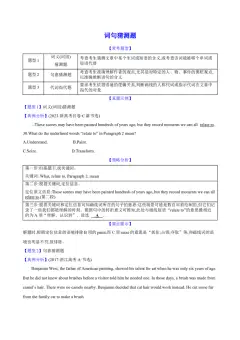
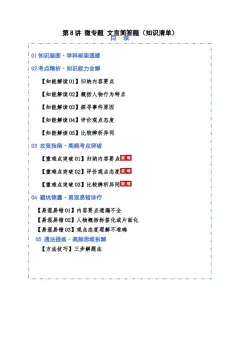
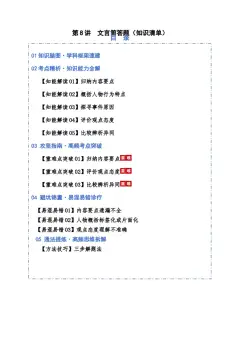
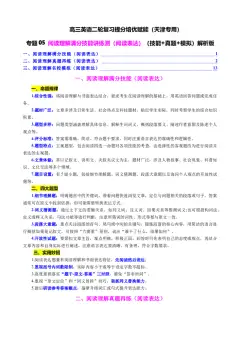
技巧04 词句猜测题的答题优化策略
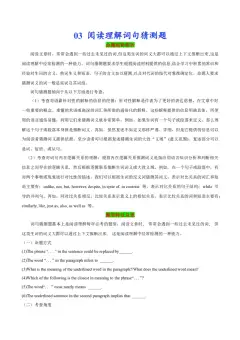
高考英语阅读理解词句猜测题,核心是要求考生结合上下文语境、语法结构或文章逻辑,推断出生
词、短语或指代性词语(如it/they)的含义,而非依赖外部词汇储备直接作答。词句猜测题有如下特征:
(1)语境依赖性强:答案线索完全隐藏在该词句的前后文之中,如定义解释、同义举例、转折对比或因
果逻辑等,需通过语境推导。(2)考查对象多样:既包括超纲生词、熟词僻义(如“address”表“解
决”),也包括代词指代、短语含义(如动词短语、习语),甚至是对复杂句子的理解。(3)干扰项易
混淆:错误选项常是该词句的常见含义(与语境不符)或脱离上下文的主观猜测,需通过语境验证排除。
答题突破技巧
一、定义解释法:依托明确释义线索
【操作技巧】
    英语阅读理解中,作者为帮助读者理解关键生词,常在生词后设置明确的语义解释信号。最常见的
是定义解释,通过 "be defined as""refer to" 等短语直接给出词义,如"Anthropology is defined as the
scientific study of man"中,"is defined as"后内容揭示了"anthropology"(人类学)的含义;同位语结构也具
有显著提示作用,两个并列名词短语通过逗号分隔,后者解释前者,例如 "The harbor, an important
trading center, was bustling with activity" ,破折号、冒号等标点符号同样承担解释功能,像 "The
phenomenon—unusual weather patterns—has puzzled scientists",破折号间内容明确了 "phenomenon" 的具
体所指;而 "that is""in other words" 等插入语,则以更直白的方式转述词义,帮助读者快速锁定生词含义。
【阅读语段】
A biography is the story of a person’s life written by someone else. Unlike autobiography, which is a self-
written life story, biography focuses on others’ experiences.
What does the underlined word “biography” mean?
A. A self-written life story
B. A story of someone’s life written by others
C. A collection of personal diaries
策略分析
D. A book about historical events
【技巧应用】
     在高考英语阅读理解中,词句猜测题常通过定义法和对比法设置线索。以 “biography” 一词为例,
语段中 “is the story of a person’s life written by someone else” 采用定义法,通过 “is” 引导的主系表结构,
直接给出 “由他人撰写的人物生平故事” 这一核心释义;同时,借助 “unlike autobiography” 形成对
比关系,将 “biography” 与 “autobiography(自传)” 进行对比,进一步突出 “由他人撰写” 的本
质特征。答题时,考生应敏锐捕捉 “is” 引导的定义句这一关键信息,快速定位正确选项 B。通过结合
定义法与对比法的双重线索,不仅能精准锁定答案,更能加深对词汇内涵的理解,有效提升此类题型的
解题准确率。
二、因果逻辑法:借助因果关系推导
【操作技巧】
    英语文本中,"because, so, thus, as a result, consequently, due to, therefore" 等因果逻辑词是连接上下文
语义的重要纽带。当遇到生词时,可依据这些标志词构建的因果链条,通过已知的原因或结果推导未知
词汇的含义。例如,在句子 "The company's revenue plummeted due to a sudden drop in consumer demand"
中,即使不认识 "plummeted",也能根据 "due to" 建立的因果关系,结合 "消费者需求骤降" 这一原因,
推断出 "plummeted" 意为 "急剧下降"。在高考真题中,命题人常通过这种逻辑关系设置词汇猜测题,考
生只要抓住因果线索,就能快速突破生词障碍,精准定位答案。
【阅读语段】
I guess that there’s probably some demanding work schedule, or social anxiety around stepping up to help for
an unknown sport. She may just need a little persuading. So I try again and tug at the heartstrings. I mention the
single parent with four kids running the show and I talk about the dad coaching a team that his kids aren’t even on
… At this point the unwilling parent speaks up, “Alright. Yes, I’ll do it.”
What does “tug at the heartstrings” mean?
A. Encourage team work
B. Appeal to feeling
C. Promote good deeds
D. Provide advice
【技巧应用】
     在解答这道词句猜测题时,破题点在于精准把握句间逻辑关系与文本细节暗示。由连接词 “so” 构
建的因果逻辑链条可知,后文 “tug at the heartstrings” 实为解决前文 “need a little persuading” 这一困境
的具体方式。深入剖析文本细节,文中描绘了单亲家长在孩子成长路上默默付出的艰辛,展现了无私教
练为学生不计回报的悉心指导等情节,这些细腻的情感刻画与场景描述,实则是在暗示劝说并非依靠理
性说教,而是通过唤起人们内心深处的情感共鸣来实现。由此可推断,“tug at the heartstrings” 意为触动
情感、打动人心,所以答案为 B 选项。
三、对比转折法:利用反义关系定位
【操作技巧】
    在英语文本中,转折对比类连接词是破解生词含义的关键线索。以 "but, however, unlike, on the
contrary" 为代表的词汇,往往预示着前后文存在语义反转关系。考生可运用「反义推理法」,通过已知
词汇的含义反向推导生词内涵。例如,在句子 "Unlike his timid classmates, Mark boldly raised his hand to
answer the question" 中,通过 "Unlike" 明确对比关系,结合已知形容词 "timid(胆怯的)",即可快速推
断出 "boldly" 意为 "大胆地"。此类连接词还包括 "nevertheless, whereas, while" 等,在高考真题中高频
出现,熟练掌握该策略可显著提升猜词效率。
【阅读语段】
Unlike her gregarious sister, Jane is a shy person who does not like to go to parties or make new friends.
The word “gregarious” is closest in meaning to ______.
A. Outgoing
B. Shy
C. Careful
D. Lazy
【技巧应用】
     在英语阅读理解中,遇到生词时,利用上下文逻辑关系是解题的关键。以本题为例,转折词
“unlike” 明确表明 Jane 与姐姐性格呈对立关系。这种转折对比的逻辑关系,是我们破解生词含义的重
要线索。后文详细描述 Jane 具有 “害羞、不喜社交” 的性格特点,基于 “unlike” 所构建的对立逻辑,
可推断出 “gregarious” 的含义应与 “害羞、不喜社交” 相反。在英语词汇中,“外向的” 恰是这类
性格特征的反义词,因此 “gregarious” 意为 “外向的”,对应选项 A。通过这一实例,我们可以看到,
精准捕捉文本中的逻辑连接词,并结合已知信息进行反向推理,是攻克词句猜测题的有效策略。
四、例证归纳法:通过实例概括词义
【操作技巧】
    英语文本中,"such as, for example, including" 等举例标识词犹如理解生词的 "金钥匙"。这些词汇引
导的具体实例,能精准定位生词所属类别,辅助推导深层含义。例如在句子 "Ornamental plants, such as
roses, lilies, and tulips, brighten up any garden" 中,通过玫瑰、百合、郁金香等花卉实例,即便不认识
"ornamental",也能快速推测出该词与 "观赏性" 相关;再如 "She enjoys recreational activities, including
hiking, cycling, and swimming",由徒步、骑行、游泳等活动,可自然推断 "recreational" 意为 "娱乐的、
休闲的"。这类举例结构通过具象化表达,将抽象词汇转化为可感知的具体事物,是高考英语词句猜测题
中最直观有效的破题线索。
【阅读语段】
Today young couples starting their households often spend much on appliances—for example, washing
machines, fridges and color TVs.
What does “appliances” refer to?
A. Daily necessities like food and clothes
B. Electronic devices for home use
C. Furniture like sofas and beds
D. Kitchen tools like pots and pans
【技巧应用】
     在解答词句猜测题时,我们可利用 举例说明法 来推断生词含义。以 "appliances" 一词为例,原文
句子 "Many households have a variety of appliances, for example, washing machines, refrigerators, and color
TVs" 中,"for example" 作为典型的举例标志词,其引导的 "washing machines(洗衣机)、refrigerators
(冰箱)、color TVs(彩电)" 均属于日常生活中常见的家用电子设备范畴。由此可见,这些具体例子
是对 "appliances" 的具象化说明,通过将例子进行共性归纳,我们可以快速锁定 "appliances" 的核心语
义 ——家用电子设备,从而判断选项 B 为正确答案。这一过程充分体现了从具体实例到抽象概念的推
理逻辑,也印证了举例说明法在破解生词含义时的有效性。
五、构词拆解法:依托词根词缀推断
【操作技巧】
    通过前缀(如表示否定的 "un-"、表 "下,接近" 的 "sub-"、表 "在... 下面;低;副" 的 "sus-")、
后缀(如构成形容词表 "可... 的" 的 "-able"、构成名词表 "行为;状态;结果" 的 "-tion")和词根(如
表示 "支撑;维持" 的 "sustain"、表示 "搬运;携带" 的 "port")的已知含义推导生词。例如,在生词
"unsustainable" 中,前缀 "un-" 表示否定,词根 "sustain" 意为 "维持",后缀 "-able" 表示 "可... 的",
将三者含义串联,即可推出该词意为 "不可持续的";再如 "transportation",词根 "port" 表示 "搬运",
前缀 "trans-" 表示 "转移;跨越",后缀 "-ation" 表示行为结果,由此可推测出该词表示 "运输;交通运
输系统" 。
【阅读语段】
The company’s “Future City” idea aims to make buildings more energy-efficient. The idea is to create a city
that is more sustainable and livable for future generations.
What does “sustainable” probably mean?
A. Able to last for a long time
B. Worth a lot of money
C. Easy to remember
D. Popular with youth
【技巧应用】
     在高考英语阅读理解中,面对生词猜测题时,词根词缀法是极为有效的解题利器。以 “sustainable”
一词为例,它由核心词根 “sustain”(意为 “维持、支撑”,常见于 “sustain life” 维持生命、“sustain
an injury” 承受伤害等短语)和后缀 “-able”(表示 “能够…… 的”,如 “ readable” 可读的、
“drinkable” 可饮用的)构成。从字面拆解来看,“sustainable” 意为 “可维持的”。然而,仅依赖词根
词缀拆解往往不够,还需结合具体语境进行精准判断。在本题语境 “Our goal is to create livable cities for
future generations by developing sustainable urban systems” 中,通过 “为后代创造宜居城市” 以及 “发
展…… 城市系统” 等关键信息可知,这里强调的并非短期维持,而是着眼长远、能够长期持续的城市
发展模式。综合词根词缀分析与语境推理,可确定 “sustainable” 的准确含义为 “能长期持续的”,与
选项 A 高度契合,成功锁定正确答案。
六、上下文语境法:依托整体语义连贯
【操作技巧】
    当题目中未出现诸如 "mean"、"refer to" 等明显的词义猜测标志词时,考生可通过剖析前后文的主题
连贯性、情感基调一致性或动作发展逻辑性进行词义推断。例如,在描述生态保护的文章中,若生词所
在句提及 "preservation efforts" 与前文 "habitat restoration"、后文 "species protection" 形成语义链,则可
推测生词与 "保护" 概念相关;又如,在记叙文里通过人物 "frown(皱眉)"、"sigh(叹气)" 等动作,
结合 "disappointing news" 的情感基调,可推断描述心理状态的生词带有消极色彩。这种基于语境逻辑的
推理方法,能有效突破词汇障碍,精准把握文本含义。
【阅读语段】
I have a disability,” he explained. “I always dreamed of becoming a policeman, but I’m just too short to be
one.” But he never lost hope. “I wanted to prove to myself and others that I can do it,” he said. He spent four
years training for the police academy exam.
What does “it” refer to?
A. Graduating from the academy
B. Becoming a policeman
C. Training for the exam
D. Overcoming disability
【技巧应用】
     在高考英语阅读理解的词句猜测题中,指代关系的判断是关键考点。针对这道例题,文本围绕主人
公的职业理想展开,前文通过 "aspire to become a police officer"、"dream of a law - enforcement career" 等
表述,反复强调 “梦想成为警察” 这一核心主题,形成强烈的语义场。而后文出现的 "training for the
police academy exam"(警校入学考试训练),是朝着目标付诸实践的具体行动。在英语语篇中,代词往
往承担着衔接上下文、避免重复的功能。这里的 “it” 作为关键指示代词,根据语篇连贯原则和就近指
代规律,结合前文高频出现的核心语义,可精准锁定其指代对象为前文反复提及的核心目标 ——“成为
警察”。这种通过把握文本主题脉络、分析前后文逻辑关联来确定代词指代的方法,不仅适用于本题,
也是应对高考英语中词句猜测类题型的重要策略,故答案为 B。
七、指代还原法:遵循 “就近向前” 原则
【操作技巧】
    代词(it, they, that 等)通常指代前文最近的名词或名词短语,需结合单复数和语义匹配。在实际解
题中,考生可采用 "三步定位法":首先,锁定代词所在句子,明确指代对象的词性和单复数属性;其次,
按照由近及远的顺序回溯前文,优先筛选 50 词范围内的名词或名词短语;最后,将候选对象代入原句,
通过语义连贯性和逻辑合理性进行验证。例如,当遇到 "they" 时,需特别注意前文复数名词,若出现多
个候选对象,可借助动词时态、修饰限定词等线索缩小范围。值得注意的是,当代词出现在长难句或段
落开头时,可能需要跨句甚至跨段分析指代关系。
【阅读语段】
The museum’s “Inspiring Science” exhibition features interactive exhibits. It allows visitors to explore
concepts in a fun way. It is designed to inspire young people to pursue STEM careers.
What does the first “It” refer to?
A. The museum
B. The exhibition
C. An interactive exhibit
D. A scientific concept
【技巧应用】
     在解答词句猜测题时,遵循 "就近向前" 的核心原则是关键。通过观察发现,文中第一个 "It" 与前
文的 "‘Inspiring Science’ exhibition" 紧密相邻,在位置上形成了天然的指代关联。进一步分析句子结构,
后文 "allows visitors to explore concepts" 描述的功能属性,与我们对 "展览" 所具备的展示与科普功能的
认知高度契合。展览作为一种展示平台,其主要目的就是通过多种形式呈现内容,让参观者能够深入探
索各类科学概念,这也与文中描述的功能相匹配。基于以上逻辑分析与信息对应,"It" 所指代的内容正
是 "‘Inspiring Science’ exhibition",故答案为 B。
1
The sun was shining, people were paddling in the sea and dogs were being walked — a typical day on the
beautiful Dorset coast. Just a few minutes inland, however, history was being made. Yesterday, at the National
Trust’ s Purbeck Heaths nature reserve, four beavers (海狸) were released from cages and crawled into Little Sea,
a 33-hectare lake — the first to be legally released in England after a 400-year disappearance and a fight to return
them to the landscape.
The Trust says this is the prime habitat for them to wander free, with no fenced enclosures, full of lakes
and watercourses for the beavers to make their home. The Trust has permission to release 25 on the island but is
starting with four and then making more releases in coming years if this one goes well.
“I feel real hope,” said David Brown, the director at Purbeck. “I’ve worked as an ecologist for 40 years and
this is the most optimistic time in my career without doubt. We are visibly, measurably recovering nature and that
is so exciting!”
Conservationists have been campaigning for the return of the beaver for decades because it is a keystone
species, whose existence allows other creatures to develop well. This is because beavers create complex wetland
habitats by digging channels and pools and constructing leaky dams. Their dams can also deal with pollution,
helping to clean up rivers, and prevent flooding as well as drought.
The Trust has worked with local farmers and landowners to ensure the beavers do not cause unwanted
disruption. Purbeck hopes it will stimulate year-round nature tourism as people come to see the beavers and the
habitats they create. “We have been seeing the economic development shift from bucket-and-spade tourism to
nature tourism, and that is more sustainable,” Brown said.
1.Why is the beavers’ release considered historical?
A.They are the first beavers spotted in the wild.
B.It marks an improvement in lake protection.
C.They are reintroduced to the wild after centuries of absence.
突破演练
D.It offers a great chance for people to interact with them freely.
2.What does the underlined word “prime” in paragraph 2 probably mean?
A.Perfect.
B.Temporary.
C.Familiar.
D.Extra.
3.What aspect of the beavers do conservationists highlight?
A.Their impact on the ecosystem.
B.Their capability of constructing dams.
C.Their adaptability to the environment.
D.Their popularity among tourists.
4.What can be inferred from the last paragraph?
A.The beavers will reach other reserves quickly.
B.Beaver tourism may reshape the local economy.
C.More beavers will be released next summer.
D.Bucket-and-spade tourism is declining sharply.
2
A new groundbreaking study reveals a landmark breakthrough in the field of snakebite treatment.
Researchers, led by David Baker from the University of Washington, have designed new proteins — unlike any
found in nature — that can inactivate some of the most poisonous components of snake bite toxins (毒素).
Snakebites represent a substantial global health issue, affecting millions of people each year. According to
the World Health Organization, over 2 million people suffer from snakebites annually, with more than 100,000
deaths and 300,000 cases of permanent disabilities. Current treatment options, mainly obtained from animal
blood, often present drawbacks, including high production costs, limited efficiency, and severe side effects, such
as causing shock and breathing difficulties.
In light of these challenges, Baker and his team have made effective use of deep learning tools to develop
artificial proteins capable of attaching to and inactivating toxins. The study focuses on a specific group of snake
proteins known as three-finger toxins. These toxins often bypass the immune ( 免疫的) system, making
conventional treatments ineffective. Notably, the newly designed proteins provide significant protection against
deadly amounts of three-finger toxins in mice, achieving survival rates ranging from 80% to 100%.
By avoiding the lengthy and resource-intensive processes associated with conventional antibody
development, this approach could lead to more accessible and affordable treatments. Also, the new proteins are
smaller, allowing for greater penetration (渗透) into body systems to quickly inactivate the toxins and reduce
damage. The efficiency and speed at which these proteins can be designed and produced using AI indicate a
transformative shift in drug discovery processes, especially in resource-limited settings.
While the study’s findings are encouraging, the researchers acknowledge that traditional antitoxins will
remain central to snakebite treatment for the near future. The newly created computer-designed antitoxins can be
integrated into existing treatment as additions, enhancing the overall effectiveness of established treatments.
Meanwhile, scientists believe the new methods employed in this study could be beneficial to tackling other
diseases, potentially leading to the emergence of less expensive medicines for various health challenges.
1.Which is a shortcoming of the current snakebite treatments?
A.They mainly rely on animal blood.
B.They are effective in certain regions.
C.They can lead to serious health risks.
D.They may leave toxins in patients’ bodies.
2.How did Baker’s team deal with the current challenges?
A.By inventing deep learning tools.
B.By identifying more snake toxins.
C.By enhancing the immune system.
D.By designing AI-generated proteins.
3.What is paragraph 4 mainly about concerning Baker’s new study?
A.Its advantages.
B.Its strategies.
C.Its procedures.
D.Its limitations.
4.What can be inferred from the last paragraph?
A.The existing approaches are hard to change.
B.The conventional treatments are out of date.
C.The new methods might enlighten other treatments.
D.The new antitoxins will be the core of future methods.
3
In 2024, TIME Magazine named 34-year-old Marí a González its “Person of the Year” for her extraordinary
efforts to bring renewable energy to remote Amazonian communities. Born in a riverside village in Peru, Maria
grew up in a home lit by kerosene (煤油) lamps. Her father, a fisherman, often risked his life sailing through dark
waters at night. When María was 12, a storm tipped over his boat. He survived but lost his sight due to untreated
injuries. “I watched him struggle to relearn even basic tasks,” María recalled, “which made me promise to prevent
others from suffering the same fate.”
She graduated with honors after earning a scholarship to study engineering in Lima. Returning to the
Amazon in 2018, she proposed solar-powered lanterns made from recycled materials. Her original model — a
rusty tin can wired to a broken calculator battery — exploded during a rainstorm. Local elders doubted her “magic
boxes”, and funding was scarce. María spent nights testing designs in her hut. She studied traditional basket-
weaving techniques to improve waterproofing and partnered with a women’s cooperative to collect plastic waste.
A breakthrough came in 2022 when she created a durable solar lamp using recycled plastic bottles and smartphone
batteries donated by a tech nonprofit.
Her project, Green Light, has since equipped over 200 villages with affordable solar energy. In the
Yurimaguas district alone, childhood respiratory ( 呼吸的) illnesses from kerosene smoke dropped by 60%.
Children now study after sunset, clinics refrigerate vaccines, and fishermen like her father sail safely. “The forest
taught me toughness,” Maria said in her TIME interview. “Every failure was a root growing deeper, helping me
stand taller.”
Despite international fame, Maria rejects to patent (申请专利) her designs. “Light belongs to everyone,”
she insists. Her next goal? Training 1,000 women across the Amazon to become solar engineers by 2025.
Meanwhile, María’s designs have inspired similar projects in Congo and Bangladesh. “True sustainability,” she
says, “is when solutions grow from the soil of a community itself.”
1.What motivated Maria to start her project?
A.A family accident caused by poor lighting.
B.Her great passion for environmental science.
C.The severe lack of electricity in her hometown.
D.Encouragement from her engineering professors.
2.What dose the underlined phrase “magic boxes” in Paragraph 2 refer to?
A.Recycled materials.
B.Broken calculator batteries.
C.Maria’s initial solar lantern models.
D.Containers for storing medical supplies.
3.Which benefit is NOT mentioned in the article?
A.Better medical storage in local clinics.
B.Enhanced safety for nighttime fishermen.
C.Improved education opportunities for children.
D.Equipping each village with affordable solar energy.
4.What does Maria’s refusal to register her inventions reveal about her character?
A.She possesses an innovative spirit.
B.She fears industrial competition.
C.She values community access over profit.
D.She prioritizes personal recognition.
4
They say one’s trash is another’s treasure, but a chunk of “rock” used to keep a door open for decades is a
treasure by pretty much any metric you might care to use.
The 3.5 kilogram (7.7 pound) stone was found in a stream bed in southeast Romania by an elderly woman,
who brought it home and put it to use. After the woman died in 1991, the relative who inherited her home
suspected the doorstop might be more than meets the eye.
So he consulted experts to find that this is not a “rock” but an amber — tree resin from millions of years in
the past. Over time, the highly sticky substance fossilizes into a hard, warm-coloured material widely recognized
as a gemstone. This doorstop amber is likely between around 38 and 70 million years old, categorised as rumanite,
which is famed and prized for its wide range of deep, reddish colour, and this one turned out to be one of the
biggest entire chunks of amber up to now in the world. Its value? Somewhere in the region of $1 million —
around $ 1.1 million.
“Its discovery represents a great significance both at a scientific level and at a museum level,” Daniel
Costache, said director of the Provincial Museum of Buzau.
Classified as a national treasure of Romania, the nugget has had a home now at the Provincial Museum of
Buzau — the county in which the relic was found — since 2022.
The discovery resembles that of a man in Michigan, who kept a large piece of rock as a doorstop, only to
find out decades later that he was keeping his doors in place with a meteorite worth $100,000.
A chunk of amber worth over a million dollars isn’t a bad score, either, really. Just imagine how many
doorstops you could buy.
1.What is the author’s attitude towards this kind of discovery?
A.Doubtful.
B.Humourous.
C.Indifferent.
D.Critical.
2.What does the underlined phrase “more than meets the eye” in Paragraph 2 mean?
A.Looking more attractive than usual.
B.Having a hidden or unexpected value or quality.
C.Appearing larger in size than it actually is.
D.Being more difficult to understand that expected.
3.Why is this “doorstop rock” considered a treasure?
A.Because of its beautiful appearance
B.Because of its unusually large size.
C.Because of its gem-level and scientific significance.
D.Because of its sentimental value as a
doorstop tool.
4.What is the best title of this text?
A.The Hidden Treasure in a Doorstop
B.The Story of an Elderly Woman’s Discovery
C.Amber: A Precious Gemstone
D.Famous Discoveries in Romania
5
UPS driver RYAN ARENS was making his rounds near a pond in Bozeman, Montana, when he heard an
unearthly sound. “Like a cry for help,” he told thedodo.com, a website for animal lovers. It was December 2018,
and about 15 feet from the frozen banks was the source of that cry — a half-submerged brown-and-white
wirehaired hound, struggling to cling to a thin layer of ice. How she got there no one knows, but an elderly man
was already on the scene, determined to save her. He’d entered the pond in a rowboat and was hacking away at the
ice with a rock to create a path to the dog. It was slow going, and Arens, 44, thought he stood a better chance.
“Animals are my weakness,” he told the Great Falls Tribune, explaining why he stripped down to his
boxers and socks, even though the temperature was in the 30s, and commandeered the rowboat.
His heart thumping, Arens slid closer to the dog and used the other man’s rock to smash away at the ice. He
gave one strong heave too many and slipped off the boat, crashing into 16 feet of freezing water.
He resurfaced in time to see the dog going under. Using nervous energy to keep warm, he swam about five
feet toward her, grabbed hold of her collar, and pulled her to the ice. He then boosted the dog into the boat and slid
it back to the shore, where anxious bystanders carried the dog to the home of the rowboat owner, a retired
veterinarian. Once in the house himself, Arens jumped into a warm shower with the dog until they both defrosted.
A few more minutes in the pond, the vet told Arens, and she would have likely suffered cardiac arrest.
The next day, Arens was back working the same neighborhood when the dog’s owner came over to thank
him for saving Sadie. “Would you like to meet her?” he asked.
He opened the door to his pickup, and Sadie bolted out. She made a beeline for Arens, leaping on him and
bathing him in wet kisses. That special delivery, says Arens, “was the highlight of my UPS career.”
1.How did the elderly man try to save the dog at first?
A.He swam to the dog directly.
B.He called Ryan Arens for help.
C.He used a stick to reach the dog.
D.He hacked at the ice with a rock.
2.What does the underlined word “commandeered” in paragraph 2 probably mean?
A.borrowed
B.took control of
C.repaired
D.sold
3.What can we infer from the passage?
A.The dog’s owner lived far away from the pond.
B.Ryan Arens often saved animals in his daily life.
C.Sadie recognized and was grateful to Ryan Arens.
D.The temperature in Bozeman, Montana was very high then.
4.What is the main idea of the passage?
A.A retired veterinarian helped take care of a rescued dog.
B.A dog owner thanked a UPS driver for returning his lost dog.
C.An elderly man tried to save a dog in a frozen pond but failed.
D.A UPS driver risked his life to save a drowning dog in a frozen pond.
6
In my senior-year literature class last term, I encountered a knight who defended a forgotten kingdom, a
gentle grandmother who healed wounds with folk tales, and a futuristic explorer who vanished in a black hole.
Once, I often found myself amazed at how my students, who brought these figures to life, grasped the essence of
complex literary themes.
But the situation was quite different with their first assignment, which centered on the question: “Why is
literature important?”
Most of the essays were barely a page long, and scarcely any had a sentence that could serve as a strong
thesis statement. I was taken aback. Then it dawned on me that the problem lay in the question itself. They could
have written volumes about the allure of social media, but literature, in its pure form, just didn’t seem significant
to them. This had to change.
As a new semester began, I asked everyone to craft a reflective essay on a literary work that had touched
their soul. This time, they found the task far more engaging. For the subsequent two tasks, a drama-analysis
project was followed by a poetry-creation workshop. I only stipulated that each piece should convey a deep-seated
emotion. The outcomes were astounding. The students delved into a wide range of literary works and produced
essays and poems, each 8 to 15 pages long, with insights that broadened my perspective and stirred my emotions.
I entered the class believing that literature is important as a mirror of humanity. However, my students
demonstrated something even more profound. When the final bell rang in June, I walked away with a year’s worth
of memories filled with the realization of literature’s most profound significance — the ability to awaken dormant
feelings, to transport us to unseen worlds, and to reveal the shared threads of our human experiences.
1.Who are the characters mentioned at the beginning of paragraph 1?
A.Senior-year students.
B.The author’s relatives.
C.Famous literary critics.
D.Fictional personas.
2.Why did the students perform poorly in their first writing task?
A.They lacked writing skills.
B.They had a limited understanding of literature.
C.They misinterpreted the question’s intent.
D.They had no interest in the topic.
3.What does the underlined word “astounding” in paragraph 4 mean?
A.Confusing.
B.Impressive.
C.Ordinary.
D.Frightening.
4.What does the author’s experience illustrate?
A.Literature can awaken deep-seated human emotions.
B.Teaching literature is an easy task.
C.Students prefer creative writing to theoretical essays.
D.Classic literature is losing its appeal.
7
Ecotourism has become an increasingly popular way for travelers to explore the world while minimizing
their environmental impact. Unlike traditional tourism, which often focuses on luxury accommodations and
crowded attractions, ecotourism emphasizes responsible travel to natural areas that conserves the environment and
improves the well-being of local communities.
The core principles of ecotourism include minimizing environmental damage, respecting local cultures, and
supporting conservation efforts. Travelers engaging in ecotourism activities typically visit protected areas such as
national parks, wildlife reserves, or remote communities. They participate in activities like bird watching, hiking,
or learning about traditional crafts from local residents. These experiences not only allow travelers to connect with
nature but also contribute to the preservation of fragile ecosystems.
One successful example of ecotourism is the Galapagos Islands in Ecuador. Faced with threats from over-
tourism in the 20th century, the government implemented strict regulations to protect the unique wildlife and
landscapes. Today, visitors to the Galapagos must follow designated routes, be accompanied by certified guides,
and pay a conservation fee that funds environmental protection projects. This approach has helped maintain the
islands’ biodiversity while providing income for local communities through tourism.
Another example is Costa Rica, often regarded as a leader in ecotourism. The country has transformed its
natural resources into a sustainable tourism industry, with over 25% of its land protected in national parks and
reserves. Tourists can explore rainforests, observe sea turtles nesting, or stay in eco-lodges that use renewable
energy and support local farmers. This model has not only preserved Costa Rica’s natural beauty but also reduced
poverty in rural areas by creating jobs in tourism.
However, ecotourism is not without challenges. Some destinations market themselves as “eco-friendly”
without implementing meaningful conservation measures, a practice known as “greenwashing.” Travelers must be
cautious and research companies before booking to ensure their tourism dollars support genuine environmental
and community initiatives.
Additionally, even well-managed ecotourism can have negative impacts if visitor numbers exceed the
carrying capacity of an area, leading to habitat disturbance or increased waste.
To practice responsible ecotourism, experts recommend choosing small-scale, locally owned
accommodations, participating in guided tours led by local experts, and following the “leave no trace” principle
by taking all trash with you and avoiding damage to plants and wildlife. By making informed choices, travelers
can enjoy meaningful experiences while helping to protect the planet for future generations.
1.What is the main difference between ecotourism and traditional tourism?
A.Ecotourism focuses on luxury accommodations.
B.Ecotourism emphasizes responsible travel and environmental conservation.
C.Traditional tourism only visits natural areas.
D.Traditional tourism requires following strict regulations.
2.Why does the author mention the Galapagos Islands?
A.To show the negative effects of over-tourism.
B.To introduce a popular luxury travel destination.
C.To provide a successful example of ecotourism.
D.To explain how to get certified as an ecotourism guide.
3.What does the word “greenwashing” in Paragraph 5 probably mean?
A.Making false claims about being environmentally friendly.
B.Using green colors in tourism advertisements.
C.Planting trees to offset carbon emissions from travel.
D.Implementing strict environmental protection measures.
4.What is recommended for responsible ecotourism according to the text?
A.Choosing large international hotel chains.
B.Exploring natural areas without a guide.
C.Leaving trash in designated areas.
D.Selecting locally owned accommodations.
8
Do you know what percentage of your family’s total expenses is spent on food? This is the main focus of
the Engel coefficient (恩格尔系数), an economic concept that describes the relationship between income and
spending on food. For years, it has been considered an important measure of people’s living standards. If the
figure is high, then it is often believed that the standard of living is low, as a large share of income is spent on
food.
However, recently a topic has gone viral on Chinese social media platforms, where many people have
begun to question whether the Engel coefficient is relevant in China.
One of the key reasons for this concern comes from the Chinese attitude toward food, shown by the old
saying, “Food is of primary importance to the people.” This highlights the significant difference between China’s
food culture and consumption habits and those of Western countries. The food culture in China is rich and diverse,
and people are willing to spend more money and energy on it.
“In the past, I earned 100 yuan a day and spent half of it on food. Now I earn 1,000 yuan a day, and I still
spend half of it on food. Having a good meal makes my day,” a user from Hunan commented on Sina Weibo.
Food in China is a science, a social activity and an art. The principles of Traditional Chinese Medicine
(TCM) are employed all over China to create healthy, well-balanced meals. Whether in a restaurant or at
someone’s home, food is often the common ground over which people gather to talk and share.
Many aspects of Chinese spiritual culture are connected to food, from governance to communication.
Chinese traditional culture focuses on seeing society and life from the perspective of food, and Chinese people are
very good at enjoying the beauty and meaning found in everyday meals.
These factors make consumption habits in China different from those in other countries, making the Engel
coefficient not able to completely reflect the living standards of Chinese people. Moreover, this public concern
shows just how deeply food is valued in Chinese society, reported Guangming Daily.
1.Which of the following Engel coefficient figures suggests a high living standard?
A.63.9%.
B.42.2%.
C.36.3%.
D.29.8%.
2.How does the author mainly illustrate irrelevance of the Engel coefficient in China?
A.By presenting data.
B.By giving examples.
C.By listing reasons.
D.By citing quotes.
3.What do the underlined words “this concern” in the third paragraph refer to?
A.Whether the Engel coefficient is relevant in China.
B.Whether Chinese people are willing to spend more on food.
C.Whether consumption habits are different in China.
D.Whether the principles of TCM are suitable for food.
4.What does this text mainly talk about?
A.Beating the economic rule.
B.The importance of food in China.
C.The consumption habits in China.
D.Improving the Chinese living standards.
9
A dropped bag of chips disturbed a cave ecosystem in Carlsbad Caverns National Park, New Mexico. This
cave is almost cut off from the outside world, so introducing anything foreign can be harmful. “Things in the
damp cave get wet quickly,” says park guide Ashley. The snack attracts tiny organisms, causing unwanted growth.
Soon, small animals like crickets and spiders came to eat, spreading the pollution. Rangers found the bag within
hours. “But that can be all it takes,” says Ashley. “I’m sure some crickets got a bit of the snack.”
Over 500 million people visit American public lands each year, creating many chances to harm wild places.
“When you look at the numbers, it’s incredible,” says Watts, head of the Leave No Trace Center in Colorado, an
organization aimed at minimizing human impact on nature.
Food waste takes a long time to break down, especially in certain areas. “It takes much longer for an apple
core to rot in a desert than in a forest,” says Blye, a teacher at the University of Utah. Leaving waste introduces
animals to an unnatural diet and changes their behavior with sometimes disastrous results. Bears who taste
garbage and become a threat to humans may have to be put down. “Bears can get used to unnatural food in three
weeks,” says Watts. “Everyone loses in this case.”
Biological waste is also problematic. Dog waste brings new bacteria into the ecosystem and scares away
deer. Meanwhile, human waste and toilet paper introduces dangerous bacteria into water sources.
In national parks, trails (小路) are designed to avoid sensitive areas. Stepping off the trail, even for a quick
photo, can scare wildlife away. Impacts from many visitors result in long-term damage to nature and wildlife. But
people don’t think of that when they see the perfect photo opportunity. “It’s just such a hard thing to resist,” says
Blye. The risk to sensitive ecosystems isn’t obvious. “It’s easy to think, oh, there’s wildflowers over there. I
shouldn’t step on that,” says Blye, but these tiny ecosystems full of microscopic organisms essential to desert life
provide many benefits, including reducing the risk of erosion ( 侵蚀) and helping absorb rainfall, and can take
hundreds of years to return to its original state.
1.What does Ashley mean by “But that can be all it takes.”?
A.The rangers’ work is efficient.
B.The damage has been done.
C.The cleanup takes a long time.
D.The pollution has spread widely.
2.What is a result of foreign waste in public lands?
A.A shift in animal behavior.
B.A shortage of food supplies.
C.A decline in bacterial species.
D.An increase in conflicts between animals.
3.Why does the writer mention wildflowers in paragraph 5?
A.To praise their benefits to desert life.
B.To highlight our ignorance of wildlife.
C.To stress their significance for photography.
D.To show our unawareness of nature’s sensitivity.
4.It is conveyed in this passage that we should ________.
A.encourage wildlife protection
B.leave no trace in the wild
C.promote national park tourism
D.restore ecological damage
10
The convenience of modern life is nothing short of astonishing. As I write this, my phone is wirelessly
sending some hits from the 1700s to my portable speaker. The fact that, as a culture, we celebrate such short cuts
is understandable. That said, most people are able to sense that convenience has a darker side.
Before getting into that, we’d better understand why convenience is so seductive first. We often desist
doing the things we need to do to make progress. Behind every well-intentioned plan lies this horrible sense of
inertia (惰性). Why is this resistance — and our corresponding appetite for ease — such an essential part of our
makeup?
Here, insights from evolutionary psychology (particularly the idea of“the evolutionary mismatch”) can
help. The evolutionary mismatch is the idea that we colved for a hunter-gather difostyle, and that while our
circumstances have changed completely, our brains and bodies haven’t. Resistance was a necessary
counterbalance (制衡) to the bursts of intense activity that characterized the lives of hunter-gatherers: searching
for food in driving rain, or running to escape a dangerous animal. It’s the reason we still ask: “Do I really have to
be doing this? Shouldn’t I save my energy?” The people choosing to remain sheltered during snowstorms, when
the prospect of obtaining food was low, were more likely to live and pass on their genes to the next generation.
Since then, of course, innovation has changed things greatly. We’ve altered technology and our
environments partly to serve our natural instinct (本能) to conserve energy. The question is: what do we stand to
lose by following our tendency to prioritize comfort and convenience?
Continually choosing the convenient path lessens your ability to deal with unavoidable difficulties. And,
from an evolutionary perspective, some measure of discomfort is as crucial to our survival as rest and relaxation.
Our ancestors didn’t survive purely by being lazy, but through a combination of playing it safe and taking
necessary risks.
This difficulty itself does shape our character. In the technological world we have fashioned, we must
sometimes make conscious efforts to act in opposition to our instincts. As a culture, we must remember while
convenience feels good in the moment, our capacity to adapt and overcome challenges is part of our evolutionary
inheritance (遗传) too, and central to the adventure of life.
1.What does the underlined word “seductive” in paragraph 2 most probably mean?
A.Attractive and inviting.
B.Useful and practical.
C.Harmful and dangerous.
D.Annoying and frustrating.
2.What does“the evolutionary mismatch” primarily refer to?
A.The inconsistency between personal goals and societal expectations.
B.The contrast between modern convenience and ancient challenges.
C.The argument over the hunter-gatherer lifestyle of ancient people.
D.The conflict between our natural instinct and the current environment.
3.What may prioritizing convenience in modern life result in?
A.It may lead to a lack of innovation and progress.
B.It may reduce our ability to overcome challenges.
C.It may make us overly dependent on technology.
D.It may cause a decline in physical fitness.
4.Which of the following can be the best title for the passage?
A.The Benefits of Modern Technology
B.Understanding Evolution in Today’s World
C.The Dark Side of Convenience in Modern Life
D.Rejecting Modern Convenience for a Better Life
11
In his new biography of Robert Crumb, Dan Nadel, a comics (漫画) expert, writes that his subject agreed to
participate in the project under one condition: “that I be honest about his faults, look closely at his urges, and
examine the racially charged aspects of his work.” Crumb, honest in his work as an underground comics pioneer,
expected the same from his biographer. And Nadel fulfilled.
That doesn’t mean Crumb: A Cartoonist’s life is a hatchet job. Far from it, Nadel expresses intense
admiration for Crumb’s art and deep sympathy for his troubled upbringing. Nadel tracks Crumb’s artistic progress,
from working with his brother Charles on adolescent comics influenced by childhood heroes like Carl Barks and
John Stanley, to designing greeting cards for American Greetings, and finally to sinking into a boundless release
of subconscious chaos.
When it comes time to explore Crumb’s problematic representations of black people, Nadel neither excuses
the artist nor issues simple criticism. Crumb’s work often embraced the racist prejudices he absorbed from his
white, postwar American upbringing, and his art was an unpleasant reflection of those influences. According to
Nadel, essentially it is both prejudiced and blaming, pointing fingers at himself, the reader and the entire culture,
and there are never happy endings in Crumb Land.
Nor happy beginnings. Crumb was born in 1943 in Philadelphia, the youngest of five children in a family
marked by mental illness and frequent moves. This instability shaped his early life and created a sense of
disconnection that would last throughout his career.
Nadel also investigates Crumb’s later years, including his time in San Francisco, where he became a major
figure in the counterculture, but always kept questioning it. Crumb’s fame grew, but he continued to refuse to be
categorized, seeing himself as separate from the very culture that celebrated him.
Generously illustrated with work throughout Crumb’s career, Crumb is an artist biography that connects
the work to the life story without forcing or simplifying anything. It works as cultural history; you won’t find a
sharper analysis of the underground comics movement. Nadel honors the complexity of his subject, even, perhaps
particularly, when it gets ugly.
1.What does the underlined phrase “a hatchet job” in Paragraph 2 probably mean?
A.A careless analysis.
B.A confusing overview.
C.A cruel attack.
D.A failed experiment.
2.How does Nadel approach Crumb’s representations of black people?
A.He embraces the sad endings.
B.He defends Crumb’s artistic freedom.
C.He acknowledges racism and criticism.
D.He separates Crumb’s views from his art.
3.What was Crumb’s relationship with the counterculture?
A.He was doubtful yet part of it.
B.He was angry yet influential in it.
C.He was interested yet rejected by it.
D.He was respectful yet distanced from it.
4.What is the author’s purpose in writing the text?
A.To analyze the underground comics movement.
B.To recommend a book on a comics pioneer.
C.To examine the influence of upbringing on art.
D.To honor the friendship with a former colleague.
12
Large language models (LLMs) seem better at making people feel seen and heard than humans. This
phenomenon, called “LLMpathy”, is both surprising and controversial. Some argue that computers can’t truly
empathize (共情) for lack of emotion. Others are alarmed by how readily people are trading human connection for
digital ones. But beyond these concerns, chatbots might offer something more practical. If they are beating us at
empathy, shouldn’t we try to learn what they are doing, right?
Researchers initially wondered if AI advantage lay in its unlimited attention. But that doesn’t seem to
explain it. A 2024 research in Harvard Business School revealed that people’s expressing of empathy, despite
increased commitments, still fell short compared to those by ChatGPT.
Chatbots’ success may come from avoiding all-too-human mistakes. Chatbots’ responses stood out mainly
because they focused on acknowledging feelings, unlike humans who often shared a seemingly related experience
to offer solutions, unintentionally damaging the hope of being truly heard.
Chatbots avoid these pitfalls. They focus entirely on the speaker. More than humans, chatbots paraphrase,
acknowledge and justify how people might feel. When people adopt similar strategies, their connections
strengthen.
It bears noting that the AI advantage in empathetic conversations has limits. Its “paraphrase, acknowledge,
follow up” may feel warm the first time, but dull the second. Most research tests people’s interactions with
Chatbots just once, so AI’s edge might fade in longer, repetitive chats.
Chatbots might be helpful, but they still can’t feel or truly care. The demand for AI therapists (理疗师) may
be growing, but many people still prefer human support. Anyone who has repeated “agent” at a customer-service
robot knows the feeling of desperately wanting a real person on the line. Some of the shortcomings of human
connection are also, in fact, features. But the fact that we often must earn human empathy, and that it comes from
limited beings who devote themselves to being there for us, is part of its beauty.
1.Why does AI often outperform humans at showing empathy?
A.It has unlimited patience.
B.It shares related experience.
C.It focuses on people’s feeings.
D.It prioritizes solving problems.
2.What does the underlined word “pitfalls” in paragraph 4 probably mean?
A.Responses.
B.Shortcomings.
C.Experiences.
D.Feelings.
3.What can we learn from the last paragraph?
A.Human care is irreplaceable.
B.In-person chats have limits.
C.Service lines benefit human.
D.Emotion is enhanced by AI.
4.Which of the following is a suitable title for the text?
A.Chatbots: The New Emotional Support B.The Double-Edged Sword of Chatbots
C.The Rising Demand for AI Therapists
D.Learn to Be a Listener like Chatbots