考前猜押 08 阅读理解—记叙文
1.押题指导原则:
2026年教育部命题指导思想:优化试题呈现方式和素材选取,融入科技前沿动态,浸润人文教育元素,加
强项目式、探究式的真实情境问题设计,更好考查学生关键能力、学科素养和思维品质。
2.押题依据分析:
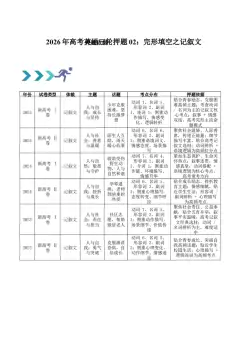
猜押 押题
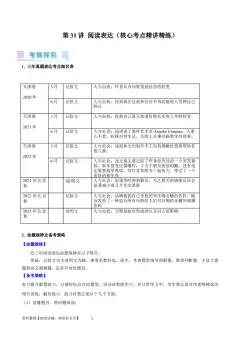
3年真题 词数 话题 考情分析
考点 依据
高考阅读
2026年1 B篇通过个人教学经验,阐述将个人爱 材料记叙
月浙江卷 B309 好融入课堂如何有效纠正学生误解、 文出现的
阅读B篇 提升学习参与度并深化师生关系的故事 频 率 很
高。高考
新高考阅读理解 B 命题人通
2025年 篇一般设计一篇记叙 过记叙文
新高考Ⅰ B300 D作者作为一名写作课老师,通过教学 文,记叙文和说明文有 语篇展现
卷阅读B 实践逐渐认识到学生写作动力的来源以 明显的语篇特征,记叙 浸润人文
篇 及写作真正意义的成长故事 文用生动、形象的语言 教育元素
刻画一个人物形象或讲 的命题指
述一个感人的故事,从 导思想。
阅读 而展现人文情怀,传递
理解 人间大爱和心灵感悟的
2025年 哲理。文章主要考查学
科普
新高考Ⅱ 生对人物故事的细节理
B讲述了Kathy Ho在斯坦福露西尔・帕
说明 卷阅读B 解,感悟人文情怀的主
B305 卡德儿童医院(LPCH)担任教师的工
文 篇 题及相关的推理判断。
作情况
鲜明地彰显了命题人旨
在培养新一代青年学子
融入社会、关爱他人的
2024年
人文关怀。
新高考I
B兽医威廉·法伯(William Farber)博士
卷阅读B
B298 在从针灸中受益后,将综合医疗应用于
篇
动物,并取得了初步成效
2024年1 B电话亭渐渐地被人们遗忘,作者家附
月浙江卷 B335 近的最后一个电话亭被改造成了“迷你
阅读B篇 图书馆”押题预测目录
一、温暖人心的故事 六、外国人在中国
二、人和动物和谐相处 七、志愿者行动
三、认识自我、追求自我 八、人与自然的故事
四、简单的生活方式 九、追寻梦想的故事
五、教与学的感悟 十、人机对话
一、温暖人心的故事
押题1
体
词数 话题 考点 押题理由
裁
340 日常相伴、互相扶 记 细节理解 高考阅读材料记叙文出现的频率很高。高考命题人通过
持,至今怀念他,充 叙 记叙文语篇展现浸润人文教育元素的命题指导思想。
推理判断
满感激。
文
I was just 26, newly married and pregnant, when I moved into the small house that shared a driveway with a
neighbor. While unpacking, I heard a knock and found a man standing at my back door, ruddy-faced and beaming.
Handing me a bushel of apples he’d picked, he said, “I am Walter. Welcome good neighbors,” and left.
Those apples were just what I needed for my persistent morning sickness, but I’d no idea at the time that this
neighbour would be an antidote for life’s struggles. We lived peacefully side by side for 35 years, coming to know
each other through our day-to-day ebb and flow — chatting, lending a helping hand, keeping a watchful eye, never
overstepping. It was a special bond — he was always there, steady as rain.
Most of our life unfolded in Walter’s backyard. From dawn to dusk, he practiced sustainable living — drying
fruit, making sausage, and tending his garden. Fishing was his year-round passion; my children loved helping clean
his catch. Without kids of his own, he cherished their company, and his catches often led to joyful family gatherings
under the mulberry tree. After my divorce, Walter quietly became my support: fixing my car, teaching me skills,
and even chipping ice off my roof. When my mother was dying, he promised to look out for me — and through my
hardest years, he was always a door-knock away.With time going by, Walter burrowed deep into my heart. Like my mum, Walter could mend nearly anything
with his hands — a torn book, a loose button, a quiet sorrow. His laughter was a force that seemed to push back
against the darkness he had known. He was the closest thing I had to a father, though mine was alive at the time.
We loved each other a lot.
He has been gone for two years now, but every time I eat an apple, I still think of him. So lucky am I to have
had him so long, just across the way.
1.How did the author develop a bond with her neighbor Walter?
A.Through small caring actions. B.By giving free gifts to each other.
C.Through years of peaceful coexistence. D.By sharing the same passion for fishing.
2.The phrase “steady as rain” in the second paragraph is used to describe Walter’s _________.
A.preference for rainy days B.constant and reliable presence
C.tendency to overstep others’ life D.unpredictable and unstable mood
3.According to the passage, which idiom best reflects Walter’s role in the author’s life?
A.A hard nut to crack. B.A drop in the ocean.
C.A storm in a teacup. D.A shoulder to cry on.
4.What’s the writer’s purpose in writing the text?
A.To describe Walter’s green lifestyle and hobbies.
B.To recall her dear neighbor and express her gratitude.
C.To show how to build a close neighbourly relationship.
D.To share how she pulled through ups and downs in her life.
押题2
体
词数 话题 考点 押题理由
裁
294 唤醒老人尘封记忆、 记 细节理解 高考阅读材料记叙文出现的频率很高。高考命题人通过
为养老院带来活力的 叙 记叙文语篇展现浸润人文教育元素的命题指导思想。
推理判断
温暖故事
文
Dr. Eleanor Hartwell had seen a lot in her 82 years, but she’d never expected a bearded dragon to become her
time machine. The creature rested quietly on her lap at Sunshine Meadows retirement Community, its skin warm
against her hands. Around her, other residents were experiencing similar magical moments with an extraordinary
collection of animals. “I remember my first lizard (蜥蜴),” Eleanor whispered, her eyes suddenly bright. “Back inthe summer of 1952, Tommy Peterson’s family had an unusual pet shop, and I was absolutely attracted.”
Rachel, in charge of animal treatment, smiles. She’d seen this phenomenon countless times — how animals
could unlock forgotten memories with a simple touch, a familiar texture (纹理), a distant smell.
Nearby, Harold was chatting vividly with a white rabbit, recounting tales of his childhood farm. Margaret
was petting a bird’s soft feathers, remembering her days as a wildlife photographer. The room was filled with
renewed energy and laughter. “It’s like they’re magical memory conductors,” whispered nurse Jennifer to Rachel.
“One moment they’re sitting quietly, and the next they’re transported back decades.”
As the afternoon progressed, the retirement home transformed. It was no longer a place of waiting, but a
lively landscape of remembered adventures. Guinea pigs rushed about, chickens clucked (咯咯叫), and memories
danced.
Cameron Innes, who had arranged the treatment session, watched in wonder. “This isn’t just an animal visit,”
he realized. “This is a time travel.”
When the session ended, the residents were different. They were brighter and more connected. The animals
had done more than provide comfort — they also reawakened something valuable: memories of one’s past. Outside,
the world continued its usual pace. But inside Sunshine Meadows, time had bent and reconnected — all thanks to
these animal friends.
1.What made Eleanor recall her first lizard?
A.The touch of a bearded dragon. B.The smell of a familiar animal.
C.A chat with other old residents. D.A visit to Tommy Peterson’s pet shop.
2.What can we learn about Rachel from the text?
A.She often takes animals to visit schools. B.She works as a head nurse there.
C.She knows well about the animals’ magic. D.She used to be a wildlife photographer.
3.How was the retirement home during the animal session?
A.Quiet and peaceful. B.Lively and energetic.
C.Calm and boring. D.Cold and messy.
4.What is Cameron Innes’ attitude towards the animal session?
A.Doubtful. B.Worried. C.Favorable. D.Disapproving.
押题3
体
词数 话题 考点 押题理由
裁
366 讲述了Esther Keim为偏远阿 记 细节理解 高考阅读材料记叙文出现的频率很高。高考命题拉斯加人空投火鸡的善举 叙 推理判断 人通过记叙文语篇展现浸润人文教育元素的命题
文 指导思想。
It begins with a steady buzz, echoing through the towering forests of Alaska. It’s a signal, but not one to be
alarmed by. It’s less “Duck and cover,” more “Come and get it!”
So you step outside your house, where there are few roads and fewer neighbors, and see it. A single-engine
plane flies low, just a few dozen feet above the ground. The plane’s door whips open, and a black package is thrown
out, plummeting (速降) to earth with a yellow tail hanging behind.
Congratulations, you’ve just been turkey bombed!
The “bomb” is a 15-pound frozen turkey stuffed into a trash bag, tied with yellow caution tape for easy
visibility. Since 2021, Alaska native Esther Keim has been dropping them from the air to remote Alaskans who
might otherwise be eating squirrel, moose or Spam for Thanksgiving dinner.
Thanksgiving falls at a tricky time of the year in this part of the country. It’s a time when rivers, which often
serve as highways in Alaska’s remote areas, are too frozen for boats to travel but not frozen enough for cars. Their
only option for reaching “civilization” is seven hours on a snowmobile. Or, if you’re a pilot like Keim, you can take
to the air.
Keim began her turkey-bombing flights after visiting her family in Skwentna, an isolated village. A neighbor
mentioned how a squirrel he hunted barely fed his family of four. This reminded Keim of her childhood, when a
family friend would drop a turkey — and sometimes a box of candy inside the package just for her — from his
plane to her family every year. “I am gonna drop turkeys to remote Alaskans without road access,” says Keim. “It
wouldn’t be a big deal, but it’d bring me a lot of joy to bless other people like we were blessed.”
Now Keim is working to turn this personal effort into a non- profit called the Alaska Turkey Drop Project.
The project has received enough donations from some individuals and local businesses, with others donating their
time and goods. Every year, that noisy plane soaring through Alaska’s sky brings not just turkeys, but a
heartwarming reminder of connection in the wilderness.
1.What can be learned about the “bomb”?
A.It’s a dangerous explosive. B.It’s sent to Alaskans for Christmas.
C.It’s a frozen turkey with yellow tape. D.It’s dropped from a high- flying plane.
2.Why is Thanksgiving a challenging time in remote Alaska?
A.Pilots avoid snowy flights. B.Snowmobiles are only for short trips.
C.All roads are blocked by snow. D.Half- frozen rivers are unfit for boats or cars.3.What inspired Keim to start the “bombing” flights?
A.A demand for her nonprofit project. B.A suggestion from her family.
C.Neighbor’s hardship and childhood favor. D.Hunting squirrels with neighbors.
4.Which of the following best describes Keim?
A.Caring and inquiring. B.Sympathetic and innovative.
C.Decisive and tolerant. D.Adventurous and ambitious.
押题4
体
词数 话题 考点 押题理由
裁
327 手机没电后在繁忙商场求助 记 细节理解 高考阅读材料记叙文出现的频率很高。高考命题
陌生人的经历,最终被一位 叙 人通过记叙文语篇展现浸润人文教育元素的命题
推理判断
衣着朴素的男子帮助,领悟 指导思想。
文
到要友善对待求助的陌生人
I always wondered how people would react if I tried to approach a total stranger for help in a busy place like
a street corner or in a noisy mall. I have always hurried past a stranger who tried to catch my attention in a busy
place or when I am rushing around.
Yesterday, I was in a busy shopping mall buying a large piece of luggage because I just had the time to do it
after many days of planning. After the purchase in one of the large shops, I picked up my phone from my pocket to
call my driver waiting in the parking lot but my phone was dead.
I then requested the shop assistant who had just sold me the luggage to ring the number of my driver for me
and she replied that it was the shop policy that they cannot use mobile phones while working in the shop.
I got out of the shop onto the busy street in front and approached a young mother with her two kids to make
a request. As soon as I said “Excuse me, madam”, she grabbed both her kids and ran. I felt like a kidnapper.
I stood there, wondering how many times I had reacted to strangers like the young mum. I stood there in the
busy street with people rushing by, looking at their faces to see if there was a sign of kindness on their faces.
I saw a man pretty shabbily dressed. He seemed to have noticed me and I just stopped him expecting him to
rush past. My request escaped the lips. He immediately called the number of my driver and waited till my car came
to be sure I was picked up, and he turned around before I could thank him adequately and was gone. I was surprised
by his kindness and hope I will do likewise to strangers who try to catch my attention from now on.
1.The author turned to others for help to_________.
A.charge up his dead phone B.call his driver to pick him upC.test their reaction to a stranger D.catch their attention to him
2.Who gave the author a helping hand at last?
A.The shop assistant. B.The mother with two kids.
C.The shabbily-dressed man. D.Nobody.
3.Why did the author expect the man to rush past when stopping him?
A.The man may be too poor to own a phone.
B.The man didn’t look safe.
C.The author found himself mistaken for a bad person.
D.The author was hopeless after seeking help in vain.
4.What does the author learn from his experience?
A.Do to others what you would like others to do to you.
B.Helping strangers is easier said than done.
C.Experience is better gained through practice.
D.Kindness can turn strangers into friends.
押题5
体
词数 话题 考点 押题理由
裁
337 因点错餐厅引发的跨国道 记 细节理解 高考阅读材料记叙文出现的频率很高。高考命题
歉,最终演变成一场温暖的 叙 人通过记叙文语篇展现浸润人文教育元素的命题
推理判断
善意传递 指导思想。
文
猜测词义
主旨大意
A little mix-up between two Bentley’s restaurants — one in Nova Scotia, Canada, the other over 1,500 miles
away in Alabama, America — has turned into one of the sweetest international apologies you’ll ever hear.
Darcy and Laura Clarke, the couple behind Bentley’s hamburgers and Fries in West Chezzetcook, Nova
Scotia, recently opened their mail to find a handwritten note and $40 in U.S. cash from a stranger in Alabama. The
mystery sender had accidentally placed a take-out order with the wrong Bentley’s — and felt so bad about never
picking it up that they mailed money across the continent to make it right.
Darcy had taken the original order on October 1: two cheeseburgers and fries. The caller had a southern
accent, but with tourists passing through all the time, nothing seemed unusual. When the food sat unclaimed for
over an hour, the Clarkes simply gave it to a different customer and moved on with their day.
The next morning, though, this Alabamian sat down with a piece of loose-leaf paper and wrote what mightbe the most polite long-distance mix-up apology in history.
“Obviously, I called the wrong restaurant,” the letter said. “I hope the amount enclosed is enough to cover
the cost of my embarrassing mistake. My sincerest apologies.”
Not only did the money cover the meal — it even left a little extra. Laura said they plan to use the remainder
in the happiest way possible: adding it to their summer ice cream shop so they can hand out free treats to kids next
season.
Darcy shared the story on the Bentley’s website, where it’s been viewed tens of thousands of times and has
drawn more than a hundred comments cheering on this act of honesty.
In true Nova Scotian fashion, Darcy says he plans to send a thank-you package to the return address —
complete with a greeting card and some Bentley’s seasoning.
This tiny moment of accountability and kindness has brought people on both sides of the border a much-
needed smile.
1.What did the Clarkes do with the unclaimed food eventually?
A.They threw it away after an hour. B.They waited for the customer.
C.They offered it to another diner. D.They shared it with each other.
2.What can we learn from the text?
A.The caller’s honesty started a chain of kindness.
B.The $40 was far from enough to cover the meal.
C.The Alabama caller placed the order to play a joke.
D.The Clarkes had never received a wrong order before.
3.What does the underlined word “accountability” in the last paragraph mean?
A.Being responsible for one’s actions. B.Being able to count money accurately.
C.Misunderstanding between friends. D.Business done between two countries.
4.What can be the best title for the text?
A.The Competition Between Two Bentley’s Restaurant
B.A Delicious Mistake: The Story of Bentley’s Burger
C.How Social Media Helps Small Businesses Develop
D.A Wrong Order leads to Something Right
押题6
体
词数 话题 考点 押题理由
裁360 让“温暖丝线”慈善组织不 记 细节理解 高考阅读材料记叙文出现的频率很高。高考命题
断发展壮大的故事 叙 人通过记叙文语篇展现浸润人文教育元素的命题
推理判断
指导思想。
文
主旨大意
Every morning, as the first rays of sunlight flow through the curtains of her small apartment, 72-year-old
Mrs. Thompson holds her knitting (编织) needles. Her fingers, weathered but skillful, weave soft thread into bright
scarves, hats, and gloves. For years, these creations have been more than just winter necessities — they are her
silent language of love, sent to strangers across the city through a local charity organization.
“It started as a way to fill the empty hours after my husband passed away,” she explains, her eyes crinkling
with a gentle smile. “But soon, it became something deeper. Each item carries a wish: May this keep you warm.
May you feel someone cares.”
The charity, called “Threads of Warmth,” collects handmade items and distributes them to homeless shelters,
hospitals, and schools in low-income neighborhoods. Mrs. Thompson devotes herself to every detail. Her
contributions, often decorated with delicate patterns, have become favorites among the recipients.
One winter afternoon, while delivering a batch of knitted goods to a shelter, Mrs. Thompson met a young girl
named Mia, a child in a threadbare coat. When Mrs. Thompson offered her a bright red hat with a cute ball on top,
Mia’s eyes lit up. “Is it really for me?” she whispered. Mrs. Thompson nodded, her heart swelling. “Yes,
sweetheart. And there’s more where that came from.” That encounter sparked a change in Mia. She began visiting
Mrs. Thompson’s apartment every weekend, learning to knit under her patient guidance. “Knitting is like magic,”
Mia declared one day, her needles clicking rhythmically. “You start with a string, and it turns into something
beautiful.”
Over time, Mia’s skills improved, and she even designed her first scarf-a striped pattern in blue and green,
her favorite colors. Mrs. Thompson framed it as a reminder of Mia’s progress. “You see?” she said. “Kindness isn’t
just about giving; it’s about passing on the light.”
Today, Threads of Warmth has expanded beyond the city, with volunteers nationwide joining the cause. Mrs.
Thompson, though no longer the youngest member, remains its heart. Her apartment, once quiet, now buzzes with
laughter as Mia and other children gather to knit, chat, and share stories.
1.What motivated Mrs. Thompson to start knitting for charity?
A.Her need to overcome loneliness. B.Her desire to earn extra money.
C.A request from a charity organization. D.Her childhood hobby of knitting.
2.What makes Mrs. Thompson’s contributions to the charity stand out?A.Their quantities. B.Their materials. C.Their craftsmanship. D.Their
market value.
3.Why was Mia’s encounter with Mrs. Thompson a turning point in her life?
A.To get immediate warmth from a red hat. B.To create beauty with hands and share warmth.
C.To become known for scarf designs in the town. D.To find a permanent home with Mrs. Thompson.
4.Which of the following best describes the theme of the passage?
A.The growth of a nationwide charity organization.
B.The challenges faced by the elderly in urban areas.
C.The importance of traditional crafts in modern society.
D.How small acts of kindness can create lasting connections.
二、人和动物和谐相处
押题1
体
词数 话题 考点 押题理由
裁
327 戴安·福西深入卢旺达研究大 记 细节理解 高考阅读材料记叙文出现的频率很高。高考命题
猩猩,为保护它们与非法捕 叙 人通过记叙文语篇展现浸润人文教育元素的命题
推理判断
猎斗争,最终献出生命的故 文 指导思想。
事
Dian Fossey arrived in Rwanda’s misty mountains in 1967. With no formal scientific training, she pioneered
a new way of study: integration, aiming to bridge the divide between humans and gorillas (大猩猩). This involved
patiently imitating them — chewing wild grass, making deep sounds, and walking on all fours — as a way to build
mutual understanding. Over time, these efforts allowed her to be accepted by creatures once feared as violent
beasts, revealing them as gentle and social.
But the paradise Fossey found was under threat. Illegal hunters, armed with arrows and traps, pushed deeper
into the forest. In 1978, a young gorilla named Digit, whom she had known since it was born, was killed. A
profound and personal sorrow seemed to harden her resolve. Her focus shifted decisively from observation to direct
action. Fossey’s battle against illegal hunting consumed her life. She began capturing and questioning illegal
hunters, burning down their camps, and pretending to use black magic to make locals believe she was a witch. Her
extreme methods created tension with others who preferred tourism and education as a way to protect the gorillas.
Fossey saw tourism as a direct threat. Isolated at her research center, she grew more convinced that onlydirect action could save the gorillas. This earned her many enemies. On December 26, 1985, her lonely struggle
ended in violence. She was found murdered in her cabin. The crime was never solved — many believe it was linked
to illegal hunting, smuggling (走私), or conflicts over land and money. As her former assistant said, she was
“standing in the way of certain individuals making money”.
She was buried beside her gorilla friends like Digit, and her legacy lives on in these mountains. Though she
did not live to see it, her fierce devotion inspired a global movement that saved the species from extinction.
1.Why did Fossey imitate gorillas’ behavior?
A.To gain gorillas’ trust.
B.To feel more comfortable in jungle.
C.To study their eating habit.
D.To prove gorillas were gentle creatures.
2.What directly caused Fossey’s change in protection methods?
A.Tragedy in her personal life.
B.The death of a gorilla close to her.
C.Her desire to gain local recognition.
D.Disagreements with tourism supporters.
3.What could be the main reason behind her murder?
A.A random violent act.
B.Conflicts with researchers.
C.Anger from local people.
D.Her prevention of illegal profits.
4.Which of the following best describes Fossey’s strategy?
A.A universally accepted approach.
B.A great success at a personal cost.
C.A direct solution to gorilla extinction.
D.A scientific and cooperative model.
押题2
体
词数 话题 考点 押题理由
裁
383 作者在非洲草原观察大象时 记 细节理解 高考阅读材料记叙文出现的频率很高。高考命题
的所见所感 叙 人通过记叙文语篇展现浸润人文教育元素的命题
推理判断
指导思想。
文The great elephant stands in the hot African sun. Slowly the beast lifts its head and its thick trunk delicately
curls around the leaves of a nearby tree, pulling out the leaves and politely slipping them into its mouth.
The beast’s great grey skin is partly broken and aged from the African sun. Some mud drops on one side
from its last trip to a nearby river. Its rough hair sticks out from all over its skin and two large, white tusks curve
elegantly from either side of its mouth.
Somewhere a lion roars and something else gives a loud high shout. A vulture (秃鹫) drifts over far above
this world, barely a black dot in the sky. The buzzing of the countless bush insects seems to collectively shift up in
high tune, almost like the whole of the savanna (热带草原) was singing some song that only they knew.
I peer through the lens (镜头) at this scene. The zoom lens shows almost every detail of the elephant: the
three small cuts in its left ear from playing as a baby around thorn trees, the scar down its front leg where a lion
caught it unaware as a young adult, and weathering on its great, valuable tusks from decades of living in this
unforgiving grassland on a dusty continent.
And then the elephant looks at me. It looks at me with those big, eyelashed eyes with a warmth coming
outwards from a vast, hidden depth there. I can suddenly feel its soul, and feel the line of elephants that came
before this one, trailing back to the very beginnings of this great savanna. We will never understand what wonders
this ancient being and its kind have seen and whispered to each other across the ages on this old, sacred grassland.
It looks at me, and it looks through me and sees me.
The elephant knows I am there. It always did. It is not running away, nor is it fighting. It accepts and
forgives. It loves. But mostly, it just feels sad. It feels sorry for me. I cannot do this anymore.
I take my eye off the sights and hand the gun back to my partner. “Let’s go home,” I said in a quiet voice,
“let’s just go home.”
1.Which word can best describe the elephant according to the first two paragraphs?
A.Mysterious. B.Aggressive. C.Depressed. D.Graceful.
2.How does the author feel when he sees through the lens?
A.Deeply moved and filled with sympathy. B.Overwhelmed by the elephant’s strength.
C.Annoyed at the presence of other animals. D.Shocked and scared by the elephant’s scars.
3.What does the author intend to do initially?
A.Take a picture. B.Hunt the elephant.
C.Observe the elephant. D.Study African grassland.
4.What does the author’s experience show?A.Nature calms our anger. B.Nature purifies our souls.
C.Nature heals our wounds. D.Nature enriches our imagination.
押题3
体
词数 话题 考点 押题理由
裁
296 波莉·普拉尔通过改造农场为 记 细节理解 高考阅读材料记叙文出现的频率很高。高考命题
红松鼠打造自然栖息地,助 叙 人通过记叙文语篇展现浸润人文教育元素的命题
推理判断
力苏格兰红松鼠保护项目, 文 指导思想。
以及她的相关经历和感悟 猜测词义
Efforts to help Scotland’s red squirrels are bearing positive fruits, which owes much to the Saving Scotland’s
Red Squirrels (SSRS) project and its helper, Polly Pullar, who has transformed her farm into red squirrels’ natural
habitat.
Polly recalls her first encounters with red squirrels at school in Dunkeld. Despite being a top student and
popular girl on campus, she, as a boarder, frequently missed her family far away when she was alone. She got her
first baby squirrels to look after in the nearby woods. “I became completely absorbed in them and they distracted
me from missing home too much,” she says.
The squirrels eventually returned to the wild, and since then she has regularly taken more in, developing
special techniques such as regular touching to stimulate bodily functions. In Polly’s view, the eventual release is
often challenging because the newly released squirrels still need feeding until they rewild themselves. Their
susceptible character makes them suffer from stress more seriously than other small creatures.
Polly’s own farm, where she lives now, has a rising population of the reds. With the help of the SSRS, more
than 20,000 trees have been planted. On the farm, everything is kept untidy. “We arrange it intentionally to keep the
living environment of squirrels original and natural.” To Polly’s relief, it has proved a major boost for the reds’
population.
Polly believes the reds have a healthy future if efforts can be maintained. That is a matter of money, one for
the politicians. The experience of raising red squirrels has taught Polly a lesson: “When I have these baby squirrels
in my hands and they are completely dependent on me, they highlight the fact that we humans hold the key to
nature. It is our duty to protect the natural world.”
1.What did tending the baby squirrels relieve Polly of?
A.Social anxiety.B.Academic pressure. C.Intense homesickness. D.Life’s boredom.
2.The underlined word “susceptible” in the sentence probably means ______.A.resistant to change B.easily affected C.extremely aggressiveD.totally
indifferent
3.Why doesn’t Polly keep the farm neat and well arranged?
A.To attract the attention of the SSRS. B.To safeguard a habitat free from disturbance.
C.To seek politicians’ economic support. D.To make room for newly-planted trees.
4.What do Polly’s words mainly convey in the last paragraph?
A.Her pride in human superiority. B.Her affection for red squirrels.
C.Her appreciation of the wildness. D.Her awareness of shared responsibility.
三、认识自我、追求自我
押题1
体
词数 话题 考点 押题理由
裁
339 自己应在忙碌生活中给自己 记 细节理解 高考阅读材料记叙文出现的频率很高。高考命题
留出时间放松,强调了拥有 叙 人通过记叙文语篇展现浸润人文教育元素的命题
推理判断
自我时间的必要性 指导思想。
文
It was at a community meeting of women. I was comfortable as we visited and shared stories. And then, the
hostess handed us each a piece of paper and a pencil and asked us to write down our New Year’s resolution.
My pencil wouldn’t write. Those around me smiled and wrote non-stop. I was blank and confused. I thought
about my everyday life. Sometimes I am really tired and often wish there were more minutes in a day. I love my job
and my family and friends. I work out and volunteer in the schools, in the community and for many organizations.
Everyone smiled as they placed their well-chosen words into a basket. My face turned red — I knew I had to
write something. This same group of women promised to look at these resolutions at the same party, same place,
same time… next year. So in a rush I wrote something down, folded it and folded it again, and put it in the basket.
“Say no.” That was all I wrote down.
That was the best resolution I had ever made. And, I kept it! I realized on that warm winter day that I had
participated in a lot of ineffective socializing. I realized that I had stopped reading books, watching my favourite
shows on television, baking fresh bread, or sitting on the couch relaxing. I resolved that I could still give to others,
lead my busy fulfilling life, and also save time for myself.
Each woman left with a colorful sparkly hat to wear on New Year’s Eve and a hug for happiness in the New
Year. I left, feeling heavy and wondering what they would think of me in one year when the paper with my briefwords was unfolded.
On the way home, enjoying the birds singing and observing the colorful trees lining the street, I realized that
it didn’t matter. What mattered was, for once, me taking care of me. I even said it out loud, “I need to take care of
me!”
1.What were the women required to do at the meeting?
A.Recall their past experiences. B.Analyze their present situation.
C.Make decisions about their future. D.Find solutions to their problems.
2.How did the author feel before she wrote something?
A.Excited. B.Embarrassed. C.Surprised. D.Confident.
3.What will the author focus on in her life?
A.Social activities. B.Recharging and relaxing.
C.Wealth creation. D.Struggling and exploring.
4.What is the author’s purpose in writing the text?
A.To promote the value of volunteering. B.To emphasize the function of socializing.
C.To prove the benefits of relaxing oneself.D.To stress the necessity of having me-time.
押题2
体
词数 话题 考点 押题理由
裁
330 在快节奏的世界里,耐心很 记 细节理解 高考阅读材料记叙文出现的频率很高。高考命题
重要 叙 人通过记叙文语篇展现浸润人文教育元素的命题
推理判断
指导思想。
文
In the morning, when mist still hangs over the old stone streets of the coastal town of Seabrook, Thaddeus
Flint is already at work in his workshop. For decades, the elderly clockmaker, known for his complicated handmade
timepieces, had worked alone. That changed last spring when Leo, a quiet transfer student with no friends in his
new school, wandered into the shop by accident, drawn by the steady ticking (嘀嗒作响) from within.
Seeing Leo interested in clocks, Thaddeus, a man of few words, simply handed the boy a dusty small gear
(齿轮) and a clean cloth. To his surprise, Leo returned the next day, having polished it to a shine. Recognizing his
uncommon attentiveness, Thaddeus offered him a simple task: sorting screws. Week by week, Thaddets’ tasks grew
more complex. Leo learned to adjust tiny pendulums (钟摆) and carefully position delicate gears.
The real turning point came with the specially ordered Clock Project for the town hall — a piece that had
defeated Thaddeus for months due to a faulty bell sound mechanism. Leo, after observing for weeks, suggested adifferent design for the spring tension setup using a method from an old physics book. Doubtful but impressed,
Thaddeus let him try. To the old man’s astonishment, it worked. The deep, clear-sounding bell that now marks each
hour in Seabrook is partly Leo’s creation. News of their successful work together spread. Many locals bring their
hard-to-fix antique shelf clock for repair.
Leo, once an outsider, gradually became a familiar face. Thaddeus often speaks proudly of Leo’s “steady
hands and a steadier mind”. Leo plans to study engineering after graduation. “A clock isn’t just gears and time,”
Thaddeus told him. “It’s a promise that every piece has its place. All we need is to observe and study calmly and
steadily.” In a world that often feels rushed, their unlikely partnership reminds the town that some of the best
connections are built slowly, one careful tick at a time.
1.Which word best describes both Thaddeus and Leo?
A.Reserved. B.Strong-willed. C.Easy-going. D.Flexible.
2.What can be inferred about Thaddeus from paragraph 2?
A.He displayed strong devotion to clocks.
B.He aimed to impress Leo more quickly.
C.He intended to train Leo in clock making.
D.He got inspiration from his prior experience.
3.What surprised Thaddeus about Leo’s skills in clock making?
A.An old physics book. B.A solution to a bottleneck.
C.Leo’s careful modesty. D.Leo’s challenge to authority.
4.What does the author want to convey in the last paragraph?
A.Precision is key. B.Patience matters.
C.Every detail counts. D.Teamwork is essential.
押题3
体
词数 话题 考点 押题理由
裁
357 写作才是自己真正热爱的事 记 细节理解 高考阅读材料记叙文出现的频率很高。高考命题
业的故事 叙 人记叙文语篇展现浸润人文教育元素的命题指导
推理判断
思想。
文
主旨大意
If I hadn’t been a struggling violinist, I might have never become a writer. In fourth grade, my school had an
orchestra program, and I eagerly signed up to learn the violin with my friend Irene. We both loved the idea of beingin the orchestra and walked together to our music lessons every week.
Our orchestra teacher, Mr. Baumgartner, was strict. He told us that if we damaged our instruments, we’d be
kicked out of the program because the school couldn’t afford replacements. Unfortunately, I wasn’t very good at the
violin. One day, while practicing, the bridge of my violin flew off and the strings broke. Scared of Mr.
Baumgartner’s reaction, I tried to fix it myself with some glue. But when he saw my crooked bridge, he told me I
couldn’t be in the orchestra anymore. Instead, he suggested I join the glee club.
I switched to the glee club and found I enjoyed singing with others, even though I didn’t have a great voice.
Later, the junior high chorus held auditions for the All City Honor Chorus, and I was one of only five girls from my
school to audition. Because of this, I made the chorus.
After a performance, my English teacher asked if anyone in the chorus wanted to write an article for the
school newspaper. For some reason, I raised my hand. I loved reading, but I had never thought about writing before.
However, when I saw my name and words in print, I knew I wanted to write more.
The next year, I became the editor of the school newspaper. I realized that writing was my true passion.
Looking back, I understand that if I hadn’t broken my violin and joined the glee club, I might never have
discovered my love for writing. Years later, I saw Irene at a reunion. She told me she had become a professional
violinist in Australia. I thought, "That could have been me." But Mr. Baumgartner’s decision led me to a different
path — one filled with words and stories. I’m grateful for that turn in my life and for Mr. Baumgartner’s
unexpected guidance.
1.What caused the author to leave the school orchestra?
A.She lost interest in playing the violin.
B.She wanted to join the glee club instead.
C.She damaged her violin and failed to repair it properly.
D.Her friend Irene became much better than her.
2.What was the initial result of the author joining the glee club?
A.She immediately discovered her talent for singing.
B.She was selected for a city-wide honor chorus.
C.She decided to become a professional singer.
D.She started writing articles for the newspaper.
3.How did the author feel when she first saw her writing published?
A.Surprised but indifferent.
B.Proud and determined to continue.C.Regretful about her past choices.
D.Nervous about others’ opinions.
4.What is the main message the author wants to convey?
A.Failure in one area can lead to success in another.
B.Strict teachers are essential for student development.
C.Childhood friendships can shape our future careers.
D.Natural talent is more important than hard work.
押题4
体
词数 话题 考点 押题理由
裁
348 作者从经验中学习并不断成 记 细节理解 高考阅读材料记叙文出现的频率很高。高考命题
长的过程 叙 人通过记叙文语篇展现浸润人文教育元素的命题
推理判断
指导思想。
文
My undergraduate student needed advice after yet another failed experiment. Sitting across from me, she
looked exhausted — frustrated even. I heard myself say, “This is part of research. You just have to push through.”
But even as the words left my mouth, I felt uneasy. She nodded silently and shifted her posture. Afterward, she
began showing up less frequently and eventually stopped coming altogether. I tried to explain it away:
undergraduates sometimes get busy with coursework, lose interest or change direction, but deep down, I wondered
what I could have done differently.
I became a mentor (导师) during my second year of Ph. D.but didn’t get much guidance on how to do it. I
learned only by doing. There were moments I felt proud of. One student started out quiet and unsure, but over time
grew into a most independent and confident young researcher. Before graduating, she told me, “You are the reason I
stuck with this.” That moment stayed with me. But so did the other one — the silence, the absences, the slow fade-
out. Had I failed her?
It wasn’t until the final year of my Ph. D.that I came across a leaflet for a mentorship training workshop.
Skeptical at first, I decided to try it. The program, called Entering Mentoring, brought together graduate students
for weekly discussions. For the first time, I had the space to explore the invisible labor and emotional complexity of
mentoring. One session asked us to reflect on our own practices. I began to realize what might have been missing in
my relationship with the student who had drifted away. I had never invited her to share her goals or concerns. I
could have been more attentive to her unspoken struggles.After the workshop, I began changing how I interacted with students. I now start by asking how they’re
doing, not just experimental details. This shift has led to more honest conversations. I’ve learned that good mentors
are built through reflection and training. I wish I’d attended that workshop earlier, but I’m grateful I did at all.
1.What primarily caused the student’s withdrawal according to paragraph 1?
A.Demanding research challenges. B.Overwhelming academic workload.
C.Repeated failures in research. D.Unattended inner struggles.
2.Why did the author mention the transformation of another student?
A.To highlight contrast in mentoring results.
B.To showcase his pride in her achievement.
C.To explain his own research breakthrough.
D.To illustrate his lack of proper guidance
3.What did the workshop mainly focus on?
A.Developing excellent academic research skills.
B.Encouraging discussions among graduate students.
C.Exploring the interpersonal aspects of mentoring.
D.Displaying diverse personal mentoring approaches
4.Which of the following can best describe the author?
A.Responsible and reflective. B.Talented and intelligent.
C.Thoughtful and ambitious. D.Disciplined and considerate.
押题5
体
词数 话题 考点 押题理由
裁
325 克服恐惧,自我成长的故事 记 细节理解 高考阅读材料记叙文出现的频率很高。高考命题
叙 人通过记叙文语篇展现浸润人文教育元素的命题
推理判断
指导思想。
文
主旨大意
On a hot Saturday evening in May, I reported to Terminal 4 of Phoenix Sky Harbor International Airport.
There, in a small conference room behind an unmarked door, I put on a name tag (标牌) and joined 18 other
nervous-looking people hoping to be cured by Captain Ron, a 78-year-old former commercial pilot who delivers a
lecture to nervous fliers roughly once a month.
I’d experienced 21 years of unmemorable flights before my own fear of flying took hold, which did notresult from a recent succession of frightening plane crashes. Years ago, I was traveling from my home state of Iowa
to New York City for a job. I was already nervous about moving, and then, somewhere above Illinois, the plane hit
turbulence (湍流) and dropped what felt like a thousand feet. Several people screamed. They were all okay, and,
physically, so was I. But I had unlocked a new fear.
Captain Ron’s class took place on an immobile Southwest airplane. After introductions, he handed out
boarding passes bearing our names, and together we marched through security and boarded. For the next hour,
Captain Ron taught us how much time is generally required for a plane to be in the air and how much fuel planes
typically carry for domestic flights. We were reminded that turbulence, while unpleasant, is not dangerous. We
learned about strategies for powering our emotional “elephant brain” with our logical “rider brain” and were
advised to do an “actionable task” like journaling about our anxiety or solving rapid-fire math problems to distract
(转移注意力) ourselves during takeoff.
Captain Ron didn’t erase my fear entirely, but he gave me something even more valuable: a new viewpoint. I
came to see that fear, in essence, is nothing to be ashamed of. True courage, then, may not lie in the absence of fear,
but in the gentle act of carrying it with us without judgment, as we continue to move forward.
1.Why did the author come to Terminal 4?
A.To attend a class. B.To have the room marked.
C.To hold a meeting. D.To give emotional support.
2.What caused the author’s new fear years ago?
A.A series of plane incidents. B.A specific flying experience.
C.A scream of the fellow passenger. D.A move to an unfamiliar city.
3.Which aspect of Captain Ron’s class does paragraph 3 mainly focus on?
A.The venue. B.The content. C.The schedule. D.The significance.
4.What lesson does the author learn?
A.Watching out for the absence of fear. B.Trying to erase fear with courage.
C.Seeing things from various viewpoints.D.Progressing despite the presence of fear.
押题6
体
词数 话题 考点 押题理由
裁
327 曾遭身体困扰、多次换工 记 细节理解 高考阅读材料记叙文出现的频率很高。高考命题
作,但始终坚守诗歌创作 叙 人通过记叙文语篇展现浸润人文教育元素的命题
推理判断
指导思想。
文
猜测词义The room went silent as soon as Richard Siken, a big-name poet, walked in. He was well-known among
those of us currently enrolled in the University of Arizona’s MFA program — the same program Siken had
graduated from. His poems would show up after they were printed and sent out in classrooms in the Modern
Languages building. Many of us taught his work to our English 301 students.
Earlier this year, I met Siken at Casa Video. A knee injury involving one of the four dogs he lives with had
forced Siken to use a walker. We nodded to each other as he walked unsteadily in. I stepped forward to help him
pull out a chair, and once he’d settled in, we chatted about his new, highly anticipated third collection, now
shortlisted for the National Book Award for poetry. It comes a decade after his second collection, which itself came
a decade after his first book. Siken had a stroke (中风) in the spring of 2019, an experience that informs every page
of the new collection.
Siken worked as a care worker in the mid-to-late 1990s, with patients dealing with serious mental illness. He
would work long, overnight weekend shifts at behavioral health facilities so that he could read and write poetry
during the week. As he wrote and revised his first book over 15 years, he left social work for restaurant jobs in
downtown Tucson. There was one job opportunity in 1998 that spurred a move to New York, but he returned to
Tucson less than a year later, working at a local bar.
For Siken, poetry is also service. He likes poetry because it’s clear and fast, and he tries to be as economical
and precise as he can in his writing. Through health challenges, career shifts, and life changes, Siken has stayed
committed to creation, turning his experiences into work that connects with readers.
1.Why did the room become quiet when Richard Siken entered?
A.He was highly respected among fellow writers. B.The MFA program had strict rules for visitors.
C.A famous poet made people feel nervous. D.Students were required to be quiet,
2.What do we know about Siken from paragraph 2?
A.He no longer wrote poetry. B.He gave up public appearances.
C.He suffered some physical challenges. D.He published 3 poetry collections in 10 years.
3.What does the author try to show by mentioning Siken’s career shifts?
A.Siken struggled to find stable employment.
B.Siken’s dedication to poetry remained constant.
C.Siken could not decide on a single career direction.
D.Siken’s health issues forced him to change jobs frequently.
4.What does the underlined word “spurred” in paragraph 3 mean?A.Blocked. B.Delayed. C.Encouraged. D.Complicated.
四、简单的生活方式
押题1
体
词数 话题 考点 押题理由
裁
348 在精简生活过程中面临的情 记 细节理解 高考阅读材料记叙文出现的频率很高。高考命题
感挑战 叙 人通过记叙文语篇展现浸润人文教育元素的命题
推理判断
指导思想。
文
猜测词义
When Anne and Dudley O’Sullivan decided to finally downsize (精减) at the age of 89, they were surprised
that the hardest part was saying goodbye to their beloved book collection. “We had thousands of books we had
collected over the years. Getting rid of some was hard. Choosing what to take was the biggest decision,” says Anne.
With an ageing population, the “downsizing dilemma” is one confronting thousands of older Australians at
the moment — a difficult decision that involves saying goodbye to a family home that contains memories in every
room.
For the Sydney couple they weren’t forced to move — there was no urgent health crisis or emergency. But
instead of waiting for one, they made the choice to downsize into independent living before circumstances took the
decision away from them. “We knew we didn’t need the large space we had in our old house. We just decided it was
time to move. The house we were in met all our needs at the time, but we are not having big parties or anything
anymore so that’s mainly why we were ready,” says Dudley.
For Anne and Dudley, the decision to move into “The Grove by Elysium”, a new benchmark (标杆) for
senior living which presents a lifestyle that promotes independence and active living in a safe and secure
environment, was an easy one. They could see their new apartment from the back balcony of their existing house.
Even when the decision is clear, the process of letting go is rarely simple. Their home was filled with items that
held sentimental value from Dudley’s mother’s 1927 dining table to furniture passed down from family. “Some of
it we passed down to our grandchildren. One of our granddaughters has the old dining table now,” says Anne.
Since moving into Elysium, life has become easier and more enjoyable for them. “Living in a smaller space,
it is so easy to keep clean. We don’t have to do any maintenance (维护). If anything goes wrong, we just call
somebody to come and fix it,” Anne says.
1.What usually troubles people in a “downsizing dilemma”?
A.Getting rid of limitations. B.Living away from relatives.C.Parting with the old items. D.Adapting to a new environment.
2.Why did Anne and Dudley decide to move?
A.To pursue larger living space. B.To escape a severe health crisis.
C.To make it easier to hold parties. D.To live an independent later life.
3.What does the underlined word “sentimental” mean in paragraph 4?
A.Practical. B.Emotional. C.Economical. D.Recreational.
4.What’s Anne’s tone like in the last paragraph?
A.Concerned. B.Curious. C.Satisfied. D.Ambitious.
五、教与学的感悟
押题1
体
词数 话题 考点 押题理由
裁
314 Sharri Conklin通过在课堂中 记 细节理解 高考阅读材料记叙文出现的频率很高。高考命题
引入一些能带来快乐的活动 叙 人通过记叙文语篇展现浸润人文教育元素的命题
推理判断
指导思想。
文
When fifth-grade teacher Sharri Conklin first invited her students to lead a daily mindful moment, she didn’t
expect it to grow into a classroom tradition of student-led calm and joyful clapping after lessons — not because it
was required, but because it felt good. In a school year marked by pressure to catch up, keep pace, and push
forward, Conklin found that the most transformative moments came not from strictness or routine, but from pausing
to notice what brought her and her students joy.
“Observe, pause, and notice things that your classroom community brings to you, and then expand on them,”
Conklin says. In her classroom, joy isn’t a break from work; it is an essential addition. In the face of feelings of
burnout and disconnection that both students and teachers are experiencing, being able to laugh and smile becomes
an act of resistance.
“The role of emotional experiences like joy, boredom, and anxiety is a significant aspect of learning
environments that is often underestimated,” writes Swedish professor Marita Cronqvist. “Positive emotions affect
students’ engagement, which in turn provides a positive cycle for motivation, results, and students’ emotional well-
being, especially for those who have had difficult or discouraging experiences in school.”
Conklin created “Make Someone’s Monday”, where students write an appreciation letter to someone in the
class every Monday. Another tradition is laying out stickers on a table and having her students choose one for afellow classmate. Over time, her students became more engaged in class. “I had a very shy student who wanted to
read a mindfulness passage, and I said to the class, ‘Get yourself settled for this mindful moment,’” Conklin says.
“When she finished, she clapped, then everybody else clapped, and then we started the clapping tradition.” These
shared moments aren’t breaks from education, but essential parts of creating a supportive, lively learning
environment where students feel seen and valued.
1.What can be known about the clapping after lessons?
A.It was started by a teacher. B.It emerged naturally from joy.
C.It was required as a class rule. D.It replaced mindfulness moments.
2.What does Conklin think of joy in her classroom?
A.A tool to maintain discipline.
B.A reward for completing work.
C.A temporary escape from tasks.
D.A vital boost to learning.
3.What does Marita Cronqvist say about positive emotions in education?
A.They matter more for top students.
B.They are overvalued in some schools.
C.They facilitate a favorable cycle for students.
D.They are less important than academic skills.
4.What role does “Make Someone’s Monday” play in Conklin’s class?
A.Serving as a writing task.
B.Evaluating students’ emotions.
C.Enhancing bonds and class engagement.
D.Offering a chance to share experiences.
押题2
体
词数 话题 考点 押题理由
裁
310 通过记录并复习不熟悉的单 记 细节理解 高考阅读材料记叙文出现的频率很高。高考命题
词来恢复和提升自己的专注 叙 人通过记叙文语篇展现浸润人文教育元素的命题
推理判断
力和思维灵活性 指导思想。
文
猜测词义
As a child, I devoted myself to books. When exams came, I revised for hours without break. But in recentyears, I’ve watched that capacity for intense concentration fade into infinite phone scrolling (滚动). My attention
span contracts like a candle in the wind. I want to restore that mental flexibility.
So, about a year ago, I made a small promise: every time I encountered a word I didn’t know, I’d look it up
and write it down. Nothing complicated, just a running list kept, ironically, on my phone. Each week, I’d review to
fix words into my memory. The list now covers almost 20 pages, and this tiny routine has been quietly
transformative. Each time I look up, record and review a word, I feel a faint stretch, as though some neglected part
of my brain is flexing again.
It’s not an easy habit to keep up, often impractical. If I’m reading on the subway, I have to stop mid-
paragraph, pull out my phone and type “millenarianism” into my Google document while trying not to knock into
strangers. It can slow my reading to a maddening pace. And then there’s the revising, dutifully scrolling through my
growing word-collection like preparing a vocabulary test. Realistically, I apply maybe 5% of these words into my
everyday speech. Most remain like museum pieces-admired but rarely handled.
Still, it’s made my mind sharper. I find myself reaching less often for the same tired adjectives, and more
often for something precise. Few things are more satisfying than unearthing the exact word you seek.
In an age when our devices absorb our attention with merciless efficiency, it feels unconventional to use
mine as a tool for slow thinking. And it’s given me back something I feared I’d lost—the pleasure of exercising a
mind that, after years of mindless scrolling, is finally waking up again.
1.Why did the author begin noting down unfamiliar words?
A.To prepare for a vocabulary test. B.To collect rare words for daily use.
C.To regain the ability to focus deeply. D.To replace phone use with useful tasks.
2.What can we know about the author’s word-recording habit?
A.It requires his consistent effort. B.It speeds up his reading process.
C.It improves his everyday speech. D.It enables him to use most words.
3.What can be inferred from paragraph 4?
A.Common adjectives might be misused. B.Using precise words fulfills the author.
C.Poor vocabulary does harm to thinking.D.The author no longer uses simple adjectives.
4.What does the underlined word “mine” refer to in the last paragraph?
A.The author’s attention. B.The author’s time. C.The author’s vocabulary. D.The
author’s phone.
押题3体
词数 话题 考点 押题理由
裁
293 致力为学生开拓更多成长机 记 细节理解 高考阅读材料记叙文出现的频率很高。高考命题
会,赋能孩子发展 叙 人通过记叙文语篇展现浸润人文教育元素的命题
推理判断
指导思想。
文
Kheshawn Wynn, a Stanford University student, initially dreamed of becoming a music teacher. However, as
he progressed through his studies, he shifted his focus to pediatrics (儿科学), knowing he wanted to work with
children. A vital moment came when he attended a psychology class that explored how social biases develop. This
inspired him to join a psychology lab, where he researched how children viewed themselves and how their school
experiences shaped these perceptions.
During his junior year, Kheshawn met a fellow student who desired to be a high school English teacher. This
encounter reawakened his passion for teaching. He decided to major in psychology and minor in education,
ultimately earning a Be GLAD education certificate. Currently, he is enrolled in a teacher preparation program and
teaches at REACH Academy, a public school in Oakland, just a block from his childhood home. He is teaching a
combined third-grade class and fourth-grade class, aiming to create enriching experiences for his students and their
families.
Kheshawn’s daily routine begins early, arriving at school by 7:30 AM to prepare for the day. He emphasizes
collaboration in his classroom, using group activities to support students at different learning levels. Kheshawn
advises ambitious teachers to prioritize building relationships with their students and families, saying that teaching
is a collaborative effort that depends on partnerships. He believes that mistakes should be viewed as opportunities
for growth, encouraging both students and their parents to adopt this mindset.
Despite the challenges his students face, such as poverty and immigration stress, Kheshawn remains
dedicated to fostering a supportive classroom environment. He decides to pursue a master’s degree in education
while continuing to teach elementary school. His ultimate goal is to create programs that expose students to new
opportunities beyond their immediate surroundings.
1.Which factor mainly reshaped Kheshawn’s career path?
A.The experience of taking a psychology class.B.The desire to contribute to his high school.
C.The pressure from a psychology lab. D.The need for a music profession.
2.Which word best describes Kheshawn’s teaching style?
A.Parent-led. B.Teacher-centered. C.Conventional. D.Individualized.
3.Which of the following is Kheshawn’s plan?
A.To switch to high education teaching.B.To become a principal at REACH Academy.
C.To continue further studies without leaving the classroom.
D.To explore ways to develop new environmental programs.
4.What does the text mainly talk about?
A.Overcoming challenges in the classroom. B.A teacher’s path to empowering students.
C.A collaborative effort in education. D.A journey from music to medicine.
押题4
体
词数 话题 考点 押题理由
裁
301 作者突破教师的传统定义,倾听学生的 记 细节理解 高考阅读材料记叙文出现的频率很
问题与建议,尊重学生独特个性,力求 叙 高。高考命题人通过记叙文语篇展现
推理判断
平衡引导与助力,促进学生学业与个人 浸润人文教育元素的命题指导思想。
文
成长
For me, being a teacher is not only about introducing students to mathematical facts and techniques, but is
also about helping students grow both academically and personally, explore their interests, and develop their
talents. To do this, I have to go beyond the conventional definition of a woman teacher as someone who simply
demonstrates academic content and evaluates students’ progress.
Over my career as a teacher, I’ve learned to listen to suggestions and questions from students in order to
improve my own teaching practice. I revised my lecture notes based on a student’s suggestion from years ago. It
was during a visit to a school that a Grade 3 student asked me what the world would look like without mathematics.
Ever since, whenever I give a talk about the importance of mathematics, this has been the question I always ask the
audience.
My class is just one piece in the possibly complex mosaic (镶嵌图案) of my students’ lives. Other academic
and non-academic interests, family dynamics, health conditions, economic backgrounds, and social status all play a
crucial part as well. Recognizing this, I always accept my students as individuals, each with their own distinct
learning styles,educational histories, and working habits. This acceptance drives me to actively discover their
stories. By listening to them with empathy and patience, whether during open-office hours or even brief chats on
public transport, I learn how to enhance my teaching methods and approaches to suit their generation.
As educators, we have the privilege of connecting with young people and contributing to the quality of their
present and future lives. I aim to find a balance between respecting my students’ personalities, entrusting them withthe responsibility to take on the necessary work themselves, and doing all I can to help them achieve their academic
and personal goals.
1.Why does the author mention the conventional definition of a teacher in paragraph 1?
A.To stress its limitations. B.To demonstrate its accuracy.
C.To introduce ordinary students. D.To confirm traditional teaching.
2.What did the author do with the Grade 3 student’s question?
A.Add it to the talk.
B.Reject it on the spot.
C.Exclude it from the lecture notes.
D.Offer some suggestions regarding it.
3.What pushes the author to discover her students’ stories?
A.The need to test her patience.
B.The respect for unique individuality.
C.The desire to share them in public transport.
D.The interest in exploring political backgrounds.
4.What can we learn from the author’s experiences?
A.Still tongues tell great truths. B.Good teachers are students’ ears.
C.Actions speak louder than words. D.Knowledge comes from questioning.
押题5
体
词数 话题 考点 押题理由
裁
346 创造力源于用心和耐心而非 记 细节理解 高考阅读材料记叙文出现的频率很高。高考命题
速度的故事 叙 人通过记叙文语篇展现浸润人文教育元素的命题
推理判断
指导思想。
文
主旨大意
I used to believe that creativity depended on speed. Ideas had to be captured before they faded, and designs
had to be completed before doubt appeared. Nothing challenged this belief more than watching my grandmother
weave (编织) by the window. Her hands moved with a calm patience I found unbearable, and although wooden
frames filled our home with quiet color, I rarely stayed long enough to understand them.
Years later, just before I left for design school, she handed me a small woven bracelet (手镯). I accepted it
politely while imagining the fast-paced world ahead: new techniques, competitions, and the excitement ofbecoming a designer. The bracelet disappeared into my luggage and, soon after, into my memory.
City life rewarded me with everything that I thought mattered. Professors praised my technique, classmates
admired how quickly I worked, and exhibitions displayed my early projects. Yet the same remark returned again
and again: my designs were skillful but seemed to lack a heartbeat. I tried to ignore it. But late at night, when the
studio grew silent, a strange emptiness settled over me. The more polished my work became, the less related I felt
to it.
One winter afternoon, while searching through a drawer, I found the forgotten bracelet. As I studied it
closely, I noticed intention in every irregular line and a rhythm shaped by pauses (暂停) and choices. For the first
time, I realized that craft was not slow but thoughtful. I placed the bracelet on my wrist and returned to the studio
with a new sense of direction.
In the months that followed, traditional weaving quietly entered my modern designs. Soft threads crossed
clean structures, and handwoven patterns mixed with digital forms. My professors immediately sensed the change
and praised the work as alive and grounded.
At my graduation exhibition, visitors paused in front of my pieces, tracing the woven details hidden within
the forms. When asked about my inspiration, I simply raised my wrist. In that moment, I understood that creativity
did not grow from speed but from attention and patience.
1.What did the author originally think of her grandmother’s work?
A.Boring. B.Inspiring.
C.Complicated. D.Valuable.
2.What once bothered the author?
A.The fast pace of the city life.
B.Competition in the design industry.
C.The lack of emotional bond in her work.
D.Constant criticism from her professors.
3.What led to the author’s change in her design style?
A.The use of digital tools.
B.Her longing for perfection.
C.Her interest in irregular lines.
D.The new insight from the bracelet.
4.What message does the author convey?
A.Creativity requires speed.B.Innovation comes from patience.
C.Tradition limits originality.
D.Skill matters more than emotion.
押题6
体
词数 话题 考点 押题理由
裁
302 践行农场教育使命的故事 记 细节理解 高考阅读材料记叙文出现的频率很高。高考命题
叙 人通过记叙文语篇展现浸润人文教育元素的命题
推理判断
指导思想。
文
猜测词义
Elaine Smith, once scared of cows and without any farming background, now leads farm education by
welcoming children to her Croston dairy (乳品) farm’s education center. After working as a full-time teacher for
years, she shifted focus to the farm five years ago, combining her teaching experience with agricultural
engagement.
The farm features milking robots and a viewing space big enough for school classes to watch cows being
milked anytime. Her teaching experience helped her better connect with children from non-agricultural
backgrounds. Aiming to bridge the gap between children and their lack of knowledge about food sources, Elaine
emphasizes “a lot of work goes into producing a bottle of milk.”
Elaine also ensures the visits are authentic. “We are a working farm-not a petting zoo,” she states, proud to
show what farming is actually like. All sessions link to the national curriculum (课程) or other studying purposes,
suitable for children aged 4 and up, even high school students. Her main goal is to equip children with knowledge
to make informed food choices and help them recognize that food is produced by a farmer somewhere.
Through a government scheme (方案), Elaine can fund 25 school visits per year, but that is not enough. She
also notes the over-200-page national curriculum has only one sentence on food for a learning stage, “Understand
where food comes from." She hopes to give schools a place to come and do that.
Elaine has achieved a lot through the education center, even appearing on TV and visiting Downing Street
with children to showcase food and farming. Yet, what brings her most joy is seeing children who have never seen
grass run and laugh in the fields for the first time. Elaine Smith has made it her mission to excite children about the
world of farming.
1.What do we know about Elaine Smith?
A.She was born in a farming family.B.She launched a field trip program.
C.She is unwilling to work with cows.
D.She raises money for an education center.
2.What can children do on the farm?
A.Interact with robots. B.Choose their own food.
C.Learn to build a bridge. D.Watch the milking process.
3.What does the underlined word “authentic” in paragraph 3 probably mean?
A.Real. B.Adventurous. C.Engaging. D.Helpful.
4.How does Elaine Smith find her work?
A.Meaningful and profitable. B.Fruitful but unrecognized.
C.Instructive and rewarding. D.Challenging but interesting.
六、外国人在中国
押题1
体
词数 话题 考点 押题理由
裁
338 匈牙利留学生刘宝奥斯卡立 记 细节理解 高考阅读材料记叙文出现的频率很高。高考命题
志将中医带回祖国推广的故 叙 人通过记叙文语篇展现浸润人文教育元素的命题
推理判断
事 指导思想。
文
In Shenyang, a Traditional Chinese Medicine(TCM) night market took place at Liaoning University of
Traditional Chinese Medicine(LNUTCM). Liu Bao Oscar, who is a 26-year-old Hungarian student at LNUTCM,
caught most people's attention. Liu’s journey from Hungary to LNUTCM was not just academic but also personal.
As a child, Liu often struggled with digestive issues, and Western medicine offered little relief. His father applied
traditional Chinese medicinal patches(贴片) to Liu’s belly button. Several months later, Liu's condition improved
significantly.
In 2019, driven by admiration for his father, Liu left Hungary for China. During his studies, Liu’s
understanding of TCM broadened and deepened. He learned that the medical stickers his father used contained
herbs believed to have warming effects, perfectly suited to his cold-induced digestive issues. “It all made sense
once I understood the theory,” he said.“It’s not magic — it’s science.” This realization marked a turning point for
Liu. He began applying what he had learned to his own condition.
Among the many ancient texts he studied, Huangdi Neijing resonated most deeply with him, especially theprinciple of nourishing yang energy in spring and summer, and yin energy in autumn and winter. To preserve his
yang energy, Liu made a significant lifestyle change. “I haven’t eaten ice cream in three years,” he said. “It’s a
small sacrifice (牺牲) to maintain my health.”
The night market offered Liu an opportunity to see TCM in action outside the classroom. He eagerly
engaged in various activities. Over the three days, the market saw more than 55,000 people receiving treatments
like acupuncture (针灸) and cupping. The number was quite large, and the market also attracted a lot of people
outside the University. About 100,000 people participated in cultural activities, from tea tastings to making herbal
remedies.
For Liu, the event boosted his desire to bring this knowledge back to Hungary after graduation. “I want more
people to understand, to accept and to benefit from TCM,” Liu said. Reflecting on his journey, Liu sees himself as
part of a larger narrative.
1.What can be learned about the Western medicine treatment for Liu’s digestive issues?
A.It was convenient.
B.It was expensive.
C.It was helpful sometimes.
D.It was largely ineffective.
2.What mainly motivated Liu to study TCM in China?
A.Family influence.
B.Cultural curiosity.
C.Job opportunities.
D.Academic scholarships.
3.What can we infer from the TCM night market?
A.TCM needs more practice.
B.TCM is very popular.
C.Its aim was to attract foreigners.
D.It provided knowledge of yin and yang.
4.What is Liu’s plan after completing his studies in China?
A.Opening a clinic in China.
B.Conducting research in Hungary.
C.Becoming a professor at LNUTCM.
D.Promoting TCM in his home country.押题2
体
词数 话题 考点 押题理由
裁
318 英国人David Ferguson对中国 记 细节理解 高考阅读材料记叙文出现的频率很高。高考命题
的热爱、贡献及他获兰花奖 叙 人通过记叙文语篇展现浸润人文教育元素的命题
推理判断
一事 文 指导思想。
British man David Ferguson holds more than one identity. Though better known for his translations of
Chinese classics and government documents, his connection with China began around two decades ago.
He first came to China in 2004 to visit his future in-laws in Jilin. Two years later, he moved to China and
soon discovered a striking contrast between the reality he witnessed and the narrative presented by certain Western
media. It was then that he resolved to become a journalist and share what he truly saw in person.
During his years of reporting, one of his most memorable experiences is one in Nantong, where he
encountered self-made business people in the textile (纺织) industry who built international enterprises out of
nothing. “In the early 1970s, one of them travelled to Romania with a backpack of pillowcases and tablecloths.
Knowing little Romanian, he penciled the pronunciation of the words in Chinese pinyin so that he could
communicate,” Ferguson recalled. “They make me understand why Chinese people are successful in business, and
why China has a successful economy.”
In 2010, Ferguson joined the Foreign Languages Press, and has since authored several books introducing
Chinese cities. According to him, China’s remarkable achievements and prosperity (繁荣) over the past decades are
also due to its stable social and economic system. Besides, as a senior editor, his job is to carefully compare and
refine the translations of the Chinese texts, ensuring that they gain the broadest recognition in the English context.
In 2023, David Ferguson was awarded the Orchid Awards, a recognition to international friends for
enhancing cultural exchanges between China and the rest of the world. As he stated in his acceptance speech,
among the people who built the Forbidden City, there were craftsmen, and there were also those who helped them
carry materials. “Translators are the wood carriers,” he said, “What we build is development, prosperity and world
peace.”
1.Why did Ferguson decide to become a journalist?
A.To pursue a career in China. B.To present a true image of China.
C.To introduce Chinese culture. D.To compare China and the West.
2.What factors contributed to China’s economic success, according to Ferguson?A.Chinese people’s drive and creativity. B.Chinese people’s vision and honesty.
C.Chinese people’s courage and integrity.D.Chinese people’s generosity and patience.
3.Why did Ferguson compare translators to “wood carriers”?
A.They play a crucial but hidden role. B.They take on minor responsibilities.
C.They do heavy and continuous work. D.They support professional exchanges.
4.What can be a suitable title for the text?
A.A True Story Behind Western Media B.A Secret of China’s Rapid Development
C.A Foreigner’s Passion for Academic Exchange D.A British Man’s Devotion to Documenting China
押题3
体
词数 话题 考点 押题理由
裁
281 冈萨雷斯成为中阿民间交流 记 细节理解 高考阅读材料记叙文出现的频率很高。高考命题
大使,其成功离不开母校的 叙 人通过记叙文语篇展现浸润人文教育元素的命题
推理判断
培养 指导思想。
文
猜测词义
Brian Gonzalez, an Argentine graduate of Beijing International Studies University (BISU), is a noticeable
figure in cultural exchange between China and Argentina. A regular guest on the Chinese TV show Informal Talks,
he started his own trade company in Yiwu, Zhejiang province, in 2017. Due to his close connections with the
embassies in the two countries, he was also called a “folk ambassador” between China and Argentina.
Gonzalez, who comes originally from a small town in Argentina, developed a passion for the Chinese
language at the age of 14. His interest in Chinese culture led him to study Chinese in Buenos Aires, where he was
taught by a BISU graduate. He won the “Chinese Bridge” competition in Argentina at 15, earning an opportunity to
apply for a scholarship to study in China. Entering BISU in 2009 and majoring in Chinese, he later pursued a
master’s degree in international trade at BISU’s School of Economics.
During his master’s studies, Gonzalez was selected to join the popular TV show Informal Talks, which
features international participants sharing perspectives on various topics. It allowed him to showcase his fluent
Chinese and deep understanding of Chinese culture. He then became a beloved figure among Chinese audiences,
amassing over 2 million followers across social media platforms.
He credited BISU for much of his success, particularly the cultural knowledge and experiences he gained
there, which played a crucial role in his career, both in media and in international trade.
He also fondly recalled the BISU International Culture Festival, an event that celebrates the internationalstudents’ diverse cultures.
Gonzalez’s achievements as a cultural ambassador and media personality are a shining example of the global
impact of the university’s education.
1.What do we know about Gonzalez?
A.He studies abroad to win a government scholarship.
B.He once worked in the embassy of Argentina in China.
C.His major remains consistent during the academic journey.
D.His passion for the Chinese language originated in his teens.
2.What does the underlined word “amassing” in paragraph 3 mean?
A.Gathering. B.Training.
C.Targeting. D.Blocking
3.What does Gonzalez think contributes to his success?
A.The competition. B.The university.
C.The scholarship. D.The social media.
4.In which column of a newspaper can the text be found?
A.National news. B.Volunteer service.
C.International trade. D.Cultural exchange.
七、志愿者行动
押题1
体
词数 话题 考点 押题理由
裁
317 为都市人提供了无评判的温 记 细节理解 高考阅读材料记叙文出现的频率很高。高考命题
暖陪伴,也让老年志愿者实 叙 人通过记叙文语篇展现浸润人文教育元素的命题
推理判断
现了“被看见”的价值感 指导思想。
文
主旨大意
猜测词义
On freezing cold Tuesdays in New York, a small purple stand in the street corner catches the eyes of passers-
by. It looks like a lemonade stand, but something very different is on the menu. This is the Grandma Stand.
The concept began back in 2012 in New York City, thanks to Upper West Sider Mike Matthews. After seeing
how a heartfelt chat with his 95-year-old grandmother Eileen lifted a friend’s spirits, he knew there was something
powerful in grandmotherly presence. But at the time, his grandmother was too old to travel. With dreams ofconnecting his grandma Eileen virtually to his community, he bought a lemonade stand, put a laptop and
headphones in a chair and let anyone talk to his grandma. Thousands followed the project online for years, but the
stand stalled in 2018 when Matthews’ grandmother died at 102.
Soon after Eileen’s death, Matthews revived it, feeling the world still needed that gentle listening ear. He
now uses a bright purple booth (Eileen’s favorite color) and a circle of volunteer grandmas take turns to offer
empathy and wise insight. Everyone can stop by and share a conversation with a “grandma” — wise, warm, and
wonderfully non-judgmental. As Grandma Nancy recently told CBS News, “Grandmas are non-judgemental —
we’re loving people as a rule.”Her words capture exactly what makes this project so special: a welcoming space
where people of all ages can sit, talk, laugh, or simply be listened to.
However, the Grandma Stand is not a project that benefits only one side. As Matthews reflected on his
grandmother’s motivation, “She wanted to be seen. She wants, in her own words, old people to be seen.” This
desire is shared by 77-year-old Grandma Flo, a volunteer who is looking for more opportunities for connection. “I
strive to be the type of person that sees good in everyone. We do need to show more love,” she said.
1.What inspired Matthew to start the Grandma Stand?
A.His desire to gain popularity online. B.His dream of owning a lemonade stand.
C.His love and respect for his grandmother.D.His grandma’s power to cheer a friend up.
2.What does the underlined word “staffed” in paragraph 2 probably mean?
A.Stopped. B.Continued. C.Expanded. D.Changed.
3.What can we learn from paragraph 3?
A.Matthews chose purple by accident. B.The Grandma stand makes a good profit.
C.Volunteer grandmas are easy to talk to. D.Nancy became famous due to the project.
4.What can be the suitable title for the text?
A.Mike’s Grandma: A Project’s Inspiration
B.The Grandma Stand: Mutual Warmth for All
C.A Purple Booth: A Popular Spot in New York
D.Volunteer Grandmas: Helpers for Sad Passers-by
押题2
词数 话题 体裁 考点 押题理由
307 为无家可归者建造微型房 记叙文 细节理解 高考阅读材料记叙文出现的频率很高。高考命
屋社区 题人通过记叙文语篇展现浸润人文教育元素的
推理判断命题指导思想。
Linda Brown, a real estate agent, believes that when it comes to solving homelessness, it takes a village. She
spent nine years supporting homeless people in Springfield, Missouri, through a charitable organization called The
Gathering Tree, which welcomed people a few times each week during daylight hours, providing a safe and
welcoming place for them to take showers, socialize, or simply rest. But they had to close their doors for the night.
“One cold winter night, I watched as my friends walked off into the darkness to a wet, cold camp, while we went
home to a warm bed,” Linda said. “I realized I had to do something.”
She had an idea to create a village of tiny houses to make sure no one slept outside on her watch! Linda
started fundraising. She began by appealing to her fellow estate agents in the area before branching out into local
businesses.
Using these donations, Linda purchased a nearby abandoned area that already had the infrastructure in place.
By February 2019, they’d built 31 tiny homes for their Eden Village and found residents for each one. All the
residents must be good neighbors in order to stay in the village, and they certainly are! Linda was happy when she
learned that the village actually increased local property values rather than lowering them as some people had
feared.
The driving philosophy behind Eden Village is simple: housing is the foundation of recovery. “Witnessing
the struggles of the homeless in those unbearable environments was a turning point for me,” Linda said. “This led
to the concept of a tiny-home community, a place where the chronically disabled can live with dignity and self-
worth.”
To this day, Linda firmly believes that there are a million reasons why someone can become homeless, but
each of them can be solved with love and community involvement.
1.What function does The Gathering Tree serve for the homeless?
A.It provides them with daytime shelters.B.It raises money for housing projects.
C.It helps them find temporary camps. D.It builds tiny houses for them.
2.What were some local residents initially concerned about?
A.A lack of tiny homes available. B.The cost of the construction.
C.The safety of the neighborhood. D.A drop in their house prices.
3.Which statement would Linda Brown most likely agree with?
A.Financial aid should be prioritized for the homeless.
B.Housing is fundamental to solving homelessness.C.Community support is secondary to government aid.
D.Self-reliance is key to regaining dignity.
4.Which of the following can best describe Linda?
A.Generous and independent. B.Ambitious and intellectual.
C.Sympathetic and innovative. D.Brave and imaginative.
八、人与自然的故事
押题1
体
词数 话题 考点 押题理由
裁
348 多年后故地重游,看到自己 记 细节理解 高考阅读材料记叙文出现的频率很高。高考命题
种下的树长成森林,感慨万 叙 人通过记叙文语篇展现浸润人文教育元素的命题
主旨大意
千 指导思想。
文
猜测词义
One sunny morning, my wife and I piled the kids into the car with a hope that my memory was reliable.We
went out looking for “my” trees.
About 25 years ago, I started working as a tree planter in Northern Ontario. I would have planted several
thousand a day, every day, for weeks and weeks. I worked every summer for six years, which added up to over
500,000 trees. While we were planting, we talked about what our trees would be like when they grew taller. The
small trees were no longer than my thumb. It seemed unlikely our trees would last more than a day or two.
Eventually, I stopped the car and stared at the clear blue sky and treetops softly waving. I walked toward
them. They were so tall and solid, much bigger than I thought they would be. There were so many of them,waving
soundlessly in the wind like they were welcoming me. Row upon row of fully grown, healthy pines left me
speechless. They spoke of that time of my life, in 1995, when I was strong and young in my mid-20s.
I walked among them, listening to the sound of the wind in their high branches. Humbled and moved, Inever
had such a strong sense of my impact on the world. I felt a quiet presence and at home among my trees, as if they
had been waiting for me. What was unclear and unlikely had grown specific and very real. What I had held in my
hands had grown into a towering forest surrounding me.
My kids ran to join me.
“You planted all these?” asked my 10-year-old son, Forest.
“I planted more than this every day. And this is where your name comes from,” I told him.
Together, with my 6-year-old son River, we walked deeper into the woods and spotted a clearing. Weemerged suddenly into the open space and I felt even more at home than in the forest I'd planted. It was more
familiar, this open space where I had once spent thousands and thousands of hours.
1.What do we know about the author when he was in his mid-20s?
A.He planted over 500,000 trees within six years.
B.He volunteered to plant trees in Northern Ontario.
C.Most of the trees he planted didn't survive a week.
D.He planted several thousand trees every day for six years.
2.How did the author feel at the sight of the trees he had planted?
A.He felt surprised that the place looked so different.
B.He mainly missed the hard work he did in the past.
C.He wanted to count how many trees were still alive.
D.He felt deeply touched by the real results of his young days.
3.What does the underlined word“clearing” in the last paragraph probably mean?
A.a fallen tree B.an empty place C.a cutting tool D.a clean cottage
4.Which could be the best title for the text?
A.Memory of Planting Trees. B.Planting Trees with Families.
C.A Reunion with My Trees. D.Making for a Greener Future.
押题2
体
词数 话题 考点 押题理由
裁
385 历经艰辛最终成功将荒漠变 记 细节理解 高考阅读材料记叙文出现的频率很高。高考命题
为森林,并将技术推广造福 叙 人通过记叙文语篇展现浸润人文教育元素的命题
主旨大意
更多农民的故事 指导思想。
文
Sahel, a dry region of Africa sandwiched between the Sahara desert and the Sudanian Savanna, was turning
to dust. With efforts on both national and international scales having failed, it was a local farmer, Yacouba
Sawadogo, who decided to take matters into his own hands in the 1980s.
Instead of using modern innovations, the farmer turned to old ways, employing two simple traditional
approaches to fight against the desert. One involved digging holes to collect precious rainwater, where fertilizers or
compost may be placed to increase the amount of nutrients in the soil. Crops may then be planted in these holes.
The other was laying lines of stones across the field to slow the water’s flow. But to his community, these waysseemed odd. “They thought I had lost my mind,” Yacouba later recalled.
It’s true that the two methods are labor-intensive tasks, and the cost is higher in terms of manpower. Yet,
Yacouba persevered. For years, changes began to show. Green shoots pushed through the earth where there was
once only dust. Trees grew, and his land was transformed.
The success gained by Yacouba has made him a respected figure in the community that initially laughed at
him. In 2010, his story reached the world through a documentary film. More importantly, the fame enabled him to
reach out to a much greater audience and allowed him to share his agricultural techniques with fellow farmers,
making them better equipped in their own struggle against desertification.
The forest that now stands is a testament to one man’s strong belief. Yacouba Sawadogo did not just stop the
desert; he sowed seeds of hope that grew into a forest, and took root in the hearts of his people.
1.What did Yacouba dig holes for?
A.Placing farm tools. B.Storing more crops.
C.Laying stone lines. D.Gathering rainwater.
2.What might make the community misunderstand Yacouba initially?
A.Using modern methods. B.Seeking international help.
C.Employing local people. D.Increasing the labor cost.
3.What is the most significant impact of Yacouba’s success?
A.His personal documentary was made.
B.His techniques got applied more widely.
C.He invented agricultural equipment.
D.He gained respect from his community.
4.Which can be a suitable title for the text?
A.Dry Sahara: A Land of Miracle in Africa.
B.Stopping Desertification: How Far to Go.
C.From Desert to Forest: A Farmer’s Belief.
D.Modern Problems: How to Solve Them.
押题3
体
词数 话题 考点 押题理由
裁
317 印度少年Dev恢复家乡池塘 记 细节理解 高考阅读材料记叙文出现的频率很高。高考命题
改善村民生活的事迹 叙 人通过记叙文语篇展现浸润人文教育元素的命题
推理判断
指导思想。
文主旨大意
When 17-year-old Dev Karan from a small rural village in northern India saw the dry, waste-filled ponds in
his hometown, a strong sense of responsibility made him know he had to take immediate action.
These small water bodies, once a vital lifeline for local farmers and native wildlife, had been totally ignored
for over a decade, sharply worsening the area’s serious water crisis and affecting the daily life of nearly 2,000
villagers. Farmers couldn’t water their crops normally, grain harvests declined year by year, and families had to
walk three to five miles to fetch clean drinking water, while local aquatic ( 水生的) life almost disappeared
completely.
In 2024, with the warm support of his school teachers and village officials, Dev launched a youth-led project
combining low-cost technology and community care. At first, most local villagers doubted that a teenage student
could solve such a long-term tough problem and even refused to join in the project. But Dev never gave up: he
spent his spare time making a simple water quality testing device with recycled materials, which let residents check
water pollution in real time via a self-designed phone app. He also held free weekly workshops to train villagers in
basic pond protection and daily water quality monitoring.
By early 2026, Dev’s hard work paid off and the project had brought 8 local ponds back to life successfully.
Clean water returned to the village, crops grew much better with sufficient irrigation (灌溉) , and rare wildlife
reappeared around the ponds. Farmers’ harvests rose by about 30%, and families no longer needed to walk far for
clean water. Dev was highly praised at the 2026 UN Youth Climate Summit, but he valued the great community
change most. “Technology works only when people join hands,” he said sincerely. “We teens can use what we learn
at school to make a real positive difference to the world around us.”
1.What directly made Dev start his project?
A.To get the UN summit honor B.To fix poor pond conditions
C.To gain teachers’ encouragement D.To design a new phone application
2.What can we infer about the villagers at the beginning?
A.They doubted whether Dev could succeed
B.They joined in the project very actively
C.They taught Dev pond protection skills
D.They gave money to support Dev’s work
3.What can we infer about Dev’s project?
A.It was finished only by Dev himselfB.It cost much to make the testing device
C.It improved local people’s daily lives
D.It has been used in every country worldwide
4.Which is the best title for the text?
A.Water protection in rural Indian villages
B.Technology solves global climate problems
C.A teen’s success at the UN youth summit
D.A teen’s work to restore local ponds
九、追寻梦想的故事
押题1
体
词数 话题 考点 押题理由
裁
309 移民后代Roger Leon克服困 记 细节理解 高考阅读材料记叙文出现的频率很高。高考命题
难,凭借教育实现梦想,成 叙 人通过记叙文语篇展现浸润人文教育元素的命题
推理判断
为纽瓦克学区首位拉丁裔总 文 指导思想。
监并致力于回报社区的故事 主旨大意
Roger Leon grew up the son of immigrants, a welfare receiver, and, perhaps most importantly, a Newark kid
with big dreams. Now, as the superintendent (学区总监) of the city’s schools, he leads a district filled with kids
who grew up like him. In the district that is majority Latino, Leon is the first ever Latino superintendent.
Leon’s story started out like that of many Newark residents. He came to the city from Cuba in the 1960s with
his mother, who didn’t speak English and had no family in the country while caring for him and his three elder
sisters. Government assistance supported Leon into his young adult life, but his greatest hope lay in education.
“My mom taught us that an education was the most important thing that we could receive and achieve,” he
says. “It was always about having high expectations for ourselves.”
After coming up through the Newark schools and receiving degrees at Rutgers and Montclair State, Leon
returned home. He taught fifth grade at Hawkins Street School and coached the championship debate team at
Science-Park High School before teaching math at Rafael Hernandez Elementary School. He then quickly rose as
head of Dr. William H. Horton School and University High School of Humanities, before serving as school
superintendent.
Under Leon’s leadership, the board of education launched an ambitious 10-year strategic plan. A greater
focus on early childhood, development and education, more teachers and reduced chronic absenteeism (长期缺勤)are the immediate goals, but the ultimate objective is to have graduates return to Newark and contribute to the
community.
The superintendent says he enjoys frequent communication with students and parents, calling his quarterly
meetings with them the most rewarding part of his job. “They enable me to have a quality-control check to assess to
what degree we’re actually doing what I’m saying we’re doing,” Leon says.
1.What can we learn about Leon’s childhood?
A.He came to Cuba with his family. B.He faced tough immigrant challenges.
C.He received little formal education. D.He dreamed of becoming a superintendent.
2.What is paragraph 4 mainly about?
A.Leon’s early career development. B.Leon’s later academic success.
C.Leon’s style of leadership. D.Leon’s teaching methods.
3.What is the final goal of Leon’s 10-year plan?
A.To reduce student absenteeism. B.To increase the number of teachers.
C.To encourage graduates to give back. D.To improve early childhood education.
4.Which of the following words best describe Leon?
A.Demanding and conservative. B.Humorous and professional.
C.Honest and independent. D.Humble and reflective.
押题2
体
词数 话题 考点 押题理由
裁
355 原本梦想成为法医,因飓风 记 细节理解 高考阅读材料记叙文出现的频率很高。高
“Maria”获得去布朗大学学习的机 叙 考命题人通过记叙文语篇展现浸润人文教
推理判断
会,在布朗大学学习过程中,作者 文 育元素的命题指导思想。
的兴趣从医学转向科研,最终走上
攻读博士学位的道路
I started college dreaming of becoming a forensic pathologist (法医). I wanted to help give a voice to those
who could no longer speak. I would need a medical degree, so I registered as a biology major. Research wasn’t on
my agenda, partly because such opportunities in Puerto Rico were limited.
The following year, Hurricane Maria hit. It leveled our communities, causing thousands of deaths and
billions of dollars in damage. Two weeks after the hurricane, I, together with 29 other students, was offered a
chance to temporarily continue our studies at Brown University while our school recovered.
On the flight north, which was booked by Brown, everything felt unreal — leather seats, fresh fruit, and,after landing, a reception in a splendid hall. I felt conflicted. Here I was, feeling joy and wonder at a new
experience, while everyone back home struggled.
Brown set us up with classes, books, dorm rooms, and funds to purchase winter clothes. It was in an
introductory biology course that my path began to shift. I was fascinated by the professor’s lecture and reached out
after class. Surprisingly, he immediately offered me a research position in his lab to work on a project modeling
how climate change could influence the distributions of plants. The research opened my eyes to the important work
scientists were doing.
I began to see a path in science beyond medicine and think a Ph.D.was what I wanted. Yet, despite the
excitement, I felt doubtful, anxious, and guilty. I struggled to reconcile (调和) my new opportunities with the
destruction back home. I also worried about leaving behind my dream of medicine to pursue a path that I was
excited about but that might not lead to a job in Puerto Rico.
After I shared with my mentor (导师) my conflicted feelings on the future, he replied: “There’s nothing
better than doing what excites you.” The words felt like permission to follow my passion.
Now I am in the fourth year of my Ph.D.It is the hurricane that blew me off my planned course and set me
on an unexpected path.
1.What initially motivated the author to major in biology?
A.A deep interest in science. B.A professor’s encouragement.
C.The desire for a medical degree. D.The lack of job opportunities.
2.Why did the author feel conflicted arriving at Brown?
A.New financial burdens replaced post-disaster stress.
B.His academic anxieties outweighed his sense of relief.
C.The comfort during travel deepened his guilt about leaving.
D.His personal joy contrasted with his community’s hardship.
3.What did the author realize through his work in the lab?
A.The promise of medicine. B.The importance of research.
C.The severity of climate issues. D.The danger of scientific work.
4.What can be learned from the author’s experience?
A.Sticking to one’s original life plan is the key to success.
B.Natural disasters are the primary drivers for life changes.
C.Leaving one’s homeland is necessary for academic excellence.
D.Unexpected challenges can create opportunities for redirection.押题3
体
词数 话题 考点 押题理由
裁
305 坐轮椅的Cory Lee克服重重 记 细节理解 高考阅读材料记叙文出现的频率很高。高考命题
困难,游历众多国家并追求 叙 人通过记叙文语篇展现浸润人文教育元素的命题
主旨大意
新梦想的故事 文 指导思想。
Going to Antarctica is a dream goal for many, but for Cory Lee, it is that and much more. At the age of two,
Lee was found to have a type of muscle disease. He started using a wheelchair full-time when he was 4 years old.
That didn’t stop Lee from visiting 37 countries, including Morocco, Australia, India, Costa Rica, Finland, and many
more.
As a wheelchair user, planning trips requires extensive research. Through his blog, Lee has shared tips on
what to look for and where to go for the best experience. He typically begins researching a trip six to twelve months
in advance. He searches for accessible transportation and attractions, and contacts hotels or rental homes ahead of
time to request photos and make sure they are truly accessible — a practice he strongly recommends to others.
In Morocco, Lee rode a camel using a specially designed seat. “It had a full backrest, almost like sitting in a
chair,” he explained. His 2014 visit to Sydney was memorable. “It was the first time I’d traveled somewhere and
felt completely independent,” he recalled.
Lee credits his mother, Sandy Gilbreath, for inspiring his love of travel. “She always told me, ‘If you can’t
stand up, stand out,’” Lee said. “That’s why I set big goals and keep going on with my dreams so actively. I hope to
stand out as much as I can and inspire others.” To spread that message, Lee and his mother co-wrote a children’s
book, Let’s Explore With Cor Cor, about a child exploring the world in a wheelchair.
Now that he has visited all seven continents, Lee’s new life goal is to explore every US National Park. Other
items on his bucket list include skiing, eating pizza in Italy, visiting the Great Wall of China, and attending the
Paralympic Games.
1.Why does Lee contact hotels before his trips?
A.To get the best room prices. B.To learn about nearby sights.
C.To share his travel experiences. D.To check their wheelchair access.
2.What made Lee’s Sydney trip special?
A.He wrote a book about it. B.He traveled without any help.
C.He went there with his family. D.He tried local food for the first time.3.What drives Lee to pursue big dreams?
A.His mother’s encouraging words. B.His own extensive research.
C.His plan to start a travel business. D.His desire to win travel competitions.
4.Which can be a suitable title for the text?
A.A Typical Accessible Trip B.Travel Has No Boundaries
C.Lee Owns Adventures Plans D.An Excellent Travel Expert
押题4
体
词数 话题 考点 押题理由
裁
294 Barbara Morgan等待22年终 记 细节理解 高考阅读材料记叙文出现的频率很高。高考命题
于实现梦想,成为首位进入 叙 人通过记叙文语篇展现浸润人文教育元素的命题
推理判断
太空的专业教师 文 指导思想。
猜测词义
After a wait of 22 years, Barbara Morgan finally achieved her lifetime dream. The spaceship Endeavor was
launched on August 8, carrying her and six other crew members into space.
Morgan, a former school teacher, was on a two-week trip to the International Space Station (ISS). This
makes her the first professional teacher who has experienced flying in space. Morgan’s main duties include taking
goods from Endeavor to the ISS and controlling the spaceship’s robotic arms to help set up new station hardware.
She will also teach a six-hour course to students on the Earth. She took a plant with her onto the spaceship. She will
use it to explain how plants grow in space. Morgan hopes that it will encourage students to think about how future
astronauts might grow food on missions to the moon and Mars. “The task force highlighted the need to motivate
students to pursue the science and engineering fields,” said Morgan in a preflight interview.
Morgan was a 55-year-old elementary school teacher before she became an astronaut. She was chosen as the
backup candidate for NASA’s Teacher in Space program in 1985.But it was not until 1998 that she became a full-
time astronaut. During her training she witnessed two spaceflight tragedies (悲剧) — the 1986 Challenger
explosion and the 2003 Columbia accident. But she was not put off. Something deep inside of her made her push
on with the work.
“There’s nothing more important than our kids and our future and keeping their future open-ended,” said
Morgan. Morgan also hopes that her flight will be the first of many journeys for astronauts who are also educators.
After her return to the Earth last Wednesday, Morgan wishes to continue her beloved career — being an elementary
school teacher.1.During the mission, Morgan played the following roles except ______.
A.a supply transporter B.a botanical expert C.an astronaut educatorD.a technical
operator
2.What does the underlined phrase “put off” in paragraph 3 mean?
A.Delayed. B.Deserted. C.Dismissed. D.Discouraged.
3.Which of the following best describes Morgan?
A.Curious and humorous. B.Creative and adventurous.
C.Ambitious and generous. D.Forward-thinking and dedicated.
4.What does Morgan’s experience show?
A.Better late than never. B.Practice makes perfect.
C.Where there is a will, there is a way. D.When one door closes, another opens.
押题5
体
词数 话题 考点 押题理由
裁
318 Richard Siken曾遭身体困扰、 记 细节理解 高考阅读材料记叙文出现的频率很高。高考命题
多次换工作,但始终坚守诗 叙 人通过记叙文语篇展现浸润人文教育元素的命题
推理判断
歌创作 文 猜测词义 指导思想。
The room went silent as soon as Richard Siken, a big-name poet, walked in. He was well-known among
those of us currently enrolled in the University of Arizona’s MFA program — the same program Siken had
graduated from. His poems would show up after they were printed and sent out in classrooms in the Modern
Languages building. Many of us taught his work to our English 301 students.
Earlier this year, I met Siken at Casa Video. A knee injury involving one of the four dogs he lives with had
forced Siken to use a walker. We nodded to each other as he walked unsteadily in. I stepped forward to help him
pull out a chair, and once he’d settled in, we chatted about his new, highly anticipated third collection, now
shortlisted for the National Book Award for poetry. It comes a decade after his second collection, which itself came
a decade after his first book. Siken had a stroke (中风) in the spring of 2019, an experience that informs every page
of the new collection.
Siken worked as a care worker in the mid-to-late 1990s, with patients dealing with serious mental illness. He
would work long, overnight weekend shifts at behavioral health facilities so that he could read and write poetry
during the week. As he wrote and revised his first book over 15 years, he left social work for restaurant jobs indowntown Tucson. There was one job opportunity in 1998 that spurred a move to New York, but he returned to
Tucson less than a year later, working at a local bar.
For Siken, poetry is also service. He likes poetry because it’s clear and fast, and he tries to be as economical
and precise as he can in his writing. Through health challenges, career shifts, and life changes, Siken has stayed
committed to creation, turning his experiences into work that connects with readers.
1.Why did the room become quiet when Richard Siken entered?
A.He was highly respected among fellow writers. B.The MFA program had strict rules for visitors.
C.A famous poet made people feel nervous. D.Students were required to be quiet,
2.What do we know about Siken from paragraph 2?
A.He no longer wrote poetry. B.He gave up public appearances.
C.He suffered some physical challenges. D.He published 3 poetry collections in 10 years.
3.What does the author try to show by mentioning Siken’s career shifts?
A.Siken struggled to find stable employment.
B.Siken’s dedication to poetry remained constant.
C.Siken could not decide on a single career direction.
D.Siken’s health issues forced him to change jobs frequently.
4.What does the underlined word “spurred” in paragraph 3 mean?
A.Blocked. B.Delayed. C.Encouraged. D.Complicated.
十、人机对话
押题1
体
词数 话题 考点 押题理由
裁
437 作者明白AI能承载难言的情 记 细节理解 高考阅读材料记叙文出现的频率很高。高考命题
感,弥补亲情里的沉默缺口 叙 人通过记叙文语篇展现浸润人文教育元素的命题
推理判断
指导思想。
文
主旨大意
猜测词义
After my dad passed away at 47, I discovered a side of him I’d never known — hidden in his worn-out
phone. He had poured his heart into an AI app, a digital confessional where he articulated existential anxieties,
mundane practicalities and tender familial concerns, which he had long buried beneath the stoic veneer he
presented to the world.
In January 2025, I had told my father I had a gastrointestinal ulcer (胃肠溃疡). He said little. But after hisdeath in April, I found he’d privately asked AI: “Which hospital is better for GI ulcers?” and “Can Chinese
traditional medicine cure it?” I was shaken. Even at the edge of life, he clung to the role of the strong, silent
provider. A former long-haul trucker and later auto mechanic, my dad was a man of action, not words. Though
often away, his love showed through quiet gestures. Once, after I mentioned my gastritis (胃炎), he sent me money
with a note: “Eat well, don’t skip meals.”
He was diagnosed with cancer in April 2023. Our family kept it from him — doctors hid drug labels, nurses
avoided terms like “chemo (化疗)”. In the weeks following his diagnosis, I watched him retreat into a world of
silence calculations. He would sit for hours, scrolling through medical forums and prognosis calculators, his face a
mask of quiet resolve.
It was not until I found his AI chat logs that I realized the calculations were not just about survival, but about
how to say goodbye without ever having to say a word — to AI, he got a different side. Vulnerable, perceptive. On
March 2, 2025, while telling me not to visit him because he knew I got carsick, he messaged the AI: “I’m going to
die.”
I had posted the story online, one comment read: “What hurts most is that he said it to an AI. He was afraid,
but more afraid to tell us.” In a world of unsaid words, AI had become the listener that bridged the gaps left by love.
And AI, as a form of cyber life, has gradually been an object, or more precisely, a deep connected soul, to whom
people would love to repose emotion and vulnerability.
I knew and I saw, that the flowing code of so-called emotionless machine began to bridge the broken
currents of human emotion, filling the chasms left by words unsaid, and that it can, like a quiet tide, receiving what
we cannot speak and returns what we dared not feel.
1.What can we infer from the questions the author’s dad asked to AI?
A.He poured his unspoken heart to AI B.He shopped online with AI assistance
C.He was worried about his daughter D.He got ignored by his family
2.Why is the career of author’s dad mentioned in paragraph 2?
A.To emphasize the hardness of author’s family B.To reflect his love that spread to the author
C.To show he was a man of action but not words D.To stress the vulnerability of his unknown side
3.How did the author’s family react to the diagnosis of cancer?
A.They brushed it aside B.They confessed it C.They hid itD.They distrusted it
4.What lesson does the author learn according to the last two paragraph?
A.AI influenced how we see the world B.AI changed how we connect with people
C.Unspeaking makes incompleteness D.Emotionless AI captures intangible emotion