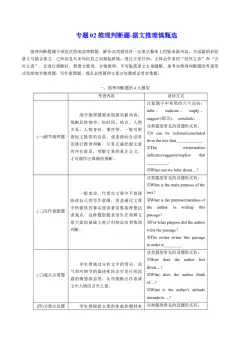
技巧02 推理判断题的答题优化策略
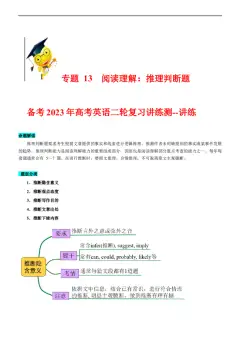
高考英语阅读理解推理判断题的核心是要求考生基于原文细节信息,通过逻辑分析、归纳或推断,
得出作者未直接陈述的隐含意义、观点态度或深层结论,而非简单提取原文内容。推理判断题答题的
“黄金三步骤”:
(1)精准定位。快速圈定题干中的核心关键词,如人名、地名、数字、专有名词等具有强标识性的
信息,利用这些 “定位锚点” 迅速锁定原文对应段落。对于抽象概念类关键词,需结合上下文进行语
义联想,通过同义替换、近义表达等方式在文中定位相关表述。
(2)严格验证。每一个选项都必须在原文中找到确切的文字依据,任何缺乏原文支撑的主观猜测都
应排除。比如,选项中出现的因果关系、比较关系等,必须与原文表述完全契合。警惕干扰项常见陷阱
如偷换概念(如将文中 “青少年群体” 偷换为 “年轻人群体”)、无中生有(选项内容在原文未提
及)、过度夸大(对原文程度词进行不合理升级)。
(3)适度推导。推理过程要以原文内容为基础,严格遵循 “只推一步” 原则,避免过度解读。例
如,原文提到 “某产品在一线城市销量显著提升”,只能推出该产品在一线城市受欢迎,而不能直接推
断出在全国范围内畅销。注意保持推理结果与原文的范围一致性,既不随意扩大讨论范围(如将个别案
例推广到普遍情况),也不缩小概念内涵(遗漏原文关键限定条件)。
答题突破技巧
一、细节关联推理法:立足具体信息,推导隐含意义
【操作技巧】
    高考英语阅读理解推理判断题的破题关键在于构建 “定位 — 分析 — 排除” 的完整解题链条。
首先,考生需依据题干中的关键词精准定位原文段落,快速锁定与题目相关的细节描述;其次,深度挖
掘文本中的 “显性信息”,同时结合上下文的逻辑关系,包括因果、对比、例证等,提炼出隐含的深层
含义;最后,针对选项中出现的无中生有、过度推断、偷换概念等干扰项,通过与原文信息的细致比对
逐一排除,从而得出符合文本逻辑的正确结论。【阅读阅读】
The new technology allows farmers to monitor the water levels in their fields remotely. They can adjust the
策略分析
irrigation system according to the real-time data. This not only saves water but also increases the crop yield...
What can we infer about the new technology?
A. It is too expensive for most farmers.
B. It is difficult to operate.
C. It benefits farmers in multiple ways.
D. It is only suitable for large-scale farms.
【技巧应用】
精准定位细节:在解答推理判断题时,首要步骤是回归原文,锁定关键信息。本题中,原文明确提
及 “saves water”(节约用水)和 “increases the crop yield”(提高作物产量)两个核心优势,这为后续
的推理判断奠定了坚实基础。通过精准定位细节,能够有效避免脱离文本进行主观臆断,确保答案的可
靠性与准确性。
系统排除干扰:在分析选项时,需秉持严谨的态度,逐一甄别选项与原文的关联。A 选项讨论的产
品价格,B 选项涉及的操作难度,以及 D 选项提及的适用规模,均未在原文中找到任何相关描述,属于
典型的 “无中生有” 类干扰项。这类选项往往会利用考生的思维惯性或知识盲区,设置看似合理却与
原文无关的内容。通过系统地排除此类干扰项,能够大幅缩小正确答案的范围,提高答题的正确率。
科学合理推导:当排除干扰项后,对于剩余选项需进行深入分析与合理推导。“节水” 意味着资源
利用效率的提升,能够降低农业生产的成本与环境压力;“增产” 则直接体现了对农业生产效益的积极
影响。这两个优势从不同维度展示了该事物的益处,共同指向 “多方面益处” 这一结论。因此,C 选
项 “具有多方面益处” 不仅契合原文所提供的关键信息,更是基于文本内容进行的科学合理推导,是
本题的正确答案。
二、态度词汇定位法:抓情感倾向词,判断观点立场
【操作技巧】
通过形容词、副词、情态动词等情感词,结合作者论述语气推断态度。在高考英语阅读理解中,作
者往往不会直接表明自己的立场,而是通过情感色彩强烈的词汇和微妙的语气变化传递观点。例如,使
用 "unfortunately""regrettably"等副词暗示负面态度;用"remarkably""significantly" 等副词凸显积极评
价;"must""should"等情态动词常表达强烈主张,而"might""could" 则暗含不确定性。考生需结合上下文
语境,分析这些词汇出现的频率和分布,判断作者对论述对象是支持、反对还是中立,从而精准把握文
章深层意图。
【阅读语段】
The new policy has been controversial since it was announced. Some people believe it will bring economic
opportunities, while others worry about environmental problems. As for me, I think the government should take
more measures to balance economic development and environmental protection...
What is the author's attitude towards the new policy?
A. Supportive.  B. Opposed.  C. Neutral.  D. Concerned.
【技巧应用】
精准识别态度关键词:在高考英语阅读理解中,作者的态度往往隐藏在具有主观倾向性的词汇和句
式中。如文中出现的 “should take more measures”(应采取更多措施),这类情态动词 “should” 与动
词短语的搭配,明确体现出作者对 “平衡发展” 问题的积极关注与迫切诉求。通过捕捉此类态度词,
能够快速定位作者的核心观点倾向,为推理判断奠定基础。
科学排除干扰选项:在分析选项时,需遵循 “立足原文,谨慎推断” 的原则。选项 A(支持)与 B
(反对)均属于极端化表述,在原文中找不到直接的语句支撑。高考英语命题中,作者的态度通常不会
以绝对化的形式呈现,更多是通过委婉、客观的表述传递观点。因此,缺乏文本依据的极端选项可优先
排除,有效缩小正确答案的范围。
深度推导作者立场:通过对文章整体内容的细致梳理可以发现,作者既强调了保障经济发展机会的
重要性,同时也多次提及环境问题可能带来的潜在风险,展现出全面、辩证的思考视角。这种对不同方
面的兼顾与权衡,反映出作者并非单纯支持或反对某一方,其核心诉求是希望通过政策优化来实现更好
的发展,所以 “关切(Concerned)” 一词最能准确概括作者的态度,选项 D 为正确答案。
三、文体特征匹配法:依内容结构,推断文章出处
【操作技巧】
不同文体具有独特的文本特征与结构规律,通过精准识别这些特征,可快速定位文章来源,提升推
理效率。例如,广告文本通常会在显著位置使用号召性语言,如 “立即抢购”“限时优惠” 等,并强
调产品或服务的独特卖点;新闻报道则遵循倒金字塔结构,将最重要的新闻要素(何事、何人、何时、
何地、为何、如何)前置,次要信息按重要程度依次排列;学术论文多采用 “引言 - 方法 - 结果 - 讨
论” 的固定结构,且包含大量专业术语与参考文献标注。通过建立 “文体特征库”,将文本中的关键
词、结构布局、语言风格与典型文体模板进行比对,即可实现来源的高效匹配。
【阅读语段】
Reading Art: Art for Book Lovers is a celebration of the book, represented in 300 artworks from global
museums. It shows scenes of reading across eras—children learning, adults leisuring—and uses books as symbols
of intellect or wealth...
Where is the text most probably taken from?
A. A book review.  B. A travel guide.  C. A news report.  D. A product manual.
【技巧应用】
深度剖析文体特征:通过对文本的精读,可以发现语段围绕某本书的核心内容、学术价值、叙事风
格等方面展开系统且专业的介绍,不仅包含了对书籍情节的梳理,还融入了对作者创作意图、写作手法
的探讨,以及对书籍在所属领域中地位的评价,这些元素都高度契合 “书评” 作为书籍评论文章的核
心特征。
精准排除错位选项:
B 选项(旅游指南):从文本内容来看,通篇没有任何关于旅游景点的介绍、路线规划、住宿
推荐等旅游指南应有的核心信息,因此可以明确排除该选项。
C 选项(新闻):新闻类文本通常具有明确的时间要素、具体事件的发生过程以及时效性等特
点。但此语段中,既没有标注新闻事件发生的具体时间,也未呈现新闻事件的起因、经过、结果等关键
要素,所以该选项不符合文本出处要求。
D 选项(产品手册):产品手册的主要功能是对产品的使用方法、操作流程、注意事项等进行
详细说明。然而,该文本并未涉及任何关于书籍作为 “产品” 的使用指导内容,因此 D 选项也可排除。
准确匹配出处:文本中对书籍内容的深入解读、对书籍价值的专业评价,以及对书籍整体风格的细
致分析,都清晰地表明了该语段的主要目的是对书籍进行评论与推荐,这种特性直接指向 “书评” 这
一文体,所以 A 选项(书评)为正确答案。
四、逻辑关系分析法:借连接词,推导句间隐含关联
【操作技巧】
通过转折(but/however)、因果(so/therefore)、让步(although/though)、对比(while/whereas)
等逻辑连接词,精准定位文本中的关键信息节点。这些连接词如同文本脉络的 "导航标",不仅能够揭示
句间关系,更能帮助考生快速建立 "表面信息" 与 "深层逻辑" 的关联。以 2023 年全国甲卷阅读 C 篇
为例,在 "The study showed promising results, but more research is needed." 这样的句子中,but 一词不仅
形成语义转折,更隐含着 "当前成果存在局限性" 的深层推断,要求考生跳出字面含义,结合上下文构建
完整的逻辑链条,进而得出合理的推理判断。
【阅读语段】
Traditional wisdom says 'the wisdom of crowds' relies on independent estimates. But a new study found that
when crowds are divided into small discussion groups, their average estimates are more accurate than independent
individuals'.
What does the new study imply?
A. Crowds are less reliable than expected.
B. Discussion improves estimation accuracy.
C. Independence is key to wise decisions.
D. Small groups work better than large crowds.
【技巧应用】
精准捕捉转折信号:转折词在阅读理解中如同导航路标,能有效指引关键信息。以真题中出现的
“But” 为例,其作为典型的转折标志,明确传递出 “新研究推翻传统认知” 的重要信号。在英语文本
中,诸如 “however” “nevertheless” “yet” 等词同样具有转折功能,考生需养成敏锐捕捉这些词汇的习惯,
以便快速锁定文章核心观点的转折与变化。
深度剖析核心差异:面对复杂的学术观点表述,需具备精准提取核心差异的能力。此真题中,传统
观点着重强调 “独立估算” 的重要性,而新研究则通过严谨的实验与论证,发现 “小组讨论后估算更
准确” 这一颠覆性结论。在剖析过程中,可采用对比表格、思维导图等工具,将不同观点的关键要素罗
列对比,帮助考生更清晰直观地把握差异,为后续推理判断奠定坚实基础。
高效排除干扰选项:干扰选项往往通过偷换概念、夸大事实、无中生有等方式设置陷阱。选项 A 中
“群体不可靠” 的表述与原文 “小组讨论后估算更准确” 形成明显矛盾,属于偷换概念;选项 C “独
立估算才是关键” 只是对传统观点的复述,并非新研究的核心结论;选项 D “小组优于大群体” 在原
文中并未涉及 “小组” 与 “大群体” 的规模对比,属于无中生有。通过逐一分析选项与原文的逻辑
关系,精准排除干扰,推导得出 “讨论提升准确性” 这一正确结论,从而确定选项 B 为正确答案。
五、写作目的推导法:依文体功能,判断作者意图
【操作技巧】
不同文体的底层逻辑是破解推理判断题的关键钥匙。说明文以客观信息传递为核心,作者通过数据
列举、对比分析、流程阐释等方式,系统呈现事物特征或现象原理,阅读时需关注信息的逻辑链条与专
业术语,推理答案往往藏在对细节的精准概括与深层解读中;议论文以说服读者为目的,通过论点阐述
论据支撑、论证推进构建逻辑闭环,推理时需梳理观点与论据的呼应关系,答案常涉及对作者立场的精
准提炼或论证意图的合理推测;记叙文则以故事叙述为载体,在情节发展、人物塑造中蕴含深层启示,
读者需捕捉对话隐喻、环境描写等细节,从情感共鸣点切入,答案多为对故事折射出的人生哲理或社会
现象的抽象概括。
【阅读语段】
   This article introduces a self-repairing material. Scientists spent years on it and made breakthroughs. It has
potential applications in aerospace and automotive industries...
What is the purpose of this passage?
A. To tell a story.  B. To advertise a product.  C. To report news.  D. To introduce a material.
【技巧应用】
精准定位功能词,锁定文体方向:在题目文本中,“introduces a self-repairing material”(介绍一种自
修复材料)这一表述明确指向了文本的核心功能。“introduces” 作为关键的功能动词,直接揭示了文本
属于说明性文体。在高考英语阅读理解中,这类明确点明文体功能的词汇是重要的解题线索,考生可据
此初步判断文章的类型与写作目的。
深入剖析内容结构,排除干扰选项:对相关语段进行细致分析,发现其内容主要围绕 “材料研发、
突破、应用” 三个维度展开。从材料研发的背景与过程,到技术上实现的关键突破,再到实际应用场景
的阐述,整体呈现出典型的说明文结构特征。通过与选项对比分析,A 选项 “叙事”,文中未出现明显
的事件发展脉络与情节描写;B 选项 “推销”,没有对产品进行促销性的宣传或引导消费的表述;C 选
项 “新闻时效性”,缺乏新闻报道中常见的时间要素与新近发生事件的特征。因此,通过对内容结构的
深入分析,可有效排除这三个干扰选项。
匹配文本核心目的,确定正确答案:说明文的核心功能在于客观、系统地 “介绍事物”,使读者对
特定对象有清晰、全面的认识。结合本题中对自修复材料的介绍,符合说明文的写作目的与特点。基于
以上对功能词的定位、内容结构的分析,能够得出 D 选项为正确答案,这种解题思路有助于考生在高考
英语阅读理解推理判断题中,更科学、准确地做出判断。
六、上下文呼应法:借指代 / 复现,破解隐含含义
【操作技巧】
通过代词(it/this/that)、原词复现、同义词替换、同根词转化等衔接手段,将文中看似零散的信息
点紧密关联。代词指代可避免重复表述,增强行文连贯性,例如用 "it" 指代前文提及的实验结果,使读
者快速建立信息联系;原词复现能强化关键概念,帮助读者把握核心内容;而同义词替换和同根词转化
则在丰富表达的同时,隐性串联起同一主题的不同描述。通过这些衔接手段,不仅能理清段落内部的逻
辑脉络,更能揭示段落间的内在联系,助力考生精准捕捉作者隐含的观点和意图。
【阅读语段】
Volunteers built community gardens in the neighborhood. At first, residents were hesitant. But after
harvesting fresh vegetables together, they started organizing monthly workshops. This changed the neighborhood's
atmosphere completely.
What does “this” in the last sentence refer to?
A. The building of gardens.
B. Residents' initial hesitation.
C. Joint harvesting and workshops.
D. Fresh vegetables from the gardens.
【技巧应用】
精准定位指代链:在长难句分析中,指示代词 "this" 的指代对象往往是解题突破口。通过精读上下
文可知,"this" 明确指向由 "after" 引导的时间状语从句所描述的事件,该事件作为因果链条的起点,后
续推理需以此为核心展开。例如,当文本中出现 "After the community gardening project was launched, this
changed the atmosphere completely" 时,"this" 指代的就是 "社区园艺项目启动" 这一事件,分析后续变化
必须围绕此核心。
有效排除近距干扰:选项设置中常存在与原文高度相似但逻辑关系不符的干扰项。以本题为例,选
项 A 中提到的 "建花园" 虽在原文出现,但它仅是整个事件的起始动作,属于时间上的前期行为。而题
目设问聚焦于 "changed atmosphere"(氛围改变)的直接诱因,从因果逻辑判断,单纯的 "建花园" 动作
与最终的氛围转变不存在直接因果关联,因此可果断将其排除,避免陷入近距干扰陷阱。
深度锁定呼应点:文本中 "harvesting together"(共同收割)和 "organizing workshops"(组织工作
坊)等具体行为描述,不仅是简单的事件陈述,更是居民态度从疏离转向积极合作的关键证据。这些行
为直接对应题干中对 "居民态度转变原因" 的设问,通过与选项 C 的内容形成精准匹配,结合上下文语
境可清晰判断,正是这些互动行为促成了社区氛围的实质性改变,因此选项 C 为正确答案 。
七、选项特征排除法:依 “合理推断” 原则,筛除干扰项
【操作技巧】
干扰项常具 “过度推理、偷换概念、无中生有” 三大特征,需通过 “原文依据检验法” 精准排
除。过度推理 指选项脱离原文合理范围,将可能结论夸大为必然结果,如原文仅描述现象,选项却直接
给出因果定论;偷换概念 表现为替换关键词或曲解原文术语,如将 “部分学生” 偷换为 “全体学
生”;无中生有 则是选项内容在原文中毫无依据。解题时需逐句对照选项与原文,确认每个关键信息均
能在文中找到明确支撑,若存在逻辑断层或信息偏差,即可判定为干扰项。
【阅读语段】
Research shows strict-sounding teachers are less effective at inspiring teens. 10-16-year-olds were more
likely to rebel, and their well-being suffered when facing controlling voices.
What can we conclude from the research?
A. Kind teachers are the most popular among teens.
B. Strict teachers harm students' mental health.
C. Teens prefer group learning to individual study.
D. Teacher's tone affects student behavior.
【技巧应用】
分析选项特征:
在高考英语阅读理解推理判断题中,对选项进行细致分析是避免掉入出题陷阱的关键。以下以一道
典型真题为例,深入剖析各选项的问题所在:
A 选项(最受欢迎):该选项中出现的 “popular” 一词在原文中完全没有任何线索或依据,属于典
型的 “过度推理” 错误类型。考生容易因主观臆断,在没有原文支撑的情况下,过度解读文本含义,
从而误选此类选项。
B 选项(伤害心理健康):虽然选项中 “well-being suffered” 看似与 “mental health harm” 语义相
近,但在英语语境中,“well-being” 涵盖的范围更广,包含身体、心理、社会关系等多个方面的良好状
态,“well-being suffered” 并不能直接等同于 “mental health harm”,这是出题者精心设置的 “偷换概
念” 陷阱。
C 选项(偏好小组学习):纵观全文,找不到任何与 “偏好小组学习” 相关的表述或暗示,此类
选项属于毫无根据的 “无中生有” 类型,纯粹是干扰考生判断的无效选项。
验证合理项:
正确答案的选择需严格遵循 “立足原文、一步推断” 的原则。在本题中,原文提到 “strict-
sounding voices”(严厉的语气),通过对文本语境的合理分析,可以自然推断出这种语气会导致
“rebel”(反抗行为)。D 选项正是基于这样的原文线索进行合理推断得出的,既没有过度引申,也没有
偏离原文信息,因此是正确答案。
1
As pressure grows to get artificial colors out of the U.S. food supply, the shift may well start at Abby
Tampow’s laboratory desk. Tampow is part of the team at Sensient Technologies Corp., a top dye-maker (色素生
产商), helping thousands of U. S. businesses change colors for products like cereals and sports drinks.
Last week, U. S. health officials announced plans to persuade food companies to voluntarily remove
petroleum-based (石油基的) artificial dyes by the end of 2026. Health Secretary Robert F. Kennedy Jr. called
them “poisonous compounds” that endanger children’s health and development, citing limited evidence of
potential health risks.
But making the change from the petroleum-based dyes to colors taken from vegetables, fruits, flowers and
even insects won’t be easy, fast, or cheap, said Monica Giusti, an Ohio State University food color expert. “If all
companies were to remove artificial colors from their products, the supply of the natural alternatives would not be
enough,” Giusti said.
“It’s not like there’s 150 million pounds of beet juice sitting around waiting on the off chance the whole
突破演练
market may switch,” said Paul Manning, the company’s chief executive. Natural dyes are harder to make and use
than artificial colors. They are less consistent in color, less stable and subject to changes related to acidity, heat,
and light. Also, a natural color costs about 10 times more to make than the artificial version.
In 2016, food giant General Mills removed artificial dyes from Trix cereal, switching to natural sources.
But the cereal lost its neon colors and became less vibrant, resulting in consumers’ negative reaction. Trix fans
said they missed the bright colors and familiar taste of the cereal. In 2017, the company switched back.
Kennedy, the health secretary, said U. S. officials have an “understanding” with food companies to phase
out artificial colors. Industry officials told The Associated Press that there is no formal agreement. However,
several companies have said they plan to accelerate a shift to natural colors in some of their products.
1.What can be inferred about Abby Tampow’s work?
A.She works to replace artificial colors.
B.She develops a new artificial color.
C.She markets cereals and sports drinks.
D.She researches health risks of colors.
2.Why are health officials urging the removal of petroleum-based dyes?
A.To lower the production costs.
B.To prevent possible health risks.
C.To promote natural alternatives.
D.To push food companies’ reform.
3.What is paragraph 4 mainly about?
A.Why natural dyes are hard to make.
B.Which dyes are more popular.
C.What limitations natural dyes have.
D.How natural dyes are produced.
4.What can be learned about General Mills’ attempt?
A.Health is a top concern in food companies.
B.Color is a powerful driver of consumer behavior.
C.Taste is the decisive factor in the food sales.
D.Source is the priority in food color research.
2
Horses can not only synchronize (同步) their heartbeats to sense danger more effectively, but they can also
synchronize with people, which can, in turn, help the human calm down. The Fox Moon Farm Project has been
doing this equine therapy (马疗法) work with youths for years. After a career in the corporate world, Cindy
Freishtat said she and her co-founder, Maria Flint, were both ready for a new chapter in their lives. “We reached a
place where we wanted to be of service,” Freishtat said. “We wanted to give back.”
Freishtat, whose father suffered from Alzheimer’s (阿尔茨海默症), wanted to see equine therapy’s results
for people dealing with the disease. The Lakewood retirement Community in western Henrico County was a
perfect match. Executive Director Heather Crumbaugh said she had been looking for an equine therapy
organization willing to work with Alzheimer’s patients but that no other local place had felt equipped for it.
Crumbaugh said, “The Fox Moon Farm was willing to take this step with us.”
Interested in contributing to the worldwide development of Alzheimer’s treatment, the team at the Fox
Moon brought psychology professor Maureen Matthews of Virginia Commonwealth University into the fold to
conduct a scientific study on the program’s effects. Even in its early stages, the immediate results were significant.
The participants were Lakewood residents with advanced Alzheimer’s. Several could no longer speak, and
all needed repeated introductions to their surroundings at first. Within a few sessions, residents were able to
remember the farm and the horses when they arrived. “I saw a lady who wasn’t willing to speak leading the horse,
and she came over next to me and started talking, pointing out things like birds and flowers,” Crumbaugh said.
Though the program took a break over the winter months, the study will resume this month. “I have no
doubt in my mind that we are going to prove and show the effectiveness of working with horses in treating
Alzheimer’s,” Freishtat said. “I want to help as many people with Alzheimer’s as I possibly can.”
1.Why did Cindy Freishtat and Maria Flint try the equine therapy on people with Alzheimer’s?
A.They wanted to be helpful.
B.They needed to change their careers.
C.They used to benefit from it.
D.They were required by a professor.
2.How did Crumbaugh probably feel about The Fox Moon Farm Project?
A.Regretful.
B.Threatened.
C.Grateful.
D.Annoyed.
3.What does paragraph 4 mainly talk about?
A.The difficulty of choosing participants.
B.The steps of the equine therapy.
C.The simplicity of researchers’ work.
D.The effects of the program.
4.What does the underlined word “resume” in the last paragraph probably mean?
A.Suspend.
B.Continue.
C.Quit.
D.Start.
3
“A man does not know his true identity when he does not know the background of where he comes from.”
says Paul Ninson, a Ghanaian photojournalist. Here in New York, thousands of miles from Ghana, he found
numerous visual images of life in Africa, past and present, in the archives (档案室) of the city’s libraries, galleries
and museums. This led to an idea: create a library of photobooks in Ghana to bring the African story home.
Deeply influenced by his grandparents’ storytelling traditions, Ninson decided to pursue a career in
photography. He left Ghana in 2019 to seek a formal education in photojournalism at the International Center of
Photography (ICP) in New York City. There, he read the center’s hundreds of photobooks while in Ghana, he only
had access to five or six of such books. As he ventured deeper into the city, he discovered more visual histories of
Africa than he had experienced at home. This led to his idea to create a library in Africa that held such stories.
With characteristic determination, Ninson began searching New York City for books to ship to Ghana. He
searched secondhand stores, engaged in online bidding wars and reached out for publishers donations. He maxed
out credit cards and filled his apartment with over 30,000 volumes. With help from a friend Brandon Stanton, a
GoFundMe campaign raised $1.2 million, enabling shipment of the collection to Ghana.
In December 2022, the local library Dikan Center opened near the Gulf of Guinea. It offers free public
access to photobooks documenting Africa’s past and present. Beyond its collection, Dikan Center provides
workshops, fellowships, and seminars on visual storytelling, empowering a new generation to reshape Africa’s
narrative. Local artist Daniella Afful sees Dikan Center as transformative: “It has boosted art and photography,
giving hope for preserving our history and making history.”
1.What inspired Ninson to build a photobook library?
A.His interest in history books.
B.His fancy of New York libraries.
C.His ambition to make a fortune.
D.His desire to bring Africa culture back home.
2.Why did Ninson go to New York in 2019?
A.To raise money for a library building.
B.To improve himself as a photographer.
C.To seek his family roots and traditions. D.To collect books about African history.
3.What can we learn from paragraph 3?
A.Ninson was involved in a war.
B.Ninson used his own money to pay for books.
C.Brandon Stanton donated some books to him. D.African government arranged to ship the books back.
4.What can be inferred about the library from Daniella Afful’s words?
A.It provides more job opportunities.
B.It has transformed people’s hobbies.
C.It is helpful to preserve local history.
D.It is widely welcomed by the natives.
4
In early 2023, I embarked on a voyage to the Galápagos Islands. It was on Floreana Island’s windswept
shore that I encountered a weathered whisky barrel — the legendary Post Office Bay mailbox. It was first used by
sailors in 1793 to send mail back home: they would leave a letter and take any addressed to their next port of call
to deliver them by hand. It’s still used by tourists. People will leave a letter and take one that they are able to
hand-deliver to their next destination.
The barrel was full with postcards waiting for delivery. I took a couple home and delivered them with
delight: one to a teacher from her pupil, and another from a girl to her boyfriend. The recipients were incredibly
grateful.
Weeks later, I couldn’t stop thinking about the letters. Then I thought what if I spent a year delivering more
letters from that postbox? I realised I could keep my remote job, and at the same time travel the world delivering
post, using air miles-and working along the way.
By March 2024, I returned to Galápagos I picked out 55 letters and postcards that covered a large
geographic area. I aimed to deliver one a week, covering at least 52 countries and spanning all seven continents.
I’m 52 and very outgoing, but I’m aware that nowadays people are cautious of speaking to one another.
Delivery letter number 50, in Bergen, Norway, I almost got arrested. The lady who answered the door didn’t
believe my story and mistook my selfie stick for a weapon, so she called the police. I had to show the officers my
GPS location history to prove what I was doing, and we all ended up laughing together.
My favourite delivery was letter eight, in Mexico City, from a daughter to her mother, thanking her for
letting her follow her dreams. The mother had been very ill, and her daughter wanted to come home from her
travels to look after her, but she insisted her daughter should continue with her trip. I’m still in touch with both of
them.
When I finished my challenge in March this year, I held a party in London and invited everyone I’d met
along the way. People came from all over the world. I was so touched and humbled. I’ve made friends for life.
1.How was mail delivered at Post Office Bay in the 18th century?
A.By regular local messengers.
B.By sailors stationed on the islands.
C.By private postal service on the islands. D.By hand-delivery to the next destination.
2.The author decided to return to Galapagos because she ________.
A.was assigned to handle some remote work
B.was concerned about the delivery of the letters
C.intended to use her air miles before the deadline
D.wanted to check the letters in the deserted barrel
3.Which words can best describe the author according to the passage?
A.Positive and curious.
B.Determined and caring.
C.Passionate but serious.
D.Brave but introverted.
4.What can we learn from this passage?
A.New bonds grow out of the traditional practices.
B.Letters hold magical power in the modern world.
C.Each individual is the architect of their own success.
D.Small acts of kindness bring huge emotional rewards.
5
For Cai Guoqiang, every time feels like the first time. His nerves still hurt, his mind still races before he
lights the fuse (引线) and the gunpowder explodes. It’s an intensity that hasn’t lessened even after 40 years. That’s
how long Cai’s been making art through the use of explosives. “The anxiety is part of my motivation to create
artwork,” Cai says.
And there’s high demand for Cai’s art, famous worldwide. In China, he led visual and special effects for the
2008 Summer and 2022 Winter Olympics’ ceremonies. He spent eight years in Japan as a young artist and now
lives in New York. Each time he lights a match, he briefly returns to his childhood — when he first played with
firecrackers innocently.
It helped that his hometown, Quanzhou City, was one that was known for its collection of fireworks sellers.
But that didn’t mean he immediately grasped their artistic potential. First, he tried firing them headlong into blank
canvases, which “wasn’t very successful because the whole canvas would burn completely through,” says Cai.
But art was in his DNA.His father was a small-time poet and brush-and-ink calligrapher; and his mother,
though not an artist herself, was a temple-going and incense-burning woman whose spiritual beliefs influenced her
son.
In his youth, Cai says, he was “unconsciously exposed to the ties between fireworks and the fates of
humans, from the Chinese practice of setting off firecrackers at a birth, a death and during a wedding.” He felt
something in the mix of matter and energy — maybe a comparison between mind and matter, humans and the
universe — in the hot center of an explosion. Soon, he found he could take gunpowder out of firecrackers and
light it directly on canvas, making mysterious, messy black-and-brown pictures of space, nature and time.
The explosive aspect of the gunpowder took on a symbolic meaning for Cai. “As a person, it’s fine to be
careful and cautious, but as an artist, you may need to break free and let yourself go a little,” says the artist.
1.What’s Cai’s feeling after having worked as an explosives artist for decades?
A.Proud and satisfied.
B.Fresh and motivated.
C.Anxious and insecure.
D.Exhausted and indifferent.
2.What does the underlined word “headlong” in paragraph 3 probably mean?
A.Delicately.
B.Slowly.
C.Carelessly.
D.Skilfully.
3.Which of the following factors hasn’t contributed to Cai’s artistic creations?
A.The upbringing of his father, who was also an artist.
B.The high demand for innovative artists around the world.
C.The influence of his temple-going and incense-burning mother.
D.The fact that he grew up in a place famous for firecrackers.
4.What can be inferred from the last paragraph?
A.People should take their careers seriously.
B.There are lots of things worth celebrating in one’s life.
C.Our time on earth is limited and we should treasure it.
D.Artists should free their mind to have innovation.
6
When Dink NeSmith heard that his friend Ralph Maxwell was shutting down his weekly newspaper, The
Oglethorpe Echo, due to health issues, he was determined to save the nearly 150-year-old publication from
disappearing.
Both NeSmith and Maxwell are long-time residents of Oglethorpe County, located east of Athens. They
have known each other for nearly five decades. NeSmith has also been contributing a column to The Oglethorpe
Echo ever since he moved to Oglethorpe County.
Maxwell’s father bought The Oglethorpe Echo in 1956, but its origins date back to 1874. It’s a record of
everything from local weddings to significant legislative (立法的) changes.
NeSmith looked up at the ceiling of the office, searching for an answer. Then, inspiration struck. He called
Charles Davis, dean ( 院长) of the University of Georgia’s Henry W. Grady College of Journalism and Mass
Communication. “I’ve got an idea,” NeSmith told him. “I want to turn The Oglethorpe Echo into a practical
training ground for the future journalists at the Grady College.”
Davis was enthusiastic about the idea, and they built a sustainable business model to ensure the
newspaper’s future. They developed a cornerstone course ( 综合性课程) with The Oglethorpe Echo as its
foundation. Students experience a working newsroom which acts as a stepping stone into their careers.
Traditionally run by a single reporter, The Echo now benefited from a team of eager student journalists.
Of course, they needed someone to run the newspaper. So Andy Johnston joined in. He was the adviser for
The Red & Black from 2018 to 2021, and familiar with working with students and had an extensive
journalism background. Most importantly, he believed in the project.
He teams up with Amanda Bright, the course instructor, who has spent her career as a community journalist
across various platforms, from mid-sized daily newspapers to digital startups. Together, they developed new
digital strategies for The Oglethorpe Echo, including an email newsletter, four social media channels, and an
updated website.
1.What has NeSmith ever done for The Oglethorpe Echo before the plan?
A.He contributed regularly to a column.
B.He developed a cornerstone course.
C.He led a team of student journalists.
D.He suggested new digital strategies.
2.What did NeSmith propose for The Oglethorpe Echo?
A.A focus only on online news.
B.A partnership with local businesses.
C.A practical training platform for students.
D.A weekly publication with more journalists.
3.What probably motivated Andy Johnston to join The Oglethorpe Echo?
A.His belief in the potential of the project.
B.His familiarity with student work.
C.His connection to Oglethorpe County.
D.His desire for promotion in journalism.
4.What does the text mainly talk about?
A.The history of The Oglethorpe Echo.
B.Journalism education at Grady College.
C.NeSmith’s friendship with Maxwell.
D.The transformation of a local newspaper.
7
When we think about what makes humans unique, a good sense of humor is often high on the list. Laughter
and playful teasing seem like traits only we possess. However, recent research suggests that animals —
particularly great apes — may also engage in behavior that resembles humor.
A study led by primatologist ( 灵长类动物学家) Isabelle Laumer at the Max Planck Institute reveals
fascinating insights. “We documented young apes deliberately sneaking up to hit adults, then waiting expectantly
for a reaction,” Laumer explains. “This isn’t random play — it meets all the criteria of intentional teasing.” Over
75 hours of video recordings showed this behavior mirrors how human children joke: repetitive, surprising, and
aimed at seeking responses. The researchers noted that the apes even paused to watch for the adult’s reaction,
much like a child waiting to see if their joke landed.
But humor in animals may not be limited to apes. Dog owners often notice their pets making breathy,
snorting sounds during play, which some scientists interpret as laughter. In a 2025 study, researchers found that
playing these sounds to shelter dogs reduced their stress levels. Similarly, dolphins emit joyful sounds during
play-fighting, elephants trumpet excitedly when playing, and some parrots tease other animals — like confusing
dogs with whistles — just for fun.
Why might animals exhibit humor? In humans, laughter strengthens social connections and eases tension.
Scientists argue that playful teasing in apes or “laughter” in dogs could serve a similar purpose — breaking the ice
and reinforcing relationships. Some researchers believe these behaviors may have evolved (进化) to help animals
manage complex social ranks or reduce conflict. However, Laumer cautions that more research is needed to
confirm this theory, as observing humor in animals remains challenging.
While we may never know if animals understand punchlines, their behaviors hint at humor’s deep
evolutionary roots. As Laumer reflects: “The line between human and animal laughter isn’t as sharp as we
thought.”
1.What did Laumer’s study find about young apes?
A.They enjoy teasing others.
B.They often fight in groups.
C.They seek adult protection.
D.They learn from human kids.
2.What does the underlined word “trumpet” in paragraph 3 mean?
A.Wag.
B.Smile.
C.Nod.
D.Shout.
3.Why might animals show humor?
A.To improve social status.
B.To strengthen social bonds.
C.To win in complex conflicts.
D.To get much more pleasure.
4.What can be a suitable title for the text?
A.Animal Social Behaviors
B.Do Animals Copy Our Laughs?
C.Animals Play Tricks Too
D.Why Animals Understand Humor?
8
When Percy Lee has a bad day, he hangs out with his chinchilla, Rin. “She’s like emotional support for
me,” says the 14-year-old. He’s not alone — whether holding a cat or petting a pup, people worldwide find
comfort in relaxing with their pets. That animal affection may have benefits that go far beyond temporary mood
boosts. Researchers have found that pets can reduce stress and enhance people’s immune (免疫) systems.
Developmental psychologist Patricia Pendry’s research reveals that just 10 minutes of petting animals
significantly lowers cortisol, the body’s stress hormone ( 荷尔蒙). “Rhythmic petting releases oxytocin — a
hormone that helps calm the stress system,” she explains, noting even eye contact with dogs sets off this effect.
Beyond mental health, early pet exposure boosts immunity. Mikael Knip’s 2020 study shows children
growing up with pets exhibit dramatically lower health risks: 40% less asthma, 28% fewer allergies, and half the
likelihood of developing type I diabetes.
Animals themselves probably don’t help train our immune system. “The idea is that early exposure to a dog
or a cat in the house leads to an increased exposure to ‘healthy’ microbes,” Knip explains. All kinds of microbes
collect on an animal’s paws and fur while they’re outdoors. The animal then brings those microbes home, which
exposes family members to the germs. Those exposures help train up kids’ immune systems.
While owning pets offers these benefits, not everyone can have one. “If you can’t have a pet of your own,
talk to your neighbors, family members or friends,” suggests Dr. Kerri Rodriguez, who studies animal-human
bond. “Can you volunteer to walk their dog for them one day a week?” You could even visit a cat café now and
then, or volunteer at an animal shelter. Interacting with animals can be beneficial, Rodriguez says. “But animals
have feelings and emotions too. Remember to always respect an animal’s boundaries and personal space, just like
you’d like to be treated.”
1.Why does the author mention Percy Lee in the first paragraph?
A.To prove a theory.
B.To define a concept.
C.To introduce the topic.
D.To provide the background.
2.Why does early pet exposure improve immunity according to Knip?
A.It helps cure asthma and allergies.
B.It lowers the number of microbes in the house.
C.It relieves children’s stress and pain.
D.It enhances exposure to beneficial microbes.
3.What can be inferred from Kerri Rodriguez’s words?
A.Volunteering can bring people closer.
B.Animals should be treated considerately.
C.Cat cafés are a good way to own a pet.
D.Pets improve neighborhood relationships.
4.What can be a suitable title for the text?
A.Pets: Health and Well-Being Boosters
B.Pets: Children’s Illness fighters
C.Pets: Human’s Emotional supporters
D.Pets: Owners’ Helpful Companions
9
A new study published in Journal of Traditional Beverages found that daily moderate tea drinking can
lower cortisol (皮质醇) by up to 18% and reduce work-related tiredness by 25% among office workers. The
finding suggests that tea can be a simple yet effective way to relieve stress in fast-paced urban life. However,
many city residents struggle to brew (冲泡) quality tea due to limited experience, which makes it difficult to fully
enjoy these benefits.
The key to brewing perfect tea consistently lies in smart tea-brewing systems. These systems are equipped
with sensors that monitor water temperature, tea brewing time, and water volume, transmitting real-time data to a
mobile app. Users receive instant alerts, such as “Water temperature is higher than the best range for green tea” or
“Brewing time is sufficient,” making it easy even for beginners to master tea brewing. “Technology bridges the
gap between busy urban life and the slow enjoyment of traditional tea,” explains Dr. Min Li, lead researcher of the
study.
One well-known system, TeaSmart, has gained popularity in 10 major cities since 2024. Compared with
traditional brewing methods — where improper temperature often wastes 30% of tea leaves — TeaSmart delivers
precise conditions, increasing tea leaf utilization (利用率) by 60%. User surveys indicate that 85% of TeaSmart
users maintain the habit of daily tea drinking after six months, while only 40% of those using traditional teapots
do so.
Though smart systems simplify tea brewing, experts stress that patience and sensory experience remain
vital. “Tea tasting is about observing the color of the tea soup and smelling its fragrance,” notes Dr. Li. “Even with
technology, interacting with tea itself is part of the charm.” This combination of innovation and tradition makes
tea drinking a rewarding routine for city residents.
1.Why do many city residents find it hard to brew quality tea?
A.They lead a fast-paced life.
B.They struggle to make a living.
C.They are short of professional tools.
D.They are inexperienced in brewing tea.
2.How do smart tea-brewing systems assist beginners?
A.By promoting their tea brewing skills.
B.By providing live data to a mobile app.
C.By shortening the time of tea brewing.
D.By adjusting water temperature in time.
3.What is the author’s purpose in mentioning TeaSmart?
A.To improve tea leaf utilization.
B.To keep the habit of drinking tea.
C.To compare it with traditional brewing. D.To prove the advantages of smart systems.
4.What can be a suitable title for the text?
A.Smart Brewing: Enhancing the Fragrance of Tea
B.Smart Brewing: Replacing Traditional Tea Brewing
C.Smart Brewing: Simplifying the Steps of Tea Brewing
D.Smart Brewing: Bridging Urban Life and Tea Enjoyment
10
I would never describe myself as being a cynic (愤世嫉俗者), it’s a person who has negative opinions
about other people and things people do. While I might be doubtful about our ability to unite and address
significant challenges, that’s based on evidence. Who wouldn’t be concerned when considering the current events
we face? That’s what I might have argued before I read Zaki’s new book, Hope for Cynics. Afterwards, I felt a
sense of pity: I might be part of the problem.
Zaki, a professor of psychology and the director of the Stanford Social Neuroscience Lab, presents a picture
of cynicism’s hold on us. And its potential impacts on our future and personal well-being. In 2018, only 32% of
the Americans surveyed said that “most people can be trusted”, compared with nearly 50% in 1972. During this
process, cynicism has taken root as a response to many challenges.
But, Zaki argues, it’s an own goal: expecting the most negative outcomes is self-harming. It weakens our
connections with others and discourages us from tackling issues that matter. Say climate crisis. Expecting the most
negative outcomes also harms our chances of finding happiness in the here and now. The popular belief that
cynics are just smarter and more realistic isn’t necessarily justifiable. Zaki points out that cynics perform worse at
cognitive (认知) tests and are less effective at identifying untrustworthy people and lies than non-cynics. “200,000
years ago, the people worrying about the dangers on the horizon probably did better than their friend relaxed by
the sunset, but now being overly anxious can lead us to overestimate the chances of frightening but rare events,”
he says.
As a self-described “recovering cynic”, Zaki has made small but powerful changes in his own life. First, he
has become more conscious of cynical thoughts, noticing when he is coming to “unnecessarily cold conclusions”
and interrupting them with facts. Tellingly, Zaki has noticed that coming to the conclusions is most common when
he’s sleep-lacking or stressed; cynicism is a kind of burnout. Zaki also practices what he calls “positive talk”:
spreading word, within his circles, of acts of generosity or kindness. I think it is this “personal counter-
programming” to cynicism.
1.Why did the author initially refuse to be labeled as a cynic?
A.Her doubt made much sense.
B.Her view was widely accepted.
C.She disliked such type of person.
D.She had great faith in her ability.
2.What may be the cause of cynicism?
A.Burning desires for well-being.
B.Decreased faith in each other.
C.Constant emergence of challenges.
D.Negative attitudes to the future.
3.Why is it bad for a person to expect the worst?
A.It fuels ignorance of dangers.
B.It goes against the popular belief.
C.It discourages realistic thoughts.
D.It does damage to our social bonds.
4.What does Zaki’s practice of overcoming cynicism suggest?
A.Positive talk promotes kind acts.
B.Action speaks louder than words.
C.Minor yet impactful changes matter.
D.High mental pressures relate to burnout.
11
I know people who say they don’t watch television, and I always nod and agree. Reading requires
intelligence, and television is merely entertainment, right?
I’m going to Scotland this year, and three different people told me I must watch “Outlander” before I go,
which is like “Game of Thrones” for fans of romance novels. I watched the first four-hour-long episodes back to
back. When I stood up from the couch I felt sick, and it wasn’t just the cookies, popcorn and peanut butter
sandwiches I’d had without noticing. It was dark outside, and I felt ashamed. I had spent half a day on the couch.
Research for Scotland? Not exactly.
A few days later I had a library book due: The National Book Award winner The Friend, by Sigrid Nunez.
I needed to finish it, so I read the last half straight through. I was absorbed in Nunez’s New York City, worrying
about the heroin’s career and her future. I finished the book with tears in my eyes and stood up feeling, well, great.
I had wasted another four hours on my couch. I hadn’t eaten as much junk food because I needed my hands
free — and not sticky — so I could turn pages and return the book to the library relatively clean, but I hadn’t
moved and once again it was dark outside. Why did I feel so much better and guilt-free?
All the research says reading a book is good for you. It reduces stress, promotes comprehension and
imagination, relieves depression, helps you sleep and may contribute to preventing Alzheimer’s (阿尔兹海默症).
The act of physically turning a page creates a momentary pause for understanding to sink in. Our brains have to
work to translate the black squiggles (弯弯曲曲的线条) on the page into words and then interpret the meaning
and intent (意图) of those words. When a character is described as tall with brown hair, a reader creates her own
picture. TV takes all that imagination away. But there’s a lot of good TV now.  I’d like to say the answer to TV
versus books must be, as Aristotle said, “Moderation in all things,” though he never had a television or a computer
and had to read his scrolls by candlelight. I agree that too much television is bad for you. I know I feel better if I
read, but it won’t stop me from watching too: My second DVD of “Outlander” has just arrived, and as soon as I
get this essay done, the rest of my day is free.
1.By “I always nod and agree” (paragraph 1), the author implies that ______ .
A.she doesn’t think highly of TV either
B.she believes those who say they don’t watch TV
C.she should be polite to get the conversation to go on
D.she is not willing to admit that she watches television
2.The phrase “back to back” (paragraph 2) is closest in meaning to “ ______ ”.
A.from morning till night
B.one after another without a break
C.looking at the opposite direction
D.leaning against the back of the couch
3.The author felt better after reading The Friend than watching “Outlander”, most probably because ______ .
A.she didn’t feel hungry for any snacks
B.the TV series got her to cancel her trip to Scotland
C.the television series was no more attractive than the book
D.she regarded reading as more rewarding than watching TV
4.What can be concluded from all the research introduced in paragraph 5?
A.Reading is active while watching TV is passive.
B.Reading involves physical exercises while watching TV doesn’t.
C.Reading stimulates the brain to concentrate while watching TV doesn’t.
D.Reading is good for one’s mental health while watching TV is bad for it.
12
In a world where our digital devices have become extensions of ourselves, it’s no surprise that we often
immerse (沉浸) ourselves in screens rather than engage with the world and people around us.
But amidst this digital deluge ( 涌现的事物), something vital is being lost: the art of genuine human
connection. These devices offer a convenient escape from boredom or discomfort, allowing us to avoid awkward
social situations or difficult emotions.
Small talk often receives criticism for being empty or insignificant. Rarely does someone express a
fondness for it, let alone find fulfillment in it. However, small talk matters a lot in social interactions. Think of it
as the warm-up before a workout — it helps us ease into deeper conversations and establishes a foundation of
trust and understanding. It lays the groundwork for assessing whether the exchange has the potential to cultivate a
friendship or deeper connection. Even one-off exchanges with someone at the grocery store or at the bus stop offer
opportunities for connection.
But our aversion (厌恶) to small talk is significant. We may convince ourselves that we’re not good at it or
that it’s unnecessary, but that’s simply an excuse. Yes, of course, social anxiety is real, but the only way to
overcome the fears is through practice, gaining confidence by slowly taking risks, and actively engaging in
conversations.
So, how can we embrace small talk and harness its power? Start by paying attention to your surroundings
and engaging with those around you. Whether it’s commenting on the weather or striking up a conversation about
a shared experience, small talk provides an opportunity to connect with others on a basic level.
Like any skill, small talk requires practice. Start small by initiating conversations with strangers or
acquaintances and gradually work your way up to deeper connections. With each interaction, you’ll gain
confidence and build the skills necessary for meaningful conversations.
It may feel uncomfortable at first, but with practice, we can regain the richness of human interaction and
cultivate relationships that truly nourish(滋养)the soul, build confidence, and reclaim the internal real estate that is
overrun with anxious thoughts.
1.Why do people often prefer to engage with digital devices rather than the real world?
A.They find it more convenient to do so.
B.They are afraid of genuine relationships.
C.They have little time to engage with others.
D.They want to avoid face-to-face communication.
2.What does the author think of small talk?
A.It is an unnecessary and hard skill.
B.It takes a lot of meaningful time.
C.It plays a crucial role in social interactions.
D.It is difficult to master for most people.
3.What does the underlined word “harness” in Paragraph 5 probably mean?
A.Hold.
B.Employ.
C.Discover.
D.Overlook.
4.Which of the following can be the best title for the text?
A.How to Overcome Social Anxiety
B.The Challenges of Modern Social Life
C.Digital Devices and Human Connection D.The Power of Small Talk in Social Life