专题10 阅读理解一轮复习难点突破1(名师点津+精准押题)原卷版
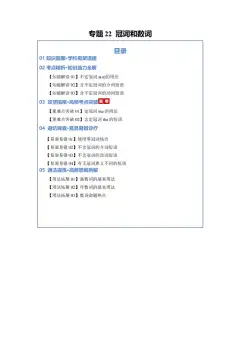
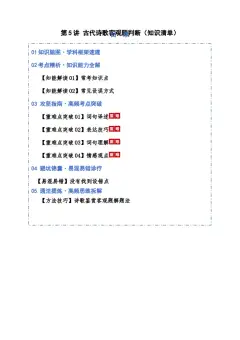
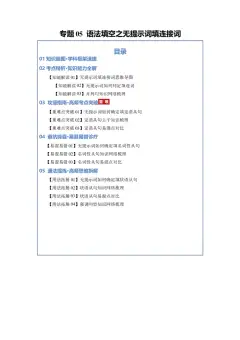
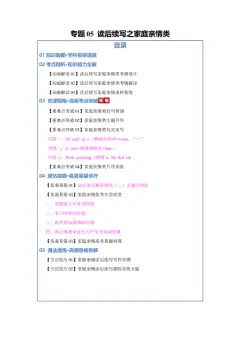
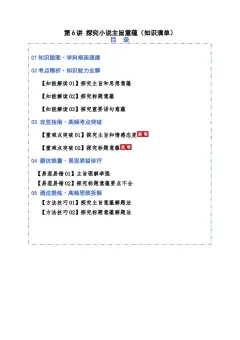
目录
段落大意题3 篇

 P2

【名师点津】

 P2

【高考真题】

 P2

【名校模拟】

 P3

文章大意题3 篇

 P5

【名师点津】

 P5

【高考真题】

 P6

【名校模拟】

 P7

态度推断题3 篇

 P9

【名师点津】

 P9

【高考真题】

 P10

【名校模拟】

 P10

写作手法题3 篇

 P  1  2
【名师点津】

 P12

【高考真题】

 P13

【名校模拟】

 P14

写作意图题3 篇

 P16


【名师点津】

 P16

【高考真题】

 P16

【
  名校模拟

 】

 P17

文章寓意题3 篇

 P19


【名师点津】

 P19

【高考真题】

 P20

【名校模拟】

 P21

段落大意题3 篇
【名师点津】
一、段落大意题干扰项特征
1.过于笼统,不知所云。所概括的内容超出原文的范围。
2.以偏概全,主次不分。以文章中的细节内容或个别词语做出选项内容。
3.移花接木,偷换概念。选项中定语和状语影响语意范围,或者把属于A 的内容放在B 上。
4.主观臆测,无中生有。选项中关键词也在文中提及,但选项的实际含义与文章主题无关。
二、段落大意题两大抓手
1.寻找段落主题句
解答段落大意题的关键是抓住段落的主题句。一般而言,每个段落总有一个中心,通常中心思想会在首句
或尾句体现出来,这就是常说的段落主题句。总体来说,采用归纳法的段落,细节表述在前,归纳概括在
后,主题句在段尾;采用演绎法的段落,先提出观点,后举例子,由一般到特殊,主题句出现在段首,这
种现象较多出现在说明文和议论文中;若作者采用“特殊→一般→特殊”的方式,主题句可能出现在段落
的中间。有时,作者没有写出明显的主题句,考生要学会根据段落的内容概括出主题句。
2.确定段落关键词
段落中反复出现的词汇一般就是段落关键词,往往需要出现在正确选项中。
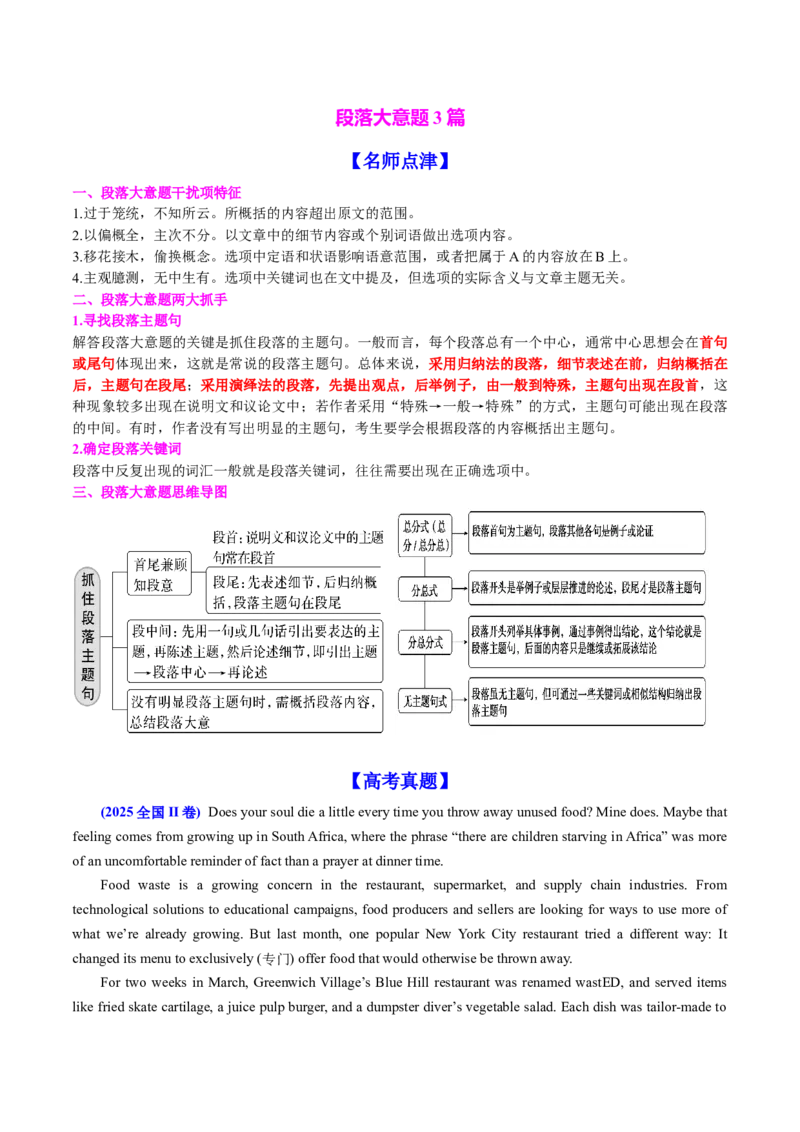
三、段落大意题思维导图

【高考真题】
(2025 全国II 卷) Does your soul die a little every time you throw away unused food? Mine does. Maybe that
feeling comes from growing up in South Africa, where the phrase “there are children starving in Africa” was more
of an uncomfortable reminder of fact than a prayer at dinner time.
Food waste is a growing concern in the restaurant, supermarket, and supply chain industries. From
technological solutions to educational campaigns, food producers and sellers are looking for ways to use more of
what we’re already growing. But last month, one popular New York City restaurant tried a different way: It
changed its menu to exclusively (专门) offer food that would otherwise be thrown away.
For two weeks in March, Greenwich Village’s Blue Hill restaurant was renamed wastED, and served items
like fried skate cartilage, a juice pulp burger, and a dumpster diver’s vegetable salad. Each dish was tailor-made to
raise awareness regarding food waste.
A study by the Food Waste Alliance determined that the average restaurant generates 33 pounds of food waste
for every $1,000 in revenue (收入), and of that waste only 15.7% is donated or recycled. Up to 84.3% is simply
thrown out. Restaurants like Silo in the UK have experimented with zero-waste systems, but wastED took the
concept to its logical conclusion.
It should be noted that none of the items on wastED’s menu was technically made from garbage. Instead, all
the ingredients (配料) used were examples of meat cuts and produce that most restaurants would never consider
serving. Things like kale ribs, fish collars, rejected sweet potatoes, and cucumber butts were all re-appropriated and,
with the help of a number of good chefs, turned into excellent cuisine.
Though wastED received enthusiastic reviews, it was designed from the start as a short-lived experiment; Blue
Hill has since returned to its regular menu. Nevertheless, it serves as a reminder that there are many ways to address
problems of sustainability, and that you can make an amazing meal out of almost anything.
32. What can be inferred about the author’s early life?
A. He witnessed food shortage.
B. He enjoyed the local cuisine.
C. He donated food to Africans.
D. He helped to cook at home.
33. Why did Blue Hill carry out the experiment?
A. To customize dishes for guests.
B. To make the public aware of food waste.
C. To test a food processing method.
D. To improve the UK’s zero-waste systems.
34. What is paragraph 5 mainly about?
A. Why the ingredients were used.
B. Which dishes were best liked.
C. What the dishes were made of.
D. Where the ingredients were bought.
35. What can we learn about wastED?
A. It has ended as planned.
B. It is creating new jobs.
C. It has regained popularity.
D. It is criticized by top chefs.
【名校模拟】
(25-26 高三上·广东·阶段练习)A new report from the Reuters Institute for the Study of Journalism raises
concerns about artificial intelligence (AI) in news production, as the rise of AI tools for news production, coupled
with existing struggles to engage audiences, presents a fresh challenge for newsrooms worldwide.
The report, based on a survey of nearly 100, 000 people across 47 countries, highlights audience anxieties
surrounding AI-generated news content and notes this is particularly true for sensitive topics like politics.
News organizations are dealing with the rise of Generative AI, with tech giants like Google and startups developing
tools that summarize information and potentially divert ( 转移) traffic from news websites. However, the report
reveals a public distrust of AI-generated news, raising questions about its viability and impact on profits. The report
also looked at audience perceptions of AI-generated news. A significant part of respondents ( 调查对象) to the
survey expressed discomfort with news primarily produced by AI. This feeling was particularly strong in the UK
(63 percent) and the US (52 percent). The report finds that people were more accepting of AI being used behind the
scenes to enhance journalistic efficiency.
Nic Newman, senior research associate at the Reuters Institute and lead author of the Digital News Report,
said, “It was surprising to see the level of suspicion. People broadly had fears about what might happen to content
reliability and trust.”
The survey also reveals a continuing worry about online misinformation. Concerns rose by 3 percent
compared to the previous year, with 59 percent of respondents expressing worry. This anxiety was particularly
conspicuous in countries like South Africa(81 percent) and the US (72 percent).
The report also highlights the difficulties news organizations face in securing paying subscribers. Only 17
percent of respondents across 20 countries reported paying for online news, a figure stagnant ( 没有变化) for the
past three years.
“The findings show that newsrooms need to build a direct relationship with their audiences while also
strategically using the platforms to connect with people who are trickier to reach, like younger audiences,”
Newman said. “We see that news influencers have a bigger role on the popular platforms.”
1.How is newsrooms’ current situation?
A.Difficult.
B.Shaming.
C.Promising.
D.Competitive.
2.What is paragraph 4 mainly about?
A. Some disadvantages of AI editors.
B. An analysis of the research results.
C. Possible application of AI in news.
D. Respondents’ attitude to AI in news.
3. What does the underlined word “conspicuous” in paragraph 6 mean?
A. Doubtful.
B. Similar.
C. Obvious.
D. Limited.
4. What does Nic Newman advise newsrooms to do?
A. Employ famous influencers to spread news by AI.
B. Encourage more younger people to make use of AI.
C. Distinguish accurately true news from disinformation.
D. Take advantage of popular platforms to attract audiences.
(25-26 高三上·湖南长沙·阶段练习)Recycling lithium-ion (锂离子) batteries to recover their critical
metals like lithium, nickel and cobalt has significantly lower environmental impacts than mining raw metals,
according to a new Stanford University life cycle analysis published in Nature Communications.
The study quantifies the environmental footprint of this recycling process, and finds it gives off less than half
the greenhouse gases (GHGs) of conventional mining and uses about one-fourth of the water and energy of mining
new metals. The environmental benefits are even greater for the scrap ( 废料) stream, which accounted for about
90% of the recycled supply studied.
Battery recycling’s environmental impacts depend heavily on the processing facility’s location and electricity
source. “A battery recycling plant in regions that rely heavily on electricity generated by burning coal would see a
reduced climate advantage,” said Samantha Bunk e, one of the study’s three lead investigators. “On the other hand,
freshwater shortages in regions with cleaner electricity are a great concern,” added Bunk e. Most of the study’s data
for battery recycling came from Redwood Materials in Nevada — North America’s largest industrial-scale lithium-
ion battery recycling facility — which benefits from the western U.S.’s cleaner energy mix.
Redwood, which has since broken ground on a new facility in South Carolina, was one of the first to apply
the lessons of this project to their own operations and environmental footprint. Its founder, JB Straubel said that the
insights of this research have played a key role in refining Redwood’s battery recycling processes. “Thanks to the
researchers’ observations, we have further reduced our environmental footprint,” he noted.
While the U.S. now recycles about 50% of available lithium-ion batteries, it has successfully recycled 99%
of lead-acid batteries for decades. “Given that used lithium-ion batteries contain materials with up to 10 times
higher economic value, the opportunity is significant,” senior author William Tarpeh said. “For a future with a
greatly increased supply of used batteries, we need to design and prepare a recycling system today from collection
to processing back into new batteries with minimal environmental impact,” he added. “Hopefully, battery producers
will consider how to make their batteries more recyclable in their future plans, too.”
5. What is paragraph 2 mainly about?
A. The effectiveness of energy use.
B. Methods of conducting the study.
C. The complexity of the recycling process.
D. Advantages of recycling lithium-ion batteries.
6. Why is Redwood Materials mentioned?
A. To show the key role of battery industries.
B. To highlight its reduced climate advantage.
C. To illustrate the practical use of the research.
D. To criticize its lasting environmental footprint.
7. What does the underlined word “refining” mean in paragraph 4?
A. Shaking.
B. Bettering.
C. Starting.
D. Limiting.
8. What is Tarpeh’s suggestion for battery producers?
A. Improve their recycling system.
B. Limit the use of lead-acid batteries.
C. Focus on their processing cost.
D. Prioritize recyclability in their designs.
文章大意题3 篇
【名师点津】
一、记叙文主旨大意题
1.看首段和尾段,以尾段为主
2.借助主题词或关键词归纳
二、说明文和议论文主旨大意题
1.看首段和每段段首句,以首段为主
2.借助主题词或关键词归纳
三、文章大意题错误选项典型错误
一是“以偏概全”:选项范围太窄,只表达局部信息或某一细节,不能概括整篇文章的主旨大意;
二是“概括宽泛”:所表达的内容超出或多于文章阐述的内容;
三是“无中生有”:即文章中根本未提到或者不是指定段落的大意。
四、文章大意五种题型
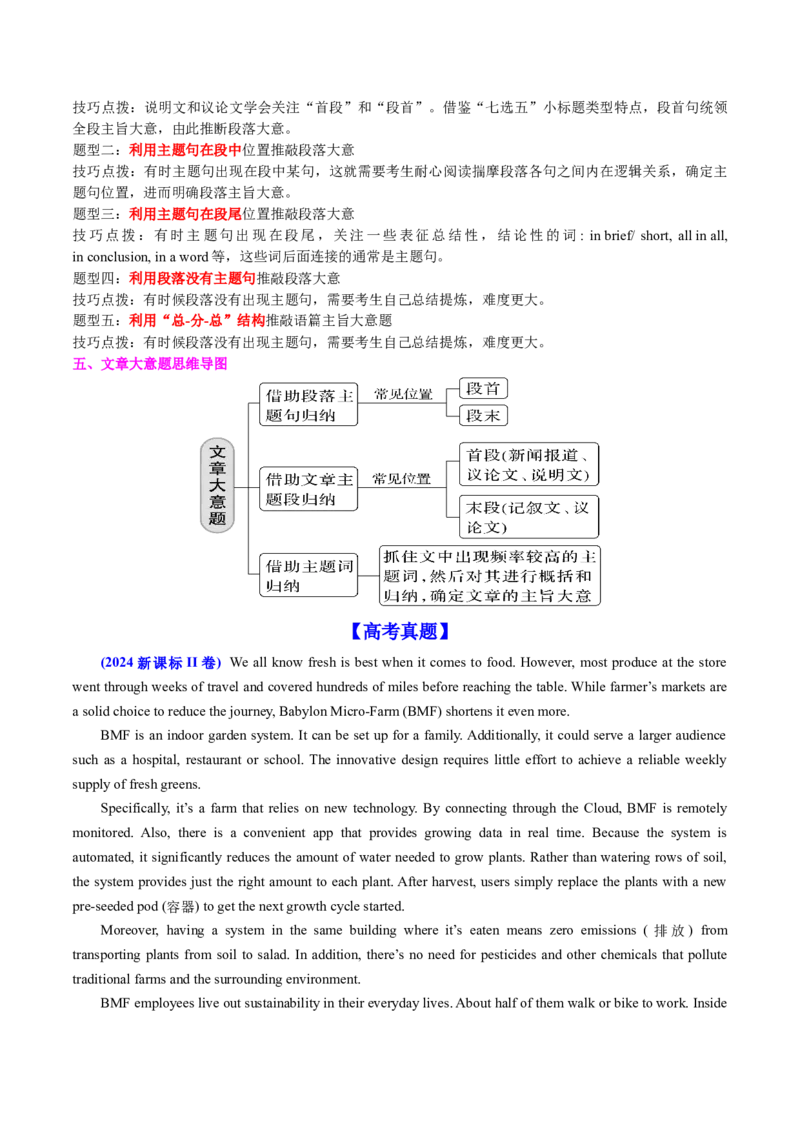
题型一:利用主题句在段首位置推敲段落大意
技巧点拨:说明文和议论文学会关注“首段”和“段首”。借鉴“七选五”小标题类型特点,段首句统领
全段主旨大意,由此推断段落大意。
题型二:利用主题句在段中位置推敲段落大意
技巧点拨:有时主题句出现在段中某句,这就需要考生耐心阅读揣摩段落各句之间内在逻辑关系,确定主
题句位置,进而明确段落主旨大意。
题型三:利用主题句在段尾位置推敲段落大意
技巧点拨:有时主题句出现在段尾,关注一些表征总结性,结论性的词: in brief/ short, all in all,
in conclusion, in a word 等,这些词后面连接的通常是主题句。
题型四:利用段落没有主题句推敲段落大意
技巧点拨:有时候段落没有出现主题句,需要考生自己总结提炼,难度更大。
题型五:利用“总-分-总”结构推敲语篇主旨大意题
技巧点拨:有时候段落没有出现主题句,需要考生自己总结提炼,难度更大。
五、文章大意题思维导图
【高考真题】
(2024 新课标II 卷) We all know fresh is best when it comes to food. However, most produce at the store
went through weeks of travel and covered hundreds of miles before reaching the table. While farmer’s markets are
a solid choice to reduce the journey, Babylon Micro-Farm (BMF) shortens it even more.
BMF is an indoor garden system. It can be set up for a family. Additionally, it could serve a larger audience
such as a hospital, restaurant or school. The innovative design requires little effort to achieve a reliable weekly
supply of fresh greens.
Specifically, it’s a farm that relies on new technology. By connecting through the Cloud, BMF is remotely
monitored. Also, there is a convenient app that provides growing data in real time. Because the system is
automated, it significantly reduces the amount of water needed to grow plants. Rather than watering rows of soil,
the system provides just the right amount to each plant. After harvest, users simply replace the plants with a new
pre-seeded pod (容器) to get the next growth cycle started.
Moreover, having a system in the same building where it’s eaten means zero emissions ( 排放) from
transporting plants from soil to salad. In addition, there’s no need for pesticides and other chemicals that pollute
traditional farms and the surrounding environment.
BMF employees live out sustainability in their everyday lives. About half of them walk or bike to work. Inside
the office, they encourage recycling and waste reduction by limiting garbage cans and avoiding single-use plastic.
“We are passionate about reducing waste, carbon and chemicals in our environment,” said a BMF employee.
28. What can be learned about BMF from paragraph 1?
A. It guarantees the variety of food.
B. It requires day-to-day care.
C. It cuts the farm-to-table distance.
D. It relies on farmer’s markets.
29. What information does the convenient app offer?
A. Real-time weather changes.
B. Current condition of the plants.
C. Chemical pollutants in the soil.
D. Availability of pre-seeded pods.
30. What can be concluded about BMF employees?
A. They have a great passion for sports.
B. They are devoted to community service.
C. They are fond of sharing daily experiences.
D They have a strong environmental awareness.
31. What does the text mainly talk about?
A. BMF’s major strengths.
B. BMF’s general management.
C. BMF’s global influence.
D. BMF’s technical standards.
【名校模拟】
(25-26 高三上·山东青岛·开学考试)Travellers have long feared being swallowed into the peatlands (泥
炭地): “If his foot slips ... it is possible he may never more be heard of,” described William Gilpin in 1772.
But now the image of this ecosystem finally turns a corner. UNESCO has recognized the Flow Country as a
world heritage (遗产) site-the first peatland to make the list-due to its natural characteristics: the remarkable variety
of plants and animals that live there. It’s also recognized that these peatlands are not humankind’s enemy but an
important partner in the fight against climate crisis. Peat has formed in the Flow Country for 8,000 years, trapping
carbon. It’s vital this carbon stays to avoid further global heating.
The Flow Country was chosen for its natural heritage not cultural significance, which comes as a welcome
contrast to the vast majority of the UK’s other world heritage sites. Prioritising culture might make sense for places
like Stonehenge or Durham Cathedral, but the Lake District? Not so much. The Lake District National Park is
remarkable for its natural geography: deep valleys, uneven peaks and icy lakes. People have long shaped the area,
but their impact is just a thin layer on a remarkably splendid landscape. Yet, when the park gained world heritage
status in 2017, it was largely upon the basis of its relatively recent tradition of sheep farming. The decision reflected
how the English perceive the natural world.
But the recognition of the Flow Country looks even more profound. It represents a change not only in our
perception of peatlands but of nature itself. Unlike the Lake District, it prioritises not sheep, but moss (苔藓). This
approach aligns with the growing movement to recognise the rights of nature: to reframe the natural world as
something more than a collection of raw materials.
None of that is to ignore humans’ role in the Flow Country but we should recognize that no landscape in the
UK can be considered in isolation from its culture, while also remembering that the human story never unfolds
alone.
1. Why does the author quote William Gilpin in paragraph 1?
A. To illustrate the author’s point.
B. To give a scientific explanation.
C. To provide historical background.
D. To present a common partial view.
2. For what was the Flow Country recognized as a UNESCO World Heritage site?
A. Climate benefit and natural value.
B. Beautiful scenery and conservation efforts.
C. Geographical uniqueness and rare species.
D. Educational significance and cultural value.
3. What does the underlined phrase “aligns with” in paragraph 4 mean?
A. addresses.
B. matches.
C. Challenges.
D. Outweighs.
4. What is the text mainly about?
A. The formation of the Flow Country.
B. The recognition of the Lake District.
C. The long-overdue respect for peatlands.
D. The conservation difficulties of peatlands.
(25-26 高三上·江西·开学考试)Leafy vegetables are widely considered to be a healthy and refreshing
food choice. Eating enough vegetables which are packed with fiber, vitamins and minerals supports your overall
health. However, it can be tough for all sorts of people, from busy moms to picky kids, to get the leafy greens their
bodies need. That's why many people are attracted by an emerging trend called “dinosaur time”.
The trend, which encourages people to get their daily serving of leafy greens by gobbling (狼吞虎咽) them
up like dinosaurs, originated with former middle school science teacher, CrossFit enthusiast and stay-at-home mom,
Amy Garrett. Garrett's online videos have millions of views and have inspired others to gobble down on the healthy
trend.
Garrett's recipe consists of eating fistfuls ( 一把) of romaine lettuce, spinach, or other greens, without
preparing them or putting them in a salad. Instead, she consumes them like she came straight out of the dinosaur
era, often with dinosaur-themed music playing in the background. She also emphasizes the importance of washing
vegetables before eating them, if they aren't already pre-washed.
It isn't just grown-ups that get inspired by “dinosaur time”. Young children naturally enjoy pretending to be
dinosaurs and parents, with the help of this odd trend, are using their little ones' imaginations to encourage them to
eat healthier.
“‘Dinosaur time’ isn't intended to replace meals,” Garrett told the New York Post. “The recipe is intended to
be a supplement (补充) to an existing meal to get your greens out of the way so you can enjoy the things you
actually like to eat, whether that be a burger, a slice of pizza, a sandwich, etc.”
A warning: People who are at risk of kidney stones should think twice before following the trend and those
who are on blood thinners should consult their doctors before changing their diet.
5. What can be learned from paragraph 1?
A. It's beneficial to eat leafy greens.
B. Food choices are limited currently.
C. Parents and kids argue over eating.
D. Many people hate cooking at home.
6. What are those strictly following Garrett's recipe unlikely to do?
A. Listen to music over meals sometimes.
B. Ensure their food is washed before eating.
C. Eat well-cooked leafy vegetables all the time.
D. Refuse to prepare a vegetable salad on a busy day.
7. Which of the following shows the author's opinion?
A. It's unnecessary to eat what you dislike.
B. Garrett's recipe is a challenge for parents.
C. “Dinosaur time” isn't suitable for everyone.
D. Doctors should ask patients to eat vegetables.
8. What is the text mainly about?
A. A popular solution that replaces meals.
B. A trend that encourages healthy eating.
C. A traditional lifestyle that excites kids.
D. A recipe that frees parents from cooking.
态度推断题3 篇
【名师点津】
态度观点态度类试题的解题方法:
第一:结合题干人物和内容定位原文出现在哪一(些)段;然后仔细比对该句言外之意;
第二:加入自己的态度。要注意区分试题考查的是作者的态度还是作者引用别人的态度;
第三:态度没有明确提出时,要学会根据作者在文章中所运用词汇的褒贬性去判断作者的态度,尤其是动
词、形容词和副词,如wonderfully, successfully, unfortunately, doubtfully 等。
乐观支持类词汇:optimistic 乐观的;positive 肯定的;favorable 支持的,赞同的;supportive 支持的;
approving 赞成的
客观中立类词汇:objective 客观的;neutral 中立的;cautious 谨慎的
消极反对类词汇:negative 否定的;opposite 相反的;unfair 公正的;doubtful 怀疑的;indifferent 漠不关心
的;critical 批评的;ironic 讽刺的;skeptical 质疑的;disappointed 失望的;disapproving 不赞同的;
pessimistic 悲观的;dismissive 轻蔑的,不屑一顾的
【高考真题】
(2024 全国甲卷)The Saint Lukas train doesn’t accept passengers—it accepts only the sick. The Saint Lukas is
one of five government-sponsored medical trains that travel to remote towns in central and eastern Russia. Each
stop lasts an average of two days, and during that time the doctors and nurses on board provide rural( 乡
村)populations with basic medical care, X-ray scans and prescriptions.
“People started queuing to make an appointment early in the morning,” says Emile Ducke, a German
photographer who traveled with the staff of the Saint Lukas for a two-week trip in November through the vast
regions(区域)of Krasnoyarsk and Khakassia.
Russia’s public health care service has been in serious need of modernization. The government has struggled
to come up with measures to address the problem, particularly in the poorer, rural areas east of the Volga River,
including arranging doctor’s appointments by video chat and expanding financial aid programs to motivate doctors
to practice medicine in remote parts of the country like Krasnoyarsk.
The annual arrival of the Saint Lukas is another attempt to improve the situation. For 10 months every year,
the train stops at about eight stations over two weeks, before returning to the regional capital to refuel and
restock(补给). Then it starts all over again the next month. Most stations wait about a year between visits.
Doctors see up to 150 patients every day. The train’s equipment allows for basic checkups. “I was very
impressed by the doctors and their assistants working and living in such little space but still staying focused and
very concerned,” says Ducke. “They were the best chance for many rural people to get the treatment they want. ”
28. How is the Saint Lukas different from other trains?
A. It runs across countries.
B. It reserves seats for the seniors.
C. It functions as a hospital.
D. It travels along a river.
29. What can we infer from paragraph 3 about Krasnoyarsk?
A. It is heavily populated.
B. It offers training for doctors.
C. It is a modern city.
D. It needs medical aid.
30. How long can the Saint Lukas work with one supply?
A. About a year.
B. About ten months.
C. About two months.
D. About two weeks.
31. What is Ducke’s attitude toward the Saint Lukas’ services?
A. Appreciative.
B. Doubtful
C. Ambiguous.
D. Cautious.
【名校模拟】
(25-26 高三上·河北承德·阶段练习)When Leonardo da Vinci wasn’t painting masterpieces or dreaming
up flying machines, he was exploring the secrets of gravity. Considering himself a scientist and artist, this
Renaissance thinker spent untold hours studying how the “attraction of one object to another” affected phenomena
like the flight of birds and the fall of water.
Recent research published in the journal Leonardo reveals that Leonardo conducted detailed gravity
experiments over a century before Galileo and two centuries prior to Newton. “His thinking was far ahead of his
time,” said co-author Dr Morteza Gharib. The study highlights Leonardo’s determination to find the law governing
the dynamics of falling objects.
Dr Gharib said he discovered the experiments while examining an online version of the Codex Arundel, a
collection of Leonardo’s notes from 1480 to 1518. Among its mirror-written texts, a drawing on page 143 caught
his eye: a triangle (三角形) formed by circles pouring from a pot. He used a computer program to flip ( 翻转) the
triangle and the nearby mirror writing. Suddenly, the image came to life. “I could see motion,” Dr Gharib recalled.
“I could see him pouring stuff out.” It was a eureka moment that revealed Leonardo’s forward-looking experiment.
Gazing at Leonardo’s drawing, Dr Gharib realized that the artist had separated gravity’s effects into two
components, revealing a normally hidden aspect of nature. Inspired by hail (冰雹) falling from fast-moving clouds,
Leonardo demonstrated through his drawing how gravity’s constant force causes a steady speed gain — shown by
the increasing gaps between falling objects as the pot moves.
Despite his basic experimental setup more than 500 years ago, Leonardo calculated the constant to an
accuracy within 10 percent of the modern value. “It’s incredible,” Dr Gharib said. “That’s the beauty of what
Leonardo does.”
However, Dr Gharib hesitated to examine the Codex Arundel further. “I’m like a kid in a toy store, afraid to
even look at it,” he said. He noted that while art historians had studied it, scientists had not. “It’s an open book with
so much to discover.”
1. What does the underlined phrase “a eureka moment” in paragraph 3 refer to?
A. The moment of pouring stuff out.
B. The time of finding the secret in the drawing.
C. The moment of discovering the mirror-written texts.
D. The time of realizing the triangle’s function in the drawing.
2. How did Leonardo demonstrate the effect of gravity’s constant force in his drawing?
A. By sketching birds flying in a triangular pattern.
B. By showing water pouring from a moving pot.
C. By recording the speed and track of hail.
D. By illustrating increasing gaps between falling objects.
3. Why does Dr Gharib think Leonardo’s works incredible?
A. Leonardo’s notes were mirror-written.
B. Leonardo’s experiments used advanced technology.
C. Leonardo painted masterpieces while studying science.
D. Leonardo achieved scientific accuracy centuries before other scientists.
4. What is Dr Gharib’s attitude toward the Codex Arundel?
A. Admiring.
B. Critical.
C. Doubtful.
D. Objective.
(25-26 高三上·山东日照·开学考试)Martha Siede, who has lived with dystonic cerebral palsy (肌张力障
碍型脑瘫) just since she was born, shares her powerful story in the book In Pursuit of “Normal”. As a disabled
reader, I was delighted, relieved, and lit up with encouragement and connection while reading this book.
I especially appreciated the way Martha lays out our struggles frankly because of how frequently we
encounter them. “The hospital is where you would think disabilities would be comfortable and accepted,” she
writes, “but it does not work. It is like trying to fit a square peg in a round hole.” Martha’s experiences reflected my
own frustration there: narrow doorways and crowded spaces that were difficult for me to navigate.
Throughout each stage of her life, Martha excels in fair, inclusive environments and struggles greatly
otherwise. My preferred adaptation explored in this book is that of clothing companies who advertise by using
photos in which models are seated so that wheelchair users can picture how it will look on their bodies.
Martha makes a clear, easy-to-follow distinction between when she gets the kind of support that makes her
life more equal, and when she does not. Recounting these hardships never feels like a lecture or a reframing of
history. Instead, Martha has written something that feels honest and strikes a balance between serious health
concerns and conversations where she’s direct about some tough topics. This tone is very true to my experience of
living with depression and disability.
This book will guide not only disabled people but also their caregivers. A lot of valuable advice and life
lessons can be learned from this book. Her candid account of struggles and achievements makes her story a source
of inspiration for others, showing that anything is possible with a sense of humor and determination. It’s not just a
tale of survival; it’s a testament (证明) to her strength and resolve.
5. Why does the author quote Martha’s words in paragraph 2?
A. To arouse readers’ care for the disabled.
B. To reveal the poor service of the hospital.
C. To explain the cause of Martha’s frustration.
D. To demonstrate one issue faced by the disabled.
6. What’s the author’s attitude towards using photos of seated models?
A. Ambiguous.
B. Dismissive.
C. Favorable.
D. Indifferent.
7. What does the author think of In Pursuit of “Normal”?
A. It is boring but practical.
B. It is classic and moving.
C. It is abstract but engaging.
D. It is inspiring and influential.
8. What is the purpose of the text?
A. To teach life lessons.
B. To provide inspiration for writers.
C. To recommend a book.
D. To emphasize the power of humor.
写作手法题3 篇
【名师点津】
高考阅读理解主要考查下定义、分类说明、列举例证和对比等写作手法。其中“引用”和“例证”是
议论文和说明文中最常用的写作手法之一,其共同目的就是增强说服力,服务于段落或篇章的主旨。
一、根据文章题材来判断。
①记叙文多采取以时间为序、以空间为序、以故事情节发展为序等叙事方式进行写作。
②说明文往往采取下定义、举例子、列数字、对比等方式使说明更清晰或更具说服力。
③议论文大多通过举例子、列数字、引名言、作对比是使得观点更可信,更有权威性。
二、根据“原文定位”来判断。
先根据题干判断是具体某段还是全文写作手法,然后寻找标志词,进而找到答案。
by giving examples
①
通过举例。标志词:for example, for instance
by analyzing causes
②
通过分析原因。标志词:as a result/consequence
by giving definitions
③
通过下定义。标志词:that is to say
by listing data/statistics
④
通过列数字。标志词:具体数字
by describing a process
⑤
通过描述过程。标志词:first, second, third, finally
by following time order
⑥
遵循时间顺序。标志词:in 1920,in the 1940s, nowadays
by making comparisons/contrast
⑦
通过对比。标志词:but, while,
by making classifications
⑧
通过分类。标志词:first, next, then
by analyzing cause and effect
⑨
通过分析因果。标志词:That is because….
by following space order
⑩
 遵循空间顺序。标志词:由近及远,由外到内
【高考真题】
(2025 全国I 卷) Microplastics have become a common source of pollution across the Earth — they have
settled in the deep sea and on the Himalayas, stuck inside volcanic rocks, filled the stomachs of seabirds and even
fallen in fresh Antarctic snow. They are even appearing inside humans.
Now, new research suggests that a simple, cheap measure may significantly reduce the level of microplastics
in water from your tap (水龙头): boiling and filtering (过滤) it. In a study published Wednesday in Environmental
Science & Technology Letters, researchers from China found that boiling tap water for just five minutes — then
filtering it after it cools — could remove at least 80 percent of its microplastics.
Crucially, this process relies on the water containing enough calcium carbonate (碳酸钙) to trap the plastics.
In the study, boiling hard water containing 300 milligrams of calcium carbonate led to an almost 90 percent drop in
plastics. But in samples with less than 60 milligrams of calcium carbonate, boiling reduced the level of plastics by
just 25 percent. Additionally, the research didn’t include all types of plastics. The team focused only on three
common types — polystyrene, polyethylene and polypropylene — and they didn’t study other chemicals previously
found in water such as vinyl chloride.
Still, the findings show a potential path forward for reducing microplastic exposure — a task that’s becoming
increasingly difficult. Even bottled water, scientists found earlier this year, contains 10 to 1,000 times more
microplastics than originally thought.
Scientists are still trying to determine how harmful microplastics are — but what they do know has raised
concerns. The new study suggests boiling tap water could be a tool to limit intake. “The way they demonstrated
how microplastics were trapped through the boiling process was nice,” Caroline Gauchotte-Lindsay, an
environmental engineer of the University of Glasgow in Scotland who was not involved in the research, tells New
Scientist. “We should be looking into upgrading drinking water treatment plants so they remove microplastics.”
32. How does the author present the issue in the first paragraph?
A. By quoting an expert.
B. By defining a concept.
C. By giving examples.
D. By providing statistics.
33. What determines the effectiveness of trapping microplastics in water?
A. The hardness of water.
B. The length of cooling time.
C The frequency of filtering.
D. The type of plastic in water.
34. What does the author try to illustrate by mentioning bottled water in paragraph 4?
A. The importance of plastic recycling.
B. The severity of the microplastic problem.
C. The danger in overusing pure water.
D. The difficulty in treating polluted water.
35. What is Gauchotte-Lindsay’s suggestion about?
A. Choice of new research methods.
B. Possible direction for further study.
C. Need to involve more researchers.
D. Potential application of the findings.
【名校模拟】
(25-26 高三上·河北保定·开学考试)Are you a fan of spending your lunch breaks in a park? Or do you
walk your dog in a park each morning and evening? Well, if you do, we have good news for you: Studies have
confirmed that spending just 20 minutes in a park every day will make you happier and less stressed—regardless of
whether or not you’re exercising while you’re there.
A recent study from University of Michigan suggests that spending at least 20 minutes wandering or sitting
in a place where you’re in contact with nature significantly lowers stress levels. “Our study shows that for the
greatest payoff, in terms of efficiently lowering levels of stress, you should spend 20 to 30 minutes sitting or
walking in a place that provides you with a sense of nature,” says lead researcher Mary Carol Hunter. “You don’t
have to travel to the wildlands. Getting out of an office block and sitting next to a tree can be enough.”
Meanwhile, another study by King’s College London researchers finds that being outdoors, seeing trees,
hearing birdsong, looking at the sky, and feeling in contact with nature are associated with higher levels of mental
well-being. In some cases, these beneficial effects impact people positively for up to seven hours afterwards.
The latest research, published today by Aarhus University, Denmark, suggests that children who grow up
with greener surroundings have up to 55% less risk of developing various mental disorders later in life.
The results are perhaps unsurprising. Multiple studies have previously highlighted the benefits of nature on a
person’s mental health and emphasized the need for designing greener cities for the future and protecting our
existing parks. However, the challenge facing cities is that planners and developers are eager to replace green space
with residential and commercial buildings.
1. What will Mary Carol Hunter most probably advise us to do to reduce stress?
A. Put some flowers in the office.
B. Spend 25 minutes in nature each day.
C. Go to wildlands once a week.
D. Do exercise each morning at home.
2. What is paragraph 4 mainly about?
A. The challenge facing cities.
B. The healing effects of trees.
C. Nature’s impact on efficiency.
D. The lasting influence of green space.
3. What message does the author seem to convey in the last paragraph?
A. The conclusion of the studies is not reliable.
B. The studies have ground-breaking significance.
C. The urban planning is going in a wrong direction.
D. Cities will become greener and healthier in the future.
4. How is the text mainly developed?
A. By listing examples.
B. By analyzing data.
C. By conducting surveys.
D. By making comparisons.
(2025·安徽·三模)What’s black and white and read all over? Newspapers used to be the answer. But now,
they’ve lost their appeal for many. In a recent survey, only 19% of young people aged 18 to 34 said they read
newspapers daily. Instead, 37% prefer local TV news, while 44% turn to online news sites. The way we get news
has clearly changed.
Just a generation or two ago, the newspaper was the main way in which many people got their news. But
now, “there’s a revolution in the way young people access news,” says media consultant Merrill Brown. Nearly
every home has at least one TV set. There’s high-speed, wireless Internet access in many cafes. Cell phones handle
text messages and can take pictures and download e-mails. You no longer have to wait for a bundle of newsprint to
arrive on your doorstep every morning.
One problem is that many news organizations refuse to see the potential of the Web, says new media
specialist Bob Cauthorn. For those who do, however, the Internet is rapidly changing the way journalists work.
Traditional newspaper articles are supposed to be read from beginning to end. With web pages, you can zero in on
the things you’re interested in, then follow links to other sources. You can join discussion groups, read other
people’s reactions to a topic, or start a blog — a type of online diary — to express your own views and collect
comments. In this world of “new media,” straight lines no longer apply, says Jane Ellen Stevens, a multimedia
journalist. “It’s not 1, 2, 3, 4, ” she says, “but this, that, and another.”
Raised on MTV and video games, today’s kids and young adults want flashy displays, special effects, instant
access to information, and the chance to interact in real time, even when they’re reading about serious issues. If
newspapers can’t find creative ways to be more than just ink on paper, some experts suggest, they might disappear
completely.
5. How is Paragraph 1 mainly developed?
A. By comparing data.
B. By presenting facts.
C. By listing examples.
D. By explaining reasons.
6. What can be inferred from Brown’s words?
A. Processing news is revolutionary.
B. New technologies are favored by many.
C. TV sets started the fashion of mass media.
D. It takes long to deliver newspapers to readers.
7. What message does Paragraph 3 want to convey?
A. Following links to resources is promising.
B. Much remains to be done on the webpage.
C. New technologies have changed news delivery.
D. New media allows more freedom and choices.
8. How does the author feel about newspapers’ future?
A. Critical.
B. Optimistic.
C. Concerned.
D. Indifferent.
写作意图题3 篇
【名师点津】
每篇文章都有一个特定的写作目的,或是向读者传递某个信息,或是愉悦读者,或是讲授某个道理。而这
些信息通常并不是明确表达出 来,而是隐含在文章 之中。因此,这类问题要求考生在理解文章总体内
容的基础上,去领会作者的言外之意。
1. 主旨推断法。
写作意图与文章主旨密切相关,因此,解答这类题跟解答主旨大意题和选择文章标题一样,用略读法,即
重点关注文章首尾段和各段的首尾句,找到主题句,抓住文章主旨,然后由主旨来推断作者的写作目的。
议论文、新闻报道、说明文等,其主题句多在文首。
2. 文体推断法。
①应用文广告的目的是吸引更多顾客、游客、读者、订户、观众等订阅或前往(to attract readers)。
②记叙文的目的是分享有趣的经历、告诉一个有趣的故事(to entertain readers)、或给读者某种启示。
③说明文的目的是使读者获得某种知识(to inform readers),提出建议、劝告或呼吁有关部门给予重视。
④议论文的目的通常是说服读者接受或赞同某一观点(to persuade readers),倡导某种做法等。
【高考真题】
(2024 新课标II 卷) Given the astonishing potential of AI to transform our lives, we all need to take action to
deal with our AI-powered future, and this is where AI by Design: A Plan for Living with Artificial Intelligence
comes in. This absorbing new book by Catriona Campbell is a practical roadmap addressing the challenges posed
by the forthcoming AI revolution (变革).
In the wrong hands, such a book could prove as complicated to process as the computer code ( 代码) that
powers AI but, thankfully, Campbell has more than two decades’ professional experience translating the heady into
the understandable. She writes from the practical angle of a business person rather than as an academic, making for
a guide which is highly accessible and informative and which, by the close, will make you feel almost as smart as
AI.
As we soon come to learn from AI by Design, AI is already super-smart and will become more capable,
moving from the current generation of “narrow-AI” to Artificial General Intelligence. From there, Campbell says,
will come Artificial Dominant Intelligence. This is why Campbell has set out to raise awareness of AI and its future
now-several decades before these developments are expected to take place. She says it is essential that we keep
control of artificial intelligence, or risk being sidelined and perhaps even worse.
Campbell’s point is to wake up those responsible for AI-the technology companies and world leaders-so they
are on the same page as all the experts currently developing it. She explains we are at a “tipping point” in history
and must act now to prevent an extinction-level event for humanity. We need to consider how we want our future
with Al to pan out. Such structured thinking, followed by global regulation, will enable us to achieve greatness
rather than our downfall.
AI will affect us all, and if you only read one book on the subject, this is it.
32. What does the phrase “In the wrong hands” in paragraph 2 probably mean?
A. If read by someone poorly educated.
B. If reviewed by someone ill-intentioned.
C. If written by someone less competent.
D. If translated by someone unacademic.
33. What is a feature of AI by Design according to the text?
A. It is packed with complex codes.
B. It adopts a down-to-earth writing style.
C. It provides step-by-step instructions.
D. It is intended for AI professionals.
34. What does Campbell urge people to do regarding AI development?
A. Observe existing regulations on it.
B. Reconsider expert opinions about it.
C. Make joint efforts to keep it under control.
D. Learn from prior experience to slow it down.
35. What is the author’s purpose in writing the text?
A. To recommend a book on AI.
B. To give a brief account of AI history.
C. To clarify the definition of AI.
D. To honor an outstanding AI expert.
【名校模拟】
(25-26 高三上·广东·开学考试)Motivational quotes. Videos of Steve Jobs saying absolutely anything. A
short part of a film is showing that a baby elephant is being rescued from a river. You do not have to scroll (滚屏)
for long on LinkedIn, a networking site supposedly for people at work, to find “inspirational” content. But for
leaders interested in how to motivate the people around them, there is a better option-a book titled Inspire, by Adam
Galinsky.
At some level, advice on how to inspire staff is silly. It’s usually blindingly obvious — be good at your job,
be passionate about the organization, make people and leadership teams feel valued. But believe me, you can find
more insights in Galinsky’s book. For example, lots of firms use a succession of abstract words to convey their
goal, such as “change”, “innovate” and “connect”. The result is less a mission than a mood. But Inspire really helps
you out.
Mr Galinsky cites an experiment that showed the effect of more concrete language, in which teams were
asked to design toys and given a vision statement to guide their behavior. The result showed that teams who were
handed a statement with more visual language — to create toys that make wide-eyed kids laugh and proud parents
smile — produced more engaging toys than teams who were given something more generic (通用的).
The most striking idea in Mr. Galinsky’s book is that instead of bosses motivating people from above,
individuals can motivate themselves. And a study conducted recently supports this claim. In the study, nearly 3,000
employees at a consumer-goods firm were randomly assigned to take part in a self-reflection exercise that helped
them to think about how their current jobs matched their own sense of purpose.
The researcher found that those whose jobs did not inspire them tended to leave, and that those who found
that their purpose and their job were in line with the firm’s goals tended to put in more effort. Since the departure of
uninspired employees and the increased effort of motivated ones collectively contributed to a more efficient
workforce, this experiment is conducive to the firm’s overall performance.
Managers play a huge role in motivating their people, but inspiration can be bottom-up as well as top-down.
Don’t just tell your team what Steve Jobs said. Ask why their jobs matter to them.
1. What does the author think of Galinsky’s book Inspire?
A. Challenging.
B. Confusing.
C. Humorous.
D. Practical.
2. What can be inferred from the toy design experiment?
A. Emotional appeal outweighs functional design.
B. Toy design should center on children’s demands.
C. Specific instructions produce more creative outcomes.
D. Parental approval determines toy products’ success.
3. What does the underlined word “conducive” in paragraph 5 probably mean?
A. Regular.
B. Beneficial.
C. Troublesome.
D. Superior.
4. What is the author’s purpose in writing the text?
A. To provide helpful insights into how to inspire employees.
B. To highlight the significance of inspiration in group performance.
C. To show the problems of existing employee motivation measures.
D. To urge management to place greater emphasis on staff motivation.
(25-26 高三上·广东·阶段练习)One of my bad habits is saying “busy” when people ask me how I’m
doing. Sometimes it’s because I actually am busy, but other times it’s because that’s what I think I’m supposed to
say. That’s what important people say. That’s what people who get promoted say. But working long hours doesn’t
drive better results. Never taking a vacation won’t lead to a promotion. So why are we so proud to talk about how
busy we are all the time?
In 2016, researchers from Columbia, Harvard, and Georgetown conducted a study to figure it out. They
found busy people are perceived to be of high status, and interestingly, these status attributions are heavily
influenced by our own beliefs about social mobility. In other words, the more we believe that one has the
opportunity for success based on hard work, the more we tend to think that people who skip leisure and work all the
time are of higher standing.
That’s why we feel like we have to appear busy, and there’s a real perception that if someone is knee-deep in
meetings, emails, and stress, then they’re probably a big deal. This culture of busyness is making it hard for
employees to find work-life balance. According to a recent study, one in five highly engaged employees is at risk of
burnout.
Personally, I’m going to stop saying “busy” when people ask me how I am. It sounds self-righteous (自以为
是的) and sets the wrong tone. Phrases like “I have limited access to email” and “I’ll respond as soon as I get back”
sound like you’re being held against your will from working as opposed to making the most of your time off.
By rejecting the myth that business equals worth, we free ourselves and others from exhaustion. True success
isn’t about working harder; it’s about working smarter and finding balance. Let’s redefine what it means to be
productive — and start valuing rest as much as effort.
5. How does the author introduce the topic in the first paragraph?
A. By quoting famous people.
B. By presenting statistical data.
C. By comparing different opinions.
D. By introducing personal experience.
6. Why do we tend to think that busy people are of high status?
A. Our status can be attributed to our social mobility.
B. We hold the belief that hard work leads to success.
C. Our own opportunity for success never comes easily.
D. We find few people of high status have time for leisure.
7. What does the underlined phrase “knee-deep in” in Paragraph 3 probably mean?
A. Bored with.
B. Worried about.
C. Fully involved in.
D. Very interested in.
8. What is the author’s purpose in writing the passage?
A. To advise employees on how to achieve work-life balance.
B. To share his personal experience of overcoming a bad habit.
C. To introduce a study on people’s attitude towards busyness.
D. To argue against the culture of equating busyness with worth.
文章寓意题3 篇
【名师点津】
1. 关注选项格言或成语含义,甚至言外之意,做题留痕圈。
2. 找到原文相对应的段落或句子描述,进而提炼相应形容词。
3. 比对四个选项,留意答案往往是一对一错,选择最佳答案。
高频英语格言或成语20 例
1.Practice makes perfect.
熟能生巧。
2.It is never too old to learn.
活到老,学到老。
3.Where there is a will, there is a way. 有志者事竟成。
4.No pains, no gains.
没有付出就没有收获。
5.Constant dripping wears away a stone.水滴石穿,绳锯木断。
6.Knowledge starts with practice.
实践出真知。
7.Honesty is the best policy.
诚实不欺为上策。
8.A friend in need is a friend indeed.
患难见真情。
9. One good turn deserves another. 善有善报。
10. Birds of a feather flock together.
物以类聚,人以群分。
11.A good beginning is half done. 良好的开端是成功的一半。
12.Experience must be bought.
吃一堑,长一智。
13. The finest diamond must be cut.
玉不琢,不成器。
14.Rome is not built in a day.
冰冻三尺,非一日之寒。
15.Actions speak louder than words.
行动胜于言辞。
16.A miss is as good as a mile.
差之毫厘,谬以千里。
17.Every cloud has a silver lining. 每朵乌云都有银边,事情总有好的一面。
18.Look before you leap.
三思而后行。
19.Old habits die hard.
旧习难改。
20. Strike while the iron is hot.
趁热打铁。
【高考真题】
(2025 全国I 卷) In my ninth-grade writing class last year, I met a cowboy who saved his town, a strict father
who demanded his son earn straight A’s, and a modern-day Juliet who died of heartbreak after her parents rejected
the love of her young life. More than once, I found myself wondering just how my students, who’d created these
people, knew their subjects so well.
But things were different for their first essay, which was about the question: “Why is writing important?” Most
of the essays filled less than one page, and few contained a sentence that could be interpreted as a thesis ( 论点)
statement. I was shocked. Then I realized that the problem was the question itself. They could have written pages
on the necessity of computers, but writing, in and of itself, simply didn’t strike them as important. This would have
to change.
As a new unit started, I asked everyone to write a persuasive piece on a health-related topic of their choice.
This time they found the exercise much more interesting. For the next two assignments, a personal-narrative unit
followed by a creative-writing workshop, I only required that the piece meet the specifications of its genre ( 体裁)
and that it contain a thesis. The results were staggering. The students took on diverse topics and turned in stories,
10 to 20 pages each, with characters that broadened my view and touched my heart.
I walked into class believing that writing is important as a means of communication. However, my students
demonstrated something more important to me. When the final bell rang in June, I walked away with a yearbook
full of messages about writing’s most powerful significance — the ability to connect people, to put us in another’s
skin, to teach us what it means to be human.
24. Who are the people mentioned at the beginning of paragraph 1?
A. Ninth graders.
B. Students’ parents.
C. Modern writers.
D. Fictional characters.
25. Why did the students perform poorly in writing their first essay?
A. They were not given enough time.
B. They had a very limited vocabulary.
C. They misunderstood the question.
D. They had little interest in the topic.
26. What does the underlined word “staggering” in paragraph 3 mean?
A. Mixed.
B. Amazing.
C. Similar.
D. Disturbing.
27. What does the author’s experience show?
A. Teaching is learning.
B. Still waters run deep.
C. Knowledge is power.
D. Practice makes perfect.
【名校模拟】
(25-26 高三上·山东·阶段练习)A story of friendship between a human and a beast is familiar, but one
between a man and a penguin is rare. It began when 71-year-old Brazilian fisherman Joao found an oil-covered
penguin on a Rio de Janeiro beach, close to death.
The kindhearted fisherman knew that he could not simply walk away from the poor penguin. So Joao
cleaned the oil off the penguin’s feathers and nursed it back to health. He started taking care of the poor penguin
and fed it with fish to recover the energy it had lost. Soon, he decided to name his newfound friend Dindim. Right
after Dindim was able to recover, Joao attempted to release the penguin back into the sea. However, Dindim would
not leave his side.
If you are thinking that their one-of-a-kind friendship ended there, then you are in for a big surprise!
Apparently, Dindim was so touched by the local fisherman’s kind gesture that it cannot forget about him and
considered where he lives as its second home. Hence, each year, Dindim would travel over 5,000 miles just to see
and be reunited with Joao, the man who saved its life. In fact, for the past four years, Dindim has already spent 8
months of the year with the kindhearted fisherman in its second home.
According to Professor Krajweski, the one who interviewed Joao for Globo TV, Dindim was the first ever
penguin that he had encountered to be sweet, thoughtful, and attached to its rescuer. But he has an explanation
about such remarkable incident. Meanwhile, this heartwarming story of a unique friendship has made its way to the
big screen. In My Penguin Friend, Brazilian director David Schurmann adds creative touches to the true story,
sometimes going beyond the original facts. Although Schurmann aimed to subtly ( 巧妙地)include an
environmental message, his main goal was to offer hope and relief to audiences.
1. How did Joao help Dindim?
A. He released it into the sea.
B. He called nurses to clean it.
C. He trained it in learning tricks.
D. He helped it to restore strength.
2. What do we learn about Dindim?
A. It possessed a good memory.
B. It improved its swimming skills.
C. It formed a strong bond with Joao.
D. It built its second home on the island.
3. What was Schurmann’s primary goal to make My Penguin Friend?
A. To uplift viewers.
B. To arouse attention.
C. To inform audiences.
D. To document a story.
4. What message does the story try to convey?
A. Love me, love my dog.
B. Good deeds bring good returns.
C. Every cloud has a silver lining.
D. Birds of a feather flock together.
(25-26 高三上·湖南长沙·阶段练习)When Tina Farr visits the year 2 classroom at her Oxford primary
school, she can feel the changed atmosphere since play was put firmly back on the curriculum ( 课程). “The
children come running up with things they have made. There is always a shop on the go so they will be pricing up
something or finding change,” the headteacher says.
Play-based learning — letting children move around, make up games and explore within loosely guided
activities — usually stops when they attend primary school. Lessons then become desk-based, focused on reading
and writing.
Farr had long championed the value of play, working hard to bring it into breaktimes. “Teachers would
recognise what we do and it doesn’t take any more planning than the standard approach.” With play-based learning
in place for her year 1 and 2 children, Farr then looked at where else she could change any practices that weren’t
working. “If a practice isn’t in line with healthy child development, why are we doing it?”
The school’s year 5 children — aged 9 and 10 — were struggling to sit still in a tight space so she removed
all the furniture. “The impact was immediate and impressive. Children now choose where and how to learn. A class
once struggling with attention is now calm and engaged.” A teacher noted: “Their self-regulation has improved
greatly. They settle down to work much more readily.”
Farr believes the outdated system needs urgent change. “We have neuroscience (神经科学) tell us children
learn through play.” In June the school sailed through its Ofsted inspection. “The inspector really understood our
play-based learning.” Farr’s message is that her approach can be rolled out. “It’s blown my mind how engaged the
children are. It’s phenomenal,” she says.
5. What change does Farr bring to her school?
A. Additional income.
B. Flexible environments.
C. Upgraded equipment
D. Diverse outdoor games.
6. Why did Farr decide to change other ineffective practices?
A. To reduce teachers’ workload.
B. To enhance the school’s reputation.
C. To improve students’ academic results.
D. To promote kids’ well-being and growth.
7. Which of the following can best describe Farr according to the last paragraph?
A. Firm and confident.
B. Mild and cooperative.
C. Humble and grounded.
D. Merciful and generous.
8. What message does the text mainly convey?
A. Actions speak louder than words.
B. Keep your play clean until the last whistle.
C. All work and no play makes Jack a dull boy.
D. By learning to obey, you learn to command.