� �
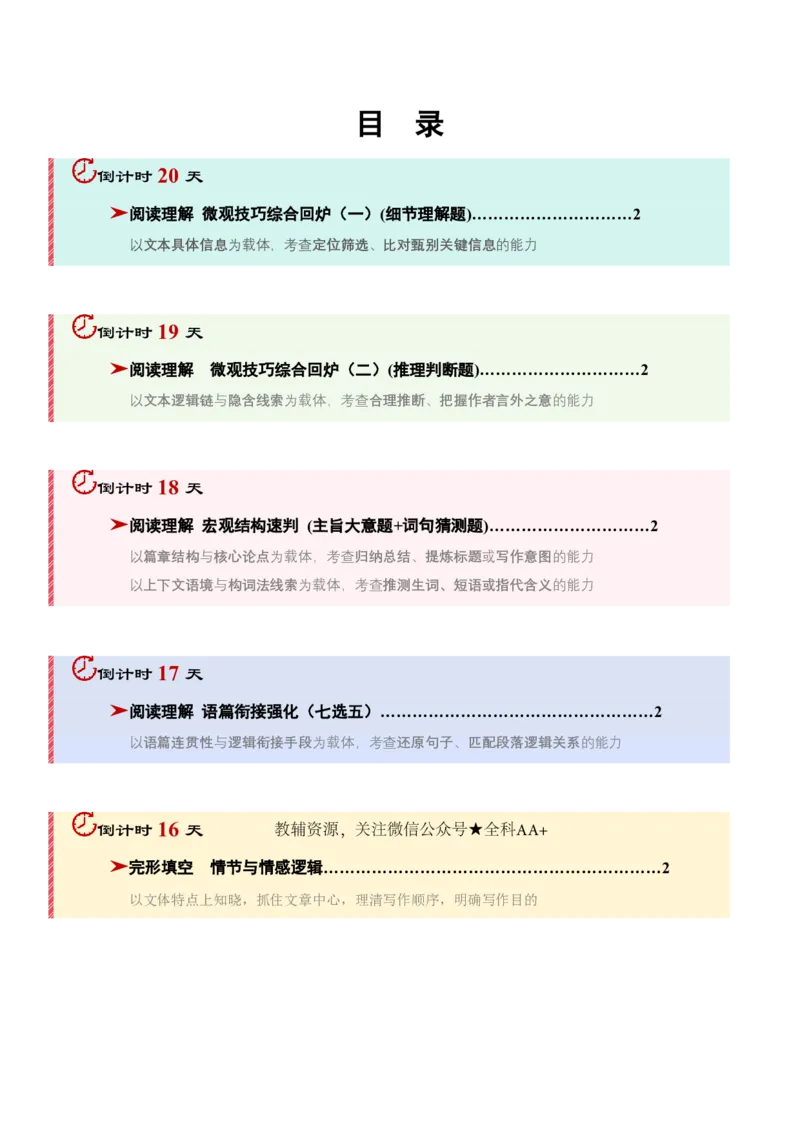
倒计时20 天
➤����
��
������(�����)…………………………2
以文本具体信息为载体,考查定位筛选、比对甄别关键信息的能力
倒计时19 天
➤����
��
������(�����)…………………………2
以文本逻辑链与隐含线索为载体,考查合理推断、把握作者言外之意的能力
倒计时18 天
➤���� �
���� (� !"�+#$%&�)…………………………2
以篇章结构与核心论点为载体,考查归纳总结、提炼标题或写作意图的能力
以上下文语境与构词法线索为载体,考查推测生词、短语或指代含义的能力
倒计时17 天
➤���� '()*+,�-./�……………………………………………2
以语篇连贯性与逻辑衔接手段为载体,考查还原句子、匹配段落逻辑关系的能力
倒计时16 天
➤0123 4�54678………………………………………………………2
������
��
������������������
教辅资源,关注微信公众号★全科AA+
倒计时20 天
Believe you can, and you’re halfway there.
— Theodore Roosevelt
����
��
���(�)(�����)
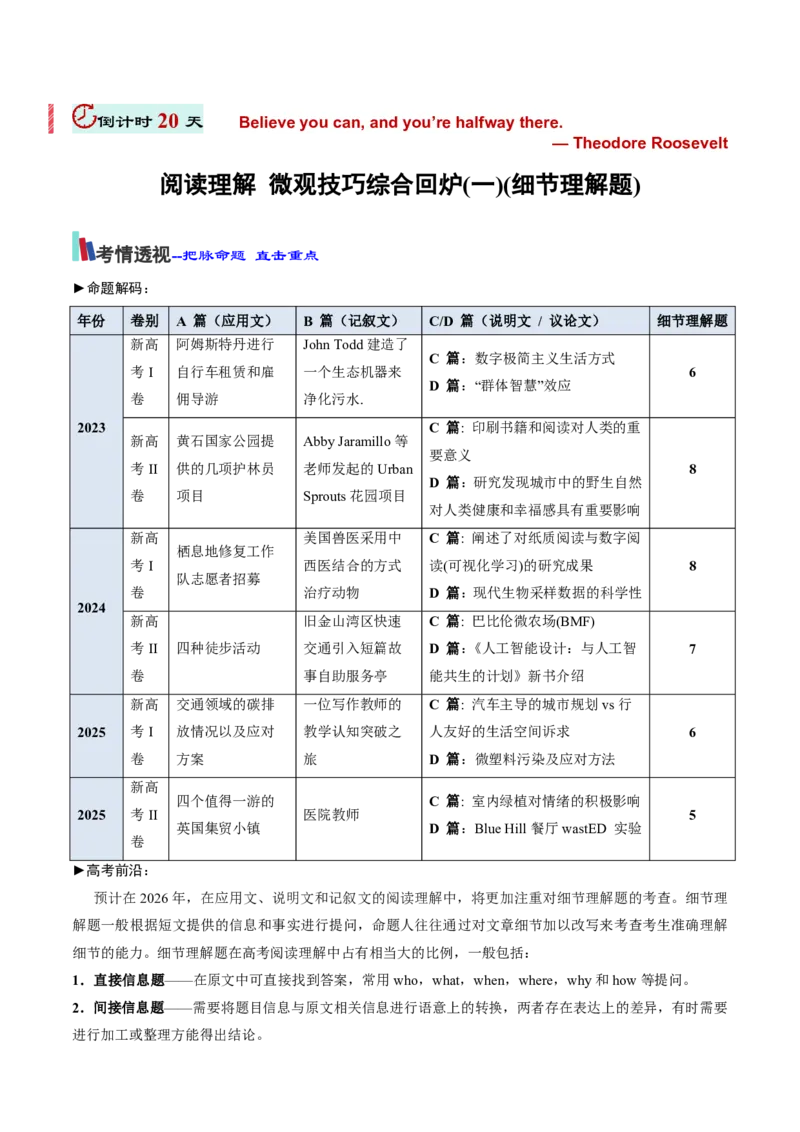
94:;--把脉命题 直击重点
�<��=>
��
��
A � !"�#
B � $%�#
C/D � &�� / '(�#
)*�+,
-.
/ I
�
012�345
65789:;
<=>
John Todd ?@A
BCDEFGH
IJKL.
C �MNOPQRSDTUV
D �M“W�XY”Z!
6
2023
-.
/ II
�
[\]^_`a
b�cdefg
d�
Abby Jaramillo h
ijkl� Urban
Sprouts m`d�
C �: nopq:rstuv�w
xyS
D �Mz{k|}~��D6
tuv:
wx
8
-.
/ I
�
�
]"�
�UV
C �: ¡¢At£¤rs¥NOr
s(¦§J¨©)�z{ª«
D �M|¬D N®�¯¨°
8
2024
-.
/ II
�
±²³´T
µ¶·¸¹º»
¼½¾¿À�Á
Â6ÃÄÅÆ
C �: ÇÈÉÊËÌ(BMF)
D �MÍuXÎÏÐM¥uX
ÎÑD�ÐÒÓ-pÔÕ
7
2025
-.
/ I
�
¼½Ö×�ØÙ
ÚÛÜ�Ý!t
UÞ
Bß��àj�
à¨á âãä
å
C �: æ7R=�}~çÒ vs 5
uèé�DTêëìí
D �MÊîïKðÝ!tUñ
6
2025
-.
/ II
�
±CòóB>�
ô]õö÷ø
ùàj
C �: úûüýtÛþ�ÿP
D �MBlue Hill Āā wastED Ăă
5
�?9@A>
ĄÐą 2026 ��ą!"�Ć&��:$%��rs�+��ćĈĉĊwt)*�+,�/ċČ)*�
+,BčĎ®À�ab�ď:ÂĂ45aĐ�đ,uĒĒ½ēt��)*ĉ�Ĕ�H/ċ/Dĕ��+
)*�ÎĖČ)*�+,ą./rs�+�ėĘęĚ�Èě�BčĜĝM
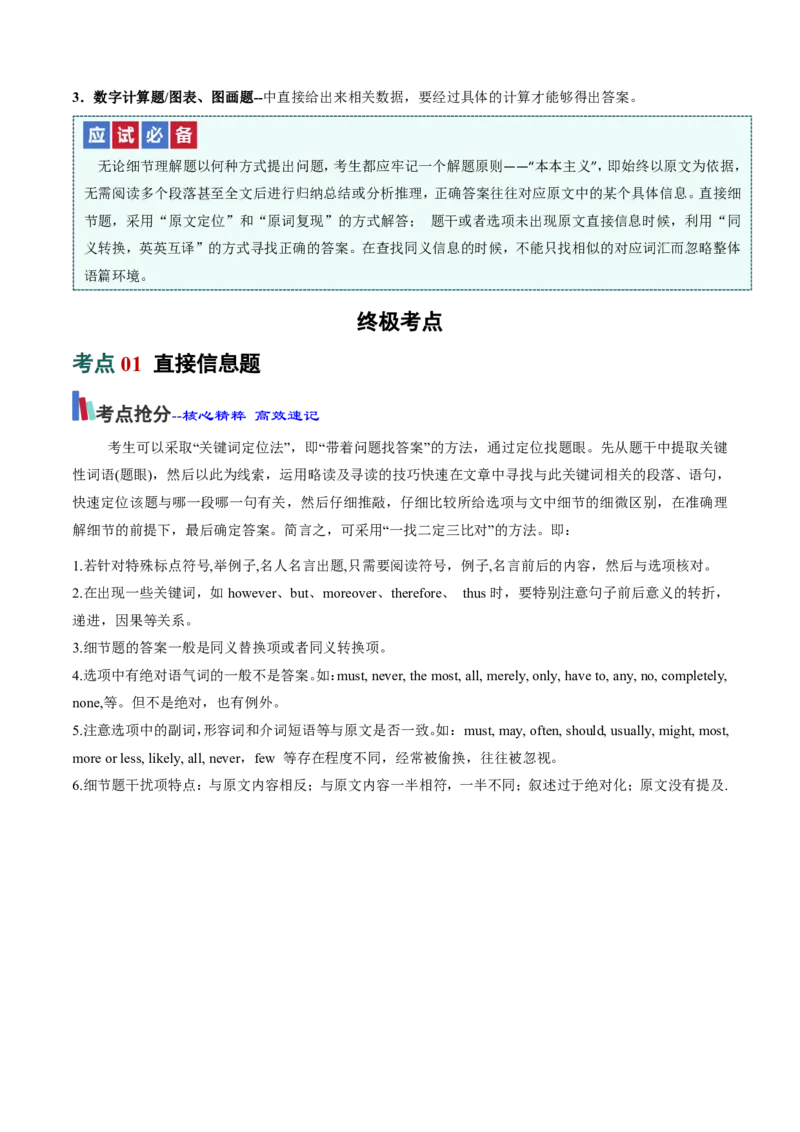
1ĞğĠď,——ąġ��¦ğĠĢģĤÞ�ĥ" who�what�when�where�why : how haĐČ
2ĞëĠď,——Ħxć,�ď¥ġ�Ęħď45Ĩy��ĩĪ�īĬąĭĮ��įİ�ıĦx
45ĉIJij�UÎóĴ(Č
3ĞNOÐĵ,/ĶĭĆĶķ,--�ğĠĸĴHĘħN®�xĹē��ÐĵĺÎĻóĴĤÞČ
BC9D
9D 01 E*FG�
9DHI--核心精粹 高效速记
/D¦�ļ“ħĽľĿßñ”�ŀ“ŁłĐ,ĢĤÞ”�Uñ�½ēĿßĢ,ŃČńŅ,ņ�aļħĽ
°ľĨ(,Ń)�Ň�ňʼnŊŋ�Ō"ōsÝŎs�ŏŐº»ą���ŎĢ¥ňħĽľĘħ�őŒĆĨœ�
º»ĿßŔ,¥ŕBőŕBœħ�ŇŖ)ŗŘ�Ŗ)ÈřŚĸśd¥��)*�)ʹ��ąĕ��
+)*�Ŝaŝ�ŞŇ�ĿĤÞČQşä�¦"“BĢŠĿšÈt”�UñČŀM
1.Ţţt�Ťť�Ŧŧ,Ũěũ,ŪuŪşĴ,,ūĦxrsŦŧ�ěũ,ŪşŜŇ�ûŬ�Ň¥śdŭtČ
2.ąĴ|BŮħĽľ�ů howeverĆbutĆmoreoverĆthereforeĆ thus ı�x��ĊyœũŜŇyS�ĩŰ�
ű4�Ų«hħųČ
3.)*,�ĤÞBčŴŵSŶĪdIJŵSĩĪdČŷ
4.śd�ŸtĨŹľ�BčźŴĤÞČůMmust, never, the most, all, merely, only, have to, any, no, completely,
none,hČŻźŴŸt�żěŽČ
5.Ċyśd��žľ�ſŬľ:ÔľÀĨh¥ġ�ŴƀBƁČůM must, may, often, should, usually, might, most,
more or less, likely, all, never�few hĬąƂƃźŵ�ĹĥƄƅĪ�ĒĒƄƆ§Č
6.)*,ņƇd��M¥ġ�ûŬĘƈƉ¥ġ�ûŬBƊĘŦ�BƊźŵƉ%¢ēƋŸtJƉġ�ƌaÝ.
ƍ()*�+,�Ǝ²UVaĴĐ,�/DƏ!Ɛ$BC+,ġƑ——“ƒƒRS”�ŀƓƔ�ġ�ʼnƕ®�
ƍĦrsƖCőŒƗƘƙ�Ň45ƚƛƜIJƝƞŗ��Ɵ�ĤÞĒĒt!ġ���ƠC�ďČğĠ)
*,�"“ġ�Ŀß”:“ġľ|”�UV+ĤƉ ,ņIJśdƣĴ|ġ�ğĠďıƤ�ƥ"“ŵ
SĩĪ�ôôƦƧ”�UVŎĢƟ��ĤÞČąċĢŵSď�ıƤ�źÎūĢĘƨ�t!ľƩƪƆōij�
Ĩ�ƫƬČ
J�KL--复盘经典 把握规律
ƭě 1Ʈ2025 -./Ư� Aư
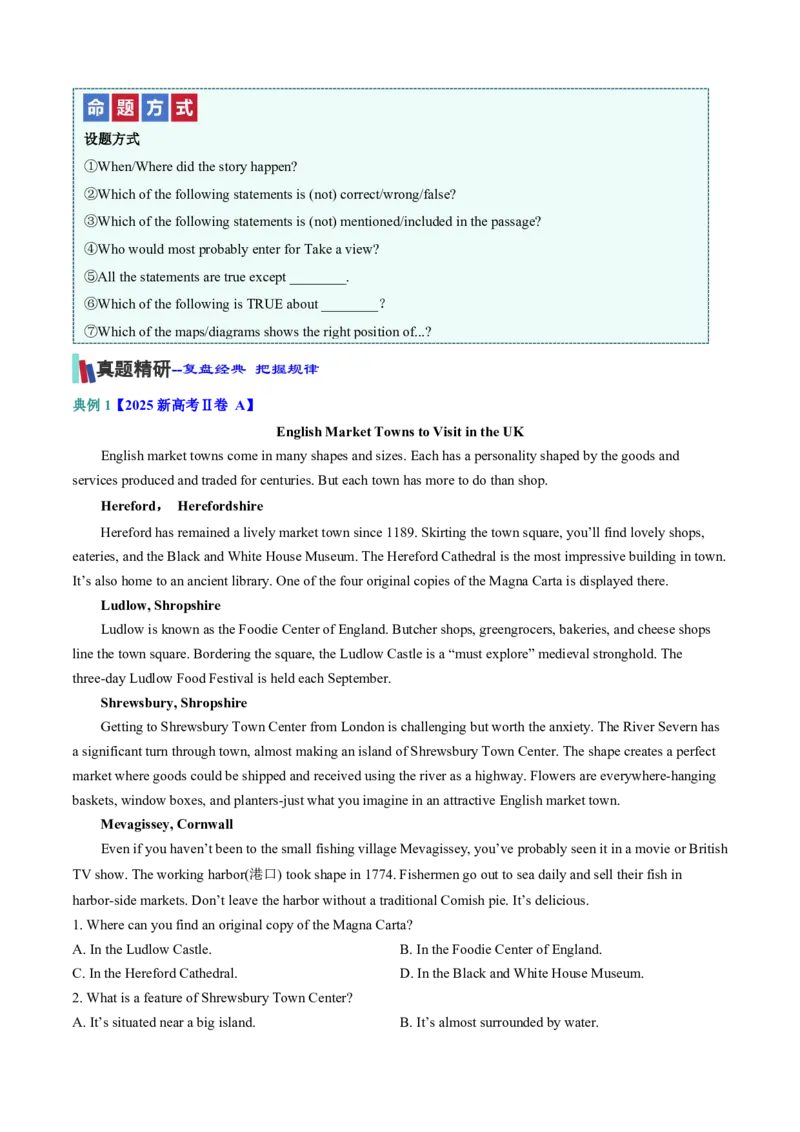
English Market Towns to Visit in the UK
English market towns come in many shapes and sizes. Each has a personality shaped by the goods and
services produced and traded for centuries. But each town has more to do than shop.
Hereford� Herefordshire
Hereford has remained a lively market town since 1189. Skirting the town square, you’ll find lovely shops,
eateries, and the Black and White House Museum. The Hereford Cathedral is the most impressive building in town.
It’s also home to an ancient library. One of the four original copies of the Magna Carta is displayed there.
Ludlow, Shropshire
Ludlow is known as the Foodie Center of England. Butcher shops, greengrocers, bakeries, and cheese shops
line the town square. Bordering the square, the Ludlow Castle is a “must explore” medieval stronghold. The
three-day Ludlow Food Festival is held each September.
Shrewsbury, Shropshire
Getting to Shrewsbury Town Center from London is challenging but worth the anxiety. The River Severn has
a significant turn through town, almost making an island of Shrewsbury Town Center. The shape creates a perfect
market where goods could be shipped and received using the river as a highway. Flowers are everywhere-hanging
baskets, window boxes, and planters-just what you imagine in an attractive English market town.
Mevagissey, Cornwall
Even if you haven’t been to the small fishing village Mevagissey, you’ve probably seen it in a movie or British
TV show. The working harbor(ƱƲ) took shape in 1774. Fishermen go out to sea daily and sell their fish in
harbor-side markets. Don’t leave the harbor without a traditional Comish pie. It’s delicious.
1. Where can you find an original copy of the Magna Carta?
A. In the Ludlow Castle.
B. In the Foodie Center of England.
C. In the Hereford Cathedral.
D. In the Black and White House Museum.
2. What is a feature of Shrewsbury Town Center?
A. It’s situated near a big island.
B. It’s almost surrounded by water.
Ï,UV
ƳWhen/Where did the story happen?
ƴWhich of the following statements is (not) correct/wrong/false?
ƵWhich of the following statements is (not) mentioned/included in the passage?
ƶWho would most probably enter for Take a view?
ƷAll the statements are true except ________.
ƸWhich of the following is TRUE about ________ƹ
ƺWhich of the maps/diagrams shows the right position of...?
C. It’s known for its flower festival.
D. It’s easily accessible from London.
3. What does the author suggest visitors do in Mevagissey?
A. Try the Cornish pie.
B. Watch a British TV show.
C. Go fishing in the sea.
D. Take pictures of the harbor.
Ĩ�+s
ħĽľ
English market towns, Visit, come in many shapes and sizes, personality
RƻƼx
ƒ�ŴB�!"��ƽ¢A±CòóB>�ƾƿǀǁĆǂǃDŽİ�ô]õö÷ø�ŁÖs
Dž6¥u�ǃdž�LJäČ
ġ�ĴLj
ś6 TRAVEL AWAITS ljNJB�Ūʼn 5 Charming English Market Towns To Visit In The UK
���Č
https://www travelawaits.com/2727110/best-english-market-to-wns-uk/
Nj¯ nj
Magna CartaÍĚǍ�ÓM1215 �ôǎǏ]ǐǑǒƄǓǔǕ:ǖǗ�ĆǘǙôǎǏ_ǚǛ
:ñǜǝƥ�wxƾƿ�Ǟ�ĥƄ§�|¬ôǎǏñǜ�ǟǠČ
The River Severn ǡ�ǢMô]ƬûŞǣ�ǢǤ�ƙǣ 354 ǥǦ�Ǒ 220 ôǧČ
Ĩş nj
wǨ�ľ
shape v. [ǩľDS]î@�; skirt v. [ŪľJ]Ǫł……�ǫǬǭ�ƫǮ....�±ǯ; eatery
n. [ǰƟV]ĀDZ�DzdzǴ; copy n. ġǵ�Ƕǵ; foodie n. [ǰƟV]dz^(=foody); line v. [Ū
ľJ]Ǫ......ª5; border v. [ŪľJ]Ǫ.....ǫM:……ǷǸ; medieval adj. �ǹǺ�;
stronghold n. ǻǼ; significant adj. ĘęĚ�; ship v. [ŪľJ]"ǽŌǾ; hanging basket n.
ǿmȀ�ǿmȁ; window box n.ȂƲmȃ�ȂȄmȅ; planter n. mȁ; harbor-side adj. ƱƲ
ǫ��ƱȆ�; accessible adj. ȇģĮ��ȇ4¿�
wǨ�ľ
Ȉ
come in many/all shapes and sizes(uIJ )ſſȉȉ�DŽ²DŽ; original copy ġǞ; take
shape ſª�?ª; go out to sea ĴȊ
21. C ÂĂ)*,ČĎ®,ņ�� an original copy of the Magna Carta ¦ćĤÞĿßģ÷ť, Hereford,
Herefordshir ŝ�ŞŇBœ One of the four original copies of the Magna Carta is displayed there.(ÍĚǍ�Ó�±
�ġǞäBȋȌȍąȎǧČ)�Áś CČ
22. B ŗ�ȏȐČ,Ď®÷ť, Shrewsbury, Shropshire ŝ�ȑŠœ The River Severn has a significant torn
through town, almost making an island of Shrewsbury Town Center.¦ �ǡ�Ǣ(River Severn)ą Shrewsbury ÷
ø�ȒABCĚȓ�cȔȕø��ȖªABC÷ȗ�Șň¦ŗĴ�Shrewsbury ø��cȔ±șƫL�Áś BČ
23. A ÂĂ)*,ČĎ®÷ť, Mevagissey, Cornwall ŝ�ŞŇīœ Don't leave the harbor without a traditional
Cornish pie. It's delicious.¦ ��?'>Țą Mevagissey ÷øBĿxțȜȝȞȟ�ȠȡȢȣ�Áś AČ
9D 02 M*FG�
9DHI--核心精粹 高效速记
ĘÈğĠď,�đ,�Ȥȥ°ĈȦ�Ɵ�śdBčƏȧąġ�ǟǠ�45Ĕ@Čňv,�Ħx/D
ć,�ď¥ġ�Ęħď45ĨS��ĩĪ�ıȨĦx4B´�ĉIJij�Č
ëĠď, Ħxtġ�ƖLjĘħď45ĩĪIJij#Mȩń�s,ņ���ħĽľ:Ĥ,UȪƉ
Ň�Ŀߥ,ņħĽľĘħ�ȫSľĆƈSľIJ+Ȭ°ďƉŞŇ�ƥ"Ɵ�śd�� ȫSľŶĪġ�
ďĆȖĪġ�ĨEĆľ°IJľſĆQJIJƼĝġ�ĆƟȭƈ&h#��ĿĤÞČ
J�KL--复盘经典 把握规律
NO 2【2025 新高考I 卷 D】
Microplastics have become a common source of pollution across the Earth — they have settled in the deep sea
and on the Himalayas, stuck inside volcanic rocks, filled the stomachs of seabirds and even fallen in fresh Antarctic
snow. They are even appearing inside humans.
Now, new research suggests that a simple, cheap measure may significantly reduce the level of microplastics
in water from your tap (LȮȯ): boiling and filtering (ēȰ) it. In a study published Wednesday in Environmental
Science & Technology Letters, researchers from China found that boiling tap water for just five minutes — then
filtering it after it cools — could remove at least 80 percent of its microplastics.
Crucially, this process relies on the water containing enough calcium carbonate (ØȱȲ) to trap the plastics.
In the study, boiling hard water containing 300 milligrams of calcium carbonate led to an almost 90 percent drop in
plastics. But in samples with less than 60 milligrams of calcium carbonate, boiling reduced the level of plastics by
just 25 percent. Additionally, the research didn’t include all types of plastics. The team focused only on three
common types — polystyrene, polyethylene and polypropylene — and they didn’t study other chemicals previously
found in water such as vinyl chloride.
Still, the findings show a potential path forward for reducing microplastic exposure — a task that’s becoming
increasingly difficult. Even bottled water, scientists found earlier this year, contains 10 to 1,000 times more
microplastics than originally thought.
Scientists are still trying to determine how harmful microplastics are — but what they do know has raised
concerns. The new study suggests boiling tap water could be a tool to limit intake. “The way they demonstrated
how microplastics were trapped through the boiling process was nice,” Caroline Gauchotte-Lindsay, an
environmental engineer of the University of Glasgow in Scotland who was not involved in the research, tells New
ƳWhich is the right order of the events given in the passage?
ƴBy the first sentence of the passage, the author means that…ƹ
ƵWhat’s the right order of the events related to…?
ƶIn the passage, the author states that…
ƷWhat was the reason for…?
ƸWhat can we learn about the pet lizard …?
Scientist. “We should be looking into upgrading drinking water treatment plants so they remove microplastics.”
12. How does the author present the issue in the first paragraph?
A. By quoting an expert.
B. By defining a concept.
C. By giving examples.
D. By providing statistics.
13. What determines the effectiveness of trapping microplastics in water?
A. The hardness of water.
B. The length of cooling time.
C. The frequency of filtering.
D. The type of plastic in water.
14. What does the author try to illustrate by mentioning bottled water in paragraph 4?
A. The importance of plastic recycling.
B. The severity of the microplastic problem.
C. The danger in overusing pure water.
D. The difficulty in treating polluted water.
15. What is Gauchotte-Lindsay’s suggestion about?
A. Choice of new research methods.
B. Possible direction for further study.
C. Need to involve more researchers.
D. Potential application of the findings.
'(��
� PQ
��������
��
������������������� !"#��
$%&'()�*+,-./01232456738�
��9:;<=>?# 3�
@A(BCD9:)�EFG*+HI�JKLM;�NOP
����QR�ST� !U
VW�XYZ673[\] ^_�
����QR;
RSTU
��`1Smithsonian magazineab2024c3d1efgBoiling Tap Water Could Help Remove
80 Percent of Its Microplastics, Study Suggests ��N;
https://www.smithsonianmag.com./smart-news/boiling-tap-water-could-help-remove-80-percent-of
-its-microplastics-study-suggests-180983874/
VWXY
@3(hard water):?9hijkl�Dmnopq�3;
'ZXY
[\D#
microplastic n.
��(micro- + plastic); stick v. rs tu; significantly adv. vwx; cool v.
(y)z{|remove v. }~; crucially adv. JKx Jx; trap v. ; drop n.
; additionally adv. } ; previously adv. ^ ; still adv. ;
exposure n. ; originally adv. 2 ; intake n. u : u : (in + take);
demonstrate v. |upgrade v. (y)YZ(up + grade); quote v. 7 ; hardness n. @A
(hard +-ness); severity n. S(severe + -ity); overuse v. /Ay7(over- +use)
[\D#]
settle in �......
2; volcanic rock ; rely on ; hard water @3; lead to ¡ ¢
£; bottled water ¤¥3; raise concerns about/over/for sth. "#�¦§�¨©; look into P
ª <=; pure water «¬3
ƮĨ�+sưƒ�ŴB�&��Č��RxÔÕABdħƋȳȴ6HL�ÊîïKð�-z{ČÊîïK
ðȵȶÝƙȷ�ƗƘ4¿u�Č�]z{ugk|�ć6HLȸȹȺƝȻȼȽȾŇēȰ¦ÎȧȿɀɁɂ6
HL��ÊîïɃɄČz{ɅƣɆɇŚîïvɈ:J¨ ¤�ŻɉɊAB²ɋą+ɌUÞČɍǎǏƫƬ
ƂjɎĴ�Ŕz{ɏɊAȸȹñ�Z°�ȼ?'ɐɑDz"LLj�ɒ�ŗɓ!"Č
32.C ŗ�ȏȐ,ČĎ®��ȑBő�“Microplastics have become a common source of pollution across the Earth
— they have settled in the deep sea and on the Himalayas, stuck inside volcanic rocks, filled the stomachs of
seabirds and even fallen in fresh Antarctic snow. They are even appearing inside humans. ”¦ŗ ��½ēŨě
aĴÊîïKð�Đ,ČÁś CČ
33.A )*�+,ČĎ®��ȑŠő�“Crucially, this process relies on the water containing enough calcium
carbonate (ØȱȲ) to trap the plastics. In the study, boiling hard water containing 300 milligrams of calcium
carbonate led to an almost 90 percent drop in plastics. But in samples with less than 60 milligrams of calcium
carbonate, boiling reduced the level of plastics by just 25 percent. ”¦ �ɌĿąL�ɔɕÊîï�Z°�Ŵ
L�ɖƃČÁś AČ
34.B ŗ�ȏȐ,ČĎ®��ȑ±ő�“Still, the findings show a potential path forward for reducing microplastic
exposure — a task that’s becoming increasingly diffcult. Even bottled water, scientists found earlier this year,
contains 10 to 1,000 times more microplastics than originally thought. ”¦ŗȐ��aģɗɘLŴʼnA&�Êî
ïKð�əw°ČÁś BČ
35.D ŗ�ȏȐ,ČĎ®��ŞŇBő�““The way they demonstrated how microplastics were trapped through the
boiling process was nice,” Caroline Gauchotte-Lindsay, an environmental engineer of the University of Glasgow in
Scotland who was not involved in the research, tells New Scientist. “We should be looking into upgrading drinking
water treatment plants so they remove microplastics.””¦ŗ �Caroline Gauchotte-Lindsay �?'ŴħƋȎdz
{«�ɋą!"�ŀɐɑDz"LLj�ɒČÁś DČ
9D 03 ^_`a�
9DHI--核心精粹 高效速记
NOÐĵ,BčȧɚÝıëĆ�ɛĆɜɝĆNɄĆɞɟh�QɠÐĵČBčH&�ÐĵɄƏÈř÷�
ŬȇÐĵČŻŴôĨrs��NOÐĵɡɢxĢĴÐĵɣŇŚȤɃ�ďČȎŮ“ɤ”ďȧɚÝtƠCǨœ
��+�ŅȎCɥƃ�ɦ��+��Ę!�ɧœŴ+Ȏv,�ħĽČ
NOÐĵ,�ȭ,M1.ɓɨvƉ2.ÁÂvƉ3. ¯ɩ njvƉ4.ƿ6vƉ5.�JàɪvČÏĐUV
� when�in which year�how many/much hɫĐľ(ɬ)ɭȯ¾ĴĐ,Č+ňvɮ,ĥ"“ijŗĵ”ñČ
ġ�ĿßMƕ®,ņħĽľ�ŇŎsġ��ŵıť$NOĆıëĆ�¬hĘħďČ
��ħųMN®¥ġ�N®�ɯɰħų�ȼ45ĉȳɱɲÐĵČ
��ħĊMdecade ɳ� fortnight īǯ double īɴ couple īC score Šɳ dozen ɳŠ off ɵɜ�ȳɜ
discount ŰɶČ
J�KL--复盘经典 把握规律
NO 1Ʈ2025 -./ I � Aư
The greening of planes, trains and automobiles
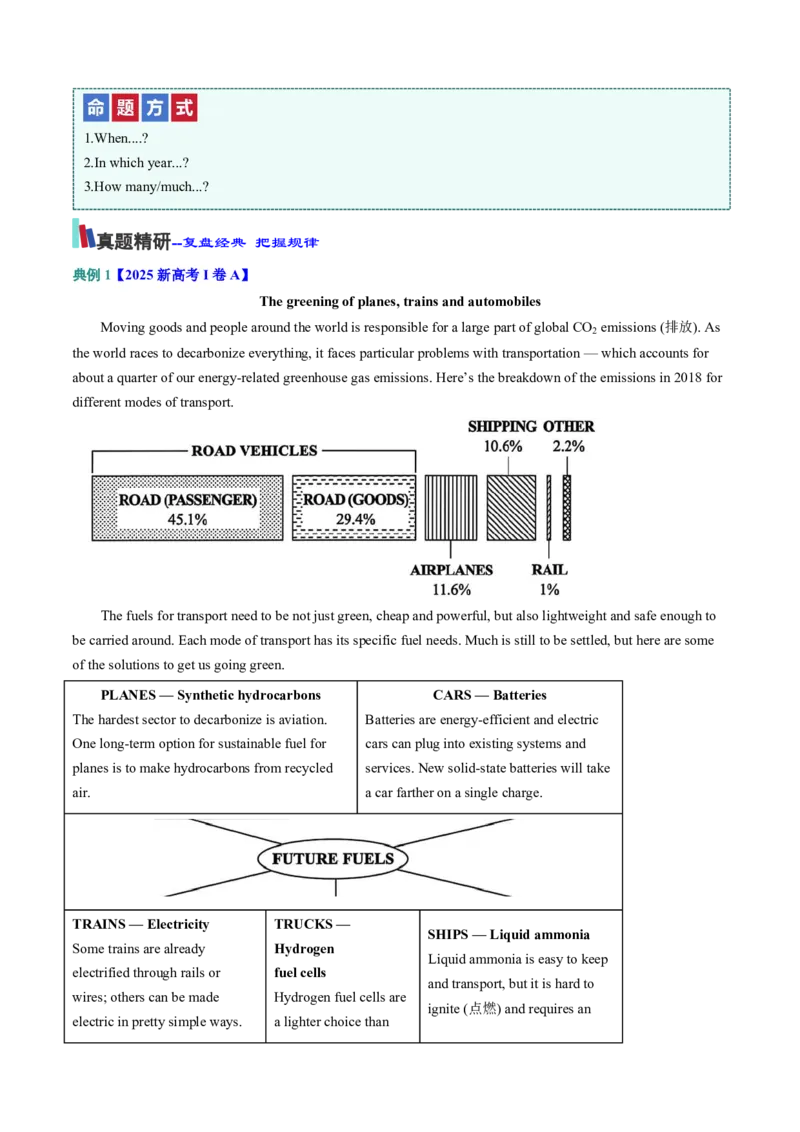
Moving goods and people around the world is responsible for a large part of global CO2 emissions (ÙÚ). As
the world races to decarbonize everything, it faces particular problems with transportation — which accounts for
about a quarter of our energy-related greenhouse gas emissions. Here’s the breakdown of the emissions in 2018 for
different modes of transport.
The fuels for transport need to be not just green, cheap and powerful, but also lightweight and safe enough to
be carried around. Each mode of transport has its specific fuel needs. Much is still to be settled, but here are some
of the solutions to get us going green.
PLANES — Synthetic hydrocarbons
The hardest sector to decarbonize is aviation.
One long-term option for sustainable fuel for
planes is to make hydrocarbons from recycled
air.
CARS — Batteries
Batteries are energy-efficient and electric
cars can plug into existing systems and
services. New solid-state batteries will take
a car farther on a single charge.
TRAINS — Electricity
Some trains are already
electrified through rails or
wires; others can be made
electric in pretty simple ways.
TRUCKS —
Hydrogen
fuel cells
Hydrogen fuel cells are
a lighter choice than
SHIPS — Liquid ammonia
Liquid ammonia is easy to keep
and transport, but it is hard to
ignite (�ɷ) and requires an
1.When....?
2.In which year...?
3.How many/much...?
batteries for trucks, but
making green hydrogen
is expensive.
engine redesign.
This energy transition (Ȗɸ) is global, and the amount of renewable energy the world will need is “a little bit
mind-blowing,” says mechanical engineer Keith Wipke at the National Renewable Energy Laboratory. It’s
estimated that the global demand for electricity could more than double by 2050. Fortunately, analyses suggest that
renewables are up to the task. “We need to speed up the development of green energy, and it will all get used,” says
Wipke.
21. What percentage of global transport emissions did road vehicles account for in 2018?
A. 11.6%.
B. 45.1%.
C. 74.5%.
D. 86.1%.
22. Which mode of transport can go green comparatively easily?
A. Planes.
B. Trucks.
C. Trains.
D. Ships.
23. What does Wipke suggest regarding energy transition?
A. Limiting fuel consumption.
B. Putting more effort into renewables.
C. Improving energy efficiency.
D. Making electricity more affordable.
Ĩ�+s
RƻƼx
�������� �N^“®¯°�±²o”g³´ µ¶
��·¸®B¹º�»
¼ ½¾®*¿�ÀÁ*Â^�ÃÄÅÆ8ÇÈ_GÉÊ�*Ë;
ġ�ĴLj
ÌÍÎÏÐ#Ñq:
https://knowablemagazine.org/content/article/technology/2024/decarbonization-of-transportation-pre
dictions
VWXY
p£BÒopq(synthetic hydrocarbon)?®/�ÓoÔ*+ Õ�ÖoBm ×ÖoBmÒØ
Ù%&�ÚogÛB.ÒÜ£�hÝopq;Þ�ßà®á7âãäåæçèéÄ ê»
ÃÄëoÓ��kìíîï;
Òð�ñò(hydrogen fuel cell) ��$®/ñoÔó_ÕÒØ.ÖØ�oÔÃôÚogñÃ
�¥õ /ö8÷¹º3 ø�� �ùúÃÄßà�û*Ë�;
üý(liquid ammonia)�ýØ�þÿëĀā
üoĂ£�ø²üă ĄhOąĆć�ØĈ �
�$�oÓ�.ĉĊ�ùúÃÄċă;
Ĩş nj
wǨɠľ
greening n. ±²ÚČ(green + -ing); decarbonize v. čB(de- + carbonize); greenhouse gas n. ÿĎ
Øă(ď?×ÖoB)|breakdown n. [ĐđîĒ]�ē(break + down); mode n.*¿; specific adj.
Ĕĕ�; settle v. [ĐđîĒ]ÀÁ(ĖėmĘęÙ); sector n. ¯°/Ěě; aviation n. ĜĝÓě;
sustainable adj. kìí�(sustain + -able); recycled adj. Ğ�(recycle + -ed); energy-efficient
adj. ğÃ�(energy + efficient); solid-state adj. Ġġ�(solid + state); electrify v. yñØo
(electric + -fy); redesign n. ĉĢģ(re- + design); mind-blowing adj. ÎáĤ�ĥĦ�(mind +
blow + -ing); analysis n. Ęħ
wǨľȈ
be responsible Ĩĩ; account for (Ī:mīĬĭ)Į; plug (sth.) into sth. (Õ¦q)į¦q®;
renewable energy kİîÃÄ; It is estimated (that)... ıIJģ……; up to ijĴ(¦ĵĶķ); speed
up (y)ĸĹĺA
ƮĨ�=sưƒ�ŴB�!"�Č��RxÔÕA 2018 �źŵ¼½UV�ɹúŹ�ÙÚėÈ��ÝɺFĆ
æ7hDŽv¼½�ƣHüȉɷïɻɼČ
ƮĨ�+sưƒ�ŴB�!"�Č��RxÔÕA 2018 �źŵ¼½UV�ɹúŹ�ÙÚėÈ��ÝɺFĆ
æ7hDŽv¼½�ƣHüȉɷïɻɼČ
21.C Ʈ+ƞư)*�+,ČĎ®Ķĭď ROAD VEHICLES ɽƝ�“ROAD (PASSENGER) 45.1% ”�Ý
“ROAD (GOODS) 29.4% ”¦ �ɾɻ7ɿƜėÈʼn 45.1%+29.4%=74.5%�ŀɾɻ7ɿą 2018 �ƙȷ¼½
ÙÚ�ėÈ 74.5%ČÁś C dČ
22.CƮ+ƞư)*�+,ČĎ®Ķĭď TRAINS — Electricity ɽƝ�“Some trains are already electrified
through rails or wires; others can be made electric in pretty simple ways. ”¦ �ʀ7Ęřʁʂ¼½UVĈȇĂ
|üȉJČÁś C dČ
23.BƮ+ƞư)*�+,ČĎ®ŞŇBő�““We need to speed up the development of green energy and it will all
get used,” says Wipke. ”¦ �Wipke ?'ĉĚt¦ʃDÎʄ�ʅ¿�ŀĉĚtüȉÎʄ�ʅ¿ČÁś B dČ
BCb&
BCb&--压轴实战 稳拿高分
A
2026 ʆǢʇʈʉ~ŌǢ¹ʉ~ȑB�¨Šʊ#
Four Pet-Friendly Hotels
Montage Palmetto Bluff
Location: Bluffton, South Carolina
Price: $150 pet fee, rooms start at $645 a night
In this great riverside hotel, your pet will be treated to a fancy pet bed, toy gifts, and a special menu. For you
there’re spa treatments, golf and eight dining experiences. With 20,000 acres (ôʋ) to explore, you and your dog
can spend hours visiting and playing.
Kinship Landing
Location: Colorado Springs, Colorado
Price: $49 per night pet fee, rooms start at $249 a night
Inside this new hotel, you’re greeted with hundreds of green plants, along with an event space that houses nearly a
forest. You can also order your dog a bowl made with sweet potatoes and eggs at the hotel’s café, and then head out
to travel in the Rocky Mountains.
Inn By The Sea
Location: Cape Elizabeth, Maine
教辅资源,关注微信公众号★全科AA+
Price: $544 a night in a pet-friendly single-bedroom room, 2-night stay required
In the hotel, book the pet package, and your dog will receive a personalized bed and a toy dog, a bowl, and an
evening selection from the pet menu. You will be provided with a list of nearby walking paths and pet-friendly
beaches. The hotel also gives a temporary (ʌı�) home to dogs that are looking for their forever families. 154
have been adopted (Öʍ) by guests.
Kimpton Sawyer Hotel
Location: Sacramento, California
Price: No pet fee; rooms start at $249 a night
There’s no limit on pets you can bring — so pack up your dog and your cat. Awaiting them will be pet beds,
food, water bowls and a list of pet-friendly restaurants and parks. When the free nightly wine party begins in the
hall, your pet can join you for socializing.
1ĞWhich hotel provides chance to explore the mountains?
AĞMontage Palmetto Bluff.
BĞKinship Landing.
CĞInn By The Sea.
DĞKimpton Sawyer Hotel.
2ĞWhat is special about Inn By The Sea?
AĞIts guests can take pets to the party.
BĞIt serves pets sweet potatoes and eggs.
CĞIt offers spa treatments to its guests.
DĞIts guests might adopt a pet there.
3ĞWhere will you go if you want to save money?
AĞTo Bluffton, South Carolina.
BĞTo Cape Elizabeth, Maine.
CĞTo Sacramento, California.
DĞTo Colorado Springs, Colorado.
ƮĤÞư1ĞB
2ĞD
3ĞC
ƮĨ�=sưƒ�ŴB�!"�Č��ÔÕA±^ʎ èéɈʏǴ��ȉÄÅĆɜǎ:��âĴAʐʑ
ʼnʎ ab�ÏʒÝʼnȚuÏÐ�TČ
1Ğ)*�+,ČĎ® Kinship Landing ��“You can also order your dog a bowl made with sweet potatoes and
eggs at the hotel’s café, and then head out to travel in the Rocky Mountains.(ʓ¦�ąʏǴ�ʔʕDZʼnʓ�ʖ�
B�"ʗʘ:ʙʚʛ��ʜdz�ŇĴkʝŒǟ·ʞå5Č)”¦ �Kinship Landing ʼnȚuabʟŋ·ʞ�
FȧČÁś B dČ
2Ğ)*�+,ČĎ® Inn By The Sea ��“The hotel also gives a temporary (ʌı�) home to dogs that are
looking for their forever families. 154 have been adopted (Öʍ) by guests.(ʏǴȨʼnŎĢʠǁ^ʡ�ʖʖabʌ
ı
ŚČȵ 154 ūʖƄȚuÖʍČ)”¦ �Inn By The Sea ���äLjąƋȚu¦ÎąʢǧÖʍʎ Č
Áś D dČ
3Ğ)*�+,ČĎ® Montage Palmetto Bluff ɽƝ�ɜǎ“$150 pet fee, rooms start at $645 a night (150 ʣ�
ʎ ʤ�ʥëʦʧŞɂɜǎʼn 645 ʣ)”ĆKinship Landing ɽƝ�ɜǎ“$49 per night pet fee, rooms start at $249
a night (ʦʧʎ ʤ 49 ʣ�ʥëlɜʼnʦʧ 249 ʣ)”ĆInn By The Sea ɽƝ�ɜǎ“$544 a night in a
pet-friendly single-bedroom room, 2-night stay required(ʨʩʎ ¿
�ɠʪúʥëʦʧ 544 ʣ�Ħ¿
2
ʧ)”: Kimpton Sawyer Hotel ɽƝ�ɜǎ“No pet fee; rooms start at $249 a night(ƍʎ ʤƉʥëʦʧŞɂɜ
249 ʣ)”¦ �ʫ/ʬʎ ʤ:ʥʤ�Kimpton Sawyer Hotel �ƜªƒŞɂƉʃĎ®ŔʏǴ��
“Sacramento, California (ĉƥʭʮʉʯʰʱʲʳ~)”¦ �ů«ʴʵɝ�!ŜĒĉʉ�ʯʰʱʲʳ~ČÁ
ś C dČ
B
2026 ʆʶɍǟĚʷ/ ʸ½Ćʹʉ 2.5 ʊ#.š 4 ʺ¤Ʉʻʼ#
A 19-year-old runner with Down syndrome (ʽʾʫʿ) has become the youngest person with a learning
disability to complete a marathon. Lloyd Martin created history by finishing the 26.2-mile (42 km) course of the
London Marathon guided by his mother Ceri Hooper, 54, on Sunday.
After undergoing surgery on both of his knees in 2021, Martin began running 5 kilometers at a time. The
Daily Mail reported that the teenager began training for the marathon in December, coached by his mother, an
experienced marathoner. After Christmas, he began increasing his mileage and prepared for London.
More than 50,000 excellent and charitable runners took to the streets of the British capital, with a record
578,000 people entering the ballot (ˀǔ) for this event, making it the most popular marathon in the world.
The Guinness World Records awarded Lloyd Martin a certificate at the end of the race. He is the youngest
person to complete a marathon in the intellectual impairment (ˁ˂) category, the book of records announced.
The teenager and his mother broke down in tears after finishing the race. “In Lloyd’s words, it’s achieving
his dream.” Ms. Hooper was quoted by the BBC as saying. “Really anything is possible if you put your mind to it.
With a bit of work, you can achieve it.”
Martin ran the first 14 miles of the marathon without stopping, which was the farthest he had ever run, his
mother said. He then walked the rest of the miles till the finish line as the crowd cheered for him.
“It was tough, but we had a ball,” Ms. Hooper said, adding that her son’s achievement was important for
people with Down syndrome. “We did not say a lot when we crossed the finish line. We just both burst into tears,”
she said. Prior to the marathon, Mr. Martin had run the farthest distance of 5 km in November last year.
The London Marathon shared a touching video of Martin finishing the race and celebrating his
accomplishment with his mom.
4ĞWhat do we know about Lloyd Martin?
AĞHe had the determination for a race.
BĞHe competed with a disabled runner.
CĞHe maintained a speed in the Marathon.
DĞHe participated in the match on his own.
5ĞWhat is the key to Martin’s accomplishment?
AĞHis mom’s encouragement.
BĞHis physical strength.
CĞThe professional training.
DĞThe crowd’s cheers.
6ĞWhy did Martin and his mother both burst into tears after crossing the finish line?
AĞThey were too exhausted after the race.
BĞThey were overcome by the excitement.
CĞThey were disappointed with the result.
DĞThey were moved by the loud applause.
7ĞWhat can we learn from Martin’s story?
AĞNothing is impossible for a willing heart.
BĞA great coach is the key to sports success.
CĞEveryone adds fuel and the flames rise high.
DĞAll things are difficult before they are easy.
ƮĤÞư4ĞA
5ĞC
6ĞB
7ĞA
ƮĨ�=sưƒ�ŴB�-˃˄ɾČRxÔÕ˅ʽʾʫʿ� 19 ˆȴ�ˇˈˉ·ˊˋˌªÉˍˊʱˎ�ª
ʼnĘħɬ�Ş�ˏˌː�ˑÁÂČ
4Ğ)*�+,ČĎ®ȑŠő��“After undergoing surgery on both of his knees in 2021, Martin began running 5
kilometers at a time. The Daily Mail reported that the teenager began training for the marathon in December,
coached by his mother, an experienced marathoner. After Christmas, he began increasing his mileage and prepared
for London. (2021 �˒˓Ƕ˔Ň�ˊˋɭƓB˕˖ 5 _ǧČȎŪȴ� 12 ʺɭƓą˗ʼn˘˙ˊʱˎśǶ�˚
˛Ɏ=ŝ˜˝˞˟ˊʱˎČˠˡ*Ň�ʂɭƓˢĉ˖ɄʼnÉˍːÂˣĕ˞Č)”¦ �ˊˋɅ˗˅ˤ˥˦˂
˧�˨˩˪˜˝˞˟ˊʱˎ�¦˫ʂˬ˭ː�˩ĿɌ�ČÁś A dČ
5Ğ)*�+,ČĎ®ȑŠő��“the teenager began training for the marathon in December, coached by his
mother, an experienced marathoner. After Christmas, he began increasing his mileage and prepared for London.(Ȏ
Ūȴ� 12 ʺɭƓą˗ʼn˘˙ˊʱˎśǶ�˚˛Ɏ=ŝ˜˝˞˟ˊʱˎČˠˡ*Ň�ʂɭƓˢĉ˖ɄʼnÉˍ
ːÂˣĕ˞Č)”¦ �ˊˋĠDžAˮ˯ųȞ�˜˝�ȎŴʂļóªȋ�ħĽČÁś C dČ
6Ğŗ�ȏȐ,ČĎ®ȑȺő��““In Lloyd’s words, it’s achieving his dream.” Ms. Hooper was quoted by the
BBC as saying. “Really anything is possible if you put your mind to it. With a bit of work, you can achieve it.”(ô
]ɓ˰_˱˲¾˳˴˵˶�ȭ&M“"ˇˈˉ�ȭH&�ʂĂ|A6˷�˸ʴČūx"�ʝˣ�B˹˺¦
ÎČūx˻ĴB�˼Ė�ʓȋÎĂ|�ťČ”)”¦ �˚ũŠu˽ŊŇŒ˾ŴŲʼnĂ|˸ʴƪ˿źȵ�Ǩ
�̀
ʛû��́̂
ČÁś B dČ
7Ğŗ�ȏȐ,Č½sƙ��̃
ʁŴȑȺő��“Really anything is possible if you put your mind to it. With a bit
of work, you can achieve it.(ūx"�ʝˣ�B˹˺¦ÎČūx˻Ĵ˼Ė�ȋÎĂ|�ťČ)”¦ �ˊˋ˗
˅ʽʾʫʿ�˦̄
ĠDž˓ɇǶ˔�Ⱦ̅̆
˩˪¥˜˝ˌªˊʱˎ�̇ �A�äŚ�ƍÂźª�Ųň“Nothing
is impossible for a willing heart(�äŚȪ�ƍŚźªČ)”ŞÎ�|ÁÂȝű�ɾ�ČÁś A dČ
C
2026 ʆ̈
ʶ̉
ʉĆ̊
ʉĆ̋
L 4 ʺš~.šŠʊ#
Two months into my Ph.DĞ, I was on the verge of quitting. My broken English made it hard to keep up with
colleagues. At lab meetings, the conversation progressed so quickly that by the time I understood a question, the
discussion had already moved on. I once ruined an experiment due to misunderstanding instructions. In a
presentation, I embarrassed myself by confusing “gene dilution” with “gene deletion”. I felt out of place, uncertain
about my future in science.
I had moved to Hong Kong from the Chinese mainland, excited to become a scientist, but quickly felt
overwhelmed. The lab was full of complex instruments I had only ever seen in textbooks, and I had no idea how to
use them. Most of all, the language barrier made everything harder. Classes were taught in English, and I struggled
to follow the discussions.
After a particularly embarrassing presentation, a senior lab member pulled me aside and said, “You are not
here because of your English. You are here because you can think.” His words gave me the strength to continue. I
began recording every class and replaying the discussions at night. Slowly, my English improved, and I grew more
confident in expressing my ideas.
Years later, after training in Hong Kong, Canada, and the United States, I returned to my hometown to run
my own lab. My students all spoke Mandarin, and I assumed they wouldn’t struggle as much as I had because they
didn’t face the same language barrier. But I soon realized they too battled doubts about their careers and abilities. I
realized my job was to teach them to think critically and solve problems creatively, just as I had been taught. When
I saw a student struggling with an experiment, I told her, “You are not here because your experiments always work.
You are here because you can think.” Her smile told me she was encouraged by these words.
Today, what I value most in my job is the transformation I see in the students who arrive uncertain, but who
leave with enough confidence to challenge me, their professor. For me, helping others cross the bridge is the true
reward of scientific life.
8ĞWhy did the author almost quit her Ph. DĞaccording to paragraph 1?
AĞShe disliked lab discussions.
BĞShe lacked future plans in science.
CĞShe messed up her presentation.
DĞShe struggled with language barriers.
9ĞWhat was the turning point for the author during her Ph.DĞstudies?
AĞHer embarrassing presentation.
BĞReturning to her hometown to run a lab.
CĞThe senior lab member’s supportive remark.
DĞMoving to Hong Kong from the Chinese mainland.
10ĞWhich word would best describe the author as a teacher?
AĞInspirational.
BĞStrict.
CĞHumorous.
DĞAuthoritative.
11ĞWhat does the underlined phrase “cross the bridge” in the last paragraph refer to?
AĞTravel between countries for education. BĞChange from a student to a professor.
CĞGrow from uncertainty to confidence.
DĞBuild bonds between professors and students.
ƮĤÞư8ĞD
9ĞC
10ĞA
11ĞC
ƮĨ�=sưƒ�ŴB�$%�ČRxɦ¢�̌
s̍
˶̎̏
ŲĨşǙ̐̑
¿6̒̓
ɫƗƘʴÚ̔
�ąó
ģŜ̖̕
ˑŇ˩˪ȼªǣ�ŇHªʼn=j�"ŵ�UV̖
ˑ¨DŅ̗̘
ǭȪ6ď�̙̚
¯zuD�̛
Ɵ
ɜòČ8Ğ)*�+,ČĎ®ȑBő�“Two months into my Ph.D., I was on the verge of quitting. My broken
English made it hard to keep up with colleagues.(s̍
īCʺŇ�̒
cȔxÚ̔
AČ̜̝̒
�ôĨ̞̟̒
Ǩ̠
�
ŵÂ�´̡
Č)”Ć“I felt out of place, uncertain about my future in science.(̒
ģǎǎź¿�t6˷ą¯¨Ö×
�ƣH
ģź�Ŀ)”�݃ő�Śɦ¢�ĨşĐ,=ƁĂặ̢
Ć̤
ɦ̥̦
h��cȔ̧
¨�ġŲŴĨş
Ǚ̐
ŁH�²²̨
Ƭ�Áś DČ
9Ğ)*�+,ČĎ®ȑšő�“After a particularly embarrassing presentation, a senior lab member pulled me
aside and said, “You are not here because of your English. You are here because you can think.” His words gave
me the strength to continue.(ąB˕��̥̦
�Ʃ˄Ň�BßĂăú˘˙ªgȕ̒
ʱģBǫ&M“ʓÎąȎǧź
ŴŲʼnʓ�ôĨ�ƪŴŲʼnʓȧ̩
/” ʂ�ȭĸA̒
˩˪ŝʝ�ĖɄČ)”¦ �Bߢ˙Ăăúªg�̖
ˑ
ȭĨĸA�̪̫
ŝʝ�Ė�Ŵ�̍
˶D̬
ő�ĩŰ�ČÁś CČ
10Ğŗ�ȏȐ,ČĎ®ȑ±ő�“When I saw a student struggling with an experiment, I told her, “You are not here
because your experiments always work. You are here because you can think.” Her smile told me she was
encouraged by these words.(ę̭̒
ģBC¨DąˣĂăı̟̮
Ė�̒ ɨì̯
M“ʓźąȎǧŴŲʼnʓ�ĂăƜ
Ŵª̰
�ČʓąȎǧŴŲʼnʓÎ̩
/”̯
�Ê̱
ɨì̯̒
ƄȎŮȭ̖̲
AČ)”¦ ��ȝ̳
Aę�ʂut
6˷�̖
ˑ�"Ęƨ�ȭ̖
ˑ̗̘
�¨D�̴
èD?̵
ď�ƉŲň���ʼnijŴ̖̲
˿ˑu�ČÁ
ś AČ
11Ğľœ̶
ʼ,ČĎ®ŞŇBő�“Today, what I value most in my job is the transformation I see in the students
who arrive uncertain, but who leave with enough confidence to challenge me, their professor.(ů̷
�̒ ą��Ş̭
w�Ŵ̒
ą¨D˗�̭
ģ�ĩȖ�ʂʑH�ıƤź�Ŀ�ɟɭ�ıƤȾ̸
Ļ�ď�H̹
˟̒
——ʂʑ
�à̺
Č)”¦ ����Ċw̴
èD?̵
ď��̴
èDˌªŅ̗̘
ź�Ŀģ6ď�ªǣĩȖ�“For
me, helping others cross the bridge is the true reward of scientific life.(t̒
H&�̴
Ã�u cross the bridge Ŵ¯
¨DT�̛
Ɵ̻
˄Č)”��“cross the bridge”Ɏ�ŴŅ̗̘
ź̼
ǭȪ6ď�ªǣ�Áś CČ
D
2026 ʆ̼̽̾
ʇ~.šȑŠ˕¤Ʉʻʼ#
Killer whales in the coastal waters off Washington have been seen massaging each other by rubbing pieces
of kelp (ȊŁ) between their bodies. Researchers filmed the animals selecting and biting off the kelp into long, thin
pieces, then placing one piece onto the back of another whale. The scientists think this might have a health or
cleanliness function, but they also believe they are a form of social bonding. The findings appear to be an example
of tool use in whales, with the animals fashioning a piece of kelp and using it for a planned purpose.
During 12 days of studying a population of killer whales, the team recorded 30 times of kelp massage. “We
see it multiple times per day,” said lead researcher Dr Weiss. This could be a marine version of behaviour seen in
monkeys, where animals spend hours picking through fur, cleaning and removing harmful insects. Physical touch in
animals is important for building and maintaining social relationships, and killer whales are highly social animals.
The view from the air has provided new insight into underwater behaviour, including how the animals
interact. High-quality video showed that whales with rougher skin were more likely to engage in the behaviour,
suggesting it may help with skin health. It is not yet clear whether this behaviour is unique to this group or more
widespread among other whale populations. However, scientists say the discovery is exciting, as these objects were
being used in a way never before reported in marine mammals.
The study of this threatened killer whale population was started by Dr Balcomb more than 50 years ago.
Initially, he wanted to examine the threats to their survival, particularly as the population was targeted for capture
and sale to some marine parks. Long-term research on this population has revealed many insights into their social
structure, and this new finding highlights the complexity of their society and the importance of protecting them.
12ĞWhat are the killer whales observed doing in paragraph 1?
AĞUsing kelp to feed each other.
BĞShaping kelp to rub another whale.
CĞCollecting kelp from the ocean floor.
DĞTeaching young whales to clean with kelp.
13ĞWhat can be inferred about killer whales in comparison with monkeys?
AĞThey use tools more often.
BĞThey rely less on interaction.
CĞThey are physically far stronger.
DĞThey show similar social behaviours.
14ĞWhy do scientists consider the discovery exciting?
AĞIt provides clear video evidence.
BĞIt suggests rubbing is common among whales.
CĞIt is the first report of such tool use in marine mammals.
DĞIt explains why whales with skin problems behave this way.
15ĞWhich is the most suitable title for the text?
AĞKiller Whales Use Tools for Social Purposes
BĞThe Role of Food in Whales’ Communication
CĞA Behaviour Observed in Killer Whales Hunting
DĞHow Killer Whales Adapt to Changes in the Ocean
ƮĤÞư12ĞB
13ĞD
14ĞC
15ĞA
ƮĨ�=sưƒ�ŴB�&��Č��RxÔÕz{ugdž̿
ģ̀́͂
ȫ̓̈́ͅ
"ȊŁƦĘ͇͆
�5ʼn�
�ÝŔ5ʼn�¦Î�":z{ySČ
12Ğ)*�+,ČĎ®ȑBő��“Killer whales in the coastal waters off Washington have been seen massaging
each other by rubbing pieces of kelp (ȊŁ) between their bodies. Researchers filmed the animals selecting and
biting off the kelp into long, thin pieces, then placing one piece onto the back of another whale.(z{ugdž̿
ģ̀́͂
ȫ̓
Ȋ×�̈́ͅ
½ēą͈
ň˗�ë͇͉
ȊŁ͊͋
HƦĘ͇͆
Čz{ug͍͌
ģȎŮ ȧ̹
śȼ͎
ŝȊŁ�ćʁ͏
ªǣƪ)�͊͋
�ŇȕB͋
Úą͐
Bṻ́ͅ
�ɣ�)”¦ �̈́ͅ
Ƅdž̿
ģćȊŁĉªɈ�
"H͇͉͐
Bṻ́ͅ
ČÁś B dČ
13Ğŗ�ȏȐ,ČĎ®ȑŠő��“This could be a marine version of behaviour seen in monkeys, where animals
spend hours picking through fur, cleaning and removing harmful insects. Physical touch in animals is important for
building and maintaining social relationships, and killer whales are highly social animals.(Ȏ¦ÎŴ͑
ũ˗�dž̿
ģ�5ʼn�Ȋ͓͒
ƒ�͑
ũȧmN÷ı͔
�͕
kĆ�͖
ȼ�ɲ͙͗͘
Č äë�˗�Ġ͚
t?̵
:͛
˪͜
ȧħų̟
wx�ƪ̈́ͅ
Ŵ.ƃ͜
ȧJ� )”¦ŗȐ�̈́ͅ
:͑
ũĭ|ĴĘƨ�͜
ȧ5ʼnČÁś D dČ
14Ğ)*�+,ČĎ®ȑšő��“However, scientists say the discovery is exciting, as these objects were being
used in a way never before reported in marine mammals.(ƪ�¯¨^ʑĭɊȎBk|͝
ú̂
�ŲʼnȎŮ
ț�̞
"UVąȊ͒͟͞
�Ņƣē˄ɾ)”¦ �¯¨^áʼnȎBk|͝
ú̂
ŴŲʼnȎŴȩ˕˄ɾȊ͒͟͞
ňv̞
"5ʼnČÁś C dČ
15ĞRƻĚy,Č½sƙ��ȼȑBő“Killer whales in the coastal waters off Washington have been seen
massaging each
other by rubbing pieces of kelp (ȊŁ) between their bodies. Researchers filmed the animals
selecting and biting off the kelp into long, thin pieces, then placing one piece onto the back of another whale. The
scientists think this might have a health or cleanliness function, but they also believe they are a form of social
bonding. The findings appear to be an example of tool use in whales, with the animals fashioning a piece of kelp
and using it for a planned purpose.(uą̀́͂
ʉǪȊL×dž̿
ģ�̈́ͅ
ȧą͈
ň˗�ë͇͉
ȊŁ��ňƦ
Ę “͇͆
”Čz{ug͍͌
ģ�ȎŮ̈́ͅ
ȧ̹
śȊŁȼćʁ͎
ªǣǣ�)͠
�ŇȕB͠
ȊŁÚą͐
Bṻ́ͅ
�ɣ�Č¯¨^ʑáʼn�Ȏ²5ʼn¦ÎǘIJ�͖
�"�ŵıżĘďȎŴB²?̵͜
ȧʷų�UVČ
ȎBk|ƨȔŴ̞̈́ͅ
"�ě̇
�ʐʑȧĉȊŁ�ȼ͆
�Ŀ��ĉ�ƥ")”¦ ���͡
Ǯ̈́ͅ
"Ȋ
ŁƦĘ͇͆
ȎB5ʼnɏɭ�ÔÕAŔ5ʼn��ĭ|ƦÎ��" ͣ͢
Ć͜
ȧʷų#��Ýʁ�ʼnȊ͒͟͞
̞
"5ʼn�z{ySČA d“̞̈́ͅ
"�Įģ͜
¼��”ÎĻƼĝ��ŭ�ûŬ�¦��
ʼnƒ�Şͤ
ť,ČÁś A dČ
E
2026 ʆ·ͥͦ
ʸ~.šȑŠ˕ʊͧ
#
On a snowy morning in Stockholm, the Candela C-8 looks like a standard speedboat. Once it picks up speed,
something extraordinary happens: the hull (ǽ�) lifts entirely out of the water, “flying” half a meter above the
surface. This is the new generation of electric hydrofoils (Lͨ
ǽ).
They are ideal for urban transport, says Gustav Hasselskog, the founder of Candela technology company.
They are quiet, emission-free and cheap to run — the C-8’s cost per mile is about 5% of that of a traditional
speedboat. In many cities, to reduce the disturbance caused by large waves, boats are usually speed-limited.
Hydrofoils, however, cause almost no wake and thus travel faster. Hasselskog believes they could reshape urban
transport by shifting traffic from blocked roads to underused waterways, which he terms “blue highways”.
The Candela C-8 is supported by three thin, red struts (ͩͪ
), which are linked to two underwater wings that
turn forward motion into lift. By lifting the hull out of the water, the boat reduces drag by as much as 80 percent,
saving a huge amount of energy. Sensors around the boat measure waves and control systems adjust the wings 100
times a second, providing such a solid, smooth ride that the boat feels as though it is on rails.
The power needed to drive a hydrofoil varies directly with its mass, so minimizing a hull’s overall weight is
also of importance. The wings must be small enough to reduce drag and strong enough to bear the boat’s weight.
The solution is to borrow from aerospace and motor racing, and use carbon fiber. As for motors, Candela now has a
partnership with makers of electric vehicles, allowing electric boats to use standard fast-chargers designed for cars.
The potential impact is significant with nearly half of the world’s population living in coastal regions where
cities are often stuck in traffic. While large traditional public boats will still be needed for heavy routes, on short
passenger-only routes in cities, electric hydrofoils may be about to take off.
16ĞWhat does Gustav Hasselskog expect the Candela C-8 to do?
AĞBoost coastal tourism.
BĞRemodel urban traffic.
CĞLower travel expenses.
DĞPromote road building.
17ĞWhich part of the Candela C-8 plays a vital role in its high energy efficiency?
AĞIts type of drive.
BĞIts power source.
CĞIts control systems.
DĞIts underwater wings.
18ĞWhat does the author think of the large traditional public boats?
AĞThey are out of date.
BĞThey show huge potential.
CĞThey are irreplaceable.
DĞThey need to be improved.
19ĞWhat can be a suitable title for the text?
AĞElectric Hydrofoils: A New Solution to City Traffic
BĞTraditional Speedboats: Features and Cost Analysis
CĞThe Candela C-8: Reshaping Heavy-route Transport
DĞCarbon Fiber: Equipping the Candela C-8 with Wings
ƮĤÞư16ĞB
17ĞD
18ĞC
19ĞA
ƮĨ�=sưƒ�ŴB�&��Č��RxÔÕA-Ɉͫ
Lͨ
ǽ Candela C-8�ʁ½ēLͨ
ŏ˔Ă|.ZĆͬͭͮ
5�ͯ
Ͱ+}~¼½ͱĖ�ʼnǪȊ}~ab-�¼½+ɌUÞČ
16Ğ)*�+,ČĎ®ȑŠő�“Hasselskog believes they could reshape urban transport by shifting traffic from
blocked roads to underused waterways, which he terms “blue highways”.(Hasselskog áʼn�ʐʑ¦�½ēć¼½
ŅˬͲ�ɾɻĩͳģƣʹƝƥ"�Lɻ�Hwî}~¼½�ʂ͵äʼn“Ͷȉ.»_ɻ”)”¦ �Hasselskog̏ͯ
Candela C-8 wî}~¼½ČÁś B dČ
17Ğ)*�+,ČĎ®ȑšő�“The Candela C-8 is supported by three thin, red struts (ͩͪ
), which are linked to
two underwater wings that turn forward motion into lift. By lifting the hull out of the water, the boat reduces drag
by as much as 80 percent, saving a huge amount of energy.(Candela C-8 ȘšĎ)ǣ�ʗȉͩͪͩ
ͷ�ȎŮͩͪ
¥īCLŝFͨ
Ę�ćȪŜ�ŌĩJʼnɐĖČ½ēćǽ�ɟLș�ǽūȳȴA.Į 80%�ͺĖ�*
ʵAĚɄÎʄ)”¦ �Candela C-8 �LŝF̞ͨ
ʁ̚
óɐĖ�ȳȴAͺĖ�Ņƪa.AÎʄZͻČÁś D
dČ
18Ğŗ�ȏȐ,ČĎ®ŞŇBő�“While large traditional public boats will still be needed for heavy routes, on
short passenger-only routes in cities, electric hydrofoils may be about to take off.(ɅĚɈȝȞ_Ñǽū˨Ħ
x"Ƌͼͽͮ
Ŋ�Żą}~�À;ȚŌͮ
Ŋ��ͫ
Lͨ
ǽ¦Îŀćlɺ)”¦ ��áʼnĚɈȝȞ_Ñǽ
ūtƋͼͽͮ
ŊŴɡx��ŀʐʑŴź¦Ŷ¬�ČÁś C dČ
19ĞRƻĚy,Č½sƙ��ȑBő“This is the new generation of electric hydrofoils (Lͨ
ǽ). (ȎŴ-B
¬�ͫ
Lͨ
ǽ)”ĆȑŠő“Hasselskog believes they could reshape urban transport by shifting traffic from
blocked roads to underused waterways, which he terms “blue highways”. (Hasselskog áʼn�ʐʑ¦�½ēć¼½
ŅˬͲ�ɾɻĩͳģƣƄʹƝƥ"�LɾHwî}~¼½�ʂ͵äʼn“Ͷȉ.»_ɻ”)”:ŞŇBő“The
potential impact is significant with nearly half of the world’s population living in coastal regions where cities are
often stuck in traffic. While large traditional public boats will still be needed for heavy routes, on short
passenger-only routes in cities, electric hydrofoils may be about to take off. (ɋąŴͿĚ��Ųʼnǹ�ȫB
Ɗ�uƲDTąǪȊ¹�ȎŮ¹�}~Ĺĥ̑
¿¼½ˬͲČɅĚɈȝȞ_Ñǽūąͼͽͮ
Ŋ�˨
Ħx�Żą}~�À;�ȚŌͮ
Ŋ��ͫ
Lͨ
ǽ¦Îŀćlɺ)”¦ ���RxÔÕAͫ
Lͨ
ǽ C-8 �
��:��ÝʐůƎ½ēƥ"}~LɾHͰ+¼½ˬͲ�ªʼn}~¼½�-+ɌUÞČÁ A d“Electric
Hydrofoils: A New Solution to City Traffic (ͫ
Lͨ
ǽM}~¼½�-+ɌUÞ)”ÎƼĝ��ûŬ�Şˣ
��ť,ČÁś A dČ
F
2026 ʆǢʸĚʷ/.šŝ¨̏
3 ʺ¤Ʉ΄ʼ Šʊ#
Crestwood Creative Art Festival Volunteer Call
The festival’s immersive children’s zone, ArtVenture Hub, seeks energetic volunteers to facilitate hands-on
activities, manage art supplies, and encourage our young creators. Expect a lively, joyful atmosphere — ArtVenture
Hub is designed to spark imagination and foster playful learning for children and helpers alike. We invite you to
join us from March 14th to March 16th.
We depend on about 120 volunteers to operate six interactive stations, featuring activities such as collaborative
mural painting, upcycled material crafts, sensory clay modeling, illustrated storytelling, paper engineering, and
nature-inspired weaving. Our volunteers’ enthusiasm and dedication are essential to delivering an engaging and
smooth festival experience.
Apply To Volunteer
Registration begins on January 10th. Early applicants (by February 18th) receive priority assignment. All
applications must be submitted by the final deadline — March 5th.
Volunteer Benefits
◇ A limited-edition festival volunteer T-shirt
◇ A meal voucher (΅Ά) for use at any festival food vendor
◇ A 20% discount on purchases from featured artist booths
◇ A post-festival personalized thank-you certificate
◇ Free admission to select festival workshops on the day of service
Volunteer Requirements
◇ Must be over 16 years of age
◇ Shifts are 2.5 hours in length (each volunteer can select 1 to 2 shifts for this festival)
◇ Full attendance for the selected shift is mandatory (Ȧʛ�)
◇ On-site registration is not permitted under any circumstances
◇ A brief online training course must be completed during the week before the festival begins
◇For community service verification, documentation will be signed at the Volunteer Check-Out Tent within 15
minutes after the end of each shift; volunteers must present their own forms
Contact & Registration
Volunteer Coordinator: Naomi Shah (436-5867)
Application Portal: volunteer.crestwoodfest.org
20ĞWhich date qualifies volunteers for priority assignment?
AĞJanuary 8th.
BĞFebruary 13th.
CĞFebruary 20th.
DĞMarch 15th.
21ĞWhat can volunteers receive for their service?
AĞA free ticket to all festival workshops.
BĞA volunteer T-shirt signed by featured artists.
CĞA food voucher valid at any festival vendors.
DĞA standard appreciation certificate available after each shift.
22ĞWhat are the volunteers required to do?
AĞBring a completed form for check-in.
BĞWork for a minimum of two and a half hours.
CĞArrive fifteen minutes prior to their shift start time.
DĞComplete the online training course two weeks prior to the festival.
ƮĤÞư20ĞB
21ĞC
22ĞB
ƮĨ�=sưƒ�ŴB�!"�Č��Rxɦ¢A Crestwood ·yΈ˔*�ĘħďČ
20Ğ)*�+,ČĎ® Apply To Volunteer ɽƝ�“Early applicants (by February 18th) receive priority
assignment.(ą 2 ʺ 18 Ή ɃęΉ#äŜa¼Ί�Ό̏
Ί¦̚
óńƝ)”¦ �2 ʺ 13 ΉŦ
ńƝ�Ή̏
xíČÁś BČ
21Ğ)*�+,ČĎ® Volunteer Benefits ɽƝ�“A meal voucher (΅Ά) for use at any festival food vendor(¦
ąΎƎ*Ήdzțb!ΏLj̞
"�ĀΆ)”¦ �¦�̚
óBΐ¦ąΎƎ*Ήdzțb!ΏLj̞
"�ĀΆČ
Áś CČ
22Ğ)*�+,ČĎ® Volunteer Requirements ɽƝ�“Shifts are 2.5 hours in length (each volunteer can select 1
to 2 shifts for this festival)(Α˕ıǣʼn 2.5 ÷ı ʦߦ�ʼnƒ˕*ΉśΒ 1 Ƙ 2 CΑ˕#)”¦ �
ƄxíƘȴ�īCƊ÷ıČÁś BČ
G
2026 ʆΓʵΓΔ T8 ʷ/.š�ɑ±ʺ̬
őʻʼ#
This weekend I had the pleasure of seeing the Latvian animated film Flow in the theater. I’d never heard of it,
but all of the other options were sequels (̫
õ) or Christmas movies. Flow had a great trailer (Ąɨ͋
), excellent
reviews, and won many awards. I was sold.
It is about the adventures of a black cat, a yellow dog, and several other animals that band together to survive
a catastrophic flood. There are no people in the film. In fact, there is no dialogue at all in the hour and a half.
You would think that a movie without any human characters or dialogue would be boring. Well, Flow is
anything BUT. On the contrary, I was often on the edge of my seat, terrified for the danger these little guys faced.
They’re constantly escaping enemies and rising water. Eventually, our black cat finds himself in a new land. At the
start of the movie he is alone, but by the end he is surrounded by new friends.
What, if anything, does this movie “mean”? Clearly, one of the basic themes is unity — different species that
initially don’t get along eventually learn to help each other survive. But I think the fact that humans are completely
absent seems intentional. The animals pass through run-down, abandoned towns, implying that humanity may have
been wiped out by a disaster. Combined with the flood, this suggests a metaphor about climate change and sea level
rise. The movie’s metaphors are subtle: water is an ever-present symbol in the film, and it is constantly flowing
forward, pushing the action and our characters. With the title literally named FLOW, temporariness seems to be the
main message: things constantly changing, the world moves on. We often can’t control storms of life. What we can
control are our own actions. You can choose to fight the current or go with it and make the best of what you find
down river.
Or it could mean something else completely different to you! Like the best poems, this movie is open to
multiple interpretations.
23ĞWhat initially motivated the author to watch the film Flow?
AĞRecommendations from strangers.
BĞCuriosity about an unknown movie.
CĞIts positive reception and many awards. DĞIts unique theme concerning animals.
24ĞWhich of the following is a distinctive feature of Flow?
AĞIt contains no spoken dialogue.
BĞIt involves more than human characters.
CĞIt is a short animation within 90 minutes.DĞIt is primarily a Christmas-themed story.
25ĞIn the author’s opinion, what does humans’ absence from the film imply?
AĞThe difficulty of survival.
BĞThe loss of humanity.
CĞThe unpredictability of life.
DĞThe unity of diverse species.
26ĞWhere is the text probably from?
AĞA textbook on animation.
BĞAn eco-tour journal.
CĞAn entertainment website.
DĞAn editorial on global warming.
ƮĤÞư23ĞC
24ĞA
25ĞB
26ĞC
ƮĨ�=sưȎŴB�$%�ČRxɦ¢A�ǯΕdž̭
AʱΖ͛
ʮķͫ
ÍΗǤÓ�Ŕ͋
ƍuvɥȉ¥
tΘ�ɦ¢ ʑΙΚΛΜLíD�ÁÂ�ɤɃΙĆŹƤȖJh˙y�¦bdžΝƖʣ+sČ
23Ğ)*�+,ČĎ®ȑBő�“Flow had a great trailer (Ąɨ͋
), excellent reviews, and won many awards. I was
sold.(ƪÍΗǤÓłΞΟ�Ąɨ͋
ĆP.�Πɜ�ȼ˦Ȩ̚
óAΝƖΡdČ̒
Ƅ&ÄAČ)”¦ ���Ŵ
ŲʼnȎɽͫ
Ąɨ͋
ΞΟĆƲé˦̚
ΡΝƖĺɌĿdž̭
ČÁś C dČ
24Ğ)*�+,ČĎ®ȑŠő�“There are no people in the film. In fact, there is no dialogue at all in the hour and
a half.( ͋
�ƌuvɥȉ�ijijBCƊ÷ı�ıëǧżƌΎƎtȭČ)”¦ �ijɽͫ
ƌΎƎtΘ�
ȎŴʐ�ȿɀ��ČÁś A dČ
25Ğŗ�ȏȐ,ČĎ®ȑ±ő�“The animals pass through run-down, abandoned towns, implying that humanity
may have been wiped out by a disaster. Combined with the flood, this suggests a metaphor about climate change
and sea level rise.( ʑΣēãΤĆὙ
�}ø�ɤɊłuv¦ÎŲBÌΦǨƪΧŸČʃĉ�ΜL�ȎɤɊ
ABCħƋŹƤȖJ:Ȋͬ
ș�ɐ�ȤΨČ)”¦ŗ �uv�Ω̢
ɤɊAuv�ΩΪ�ŀuv�ΧŸČÁś
B dČ
26Ğŗ�ȏȐ,ČĎ®��Ěy�ÝȑBő�“This weekend I had the pleasure of seeing the Latvian animated
film Flow in the theater. I’d never heard of it, but all of the other options were sequels (̫
õ) or Christmas movies.
Flow had a great trailer (Ąɨ͋
), excellent reviews, and won many awards.(ȎCǯΕ�̒ ąͫ
ùdž̭
AʱΖ͛
ʮ�ķͫ
ÍΗǤÓČ̒
äŜŅƣΫ&ēȎɽ͋
�Żʁʂ͋
xάŴ̫
õ�xάŴħƋˠˡ*�Čƪ
ÍΗǤÓłΞΟ�Ąɨ͋
ĆP.�Πɜ�ȼ˦Ȩ̚
óAΝƖΡdČ)”¦ �ƒ�ŴB�ͫ
džŇ
�ûŬ͡
Ǯķͫ
ɏɭΠɜ¥+s�έƋήίvûŬ�Șň¦ŗ �Ȏ���ަÎĴ6ήίljNJČÁś C dČ
H
2025-2026 ¨�̉
ʸǣΰ~ŝ¨̏
ŪΔʷα 4 ʺŠʊ#
Scientists have known that sperm whales communicate through patterns of clicks known as codas. These
sounds are not random. Instead, they form complex sequences that whales use when interacting with members of
their family groups. Yet the real meaning of these signals has long remained a mystery. Hidden within the ocean’s
depths is a communication system far more complicated than researchers once imagined. Many experts believe that
such a system may even include something similar to a basic language, but no one has been able to fully figure it
out so far.
To solve this long-standing puzzle, scientists have turned to AI for help. By feeding thousands of whale
recordings into advanced computer models, scientists have begun to detect patterns that human ears alone could
never recognize. Similar to the way large language models learn patterns in human speech, AI systems can analyze
enormous collections of whale codas and identify repeating structures within them. In early experiments, these
systems were able to predict the type of coda and even identify which whale produced it with remarkable accuracy.
Inspired by these results, researchers launched Project CETI Cetacean Translation Initiative # , an
international collaboration bringing together marine biologists, linguists, engineers and computer scientists to
interpret the communication system of sperm whales. By combining underwater recording devices with powerful
AI models, the team hopes to map the hidden structure of whale sounds and eventually understand how whales
exchange information.
If successful, the project could transform how humans understand animal intelligence. Not only might it
reveal that whales possess a complicated communication system, but it could also show that language-like
structures exist far beyond the human world. In this sense, AI may become more than a technological tool. Properly
used, it could help humans listen, perhaps for the first time, to the voices of another species.
27ĞWhat can we learn about sperm whales’ codas from paragraph 1?
AĞThey can only be heard in the deep ocean.
BĞThey are simple signals for daily communication.
CĞThey carry meanings that are waiting to be explained.
DĞThey differ greatly from other sea animals’ sound patterns.
28ĞWhat does paragraph 2 mainly focus on?
AĞThe importance of large language models.
BĞThe process of collecting whale recordings.
CĞThe role AI plays in studying whale codas.
DĞThe achievements in whale protection research.
29ĞWhat does the author say about Project CETI?
AĞIt has solved the mystery of animal intelligence.
BĞIt aims to make whale research a separate discipline.
CĞIt helps develop advanced underwater recording devices.
DĞIt may improve human understanding of animal language.
30ĞWhich of the following is the best title for the text?
AĞAI: A Bridge to Sperm Whales’ Hidden Communication.
BĞSperm Whales: Creatures with Special Languages.
CĞNew Discoveries in Ocean Ecosystem Protection.
DĞInternational Efforts to Study Ocean Animals.
ƮĤÞư27ĞC
28ĞC
29ĞD
30ĞA
ƮĨ�=sưƒ�ŴB�&��Č��ɦ¢Az{uğ
ÃuXÎƝƞͅ
vβγ�ȼδ CETI d��
ɮĶã+εζͅ
�¼ǤųȞ�ȎBz{¦Îĉ˙uvt Ĩş¥XĖ��+Č
27Ğ)*�+,ČĎ®ȑBő“Yet the real meaning of these signals has long remained a mystery.(ƪȎŮďŧ
�̛
ƟɃSǣ̏
�HBğŴCη)”¦ �εζͅ
�θγ̳
ιłκ+s�ɃSČÁś CČ
28ĞRƻĚy,ČĎ®ȑŠő“To solve this long-standing puzzle, scientists have turned to AI for help.(ʼnA+ɭ
ȎCǣ̏
Ĭą�η,�¯¨^ʑȪuXÎŎí̴
Ã)”�ÝŇ�tuXÎƝƞͅ
γ�ÔÕ¦ �ƒőRx
ÔÕuXÎąz{εζͅ
θγ�Śl��"ČÁś CČ
29Ğŗ�ȏȐ,ČĎ®ȑ±ő“If successful, the project could transform how humans understand animal
intelligence. Not only might it reveal that whales possess a complicated communication system, but it could also
show that language-like structures exist beyond human beings.(ů«d�ª̰
�ʐćĔȖuvt XĖ��
+Čʐźλ¦ÎɉɊͅ
μˬɧ�¼ǤųȞ�ȨÎĭ�vƨĨş�νȼǰuvξ)”¦ ��áʼn
CETI d�¦Îaɐuvt Ĩş��+ČÁś DČ
30ĞRƻĚy,Č½sƙ��Ď®ȑŠő“By feeding thousands of whale recordings into advanced computer
models, scientists have begun to detect patterns that human ears alone could never recognize. Similar to the way
large language models learn patterns in human speech, AI systems can analyze enormous collections of whale
codas and identify repeating structures within them. In early experiments, these systems were able to predict the
type of coda and even identify which whale produced it with remarkable accuracy.(½ēćNǥ͠ͅ
μ�$οπ¿
ń4�ÐĵFʊɈ�¯¨^ʑȵĹɭƓʻʼĴλ̅
uvρςʠσƍñnj��ʊVČ¥ĚɈĨşʊɈ¨©u
vĨγʊV�UVvƨ�uXÎųȞ¦�ƝƞĚɄ�ͅ
μθγ�ȼnj�ʁ��wνČąΌ̏
�Ăă
��ȎŮųȞÎĻĄʼθγ�vɈ�ƗƘÎĻ�τu�ĕ�°nj�ŕūͅ
μυDAθγČ)”¦ �ƒ�͡
Ǯ̆
ÃuXÎã+εζͅ
�¼Ǥäηɏɭ�A d“uXÎM½Ēεζͅ
Ȥφ¼Ǥ�χψ”ŞÎƼĝ��Rƻ�
"�ť,ČÁś AČ
倒计时19 天
It always seems impossible until it’s done.
— Nelson Mandela
����
��
���(�) (�����)
94:;--把脉命题 直击重点
�<��=>
��
��
A � ! "
�#
B � $%�#
C/D � &�� / '(�#
ŗ�ȏȐ,
-./ I
�
012�3
45657
89:;<
=>
John Todd ?
@ABCDE
FGHIJK
L.
C �MNOPQRSDTU
V
D �M“W�XY”Z!
7
2023
-./ II
�
[\]^_
`ab�c
defgd
�
Abby
Jaramillo hi
j k l �
Urban Sprouts
m`d�
C �: nopq:rstu
v�wxyS
D �Mz{k|}~��
D6tuv:
wx
4
-./ I
�
�
]"
��
UV
C �: ¡¢At£¤rs¥
NOrs(¦§J¨©)�z
{ª«
D �M|¬D N®�
¯¨°
4
2024
-./ II
�
±²³´T
µ¶·¸¹º
»¼½¾¿À
C �: ÇÈÉÊËÌ(BMF)
D �MÍuXÎÏÐM¥u
4
�ÁÂ6ÃÄ
ÅÆ
XÎÑD�ÐÒÓ-pÔ
Õ
-./ I
�
¼½Ö×�
ØÙÚÛÜ
�Ý!tU
Þ
Bß��àj
�à¨á â
ãäå
C �: æ7R=�}~çÒ
vs 5uèé�DTêëì
í
D �MÊîïKðÝ!tU
ñ
7
2025
-./ II
�
ĻĵļĽ�
ľ�ĿÍ
ŀŁł
ŃńŅņ
C �: Ďұň�ʼnŊ�ŋ
ŌEF
D �MBlue Hill ōŎ wastED
êŏ
7
�?9@A>
ŗ�ȏȐέƋRdž°řȦ�.ω˕rs�+,�ŴɎą�+ġ�OșyS�ǟǠ��½ētĨ�ɯɰ
ħų�Ɲƞ:)*�ɤɊ��ĴBĿ�ȏȐ:ŗ��ŅƪóĴ���˙ωɃSÝȤɃySČ./tƋŗ�
ȏȐ�/ċxí/DĎ®��Śab�ÂĂÝ6˷�BŮĥnj45��ŗȐ�ȏȐ��yĶĆu �
FÝ°ǎ�ϊ:ÂǞkD�ŜŲŇ«hČ+ĤŔvɈ,�ıxŅij��ȕϋĨ�ûŬ�ąĨ��ĭșɃ
S¥ȤɃySĆȵ ď¥ƣ ďëόlχψ�ύēOǧ5ë�ʝ�ȧ��“ώŽγ”Č
BC9D
9D 01 cd���
9DHI--核心精粹 高效速记
ȤɃŗȐ,Ŵ./rs�+��ĥ˫,Ɉ�ǨȇƂƃźhČ+Ĥňv,�Ħą�+ġ�ĭș�Oď�
ǟǠä��sϏġ���+ώŽäγ�ˣĴ��ŗȐČϐĿ,ņ� infer�conclude�suggest�imply�
indicate�assume hľ���Ĥ,UȪ;Ď®Ĩ��tÂǞ¦ÎυD�ϑIJŝő¦ÎɚÝ�ûŬh45ŗ�;
B. ȤɃŗȐ,MŗȐȤɃyS�,ņ�½ĥɃ infer, suggest, imply, conclude hť°ľĨ�Ď®,
ņûŬ�ą��ĢģĿßľIJœ��+ďœ�Oșy̩
�ȵĥnj�45ŦÛ��ŗȐČ
ŠĞdž�Eƃ,MŗȐ��dž�:Eƃ�xĊy�IJ��u �ϒϓÝĭĮÛ
ĆEƃIJdž��ľ
ĨĆœũ���ŴĐϔtϕάÂ�Eƃ���Ŵ�IJ��u �dž�ƪǰRdžϖȐČ
šĞ��yĶ,MŗȐ��yĶ�x½ē��Śȍ ̞
s
DžģʁŚȝű�ʴñČ
±.��LjLj,���vɈ,�stϗ,MŗȐ��ĴLjIJstϗ�ĦxĎ®���ϘĆ,ϙĆû
ŬĆϒϓȏȐ�ȎvĐ,!Ņ���ûŬIJνHȏȐʁĴLjČ
Ϛϛ±Cśd�ȩńÙɲ¥ġ�ďB�śd;̵̸
ġ��ĨƬ:ĥnj�ąOșyS�ǟǠ�45
Ȕɯɰ�ŗȐ
1.Ŀßď �Ŀ,ņħĽľ�ƥ"Ϝsą��ĿßĘħď(ŀÎĻ45ŗ��ƕ®)
2. ʫƝƞ �
ġ�ħĽď��ƙ�Rƻ:��ʼnƕ®�ą�+OșyS�ǟǠ��45ɯɰ�ŗ
Ȑ��+��şŽäy
3. Ɵ�śdƟ�śd�y̩
¥ġ�ď�έƋŵS�ĭĮ�y̩
ĘȫƉŴ̵̸
ġ�ŗȐĴ�ûŬ,źŴġ�
ğĠ%¢�ďČ
J�KL--复盘经典 把握规律
ƭě 1Ʈ2025 ̈
ʶ 1 ʺ Bư
When I was a child I was often told what not to eat. “You don’t want to get fat” was on constant repeat
throughout my childhood. It really messed up my relationship with food — something that took me years to
overcome. Because of this, I’m careful not to connect what my kids weigh with their worth as people. I encourage
my daughter to make healthy snack choices and often dissuade (ϝͺ) her from a second dessert. But one day when
I heard her saying “I think I’m too fat,” my heart sank. It made me wonder if giving her advice on snacks was
having an unintentionally negative impact.
According to Charlotte Markey, a professor of psychology, food is one of the rare subjects where, as parents,
saying less is more. “There are so many things in parenting that are good to talk through, but I’m not convinced that
food is one of them,” she says. “It just creates some worries and insecurities in kids that aren’t necessarily healthy.”
Instead, she recommends applying a well-known concept among nutrition experts called the “Division of
Responsibility,” where parents provide a variety of mostly healthy foods to their kids at fixed times, and the kids
themselves decide what and how much they want to consume — even if that means occasionally eating more
cookies than carrots.
Allowing kids to eat what they want also exposes them to the natural consequences of their decisions. “When
your child says, ‘My stomach hurts,’ you can say, ‘Well you had a lot of sugary foods and you might feel better if
you made some other choices,’” says Markey. “Let them feel like they have some control over it.”
I’ve been trying out these strategies and I’ve found that when I’m less restrictive, they do make better
decisions. “Feeding is a long game,” says Markey. “The food you have available makes a huge difference. Even if
ÏĐUVM
ƳIt can be inferred from the text thatŷŷ .
ƴAccording to..., we can infer thatŷŷ .
ƵThe story implies that ŷŷ .
ƶCompared with other similar products, the new design ________.
ƷIt can be concluded from the passage that ________.
ƸThe passage/writer/author indicates/suggests/implies that ________.
they don’t eat it, they’ re seeing it. And then all of a sudden it clicks.”
24. What can be inferred about the author from the first paragraph?
A. She is upset by her kids’ weight.
B. She is critical of the way she was fed.
C. She is interested in making food.
D. She is particular about what she eats.
25. Which of the following would Markey disapprove of?
A. Allowing kids to eat cookies occasionally.
B. Offering various foods to kids at fixed times.
C. Explaining to kids the risks of taking snacks.
D. Talking with kids about school at mealtimes.
26. What should kids do according to the “Division of Responsibility”?
A. Make diet decisions on their own.
B. Share their food with other kids.
C. Eat up what is provided for them.
D. Help their parents do the dishes.
27. What does the author think of the strategies she has been following?
A. Costly.
B. Complex.
C. Workable.
D. Contradictory.
Ĩ�+s
ħĽľ
food, kids, advice, parenting, Division of Responsibility
RƻƼx
ƒ�ŴB�&��Č��ʟϠAϡ˚tκϢũDzdz�àɪUV�?'ϡ˚şĨƃȼǟƋ
“ϣΎƝ”̴
ÃϢũ?̵
Dzdz©ϤČ
ġ�ĴLj
ƒ�*ś6]ɪϥljNJ Parents
https://www.parents.com/kids/nutrition/trying-to-teach-my-kids-about-nutrition/
Ĩş nj
wǨ�ľ
constant adj. ˪̫
��źȐ�; overcome v. ʰÄ; worth n. ɜò
; unintentionally adv. ƍy
; rare adj. Ϧ˫�; parenting n. ʍɪ; convince v. ̞
ďÄ; insecurity n. ź̼
ƙ
;
recommend v. ?'; apply v. ̞
"; concept n. ƼϧƉnutrition n. Ϩʍ(¨); division n. Ɲ
; consume v. [ƟV"Ĩ]̮
�ϩ; consequence n. «�Ň«; sugary adj. ɃϪ�; restrictive
adj. Ǒϫ°�; click v. [ǩľDS]âɭϬ/�Θ; costly adj. ¬ɜ.�; workable adj. ¦5
��Z�; contradictory adj. ĘƦϭϮ�
wǨ�ľȈ
mess up͏
ϯ; sb.’s heart sinks �Ûϰw�ÛþɂŒ; a variety of DŽ²DŽ�; expose sb. to
sth. ̞
șʌ; try out ɮ"�ʻă; make a huge difference ̟
Ě�"; be critical of ϱΠ……;
be particular about t......̟̹
ϲ; disapprove of ƈt
ǣǨœƝƞ
Instead, she recommends applying a well-known concept among nutrition experts called the
“Division of Responsibility,” where parents provide a variety of mostly healthy foods to their
kids at fixed times, and the kids themselves decide what and how much they want to
consume--even if that means occasionally eating more cookies than carrots.
œyʼnMĘƈ�̯
?'"Ϩʍ¨ˮ^ʑǩ �BCƼϧ�ŀ“ϣΎƝ”ČąȎ²ʊVŝ�
^ǣĿıʼnϢũabƖ²dz �ȘϢũ6˷ɌĿ̮
ϕά�Ý̮
Ɩȴ--ŀϳȎyȟłϢ
ũϴȡ̮
�ȣņȧÈ˳ϵ϶ƖČcalled the “Division of Responsibility”Ŵľ-ed ſV�ŇϷ
教辅资源,关注微信公众号★全科AA+
Ŀ Ĩ � ϸ concept, where ¾ = � ǰ Ϲ ʛ ° Ŀ Ĩ Ņ œ , ϸ ń 5 ľ “Division of
Responsibility”�ʁ� decide ŇĠBCϺĨŅœ�even if ¾=ϻ´ϼĨŅœČ
24. B ŗ�ȏȐ,ČĎ®ȑBőûŬ¦ ��÷ıƤĹĥƄ&“źʴǣϽȋ�̮
ȎC”�ȎəwAʁ¥
dz �ħų�mAƖ�ĺʰÄČȘň¦ŗȐ��t6˷÷ıƤƄϾʍ�UV˪ϱȏEƃČ
25. C ŗ�ȏȐ,Č½ēħĽľ Markey Ŀßģ��ȑŠő�Markey áʼnϡ˚ąɪϥēƂ�̟
Ɩȭ,¦�
Ϡ(�ŻŴdz Uș!ȴ&�Áś CČ
26. A ÂĂ)*,ČĎ®ȑšőûŬ�t“ϣΎƝ”�+Ȭ¦ �ϡ˚¦�ąϿĿıëʼnϢũabƖ²
dz �Ϣũ6˷ɌĿ̮
ϕά:̮
Ɩȴ�ŀϢũ6RˣĴDzdzɌĿČ
27. C ŗ�ȏȐ,ČąŞŇBő�aģ�BğąȜɮȎŮЀō�ȼk|ę6ȵϹʛȴBŮı�Ϣũʑ�Ă
ÎˣĴĈé�ɌĿ�&��áʼnȎŮЀōŴZ�Č
9D 02
Def�
9DHI--核心精粹 高效速记
./��dž�Eƃ,Ï,UVЁHЁЂT�ƪÏϷ�,��ǨƃżŚˢĉČŗȐ���tƠÂŚ˪
�EƃIJdž�ƉŗȐ����u t�� IJûŬ�dž�IJEƃČ
1.̭
�ЃŴ�ȨŴ��u tϕά�dž�IJEƃʃĿßħĽď45Ɲƞ
2.ƥ"��ƽ�ƫƬ�ÝĭĮ
ÛȉΟĆdž�IJEƃ�ľĨIJœũŗȐ��dž�Eƃ
3.ƥ"��u �ȭĨȏȐʁdž�IJEƃ
4.˹Є"6˷�dž�¬Ŷ�IJ��u �dž�
5. ĊyBŮħĽľ
①ͩ
˪ĆЅĿ ů:favorable Іŵ��ƥ�; approving Іª�; positive ÿP��ЅĿ�; reasonable ��;
enthusiastic ЇÛ�
②ƈtĆƀĿ ů:critical ϱΠ�; negative ƀĿ�; disapproving źІª�; impractical źĂЈ�; radical ˿4
�; prejudiced ª˫�
③�̵
ĆȚdž ů:objective Țdž�; neutral �̵
�; unconcerned Љźħ��; indifferent Љ�
J�KL--复盘经典 把握规律
NO 2【2025 新高考II 卷 C】
When Sonja Detrinidad opened her online shop selling houseplants, she didn’t have high hopes for it. But the
opposite happened: She was flooded, shipping out 1,200 orders in June of 2020 alone. In the past year, Detrinidad
sent out more than 70,000 plants. Her success is just one example of increased time at home leading to an explosion
in the houseplant industry.
“Plants are in fashion right now,” says Dr. Melinda Knuth, a researcher from the University of Florida.
“People who live in plant-rich environments report a higher life satisfaction rating, ” she says. “Adding more nature
to our environment can change our mood and how we think.” Plants can improve our state of mind in a few ways
but the biggest is by decreasing our level of cortisol, the stress hormone (˿Њ) in our body.
“Students who are around plants perform better academically than students who are in a classroom without
plants,” says Knuth. “This productivity also translates into the workplace for adults. Our study showed that there
was a 30% decrease in sick leave for people who were in plant-rich workplaces.”
If you’re among the groups of people who are enjoying the mental and physical health benefits of surrounding
yourself with plants, don’t beat yourself up if one (or a few!) doesn’t make it. “Doctors practice medicine and
lawyers practice law and you should allow yourself the practice it takes to sustain a plant. Tending to plants is an
exercise in patience and learning. Be invested in taking care of it, but if it dies, go get another one,” Detrinidad
says.
8. How was Detrinidad’s business when it started?
A. It faced tough competition.
B. It suffered a great loss.
C. It got lots of financial support.
D. It went surprisingly well.
9. What is one of Knuth’s findings about plants?
A. They appeal more to students.
B. They purify the environment.
C. They raise the cortisol level.
D. They enhance productivity.
10. What does Detrinidad try to explain by mentioning doctors and lawyers?
A. The necessity of social skills.
B. The meaning of sustainability.
C. The importance of repeated efforts.
D. The value of professional opinions.
11. What can be a suitable title for the text?
ÏĐUV:
ƳIt can be inferred from the passage that ________.
ƴWhat conclusion can be drawn from the passage?
ƵFrom the passage we can conclude that ________.
ƶThe attitude of the author towards somebody/something is ________.
ƷThe author's attitude towards ...can be best described as ________.
ƸThe tone of this passage is best described as _______.
A. Time to Replace Houseplants
B. Plants Boost Your Mood
C. Tips on Choosing Houseplants
D. Plants Brighten Your Home
Ĩ�+s
ħĽľ
houseplants, mood, state of mind, productivity
RƻƼx
ƒ�ŴB�&���½ēŊ�üýǴR Sonja Detrinidad �ª̰
Þě:ЌЍǧĮ̨z{
Melinda Knuth̍
˶�dž��&�Aúûüý�Ǥ5ЎÝʁt˗�Ć�Zͻ�Ɩw
ЏLj��Ýuʑ!tʍeüýŚ˪�ÿPEƃČ
ġ�ĴLj
ġ�ĴLjś6 House Beautiful ljNJŪʼn How the Pandemic Has Changed the Houseplant
Industry--and Why ���Č
https://www.househeautiful.com/lifestyle/a35966943/how-the-pandemic-has-changed
the-houseplant-industry/
Ĩş nj
wǨ�ľ
houseplant n. úûȁϘý ; ship v. [ŪľJ]kА�ŌǾ; order n. Бɠ; alone adv. λλ�
ū; explosion n. Вk�˿ˢ; industry n. 5˯; plant-rich adj. üýʹГ�; rating n. Ƃƃ�h
ɑ; state of mind n. Ûþ��E; academically adv. ¨˯�; productivity n. DυZͻ; sick
leave n. ˧ДƉpractice v. & n. ˝©�ĂЕ; allow v. ɕĴ�ĸЖ; sustain v. ͛
˪�ʍe; tough
adj. ˿З��ИǨ�; purify v. IJ; enhance v. a.; sustainability n. ¦˪̫
°; boost v. a
.�ˢȦ; brighten v. ̞
�Й�̞
ĈК
wǨ�ľȈ
have high hopes for t......Л̏
κ; send out kĴ; in fashion Ǥ5; translate into "Ƌ��|
ʼn�ĩJʼn; surround oneself with :......ąBl; beat oneself up ēƝ6ϣ; make it ĬT�ª̰
; tend to Мï�М̭
(to ŴÔľ); be invested in ʅ¿ģ......; go well 4ɏ�ƥ; appeal to Н
¾
28. D ŗ�ȏȐ,ČĎ®ȑBő¦ �BɭƓ Detrinidad t̯
�Ŋ�üýDyȼźОПĚ̏ͯ
�Ż«ȾĴ
uyï�Ņ food, ship out, send out : success �ÝȑŠœ:ȑšœ��БɠNɄ�Ə&�̯
�DyĴȔyï
éČ
29. D ŗ�ȏȐ,ČȑŠő�z{ug Dr. Melinda Knuth áʼnüý¦�a.Л̸
ĆĔРÛþhƉȑšő
�Ũě&��ąüý�ƫƬ�¨©IJ�ZͻƏȧĈ.�ȎB˹Ə&�üýÎa.ZͻČ
30. C ŗ�ȏȐ,ČĎ®ŞŇBő Detrinidad Ś&�ȭ¦ �̯
áʼnʍeüýĦxС�:¨©�Ħxʅ¿ʁ
��̢
ΤAȋʃHB˕ČȋéÈǜj:DȼǰТDΞ½ŏÎ�ƪŴ½ēźȐ˝©aɐˮ˯ÎĖ��Ś�
ʍeüýżĦxƈȜɮĆźУ˼ĖČ
31. B RƻĚy,Č½sƙ�¦ �Detrinidad úûüýDy�ʀВ&�Auʑtüý�ФХ:Ħí�ŵı
z{ĭ�üý¦�ĔРÛþĆȳͱĆaɐZͻhČȘň¦˫,Ȏ���RxÔÕAüýtÛþ�ÿPČ
9D 03 gh"i�
9DHI--核心精粹 高效速记
DŽ²ȭ,�rsϙïƏ¦Î/ċ��yĶ,Č
1. ɕy��
ÁÂvMto tell a story/to share a(n)...experience/to amuse/to entertain/to inspire…
ɓɨv!"�Mto sell a product/to attract visitors/to persuade/to promote
¯ɩv&��Mto introduce/to explain/to inform…
'(�Mto argue/to prove/to analyze/to show/to persuade
�JvMto inform…
-˃vMto inform/to report…
2.ƚƛRƻ
Ď®źŵ�����ĿR,œ�ȕϋ��Rƻ�ŗȐ��yĶ
3. )̭
)*̵̸
,ņŚɎőŒ�ϐĿħĽď�ƥ"Ŕő�ŝ�ûŬ�ĿƠBőŒIJ)*���yĶ
4. ��Ƕñ
ą��ɭȯaĴĐ,IJÔÕ¥R,ħ�ʁʂ Mto bring in/to introduce the topic ŨěIJ¾"Ơu�ȭM
to support/to show
J�KL--复盘经典 把握规律
NO 3【2025̈
ʶ 1 ʺ D】
As new technologies take on increasingly humanlike qualities, there’s been a push to make them genderless.
“People are stereotyping (ſªЦЧnϗ) their gendered objects in very traditional ways,” says Ashley Martin, a
Stanford associate professor of organizational behavior. Removing gender from the picture altogether seems like a
simple way to fix this. Yet as Martin has found in her work, gender is one of the fundamental ways people form
connections with objects, particularly those designed with human characteristics.
ÏĐUV:
ƳThe main purpose of this text is ________.
ƴWhat's the author's purpose in writing this article?
ƵIt can be concluded that the passage is mainly written for ________.
ƶThe author writes this passage to ________.
ƷThe author in this passage intends to ________
In her study, Martin asked participants to rate their attachment to male, female, and genderless versions of a
digital voice assistant and a self-driving car known as “Miuu.” It was found that gender increased users’ feelings of
attachment to these devices and their interest in purchasing them. For example, participants said they would be less
likely to buy a genderless voice assistant than versions with male or female voices.
While gendering a product may be good marketing, it may also strengthen outdated or harmful ideas about
power and identity. The stereotypes commonly associated with men, such as competitiveness and dominance, are
more valued than those associated with women. These qualities, in turn, are mapped onto products that have been
assigned a gender.
Martin’s study also found that creating a genderless object was difficult. For instance, if an object’s name was
meant to sound genderless, like Miuu, participants would still assign a gender to it — they would assume Miuu was
a “he” or “she.”
Martin sees a silver lining, however: She believes that anthropomorphism (ͧ
uJ) “provides an opportunity
to change stereotypes.” When women are put into positions of leadership like running companies, it reduces
negative stereotypes about women. Similarly, anthropomorphized products could be created to take on
stereotype-inconsistent roles — a male robot that assists with nursing or a female robot that helps do calculations,
for instance.
32. What is the purpose of making new technologies genderless?
A. To reduce stereotypes.
B. To meet public demand.
C. To cut production costs.
D. To encourage competition.
33. What were the participants probably asked to do in the study?
A. Design a product.
B. Respond to a survey.
C. Work as assistants.
D. Take a language test.
34. Why is it difficult to create genderless objects?
A. They cannot be mass-produced.
B. Naming them is a challenging task.
C. People assume they are unreliable.
D. Gender is rooted in people’s mind.
35. What does the last paragraph mainly talk about?
A. The quality of genderless products.
B. The upside of gendering a product.
C. The meaning of anthropomorphism.
D. The stereotypes of men and women.
Ĩ�+s
ħĽľ
technology, genderless
RƻƼx
Ȏ���ʟϠAŏ˔υț��°�J|ϗ�ɎĴʝ°�JĨ�ɡx°�Ý°�ąυțÏÐ
��˙ωɃSČ
ġ�ĴLj
ƒ�H62Ш̨Ώ¨ùljNJ 2023 � 5 ʺ 17 ΉŪʼn Is That Self-Driving Car a Boy or a
Girl?���
https://www.gsb.stanford.edu/insights/self-driving-car-boy-or-girl
Nj¯ nj
1.ɬЩ5ʼn¨(organizational behaviour�Q͵ OB)�ŴBʲЪ¨¯Ö×�ʫŌ"��¨Ć͜
ȧ¨Ćuv¨Ы�¨hƖ¨¯ nj�ųȞz{ɬЩûC�ĆW��ÝijCɬЩųȞ�5
ʼnĭ|Ć5ʼnʊVÝʁɣŇ�ŲЊ���Ŵa.ɬЩЬZĆЭ4ɬЩkɏ�Ýaɐg
ЛyƃhČ
2.ͧ
uJ(anthropomorphism)�IJ͵“XY�J”�Ŵćuv(IJ͵“XY�”)�ſEĆŽdžĆ�
ϊĆÛ
Ć°ǎ�¤ĉäƋǰuv�D Ć țĆ6IJЮ6|ϗ(IJ͵“ǰXY�”)Č
ϓ¨��ͧ
uŀɎЯЖˀϗÂ �аͧ
�u�ſϗČ
Ĩş nj
wǨ�ľ
humanlike adj. бuv�; push n. [ǩľDS]̖
ˑ�˿ˑ; genderless adj. ƍ°��; gender v.
[ŪľJ]ЯЖ°�; organizational adj. ɬЩ�; fundamental adj. ǟƒ�; connection n. ʷ
ų; rate v. [ŪľJ]Πɜ; attachment n. ФХ; version n. ͓
ƒ; outdated adj. ēı�;
identity n. ˗�; competitiveness n. вгĖ; dominance n. ͩ
ß; value v. [ŪľJ]w
§; assign v. Ɲ; assume v. ДĿ�Ĩáʼn; inconsistent adj. źBƁ�; calculation n. Ðĵ;
upside n. é�Bș
wǨ�ľȈ
take on д|�̳ е; map sth. on/onto sth. ȕ¥Ęʷų; associated with ¥......ʷų�; silver
lining ÿP�Bș; respond to sth. ̻
Ĥ; be rooted in ĎýƋ
ǣǨœƝƞ
Similarly, anthropomorphized products could be created to take on stereotype-inconsistent
roles--a male robot that assists with nursing or a female robot that helps do calculations, for
instance.
œyʼnMŵ�ͧ
uJ�υț¦�ƄÏЪ¥ЦЧnϗźBƁ�ɥȉ--ěů�жÃe��
з°FGu�IJ̴
Ã45Ðĵ�˵°FGuČƒœRœŴ anthropomorphized products could
be created to take on stereotype-inconsistent rolesƉãŰŧŇșɽƝŴ stereotype-inconsistent
roles �ŵßĨ�ʁ�ĜɃīCĿĨŅœ�Ɲ�Ŵ that assists with nursing�ϸń5ľ a male
robot,�Ý that helps to calculations�ϸń5ľ a female robotČ
32. A ÂĂ)*,ČĎ®ȑBő�� People are stereotyping their gendered objects in very traditional ways ...:
Removing gender from the picture altogether seems like a simple way to fix this.¦ �uʑ�ȝȞUVt°�
�ϊ� țſªЦЧnϗ�ƪ+ɌȎBĐ,�QɠUñȋŴć°�ʣЊŅ-ŏ˔�ʝɲ,Ś�ϻ-ŏ˔ƍ°
�J���ŴȳȴЦЧnϗ�Á A dƟ�Č
33. B ŗ�ȏȐ,ČĎ®ȑŠő�� Martin asked participants to rate their attachment to male, female, and
genderless versions of a digital voice assistant and a self-driving car known as “Miuu.”¦ �Martin xí˭¥t
NOĨγÃǶ:Ūʼn“Miuu”�6ийæ7�з°Ć˵°Ýź¹Ɲ°��͓
ƒ�ƕкƂƃ45Πɑ�Șň
¦ŗʼ�Ȏdz{"Aлċñ�˭¥ĦxtĘħ�лċûŬ�Ĵ̻
!�Á B dŦ�yČ
34. D ŗ�ȏȐ,ČŅȑ±ő�� Martin's study also found that creating a genderless object was difficult. For
instance, if an object's name was meant to sound genderless, like Miuu, participants would still assign a gender to it
they would assume Miuu was a "he" or "she."¦ �ŀϳ țŪOΫlHƌ°�¹Ɲ�uʑȨŴȧĸʐЯЖ
°��Ȏĭ�°�džϧąuʑ�̩͛
�Ď˙мϿ�Ś�̟
Ǩ·@Ĵƍ°� ț�Á D dƟ�Č
35. B RƻĚy,ČĎ®ŞŇBőȩœ Martin sees a silver lining, however: She believes that anthropomorphism
"provides an opportunity to change stereotypes."¦ �Martiṋ
ģĸυțЯЖ°�ÿP�Bș�нŇŨě&
��Á B dƟ�。
9D 04 SjTU�kSjlm�k�nop�
9DHI--核心精粹 高效速记
ˣ��ĴLjĆ��vɈ,stϗ,xÎĻĎ®���RxûŬ:ħĽďŗȐ���ĴLj:vɈ�ˣs
tϗ,xĎ®��Ŭ:ϒϓŗȐ���stϗČ
1.ġƑMŅ���ûŬIJνȏȐlĴLj
2.Uñtŧ¿о——
˄£MŜșĥȧĴ|Ή̏
Ć�IJ½п͜
Ū͵
ɓɨMǎV�Ť�Ŭȇрá
υț&�MĥɃс�UVĆ̞
"Uñh
ljтMĥȨljт�ƭɈ"Ĩ
J�KL--复盘经典 把握规律
NO 4Ʈ2024 -./ I � Cư
Is comprehension the same whether a person reads a text onscreen or on paper? And are listening to and
viewing content as effective as reading the written word when covering the same material? The answers to both
questions are often “no.” The reasons relate to a variety of factors, including reduced concentration, an
entertainment mindset(�E) and a tendency to multitask while consuming digital content.
When reading texts of several hundred words or more, learning is generally more successful when it’s on
paper than onscreen. A large amount of research confirms this finding. The benefits of print reading particularly
shine through when experimenters move from posing simple tasks – like identifying the main idea in a reading
passage – to ones that require mental abstraction – such as drawing inferences from a text.
The differences between print and digital reading results are partly related to paper’s physical properties. With
paper, there is a literal laying on of hands, along with the visual geography of distinct pages. People often link their
memory of what they’ve read to how far into the book it was or where it was on the page.
But equally important is the mental aspect. Reading researchers have proposed a theory called “shallowing
hypothesis(Д&).” According to this theory, people approach digital texts with a mindset suited to social media,
ÏĐUVM
Ƴ The text is most likely to be taken from ________.
ƴ Where can we most probably read this text?
Ƶ The passage is likely to appear in _________.
ƶ Where is the passage most likely to have been taken from?
Ʒ Where is this text most likely from?
Ƹ Where can the text be found?
which are often not so serious, and devote less mental effort than when they are reading print.
Audio(γу) and video can feel more engaging than text, and so university teachers increasingly turn to these
technologies – say, assigning an online talk instead of an article by the same person. However, psychologists have
demonstrated that when adults read news stories, they remember more of the content than if they listen to or view
identical pieces.
Digital texts, audio and video all have educational roles, especially when providing resources not available in
print. However, for maximizing learning where mental focus and reflection are called for, educators shouldn’t
assume all media are the same, even when they contain identical words.
28. What does the underlined phrase “shine through” in paragraph 2 mean?
A. Seem unlikely to last.
B. Seem hard to explain.
C. Become ready to use.
D. Become easy to notice.
29. What does the shallowing hypothesis assume?
A. Readers treat digital texts lightly.
B. Digital texts are simpler to understand.
C. People select digital texts randomly.
D. Digital texts are suitable for social media.
30. Why are audio and video increasingly used by university teachers?
A. They can hold students’ attention.
B. They are more convenient to prepare.
C. They help develop advanced skills.
D. They are more informative than text.
31. What does the author imply in the last paragraph?
A. Students should apply multiple learning techniques.
B. Teachers should produce their own teaching material.
C. Print texts cannot be entirely replaced in education.
D. Education outside the classroom cannot be ignored.
Ĩ�+s
ħĽľ
print and digital reading
RƻƼx
ÔÕA£¤rs¥NOrs(¦§J¨©)ą�+:$фUș�х�Ȧл£¤rstƋ˙
ƃ¨©:$ф�wx°Č
ġ�ĴLj
https://theconversation.com/why-we-remember-more-by-reading-especially-print-than-from-
audio-or-video-159522
Nj¯ nj
①NOrs|ϼMнłƦʷlj:ͫ
ũÏ˞�ɩÝ�NOrs�ÈěźȐ�ɐČÍȑ 52 ˕�
]ƦʷljцkɏϼÜȞÐ˄ɨÓȿɊ�ɔƘ 2023 � 6 ʺ�̒
]ljц�¨"чçʊĮ 5.35
ш�ėljǚij�� 48.6%�ƈщĴNOrsąuʑDT��wxßČ
②£¤rsz{MƖdz{ĭ��£¤rsą�+:$фUșČěů�ъы
2ьэą̌�z{k|�rs£¤p�¨Dąrs�+ʼɮ��ĭ|Èrsͫ
ũp�¨
DĈéČȎ¦ÎŴŲʼn£¤pÎabĈğdž�êëŊŋ�̴
ÃsĈéν? njюόČ
③ƖΎÅLj�t¨©�MąNOƫƬ��uʑĈŬȇ45ƖΎÅLj��ůBǫrsB
ǫċ̭͜
¼я�IJ̻
ΩČ]ѐёĎ̨�z{ɎĴ�ƖΎÅLj�ȧƝђĊyĖ�Ɂ
ɂ¨©Zͻ�t nj��+:ѓϋČ
④γу:§у¨©�!"MąàɪÖ×�γу:§у¨©˘ʄЁHЁDžģw§ČʩƖąŊ
àɪͬ
єabѕі�§уїƂ:γу˘ï�Uϳ¨Dнıн¨©Čƪ�z{żk|�
Ʌγу:§уÎˢĉ¨©�Кȟ°�Żą nj�˙ƃ�+:$фUș�¦Îźůrs�
ƒZČ
Ĩş nj
wǨ�ľ
1. view v. [ŪľJ]̭
2. content n. ûŬ 3.multitask v. ŵıј5ƖdΎÅ 4.consume v.Ωʤ�Ω
љ 5.confirm v. ̇
Ă 6.identifyν. nj��Ģģ 7.mental adj. ̩
/��̩
ʴ��Ξњ�
8.literal adj. ��ĂĂ��̛
Ă� 9.visual adj. §ћ� 10.distinct adj. źŵ� 10.aspect n. Uș
11.propose v. aĴ 12.shallow v. Ȗќ 13.approach v. Lj��tκ 14.assign v. ǗϷ 15.demonstrate
v. ̇
� 16.identical adj. ˌƙĘŵ� 17.maximize v. ̞
ˢĉģŞĚϹƃ�̞
ŞĚJ 18.imply v.
ɤɎ 19.apply v. Ō" 20.multiple adj. Ɩ²� 21.technique n. ŏŐ 22. produce v. ʛ�
wǨ�ľȈ
1. relate to ɚÝ�¥……Ęħ 2. a variety of DŽ²DŽ� 3.. draw … from Ņ……�ŗȐĴ(
4.along with ¥……Bl 5.link...to ... ć……ŵ……ʷųlH 6.(be) suited to ……
7.call for Ħx
ǣǨœƝƞ
1. The benefits of print reading particularly shine through when experimenters move from posing
simple tasks – like identifying the main idea in a reading passage – to ones that require mental
abstraction – such as drawing inferences from a text.
œyMęĂăŅǗϷQɠΎÅ ÈůĢĴrs���Rƻ#ĩȪĦx45ˀϗ̩͛
�Ύ
Å ÈůŅ�ƒ�ŗȐ(#ı�£¤rs�ȋ̃
ʼn�ȿČ
ƝƞMƒœŴœČThe benefits of print reading ŴRĨ�shine through ŴѝĨƉwhen
experimenters move from posing simple tasks to ones...ŴıëϼĨŅœ�ʁ�ãŰŧû�ûŬ
Ŵt simple tasks : ones �Ũě&�Ɖthat require mental abstraction ŴĿĨŅœ�ϸ onesČ
2. According to this theory, people approach digital texts with a mindset suited to social media,
which are often not so serious, and devote less mental effort than when they are reading print.
œyMĎ®ȎB�(�uʑ�B²͜
¼я���Eʝrsͫ
ũ�ƒ�ƪ͜
¼я��û
ŬĒĒźПəў�ȼ˦¥rs£¤�ƒĘÈ�uʑąrsͫ
ũ�ƒıʅ¿�џĖĈȴČ
ƝƞMƒœŴœČAccording to this theory ŴϼĨ�people ŴRĨ�īCȼȍ�ѝĨ
ľ approach : devoteƉwith a mindset suited to social media ŴѠнϼĨ�ʁ� suited to social
media ŴŇϷĿĨ�ϸ mindsetƉwhich are often not so serious ŴĿĨŅœ�ϸ social
mediaƉthan when they are reading print ŴÈřϼĨŅœČ
ƮĨ�=sưƒ�ŴB�&����ÔÕA£¤rs¥NOrs(¦§J¨©)ą�+:$фUș�х�
Ȧл£¤rstƋ˙ƃ¨©:$ф�wx°Č
28. D ľS̶
ʼ,ČĎ®ȑŠőŜīœ When reading texts of several hundred words or more, learning is
generally more successful when it's on paper than onscreen. A large amount of research confirms this finding.¦
�ąrscNjO��ƒı�£¤rsÈѡѢrs�¨©Z«ĈéČĎ®ķŊľŚąœ¦ �ęĂăug
ȕΎÅŅȇ(ÈůĢģrs���Rƻ)ģǨ(Ħxˀϗ̩͛
�ÈůŅ�ƒ�ŗȐĴ()ŗ4ı�£¤rs�
̃
ʼn�ȿ�żȋŴȖóŬȇƄuĊyģ(become easy to notice)�Áś DČ
29. A ŗ�ȏȐ,Čȑ±őŞŇBœ According to this theory, people ... than when they are reading print.Ŵt
shallowing hypothesis(ќωrsД&)�+Ȭ&�ČuʑtκNO�ƒ�Eƃ¥tκ͜
¼я��EƃĘę�͜
¼я�½ĥźʢάəў�ĘÈ£¤rs�uʑʅ¿�џĖxȴ�żȋŴstNO�ƒ˪źəўĆˏˎ�
EƃČtreat sth lightly yʼn“ˏˎtκƠ”�Áś AČ
30. A )*�+,ČĎ®ȑȺőȑBœ Audio(γу) and video can feel more engaging than text, and so university
teachers increasingly turn to these technologies...¦ �̨àjЁHЁƖ̞
"γу:§у�ŴŲʼnʐʑÈ�
ƒĈН¾Ė�żȋŴÎĻǘ˪¨D�ĊyĖ�hold students’ attention Ŵ engaging �ŵSŶĪ�Áś AČ
31. C ŗ�ȏȐ,ČĎ®ŞŇBőŞŇBœ However, for maximizing learning where mental focus and reflection
are called for, educators shouldn't assume all media are the same, even when they contain identical words.¦ �à
ɪ�ź!ŔáʼnŚяÔ�Z«ŴB�ČňŽ�ƒ�RxÔÕA£¤rsą¨©Z«UșĘřƋN
Ors�,ɤɊA£¤�ƒąàɪÖ×��ź¦Ŷ¬°�Áś CČ
BCb&
BCb&--压轴实战 稳拿高分
A
2026 ʆ̉
ʸѣѤ~ȑB�¨.šŝ¨̏
3 ʺ˜˝#
Like other cities in New Jersey’s Rust Belt (ѥѦŁ), Paterson has fallen on hard times, with its once-famous
textile (ѧЩț) industry in disrepair and its schools abandoned.
Strickland, an expert in school design and instructor at MIT in Boston, had been hired as a consultant to help
Paterson find sites for new schools. The architect hatched a grand plan to help revitalize (́
) Paterson’s schools
and the city itself.
Six career academies are holding classes at old sites. These small changes have not gone unnoticed. The city, as
the residents expected, has the potential to shine.
A nearly unoccupied three-story shopping mall houses two schools, one focused on medical careers, the other on
media arts and urban planning. English and math teachers for the two schools lead classes in storefronts that were
empty just a year ago. Across town, under the thick wooden beams (Ѩψ) of an old textile factory and a train engine
plant, students with disabilities will learn about careers with the region’s transportation systems.
Strickland requires his graduate students at MIT to help Paterson construct models for new building projects in
the city. Jane Riesman, one of Strickland’s students, has been working with her kids on an educational park that
would replace a wasteland of lifeless asphalt (ѩѪ) and grass that stretches between two downtown schools. The
surrounding neighborhood is hardly inspiring; pulling-down of a high-rise housing project is underway, showering
dust everywhere. But Riesman’s students envision a very different place. One of the student models includes a
swimming pool, skating court, climbing wall, sandbox, and a pond with a fountain and lots of trees. “It’s fun, and it
makes us feel like we’re in charge and helping the community,” says 15-year-old Marilyn Medina, one of the model’s
creators.
Strickland says it’s important for the students to dream. “They’re setting a tone for the town,” he says. “The kids
can push the envelope and change the culture.”
1. What was Paterson like in the past according to Paragraph 1?
A. It fell into severe disrepair.
B. It rarely produced any iron.
C. Its textile industry was well-known.
D. Its schools were completely deserted.
2. What was the residents’ attitude towards Strickland’s plan?
A. Opposed.
B. Favorable.
C. Dismissive.
D. Uncaring.
3. What can we infer about Riesman’s students?
A. Diligent and innocent.
B. Funny and responsible.
C. Honest and trustworthy.
D. Imaginative and helpful.
4. What does the text focus on?
A. Transforming old buildings to shine.
B. Revitalizing the city’s shopping mall.
C. Developing students’ logical thinking.
D. Witnessing the rise and fall of Paterson.
ƮĤÞư1. C
2. B
3. D
4. A
ƮĨ�=sưƒ�ŴB�$%�Č��ɦ¢A?ѫj Strickland ÝʁΙ½ēĔ@Ὑ
?ѫ?Ï-¨Δ�˿
k͜
¹TĖ�ȼϻ¨D˭¥}~çÒ�̴
ÃѬŒ�ѭ�Ѯ~wѯDF�ÁÂČ
1.)*�+,ČĎ®ȑBő“Like other cities in New Jersey’s Rust Belt (ѥѦŁ), Paterson has fallen on hard
times, with its once-famous textile (ѧЩț) industry in disrepair and its schools abandoned. (¥-ѰʉѥѦŁ
�ʁʂ}~B�ѭ�Ѯȵ̑
¿̨
Ƭ�ʁ̄
ĹɀŪ�ѧЩ˯ãΤźѱ�¨ΔżƄὙ
)”¦ �ѭ�Ѯ�ѧЩ
˯̄
Ĺ̟
ɀŪČÁś C dČ
2.ŗ�ȏȐ,ČĎ®ȑšő�“These small changes have not gone unnoticed. The city, as the residents expected,
has the potential to shine. (ȎŮ)Ê�ĔȖȼƣƄƆ§ČƟůѲǚʑŚ̏
κ�ʢ�Ȏо}~ѳѴłwѯѵΟ
�ɋĖ)”¦ �Ѳǚt}~�́
О̏
κ�Ȏĭ�ʂʑtň˪Іª�EƃČÁś B dČ
3.ŗ�ȏȐ,ČĎ®ȑȺő�“But Riesman’s students envision a very different place. One of the student models
includes a swimming pool, skating court, climbing wall, sandbox, and a pond with a fountain and lots of trees. “It’s
fun, and it makes us feel like we’re in charge and helping the community,” says 15-year-old Marilyn Medina, one of
the model’s creators. (Ż Riesman �¨DʑνʴĴABCɔźŵ�UČʁ�BC¨DÏÐUÞĜɃ>Ѷ
ѷĆѸѹÌĆѺѻѼĆΰѽ��ÝŁѾѿ:üҀªҁ�ǃdžѷČ15 ˆ� Marilyn Medina ŴŔʊɈ�·@
äB�̯
&M“Ȏ̟
К�ϻ̒
ʑћó6˷ą҂ϣȼ̴
Ã͜
¹Č”)”¦ �Riesman �¨DʑÎÏʴĴBC
ɔźŵ�U�Ȏ�|ĴʂʑіʴϗĖƉʂʑʴ̴
Ã͜
¹�Ȏ&�ʂʑίƋÃuČÁś D dČ
4.RƻĚy,Č½sƙ��̃
ʁŴȑŠő�“The architect hatched a grand plan to help revitalize (́
)
Paterson’s schools and the city itself. (Ȏß?ѫjЀÒABC҃҄
�ÐÒ��̴
Ã҅́
ѭ�Ѯ�¨Δ:}~ƒ
˗)”¦ ���͡
Ǯ½ēĔ@µ?ѫH҅́
}~ɏɭ�ɦ¢A?ѫj Strickland ÝʁΙ½ēĔ@Ὑ
?ѫ
?Ï-¨Δ�˿k͜
¹TĖ�ȼϻ¨D˭¥}~çÒ�̴
ÃѬŒ�ѭ�Ѯ~wѯDF�ÁÂČÁś A dČ
B
2026 ʆǢʸɭ҆
~.š�ɑȑŠ˕¤Ʉʻʼ#
International sportswear giants have long competed to place their high-tech running shoes on the feet of elite (Ξ
ô) athletes. Now, they eye a fresh opportunity: targeting the extended hours when runners shift from gear designed
for speed to footwear made for comfort.
Companies that once focused only on fashion or outdoor recreation are rushing into the so-called “recovery
footwear” market. “After a long run or intense workout, there’s a moment when you just want your feet to breathe,”
explains Sam Poser, a senior industry analyst. “This isn’t a new trend, but what’s different now is the scale.”
Traditionally, post-run shoes have been a specialized product. However, leading brands are now making a
concerted effort to carve out a mainstream market. A recent survey suggests over 50% of U.S. consumers are
interested in recovery footwear, not just to comfort the tired feet post-exercise but also to suit everyday casual wear.
Many office workers have also joined runners as key customers, seeking relief from standing all day in rigid shoes.
The trend is led by Oofos, a brand that initially sought to design a shoe to propel (ŗ, ҇
) wearers faster and
higher. Instead, the patent foam they developed had the opposite effect; it absorbed energy like a soft cushion, rather
than delivering a springy bounce. Recognizing the potential, Oofos turned to focus exclusively on recovery, creating
shoes that reduce impact and ease pressure on the body.
In contrast, Birkenstock takes a different approach. While Oofos emphasizes soft, shock-absorbent foam,
Birkenstock prioritizes firm support. “Tired feet need stability, not just softness,” the brand argues. Its iconic soles,
typically crafted from cork, provide the rigid structure that many adults seek after a long day on their feet.
According to Jeff Henderson, a franchise owner of four Fleet Feet stores in Ohio, the sector has rapidly
transformed into big business. “Oofos is among the fastest-growing brands this decade,” he says. “And while
Birkenstock is chipping away at its market share, the recovery category as a whole has really taken off.”
5. What differs the current recovery footwear market from the traditional one?
A. Involving international sportswear giants.
B. Boosting athletic performance via targeted design.
C. Focusing on outdoor recreation rather than sports.
D. Building a mainstream market through large-scale joint efforts.
6. What can we learn about recovery footwear from the passage?
A. Popularity among ordinary office workers.
B. Design of springy bounce for daily activities.
C. Exclusivity for professional runners after intense training.
D. Similarity in materials and design concepts across brands.
7. Why did Oofos change its direction to focus on recovery footwear?
A. Purpose of meeting casual wear demand.
B. Failure to improve athletic performance.
C. Reduction of foam material for shoes.
D. Desire for high-end market competition.
8. What can be inferred from Jeff Henderson’s words?
A. The recovery footwear industry is booming.
B. Oofos will surely become the top-selling brand.
C. Birkenstock has taken most of Oofos’ market share.
D. Fleet Feet profits mainly from selling running shoes.
ƮĤÞư5. D
6. A
7. B
8. A
ƮĨ�=sư��RxÔÕAŌ҈҉~Ì�́
l¥kɏČ��ɎĴ�ȝȞ�˖Ň҈҉έƋ÷Νˮ˯
υț�Żů̷
DŽĚțҊƟĖćʁŗȪRǤ~ÌƉOofos : Birkenstock hțҊ�źŵŏ˔ɻŊ4¿ŔÖ×�
ŵıҋ_úҌghǰ˖´uWżªʼnwxΩʤW��ijC҈҉5˯Ɵҍ»ҎĚČ
5.)*�+,ČĎ®ȑšő“Traditionally, post-run shoes have been a specialized product. However, leading
brands are now making a concerted effort to carve out a mainstream market. (ȝȞ��˖Ň҉ŴB²ˮ˯υțČ
ƪ�ÖńțҊ|ąƟąҏ�жĖɭҐRǤ~ÌČ)”¦ �ů̷
�҈҉~Ì¥ȝȞ~Ì�źŵäLjąƋ�
DŽĚțҊƟ½ēĚçʊÑŵ˼Ėćʁґ@ªRǤ~ÌČ
6.)*�+,ČĎ®ȑšő“Many office workers have also joined runners as key customers, seeking relief from
standing all day in rigid shoes. (ʩƖҋ_úҌgżĉ¿˖´�5ȍ�ªʼnRxҒȚ�ŎíŅijТΣłғɖ҉
ũNJ̵
�óģͰ+Č)”¦ �҈҉ąɩ½ҋ_úҌg�ż̟
DžҔҕČ
7.)*�+,ČĎ®ȑ±ő“The trend is led by Oofos, a brand that initially sought to design a shoe to propel (ŗ, ҇
) wearers faster and higher. Instead, the patent foam they developed had the opposite effect; it absorbed energy
like a soft cushion, rather than delivering a springy bounce. Recognizing the potential, Oofos turned to focus
exclusively on recovery, creating shoes that reduce impact and ease pressure on the body. (ȎBЎȘ Oofos țҊ
¾ÖČŔțҊŞ̎
ƻąÏÐBҖÎ̴
ÃΣł˖óĈºĆϜóĈ.�҉ũČƪ�ʂʑzk�ˮƥҗҘȾ
υDAĘƈ�Z«ƉȎ²җҘбҙҚ�қũBН̙
ÎɄ�ƪźŴabҜ°�Ϝҝ
Čynjģʁ��ɋĖ
Ň�Oofos ĩƪˮĊƋ҈̰
Î�ÏÐĴÎĻȳȴ˽Ҟȼȳˏ˗�ͱĖ�҉ũČ)”¦ �Oofos ġƒʴaɐ
Ōĭ|�ŻˮƥҗҘƣÎĂ|ȎB�ť�ƈƪ҈Ìǃ�ŲňĩȪ҈҉Ö×Č
8.ŗ�ȏȐ,ČĎ®ŞŇBő“According to Jeff Henderson, a franchise owner of four Fleet Feet stores in Ohio,
the sector has rapidly transformed into big business. “Oofos is among the fastest-growing brands this decade,” he
says. “And while Birkenstock is chipping away at its market share, the recovery category as a whole has really
taken off.” (®ҟҠҟʉ±^Fleet FeetʲǴ�ϐǴiЧҡҢ·ңˉѮ͵�Ŕ5˯ȵҍ»kɏªʼnBdĚυ˯Č
“Oofos ŴȎɳ��ˢǣ޺�țҊäB�”ʂ&ɾ�“ƪ Birkenstock ƑƟąҤdzʁ~Ì�ҥ�ŻijCv
υț�~ÌȾ�ĂļóAȿɀ�ˢǣČ”)”¦ŗ �҈҉5˯ƟąҦҧkɏČ
C
2026 ʆɓͥ
2026 �ɩ½.h¨ΔDƙ]ȞB/ɮʊͧ
ʼɮ Š#
Topiary, the practice of training plants into defined shapes, might remind people of scenes from Alice in
Wonderland. Michael Gibson believes its lessons go beyond the aesthetic (Ҩ). “Topiary teaches patience. After
trimming (ҩ), you have to wait for new growth,” he explained. “It can also reduce anxiety and improve focus.” In
other words, it benefits both plants and humans.
To that end, Gibson uses his training in therapeutic horticulture (Ҫ`Έ) to serve communities. He is known
for his distinctive style, based on what he calls the “Gibson method,” which has five elements: storytelling; geometry
for balance and harmony; a special tree-trimming technique that shapes trees; visual effects for striking appearances;
and directional trimming, which smooths the surface like brushing hair.
Depending on the plant variety and location, a single tree can take 5 to 10 hours to complete, while larger
projects may take 20 to 30 hours and need to be maintained two or three times a year. At home in South Carolina, he
retrims his topiaries every six to eight weeks, and a design can take years to fully develop.
Gibson started developing his signature method early in life. His mother, a beautician, taught him to cut hair, and
his artist father introduced him to the fundamentals of art — geometric shapes, proportional faces, and 3D images.
After years of practice in the yard, he turned topiary into a side job while doing other work. Gradually, clients and
neighbors noticed his vision, and by 2021 he transformed it into a full-time career, focusing on and continuing to
refine his topiary art.
Gibson is now creating a therapeutic sensory garden. He hopes it will be a place both children and adults keep
returning to, while teaching them lessons in horticulture they can apply in everyday life. “When we’re throwing away
dead wood and branches we don’t need anymore, think of those as bad habits,” he said. “You need to cut off the bad
habits so they don’t affect your design later. That’s a life lesson.”
9. Which aspect of topiary does Gibson stress in paragraph 1?
A. Its aesthetic value.
B. Its psychological benefits.
C. Its traditional methods.
D. Its commercial potential.
10. Which of the following best describes the Gibson method?
A. Tech-driven.
B. Time-efficient.
C. Straightforward.
D. Multidimensional.
11. What is paragraph 4 mainly about?
A. The impact of family education.
B. Gibson’s path to his craft.
C. The challenge of topiary career.
D. The popularity of topiary art.
12. What is the life lesson from horticulture according to Gibson?
A. Life is a journey of rises and falls.
B. Beauty is in the eye of the beholder.
C. Removing what holds us back helps us grow.
D. What doesn’t defeat you makes you stronger.
ƮĤÞư9. B
10. D
11. B
12. C
ƮĨ�=sưƒ�RxÔÕAҫʰȡ·ҬǗѮ Michael Gibson#�ҀҭijſΈ˔�ɦ¢Aʂ�Ņ˯Ĺƾ�ȼ
¡Ȭ@Ɉ`ΈҮҪ�"¥uDδɊČ
9.)*�+,ČĎ®ȑBő��“Michael Gibson believes its lessons go beyond the aesthetic (Ҩ). “Topiary
teaches patience. After trimming (ҩ), you have to wait for new growth,” he explained. “It can also reduce anxiety
and improve focus.” In other words, it benefits both plants and humans.(ҫʰȡ·ҬǗѮáʼn�ʐ�ySźλλą
ƋҨČ‘ijſҀҭàȧuʑС�ČҩŇ�ʓɡɢhκ-�Dǣ�’ʂ+ȬɾČ‘ʐȨ¦�ȳȴүʬ�a.
ĊyĖČ’Īœȭ&�ʐtý :uvƏЏČ)”¦ �ҬǗѮąȑBőȦлAijſҀҭtu���ЏLjČ
10.ŗ�ȏȐ,ČĎ®ȑŠő��“He is known for his distinctive style, based on what he calls the “Gibson
method,” which has five elements: storytelling; geometry for balance and harmony; a special tree-trimming technique
that shapes trees; visual effects for striking appearances; and directional trimming, which smooths the surface like
brushing hair.(ʂ�ʁξ��ǂǎƪ˃Ū�Ȏ²ǂǎǟƋʂŚѝ�‘ҬǗѮUñ’�ŔUñȺCxЊMɦÁÂƉ
"Ƌͬ
Ұ¥:ұ�cƎ¨ƉB²î@Ҁҭ��Ťҩŏ˔Ɖ§ћZ«�ґ@¾uĊ��ŽdžƉ�ÝĿȪ
ҩ�̞
ĭșб͔
ȯBѵѸČ)”¦ �“ҬǗѮUñ”ɚÝƖCUș�ĜĝɦÁÂĆcƎ¨Ćҩŏ˔Ƨћ
Z«:ĿȪҩ�ŲňʐŴƖ͛
ƃ�Č
11.RƻĚy,ČĎ®ȑ±ő“Gibson started developing his signature method early in life. His mother, a beautician,
taught him to cut hair, and his artist father introduced him to the fundamentals of art — geometric shapes,
proportional faces, and 3D images. After years of practice in the yard, he turned topiary into a side job while doing
other work. Gradually, clients and neighbors noticed his vision, and by 2021 he transformed it into a full-time career,
focusing on and continuing to refine his topiary art.(ҬǗѮą̟
÷�ıƤȋɭƓkɏʂ�ť°UñČʂ�˚˛
ŴBŪŬj�àʂ�k�ʂ�Έ˔^ϡ˛ȪʂÔÕAΈ˔�ǟǠ nj——cƎſϼĆÈěҲ:š͛
ĶбČ
ĹēƖ��ʡùĂЕ�ʂąˣʁʂ��ŵıćijſҀҭȖªAB�ҮҌ�Čҳҳ�Țч:ǸѲĊy
ģAʂ�σ˫�ģ 2021 ��ʂćʁĩȖʼnƙҌ��ˮĊƋȼźȐˌРʂ�ijſҀҭΈ˔Č)”¦ �ȑ±
őRxɦ¢AҬǗѮůƎkɏʂ�ijſҀҭΈ˔��ÝʂůƎćʁŅҮҌĩȖʼnƙҌ�ČŲň�ƒőR
xɦ¢�ŴҬǗѮ�ΈäɻČ
12.ŗ�ȏȐ,ČĎ®ŞŇBő��“‘When we’re throwing away dead wood and branches we don’t need anymore,
think of those as bad habits,’ he said. ‘You need to cut off the bad habits so they don’t affect your design later. That’s
a life lesson.’(‘ę̒
ʑҴҵźʃĦx�Ҷҭ:Ҁҷı�ȋȕʐʑę�Ҹ©Ϥҹ�’ʂ&Č‘ʓĦxĔҵҸ©Ϥ�
Ȏʐʑ�Ňĺźȧʓ�ÏÐČȎŴBCuDà˜Č’)”¦ �ҬǗѮáʼn�ȋбҩҵźĦx�Ҷҭ
:ҀҷB�̒
ʑĦxĔҵҸ©Ϥ�Ȏʐʑĺźȧ̒
ʑƣH�kɏČŲň�Ď®ҬǗѮ�dž��`
Έĸ̒
ʑ�uDà˜Ŵʝɲͺ̐̒
ʑªǣ�ͥ
ÃƋ̒
ʑªǣČ
D
2026 ʆҺһʵĂă�¨.š�ɑʊͧ
#
For his 80th birthday, my grandfather, a man who had fixed everything with his large hands, received a tablet
from my cousin. We gathered around, expecting him to be pleased. Instead, he held the device as if it were a foreign
object, his thumb hovering awkwardly over the screen. He gave a polite smile that didn’t reach his eyes, and then set
教辅资源,关注微信公众号★全科AA+
it aside.
Later that day, I found him in his workshop — his true kingdom, filled with the smell of wood and oil. The tablet
was lying untouched on a shelf, gathering dust next to jars of nails. “It’s too... clean,” he explained to me. “There’s no
weight to it, no resistance. How can you truly fix something you can’t feel?”
Then, one Saturday morning, he announced he was clearing out the garage. But what emerged from the garage
was not bags of trash, but a parade of neighborhood kids, each carrying a bicycle with a problem: a loose chain, a
wobbling wheel, a stubborn brake.
Grandpa had placed a small sign at the end of the driveway: “Doc’s Bike Shop — Payment by Story.” And so the
driveway became his new workshop. He traded his expertise not for money, but for tales of school adventures and
summer dreams. His rough, worn hands, once hesitant around a tablet, were sure and steady as they spun a wheel or
tightened a bolt. The laughter of children and the ringing of bicycle bells replaced the previous silence of the
community.
He didn’t need to enter their digital world; he created a real one in his own driveway. He wasn’t rejecting the
new; he was simply reminding us that some connections can’t be downloaded. They have to be built, piece by piece,
with the touch of a hand.
13. What can be inferred about the grandfather’s response to the tablet?
A. He hated to learn new technology.
B. He accepted it politely, though uninterested.
C. He considered it a waste of money and time.
D. He disliked the products made in foreign countries.
14. Why does the author mention the tablet gathering dust?
A. To imply the tablet was out of date.
B. To showcase grandfather’s attitude to the gift.
C. To highlight grandpa’s passion for his hobby.
D. To introduce the workshop’s messy condition.
15. What does the underlined word “wobbling” mean in Paragraph 3?
A. Running steadily.
B. Shining like a star.
C. Singing softly.
D. Moving from side to side.
16. What did the grandfather achieve by starting the service in the driveway?
A. He proved his capability and productivity.
B. He demonstrated the complexity of craftsmanship.
C. He successfully earned himself money and fame.
D. He found a way to connect with younger generation.
ƮĤÞư13. B
14. B
15. D
16. D
ƮĨ�=sưRxɦ¢ąҼϡ 80 ˆDΉı̙
ģͬ
Чͫ
џ�ʂɅҽҾĠDžŻȼź
́
К�äŇҼϡą6^7
ɾɭA657�ҿ��ÁÂ�ʼn˄Ӏ�½ēȎ²UV¥Ϣũʑ?̵
l̛
Ă�ʷųČ
13.ŗ�ȏȐ,ČĎ®ȑBő“He gave a polite smile that didn't reach his eyes, and then set it aside.(ʂҽҾ̱
A̱
�ŻŃњ�ȼƍ̱
y�Ňȕͬ
Чͫ
џÚąABǫ)”�ÝȑŠő““It's too... clean,” he explained to me.
“There's no weight to it, no resistance. How can you truly fix something you can't feel?”(“ʐП……ņIA�” ʂ
Ȫ̒
+ȬɾČ“ʐƌwɄ�ƌͺĖČʓӁάÎ̛
Ɵ�ʓ
ћźģ�ͥ
ӂƹ”)”¦ �ҼϡɅҽҾ
ĠDžAͬ
Чͫ
џ�Żȼź
́
КČ
14.ŗ�ȏȐ,ČĎ®ȑŠő“Later that day, I found him in his workshop — his true kingdom, filled with the smell
of wood and oil. The tablet was lying untouched on a shelf, gathering dust next to jars of nails. “It's too... clean,” he
explained to me. “There's no weight to it, no resistance. How can you truly fix something you can't feel?”(ʢТʧ
ŮıƤ�̒
ąʂ�ӃǧĢģAʂ —— ȎǧŴʂ̛
Ɵ�BUТ�±LjӄӅłҭϙ¥ӆӇ�ŹČʢCͬ
Чͫ
џӈӈӉϷąόũ�Ćƍu͚
ӊ�ӋłcӌӍũ�ŒЛAӎӏČ “ʐП…… ņIAČ” ʂȪ̒
+Ȭ
ɾ�“ƌ¤
�ƌͺĖČӐŢƍñ˹˗
Dž�ӑӁÎ̛
ƟéBͥ
ƹ”)”¦ ȎŴʼnAɏɊҼϡtȎ
�ҽ �Eƃ——ź
́
КČ
15.ľœ̶
ʼ,ČĎ®Ŝ�“each carrying a bicycle with a problem(ʦCϢũƏŁłBɿĐ,�657)”�Ý
Ň�“a loose chain, a stubborn brake(ˎ�Ӓ͠
�Ǩс��ӓ7)”¦ �“wobbling”ƽ¢�ŴӔũĐ,�
“wobbling wheel”Ɏ�Ŵӕ�Ӕũ�Ś�“wobbling”y̩
Ŵ“Ӗӗͳ”Č
16.ŗ�ȏȐ,ČĎ®ŞŇBő“He didn't need to enter their digital world; he created a real one in his own
driveway. He wasn't rejecting the new; he was simply reminding us that some connections can't be downloaded.
They have to be built, piece by piece, with the touch of a hand.(ʂźĦx4¿ʂʑ�NOǹƉʂą6˷�7ɾ
�·@ABC̛
Ă�ǹČʂȼźŴąӘŸ- ƉʂūŴąaә̒
ʑ�ŮʷųŴƍñŝι�Čʐʑɡ
ɢ½ē˛ǶB��?̵
lH)”¦ �Ҽϡ½ēą7ɾ�ab�ÄÅ�ĢģA¥�ˏB¬?̵
ʷų�UVČ
E
2026 ʆǢʇӚӛ~.šŠʊ#
When my children were little, they happily went along on our travels. But around age 10, my son made it clear: “I
don’t really like to travel.” It broke my heart.
My daughter caught the travel bug early, but my son showed little enthusiasm — whether in Barcelona, the Louvre,
or even a trip to see white whales. Still, I kept pushing. Before my daughter left for college, I proposed one last family
trip. The rest of the family voted for Egypt. My son suggested we stay home. I bribed (Ӝӝ) him with more screen
time, and he agreed.
Egypt turned out to be the destination that clicked. At the Grand Egyptian Museum, my son — who usually
speedwalked through museums — stopped. He read the information cards and stayed over artifacts. My husband and
I kept quiet, afraid to break the spell. At the Temple of Karnak, he listened attentively as our guide explained its
history. At the Valley of the Kings, he stood fascinated in Tutankhamun’s burial tomb, recalling what he’d learned in
ninth grade. Watching our son discover that maybe travel wasn’t so bad after all, I suddenly realized what had been
wrong all along.
I had been dragging him through my version of travel — the Mona Lisa, Barcelona’s Gothic Quarter —
experiences viewed through my camera. But my son needed something to attract him, a tale he could follow and
historical contexts he could connect with what he’d learned.
Our Egypt trip taught me that not all kids love travel the same way. My daughter gets great pleasure from aesthetic
(Ҩ�) experiences; my son needs a connection he can make. I’m glad I let go of my own travel dreams long
enough to figure out what might fuel my children’s curiosity. Egypt worked for my son because it is consistent with
who he is as a learner at this moment in his life. Maybe your unwilling traveller doesn’t hate travel — they’re just
waiting for you to help them find their version of it.
17. What did the author do to persuade her son to join the Egypt trip?
A. She promised to buy him a gift.
B. She offered him extra screen time.
C. She let him choose the destination.
D. She told him about the white whales.
18. Why did the author and her husband keep quiet in the museum?
A. They were too surprised to speak.
B. They feared to interrupt their son.
C. They were busy in taking pictures.
D. They wanted to focus on the guide.
19. What do we know about the author’s son?
A. He was drawn to nature exploration.
B. He was fond of aesthetic experiences.
C. He enjoyed traveling without a set plan.
D. He was keen on trips linked to his learning.
20. What is the main lesson the author learned from the Egypt trip?
A. Kids’ travel preference is changeable.
B. Parents can follow their own dreams.
C. Travel should be tailored to children.
D. Egypt is the best destination for kids.
ƮĤÞư17. B
18. B
19. D
20. C
ƮĨ�=sưȎ���Rxɦ¢A�ϥũġƒΚ͚
å5�B˕ˈÝä5Ⱦϻʂ˙˙ł̗
Č�ȘňәӞ�
!Ϣũ�́
К¥��Ŀʛå5�ƪǰūƕŅ6˗ФéČ
17.)*�+,ČĎ®ȑŠő�“Before my daughter left for college, I proposed one last family trip. The rest of the
family voted for Egypt. My son suggested we stay home. I bribed (Ӝӝ) him with more screen time, and he agreed.(
ą˵ϥʝ�̨äŜ�̒
a'AB˕ŞŇ�^ʡå5Čƙ^uƏʅ΅ɌĿʝˈÝČ̒
�ϥũƑ?'̒
ʑκ
ą^ǧČ̒
"ĈƖ�ѡѢıëHӜӝʂ�ʂȎĺŵyČ)”¦ ��"ҥŽ�ѡѢıë�ʼn͠
Ǟ�&Äϥũ
˭ĉˈÝäåČ
18.)*�+,ČĎ®ȑŠő�“He read the information cards and stayed over artifacts. My husband and I kept
quiet, afraid to break the spell. At the Temple of Karnak, he listened attentively as our guide explained its history.( ʂ
rsAďӟ͋
�ȨŖ)z{A� Č̒
:̒
�ӠҢǘ˪ϰӡ�DӢґãȎ�ӣӤ�ӥ͡
ČąӟƛʰњӦ�
ʂá̛
Ϋł̒
ʑ�=>ɦ+ʁƾƿČ)”¦ ��:ӠҢǘ˪̼
ӈŴŲʼn͗
ӢґȐϥũϰӧʁ��ϼEČ
19.ŗ�ȏȐ,ČĎ®ȑšő�“At the Valley of the Kings, he stood fascinated in Tutankhamun’s burial tomb,
recalling what he’d learned in ninth grade.( ąӨǐө�ʂӪ́
КNJąĶШӟӫ�ӬӭŜ�̻
фlʂąӮ�
ɑı¨ģ� njČ)”aģϥũąĶШӟӫӭ�̻
фӮ�ɑ¨ē� nj��Ýȑ±ő�“But my son needed
something to attract him, a tale he could follow and historical contexts he could connect with what he’d learned.( Ż̒
�ϥũĦxBŮÎН¾ʂ�ͥ
�BCʂÎ̠
н�ÁÂ��ÝBŮÎϻʂ¥Ś¨ûŬ?̵
ʷų�ƾƿɣ
ǃČ)” &�ϥũĦx“Î¥Ś¨ nj?̵
ʷų�ƾƿɣǃ”�:ŞŇBő�“Egypt worked for my son because it
is in consistent with who he is as a learner at this moment in his life.( t̒
�ϥũH&�ˈÝäå̟
ª̰
�Ųʼnʐ
¥ʂ�Ŝ�ʼn¨©Śɏ|��¤ĘŦČ)”ɎĴˈÝäåʂŴŲʼn “Ŧʂęŝ�ʼn¨©���”Č
Șň¦ �ϥũЇӯƋ¥6˷�¨©Ęħ�å5Č
20.ŗ�ȏȐ,ČĎ®ŞŇBő“Our Egypt trip taught me that not all kids love travel the same way. My daughter
gets great pleasure from aesthetic (Ҩ�) experiences; my son needs a connection he can make. I’m glad I let go of
my own travel dreams long enough to figure out what might fuel my children’s curiosity. Egypt worked for my son
because it is consistent with who he is as a learner at this moment in his life. Maybe your unwilling traveller doesn’t
hate travel — they’re just waiting for you to help them find their version of it.( ̒
ʑ�ˈÝä5ϻ̒
�Θ�ȼǰŚ
ϢũƏФҔå5�UVƏĘŵČ̒
�˵ϥŅҨ�ă�̚
óPĚ�ίКƉƪ̒
�ϥũƑĦxB²ʂÎĻ
?̵
ʷų�ͥ
Č̟̒
.́
6˷ÎӰıÚŝ6˷�å5˸ʴ�ʝ͏
�ЃӁĺÎ˿kϢũʑ�éӣ�Čt̒
�ϥũH&�ˈÝäå̟
ª̰
�Ųʼnʐ¥ʂ�Ŝ�ʼn¨©Śɏ|��¤ĘŦČżʩʢŮźyå5�
uȼǰ̛
�Ϡӱå5——ʂʑūŴąhκʓH̴
ÃʂʑĢģέƋ6˷�å5UVČ)”¦ŗ ��ŅˈÝä
å�ÖӞģMʦCϢũ�å5Ӳéźŵ�å5!ŔĎ®Ϣũ���Ʉ˗ĿʛČ
F
Karen de Boer still remembers the morning when she almost missed her choir’s (ӳΙ�) performance during
her freshman year in 1990. The choir, selected for an international tour to China, would perform at a church an hour
away. But Karen overslept, missed the bus, and panicked.
Tears welled up in her eyes as she imagined the consequences. “This was my big chance. If I missed this
performance, I might get kicked out of the choir. No choir meant no international tour.” Karen recalled, her voice still
trembling slightly at the memory.
In desperation, she ran into the dorm hallway. “I was just standing there, completely lost, when I heard a door
open behind me.”
It was Pam, Karen’s neighbor from across the hall. Karen and her friends had repeatedly interrupted her study
with their loud laughter and practical jokes just weeks before.
“What’s wrong?” Pam asked, her voice surprisingly gentle despite their rocky history.
Karen swallowed hard. “I... I missed the choir bus. Our performance will start in less than an hour and no taxi
will get there.”
To her astonishment, Pam didn’t hesitate. “Wait here,” she said firmly. Two minutes later, she returned with car
keys. “I know where that church is. Let’s go.”
The ride was quiet at first. Then Karen finally found the courage to speak. “Pam... I’m sorry we kept you up at
night...”
Pam kept her eyes on the road but smiled slightly. “Everyone deserves a second chance.”
They arrived with just minutes to spare. As Karen rushed to join her choir members, she turned back to see Pam
waving encouragingly.
Years later, Karen sees Pam’s act as more than just a ride — it was forgiveness. “She showed me kindness I
didn’t deserve,” Karen said. If she could speak to Pam today, she would apologize again for her past behavior and
thank Pam. “That decision changed my life. It taught me the power of grace.”
21. Why was Karen concerned that morning?
A. She missed the choir bus.
B. She forgot the international tour.
C. She mistook the performance time.
D. She was kicked out of the choir.
22. How did Pam help Karen?
A. She called a taxi for her.
B. She took her on a bike.
C. She drove her to the destination.
D. She encouraged her to perform.
23. What can we infer about Pam’s character?
A. Strict but fair.
B. Shy and quiet.
C. Ambitious but easy-going.
D. Kind and forgiving.
24. What does the story mainly teach us?
A. Time management matters.
B. True kindness changes lives.
C. Friendship requires efforts.
D. Performance connects people.
ƮĤÞư21. A
22. C
23. D
24. B
ƮĨ�=sưȎŴB�$%�ČRxÔÕA Karen ӴēȯӵēӳΙ̤
ĴΑ7�ǭʅƍɻı�̄
Ƅ̯
ґƇ
ē�ǸѲ Pam źÐŜӶɭ7Ǿ̯
ӷģ|Ì�ȎǞÂϻ Karen
DžģAӸŬ¥Рy�ĖɄČ
21.)*�+,ČĎ®ġ�ȑBő“The choir, selected for an international tour to China, would perform at a church
an hour away. But Karen overslept, missed the bus, and panicked.(Ȏͩ
Ƅś�ӹ�]45]ЈӺ̤
�ӳΙ�ć
ąB÷ı7ƂäŽ�Bоàӻ̤
ĴČŻŴ Karen ӴēȯA�ӵēAΑ7�
ģτӼ̢
ϒČ)”¦ �Karen ʢ
ТΌ�е�ŴŲ̯
ӵēAӳΙ�Α7ČÁś AČ
22.)*�+,ČĎ®ġ�ȑӽő“To her astonishment, Pam didn’t hesitate. “Wait here,” she said firmly. Two
minutes later, she returned with car keys. “I know where that church is. Let’s go.”(̯͝
τӾ�Ŵ�Pam ӿźԀԁČ
“ąȎϥhłČ” ̯
ĨŹ˩Ŀ&ČīƝȻŇ�̯
Ԃł7ԃԄ̻
HAČ“̒
ɾʢCàӻąŕϥ�̒
ʑǭ
ҹČ”)”¦ �Pam ɭ7ȕ Karen ǾģA��ČÁś CČ
23.ŗ�ȏȐ,ČĎ®ġ�ԅNȑŠő“Pam kept her eyes on the road but smiled slightly. “Everyone deserves a
second chance.”(Pam ŃԆ̭
łɻ�ÊÊ̱
A̱
Č“ʦCuƏ!ŔȑŠ˕FȧČ”)”�ÝŞŇBő““She showed
me kindness I didn’t deserve,” Karen said.(Karen &M“̯
ĸЖA̒
ƒźóģ�РyČ”)”¦ �Pam Рԇ˦Ӹ
ŬČÁś DČ
24.ŗ�ȏȐ,ČĎ®ġ�ŞŇBő“That decision changed my life. It taught me the power of grace.(ʢCŨĔ
ȖA̒
�uDČʐàȧA̒
Рy�ĖɄČ)” Pam źÐŜӶ̴
à Karen �ÁÂÛ*¦ �ȎCÁÂR
xɨì̒
ʑ̛
Ɵ�РyÎĻĔȖuDČÁś BČ
G
(2026 ʆҺһԈԉ~ƖΔʷ/±ʺ./¤ɄлzôĨɮ� Šʊ#
Here on the side of Mount Everest, Kaji Bista has spent a decade keeping a lonely watch over a largely
abandoned scientific laboratory. He expects the world’s highest research station to once again come to life.
The laboratory opened in 1990 and for more than 2 decades, it served as a special spot for scientists seeking to
keep an eye on changing conditions on Earth’s tallest mountain. In 2015, shifting scientific priorities cost the lab most
of its funding, and its 15-person staff were reduced to just Bista. Now, the tall, soft-spoken man spends 10 months a
year working to keep the aging facility functioning. “My emotional attachment to the lab... keeps me going,” he said.
Bista began working at the station in 2006. He states that it was originally established to settle a disagreement
between Italian and U. S. mountaineers over whether Everest or K2 was the world’s tallest. Researchers used GPS
measurements to prove Everest was taller, as the Italian climbers maintained. That work ultimately evolved into a
plan, backed by the National Research Council of Italy (CNR) and the Nepal Academy of Science and Technology
(NAST), to develop a facility that could do much more.
Climate scientist Sudeep Thakuri says that he is grateful the lab has played an important role in not only his own
studies of the region’s glaciers (ѹԊ), but also in studies of regional biodiversity, the long-range transport of
pollutants, etc. In response to the appeal of scientists, Suresh Kumar Dhungel, a senior scientist at NAST, reports
discussions with CNR officials have recently resulted in moves to restore labaratory operations. And Agostino Da
Polenza, president of Ev-K2-CNR, says he is working to regenerate lab programs. And his group plans to launch a
crowdfunding campaign later to raise more money.
Bista does his best to repair those aging instruments. “When I face any problem, I turn to experts in Italy and
then act accordingly,” he said. But sometimes it can take months for spare parts to arrive. “I am helpless in this case,”
he said. Yet, Bista hasn’t lost hope. “This laboratory will soon be renovated (ij), ” he said. This is my belief.
25. What can we infer about the research station?
A. It has set off a disagreement.
B. It has been fully functioning.
C. It involves high repair costs.
D. It has been lightly regarded for years.
26. What was the station initially intended for?
A. Conducting a geographic survey.
B. Providing accommodation for mountain climbers.
C. Studying the effect of human activities on Everest.
D. Establishing a barmonious relationship between Italy and America.
27. What challenge is Bista encountering in his work?
A. Lack of timely guidance from professionals.
B. Pressure from administrative management.
C. Conflicts between research team members.
D. Delays in transporting the repair parts.
28. Which can be a suitable title for the text?
A. Mountaineers fuel debate over Everest
B. Scientists make the most of a lab on Everest
C. A lone caretaker struggles to keep a lab alive
D. Scientific research on Everest matters a lot
ƮĤÞư25. D
26. A
27. D
28. C
ƮĨ�=sưƒ�ŴB�-˃˄ɾČ��Rxɦ¢A Kaji Bista ąԋԌԍԎԏBԐ�BCƄĚɽƝὙ
�¯
¨Ăăúǧ˩ԑAɳ��ÁÂČ
25.ŗ�ȏȐ,ČĎ®��ȑŠő“In 2015, shifting scientific priorities cost the lab most of its funding, and its
15-person staff were reduced to just Bista. Now, the tall, soft-spoken man spends 10 months a year working to keep
the aging facility functioning. “My emotional attachment to the lab... keeps me going,” he said.(2015 ��¯zw�
�ĩͳƁ̞
ŔĂăú̢
ʝAĚɽƝ˘¶�ġƒ 15 u��ugԒżūԓŝÈ2ьBuČů̷
�Ȏß˗
ϙ.ĚĆ&ȭɹ:�зũʦ� 10 Cʺ�ıëƏą˼Ė͛
˪ȎоΉҳiJ�ÏʒƟĥŌĩČ“̒
tĂăú
�Û
Ԕԕ……ͩ
ͷł̪̫̒
˩˪ŝʝ�” ʂ&ɾ)”¦ŗʼ�ȎC¯¨ĂăúƖ�HʐƌDžģ̸
Ļw§Č
Áś DČ
26.)*�+,ČĎ®��ȑšő“He states that it was originally established to settle a disagreement between
Italian and U. S. mountaineers over whether Everest or K2 was the world’s tallest. Researchers used GPS
measurements to prove Everest was taller, as the Italian climbers maintained.(ʂĭɊ�ĂăúŞ̎
?̵
ŴʼnA+
ɌyĚƥ:]Ԗ·äëħƋԋԌԍԎԏ:ԗԘǧԏ K2#{ԙŕо·ĺŴǹŞ.ԏ�г'Čz{u
gƥ"ƙȷĿßųȞ GPS#ʼɄ̇
�AԋԏĈ.�ƟůyĚƥԖ·Ś˩˪�ʢ)”¦ �ȎCĂăúŞ̎
?̵
ŴʼnA+ɌyĚƥ:]Ԗ·äëħƋԋԌԍԎԏ:ԗԘǧԏ K2#{ԙŕо·ĺŴǹŞ.ԏ
�г'�z{ugƥ"ƙȷĿßųȞ GPS#ʼɄḢ
�ԋԏĈ.�żȋŴŞ̎
Ŵ"Ƌ45�Uș�Ęħ
лċČÁś AČ
27.)*�+,ČĎ®��ŞŇBő“Bista does his best to repair those aging instruments. “When I face any
problem, I turn to experts in Italy and then act accordingly,” he said.( Bista ԚԛƙĖ�ʢŮiJ�ԜGÏ˞Č
“ʦęԝģĐ,ı�̒
ƏȧȪyĚƥ�ˮ^à�ŇМʂʑ�?'5Â�”ʂ&)”¦ �Bista ąԛĖ�
iJ�ԜGÏ˞ı�ɅȧȪyĚƥˮ^à�ŻıƤԞɽǞĦxNʺĺÎǾĮ�ȎŴʂą��ԝģ
�Ǩ,�żȋŴ͛
ԞǞŌπUș�ԟԠĐ,ČÁś DČ
28. RƻĚy,ČĎ®��ûŬ¦ ���Rx͡
Ǯ Kaji Bista ɏɭ�ɦ¢Aġƒ�ʼnwx¯zÌŚ�ԋԏ
��ĂăúŲ¯zw�ĩͳhġŲȖócȔὙ
�ūԓ Bista Bu˩ԑ�ʂ˼Ė͛
˪ĂăúŌĩ�ԛĖ�
iJԜG�ɅșʌԞɽǞŌπԟԠhǨ,�Żƕ̓
ԡԢͯ̏
κĂăúÎƄijw-ѯkDF�ÁÂ�
w��|A Bista Ȏßԣξ�ԑeʼnϻĂăúĬ̫
ŝʝŚˣ�Ԥԥ¥˼ĖČȘň¦ �śd C“A lone
caretaker struggles to keep a lab alive(Bßԣξ�ԑe˼ĖϻĂăúĬ̫
ŝʝ)”ĕ�ƼĝA��ŭ�ûŬČ
Áś CČ
H
(2026 ʆԦʉԧΔʷα.š�ɑ 4 ʺ./Ă"°ʷ/ôĨ�(š)
If those crucial nineteen minutes of “system maintenance” is taken from the brain every night, it may fail to
complete its repair work. Over time, white noise, once considered a helpful sleep aid, may in fact damage the brain.
The debate over “noise-assisted sleep” has lasted for years. Researchers at the French National Institute of
Health and Medical Research once pointed out that even when we are asleep, our ears never stop working. Joëlle
Adrien explained that all sounds are captured by the auditory nerve and sent to the brain. A meaningless background
noise may not wake you, yet a baby's cry can instantly awaken a mother. This shows that the brain continues to filter
information and consume energy during sleep.
For a long time, white noise was seen as a practical solution. Compared to “white light,” it contains a wide range
of sound frequencies and is believed to mask sudden noises such as traffic or slamming doors. Under this logic, white
noise was regarded as a lesser problem used to fight a greater one. Some studies even suggested that gentle sounds
could reduce anxiety and slow the heart rate, which led to the growing popularity of sleep-aid apps.
However, more experts are now questioning this idea. Pierre Philip from Bordeaux University Hospital argues
that using one noise to cover another is only a false solution. Across Europe, millions of people are exposed to
nighttime noise levels that exceed the limit recommended by the World Health Organization. Long-term exposure not
only disrupts sleep but also increases the risk of high blood pressure and heart disease.
In fact, human evolution has never equipped us with the ability to block out continuous background noise. This
approach may help people fall asleep in the short term, but at a deeper level of sleep structure, it may break the most
valuable time for the brain’s self-repair.
29. What did the researchers point out about the brain while sleeping?
A. It ignores all meaningless noises.
B. It continues to process sounds.
C. It only reacts to sudden noises.
D. It stops working until wake-up.
30. Why was white noise once regarded as beneficial?
A. It covers abrupt noise with steady sound.
B. It removes environmental noise entirely.
C. It enhances auditory sensitivity at night.
D. It creates a perfectly silent setting.
31. What can be inferred from Pierre Philip’s statement?
A. White noise is a reliable long-term solution.
B. Noise pollution is no longer a health concern.
C. Masking noise does not solve the key problem.
D. The brain can easily adapt to continuous sound.
32. What is a consequence of using noise to assist sleep according to the last paragraph?
A. It helps the brain adjust better to environmental noise.
B. It may interfere with the brain's essential self-repair.
C. It eliminates the need for natural sleep cycles.
D. It significantly improves sleep efficiency.
ƮĤÞư29. B
30. A
31. C
32. B
ƮĨ�=sưƒ�ÔÕΘԨγ̄
ƄáʼnÃӴԩ�ŻŞ-z{ĭ��ǣ̞̏
"ΘԨγÃԩȧϻĚџąӴԩ
�˪̫
Lj�βγĆΩљÎɄ�4ƪņƇĚџħĽ�6̒
ēƂ�Ԫ͗
Č
29. )*�+,ČĎ®ȑŠő�“Joëlle Adrien explained that all sounds are captured by the auditory nerve and
sent to the brain. This shows that the brain continues to filter information and consume energy during sleep.(Joëlle
Adrien +Ȭ&�ŚβγƏƄΫћњĹԫԬȼȝǾģĚџČȎĭ�ĚџąӴԩ̏
ë̪̫
ēȰďȼΩљÎ
Ʉ)”¦ �z{ugɎĴĚџąӴԩı̪̫
Lj�βγČ
30.)*�+,ČĎ®ȑšő�“Compared to “white light,” it contains a wide range of sound frequencies and is
believed to mask sudden noises such as traffic or slamming doors.(¥“Θѵ”ĘÈ�ʐĜɃɓԭ�βγуͻ�Ƅá
ʼn¦�Ԯɇ¼½IJԯԯħʲhâ�Ԩγ)”¦ �ΘԨγ̄
ƄáʼnЏŴŲʼnʐ"ͭ
Ŀ�βγԮɇAâk�
ԨγČ
31.ŗ�ȏȐ,ČĎ®ȑ±ő�“Pierre Philip from Bordeaux University Hospital argues that using one noise to
cover another is only a false solution.(ȡƖ̨ù� Pierre Philip áʼn�"BCԨγԮɇ͐
BCԨγūŴB
Cӵ̣
�+ɌUÞ)”¦ �Pierre Philip áʼnԮɇԨγȼźÎ+ɌħĽĐ,Č
32.ŗ�ȏȐ,ČĎ®ŞŇBő�“This approach may help people fall asleep in the short term, but at a deeper
level of sleep structure, it may break the most valuable time for the brain’s self-repair.(Ȏ²Uñ¦ÎąÀ̏
û̴
Ãuʑ¿Ӵ�ŻąĈ˙ω˕�Ӵԩν��ʐ¦ÎȧãҸĚџ6̒
�ŞԱԦıë)”¦ �̞
"ԨγÃԩ
¦ÎȧņƇĚџɡx�6̒
Č
倒计时18 天
If you can dream it, you can do it.
— Walt Disney
���� �
���� (� !"�+#q%&�)
94:;--把脉命题 直击重点
�<��=>
��
��
A � ! "
�#
B � $%�#
C/D � &�� / '(�#
RƻĚy,
ľœ̶
ʼ,
-./ I
�
012�3
45657
89:;<
=>
John Todd ?
@ABCDE
FGHIJK
L.
C �MNOPQRSDTU
V
D �M“W�XY”Z!
1
1
2023
-./ II
�
[\]^_
`ab�c
defgd
Abby
Jaramillo hi
j k l �
Urban Sprouts
C �: nopq:rstu
v�wxyS
D �Mz{k|}~��
D6tuv:
1
1
�
m`d�
wx
-./ I
�
�
]"
��
UV
C �: ¡¢At£¤rs¥
NOrs(¦§J¨©)�
z{ª«
D �M|¬D N®�
¯¨°
1
1
2024
-./ II
�
±²³´T
µ¶·¸¹º
»¼½¾¿À
�ÁÂ6ÃÄ
ÅÆ
C �: ÇÈÉÊËÌ(BMF)
D �MÍuXÎÏÐM¥
uXÎÑD�ÐÒÓ-p
ÔÕ
1
1
-./ I
�
¼½Ö×�
ØÙÚÛÜ
�Ý!tU
Þ
Bß��àj
�à¨á â
ãäå
C �: æ7R=�}~çÒ
vs 5uèé�DTêëì
í
D �MÊîïKðÝ!tU
ñ
2
1
2025
-./ II
�
ĻĵļĽ�
ľ�ĿÍ
ŀŁł
ŃńŅņ
C �: Ďұň�ʼnŊ�ŋ
ŌEF
D �MBlue Hill ōŎ wastED
êŏ
2
1
�?9@A>
RƻĚy,RxŴʼɮ/DtB���IJBő�O�˙ω�+Ƃƃ�Ýąº»�ĕ�ȕϋRƻĚy�
ÎĖČBčţtƠBĨőIJƠBĨ��R,ť,IJ��Ï,ČȎv,�/ċ�Բ͡
Ŵǟƒ(�Ć��ť,Ć
R,IJőŒĚyhČxí/Dą�+ƙ��ǟǠ�ÎřéŌ"ƼĝĆȏȐĆƚƛĆŗ�hɯɰ̩͛
Uñ�
t��45.ƃƼĝIJƜ�ĨşBčQ͖
ĆԳ˝�ʁņƇd�ÏϷĒĒÈř̗
Դ°�έƋ.ω˕�r
s�+,Č
ľœ̶
ʼ,�Ɵ��+��ɠľIJÀĨ�ɃSŴ�+���ȑB´�żŴ�+���ǟǠ�źϏɠľ
ɃSĎƒȋԵź��+��ČŻôĨɠľĆÀĨ�ɃSȼǰˌƙhŵƋľƭ�ŚťĊ�ԶĨy̩
�ʁɃS
нźŵĨƬȧŚźŵČÎĎ®�ŝ��+ЂTȖJ�ľS�ĺĵŴ̛
Ɵ̎
´˞ABĿ�rs�+ÎĖČ
ą./rs�+��ľS̶
ʼ,½ĥ�ŝš²ÛÜMŗʼÒŊɠľIJÀĨ�ɃSƉŗʼÒŊ¬ľɎ¬Ƀ
SƉŗʼÒŊœũ�ɃSČ
BC9D(�)(� !"�)
9D 01 rs!"�
9DHI--核心精粹 高效速记
őŒĚy,Rx/ċ/D"ĕ��ĆQ˝�ĨşȕBCőŒ�Rxy̩
��ƪˌijĭĮĴH�ÎĖČ/
Dąˣ,ıx��Ċy“ȩθҮҒ”ŀŚĐőŒ�ȩœ:θœČ
1.ƜƝV(ƜƝ/ƜƝƜ) őŒȩœʼnR,œ�őŒʁʂDŽœŴěũIJ(̇
�ĥĴ|ą&��IJ'(��
2.ƝƜV őŒɭȯŴŨěũIJωωŗ4�)*ĭ¢�őθĺŴőŒR,œ
3.ƝƜƝV őŒɭȯȍŨ�Âě�½ēÂěóĴ(�ȎC(ȋŴőŒR,œ�Ňș�ûŬūŴ̪̫
IJҐɏŔ(
4.ƍR,œV őŒɅƍR,œ�Ż¦½ēBŮħĽľIJĘƨνƚƛĴőŒR,œ
1.RƻĚy,
Ď®����œ�aԷR,ľʹę��ť,
ę�����tϗ��řƖı�ĥ"��tϗ�Ū͵ʹę���,�
ć�����tϗ:ʁRx��ĆySIJijʹę���,�̆
ÃőŒR,œƚƛ——ĥ˫ßϷ——őȩĆő�ĆőΕ̆
Ã��R,őƚƛ——ĥ˫ßϷ——ȩő -˃˄ɾĆ'(�Ć&��#ĆΕő $%�Ć'(�#̆
ÃR,ľƚƛ——�
��Ĵ|уͻř.�R,ľ�Ňtʁ45Ƽĝ:ƚƛ��Ŀ���RƻĚy
xĕ�ƼĝƠő�Ěy�Åɡx ɾŔő�ɯɰνČ
2. ľœ̶
ʼ,
tƋŗʼÒŊɠľIJÀĨ�ɃS�¦�ƕ®ĿSĆŵßĨĆ����ěũĆtÈħųIJÈřħųĆν
ľñĆȼȍνĆŲ«ħųhH+,Ɖ
tƋŗʼ¬ľɃS�¦�Ņ҃
dž�ʹƝȕϋ¬ľɎ¬ûŬɚÝőŒ�ij�ɃS�ȼŅÊdž¿Ƕ�
ħ
ĽľIJħĽœ�͏
�ɯɰħų Ų«ħų�ĩŰħų�Ըʹ&��tÈħųh#H+,Ɖ
ħƋŗʼÒŊœɃS�"š´ñ—BĿß�Թ̻
ġ��ĿßÒŊœũ���œũνƉŠƝƞ�Ɲ
ƞÒŊœũŜŇĨƬ�Ď®ħĽď:ɯɰħų Ų«ħų�ĩŰħų�Ըʹ&��tÈħųh#�ŗ
ȐœyƉšÈř�Èřśd�ĢĴ¥ŗȐĴ�œSĘƨ�śdČ
J�KL--复盘经典 把握规律
ƭě 1Ʈ2025 -./ II � Dư
Does your soul die a little every time you throw away unused food? Mine does. Maybe that feeling comes
from growing up in South Africa, where the phrase “there are children starving in Africa” was more of an
uncomfortable reminder of fact than a prayer at dinner time.
Food waste is a growing concern in the restaurant, supermarket, and supply chain industries. From
technological solutions to educational campaigns, food producers and sellers are looking for ways to use more of
what we’re already growing. But last month, one popular New York City restaurant tried a different way: It
changed its menu to exclusively (ˮʲ) offer food that would otherwise be thrown away.
For two weeks in March, Greenwich Village’s Blue Hill restaurant was renamed wastED, and served items
like fried skate cartilage, a juice pulp burger, and a dumpster diver’s vegetable salad. Each dish was tailor-made to
raise awareness regarding food waste.
A study by the Food Waste Alliance determined that the average restaurant generates 33 pounds of food waste
for every $1,000 in revenue (̙
¿), and of that waste only 15.7% is donated or recycled. Up to 84.3% is simply
thrown out. Restaurants like Silo in the UK have experimented with zero-waste systems, but wastED took the
concept to its logical conclusion.
It should be noted that none of the items on wastED’s menu was technically made from garbage. Instead, all
the ingredients (ï) used were examples of meat cuts and produce that most restaurants would never consider
serving. Things like kale ribs, fish collars, rejected sweet potatoes, and cucumber butts were all re-appropriated and,
with the help of a number of good chefs, turned into excellent cuisine.
Though wastED received enthusiastic reviews, it was designed from the start as a short-lived experiment; Blue
Hill has since returned to its regular menu. Nevertheless, it serves as a reminder that there are many ways to address
problems of sustainability, and that you can make an amazing meal out of almost anything.
Ĩ�+s
ħĽľ
food waste, wastED, sustainability
RƻƼx
ƒ�ŴB�&��Č��ÔÕAԺǑ^Āā�À̏
Ăă wastED�ŔĀā"ǫɥïdzϙʛ�
ȟͤ
Ի�Լ=ȳȴdz Խʤ: ԛʁ"�¦˪̫
kɏ�ϧČ
ġ�ĴLj
ś6 Reviewed ljNJŪʼn Let Them Eat Waste: Chefs Turn Trash Into Haute Cuisine ���Č
ÏĐUVM
ƳWhat does the author tell us in Paragraph...?
ƴThe main idea of the second paragraph probably is ______.
ƵThe first paragraph is mainly about ________.
ƶWhich of the following can best summarize Para.1?
https://www.reviewed.com/ovens/features/chefs-turn-trash-into-haute-cuisine-blue-hill-
wasted-food-waste
Nj¯ nj
ԺǑ Blue Hill ĀāŴȘŪԾ Dan Barber ·̵
�ǦʁfԿɑĀā�ßƋǎfыՀ
(Greenwich Village)��“ËÌģĀՁ”�¦˪̫
�ϧ˃ŪČĀāğ6^ËÌ(Blue Hill at
Stone Barns)�80%dzϙH6ƒ�ɭ·°ćĥƄՂ̔
�dzϙǫɥïĩJʼnΞƁï�Č2015
�ʁŗĴ� wastED Ăăd�¾kƙȷtdz Խʤ�ħĊ�̄̚
Íı¬ÓǯՃ“ĔȖĀDz˯
� 10 ĚĀā”͵ŧČ
Ĩş nj
wǨ�ľ
reminder n. aәu� ; prayer n.ՄՅ�Յɨ; concern n. е��Նʬ; supply chain n. b
!Ӓ; campaign n.Ō�T; rename v. w-đŪ�ĈŪ; item n. Ώț�Շț; skate n. Ոμ
(Չ�Ȋμ); tailor-made adj. �ʛ�; regarding prep. ħƋ(about); determine v. ċ���Ŀ;
generate v. υD�·@; cut n . [ǩľDS]˹ŝ�BȈՊ; reject v. [ǩľDS](Ų¤Ʉźéƪ)
Ὑ
�ՋՌ; re-appropriate v. w-ƥ"(appropriate v. [ǩľDS]ъ"); short-lived adj. ÀӰ
�; address v. [ǩľDS]Lj�; sustainability n. ¦˪̫
°; witness v. �Ս; shortage n. ÀՎ;
customize v. Ŀʛ; processing n. ů�Lj�
wǨ�ľȈ
be more of sth. than sth. ¥ʁ&……�ԅźů&……; throw out Ҵҵ�Ղҵ; experiment with
ɮă�Ȝɮ; it should be noted that… !ŔĊy�Ŵ; meat cuts ՊȈ; fish collars μՏՊ;
receive enthusiastic reviews̚
óéΠ; from the start ŅBɭƓ; serve as ʹę
ǣǨœƝƞ
Maybe that feeling comes from growing up in South Africa, where the phrase "there are children
starving in Africa" was more of an uncomfortable reminder of fact than a prayer at dinner time.
œyʼnMȎ²
DžIJʩʄƋ̒
ąʸǰ�ªǣĹƾ--ąʢǧ�“ǰՐϢũąӋՑ”Ȏœȭ�
¥ʁ&ŴՒŜ�Յɨľ�źů&Ŵt|Ă͝
uź̼
�aәČƒœŴ where ¾=�ǰϹʛ°
ĿĨŅœ�ĿĨŅœ�Ƀ more of…than..νČ
32. A ŗ�ȏȐ,ČĎ®ȑBőŞŇBœ¦ ��ąʸǰǣĚ�ǰՐϢũӋՑŴÂĂ�Șň¦ŗ �
Ό�˛Ń�Սēdz ÀՎ|ϗČ
33. B ÂĂ)*,ČĎ®ȑšőŞŇBœ Each dish was tailor-made to raise awareness regarding food waste.¦
�Blue Hill Āā45ȎCĂăŴʼnAa._Νtdz Խʤ�ánjČ
34. C RƻĚy,ČȑȺőȩœƀĿ“ՓՔdzϙ”�&ñ�нŇȍŨՕՖͶՙĆμՏՊĆՋՌ�ʘĆ[
՚ȯhǰĥçdzϙH&�Շțġï�νªČ
35. A ŗ�ȏȐ,ČĎ®ŞŇBő Though wastED received enthusiastic reviews, it was designed from the start as
a short-lived experiment; Blue Hill has since returned to its regular menu.¦ �wastED ŅBɭƓȋŴÀ̏
Ă
ă,Blue Hill Āā|ȵ҈ĥçՇɠČȘňŗȐ�wastED ȵ͆
ÐÒϫČ
9D 02 Sj!"�
9DHI--核心精粹 高效速记
��Ěy,Ŵ/ċ/D˙ω�+���Ýą»s�ĕ�Ŀß��RƻĚy�ÎĖČ����ʦBőƏŴ͡
ǮƠBR,ɏɭ�,ȕʦCőŒ�R,œʫlHȋ¦�ƼĝĴƙ����̩
ʴČ
1. R,œą��ɭȯ -˃˄ɾ:лċz{v��Rƻ½ĥąɭȯɽƝƉůȩőR,œĨşΞԷ��ëőƖ
ɥƃ&�IJ(̇
�˦¥θőR,œ՛!�ƑȩőR,œŴƙ�R,œ
2.R,œą�Ε ՜%՜'v$%��Ε�'(ɽƝȤɃR,œ
3.R,œą�ëő ��ȩőŴŨěũIJԵ(C�|ϗı�R,œƑąŇș�őŒ
4. R,œĦƚƛ→R,œź��ı,ƚƛʦBőR,œ�ijʼnƙ�Ěy
5. ŞŇdž�ʼnR,œ→���Ĵ|ī²IJī²���źŵdž��Ƒ��ŞŇ��dž�ʼnR,œ
6. Ċywľ→���ƈĴ|�ľBčȋŴ�|Rƻ�ħĽľ
7.ɕ�ĩŰľ→butĆyetĆ howeverĆ althoughĆby contrastĆon the contrary ȎŮľĨ/ÀĨŇ�ûŬĒĒŴ
J�KL--复盘经典 把握规律
NO 2【2025 新高考I 卷 B】
In my ninth-grade writing class last year, I met a cowboy who saved his town, a strict father who demanded
his son earn straight A’s, and a modern-day Juliet who died of heartbreak after her parents rejected the love of her
young life. More than once, I found myself wondering just how my students, who’d created these people, knew
their subjects so well.
But things were different for their first essay, which was about the question: “Why is writing important?” Most
of the essays filled less than one page, and few contained a sentence that could be interpreted as a thesis ((�)
statement. I was shocked. Then I realized that the problem was the question itself. They could have written pages
ÏĐUV:
Ƴ This passage chiefly deals with/is mainly concerned about ________.
ƴWhat's the topic of the article?
ƵWhat is the subject discussed in the text?
ƶWith what topic is the passage chiefly concerned?
ƷWhat's the main idea/point of the passage?
ƸThe subject discussed in this text is ________.
ƺFrom the passage we know that ________.
ϞWhich of the following best states the main idea of the passage?
ϟWhich of the following statements best expresses the main idea/theme of the passage?
՝In this passage the author discusses primarily ________.
]
11The general/main idea of the passage is about ________.
on the necessity of computers, but writing, in and of itself, simply didn’t strike them as important. This would have
to change.
As a new unit started, I asked everyone to write a persuasive piece on a health-related topic of their choice.
This time they found the exercise much more interesting. For the next two assignments, a personal-narrative unit
followed by a creative-writing workshop, I only required that the piece meet the specifications of its genre (�Ϙ)
and that it contain a thesis. The results were staggering. The students took on diverse topics and turned in stories,
10 to 20 pages each, with characters that broadened my view and touched my heart.
I walked into class believing that writing is important as a means of communication. However my students
demonstrated something more important to me. When the final bell rang in June, I walked away with a yearbook
full of messages about writing’s most powerful significance — the ability to connect people, to put us in another’s
skin, to teach us what it means to be human.
4. Who are the people mentioned at the beginning of paragraph 1?
A. Ninth graders.
B. Students’ parents.
C. Modern writers.
D. Fictional characters.
5. Why did the students perform poorly in writing their first essay?
A. They were not given enough time.
B. They had a very limited vocabulary.
C. They misunderstood the question.
D. They had little interest in the topic.
6. What does the underlined word “staggering” in paragraph 3 mean?
A. Mixed.
B. Amazing.
C. Similar.
D. Disturbing.
7. What does the author’s experience show?
A. Teaching is learning.
B. Still waters run deep.
C. Knowledge is power.
D. Practice makes perfect.
Ĩ�+s
ħĽľ
writing, important, persuasive piece, connect
RƻƼx
ƒ�ŴB�$%��ɦ¢Ӯ�ɑ��ї��àj½ēлijà¨UV�ϻ¨DŅŞ̎
��ĭ
|źͤ
ģ·�Ĵ՞�ț�ȼÖӞ��ÎĠu�Ćȝűu°�ySČ
Ĩş nj
wǨ�ľ
heartbreak n. �͊
; reject v. ӘŸĠDž; subject n. ƽ¢tϗ; contain v. ĜɃ; statement n.
(state + -ment)Ȍ¢; necessity n. ɡx°; persuasive adj. &ÄĖ�; assignment n. (¨D�)
�˯(assign + -ment); workshop n. zϠȧ, z©ΑƉdiverse adj. Ɩ²Ɩ�; demonstrate v.
ĭ�; yearbook n. ¨Δ�Ճ
wǨ�ľȈ
straight A's ƙ A(ЛƝ)ªЬ; modern-day Juliet |¬͓
՟̋
ՠ(ÈΨŲХÛաբDžգ�u );
be interpreted as Ƅ�+ʼn……; in and of itself ƒ˗�ƒ¤�; strike sb. as ĸƠuɕŝ……n
ϗ; meet the specifications ŦçԲ/xí; take on д|; turn in �¼; broaden one’s view Ґ
ӸƠu�§; touch one’s heart ͚
Ơu�û�; a means of B².....�UV; walk away
with ŞƔ̙̚
; put us in another's skin Ï˗Lj�Īß̩
/
,
24. D ÂĂ)*,ČĎ®ȑBő a cowboy who saved his town, a strict father … and a modern-day Juliet who died
of heartbreak …Ćmy students, who’d created these people ¦ �ȎŮu Ŵ¨D�ț��ɥȉ�έƋаνu
25. D ŗ�ȏȐ,ČȘ their first essay Ŀßģ��ȑŠő�Ď®ȑŠőŞŇīœ¦ �¨Dĭ|źͤ
�Đ,
ȋĴąȎC,�(Why is writing important?)�--ʂʑƒ¦�ȋͫ
џ�ɡx°��éƖт�Ż��ƒ˗tʂʑƪ
şĂąĵź�wxČȘňŗ �¨Dtȭ,Վդ́
К=Ɓĭ|źͤ
Č
26. B ľS̶
ʼ,ČĎ®ķŊľŝBœ The students took on diverse topics and turned in stories, 10 to 20 pages
each, with characters that broadened my view and touched my heart.¦ �¨Da¼A 10-20 т�ÁÂ�ɥȉҐ
ɏA“̒
”�§Ć͚
A“̒
”��ČȘň¦ �ȎC«!ŴƟȪ��amazing yʼn“(̃
Ɏé�)τu�”�
ŦĨƬČ
27. A RƻĚy,Čȩő½ē¨D��Þě¾Ĵ��à¨�ȑŠőƝƞ¨DȑB˕��̢
Τ�ġŲ�ȑšő
ɏɊлijà¨ЀōŇ�ȿɀªZ�ΕőɉɊ�á �ĩȖŅ��Ŵե½ģ��ŴĠu°�χψČ
ƙ�½ēà¨ĂЕÞě�ṅ
Aà¨Ęǣ(Teaching is learning)�àɪ�ϧČ
9D 03 t�uv�
9DHI--核心精粹 高效速记
ť,Ŵ����̩
ʴ�ΞԷĭĮ�Rx/ċ/DȕϋR,:�+��̩
ʴ�ÎĖ�xí/Dą�+�
��ǟǠ�Ō"ȏȐĆƚƛĆƼĝhUñ�t���R,45aԷIJ.ƃƼĝ�ŞƔĕ�śĴ���ť
,ČĊyť,ƚƛMƼĝRƻ�ĨşxΞԷƉ�dž��ĭĮxĕ�ƉÎȞÖƼĝƙ�Ɖť,-զК
1.ħĽľñ ƈĴ|�ľĨ�Ɩ˕w�dž�ȋŴ�|Rƻ�ħĽľ
2. R,œñ Ď®��R,œ��Ŀ��ľʹęť,
3. śԋէñ Ɲƞ��)*��ĿÑŵ��ůŵΣԋč�/ʬÎΣԋ¾Ŋ�Rƻ��Ŀť,
4. ըȪñ Ď®±Cśd�/ʬʁ¦ÎûŬ�tМġ��ŞĘƨʼnŞͤ
śdČ
ÏĐUV:
ƳThe best title/headline for this passage might be ________.
ƴThe text/passage could be entitled ________.
ƵWhat is the best title for the passage?
ƶWhich of the following would be suitable as a title for the passage?
ƷWhich of the following is the best title of the passage?
ƸWhat would be the best title for the passage?
ƺThe most appropriate title of the passage is ________.
J�KL--复盘经典 把握规律
NO 3Ʈ2025 -./ I � Cư
While safety improvements might have been made to our streets in recent years, transport studies also show
declines in pedestrian (5u) mobility, especially among young children. Many parents say there’s too much traffic
on the roads for their children to walk safely to school, so they pack them into the car instead.
Dutch authors Thalia Verkade and Marco te Brömmelstroet are bothered by facts like these. In their new book
Movement: How to Take Back Our Streets and Transform Our Lives, they call for a rethink of our streets and the
role they play in our lives.
Life on city streets started to change decades ago. Whole neighbourhoods were destroyed to make way for
new road networks and kids had to play elsewhere. Some communities fought back. Most famously, a Canadian
journalist who had moved her family to Manhattan in the early 1950s led a campaign to stop the destruction of her
local park. Describing her alarm at its proposed replacement with an expressway, Jane Jacobs called on her mayor
(~ǣ) to champion “New York as a decent place to live, and not just rush through.” Similar campaigns occurred in
Australia in the late 1960s and 1970s as well.
Although these campaigns were widespread, the reality is that the majority of the western cities were
completely redesigned around the needs of the motor car. The number of cars on roads has been increasing rapidly.
In Australia we now have over twenty million cars for just over twenty-six million people, among the highest rate
of car ownership in the world.
We invest a lot in roads that help us rush through, but we fail to account for the true costs. Do we really
recognise what it costs us as a society when children can’t move safely around our communities? The authors of
Movement have it right: it’s time to think differently about that street outside your front door.
8. What phenomenon does the author point out in paragraph 1?
A. Cars often get stuck on the road.
B. Traffic accidents occur frequently.
C People walk less and drive more.
D. Pedestrians fail to follow the rules.
9. What were the Canadian journalist and other campaigners trying to do?
A. Keep their cities livable.
B. Promote cultural diversity.
C. Help the needy families.
D. Make expressways accessible.
10. What can be inferred about the campaigns in Australia in the late 1960s and 1970s?
A. They boosted the sales of cars.
B. They turned out largely ineffective.
C. They won government support.
D. They advocated building new parks.
11. What can be a suitable title for the text?
A. Why the Rush?
B. What’s Next?
C. Where to Stay?
D. Who to Blame?
Ĩ�+s
ħĽľ
pedestrian mobility, d rethink of our streets, road networks
.
RƻƼx
ƒ�ŴB�'(��½ē¾¢թǏ��-pÍĴ5äɾÓ�ϱΠA}~ժɾÏÐēƃÄ
Åæ7ĆƆ§5ũ
ʁŴϥիĴ5̼
ƙ�Đ,�՛՛uʑw-̩
/ժɾ�̰
Î�?Ïլ
ѲǚDT�}~ƫƬČ
ġ�ĴLj
ś6 Inside Story ljNJ 2023 � 1 ʺ 21 ΉŪʼn Why the rush? ���
https://insidestory.org.au/why-the-rush/
Nj¯ nj
Q·խDŽǗ2(Jane Jacobs)Ŵ 20 ǹǺŞĖ�}~çÒ̩
ʴ^äBČ̯ aԼ�uʼnƒ�
}~ÏÐ�ƈt�æ7ʼn���}~w?�Rΐǘe͜
¹�TĖ:ժɾ�Ɩ°Č
Ĩş nj
wǨ�ľ
decline n. ŝɁ; bother v. ̞
еՆ; destroy v. ծկ; destruction n. ãҸ; alarm n. τհ;
champion v. ձղ; decent adj. լѲ�; motor car n. æ7Ɖrecognise v. ynjģ
wǨ�ľȈ
pack sb. into sth. ą(Ϲêëǧ)ǡ4(ĚɄ�u); take back ճ̻
; call for (_ɭ)xí; make
way for ĸϻɻ; fight back ƈҞ; lead a campaign Ö=Ō; call on sb. to do sth. ՛՛Ơuˣ
ƠÂ; rush through º»½ē; account for /ʬģ
ªľĆմ
Dľ
improvement n. ĔР(improve + -ment); mobility n. Ǥ(°)(mobile + ity); transform v. ̞
Ĕ
Ȗ(trans- + form); rethink n. w-/ʬ(re- + think); journalist n. -˃$(journal + -ist);
proposed adj . a'�(propose +-d); replacement n. ļ¬(replace + -ment); expressway n. .
»_ɻ(express + way); widespread adj. ɓԭ�(wide + spread); majority n. ĚƖN(major +
-ity); redesign v. w-ÏÐ(re + design); ownership n. Śǝ(owner + -ship)
ǣǨœƝƞ
In their new book Movement: How to Take Back Our Streets and Transform Our Lives, the call
for a rethink of our streets and the role they play in our lives.
œyʼn:ąʂʑ�-pÍĴ5äɾ: ůƎճ̻̒
ʑ�ժɾȼĔȖ̒
ʑ�DTÓ���՛յ
w-Ҩ§ժɾÝʁą̒
ʑDT�ն̤
�ɥȉČƒœRņŴ they call for a rethinkƉ of our
streets and the role they play in our lives ŴÔľÀĨ�ŇϷĿĨϸ rethink�ʁ� they play in
our lives Ŵʵō that /which �ĿĨŅœ�ϸ roleČ
28. C ÂĂ)*,ČĎ®ȑBő� declines in pedestrian mobility especially among young childrenĆtoo much
traffic on the roadsĆthey pack them into the car instead ¦ �ժɾ��7ǤɄ̟
Ě�´5�uNȴA�^ǣŲ
ʼnе�Ϣũ�¨ı�Ĵ5̼
ƙ�ūóśΒɭ7ĠǾϢũČŚ�ƒőƽ¢�ŴuʑÚ̔
´5�śΒɭ7�|
ϗČ
29. A ÂĂ)*,Čȑšőńд|A}~ժɾçÒ�|ϼ:͜
¹ʼnɾɻ¼½ljϻ´ČĠł¾ĴAĉԂĚ$
Jane Jacobs tň|ϗ�շ'ČĎ® Jane Jacobs �5ʼn called on her mayor to champion "New York as a decent
place to live, and not just rush through."¦ �̯
ƈt?.»_ɻŴʼnAϻ}~ȖóլѲ�livable Ŵ a decent
place to live �ŵSŶĪČ
30. B ŗ�ȏȐ,ČȑšőŞŇBœɎĴ�20 ǹǺ 60 : 70 �¬ոĚƥʮżkDAշ'“}~çÒńɾɻ
ƪչպ͜
¹”�TČȑ±őƽ¢AԛЫȎŮշ'T�Բ͡
ɓԭ�ŻĎ® the majority of the western cities
教辅资源,关注微信公众号★全科AA+
were completely redesigned around the needs of the motor carĆThe number of cars on roads has been increasing
rapidlyĆthe highest rate of car ownership ¦ �U]^}~çÒ˨ħĊæ7Ĵ5�Ħí�̃
ʁŴոĚƥʮ
æ7NɄƖ�Șň¦�ŗȐ}~çÒ˨�ɾɻʼn���ÁȎŮշ'̙
ZƗÊČ
31. A RƻĚy,Čȩő¾Ĵę̷
�¼½|ϗ�5uȴA�æ7ƖA�¾Ĵ»ƃºŻ̼
ƙѱՆ�æ7Ĵ5U
VČȑŠőaĴīß�^tȎ²|ϗ�̩
/ČȑšĆ±őÔÕƈt“Ų?ɾɻƪչպ͜
¹”�շ'TÝʁ
«}~çÒ˨�æ7�Ħíʼn���ջíº»�Ĵ5UVČŞŇBő՛!ȑBőˣĴƜ�źÎŲʼnջ
í»ƃƪÚ̼̔
ƙ�!w-̩
/ժɾ�ySČŚ����ij�ąϱȏ}~çÒ�ēƃջíº»�¼½ƪƆ
ō̼
ƙĆլѲ�DTƫƬ�A d Why the Rush? �ƈĐſV��Rƻ。
BC9D(�)(#$%&�)
9D 01 #q%&�
9DHI--核心精粹 高效速记
1.ƥ"ɯɰħų̶
ʼľS, ͆
МBĿ�ɯɰħųɏɭ��Ď®ɯɰħų¦�ռōŗȐĴDľľSČt̶
ʼ
ľS̴
ÃřĚ�ɯɰħųƈSħųĆŵSħų:Ų«ħųhČ
①ƈSħų: ů:ĩŰ: butĆhoweverĆotherwiseĆthoughĆeven though; tÈ: unlikeĆin contrastĆwhileĆon the
contraryĆon the other handĆrather thanĆinstead ofĆcontrary to;
②ŵSħų ů: similarlyĆlikeĆorĆnamelyĆin other wordsĆthat is to sayĆjust asĆandĆalsoĆas well asĆ
the same asĆas...as…;
③Ų«ħų ů:ġŲ: becauseĆbecause ofĆsinceĆdue toĆthanks toĆforĆas a result of; «: soĆthereforeĆ
so thatĆso/such...that…Ćlead to/result in/contribute toĆas a result
2. ƥ"Ĩñħų(ŝĿSĆŵßĨĆŵßĨŅœĆĿĨŅœĆŨěĆť�Ŧŧh)̶
ʼľSŴB²º»Z�
UñäB
①ŝĿSMbeĆmeanĆrefer toĆbe called/namedĆnamelyĆthat isĆbe considered hľĨŇș�ûŬŴtŜș
ûŬ�Ċ+°&��ĘęƋtŜș�ľĨŝĿS
②ŵßĨ(Ņœ)MŵßĨ(Ņœ)ŴtʁŜûŬ�+Ȭ&��ż¦�̴
Ã̶
ʼľS
③ĿĨŅœM̃
ʁĊy which/who Ňș�ǰϹʛ°ĿĨŅœ
④ŨěMfor exampleĆfor instanceĆsuch asĆlikeĆincludeĆincluding hŇ�ûŬżÃƋ̶
ʼľS
⑤ť�ŦŧMĊyãŰŧ(--)Ćսŧ(M)ĆƝŧ(Ɖ)Ňș�ûŬ�Ċy¾ŧ(“”)IJĝŧ��ûŬ
3. ƥ"νľñ̶
ʼľS̞
"νľñ¦�ź̆
Ãrs�ŝ�ϳÎĚ�̶
ĴľS�ŇʃĨƬ̶
ʼ,ȎÂƊ̰
ɴ�ƪ˦˒w
ǘվ�ĚĚa.A+,Zͻ:Ɵ�ͻČŚ�ˣ,ı¦�ƥ"νľñ��BĿńƥ"νľñ�ʃĨƬ+
,Č
①մDñ ů:ƀĿŜտIJŇտ�¥ġɠľνªƈSľ�ů dis-Ćun-Ćim-Ć-legg h; Ŝտ②re-ĭɊ“ӑĆ
ʃ”Ɖco-ĭɊ“Ñŵ”ů coauthor“ɀ”Ɖtele-ĭɊ“σ�; ③ªñνª-ľ Ď®ªľDŽCɬªľ�yS
ġ�ĕ�̶
ʼľS�ů teammate“è”④ĩJñ B²ľ°"�͐
B²ľ°ƪľſźȖ
4. ƥ"�ŝ�ĨƬ̶
ʼľS
ŮľS̶
ʼ,Ģźģ��ť°Ŋŋ�¦�ƥ"�ŝ�ab�Ûǃ:Ŋŋ45Ȕɯɰ�ʫƝƞ�4
ƪŗʼľSČȎżŴȫc�H.//ċ�Ї�Čƥ"�ŝ�ĨƬ̶
ʼľS�!ƙș/ʬ; ħĽľ��+
���y̩
; ƥ"ľ�րց°�ÝľĨ�ɬւ�a.̶
ʼ�ĕ�ͻ
J�KL--复盘经典 把握规律
NO 1Ʈ2025̈
ʶ 1 ʺ Cư
A novel design approach to gardening has been gaining in popularity worldwide. Referred to as matrix
planting, this approach aims for nature to do a lot more of the heavy lifting in the garden, and even some of the
designing. Eschewing fertilizers(Jփ) and power tools, it’s based on an elegantly simple principle: to garden more
like nature does.
The concept was born when German city planners sought to plant large areas of parkland after World War II
in a reproducible way that would need minimal maintenance. Planners created planting mixes that could be used
modularly (ʊȈJ). In a matrix garden, plants with similar cultural needs are grouped so that they will grow
together above and below ground, forming a cooperative ecosystem that conserves water and discourages weeds.
Dutch plantsman and designer Piet Oudolf’s gardens popularized this style, adding artistic flavors to the
planting mixes while playing with color and form, including four-season interest and serving the needs of wildlife.
Beautiful year-round, they invite you to enjoy the smallest detail, from the sound of grasses in the gentle wind to
the sculpture of odd-looking seed heads.
It takes a lot of thought to look this natural. While matrix gardens appear wild, they are carefully planned, with
cultural needs the first consideration. Led by the concept of “right plant, right place,” they match plants that enjoy
the same soil, sun and weather conditions, and arrange them according to their patterns of growth.
The benefits are substantial for both gardener and planet. With human inputs dramatically reduced, the
ÏĐUVM
1. What does the underlined word in paragraph 1 mean?
2. What does the underlined phrase in paragraph 2 probably refer to?
3. What do the underlined words “…” probably mean?
4. What could the phrase “…” in the sentence be replaced by?
5. What do the underlined words “…” in paragraph 1 refer to?
6. What does the underlined word in the first/second/... paragraph mean?
7. What does “…” underlined in paragraph 1 refer to?
8. Which of the following is the closest in meaning to the phrase
garden’s ecology can develop well. Established matrix gardens should not need the life support we give most
gardens: fertilizer, dividing, regular watering. Compared to traditional garden plots, they increase carbon absorption,
reduce stormwater runoff and boost habitat and biodiversity significantly.
28. What does the underlined word “Eschewing” in the first paragraph mean?
A. Running out of.
B. Keeping away from.
C. Putting up with.
D. Taking advantage of.
29. Why was the idea of matrix planting introduced?
A. To control weeds in large gardens.
B. To bring in foreign species of plants.
C. To conserve soil and water resources.
D. To develop low-maintenance parkland.
30. Which of the following best describes Piet Oudolf’s gardens?
A. Traditional.
B. Odd-looking.
C. Tasteful.
D. Well-protected.
31. Which of the following can be a suitable title for the text?
A. The future of gardening is WILD
B. Nature treats all lives as EQUALS
C. Matrix gardens need more CARE
D. Old garden plots work WONDERS
Ĩ�+s
ħĽľ
matrix planting, matrix garden
RƻƼx
ƒ�ŴB�&���ÔÕAքօV²ýUñ��ϧĆlʄĆkɏĆġƑÝʁŁH�ЏLjČ
Ȏ²²ýUñ½ēΞ�çÒý ɬ�ȳȴuņĄ�kֆ6�ŞĚ�"�Ņƪ·?B
C6ĸ6̸
�DEųȞ�źλdž�ȨÎȿɀaɐƫƬZЏČ
ġ�ĴLj
ƒ�@6`Έɧ Horticulture �B�Ū The Matrix Planting Approach to Garden Design �
��Č
https://www.hortmag.com/gardens/matrix-planting-garden-design
Nj¯ nj
Ɲև(dividing)Ŵćý �ĎĆǟǟɽǣĴ�÷Ɲҷ¥˚ևĘ�U˹Ȑ�ŇƝֈϘý�̞
äǣªξ̵
�-ýև�ͼ։UñČ
Ĩş nj
wǨ�ľ
novel adj. -զ�; garden v. [ŪľJ]ˣ`Έ�; power adj. ͫ
Ė҇
�; principle n. ġ
Ƒ; reproducible adj. ¦ʃD�; maintenance n. ǘʍ�͛ e; mix n. ֊ ; cultural adj. [ǩľ
DS]²ý�; group v. [ŪľJ]ȕ……Ɲv/Ɲɬ; cooperative adj. ж��; discourage v.
[ǩľDS]̀
ʛ�ͺ; popularize v. ֍�ŗɓ; artistic adj. Έ˔°��Ξ�; flavor n.
[ǩľDS]�ȉ; interest n. Н¾Ė�Кȟ; serve v. Л̸
……�Ħx; odd-looking adj. Žſӣ
��; substantial adj. wĚ�; input n. ʅ¿; dramatically adv. ֎բ; established adj. ȵ�̵
��Όȵʅ¿̞
"�; dividing n. Ɲև; plot n. (ˮ"�)÷Ȉ֏; absorption n. Н̙
;
runoff n. (ĆLIJʁʂ֑
��)ɼǤ; boost v. Э4
wǨ�ľȈ
approach to +Ɍ....�Uñ; gain in popularity ЁHЁDžҔҕ; be referred to as Ƅ͵ʼn……;
heavy lifting wе�ИͿ��; seek to do sth. ɮĶˣƠÂ; play with ŐӤƥ"�-ӣŌ
"; run out of "ˌ�љԛ; keep away from ֒֓
Ġȫ�σɟ; put up with Ŭ֔
�֔
Dž
ǣǨœƝƞ
In a matrix garden, plants with similar cultural needs are grouped so that they will grow together
above and below ground, forming a cooperative ecosystem that conserves water and discourages
weeds.
œyʼnMąքօVm`��Ęƨ֖֕
Ħí�ý ƄƝɬ²ý�Ȏʐʑąĭ:ŝ
ƏÎÑŵDǣ�ſªBCжŵ�DEųȞ�Ņƪ*Ǒ"Lȼ̀
ʛɧ֗
DǣČƒœœũRņ
ŴMplants with similar cultural needs are grouped, so that ¾=��ϼĨŅœ�forming a
cooperative ecosystem... weeds Ŵľ-ing ſV�ѠнϼĨ�ʁ�ĜɃBCȘ that ¾=�Ŀ
ĨŅœ�ϸ a cooperative ecosystemČ
28. B ľS̶
ʼ,ČĎ®ȩőȑŠœ“Referred to as matrix planting, this approach aims for nature to do a lot more
of the heavy lifting in the garden, and even some of the designing.”�ÝŞŇBœ�� to garden more like nature
does ¦ �քօV²ýUñƻąȳȴuņĄ�kֆ6ąm`�Dǣ:ÏÐ��ĈĚ�"ČÁ Eschewing
!ŔɎȳȴĆ֘̔
Jփ�Ý`Έͫ
�̞
"�Áś BČ
29. D ÂĂ)*,ČĎ®ȑŠőȩœ“The concept was born when German city planners sought to plant large
areas of parkland after World War II in a reproducible way that would need minimal maintenance.”¦ �քօV²
ý���Ŵɭk͛
eƃPɂ�_`"Čdevelop low-maintenance parkland Ŵ plant large areas of parkland ...
need minimal maintenance �ŵSĭĮ�Áś DČ
30. C ŗ�ȏȐ,ČĎ®ȑšő�� adding artistic flavorsĆplaying with color and formĆBeautifulĆenjoy the
smallest detailĆthe sound of grassesĆthe sculpture of odd-looking seed heads ¦ �Piet Oudolf �m`LJ¿AΈ
˔�ȉ�ŐӤŌ"ȉΟ:ſE�±֙
˺�)*ѕі�dž֚
ɜòČTasteful yʼn“խƁ�Ɖțß�”�
Ŵt artisticĆBeautifulĆenjoy �ƼĝČ
31. A RƻĚy,Č��ȩőɭʲ˫·�ÔÕքօV²ýUñ��ϧ:ȳȴuņĄ�kֆ6��"Čȑ
ŠĆšőÔÕȎ²ÏÐUñ�lʄ:kɏ�ȑ±ő֛
үքօV²ý�ġƑ“Ҁ”�ΕőƝƞȎ²ÏÐU
ñŁH�ЏLjČ®ň¦ ,��ƻąÔÕB²-Ɉ`ΈÏÐUñ“քօV²ý”�A d� WILD yʼn“6Dǣ
�”�֜
քօV²ý��ϧ�Áś AČ
9D 02 w#xw�
9DHI--核心精粹 高效速记
¬ľɎ¬,ĥĴ|ąu IJ ȖĪƖĆ�ĩĪуͼ�ĨƬ��/D!Ď®ĨƬȏȐu͵¬ľĆźĿ
¬ľ:ɎɊ¬ľČıżȧ/ċĿĨŅœ�ħų¬ľ�Ɏ¬ûŬČ
ǩ֝
¬ľɃS�ƥ"“ȋȫġƑ”Ņ¬ľŚąœ�ŜBœIJŜcœ�ĢĴŚɎ¬ûŬ,ŶĪķŊ¬ľ�
ŇŭĂœyŴƀ�,ŜŇûŬŴƀBƁ�Ņƪ�ĿŞƔĤÞ
J�KL--复盘经典 把握规律
NO 2Ʈ2025 -./ II � Bư
Kathy Ho teaches high school inside Lucile Packard Children’s Hospital Stanford (LPCH). “Sometimes I
don’t like saying that I’m a teacher,” says Ho. “People get in their minds an idea of what teachers do, but that’s not
really what it is here.”
“Here” is room 386, where each year, about 500 LPCH patients also become students. The hospital school is
free of parents, doctors, and medical procedures. It’s a place of learning. About half of Ho’s students stay for a
week or less; others are there for more than a year. Most of Ho’s students will recover, which means that preparing
them to return to school is an increasingly important component of care.
Still, in room 386, academics don’t come first. Physical health and mental health are the priority. “If you’re
scared about something and thinking only about that, there’s no way you’re going to be able to learn,” Ho says.
“I’m a coach, an adviser, and a comforter, and that’s what it means to be a hospital teacher.”
There are up to 30 students at any given time in Ho’s class. She generally works with their regular teachers to
get lessons and tests being used at their home schools. Some teachers don’t give the kids any assignments; they
express sympathy instead. “I feel like it is a disservice to the kids,” Ho says. “They think their teachers don’t care
about their schoolwork.”
Ho recognizes the psychological benefit of helping kids keep up with their peers (ŵɛu) outside the hospital.
“I actually think the medicine is only a small piece for some problems,” says Julie Good, director of pain
management services at LPCH. “It’s about problem-solving around what it means to have a full life. Those kids
have dreams. School can keep those dreams alive by giving kids a way to learn and grow.”
4. Who does Ho teach at LPCH?
A. Sick children.
B. Young nurses.
C. Medical students.
D. Patients’ parents.
5. What is a characteristic of Ho’s job?
A. Prioritizing academics.
B. Encouraging innovation.
C. Treating various diseases.
D. Playing multiple roles.
6. What does the underlined word “it” refer to in paragraph 4?
A. Offering regular lessons.
B. Paying extra attention.
C. Assigning no schoolwork.
D. Showing no sympathy.
7. How does the hospital school benefit the students according to Good?
A. It eases peer pressure.
B. It helps them live in hope.
C. It frees them from aches.
D. It entertains them with stories.
ÏĐUVM
1. What does the underlined word “this/it/them/which/…” refer to?
2. The underlined word “it/that/they/which/…” in paragraph…refers to________.
Ĩ�+s
ħĽľ
hospital school, hospital teacher, patients, students
RƻƼx
ƒ�ŴB�&���ɦ¢Aùàj֞
·֟
ůƎ̴
Ã˅˧¨Dą
ù̏
ëǘ˪˸ʴĆ̪̫
45ї˯¨©�ÁÂČ
ġ�ĴLj
ś6 STANFORD MAGAZINE ljNJ�B�Ūʼn The Hospital Teacher ���Č
https://stanfordmag.org/contents/the-hospital-tcacher
Ĩş nj
wǨ�ľ
procedure n. Ƃ��Ƕ̫
; component n. ɬªɽƝ; academics n. (¨ΔIJ¨ù�)їƂ; priority
n. ńÂd�Şwx�Â; comforter n. ̼֠
�͝
u
ģ̼֠
�u ; given adj. �Ŀ�;
assignment n. (¨D�)�˯; disservice n. ˂͗
�Ԫ͗
(dis-Ęƈ+service); prioritize v. ͆
wx
°Ùȍ��Ŀń˕�; assign v. Ɲմ�ǗϷ; ease v. ȳˏ�Ͱ+; peer pressure n. ŵɛu
ë�ͱĖ
wǨ�ľȈ
be free of ƍ……�; up to ƖĮ; keep up with ̠
��ӷ�; have a full life ēʹĂ�DT;
free…from ̞
……֡
Ζ
24. A ÂĂ)*,ČĎ®ȑBőȑBœ Kathy Ho teaches high school inside Lucile Packard Children's Hospital
Stanford (LPCH).:ȑŠőȑBœ��... about 500 LPCH patients also become students.¦ �Ho ąȎ^ϥի
ùà�Ŵ˧u�ŀD˧�Ϣũ�Áś AČ
25. D ÂĂ)*,ČĎ®ȑšő� Ho &�ȭ I’m a coach, an adviser, and a comforter, ...¦¦ ��ʼnùà
j�̯
ą��ն̤
à˝ĆҒĐ:̼֠
hƖ²ɥȉ�Áś DČ
26. C ľS̶
ʼ,Čƒ,ŴľS̶
ʼ,��¬ľɎ¬,ČĎ®ķŊľŚąœ��Bœ Some teachers don't give
the kids any assignments; they express sympathy instead.:ŝBœ They think their teachers don't care about their
schoolwork.¦ ,BŮijźĸD˧�ϢũʑǗϷ�˯�ĈƖ�ŴĭɊŵÛ�ƪϢũʑƑáʼnijȎˣŴ
źħ�ʂʑ�¨˯�ŜŇtÈ&�źǗϷ�˯ƈƪtʂʑH&ŴB²˂͗
�it Ɏ¬Ŝșaģ� Some teachers
don't give the kids any assignments�ŀ C d“Assigning no schoolwork.”
27. B ŗ�ȏȐ,ČĎ®,ņ�� Good Ŀßģ��ŞŇBő�Ď® Good &�ȭ¦ �֢
ūŴ+ɌƠŮ
Đ,�B÷ɽƝ�ƪù¨Δ¦�½ēϻϢũʑ¨©:ªǣ�ǘ˪ʂʑ�˸ʴ�ϻʂʑDTąԢͯ
��Á
ś BČ
9D 03 $"%&�
9DHI--核心精粹 高效速记
œy̶
ʼ,BčĴ|ąŜŇ�+Ȭ�Ć�ŤɃS�ĨœIJ.ƃƼĝœ��xí/D"�œũ+
ȬȎBĨœIJȎBĨœ�ƠBɽƝČϐĿĨœŜŇŎĢ�yS֣
Ŵ+,ħĽČ
1. Թ̻
ġ��ĿßķŊœ
2. ŎĢķŊœŜŇ�ďœ
3. )s¥ķŊœySħʷ�ďœ��ŗȐķŊœ�œy
4. ƚƛƜ�Ŗ)Ètśd��ĿĤÞ
J�KL--复盘经典 把握规律
NO 3Ʈ2024 -./ II � Dư
Given the astonishing potential of AI to transform our lives, we all need to take action to deal with our
AI-powered future, and this is where AI by Design: A Plan for Living with Artificial Intelligence comes in. This
absorbing new book by Catriona Campbell is a practical roadmap addressing the challenges posed by the
forthcoming AI revolution(Ȗɸ).
In the wrong hands, such a book could prove as complicated to process as the computer code(¬֤
) that
powers AI but, thankfully, Campbell has more than two decades’ professional experience translating the heady into
the understandable. She writes from the practical angle of a business person rather than as an academic, making for
a guide which is highly accessible and informative and which, by the close, will make you feel almost as smart as
AI.
As we soon come to learn from AI by Design, AI is already super-smart and will become more capable,
moving from the current generation of “narrow-AI” to Artificial General Intelligence. From there, Campbell says,
will come Artificial Dominant Intelligence. This is why Campbell has set out to raise awareness of AI and its future
now — several decades before these developments are expected to take place. She says it is essential that we keep
control of artificial intelligence, or risk being sidelined and perhaps even worse.
Campbell’s point is to wake up those responsible for AI — the technology companies and world leaders — so
they are on the same page as all the experts currently developing it. She explains we are at a “tipping point” in
history and must act now to prevent an extinction-level event for humanity. We need to consider how we want our
future with AI to pan out. Such structured thinking, followed by global regulation, will enable us to achieve
greatness rather than our downfall.
AI will affect us all, and if you only read one book on the subject, this is it.
32. What does the phrase “In the wrong hands” in paragraph 2 probably mean?
A. If read by someone poorly educated.
B. If reviewed by someone ill-intentioned.
C. If written by someone less competent.
D. If translated by someone unacademic.
33. What is a feature of AI by Design according to the text?
A. It is packed with complex codes.
ÏĐUVM
1. What does the underlined sentence in paragraph... mean?
2. Which of the following best explains the underlined sentence in paragraph...?
B. It adopts a down-to-earth writing style.
C. It provides step-by-step instructions.
D. It is intended for AI professionals.
34. What does Campbell urge people to do regarding AI development?
A. Observe existing regulations on it.
B. Reconsider expert opinions about it.
C. Make joint efforts to keep it under control.
D. Learn from prior experience to slow it down.
35. What is the author’s purpose in writing the text?
A. To recommend a book on AI.
B. To give a brief account of AI history.
C. To clarify the definition of AI. D. To honor an outstanding AI expert.
Ĩ�+s
ħĽľ
A Plan for Living with Artificial Intelligence
RƻƼx
ƒ�Π¢A Catriona Campbell �-p《uXÎÏÐM¥uXÎÑD�ÐÒ》�ƝƞAęŜ
AI �kɏЎ:ŀćģH� AI ɸđ�՛յuʑÑŵșt�ŏ˔_˱:ǹÖ֥
!¥ AI ˮ^ʑ
ĮªÑnj、֦
ǶÑ4;
ġ�ĴLj
https://www.blackpoolgazette.co.uk/must-read/must-read-of-the-week-ai-by-design-a-plan-fo
r-living-with-artificial-intelligence-by-catriona-campbell-3696983
Nj¯ nj
①AI kɏ|ϼM�Ŝ AI RxLjƋ“֧
AI”̬
ő�ą�ĿÖ×ĭ|Ĵȉ�Żɟ˞½"ÎĖ�
AGI ȨɞɟČěů�Ĩγnj�ĆĶбnj�hŏ˔ȵɓԭ!"�Żąɧŗ�ĆÛ
�+hU
ș˨ϹČ
②AGI ¥ ADIMAGI Artificial General Intelligence�½"uXÎ#ŴɎÎĻбuvB�+Ć
¨©:!DŽ²ΎÅ�XÎųȞƉADI Artificial Dominant Intelligence�uR=XÎ#ƑŴ
Ĉ.ɑ�̬
ő�¦Îtuv͜
ȧυDwĚČ�ŜħƋ AGI : ADI �kɏıëĬąźŵĄ
ʼ�ŻƏáʼnȎŴƣH AI kɏ�wxUȪČ
③AI ǂվ¥̹
˟MAI ¦ÎŁH̢
˯ĆȤ֪֨֩
ĆÉ�ɾˉhĐ,Čěů�6Jŏ˔¦Î=
ƁĚɄ�֫
ßƄļ¬Ɖ˙ƃ֬
@ŏ˔¦ÎƄ"ƋаДďȝ˰:֭֮
Č
④ƙȷ΄Ы5MDŽ]Ǜ֯
:]ЈɬЩɭƓw§ AI �΄ЫČְ
αŗĴAͽ"N®ǘe͠
ěÓ
GDPR#�t AI �N®̞
":Ȥ֨
ǘeaĴAəǎxíƉ�]żĴєAĘħǛЀ�çԲ AI �
kɏ:!"Č
⑤pqŗֱ
MɲAÍAI by Design: A Plan for Living with Artificial IntelligenceÓ�ȨÍDđ
3.0MuXÎı¬uv�4J¥ƣHÓÍuvQƿMŅ ģ�ӨÓhpqżʟϠA AI tuv͜
ȧ�Č
Ĩş nj
wǨ�ľ
1Ğpotential n. ɋĖ adj. ɋĖ� 2. transform v ĩȖ 3. complicated adj. ɧ� 4. capable adj.
ÎĖ�Ɖ5. essential adj. ˌƙɡx� 6.competent adj. ÎĖ�Ɖ7.feature n. �� 8.prior adj.
ńŜ� 9.clarify v. ¡� 10. address n. ֲ
[ň�Ɏ�Ŵ]v. Lj��!˻
11. pose n. ֳ
v. ֳ֡
[ň�Ɏ�Ŵ]v.@ª 12. process n. ēƂ[ň�Ɏ�Ŵ] v.Lj�
13.power n. ǝĖ [ ň�Ɏ�Ŵ] v.҇
14.point n.� [ň�Ɏ�Ŵ]dž� 15. honor . n. ִֵ
[ň�Ɏ�Ŵ]v.ĭֶ
w Ǩ � ľ
Ȉ
1. take action ļ5 2. come in Ĵ| 3. translate. into..ć……Ȗʼn……4. make for Эª
5.by the close ϫı 6.set out to do sth.łǶˣƠÂ 7.keep control of ַ
ʛ 8.wake up ָ
ә 9.be
responsible for t……҂ϣ 10. enable sb, to do sth..̞
ƠuÎĻˣƠÂ 11. be packed with.ʹ
Л……12. be intended for sb./ sth.ŴʼnƠu/Ơ ƪÏÐ�13.urge sb.to do sth. ˍЭƠuˣƠÂ
14.make joint efforts to do sth. Ñŵ˼ĖˣƠÂ 15.keep sth under controlַ
ʛ
Ơ 16.give a
brief account of QxÔÕ
ƮĨ�=sưƒ�Π¢A Catriona Campbell �-p《uXÎÏÐM¥uXÎÑD�ÐÒ》�ƝƞAęŜ
AI �kɏЎ:ŀćģH� AI ɸđ�՛յuʑÑŵșt�ŏ˔_˱:ǹÖ֥
!¥ AI ˮ^ʑĮªÑnj、֦
ǶÑ4;
32. B )*�+,ČĎ®ȑBőȑŠœToday, most records of biodiversity are often in the form of photos, videos,
and other digital records.¦ �|ąĚƖND Ɩ°�$οƏŴ�М͋
Ƨу:ʁʂͫ
ũſVĬą�Č
33. C ŗ�ȏȐ,ČĎ®ȑŠőȑŠœ“These observations now outnumber ... Are they usable?”:ȑšő¦ �
Daru �z{w�ŴȎŮN®ąƖĚƂƃ�¬ĭAĂЈ�ƙȷD Ɩ°ČŚ�ʂ�z{֛
ү�Ŵ“ƒN
®”Č
34. C ŗ�ȏȐ,ČĎ®ȑ±ő��... like the greater likelihood scientist ... right next to it :ȑȺő¦ �̙
õ
D N®�u�tƋ¹×Ćıő�Ý ²�śΒBĿ�Rdž°,ȎŮźę�UVȧ
=Ɓ̙
õģ�N®υDӲįČ
35. D ŗ�ȏȐ,ČĎ®ŞŇBő¦ �Daru áʼn biodiversity apps ¦�Ď®z{«¾=ugħĊƒõ
ź̸
�¹: ²�̖
ˑʂʑϻˮ^�á�ȝƒĶ͋
�� ²Ū͵ČŲň�Daru ?' biodiversity apps abĸ
ugBŮɎ=y˫Č
BCb&
BCb&--压轴实战 稳拿高分
A
(2026 ʆԦʉԧΔʷα.š�ɑ 4 ʺ./Ă"°ʷ/ôĨ�(š)In Antarctica, where ice and wind once set
a steady rhythm for life, penguins are now changing their schedule in a striking way. A long-term study led by
researchers from the University of Oxford has found that several penguin species are breeding (ͼɪ) much earlier
than before, apparently in response to rising temperatures. So rapid is this shift that some species now begin their
nesting season more than three weeks earlier than any record in the past.
The study followed three species — Adélie, chinstrap and gentoo penguins — over a ten-year period. Using
automatic cameras, scientists recorded the first days when penguins settled and stayed in their nesting areas. At the
same time, air temperatures were measured. The results were clear: All the three species are advancing their breeding
season, with gentoo penguins showing the most dramatic change, in some places moving forward by nearly a month.
Why does this matter? Penguins need their breeding time to match when food is plentiful, especially krill and
fish for their young. If they breed too early, there may not be enough food. Without enough to eat in the first weeks,
many may die. The problem is made worse because different penguin species may now compete for the same food
and nesting areas as their breeding seasons start to overlap.
Among the three, gentoo penguins seem better able to adapt. They can switch between krill and fish. By contrast,
Adélie and chinstrap penguins rely more heavily on krill and are already declining in number. As warming continues,
the balance among species may be further disturbed.
Penguins are not just symbols of the Antarctic; they are key parts of its food web, helping move nutrients
through the ocean system. If their populations fall sharply, the effects could spread throughout the ecosystem. The
shifting breeding seasons, therefore, are not merely a change in timing. They are a warning that even the most remote
and seemingly stable environments are being reshaped by climate change, and that the future of Antarctic wildlife
now hangs on a delicate and uncertain balance.
1. What does the Oxford-led study reveal?
A. Penguins break a new hunting record in Antarctica.
B. Antarctica is facing a clear pattern of climate change.
C. Antarctica’s biodiversity is witnessing a sharp decline.
D. Penguins’ nesting season is changing due to rising temperatures.
2. What does the underlined word “overlap” in paragraph 3 probably mean?
A. Meet.
B. Stabilize.
C. Delay.
D. Lengthen.
3. What sets gentoo penguins apart from Adélie and chinstrap penguins?
A. Their group hunting habit.
B. Their dietary flexibility.
C. Their fixed breeding season.
D. Their adaptation to seasonal migration.
4. What can be learned from the last paragraph?
A. Nature’s clock is being reset.
B. Survival favors the strongest.
C. Change always brings progress.
D. Cold regions remain untouched.
ƮĤÞư1. D
2. A
3. B
4. A
Ʈ=Ĩưƒ�ŴB�&��Č��RxÔÕAŲŹɹ�ɐ�ʸPՐƖ²ֹֺ
�ͼ։̏
Ěֻ
aŜ�ȎBȖJ
¦Î¾kdz вгĆ²WNɄȖJ�ȼּ
ɊuʑŹƤȖJƟąĔȖʸPDEųȞČ
1.)*�+,ČĎ®ȑBő��“A long-term study led by researchers from the University of Oxford has found
that several penguin species are breeding (ͼɪ) much earlier than before, apparently in response to rising
temperatures. (ֽ
־̨z{ugR=�Bdǣ̏
z{k|�c²ֹֺ
�ͼɪıëÈ�ĒΌ̟
Ɩ�ȎȿŴ
tŹɹ�ɐ�̻
!Č)”¦ �z{ɉɊֹֺ
�ѫֿ
ͼ։̏
ŲŹɹɐ.ƪkDĔȖČÁś D dČ
2.ľœ̶
ʼ,ČĎ®ȑšő��“The problem is made worse because different penguin species may now compete
for the same food and nesting areas as their breeding seasons start to overlap. (Đ,ȖóĈϯ�Ųʼnнłźŵֹֺ
�ͼ։̏
ɭƓ overlap�ʐʑ¦ÎȧгճĘŵ�dz :ѫֿ
¹×Č)”¦ �źŵֹֺ
²ȧгճĘŵdz :
ѫֿ
¹×ŴŲʼnʐʑ�ͼ։֙
*ɭƓ“Ęԝ”�żȋŴw׀�“overlap”y̩
Ŵ“w׀Ć¼׀”�¥“Meet”y̩
Ę
ȫČÁś A dČ
3.)*�+,ČĎ®ԅNȑŠő��“Among the three, gentoo penguins seem better able to adapt. They can
switch between krill and fish. By contrast, Adélie and chinstrap penguins rely more heavily on krill and are already
declining in number. (ąȎš²ֹֺ
��ÇǗʮֹֺ
ƨȔĈÎ!Čʐʑ¦�ąׁׂ
:μäë˹ĪČĘÈäŝ�
0ˉƥֹֺ
:׃Łֹֺ
Ĉƕׁׂׄ
�NɄȵĹąŝɁČ)”¦ �ÇǗʮֹֺ
¥0ˉƥֹֺ
:׃Łֹֺ
�źŵ
äLjąƋʐʑ�DzdzЂT°ČĤÞś BČ
4.ŗ�ȏȐ,ČĎ®ŞŇBő��“The shifting breeding seasons, therefore, are not merely a change in timing.
They are a warning that even the most remote and seemingly stable environments are being reshaped by climate
change, and that the future of Antarctic wildlife now hangs on a delicate and uncertain balance. (Ųň�ͼ։֙
*�
ȖJźλλŴıë��ȖJČʐʑkĴּ
ɨ�ŀ̞
ŴŞӲσ:̭
ƨͭ
Ŀ�ƫƬżƟąƄŹƤȖJwî�ʸ
PD �ƣH|ąļɌƋBCÊӤƪź�Ŀ�ͬ
ҰČ)”¦ŗ �Ě6�ıȻƟąƄwϷČĤÞś AČ
B
(2026 ʆҬfˎmʶ�¨.š�ɑ 4 ʺʊͧ
#Since Francis Galton coined the phrase “nature vs nurture (ƫ
ƬŲЊ)” 150 years ago, the debate about what makes us who we are has dominated the human sciences.
Today, however, a new scientific field is set to reshape the debate — not by declaring victory for one side or the
other, nor even by calling a tie, but rather by revealing they were never in opposition in the first place. Through this
new perspective, nature and nurture are not even entirely distinguishable, because genes and environment don’t
operate in isolation; they influence each other and to a very real degree even create each other.
The new field is called sociogenomics, an integration of behavioral science and genetics. Despite being a
relatively new area of study, it has the potential to rewrite a great deal of what we think we know about who we are
and how we got that way.
Genes don’t affect who we become just on their own, inside our bodies — they work, in part, by shaping the
environments we look for or produce. At other times, the nature-nurture feedback circle may be more pernicious. It’s
no surprise that terrible setbacks — the loss of a job, the end of a marriage — can cause people to fall into depression.
I was astonished to learn, however, that people with a high genetic tendency for depression are more likely to
encounter these setbacks, which in turn contribute to their depression. That’s not to say that any of it is their fault, just
that the way we’re supported and the world we pilot are closely linked.
Here is the part of this research that really blows me away. The research suggests that your partner’s genes
influence your likelihood of depression almost a third as much as your own genes do. It also shows when a small
number of students with a genetic tendency to smoke are present in a high school, smoking rates can rise rapidly
across an entire grade — even among those students who didn’t personally know those classmates.
Genes alone aren’t enough to determine these outcomes and neither is environment. Nature and nurture both
shape each other, with nature influencing the way we experience nurture and nurture influencing the way our nature
expresses itself. The more opportunities and information the environment provides — the more varied environments
become — the greater the influence that genetic variation has in sorting us into different categories.
Nature and nurture aren’t separate forces — they’re endlessly circling back on each other.
5. Prior to the emergence of sociogenomics, it was widely believed that ________.
A. genes and environment functioned separately
B. there was no clear line between nature and nurture
C. environment shaped our perception of who we are
D. nature mattered more than nurture for personal growth
6. The underlined word “pernicious” (paragraph 4) is closest in meaning to “________”.
A. disastrous
B. generative
C. pointless
D. questionable
7. It can be inferred that the research shocked the writer by suggesting that ________.
A. our genes may change because of the people we live with
B. nature determines our behaviour just as much as nurture does
C. people with the same genes are more likely to interact with each other
D. the genes of people around us can affect the environment we experience
8. Which of the following pictures correctly illustrates how nature and nurture make us who we are?
A.
B.
C.
D.
ƮĤÞư5. A
6. A
7. D
8. C
Ʈ=Ĩưƒ�ŴB�'(�Č��RxÔÕA͜
ȧǟŲɬ¨ȎB-́
¯¨Ö×tȝȞ“ńТ vs ƫƬŲЊ”ׅ
(�w-ĿS�ɉɊAǟŲ¥ƫƬäëĘƦĆĘƦî@�ɧħųČ
5.)*�+,ČĎ®ȑBő�“Since Francis Galton coined the phrase “nature vs nurture (ƫƬŲЊ)” 150 years
ago, the debate about what makes us who we are has dominated the human sciences.(6 150 �Ŝ׆ԍ2·.ȡ͂
aĴ“ńТ¥ƫƬŲЊ”ȎB&ñ�H�ħƋϕάî@A̒
ʑ�г(ϳBğR=łu�¯¨Ö×)”ĆȑŠő�
“Today, however, a new scientific field is set to reshape the debate — not by declaring victory for one side or the
other, nor even by calling a tie, but rather by revealing they were never in opposition in the first place.(ƪ�ů̷
B
C-�¯¨Ö×ŀćwîȎÌг(——ʐźŴ½ēǗƠBUׇ̚
�ƗƘżźŴɨͬ
ϑ�ƪŴɉɊĴʐ
ʑŅBɭƓȋȼǰt̵
)”:ȑšő�“The new field is called sociogenomics, an integration of behavioral science
and genetics.(ȎC-Ö×Ƅ͵ʼn͜
ȧǟŲɬ¨�Ŵ5ʼn¯¨¥ȝ¨�¼LJ)”¦ �ą͜
ȧǟŲɬ¨Ĵ
|äŜ�uʑɩȶáʼnńТ:ƫƬŲЊŴt̵
��ŀǟŲ:ƫƬŴƝɭ�"�ČÁś A dČ
6.ľœ̶
ʼ,ČĎ®ȑ±ő�“At other times, the nature-nurture feedback circle may be more pernicious. It’s no
surprise that terrible setbacks — the loss of a job, the end of a marriage — can cause people to fall into depression. I
was astonished to learn, however, that people with a high genetic tendency for depression are more likely to
encounter these setbacks, which in turn contribute to their depression.(ąʁʂıƤ�ńТ¥ƫƬŲЊ�ƈƫ
¦ÎĈ perniciousČ̢
˯Ćãh¦Ӣ�Űȧ=Ɓuʑ̑
¿̀
א�ȎȼźӣבČƪ�̒
τӾk|�
ʢŮąǟŲ�ĈŬȇ˅̀
אʿ�u�Ĉ¦ÎגԝȎŮŰ�ƪȎŮŰƈēHӑȧĉwʂʑ�̀
א)”¦ŗ
�Ȏ²ńТ¥ƫƬŲЊ�ƈƫĈ͗
��ĈãҸ°ČÁÒŊľ pernicious yʼn“͗
�ƉãҸ°
�”�¥ A d“disastrous”ySĘȫČÁś A dČ
7.ŗ�ȏȐ,ČĎ®ȑȺő�“Here is the part of this research that really blows me away. The research suggests
that your partner’s genes influence your likelihood of depression almost a third as much as your own genes do. It also
shows when a small number of students with a genetic tendency to smoke are present in a high school, smoking rates
can rise rapidly across an entire grade (Ȏdz{�̛
Ɵϻ̒
דτ�ŴȎBɽƝČz{ĭ��Ѡה�ǟŲtʓ˅̀
אʿ¦Î°�cȔĮģʓ6˷ǟŲ�šƝäBČz{Ȩĭ��ę.�ȴNНוȝזȪ
�¨Dı�ijC�ɑ�Нוͻȧҍ»�ɐ)”¦ŗ �Ȏdz{ϻ�
ģדτ�Ŵ�̒
ʑǯ͡
u�ǟŲ¦�
̒
ʑŚLj�ƫƬČÁś D dČ
8. ŗ � ȏ Ȑ , Č Ď ® ȑ Š ő � “Through this new perspective, nature and nurture are not even entirely
distinguishable, because genes and environment don’t operate in isolation; they influence each other and to a very
real degree even create each other.(ŅȎC-�ɥƃH̭
�ńТ:ƫƬŲЊƗƘźÎˌƙ¹Ɲ�ŲʼnǟŲ:ƫ
ƬȼźŴԣ̵
l�"�ƉʐʑĘƦ�ƗƘą̟
ĚƂƃ�ĘƦ·@)”Ćȑԧő�“Nature and nurture both
shape each other, with nature influencing the way we experience nurture and nurture influencing the way our nature
expresses itself. (ńТ¥ƫƬŲЊĘƦî@�ńТ̒
ʑ�ăƫƬ�UV�ƫƬŲЊ̒
ʑТ°ĭĮ�U
V)”:ŞŇBő“Nature and nurture aren’t separate forces — they’re endlessly circling back on each other. (ńТ
¥ƫƬŲЊȼǰī²Ɲɟ�ĖɄ——ʐʑƍחĘƦƫ)”¦ �Šȼǰī²Ɲɟ�ĖɄ�ŴĘƦ�
ĘƦ·@�ħųČÁś C dČ
C
(2026 ʆǢʇӚӛ~.šȑŠ˕ʊͧ
)
In 1944, two psychologists conducted a simple experiment: they showed people a short film featuring only
shapes — two triangles and a circle moving in and out of a rectangle (ǣUſ). Yet most viewers told stories
involving love, violence, and abandonment. The experiment revealed a fundamental human tendency: our brains can
find a story in anything.
This insight lies at the heart of Kevin Ashton’s book The Story of Stories. Ashton, a technologist, traces the
history of storytelling from its earliest origins. He begins with ancient fires, around which ancestors gathered at night,
sharing tales of remembered and imagined events. From there, the book explores how stories have been transmitted
through curious stories and revolutionary technologies — from the printing press to electricity to social media.
Ashton has a gift for unearthing memorable historical details. For example, he notes that in the mid-1800s,
American paper was made from worn cloth, some of which was taken from Egyptian mummies (ҭטי) and smelled
terrible. Paper plants often hid this fact to avoid public anger.
The book’s structure can feel unorganized at times, jumping between stories. Yet it builds toward a contrast: the
soft orange glow (ѵ) of ancient fires gives way to the blue light of smartphone screens. In the digital age, Ashton
argues we have moved from a world where few told stories to few to one where everyone can tell stories to everyone.
This expansion brings both promise and danger. Generative AI now makes it easier to create realistic fake
images and videos, allowing powerful people to shape reality. As AI improves, Ashton warns, it may become
possible to make it seem as though people said things they never did — or unsaid things they actually said.
With more and more stories appearing, the way forward, according to Ashton, requires recognizing that our
minds are often too trusting. Anyway, the proliferation of stories holds the power to reveal “diverse expressions of
beauty and glory of all humanity.”
9. What can be known about the book?
A. It intentionally avoids using any stories.
B. It is strictly organized by historical period.
C. It deals with the negative effects of technology.
D. It feels disjointed but focuses on a central idea.
10. What’s the author’s attitude to the digital age of storytelling?
A. Objective.
B. Critical.
C. Dismissive.
D. Positive.
11. What does the underlined word “proliferation” in the last paragraph probably mean?
A. Limitation.
B. Increase.
C. Control.
D. Distribution.
12. Which of the following would be the best title for the text?
A. The Dangers of Digital Lies
B. To Become a Better Storyteller
C. The Science Behind Shapes and Stories
D. From Ancient Fires to Smartphone Screens
ƮĤÞư9. D
10. A
11. B
12. D
Ʈ=Ĩư��Rxɦ¢A֞
�·0ϕ͂
�pÍÁÂ�ÁÂÓ�ʟϠAÁÂɦ¢�ƾƿÝʁąNOı¬�kɏČ
9.)*�+,ČĎ®ȑ±ő�“The book’s structure can feel unorganized at times, jumping between stories. Yet it
builds toward a contrast: the soft orange glow (ѵ) of ancient fires gives way to the blue light of smartphone
screens.(Ȏƒp�νıȧϻuћóɧךƍ��ąźŵÁÂäëϜҝČƪ�ŻʐƓƔ͡
ǮBCŭ�tÈ
ɏɭMכ¬לʀ�ҙ:םѵϻßƋXÎǶFѡѢ�ͶѵČ)”¦ �Ȏƒpν�ıȿóɧךƍ��ŻƏ͡
ǮłBC��̩
ʴɏɭČ
10.ŗ�ȏȐ,ČĎ®ȑȺő“This expansion brings both promise and danger. Generative AI now makes it easier
to create realistic fake images and videos, allowing powerful people to shape reality. As AI improves, Ashton
warns, it may become possible to make it seem as though people said things they never did — or unsaid things they
actually said.(Ȏ²מΐןŁHAԢͯ
�żŁHAԪվČDªVuXÎ|ąϻ·?נ̛
�ДĶб:§уȖó
ĈĉŬȇ�ϻǝ�uÎĻî@|ĂČ0ϕּ͂
ɨ&�нłuXÎ�4´�¦Îȧϻuʑ̭
lHéб
&AʂʑŅƣ&ē�ȭ�IJƌ&ĴʂʑĂЈ�&ē�ȭČ)”¦ ��ןaģANOı¬ÁÂɦ¢�ɋ
Ė�żɎĴAʁŁH�Ԫվ�ŲňEƃŴȚdž�Č
11.ľœ̶
ʼ,ČĎ®ŞŇBő�“With more and more stories appearing, the way forward, according to Ashton,
requires recognizing that our minds are often too trusting. Anyway, the proliferation of stories holds the power to
reveal “diverse expressions of beauty and glory of all humanity.”(ștωĴźס�ȊɄÁÂ�0ϕ͂
áʼn�̒
ʑ
Ħxá�BC|ĂMuvĒĒŬȇˏďʂuČŻź¦ƀá�proliferation ÁÂ�ע|�żÎɏ|ƙuvƖʣ
�é¥ѵףČ)”¦ �ÁÂωĴźס�NɄˢƖ�proliferation yʼn“ˢĉ”Č
12.RƻĚy,Č½sƙ��̃
ʁŴĎ®ȑ±ő�“The book’s structure can feel unorganized at times, jumping
between stories. Yet it builds toward a contrast: the soft orange glow (ѵ) of ancient fires gives way to the blue
light of smartphone screens.(Ȏƒp�νıȧϻuћóɧךƍ��ąźŵÁÂäëϜҝČŻʐƓƔ͡
ǮB
Cŭ�tÈɏɭMכ¬לʀ�ҙ:םѵϻßƋXÎǶFѡѢ�ͶѵČ)”¦ ���Rxɦ¢A֞
�·0ϕ͂
�pÍÁÂ�ÁÂÓ�ʟϠAÁÂɦ¢�ƾƿÝʁąNOı¬�kɏ�Ųň D d“From Ancient Fires to
Smartphone Screens(Ņכ¬לʀģXÎǶFѡѢ)”ŞŦ��RƻČ
D
(2026 ʆǢʸɭ҆
~.š�ɑȑŠ˕¤Ʉʻʼ#Growing up in the UK, I was utterly fascinated by the tiny
world of insects. At five, my dog wrecked an ant nest I’d spent weeks building, so I set out to rebuild it better. I carved
tiny dwellings for ants from twigs and leaf fragments, then moved on to fashioning teacups from silver foil for
imaginary sprites. When my mother saw my work, she whispered, “The smaller your creations, the larger your impact
will be.”
As I matured, my designs grew fiendishly complex. Sculpting is no casual hobby; I often work 16 - hour
stretches without breaks, and a single piece can take three months to finish. I must hold my breath during the entire
sculpting process to avoid disturbing the fragile forms.
Once, a fly landed on a tiny Cinderella carriage I was carving. Its wingbeat blew the delicate work away, and it
was lost forever. Another time, I accidentally exhaled (՛Ź) on a minuscule Alice from Alice in Wonderland, and
she vanished. Yet these failures taught me to refine my technique, leading to even more precise work on the second
try.
My micro - sculptures have taken me to extraordinary places. In 2012, I met the Queen, presenting her with a
crown perched on the head of a pin. In 2013, I earned my first Guinness World Record for the smallest sculpture: a 24
- carat gold motorbike that fit inside a human hair. In 2017, I broke my own record with a human fetus sculpture
measuring just 0.078 mm by 0.053 mm.
Although I was diagnosed with autism as an adult, I was once labeled a “failure” by my schoolteachers. Now, I
see my autism as a superpower — it has given me the laser focus to excel in my craft. I run workshops for
neurodiverse kids, sharing my story and helping them build their own tiny worlds.
The micro - kingdom has always been my happy place. I’ve tried larger sculptures, but small is where I shine.
We must learn to value the little things in life, for they can hold immense power.
13. What can we infer from the comment of the author’s mother?
A. Small art was less valuable than large-scale works.
B. The author’s work was too delicate to be practical.
C. The author was encouraged to pursue tiny world passion.
D. The author’s focus on tiny things would limit his success.
14. What does the underlined word “fiendishly” in Paragraph 2 mean?
A. Extremely.
B. Frighteningly.
C. Surprisingly.
D. Conveniently.
15. What specific achievement did the author accomplish in 2017?
A. Creating a tiny gold motorbike in a hair.
B. Being granted an audience with the Queen.
C. Holding workshops for neurodiverse children.
D. Breaking his own Guinness record with a fetus sculpture.
16. Why does the author view his autism as a “superpower”?
A. To win public sympathy through it.
B. To give intense focus for micro-sculpture.
C. To allow easier communication with others.
D. To make him popular among schoolteachers.
ƮĤÞư13. C
14. A
15. D
16. B
Ʈ=ĨưȎ���Rxɦ¢Aô]�6פץ̗
Êצǹ�˙קÊרŏΈש·Ҭʭ2Ǻο�§6תʿʼnˮ
Ċ�ЮÎĖ�˩ďÊ÷ ѳѴłͿĚĖɄČ
13. ŗ�ȏȐ,ČĎ®ȑBő�“I carved tiny dwellings for ants from twigs and leaf fragments, then moved on to
fashioning teacups from silver foil for imaginary sprites. When my mother saw my work, she whispered, “The
smaller your creations, the larger your impact will be.”(̒
"÷Ҁҷ:Ҁՠ͊͋
ʼnרЦĴ÷÷�
Ś�Ň
ӑ"ʼnʴϗ��ΞЂʛ�ׯװČę̒
˚˛̭
ģ̒
��țı�̯
ˏβ&ɾM“ʓ�·�Ё÷�υD�
ȋЁĚČ”)”¦ �˚˛�ȭŴƟȪ�ЅĿ¥̖
ˑ�yʼn“ʓ�·�ЁÊ÷�ʓ�ĖȋȧЁĚ”�ƒ¤Ŵ̖
ˑ�˩˪tÊ÷ǹ�ЇХČ
14.ľœ̶
ʼ,ČĎ®ÒŊɠľœ�“As I matured, my designs grew…complex.( нł�ɛ�ˢǣ�̒
�ÏÐȖ
ó……ɧČ)”�ÝŇ�“Sculpting is no casual hobby; I often work 16 - hour stretches without breaks, and a
single piece can take three months to finish. I must hold my breath during the entire sculpting process to avoid
disturbing the fragile forms.( רЦȼǰB²нy�ХéƉ̒
Ĺĥ̫
� 16 C÷ıźח�ƪ˦BǞ�ț¦
ÎĦxšCʺĺÎˌªČąijCרЦēƂ��̒
ɡɢѡ
՛Н�֓
ãҸȎŮױײ�ſEČ)”¦ �Ň�Ըʹ
&��ÊרźŴнy�Хé��ĥ̫
16 ÷ıƍח·��ɠǞ�țљı 3 Cʺ�ƙƂɡɢѡ
՛Н֒֓
ãҸ�ț�¦˫ÏÐ�ɧƂƃP.Čfiendishly ąňLjĭƂƃ�yʼnPʁĆǰĥ�¥ A śd extremely“P
ʁ”ŵSČ
15.)*�+,ČĎ®ȑ±ő�“In 2017, I broke my own record with a human fetus sculpture measuring just 0.078
mm by 0.053 mm.( 2017 ��̒̅̆
BC׳״λʼn 0.078 ӿǦɱ 0.053 ӿǦ�u�ϥרîґãA6˷äŜ
·ŝ�ǺοČ)”¦ ��ą 2017 �"ϥרîґã6˷�Ҭʭ2ǹǺοČ
16.ŗ�ȏȐ,ČĎ®ԅNȑŠő�“Now, I see my autism as a superpower — it has given me the laser focus to
excel in my craft. I run workshops for neurodiverse kids, sharing my story and helping them build their own tiny
worlds.( ů̷
�̒
ć6תʿ§ʼnB²ЮÎĖ——ʐЯЖA̒
.ƃˮĊ�ÎĖ�̞̒
ÎĻą6˷�Ö×�Ζզ
ƪĴČ̒
ʼnњĹƖ°�ϢũŨҋ�Ӄ�Ɲ̒
�ÁÂ�ȼ̴
Ãʂʑν?6˷�÷÷ǹČ)”¦ŗ ��
ć6תʿ§ʼnЮÎĖ�ŭ�ġŲŴʐŁHA˿ѵč�PƁˮĊĖ�ϻ6˷ÎąÊרŏΈ�ˣģPƁČ
E
(2026 �ɓͥ
ɩ½.h¨ΔDƙ]ȞB/ɮʊͧ
ʼɮŠ#What if we could fight farm weeds with a
precise strike instead of blanket chemicals? This vision is now becoming a reality in the farmlands of China. The HG
LaserWeederr, a new machine developed by Huagong Tech, marks a major breakthrough in precision agriculture by
making targeted weed control a practical reality.
This advancement responds directly to the persistent problems associated with traditional farming. Decades of
heavy reliance on chemical herbicides ( ɲ֗
) have caused significant environmental harm, including soil
degradation and water pollution. For China, a nation with vast agricultural lands, finding a sustainable solution is a
matter of particular urgency.
So, how does this “robot farmer” work? At its core, it combines artificial intelligence with advanced light
technology. Its AI-powered visual system, trained on a vast database of plant images, acts as a smart “eye” that can
distinguish weeds from crops in milliseconds. Once a weed is spotted, the robot delivers a precise laser beam (˿ѵϫ)
to each weed’s growth center, destroying key cells and causing the plant to die naturally, all without harming the
surrounding crops or the soil.
The advantages of this approach are substantial. In terms of efficiency, an advanced model equipped with 32
laser heads can destroy up to 320,000 weeds per hour, which is four to eight times more efficient than traditional
methods. Through continuous operation, it achieves a weed control rate of over 95%, far outperforming hand
weeding and obviating the need for this back-breaking task. Ecologically, it significantly reduces the use of chemicals,
thereby cutting off a primary source of agricultural pollution.
The introduction of this technology is part of a broader shift toward automated and sustainable agriculture in
China and abroad. As farms worldwide seek to enhance efficiency while minimizing environmental impact, robotic
solutions like the Hg LaserWeeder are likely to become increasingly common. This technology signals a move
toward precision agriculture, where data-driven tools enable farmers to manage their crops with greater accuracy and
less dependence on chemicals, pointing the way for a cleaner, more efficient future for farming.
17. What is the main factor behind the development of the Hg LaserWeeder?
A. The shortage of clean water.
B. The vast farmlands in China.
C. The pollution from chemicals.
D. The failing power of herbicides.
18. What is the main role of the visual system in the Hg LaserWeeder?
A. To deliver laser beams.
B. To protect nearby crops.
C. To capture plant images.
D. To identify target weeds.
19. What does the underlined word “obviating” in paragraph 4 mean?
A. Facing.
B. Removing.
C. Sharing.
D. Delaying.
20. What can we infer about future agriculture from the last paragraph?
A. It will rely more on smart robotic tools.
B. It will witness more global cooperation.
C. It will prioritize environment over yields.
D. It will improve the social status of farmers.
ƮĤÞư17. C
18. D
19. B
20. A
Ʈ=Ĩưƒ�RxÔÕÀ
¯ŏzk�-ɈFG HG LaserWeeder�ÔÕAʁzkɣǃĆ�ġ�Ć
�ÝŔŏ˔t]ûŽΞĕ¦˪̫
Ë˯kɏ�ySČ
17.)*�+,ČĎ®ȑŠő��“Decades of heavy reliance on chemical herbicides (ɲ֗
) have caused
significant environmental harm, including soil degradation and water pollution. For China, a nation with vast
agricultural lands, finding a sustainable solution is a matter of particular urgency.(cɳ�H�tJ¨ɲ֗
�əw
ƕׄ
ȵĹtƫƬ@ªAwĚԪ͗
�Ĝĝ֏̧
J:LKðČtƋ�]ȎCË˯Ě]H&�ĢģBC¦˪̫
�+ɌUÞ̃
ʼnǓČ)”¦ �HG LaserWeeder zk�RxŲЊŴJ¨ ¤@ª�KðČ
18.)*�+,ČĎ®ȑšő��“Its AI-powered visual system, trained on a vast database of plant images, acts as
a smart “eye” that can distinguish weeds from crops in milliseconds.(ʁuXΧћųȞǟƋĚ�ý ĶбN
®45˜˝�ȋбBūXΓŃԆ”�Îąӿû¹Ɲɧ֗
:� Č)”¦ �HG LaserWeeder §ћųȞ�R
x�"Ŵnj��ťɧ֗
Č
19.ľœ̶
ʼ,ČĎ®ȑ±ő��“Through continuous operation, it achieves a weed control rate of over 95%, far
outperforming hand weeding and obviating the need for this back-breaking task.(Ĺ˪̫
�˯�ʁɲ֗
ͻЮ 95%�
Z«σЮuɲ֗
�ȼ˦ obviating AȎdͼwˇ��ĦíČ)” ¦ �˿ѵɲ֗
ZͻP.�źʃĦxuɲ֗
�ȘňŗȐ obviating ĭɊ“ΩɲĆ֓
ʝ”�¥ Removing ɃSĘȫČ
20.ŗ�ȏȐ,ČĎ®ŞŇBő��“As farms worldwide seek to enhance efficiency while minimizing
environmental impact, robotic solutions like the Hg LaserWeeder are likely to become increasingly common. This
technology signals a move toward precision agriculture, where data-driven tools enable farmers to manage their
crops with greater accuracy and less dependence on chemicals, pointing the way for a cleaner, more efficient future
for farming.(нłƙȷËÌŎíąa.Zͻ�ŵıԛɄȳȴtƫƬ��б Hg LaserWeeder Ȏ�FGu
+ɌUÞ¦ÎȧЁHЁɩȶČȎdŏ˔ťłȪΞĕË˯�ĩȖ�N®҇
�̞
ËǚÎĻĈΞ�Ы
�� �ȳȴtJ¨ ¤�ƕׄ
�ʼnĈ�͖
ĆĈ.Z�Ë˯ƣHɎ�AUȪČ)”¦ŗ �ƣH�Ë˯ćĈƖ
ƕׄ
XÎFGuČ
F
(2025-2026 ¨�̉
ʸѣѤ~ȑB�¨.šŝ¨̏
3 ʺ˜˝#Ever notice how some days feel like you’re
walking through life surrounded by an invisible force field? There may be random smiles exchanged with strangers,
the brief chat with your local barista (ʔʕj) who remembers your order, the knowing glance shared with another
traveller when something amusing happens on the train. These microconnections might seem insignificant, but
they’re actually the building blocks of our social universe.
Microconnections refer to short, shared moments with strangers or acquaintances,ranging from a smile or a
wave to a casual conversation. They happen everywhere. A coffee order, a bus wait, or a door hold — all count. Ever
notice how one positive interaction in the morning can set off a chain reaction of pleasant encounters throughout your
day? That’s what we call “social momentum”, and it’s about to get even more interesting.
Such interactions matter greatly in modern society. Although social media keeps us digitally connected,
loneliness is on the rise. People now have fewer chances to communicate face-to-face, as many daily tasks can be
completed online. Worse still, deep social divisions reduce trust between individuals. Microconnections offer a
simple way to fight the state of being separate.
Microconnections contribute to the overall health and vitality (TĖ) of our social ecosystem. These small acts
of kindness create a two-way benefit, making both speakers and listeners feel seen and valued. In a world that often
feels increasingly disconnected, these small moments of genuine human connection aren’t just nice-they’re
necessary.
What’s more, talking with strangers exposes us to different ideas and perspectives. Unlike close friends,
strangers often hold different opinions, allowing us to learn new things and become more open-minded. Over time,
frequent microconnections improve trust and strengthen the sense of community.
The good news is that anyone can practise microconnections. Like any language, the more you practice, the
more natural you become in creating social situations. Your brain starts to recognize patterns, anticipate responses,
and generate real connections with the ease of a native speaker.
21. What does the author try to illustrate about microconnections by mentioning “social momentum”?
A. It goes with little notice.
B. It is all-too-common.
C. It is usually insignificant.
D. It has positive returns.
22. Why are people suffering more from loneliness nowadays?
A. They lack real-life contact.
B. They are considered untrustworthy.
C. They share too much online.
D. They ignore community connections.
23. What is the benefit of microconnections according to paragraph 5?
A. Bridging cultural differences.
B. Forming a new community.
C. Helping avoid limited viewpoints.
D. Strengthening the independence.
24. What is the best title for the text?
A. How Microconnections Change Friendship
B. Microconnections: Power in Social Life
C. Microconnections: Product of the Digital Age
D. Ways to Improve Communication Skills
ƮĤÞư21. D
22. A
23. C
24. B
Ʈ=Ĩưƒ�ŴB�&��Č��RxÔÕA“ÊĠ”ȎBƼϧ�¡¢Aʁą|¬͜
ȧ�tշԣξĆЭ4͜
ȧĆҐӸ§hUș�wxɜòČ
21.ŗ�ȏȐ,ČĎ®ȑŠő�“Microconnections refer to short, shared moments with strangers or acquaintances,
ranging from a smile or a wave to a casual conversation. They happen everywhere. A coffee order, a bus wait, or a
door hold — all count. Ever notice how one positive interaction in the morning can set off a chain reaction of pleasant
encounters throughout your day? That’s what we call “social momentum” (ÊĠɎ�Ŵ¥DuIJǩuƝ�
ÀӰıЦ�ŅBCÊ̱
ĆBCֆǶģB˕нy�¼ԵČȎ²ÂģLjƏČ�ʔʕ�h_Ñæ7�IJʼnʂ
uɭʲČʓŴƀĊyģ�Ό�B˕ÿPƦůƎξkBijТ�º�ϐƈ!?ȎȋŴ̒
ʑŚ&�
“͜
ȧɄ”)”¦ ��½ēaÝ“͜
ȧɄ”H&�ÊĠȧυDÿP̻
˄ČÁś D dČ
22.)*�+,ČĎ®ȑšő�“Although social media keeps us digitally connected, loneliness is on the rise.
People now have fewer chances to communicate face-to-face, as many daily tasks can be completed online. (Ʌ͜
¼я�ϻ̒
ʑąNO�ǘ˪ʷų�Żԣξ
Ⱦą�ɐČȘƋʩƖΉĥÂŦ�ąlj�ˌª�uʑ|ąșt
ș¼Ǥ�FȧĈȴA)”¦ �ů̷
uʑĈԣξŴŲʼnʂʑՎդ|ĂDT��Ġ͚
ČÁś A dČ
23.ŗ�ȏȐ,ČĎ®ȑȺő�“What’s more, talking with strangers exposes us to different ideas and perspectives.
Unlike close friends, strangers often hold different opinions, allowing us to learn new things and become more
open-minded. (Ĉwx�Ŵ�¥Du¼Եϻ̒
ʑĠ͚
ģźŵ�ʴñ:§ɥČ¥˛ѐèźŵ�DuĒĒ
˪źŵ�dž��ϻ̒
ʑ¨ģ-ͥ
�ȖóĈĉɭÚ)”¦ �ÊĠ�éLjäBŴϻ̒
ʑ¨ģ-ͥ
�Ȗó
ĈĉɭÚ�̴
Ã֒֓
dž�ϑϹČÁś C dČ
24.RƻĚy,Č½sƙ��ȑBő“These microconnections might seem insignificant, but they’re actually the
building blocks of our social universe. (ȎŮÊĠ̭
ƨÊź̸
ɾ�ŻʐʑĂЈ�Ŵ̒
ʑ͜
¼ǹ�ǟ\)”�Ý
Ň�tÊĠwx°ĆЏLj:¦ĂЕ°�¡¢¦ �ƒ�Rx&�AÊĠą͜
¼DT��ĖɄČÁ B d
“Microconnections: Power in Social Life (ÊĠM͜
¼DT��ĖɄ)”ÎƼĝ��ûŬ�Şˣ��ť,Č
Áś B dČ
G
(2026 � 4 ʺҺһʵĂă�¨.š�ɑʊͧ
/ɮ#For his 80th birthday, my grandfather, a man who had
fixed everything with his large hands, received a tablet from my cousin. We gathered around, expecting him to be
pleased. Instead, he held the device as if it were a foreign object, his thumb hovering awkwardly over the screen. He
gave a polite smile that didn’t reach his eyes, and then set it aside.
Later that day, I found him in his workshop — his true kingdom, filled with the smell of wood and oil. The tablet
was lying untouched on a shelf, gathering dust next to jars of nails. “It’s too... clean,” he explained to me. “There’s no
weight to it, no resistance. How can you truly fix something you can’t feel?”
Then, one Saturday morning, he announced he was clearing out the garage. But what emerged from the garage
was not bags of trash, but a parade of neighborhood kids, each carrying a bicycle with a problem: a loose chain, a
wobbling wheel, a stubborn brake.
Grandpa had placed a small sign at the end of the driveway: “Doc’s Bike Shop — Payment by Story.” And so the
driveway became his new workshop. He traded his expertise not for money, but for tales of school adventures and
summer dreams. His rough, worn hands, once hesitant around a tablet, were sure and steady as they spun a wheel or
tightened a bolt. The laughter of children and the ringing of bicycle bells replaced the previous silence of the
community.
He didn’t need to enter their digital world; he created a real one in his own driveway. He wasn’t rejecting the
new; he was simply reminding us that some connections can’t be downloaded. They have to be built, piece by piece,
with the touch of a hand.
25. What can be inferred about the grandfather’s response to the tablet?
A. He hated to learn new technology.
B. He accepted it politely, though uninterested.
C. He considered it a waste of money and time.
D. He disliked the products made in foreign countries.
26. Why does the author mention the tablet gathering dust?
A. To imply the tablet was out of date.
B. To showcase grandfather’s attitude to the gift.
C. To highlight grandpa’s passion for his hobby.
D. To introduce the workshop’s messy condition.
27. What does the underlined word “wobbling” mean in Paragraph 3?
A. Running steadily.
B. Shining like a star.
C. Singing softly.
D. Moving from side to side.
28. What did the grandfather achieve by starting the service in the driveway?
A. He proved his capability and productivity.
B. He demonstrated the complexity of craftsmanship.
C. He successfully earned himself money and fame.
D. He found a way to connect with younger generation.
ƮĤÞư25. B
26. B
27. D
28. D
Ʈ=ĨưRxɦ¢ąҼϡ 80 ˆDΉı̙
ģͬ
Чͫ
џ�ʂɅҽҾĠDžŻȼź
́
К�äŇҼϡą6^7ɾɭ
A657�ҿ��ÁÂ�ʼn˄Ӏ�½ēȎ²UV¥Ϣũʑ?̵
l̛
Ă�ʷųČ
25.ŗ�ȏȐ,ČĎ®ȑBő“He gave a polite smile that didn't reach his eyes, and then set it aside.(ʂҽҾ̱
A̱
�ŻŃњ�ȼƍ̱
y�Ňȕͬ
Чͫ
џÚąABǫ)”�ÝȑŠő““It's too... clean,” he explained to me.
“There's no weight to it, no resistance. How can you truly fix something you can't feel?”(“ʐП……ņIA�” ʂ
Ȫ̒
+ȬɾČ“ʐƌwɄ�ƌͺĖČʓӁάÎ̛
Ɵ�ʓ
ћźģ�ͥ
ӂƹ”)”¦ �ҼϡɅҽҾ
ĠDžAͬ
Чͫ
џ�Żȼź
́
КČ
26.ŗ�ȏȐ,ČĎ®ȑŠő“Later that day, I found him in his workshop — his true kingdom, filled with the smell
of wood and oil. The tablet was lying untouched on a shelf, gathering dust next to jars of nails. “It's too... clean,” he
explained to me. “There's no weight to it, no resistance. How can you truly fix something you can't feel?”(ʢТʧ
ŮıƤ�̒
ąʂ�ӃǧĢģAʂ —— ȎǧŴʂ̛
Ɵ�BUТ�±LjӄӅłҭϙ¥ӆӇ�ŹČʢCͬ
Чͫ
џӈӈӉϷąόũ�Ćƍu͚
ӊ�ӋłcӌӍũ�ŒЛAӎӏČ “ʐП…… ņIAČ” ʂȪ̒
+Ȭ
ɾ�“ƌ¤
�ƌͺĖČӐŢƍñ˹˗
Dž�ӑӁÎ̛
ƟéBͥ
ƹ”)”¦ ȎŴʼnAɏɊҼϡtȎ
�ҽ �Eƃ——ź
́
КČ
27.ľœ̶
ʼ,ČĎ®Ŝ�“each carrying a bicycle with a problem(ʦCϢũƏŁłBɿĐ,�657)”�Ý
Ň�“a loose chain, a stubborn brake(ˎ�Ӓ͠
�Ǩс��ӓ7)”¦ �“wobbling”ƽ¢�ŴӔũĐ,�
“wobbling wheel”Ɏ�Ŵӕ�Ӕũ�Ś�“wobbling”y̩
Ŵ“Ӗӗͳ”Č
28.ŗ�ȏȐ,ČĎ®ŞŇBő“He didn't need to enter their digital world; he created a real one in his own
driveway. He wasn't rejecting the new; he was simply reminding us that some connections can't be downloaded.
They have to be built, piece by piece, with the touch of a hand.(ʂźĦx4¿ʂʑ�NOǹƉʂą6˷�7ɾ
�·@ABC̛
Ă�ǹČʂȼźŴąӘŸ- ƉʂūŴąaә̒
ʑ�ŮʷųŴƍñŝι�Čʐʑɡ
ɢ½ē˛ǶB��?̵
lH)”¦ �Ҽϡ½ēą7ɾ�ab�ÄÅ�ĢģA¥�ˏB¬?̵
ʷų�UVČ
H
(2026 ʆΓʵΓΔ T8 ʷ/.š�ɑ±ʺ̬
ő˝©#At a party I encountered a museum director, who would
soon be leaving on an African safari (džå5). Feeling fascinated, my partner Hugh and I enthusiastically booked
one, the sort where you shoot wildlife with a camera rather than a gun.
A month later at Maasai Mara, a 583-square-mile nature reserve, we were in a vehicle surrounded by seven lions,
none of which seemed to care about us. On the drive to our camp, we saw every animal that was in The Lion King. But
a herd of eight elephants eating grass stole the show. Despite their impressive size, what surprised me, and was so
magnificent, was the sound of the tall grass being torn with their trunks. I closed my eyes to listen, imagining creating
a best-selling perfume that would smell the way grass being ripped from the ground by elephants.
The world can be a wild place, but that’s not the lesson you want to carry home with you. Yes, we humans are
cruel and often dangerous, but there’s still nature, and before it’s too late we need to appreciate it. Admittedly, not
everyone can hang out with elephants, but look at that bird landing on your feeder, and at that squirrel chasing the bird
away from the feeder. Look at the rats slipping before you on a city street, at the spider that somehow got smashed in
your elevator.
We’re all on a safari of one kind or another — it’s just that some of us aren’t returning with two brilliant
souvenirs of Maasai and a bacteria infection.
29. What can we learn about the safari the author booked?
A. It involved photographing wild animals.
B. It was recommended by the museum director.
C. It required the author to carry a gun for safety.
D. It was a last-minute booking due to excitement.
30. What can be inferred from paragraph 2?
A. Lions were the most impressive animals they saw.
B. They spotted a great variety of classic wild animals.
C. The author recommended the movie The Lion King.
D. Maasai Mara was the filming location of The Lion King.
31. What does the underlined phrase “stole the show” in paragraph 2 probably mean?
A. Failed to meet expectations.
B. Caused a sudden disturbance.
C. Created a dangerous situation.
D. Became the most attractive part.
32. What is the author’s main purpose of writing the text?
A. To call for timely appreciation of nature.
B. To share an unforgettable safari experience.
C. To remind readers of the cruelty of humans.
D. To describe the beauty of wildlife in Africa.
ƮĤÞư29. A
30. B
31. D
32. A
Ʈ=Ĩưƒ�ŴB�$%�Č��Rxɦ¢A�ąǰՐdžå5��Ś˫Ś
Ýt6�՛յČ
29.)*�+,ČĎ®ȑBő�“Feeling fascinated, my partner Hugh and I enthusiastically booked one, the sort
where you shoot wildlife with a camera rather than a gun.(̒
:Ѡה Hugh tňɳƝȪĒ�ęŀ́
ƁҧҧĄБ
ABÌ safari äå —— Ȏ²å5Ŵ"ĘFƪǰ͍͌
D Č)”¦ ��ĄĿ�Ȏ²džå5Ŵ͍͌
D ČÁś AČ
30.ŗ�ȏȐ,ČĎ®ȑŠő�“On the drive to our camp, we saw every animal that was in The Lion King.(ąɭ7
ʝϨ�ɻ��̒
ʑ̭
ģAÍũǐÓǧ�ʦB² Č)”¦ �ʂʑ̭
ģADŽ²DŽ�Ĺƭ�D Č
Áś BČ
31.ľœ̶
ʼ,ČĎ®ȑŠő�“But a herd of eight elephants eating grass stole the show.(ŻŴBWƟą̮֗
�Γ
ȯĚϗН¾AŚu��ѵČ)”�Ý“Despite their impressive size, what surprised me, and was so magnificent,
was the sound of the tall grass being torn with their trunks.(ԛЫʐʑ�ɈĚ�Żϻ̒
τӾ˦ůňҎdž�Ŵ�ʐ
ʑ"ϗ؆؇.֗
�βγČ)”¦ �Ěϗ�ĭ̤
Н¾AŚu��ѵ�ªʼnŞН¾u�ɽƝ�Á stole the show
yʼn“ªʼnŞН¾u�ɽƝ”ČÁś DČ
32.ŗ�ȏȐ,Č½sƙ��̃ ʁŴĎ®ȑšő�“Yes, we humans are cruel and often dangerous, but there’s still
nature, and before it’s too late we need to appreciate it.(Ŵ��̒
ʑuvŴˤ֔
��ĥĥŴԪվ��Ż˨6
�ąʼnıȵʧäŜ�̒
ʑĦx؈֚
ʐČ)”¦ ��½ēƽ¢6˷ąˊːˊʱ�džå5Ĺƾ�՛յuʑ
Ýı؈֚
6ČÁś AČ
倒计时17 天
Where there is a will, there is a way.
(Proverb)
���� (-./) '()*+,
94:;--把脉命题 直击重点
�<��=>
Ï,ßϷ
R,
d�
��
őȩ
ő�
őΕ
Ĩ�vɈ
ĨƬ
R,ĨƬûŬ
-./ I �
0
4
1
$%�
u¥͜
ȧ
ЇХÂ˯�ʔʕDZg
2025
-./`�
2
2
1
&��
u¥͜
ȧ
^ʡÄÅ�éLj
-./ I �
1
4
0
&��
u¥6̞̒
"Oƭ�Ĺă:ίК
2024
-./`�
1
3
1
&��
u¥͜
ȧ
ůƎ֒֓
"ē؉å>”
-./ I �
0
4
1
&��
u¥6̒
6̒
Ӹ؊
2023
-./`�
1
3
1
&��
u¥͜
ȧ
ɭƓΈ˔äå�éLj
�?9@A>
./rs�+ӽśȺÏ,Ўt¨Dȕϋ��νʞцĆɯɰ̩͛
ÎĖ:ĨşʫŌ"ÎĖ�Ĉ.
�xíČ�ŝ�ĨƬ�Ď®ÏêLjŜĆŇœIJŜĆŇő�yS:ɯɰħų�ȼĨƬ�ħĽľ:R
,ľ�؋“ȘȇģǨ”����ŅŞ���êΘLj¿Ƕ�،´�ĿŚĤÞśdČ“rs�+ӽśȺ”ąÏê
ı�śd�ÏϷĒĒ؋“ÎˀĴÎȨġ”�ġƑ�ˀĴ�œũą�ŝ�ĨƬ�BčƏÎĢģĘ!�Ȩġƕ®Č
Ųň�ˣ,ıBĿxŅ�ŝ�ĨƬ�Ģģͩ
ͷĘħśd��ÂĂď�ıȨĦxĎ®ĭωď45ŗ
�:ȏȐĺÎ�ĿŞͤ
śdČ
BC9D
9D 01 ryz3�
9DHI--核心精粹 高效速记
Ïêąőȩ�ů«ÏêLj؍éLjƋőŒRƻœ�ßϷ�ƑŔLj!ŔʼnőŒRƻœ�ŇĎ®ƒő�ûŬ
ˣĴśΒČ
ŢŴţtőŒ÷ť,Ïê�ʁд|ſV!Ŕ:ʁʂ÷ť,Ęŵ�Ųň�ąˣ,�ıƤ�Ħxdž̿
ʁʂő
Œ÷ť,�œVν�Ď®νĘŵ�ġƑ�צ÷Բ͡
�śΒÀ÷Ξ؎�ƖʼnŪľľɬ�ľ-ing ſVÀĨ
IJՄ̞
œʼn÷ť,Č
1#Ņy̩
�ȏȐ ąˣ,ıŞwx�ŴxsϏêΘŜŇ�œũ�Ɵ��+AȎŮœũŇ�Ď®y̩
�
؏°Ćɯɰ°IJŊŋľŅśd�śļƟ�ĤÞČąsϏy̩
�ǟǠ��ʃƥ"Ŋŋ�ϊľh4B´�
áĤÞČ
2#ŅľƩ�ϐĿŊŋ ˣǘ˪tBŮŊŋľ�ؐ
Ŵǰĥwx��xééħĊêΘŜŇ�Ūľ:ľ�
Ňąśd�ċĢʐʑ�ȫSľĆƈSľĆŵSľĆŵvľhČʁ˕ŴBŮˮŪľ�Èů&NľĆ¬
ľĆıëĆ�¬Ć�/Ū͵hČ̃
ʁŴąsźϏœũ�ÛÜŝ�ƥ"Ȏ�ŊŋľŎĢĤÞŴ̟
Z�
UñČ
3#Ņħʷľ�ʼn˹¿� ½ĥ�ôĨ�œőäëĹĥȧŌ"ħʷľĭɊē؉:ؑ
Ġ�ϻ���̩
ɻ¥
Ĉ�ЃĆɯɰĈ؏�Ųň���:śd�ĭɊDŽ²ɯɰħų�ɻť°ďŧľąśΒĤÞıƏŴ̟
wx
�ŊŋČąˣ,ı¦ćȎšCωș�Ŋŋ̟
élHČěů�ą̭
ģĭɊȼȍIJű4ħų�ħʷľ
ı�BčĭɊŜŇœũ�ŪľIJœyŵɎ°;ƪĭɊĩŰϻ´ħų�ľƑĒĒĭɊŜŇœũ�Ūľ
ŵɎ�Żœyt̵
�IJրցt̵
IJЅƀt̵
;ƪĭɊě̇
ħų�ľƑyȟłąŨěäŜIJäŇĭ¢Ƽϧ
IJƠBdž��œũ�ĒĒȧNŪľĴ|Č�ŝ±vʼnĥ"�ħʷľ�Ě^BĿxɣǩM
Ƴ ȼȍ¥ű4Mand, or, also�neither… nor…, either…or…,likewise, similarly, equally, in the same way,
that is to say ,as well as, the same „as, besides, additionally, furthermore, moreover, in addition to ,what is more
ƴ Ų«Mbecause, for, since, as, thus, hence, therefore, so, so…that, consequently, accordingly, due to,
thanks to, as a result, because of, in that, for this reason, of course
ƵĩŰϻ´
ů«ÏêLjąőȩ�ƑĤÞ½ĥŴőŒR,œ�ˣ,ı�!á̛
rsƒőûŬ�ƼĝőŒĚy�ċĢŵ
SľIJʁʂĘħ�ľ�ŗȐĴR,œČ
J�KL--复盘经典 把握规律
ƭě 1Ʈ2025 -./ I �ư
An Unsung Hero
Need a break between classes or just a quick pick-me-up in the morning? The College Cafe has just that, and
more. _____16_____
Catherine Murphy, a cafe worker in a green shirt and black hat, makes sure that each customer gets exactly
what they order. She goes back and forth between machines to make the drinks. _____17_____ As the customer
grabs the drink from her hand, she smiles and says, “Hello, how is your day?” Even when the line is getting longer,
she doesn’t let it get in the way of her genuine conversations.
Murphy gets up at a quarter to five and drives thirty minutes every day to get to work on time. _____18_____
“I do so because I like to make coffee for the students. I know they need it in the morning,” Murphy said. Being a
mother and wife has helped her become the woman she is. She believes she is here to serve.
One thing Murphy may not know is that her smile is contagious (
ðĖ) and can be the difference in a
student having a much better day than they were having before seeing her. Joanna Wright, a senior political science
major, loves coffee and goes to the cafe at least six days a week. _____19_____ “Catherine always has a huge
smile on her face, which always puts me in a cheerful mood,” Wright said.
“I enjoy working in the cafe,” Murphy said. _____20_____ She has every intention of staying and continuing
doing what she loves.
A. The cafe closes at 9 pm every day.
B. She has two children aged eight and four.
C. Sometimes she arrives early to serve the students early.
D. After finishing an order, she calls out the name on the cup.
E. Not only does this cafe serve up drinks, it also serves up smiles.
F. Going to the cafe starts her day off good and gets her ready for class.
G. She has served here for 17 years and can’t imagine working anywhere else.
Ĩ�+s
ħĽľ
cafe worker, genuine conversations, smile
RƻƼx
ƒ�ŴB�$%��ɦ¢ABß̨ʔʕDZg�ؒؓ
�ʼn¨DҒȚԚؔ
ÄÅ�ÁÂ�
�|ˇ�ɜò�ȝűؒؕؖ
˯�ˇàɪ̛ؗ
Č
Ĩş nj
wǨ�ľ
unsung adj.ƣƄؘ
֍��Ƅؙ
ƌ�; pick-me-up n. aњ ț; grab v. �
�Ԃģ; line n.
Ԓ; genuine adj. ̛ؔ
�; political science n. Ǜ¨; major n. Ơˮ˯�¨D
wǨ�ľȈ
back and forth ƈH̻
; get in the way of ؚ̐
; on time ĕı�͆
ı; have a huge smile on
one's face ̱
ŬЛș; in a cheerful mood �Û؛; have every intention of doing sth. B�ʴ
ˣƠÂ; call out Ěβ՛�՛ָ
; serve up ab; start sth. off ̞
ƠÂɭƓ
36. E êΘLjŜÔÕ College Cafe ɲabїëח�ÌŚ:aњ�DzțŽ�ȨĈƖ�ͥ
ČêΘŇ�ŝB
őɭƓƽ¢g Catherine Murphy ��ÄÅ)*ČȘň¦ �êΘLj!̳
Ġ��ȼ¾Ĵŝ��Á E d“Ȏ
^ʔʕDZźλabDzț�ȨabÊ̱
”ŦĨƬČ
37. D êΘLjŜƽ¢ Murphy ąFGëΣ؝ʛ�Dzț�ēƂêΘLjŇƽ¢ҒȚŅ̯
Ƕ�ĠēDzïı�̯
Ê̱
ł45ĐƤČȘň¦ �êΘLj!ؑ
Ġ“ʛ�Dzț”:“ҒȚĠēDzț”ȎīC��Á D d“ˌªБɠŇ�̯
ȧ؞Ĵװũ�ҒȚ�ŪO”ŦĨƬČ
38. C Ď®êΘLjŜ� gets up at a quarter to five : get to work on time ¦ Murphy ʦТΌlȼĕı�ΑČê
ΘLjŇ¾" Murphy �ȭ+Ȭ̯
Ȏάˣ�ġŲČȘň¦ �êΘLj¦ÎԸʹ Murphy ��)*�Á C d“
ı̯
ȧΌΌģĮ��ϳԛΌʼn¨DʑabÄÅ”ŦĨƬČ
39. F êΘLjŜaģ¨D Joanna Wright ĹĥѵҒʔʕDZ�êΘLjŇ¾"̯
�ȭΠɜ MurphyČȘň¦ �ê
ΘLj!&� Wright ʝʔʕDZ�ġŲ�Á F d“ʝʔʕDZϻ̯
BТCé�ɭƓ�ȼʼn�їˣéĕ˞”ŦĨ
ƬČ
40. G Ď®êΘLjŜ� I enjoy working in the cafe �Ýŝ�� staying and continuing doing what she loves ¦ �
Murphy ɳƝЇХ6˷�Ŝ��ȼ˦ґĵBğɕąȎǧČȘň¦ �G d“̯
ȵąȎǧ�A 17 ��źʴ
ʝ��U�A”ŦĨƬČ
9D 02 r{z3
9DHI--核心精粹 高效速记
1. ů«Ŵ)*œM̒
ʑx)sêǎŜŇûŬ�ť$ħĽľČrsDŽCśd�ť$ħĽľ�Èř؟ħĽľ�
�ĿĤÞ�ƥ"ľƩ|�ĿĤÞ�ƥ"ĭɊȼȍ�ĩŰ�ϻ´IJŲ«ħų�ē؉ؑ
ĠľH�ĿĤÞČ
2. ů«Ŵē؉œ�)sêǎŜŇûŬ�ȕϋûą�ɯɰħųƉrsDŽCśd�ť$ĭɊȼȍ�ĩŰ�ϻ´
IJŲ«ħų�ē؉ؑ
ĠľƉĊyľĨ|�ŵʄ�ŵS�ȫSIJƈSľ|�źŵ�ıEſV�ľ
hČ
J�KL--复盘经典 把握规律
NO 2【2025 新高考II 卷 】
Unexpected Benefits of Volunteering as a Family
Are you looking for a way to bring your family together? Hoping to find a hobby that can be shared by both
the little ones and adults? ___16___ You may know the “feel-good” emotions that come with helping others, but
ÏêLjąő��ő��êΘLjƖßƋőŒR,œäŇ�¥�ŝ�νª�ȿ�ɯɰħųMůĥ˫�
Ɲ¢)JR,�ȼȍħųĆĨSkDȖJ�ĩŰħų�t�ìƼϧ�+Ȭ&�ĆŨě(̇
�ȎŮ
œũlؑ
Ġ�ŝ���"�Ųňªʼnƾ�./Ĩ�/ċ�w�äwČ
there are even more unexpected ways volunteering will positively affect the whole family.
bS��9�� feel like you have more time.
People often feel they are too busy to volunteer. Yet, research has found that giving your time to community
causes actually makes you feel like you have more of it. ___17___
bS�� can live longer if you volunteer regularly.
___18___ Washington University found that adults 55 and older who volunteered had better memory and
maintained overall health longer than others their age. Volunteers are also more likely to look after their own health
and are more focused on adding physical activity into their lives.
b ___19___
Volunteering during teenage years has been linked to some major positive effects such as improved grades and
increased self-confidence. These effects aren’t just short-term but have been proved to affect a teen’s well-being in
the years to come.
bS��9�� have more time with family.
Families who volunteer together have the unique experience of working toward a common goal. ___20___
Everyone brings something unique to the table and can connect with each other in a new way. And, there are tasks
for every age and ability, so all your children can feel proud of their work.
A. Helping the community lowers rates of depression.
B. Volunteering as a family may be just the thing you need.
C. Volunteering has a lifelong effect on kids and teenagers.
D. Volunteering can be the first step in breaking down prejudice.
E. For adults, volunteering can provide significant physical health benefits.
F. You may even learn that your kid has a talent you didn’t know about before.
G. Volunteering makes you feel capable and inspires you to make the most of each day.
Ĩ�+s
ħĽľ
volunteer, benefit, family
RƻƼx
ƒ�ŴB�&���ÔÕA^ʡÄÅ�éLjČ
ġ�ĴLj
https://www fecdin gamerica. org/hunger-blogs- uncxpccted-ben efis-volunteering-family
Ĩş nj
wǨ�ľ
feel-good adj. ̞
u؛�; emotion n. Ûþ; cause n. Â˯; maintain v. ͛
˪�ǘ˪; overall
adj. ƙș�; improved adj. Ĕ4�; self-confidence n. 6ď; short-term adj. À̏
�;
well-being n. ; lower v. Ɂɂ; rate n. Èͻ:depression n. ̀
א(ʿ); lifelong adj. Ɣ˗��
ؠD�; prejudice n. Ӳ˫Ɖcapable adj. Îņ�
wǨ�ľȈ
focus on õ�Ƌ�֛
үƋ; be linked to ¥.....ħ; bring sth. to the table ʼn(Ϡ(Ćd�h)ˣ
Ĵءآ�DŽɏŚǣ; break down ґã�Ωɲ; make the most of ʹƝƥ"
36. B êΘLjŜaÝŎĢԳ֛
^ʡ�UV:ÑŵХéČêΘLjŇ¡¢ÄÅ�éLjČB d“�^ʡʼnɠß
˭ĉT¦ÎƟŴʓĦx�”ğĠ̻
ĤŜ�Đ,ȼ¾ĴTȎCR,�̳
�δŝ�ŦĨƬČ
37. G êΘLjŜaģz{ȿɊćıëʅ¿ģ͜
¹_ЏÂ˯ȧϻu
ћˬĈʹأ�ıëČG d“ÄÅϻ
ʓћó6˷̟
ÎĖ�ȼ˿ˑʓʹƝƥ"ʦBТ”ŴtŜ��+Ȭ&�Č
38. E êΘLjŇ¾"À́͂
̨�z{�&� 55 ˆÝ���ÈŵɛuĈé�$фĖ:ǘ˪Ĉǁ
�ϼEČ E d“tª�uH&�˭ĉTÎĸŁHȿɀЏLj”¥ŝ��z{k|Ę՛!Č
39. C êΘLjʼnőŒ÷ť,ČŔőŒϠ(�ŴѪȴ�ı̏
ˣŁH�ǣ̏
ÿPČC d“ÄÅt
Ϣũ:Ѫȴ�ƔD�”ƼĝAőŒûŬ�ŦĨƬČ
40. F êΘLjŜaģBlʅ˗_Џ�^ʡÎ̙̚
ʼnÑŵ�ť̂
ؤ�ξ��ă,êΘLjŇȦлʦCuŁHξ�
ءآČȘň¦ �êΘLjĦ�ƽ¢Ȏ²�ă�ĭ|ČF d“ʓƗƘ¦Îk|ʓ�Ϣũʓ�Ŝź ɾ�Т
Я”ŴȎ²“ξ��ă”���|Č
9D 03 r|z3�
9DHI--核心精粹 高效速记
1. ů«ŴƜœ rsêŜőŒûŬ��
Rƻ�ƜêŜ�ûŬ�ȼ˦ƥ"ľƩ|hŏŐśĴƟ�śd
w�rs�ϐĿħĽľČˣ,ıĊyąśd�ċĢĭɊ«Ć(ĆƜh�ďŧľů therefore, as a result,
thus, hence, in short, to sum up, to conclude, in a word hľĨČů«ąśd�ĢźĴ¥Ŝ�äë�ħʷ�ňı
¦/ʬ¥ŝBőɭȯŴƀBĿ�ؑ
Ġ�ŀêΘLjlŜŇīőē؉�"Č
2. ů«Ŵē؉œ إŜҒŇĢδɊƉ rsÏêŜBœ�ŝBőɭȯ�ɕyؑ
Ġľ:ħĽľČĊyŚś
ĤÞŴƀؑ
Ġ�ŝő�ûŬČ
J�KL--复盘经典 把握规律
NO 3Ʈ2025̈
ʶ 1 ʺư
One of the most common mistakes in communication is trying to do too much. ___36___ There’s no value in
delivering any kind of communication, whether written, spoken, formal, or informal, if the message doesn’t come
across clearly. Being clear and brief — while maintaining interest and including everything your listeners need to
know — is a high-level communication skill.
Here are some tips worth following in order to communicate more effectively.
Keep your audience in mind.
Your audience will naturally be more interested and engaged when you tailor your communications to their
interests. ___37___ This will engage their desire to understand and interact with the information.
Don’t use ten words when one will do.
ÏêLjąőθ�ƑĤÞ½ĥŴ(IJƼĝ°�ĨœČêΘLjŜ�BœIJīœŴw�Ĩœ�ů«źŴ�
Ƒx/ʬŴē؉œČ½ēêǎȕƒő�ûŬ¥ŝBő�ûŬؑ
ĠlHČ
Even the most engaged and committed audience will eventually get bored. Keeping your message simple and
clear will make it easier for people to understand. ___38___ However, they’re hearing it for the first time. Keep it
simple.
FFF/7FFF
If you’ve ever worked as an instructor, manager, trainer or coach, you’ll know that there are few better ways to
learn new information than to teach it. Ask the audience to contribute their ideas or to take a role in explaining new
concepts and policies to others. Allow them to lead discussions and meetings to develop their communication skills.
Consider the best method to deliver your message.
If the information you’re communicating isn’t urgent, consider sending an email. Written communication will
give your audience more time to review it, think it over, and follow up with questions. ___40___
Building effective communication skills takes time, but the effects are worth the effort.
A. Be patient.
B. Get the audience involved.
C. The best messages are often simple.
D. Speak directly to what matters to them.
E. You may be surprised by what your listeners offer.
F. It will also give them a handy record to refer back to.
G. As the speaker, you already know what you’re going to say.
Ĩ�+s
ħĽľ
communication, clear and brief, effectively
RƻƼx
ƒ�ŴB�&���ɦ¢AZե½�UVČ
ġ�ĴLj
https://www.linkedin.com/pulse/rnd-soft-tech-communication-training-srimathi-n-f5p8c
Ĩş nj
wǨ�ľ
deliver v. ȝű; engaged adj. ʅ¿�; engage v. ¾l�Н¾; committed adj. ˮĊ��˩Ŀ�;
instructor n. ɦj; urgent adj. ֎�; handy adj. ϳƥ�
wǨ�ľȈ
come across Ƅ�+; keep...in mind ć......$ą��; tailor... to Ď®......лij……; interact
with ¥……Ʀ; take a role kֆƠ²�"; think over Ŗ)/ʬ; follow up (with) t……
ļ4B´5; be worth the effort òó˻Ĵ˼Ė; refer to ċr
36. C êΘLjŜaģ�ąե½�Şĥ˫�ӵ̣
äBȋŴɮĶˣóПƖƉêΘLjŇɦ�Ŵ“ů«ďƌ�ئ
ȝĮĴH�ʢάΎƎſV�ե½�ƍ(Ŵpș�ĆƲȯ�ĆƟV�IJǰƟV��Əƌɜò”ČȘň¦ �
êΘLjȦл�!ŴźxȝĮēƖûŬ�xĊwď��ئȝĮ� C d“Şé�ďĒĒŴQɠ�”ŦĨƬČ
37. D Ď®êΘLjŜ¦ �xĎ®ΫΝ�́
КɌĿե½ûŬ�ʃêΘLjŇ“Ȏć˿kʂʑ�+ďȼ¥
äƦ�اͯ
”¦ �D d“ğĠɦ¢tʂʑwx�ÂÛ”4B´&�AxţtΫΝ
́
К�ûŬ45ե½�
ŦĨƬČ
38. G Ď®÷ť,¦ �ƒő͡
Ǯե½ûŬxQ͖
ɏɭČĎ®êΘLjҦ �ȎǧŴćɦȭ:ΫΝ45t
È�ɦȭȵĹ ɾûŬ�ƪΫΝŴȑB˕Ϋ�Ś�xQɠ�AČG d“�ʼnɦȭ�ʓȵĹ ɾ6˷x&
ϕά”�¥ŝ�ɯɰ؏Č
39. B êΘLjʼnŔő�÷ť,ČĎ®ƒőŇīœ¦ �ƒő?'ɦȭϻΫΝÿPءآʴñ˭¥ģϠ(�HČ
B d“ϻΫΝ˭¥4H”ŞÎƼĝƒőûŬČ
40. F Ď®÷ť,¦ �ƒő?'ե½/ʬȝűď�Şͤ
UVČêΘLjŜaģ�pșե½ÎϻΫΝĈ
Ɩıë̻
ҒĆá̛̩
/ȼaĴĐ,H̠
4ČF d“ȎżȧʼnʂʑabB�Uϳċr�$ο”�4B´&�Ap
șե½�͐
BCéLj,¥��ؑ
ĠѐČ
BCb&
BCb&--压轴实战 稳拿高分
A
(2026 ʆǢʇӚӛ~.šȑŠ˕ʊͧ
)Research shows that a satisfying life requires regularly experiencing
three elements: achievement, meaningfulness and joy. Many ambitious professionals excel in the first two but
struggle with joy. Based on studies of professionals who have found joy, here are five strategies to maximize it in
your limited time.
★ Engage with others.
____1____ The Harvard Study of Adult Development found that strong, supportive relationships are the
strongest factor of life satisfaction. Shared experiences increase joy — activities done with others are almost always
more enjoyable than solo pursuits, regardless of personality type.
★ ____2____
After a demanding day, many unwind with passive leisure like TV or social media. However, active pursuits like
exercising, hobbies, or volunteering bring significantly more joy (scoring 2.4 vs. 1.7 on a 0-3 scale). Increasing time
in active activities boosts life satisfaction, while passive habits reduce it.
★ Follow your passion.
Joy arises when we choose activities consistent with our personal values, not external expectations. ____3____
Pursuits you find personally rewarding increase life satisfaction four times more than generic “beneficial” activities.
True joy comes from doing what you love.
★ Diversify your activities.
____4___ Variety prevents boredom and the loss of enjoyment over time, where repeated exposure reduces
enjoyment. Balancing different activities keeps experiences fresh and exciting, enhancing overall happiness.
★ Protect your time.
Professionals often let work take over free time, but overworking reduces well-being. Studies show that
psychologically avoiding work improves happiness and even job performance. Dedicating time to leisure — such as
hobbies, socializing, or family — boosts joy and creates a virtuous cycle, enhancing both personal and professional
life. ____5____
By protecting leisure time, prioritizing social and active experiences, following personal passions, and
embracing variety, you can find more joy within the time you already have.
A. Avoid passive pursuits.
B. Pursue leisure and joy.
C. Overcommitting to one hobby can decrease joy.
D. Inner motivation is a key driver of life satisfaction.
E. While socializing requires effort, the benefits outweigh the costs.
F. You don’t need more hours or to sacrifice meaning and achievement.
G. Most professionals believe that joy comes at the price of intense efforts.
ƮĤÞư1. E
2. A
3. D
4. C
5. F
Ʈ=ĨưȎ���RxÔÕAz{ĭ��͝
uЛy�DTĦxªȋĆyS¥ºί�ʩƖҌÌu˶Վդºί�
��ÔÕAȺ²ąϹıëûŞĚJºί�Ă"ЀōČ
1.ƒő÷ť,“Engage with others. ( ¥ʂu¼ĒČ)”ŭ�Ŵ“¥u¼ĒÎaɐºί”Čŝ�“The Harvard Study of
Adult Development found that strong, supportive relationships are the strongest factor of life satisfaction. (بЌªu
kɏz{k|�ƐϿ˦ͩ
˪°�ħųŴDTЛyƃ�ŞwxŲЊČ)”ğĠ"بЌz{̇
�uЈħų�wx°�
êǎLjĦxńҿқ“͜
¼ɅĦ˻ĴŻ̙
ЏĈĚ”�6¾ĴŇ��éLjČE d“While socializing requires effort,
the benefits outweigh the costs. (Ʌ͜
¼Ħx˻ĴΞĖ�ŻƥĚƋةČ)”ˌ̳
�δŝČ
2.ŝ�“After a demanding day, many unwind with passive leisure like TV or social media. However, active pursuits
like exercising, hobbies, or volunteering bring significantly more joy (scoring 2.4 vs. 1.7 on a 0-3 scale). Increasing
time in active activities boosts life satisfaction, while passive habits reduce it. (ąͽت�BТϫŇ�ʩƖuȧ½
ēƄ�חثUVHÚˎ�Èṷ̊ͫ
§IJ̞
"͜
¼я�Čƪ�бجԷĆХéIJÄÅȎ�RT
ÎŁHĈƖ�ºί ą 0 ģ 3 �ΠƝųȞ��ŜóƝʼn 2.4�Ňʼn 1.7#ČˢĉRT�ıë¦�a
.DTЛyƃ�ƪƄ�©ϤƑȧɁɂʐČ)”ƒő½ētÈ“Ƅחث ̭ͫ
§Ćo͜
¼я�#”:“RT
ŌĆХé#”���ɎĴƄ©ϤȧɁɂ
�RTÎȿɀaɐºίČA d“Avoid passive pursuits.
( ֒֓
ƄΩحČ)”ΞĕƼĝƒőŭ�dž��ŴŞخ�÷ť,Č
3.ƒő÷ť,“Follow your passion. (Ď®6˷�ЇÛ5ÂČ)”ŭ�Ŵ“ջнû�ЇХĺÎ̚
ớ
Ɵºί”Č��
“Joy arises when we choose activities consistent with our personal values, not external expectations. (ºίʄƋ̒
ʑ
śΒ¥CuɜòdžĘŦ�T�ƪǰŽɽ̏ͯ
Č)”&ºίH6ŦCuɜòdžƪǰŽ̏
κ�ŝ�“Pursuits
you find personally rewarding increase life satisfaction four times more than generic “beneficial” activities. ( ʓáʼn
t6˷CuyS�ջ팣H�Л̸
�ŴʢŮɩ½“Џ”T�±ɴäƖČ)”&Cuá¦�TȽ"
“Џ”TĈÎaɐЛyƃČD d“Inner motivation is a key driver of life satisfaction. (ûąĖŴDTЛyƃ
�ħĽ҇
ĖČ)”ؑ
ĠŜŇ�“ûąĖ”t!“Cuɜòdž”:“Cuћó̻
˄”Č
4.ƒő÷ť,“Diversify your activities. (ѕіʓ�T²vČ)”ŭ�Ŵ“TƖJÎ֒֓
ƍد�ǘ˪-ذ
”Č
ŝ�“Variety prevents boredom and the loss of enjoyment over time, where repeated exposure reduces enjoyment.
(ƖJ¦�֒֓
ƍد�Ýнłıë�ŗͳƪر̢
ίК�ÛÜ�ƪwĠ͚
ȧɁɂίКČ)”Ɵș(̇
Ɩ°
�éLj�êǎLjĦxŅƈș(̇
ɠBT�ةزČC d“Overcommitting to one hobby can decrease joy. (ēƃ
ϰ̗
ɠBХéȧɁɂ؛
Č)”ƈȪͩ
ͷA“ƖJ”�ɡx°�ɯɰəѐČ
5.��“Dedicating time to leisure — such as hobbies, socializing, or family — boosts joy and creates a virtuous cycle,
enhancing both personal and professional life. (ćıëˮʲ"ƋחثT——ÈůХéĆ͜
¼IJ^ʡ——Îa
ɐºί
�ȼſªB²ԇ°ƫ�ŅƪaɐCu:Ҍ˯DTČ)”&ɕĴחثıëÎſªCu¥Ҍ˯˒س�ԇ
°ƫ�ŝ�“By protecting leisure time, prioritizing social and active experiences, following personal passions,
and embracing variety, you can find more joy within the time you already have. (½ēǘeחثıëĆń/ʬ͜
¼:ÿP�ăĆջнCuХé�ÝˬОƖ°�ʓ¦�ą|�ıëǧĢģĈƖ�ºίČ)”Ɯ“ąʓȵ
�ıëǧȋÎĢģĈƖºί”ČF d“You don’t need more hours or to sacrifice meaning and achievement. (ʓƍĦ
ҥŽشıë�żźɡչպªȋ
¥DTySČ)”ן՛!Aɭȯaģ�“ªȋĆySĆºί” šĚxЊ�żˌ
ؑ
ĠAθ “ą|ıëǧ̚
óºί”�ƜČ
B
(2026 ʆǢʸɭ҆
~.š�ɑȑŠ˕¤Ʉʻʼ)
For so long, we had been told by our parents, teachers, and society that the reason why we have not achieved our
goals is that we don’t want them hard enough, we don’t have discipline or we’re not motivated. We have always felt
guilty for not being where we want to be. Guilt doesn’t create progress either. So we feel guilty and we are still stuck.
The book Atomic Habits offers a different perspective. ____6____. Instead, it says that you need to make your habits
as easy as possible to do. That’s the only way to stick to them. It provides four laws or systems that you can apply to
good habits.
b To make good habits obvious: make them more visible in your routine or environment. For example, add a
new habit to something you already do. ____7____. This is called habit stacking.
b To make good habits attractive: pair them with a current habit or activity that you enjoy. I have started carrying
a book whenever I go to the park. Instead of scrolling on my phone, I’ll read. My brain has started connecting a new
desired habit (reading) with a habit I enjoy (going to the park). ____8____.
b To make good habits easy: start small and reduce friction. To become a runner, start by going on brisk walks,
build up to a one-mile run and so on. ____9____.
b ____10____. This can be buying yourself something nice or taking yourself out to dinner if you stick to a habit
for a period of time like a week or a month. Charting your progress on the calendar or in a diary can also be enough of
a reward.
So now use this mantra before you find yourself trying to avoid reciting words, “One percent better every day.”
A. Eat a fruit after work or read a page before bed.
B. Habit formation focuses on outcome rather than process.
C. Reading becomes more attractive, even when not in the park.
D. This method contrasts with traditional discipline and motivation.
E. To eat healthily, start with one daily fruit instead of extreme diets.
F. To make good habits satisfying: reward yourself after consistent practice for a period.
G. To make good habits rewarding: offer yourself instant rewards after each small behavior.
ƮĤÞư6. D
7. A
8. C
9. E
10. F
Ʈ=Ĩưƒ�ţtȝȞdž�áʼnƌĂ|�ťŴŲʼnźĻصͯ
ĆՎդǺǜIJĖ�̣
¹�ض)ÔÕAÍġũ
©ϤÓ�ʍªé©Ϥ�±CĂ"ñƑČ
6.êǎŜ“For so long, we had been told by our parents, teachers, and society that the reason why we have not
achieved our goals is that we don’t want them hard enough, we don’t have discipline or we’re not motivated. We
have always felt guilty for not being where we want to be. Guilt doesn’t create progress either. So we feel guilty
and we are still stuck. The book Atomic Habits offers a different perspective.(ǣ̏
�H�̒
ʑ�ϡ˚Ćij:͜
ȧƏɨì̒
ʑ�̒
ʑƌĂ|�ť�ġŲŴ̒
ʑźĻصͯ
�ƌǺǜ°IJՎդĖČ̒
ʑƜŴŲʼnƌ
Įģ6˷ʴx�ϼEƪ
ģûطČûطżźȧŁH4´ČŚ�̒
ʑ
ģûط�Ⱦ˨ظعźŜČÍġũ©ϤÓ
ȎƒpabABCźŵ�§ɥČ)”aģȝȞdž�áʼnƌĂ|�ťŴŲʼnźĻصͯ
ĆՎդǺǜIJĖ�ƪÍġ
ũ©ϤÓabAźŵ§ɥČêǎŇ“Instead, it says that you need to make your habits as easy as possible to do.
That’s the only way to stick to them. It provides four laws or systems that you can apply to good habits.(Ęƈ�ʐ&
ʓĦxϻʓ�©Ϥԛ¦ÎŬȇˣģČȎŴ˩˪ŝʝ�غBUñČʐabA±Cʓ¦�!"Ƌé©Ϥ�ñƑ
IJųȞČ)”aģÍġũ©ϤÓRΐϻ©Ϥԛ¦ÎŬȇˣģČDśd“This method contrasts with traditional discipline
and motivation.(Ȏ²Uñ¥ȝȞ�Ǻǜ:ĖſªtÈČ)”��“traditional discipline and motivation”ƟéɎ¬
Ŝ��“we don’t have discipline or we’re not motivated”�ƪ“This method”ƑɎ¬Ň��“make your habits as
easy as possible to do”�ן̳
ĠAŜ�“ȝȞdž�=Ɓ�Đ,”�ӑÎ6¾ĴŇ�“Íġũ©ϤÓ�źŵ§
ɥ”�ˌؑ
Ġ�ŝ�ɯɰČ
7.êǎŜ“To make good habits obvious: make them more visible in your routine or environment. For example, add
a new habit to something you already do.(ϻé©Ϥȿƪȇ˫Mąʓ�ΉĥIJƫƬ�ϻʐʑĈȿŃČěů�ąʓ
ȵĹˣ�ÂÛ�ػĉBC-©ϤČ)”aģϻé©Ϥȿƪȇ˫�UñŴąȵˣ�ÂÛ�ػĉ-©ϤČêǎŇ
“This is called habit stacking.(ȎƄ͵ʼn©Ϥ׀ĉČ)”aģȎŴ©Ϥ׀ĉČA śd“Eat a fruit after work or read a
page before bed.(ŝΑŇ̮
BCL«IJӴŜsBтpČ)”��“after work”:“before bed”ƏŴ“already do”�Â
Û�ƪ“Eat a fruit”:“read a page”ƑŴػĉ�-©Ϥ�ƟéŴŜ�“add a new habit to something you already
do”��ěũ�¥Ň��“habit stacking”ˌƙ՛!�ˌ+ȬA“©Ϥ׀ĉ”�ƼϧČ
8.êǎŜ“To make good habits attractive: pair them with a current habit or activity that you enjoy. I have started
carrying a book whenever I go to the park. Instead of scrolling on my phone, I’ll read. My brain has started
connecting a new desired habit (reading) with a habit I enjoy (going to the park).(ϻé©ϤН¾ĖMȕʐʑ:ʓ
|ąФҔ�©ϤIJTtČ̒
|ąʦ˕ʝ_`ƏȧŁBƒpČ̒
ȧsp�ƪźŴoǶFČ̒
�ĚџȵĹ
ɭƓȕBCʴxʍª�-©Ϥ rs#:̒
ФҔ�BC©Ϥ ʝ_`#ʷųlHČ)”aģϻé©ϤН¾Ė
�UñŴćʁ¥ФҔ�©Ϥt��Ũěćrs:ʝ_`ʷųlHČC śd“Reading becomes more
attractive, even when not in the park.(rsȖóĈН¾Ė�ŀ̞
źą_`Č)”��“more attractive”Ɵé՛!A
Ŝ��“make good habits attractive”�ƪ“even when not in the park”ƑŴŜ�“connecting reading with going to
the park”�«——ęĚџȕrs:ФҔ�_`ʷųlHŇ�rsƒ˗żȖóĈН¾ĖA�ŀ̞
źą_`
żʴs�ˌ�|AȎ²tUñ�Z«Č
9.êǎŜ“To make good habits easy: start small and reduce friction. To become a runner, start by going on brisk
walks, build up to a one-mile run and so on.(ϻé©ϤŬȇˣģMŅ÷Âˣl�ȳȴͺĖČxªʼnBŪ˖´�
ŅºǭɭƓ�،ҳˢĉģBôǧ˖´hhČ)”aģϻé©ϤŬȇˣģ�UñŴŅ÷Âˣl�ȳȴͺĖ��
Ũěªʼn˖´ŅºǭɭƓČE śd“To eat healthily, start with one daily fruit instead of extreme diets.(x
Dzdz�ŅʦТ̮
BCL«ɭƓ�ƪźŴPزDzdzČ)”��“start with one daily fruit instead of extreme diets”Ɵ
éŴŜ�“start small and reduce friction”��ěũ�¥“start by going on brisk walks”�ɯɰˌƙBƁ——Ə
Ŵ½ēŅ÷ÂˣlĆɁɂǨƃHϻ©ϤĈŬȇ˩˪�ˌ՛!A“ϻé©ϤŬȇˣģ”�ñƑČ
10.êǎŇ“This can be buying yourself something nice or taking yourself out to dinner if you stick to a habit for a
period of time like a week or a month. Charting your progress on the calendar or in a diary can also be enough of a
reward.(Ȏ¦�Ŵů«ʓ˩˪BC©ϤBőıë�ÈůBǯIJBCʺ�ĸ6˷ؼŮéͥ
IJŁ6˷Ĵʝ̮
ʧ
ĀČąΉƾIJΉ$�$οʓ�4´ż¦�Ŵ̸
Ļ�ΡˑČ)”aģ˩˪©ϤBőıëŇĸ6˷Ρˑ�UñČF
śd“To make good habits satisfying: reward yourself after consistent practice for a period.(ϻé©ϤЛ̸
M
ą˪̫
˝©BőıëŇΡˑ6˷Č)”��“reward yourself after consistent practice for a period”ƟéŴŇ�
“buying yourself something nice”“taking yourself out to dinner”“Charting your progress”�ŭ�Ƽĝ�ğĠ��A
ƒő�ŭ�?'——½ēΡˑϻé©ϤЛ̸
�¥Ň��Ũěˌƙ՛!�ˌƜAϻé©ϤЛ̸
�ñƑČ
C
(2026 �ɓͥ
ɩ½.h¨ΔDƙ]ȞB/ɮʊͧ
ʼɮ)
Did you know that your stylish jacket or favorite jeans might once have been plastic bottles? This is the world of
rPET, also known as recycled polyester (ʃD֛
ؽؾ͛
). ____1____ As a result, a used water bottle can take on a
new life as activewear or even high-fashion pieces.
____2___ First, plastic bottles are collected, sorted, and cleaned. After cleaning, they are cut, melted into liquid,
and stretched into thin fibers. These fibers are then spun into yarn (ؿŊ), which can be woven into different kinds of
fabric. Finally, the fabric goes through finishing processes such as printing or coating to achieve the desired color,
pattern, and performance.
Some people assume that clothing made from “waste” must be cheap or low-quality. It is true that plastic-based
fabrics can be less breathable and may feel rough for people with sensitive skin. ____3____ According to a Textile
(ѧЩț) Exchange report, the use of rPET grew by 20% between 2020 and 2021, and made up about 14% of all
global polyester production in 2022. This growth comes from rising awareness of both its practical advantages and its
environmental value.
In terms of performance, rPET is strong, durable, and quick-drying — qualities that make it ideal for
sportswear. ____4____ Beyond performance, rPET supports the environment. Producing it uses 99% less water than
producing traditional polyester, an important benefit for water-stressed regions involved in textile manufacturing. It
also helps reduce waste. About 25 rPET bottles can be turned into the fibers for one jacket. ____5___
rPET is not a perfect solution to plastic pollution, but it is a meaningful step toward more sustainable fashion and
a cleaner planet.
A. It is also lightweight and wrinkle-resistant.
B. However, market trends tell a different story.
C. The transformation happens through several steps.
D. This keeps millions of plastic bottles out of landfills each year.
E. Recycling rPET fabric back into new fabric can be challenging.
F. While it is safe to wear, it releases microplastics when it is washed.
G. Unlike traditional polyester made from petrol, rPET uses existing plastic.
ƮĤÞư11. G
12. C
13. B
14. A
15. D
Ʈ=Ĩưƒ�RxÔÕʃD֛
ؽؾ͛
rPET�ɦ+ʁġïHʄĆʛ�ǤƂĆ~ÌkɏĆ°Î¥ƫǘɜò�
ɎĴʐɅźˌ�ŻÃĖ¦˪̫
ıـkɏČ
11.Ď®��“Did you know that your stylish jacket or favorite jeans might once have been plastic bottles? This is the
world of rPET, also known as recycled polyester (ʃD֛
ؽؾ͛
).(ʓ ɾف�ʓıـ�՜ʰIJŞФҔ�ֽ
Ŗق
¦Î̄
ĹŴîïɗƹȎȋŴ rPET �ǹ�żƄ͵ʼnʃD֛
ؽؾ͛
Č)”�Ýŝ�“As a result, a used water bottle
can take on a new life as activewear or even high - fashion pieces.(Ųň�BC"ē�Lɗ¦��ŌÄƗƘ.ɑ
ıɘ�ſV̚
ó-DČ)”¦ �êǎLjĦÔÕ rPET �ġï��ČG śd“Unlike traditional polyester made from
petrol, rPET uses existing plastic.(¥Ș\ӆʛª�ȝȞ֛
ؽؾ͛
źŵ�rPET̞
"|�îïČ)”ŦĨƬ�̳
Ġ��t rPET �ÔÕ�¾Ĵŝ�"ē�LɗÎ̚
ó-D�ûŬČ
12.Ď®ŝ�“First, plastic bottles are collected, sorted, and cleaned. After cleaning, they are cut, melted into liquid,
and stretched into thin fibers. These fibers are then spun into yarn (ؿŊ), which can be woven into different kinds of
fabric. Finally, the fabric goes through finishing processes such as printing or coating to achieve the desired color,
pattern, and performance.(ȩń�̙
õĆƝv:�͖
îïɗČ�͖
Ň�ćʐʑ˹كĆلJª֑
��ȼʱمª)
ؾ͛
ČŇ�ȎŮؾ͛
ƄѧªؿŊ�¦�نЩªźŵ²v�Щ ČŞŇ�Щ ĹēnoIJهωhij���
�ĮģŚĦ�وȉĆĶÞ:°ÎČ)”¦ �ňőRxÔÕAîïɗȖª rPET șï�ēƂ�ŀ½ēcC´ى
Ă|ĩȖČC śd“The transformation happens through several steps.(Ȏ²ĩȖ½ēcC´ىkDČ)”ŦĨƬ�
¾Ĵŝ�t�´ى�ÔÕČ
13.Ď®��“Some people assume that clothing made from “waste” must be cheap or low-quality. It is true that
plastic-based fabrics can be less breathable and may feel rough for people with sensitive skin.(Ůuáʼn"“Υ ”
ʛª�ՖÄBĿ̟
ϳլIJ¤ɄɂхČ���ǟƋîï�șïύŹ°¦Îřį�tؐ
ͣ͢
�uH&¦Îȧ
ћռيČ)”�Ýŝ�“According to a Textile (ѧЩț) Exchange report, the use of rPET grew by 20% between
2020 and 2021, and made up about 14% of all global polyester production in 2022.(Ď®ѧЩț¼ȇŚ�B�˄
ɨ�2020 �Ƙ 2021 �ë�rPET �̞
"ɄˢǣA 20%�2022 �ėƙȷ֛
ؽؾ͛
ƜυɄ�Ǒ 14%Č)”¦ �
��aģŮut rPET ʛª�ՖÄ҂ș̭
ñ�ŝ�Ⱦĭ� rPET �̞
"Ʉąˢǣ�ŜŇûŬĬąĩŰħ
ųČB śd“However, market trends tell a different story.(ƪ�~ÌЎȾɦ¢A͐
BCÁÂČ)”ĩŰē؉�
&�~ÌÛÜ¥uʑʴñźŵČ
14.Ď®��“In terms of performance, rPET is strong, durable, and quick-drying — qualities that make it ideal for
sportswear.(ą°ÎUș�rPET ˩ϿĆС"˦»ņ�ȎŮ�°̞
ʁªʼnŌÄɘ��ʴśΒČ)”¦ �ňő
ąÔÕ rPET �°Î�ňLj!̪̫
&�ʁʁʂ°ÎČA śd“It is also lightweight and wrinkle -
resistant.(ʐȨwɄˏ˦շً
Č)”"ȼȍνԸʹʁ°Î�¥��ûŬؑ
ĠѐČ
15.Ď®��“Beyond performance, rPET supports the environment. Producing it uses 99% less water than
producing traditional polyester, an important benefit for water-stressed regions involved in textile manufacturing. It
also helps reduce waste. About 25 rPET bottles can be turned into the fibers for one jacket.(ɲA°ÎäŽ�rPET Ȩ
ƥƋƫƬČ¥ȝȞ֛
ؽؾ͛
�DυĘÈ�ʐ�Dυ"LɄȳȴA 99%�Ȏt˭¥ѧЩʛ@�L˘ʄΐ
¹H&ŴBCwxéLjČʐȨÃƋȳȴԽʤČĚǑ 25 C rPET ɗũ¦�ʛªBǞ՜ʰ�ؾ͛
Č)”¦ �
ňőąÔÕ rPET �ƫǘɜò�êǎLjĦ&�Ŕˣñ�ƫǘªZČD śd“This keeps millions of plastic bottles
out of landfills each year.(Ȏʦ�̞
NNjэCîïɗσɟՓՔٌؙ
ÌČ)”̳
Ġ��ȳȴԽʤ�ûŬ���|
rPET �ƫǘɜò�ŦĨƬČ
D
(2025-2026 ¨�̉
ʸѣѤ~ȑB�¨.šŝ¨̏
3 ʺ˜˝#
The violin’s roots can be traced back to Renaissance Italy in the 1500s, where it emerged from earlier string
instruments like the rebec and the viola da gamba. These instruments, while simple, laid the foundation for the
violin’s eventual form.
____16____. During this time, some of the world’s most renowned violin makers — Antonio Stradivari,
Giuseppe Guarneri, and Nicolò Amati — perfected their iconic violin designs. Their violins are still celebrated today
for their unmatched craftsmanship and legendary sounds. ____17____.
Antonio Stradivari, in particular, is often regarded as the peak of violin making. His instruments, known as
Stradivarius violins, are much prized possessions of musicians. ____18____. These violins are not only masterpieces
of art but also produce a sound that’s rich, warm, and full of life — a sound that still captures the imagination of
musicians and music lovers.
As the violin itself evolved, so too did the way it was played. In the late 1700s, French bow (ٍَ
) maker
François Tourte introduced the modern bow, which allowed violinists to play with greater expression and precision.
____19____, opening the door to new techniques and sounds.
The 19th century saw the rise of skilled violinists like Niccolò Paganini, who became a household name for his
extraordinary skill. Paganini’s ability to perform feats of technical brilliance inspired violinists around the world to
push the limits of what was possible on the violin. His influence continues to motivate musicians today.
In today’s world, the violin is as relevant as ever. It graces concert halls, orchestras, and solo performances
around the globe. ____20____. Whether you’re a beginner or a seasoned player, the violin offers a way to express
yourself, connect with others, and experience the joy of music.
A. The violin is more than just an instrument
B. This was a game-changer for violin playing
C. It lives in the hands of everyday people as well
D. It continued to hold a special place in the world of music
E. The 17th and 18th centuries were a golden age for the violin
F. Many modern violin makers still copy their models to this day
G. They have been played by some of the greatest violinists in history
ƮĤÞư16. E
17. F
18. G
19. B
20. C
Ʈ=Ĩưƒ�ŴB�&��Č��Rxɦ¢A÷aٍ
�lʄĆkɏƾƂÝʁąγίƿ��wxß:Č
16.Ș��“The violin’s roots can be traced back to Renaissance Italy in the 1500s, where it emerged from earlier
string instruments like the rebec and the viola da gamba. These instruments, while simple, laid the foundation for
the violin’s eventual form.(÷aٍ
�lʄ¦�ջُ
ģ 16 ǹǺ�Έ́
ı̏
�yĚƥ�ʐlʄƋΌ̏
�ώίG�
ůِّ
ʰٍ
:ْ͛
ȡٍ
ČȎŮίGɅQɠ�Żʼn÷aٍ
�ŞƔſEٓ
ĿAǟǠČ)”Ýŝ�“During this time,
some of the world’s most renowned violin makers — Antonio Stradivari, Giuseppe Guarneri, and Nicolò Amati —
perfected their iconic violin designs.(ąȎőıëǧ�BŮǹ�ŞɀŪ�÷aٍ
ʛ@Ώ——̼ͥ
ʭْ
·2�ʱٕٔ
ǧĆ՟ǡٖ
·՚ٗ
ǧ:ʭ¯٘
·0ˊм——ˌРAʂʑť°�÷aٍ
ÏÐČ)”¦ ���ÔÕA÷aٍ
�lʄ�ŝ�aģ 17Ć18 ǹǺɀŪ�÷aٍ
ʛ@ΏˌРA÷aٍ
�ÏÐ�ƒê!��ȎBwxı̏
ČE ś
d“The 17th and 18th centuries were a golden age for the violin.(17 : 18 ǹǺŴ÷aٍ
�[¶ı¬Č)”Î̳
�δ
ŝ�ŦĨƬČÁś EČ
17.Ș��“Their violins are still celebrated today for their unmatched craftsmanship and legendary sounds.(ʂʑ�
÷aٍ
Ƙ̷
˨Ųʁƍ¥ÉÈ�Έ:ȝӣč�γȉƪ˞DžІֵ
Č)”¦ ���ÔÕAɀŪ÷aٍ
ʛ@Ώ�÷
aٍ
˞DžІֵ
�ƒê!&�ȎŮ÷aٍ
ʛ@Ώt|¬÷aٍ
ʛ��ČF śd“Many modern violin makers
still copy their models to this day.(ʩƖ|¬÷aٍ
ʛ@ΏƘ̷
˨ąʊٙ
ʂʑ�ʊɈČ)”Î̳
Ġ���ŦĨƬČ
Áś FČ
18.Ș��“His instruments, known as Stradivarius violins, are much prized possessions of musicians.(ʂ�ίG�
Ƅ͵ʼn2�ʱٕٔ
ǧ÷aٍ
�Ŵγί^ʑٚ
§�ٛ
υČ)”Ýŝ�“These violins are not only masterpieces of art
but also produce a sound that’s rich, warm, and full of life — a sound that still captures the imagination of
musicians and music lovers.(ȎŮ÷aٍ
źλŴΈ˔ҡ��ƪ˦kĴ�βγѕіĆɹٜ
ĆʹЛTĖ——Ȏ²β
γ˨Н¾łγί^:γίХé�ʴϗĖČ)”¦ ���ÔÕA2�ʱٕٔ
ǧ÷aٍ
˞Džٚ
§�ŝ�&�
ȎŮ÷aٍ
ŴΈ˔ҡ�˦γȉ̗
u�ƒê!4B´&�ʁßČG śd“They have been played by some of the
greatest violinists in history.(ʐʑƄƾƿ�BŮŞ҄
Ě�÷aٍ
^̤ٝ
ēČ)”Î̳
�δŝ�ŦĨƬČÁś GČ
19. Ș � � “In the late 1700s, French bow (ٍَ
) maker François Tourte introduced the modern bow, which
allowed violinists to play with greater expression and precision.(18 ǹǺΕ�ñ]ٍَ
ʛ@Ώ׆ԍŋٕ
·Ķȡ�¾
¿A|¬ٍَ
�̞
÷aٍ
^ÎĻ̤ٝ
ĴĈĭ|Ė:Ξ�ƃ�γίČ)”Ýŝ�“opening the door to new
techniques and sounds.(ʼn-�ŏŐ:βγґɭAĚʲČ)”¦ ���ÔÕA|¬ٍَ
�¾¿̞
÷aٍ
^ÎĻ̤ٝ
ĴĈĭ|Ė:Ξ�ƃ�γί�ŝ�&�Ȏʼn-�ŏŐ:βγґɭAĚʲ�ƒê!&�|¬ٍَ
�¾
¿t÷aٍ̤ٝ
�ČB śd“This was a game-changer for violin playing.(Ȏt÷aٍ̤ٝ
H&ŴBCĔȖ
>ٞ
çƑ�ıЦČ)”Î̳
�δŝ�ŦĨƬČÁś BČ
20.Ș��“It graces concert halls, orchestras, and solo performances around the globe.(ʐɘϸłƙȷ�γίāĆ
Ыώί:ξٝ
ĭ̤
Č)”Ýŝ�“Whether you’re a beginner or a seasoned player, the violin offers a way to
express yourself, connect with others, and experience the joy of music.(ƍ(ʓŴ̎
¨ȨŴĹăѕі�̤ٝ
�
÷aٍ
ƏabAB²ĭĮ6˷Ć¥ʂuʷų:�ăγίίК�UVČ)”¦ ���aģA÷aٍ
ąƙȷ�̤
ĴÌ�ŝ�aģA÷aٍ
tźŵL̤ͬٝ
�yS�ƒê!Ґɏʁąɩ½u��ɩÝƃČC śd“It lives in
the hands of everyday people as well(ʐżĬąƋɩ½u�Ƕ�)”Î̳
�δŝ�ŦĨƬČÁś CČ
E
(2026 �ҺһʵĂă�¨ 4 ʺ.š�ɑʊͧ
/ɮ)
Volunteer with the Telephone Friendship Service
Just 30 minutes of your time a week could make a big difference to an older person’s life. If you’re empathetic
and good at talking on the phone, you could be a Telephone Friendship Service volunteer.
What is the Telephone Friendship Service?
As people get older, some may find they spend more time on their own. ____21____ We offer free telephone
friendship services for older people over 60 so they can enjoy chatting with someone over the phone at a regular time
once a week. ____22____ If you’re over 18 and can give 30 minutes of your time every week to chat with an older
person, volunteering with the Telephone Friendship Service could be right for you.
What’s great about becoming a telephone friend?
____23____ And it can be a very rewarding experience where new friendships can be formed. Your calls can
make a massive difference to the happiness and well-being of an older person.
What are the steps to becoming a volunteer?
You sign up and start your application online. This involves completing references, online training, passing an
ID check and having an interview with our team. ____24___ Finally, we Age UK will connect you with your
telephone friend to begin your weekly calls. We try to find you the best match based on shared interests and
availability.
____25____
We are looking for people with excellent listening skills. If you can strike up a friendship easily over the phone,
this volunteer role is for you. You’ll need to show your telephone friend respect, patience, empathy and
understanding. You are to make a 30-minute call on the same day and time each week. You will volunteer with us for
a minimum of 12 months.
A. How am I supported as a volunteer?
B. What's expected of me as a volunteer?
C. It’s a free, simple way to give something back to an older person.
D. For many older people these chats are the highlight of their week.
E. This can make people feel lonely, bored or miss their friends or families.
F. Then, we match you with a suitable older person based on your interests.
G. You’ll receive a Telephone Friendship Service Volunteer Handbook to help you.
ƮĤÞư21. E
22. D
23. C
24. F
25. B
Ʈ=Ĩư��ÔÕAͫ
ȭèٟ
ÄÅd��ɦ¢ŔÄÅ�ûŬĆ˭¥ЏLjĆΊ´ى�ÝĦxЛ̸
�xí�ŧ٠�uWĉ¿T�١ѠξѲiuČ
21.Ď®��“As people get older, some may find they spend more time on their own.(нł�Ǻˢǣ�BŮiuȧ
ĥĥξ6DT)”&�i�uξLjıëƖ�|ϼȦ êǎLj&�ǣ̏
ξLjŁH�ČE śd“This can make
people feel lonely, bored or miss their friends or families.(Ȏȧϻʂʑ
ģԣξĆƍد�IJŴ̩
ϧ˛è)” ��
“This”Ɏ¬Ŝ�“ξLjıëƖ”�̳
ĠŜ�ȼ¾ĴŇ�ÄÅ�ɡx°Č
22.Ď®��“We offer free telephone friendship services for older people over 60 so they can enjoy chatting with
someone over the phone at a regular time once a week.(̒
ʑʼn 60 ˆ���i�uab֓
ʤ�ͫ
ȭ¼èÄÅ�ϻ
ʂʑÎĻʦǯϿĿıë½ēͫ
ȭ¥ʂu¼ǤدТ)”&�ͫ
ȭدТÄÅ�ûŬȦ êǎLj&�Ȏv½ȭti
u�ySČD śd“For many older people these chats are the highlight of their week.(tʩƖiuH&�ȎŮد
ТŴʂʑBǯ�Şɭ��ıЦ)”̳
ĠŜ�&�دТ�ɜòČ
23.Ď®ƒő÷ť,ɦ¢ªʼnͫ
ȭ�éLj�ŝ�“And it can be a very rewarding experience(ȎżŴ
Bő̟
yS�Ĺƾ)”¦ �êǎLjÔÕT�ɜòČC śd“It’s a free, simple way to give something
back to an older person.(ȎŴB²֓
ʤ˦Qɠ�UV�ϻʓ̻
i�u)”خőŒRƻ�ŦĨƬČ
24.Ď®��ÔÕŊ�ΊĆ֖ ˜ĆҨŭĆșɮhǤƂ��Ýŝ�“Finally, we Age UK will connect you with your
telephone friend to begin your weekly calls.(ŞŇ�ô]iɛжȧćȧʼnʓ؟ͫ
ȭ١Ѡ٢Ѡ�ɭδʓʑʦǯ�
½ȭ¼Ǥ)”¦ �êǎLjʼnǤƂ��ëƫ*ČF śd“Then, we match you with a suitable older person based on
your interests.(Ň�̒
ʑȧĎ®́
Кʼnʓ؟�iu)”Ŧ´ى���ؑ
Ġ6Č
25.Ď®ŝ�“We are looking for people with excellent listening skills. If you can strike up a friendship easily over
the phone, this volunteer role is for you. You’ll need to show your telephone friend respect, patience, empathy and
understanding. You are to make a 30-minute call on the same day and time each week. You will volunteer with us
for a minimum of 12 months.(̒
ʑƟąРƋזΫ�Čů«ʓÎˏˎ½ēͫ
ȭ¥u¼è�Ȏ�
�ȋǰĥʓČʓĦxĸЖͫ
ȭ١Ѡtϗ٣wĆС�ĆÑÛ¥�+ČʦǯĦąϿĿΉ̏
ĆϿĿı
ë�45B˕ 30 ƝȻ�½ȭČÄÅ̏
ϹƘȴ 12 Cʺ)”&�t�xíȦ ƒőÔÕ
Ħx˞זΫÎĖĆС�Ćŵ����ÝϿĿ½ȭıǣĆŞɂÄÅıǣhxíČB śd“What’s expected of me
as a volunteer?(tŕŮxíƹ)”ʼnƒő÷ť,�ƼĝƙőûŬČ
F
(2026 ʆΓʵΓΔ T8 ʷ/.š�ɑ±ʺ̬
ő˝©#
You may have already noticed the nights getting darker, quicker and the days getting shorter, colder and darker.
____26____ However, stress management expert Sam Wones has shared some top tips for staying sharp-minded.
____27____ A 20-minute nap is the best because anything past 30 minutes risks waking up in a deep sleep.
Afternoon decline in energy and focus (1-3 p. m., or 7 hours after waking) is normal, a natural feature of circadian
rhythm (٤٥*ǜ). Napping is frowned upon in a productivity-driven society, but it’s how we’re hardwired.
____28____ For non-nappers, just be gentle with yourself, take a lunch break, step outside for fresh air or a walk, or
focus on less taxing work. Moreover, Wones recommended prioritizing 7.5 hours of nightly sleep. Alack of sleep
causes countless health risks beyond brain fog (џ٦). Research found sleeping over 9 hours can have similar harmful
effects.
He also suggested high-protein meals with slow-release carbs to stabilize energy. ____29____ Dates with butter
and salt, for instance, help sustain blood sugar while satisfying a sweet tooth. Dehydration (ΖL), even mild, can
severely disrupt cognitive function, so try to introduce electrolytes (ͫ
+¤) and minerals to your daytime water.
Screens drain energy too, so it’s important to move away from your screen from time to time. Suggested
work-and-rest ratios are 25:5, 50:10, or 90:15. For your breaks, look away from a screen, move your head, eyes, and
stretch. ____30____
A. Breaks are a tool, not something to avoid.
B. One of the most effective is taking a strategic short nap.
C. Blood sugar levels influence focus, attention and output.
D. Use it strategically to increase your capacity and productivity.
E. Irregular sleep patterns often harm concentration during the day.
F. These food choices keep blood sugar stable, preventing energy drops.
G. As winter comes, it is hard to keep your energy levels up in the day.
ƮĤÞư26. G
27. B
28. D
29. F
30. A
Ʈ=Ĩưƒ�ŴB�&��Č��RxÔÕAˮ^Ɲ�cCą٧Ήǘ˪ΞĖ:ȯџ�ә�UñČ
26. ��“You may have already noticed the nights getting darker, quicker and the days getting shorter, colder and
darker.(ʓ¦ÎȵĹĊyģ٥ʧ٨óĈº�ΘТȖóĈÀĆĈȽĆĈ٩ɤ)”ƽ¢A٧֙
Hʌ�6|ϗČêŇ
“However, stress management expert Sam Wones has shared some top tips for staying sharp-minded.(ƪ�ͱĖЫ
�ˮ^ʯ1・Ƞ٪2ƝABŮǘ˪ȯџؐ
٫�٬ɑŏŐ)”"ĩŰ¾Ĵ!tUñČêLj:Ŝ�ʼn�Ġħų�
&�٧֙
ŁH�Đ,Čśd G“As winter comes, it is hard to keep your energy levels up in the day.(нł٧ТH
ʌ�ΘТ̟
Ǩǘ˪ΞĖʹ٭)”̳
ĠŜ�֙
*ȖJ�ƽ¢�ɎĴȘňυD�ΞĖĐ,�¥Ň��+Ɍ?'ſª
ĩŰt!�ŦĨƬČÁś GČ
27. êŇ“A 20-minute nap is the best because anything past 30 minutes risks waking up in a deep sleep.(20 ƝȻ
�÷ӴŞé�ŲʼnЮē 30 ƝȻ¦ÎȧŅ˙Ӵԩ�әH)”�ÔÕA�÷Ӵ�ıǣ:éLjČêLjßƋőȩ�
!ʼnƒő��œ�¾Ĵ÷ӴȎBUñČśd B“One of the most effective is taking a strategic short nap.(ŞZ
�UñäBŴÐÒÀӰ÷Ӵ)”Ƽĝƒőŭ�ûŬ�ğĠ¾ĴŇ�ħƋ÷Ӵ��&��ŦĨƬČÁś
BČ
28. ��“Napping is frowned upon in a productivity-driven society, but it’s how we’re hardwired.(ąZͻƘ��͜
ȧ�÷ӴźƄ̭
é�ŻȎŴ̒
ʑТD�D�Ħí)”&�÷Ӵ��°ČêŇ“For non-nappers, just be gentle
with yourself, take a lunch break, step outside for fresh air or a walk, or focus on less taxing work.(tƋźٮӴ�
uH&��ʼnǨ6˷�ٮחıĴʝύύŹĆђђ´�IJˣŮźʤџĖ��ȋé)”ĩȪźٮӴuW�?'Č
êLj̳
Ġ���4B´&�÷Ӵ��"ČśdD“Use it strategically to increase your capacity and productivity.(
Ѐōƥ"ʐHaɐʓ�ÎĖ:Zͻ)”��“it”Ɏ¬Ŝ��“napping”�Ȧл�÷Ӵ�ЏLj�ؑ
Ġ6�Ŧ
ĨƬČÁś DČ
29. ��“He also suggested high-protein meals with slow-release carbs to stabilize energy.(ʂȨ?'dz"ɃͰȬ
ØLJ �.ʚΘdz Hͭ
ĿΞĖ)”aĴDzdzUș�?'ČêŇ“Dates with butter and salt, for instance, help
sustain blood sugar while satisfying a sweet tooth.(ěů�εA[ӆĆٯAٰ
�ٱٲ�ןÎЛ̸
ٳdzاͯ
�ӑ
ÃƋ͛
˪ٴϪͭ
Ŀ)”Ũě&��dz ��"ČêLj!+ȬȎvDzdz��"ġ�Čśd F“These food choices
keep blood sugar stable, preventing energy drops.(ȎŮdz śΒÎͭ
ĿٴϪ�ٵΞĖŝɁ)”��“These food
choices”Ɏ¬Ŝ��.ʚΘͰȬØLdz �¡�ʁ�"�¥Ň�ěũĘ՛!�ŦĨƬČÁś FČ
30. ��“Suggested work-and-rest ratios are 25:5, 50:10, or 90:15. For your breaks, look away from a screen,
move your head, eyes, and stretch.(?'��¥חıëÈěʼn 25:5Ć50:10 IJ 90:15Čחı�ć§Ŋ
ŅѡѢ�ͳɭ�TȯɽĆŃԆȼمɏ˗�)”ÔÕAˇٶ��UVČêLjßƋőΕ�!tחȎBȭ
,45ƜČśd A“Breaks are a tool, not something to avoid.(חŴB²Uñ�ƪǰĦx̻֒
�Â)”Ɯח
�wx°�̙
ϫƙőûŬ�ŦĨƬČÁś AČ
G
2026 ʆʸٷ�ٰ
}Bʊ#
One early morning, as I walked around the block, a friend’s “hi” from my phone nearly stopped me in my tracks.
____31____ She talked me through a life update from the opposite side of the country. It felt like the surprise of an
unexpected letter because we normally didn’t communicate that way.
At the time, I only sent voice messages occasionally. Stage fright would kick in. I worried that I’d say the wrong
thing, or that others would experience the same cringe (ϑЭź̼
) upon hearing my voice that I do.____32____
But recently, I’ve found myself recalling how my friend’s voice broke through loneliness.Particularly during a
season that’s supposed to be all about love, I think about all the ways that can look-specifically, how we reach out and
connect. As I’ve sent more random voice messages to loved ones, it’s become obvious how much I was longing for
this point of connection with them. _____33____There’s a level of closeness that comes with this kind of listening.
____34____ It allows you to take your time and speak without the pressure of an immediate response. You can
fill it with laughter, pauses, and tone that a text message can’t convey. It’s a small act of presence, a way to say, “I’m
thinking of you, and I want to connect in a way that feels human.”
In a world where so much of our communication is quick, instrumental, and screen-based, voice messages are a
rebellion (ƈշ). They’re a choice to be unpolished, to be real, and to invest time in someone else. ____35____ It’s
just a friend’s “hi” in your pocket, waiting for you to hit play.
A. In fact, I’m a late adopter of voice messaging.
B. I find comfort in their voices even if I can’t see their faces.
C. It was the first voice message I remember clicking play on.
D. When we reach out, we can better understand others’ difficulties.
E. Sometimes, connection doesn’t have to be grand to be meaningful.
F. I think better in writing, I’d tell myself, holding on to my text messages
G. A voice message is a conscious choice for thoughtful, heartfelt connection.
ƮĤÞư31. C
32. F
33. B
34. G
35. E
Ʈ=Ĩưƒ�ŴB�$%�Č�½ē̻
фèkH�B͠
ĨγďŁH�ɹٜ
�ƈ̩
AĨγΩąº*ٝ
ĆѡѢJ�|¬ե½���ʼnB²̛
ĂĆu°JĠUV�ɜòČ
31. Ď®��“One early morning, as I walked around the block, a friend’s “hi” from my phone nearly stopped me in
my tracks. (BТ��ę̒
Ӆ´ą÷¹ǧı�ǶFȝHè�“hi”βį�ϻ̒
ظŝ̝
´Č)”¦ ��aģ
AǶFǧèkH�“hi”�êǎŇƽ¢AȎCĨγΩ�ûŬ:
DžČC d“It was the first voice message I
remember clicking play on.(ȎŴ̒
$ó̒
�ɭ�ȑBCĨγΩČ)”̳
Ġ����&�AȎ͠
Ω�°¤�
ȼ¾Ĵŝ��
DžČÁś C dČ
32.��“At the time, I only sent voice messages occasionally. Stage fright would kick in. I worried that I’d say the
wrong thing, or that others would experience the same cringe (ϑЭź̼
) upon hearing my voice that I do. (ęı�̒
ūŴϴȡȧkǾĨγΩČ̒
ȧ
ģΐź̼
Č̒
е�6˷ȧ&ӵȭ�IJ�uΫģ̒
�βγıȧб̒
B
ģϑЭź̼
Č)”aģ�ēʝ̟
ȴkĨγ�Ųʼnȧ“̲
єհٸ”�е�&ӵȭIJ6˷�βγϻu̥̦
Č
F d“I think better in writing, I’d tell myself, holding on to my text messages. (̒
ɨì6˷�̒
Ĉٹǣ�OĭĮ�
ȼ˩˪k�OΩČ)”+ȬA�äŜӲХ�OΩ�ġŲ�Ŵt�� stage fright : cringe �4B´&�Č
Áś F dČ
33. êǎßƋőŒɭȯČŝ�aģ“There’s a level of closeness that comes with this kind of listening.(Ȏ²זΫŁ
HAB²˛ȫ
Č)Ȏ² closeness ŴB²֠
ٺČB d“I find comfort in their voices even if I can’t see their faces.
(ŀ̞̭̒
źģʂʑ�Ҳ�̒
żÎŅʂʑ�βγ�Ģģ̼֠
Č)”¥ŝ��“˛ȫ
”ɯɰBƁ�˦ their voices
¥őŒ�“ĨγΩ”R,ĘŦČÁś B dČ
34. êǎßƋőŒɭȯ�!ʼnƒőR,œČƒő“It allows you to take your time and speak without the pressure of
an immediate response. You can fill it with laughter, pauses, and tone that a text message can’t convey. It’s a small act
of presence, a way to say, “I’m thinking of you, and I want to connect in a way that feels human.”(ʐϻʓıë&
ȭ�ƪƍĦ̳
Dž̵
ŀóģ̻
!�ͱĖČʓ¦�"̱
βĆظ͂
:ĨŹHٌ
ʹʐ�ȎŮƏŴÀďƍñȝĮ�Č
ȎŴB²÷÷�ɊéäŨ�ŴB²ĭĮ“̒
Bğąʴłʓ�̒
ʴx�B²u°J�ſV¥ʓ?̵
ʷų”�U
VČ)”Rxƽ¢AĨγΩʨʩ̞
"ŅŬĭĮĆȝű�Oƍñ̳
ι�Û
�Ŵ“B²"uvUVĠ”�ś
ΒČG d“A voice message is a conscious choice for thoughtful, heartfelt connection.(ĨγΩŴB²ʼnA�خĆ̛ؔ
ĠƪˣĴ�yśΒČ)”ΞĕƼĝAƒőRƻČÁś G dČ
35. êǎßƋ��θ�!ƜIJɐ̀
��"Č��“In a world where so much of our communication is
quick, instrumental, and screen-based, voice messages are a rebellion (ƈշ). They’re a choice to be unpolished, to be
real, and to invest time in someone else. (ąȎC̒
ʑĚɽƝ¼ǤƏҍ»ĆĂ"˦ƕׄ
ѡѢ�ǹǧ�ĨγΩ
ŴB²ƈշ�ĭ|ČʐʑŴB²śΒ�ŀǘ˪źĉϸ�ϼE�ǘ˪̛
Ă�ȼmıëʝħ�ʂuČ)”aģĨ
γΩŴtº»ĆJե½�B²“ƈշ”�ŴśΒźĉϸĆ̛
ĂȼyʼnʂumıëČE d“Sometimes,
connection doesn’t have to be grand to be meaningful.(ıƤ�Ġźɡ҃҄
�żÎySČ)”ŴtĨγΩȎ
²“Ê÷Ũ”ɜò�Ɯ�ȼ¥ŞŇBœ“It’s just a friend’s “hi” in your pocket, waiting for you to hit play. (ʐ
ūŴʓƲٻǧ�Bœè�“hi”�hκłʓ�Ҟ˰ÚČ)”ſªˌ՛!ČÁś E dČ
H
(2026 ʆ̼̽
ټ̉
~ƍʼn�¨hΔŝ¨̏
.š 3 ʺ/ɮ#Author Desha Peacock works and writes in several
locations in her Vermont home but her favorite is a space she carved out in her bedroom. ____36____ “It’s great for
clarity,” Peacock says.
Peacock says that there are several key factors to consider when creating a home work space. ____37____ In
summer, she is often found on her front porch. However, when it comes time for serious work, she retreats to an office
in her bedroom, which is her favorite place to work. Here are Peacock’s top tips.
· Tidy up and organize: “Too much stuff can overwhelm us, so try to cut down on paper,” suggests Peacock. Set
aside a specific place for all printed items: notes, bills and invitations. ____38____ Do the same with newspapers and
magazines after you finish reading them.
· Make the space bright: Natural light is ideal. If you’re fortunate to have windows, try not to use curtains;
uncovered windows let in more sunlight. Avoid fluorescent (ٽѵ) lights — they can lead to headaches and tired eyes.
____39____
· Less is more: How much furniture do you actually need? A desk, a chair, a storage unit? Keep it simple.
Remember, the storage cabinet doesn’t have to be an unattractive metal box, and the desk doesn’t need to be a large
wooden piece. You can find nice-looking choices without spending much.
· Make it your own: ____40____ You should feel at ease and motivated each time you step inside.
A. Printing materials will save you a lot of time.
B. Attractive options are available at minimal cost.
C. Throw away unwanted mail right away in the recycling bin.
D. This is your own area, so make sure it shows your personality.
E. Other than a single wall of wallpaper, the room is painted white.
F. She explains that she has several creative work spaces in her home.
G. Instead, choose the desk lamps that allow you to adjust the brightness.
ƮĤÞư36. E
37. F
38. C
39. G
40. D
Ʈ=Ĩưƒ�ŴB�&��ČRxÔÕA�^ Desha Peacock ƝAą^·?�êë
?'�Ĝĝij�
țĆϻêë�ЙĆ^QǑ�ÝC°JǗϷhČ
36.Ď®��“Author Desha Peacock works and writes in several locations in her Vermont home but her favorite is
a space she carved out in her bedroom. (�^ Desha Peacock ą̯
Ќӫ�ʉ^��écCU����Ż̯
Ş
ФҔ�Ŵ6˷ąʪúǧɭپĴH�BCêëČ)”¦ �Ŝ�aģ̯
ŞФҔʪúǧ�ҋ_¹�êLjĦx�ƽ
¢ȎCêëČE śd(ɲABșѼ£ѼäŽ�ijCʥëƏoªAΘȉČ)�ÔÕAʪúêë�ǗϷ�̳
Ġ�
�tŞФҔêë�ƽ¢�ŦĨƬČÁś E dČ
37. Ď®��“Peacock says that there are several key factors to consider when creating a home work space.( ͢
¯ʰ
�
&ґ@Ѳ^ҋ_êëıcCħĽŲЊĦx/ʬČ)”�Ýŝ�“In summer, she is often found on her front porch.
(ٿТ�̯
ĹĥąŜڀ�Č)”¦ �êLjĦx&�̯
^�ƖCҋ_¹×ČF śd(̯
+Ȭ&6˷^ǧé
cC·y�¹Č)̳
Ġ��ȼ¾Ĵŝ�źŵ���êë�ŦĨƬČÁś F dČ
38. Ď®��“Set aside a specific place for all printed items: notes, bills and invitations. (ʼnŚ£¤ țɕĴˮ
ʲ�UMϳ͠
Ćځɠ:ڂڃČ)”�Ýŝ�“Do the same with newspapers and magazines after you finish reading
them. (̭
ˌ˄£:ɧŇżxȎLj�Č)”¦ �ƒőɦij�ΞQ ț�êLjĦxĸĴLj�£¤ ț��
ˣñČC śd(̵
ЦȕźĦx�ڄǞҴ4̻̙
ȅČ)έƋij�£¤ ț��5ʼn�¥�ŝ�ˣñBƁ�Ŧ
ĨƬČÁś C dČ
39. Ď®��“Avoid fluorescent (ٽѵ) lights — they can lead to headaches and tired eyes. (̞֒֓
"ٽѵڅ——
ʐʑȧ=Ɓȯچ:ŃڇˇČ)”¦ �Ŝ�ɎĴź?'"ٽѵڅ�êLjĦxĸĴŶ¬UÞČG śd(Ęƈ�ś
Β¦�л*Йƃ�єڅČ)ţt��aĴ�څѵ?'�ſªĩŰtÈ�ŦĨƬČÁś G dČ
40. Ď®��“Make it your own: (ϻʐέƋʓ6˷M)”¦ �ƒőȦлҋ_êëx�|Cu�ȉ�êLjĦx
4B´+ȬȎB�ČD śd(ȎŴέƋʓ6˷�¹×�Ś�BĿxϻʐɏ|ʓ�C°Č)ɶ“Make it your
own”�R,��¡ȬC°JǗϷ�yS�ŦĨƬČÁś D dČ
倒计时16 天 The secret of getting ahead is getting started.
— Mark Twain
0123 4�}4678
94:;--把脉命题 直击重点
�<��=>
R,
/�
d�
��
�Ϙ
R,ĨƬ
R,Ƽx
œûω
˕,
œɬω
˕,
Ĩ�ω
˕,
-.
/ I �
$%�
u¥͜
ȧ
ڈ^КÂä“ډuڊڋ�Ƕڌ
ζ”
10
3
2
2025
-.
/Ư
�
$%�
u¥͜
ȧ
˗ڍڍըڎ�˿ˑʂu
9
3
3
2024
-.
/� I
$%�
u¥6̒
�ąźŵ̬
őtźŵŌ�
ánj
8
6
1
-.
/Ư
�
u¥͜
ȧ
�ąyĚƥĿѲ�ġŲ�Ý
yĚƥ�ǂ֏uÛČ
9
4
1
-.
/� I
$%�
u¥͜
ȧ
Ёː��Melanie Bailey ɣł͐
BC˭ː Danielle Lenoue
ēƔ�ŊȼĠDžʻċ�Р
5SŨČ
10
3
2
2023
-.
/Ư
�
$%�
u¥͜
ȧ
½ē Pilots N Paws ljNJ̴
ÃB
^ڈ^�ućʂʑ�ʖĠģ͐
BC}~�ēƂČ
10
3
2
�?9@A>
ˌſٌ
ê,ϙƖʣJ�؋“��ûŬDTJ”ġƑ�ȝűƟÎɄČԐw/ċą�ĨƬ�Ō"ľƩ�Î
Ė�ŭ�/�ʼnɯɰŗ�Č,Ɉ¦Ɲʼnœûω˕�œɬω˕:Ĩ�ω˕šCωș��œûωș:œɬωș
,ʼnR�Ĩ�ωș,ʼnڏČ/�ÏϷ�ĂľʼnR�ʁ�tľ�Ūľ�ÝſŬľ�/ċNɄřƖČĚɽƝ
,�ƥ"ř÷�ĨƬ:ľƩрƞŀ¦+ɌČČ
BC9D
9D 01 $%�
9DHI--核心精粹 高效速记
1. sύȩœ�ѓϋRƻƉħĊΕő�Ċy
ʴ
w§ȩœ�A+À�ȭ,���%¢ɥƃČ%¢ɥƃƖʼnȑBu͵IJȑšu͵ČȑBu͵Ņ“6̒
˭¥”
�ɥƃ45%¢�ŅOǧ5ë¦sĴ�tu Ć IJǃȉ�Û
EƃČȑšu͵Ņ“ڐdž”�ɥƃȚdž
$uĆ%ÂĆϼ ČŞŇBő½ĥŴ��
ƪkĆ���ăIJĹăà˜hČ$%��ŞƔ��Ŵ̆
Ã%ÂH¡�BCɾ��ĸu�δٔ
ČŲňxá̛
�ȧ��������
���RƻČ
2. Ϝê»sƙ�������������xЊ
Ϝēêǎ�º»rs�ÖȧĚy�ȕϋ��ČŅij��ȕϋ���%¢��:��xЊČ�ĒĒ
"�%Ćԅ%IJڑ%hUñ45%¢Čǟƒ���xЊĜĝÂÛkD�ıë(when)Ć�(where)ĆÂǞ�
ûŬ(what)Ću (who)ĆġŲ(why)hČ͏
�AȎŮxЊżȋǟƒ��
A���R���+Aij���Č
ˌſٌ
êŴǟƋľƩ/ċ�B²,ɈČŵ¨ʑȩń!ĉȦÿڒ�ԇé�ľƩá �ǩľDS�BľƖ
SŴˣéˌſ�ɡ˞ÎĖČʁ˕�ŵ¨ʑ!ǩ֝
Ĩ�ν�w§R,œ:ħĽœ�ȕϋ���R,̩
ʴ:
��EƃČѓϋˌſٌ
êĤ,ŏŐ�ŵıȨxtĨş nj��Jynj:̩͛
ț¤h¨¯ŭ�Њʍ45ړύČ
Ɯ�ƪş�ˌſٌ
ê�+,´ىʼnM1.»sƙ��ȕϋRƻ 2.�؏ŝ�ńȇŇǨ 3.sƙ��ă̇
ĤÞČ
ĥ"Ĥ,ÊŏÎůŝM1.ƥ"ħʷľƩƉ2.ƥ"ɯɰŗȐƉ3.ƥ"ĨƬaɊƉ4.ƥ"ɣǃĥnjČ
3. ˗ʌʁƬ�ÁÂwν
ˣ,ı¦"“ɥȉړύñ”�ŀДÏ6˷Ŵ���ɥȉȧϕά
DžĆˣĴӁ�śΒh�ǭ4�̩͛
�˙¿�+���ɃS��ă���Û�Ýdž�:Eƃh�ȎĺÎtÁÂIJÂǞBCخ˹�ȕϋ�
ŵıx�Jɣǃ nj:DTĥnjČ
4. Ϛϛƙ��ċŭĿ
Ď®$%��Ŋŋ�/DBĿx45̻
ċ�Ŗ)ŗŘ�ΔƟƙ��̞
ÁÂ҈ġҾČʻċx�ĜĝĨ
yŴƀŜŇBƁƉ�ŝ�Ŵƀ½�؏�ûŬŴƀˌijƉŚśľƩŴƀŦĨñĆœñν�Ý�Jɣǃ
nj:DTĥnjŴƀ�Č
J�KL--复盘经典 把握规律
ƭě 1Ʈ2025 -./ I �ư
One August afternoon, I sat in my kitchen staring at a glass vase that hadn’t seen daylight since my wedding.
My husband and I had just sold our house and we were busy ___21___ the beloved home our family had spent
23 years filling up. We had decided on key items for the ___22___ we were moving to in town, donated what we
could, and rented a place to ___23___ our supposedly important objects. That left a house still ___24___ with
things that, while not particularly ___25___, didn’t belong in a landfill (ՓՔٌؙ
Ì).
I took a picture of the vase and posted it online, for $10. A couple of messages came in, one wanting
additional ___26___, another asking for a price cut. As our ___27___ day drew near, I settled on a new price ($0)
and reposted it. The ___28___: “I hate this vase. Maybe you won’t.” In an instant, a woman raced into my house
and left happily with the vase.
___29___, I posted more. My daily posts and the ___30___ I received became a precious ray of light in the
chaos of my house. Each exchange provided a chance to ___31___ the landfill and to please another person I might
not otherwise have ___32___.
I sit in my apartment today, loving each of the ___33___ that share our small space. I take ___34___ in
knowing that, somewhere nearby, someone is ___35___ something that couldn’t come with us.
21. A. painting over
B. looking around
C. emptying out
D. pulling down
22. A. hotel
B. office
C. cottage
D. apartment
23. A. store
B. display
C. sell
D. repair
24. A. covered
B. decorated
C. stuffed
D. equipped
25. A. conventional
B. valuable
C. complicated
D. tolerable
$%�Ŵˌſٌ
êĥ/��Ϙ�¦Ɲʼn%Â:$uī²ſV�RxĜĝڔӡÁÂ�Ūuȝ$�ÂǞ%¢
hČ���śϙĚƏŴ¨Dǩ֝
�ȭ,�ÎĻȝűƟÎɄ�ڕ֍͜
ȧRSŭ�ɜòdž�sŇÎŁH�Ђ�δٔ
Č��ĚƖġږġȟ�Ĩşɾ�Ċw̩
ʴ°:àɪ°��|Íɩ½.�ôĨїƂťĕÓŚȦл�t¨D
ôĨ¨¯ŭ�Њʍ�֖
ʍxíČ$%�ˌſ�BčēʝıʼnR�ʁʂıEʼnڏƉĚɄ̞
"ľƉęĴ|ğ
Ġ¾ĨČ
26. A. fees
B. photos
C. receipts
D. models
27. A. move
B. pay
C. market
D. work
28. A. warning
B. request
C. description
D. reply
29. A. Confused
B. Interested
C. Disappointed
D. Encouraged
30. A. visits
B. reports
C. advice
D. money
31. A. remove
B. spare
C. find
D. check
32. A. investigated
B. recognized
C. encountered
D. recommended
33. A. giveaways
B. posts
C. contributions
D. belongings
34. A. joy
B. part
C. care
D. time
35. A. anticipating
B. appreciating
C. delivering
D. withdrawing
Ĩ�+s
ħĽľ
vase, apartment, move, post, belongings, empty out
RƻƼx
ƒ�ŴB�$%��Rxɦ¢A�ąڈ^ēƂ�½ēƝźĦx� țȳȴԽʤ�¥ʂ
u?̵
ʷų�Ņ�̚
óAºίČ
ġ�ĴLj
ś6New Jersey Monthly MagazineljNJ�B�ŪʼnFree for All: The Joys of Giving Stuf4way
on Facebook ���
https//njmonthly.com/articles/news/ free-for-all-the-joys-of-giving- stuff-away-on-facebook
Nj¯ nj
landfill(ՓՔٌؙ
Ì)ŴɎ"ƋŞƔLjϷϿ�Υ (RxŴDTՓՔ�żĜĝɽƝ?ѫՓՔĆ
ƍ͗
˯ՓՔh)�ƂJÏʒČʐźŴнyזԅՓՔ�Ì�ƪŴĹēΞ�ÏÐ:Ы��
ÌŚ�ƻąŞĚϹƃȳȴtƫƬ:uv�҂șČ
Ĩş nj
wǨ�ľ
vase n. mɗ; wedding n. ҽ; beloved adj. ȻХ�; item n. BǞ( ț); donate v. ڗډ;
supposedly adv. ®&�Bč̭
H(supposed + -ly); particularly adv. ���̃
ʁ(particular +
-ly); additional adj. ژĉ��ҥŽ�(addition + -al); repost v. w-kǗ(ڙũ)(re-+ post); race
v. º»ͳ; chaos n. ֊ך; exchange n. ¼Ǥ�¼Ե; please v. (̞
).́
/Лy; otherwise adv.
ƀƑ�xź; apartment n. _ښ; cottage n. ڛՀ÷ڜ; store v. ڝĬ; decorate v. ɘϸ; stuff
v. ǡЛ; equip v. ɘ˞�˞; conventional adj. ȝȞ��ĥç�(convention + -al); valuable
adj. ɜò��ԱԦ�(value + -able); complicated adj. ɧ�; tolerable adj. ¦֔
Dž�
(tolerate +-able); fee n. ʤ ; receipt n. ̙
® ; spare v. ̞֓
ג …...; investigate v. л ċ ;
encounter v. ϴ ӊ ģ ( Ơ u ); recommend v. ŗֱ
Ɖ giveaway n. ډ ț (give + away);
belongings n. Ś �ٛ
υ; anticipate v. Ąï�ĄÐ; appreciate v. ؈֚
�
˿; deliver v.
űǾ; withdraw v. ڞ̻
wǨ�ľȈ
stare at ڟł�Գ§; see daylight (see the light of day) ԂĴH�˫ТΉ; fill up ɘЛ; decide
on/upon sth. śĿƠÂ ; a couple of cC; come in Ƅ̙
ģ; a price cut ȳɜ; draw near Ġ
ȫ�ڠȫ; settle on ɌĿ�śĿ; in an instant ˊ�; a ray of light BڡѵŊ; take joy in �......
ʼnί; paint over oӆڢڣɇ; looks around ±ŝƫҒ�ģLjŎĢ; empty out �ê�ڤê; pull
down ڥկ
ǣǨœƝƞ
We had decided on key items for the apartment we were moving to in town, donated what we
could, and rented a place to store our supposedly important objects.
œyʼn:̒
ʑɌĿAxŁģ~¹-_ښ�ħĽ ț�ڗډAÎڗډ�ͥ
�ȼ8ABCU
ĬÚʢŮ̒
ʑáʼnwx� țČ
ƒœɃšCȼȍ�лĨ�Ɲ�ʼn had decided onĆdonatedĆrentedČȑBCƝœ�ĜɃB
CʵōA that/which �ĿĨŅœ�ϸ apartmentƉȑŠCƝœ�ĜɃ what ¾=�ϺĨŅœ�
could ŇʵōAƒœ�ȵĴ|� donateƉȑšCƝœ�� to store our supposedly important
objects ŴľźĿV���ϼĨČ
That left a house still stuffed with things that, while not particularly valuable, didn't belong in a
landfill.
œyʼn:«ʥũǧȨŴǡЛłɅźŴ��ɜòŻżź!ŔҴ4ՓՔٌؙ
Ì�ͥ
Č
ƒœ�œũRņʼn That left a house, stuffed with ...ʼnľ-ed ſV�ſŬľľɬ�¥Ŝș�
ŪľνªϺĨƉwhile not particularly valuable ʼnڑ¿Ĩ�¥ that didn't belong in a landfill
ŅœBŵϸ thingsČ
ƮĨ�+sưƒ�ŴB�$%�Č��Rxɦ¢A�ąڈ^ēƂ�½ē֓
ʤډǾµ ̚
óºί�ÁÂČ
21.C /ċľÀĨрƞČœyM̒
:ӠҢڦڦڧҵA̒
ʑ�ʥũ�̒
ʑƟͽł�ê̒
ʑB^umA 23 �ı
ë?@��Х�ʥũČA. painting over ڨoڣɇƉB. looking around ƫҒ±ǯƉC. emptying out �êƉD.
pulling down ڥɲČĎ®��“ My husband and I had just sold our house”:ŝ�“the beloved home our family
had spent 23 years filling up”¦ŗ �ňLjɎ�ڧҵAʥũ�ͽł�êʥũǧ�Ɩ�Hکÿ�ͥ
ČÁś CČ
22.D /ċŪľľSрƞČœyM̒
ʑȵĹʼnŀćڈģ}ǧ�_ښśĿAħĽ ț�ԛ¦ÎڗډAÎڗ�ͥ
�ȼ8ABCUHĬÚ̒
ʑ6áʼnwx� țČA. hotel ʏǴƉB. office ҋ_úƉC. cottage ÷ڜƉD.
apartment _ښČĎ®��ŞŇBő“I sit in my apartment today”¦ŗ �ňLjɎ�B^uڈģA_ښČÁ
ś DČ
23.A /ċľľSрƞČœyM̒
ʑȵĹʼnŀćڈģ}ǧ�_ښśĿAħĽ ț�ԛ¦ÎڗډAÎڗ�ͥ
�ȼ8ABCUHĬÚ̒
ʑ6áʼnwx� țČA. store ڝĬƉB. display ɏɊƉC. sell ĴڪƉD. repair
�ČĎ®��“rented a place”�Ýŝ�“our supposedly important objects”¦ŗ �ňLjɎ8UŴʼnAĬÚ
wx țČÁś AČ
24.C /ċſŬľľSрƞČœyMȎ̞
óʥũǧ˨کЛAʢŮɅźŴ��òɝ�Żź!ŔÚąՓՔٌؙ
Ì�ͥ
ČA. covered ڣɇ�ƉB. decorated ɘϸ�ƉC. stuffed ǡЛ�ƉD. equipped ˞�ČĎ®��
“rented a place to
23
our supposedly important objects”�Ýŝ�“with things”¦ŗ �ňLjɎʥũǧ
˨ǡЛ țČÁś CČ
25.B /ċſŬľľSрƞČœyMȎ̞
óʥũǧ˨کЛAʢŮɅźŴ��òɝ�Żź!ŔÚąՓՔٌ
ؙÌ�ͥ
ČA. conventional ȝȞ�ƉB. valuable ɜò�ƉC. complicated ɧ�ƉD. tolerable ¦Ŭ֔
�Č
Ď®��“while not particularly”�Ýŝ�“didn’t belong in a landfill”¦ŗ �ňLjɎɅźԦwŻź!Ղ̔
�
țČÁś BČ
26.B /ċŪľľSрƞČœyMc͠
ď4HA�B͠
ʴxĈƖ�М͋
�͐
B͠
íɁɜČA. fees ʤ"Ɖ
B. photos М͋
ƉC. receipts ̙
®ƉD. models ʊɈČĎ®��“I took a picture of the vase”Ý“additional”¦ŗ
�ňLjɎuŋxĈƖМ͋
ČÁś BČ
27.A /ċŪľľSрƞČœyMнłڈ^Ή�ʌȫ�̒
�ĿABC-�ɜǎ 0 ʣ#ȼw-kǗAʐČ
A. move ڈ^ƉB. pay ͩ
˻ƉC. market ~ÌƉD. work �ČĎ®Ŝ�ڈ^ɣǃÝŝ�“day drew near”¦ŗ
�ňLjɎڈ^ΉʌȫČÁś AČ
28.C /ċŪľľSрƞČœyMƽ¢M“̒
ϠӱȎCmɗČżʩʓźȧČ”A. warning ּ
ɨƉB. request íƉ
C. description ƽ¢ƉD. reply ̻
ČĎ®��“I took a picture of the vase and posted it online”�Ýŝ�“I hate
this vase. Maybe you won’t.”¦ŗ �ňLjɎŴw-kǗ�tmɗ�ƽ¢ČÁś CČ
29.D /ċſŬľľSрƞČœyMDžģ̖
ˑ�̒
kǗAĈƖČA. Confused ̨
Դ�ƉB. Interested
́
К�Ɖ
C. Disappointed ̢ͯ
�ƉD. Encouraged Dž̖
ˑ�ČĎ®��“In an instant, a woman raced into my house and
left happily with the vase.”�Ý�Ň�˪̫
kڙ�5ʼn�¦ŗ �ňLjɎ�Džģ̖̲
ČÁś DČ
30.A /ċŪľľSрƞČœyM̒
ʦТ̙
ģ�ڙũ:H̒
^ǧ�ګڬ�ą̒
֊ך�ʥũǧȖªABϫٚ
Ԧ
�ѵڭČA. visits ګڬƉB. reports ˄ɨƉC. advice ?'ƉD. money ɝČĎ®��“In an instant, a woman raced
into my house”�Ý“My daily posts”:Ň��Ʀ�¦ŗ �ňLjɎʝ�^ǧګڬČÁś AČ
31.B /ċľľSрƞČœyMʦB˕¼ĪƏabABC֒֓
ՓՔٌؙ
�Fȧ�żϻ̒
ó�ļ؛͐
BCġ
ƒ¦Îźȧԝģ�uČA. remove ͳɲƉB. spare ʵóƉ֓
ʝƉC. find k|ƉD. check ʻċČĎ®��ĨƬ
�Ýŝ�“the landfill”¦ŗ �ňLjɎ�"֓
ʤډǾµ H¬ŶՂҵµ ՓՔٌؙ
�ňLj spare ¾Ίʼn“֓
ʝ”ĭɊ֓
óʝՓՔٌؙ
ÌՂͥ
ČÁś BČ
32.C /ċľľSрƞČœyMʦB˕¼ĪƏabABC֒֓
ՓՔٌؙ
�Fȧ�żϻ̒
ó�ļ؛͐
BCġ
ƒ¦Îźȧԝģ�uČA. investigated лċƉB. recognized áĴƉC. encountered ԝ˫ƉD. recommended ŗֱ
ČĎ®��“another person I might not otherwise”¦ŗ �ňLjɎ֓
ʤډǾµ ϻġƒźȧԝ˫�u
ģ.́
ČÁś CČ
33.D /ċŪľľSрƞČœyM̷
Т̒
ڮą̒
�_ښǧ�Хł̒
ʑ÷êëǧ�ʦBǞŚ ČA. giveaways
ډțƉB. posts ڙũƉC. contributions ءآƉD. belongings Ś ČĨƬ�ʃĎ®��“I sit in my apartment
today”�Ýŝ�“share our small space”¦ŗ �ňLjɎ|ąˬ� țČÁś DČ
34.A /ċŪľľSрƞČœyM ɾȋąژȫ�ƠCU�uƟą؈֚
łȎǞƍñн̒
ʑBlǭ�ͥ
�̒
ģ̟
ºίČA. joy ºίƉB. part ɽƝƉC. care ħ�ƉD. time ıëČĨƬ�ʃĎ®��“loving each
of the
33
that share our small space.”�Ýŝ�“in knowing that, somewhere nearby”¦ŗ �ňLjɎ
�֓
ʤډǾµ �żŅ�̚
óAºίČÁś AČ
35.B /ċľľSрƞČœyM ɾȋąژȫ�ƠCU�uƟą؈֚
łȎǞƍñн̒
ʑBlǭ�ͥ
�̒
ģ̟
ºίČA. anticipating ̏
κƉB. appreciating ؈֚
ƉC. delivering űǾƉD. withdrawing ڞ̻
ČĎ®
��“I take
33
in knowing that, somewhere nearby”�Ýŝ�“something that couldn’t come with us”
¦ŗ �ňLjɎʂuą؈֚
ȎŮ�Łźǭ��ډЖ� țČÁś BČ
9D 02 ՜%՜'�
9DHI--核心精粹 高效速记
1. ħĊȩθ�ȕϋRƻĚy
Ȏǧ�“ȩθ”Ĝĝ Ĩ��#ȩőθőĆ(őŒ�)ȩœθœČ½ēȩœ/ȩő¦����ȭ,�A+��
ν�گBڰƪ ƙڱ ȕϋRƻĚy�ŀ“�y”#ČθœĒĒŴ���Ԇäڲ�½ēθő/θœBč¦�
Ĉĉ̛
ĂĆ�˹�ȧģ����yĶĆtκÂǞ�̛
ĂEƃhŭ�ûŬČ
2. �
RŊ���Û*kɏ
�
ÁÂ�RŊ ���“�ʞ”:őŒ�“�ʞ”#��łȎŮRŊ���À�DŽőÛ*kɏ�ʞцČ/D
xħĊ�u%Â�Uñ tÈĆȦлĆŨěĆ+ȬĆű4hh#����ν���ƕ®ؑ
ĠľHƟ�
�+ÁÂÛ*�kɏČ
3. ĊwĨƬ��+5�ɯɰ
՜%՜'��%¢ʼnR�ĚɽƝ�ֻ
ąƽ¢u ĆÂǞ���dž�ÝEƃıȋȤɃąʁ�ƉȴɽƝ
�ֻ
kĭ'(�'(ɽƝ¥%¢ɽƝؑ
ĠѐĆɯɰəڳ ½ē“�ñ”H�|#ČȎȋxí/DˢȦĨ�ɯ
ɰynj�͏
���ûąɯɰħų�Ď®�ŝ�ûŬ�ȼę45ɯɰŗ�HˣĴśΒČ
J�KL--复盘经典 把握规律
NO 2【2025 新高/Ⅱ卷 】
Evelyn Donohue is a 65-year-old grandma. She only started to ___21___ seven years ago after having a
___22___ call. She’d been struggling with eating disorders and health issues, which ___23___ led her to getting
surgery. After that experience, she knew that she needed to make a ___24___. Determined to turn her life around,
Ms Donohue began to work out and follow a ___25___ lifestyle, before discovering a ___26___ for weightlifting.
Since setting out on the journey, the ___27___ lover has not only managed to ___28___ an impressive set of
՜%՜'�v�ˌſٌ
êŚś��ĥĥąͬ
ڴ�ÁÂ�ѳɃłѕі�ڵ���ן¦�ϻs
ŅBCQɠ�ÁÂ��ȧģDT�yS�ӑξl�tuDĆDTĆ͜
ȧɜò�̩
/Ýtu
Јħųhȭ,�6ʵƈ̩
ČȎv���ɬЩUVBč�ŝš²νMÂěBdž�Ɖdž�BÂěƉ
dž�BÂěBdž�Č
muscles — but also a huge following on social media.
The well-liked grandma regularly posts workout content, explaining there’s no ___29___ others can’t look this
good. She said it was all down to some key aspects.
“Hold on: Consider failure as a ___30___ to success and never give up. Stick to your plan,” she said.
“___31___ others: Lift others up on your journey. Success is sweeter when ___32___.” She previously explained
that “you do not need to have an amazing body to exercise... the ___33___ is to feel good, not look good.”
Ms Donohue used to be laughed at for being too old to work out, but she has proved the ___34___ wrong in
the best possible way and has indeed become an ___35___ or many social media users.
21. A. write
B. travel
C. exercise
D. recover
22. A. goodwill
B. timeout
C. long-distance
D. wake-up
23. A. normally
B. ultimately
C. suddenly
D. automatically
24. A. change
B. fortune
C. wish
D. deal
25. A. risky
B. traditional
C. comfortable
D. healthy
26. A. demand
B. secret
C. passion
D. cure
27. A. peace
B. fitness
C. fun
D. nature
28. A. grow
B. control
C. activate
D. relax
29. A. need
B. choice
C. reason
D. difference
30. A. green light
B. road block
C. passing mark
D. stepping stone
31. A. Help
B. Consult
C. Follow
D. Forgive
32. A. accepted
B. shared
C. expected
D. celebrated
33. A. goal
B. case
C. duty
D. cost
34. A. instructors
B. admirers
C. beginners
D. doubters
35. A. authority
B. excuse
C. inspiration
D. option
Ĩ�+s
ħĽľ
change, exercise/work out, healthy lifestyle, inspiration, social media
RƻƼx
ƒ�ŴB�$%��ɦ¢ABß 65 ˆڍڍ˗ª̰
�ĔРADTUV:ϼÜ�ȼª
ʼnˑljʗ�˿ˑʂu˩˪Ō�ÁÂČ
ġ�ĴLj
ś6 news.com.au ljNJŪʼn Nan, 65, reveals the reason behind her fit physiyue ���Č
https://www.news.com.au/lifestyle/fitnessfimspirationfnan-65-reveals-the-reason-behind-her-
it-physiquenews-story917562d18c58939887c6d1154e4e6736
Ĩş nj
wǨ�ľ
eating disorder n. Dz dz̰
Î̢
л ; weightlifting n. Ũ w ; impressive adj. ͝
u І ڶ � ;
following n. BWջн; well-liked adj. ˙DžФХ�; post v. kǗ(ڙũ); workout n.جԷ�
˗; goodwill n. èР; timeout n. (Èː��)Ӱظ; wake-up call n. ּ
Ɋ; ultimately adv. ŞƔ;
automatically adv. 6; activate v. ˿TƉroad block n. ɻǙ�Ǚ̐
; passing mark n. Ýǎ
ƝN; stepping stone n. қ̝
\; inspiration n. ̖̲
u��u
wǨ�ľȈ
struggle with ¥......г; lead sb. to sth. Ɓ̞
ƠuגԝƠÂ; (be) determined to do sth. Ɍ�ˣ
ƠÂ; turn sth. around ̞
……éĩ; work out جԷ; set out Ĵk�δƂ; be down to Ș.....¾l/
@ª; hold on ˩˪
; stick to sth. ˩˪ƠÂ; lift up ̞
aɐ
ƮĨ�+sưƒ�ŴB�$%�Č��Rxɦ¢ABß 65 ˆ�iڍڍ˩˪˗�ÿPĔȖ6˷�DT�
Ωɲljц¤ɫ�ÁÂČ
21. C /ċľľSрƞČœyMӽ�Ŝ�ąĠģBCּ
әͫ
ȭŇ�̯ ĺɭƓجԷ˗�ČA. write ��ƉB. travel
å5ƉC. exercise جԷƉD. recover ČĎ®ŝ��“ Determined to turn her life around, Ms Donohue began to
work out...”¦ �ňLjɎiڍڍɭƓجԷ˗�ČÁś CČ
22. D /ċŪľľSрƞČœyMӽ�Ŝ�ąĠģBCּ
әͫ
ȭŇ�̯
ĺɭƓجԷ˗�ČA. goodwill РyĆ
èéƉB. timeout ЮıƉC. long-distance ǣ;ƉD. wake-upָ
әČĨƬ�ʃĎ®Ň�“She’d been struggling
with eating disorders and health issues”¦ŗ �ňLjɎȎŴB˕“ּ
ә”iڍڍ�ĹƾČÁś DČ
23. B /ċžľľSрƞČœyM̯
Bğą¥Dzdz̢
л:Đ,�ؤг�ŞƔ=Ɓ̯
ĠDžAǶ˔ČA.
normally ½ĥƉB. ultimately ŞƔƉC. suddenly âƉD. automatically 6ČĎ®��“She’d been struggling
with eating disorders and health issues”�Ýŝ�“led her to getting surgery”¦ŗ �ňLjɎĐ,ŞƔ=ƁǶ
˔ČÁś BČ
24. A /ċŪľľSрƞČœyMąʢ˕ĹƾäŇ�̯
ɾ̯
ĦxˣĴĔȖČA. change ĔȖƉB. fortune
ŌƉC. wish ͯ
ƉD. deal ¼ȇČĎ®��“led her to getting surgery”ÝŇ�“turn her life around”¦ŗ �ň
LjɎ̯
ĹƾēǶ˔ŇÖӞģA6˷ĦxĔȖČÁś AČ
25. D /ċſŬľľSрƞČœyMDonohue ˵˶Ɍ�ĔȖDT�ɭƓجԷ˗�ȼ؋�DTUV�ä
Ň̯
k|AtŨw�ЇХČA. risky ǂվ�ƉB. traditional ȝȞ�ƉC. comfortable ڷ�ƉD. healthy
�ČĎ®��“Ms Donohue began to work out”¦ŗ �ňLjɎ̯
śΒ�DTUVČÁś DČ
26. C /ċŪľľSрƞČœyMDonohue ˵˶Ɍ�ĔȖDT�ɭƓجԷ˗�ȼ؋�DTUV�ä
Ň̯
k|AtŨw�ЇХČA. demand xíƉB. secret φѐƉC. passion ˿Û�ЇÛƉD. cure ñĆ֢
Č
Ď®��“Ms Donohue began to work out and follow a
25
lifestyle”�Ýŝ��“for weightlifting”
¦ŗ �ňLjɎ̯
ÿPجԷ˗��tŨwυDAЇÛ�a passion for sth.yʼn“tƠÂʹЛЇÛ”ČÁś CČ
27. B /ċŪľľSрƞČœyM6Ņڸ�ȎőåƂ�H�Ȏß˗ХéźλυDA͝
uτڶ�ڹՊ�
Ȩą͜
¼я��̙̚
AĚ�ڨںWČA. peace :ͬ
ƉB. fitness ˗ƉC. fun ίКƉD. nature 6ČĎ®ŝ
�“workout content”¦ŗ �ňLjɎ̯
Ŵ˗ХéČÁś BČ
28. A /ċľľSрƞČœyM6Ņڸ�ȎőåƂ�H�Ȏß˗ХéźλυDA͝
uτڶ�ڹՊ�Ȩ
ą͜
¼я��̙̚
AĚ�ڨںWČA. grow ſª�υDƉB. controlַ
ʛƉC. activate ˿TƉD. relax ÚˎČ
Ď®ŝ�“an impressive set of muscles”¦ŗ �ňLjɎ̯
˝ĴڹՊ�ŀυDڹՊČÁś AČ
29. C /ċŪľľSрƞČœyMȎßDžuФХ�ڍڍĿ̏
kǗ˗ûŬ�ȼ+Ȭ&ʁʂuƌ�ȘźÎ̭
l
HȎάéČA. need ĦxƉB. choice śΒƉC. reason �ȘƉD. difference įİČĎ®��“no”�Ýŝ�“others
can’t look this good”¦ŗ �ňLjɎ̯
áʼn6˷¦�ˣģ�ƌ�Ș�uźÎˣģČÁś CČ
30. D /ċŪľÀĨрƞČœyM˩˪ŝʝMȕ̢
Τę�½Ēª̰
�қ̝
\�ʠźÚ̔
ČA. green light üڅƉ
B. road block ɻǙƉC. passing mark ½ēťƉD. stepping stone ڸ̝
\ČĨƬ�ʃĎ®��“The well-liked
grandma regularly posts workout content, explaining there’s no
29
others can’t look this good.”:
“failure as a”�Ýŝ�“to success”¦ŗ �ňLjɎ̢
ΤŴª̰
�қ̝
\ČÁś DČ
31. A /ċľľSрƞČœyM̴ ÃʂuMąʓ�åƂ�˿ˑʂuČA. Help̴
ÃƉB. Consult ڻڼƉC. Follow
؋ƉD. Forgive ġڽČĎ®ŝ�“Lift others up”¦ŗ �ňLjɎ̯
aԼ̴
ÃʂuČÁś AČ
32. B /ċľľSрƞČœyMƝª̰
ĈٳھČA. accepted ĠDžƉB. shared ÑƉC. expected̏
κƉ
D. celebrated ڿۀČĎ®��“The well-liked grandma regularly posts workout content, explaining there’s no
___29___ others can’t look this good.”¦ �ȎßDžuФХ�ڍڍĿ̏
kǗ˗ûŬ�ȼ+Ȭ&ʁʂuƌ�
ȘźÎ̭
lHȎάé�Șň¦ �ňLjɎ�Ŵª̰
ąƝıĈٳھČÁś BČ
33. A /ċŪľľSрƞČœyM̯
ňŜ̄
+ȬɾM“ʓƍĦˬˌ˗ϙĺÎجԷ……جԷ��ťŴϻ6
˷
ћԇé�ƪǰ̭
lHḙ́
Č”A. goal �ťƉB. case ÞěƉC. duty ϣΎƉD. cost ªƒČĎ®��“you do not
need to have an amazing body to exercise”�Ýŝ�“is to feel good, not look good.”¦ŗ �ňLjɎŌ��ť
Ŵ
ћԇéČÁś AČ
34. D /ċŪľľSрƞČœyMDonohue ˵˶̄
Ų�ǺПĚźجԷƪגuہ̱
�Ż̯
�Şé�UV̇
�A̓
ɫ�ӵ̣
��ĂªʼnAʩƖ͜
¼я�"ч�Ђ
HʄČA. instructors ɦjƉB. admirers Ы�gƉC.
beginners̎
¨ƉD. doubters ˪̓
ɫEƃ�uČĎ®��“Ms Donohue used to be laughed at for being too old to
work out, but she has proved the”�Ýŝ�“wrong in the best possible way”¦ŗ �ňLjɎ Donohue ˵˶"6˷
�UV̇
�̓
ɫӵAČÁś DČ
35. C /ċŪľľSрƞČœyMDonohue ˵˶̄
Ų�ǺПĚźجԷƪגuہ̱
�Ż̯
�Şé�UV̇
�A̓
ɫ�ӵ̣
��ĂªʼnAʩƖ͜
¼я�"ч�Ђ
HʄČA. authority ǝыƉB. excusĕ
ƲƉC.
inspiration Ђ
ƉD. option śdČĎ®ĨƬ�Ýŝ�“or many social media users”¦ �Bß 65 ˆ�iڍڍ˩
˪˗�ÿPĔȖ6˷�DT�ȎtʁʂuH&ȋŴˑ�ƭԲ�Șň¦ �ňLjɎ̯
ªʼnʩƖ͜
¼
я�"ч�Ђ
HʄČÁś CČ
9D 03 &��+'(�
9DHI--核心精粹 高效速记
&��M
1. º»ѓϋ��Ěy
tƋňv��̒
ʑśΒd�45ռsIJōs�t���ĚyxńBCĚ��A+Č&��ĒĒD
ľřƖ�ƪ,ϙӑÈřɓԭ�Ś�rsı�ȩńxÎĻѓϋ���ĚyČ
2. ��&���
ȕϋA&����ȋÎĕ�ȕϋ���ʞц�ĉȦtij�����+Č
3. ȕϋ���ɬЩν:ÂĂ)*
&�°���BčƏŴB�ˌij�Ćy̩
ĭĮ�Ѓ�ĆɯɰÈřəѐ�À�ČąrsȎv��ı�xŖ
)zs���ɭȯ:θ�ŅR,œłǶ�ĢĴͩ
˪œ�ŇŎĢ���(�źxƄĭș�BŮ)*Ś̗
Դ�ą�+)*�ǟǠ��Ȩxۂۃ�O�ûɆyS�Ņƪt��45˙ω˕��+Č
4. Ċw�ŝ�ĨƬ
t�Ŀ�ĨƬ�˙¿��+�ʰÄ“̩͛
Ŀ”�Ď®ƙ�Ěy:ľźɟœĆœźɟ��ġƑ،dٌ
êČ
'(�M
1. ȕϋȩő:ȩœˌij�ď�ȕϋƙ��RƻĚy
2. ȕϋ��dž�:Eƃ
'(�ĒĒ�|�tƠB �dž��ƪ��dž�ȋŴ���(�Č/Dxȕϋ��dž��ȕϋ
�tƠB ŴրȨŴց�ŴІªȨŴƈt�ƪ½ĥȕϋA��dž�żȋĢĕA���(�Č
3. (�Ć(®�ĢĴƟ�śd
Bč&H�Î&�(®RxûŬ�ĤÞ¦�ą(�ǧóģṅ
�ƪ(�ǧ�ƠŮĤÞż¦�¥(®F
lH�̞
(�Ć(®ſªĘڏĘª�ħų�ŲƪijC���ŝBƁČů«̒
ʑŚś�ĤÞŜŇϭϮ�
(®¥(�Ęƈ�ŞŇ�(¥(�ĘϭϮ�ʢά̒
ʑȋxw-̻
ēȯH�����DŽCɽƝ�ğģ�Ѓ
ʼn�ȎĺÎśĴƟ�ĤÞČ
4. ½�rs�͡
ǮR, (�#ŗŘɫĐ�,��ȼŞƔ�ĿĤÞČ
،,͆
М���ûŬÝĨƬśΒˌؠŇ�B�ˌij���ϳд|ĴH�ňı�xĊyBĿx½sƙ��
�ă̇
C�,��ĤÞŴƀ¥R,Ӳɟ��íĈ.�ĕ�ƃČ
J�KL--复盘经典 把握规律
NO 3Ʈ2025̈
ʶ 1 ʺư
Manuela Ribeiro has a healthy addiction. It’s ___41___. A few months ago, the 30-year-old teacher decided it
was time to put her ___42___ to good use. She signed up on the website Bookalokal, and now welcomes ___43___
1.&��ĒĒ͡
ǮBCĐ,Ņźŵ�ԐșHĉ�&��½ĥνəڳ�œũνɧ�ŲňżŴ./ˌſٌ
ê
,�řǨ�+�B²��ČʁRx��ʼnM1.�Bčą���ȩœğĠaĴ&��tϗ�ȎŴѓϋ&�)*
�ŜaƉ2.Bč͆
BĿ���ɏɭ������&����tƋƟ�ȕϋ�y:�ŝ��ɯɰħų�śΒƟ�
ĤÞwxySƉ3.ĒĒ"ÈřƟV����ĭ¢ĕ�əڳ�Dľ˔ĨřƖ�œũřǣ�νřʼnɧƉ
4.Bč"Q˝�Ĩş�͆
BĿ�UñÔÕ �v�Ć°¤Ć��Ćν@ĆªŲĆħųIJ �ŌȖJĆ
kɏ�ēƂÝʁçǜƉ5.ɦ{͠
�°�Bčļıë��Ćêë��Ćɯɰ��IJá ��H&� IJÂ�Č
2. '(�ŴB²ۄƞ Ć(¢Â�Ćkĭ˫+IJaĴRΐ�&�°���RxŴȋƠBR,�ą֡
ĴƟƈ
īUșdž��ǟǠ��½ē(̇
Ćŗ�Ćׅ
(hǶő�ɮĶϻsŞƔĠDž�tȎBR,�Ơ²dž�Č'
(�ƏŴȘ(�Ć(®:(̇
ȎšCxЊνª��ȎżŴBCaĴĐ,—ƝƞĐ,—+ɌĐ,�ēƂČ ʐ�
Ĩş6ĆȚdžĆˀϗĆƼĝČ
into her Brussels flat twice a week for dinner parties.
Ribeiro ___44___ €35 per person for what is usually a three-course meal that can last up to three hours. For
Ribeiro, it has become a perfect platform for ___45___ her hobby of buying food, ___46___ new recipes and
holding dinner parties.
“It’s a great opportunity to share my passion for food and to ___47___ new people,” said Ribeiro. Sometimes
she prepares traditional Brazilian dishes ___48___ her native home; other times she ___49___ dinner courses with
her favorite beers.
The platform has enabled Ribeiro to realise her dream with a great deal of freedom, as ___50___ to a
restaurant where the service is ___51___, the menu is known in advance, and the meal is expected to be no
___52___.
“But it’s also a great ___53___, for it can sometimes take days to ___54___ a single event,” Ribeiro said.
“This platform is not only ___55___ for professional cooks, but also for those willing to discover new
experiences.”
41. A. reading
B. traveling
C. cooking
D. teaching
42. A. hobby
B. energy
C. education
D. money
43. A. coworkers
B. students
C. relatives
D. strangers
44. A. pays
B. charges
C. owes
D. raises
45. A. pursuing
B. choosing
C. discussing
D. changing
46. A. passing on
B. trying out
C. going over
D. taking down
47. A. hire
B. help
C. meet
D. train
48. A. in addition to
B. in return for
C. in honor of
D. in line with
49. A. replaces
B. tastes
C. orders
D. pairs
50. A. opposed
B. related
C. subject
D. vital
51. A. invaluable
B. impersonal
C. unsuitable
D. unprofessional
52. A. surprise
B. end
C. need
D. problem
53. A. lesson
B. pleasure
C. success
D. challenge
54. A. celebrate
B. record
C. attend
D. organise
55. A. selected
B. reserved
C. evaluated
D. requested
Ĩ�+s
ħĽľ
cooking, hobby, dinner party, platform, share
RƻƼx
ƒ�ŴB�$%��Rxɦ¢ABßÇۅijƥ"͜
¼ͬ
є�ćʁۆۇХéȖªB²-
Ɉ͜
¼ʊV�ÁÂČ
ġ�ĴLj
ś6 BBC ljNJB�Ūʼn Eat with strangers, make money?���Č
https://www.bbc.com/w orklife/article20150429-eat-with-strangers-make-money
Nj¯ nj
Bookalokal ŴBCƻą½ēabξ��ĀDz�ăĠå5:ę͜
¹�ąŊͬ
є�"ч
¦�ąŔͬ
є�ĄБȘęѲǚRҋ�֨
uĀۈĆۆۇїƂIJ�JT��ăɾ�dz
:�Jӥ͡
Č
Ĩş nj
wǨ�ľ
addiction n. ۉé;charge v. ̙
ʤ; course n. BɾՇ; pursue v. ջí; pair v. t; invaluable
adj. PԱԦ�; impersonal adj. ƌuÛȟϥ�; reserve v. ǘɕ; evaluate v. Πɜ�Πۊ
wǨ�ľȈ
put sth. to good use ééƥ"ƠÂ ; sign up Ċۋ; as opposed to sth. ¥ƠÂ Ęƈ�ƪǰƠ
 ; pass on ȝű; try out ɮ"�ɮă; go over Ŗ)ʻċ�ƈz{; take down �ŝ�$
ο; in return for sth. �ʼntƠÂ �̻
˄IJ̻
!; in honor of sth. ǺϧƠÂ ; in line with
sth. ¥ƠÂ BƁ
ǣǨœƝƞ
The platform has enabled Ribeiro to realise her dream with a great deal of freedom, as opposed
to a restaurant where the service is impersonal, the menu is known in advance, and the meal is
expected to be no surprise.
œyʼnMȎCͬ
є̞
Ribeiro ÎĻ�PĚ�6ȘĂ|̯
�˸ʴ�ƪźŴбĀDZʢ�ÄÅ
ƌϕάuÛȟϥ�ՇɠȵĄń
�ՒՇżӿƍ-yČƒœRņʼn The platform has enabled
Ribeiro to realise her dream with a great deal of freedom ʼnÔľÀĨ�ϼĨ�ϸ realise�as
opposed to Ň̠
BCtÈν�ƽ¢ĀDZ¥ Ribeiro ŚÏ^ۈźŵ�šC���½ēšCȼ
ȍœ�ſVд|ąȘ where ¾=�ĿĨŅœ�Č
ƮĨ�+sưƒ�ɦ¢ABßÇijƥ"͜
¼ͬ
є�ćʁۆۇХéȖªB²-Ɉ͜
¼ʊV�ÁÂČ
41. C[+ƞ] śdMreading spƉtraveling å5Ɖcooking ۆۇƉteaching à¨ČĎ®���ƽ¢¦ �Manuela
�ХéŴۆۇ�Áś CČ
42. A[+ƞ] śdMhobby ХéƉenergy ΞĖƉeducation àɪƉmoney ¶ɝČ��aģ Manuela ƥ"ͬ
є
HƝ̯
�ۆۇ́
К��ŝ�¦ �Ȏǧ!ŔŴ hobby�Áś AČ
43. D[+ƞ] śdMcoworkers ŵÂƉstudents ¨DƉrelatives ˛یƉstrangers DuČĎ®���ƽ¢¦ �
Manuela ҔҕDuģ̯
�_ښ˭ĉʧĀմt�Áś DČ
44. B[+ƞ] śdMpays ͩ
˻Ɖcharges ̙
ʤƉowes ۍƉraises a.Č��aģ Manuela̙
ļʦu 35ְ
ʣ�
Ȏĭ�̯
ŴȪ"Ā�u̙
ʤ(charges)�Áś BČ
45. A[+ƞ] śdMpursuing ջíƉchoosing śΒƉdiscussing Ϡ(Ɖchanging ĔȖČManuela ½ēͬ
єɏ
Ɋ̯
tdz�ЇÛ�ȿŴջí(pursuing)̯
�ۆۇХé�Áś AČ
46. B[+ƞ] śdMpassing on ȝűƉtrying out ȜɮƉgoing over ©Ɖtaking down $οČĎ®Ň�¦ �
Manuela ąȜɮ(trying out)-Շێ�Áś BČ
47. C[+ƞ] śdMhire ;"Ɖhelp ̴
ÃƉmeet ԝ˫Ɖtrain ˜˝ČĎ®œy¦ �Manuela ½ēͬ
єԝģ
-�u�Áś CČ
48. C[+ƞ] śdMin addition to ɲAƉin return for �ʼn̻
˄Ɖin honor of ʼnAǺϧƉin line with ¥……B
ƁČĎ®Ŝ�¦ �Manuela Ŵ|ѲƋǗۏǡȡ�Çu�ˣȝȞ�ÇՇŴʼnA̓
ϧ^ڛČÁś CČ
49. D[+ƞ] śdMreplaces Ŷ¬Ɖtastes țȜƉorders �ĀƉpairs tČ̳
ĠŜ�ĨS�Manuela ʁʂı
ƤȧʼnʧĀւ̯
ŞХ�ېʏ�Áś DČ
50. A[+ƞ] śdMopposed Ęƈ�Ɖrelated Ęħ�Ɖsubject R,Ɖvital Ƙħwx�ČĎ®���ƽ¢¦
�¥ȝȞĀāǥ�Bǜ�ÄÅĘƈ�Manuela �ՇɠȧaŜ45C°JĿʛ�as opposed to yʼn“ĘtƋ”�
Áś AČ
51. B[+ƞ] śdMinvaluable ƍɜ�Ɖimpersonal Țdž��ǰCu�Ɖunsuitable ź�Ɖunprofessional
źˮ˯�ČĀā�ÄŽĥŴťĕJ��ՎդC°J�Áś BČ
52. A[+ƞ] śdMsurprise τФƉend ϫƉneed ĦxƉproblem Đ,ČĎ®Ŝ�¦ �ȎǧɎ�ŴĀā
�ՇțƌϕάτФ�Áś AČ
53. D[+ƞ] śdMlesson à˜Ɖpleasure ºίƉsuccess ª̰
Ɖchallenge ̹
˟ČĎ®Ň� Manuela �ȭ¦
�ĿʛՇɠıƤżŴͿĚ�̹
˟�Áś DČ
54. D[+ƞ] śdMcelebrate ڿۀƉrecord $οƉattend ˭ĉƉorganise ɬЩČŜ�¦ �ıƤɬЩ
B˕ dinner party TĦxmʤécТ�ıë�Áś DČ
55. B[+ƞ] śdMselected śΒƉreserved ǘɕƉevaluated ΠۊƉrequested íČͬ
єźλʼnˮ˯Ծjǘ
ɕ�żʼnʢŮyʟŋ-�ă�uŚǘɕ�Áś BČ
BCb&
BCb&--压轴实战 稳拿高分
A
(2026 ʆǢʇӚӛ~.šȑŠ˕ʊͧ
)
Moroccans are known for their hospitality (éȚ). My husband and I ____1____ their kindness firsthand during
a 10-day trip. On our second-to-last day in Morocco, we visited Essaouira, a small seaside town. During the journey,
we ____2____ at a local shop where we tried some honey.
We arrived at our small guesthouse around dinnertime. On our way to a ____3____, my husband started to feel
____4____. So he went back to the guesthouse, and I had dinner with friends.
When I ____5____, I found my husband sitting on the bathroom floor, looking very pale. I went down to the front
desk to buy a bottle of water.
A young man — no older than 18 — was working there. I ____6____ that my husband was sick and I needed
water. The receptionist said they didn’t sell drinks, so I ____7____ where the nearest shop was. I ____8____ and my
heart started to race. I ____9____ didn’t want to walk through the unfamiliar streets alone in the dark.
Instead of giving me ____10____, the young man asked me to ____11____. He stepped outside and returned 15
minutes later, ____12____ a large bottle of water. The ____13____ I felt was enormous. I tried to pay him, but he
wouldn’t ____14____ any money.
I was so ____15____ for that small act of kindness.
1. A. tested
B. evaluated
C. challenged
D. experienced
2. A. stopped
B. knocked
C. stared
D. pointed
3. A. hotel
B. restaurant
C. bank
D. station
4. A. unclear
B. unsure
C. unwell
D. unhappy
5. A. returned
B. recalled
C. cleaned
D. left
6. A. screamed
B. explained
C. doubted
D. argued
7. A. asked
B. remembered
C. learned
D. expressed
8. A. took over
B. settled down
C. chickened out
D. pulled over
9. A. gradually
B. slightly
C. hardly
D. definitely
10. A. chances
B. drinks
C. options
D. directions
11. A. chat
B. decide
C. wait
D. pick
12. A. dropping
B. pouring
C. filling
D. carrying
13. A. relief
B. guilt
C. pride
D. stress
14. A. make
B. accept
C. need
D. spend
15. A. responsible
B. eager
C. grateful
D. relaxed
ƮĤÞư1. D
2. A
3. B
4. C
5. A
6. B
7. A
8. C
9. D
10. D
11. C
12.
D
13. A
14. B
15. C
Ʈ=Ĩư�Rxɦ¢�:ӠҢą͇٘
ۑå5ı�ӠҢâkź�ęBß�ˏĠκgЇ�ĘÃ��|͇٘
ۑuéȚ�ÁÂČ
1./ċľČœyM̒
:ӠҢąʼn̏
10 Т�å5�˛˗�ăAʂʑ�РԇČA. tested ʼɮƉB. evaluated Π
ɜƉC. challenged̹
˟ƉD. experienced �ăČŜ�“Moroccans are known for their hospitality”:ŝ�“their
kindness firsthand during a 10-day trip.”ȼŝ�ɦ¢�Á¦ �ňLjɎ˛˗�ă͇٘
ۑu�РԇČ
2./ċľČœyMå;��̒ ʑąB^ęΏǴظŝ�țȜABŮےھČA. stopped ظĆظŝƉB. knocked
ŘҞƉC. stared Գ§ƉD. pointed ɎȪČĎ®ŝ�“where we tried some honey”¦ �ňLjɎąΏǴظŝțȜ
ےھČ
3./ċŪľČœyMąʝĀā�ɻ��̒
ӠҢɭƓ
ģźڷÄČA. hotel ʏǴƉB. restaurant ĀāƉC. bank
5ƉD. station 7NJČĎ®Ŝ�“around dinnertime”¦ �ňLjɎʝĀā̮
ʧՒČ
4./ċſŬľČœyMąʝĀā�ɻ��̒
ӠҢɭƓ
ģźڷÄČA. unclear ź�Ѓ�ƉB. unsure ź�Ŀ�Ɖ
C. unwell źڷÄ�ƉD. unhappy źɭ��ČĎ®Ň�“my husband sitting on the bathroom floor, looking very
pale”¦ �ӠҢ˗�źڷÄČ
5./ċľČœyMę̻̒
Hı�̒
k|ӠҢڮąۓúЧ��Ҳȉ۔ΘČA. returned Թ̻
ƉB. recalled̻
фƉC. cleaned ґەƉD. left ɟɭČŜ�“I had dinner with friends”¦ ��̮
ˌʧՒԹ̻
ϺDZČ
6./ċľČœyM̒
+Ȭ&̒
ӠҢD˧A�̒
ĦxLČA. screamedۖ
ƉB. explained +ȬƉC. doubted̓
ɫƉD. argued г(ČĎ®Ň�“my husband was sick and I needed water”¦ ��ȪĠκg+ȬÛÜČ
7./ċľČœyMĠκg&ʂʑźڧDzț�Ś�̒
ĐŞȫ�ΏǴąŕǧČA. asked ڼĐƉB. remembered $
óƉC. learned ¨©ƉD. expressed ĭĮČŝ�“where the nearest shop was”¦ �ňLjɎڼĐΏǴ�ßϷČ
8./ċľÀĨČœyM̧̒
צA��ϜɭƓĉ»ČA. took over ĠЫƉB. settled down ĿѲƉC. chickened ouţ
צƉD. pulled over ڠǫظ7ČĎ®Ň�“I ____ didn’t want to walk through the unfamiliar streets alone in the
dark”¦ ��źʴξ6ą٨ɤ�ǭD�ժɾ�Ś�̧
צAČ
9./ċžľČœyM̒
Ÿtźʴą٨ɤ�ξ6ǭēD�ժɾČA. gradually،ҳƉB. slightly ˏÊƉC. hardly
cȔźƉD. definitely ŸtČŜ�“my heart started to race”¦ ��ǰĥźyξ6ǭDժɾČ
10./ċŪľČœyMȎC�ˏuƌĸ̒
Ɏɻ�ƪŴϻ̒
hBŝČA. chances FȧƉB. drinks DzïƉC. options
śΒƉD. directions UȪĆɎɻČŜ�“where the nearest shop was”¦ ňLjɎ�ˏuƌĸ�Ɏɻ�
ƪŴϻ̯
hBŝČ
11./ċľČœyMȎC�ˏuƌĸ̒
Ɏɻ�ƪŴϻ̒
hBŝČA. chat دТƉB. decide ɌĿƉC. wait h
κƉD. pick̹
śČĎ®Ň�“He stepped outside and returned 15 minutes later”¦ ��ˏuϻ�hBhČ
12./ċľČœyMʂǭģŽș�15 ƝȻŇ̻
H�ǶǧԂłBĚɗLČA. dropping ҵŒƉB. pouring ԅƉ
C. filling ɘЛƉD. carrying֦
ŁČŝ�“a large bottle of water”¦ �ňLjɎ�ˏu֦
ŁBɗL̻
HČ
13./ċŪľČœyM̒
ģPĚ�ˏˎČA. relief +ΖĆˏˎƉB. guilt ûطƉC. prideۗۘ
ƉD. stress ͱĖČ
Ď®��“I needed water”:“a large bottle of water.”¦ ��ˏu̴
ͽŁHL��
ģˏˎČ
14./ċľČœyM̒
ʴ˻ɝĸʂ�ŻʂźЅĠDžΎƎɝČA. make ʛ�ƉB. accept ĠDžƉC. need ĦxƉ
D. spend mʤČŜ�“I tried to pay him”:ĭɊĩŰ� but ¦ ��ˏuźĠDž��ɝČ
15./ċſŬľČœyM̒
ǰĥ
˿Ȏ÷÷�РŨČA. responsible ҂ϣΎ�ƉB. eager صͯ
�ƉC. grateful
˿�ƉD. relaxed Úˎ�ČĎ®ŝ�“that small act of kindness.”¦ ��t�ˏu�Рԇǰĥ
˿Č
B
(2026 ʆǢʸɭ҆
~.š�ɑȑŠ˕¤Ʉʻʼ)
Hungarian writer László Krasznahorkai has been awarded the 2025 Nobel Prize in Literature, becoming only the
second Hungarian author ever to receive the honor. The Swedish Academy announced the decision on October 9,
2025, praising his “compelling and visionary” works that ____1____ the power of art in the face of “apocalyptic
terror” (ΕΉհۙ
).
Born in 1954 in the small town of Gyula, Krasznahorkai ____2____ his literary breakthrough with his novel
Satantango. The book became a ____3____ in Hungary when it came out, ____4____ him as one of Central Europe’s
most extraordinary literary voices. The Academy specifically thought highly of his unique writing style, ____5____
by long, flowing sentences that can continue for pages with ____6____ any punctuation. According to Yu Zemin, the
Chinese translator of Satantango, Krasznahorkai had a deep ____7____ for Chinese culture. He often enjoyed
Chinese food, listened to Beijing Opera, and made ____8____ references to China in his daily conversations. The
writer particularly valued ancient Chinese ____9____, repeatedly studying Dao De Jing, which he _____10_____ a
work of “ultimate wisdom”. In May 1998, Krasznahorkai _____11_____ a long-held dream by tracing the journey of
Tang poet Li Bai across nearly ten Chinese cultural cities, _____12_____ by Yu serving as his companion, translator
and assistant. This experience _____13_____ him profoundly and later inspired him to feature Yu in his writings.
This year, the People’s Literature Publishing House _____14_____ Krasznahorkai’s The World Goes On, a
collection of twenty-one short stories. This collection _____15_____ a piece titled Nine Dragon Crossing, which was
inspired by a specific pillar in Shanghai.
1. A. weaken
B. uphold
C. reduce
D. overlook
2. A. achieved
B. missed
C. sought
D. confirmed
3. A. failure
B. hit
C. burden
D. classic
4. A. establishing
B. denying
C. preventing
D. discouraging
5. A. created
B. polished
C. characterized
D. simplified
6. A. merely
B. nearly
C. almost
D. hardly
7. A. fear
B. fondness
C. doubt
D. respect
8. A. rare
B. occasional
C. frequent
D. vague
9. A. philosophy
B. poetry
C. architecture
D. painting
10. A. recalled
B. labeled
C. defined
D. considered
11. A. abandoned
B. realized
C. forgot
D. challenged
12. A. protected
B. followed
C. led
D. accompanied
13. A. influenced
B. annoyed
C. shocked
D. disappointed
14. A. printed
B. translated
C. released
D. reviewed
15. A. excludes
B. hides
C. contains
D. ignores
ƮĤÞư1. B
2. A
3. B
4. A
5. C
6. D
7. B
8. C
9. A
10. D
11. B
12.
D
13. A
14. C
15. C
Ʈ=Ĩư��Rxɦ¢Aۚۛ
ƥ�^ʱ2٘
·ʰʱ2ۜ֟
ȡӟי̚
2025 �ّۜ
ȡ�¨Ρ�ÔÕAʂ�ªŪ
�Ćξ���ǂǎ��Ýʂ˙۞��]�JÛĆ�]ä5Ĺƾ:ʁ�țą�]�Ĵ͓
ÛÜČ
1./ċľČœyM۟
ƭ¨ù͵Іʂі
ðĖ˦іσ˫��ț�ąΕΉհۙ
șŜ˩ԑΈ˔�ĖɄČA.
weaken ɵײƉB. uphold͛
e�˩ԑƉC. reduce ȳȴƉD. overlook Ɔ§ČĎ®ġ�“praising his “compelling and
visionary” works”¦ ��țŴƟȪɜò�˩ԑΈ˔ĖɄŦĨƬČ
2./ċľČœyMʰʱ2ۜ֟
ȡӟיƋ 1954 �ĴDąǁ٘
�BC÷ø�̅̆
ʁ÷&Íٯ۠
�ʟԘÓʂļ
óA�¨��âãČA. achieved ļó�̚
óƉB. missed ӵēƉC. sought ŎíƉD. confirmeḋ
ĂČachieve
breakthrough ʼnϿĿւ�yʼn“ļóâã”Č
3./ċŪľČœyMȎƒpBĴ͓
ȋąۚۛ
ƥĚDžҔҕ��̵
Aʂ�ʼn�ְ
ŞҡĴ�¨¬ĭäB�ßČ
A. failure̢
ΤƉB. hit Їʲ�ț�ۡۢ
țƉC. burden ҂еƉD. classic Ĺƭɀ�ČĎ®Ň�“him as one of Central
Europe’s most extraordinary literary voices.”¦ �ʁªʼn�ְ
ҡĴ�¨¬ĭ�ŲňȎƒpĚDžҔҕ�ªʼnЇ
ʲ�țČ
4./ċľČœyMȎƒpBĴ͓
ȋąۚۛ
ƥĚDžҔҕ��̵
Aʂ�ʼn�ְ
ŞҡĴ�¨¬ĭäB�ßČ
A. establishing �̵
ƉB. denying ƀáƉC. preventing ͺƉD. discouraging̞
Źۣ
ČĎ®Ň�“him as one of
Central Europe’s most extraordinary literary voices”¦ �Ȏƒp�̵
Aʂ�ʼn�ְ
ŞҡĴ�¨¬ĭäB�
ßČ
5./ċľČœyMŔ¨ù��І֚
ʂξ����ǂǎ�ʁ��ąƋʢۤ
ǣƪǤۡ
�œũ�ȎŮœũ¦�̫
��écт�ƪ˦cȔƌΎƎť�ŦŧČA. created ·@ƉB. polished ґۥƉC. characterized �……ʼn�
ϊƉD. simplified QJČbe characterized by ʼnϿĿÀĨ�yʼn“�……ʼn�ϊ”Č
6./ċžľČœyMŔ¨ù��І֚
ʂξ����ǂǎ�ʁ��ąƋʢۤ
ǣƪǤۡ
�œũ�ȎŮœũ¦�
̫��écт�ƪ˦cȔƌΎƎť�ŦŧČA. merely λλƉB. nearly ćȫƉC. almost cȔƉD. hardly c
ȔƌČĎ®Ŝ�“long, flowing sentences that can continue for pages”¦ �ʂٹǣ�ۤ
ǣƪǤۡ
�œũ�hardly
ĭƀĿ�֜
ƍť��ƽ¢Č
7./ċŪľČœyMÍٯ۠
�ʟԘÓ��ƧڌѰǚĭɊ�ʰʱ2ۜ֟
ȡӟי˙˙ФХ�]�JČA. fear հ
ٸƉB. fondness ФХ�ȻХƉC. doubt̓
ɫƉD. respect ٣wČĎ®Ň�“He often enjoyed Chinese food, listened
to Beijing Opera”¦ �ʰʱ2ۜ֟
ȡӟיǰĥФХ�]�JČ
8./ċſŬľČœyMʂĹĥțȜ�]dz�؈֚
ٷբ�ȼ˦ąΉĥ¼Ե�уͼaÝ�]ČA. rare ۦȴ�Ɖ
B. occasional ϴȡ�ƉC. frequent уͼ�ƉD. vague ʊۧ
�ČĎ®Ŝ�“Krasznahorkai had a deep ____ for Chinese
culture. He often enjoyed Chinese food, listened to Beijing Opera”¦ �ʂЇХ�]�J�уͼaÝČ
9./ċŪľČœyMȎß�^��ŗۨ
�]כ¬ڵ¨�ʂƖ˕zsÍɾˉĹÓ�ȼáʼnȎɽɀ�Ŵ“Ƙ.XY”
�۩ČA. philosophy ڵ¨ƉB. poetry۪۫
ƉC. architecture ?ѫƉD. painting۬
ķČĎ®Ň�“repeatedly studying
Dao De Jing”¦ �ʂƈzsÍɾˉĹÓ�ƪÍɾˉĹÓέƋڵ¨ƭqČ
10./ċľČœyMȎß�^��ŗۨ
�]כ¬ڵ¨�ʂƖ˕zsÍɾˉĹÓ�ȼáʼnȎɽɀ�Ŵ“Ƙ.X
Y”�۩ČA. recalled̻
фƉB. labelled خťǔƉC. defined ŝĿSƉD. considered áʼnČĎ®Ň�“a work of
“ultimate wisdom”.”¦ �ÍɾˉĹÓŴBɽѳɃƔPXY�ɀ�ČňLjŴʂRdžtpq�ΠɜČ
11./ċľČœyM1998 � 5 ʺ�ʰʱ2ۜ֟
ȡӟיĂ|Aʂǣǁ�H�˸ʴ�ʂǪłʽ¬۪
uۭ
Θ�̸
ۮ�ʟڬAȫɳC�]�JŪ}�ȼȘڌѰǚ�ʼnʂ�٢Ѡ�ۯƧ:ÃǶˌªAň˕5ƂČA. abandoned Ú̔
ƉB. realized Ă|ƉC. forgot ۰$ƉD. challenged̹
˟ČĎ®ŝ�“This experience ________ him profoundly
and later inspired him to feature Yu in his writings.”¦ �ʰʱ2ۜ֟
ȡӟיĂ|Aʂ�˸ʴČrealize dream ʼn
ϿĿւ�yʼn“Ă|˸ʴ”Č
12./ċľČœyM1998 � 5 ʺ�ʰʱ2ۜ֟
ȡӟיĂ|Aʂǣǁ�H�˸ʴ�ʂǪłʽ¬۪
uۭ
Θ�̸
ۮ�ʟڬAȫɳC�]�JŪ}�ȼȘڌѰǚ�ʼnʂ�٢Ѡ�ۯƧ:ÃǶˌªAň˕5ƂČA. protected ǘ
eƉB. followed̠
нƉC. led ŁÖƉD. accompanied ١ŵČĎ®Ň�“serving as his companion, translator and
assistant.”¦ �ňLjŴ١ŵĴ5Č
13./ċľČœyMȎőĹƾtʂυDA˙σ��ŇHЭ̞
ʂą�ț��ģڌѰǚČA. influenced
ƉB. annoyed̞
۱۲ƉC. shocked̞
דτƉD. disappointed̢̞ͯ
ČĎ®Ň�“later inspired him to feature Yu
in his writings.”¦ �ȎőĹƾtʂυDA˙σ�Č
14./ċľČœyM̷
��uǚ�¨Ĵ͓͜
k5Aʰʱ2ۜ֟
ȡӟי��țÍǹÂ̪̫
Ó�Ŕp̙
οA 21
�À�÷&ČA. printed noƉB. translated ۯƧƉC. released k5�Ĵ͓
ƉD. reviewed Π(ČĎ®Ň�
“Krasznahorkai’s The World Goes On, a collection of twenty-one short stories.”¦ �Ĵ͓͜
Ĵ͓
k5pq�
release ŦĴ͓
5˯"ĨČ
15./ċľČœyMȎɽÀ�÷&õ̙
οAB�ŪʼnÍӮȮ؉Ó��ț�·�Ђ
ʄƋ�Ȋ�BĎ\ͪ
Č
A. excludes ÙɲƉB. hides ȤѴƉC. contains ĜɃƉD. ignores Ɔ§ČĎ®Ň�“a piece titled Nine Dragon
Crossing”¦ �pqõĜɃɠ����contain Ŧ�yČ
C
(2025-2026 ¨�̉
ʸѣѤ~ȑB�¨.šŝ¨̏
3 ʺ˜˝)
Like many post-00s, 22-year-old Lin Yue grew up in a digital world filled with short videos and online games.
For years, she never showed much ___1___ in the paper-cutting art her grandma had practiced as a national
intangible cultural heritage inheritor for 40 years. She thought the traditional art was too ___2___ and out of date for
young people like her.
That all ___3___ last winter holiday. Stuck at home, Lin accidentally filmed her grandma ___4___a piece of red
paper into a lively rabbit with a few simple cuts. She posted the 15-second video online ___5___, not expecting it to
get over 100,000 views overnight. Hundreds of young people left comments, saying they had ___6___ seen such
amazing traditional art and wanted to learn it.
The unexpected ___7___ made Lin rethink the value of paper-cutting. She decided to ___8___ the art from her
grandma seriously. She not only mastered the basic skills, but also ___9___ new elements popular with young people,
such as cartoon characters and festival themes, into her works.
She kept posting videos and even started live streams to ___10___ paper-cutting skills. In just one year, she gained
over 200,000 fans, and was ___11___ as the youngest inheritor of the local intangible cultural heritage. She also went
to middle schools to give lessons, helping more teenagers fall in love with the ___12___ art.
“Traditional art doesn’t have to be ___13___ and far away from young people,” Lin said. “___14___ we give it
a new form of expression, it can always attract the younger generation. It’s our ___15___ to pass down these treasures
and make them alive in the modern world.”
1. A. joy
B. respect
C. interest
D. attention
2. A. old
B. dull
C. boring
D. complex
3. A. fell
B. ended
C. changed
D. appeared
4. A. cut
B. fold
C. carve
D. design
5. A. soon
B. quickly
C. casually
D. carelessly
6. A. ever
B. never
C. rarely
D. scarcely
7. A. win
B. fame
C. views
D. feedback
8. A. try
B. learn
C. master
D. practice
9. A. put
B. added
C. included
D. introduced
10. A. show
B. teach
C. explain
D. introduce
11. A. seen
B. named
C. honored
D. recognized
12. A. old
B. great
C. wonderful
D. traditional
13. A. blank
B. old
C. shallow
D. distant
14. A. If
B. When
C. Though
D. Because
15. A. job
B. response
C. mission
D. responsibility
ƮĤÞư1. C
2. A
3. C
4. A
5. C
6. B
7. D
8. B
9. D
10. A
11. D
12.
D
13. B
14. A
15. D
Ʈ=Ĩưƒ�ŴB�$%�Č��� 00 Ň˵Ϣf؛�˛˗Ĺƾʼn%ÂRŊ�½ē̯
Ņ“Ù۳ȝȞҩ£”ģ“R
ȝ̳
·-”�ĩȖ�ɏ|�ˏB¬¥ȝȞ�J�˒Ȫ۴ӹČ
1./ċŪľľSрƞČœyMƖ�H�̯
tڍڍ�ʼn]^ɑǰȝ̳
u˝©A 40 ��ҩ£Έ˔Ņƣĭ|Ĵ
ПƖ́
КČA. joy ºίƉB. respect ٣wƉC. interest́
КƉD. attention ĊyĖČĎ®“She thought the traditional
art was too _______ and out of date for young people like her (̯
áʼnȝȞΈ˔tб̯
Ȏ��ˏuH&ПȌµ
ēıA)”¦ �̯
tҩ£Έ˔ƌ“́
К”ČÁś C dČ
2./ċſŬľľSрƞČœyM̯ áʼnȝȞΈ˔tб̯
Ȏ��ˏuH&ПȌµēıAČA. old Ȍµ�ƉB. dull
դȟ�ƉC. boring ƍد�ƉD. complex ɧ�ČĎ®“out of date (ēı�)”¦ �̯
ћóȝȞΈ˔П“Ȍµ”Č
Áś A dČ
3./ċľľSрƞČœyMʝ�۵Д�B˹ƏȖAČA. fell ŒŝƉB. ended ϫƉC. changed ĔȖƉD. appeared
Ĵ|Č Ď®Ň�f؛ɭƓ¨©ȼŗɓҩ£Έ˔¦ �̯
tҩ£�Eƃ“ĔȖ”AČÁś C dČ
4./ċľľSрƞČœyMƄ̨
ą^ǧ�f؛ϴ͌
ģڍڍ"c۶Qɠ�ҩñȕBΐʗ£ҩªBūT۷�
۸ũČA. cut ҩƉB. fold Ű׀ƉC. carve רЦƉD. design ÏÐČĎ®“paper-cutting art (ҩ£Έ˔)”¦ �ڍ
ڍŴą“ҩ”ʗ£ČÁś A dČ
5./ċžľľSрƞČœyM̯
нyȕȎő 15 �§уkģlj��ƌʴģB٥äëȋ̚
óAЮē 10 э�
ϚϛɄČA. soon̟
ºƉB. quickly ҍ»ƉC. casually нyƉD. carelessly ռ�ČĎ®“not expecting it to
get over 100,000 views overnight (ƌʴģB٥äëȋ̚
óAЮē 10 э�ϚϛɄ)”¦ �̯
Ŵ“нy”kǗ§
уČÁś C dČ
6./ċžľľSрƞČœyMNNjŪ�ˏuɕş&�ʂʑŅƣ˫ēůňњӣ�ȝȞΈ˔�ʴx¨©ČA. ever̄
ĹƉB. never ŅƣƉC. rarely̟
ȴƉD. scarcely cȔźČĎ®ŝ�“wanted to learn it (ʴx¨©)”¦ �ʂʑ
“Ņƣ”˫ēůňњӣ�ȝȞΈ˔ČÁś B dČ
7./ċŪľľSрƞČœyMyŽ�ƈϻf؛w-̩
/ҩ£�ɜòČA. winׇ
ƥƉB. fame ŪβƉC. views
ϚϛɄƉD. feedback ƈČĎ®��“Hundreds of young people left comments (NNjŪ�ˏuɕş)”¦ �Ȏ
ŴH6ljè�“ƈ”ČÁś D dČ
8./ċľľSрƞČœyM̯
ɌĿá̛
Ȫڍڍ¨©ȎʲΈ˔ČA. try ȜɮƉB. learn ¨©ƉC. master ѓϋƉ
D. practice ˝©ČĎ®ŝ�“She not only mastered the basic skills”¦ �̯
ɌĿ“¨©”ҩ£Έ˔ČÁś B dČ
9./ċľľSрƞČœyM̯ źλѓϋAǟƒŏÎ�ȨćDž�ˏuҔҕ�-ʣЊ�ůӟ½u :*ΉR,�
¾¿̯
��țČA. put ÚϷƉB. added ػĉƉC. included ĜĝƉD. introduced ¾¿ČĎ®“new elements popular
with young people (Dž�ˏuҔҕ�-ʣЊ)”¦ �̯
ćȎŮʣЊ“¾¿”�ț�ČÁś D dČ
10./ċľľSрƞČœyM̯
źȐkǗ§у�ƗƘɭƓğ˰ɏɊҩ£ŏŐČA. show ɏɊƉB. teach à̺
Ɖ
C. explain +ȬƉD. introduce ÔÕČĎ®êŜ“live streams (ğ˰)”¦ �̯ ½ēğ˰“ɏɊ”ҩ£ŏŐČÁś A
dČ
11./ċľľSрƞČœyMλλB�ıë�̯
ȋ̙̚
A 20 Ɩэڨں�ȼƄá¦ʼnęŞ�ˏ�ǰȝ̳
uČA. seeṋ
˫ƉB. named đŪƉC. honored̺
Жִֵ
ƉD. recognized á¦ČĎ®“the youngest inheritor of the
local intangible cultural heritage (ęŞ�ˏ�ǰȝ̳
u)”¦ �̯
Ƅ۹U“ᦔȎB˗�ČÁś D dČ
12./ċſŬľľSрƞČœyM̯
Ȩʝ�¨̺
ї�̴
ÃĈƖѪȴ�Х�ȎʲȝȞΈ˔ČA. old Ȍµ�ƉB. great҄
Ě�ƉC. wonderful ΞΟ�ƉD. traditional ȝȞ�ČĎ®“paper-cutting art (ҩ£Έ˔)”¦ �ȎŴBʲ“ȝ
Ȟ”Έ˔ČÁś D dČ
13./ċſŬľľSрƞČœyMf؛&M“ȝȞΈ˔źBĿɡɢȌµ�żźBĿɡɢσɟ�ˏuČ” A. blank
êΘ�ƉB. old Ȍµ�ƉC. shallowͣ
ќ�ƉD. distant ۺσ�ČĎ®êŇ“far away from young people (σɟ�
ˏu)”ÝŜ�“out of date (ēı�)”¦ �ňLjɎȝȞΈ˔źɡ“Ȍµ”ČÁś B dČ
14./ċľľSрƞČœyMů«̒
ʑĸʐB²-�ĭ|ſV�ʐƜÎН¾�ˏB¬ČA. If ů«ƉB. When
ę……ıƉC. Though ԛЫƉD. Because ŲʼnČĎ®“we give it a new form of expression (̒
ʑĸʐB²-�ĭ
|ſV)”:“it can always attract the younger generation (ʐƜÎН¾�ˏB¬)”¦ �ňLjŴ͠
Ǟħų�"“ů
«”¾=ČÁś A dČ
15./ċŪľľSрƞČœyMȝ̳
ȎŮԱѴȼϻʐʑą|¬ǹ�ѯkDFŴ̒
ʑ�ϣΎČA. job �Ɖ
B. response̻
!ƉC. mission̞
đƉD. responsibility ϣΎČĎ®êŇ“pass down these treasures (ȝ̳
ȎŮԱ
Ѵ)”¦ �ȎŴ̒
ʑ�“ϣΎ”ČÁś D dČ
D
(2026 ʆҺһԈԉ~ƖΔʷ/Šʊ#
When Sarah turned 60, she had a sudden thought: “Death is near!” She ____1____ her life, realizing there was
still something she had always wanted to achieve.
Decades earlier, she entered the field of ____2____, devoting years to delivering babies. Her roles as a wife,
mother, and on-call midwife distanced her from her ____3____ side. At 60, she knew it was time to ____4____ with
what had once been on her mind. She got support from her family and began her journey to becoming a(n)
____5____.
Sarah ____6____ the performing arts, completing courses and performing at open mics ( Ζ Ʋ ՞ ). She
discovered her ability to make people ____7____, and her determination earned her praise as a positive role model at
her age. Those initial performances gave her great ____8____. She dived deeper and her new career started to
____9____.
While preparing her solo show Midwife Crisis, a(n) ____10____ event occurred. Her husband Mark was
diagnosed (ۻȐ) with cancer. She found herself with ____11____ feelings. “Obviously, I must support my loved one.
That was my ____12____ but at the same time I felt depressed. I might have to ____13____ my shows. Who knows
when another opportunity would come?” Sarah said.
____14____, she stepped onto the stage of her solo show with the support of her son, daughter, friends and
relatives. To her joy, the show was a big ____15____, and Mark’s surgery was successful. Sarah will perform on
bigger stages, spreading joy and laughter, and her story shows that it’s never too late to chase a dream.
1. A. put aside
B. reflected on
C. carried on
D. got through
2. A. education
B. business
C. medicine
D. engineering
3. A. literary
B. artistic
C. athletic
D. mathematical
4. A. correspond
B. contrast
C. disagree
D. reconnect
5. A. comedian
B. consultant
C. accountant
D. architect
6. A. advertised
B. alleviate
C. sponsored
D. explored
7. A. laugh
B. dance
C. frown
D. resist
8. A. comfort
B. confidence
C. pressure
D. anxiety
9. A. give way
B. break down
C. fall away
D. take root
10. A. significant
B. unreliable
C. memorable
D. unexpected
11. A. conflicting
B. appealing
C. striking
D. fascinating
12. A. prospect
B. property
C. priority
D. privilege
13. A. cancel
B. deliver
C. entitle
D. license
14. A. Occasionally
B. Thankfully
C. Subsequently
D. Normally
15. A. alternative
B. item
C. hit
D. honor
ƮĤÞư1. B 2. C 3. B 4. D 5. A 6. D 7. A 8. B 9. D 10. D 11. A 12.
C
13. A
14. B
15. C
Ʈ=Ĩư��Rxɦ¢A Sarah ą 60 ˆıwۼ�ˏı�Έ˔˸ʴ�ʰÄ^ʡyŽȖÁ�̹
˟�ª̰
ĩɈʼn
Фբ̤
g�ÁÂČ
1./ċľÀĨČœyM̯
ƈ̩
A6˷�uD�ynjģȨBŮ̯
BğʴxĂ|�ÂÛČA. put aside ӉϷƉ
B. reflected on ƈ̩
ƉC. carried on̪̫
ƉD. got through ½ēČĎ®��“When Sarah turned 60, she had a sudden
thought: “Death is near!””:ŝ�“realizing there was still something she had always wanted to achieve”¦ �
Sarah ą 60 ˆıʴģ“۽Ϊʌȫ”�̯
ɭƓƈ̩
6˷�uD�ȼynjģȨƣˌª�ͯ
Č
2./ċŪľČœyMcɳ�Ŝ�̯
4¿A¨Ö×�Ɩ�ƁĖƋĠD۾ϥČA. education àɪƉB. business Ώ
˯ƉC. medicine ¨ƉD. engineering ƂČĎ®ŝ�“devoting years to delivering babies”¦ �̯
�Ҍ˯Ŵ
ĠD۾ϥ�ȎέƋÖ×Č
3./ċſŬľČœyM̯ �ʼnۿũĆ˚˛:ннģ�Ãυ˶�ɥȉ�̞̯
σɟA6˷Έ˔�BșČA. literary
�¨�ƉB. artistic Έ˔�ƉC. athletic Ō�ƉD. mathematical N¨�ČĎ®ŝ�“Sarah ____ the performing
arts, completing courses and performing at open mics (ΖƲ՞).”¦ �Sarah ջíĭ̤
Έ˔�ȼąɭÚ܀ĭ̤
�
ȎέƋΈ˔�BșČ
4./ċľČœyMą 60 ˆı�̯
ɾŴıƤw-ĠʢŮ̄
Ĺą̯
џȊ�� AČA. correspond ½ďƉ
B. contrast tÈƉC. disagree źŵyƉD. reconnect w-ĠČĎ®��“Her roles as a wife, mother, and on-call
midwife distanced her from her ____ side.”¦ �ȎŮ˗�̞̯
σɟA6˷ʁ��Bș�ňLjɎ¥̄
Ĺą̯
џ
Ȋ�� w-Ġ�ŀw-ۼl˸ʴČ
5./ċŪľČœyM̯
óģA^u�ͩ
˪�ȼɭƓAªʼnBŪФբ̤
g�åƂČA. comedian Фբ̤
gƉB.
consultant ҒĐƉC. accountant ȧÐjƉD. architect ?ѫjČĎ®ŝ�“performing at open mics (ΖƲ՞)”¦ �
Sarah ąɭÚ܀�ĭ̤
�ĭ�̯
ڸ�AªʼnBŪФբ̤
g�åƂČ
6./ċľČœyMSarah ʟŋAĭ̤
Έ˔�ˌªAїƂȼąɭÚ܀�ĭ̤
ČA. advertised ˣɓɨƉB. alleviate
ȳˏƉC. sponsored ІÃƉD. explored ʟŋČĎ®ŝ�“completing courses and performing at open mics (ΖƲ
՞)”¦ �̯
ˌªїƂȼąɭÚ܀�ĭ̤
�ȎŴtĭ̤
Έ˔Ö×�ʟŋČ
7./ċľČœyM̯
k|6˷܁uḵ
�ÎĖ�̯
�Ɍ�ʼn̯
سóAąȎC�ɛ�ʼnÿP܂�І֍Č
A. laugẖ
ƉB. dance Ϝ̲
ƉC. frownً
܃ƉD. resist ΚշČĎ®��“performing at open mics (ΖƲ՞)”¦ �
Sarah ąɭÚ܀�ĭ̤
�̯
ŴФբ̤
g�Ųň̯
k|�Ŵ6˷܁uḵ
�ÎĖČ
8./ċŪľČœyMʢŮŞ̎
�ĭ̤
ĸA̯
ͿĚ�ď�ČA. comfort̼֠
ƉB. confidence ď�ƉC. pressure
ͱĖƉD. anxiety үʬČĎ®��“She discovered her ability to make people ____, and her determination earned
her praise as a positive role model at her age.”¦ �Sarah k|A6˷�ÎĖ�óģІ֍�Ȏ½ĥȧĸuŁH
6ďČ
9./ċľÀĨČœyM̯
Ĉĉ˙¿�̯
�-Â˯ɭƓDĎČA. give way ϻ´ƉB. break down ܄܅ƉC. fall
away ΖŒƉD. take root DĎČĎ®ŝ�“While preparing her solo show Midwife Crisis”¦ �Sarah ɭƓĕ˞
Cu՞�ĭ�̯
�-Â˯ɭƓDĎ�yȟłͭ
ĿŝHĆɭƓkɏČ
10./ċſŬľČœyMąĕ˞̯
�Cu՞“Ãυ˶ԪF”ı�kDABǞyŽÂǞČA. significant wx�Ɖ
B. unreliable ź¦ڠ�ƉC. memorable Ǩ۰�ƉD. unexpected yŽ�ČĎ®ŝ�“Her husband Mark was
diagnosed (ۻȐ) with cancer.”¦ �ӠҢ˅܆ŴBCâůʁH�Ćƣ̄
Ąï�ÂǞČ
11./ċſŬľČœyM̯
k|6˷û�ʹЛAϭϮ�Û
ČA. conflicting ĘϭϮ�ƉB. appealing Н¾u�Ɖ
C. striking ȿɀ�ƉD. fascinating̗
u�ČĎ®ŝ�“Obviously, I must support my loved one.”:“but at the same
time I felt depressed”¦ �Sarah ɡɢͩ
˪ӠҢ�Żӑʼn6˷¦ÎźóźṲ́̔
ĴFȧƪ
ģ܇ر�̯
�Û
ŴϭϮ�Č
12./ċŪľČœyMʢŴ̒
�ȩxΎÅ�Żŵı̒
ģ܇رČA. prospect ŜǃƉB. propertyٛ
υƉC. priority
ȩxΎÅƉD. privilege �ǝČĎ®��“Her husband Mark was diagnosed (ۻȐ) with cancer.”:“Obviously, I
must support my loved one.”¦ �ąӠҢ˅܆�ÛÜŝ�ͩ
˪^uŴȩxΎÅČ
13./ċľČœyM̒ ¦ÎźóźļΩ̒
�̤
ĴČA. cancel ļΩƉB. deliver ¼˻ƉC. entitle ĸЖǝƥƉD. license
ʩ¦ČĎ®��“Obviously, I must support my loved one.”¦ �ʼnAМҒ˅˧�ӠҢ�Sarah ¦ÎźóźļΩ
ȵĹ̼
Ù�̤
ĴČ
14./ċžľČœyMòóڿ�Ŵ�ąϥũĆ˵ϥĆè:˛ی�ͩ
˪ŝ�̯
Ԗ�ACu՞�̲
єČA.
Occasionally ϴȡƉB. Thankfully éƉC. Subsequently нŇƉD. Normally ½ĥČĎ®ŝ�“she stepped onto
the stage of her solo show with the support of her son, daughter, friends and relatives”¦ �Sarah ŞƔą^uĆ
è�ͩ
˪ŝó�Ԗє�ȎŴBCÿP�«�Łڿ�yȟČ
15./ċŪľČœyM̯͝
.́
�Ŵ�̤
ĴĚ̚
ª̰
�ƪ Mark �Ƕ˔ż̟
ª̰
ČA. alternative Ŷ¬țƉB. item
BǞ țƉC. hit ª̰
ƉD. honorִֵ
ČĎ®��“To her joy”¦ �̤
ĴĚ̚
ª̰
ȧϻ Sarah .́
�a big hit
ŴBCĥ"ĭĮ�yʼn“ͿĚ�ª̰
�܈Bı� ”Č
E
(2026 ʆʸٷ~Ćٰ
}~.š�ɑȑB˕ʊͧ
/ɮ)
I used to work in a center for people with alcohol use disorder in Aberdeen. I took some of them hillwalking
occasionally, and the sense of ____1____ in getting to a peak for them was really beneficial. ____2____ the scenery,
birds and wildlife really helped to build up confidence.
I recall an occasion when I was planning a ____3____, and one center resident asked how using a map and
compass ____4____ people to find the way in the hills — so I showed him how to ____5____them. Next day, when
we set off, he ____6____ the map, checked the compass and led us towards the peak. I had done this hill several times
before and conditions were ____7____.
We started on the path, then headed up onto the open hillside and stepped onto the wide and flat plateau (.ġ).
I watched him adjust the____8____ with the compass, no need to ____9____, for he did it exactly right. He used the
map and compass ____10____, and led us right to the top. He was so ____11____ that he had been able to do this.
People with alcohol use disorder often ____12____ low self-worth. I believe the chance to successfully take
responsibility for ____13____ a group up this hill really helped this individual on his way to ____14____, and even
perhaps gave him the ____15____ to be able to take on tasks and jobs in everyday life.
1. A. security
B. achievement
C. belonging
D. responsibility
2. A. Identifying
B. Describing
C. Assessing
D. Protecting
3. A. lecture
B. party
C. walk
D. meeting
4. A. reminded
B. enabled
C. forced
D. prepared
5. A. fix
B. choose
C. store
D. use
6. A. folded
B. sought
C. set
D. fetched
7. A. tough
B. special
C. clear
D. changeable
8. A. direction
B. plan
C. speed
D. destination
9. A. hurry
B. apologize
C. criticize
D. disturb
10. A. desperately
B. accurately
C. hesitantly
D. directly
11. A. happy
B. shocked
C. relaxed
D. lucky
12. A. escape from
B. reflect on
C. focus on
D. suffer from
13. A. attending
B. filming
C. leading
D. following
14. A. recovery
B. cooperation
C. independence
D. exploration
15. A. inspiration
B. confidence
C. passion
D. patience
ƮĤÞư1. B 2. A 3. C 4. B 5. D 6. C 7. C 8. A 9. D 10. B 11. A 12.
D
13. C
14. A
15. B
Ʈ=Ĩưƒ�ŴB�$%�Č��ÔÕA�ŁÖ܉ʏ܊·�Bß˅¨ȧ"ĶɎʸţª̰
ŁÖΙ
Ԗ٬�̚
óªȋ
¥6ď�ÃʁǭȪ�wۼΉĥDTď�Č
1./ċŪľľSрƞČœyM̒
ϴȡȧŁʂʑʝ45·³´å5�ϻʂʑ�ăģĮ·٬�ʢ²ªȋ
�Ȏ
tʂʑH&�Ă̟
ЏLjČA. security̼
ƙƉB. achievement ªЬ�ªȋƉC. belonging έƋƉD. responsibility
ϣΎČĎ®ŝ�“in getting to a peak for them”¦ �tȎŮʏΞƕׄ
H&܊·Ԗ٬Ŵªȋ
��Ȏtʂ
ʑ�҈Џ�ČÁś BČ
2./ċľľSрƞČœyM؈֚
܋�ǂǃĆ܌v:D ̛
�ÃƋˢȦʂʑ�6ď�ČA. Identifying
nj��рá�܋�ƉB. Describing ƽ�ƉC. Assessing Πۊ�ΠɜƉD. Protecting ǘeČĎ®��“I took some
of them hillwalking occasionally, and the sense of ____ in getting to a peak for them was really beneficial.”¦ �܊
·Ԗ٬ēƂ�ȧnj�Ǫ;Ý·٬�ǂǃĆ܌v: ČÁś AČ
3./ċŪľľSрƞČœyM̒
$óB˕̒
ƟąÐÒB˕³´T�Bß���˅Đ̒
�̞
"Ķ:Ɏ
ʸţŴůƎϻuʑą·�Ģģɻ�——ƋŴ̒
ĸʂ̤
ɊAůƎ̞
"ʐʑČA. lecture ɦо�̺
ї�̤
ɦƉ
B. party Ι��֛
ȧƉC. walk ´5�³´ƉD. meeting ȧ'�õȧČĎ®��“I took some of them hillwalking
occasionally”¦ ��ɬЩ³´�·TČÁś CČ
4./ċľľSрƞČœyMŵ�ČA. reminded aәƉB. enabled̞
ÎĻƉC. forced Ǔ̞
ƉD. prepared ĕ˞Č
Ď®��“how using a map and compass”Ýŝ�“people to find the way in the hills”¦ �̞
"Ķ:Ɏʸţ̞
uʑÎĻąD�UĢģɻČÁś BČ
5./ċľľSрƞČœyMŵ�ČA. fix ϿĿ��ƉB. choose śΒƉC. store ڝѴ�ĬڝƉD. use̞
"Č
Ď®��“so I showed him how to”¦ �ňLj�ɊԲůƎ̞
"Ķ:ɎʸţČÁś DČ
6./ċľľSрƞČœyMȑŠТ�ę̒
ʑĴkı�ʂɏɭĶ�ʻċAɎʸţ�ŇŁÖ̒
ʑȪ·٬ǭ
ʝČA. folded Ű׀ƉB. sought ջí�ŎĢƉC. set ÏϷ�֡
ÚƉD. fetched ʝԂHČĎ®��“when we set
off”Ýŝ�“checked the compass and led us towards the peak.”¦ �ȎCu¨ȧA̞
"Ķ:ɎʸţxʼnĚ^
Łɻ�ĦxɏɭĶČÁś CČ
7./ċſŬľľSрƞČœyM̒
äŜȵĹąȎо·�ǭēéc˕A���·��ÛÜČA. tough ИǨ�Ɖ
B. special �Ť�ƉC. clear �Ѓ�����ƉD. changeable ȖJƍĥ�ƦĔȖ�ČĎ®��“I had done this
hill several times before”¦ �Ȏо·�ȵĹʝēc˕���·��ÛÜČÁś CČ
8./ċŪľľSрƞČœyM̭̒
łʂ"ɎʸţлijUȪ�ƍĦґƇʂ�ŲʼnʂˣóˌƙƟ�ČA. direction
UȪƉB. plan ÐÒƉC. speed »ƃƉD. destination ��ČĎ®ŝ�“with the compass”¦ �̞
"Ɏʸţ¦
�лijUȪČÁś AČ
9./ċľľSрƞČœyMŵ�ČA. hurry ܍ͽƉB. apologize ɾƉC. criticize ϱΠƉD. disturb ґƇČĎ
®ŝ�“for he did it exactly right.”¦ �ȎCu¨ȧA̞
"Ķ:Ɏʸţ�ˣó̟
t��ūąBǫdž̿
ŀ
¦�ź"ґƇʂ�ϻʂξ̵
с�ČÁś DČ
10./ċžľľSрƞČœyMʂĕ�̞
"AĶ:Ɏʸţ�ŁÖ̒
ʑ�ƥģĮA·٬ČA. desperately
đ�Ÿͯ
�PʁƉB. accurately ĕ��Ξ�ƉC. hesitantly ԀԁƉD. directly ğĠČĎ®��“for
he did it exactly right.”¦ �ʂƟ�̞
"AĶ:ɎʸţČÁś BČ
11./ċſŬľľSрƞČœyMʂǰĥ.́
6˷ÎĻˣģȎB�ČA. happy .́
�ƉB. shocked דτ�ƉC.
relaxed Úˎ�ƉD. lucky Ō�ČĎ®ŝ�“that he had been able to do this”¦ �ʂª̰
ŁÖĚ^Ԗ٬!Ŕ
Ŵ̟
ɭ��ČÁś AČ
12./ċľÀĨрƞČœyMʏΞƕׄ
˅ĒĒ6٣�řɂČA. escape from ܐɟƉB. reflect on̩
/�ƈ̩
Ɖ
C. focus on ˮĊƋ�õ�ĊyĖƋƉD. suffer from ˅��גDžČĎ®��“People with alcohol use disorder”Ý
ŝ�“low self-worth”¦ �ɂ6٣!ŔŴʏΞƕׄ
�BCʿϼČÁś DČ
13. /ċľľSрƞČœyM̒
áʼn�ÎĻª̰
̳
еlŁÖΙԖ�Ȏо·�wΎ��ĂtȎCu
�ēƂlģAÿP�Э4�"�ƗƘ¦ÎȨϻʂ̚
óAąΉĥDT�̳
еΎÅ:��ď�ČA. attending
˭ĉƉB. filming͍͌
ƉC. leading ŁÖƉD. following̠
нČĎ®��“Next day, when we set off, he ____the map,
checked the compass and led us towards the peak.”¦ �ʂŁÖĚ^Ԗ٬�leading ňLjġľ|ČÁś CČ
14./ċŪľľSрƞČœyMŵ�ČA. recovery �҈ƉB. cooperation �ƉC. independence ξ̵
Ɖ
D. exploration ʟŋČĎ®��“I took some of them hillwalking occasionally, and the sense of ____ in getting to a
peak for them was really beneficial.”:“People with alcohol use disorder often ____ low self-worth.”¦ �ȎCu
Ŵ���ʏΞƕׄ
ʿ˅�Bčȧɂ6٣ϼE��áʼnň˕ĹƾȧÃƋʂČÁś AČ
15./ċŪľľSрƞČœyMA. inspiration̖̲
�˿ˑƉB. confidence ď�ƉC. passion ЇÛƉD. patience
С�ČĎ®êŇșĿĨ“to be able to take on tasks and jobs in everyday life.”¦ ��áʼnʂȎ˕¨ȧ̞
"
Ķ:Ɏʸţª̰
ŁÖĚ^Ԗ٬ȧĸ¥ʂt̷
ŇƟĥDT��ď�ČÁś BČ
F
(2026 ʆΓʵΓΔ T8 ʷ/.š�ɑ±ʺ̬
ő#I can’t remember exactly how the story was told, but it
sounded like a fairy tale. The people celebrated with drums, but cruel rulers banned the instruments, wanting them to
work day and night. Not ____1____, the people found old, rusty oil drums by the sea, heated them with fire, and
____2____ them with hammers. “Ping-pong, ping-pong”, the sounds ____3____ music. They played together in the
streets, and the rulers couldn’t stop them.
I learned to play the Trinidadian steel pan when I was 12. Most kids at my Toronto middle school, like me, were
immigrants. Our teacher Pat McNeilly told us the pan was invented in the 1930s from oil drums ____4____ by the US
military, with deep roots in African culture. The pan brought me joy and ____5____ my life choices. But public
music education — especially about non-Western ____6____, is often at risk of cancellation. This affects
lower-income ____7____ neighborhoods, as families can’t afford private lessons. More than a ____8____ of music,
it’s silencing an already hushed (ɂβ�), united history.
In my twenties, I learned the steel pan was a symbol of colonial (։ǚ�) ____9____. The pan is an innovation
born from a ____10____ to create art even in hard times. On Toronto streets, pan players’ melodies still ____11____
something in me. Music like this should be ____12____ to every student, as it can change lives.
Now in my forties, I see how connected our histories are and how our survival depends on embracing this
____13____. The pan’s magic ____14____ listeners and we might find ourselves ____15____ in to its sound like a
magnet to metal.
1. A. giving up
B. turning up
C. calming down
D. showing off
2. A. dug
B. held
C. covered
D. beat
3. A. drowned
B. promised
C. polished
D. ruined
4. A. sold
B. donated
C. left
D. repaired
5. A. shaped
B. limited
C. broke
D. recorded
6. A. musicians
B. instruments
C. toys
D. entertainments
7. A. resident
B. native
C. immigrant
D. foreigner
8. A. shift
B. boom
C. shortage
D. loss
9. A. ignorance
B. resistance
C. cooperation
D. acceptance
10. A. curiosity
B. habit
C. chance
D. desire
11. A. stir
B. disturb
C. save
D. amuse
12. A. convenient
B. accessible
C. familiar
D. foreign
13. A. relation
B. origin
C. connection
D. history
14. A. confuses
B. encourages
C. worries
D. attracts
15. A. looking
B. turning
C. tuning
D. breaking
ƮĤÞư1. A
2. D
3. B
4. C
5. A
6. B
7. C
8. D
9. B
10. D
11. A
12.
B
13. C
14. D
15. C
Ʈ=Ĩưƒ�ŴB�$%�Č��Rxɦ¢A�¥�̵
ʭĮܑ̖
�ܒʄ�ÝʁɣŇ��JĆƈշΞњ¥
àɪySČ
1./ċľÀĨľSрƞČœyMuʑƌÚ̔
�ąȊǫĢģADѦ�µӆܓ�"ʀĉЇ�ʃ"ܔũŘґČ
A. giving up Ú̔
ĆáπƉB. turning up Ĵ|ĆлĚƉC. calming down ȽӈŝHĆͬ
ӈƉD. showing off ܕܖĆ
ڧ͏
Č��“The people celebrated with drums, but cruel rulers banned the instruments, wanting them to work day
and night.”aģȞܗίGƉƪŝ�“the people found old, rusty oil drums by the sea, heated them with fire,
and _____ them with hammers”&uʑĢģӆܓ6ʛίG�&�uʑƌÚ̔
ČÁś AČ
2./ċľľSрƞČœyMuʑƌÚ̔
�ąȊǫĢģADѦ�µӆܓ�"ʀĉЇ�ʃ"ܔũŘґČA. dug
ܘĆܘܙƉB. held ϋ
ĆŨ5ƉC. covered ڣɇĆܚɇƉD. beat ŘґĆґΤČĎ®ŝ��“with hammers.”�
Ý““Ping-pong, ping-pong””¦ŗʼ�uʑŴ"ܔũŘґӆܓČÁś DČ
3./ċľľSрƞČœyM“ܛܜĆܛܜ”�ȎβγܝȋŴγίČA. drowned ܞƌĆܟLƉB. promised̳ۜ
Ć……�Ԣͯ
ƉC. polished͉
ЙĆܠȉƉD. ruined կҸĆãҸČĎ®��““Ping-pong, ping-pong””¦ŗ
ʼ�ͧ
βľ“ܛܜ”βΫlH̟
бγί�promise ňLjyʼn “……�ۮϗĆٙ
ЌŴ”�ŦĨƬČÁś BČ
4./ċľľSрƞČœyM̒
ʑ�ij Pat McNeilly ɨì̒
ʑ�ܑ̖
ˡDƋ 20 ǹǺ 30 �¬�Șܡɕ
�ӆܓĔʛƪª�ł˙۞�ǰՐ�JĎʄČA. sold ڧĆĴڪƉB. donated ڗډĆډǾƉC. left ɕŝĆɟɭƉ
D. repaired �ĆԸČĎ®êŇ“by the US military”¦ŗʼ�ܑ̖
Șܡɕ�ӆܓʛªČÁś CČ
5./ċľľSрƞČœyMܑ̖
Łĸ̒
ºί�żî@A̒
�uDśΒČA. shaped î@ĆſªƉB. limited
ϹʛĆϹĿƉC. broke ґãĆ͏
ҸƉD. recorded $οĆοʛČĎ®ŝ�ûŬ¦ �ܑ̖
źλĸ�ŁHºί�
żî@A��uDśΒČÁś AČ
6./ċŪľľSрƞČœyMƪ�_Ñγίàɪ——̃
ʁŴħƋǰUίG�àɪ�ĥĥșʌƄļΩ�ǂ
վČA. musicians γί^ĆίǶƉB. instruments ίGĆƉC. toys ܢĆܢ ƉD. entertainments ήίĆ
ΩحČĎ®��“I learned to play the Trinidadian steel pan when I was 12.”¦ ���Bğɦ steel pan Ȏ²ίGČ
Șň¦ �êLjɎǰUίG�γίàɪČÁś BČ
7./ċŪľľSрƞČœyMȎtɂ̙
¿ͳǚ͜
¹̃
Ɨ�ŲʼnȎŮ^ʡ҂еźl֨
uїƂČA. resident
ѲǚĆĿѲ�ƉB. native ƒuĆƒ֏�ƉC. immigrant ͳǚĆܣǚƉD. foreigner Ž]uĆiŽČĎ®��
“Most kids at my Toronto middle school, like me, were immigrants.”¦ ��:ŵ¨ƏŴͳǚČʃĎ®“But
public music education — especially about non-Western ____, is often at risk of cancellation.”¦ŗʼ�Ȏvγί
àɪDžŞĚ�Ŵͳǚ͜
¹ČÁś CČ
8./ċŪľľSрƞČœyMȎźλλŴγί�Ǥ̢
�ĈŴϻBőƒȋذʼnu ȾԳ֛
u��ƾƿƚƋϰܤČ
A. shift ĩͳĆĩȖƉB. boom ͼִ
Ć˿ˢƉC. shortage ÀՎĆź̸
ƉD. loss ˁ̢
ĆՂ̢
ČĎ®��“But public
music education — especially about non-Western ____, is often at risk of cancellation.”�Ýĥnj¦ �ظȎv
їƂźūŴγί�ˁ̢
�ĈŴBőƾƿƄϰӡČÁś DČ
9./ċŪľľSрƞČœyMŠɳƖˆı�̒
A+ģܑ̖
Ŵ։ǚƈշ�ϗϊČA. ignorance ƍ ĆƆ§ƉB.
resistance ƈշĆΚշƉC. cooperation �Ćж�ƉD. acceptance ĠDžĆá¦ČĎ®ȑBőûŬ“The people
celebrated with drums, but cruel rulers banned the instruments, wanting them to work day and night. Not ____, the
people found old, rusty oil drums by the sea, heated them with fire, and ____ them with hammers.”¦ �ą։ǚͱ
Ǔŝk�ܑ̖
�ŴB²։ǚƈշĆΚշ�ϗϊČÁś BČ
10./ċŪľľSрƞČœyMʐŴB²ʄƋ̨
Ƭ�ƕµصͯ
·@Έ˔�ΞњƪˡD�·-ČA. curiosity é
ӣĆéӣ�ƉB. habit ©ϤĆ©°ƉC. chance FȧĆFԝƉD. desire صͯ
Ćͯ
ČĎ®��“The people celebrated
with drums, but cruel rulers banned the instruments, wanting them to work day and night. Not ____, the people found
old, rusty oil drums by the sea, heated them with fire, and ____ them with hammers.”¦ŗʼ�uʑąȞܗ
�ÛÜŝ·@Ĵܑ̖
6ŴʄƋtΈ˔�صͯ
ČÁś DČ
11./ċľľSрƞČœyMąƖÉƖ�ժȯ�ܑ̖
Ƕʑ�ܥǜƕÎ͚
̒
û�˙Lj�Û
ČA. stir ܦ
Ć͚
ƉB. disturb ґƇĆؚ̐
ƉC. save ܧܨĆ*ʵƉD. amuse ܁ίĆ̞
ḵ
Č��ɦ¢A�tܑ̖
�
ЇХČʃĎ®êŇ“something in me”¦ŗʼ�ܥǜƕ͚
Ć˿lû��Û
ČÁś AČ
12./ċſŬľľSрƞČœyMȎ�γί!ŔϻʦC¨DƏÎĠ͚
ģ�Ųʼnʐ¦�ĔȖuDČA. convenient
Uϳ�Ćϳƥ�ƉB. accessible ¦Ġȫ�Ćȇóģ�ƉC. familiar ǩ֝
�Ćĥ˫�ƉD. foreign Ž]�ĆD
�ČĎ®ŝ�“as it can change lives”¦ �Ȏ�γί!ŔϻʦC¨DƏ¦̚
óĆÎĠ͚
ģČÁś BČ
13./ċŪľľSрƞČœyMů̷̒
ȵ�ē±ɳ�̒
�ΘA̒
ʑ�ƾƿŴůƎѐĘ�ż�Θ̒
ʑ�Ĭ̫
ɟźɭtȎ²ʷ�ĠƛČA. relation ħųĆʷųƉB. origin lʄĆʄȯƉC. connection ʷĆħʷƉD. history
ƾƿĆĹƾČĎ®��“I see how connected our histories are”¦ŗʼ�êLjɎ�Ŵ��aģ�¥ƾƿ�ʷČ
Áś CČ
14./ċľľSрƞČœyMܑ̖
�ܩĖН¾łΫΝ�̒
ʑȧбܪѥНژ¶έBč�źȘ6RϰӧĆܫ
Ϋʐ�βγČA. confuses̨̞
ԴĆ̞ۧ
هƉB. encourages̖
ˑĆ̖̲
ƉC. worries е�ĆՆʬƉD. attracts Н
¾Ć¾l……ĊyČĎ®ŝ�“like a magnet to metal”¦ŗʼ�ܑ̖
�ܬĖН¾ΫΝ�¥ŝ�ܪѥĘ՛!ČÁ
ś DČ
15./ċľľSрƞČœyMܑ̖
�ܩĖН¾łΫΝ�̒
ʑȧбܪѥНژ¶έBč�źȘ6RϰӧĆܫ
Ϋʐ�βγČA. looking̭
Ć̭
lHƉB. turning ĩĆĩȪƉC. tuning лγĆлұƉD. breaking ґãĆãČ
Ď®ŝ�“like a magnet to metal”¦ŗʼ�uʑƄܑ̖
ŚН¾�Ś�ȧϰӧąίβ�Č/ċÀĨMtune in to�
yʼn“̙
Ϋ/лģ……уɾƉɕyĆħĊ”�ŦĨƬČÁś CČ
G
(2026 ʆ̼̽
ټ̉
~ƍʼn�¨hΔŝ¨̏
.š 3 ʺ/ɮ#
For a long time, reading was an individual habit for me. I usually finished books ____1____, closed them, and
went on, carrying my thoughts alone. Last spring, however, pressure from exams and uncertainty about the future
made it hard for me to ____2____. Instead of choosing something light, I ____3____ a Chinese classic, Dream of the
Red Chamber, hoping its depth might offer a different kind of ____4____.
However, the novel felt ____5____. The language was incomprehensible, the characters complex, and the
emotions hidden beneath layers of tradition. Reading it by myself, I often paused (Ӱظ), unsure whether I truly
____6____ the sadness and beauty behind the lines. I realized that if I continued alone, I might ____7____ halfway.
So I ____8____ several classmates to read it together. We made a simple plan and ____9____ once a week after
school. In the beginning, our discussions were full of ____10____. Yet slowly, through different voices and
perspectives, the story began to open itself. The joys and sorrows of the characters no longer felt ____11____; they
reflected our own worries about friendship, family, and growing up.
By the time we ____12____ the final chapter, the book had become more than a ____13____. It had become a
bridge connecting our thoughts and emotions. I ____14____ difficult reading is not meant to be faced all by yourself.
When ____15____, reading turns into a journey where minds support one another and courage grows naturally.
1. A. in silence
B. on time
C. with difficulty
D. by chance
2 A. imagine
B. concentrate
C. communicate
D. discover
3. A. turned to
B. reflected on
C. gave up
D. passed down
4. A. style
B. comment
C. comfort
D. truth
5. A. convincing
B. pointless
C. creative
D. challenging
6. A. grasped
B. conveyed
C. recorded
D. accepted
7. A. understand
B. try
C. quit
D. repeat
8. A. reminded
B. invited
C. assisted
D. promised
9. A. competed
B. wandered
C. relaxed
D. gathered
10. A. inspiration
B. meaning
C. confusion
D. energy
11. A. distant
B. predictable
C. familiar
D. simple
12. A. expected
B. revised
C. skipped
D. reached
13. A. test
B. story
C. gift
D. reward
14. A. suspected
B. pretended
C. concluded
D. recalled
15. A. appreciated
B. shared
C. reserved
D. witnessed
ƮĤÞư1. A
2. B
3. A
4. C
5. D
6. A
7. C
8. B
9. D
10. C
11. A
12.
D
13. B
14. C
15. B
Ʈ=Ĩưƒ�ŴB�$%�Č��ɦ¢A�Ņξ6rsģ¥ŵ¨ÑsÍʗܭ˸Ó�Ĺƾ�ÖӞģrs�̛ؗ
ąƋƝ¥¼ǤČ
1./ċÀĨľSрƞČœyM̒ ½ĥӡӡsˌp��ʐʑ�̪̫
Ŝ5�ξ6̳
ιł̒
�̩
þČA. in silence
ϰӡƉB. on time ĕıƉC. with difficulty̨
ǨƉD. by chance ϴČĎ®Ŝ�“reading was an individual
habit for me.(rst̒
H&ŴB²Cu©ϤČ)”:Ň�“carrying my thoughts alone.(ξ6̳
ιł̒
�̩
þČ)”
¦ ��©Ϥξ6̼
ӈrsČÁś AČ
2./ċľľSрƞČœyMƪ�ʝ�ܮТ�/ɮ�ͱĖ:tƣH�ź�Ŀϻ̒
Ǩ�õ�ĊyĖČA. imagine
.
ʴϗƉB. concentrate õ�ĊyĖƉC. communicate ¼ǤƉD. discover k|ČĎ®Ŝ�“pressure from exams and
uncertainty about the future(/ɮ�ͱĖ:tƣH�ź�Ŀ)”¦ �҂șÛþ=Ɓ�ƍñˮĊČÁś BČ
3./ċľÀĨрƞČœyM̒
ƌśΒˏˎ�s �ƪŴíÃƋ�]ĹƭÍʗܭ˸Ó�Ԣͯ
ʁ˙ƃÎŁH
��֠
ٺČA. turned to íÃƋ�ĩȪƉB. reflected on ƈ̩
ƉC. gave up Ú̔
ƉD. passed down ȝ̳
ČĎ®
Ŝ�“Instead of choosing something light(̒
ƌśΒˏˎ�s )”¦ ��ĩƪśΒĹƭČÁś AČ
4./ċŪľľSрƞČœyM̒
ƌśΒˏˎ�s �ƪŴíÃƋ�]ĹƭÍʗܭ˸Ó�Ԣͯ
ʁ˙ƃÎŁH
��֠
ٺČA. style ǂǎƉB. comment Π(ƉC. comfort֠
ٺƉD. truth̛
ĘČĎ®Ŝ�“pressure from exams
and uncertainty about the future made it hard for me to ____.(/ɮ�ͱĖ:tƣH�ź�Ŀϻ̒
Ǩ�……)”¦
��û�үʬ�Ԣͯ
ŅĹƭ�̚
ó�Ђ̼֠
ČÁś CČ
5./ċſŬľľSрƞČœyMƪ�Ȏƒ÷&slH̟
̹
˟°ČA. convincing͝
uďÄ�ƉB. pointless
ƍyS�ƉC. creative ·@Ė�ƉD. challenging ̹
˟°�ČĎ®Ň�“The language was incomprehensible,
the characters complex(Ĩşܯܰ
ǨϏ�u ɧ)”¦ �rsňp̨̟
ǨČÁś DČ
6./ċľľSрƞČœyMξ6rsı�̒ ĥĥظ͂
�ź�Ŀ6˷Ŵƀ̛
ƟÖȧAOǧ5ë�ա˂¥éČ
A. grasped Öȧ��+ƉB. conveyed ȝĮƉC. recorded $οƉD. accepted ĠDžČĎ®Ŝ�“unsure(ź�Ŀ)”¦
��ź�Ŀ6˷ŴƀsϏA˙ωÛ
ČÁś AČ
7./ċľľSрƞČœyM̒
ynjģů«̪̫
ξ6sŝʝ�¦ÎȧƊ;ƪΥČA. understand �+ƉB. try
ȜɮƉC. quit Ú̔
ƉD. repeat wČĎ®Ŝ�“Reading it by myself, I often paused, unsure whether I truly ____
the sadness and beauty behind the lines.(ξ6rsı�̒
ĥĥظ͂
�ź�Ŀ6˷Ŵƀ̛
Ɵ……AOǧ5ë�ա
˂¥éČ)”aģ�rs̨
ǨÝŇ�“halfway(Ɗ;)”¦ �rs̨
Ǩϻ�е�6˷ȧÚ̔
ČÁś CČ
8./ċľľSрƞČœyMŚ�̒
ڂAcßŵ¨BlrsČA. reminded aәƉB. invited ڂƉC. assisted̴
ÃƉD. promised̳ۜ
ČĎ®Ň�“several classmates to read it together(cßŵ¨Blrs)”¦ ��ڂ
ŵ¨ÑsČÁś BČ
9./ċľľSрƞČœyM̒
ʑʛĿAQɠ�ÐÒ�ʦǯÚ¨Ň֛
B˕ČA. competed вгƉB. wandered
Ӆ´ƉC. relaxed ÚˎƉD. gathered֛
õČĎ®Ŝ�“read it together(Blrs)”:Ň�“discussions(Ϡ()”¦
�Ě^Ŀ֛̏
ąBl¼ǤČÁś DČ
10./ċŪľľSрƞČœyMl̎
�̒ ʑ�Ϡ(ʹЛ̨
ԴČA. inspiration Ђ
ƉB. meaning ySƉC. confusion̨
ԴƉD. energy ΞĖČĎ®Ŝ�“Reading it by myself, I often paused, unsure whether I truly ____ the sadness and
beauty behind the lines.(ξ6rsı�̒
ĥĥظ͂
�ź�Ŀ6˷Ŵƀ̛
Ɵ……AOǧ5ë�ա˂¥éČ)”a
ģ�rs̨
ǨÝŇ�“Yet slowly, through different voices and perspectives, the story began to open itself.(ƪܱܱ
�½ēźŵ�βγ:§ɥ�ÁÂɭƓɏ|ƙҾČ)”¦ �BɭƓĚ^Ə̨̟
ԴČÁś CČ
11./ċſŬľľSрƞČœyMu �Ф۲ܲ
ίźʃ
ћۺσ�ʐʑƈщA̒
ʑ6˷tèٟ
Ć^ʡ:ªǣ
�еՆČA. distant ۺσ�ƉB. predictable ¦Ąʼ�ƉC. familiar ǩ֝
�ƉD. simple Qɠ�ČĎ®Ň�“they
reflected our own worries(ʐʑƈщA̒
ʑ6˷�еՆ)”¦ �p�Û
¥6˗υDÑܳ
�źʃۺσČÁś AČ
12./ċľľSрƞČœyMę̒
ʑsģŞŇB�ı�ȎƒpȵźλλŴBCÁÂČA. expected̏
κƉB.
revised ĔƉC. skipped ϜēƉD. reached ģĮ�sģČĎ®Ň�“the final chapter(ŞŇB�)”¦ �ňLjɎ
sģIJģĮŞŇB�ČÁś DČ
13./ċŪľľSрƞČœyMę̒
ʑsģŞŇB�ı�ȎƒpȵźλλŴBCÁÂČA. test ʼɮƉB. story
ÁÂƉC. gift ҽ ƉD. reward ΡˑČĎ®Ŝ�“novel(÷&)”ÝŇ�“It had become a bridge(ʐªABоχψ)”
¦ �p�ySЮЁAÁƒ˗ČÁś BČ
14./ċľľSрƞČœyM̒
óĴ(�Иܰ
�rsź!ξ6ștČA. suspected̓
ɫƉB. pretended Д
ɘƉC. concluded óĴ(ƉD. recalled̻
фČĎ®Ŝ�ijCrsĹƾ:
Ӟ�ÝêŇ“difficult reading is not
meant to be faced all by yourself(Иܰ
�rsź!ξ6șt)”¦ �ȎŴ�ƜĴ�BC(ČÁś CČ
15./ċľľSрƞČœyMęrsƄƝı�ʐȋȖªABő�ЂĘƦܴ
˪Ćܵ
Ź6Dǣ�åƂČA.
appreciated ؈֚
ƉB. shared ƝƉC. reserved ǘɕƉD. witnessed ˫̇
ČĎ®ƙ�ŭ�“read it together(Blr
s)”:“discussions(Ϡ()”¦ �RƻŴrs�ySąƋƝČÁś BČ
H
(2026 ʆԦʉԧΔʷα.š�ɑ 4 ʺ./Ă"°ʷ/#In a coastal town in seventeenth-century Portugal, an
old mapmaker, called Senhor Albuquerque, worked alone in a studio, and was said to draw the most ____1____
charts in Lisbon. Sailors trusted his maps because he never drew what he did not know — empty spaces remained
empty, ___2____ only by the word INCOGNITA.
A boy named Diogo came to study under him. He had hoped to learn the secrets of the trade — how to shade
coastlines, how to ____3____ names, how to make maps beautiful enough to sell to wealthy ____4____. But for
weeks, Albuquerque gave him only one task: grind (zۥ) pigments.
Diogo grew ____5____. “When will you teach me to draw?” he asked one afternoon.
The old man looked up from his work. “What do you see when you look at the sea?”
Diogo was confused. “Water. Waves.”
“Then you are not ____6____.”
Months passed. Diogo often watched the old man work, noticing how his hand ___7____ before marking a new
coastline, how he left certain areas blank even when sailors claimed to have seen islands there.
One evening, a famous captain came to the studio. He brought gold coins and a(n) ____8____: remove the blank
spaces from the next map. Fill them with islands, with cities, with anything that would make his voyages look more
____9____ than they actually were.
Albuquerque listened, then shook his head. “I cannot.”
The captain’s face darkened. “Other mapmakers will. They will sell more maps than you.”
After the captain _____10_____, Diogo asked, “Why did you refuse? The money would have...”
“The map is not for the mapmaker,” Albuquerque _____11_____. “It is for the sailor who trusts it. If I draw an
island where none exists, I may send a ship to its _____12_____.”
Diogo looked at the blank spaces on the current map — vast, empty, _____13_____. “But they look so
incomplete.”
Albuquerque smiled slightly. “They are not empty. They are _____14_____.”
Years later, after Albuquerque died, Diogo took over his teacher’s position. He never filled the unknown spaces.
He left them blank, as his teacher had taught him. Captains complained, merchants _____15_____, but he refused.
Later, Diogo became Lisbon’s most respected mapmaker.
1. A. expensive
B. decorative
C. ordinary
D. accurate
2. A. covered
B. marked
C. filled
D. painted
3. A. copy
B. measure
C. letter
D. fold
4. A. soldiers
B. farmers
C. servants
D. merchants
5. A. frightened
B. frustrated
C. curious
D. disappointed
6. A. ready
B. patient
C. careful
D. proud
7. A. rushed
B. trembled
C. waved
D. hesitated
8. A. suggestion
B. invitation
C. demand
D. request
9. A. dangerous
B. impressive
C. adventurous
D. successful
10. A. slipped away
B. stepped aside
C. stormed out
D. walked off
11. A. interrupted
B. encouraged
C. warned
D. reminded
12. A. fortune
B. victory
C. ruin
D. safety
13. A. attractive
B. colorful
C. crowded
D. uninviting
14. A. honest
B. perfect
C. complete
D. artistic
15. A. praised
B. pressured
C. supported
D. persuaded
ƮĤÞư1. D
2. B
3. C
4. D
5. B
6. A
7. D
8. C
9. B
10. C
11. A
12.
C
13. D
14. A
15. B
Ʈ=Ĩư��Rxɦ¢ABCiʛĶj Senhor Albuquerque ƓƔ˩˪6˷�ġƑ——ŅźąĶ�۬
ʛʂź
ɾ�U�ʂ̚
óALǶ�ďΎ�ƪ˦ʂ�LjÂġƑ˙˙A6˷�³ܶ
�ŇH³̪̳ܶ
Aʂ�Ֆܷ
Č
1./ċſŬľČœyMą 17 ǹǺܸܹۛ
�BCȊܺ
÷ø�BßŪ Senhor Albuquerque �iʛĶjξ6ą
�ú��®&ʂÎ۬
ʛĴǧ2ƒŞΞ��ĶČA. expensiveܻ
Ԧ�ƉB. decorative ɘϸ°�ƉC. ordinary
ɩ½�ƉD. accurate Ξ��ČĎ®ŝ�“Sailors trusted his maps because he never drew what he did not know”¦
�LǶʑďΎʂ�Ķ�Ųʼnʂūķʂ ɾ��źķź ɾ��Ȏ&�ʂ�ĶŴΞ��Č
2. /ċľČœyMLǶʑďΎʂ�Ķ�ŲʼnʂŅź۬
ʛʂź ɾ�ͥ
——êΘLjƕêΘ�λť$
ł INCOGNITA ƣ ä#ȎCľČA. covered ڣɇƉB. marked ť$ƉC. filledٌ
ʹƉD. painted ƽ۬
ČĎ
®êŇ“by the word INCOGNITA”¦ �êΘLjŴ"“ƣ ä”ȎCľHť$�Č
3./ċľČœyMʂ̄
Ԣͯ
ΨģȎB5�φܼ
——ůƎ۬
ʛȊ̓
Ŋܽ
�ůƎťĊŪ͵�ůƎϻĶΞ
ó̸
�ڧĸі�ΏuČA. copy ʛƉB. measure ʼɄƉC. letter "O˚ť�ƉD. fold Ű׀ČĎ®êŜ�
“how to”ÝêŇ�“names”¦ �ňLjɎůƎąĶ�ťĊŪČ
4./ċŪľČœyŵ�ČA. soldiers ˶ܾ
ƉB. farmers ËǚƉC. servantsܿ
uƉD. merchants ΏuČĎ®êŜ
�“wealthy”:Ň�aģ�“Captains complained, merchants...”¦ �ňLjɎȕĶڧĸіΏČ
5./ċſŬľČœyMDiogo Ȗó܇رlHČA. frightened͗
Ӣ�ƉB. frustrated ܇ر�ƉC. curious éӣ�Ɖ
D. disappointed̢ͯ
�ČĎ®��“But for weeks, Albuquerque gave him only one task: grind (zۥ) pigments.”
�Ýŝ�“When will you teach me to draw?”¦ �Diogo ʴ¨۬
Ķ�φܼ
�ŻcǯHijūϻʂzۥوï�
Ȏ²ɠлw��ϻʂ
ģΤ:֎݀
Č
6./ċſŬľČœyMʢʓȋŴȨƌĕ˞éČA. ready ĕ˞é�ƉB. patient С��ƉC. careful Ŗ)�ƉD. proudۗۘ
�ČĎ®��“The old man looked up from his work. ‘What do you see when you look at the sea?’”:“Diogo
was confused. ‘Water. Waves.’”¦ �iuáʼnʂȨƌĕ˞騩۬
Ķ�̛ؗ
Č
7./ċľČœyMDiogo Ĺĥdž̿
iu���ĊyģʂąťĴ-Ȋ̓
ŊäŜǶȧůƎԀԁ�żĊyģŀ̞
LǶʑβ͵ąʢǧ̭
ģAȗ݁
�ʂżȧϻƠŮ¹×ǘ˪êΘČA. rushed ˽ƉB. trembled݂݃
ƉC. waved
ֆƉD. hesitated ԀԁČĎ®ŝ�“how he left certain areas blank even when sailors claimed to have seen islands
there”¦ �iutƋź�Ŀ�ďȧɕΘ�Ųňąķ-Ȋ̓
ŊıȧԀԁ��|ʁəڳ�EƃČ
8./ċŪľČœyMʂŁHA¶݄
:BCxíMŅŝBΐĶ�ʝҵêΘLjČA. suggestion ?'ƉB. invitation
ڂƉC. demand xíƉD. request íČĎ®êŇ“remove the blank spaces from the next map. Fill them with
islands...”¦ �ǽǣŁłɝH�xíĔĶČ
9./ċſŬľČœyMȕĶٌ
Л�"ȗ݁
Ć}~ĆΎƎÎϻʂ�ͮ
5̭
lHÈĂЈÛÜĈ͝
unϗ˙Ц�ͥ
ČA. dangerous Ԫվ�ƉB. impressive nϗ˙Ц�ƉC. adventurous սվ�ƉD. successful ª̰
�ČĎ®
êŇ�“than they actually were”¦ �ǽǣʼnAаִ
�ʴϻĶٌ
ЛU���ŴʼnAϻʂ�ͮ
5$ο̭
l
HÈĂЈĈ͝
unϗ˙ЦČ
10./ċľÀĨČœyMǽǣŹ˽˽ɟɭŇ�Diogo ĐɾM“ʓʼnϕάӘŸƹʢڲɝƒ¦�……”A. slipped
away݅
ǭƉB. stepped aside ϻɭƉC. stormed out Ź˽˽ɟɭƉD. walked off ǭɭČĎ®��“The captain’s
face darkened. ‘Other mapmakers will. They will sell more maps than you.’”¦ �ǽǣƄӘŸŇҲȉܽ
ϰ�֍ş
�uȧˣ�ŲňʂŴ݆
۲ɟɭČ
11./ċľČœyM“ĶźŴʼnʛĶjĕ˞��”Albuquerque ґȐɾČA. interrupted ґȐƉB. encouraged̖
ˑƉC. warnedּ
ɨƉD. reminded aәČĎ®��“The money would have...”¦ �Diogo Ɵą&ȭ�Ƅ
Albuquerque ґȐȼ¡¢6˷�dž�Č
12./ċŪľČœyMů«̒
ąźĬąȗ݁
�Uķ�ȗ݁
�̒
¦ÎȧȕB݇
ǽ¾ȪկΧČA. fortuneٛ
іƉ
B. victoryׇ
ƥƉC. ruin կΧƉD. safety̼
ƙČĎ®��“If I draw an island where none exists”ȼĥnj¦ �
ąźĬąȗ݁
�Uķȗ݁
ạ̇
=ǽū�=Ɓ͚݈
hΦǨ°Ň«�ŀ¾Ȫ“կΧ”Č
13./ċſŬľČœyMDiogo̭
łęŜĶ��êΘ¹×——ɓ݉
Ćê݊
ĆӿƍН¾ĖČA. attractive Н¾
u�ƉB. colorful ƖΟ�ƉC. crowded ˬش�ƉD. uninviting ƍН¾Ė�ČĎ®��“vast, empty”�Ýŝ�
Diogo �Πɜ“But they look so incomplete.”¦ �ʂћóȎŮêΘ¹×̭
lHźˌijĆê��ƌН¾
ĖČ
14./ċſŬľČœyMʐʑźŴê�ČʐʑŴؔ
Ă�ČA. honestؔ
Ă�ƉB. perfect ˌ�ƉC. complete ˌ
ij�ƉD. artistic Έ˔�ČĎ®ƙ�Rƻ�Albuquerque ˩˪ź۬
ʛƣ ¹×�ź@Д�ȎŴB²“ؔ
Ă”�ĭ
|Č
15./ċľČœyMǽǣʑО�Ώuʑʒͱ�ŻʂӘŸAČA. praised ĭ֍ƉB. pressured ʒͱƉC. supportedͩ
˪ƉD. persuaded ϝ&ČĎ®��“Captains complained”�Ýŝ�“but he refused”¦ �Ώuʑ:ǽǣB
źЛ�ɮĶ½ēОhUVȪʂ“ʒͱ”�ϻʂĔȖˣñČ