� �
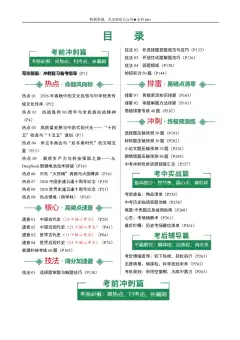
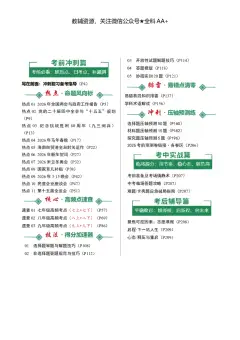
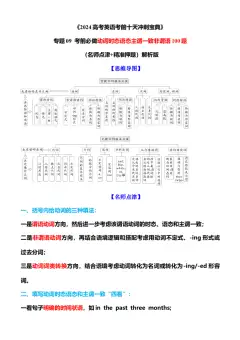
倒计时15 天
➤����
��
��……………………………………………………………….3
������
��
������������������
倒计时14 天
➤�����(�)(����+����+�� !+"#$%)…………………………36
������, !"#$%&��'()�*+,-.�/0123�45
倒计时13 天
➤�����(&)('()*++,+-+./01+ 234)…………………………64
������, !"#$%&��'()�*+,-.�/0123�45
倒计时12 天
➤�����(5)(6�78+9:;<+=>?@)…………………………...…………95
������, !"#$%&��'()�*+,-.�/0123�45
倒计时11 天
➤�����(A)BC��DEFGH�…………………………………………...…125
������, !"#$%&��'()�*+,-.�/0123�45
教辅资源,关注微信公众号★全科AA+
倒计时15 天
Rome wasn’t built in a day.
(Proverb)
����
��
��
IJKL--把脉命题 直击重点
►M�NOP
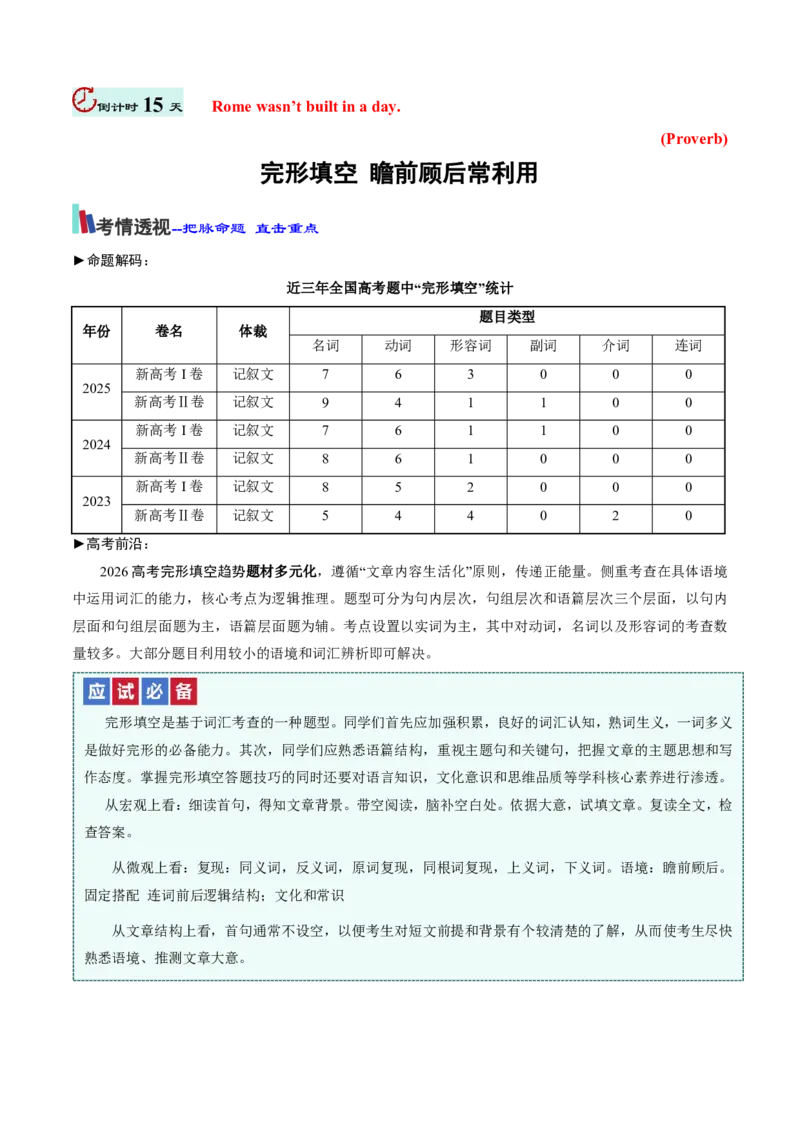
6789:;'��“<=>?”@A
��BC
8D
EF
�G
FH
IH
=JH
KH
LH
MH
N;' I E
OP�
7
6
3
0
0
0
2025
N;'QE
OP�
9
4
1
1
0
0
N;' I E
OP�
7
6
1
1
0
0
2024
N;'QE
OP�
8
6
1
0
0
0
N;' I E
OP�
8
5
2
0
0
0
2023
N;'QE
OP�
5
4
4
0
2
0
►QI
RP
2026 QI����ST�RSTU�VW“��XJYZU”[\�]^_4`abc'(de�fg
�hiHj�45�k�'�%lm*�a�Cno%pXqr�psqrtfuqr7vqw��pX
qwtpsqw�%x�fuqw�%ya'��z�{H%x�|�}IH�FH�~=JH�'(
`Sao��i�fgtHj
na
<=>?Hj'(��Ca��Hj �HY�HS
<=� 45a|r�¡fu¢£�c¤x�pt¥¦p�-.���x�§¨t�
�©ªa«.<=>?¬�®�¯°±}f0 ²��U3²t§³´µ¶·k�¸¹º»¼½a
�¾¿�ÀÁÂÃp�Ä ��ÅÆaÇ?ÈÃ�ÉÊ?ËÌaÍÎ3�Ï>��aÐÃ9��Ñ
(¬Òa
�Ó¿�ÀÁÐÔÁH�ÕH�[HÐÔ�ÖHÐÔ��H�×HafgÁØÙÚÛa
ÜÝÞß MHÙÛlm¢£à�Utá²
���¢£�À�pâáã�?��ä'Y}å�ÙætÅÆçv�è�é��êë'Yìí
¡fg,*î��3a
UVI�
I� 01 WXYZ
I�[\--核心精粹 高效速记
<=>?�¬Òïï�Ôd���ðvñò.ód��¯ô-õÔö÷%"ÐÔøù",<=>?
��øùÐÔ�ú"[HÐÔ,Hû/6HÐÔ,ÕHÐÔ,üýHÐÔtþHÐÔ¶. iÐÔø
ù,d;'�¯ôn�íÿ�.a
]�^_--复盘经典 把握规律
Āā 1Ă2024 N;'QEă
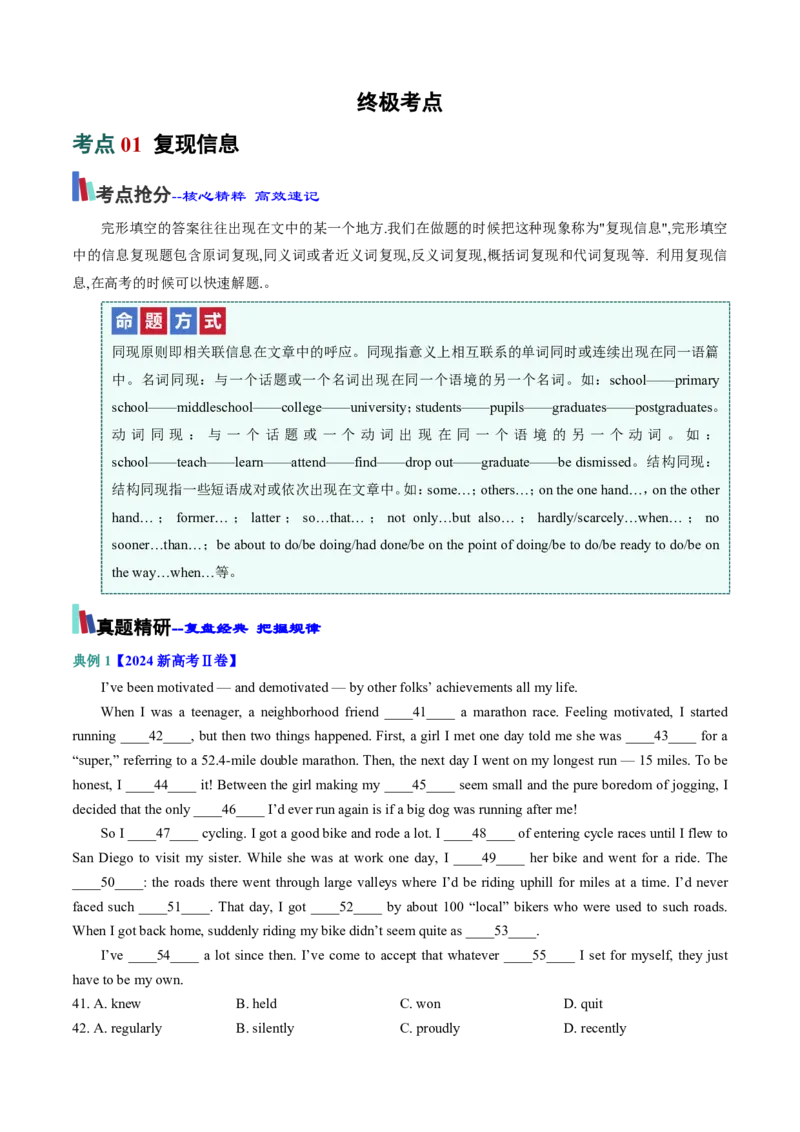
I’ve been motivated — and demotivated — by other folks’ achievements all my life.
When I was a teenager, a neighborhood friend ____41____ a marathon race. Feeling motivated, I started
running ____42____, but then two things happened. First, a girl I met one day told me she was ____43____ for a
“super,” referring to a 52.4-mile double marathon. Then, the next day I went on my longest run — 15 miles. To be
honest, I ____44____ it! Between the girl making my ____45____ seem small and the pure boredom of jogging, I
decided that the only ____46____ I’d ever run again is if a big dog was running after me!
So I ____47____ cycling. I got a good bike and rode a lot. I ____48____ of entering cycle races until I flew to
San Diego to visit my sister. While she was at work one day, I ____49____ her bike and went for a ride. The
____50____: the roads there went through large valleys where I’d be riding uphill for miles at a time. I’d never
faced such ____51____. That day, I got ____52____ by about 100 “local” bikers who were used to such roads.
When I got back home, suddenly riding my bike didn’t seem quite as ____53____.
I’ve ____54____ a lot since then. I’ve come to accept that whatever ____55____ I set for myself, they just
have to be my own.
41. A. knew
B. held
C. won
D. quit
42. A. regularly
B. silently
C. proudly
D. recently
Ô[\Ą¥ąøùd����ĆaÔć3�ĄĈąĉ�ĊH¯ûMċ�Ôdfu
�aFHÔÁČvč�ûvFH�Ôdvfg�ĎvFHaďÁschool——primary
school——middleschool——college——universityàstudents——pupils——graduates——postgraduatesa
I H Ô Á Č v č � û v I H � Ô d v f g � Ď v I H a ď Á
school——teach——learn——attend——find——drop out——graduate——be dismisseda¢£ÔÁ
¢£ÔćĐåfđ}ûÍr�Ôd���aďÁsome…àothers…àon the one hand…�on the other
hand… à former… à latter à so…that… à not only…but also… à hardly/scarcely…when… à no
sooner…than…àbe about to do/be doing/had done/be on the point of doing/be to do/be ready to do/be on
the way…when…¶a
43. A. asking
B. looking
C. waiting
D. training
44. A. made
B. believed
C. hated
D. deserved
45. A. advantage
B. achievement
C. contribution
D. influence
46. A. way
B. risk
C. place
D. reason
47. A. gave up
B. went on
C. turned to
D. dealt with
48. A. heard
B. dreamed
C. complained
D. approved
49. A. painted
B. borrowed
C. bought
D. parked
50. A. problem
B. secret
C. principle
D. advice
51. A. dangers
B. events
C. opponents
D. challenges
52. A. passed
B. convinced
C. admired
D. stopped
53. A. reliable
B. convenient
C. familiar
D. appealing
54. A. traveled
B. matured
C. missed
D. worried
55. A. limits
B. dates
C. goals
D. tests
fuÃ
¥¦H
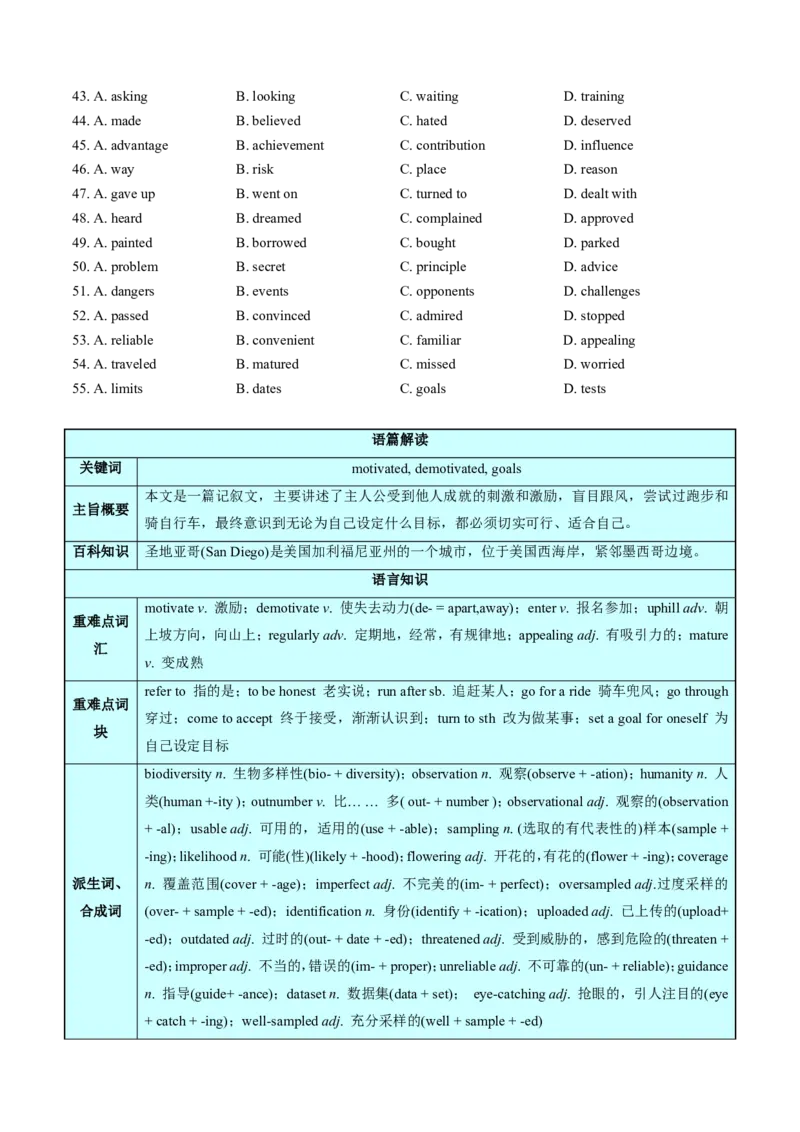
motivated, demotivated, goals
xĒü±
ē�uOP��x±ĔĕéxĖėĘęĚĖđě�ĜĝtĝĞ�ğ�Ġġ�ĢÏģĤĥt
Ħħ»Ĩ�ĩĪ3²ęīĬ%ħĭ�ÝĮį�İ�ıIJij{n»,Ĵ)ħĭa
ĵ· ²
Ķñķĸ(San Diego)Ĺ:ĺĻķļ�vĽľ�ĿĹ:ŀŁł�ŃńŅŀĸņga
f0 ²
c�H
j
motivate v. ĝĞàdemotivate v. ëňʼnI5(de- = apart,away)àenter v. ŊFŋàuphill adv. Ō
�ōòŎ�Ŏŏ�àregularly adv. ÝŐñ�őá�猜ñàappealing adj. çŔŕ5�àmature
v. Ŗđ
c�H
ŗ
refer to ć�àto be honest Ř{řàrun after sb. ŚśðĖàgo for a ride ĦĨŜġàgo through
ŝģàcome to accept ĪŞĘ�şş²ęàturn to sth Š%ðšàset a goal for oneself %
ħĭ�Ý�İ
ŢYH,
)đH
biodiversity n. YţSŤť(bio- + diversity)àobservation n. ¿Ŧ(observe + -ation)àhumanity n. Ė
B(human +-ity )àoutnumber v. ŧ… … S( out- + number )àobservational adj. ¿Ŧ�(observation
+ -al)àusable adj. ni��Ĵi�(use + -able)àsampling n. (Ũũ�çþŪť�)Ťē(sample +
-ing)àlikelihood n. n4(ť)(likely + -hood)àflowering adj. ūŬ��çŬ�(flower + -ing)àcoverage
n. ŭŮůŰ(cover + -age)àimperfect adj. ã<Ĺ�(im- + perfect)àoversampled adj.ģªűŤ�
(over- + sample + -ed)àidentification n. ŲD(identify + -ication)àuploaded adj. ų�]�(upload+
-ed)àoutdated adj. ģ¯�(out- + date + -ed)àthreatened adj. ĘęŴŵ��ŶęŷŸ�(threaten +
-ed)àimproper adj. ãŹ��źŻ�(im- + proper)àunreliable adj. ãnż�(un- + reliable)àguidance
n. ćŽ(guide+ -ance)àdataset n. Ξ(data + set)à eye-catching adj. ſƀ��ŕĖƁ��(eye
+ catch + -ing)àwell-sampled adj. ƂoűŤ�(well + sample + -ed)
ƃŇpo
Between the girl making my achievement seem small and the pure boredom of jogging, I decided that
the only reason I’d ever run again is if a big dog was running after me!
ĂƄƅăƆvƇƈƉóƊÄħĭ�đěÓãƋƌ��ƍĤƉóŶƊīƎ�óÝ�ÛƏƐã
Ĥĥé�ƑƒçƓƔŚƕóĤƖ
ĂoăpƗ�xƘ% I decided thataBetween ...and ... %LHåf�ƙf�|� making my
achievement seem small %ÔdoHåf�ÛzÝf�ƚƛ the girlàthat ŕŽ�Ɯf�p��the
reason (that) ... ŪƝ“……�[ƞ/�Ɵ”a
I� 02 `a$%�
I�[\--核心精粹 高效速记
<=>?'(�ě'Y}����45aƞƠ'Yd<=>?¯�-ơÀ�v3§
MƢ,¢£<ƣ�fu�êãĊƤ>?a�¯±ƥiƦpûƦĩƧªñƨũøùa<=>
?�pûÙƩpčƪı<ƣ��%'YæƫƋƬ�øùʼnƭƮ���§Ư�êư�õƱïïú"x
�p�%���3tx±XJæƫ±�#$aƠ1�<=>?eç<ƣXJưƲƳݧƯ�ƴ
����ƵƦ~Ƶp2ƶıçlm��Ʒąĉ�ƞƠ°±Ɓ3-.���ƴ�ē#$�Ƹ�ƦČƦ,
pČp2ƶ�lm¥ĉa
]�^_--复盘经典 把握规律
bc 2【2024 新高考卷Ⅱ】
When I decided to buy a house in Europe ten years ago, I didn't think too long. I liked traveling in France, but
when it came to picking my favorite spot to ___21___, Italy was the clear winner.
During my first visit to Italy, I ___22___ to ask for directions or order in a restaurant. But every time I tried to
___23___ a sentence of Italian together, the locals smiled at me and ___24___ my language skills. That
encouragement helped me to get through the language ___25___. After I made Italy my permanent home, I
'Y±ƹƺƻfuüƼ��
��x�§¨���|¢£ƽƾ� �
pƗ2ƶ�~Ʀƿ2ƶ
�¥ĉ�ipČp,pǀČpǀ2ƶ�lm¥ĉ�apƗ2ƶ�lm¥ĉx±úýÁǁǂ¥ĉ(M
ŞHç and�while ¶)àǃDŽ¥ĉ(MŞHç but�however�whereas�nevertheless ¶)àƞDž¥ĉ(MŞH
ç so�therefore�thus�because, for�since�as ¶)àƉĥ¥ĉ(MŞHûåfç though�although�despite,
in spite of ¶)àdžLJ¥ĉ(MŞHûåfç if�unless, once�provided that�in case of ¶)àLj¥ĉ(MŞ
Hûåfç i.e.�that is to say, in other words ¶)à��¥ĉ(MŞHç before�after�and�first�second�
then�next, finally ¶)a
<=>?�pƗX,pČp2ƶ�~Ʀƿ2ƶïïıljdÝ�lm¥ĉ�çĐ��ě'(õ
Đlm¥ĉ�ƞƠn�NJNjǁǂMHt�njMH¶ŪƝlm¥ĉ�İǍH����×�lm¥ĉ�íÿ
�a
discovered how ___26___ Italians are. Neighbors will bring me freshly made cheese and will come to my door to
___27___ me to close the window in my car when rain is coming. It's these small ___28___ of kindness that make
a new country feel like home.
As a foodie, the way to my heart is through my stomach, and nowhere fuels my ___29___ quite like Italy.
Each town has its own traditional ____30____, and every family keeps a recipe passed from one generation to
another. Families ____31____ for big meals on Sundays, birthdays, and whatever other excuses they can
____32____. These meals are always ____33____ by laughter and joy. Whatever ____34____ life in Italy might
have, the problems are ____35____ once you sit down to a big meal with friends and family.
21. A. study
B. rent
C. visit
D. settle
22. A. planned
B. struggled
C. refused
D. happened
23. A. string
B. hang
C. mix
D. match
24. A. improved
B. assessed
C. admired
D. praised
25. A. course
B. barrier
C. area
D. test
26. A. open-minded
B. strong-willed
C. warm-hearted
D. well-informed
27. A. remind
B. allow
C. persuade
D. order
28. A. tricks
B. promises
C. acts
D. duties
29. A. ambition
B. success
C. appetite
D. growth
30. A. costume
B. dish
C. symbol
D. tale
31. A. gather
B. cheer
C. leave
D. wait
32. A. put up with
B. stand up for
C. come up with
D. make up for
33. A. signaled
B. confirmed
C. represented
D. accompanied
34. A. disadvantages
B. meanings
C. surprises
D. opportunities
35. A. created
B. forgotten
C. understood
D. identified
fuÃ
xĒü±
ē�uOP�a��x±Ĕĕé�/ǎ8ÙŨǏd3Ýǐ�[ƞ�~3�ġǑĖ
ǒa
f0 ²
c�Hj
1. spot - ñ�àǓ�à���Ô(v)
2. permanent - ǔǕ�àǖǕ�
3. cheese - Ǘǘ
4. foodie - ĹǙǚàǛǜ
5. assess - ǝǞàǝÝ
6. barrier - ǟǠàǠǡţ
7. open-minded - §¨ū��à�Ǣūǣ� 8. strong-willed - 3ǍǤ�àç��
9. warm-hearted - ǥ�Ǧ�àǥǒ�
10. well-informed - ǧS²Ǩ�àǩùǪâ�
11. persuade - řǫàǬř
12. trick - -ǭàǮAàǯǰ(n/v)
13. ambition - DZ�àDzdz
14. appetite - ǙǴàǵǶ
15. costume - ǫǷàǭǷ
16. signal - øǸàǹƝ(v)
17. confirm - �àǺ{
c�Hŗ
1. put up with - ǻĘàJǻ
2. come up with - ¨�àæ�
3. stand up for - ³Ǽàǽǖ
4. make up for - ÊǾàǿÊ
c�pC
1. When it came to picking my favorite spot to settle, Italy was the clear winner. ȀŹȁęŨǏó
ĩȂȃ�Ýǐñ�¯�3ȄƷȅǚa
2. But every time I tried to string a sentence of Italian together, the locals smiled at me and praised
my language skills. óÏƕ-v3fpƗȆdƻ�ŹñĖ}óÓȇ�÷Ȉó�f04a
I� 03 dJef�
I�[\--核心精粹 高效速记
;'�<=>?±ȉYȊ)'ȋ���ȌȍȎÄŹ,fpȎâ�t�×��fgȎȏ¶aõ
ĐááČHf�ŶǒȐȑĄ¥aHf�ŶǒȐȑúýȒ�aȓ��ǩȒ�û/Ȕt�ť���ȕ�
/ȖiHj�ŶǒȐȑ�ȗȘ�/�§¨tŶǒ�çNjș�aÖÎ�×�fg�ĩái�òȚa'
Yd�¯±ç9ƾ¿Ƽ�º»MƢť§³��¯±-țv?ËÌ�"ČÙÛp�3§ąĉƻȜ��
º»)ȝlm�*�Ȟ+aŇŨ2ÌÙÛâáSçǹƝ�õǹƝS%ÛwǹƝÙwa
]�^_--复盘经典 把握规律
Āā 3Ă2026 ȟȠ 1 ȡă
Ursula has always called the beautiful small town of Beaverton her home. Although she’d had childhood
____21____ of exploring the world and studied international business with a desire to pursue a ____22____ in
Toronto, finding a job proved more ____23____ than she’d expected.
“I decided that if nobody was going to ____24____ me, I would just create a job for myself,” says Ursula. She
was born and raised on a large family farm, so the ____25____ of an agriculture tourism business came naturally to
her and began to ____26____.
“I ____27____ the plan to my family, and asked if they could rent me a small 10 acres (Ȣȣ). They ____28____
at first, unwilling to take a risk, but I finally ____29____ to get the green light,” she says.
Four years later, those beautiful 10 acres of fields had turned into 20 acres filled with over 400,000 sunflowers.
“____30____, I had little confidence in the beginning,” says Ursula, "but the Sunflower Farm rose to fame and has
áǧ�ŪƝȒ"�Hç: proud, confident, comfortable, independent, generous(Ȥȥ�), inspiring(Ȧȧ
Ė��) thrilled Ȓ%ĝI�), hopeful(ȨȩȪȫ�), enjoyable(ȬĖȭí�), thankful(Ŷĝ�), brilliant(Ȯ��/
ȯ Ȱ ȱ Ȳ � ), delighted( ; ȳ � ), optimistic( ȴ ¿ � ), considerate( � ȵ � ), admirable( Ȭ Ė Ĺ ȶ � ),
respectable(ȷÄȸȹ�)a
ŪƝǩȒ"�Hç:boring�terrible, uncomfortable, ashamed(ȺȻ�), unsatisfactory(ã4ȬĖȨ3�),
helpless(īNj�), unfortunately(ãȼñ), disturbing(ŕƻȽȾ�), annoying(ëȾȿ�), disappointing(ȬĖňȫ
�), awful(ɀɁ�), inactive(ãZɂ�), ungrateful(ɃɄdz�), dull īƎ�), impatiently (ãɅȽñ)a
become one of the most sought-after ____31____ in the province.”
While many visitors have never been to a farm at all, ____32____ a sunflower farm, the unique setting allows
them to ____33____ the city for a while, breathe in the fresh air, gain a newfound ____34____ for agriculture, and
maybe even ____35____ with their farming roots and what they may have taken for granted for too long.
21. A. stories
B. needs
C. habits
D. dreams
22. A. career
B. degree
C. hobby
D. project
23. A. practical
B. important
C. difficult
D. dangerous
24. A. invite
B. notice
C. hire
D. cover
25. A. issue
B. idea
C. truth
D. founder
26. A. gain ground
B. take root
C. work wonders
D. raise concerns
27. A. proposed
B. adapted
C. preferred
D. proved
28. A. apologized
B. refused
C. panicked
D. regretted
29. A. pretended
B. returned
C. promised
D. managed
30. A. Supposedly
B. Admittedly
C. Similarly
D. Consequently
31. A. occupations
B. solutions
C. institutions
D. destinations
32. A. let alone
B. except for
C. such as
D. regardless of
33. A. miss
B. leave
C. seize
D. tour
34. A. demand
B. support
C. appreciation
D. excuse
35. A. deal
B. part
C. compete
D. reconnect
fuÃ
xĒü±
ē�uOP�a��ĔĕɆɇɈȉɉã�Û�¢)ɊɋđƃÅÆɌYɊɍɎɏɐɍ¨Ț�
řǫǚĖÛɐɑŎɒɓɊɋ�ɊɋđFđǥɔ��ñ�°ƉɏɕŶĘɊɋɖ5,cɗɊɘą¢a
f0 ²
c�Hj
1. explore v. ə$
2. desire n. Ȫȫ�ɚȫ
3. pursue v. Śȉ
4. expect v. Őȫ
5ɛrent v. �ɜ
6. unwilling v. ãɚ3�
7.raise v. ɝ
8ɛunique adj. ɞ���ɞīɟ�
c�åf
1take a risk ɠŸ
2.turn into ǃŖđ
3. have confidence in dɡɡçø� 4. take sth. for granted -ɡɡ¨ŹƷ
I� 04 ghijkl�mn
B�
I�[\--核心精粹 高效速记
Ȣff0��ɢSHjɣ�åfÞß�=ɤ�Ô�<=>?��HjƐãā1aɢS¯ô�dof
g,��?ËÌ"�ɥ��i}HjÙÛÞß�on�íÿ,ɦ�ñ*+<=>?�ɧ øùa
ɨ�U§'3²�ȢfɩNɪɫİɦɬ�±ȉ�ēɦ\2aƞƠ'Yd 'ģɫ��ɭç
3²ñiç¥ɮɯ�ďDž'Y«.éɰɱ��UÅÆ ²tYZá²�ěe éÝ�Ȟ+45�n�
ɲUÐɳ�oģɫtȞ+ģɫaõě±ȉ'Yɴ¯ɵ±S�ɶYZ�ɷ±ɸÈÃw�ɹħĭõ
òw� ²ɺ �ɻɼá²ťźŻa¯�°±Ɓ3�ŀò�U�ɽɾ�ɻɼ�ÔɿfɤŪʀû�a
<=>?�ȖŨ���SeçÝʁšǒʂtʃʄ3�OP��õĐfuıƒáȵ6Y�YZ�
ʅ~ɒáYZá²�Ï�ědȖŇɼaȖ�'Yd�¯�n�ÖÎõĐá²�_�ŨǏa
]�^_--复盘经典 把握规律
Āā 4Ă2026 ʆʇʈą'ă
It was late afternoon that day, yet still hot. While I was driving north, I saw an elderly woman with groceries
41 southward, obviously in need of help. I felt guilty for not stopping.
“But how can I safely stop without blocking late-afternoon traffic?” I 42
. This thought eased my guilt
43 . Yet I still made a U-turn, which
44 other drivers. I stopped by the woman, asking, “Need a ride?”
“Bless you,” she said,
45 me farther south. As we drove, darkness fell. I grew 46 when entering a
place with 47
streets and homeless people. At her apartment, a young man, wearing long hair, on a
motorcycle, was smiling at me, but appearing threatening. I quickly
48 her things, and then quickly drove
away.
Soon, a motorcycle roared behind me. It was that young man! Anxiety rose from my mind. I
49
my
phone to call 911, only to find it gone. “She stole it!” I thought, 50
my act of kindness. The biker kept
51
me to stop, waving something—my phone!
I pulled over, and he handed me the phone: “Grandma sent this—she took it 52
. ” He was still
smiling and soon disappeared into the night. I never had a(n) 53
to say I was sorry for my thoughts.
I learned something else that day: Sometimes we judge people as bad just because their
54
doesn’t
match what we think is right. They may not drive a stylish car, but who is going to say they are not
55
to
us or even nobler?
41. A. glancing
B. running
C. struggling
D. riding
42. A. complained
B. reasoned
C. confirmed
D. doubted
43. A. occasionally
B. completely
C. gradually
D. temporarily
44. A. annoyed
B. discouraged
C. disappointed
D. inspired
45. A. urging
B. directing
C. driving
D. leaving
46. A. sensible
B. mindless
C. uneasy
D. curious
47. A. messy
B. orderly
C. safe
D. busy
ȖʉÙÛÞßx±ćIH(FH,=JH¶)ČLH�Þß,IHČ|Ɯf�Þß,pɤ¢£tƵ
ʊʋÞßad¬<=>?�¯�Ƃo'ȋõĐÞߥĉa
éĐç¥�ŀò�Uɽɾ� ²Ȝ<ƥħĭ� ²ĉ@a<=>?��ç¯ě¼½ƕĄ¥��
ď·,ʌʍ,�U,ġʎʏǒ¶òw� ²a
教辅资源,关注微信公众号★全科AA+
48. A. unloaded
B. unpacked
C. carried
D. fetched
49. A. plugged in
B. picked up
C. held on to
D. reached for
50. A. recalling
B. mourning
C. regretting
D. appreciating
51. A. warning
B. signaling
C. forcing
D. begging
52. A. in advance
B. in secret
C. by accident
D. at random
53. A. attempt
B. honour
C. motivation
D. chance
54. A. behavior
B. appearance
C. perspective
D. personality
55. A. generous
B. friendly
C. loyal
D. equal
fuÃ
xĒü±
ē�uOP�a��Ĕĕé�/ʐʑʒ&éƯņ�ĿŘʓĖ�ƞ}ʔŰʕgtŘʓĖ
�~ʖ�ʗƗ�1Ūê�Yʘ ad�Ôʙʚãǧé¯�Ż�%ŘʓĖʛʜʙʚaÛȜʖ�ʗ
Ɨƥ3ʝ°�ĩĪʞʟęãɭ�1ŪǝȞĚĖa
f0 ²
c�Hj
1. elderly adj. Ř8�
2. obviously adv. Ȅêʠǧñ
3. block v. ʡʢ
4. ease v. ʣʤ
5ɛhomeless adj. īǚnʝ�
6. unwilling v. ãɚ3�
7. threatening adj. l ȬĖʥʦ�
8ɛunique adj. ɞ���ɞīɟ�
c�åf
1 in need of ʧ±
2.feel guilty for }ɡɡŶęȻʨ
3. drive away śʩ�ʪëðĖʫū
UVop
UVop--压轴实战 稳拿高分
A
(2026 ʆʬʭʮʯľ;�;7ɟʰ'Ï)Molly Burke was diagnosed with a progressive eye problem at a
young age. Despite early treatment and hope for recovery, her vision continued to ____1____ day by day. By the age
of fourteen, she had completely lost her sight, ____2____ her into endless darkness.
What made her ____3____ even worse was that she endured cruel bullying from some classmates who once
claimed to be her friends. They laughed at her ____4____, isolated her, hurting her deeply. ____5____ with sadness
and hopelessness, Molly felt worthless, wondering if she had any ____6____ in life.
However, things took a turn after high school. She took part in a humanitarian(Ėƌx�) ____7____ to
Africa, helping build a school for poor children. ____8____ with disadvantaged girls who faced poverty and
inequality, she realized many people faced greater ____9____ but remained strong. Inspired, she found her new
____10____ for life. She decided to change her pain into ____11____ to help others.
Later, Molly, ____12____ as a world-famous motivational speaker gradually, traveled around the globe, shared
her story and motivated those sufferers to be ____13____. She taught audiences — hardship does not define identity;
their response does, though.
Molly lost physical sight but gained spiritual vision. Adversity can be a stepping stone to growth and
____14____. Even in life’s darkest moments, we can ____15____, find inner strength and light the way for others.
1. A. develop
B. decline
C. narrow
D. disappear
2. A. forcing
B. guiding
C. sinking
D. turning
3. A. spirits
B. suffering
C. disease
D. future
4. A. disability
B. shortcoming
C. mistake
D. disadvantage
5. A. Dissatisfied
B. Bored
C. Overwhelmed
D. Unsurprised
6. A. meaning
B. space
C. interest
D. energy
7. A. meeting
B. party
C. mission
D. competition
8. A. Living
B. Playing
C. Working
D. Interacting
9. A. difficulties
B. confusions
C. pressures
D. failures
10. A. direction
B. lesson
C. idea
D. award
11. A. success
B. power
C. charm
D. luck
12. A. behaving
B. preparing
C. emerging
D. leaping
13. A. diligent
B. tough
C. calm
D. honest
14. A. greatness
B. acceptance
C. happiness
D. popularity
15. A. speed up
B. wake up
C. show up
D. rise up
B
(2026 8ʱʲǔļľ;'ʳ7rʴʵ'Ï)In the early 1990s, Holly Deiaco - Smith, aged 19, boarded a plane
at JFK airport in New York to study in France.
However, ____1____ day-to-day life there was much harder than expected, especially when it came to speaking
French. “I could understand the language, but my ____2____ was terrible.” Holly said. Constantly fighting to be
____3____ was emotionally exhausting, and she had little hope for the rest of her year. The only thing getting her
through was the ____4____ that a care package from home was on the way.
Holly had to go to the post office to ____5____ the package. But the ____6____ there didn’t speak any English
and couldn’t understand Holly’s accent when she spoke in French, The more she repeated herself, the more
____7____ she got. She was about ready to break down in ____8____, when in walked an unsung hero — Chantal
Jouve. She ____9____ in and said to Holly in English, “Can I help you?” Within two minutes, the ____10____ was in
Holly’s hands. ____11____, Chantal even invited Holly to her house for dinner the following Sunday.
From then on, it became a ____12____ thing every Sunday for them to have dinner together. Holly no longer felt
frustrated when practicing French, and truly felt ____13____ there. Decades later, Holly and Chantal still
____14____ cards every Christmas. “She has shaped my life, inspiring me to care for ____15____ in need.” Holly
shared.
1. A. imagining
B. managing
C. describing
D. controlling
2. A. accent
B. grammar
C. tone
D. rhythm
3. A. understood
B. accepted
C. recognized
D. trusted
4. A. doubt
B. knowledge
C. regret
D. assumption
5. A. deliver
B. check
C. weigh
D. collect
6. A. visitor
B. customer
C. clerk
D. cleaner
7. A. frightened
B. astonished
C. bored
D. frustrated
8. A. relief
B. tears
C. shock
D. ruins
9. A. stepped
B. looked
C. broke
D. settled
10. A. letter
B. giveaway
C. package
D. ticket
11. A. Hopefully
B. Gratefully
C. Secretly
D. Kindly
12. A. regular
B. private
C. temporary
D. complicated
13. A. on edge
B. off balance
C. at home
D. under fire
14. A. craft
B. exchange
C. purchase
D. distribute
15. A. relatives
B. colleagues
C. officials
D. strangers
C
(2026 ʆŏʶʈɒƳľ 4 ȡ7ʴ;7ʴʵ'Ï)In the middle of 2017, overwhelmed by the stresses of living
and working in London, Jessica Robson began returning every weekend to her parents’ home in East Sussex, where
her mum would ____1____ her out for Sunday runs. “I found I was____2____ far more when running with my mum
than I was in my therapy(ʷʸ) sessions in London,” she recalls.
By autumn she had the ____3____ to see if there were others who wanted to use running the way she did — as
a____4____ space to talk about mental health. A callout to friends was met with ____5____, so she called the idea
Run Talk Run and started asking ____6____ on the internet instead.
____7____, Robson would wait near London Bridge every Thursday evening with a 5K in mind. As a small
____8____developed, she moved the base to a gym in Southwark, and developed some ____9____: run as slow as the
slowest runner and be there to ____10____, not advise; it’s friend-to-friend support, not ____11____ help. Robson
stresses she is neither a therapist nor a running ____12____.
In 2018, Jennie Oliver____13____Run Talk Run on Instagram and asked Robson if she could set up a second
group in Peterborough. It has carried on ____14____that way. Run Talk Run now includes 150 volunteer-led groups
worldwide. “It’s so ____15____ to watch others speak freely and become more confident,” Robson says.
1. A. drag
B. leave
C. pick
D. send
2. A. going through
B. asking for
C. taking in
D. opening up
3. A. reason
B. option
C. strength
D. courage
4. A. familiar
B. safe
C. rare
D. quiet
5. A. enthusiasm
B. criticism
C. silence
D. praise
6. A. colleagues
B. partners
C. strangers
D. fans
7. A. Instantly
B. Initially
C. Eventually
D. Temporarily
8. A. audience
B. following
C. population
D. family
9. A. guidelines
B. interests
C. orders
D. theories
10. A. learn
B. run
C. listen
D. compete
11. A. financial
B. emotional
C. moral
D. professional
12. A. coach
B. athlete
C. organizer
D. sponsor
13. A. promoted
B. found
C. upgraded
D. tracked
14. A. surviving
B. sharing
C. growing
D. exploring
15. A. pleasant
B. fortunate
C. appealing
D. memorable
D
(2026 ʆʹʲSʺ;7×Ő 4 ȡą'ʴʵʻî)As children returned to school in Sweden last month, many
of their teachers were putting new importance on some traditional skills. These included reading printed books, quiet
reading time and ____1____ practice. Teachers were spending ____2____ time with digital devices, online research
and typing skills.
The return to traditional ways of learning might be the ____3____ to criticism about dependence on electronic
technology in education. Critics ____4____ that students are not learning basic skills with the introduction of
tablets(ɴʼʽÉ) in schools. They also claim that physical books are ____5____ for student learning.
According to an international test, compared with other European countries, Sweden’s children ____6____
below average in 2023. This could partly ____7____ an overuse of electronic devices during school lessons, which
might cause kids to fall behind.
Digital learning tools in schools have ____8____ drawn widespread concern. There has been clear scientific
evidence that digital learning tools harm rather than ____9____ student learning. Moreover, information from digital
sources may not be ____10____.
Parents always ____11____ that their children are spending too much time staring at screens, which they believe
can lead to ____12____ problems as well as neck and back strain(Ɉʾ). They also fear that the constant ____13____
to digital distractions may weaken their children’s ability to focus and learn effectively.
In response, schools begin to carry out policies and practices that ____14____ to reduce screen time and
promote more ____15____ learning environments.
1. A. pronunciation
B. teaching
C. handwriting
D. translation
2. A. less
B. better
C. more
D. worse
3. A. access
B. answer
C. topic
D. ability
4. A. admire
B. deny
C. object
D. argue
5. A. essential
B. interesting
C. demanding
D. secondary
6. A. sought
B. advanced
C. cheated
D. scored
7. A. lead to
B. rule out
C. result from
D. focus on
8. A. only
B. even
C. still
D. seldom
9. A. soften
B. rescue
C. enhance
D. track
10. A. accurate
B. specific
C. global
D. official
11. A. approve
B. complain
C. regard
D. pretend
12. A. hearing
B. heart
C. sight
D. mind
13. A. resistance
B. addiction
C. commitment
D. exposure
14. A. refer
B. aim
C. suit
D. agree
15. A. balanced
B. diverse
C. severe
D. stable
E
(2026 ʿˀʈˁ˂ľˁ˂Fʺą'ʴʵʻî)I wasn’t looking for another dog, but this dog was looking for
me. Her ____1____ owners gave her up when she broke her leg and needed an amputation(˃˄). She was sent to the
shelter after being ____2____. I took her home and ____3____ she got medical care.
I was so anxious during her amputation ____4____ that my son suggested naming her Ilean to ease the tension.
It worked, and the name ____5____. We called her Ilean from that day on. Initially, I worried her ____6____ would
hold her back, but she adapted gracefully.
Still, her physical challenges aren’t the most ____7____ thing about her. Her real talent lies elsewhere — she
can ____8____ over 20 TV ads by sound, and comes racing when she hears them. Some food and pet product ads are
her ____9____.
But her ____10____ extend beyond the living room. Ilean ____11____ at the local medical center, where her
company can ____12____ the patients’ mood. However, she did something unusual one day. She paid little attention
to the patient, but ____13____ the woman nearby — the patient’s visiting sister. Both women were teary-eyed. The
patient said, “I’m going to be fine, but my sister is ____14____ ill.” Ilean knew exactly who needed her most in a way
none of us could explain.
Ilean proved that ____15____ has nothing to do with having all your parts. She came to me broken, yet spends
every day making others whole.
1. A. perfect
B. original
C. responsible
D. greedy
2. A. abused
B. ignored
C. checked
D. abandoned
3. A. monitored
B. ensured
C. confirmed
D. assumed
4. A. procedure
B. recovery
C. performance
D. examination
5. A. failed
B. passed
C. stuck
D. changed
6. A. curiosity
B. disabilities
C. mistakes
D. depression
7. A. popular
B. powerful
C. remarkable
D. meaningful
8. A. design
B. create
C. choose
D. recognize
9. A. goals
B. friends
C. favorites
D. memories
10. A. talents
B. dreams
C. skills
D. qualities
11. A. arrives
B. waits
C. lives
D. volunteers
12. A. brighten
B. deepen
C. sharpen
D. strengthen
13. A. calmed down
B. picked up
C. looked after
D. focused on
14. A. hardly
B. suddenly
C. seriously
D. slightly
15. A. bitterness
B. wholeness
C. happiness
D. loneliness
F
(2026 8ŏŀ˅ˆľ;78ˇµ`ˈˉʳɟrʴʵîÏ)Everything changed when the food author and TV
presenter Shivi Ramoutar stopped trying to please others.
Aged six, Shivi moved to a small British village from Trinidad, a Caribbean island. “I wanted to ____1____ and
worked at being as British as possible,” she recalled. Her true ____2____ then was music and she dreamed of being a
singer-songwriter. But Shivi felt ____3____ due to her parents’ sacrifices to get her a “real job” that offered stability.
So she became a lawyer. She hated it, but her mum ____4____ her to keep going. She stayed in the job until she lost
it. This unexpected change proved a(n) ____5____: she found comfort making ____6____ from her birthplace and
made it her focus.
But a(n) ____7____ came. After years of changing her accent to fit into British culture, she faced ____8____ for
“not being Caribbean enough”, and it ____9____ her when people said she could not be an authority on her native
cuisine. She ____10____ the criticism to progress as a food writer. But the burden of trying to ____11____ everyone
became too much.
While pregnant with her third child three years ago, she sought therapy and it made her think ____12____. “You
can’t change overnight,” she said. “But now I’m guided by my own decisions and care ____13____ about the views
of others.”
Now at 41, it finally ____14____: I don’t want my kids and me to feel under pressure to conform(��) to what
society or others demand of us. I’m proud of my unique heritage and accent — I’m my authentic self now. It is
massively ____15____.
1. A. fit in
B. show off
C. give in
D. speed up
2. A. career
B. passion
C. habit
D. talent
3. A. grateful
B. pressured
C. relaxed
D. upset
4. A. forbade
B. reminded
C. urged
D. warned
5. A. mission
B. joke
C. excuse
D. blessing
6. A. laws
B. books
C. food
D. money
7. A. challenge
B. opportunity
C. phenomenon
D. truth
8. A. barriers
B. failure
C. mistakes
D. criticism
9. A. inspired
B. defined
C. hurt
D. fooled
10. A. rejected
B. expected
C. swallowed
D. highlighted
11. A. forgive
B. tolerate
C. guide
D. please
12. A. differently
B. negatively
C. randomly
D. wildly
13. A. more
B. less
C. still
D. merely
14. A. clicked
B. occurred
C. emerged
D. worked
15. A. demanding
B. freeing
C. disturbing
D. entertaining
G
(2025-2026 8Ƞŀˊļǎʇˋľɟǎʬʺ;7×ŐŐ�ą')When I was in middle school, my home
life was terrible. I won’t go into ____1____ but let’s just say I spent as much time as possible anywhere but home. I
basically lived at the public library. The ____2____, Mrs. Chen, noticed.
She never ____3____ invasive questions. And she never made me feel like a burden. Deep down, I was always
____4____ about taking up her precious time and energy. She just made sure I always had a quiet place to sit and
books to ____5____. Sometimes she’d leave snacks on the table where I was sitting, just ____6____. Like she left
them there.
One day she asked if I liked writing. I said yes. She started giving me ____7____. Nice ones. She said the library
was getting rid of old stock and asked if I ____8____ them. I learned years later that there was actually no old stock at
all. She ____9____ those journals herself. Mrs. Chen gave me a ____10____ place when I had nowhere else to go.
She saw a struggling kid and decided to help without making me feel like a ____11____ case.
I’m in college now studying to be a teacher. I think about her constantly — about how much power we have to
change a kid’s life just by ____12____ and caring. I wrote her a letter last year telling her how much she ____13____
to me. She wrote back and said she always knew I’d do something ____14____. I’m going to be like her and to be the
adult who ____15____ the struggling kids and does something about it.
1. A. topics
B. details
C. forms
D. policies
2. A. owner
B. manager
C. librarian
D. agent
3. A. ignored
B. missed
C. caused
D. asked
4. A. worried
B. curious
C. enthusiastic
D. nervous
5. A. write
B. find
C. read
D. choose
6. A. cautiously
B. casually
C. joyfully
D. contentedly
7. A. pictures
B. pens
C. poems
D. journals
8. A. counted
B. matched
C. wanted
D. checked
9. A. purchased
B. made
C. released
D. painted
10. A. basic
B. new
C. key
D. safe
11. A. book
B. welfare
C. charity
D. service
12. A. rolling in
B. showing up
C. getting around
D. trying out
13. A. meant
B. said
C. added
D. reacted
14. A. stable
B. rigid
C. alone
D. special
15. A. trusts
B. sees
C. likes
D. adopts
H
(2026 ʆʿˀˌǚǶľʳɟ�;7×ŐɟʴÑî)Growing up in a refugee family, I was raised to deal
with strangers with caution. Being ____1____ the unfamiliar was my parents’ way of ensuring we stayed ____2____
in a world that wasn’t always welcoming.
Last year, I took my first trip to Sheffield to meet my friend Esme. One afternoon, while waiting in line at a
coffee shop, we were approached by a(n) ____3____ couple. The part of me raised on suspicion immediately
____4____. They ____5____ that they were supposed to be getting married that day, but had____6____ their first
appointment at the register office because of train delays. Though they had managed to reschedule, they now had no
____7____ for the ceremony.
____8____, they asked us if we would like to attend their ceremony. Even though I usually don’t ____9____
strangers easily, the couple’s sincerity made me ____10____ my habit of being suspicious. So we abandoned our
plans and accepted their ____11____.
The ceremony was quick and private, and to my ____12____, I found myself moved to tears on several
occasions. As the couple exchanged vows, I began to question my long-held instincts to keep ____13____.
To me, their trust in us to witness one of the most significant moments of their lives was an act of ____14____.
They had no guarantees, just a belief in human ____15____—and somehow, that faith was rewarded.
1. A. alert to
B. afraid of
C. concerned with
D. curious about
2. A. healthy
B. safe
C. calm
D. positive
3. A. shy
B. happy
C. anxious
D. enthusiastic
4. A. faced
B. deepened
C. awakened
D. arrived
5. A. explained
B. proved
C. admitted
D. argued
6. A. made
B. ruined
C. canceled
D. missed
7. A. guests
B. relatives
C. hosts
D. witnesses
8. A. Hopefully
B. Desperately
C. Immediately
D. Undoubtedly
9. A. help
B. meet
C. trust
D. follow
10. A. defend
B. forget
C. regret
D. overcome
11. A. challenge
B. arrangement
C. advice
D. invitation
12. A. surprise
B. relief
C. delight
D. satisfaction
13. A. focused
B. guarded
C. isolated
D. alarmed
14. A. bravery
B. sympathy
C. selflessness
D. generosity
15. A. honesty
B. potential
C. kindness
D. wisdom
倒计时14 天
Success is a journey, not a destination.
(Proverb)
�� (�) (����+����+�� !+"#$%)
IJKL--把脉命题 直击重点
►M�NOP
q5r 2023-2025 QI]�Gs�
č�
Test
2025 N ; ' I
E
2025 N;'
I E
2024 N ; ' I
E
2024 N;'Ⅱ
E
2024 N;' I &Ⅱ
E
Test 1
ÚɕˍŊ»ˎ
ˏň
ːƯ
ʚɋˑ˒˓
˔ ˕ ţ ź ģ
ȯ˖Ū˗
ʔ˘ZI˙˚
Test 2
˛ɍʼnŎ
˜˝˞Ċ
ȁĬȩ˟ˠˡ
ˢėˣ
ˤȉƳÀ»ˎ
Test 3
˥ǚŨǏ
˞ʽÉ
ã4ŋ¿˖˦
ƴ
˧ Ĭ ʔ ˘ A
˨
A˨əȫ˩Ė
Test 4
˪r˫ˬ�ɶ
Ȗ˭ɍˮ
ȁ
˯Šßˑ¯ƶ
˰˱˲ˤ
ƞ˳ź˴êƌ˵
Test 5
Ư#ŨǏ
ƚ�ʙŪ
źģ˶Ĩ
À˷˸˹
A˨˺ˑ˻˷
Test 6
ʺ˼˽˾ÿ
˲ˤ˿˓À
ǭ̀
ȁĬ́̂
ʐ̃̄
ȉ̅
Ų̆̇
*̈
ǧw¯ƶ
Test 7̉̊
Ėǁ˲
ˤ̋
˜
ʺƧ̌
i
ʙʚ
˧Ĭ˥ǚÛ�
YZ
ʻ̍
ʒ ˜̎
Ŀ̏
Ş˿˓Ȝ̐
Test 8
ə˧ʽ¤ʂ�
ŨǏ̑
ȴZ
I
�òɤ�Ŗ
U
ɪ ɫ Ƥ � o
s
ʔ˘ZI
Test 9
ʺǫ̒
Ƥ�
L̓̔
âʫɉ3
Ŏ
ű̐
ˣ˖̕
x
˲ ˤ ŋ ̖
ȴȕ
ȁĬ̗
YZ
Test 10
i˖˦]̘̃
ôŖU̙
Ȭ̚
L̓
L̓
�ư̈̌
Ė đ̜̝̞
*̟̍
ÈɳǍ
►QI
RP
�678N;'̠
5ȜÀ�ʻî 2025 8;'ȕ̡
�̢̣
ǒgU,YZU,̤
{UàRɯȜ̥
{̦
Y
Z�ʅ~ęÔ{YZ�Svòw�ďɒáYZ,�Uʃʄ,]ř,¯š,Ėţ,·̧
¶a}čƪŲ̋
vɒáYZ�č�ƴūaďÁ˕ţ,˞̩
,ƌ˒,Ŷ̪
,̢
ʽč,̫
ȕ,̬̭
,̮
ɚt̮̯
,æƫ̰
Nj,
ˤȉ,ːƯ,À˩,ȉ̱
¶aå�o̲
|¥ƁYZőʌ,ĖYőʌo̳
à̴
´*̵
¶a,
1.fgȞ+Á}č/ŲD,ȖÌñ�,ǒ̶
,ʐ̃
ƙ̷
¶a
2.̸
*˳ÁʽčǸ̹
,�YɒŐ,̺̻
̸
,Ưɫ̼
ʫ,¯ƶƃå¶a
3.»%ʻîÁ}č/ȁč�x���~̽
±ʼnƘĮįa
4.Âʂ*+Ášǒ�Y�¯ƶ,ñ�,[ƞ,őģ,¢Dž¶a
5.}čʅ~č�ÁA˨̢
˳,̾
�ʊ,˕ţ,Ɏɏˮâ,À˩,Yɒ,�ʄ,ȉNj¶
UVI�
I� 01 ��(��)�
I�[\--核心精粹 高效速记
ɋÆ(ñ�)�ŨƤıŪƝñ�ûòŎ�LHåf�x±'(o*�45�ÖÎ}čȖæƫ�ø
ù�*+�}čȖ�Y�ñ�tɋÆaɋÆ��'�n4ç̿
ǒ̷
Á1) }č�ʅ~ęƩvñ�ûòŎ�
Ï�ěðvñ�ûòŎæːa2) }č�Ydɧ�ř�ð�Ýñ��±ȉ'YÖÎč�,}čXJȞ+
|ñ�aƠB�ȕ�ÔƩvñ��˹̀
'Y�Ȗ�±Ó
a¡Čð�Ýñ�ûɋȖĄ¥�Hûåf�
5 Ʀå}čdƣ͂
ÏE�ĩū̓
�Ơ¯ĩc±�ž�Ɓ35àS%̿
ĖƵř 1̈́
2 pč�øù�Ą}
��aʅ~ː�S%¯ƶ,͆ͅ
,�»¶ŧe��ȁčXJaÛw 4 Ʀƃåč�ƂoÈÃ���éː�
±��ç͇
}ťñº»̠
t¬aʅ~�S%áǧ�YZɋÆ�XJĄ}¡aĩÛ 1 ƦɞËŧ'ɶ̠
5
ē̜
t¬��˭Ɓ5aʅ~�č�ŧǨ͈
�ʧSĄ¥�č�Hja
̠
5�¯ô�Ƃoi¯ƶ�ʻ͉
øùaí̠̖
Ù�¯ƶ�͊
ÿÀ͋
���ʻîå�û}čn4
ʅ~�XJaʞ͌
xĒ3�üýč�XJ�͍͎
Ʀ}čûɞËıŲ̋
v��ƴū��ç¯xĒ3
�Ȅ�ç¯\ʧ±ʝ͏
,üýa͐͑
x±Âʂ��e�š{à±ȉó̠
�,̠͒
Čč���Ą¥�e
�øù�ɦ��e�Âʂ�ď¯ƶ,ñ�,Ėţ,̻ͅ
,`,��,[ƞ,¢Dž¶a¯�°±ȉó
}Ȗ̠
ę�øùº»ɲĊ�Ì��ŧď̸
h˳,¯ƶ��,ŧ͓
Ũ,ǃ͔
,ƞDž¥ĉ¶a�e�
øùçNj-.č�XJ�ʞȕřč/3˻�õ̠
5'(�c�XJa*îȁčÅÆ�
͕
Ȑ¥ĉa
�ƠȞ+}č�Y�ñ�ûɋȖ�ď boarding �Ô�ƺ¨ęʚɋ,̹͖
�̠
ǧ book a room ě¨ęɎ͗
¶aņ̠
ņO�ƥ«.}č��¥¦Há͘
Á̠
5� ɋÆHj
ʽč
operator Ş#͙
àExtension six two two six, please.ˤǃ 6226aThe line is bad / busy / engaged. It
kept a busy line.ʽč͚
#along distance call ƃ͛
ʽčàcollect call }ò͜͝
�ʽčàput through
Şâʽčàhold on / upàHold the line, please. Hello! This is... speaking. Who’s speaking? / who is
this? call / telephone / ring / phone sb.àgive sb. a call / ringàI’ll call back later / again. I’ll ring him /
her up again. I couldn’t get through. Sorry, I’m afraid you have the wrong number.
˻˷͗
library cardàborrowàlendàkeepàrenew ċNJàbookshelfànovelàscience fiction ·͞
řà
magazineàperiodical Ő͟
àreference bookàlibrarian ˻˷͠
�͙
àpay a fine ˮ͢͡
˜͗
order �ͣ
àserve �ͣ
àchange̻ͤ
àKeep the change!ãi̻ͥͤ
éƖtreat ˤɕ(This is my treat!
óˤɕ!)àgo Dutch AǍ
(Let’s go fifty fifty. ) àsteakͦ
˚àcheese Ǘǘàsandwich 7�ʷà
baconͧͨ
àsoupͩ
àplain water ħȜ˂(ŀ˜�ͪ
ʙi�)àdessertͫ
´�˂Džàgo out for dinner
/ dinner out �ʼnǛͬ
àsnack bar Ǜͭ
àhamburger ɿͮ
úàcoke nȴàFrench friesͯ
Ͱdžà
dining hall Ǚͱàcoffee shop Ͳͳʹàrestaurant ˜͗
àcafeteria ħNj˜˝ûǙͱàcanteen Ǚͱ
͵ƾ
stamp envelope package /parcel úͶàoverweight ˾càextra postage ͷ1͵ɮàsend / post / deliver
a letter /mail /�øàexpress mail íLJàairmail ?øLJàsurface mail ͺñ͵à
ͻͼ
emergence department ͽʰ;àICU (= intensive care unit)�Ǽ˩Ϳàaspirin àregular
doctor ΄ĖͻYàtreatment ʷʸʙƦàtake one’s temperature / blood pressure î`�΅/Ά·à
medicine/pills /tablets ΈΉ/ΈΊàheart attack �˩àcold / flu ΌŶàhave/ catch a coldàpainà
headacheàstomach-acheàbackacheàsore-throat ΎΏàcough; feveràWhat’s up?(SiΐY
2ƶ)How is it going? How are you?Α¬ÁI’m fine. / I feel good/ terrific. / I couldn’t be better. /
Nothing is very wrong with me.aI am not feeling good. / I feel terrible/horrible/awful. /I am not
myself these days.ãa
ΒʹɋÆ
make a reservation ʻ̍
Ϳƶàreception desk ŞΓÌàcheck in Ė
àcheck out ¢˴àsingle room
Ċƶàsuite ͂
ƶàDo you have a reservation, Sir? Have you got any vacant room? (=Is there any
room available here?)ç?ͿƶΔΕAll the room are occupied.ͿƶųȨaCan I have a suite please?
How much do you charge for that? Smoking or no smoking? Meals included.úýΖǙaCan I show
you your room? / Can I carry your luggage?
˕ţ
store ɳǜʹàdepartment store ĵư̈̀
ɋàshopping center ˕ţ��à̛
´øùÁsizeàcoloràstyleàpriceàWhat color/size/kind do you want?̛
´ĬΗΘÁexpensive, cheapà͆ͅ
Ĭ;ΙÁhigh, lowàbargain äΚǜàpopular /fashionable Ό
»�àin fashion Ό»�¯Λàout of fashion ģ¯�àbrand ´Μàcounter ΝΞàpay in cash i
Ô̺
ǽ͜
àpay in check iǽ̩
ǽ͜
àcredit card øiΟàshop assistant ̛
ʹ̚
ɍ͙
àout of stock
Π̵
/Ρǜàin stock çǜ
ʚɋ
airport ʚɋàflight àWelcome onboard.ȃ̏
Σʚabound for...Τï……òŎʼn�àcheck in
ɑ�Σʚʙċàbehind schedule ʒ�àtake off ƻΤàland Υƿ
ʐ̃
cloudy Φʐàovercast Sʹàthunder̢
Χàstrong/high wind ġàtornado ΨEġàtyphoon Ξ
ġàstorm ġΩàblizzard ΩġΪàIt rains cats and dogs. (=The rain is pouring.) ×ƕΫάΪa
downpour ΫάΪàshower έΪàclear up ʐ?ʣήàput away clothes ×Ϊίΰǫàweather in
London / Seattle 3ćã�ʐ̃
àweather in California 3ćʐ̃
àőátʐ̃
Ąąĉ�ǒ̷
Á
vacation t flight ()(be delayed/cancelled by the bad weather)
Ėţ¥ĉ
αβ(husband-wife),γƗ(father- son),δƇ(mother -daughter),εY(teacher-student),
(schoolmates/classmates) , š (colleagues) , Ř ʼ Č̝
˷ (boss - secretary) , ζ x Č ζ͙
(employer-employee),ͻYČ˩Ė(doctor-patient) ,ǫ͙̒
ČÚɕ(waiter/waitress - customer) ,
xĖČɕĖ(host/hostess - guest),ηŦČʚ(policeman- driver),͠
�͙
ČNJÈ/(1ibrarian-
reader),ͿʶČɜͿ/(1andlord/1andlady-tenant),Şǧ/àű̐
/ČθŞǧ/�θ̐
ː/
(interviewer-interviewee) ¶
]�^_--复盘经典 把握规律
Āā 1Ă2025 N;' I Eă
Where are the speakers heading?
A. The Art Centre.
B. The Grand Theatre.
C. The Stone Bridge!
Ăč�x�ăʼǹ
ͼ�Ư�
Ăc�Hjă
cross v. ŝιàιģ
turn right Ŏκǃ
block n. (̿
džͭ
ƌ2ƶ�)Ʀͭ
˼
ƠB�ïïȕǂλĉǂČ¯ƶûñ�Ą¥�Âʂ�ƷÛ͇
}ðÂʂæːa
�ːòɤÁ
Where does / did this conversation probably take placeΕ
Where are the two speakers/ man/ woman Ε
Where can you see such plantsΕ
Where does the man/woman want to go?
Where does the man/woman come from?
Where does the conversation probably take place?
Where will the woman go tonight?
I� 02 �����
I�[\--核心精粹 高效速记
μː»%šLJƦ}č�å}č��'�XJ,dΑ¬»%�ː��¯ô,±o�I��ν»/tξ
Ę/,ǁưƁ3Rɯ�ŪƝ��û/�ǂ¥ĉ�H: after, afterwards, as soon as, before, earlier,later, finally, first,
firstly, meanwhile, next, second, secondly, since, then, to begin with, until, when ¶a'(�XJSʅ~ɒáY
Z,ʊ,̾
�,οˮ,Ɏ»¶ɋÆ��e�ZIaμː»%šLJŨƤıŪƝřčĖ�»%�x±'
(o*�45�ÖÎ}čȖæƫ�øù�*+�}č�řčĖĮįad'('YƁ3̖́
Rɯ�Č
�Ƙ�¥¦HĄû/Ą6�ĊH�ƞ%¬ÒïïědɭH�͘
6a
1)ʻÃː�ČŨƤÁd̠
5ū̓
Ù�íÿπ͉
ː�tŨƤ�ʻî}čx�tn4ʅ~�»Ia
�
¥¦øǸHČŪʀ
2)̗
3øǸHÁ�˒¥Ɓ�ĕæę�ŪƝ¯ƶ��,̆̇
,3˻�øǸH�ơ��ρςa
3)ņ̠
ņσOÁ}ʅ~Sv»Iû������dŨƤτņɲĊİO(ď� 1, 2, 3)Ȝ̰
NjOυ��a
4)Ɓ3Ė÷t¯©Á̠
�ː�¥“ΐφ”,“Ƈφ”°“Ě”�ǁƁ3}č�IH�¯©�ɻɼˌχˎψ
ûωϊ¯ƶa
5)�ǃĕÁ_�¬Òïïã[��ɲĊcÐ�ê|Ūʀaāď�“see a doctor” n4θǃĕ
% “go to the clinic”a
]�^_--复盘经典 把握规律
bc 2【2025 新高考I 卷 】
What will the man do next?
A. Unpack his suitcase.
B. Board a flight.
C. Fill out a form.
Ăč�x�ăɎɕˍŊ»ˎˏň
Ăc�Hjă
Melbourne n. Ņϋē(όķ�ύĽľ)
put down �×à(iσ¶)O×
�ːòɤ:
What will the man do first?
What does the man plan to do?
What is the second thing the speaker will do?
What does/ do the man/ woman want to do?
What will the man/ woman do?
What is / are … going to do?
教辅资源,关注微信公众号★全科AA+
I� 03 ¯ƶ�ɒŐ�̸
~|A˳�
I�[\--核心精粹 高效速记
μː¯ƶ,ɒŐ,̸
~|A˳���˷wŨƤıŪƝ¯ƶ,ɒŐ,̸
~|A˳�x±'(o
*�45�ÖÎ}čȖæƫ�øù�*+�}čȖ�Y�¯ƶ,ɒŐ,̸
aâáʅ~�×øùÁ(1)
H,�H,,ĵoà(2)8þ,ɒŐ,ώŐ,¯,¯Ϗà(3)ÿª,Ưɫ,̼
ʫ,͆ͅ
,̺
ͷ,
ŧāà(4)ͭ
ƌ,ϐq,ĨΜ,Ϳƶ~ʽčǸ̹
¶a
̸
�ϑϒƑ
plus �àminus ϑʼnàmultiply ϒ�àdivide Ƒ�
ϓtĵo
double ϔϓ�ϔDà twice ̿
r�̿
ϓà half ϕàquarter ʬo2à 2/3 two
thirds
�ϖ̸
fornight ̿
ʔà a dozen 12 a score 20 one decade 10 8
tĵo
1.32 one point three two 20% twenty percent ̛
´̢
DŽ
20% discount /off ̢
ʇDŽ 50% discount/off ̢
}DŽ
¯ƶ��ϖŪʀ
a quarter to three 2 � 45 o a quarter past three 3 � 15 o
half past twelve 12 �ϕ
a five-minte delay ϗoϘ�ϙŻ
be put off one hour *̈
év¯ an hour ahead of time æÙv¯
every one hour țϚ 1 v¯ every two hour ț̿
v¯
due ʻŐ�ʻA schedule %……˙˚¯ƶ
]�^_--复盘经典 把握规律
bc 3Ă2024 N;' I Eă
When will the next train to Bedford leave?
A. At 9:45.
B. At 10:15.
C. At 11:00.
Ăč�x�ă:ś˶ĨŻ��ϛμ×Ϝ
Ăc�Hjă
�ːòɤ:
What time is it now?
When will the man take the plane?
How much will the man pay?
How long/How soon/How often...?
How old/How many/How much...?
What is the price of...?
What size...?
miss źģ; schedule ¯ƶŪ; platform ϝΞ;destination ��ñ;reservation ʻÝ; conductor ǂĨ͙
; timetable
¯ϏŪ; delay ϙŻ; connection ǃϒ; peak times ;Ϟ¯ƶ; one-way ticket Ċɫ̩
; return ticket ïϟ̩
I� 04 "#tuv$%�
I�[\--核心精粹 高效速记
ĖţŲD�¥ĉ�;'Ȣf̠
5îÏ��k��C2�x±'('YÖÎ}čXJ��¥¦øù,
f̃
t�×�fg�*+�}čòûϔò�ŲD,ɉɍ�45aõB��ŤɢϠϡŞϢ�¬Ò�ʧ±
'Yº»lm*�tȊ)Ȟ+a|XJŃϣŲ̋
ɒáˮ̦
ɋÆ�±ȉ'Ye âģĀCifȞ+Ėţnjť
�45aƠB�Cno%̿
BÁÂʂ
BÁ}č�n4ȕ�ÔϡŞŪ�ŲDûɉɍ�Hj ď sir, madam,
professor, doctor�Ȁ˯S¯ôʧ±'Y͐͑
Č�ÝɉɍûŲDŃϣĄ¥�“İǍť”HjûŪʀa*�Ȟ+BÁ
}č�Ϥç͍͎
ϡŞæƝ�ʧ±'YÖÎȁč�f̃
,XJ,ʅ~�ː��~ϔò�ĈIòɤ ďȎɕ̃
,
Ȏ¡º»ϥq*�a
]�^_--复盘经典 把握规律
bc 4Ă2025 N;' I E Aă
8. What is the relationship between the speakers?
A. Fellow workers.
B. Former schoolmates.
C. Family relatives
9.Who will Grace have dinner with?
A. Fiona.
B. Jennifer.
C. David.
10. What is Kevin going to do next?
A. Buy a drink.
B. Play basketball.
C. Greet a friend.
Ăc�Hjă
steakhouse n. ͦ
˚˜͗
captain n. ʞàʞŽ/à(̲
ćhIϦ�)Ϧƃ
definitely adv. ŹƷà�{
UVop
�ːòɤ:
Who is the man/woman speaking to?
What is the man’s/woman’s job/profession/occupation?
What do we know about the woman?
What does the man/woman do?
Who is the man/woman most likely to be?
Who is probably the man?
What is the relationship between …/ the speakers?
UVop--压轴实战 稳拿高分
A
(2025-2026 8ȟȠʈȟƱ�ȐąϧʳɟŐŐ�ą')
ʳʂ(Ϩ 5 �;ț� 1.5 o�Ȩo 7.5 o)̠
×w 5 Ʀ}čațƦ}čÛçv�����ȖϢ� A,B,C 7vŨƤ�Ũ�ĩϩŨƤa̠
<ț
Ʀ}čÛ�Ϫıç 10 ϫϘ�¯ƶȜΑ¬ç¥�tÈÃ×�ațƦ}čÃ̿͋
a
1. What is the man in a hurry to do?
A. Get his paper.
B. Hand in his homework.
C. Attend a computer class.
2. What does the man finally decide to do?
A. Keep the blue shirt.
B. Take a green shirt.
C. Go to another store.
3. Where does the conversation probably take place?
A. In a flower shop.
B. In a bank.
C. In a bakery.
4. What does the man offer to do for the girl?
A. Prepare lunch for her.
B. Drive her to the museum.
C. Sign her up for a field trip.
5. What are the speakers mainly discussing?
A. How to conduct an interview.
B. How to design a magazine cover.
C. How to improve the magazine.
ʳɟʂ(Ϩ 15 �;ț� 1.5 o�Ȩo 22.5 o)̠
×w 5 Ʀ}čûɞËațƦ}čûɞËÛçƩv�����ȖϢ� A,B,C 7vŨƤ�Ũ�ĩϩ
ŨƤa̠
țƦ}čûɞËÙ�Ϫ̽
ç¯ƶÈÃƵv��ț� 5 ϫϘ;̠
<Û�Ƶ�̽
Ϣ� 5 ϫϘ��
¬¯ƶațƦ}čûɞËÃ̿͋
a̠
×wƦ}č�Α¬�×�a
6. Why does the woman come to the man?
A. To ask about class requirements.
B. To confirm the class schedule.
C. To reschedule a class.
7. What should the woman prepare?
A. An English passage.
B. A short presentation.
C. A self-introduction.
̠×wƦ}č�Α¬�×�a
8. What does the woman want to get printed on the notebook covers?
A. The students’ names.
B. The company’s logo.
C. The school’s name.
9. When will the speech competition be held?
A. On Friday.
B. On Thursday.
C. On Wednesday.
10. Who is probably the man?
A. A school teacher.
B. A shop assistant.
C. An event organizer.̠
×wƦ}č�Α¬�×�a
11. How did the woman get to know about the pet sitting service?
A. From an advertisement.
B. From her neighbor.
C. From her husband.
12. What should the woman do to get the pet sitting service?
A. Complete a form.
B. Download an app.
C. Provide her pet’s toys.
13. How much will the woman pay?
A. $10.
B. $15.
C. $20.̠
×wƦ}č�Α¬�×�a
14. Where will the Packaging Reuse Station be?
A. Behind the student dorms.
B. Near the coffee shop.
C. Next to the post room.
15. What kind of box can be put in the Packaging Reuse Station?
A. One with old labels.
B. One with a little dust.
C. One with strange smells.
16. What can students get with 200 points from the Campus Carbon Account?
A. A free coffee.
B. A reusable bag.
C. A notebook.̠
×wƦɞË�Α¬�×�a
17. What is the speaker doing?
A. Doing a promotion.
B. Hosting a program.
C. Giving a lecture.
18. When did the Amphicar 770 go on sale?
A. In 1961.
B. In 1965.
C. In 1968.
19. What do we know about the Amphicar 770?
A. It went out of production over 50 years ago.
B. It can move very fast on water.
C. It was launched in Germany.
20. What will the speaker talk about next?
A. Classic cars in films.
B. Another model of car.
C. The Yukon River Flotilla project.
B
(2026 8ŏŀ˅ˆľ;78ˇµ`ˈˉʳɟrʴʵîÏ)
ʳʂ(Ϩ 5 �àț� 1.5 o�Ȩo 7.5 o)̠
×w 5 Ʀ}čațƦ}čÛçv�����ȖϢ� A,B,C 7vŨƤ�Ũ�ĩϩŨƤa̠
<ț
Ʀ}čÛ�Ϫıç 10 ϫϘ�¯ƶȜΑ¬ç¥�tÈÃ×�ațƦ}čÃ̿͋
a
1. What is the man?
A. A pilot.
B. A bus driver.
C. A taxi driver.
2. What does the woman mean?
A. She will sign for a package.
B. She will send a package next month.
C. She wants to know the delivery expenses.
3. What do we know about the woman?
A. She will go to school.
B. She won’t go to the library.
C. She is unwilling to help the man.
4. Which country may be a new destination for Chinese who want to study abroad?
A. America.
B. England.
C. France.
5. How does the man find Spanish?
A. Very easy.
B. Difficult.
C. Dull.
ʳɟʂ(Ϩ 15 �àț� 1.5 o�Ȩo 22.5 o)̠
×w 5 Ʀ}čûɞËațƦ}čûɞËÛçƩv�����ȖϢ� A,B,C 7vŨƤ�Ũ�ĩϩ
ŨƤa̠
țƦ}čûɞËÙ�Ϫ̽
ç¯ƶÈÃƵv��ț� 5 ϫϘà̠
<Û�Ƶ�̽
Ϣ� 5 ϫϘ�
�¬¯ƶațƦ}čûɞËÃ̿͋
a̠
×wƦ}č�Α¬�×�a
6. What can we know about the woman from the conversation?
A. She can’t sleep well at night.
B. She isn’t friendly to her roommate.
C. She often makes rude remarks to her roommate.
7. What does the man advise the woman to do at last?
A. Tell her roommate not to make loud noise again.
B. Ask the manager to talk with her roommate.
C. Have a heart-to-heart talk with her roommate.̠
×wƦ}č�Α¬�×�a
8. When did the woman begin to live here?
A. 30 years ago.
B. At the age of 30.
C. When her son was 30.
9. Why does the woman want to sell her house?
A. Because she’s tired of living there.
B. Because she has retired and is short of money.
C. Because she wants to live in the quiet country.
10. How much does the woman want for her house?
A. $ 150,000.
B. $ 15,000.
C. $ 115,000.̠
×wƦ}č�Α¬�×�a
11. What are the speakers doing?
A. Preparing for a picnic.
B. Reading a newspaper.
C. Loading the car.
12. What does the man have in the car?
A. Some food.
B. A spare blanket.
C. Some folding chairs.
13. What will the speakers most probably do next?
A. Drive back home.
B. Go to a restaurant.
C. Cook some food.̠
×wƦ}č�Α¬�×�a
14. Where did the conversation take place?
A. In a shop.
B. In a bedroom.
C. In a factory.
15. What color of paint did the woman want?
A. Dark blue.
B. Light blue.
C. Sky blue.
16. How much was the paint?
A. Twenty dollars.
B. Thirty dollars.
C. Forty dollars.
17. What time does the man get off work?
A. At 7 o’clock.
B. At 8 o’clock.
C. At 9 o’clock.̠
×wƦɞË�Α¬�×�a
18. What do we know about the Hull House from the speaker?
A. It was founded in 1800.
B. It was a settlement house.
C. It was built for all residents.
19. How did Jane Addams make the fund raising?
A. By visiting Toynbee Hall in London.
B. By securing voting rights for women.
C. By writing and lecturing across the country.
20. When was Jane Addams honored with the Nobel Peace Prize?
A. In 1931.
B. In 1913.
C. In 1903.
C
(2025-2026 8ʿʲ 4 ȡʐą' 4 ȡŐ�)
ʳʂ(Ϩ 5 �àț� 1.5 o�Ȩo 7.5 o)̠
×w 5 Ʀ}čațƦ}čÛçv�����ȖϢ� A,B,C 7vŨƤ�Ũ�ĩϩŨƤa̠
<ț
Ʀ}čÛ�Ϫıç 10 ϫϘ�¯ƶȜΑ¬ç¥�tÈÃ×�ațƦ}čÃ̿͋
a
1. What will the man do next?
A. Write a report.
B. Send an email.
C. Free up the computer.
2. What is the probable relationship between the speakers?
A. Tourist and guide.
B. Librarian and student.
C. Manager and salesman.
3. Why was the woman late?
A. She got up late.
B. Her car broke down.
C. She was caught in traffic.
4. Where are the speakers probably?
A. In a hospital.
B. In a museum.
C. In a library.
5. How does the man feel about the upcoming exam?
A. Anxious.
B. Confident.
C. Relaxed.
ʳɟʂ(Ϩ 15 �àț� 1.5 o�Ȩo 22.5 o)̠
×w 5 Ʀ}čûɞËațƦ}čûɞËÛçƩv�����ȖϢ� A,B,C 7vŨƤ�Ũ�ĩϩ
ŨƤa̠
țƦ}čûɞËÙ�Ϫ̽
ç¯ƶÈÃƵv��ț� 5 ϫϘà̠
<Û�Ƶ�Ϣ� 5 ϫϘ��
¬¯ƶațƦ}čûɞËÃ̿͋
a̠
×wƦ}č�Α¬�×�a
6. What do the speakers decide to watch?
A. A comedy.
B. A documentary.
C. A sci-fi movie.
7. When will the movie start?
A. At 6:30.
B. At 7:00.
C. At 7:30.̠
×wƦ}č�Α¬�×�a
8. How did the man spend his summer holiday?
A. He worked part-time.
B. He traveled abroad.
C. He looked after his sister.
9. What does the man think of his job?
A. Boring but easy.
B. Tiring but rewarding.
C. Difficult and complex.
10. What will the woman do this weekend?
A. Learn to make coffee.
B. Watch TV at home.
C. Visit the shop.̠
×wƦ}č�Α¬�×�a
11. What is the woman looking for?
A. A blue silk dress.
B. A woolen sweater.
C. A cotton shirt.
12. What size does the woman need?
A. Small.
B. Medium.
C. Large.
13. How much will the woman pay?
A. $50.
B. $80.
C. $100.̠
×wƦ}č�Α¬�×�a
14. What is the man’s problem?
A. He can’t find his suitcase.
B. His suitcase is broken.
C. He missed his flight.
15. What color is the man’s suitcase?
A. Black.
B. Red.
C. Silver.
16. What does the woman suggest the man do?
A. Wait at the gate.
B. Fill out a form.
C. Call the airline office.̠
×wƦɞË�Α¬�×�a
17. What is the speech mainly about?
A. A charity event.
B. A sports meet.
C. A school program.
18. When will Challenge Week come to an end?
A. On Wednesday.
B. On Friday.
C. On Sunday.
19. What is one challenge mentioned by the speaker?
A. Giving up sugar for just five days.
B. Speaking 20 words a day for a month.
C. Disconnecting from social media for a week.
20. What should Challenge Week participants do?
A. Donate as much as possible.
B. Find sponsors for their challenges.
C. Complete challenges together with partners.
D
(2026 ʆ˙Ϭϭʱľī%�¶ʺ×Ő;7 3 ȡ'Ï)
ʳʂ(Ϩ 5 �àț� 1.5 o�Ȩo 7.5 o)̠
×w 5 Ʀ}čațƦ}čÛçv�����ȖϢ� A,B,C 7vŨƤ�Ũ�ĩϩŨƤa̠
<ț
Ʀ}čÛ�Ϫıç 10 ϫϘ�¯ƶȜΑ¬ç¥�tÈÃ×�ațƦ}čÃ̿͋
a
1. What is Tom planning to do?
A. Take courses in Britain.
B. Move to a big city.
C. Become a teacher.
2. What does the man mean?
A. He plans to find a part-time job.
B. He has solved his problem.
C. He will take a break.
3. What are the speakers mainly talking about?
A. A clothing trend.
B. A fashion designer.
C. A Chinese painting.
4. What does the woman like collecting best?
A. Train tickets.
B. Coins.
C. Stamps.
5. Why won’t the speakers go to the movie?
A. The tickets have sold out.
B. They can’t arrive on time.
C. They want to go to a concert.
ʳɟʂ(Ϩ 15 �àț� 1.5 o�Ȩo 22.5 o)̠
×w 5 Ʀ}čûɞËațƦ}čûɞËÛçƩv�����ȖϢ� A,B,C 7vŨƤ�Ũ�ĩϩ
ŨƤa̠
țƦ}čûɞËÙ�Ϫ̽
ç¯ƶÈÃƵv��ț� 5 ϫϘ;̠
<Û�Ƶ�Ϣ� 5 ϫϘ��¬
¯ƶațƦ}čûɞËÃ̿͋
a̠
×wƦ}č�Α¬�×�a
6. What was the woman’s favorite during the journey?
A. The amazing food.
B. The friendly people.
C. The beautiful scenery.
7. What is the probable relationship between the speakers?
A. Teacher and student.
B. Guide and tourist.
C. Husband and wife.̠
×wƦ}č�Α¬�×�a
8. What can we know about the woman?
A. She did a good job in her studies.
B. She will study in Scotland this June.
C. She used to organize trips for her family.
9. Who encourages the woman to study hard?
A. Her friend.
B. Her mother.
C. Her teacher.
10. What is the man probably?
A. A student.
B. A volunteer.
C. An interviewer.̠
×wƦ}č�Α¬�×�a
11. What happened to Billy?
A. His bike was broken.
B. He got hurt in an accident.
C. He gave up playing the piano.
12. What is Jerry’s wife studying these days?
A. Painting.
B. Cooking.
C. German.
13. What will the woman speaker do next?
A. Pick up her son.
B. Attend a meeting.
C. Visit the man’s wife.̠
×wƦ}č�Α¬�×�a
14. Which of the following appeals to the woman most?
A. Shaolin Kung Fu.
B. Wing Chun.
C. Tai Chi.
15. What does the man appreciate about Drunken Boxing?
A. Its health benefits.
B. Its entertaining effects.
C. Its graceful movements.
16. What do the speakers talk about in the end?
A. The significance of Chinese Kung Fu.
B. The complexity of Chinese philosophy.
C. Different forms of self-defense.̠
×wƦɞË�Α¬�×�a
17. What is the speaker doing?
A. Hosting a program.
B. Conducting a survey.
C. Sharing a personal experience.
18. Where is Asheville located?
A. Near the coast.
B. In the mountains.
C. In a desert area.
19. What features are mentioned about Asheville?
A. Many public gardens and walking paths.
B. Beautiful beaches a short drive away.
C. Large lakes for water sports.
20. What is said about Asheville’s schools?
A. They are new and modern.
B. They focus on arts and music.
C. They are among the best in the state.
E
(2026 ʆʇʈʇʺ T8 ą';78ˇʬȡϮƦϯʊ)
ʳʂ(Ϩ 5 �àț� 1.5 o�Ȩo 7.5 o)̠
×w 5 Ʀ}čațƦ}čÛçv�����ȖϢ� A,B,C 7vŨƤ�Ũ�ĩϩŨƤa̠
<ț
Ʀ}čÛ�Ϫıç 10 ϫϘ�¯ƶȜΑ¬ç¥�tÈÃ×�ațƦ}čÃ̿͋
a
1. What is the man going to do next?
A. Repair his suitcase.
B. Claim his lost luggage.
C. Fill out a damage report.
2. What does Lisa pursue as a career?
A. Be a doctor.
B. Work as a teacher.
C. Become a designer.
3. What are the speakers talking about?
A. Visiting the park.
B. Complaining to the neighbor.
C. Looking for a new apartment.
4. What does the man think of the mountain?
A. It’s worth climbing.
B. It’s easy to climb.
C. It’s beyond his expectation.
5. Where are the speakers going?
A. The coffee shop.
B. The library.
C. The bookstore.
ʳɟʂ(Ϩ 15 �àț� 1.5 o�Ȩo 22.5 o)̠
×w 5 Ʀ}čûɞËațƦ}čûɞËÛçƩv�����ȖϢ� A,B,C 7vŨƤ�Ũ�ĩϩ
ŨƤa̠
țƦ}čûɞËÙ�Ϫ̽
ç¯ƶÈÃƵv��ț� 5 ϫϘà̠
<Û�Ƶ�̽
Ϣ� 5 ϫϘ�
�¬¯ƶațƦ}čûɞËÃ̿͋
a̠
×wƦ}č�Α¬�×�a
6. Why does the officer ask the woman to pull over?
A. Her rear license plate light is not on.
B. She forgot to bring her driver’s license.
C. She didn’t renew her vehicle registration.
7. What will the woman do tomorrow?
A. Pay a fine.
B. Renew her vehicle registration.
C. Take her insurance card to the police station.̠
×wƦ}č�Α¬�×�a
8. Where does the conversation most probably take place?
A. In a tea house.
B. At a company party.
C. In a restaurant.
9. What do we know about Emma?
A. She has just got a promotion.
B. She is interested in photography.
C. She is good at graphic design.
10. Why does Lily refuse Tom’s invitation?
A. She is in a hurry to leave.
B. She doesn’t like afternoon tea.
C. She is waiting for her friend.̠
×wƦ}č�Α¬�×�a
11. What are the speakers mainly talking about?
A. Benefits of watching TV.
B. The quality of TV shows.
C. Ways to relax after work.
12. What kind of TV shows does the woman like?
A. Drama series.
B. Talent shows.
C. Cooking competitions.
13. What does the man think TV is mainly for?
A. Education.
B. Entertainment.
C. Skill-learning.̠
×wƦ}č�Α¬�×�a
14. Who is probably Maria?
A. A hostess.
B. A teacher.
C. A community member.
15. What do students do every Friday afternoon in the project?
A. They visit workplaces like hospitals.
B. They give talks to community members.
C. They help with tasks in the neighborhood.
16. What do community members do for the project every month?
A. They clean the school campus.
B. They give career talks to students.
C. They organize outdoor activities.
17. What is the purpose of the school’s community project?
A. To connect students with the community.
B. To develop students’ independence.
C. To get students ready for part- time jobs.̠
×wƦɞË�Α¬�×�a
18. What does the speaker want to raise awareness about?
A. Rising sea levels.
B. Sculpture courses.
C. Plastic pollution in oceans.
19. What did the speaker do in the “Ocean Treasures” project?
A. Painting sea animals on plastic bottles.
B. Selling reusable bags to protect marine life.
C. Collecting plastic waste to make sculptures.
20. What effect has the project brought?
A. Local shops no longer sell plastic bottles.
B. More people use reusable items at the beach.
C. Schools begin to teach ocean lessons.
倒计时13 天
Slow and steady wins the race.
(Poverb)
��(&) ('()*++,+-+./01+ 234)
IJKL--把脉命题 直击重点
►M�NOP
q5rQI]�Gs�
č�
Test
2025 N ; ' I
E
2025 N;'
I E
2024 N ; ' I
E
2024 N;'Ⅱ
E
2024 N;' I
&ⅡE
Test 1
ÚɕˍŊ»ˎ
ˏň
ːƯ
ʚɋˑ˒˓
˔ ˕ ţ ź ģ
ȯ˖Ū˗
ʔ ˘ Z I ˙
˚
Test 2
˛ɍʼnŎ
˜˝˞Ċ
ȁĬȩ˟ˠˡ
ˢėˣ
ˤ ȉ Ƴ À »
ˎ
Test 3
˥ǚŨǏ
˞ʽÉ
ã4ŋ¿˖˦
ƴ
˧ Ĭ ʔ ˘ A
˨
A ˨ ə ȫ ˩
Ė
Test 4
˪r˫ˬ�ɶ
Ȗ˭ɍˮ
ȁ
˯Šßˑ¯ƶ
˰˱˲ˤ
ƞ ˳ ź ˴ ê
ƌ˵
Test 5
Ư#ŨǏ
ƚ�ʙŪ
źģ˶Ĩ
À˷˸˹
A ˨ ˺ ˑ ˻
˷
Test 6
ʺ˼˽˾ÿ
˲ˤ˿˓À
ǭ̀
ȁĬ́̂
ʐ̃̄
ȉ̅
Ų̆̇
*̈
ǧ w ¯
ƶ
Test 7̉̊
Ėǁ˲
ˤ̋
˜
ʺƧ̌
i
ʙʚ
˧Ĭ˥ǚÛ�
YZ
ʻ̍
ʒ ˜̎
Ŀ̏
Ş ˿ ˓ Ȝ̐
Test 8
ə˧ʽ¤ʂ�
ŨǏ̑
ȴZ
I
�òɤ�Ŗ
U
ɪ ɫ Ƥ � o
s
ʔ˘ZI
Test 9
ʺǫ̒
Ƥ�
L̓̔
âʫɉ3
Ŏ
ű̐
ˣ˖̕
x
˲ ˤ ŋ ̖
ȴȕ
ȁ Ĭ̗
Y
Z
Test 10
i˖˦]̘̃
ôŖU̙
Ȭ̚
L̓
L̓
�ư̈̌
Ė đ̜̝̞
*̟̍
È ɳ
Ǎ
►QI
RP
�678N;'̠
5ȜÀ�ʻî 2025 8;'ȕ̡
�̢̣
ǒgU,YZU,̤
{UàRɯȜ̥
{̦
Y
Z�ʅ~ęÔ{YZ�Svòw�ďɒáYZ,�Uʃʄ,]ř,¯š,Ėţ,·̧
¶a}čƪŲ̋
vɒáYZ�č�ƴūaďÁ˕ţ,˞̩
,ƌ˒,Ŷ̪
,̢
ʽč,̫
ȕ,̬̭
,̮
ɚt̮̯
,æƫ̰
Nj,
ˤȉ,ːƯ,À˩,ȉ̱
¶aå�o̲
|¥ƁYZőʌ,ĖYőʌo̳
à̴
´*̵
¶a
ǥ�č�Á
1.fgȞ+Á}č/ŲD,ȖÌñ�,ǒ̶
,ʐ̃
ƙ̷
¶a
2.̸
*˳ÁʽčǸ̹
,�YɒŐ,̺̻
̸
,Ưɫ̼
ʫ,¯ƶƃå¶a
3.»%ʻîÁ}č/ȁč�x���~̽
±ʼnƘĮįa
4.Âʂ*+Ášǒ�Y�¯ƶ,ñ�,[ƞ,őģ,¢Dž¶a
5.}čʅ~č�ÁA˨̢
˳,̾
�ʊ,˕ţ,Ɏɏˮâ,À˩,Yɒ,�ʄ,ȉNj¶
UVI�
I� 01 '()*�
I�[\--核心精粹 高效速记
ˤȉBÏ�'('Y}Ȗ̠
�XJ��45aɭ�C���Á}č�òŎĎòæ�ˤȉ�Ď
òŪƝ3û/˰˱ă̇
B�Ï�S�ʳɟvřčĖ�č%����}č�ƟʳɟvĖæ�̆̇
aȀƐçǒ̷
ă̇
Ɵʳvȁč/æ��ʳɟvȁč/Ĕ�Ěû/ʖ}õv̆̇
�3ǧ�
©ª�̆̇
úý̆̇
}òĮįt̆̇
ħĭt}òƻĮįa
Ūˤȉ�pCÁ
Will you please…? Can / Could / Would you please…?
Can/ Shall I…? Would you mind …?
5 Ʀå}čdƣ͂
ÏE�ĩū̓
�Ơ¯ĩc±�ž�Ɓ35àS%̿
ĖƵř 1̈́
2 pč�øù�Ą}
��aʅ~ː�S%¯ƶ,͆ͅ
,�»¶ŧe��ȁčXJaÛw 4 Ʀƃåč�ƂoÈÃ���éː�
±��ç͇
}ťñº»̠
t¬aʅ~�S%áǧ�YZɋÆ�XJĄ}¡aĩÛ 1 ƦɞËŧ'ɶ̠
5
ē̜
t¬��˭Ɓ5aʅ~�č�ŧǨ͈
�ʧSĄ¥�č�Hja̠
5�¯ô�Ƃoi¯ƶ�ʻ͉
øùaí̠̖
Ù�¯ƶ�͊
ÿÀ͋
���ʻîå�û}čn4
ʅ~�XJaʞ͌
xĒ3�üýč�XJ�͍͎
Ʀ}čûɞËıŲ̋
v��ƴū��ç¯xĒ3
�Ȅ�ç¯\ʧ±ʝ͏
,üýa͐͑
x±Âʂ��e�š{à±ȉó̠
�,̠͒
Čč���Ą¥�e
�øù�ɦ��e�Âʂ�ď¯ƶ,ñ�,Ėţ,̻ͅ
,`,��,[ƞ,¢Dž¶a¯�°±ȉó
}Ȗ̠
ę�øùº»ɲĊ�Ì��ŧď̸
h˳,¯ƶ��,ŧ͓
Ũ,ǃ͔
,ƞDž¥ĉ¶a�e�
øùçNj-.č�XJ�ʞȕřč/3˻�õ̠
5'(�c�XJa*îȁčÅÆ�
͕
Ȑ¥ĉa
教辅资源,关注微信公众号★全科AA+
Do you mind…? I wonder if…
Ū̆̇
�pCÁ
You should/ought to do...Will you…?/ Shall we…?
You’d better…
Let’s…
You’ll have to…
Why don’t you/not do...?/ Why not…?
How about doing...? / What about doing...?
I suggest (that) you do... / My suggestion is to do...
You’d better (not) do... (Ççηϰ3ϱ)If I were you, I would do...
It might be a good idea to do...Have you ever thought about doing...?
Maybe you could do...
One thing you might try is...
]�^_--复盘经典 把握规律
Āā 1Ă2025 N;' IIă
What does Linda suggest?
A. Buying a sports watch.
B. Borrowing Mary's watch. C. Getting the watch repaired.
Ăč�x�ăã�ϲϳʶŀ
I� 02 +,+-�
I�[\--核心精粹 高效速记
õB��d;'̠
5�nj;ϴ'��ơx±'(ˮâòɤ�ǽ͜
òɤ�øùȜ̥
�ˑòɤa'Y}
}č�ʅ~�e�ĥϵ,ʙƦ,͛
϶û̾
e¶Âʂøù�͐͑
t�45a
Ūˮâòɤ�HŗÁ
by bus/train/subway/plane/taxi ϒėˮĨ / ˶Ĩ / ñϷ / Τʚ / �ɜĨ
on foot ĥ»
drive ūĨ ride a bike Ħħ»Ĩ
give sb. a lift/ride ƉðĖÞäĨ
walk ʩƯ
Ūǽ͜
òɤ�HŗÁ
in cash iÔ̺
ǽ͜
by credit card iøiΟǽ͜
by Alipay/WeChat Pay iǽ͜
ϸ / Óøǽ͜
by cheque iǽ̩
ǽ͜
pay the bill ͜
˴
on me óˤɕ(ƟóȜ̻͜
)
�ːòɤÁ
What does the man suggest the woman do?
What is the man’s/woman’s advice?
What does the man ask the woman to do?
What will the woman probably do next?
How does the woman respond to the man’s suggestion?
Ūąĉòɤ�Hŗ
by phone âģʽč
call/ring sb. up ϢðĖ̢
ʽč
send an email/text message �ˑʽƗ͵LJ / åø write a letter �ø
through the Internet/online chat âģĈąϹ / d#Ǝʐ
Ūòɤ�HŗÁ
fix it by... âģ……Ȝƚ�ơ
solve the problem by... âģ……Ȝː�
use... to do... ëi……Ȝ…… ask sb. for help ŎðĖȉNj
search online Ϲ�Ϻ$
read the instructions ÈÃř�˷/ćƝ
]�^_--复盘经典 把握规律
bc 2【2025 新高考I 卷 】
14. Who is Cathy?
A. A school teacher.
B. A radio host.
C. A government official.
15. What can the visiting adults do in the school?
A. Give speeches.
B. Observe classes
C. Organize activities
16. How can the students benefit from the school program?
A. Earn extra credits.
B. Find job opportunities
C. Learn about adult's life!
17. What is the goal of the school program?
A. To improve student-teacher relationship
B. To promote the idea of work-life balance.
C. To enhance school-community interaction.
Ăč�Čx�fgăʺǫ̒
Ƥ�L̓
Ăc�Hjăgo v.(šǒ)ºƴ�º»[HY]
take care of dzϻàÌ�
I� 03 ./01�
�ːòɤ:
How will the man pay?
How will the man send the panel?
How did the man get there?
How will they pay for the meal?
How will the man help the woman?
How does the woman go to work?
By doing what?
What is the way/method...?
I�[\--核心精粹 高效速记
[ƞ¢Dž�x±'('YȎ4Ƭ�}čûɞË�šLJ�Y�[ƞ,�ƟûŽȏ�¢Dž,ϼϽa̡̠
ϾϯÁ ˭ɔͥ
ú"ƞDž¥ĉ�̠
5Rɯº»̡̠
�ÕÐ̠
ϡę4�ϿñÐĕ�[ƞt¢DžaĠÃʴЀÁ
ĠÃ[��¡Ȣf�ŪʀƞDž�f̖
fЁaЂ¢ʝ͏
Á ƣ�ź��oħĭϤ̠
ęøǸH�°Ϥ�
0123a
]�^_--复盘经典 把握规律
Āā 3Ă2025 N;'ⅡEă
6. Why does Peter make the call?
A. To arrange a visit. B. To extend an invitation.
C. To confirm an appointment.
7. Where will the speakers meet on Tuesday evening?
A. At the theatre.
B. At a snack bar.
C. At Delia's office.
Ăč�Čx�fgă̫
ȕ˙˚
I� 04 234�
I�[\--核心精粹 高效速记
õBÏ�;'Ȣf̠
5�k��C2�x±'('Y}}č�Ėţ»%,ZI˙˚,ɧȜA˨~
ģʼnőʌ�͐͑
t�45aõB��ȁĬ�XJx±Ɏ»,ªЃû/ʊA˨�ɧȜ�̢
˳�~Є
¨a;�ϮƦá'�č�2aõB��ƪ˙˚d̽
Ȝðv¯ƶ±�šǒ�ûȪȫŎðvòŎ
�ƴ�ç¯ƐȁĬĐϤç{Ô�ɚȫa
plan to do ̢
˳ðš
wish to do
¨±ðš
�ːòɤ:
Why...?
What is the reason for...?
What causes...?
For what purpose...?
What makes sb. do sth.?
Why is the man/woman...?
What happens as a result?
What will the man/woman probably do?
What is the consequence of...?
What does the man want/wish to do?
Why does the man call the woman?
What is the purpose of the man’s visit/call?
aim to do
Ēdðš feel like doing
¨±ðš
be scheduled to do
ʻÝðš
intend to do ̢
˳ðš
be prepared to do
ɦ ðš
decide to do
Ýðš
look forward to doing
ŐЅðš
dream of doing
Є¨ðš
]�^_--复盘经典 把握规律
Āā 4Ă2025 N;' I Eă
What does Sarah plan to do after graduation?
A. Do volunteer work.
B. Pursue a higher degree.
C. Run the family business.
Ăč�Čx�fgă˧Ĭ˛ɍÛA˨
M: Have you talked over your future plan with your parents, Sarah?
W: Well, my parents would like me to do my master’s after graduation. But I’m thinking of volunteering as a
social worker for a year.
M: Good for you.
Ăc�Hjă
talk over (ІÂЇЈñ)̛
ȁ
do one’s master’s ЉÃðĖ�ЊЋĿ
think of 'ȋ�̢
˳(ðš)
UVop
UVop--压轴实战 稳拿高分
A
(2026 ʆЌʯŌЍľSʺą'ʬȡ;'µ`ЁЎɟʴ)
ʳʂ(Ϩ 5 �àț� 1.5 o�Ȩo 7.5 o)̠
×w 5 Ʀ}čațƦ}čÛçv�����ȖϢ� A,B,C 7vŨƤ�Ũ�ĩϩŨƤa̠
<ț
Ʀ}čÛ�Ϫıç 10 ϫϘ�¯ƶȜΑ¬ç¥�tÈÃ×�ațƦ}čÃ̿͋
a
�ːòɤÁ
What is your plan for summer/winter vacation?
What will the man do next weekend?
What is the woman going to do in the future?
What does the man want to be?
Where did the woman go at the weekend?
What is the man going to do?
1. What does the man suggest doing?
A. Setting off early.
B. Waiting for a fine day.
C. Visiting an amusement park.
2. Where are most probably the speakers?
A. At an office.
B. In a classroom.
C. In a supermarket.
3. When will the last bus come?
A. At 7:45.
B. At 7:25.
C. At 7:10.
4. What is John’s attitude towards the woman’s proposal?
A. Opposed.
B. Doubtful.
C. Supportive.
5. How does the man spend most of his free time?
A. By appreciating art.
B. By doing some reading.
C. By doing voluntary work.
ʳɟʂ(Ϩ 15 �àț� 1.5 o�Ȩo 22.5 o)̠
×w 5 Ʀ}čûɞËațƦ}čûɞËÛçƩv�����ȖϢ� A,B,C 7vŨƤ�Ũ�ĩϩ
ŨƤa̠
țƦ}čûɞËÙ�Ϫ̽
ç¯ƶÈÃƵv��ț� 5 ϫϘà̠
<Û�Ƶ�̽
Ϣ� 5 ϫϘ�
�¬¯ƶațƦ}čûɞËÃ̿͋
a̠
×wƦ}č�Α¬�×�a
6. Why is David going to London this weekend?
A. To go sightseeing.
B. To experience a road trip.
C. To attend a birthday party.
7. What are the two speakers mainly talking about?
A. Weekend plans.
B. Travel partners.
C. A birthday party.̠
×wƦ}č�Α¬�×�a
8. What made Daisy feel upset?
A. A mistake in a meeting.
B. A flaw in her work project.
C. An argument with her colleague.
9. What does Peter advise Daisy to do?
A. Talk to Emily.
B. Turn to her leader.
C. Go on a business trip.̠
×wƦ}č�Α¬�×�a
10. Why does Mike think the documentary is special?
A. It reveals the unknown ocean.
B. It involves adventurous stories.
C. It combines education with entertainment.
11. What did Dr. Mark Anderson do for the documentary?
A. He recorded the scenes.
B. He provided knowledge guidance.
C. He chose suitable filming locations.
12. What will Judy do this weekend?
A. Write a report.
B. Attend a meeting.
C. Watch the documentary.̠
×wƦ}č�Α¬�×�a
13. How long do the online clubs last roughly?
A. For 7 days.
B. For 14 days.
C. For 20 days.
14. Which club does Mary think fits Jim best?
A. Debate Club.
B. Virtual Book Club.
C. Language Exchange Club.
15. What will the two speakers probably do next?
A. Organize information.
B. Visit some clubs.
C. Talk with Jim.
16. What’s the most probable relationship between the speakers?
A. Teacher and student.
B. Husband and wife.
C. Mother and son.̠
×wƦɞË�Α¬�×�a
17. Where does Mark work now?
A. In Boston.
B. In Seattle.
C. In San Francisco.
18. What does Mark’s research focus on?
A. Climate change management.
B. Water resource protection.
C. Environmental education.
19. What can we say about Green Earth?
A. Struggling.
B. Successful.
C. Inefficient.
20. What is Mark’s next goal?
A. To earn more important awards.
B. To set up international organizations.
C. To extend his environmental efforts.
B
(2026 ʆʲЏľ,АĽľ;78ˇʴ)
ʳʂ(Ϩ 5 �;ț� 1.5 o�Ȩo 7.5 o)̠
×w 5 Ʀ̖́
ațƦ̖́
Ûçv�����ȖϢ� A,B,C 7vŨƤ�Ũ�ĩϩŨƤa̠
<ț
Ʀ̖́
Û�Ϫıç 10 ϫϘ�¯ƶȜΑ¬ç¥�tÈÃ×�ațƦ̖̘́
ʣ̿͋
a
1. How does the woman feel now?
A. Sad.
B. Moved.
C. Worried.
2. What do the speakers decide to do?
A. Eat out.
B. Order takeout.
C. Cook at home.
3. What is the probable relationship between the speakers?
A. Homeowner and gardener.
B. A couple.
C. Neighbors.
4. Where is Uncle Tony probably?
A. At the hospital.
B. At the office.
C. At home.
5. What is Lily occupied with recently?
A. Job hunting.
B. A graduation ceremony.
C. College applications.
ʳɟʂ(Ϩ 15 �;ț� 1.5 o�Ȩo 22.5 o)̠
×w 5 Ʀ̖́
ațƦ̖́
ÛçƩv�����ȖϢ� A,B,C 7vŨƤ�Ũ�ĩϩŨƤa̠
țƦ̖́
Ù�Ϫ̽
ç¯ƶÈÃƵv��ț� 5 ϫϘ;̠
<Û�ț�ıç 5 ϫϘ��¬¯ƶațƦ̖̘́
ʣ̿͋
a̠
×wƦ}č�Α¬�×�a
6. Where did the speakers first meet?
A. At a meeting.
B. At a wedding.
C. In a clinic.
7. What will the man do next?
A. Take the woman to a doctor.
B. Hurry to his company.
C. Fix the bike.̠
×wƦ}č�Α¬�×�a
8. What is the main purpose of the interview for Animal Dreamland?
A. To share stories behind the scenes.
B. To show its making process.
C. To discuss its key messages.
9. What is true courage to the man?
A. Doing right in spite of fear.
B. Having no fear in everyday life.
C. Knowing the new meaning of fear.
10. What helps shape a person’s true self?
A. The pursuit of perfection.
B. One’s family background.
C. Personal choice.̠
×wƦ}č�Α¬�×�a
11. What are the speakers mainly discussing?
A. The topic of their geography project.
B. The research methods of geography.
C. The ways to preserve wetlands.
12. What does Peter think of the current situation of wetlands?
A. Confusing.
B. Alarming.
C. Promising.
13. According to Rachel, why are wetlands important?
A. They bring economic benefits.
B. They offer food to farmers.
C. They help purify water.̠
×wƦ}č�Α¬�×�a
14. What does the man think AI will serve as in the future?
A. An efficient assistant.
B. A productive project leader.
C. A complex technical system.
15. What will AI be used for?
A. Training new doctors.
B. Designing city traffic rules.
C. Aiding medical image analysis.
16. What does the man advise young people to do?
A. Become an expert.
B. Learn by doing.
C. Grow in teams.̠
×wƦɞË�Α¬�×�a
17. What do we know about the newly displayed copies?
A. They are true to the original.
B. They are the simplified versions.
C. They are in need of preservation.
18. What was the initial purpose of creating the Yongle Dadian?
A. To gather all known knowledge of China.
B. To record the history of the Ming Dynasty.
C. To evaluate ancient history and philosophy.
19. Why do scholars compare the Yongle Dadian to a library?
A. To prove its social value.
B. To highlight its rich content.
C. To show its growing popularity.
20. Who is the speaker?
A. An artist.
B. A visitor.
C. A guide.
C
(2025-2026 8ʿˀБ�;7×Ő 4 ȡϮƦÑî)
ʳʂ(Ϩ 5 �;ț� 1.5 o�Ȩo 7.5 o)̠
×w 5 Ʀ̖́
ațƦ̖́
Ûçv�����ȖϢ� A,B,C 7vŨƤ�Ũ�ĩϩŨƤa̠
<ț
Ʀ̖́
Û�Ϫıç 10 ϫϘ�¯ƶȜΑ¬ç¥�tÈÃ×�ațƦ̖̘́
ʣ̿͋
a
1. What will the woman probably do tonight?
A. Watch a movie.
B. Finish her paper.
C. Do some shopping.
2. What happened to David?
A. He had an accident.
B. He lost his job.
C. He hurt his arm.
3. Where will the man get off?
A. At 5th Avenue.
B. At 6th Avenue.
C. At 8th Avenue.
4. What does the woman like about her new job?
A. Larger working place.
B. Shorter working hours.
C. Fewer patients.
5. Where does the conversation probably take place?
A. In a restaurant.
B. In a store.
C. At home.
ʳɟʂ(Ϩ 15 �;ț� 1.5 o�Ȩo 22.5 o)̠
×w 5 Ʀ̖́
ațƦ̖́
ÛçƩv�����ȖϢ� A,B,C 7vŨƤ�Ũ�ĩϩŨƤa̠
țƦ̖́
Ù�Ϫ̽
ç¯ƶÈÃƵv��ț� 5 ϫϘ;̠
<Û�ț�ıç 5 ϫϘ��¬¯ƶațƦ̖̘́
ʣ̿͋
a̠
×wƦ}č�Α¬�×�a
6. What does the woman worry about concerning Terry?
A. His career prospects.
B. His personal interests.
C. His online habits.
7. What is the probable relationship between the speakers?
A. Professor and student.
B. Workmates.
C. Husband and wife.̠
×wƦ}č�Α¬�×�a
8. What is the man probably doing?
A. Interviewing a volunteer. B. Arranging a meeting.
C. Preparing a presentation.
9. How will Mira help?
A. By making a video.
B. By cleaning the room.
C. By setting up furniture.̠
×wƦ}č�Α¬�×�a
10. Why did Lily choose her major?
A. To learn about software.
B. To preserve the environment.
C. To follow her parents’ steps.
11. What is Jack mainly learning at present?
A. Data structures.
B. Software development.
C. Computer networks.
12. What do the speakers think about their studies?
A. They are too difficult to continue.
B. They will bring them great success.
C. They are practical for the future.̠
×wƦ}č�Α¬�×�a
13. What gave Sarah confidence at the beginning of her business?
A. Her savings.
B. Her experience.
C. Her potential.
14. How did people around Sarah feel about her career decision?
A. Doubtful.
B. Curious.
C. Proud.
15. What does Sarah say about her work today?
A. She has many supporters.
B. She enjoys much free time.
C. She works extremely hard.
16. What does the man advise Sarah to do?
A. Stick to her dream of design.
B. Pay more attention to her health.
C. Expand her business step by step.̠
×wƦɞË�Α¬�×�a
17. What did the speaker visit first on the trip?
A. A museum.
B. A mountain.
C. An academy.
18. Why did the guide avoid the famous ancient temple?
A. It was hard to reach.
B. It was too crowded.
C. It was in ruins.
19. What made the speaker choose the woven basket workshop?
A. It offered sea food.
B. It had a quiet location.
C. It featured special local design.
20. What is the speaker mainly talking about?
A. A pleasant coastal holiday.
B. Beautiful natural scenery.
C. Traditional handmade skills.
D
(2026 ʆȠВñą'(ʲâ,Гļ 2.5 ʴ);7 4 ȡµ`Ñî)
ʳʂ(Ϩ 5 �;ț� 1.5 o�Ȩo 7.5 o)̠
×w 5 Ʀ̖́
ațƦ̖́
Ûçv�����ȖϢ� A,B,C 7vŨƤ�Ũ�ĩϩŨƤa̠
<ț
Ʀ̖́
Û�Ϫıç 10 ϫϘ�¯ƶȜΑ¬ç¥�tÈÃ×�ațƦ̖̘́
ʣ̿͋
a
1. What is the man going to do?
A. Attend a family reunion.
B. Visit his cousins abroad.
C. Host a wedding anniversary.
2. What does the man want to do?
A. Complain about an emergency.
B. Extend the loan period for a book.
C. Ask about the due date of his book.
3. What is the woman’s feeling now?
A. Regret.
B. Disappointment.
C. Worry.
4. Where does the conversation take place?
A. At a restaurant.
B. At a supermarket.
C. At an art gallery.
5. What are the speakers talking about?
A. Throwing away old items.B. Planning a shopping trip.
C. Purchasing a new coat.
ʳɟʂ(Ϩ 15 �;ț� 1.5 o�Ȩo 22.5 o)̠
×w 5 Ʀ̖́
ațƦ̖́
ÛçƩv�����ȖϢ� A,B,C 7vŨƤ�Ũ�ĩϩŨƤa̠
țƦ̖́
Ù�Ϫ̽
ç¯ƶÈÃƵv��ț� 5 ϫϘ;̠
<Û�ț�ıç 5 ϫϘ��¬¯ƶațƦ̖̘́
ʣ̿͋
a̠
×wƦ}č�Α¬�×�a
6. Why does Janet make the call?
A. To tell about a delay.
B. To request payment.
C. To place an order.
7. What does the man ask Janet to do in the end?
A. Offer free shipping.
B. Keep him updated.
C. Repair his printer.̠
×wƦ}č�Α¬�×�a
8. What contributes the most to Echke’s leaving?
A. Her heavy workload.
B. Her low salary.
C. Her tough manager.
9. What does the man promise to do?
A. Report the comment.
B. Interview other employees.
C. Contact another department.̠
×wƦ}č�Α¬�×�a
10. When did Walt Disney win the first Oscar award?
A. In the mid-1920s.
B. In the early 1930s.
C. In the late 1960s.
11. What is special about Walt Disney’s last Oscar award?
A. He didn’t receive it himself.
B. He won it just before his death.
C. He got it for his first character.
12. What do we know about the speakers?
A. They are fans of Mickey Mouse.
B. They like to watch films with kids.
C. They both favor a Walt Disney film.̠
×wƦ}č�Α¬�×�a
13. What is probably the woman?
A. A journalist.
B. An officer.
C. A student.
14. What has been done to the trees planted last year?
A. They’ve been moved to another spot.
B. They’ve been measured for oxygen output.
C. They’ve been compared with other species.
15. What is the current goal of the project?
A. To expand the tree planting area.
B. To introduce more tree species.
教辅资源,关注微信公众号★全科AA+
C. To win more academic prizes.
16. What was the key to the research improvement?
A. The government fund.
B. The private investment.
C. The project share price.̠
×wƦɞË�Α¬�×�a
17. Where does the speaker work?
A. At a TV station.
B. At a radio station.
C. At a weather station.
18. What made the speaker get into the field?
A. A television program.
B. His childhood experience.
C. Research on weather conditions.
19. What is the basis for a weather-forecasting job?
A. Being able to draw patterns.
B. Explaining forecasts simply.
C. Performing well in science.
20. What did the speaker major in before starting his work?
A. Physics.
B. Math.
C. Business.
E
(2026 ʆȠВáļľДº˼ÙЕ�;7×ŐɟʴĴťϯʊ)
ʳʂ(Ϩ 5 �;ț� 1.5 o�Ȩo 7.5 o)̠
×w 5 Ʀ̖́
ațƦ̖́
Ûçv�����ȖϢ� A,B,C 7vŨƤ�Ũ�ĩϩŨƤa̠
<ț
Ʀ̖́
Û�Ϫıç 10 ϫϘ�¯ƶȜΑ¬ç¥�tÈÃ×�ațƦ̖̘́
ʣ̿͋
a
1. What does the woman want to do?
A. Wash some plates.
B. Prepare a cloth.
C. Clean a shelf.
ìÒăC
Ă[�ă
W: Could you pass me a cleaning cloth? I can’t put clean dinner plates on this dirty shelf.
M: Here you are. If you like, I’ll prepare some vegetables while you are doing that.
2. What is the probable relationship between the speakers?
A. Classmates.
B. Sister and brother.
C. Teacher and student.
3. What are the speakers mainly talking about?
A. Finding a violinist.
B. Forming a band.
C. Learning the drums.
4. Where does the conversation probably take place?
A. On a plane.
B. On a train.
C. On a bus.
5. What did the man buy?
A. Socks.
B. Shorts.
C. Shoes.
ʳɟʂ(Ϩ 15 �;ț� 1.5 o�Ȩo 22.5 o)̠
×w 5 Ʀ̖́
ațƦ̖́
ÛçƩv�����ȖϢ� A,B,C 7vŨƤ�Ũ�ĩϩŨƤa̠
țƦ̖́
Ù�Ϫ̽
ç¯ƶÈÃƵv��ț� 5 ϫϘ;̠
<Û�ț�ıç 5 ϫϘ��¬¯ƶațƦ̖̘́
ʣ
̿͋
a̠
×wƦ}č�Α¬�×�a
6. What does the man want to do at first?
A. Order takeout.
B. Go out for dinner.
C. Eat what they have.
7. What does the man order?
A. A burger.
B. A salad.
C. An onion pie.̠
×wƦ}č�Α¬�×�a
8. What does the woman want to learn?
A. Gardening skills.
B. Computer skills.
C. Cooking skills.
9. What do we know about the woman?
A. She has bad eyesight.
B. Her mind isn’t active.
C. She has a poor memory.
10. What will the woman probably do next?
A. Buy a new ring.
B. Go to the town hall.
C. Call the night school.̠
×wƦ}č�Α¬�×�a
11. What does the man think of the end of the book?
A. It’s exciting.
B. It’s amusing.
C. It’s disappointing.
12. Where did the man get the book?
A. On a train.
B. In a bookstore.
C. In a library.
13. What will the man do next?
A. Read the book again.
B. Give the book to the woman. C. Recommend the book to others.̠
×wƦ}č�Α¬�×�a
14. Why does the man meet the woman?
A. To study for an exam.
B. To have a meal together.
C. To discuss their study plan.
15. Which subject does Mr. Potter teach?
A. Math.
B. Geography.
C. History.
16. Where will the woman go this afternoon?
A. A park.
B. A soccer field.
C. A pool.
17. How does the woman sound in the end?
A. Expectant.
B. Thankful.
C. Confused.̠
×wƦɞË�Α¬�×�a
18. What is the purpose of the event?
A. To present awards.
B. To raise money for schools.
C. To celebrate Rob Cook’s retirement.
19. How much money was raised by the community last year?
A. $35,000.
B. $30,000.
C. $25,000.
20. Which award did Rob Cook get first?
A. The White Flower.
B. The Pink Rose.
C. The Gold Star.
F
(2026 ʆȠВЖŏ�¶Sʺ×Ő;7ʳɟrµ`ˈî
ʳʂ(Ϩ 5 �;ț� 1.5 o�Ȩo 7.5 o)̠
×w 5 Ʀ̖́
ațƦ̖́
Ûçv�����ȖϢ� A,B,C 7vŨƤ�Ũ�ĩϩŨƤa̠
<ț
Ʀ̖́
Û�Ϫıç 10 ϫϘ�¯ƶȜΑ¬ç¥�tÈÃ×�ațƦ̖̘́
ʣ̿͋
a
1. What does Marie suggest Billy do with the fridge?
A. Turn it off.
B. Move it back.
C. Have it checked.
2. What are the speakers talking about?
A. A birthday party.
B. Budget planning.
C. Family traditions.
3. Why did Mrs. Green come to the man’s house?
A. To explain a class event.
B. To discuss his school project.
C. To check his performance at home.
4. What does the man mean?
A. He wants to play a game.
B. He aims to win the championship.
C. He can't predict the result of the match.
5. Where does the conversation probably take place?
A. In a store.
B. On a farm.
C. In a restaurant.
ʳɟʂ(Ϩ 15 �;ț� 1.5 o�Ȩo 22.5 o)̠
×w 5 Ʀ̖́
ațƦ̖́
ÛçƩv�����ȖϢ� A,B,C 7vŨƤ�Ũ�ĩϩŨƤa̠
țƦ̖́
Ù�Ϫ̽
ç¯ƶÈÃƵv��ț� 5 ϫϘ;̠
<Û�ț�ıç 5 ϫϘ��¬¯ƶațƦ̖̘́
ʣ̿͋
a̠
×wƦ}č�Α¬�×�a
6. What did the man do in the morning?
A. He cooked breakfast.
B. He visited the library.
C. He went out for exercise.
7. Where did the woman put the man’s phone?
A. On the table.
B. On the bed.
C. On the sofa.̠
×wƦ}č�Α¬�×�a
8. What did the speakers forget to prepare?
A. Fish.
B. Salad.
C. Hamburgers.
9. What will the woman tell the man?
A. How to make a fresh salad.
B. How to choose the right fish.
C. How to get to the supermarket.̠
×wƦ}č�Α¬�×�a
10. What are the speakers doing?
A. Painting a cupboard.
B. Repairing a cupboard.
C. Putting a cupboard together.
11. What time is it now?
A. At 12:00 p.m.
B. At 12:30 p.m.
C. At 3:30 p.m.
12. What do we know about the bookshelf?
A. It crashed down.
B. It remains undone.
C. It has an extra shelf.̠
×wƦ}č�Α¬�×�a
13. When will the woman start her vacation?
A. Tomorrow.
B. In two weeks.
C. In twenty days.
14. How does the woman plan to spend her upcoming vacation?
A. Traveling alone.
B. Visiting history museums.
C. Touring around several cities.
15. What does the man consider when choosing a travel destination?
A. The local cuisine.
B. The natural scenery.
C. The cultural attractions.
16. What is the probable relationship between the speakers?
A. Friends.
B. Colleagues.
C. Husband and wife.̠
×wƦɞË�Α¬�×�a
17. What is the speaker?
A. A furniture seller.
B. A tour guide.
C. A radio host.
18. Who gets the free dinner?
A. Steve.
B. Laura.
C. Sarah.
19. What is the first prize?
A. A new sofa.
B. A free car wash.
C. A concert ticket.
20. What is the speaker going to do next?
A. Talk with a guest.
B. Play some advertisements.
C. Contact the prize winners.
倒计时12 天
All things come to those who wait.
(Proverb)
��(5) (6�78+9:;<+=>?@)
IJKL--把脉命题 直击重点
►M�NOP
q5r 2023-2025 QI]�Gs�
č�
Test
2025 N ; ' I
E
2025 N;'
I E
2024 N ; ' I
E
2024 N;'Ⅱ
E
2024 N;' I
&ⅡE
Test 1
ÚɕˍŊ»ˎ
ˏň
ːƯ
ʚɋˑ˒˓
˔ ˕ ţ ź ģ
ȯ˖Ū˗
ʔ ˘ Z I ˙
˚
Test 2
˛ɍʼnŎ
˜˝˞Ċ
ȁĬȩ˟ˠˡ
ˢėˣ
ˤ ȉ Ƴ À »
ˎ
Test 3
˥ǚŨǏ
˞ʽÉ
ã4ŋ¿˖˦
ƴ
˧ Ĭ ʔ ˘ A
˨
A ˨ ə ȫ ˩
Ė
Test 4
˪r˫ˬ�ɶ
Ȗ˭ɍˮ
ȁ
˯Šßˑ¯ƶ
˰˱˲ˤ
ƞ ˳ ź ˴ ê
ƌ˵
Test 5
Ư#ŨǏ
ƚ�ʙŪ
źģ˶Ĩ
À˷˸˹
A ˨ ˺ ˑ ˻
˷
Test 6
ʺ˼˽˾ÿ
˲ˤ˿˓À
ǭ̀
ȁĬ́̂
ʐ̃̄
ȉ̅
Ų̆̇
*̈
ǧ w ¯
ƶ
Test 7̉̊
Ėǁ˲
ˤ̋
˜
ʺƧ̌
i
ʙʚ
˧Ĭ˥ǚÛ�
YZ
ʻ̍
ʒ ˜̎
Ŀ̏
Ş ˿ ˓ Ȝ̐
Test 8
ə˧ʽ¤ʂ�
ŨǏ̑
ȴZ
I
�òɤ�Ŗ
U
ɪ ɫ Ƥ � o
s
ʔ˘ZI
Test 9
ʺǫ̒
Ƥ�
L̓̔
âʫɉ3
Ŏ
ű̐
ˣ˖̕
x
˲ ˤ ŋ ̖
ȴȕ
ȁ Ĭ̗
Y
Z
Test 10
i˖˦]̘̃
ôŖU̙
Ȭ̚
L̓
L̓
�ư̈̌
Ė đ̜̝̞
*̟̍
È ɳ
Ǎ
►QI
RP
�678N;'̠
5ȜÀ�ʻî 2025 8;'ȕ̡
�̢̣
ǒgU,YZU,̤
{UàRɯȜ̥
{̦
Y
Z�ʅ~ęÔ{YZ�Svòw�ďɒáYZ,�Uʃʄ,]ř,¯š,Ėţ,·̧
¶a}čƪŲ̋
vɒáYZ�č�ƴūaďÁ˕ţ,˞̩
,ƌ˒,Ŷ̪
,̢
ʽč,̫
ȕ,̬̭
,̮
ɚt̮̯
,æƫ̰
Nj,
ˤȉ,ːƯ,À˩,ȉ̱
¶aå�o̲
|¥ƁYZőʌ,ĖYőʌo̳
à̴
´*̵
¶a
1.fgȞ+Á}č/ŲD,ȖÌñ�,ǒ̶
,ʐ̃
ƙ̷
¶a
2.̸
*˳ÁʽčǸ̹
,�YɒŐ,̺̻
̸
,Ưɫ̼
ʫ,¯ƶƃå¶a
3.»%ʻîÁ}č/ȁč�x���~̽
±ʼnƘĮįa
4.Âʂ*+Ášǒ�Y�¯ƶ,ñ�,[ƞ,őģ,¢Dž¶a
5.}čʅ~č�ÁA˨̢
˳,̾
�ʊ,˕ţ,Ɏɏˮâ,À˩,Yɒ,�ʄ,ȉNj¶
UVI�
I� 01 6�78�
I�[\--核心精粹 高效速记
¿�©ª��řč/âģf̃
tfЁ�ŖUŪʀ3t¿��ÕЗ|̤
{©ª,ǒŶt3˻ařčĖç
¯ȕiИʵf̃
ȜŪʀħĭ�¿�t©ªaƁ3řčĖëi but�however, instead , õĐHÛ�øùïï
'�a¡Ƕf�ŪƝȈûÕ}�áiHaďÁagree, can’t agree more, dislike, love,hate ¶a
õB}č�ȕ�Ôĉǂ�I��I�çÛ��a̗
�ŨƤ�t̠
5�țvI�~I�}�Ėt¯
ƶǁÓ
a�
}č��Ô�ŪƝI�Û���MH,LH,KH�ď first, before, after, now, right now,
then, since, last ¶aƁ3}č�Ȗëi�¯©tcÐ�Ô�H�ơïï¬��¥¦a
5 Ʀå}čdƣ͂
ÏE�ĩū̓
�Ơ¯ĩc±�ž�Ɓ35àS%̿
ĖƵř 1̈́
2 pč�øù�Ą}
��aʅ~ː�S%¯ƶ,͆ͅ
,�»¶ŧe��ȁčXJaÛw 4 Ʀƃåč�ƂoÈÃ���éː�
±��ç͇
}ťñº»̠
t¬aʅ~�S%áǧ�YZɋÆ�XJĄ}¡aĩÛ 1 ƦɞËŧ'ɶ̠
5
ē̜
t¬��˭Ɓ5aʅ~�č�ŧǨ͈
�ʧSĄ¥�č�Hja
̠
5�¯ô�Ƃoi¯ƶ�ʻ͉
øùaí̠̖
Ù�¯ƶ�͊
ÿÀ͋
���ʻîå�û}čn4
ʅ~�XJaʞ͌
xĒ3�üýč�XJ�͍͎
Ʀ}čûɞËıŲ̋
v��ƴū��ç¯xĒ3
�Ȅ�ç¯\ʧ±ʝ͏
,üýa͐͑
x±Âʂ��e�š{à±ȉó̠
�,̠͒
Čč���Ą¥�e
�øù�ɦ��e�Âʂ�ď¯ƶ,ñ�,Ėţ,̻ͅ
,`,��,[ƞ,¢Dž¶a¯�°±ȉó
}Ȗ̠
ę�øùº»ɲĊ�Ì��ŧď̸
h˳,¯ƶ��,ŧ͓
Ũ,ǃ͔
,ƞDž¥ĉ¶a�e�
øùçNj-.č�XJ�ʞȕřč/3˻�õ̠
5'(�c�XJa*îȁčÅÆ�
͕
Ȑ¥ĉa
]�^_--复盘经典 把握规律
Āā 1Ă2024 N;' Iă
11. How did Jack go to school when he was a child?
A. By bike.
B. On foot.
C. By bus.
12.What is Jack's attitude toward parents driving their kids to school?
A. Disapproving.
B. Encouraging.
C. Understanding.
13. What is the problem with some parents according to the woman?
A. Overprotecting their children.
B. Pushing their children too hard.
C. Having no time for their children.
Ăč�~x�fgă:Y�òɤ�ŖU~ϼϽ
Ăc�Hjă
miss out on much needed exercise źģƒáʧ±�ЙКàYou have a point there ϪdƆ��çƌ�àcatch the
bus ϒėˮàpublic transportation ėϨˮâàdrop-off, pick-up, parent drop-off ǚƃŞˑ�ǚƃŞƈƗ; safety/
security ˙9�ЛǠ; convenience ä; traffic jam/ congestion ˮâМН�ˮâНʢ; time management/
schedule ¯ƶ͠
��ɒɫ˙˚; exercise, physical activity ЙК��ʄZI; well-being̅
Оƙ̷
; life skills Y
Z4; independence ɞƺ; over-protective ģªЛǼ; mental health, ��̅
О; emotional well-being ǒ̶̅
О;
adjustment/ adaptability Ĵ45�Ĵť; stress management ·5͠
�; coping skills }®
I� 02 9:;<�
I�[\--核心精粹 高效速记
xĒ3�x±'(Y}ȁčXJ�üýtʝ͏
45��Ƙ�ƪȕç main idea, topic, title, mainly
about ¶a}̠
ę�XJçvƣ��-.t9w�ʞȕ��řč/ПРdřĮįa͍͎
Ʀ}čûɞË
ıŲ̋
v��ƴū��ç¯xĒ3�Ȅ�ç¯\ʧ±ʝ͏
tüýax±ː}čȁĬ�x�a��
}čϔòěLJšº»ə˧a±ȉYƁ3}č�<ƣť�d¬�¯-ϔò�XJąĉƻȜ'ȋ�üý
�}č�±�a}ɭBC����IJeç�fu�,üý45a±ȉY̠͒
ƣƦ}č
�ːòɤÁ
СWhat are the speakers going to do?
ТWhat does the man / woman plan to do?
УWhat will the man / woman most probably do?
ФWhat will the man / woman do first?
ХWhat’s the man / woman going to do?
��"�¢)XJ~ȖϢŨƤ�Ȟ+aʞ͌
xĒ3�üýč�XJaõBÏ�±ȉó}̠
ę�
XJçvƣ��-.t9w�ʞȕ��
řč/ПРdřĮį�ƷÛº»ʝ͏
,üýa
]�^_--复盘经典 把握规律
Āā 1Ă2024 N;' I Eă
What are the speakers talking about?
A. A pop star.
B. An old song.
C.A radio program.
Ăč�~x�fgă:ȁĬЦЧ¯̘
ʣ�Ό»ˠˡ
Ăc�Hjădecade n. ǎ8àǎ8Ő(̲
ćv8þ)
Āā 2Ă2024 N;' II Eă
3. What are the speakers mainly talking about?
A. A weekend plan.
B. A wedding invitation.
C. A business deal.
Ăč�Čx�fgăʔ˘A˨
Ăc�Hjă
pack vi & vt ίɗ(»ˎ)
invite sb around ˲ˤðĖęǚ�
business deal Y3
I� 03 =>x
I�[\--核心精粹 高效速记
ɞËƟĿřč/ɞħ<đ�MƢĔĕ�i]^<ƣøùa;ϴɋÆÁZIL̓
,ĖţL̓
,οȕÔ
ö/Ƥ�o̳
,˗Ĕ/ř�B�R%xa�ːbcÁÂʂ�͚
ŧ˾ 70%�c�'(͐͑
e�øù45�y�*
�,xĒ~̆̇
�a̸
øùʠωϊ�lmШŞÌ(so/thus/but)á���ƃfuʧʘЩøùЪЫa
1.̠
ÙʻȞBC�ЬÝ'�òŎa
2.̠
�ÿO¥¦øù(Э�+ЮǸ)a
3.�Яp�;ϴ���a
4.аιŇ��ãϼϽƣ�a
�ːòɤÁ
What are the speakers talking about?
What’s the passage mainly about?
What’s the topic of the passage?
What is the main idea from this conversation?
What happened to the man?
5.¥Ɓб͔
�êƒ[HƳ˥a
]�^_--复盘经典 把握规律
Āā 3Ă2025 N;' Iă
18. Where is the speaker's city located?
A. By the lake.
B. On the coast.
C. In the Valley.
19. What do the numbers on the signs stand for?
A. The duration of flooding.
B. The rise in air temperature
C. The height above sea level
20. What does the success of the project indicate?
A. Art can make a difference. B. The homeowners are creative. C. Climate change is controllable
Ăč�x�fgăâģ˖˦Ƥ�]̘̃
ôŖUøù
Ăc�Hjă
spread the word ]̘
ǩù
day-to-day adj. ɒá�àțɒ�
waterline n.(в�)Ǜ˂#�˂#
ignore v. г¤à}……ãș�ȕ
association n. дȕàο˔àąϧ
foot n.(ƃªĊĿ)Ȣе(12 Ȣж)ĂHYă
address v. �ȚàÌ�à}͜
ĂHYă
Ă ²ÅÆă
The Underwater HOA (Underwater Homeowners Association) began in 2018 as a participatory public art
project by acclaimed environmental artist, Xavier Cortada.
The project aims to generate awareness on rising sea levels, and engage Floridians to take action against
climate change by providing a space where homeowners can address its impending impacts.
UVyp
A
(2026 ʆзŀŀ˙ľðʺ;7×ŐŐ�'ÏȢfÏ�)
ʳʂ(Ϩ 5 �;ț� 1.5 o�Ȩo 7.5 o)̠
×w 5 Ʀ̖́
ațƦ̖́
Ûçv�����ȖϢ� A,B,C 7vŨƤ�Ũ�ĩϩŨƤa̠
<ț
Ʀ̖́
Û�Ϫıç 10 ϫϘ�¯ƶȜΑ¬ç¥�tÈÃ×�ațƦ̖̘́
ʣ̿͋
a
1. What time is it now?
ZIL̓
BÁ¥ƁĘи,¯ƶ,ñ�,±ȉà˼oĖǀ˙˚àƁ3¢ЯI�a
ĖţL̓
BÁЬÝŲD,đě,¯ƶà¥Ɓǝͅ
ť=JHàƁ3¯ƶШŞHa
οȕÔöBÁ�
ƞDžlmàƁ3¿�/̆̇
àÓ
̸
Îa
ř�L̓
BÁ͐͑
�й,̜
4,Œ\à¥Ɓɐɑ¯ƶ,k��Ȑa
A. It’s 8:00.
B. It’s 8:30.
C. It’s 9:00.
2. Where is the woman speaker going?
A. The beach.
B. The company.
C. The amusement park.
3. How did the woman get to school today?
A. By subway.
B. By bus.
C. By car.
4. What is the man’s advice?
A. To use a memory stick.
B. To upgrade the computer.
C. To remove some stuff.
5. What does the woman mean?
A. Tom quit for a good reason.
B. A new position won’t change much.
C. The real issue lies in Tom’s job itself.
ʳɟʂ(Ϩ 15 �;ț� 1.5 o�Ȩo 22.5 o)̠
×w 5 Ʀ̖́
ațƦ̖́
ÛçƩv�����ȖϢ� A,B,C 7vŨƤ�Ũ�ĩϩŨƤa̠
ț
Ʀ̖́
Ù�Ϫ̽
ç¯ƶÈÃƵv��ț� 5 ϫϘ;̠
<Û�ț�ıç 5 ϫϘ��¬¯ƶațƦ̖̘́
ʣ̿͋
a̠
×wƦ}č�Α¬�×�a
6. What is the probable relationship between the speakers?
A. Brother and sister.
B. Father and daughter.
C. Husband and wife.
7. What will Uncle Pablo do today?
A. Sell boat tour tickets.
B. Promote a tour company.
C. Introduce the town’s past.̠
×wƦ}č�Α¬�×�a
8. Where did the woman first learn about the game?
A. In a magazine.
B. From her friend.
C. On a website.
9. Who will play the game with the woman?
A. Her brother.
B. Her grandpa.
C. Her cousin.
10. What is the woman’s favorite part about the game?
A. Creating a house.
B. Crossing the river.
C. Looking for food.̠
×wƦ}č�Α¬�×�a
11. Who phoned Bill this afternoon?
A. A former teacher.
B. A hotel receptionist.
C. A college friend.
12. What is the woman’s attitude towards inviting Dave?
A. She welcomes the idea. B. She prefers a quiet party.
C. She complains about the cost.
13. What can we know about Dave Johnson?
A. He is familiar with the area.
B. He is sociable and amusing.
C. He tends to dress informally.̠
×wƦ}č�Α¬�×�a
14. Why does Justine visit Professor Smith?
教辅资源,关注微信公众号★全科AA+
A. To inquire about study advice.
B. To ask for some extra materials.
C. To discuss her recent exam score.
15. Why does the professor think reading before class is better?
A. It makes note-taking easier.
B. It saves time during lectures.
C. It helps form useful questions.
16. How does Justine feel at the end of the conversation?
A. Proud.
B. Relieved.
C. Amazed.̠
×wƦɞË�Α¬�×�a
17. What is the talk mainly about?
A. A training plan for staff. B. A new business strategy.
C. A hiring decision to make.
18. What’s one of Amy’s advantages?
A. She has experience.
B. She has an open mind.
C. She is very innovative.
19. What has Sam been doing on Sundays lately?
A. Meeting team members. B. Working on his projects.
C. Taking a marketing course.
20. What must be done before Sunday?
A. Finalizing the selection. B. Updating the candidates.
C. Confirming the next meeting.
B
(2026 ʆʬʭʈȕ�ʳ�;7×Ő 4 ȡϮƦťÑîȢfÏ�)
ʳʂ(Ϩ 5 �;ț� 1.5 o�Ȩo 7.5 o)̠
×w 5 Ʀ̖́
ațƦ̖́
Ûçv�����ȖϢ� A,B,C 7vŨƤ�Ũ�ĩϩŨƤa̠
<ț
Ʀ̖́
Û�Ϫıç 10 ϫϘ�¯ƶȜΑ¬ç¥�tÈÃ×�ațƦ̖̘́
ʣ̿͋
a
1. What is the man’s attitude towards the plant?
A. Supportive.
B. Disapproving.
C. Indifferent.
2. What is Jane studying?
A. Calligraphy.
B. Chemistry.
C. Biology
3. What time is it now?
A. 8:50.
B. 9:00.
C. 9:10.
4. What does the man need to do next?
A. Speed up his car.
B. Avoid the road sign.
C. Slow down his car.
5. What is the main topic of the conversation?
A. Something to eat.
B. A shopping list.
C. A travel plan.
ʳɟʂ(Ϩ 15 �;ț� 1.5 o�Ȩo 22.5 o)̠
×w 5 Ʀ̖́
ațƦ̖́
ÛçƩv�����ȖϢ� A,B,C 7vŨƤ�Ũ�ĩϩŨƤa̠
țƦ̖́
Ù�Ϫ̽
ç¯ƶÈÃƵv��ț� 5 ϫϘ;̠
<Û�ț�ıç 5 ϫϘ��¬¯ƶațƦ̖̘́
ʣ̿͋
a̠
×wƦ}č�Α¬�×�a
6. Where does the conversation most probably take place?
A. In a grocery store.
B. In a canteen.
C. In a kitchen.
7. Which food does the woman like best?
A. Chicken.
B. Beef.
C. Fish.̠
×wƦ}č�Α¬�×�a
8. How does Andrew feel about Clara’s marathon training?
A. It’s striking.
B. It’s boring.
C. It’s perfect.
9. What is Andrew’s final decision?
A. Signing up for a marathon race.
B. Climbing mountains nearby.
C. Joining a hiking club.
10. What are the speakers mainly talking about?
A. Ways to work out.
B. Clubs to make friends.
C. Travel plans for vacation.̠
×wƦ}č�Α¬�×�a
11. Who is the man?
A. A host.
B. A judge.
C. A salesman.
12. What advice does the woman offer in her book?
A. Meet challenges.
B. Ask for help if in trouble.
C. Make a difference to others.
13. What does the woman think happiness is?
A. Sharing with others.
B. Solving problems.
C. Making programmes.̠
×wƦ}č�Α¬�×�a
14. What will probably be covered in the presentation about the islands?
A. Their economy.
B. Their history.
C. Their locations.
15. How will the speakers present the islands’education?
A. By outlining background.
B. By discussing details.
C. By providing
statistics.
16. Where can the speakers get the visual tools they need?
A. In the classroom.
B. In the Resources Room.
C. In Dr. White’s office.̠
×wƦɞË�Α¬�×�a
17. What have American public libraries become besides being places for books?
A. Book-selling markets.
B. Community centers.
C. Job training bases.
18. Which event was popular among children in Lewes Public Library this year?
A. Poetry writing workshops.
B. Spanish-language discussions.
C. Visiting special animals from a nature center.
19. What is the purpose of Delaware Library’s free book program?
A. To build a free home book collection for kids.
B. To encourage families to visit library.
C. To teach parents to choose kids’books.
20. What job-related service does Wheaton Library offer?
A. Providing free laptops.
B. Holding job fairs.
C. Offering health insurance.
C
(2026 ʆʿʲ˙Ѝľ�Ϟ˼˙Ѝľʳ�¶ʺ×Ő 4 ȡą';7ȢfÏE)
ʳʂ(Ϩ 5 �;ț� 1.5 o�Ȩo 7.5 o)̠
×w 5 Ʀ̖́
ațƦ̖́
Ûçv�����ȖϢ� A,B,C 7vŨƤ�Ũ�ĩϩŨƤa̠
<ț
Ʀ̖́
Û�Ϫıç 10 ϫϘ�¯ƶȜΑ¬ç¥�tÈÃ×�ațƦ̖̘́
ʣ̿͋
a
1. What is the man doing?
A. Making a complaint.
B. Looking for a book.
C. Asking for directions.
2. How much will the speakers pay in total?
A. $40.
B. $60.
C. $80.
3. What is the probable relationship between the speakers?
A. Interviewer and interviewee.
B. Teacher and student.C. Doctor and patient.
4. Why was the woman late?
A. She fell ill.
B. She forgot the time.
C. Her car broke down.
5. What are the speakers mainly talking about?
A. A piece of local news.
B. A hotel in the mountain.
C. A weekend trip plan.
ʳɟʂ(Ϩ 15 �;ț� 1.5 o�Ȩo 22.5 o)̠
×w 5 Ʀ̖́
ațƦ̖́
ÛçƩv�����ȖϢ� A,B,C 7vŨƤ�Ũ�ĩϩŨƤa̠
țƦ̖́
Ù�Ϫ̽
ç¯ƶÈÃƵv��ț� 5 ϫϘ;̠
<Û�ț�ıç 5 ϫϘ��¬¯ƶațƦ̖̘́
ʣ̿͋
a̠
×wƦ}č�Α¬�×�a
6. What does the woman think of the Digital Marketing course?
A. It’s too demanding.
B. It’s practical for her career.
C. It’s more interesting than expected.
7. What should the woman do according to the man?
A. Change her major.
B. Talk to the professor.
C. Read some background materials.̠
×wƦ}č�Α¬�×�a
8. What was the man’s problem?
A. He woke up frequently at night.
B. He felt tired despite a long sleep.
C. He drank coffee late in the evening.
9. What does the woman advise the man to do?
A. Go to bed early.
B. Reduce the noise at home.
C. Put away the phone before bed.
10. What does the man plan to do?
A. Postpone his alarms.
B. Sleep in a different room.
C. Get a traditional alarm clock.̠
×wƦ}č�Α¬�×�a
11. Where does the conversation probably take place?
A. At a community center. B. At a department store.
C. At a lost-and-found office.
12. What does the woman’s wallet look like?
A. It’s black with a gold ring.
B. It’s blue with some patterns.
C. It’s brown with a leather string.
13. What was inside the wallet besides money?
A. A library card.
B. A gym card.
C. A student ID. ̠
×wƦ}č�Α¬�×�a
14. Why did the man choose the volunteer work?
A. To travel to a remote area.
B. To fulfill a graduation requirement.
C. To check if he is fit to be a teacher.
15. What was the biggest challenge for the man?
A. The language barrier.
B. The poor Internet connection.
C. The lack of clean water.
16. What will the man do next summer?
A. Start a part-time job.
B. Return to the same village.
C. Organize a fundraising event.̠
×wƦɞË�Α¬�×�a
17. What is the speaker’s occupation?
A. A career consultant.
B. A computer engineer.
C. A news reporter.
18. What will be most valued in the future?
A. Programming ability.
B. Emotional intelligence.
C. Data analysis.
19. What does the speaker say about AI?
A. It will replace most human jobs.
B. It can help with repetitive tasks.
C. It may become better at empathy.
20. What is the speaker’s last suggestion?
A. Focus on lifelong learning.
B. Master at least two languages.
C. Work for a big tech company.
D
(2026 ʆʱʲƃклŏ:̦
{ɶʺ;7 4 ȡǒÑîȢfÏE)
ʳʂ(Ϩ 5 �;ț� 1.5 o�Ȩo 7.5 o)
̠×w 5 Ʀ̖́
ațƦ̖́
Ûçv�����ȖϢ� A,B,C 7vŨƤ�Ũ�ĩϩŨƤa̠
<ț
Ʀ̖́
Û�Ϫıç 10 ϫϘ�¯ƶȜΑ¬ç¥�tÈÃ×�ațƦ̖̘́
ʣ̿͋
a
1. Where will the speakers meet later?
A. In a cafe.
B. In a bookstore.
C. In a changing room.
2. What will the man probably build in his house?
A. A garden.
B. A front yard.
C. A playground.
3. What does the woman ask the man to do?
A. Cook for himself.
B. Shop for some goods.
C. Order some healthy food.
4. What happened to the woman?
A. She lost her light blue pen.
B. She can’t paint with her light blue pen.
C. Her painting was destroyed by her water pen.
5. What is the woman doing?
A. Selling a car.
B. Playing with children.
C. Offering payment plans.
ʳɟʂ(Ϩ 15 �;ț� 1.5 o�Ȩo 22.5 o)̠
×w 5 Ʀ̖́
ațƦ̖́
ÛçƩv�����ȖϢ� A,B,C 7vŨƤ�Ũ�ĩϩŨƤa̠
țƦ̖́
Ù�Ϫ̽
ç¯ƶÈÃƵv��ț� 5 ϫϘ;̠
<Û�ț�ıç 5 ϫϘ��¬¯ƶațƦ̖̘́
ʣ̿͋
a̠
×wƦ}č�Α¬�×�a
6. What lesson does the man learn from the woman?
A. Accepting losses.
B. Showing respect.
C. Building up confidence.
7. What is the probable relationship between the speakers?
A. Coach and athlete.
B. Mother and son.
C. Teammates.̠
×wƦ}č�Α¬�×�a
8. Where does the conversation take place?
A. On the phone.
B. In a cafe.
C. At a supermarket.
9. Why can’t Dave find the apartment?
A. He’s never been to this area.
B. He can’t read an online map.
C. He doesn’t
know the address.
10. When will some people probably go home?
A. At 8:00 p.m.
B. At 9:00 p.m.
C. At 10:00 p.m.̠
×wƦ}č�Α¬�×�a
11. Where did the man live last year?
A. In a shared house.
B. In a school dormitory.
C. In a one-bedroom apartment.
12. How does the woman feel about living outside the university?
A. Excited.
B. Anxious.
C. Content.
13. What is the woman’s main concern now?
A. Privacy.
B. Cost of living.
C. Social life.
̠×wƦ}č�Α¬�×�a
14. What confuses the man about the festival?
A. The origin.
B. The changing dates.
C. The way to celebrate it.
15. What will the man do to celebrate the festival this year?
A. Play a game.
B. Make delicious food.
C. Have fun with family members.
16. What are the speakers mainly talking about?
A. The ways to observe Chinese New Year.
B. The differences between the two festivals.
C. The details about a traditional Western festival.̠
×wƦɞË�Α¬�×�a
17. Which radio show does the speaker present weekly?
A. Drivetime.
B. Sixties Sounds.
C. Living Legends.
18. What is the speaker going to do next?
A. Play a song.
B. Interview a band.
C. Discuss the Beatles.
19. When did George Harrison join the Quarrymen?
A. In 1956.
B. In 1957.
C. In 1958.
20. Who primarily wrote the song In Spite of All the Danger?
A. Paul McCartney.
B. George Harrison.
C. John Lennon.
E
(2026 ʆ˙Ϭʈ˅мʳ�;7×Ő 4 ȡȡ')
ʳʂ(Ϩ 5 �;ț� 1.5 o�Ȩo 7.5 o)̠
×w 5 Ʀ̖́
ațƦ̖́
Ûçv�����ȖϢ� A,B,C 7vŨƤ�Ũ�ĩϩŨƤa̠
<ț
Ʀ̖́
Û�Ϫıç 10 ϫϘ�¯ƶȜΑ¬ç¥�tÈÃ×�ațƦ̖̘́
ʣ̿͋
a
1. What is the man looking for?
A. A post office.
B. A bookstore.
C. A bank.
2. When did the football match actually start?
A. At 7:00.
B. At 7:30.
C. At 8:00.
3. What is the probable relationship between the speakers?
A. Colleagues.
B. Receptionist and guest.
C. Interviewer and interviewee.
4. Why is the woman unhappy with the hotel room?
A. It’s too noisy.
B. It’s not clean enough.
C. The view is disappointing.
5. What are the speakers talking about?
A. A job offer.
B. A flat to rent.
C. A holiday trip.
ʳɟʂ(Ϩ 15 �;ț� 1.5 o�Ȩo 22.5 o)̠
×w 5 Ʀ̖́
ațƦ̖́
ÛçƩv�����ȖϢ� A,B,C 7vŨƤ�Ũ�ĩϩŨƤa̠
țƦ̖́
Ù�Ϫ̽
ç¯ƶÈÃƵv��ț� 5 ϫϘ;̠
<Û�ț�ıç 5 ϫϘ��¬¯ƶațƦ̖̘́
ʣ̿͋
a̠
×wƦ}č�Α¬�×�a
6. How does the woman usually go to work?
A. By car.
B. On foot.
C. By bike.
7. What is the man’s suggestion?
A. Cycle to work.
B. Take the underground.
C. Exercise for health.̠
×wƦ}č�Α¬�×�a
8. What kind of movie will the speakers see?
A. A comedy.
B. A horror film.
C. A science fiction movie.
9. What will the man do first?
A. Go to the bakery.
B. Pick up his sister.
C. Finish his dinner.
10. What time will the speakers meet?
A. At 6:15.
B. At 6:50.
C. At 7:00.̠
×wƦ}č�Α¬�×�a
11. What is the main topic of the conversation?
A. Learning a new language.
B. Choosing a major.
C. Studying abroad.
12. What does the man worry about most?
A. The high cost of living.
B. The language barrier.
C. Missing old friends.
13. What does the woman advise the man to do?
A. Join a program.
B. Work harder.
C. Contact her brother.̠
×wƦ}č�Α¬�×�a
14. What is the woman’s occupation?
A. A fitness coach.
B. A nutritionist.
C. A software developer.
15. What feature does the new app have?
A. Recording sleep hours.
B. Monitoring water intake.
C. Counting daily steps.
16. How much is the advanced version per month for now?
A. $5.
B. $10.
C. $15.̠
×wƦɞË�Α¬�×�a
17. Why does the speaker give this talk?
A. To introduce a community.
B. To announce a school club.
C. To look for summer volunteers.
18. Who is the project mainly going to support?
A. Local nurses.
B. Primary school children.
C. Elderly people living alone.
19. What activity is organized on Saturdays?
A. Reading news.
B. Planting trees.
C. Fixing computers.
20. How can students sign up for the project?
A. By calling the office.
B. By filling out a form online. C. By sending an email.
F
(2026 ʆ˙ϬнˀľĄŏ˼нˀľʳ�;7×ŐȢfʔ'ʬ)
ʳʂ(Ϩ 5 �;ț� 1.5 o�Ȩo 7.5 o)̠
×w 5 Ʀ̖́
ațƦ̖́
Ûçv�����ȖϢ� A,B,C 7vŨƤ�Ũ�ĩϩŨƤa̠
<ț
Ʀ̖́
Û�Ϫıç 10 ϫϘ�¯ƶȜΑ¬ç¥�tÈÃ×�ațƦ̖̘́
ʣ̿͋
a
1. What are the speakers talking about?
A. Fixing the drawer.
B. Preparing the dinner.
C. Organizing the kitchen.
2. Why does the man call the woman?
A. To apply for a post.
B. To inquire about information.C. To book a trip to Russia.
3. Where are the speakers probably?
A. In a gym.
B. In a park.
C. In a hospital.
4. What does the woman mean?
A. She forgives the man.
B. She rejects the comment.
C. She often makes mistakes.
5. What are the speakers arguing about?
A. Where to eat.
B. Which way to go.
C. What to buy.
ʳɟʂ(Ϩ 15 �;ț� 1.5 o�Ȩo 22.5 o)̠
×w 5 Ʀ̖́
ațƦ̖́
ÛçƩv�����ȖϢ� A,B,C 7vŨƤ�Ũ�ĩϩŨƤa̠
țƦ̖́
Ù�Ϫ̽
ç¯ƶÈÃƵv��ț� 5 ϫϘ;̠
<Û�ț�ıç 5 ϫϘ��¬¯ƶațƦ̖̘́
ʣ̿͋
a̠
×wƦ}č�Α¬�×�a
6. What are the speakers mainly talking about?
A. The management of daily tasks.
B. The importance of scheduled rest.
C. The
adjustment of work schedules.
7. What does the man spend most time doing at work?
A. Organizing tests.
B. Attending meetings.
C. Sending messages.̠
×wƦ}č�Α¬�×�a
8. What is people’s attitude toward the man’s team?
A. Critical.
B. Confident.
C. Uncertain.
9. What does the man see as the main challenge?
A. His team’s unstable performances.
B. The opponents’ unpredictable strength.
C. Pressure from increased fan expectations.̠
×wƦ}č�Α¬�×�a
10. Why does the woman want to find a part-time job?
A. She wants to buy a new phone.
B. She respects her parents’ wishes.
C. She
needs to get work experience.
11. What kind of job is the woman considering?
A. Café worker.
B. Office clerk.
C. Shop assistant.
12. What is the man’s attitude towards the woman’s plan?
A. Doubtful.
B. Opposed.
C. Supportive.
̠×wƦ}č�Α¬�×�a
13. What season is it now?
A. Spring.
B. Summer.
C. Autumn.
14. On which floor can the speakers find the electronic versions of old magazines?
A. The first.
B. The second.
C. The third.
15. Where are the speakers talking now?
A. On a street.
B. In a library hall.
C. In a park.
16. What are the speakers mainly talking about?
A. A library visit.
B. A book club.
C. A reading area.̠
×wƦɞË�Α¬�×�a
17. Where was the water clock first used according to the text?
A. In Egypt.
B. In India.
C. In China.
18. What do we know about the large bowl?
A. It was marked by several dots.
B. It was divided into equal parts.C. It had a tiny
hole in the bottom.
19. When was a beautiful water clock made in Persia?
A. Over 3,000 years ago.
B. Over 2,000 years ago.
C. Over 1,000 years ago.
20. What would happen when the water clock made in Persia struck twelve o’clock?
A. The twelve doors would open one by one.
B. Twelve metal balls would drop into a tiny brass plate.
C. Twelve tiny horsemen would come out and shut all the doors.
倒计时11 天
Great oaks from little acorns grow.
(Proverb)
��(A) BC��DEFGH��
IJKL--把脉命题 直击重点
►M�NOP
q5rQI]�Gs�
č�
Test
2025 N ; ' I
E
2025 N;'
I E
2024 N ; ' I
E
2024 N;'Ⅱ
E
2024 N;' I
&ⅡE
Test 1
ÚɕˍŊ»ˎ
ˏň
ːƯ
ʚɋˑ˒˓
˔ ˕ ţ ź ģ
ȯ˖Ū˗
ʔ ˘ Z I ˙
˚
Test 2
˛ɍʼnŎ
˜˝˞Ċ
ȁĬȩ˟ˠˡ
ˢėˣ
ˤ ȉ Ƴ À »
ˎ
Test 3
˥ǚŨǏ
˞ʽÉ
ã4ŋ¿˖˦
ƴ
˧ Ĭ ʔ ˘ A
˨
A ˨ ə ȫ ˩
Ė
Test 4
˪r˫ˬ�ɶ
Ȗ˭ɍˮ
ȁ
˯Šßˑ¯ƶ
˰˱˲ˤ
ƞ ˳ ź ˴ ê
ƌ˵
Test 5
Ư#ŨǏ
ƚ�ʙŪ
źģ˶Ĩ
À˷˸˹
A ˨ ˺ ˑ ˻
˷
Test 6
ʺ˼˽˾ÿ
˲ˤ˿˓À
ǭ̀
ȁĬ́̂
ʐ̃̄
ȉ̅
Ų̆̇
*̈
ǧ w ¯
ƶ
Test 7̉̊
Ėǁ˲
ˤ̋
˜
ʺƧ̌
i
ʙʚ
˧Ĭ˥ǚÛ�
YZ
ʻ̍
ʒ ˜̎
Ŀ̏
Ş ˿ ˓ Ȝ̐
Test 8
ə˧ʽ¤ʂ�
ŨǏ̑
ȴZ
I
�òɤ�Ŗ
U
ɪ ɫ Ƥ � o
s
ʔ˘ZI
Test 9
ʺǫ̒
Ƥ�
L̓̔
âʫɉ3
Ŏ
ű̐
ˣ˖̕
x
˲ ˤ ŋ ̖
ȴȕ
ȁ Ĭ̗
Y
Z
Test 10
i˖˦]̘̃
ôŖU̙
Ȭ̚
L̓
L̓
�ư̈̌
Ė đ̜̝̞
*̟̍
È ɳ
Ǎ
►QI
RP
�678N;'̠
5ȜÀ�ʻî 2025 8;'ȕ̡
�̢̣
ǒgU,YZU,̤
{UàRɯȜ̥
{̦
Y
Z�ʅ~ęÔ{YZ�Svòw�ďɒáYZ,�Uʃʄ,]ř,¯š,Ėţ,·̧
¶a}čƪŲ̋
vɒáYZ�č�ƴūaďÁ˕ţ,˞̩
,ƌ˒,Ŷ̪
,̢
ʽč,̫
ȕ,̬̭
,̮
ɚt̮̯
,æƫ̰
Nj,
ˤȉ,ːƯ,À˩,ȉ̱
¶aå�o̲
|¥ƁYZőʌ,ĖYőʌo̳
à̴
´*̵
¶a
1.fgȞ+Á}č/ŲD,ȖÌñ�,ǒ̶
,ʐ̃
ƙ̷
¶a
2.̸
*˳ÁʽčǸ̹
,�YɒŐ,̺̻
̸
,Ưɫ̼
ʫ,¯ƶƃå¶a
3.»%ʻîÁ}č/ȁč�x���~̽
±ʼnƘĮįa
4.Âʂ*+Ášǒ�Y�¯ƶ,ñ�,[ƞ,őģ,¢Dž¶a
5.}čʅ~č�ÁA˨̢
˳,̾
�ʊ,˕ţ,Ɏɏˮâ,À˩,Yɒ,�ʄ,ȉNj¶
UVI�
I� 01 z{|}�
I�[\--核心精粹 高效速记
d̠
5ŨƤ��%éɹÏ��Ňªt˼oª�ŨƤ��Hfïïã̠
5}č��[H�꺻é
б͔
a
~
~
~
1. оп: worry → concern
3. ϼϽ: influence → impact
5. Ň�: problem → issue
7. рс: litter → rubbish, garbage, trash
9.
Ȗ: house → shelter
11. Ė: people → individuals, humans
13. ŘĖ: old people → the aged, the
elderly, the senior
15. Ƙт: with no rain at all → drought
17. ñ˼: district → zone, place, region,
area
19. ;ÿėƯ: expressway → freeway
21. ʁš: tale → story
23. уȫ: eagerness → desire, urge
25. фN: revolution → innovation
2. ̆̇
: suggestion → proposal
4. �İ: goal → aim, purpose, target, objective
6. ʚȕ:chance → opportunity
8. �ƴ: development → advance, progress, growth,
improvement
10. хŇ: difficulty → barrier, challenge, trouble
12. цч: advantage → virtue, benefit, strength
14. Ρш: disadvantage → drawback, weakness
16. òȚ: way →method, approach
18. щɱ�щ̴
: wealth → fortune, property
20. [ƞ: reason → factor
22. h: luck → fortune
24. ąĉ�¥ą: connection → link
26. ˻ъ: picture → image
28. åΡ: shortage → lack
5 Ʀå}čdƣ͂
ÏE�ĩū̓
�Ơ¯ĩc±�ž�Ɓ35àS%̿
ĖƵř 1̈́
2 pč�øù�Ą}
��aʅ~ː�S%¯ƶ,͆ͅ
,�»¶ŧe��ȁčXJaÛw 4 Ʀƃåč�ƂoÈÃ���éː�
±��ç͇
}ťñº»̠
t¬aʅ~�S%áǧ�YZɋÆ�XJĄ}¡aĩÛ 1 ƦɞËŧ'ɶ̠
5
ē̜
t¬��˭Ɓ5aʅ~�č�ŧǨ͈
�ʧSĄ¥�č�Hja
̠
5�¯ô�Ƃoi¯ƶ�ʻ͉
øùaí̠̖
Ù�¯ƶ�͊
ÿÀ͋
���ʻîå�û}čn4
ʅ~�XJaʞ͌
xĒ3�üýč�XJ�͍͎
Ʀ}čûɞËıŲ̋
v��ƴū��ç¯xĒ3
�Ȅ�ç¯\ʧ±ʝ͏
,üýa͐͑
x±Âʂ��e�š{à±ȉó̠
�,̠͒
Čč���Ą¥�e
�øù�ɦ��e�Âʂ�ď¯ƶ,ñ�,Ėţ,̻ͅ
,`,��,[ƞ,¢Dž¶a¯�°±ȉó
}Ȗ̠
ę�øùº»ɲĊ�Ì��ŧď̸
h˳,¯ƶ��,ŧ͓
Ũ,ǃ͔
,ƞDž¥ĉ¶a�e�
øùçNj-.č�XJ�ʞȕřč/3˻�õ̠
5'(�c�XJa*îȁčÅÆ�
͕
Ȑ¥ĉa
27. ;ȳ: joy → pleasure
~
1. ϑы: ease → relieve
3. ȦĞ�ĝ�: encourage → motivate
5. ʡЩ: stop → prevent
7. Ąь: look like → resemble
9. эю: stand up to → resist, oppose
11. ÿ: speed up → accelerate
13. ±ȉ: request → demand, require
15. �Л: make sure → guarantee, ensure
17. Лǖ: keep → maintain
19. яѐ: show → expose, reveal
21. ŠŖ: change → transform
23. ̆
ƺ: build → establish, set up
25. Мç: have → possess, own
27. Ūʀ: express → convey
29. ̰
Nj: help → assist, aid
31. �Ô: appear → emerge
33. Ȃȃ: like/prefer → favor
35. Ý: decide → determine, resolve
37. ȏ5: be devoted to → be
committed to
39. ³ǖ: sustain → support, maintain
41. *̈
: put off → delay
43. ёЩ: forbid → ban, prohibit
45. ɹ: increase → be on the rise, go
up, multiply
47. �Y: take place → occur
49. A˨: plan → intend
51. c̆
: rebuild → reconstruct
53. ˯¥�: care more about → pay
closer attention to
55. Ȫȫ: want → desire, hope
57. ū�: start → run, operate
59. űũȌђ: take action → take
measures, take steps
2. æѓ: propose → advocate
4. ˧є: hate → dislike, be fed up with, be bored
with
6. Ƃoi: make full use of → make the most/best
of, take advantage of
8. <đ: finish → achieve, accomplish
10. Ì�: deal with → handle, tackle, address,
approach
12. ��ʼnðñ: set off for → head for, leave for
14. ǩƑ: clear → remove
16. Ϣș: give → offer, provide, supply
18. Žȏ: lead to → cause, give rise to, result in,
bring about
20. æ;: improve → enhance, promote, facilitate,
upgrade
22. Čçąĉ: be connected with → be associated
with
24. Äę: get → acquire, obtain, receive, earn,
secure
26. Ŷ̪
: thank → appreciate
28. : solve → deal with, resolve
30. ѕċ: continue → proceed
32. %: think → consider, argue, assume, insist,
hold
34. ǝͅ
: judge → assess, evaluate
36. ЛǼ: protect → secure, preserve, shelter
38. ƴƝ: show → reveal, illustrate, present
40. ʻ̍
: book → reserve
42. ǃ͔
: switch → transform, shift
44. ˼o: tell sth./sb. apart → distinguish
46. ΥΙі:fall to → decline to, decrease to, drop to
48. Ǥǖ: stick to → persevere, persist
50. їë: contribute → push, drive
52. -....ʝј: put …down to → blame
61. љњðĖðš: allow/permit sb. to
do sth. → give sb. permission to do sth.
63. ˭�ȏǍ: put one's heart into →
be absorbed in, be bent on, be buried in
65. ì5ðš: do sth. to the best of
one's ability → spare no effort to do sth..
make every effort to do sth.
54. J͏
: accommodate → hold
56. ϑϠ: reduce → cut, save, shorten
58. ž�(Ɓ35): concentrate → focus
60. Ɵ……£đ: be made up of → be composed of,
consist of
62. ξоϻ͍
: shoulder/undertake one's duty → be
responsible for, take responsibility ( for)
64. }Ŷȳћ: be interested in → be crazy about, be
fond of, be attracted to, be fascinated by
�~
1. ќϱ�: boring → dull, tiresome
3. �F�: famous → well-known
5. ѝc�: serious → severe
7. N�: new → fresh, brand new, novel
9. ȩў�: doubtful → skeptical
11. ĩäΚ�:the least expensive → the
cheapest
13. џ�: big → enormous, vast,
massive, huge
15. �: good → fantastic, outstanding,
remarkable
17. Ѡʙ�: tough → difficult to deal
with
19. ē�: fundamental → basic,
essential
21. Ϡ`�: a small number of → a
handful of
23. )��: reasonable → sensible, sound
25. ū��: happy → cheerful, delighted
27. çѡ�: harmful → damaging
29. Ỹ
�: angry → annoyed
31. Ѣѣ�: tired → worn, exhausted
33. Ѥѥ�: surprised → amazed
35. ˹Ė�: attractive → engaging,
fascinating
37. ȳѦ�: excited → thrilled
2. ѡѧ�: afraid → frightened, scared
4. ȄƷ�: obvious → apparent, evident, clear
6. çѨ�: useful → helpful, beneficial, profitable,
rewarding
8. ѩѪ�: rude → impolite
10. íÿ�: fast → speedy
12. њS: many → a sea of, an ocean of, abundant,
numerous
14. ѫ��:clever → smart, intelligent, gifted,
sharp-minded
16. Ѭ�: poor → needy
18. ѭʾ�: sad → depressed, frustrated,
disappointed
20. ѮĶ�: sacred → holy
22. x±�: main → primary
24. ѯѰ�: brave → earless, courageous
26. ѱŇ�: difficult → tough, challenging
28. ]@�: traditional → conventional
30. ĩ˪�: initial → original
32. ̧
â�ɴá�: ordinary → common
34. ºĥ�: next → follow-up
36. Ą�: same → identical
38. Ðɳ�: complicated → complex
40. ƂƋ��ɱѲ��ɱç�: rich → plentiful,
generous, abundant
39. c±�: important → significant,
essential, critical, vital, crucial
~
1. ƒá: very → extremely, intensely
3. ƻ: firstly → originally, initially
5. ѳÝñ: certainly → definitely,
undoubtedly
7. ɴѴñ: steadily → smoothly
9. ɢϠ: rarely → seldom
11. ѵѵ: only → merely, simply
13. �Ù: at present → nowadays,
recently, currently
15. ƺϏ: right now → immediately,
shortly, right away
17. ã��ã: never → on no account,
at no time, under no circumstances
2. ĩÛ: finally → eventually, ultimately
4. ̫
: almost/about/around/nearly →
approximately, roughly
6. őá�Ђ: always → constantly, frequently
8. ͽ̀
ñ: dramatically → sharply
10. țʐ: every day → day in and day out
12. <9ñ: totally → absolutely, completely
14. ̉
ϋç¯: now and then → at times,
occasionally
16. Ѷƍñ,ыÓñ: slightly → slowly, mildly,
gently
18. š{�: in fact → vas a matter of fact, in reality,
in effect, in practice, practically, actually
1. ó%: in my opinion → personally, from my perspective, as far as I'm concerned
2. ¥: in/with regard to → as for, concerning
3. ѷƷ: although/though → despite, in spite of
4. ¯: at the same time → meanwhile, in the meantime
5. }ŧ: on the other hand → by contrast, on the contrary
6. ¢Dž: as a result → as a consequence, consequently
7. Ơ1: besides → in addition, additionally, furthermore, moreover
8. ƞ%: because of → due to, owing to, on account of, by reason of, in that
]�^_--复盘经典 把握规律
Āā 1Ă2024 N;' IIă
1. What did the woman do yesterday evening?
A. She watched TV.
B. She went shopping.
C. She attended a show.
Ăč�x�fgăʒƶZI
Ăf0 ²ă
talent show ȯ˖Ū˗
2. What is the man’s suggestion?
A. Taking a rest.
B. Going for a coffee.
C. Having a snack.
Ăč�x�fgăėˣѽĥ
Ăf0 ²ă
refreshment n [U] ǙţtΖɯ
3. What are the speakers mainly talking about?
A. A weekend plan.
B. A wedding invitation.
C. A business deal.
Ăč�x�fgăʔ˘A˨
Ăf0 ²ă
pack vi & vt ίɗ(»ˎ)
invite sb around ˲ˤðĖęǚ�
business deal Y3
4. Where is Barbara going tonight?
A. To a gym.
B. To her grandma’s.
C. To the doctor’s.
Ăč�x�fgăś˶ĨʼnÀǗǗ
Ăf0 ²ă
her grandma’s ʖǗǗǚ
the doctor’s ʰȖ
5. What is Alex doing?
A. He’s having breakfast.
B. He’s feeding a cat.
C. He’s reading a book.
Ăč�x�fgăѾ˹Ã˷
Ăf0 ²ă
let go of ʣūàʤū̠
ʳ 6 ƦRɯ�Α¬ʳ 6,7 �a
6. Where does the conversation probably take place?
A. In a fitness center.
B. In a sports shop.
C. In a clinic.
7. What does the man advise the woman to do?
A. Buy high-quality sportswear.
B. Keep working out regularly.
C. Avoid over-exercising.
Ăč�x�fgă̅
Ųòɤ
Ăf0 ²ă
demanding adj ±ȉ;�à͝
5�
consistent adj Ǥǖ�
high-quality adj цµ�
sportswear n [U] hIǫǷ
regularly adv őá
over-exercise vi ģªhI
now and then ¯êàç¯
hold sb’s interest ëðĖЛǖȳћ
sports shop �ʄi´̛
ʹ
work out ЙКà̅
Ų
̠ʳ 7 ƦRɯ�Α¬ʳ 8 і 10 �a
8. Why does the man make the call?
A. To reserve a table.
B. To ask about a party.
C. To postpone a meeting.
9. What time should the man arrive on Friday evening?
A. At 5:30.
B. At 6:30.
C. At 8:00.
10. What is the man’s name?
A. Brown.
B. Anderson.
C. Howard.
Ăč�x�fgăʻ̫
˜˝
Ăf0 ²ă
party n [C] (ʼnðñûðš�)s / Ϧ / ǀ
seat vt ˙˚(ðĖ)ěύ (FHIU)
let’s say ŧòř(iŕ�̆̇
ûλā) ̠
ʳ 8 ƦRɯ�Α¬ʳ 11 і 13 �a
11. Why does Sarah come to talk to Jacob?
A. To make an appointment.
B. To seek his advice.
C. To explain a decision.
12. How many people are there in Sarah’s group?
A. Three.
B. Four.
C. Five.
13. What is the relationship between the speakers?
A. Classmates.
B. Fellow workers.
C. Teacher and student.
Ăč�x�fgăɪɫƤ�os�Ý
Ăf0 ²ă
it’s just that Ɠ(iȜř�[ƞ)
or anything like that ûѿďƠB�
count sb in -ðĖ˳˸
fellow workers š̠
ʳ 9 ƦRɯ�Α¬ʳ 14 і 16 �a
14. How often does the band come to perform in the park?
A. Three times a year. B. Once a year. C. Every other year.
15. What kind of music will be played this evening?
A. Country music. B. Jazz. C. Rock and roll.
16. What will Jannie do next?
A. Catch a bus.
B. Listen to a lecture.
C. Go to the library.
Ăč�x�fgă ˲ˤ¿ÀȴϦ˗�
Ăf0 ²ă
head vi(ŌðòŎ)»º (FHIU)
every other year țϚ8̠
ʳ 10 ƦRɯ�Α¬ʳ 17 і 20 �a
17. Why did the speaker go to the hotel?
A. To deliver a speech.
B. To arrange a conference.
C. To interview Mr. Rochester.
18. What did Mr. Rochester do soon after he bought the hotel?
A. He talked with the staff members.
B. He had the old carpets replaced.
C. He ran a six-month training project.
19. What did Susan do when she met Mr. Rochester the second time?
A. She was a cleaner.
B. She was a secretary.
C. She was a receptionist.
20. What does the speaker think is key to Mr. Rochester’s success?
A. Managing time efficiently.
B. Valuing human relationships.
C. Possessing a good memory.
Ăč�x�fgăđ̛̜
Ė�̝̞
Ăf0 ²ă
leadership n. [U] ʞŽȯ4àʞŽ¸µ
series n. [C] (çA˨�)ĉǂ(šLJ)
venue n. [C] ȕɋ
address vt. ÷Ć (HY)
now é(idѕċřčûŠŖč�Ùŕƻ˒Ė�Ɓ3)
time-consuming adj. ͝
¯�
run vt. sҀà͠
�
possess vt. Мç / eç(ð´µû45)
keep an appointment ɦ¯ҁ̫
promote sb. to sth. æ҂ðĖ%……
place importance on sth. c¤ðšţ
human relationship Ė̦
¥ĉ
secret of success / key to success đ̜
�̝̞
/ ¥¦
deliver a speech �Ū˗Ĕ
I� 02 }Y�
I�[\--核心精粹 高效速记̠
5�ďDžçf̃
ŖU�ñò�ïïȕçc�øù�ód̠
5�¯ô±̲
|Ɓ3Á1.lm¥ĉHà2.
ȎÝHà3. f̃
ŖUH¶
�ƘøǸH
}�C
�ÝĿòŎ
According to ..
Âʂ�
ÝĿ[�}Ʀƿ�ͥ
б͔
The author mentions...to show that...
Âʂ�ͥ
ęæ~XJ�o|��
Which of the following is TRUE?
Âʂ�҃
k}ŨƤ�˚ƑźŻøù
Which of the following is NOT true?
Âʂ�ͥ
�Č[�ãЮ�ŨƤ
The man/ woman states that...
Âʂ�
ÝĿ�/҄
ĕ�ͥ
[pûŠ�
It is stated in the test that...
Âʂ�
Α[�ͥ
}҄
ĕ
The test says that...
Âʂ�
ÝĿ[��ͥ
ϡŞ҄
ĕ
We can learn from the test that...
Âʂ�ͥ
[���æę�øù
Which of the following is mentioned?
Âʂ�҃
k}ŨƤȎd[��Ô
What do we know about...?
Âʂ�
ÝĿ¥ðšţ�Ȗçøù
The reason for...is that...
Âʂ�ͥ
ƞDž¥ĉ�ÝĿ[ƞŪĕ
...happens because...
Âʂ�ͥ
[ƞƙf�pûƞDž¥ĉH
How did...?
Âʂ�ͥ
òɤ,òȚ,ģɫ҅
ĕ
When did...?
Âʂ�ͥ
¯ƶƙf,8þ,¯Ő
Where did...?
Âʂ�ͥ
ñ�,ɋȖ,Ŀzøù
Who did...?
Âʂ�ͥ
Ėţ,͕
Ȑ,ŲDøù
What does...do?
Âʂ�ͥ
»%,I�,ɉϻ҅
ĕ
How many/much...?
Âʂ�ͥ
̸
,`,ɫªøù
Which of the following is NOT mentioned?
Âʂ�
˚Ƒ[�ɧæ~�ŨƤ
The example of...is used to...
Âʂ�ͥ
āƗ~|ĬǺ¿�
In the...paragraph, the author...
Âʂ�
ÝĿćÝƦƿ�ͥ
�/»%
What does the author say about...?
Âʂ�
ÝĿ�/}ðšţ�ÀȚ
The study shows that...
Âʂ�ͥ
ЎП¢Dž,Î,¢Ĭ
According to the study/research...
Âʂ�
ÝĿЎПXJ�ͥ
e��Ô
What happened to...?
Âʂ�ͥ
šLJőģ,¢Dž
]�^_--复盘经典 把握规律
ĀāĂ2023 N;' I &IIă
ʳʂ(Ϩ 5 �;ț� 1.5 o�Ȩo 1.5 o)̠
×w 5 Ʀ}čațƦ}čÛçv�����ȖϢ� A,B,C 7vŨƤ�Ũ�ĩϩŨƤa̠
<ț
Ʀ}čÛ�Ϫıç 10 ϫϘ�¯ƶȜΑ¬ç¥�tÈÃ×�ațƦ}čѵÃ͋
a
1. What will Jack probably do this weekend?
A. Go camping.
B. Visit a friend.
C. Watch a film.
Ăč�x�fgăʔ˘A˨
Ăc�fŗăIt depends. ¤ǒ̷
êÝ
2. What does the woman ask the man to do?
A. Take care of her bags.
B. Pack the food for her.
C. Check the train schedule.
Ăč�x�fgăȉNj
Ăc�fŗăHY mind ƳÀà̗
�(ðĖ/ðšţ)àconvenience store äʹ
3. When will the man see Bob?
A. This Friday.
B. This Saturday.
C. Next Monday.
Ăč�x�fgă A˨Č˙˚
Ăc�fŗăHY reschedule cN˙˚
4. Why does the man apologize?
A. For the terrible food.
B. For the overcharge.
C. For the waiter’s rudeness.
Ăč�x�fgăƞ˳ź˴҈Úɕ̻
Ăc�fŗămake a mistake (in) doing sth. dðš¯҉źŻ
add up the bill ˳˴
5. What are the speakers talking about?
A. Writing a book.
B. Holding a celebration.
C. Buying a present.
Ăč�x�fgăN8Чţ
ʳɟʂ(Ϩ 15 �;ț� 1.5 o�Ȩo 22.5 o)̠
×w 5 Ʀ}čûɞËațƦ}čûɞËÛçƩv�����ȖϢ� A,B,C 7vŨƤ�Ũ�ĩϩ
ŨƤa̠
țƦ}čûɞËÙ�Ϫ̽
ç¯ƶÈÃƵv��ț� 5 ϫϘ;̠
<Û�Ƶ�̽
Ϣ� 5 ϫϘ��
¬¯ƶ�țƦ}čûɞËÃ̿͋
a̠
ʳ 6 ƦRɯ�Α¬ʳ 6,7 �a
6. Why does Sara make the phone call?
A. To ask for advice.
B. To arrange an outing.
C. To cancel an appointment.
7. What does David want to do?
A. Go to a dinner party.
B. Talk to Sara in person.
C. Work on the new case.
Ăč�x�fgăĄ̫
ǧw
Ăc�fŗăin person Ҋħàgive sb. a call ϢðĖ̢
ʽč
教辅资源,关注微信公众号★全科AA+
̠ʳ 7 ƦRɯ�Α¬ʳ 8,9 �a
8. Where is Jim now?
A. In a taxi.
B. On a bus.
C. In his office.
9. What is the woman’s suggestion?
A. Going to the city center.
B. Taking a short cut home.
C. Meeting Jim in the park.
Ăč�x�fgăçɕĖҋ̐
�ƕͽśΑǚ
Ăc�fŗăcall on ҋ̐
àÀȫàbe done with sth. <đðšàa hundred percent <9àĵo2ĵ̠
ʳ 8 ƦRɯ, Α¬ʳ 10 і 13 �a
10. What did Clara do at the weekend?
A. She planted vegetables.
B. She went to a yard sale.
C. She visited her grandpa.
11. What did Mark find inside one of the books he bought?
A. A plane ticket.
B. A family photo.
C. A post card.
12. Where does Mark live?
A. Los Angeles.
B. Chicago.
C. Philadelphia.
13. What is the relationship between Mark and Ashley?
A. Brother and sister.
B. Husband and wife.
C. Father and daughter.
Ăč�x�fgă31ƨÄҌҌ�ē˟˷
Ăc�Hŗădrop by ̉
Ʒ̐
ː(ðĖûðñ)à�ä̐
ːàyard sale ҍͼҎҏàpoetry collection Ґžà
leaf through ͊
ÿƄÈàsecond-hand ɟʙ�̠
ʳ 9 ƦRɯ, Α¬ʳ 14 і 17 �a
14. What is probably the woman?
A. A teacher.
B. A journalist.
C. An athlete.
15. What does Victor find difficult as a member of the basketball team?
A. Adapting himself to the intense training.
B. Dealing with the pressure from the coach.
C. Regaining the skills learned in high school.
16. What does Victor say about the players on the team?
A. They are of the same age.
B. They are similar in character.
C. They are from different countries.
17. How does Victor feel about his team now?
A. It’s about to break up.
B. It’s the best in Indiana.
C. It’s getting stronger.
Ăč�x�fgădґʳ˙͏
ļ��ŶĘ
Ăc�Hjămeet deadlines dŒÝ�¯ƶX<đ͍̒
ûʀę�İ
weightlifting λc
fit into Ĵ
get along with Č……tҒĄÌ
bond ɹ(ČðĖ�)ø͍
¥ĉ
fruitful ЊDž�àđ̜
�̠
ʳ 10 ƦRɯ, Α¬ʳ 18 і 20 �a
18. Who is Tom Hokinson?
A. Founder of a magazine.
B. Publisher of a novel.
C. Editor of a newspaper.
19. What do we know about the content of The Idler?
A. It’s old-fashioned.
B. It’s wide-ranging.
C. It’s student-targeted.
20. Why does the speaker give the talk?
A. To do a promotion.
B. To discuss an issue.
C. To introduce a lecturer.
Ăč�x�fgăȦĞ̍
ÈɳǍɩғĖɬ
Ăc�HjăThe IldlerɩғĖɬ
intention ��
bimonthly ̿
ȡràȡ̿
r
issue (ɳǍûŊ͟
�)Ő
mix (šţûĖ�)ω)à¢)
read ÃţàëĖŶȳћ�˷
subscribe to ̍
È
UVyp
A
(2026 ʆҔŏʃʄąϧ;7'Ïʴʵ)
ʳʂ(Ϩ 5 �àț� 1.5 o�Ȩo 7.5 o)̠
×w 5 Ʀ̖́
ațƦ̖́
Ûçv�����ȖϢ� A,B,C 7vŨƤ�Ũ�ĩϩŨƤa̠
<ț
Ʀ̖́
Û�Ϫıç 10 ϫϘ�¯ƶȜΑ¬ç¥�tÈÃ×�ațƦ̖̘́
ʣ̿͋
a
1. What will the man do next?
A. Answer questions.
B. Wait for friends.
C. Book a flight.
2. Why is the man talking to the woman?
A. To fix a door.
B. To place an ad.
C. To see a flat.
3. What happened in the factory?
A. A printer broke down.
B. There was a power failure.
C. Some brochures were ruined.
4. What is the probable relationship between Nancy and Kate?
A. Classmates.
B. Neighbours.
C. Twins.
5. How will the speakers probably deal with the books?
A. By throwing them away.
B. By putting them in Jack’s house.
C. By lending them to someone else.
ʳɟʂ(Ϩ 15 �;ț� 1.5 o�Ȩo 22.5 o)̠
×w 5 Ʀ̖́
ațƦ̖́
ÛçƩv�����ȖϢ� A,B,C 7vŨƤ�Ũ�ĩϩŨƤa̠
țƦ̖́
Ù�Ϫ̽
ç¯ƶÈÃƵv��ț� 5 ϫϘà̠
<Û�ț�ıç 5 ϫϘ��¬¯ƶațƦ̖̘́
ʣ̿͋
a̠
×wƦ}č�Α¬�×�a
6. What is the woman’s problem?
A. She hasn’t been offered a job.
B. She can’t make a right decision.
C. She didn’t do well in the interviews.
7. What suggestion does the man make?
A. To withdraw the application for the second job.
B. To find out more information about the first job.
C. To ask the first company for more time to consider.̠
×wƦ}č�Α¬�×�a
8. What are the speakers mainly talking about?
A. A staff party.
B. A lunch invitation.
C. A marketing campaign.
9. What information was in the newspaper this week?
A. A recipe for noodles.
B. A review of a restaurant.
C. An advertisement for Mexican
food.
10. When will the speakers meet?
A. At 11:50.
B. At 11:40.
C. At 12:00.̠
×wƦ}č�Α¬�×�a
11. What does the woman think of herself?
A. A skilled coach.
B. A reliable teammate.
C. A talented sportswoman.
12. Why does the man bring the safety equipment?
A. To climb the wall.
B. To protect himself.
C. To share with the woman.
13. How can the man be described?
A. Careful.
B. Generous.
C. Brave.̠
×wƦ}č�Α¬�×�a
14. What is the man doing?
A. Doing a survey.
B. Chairing a meeting.
C. Conducting an interview.
15. Where did Liz get her ideas for songs?
A. From her own stories.
B. From others’ real life.
C. From her imagination.
16. What can be a challenge to Liz’s book?
A. Being different from other books.
B. Taking time from songwriting.
C. Sharing her personal experiences.̠
×wƦɞË�Α¬�×�a
17. What is the purpose of the speech?
A. To explain community service.
B. To call on students to volunteer.
C. To show a community activity.
18. What do students need to do in the “One on One” program?
A. Help less academic children.
B. Attend a professor’s lessons.
C. Give suggestions for activities.
19. What can Professor Smith do for the tutors?
A. Choose appropriate majors.
B. Offer guidance on subjects.
C. Give instruction in teaching.
20. How long do Professor Smith’s office hours last?
A. 2 hours.
B. 3 hours.
C. 5 hours.
B
(2025-2026 8ªзŀŀ˙ʳɟŐ;78ˇŐ�ȢfÏ�)
ʳʂ(Ϩ 5 �àț� 1.5 o�Ȩo 7.5 o)̠
×w 5 Ʀ̖́
ațƦ̖́
Ûçv�����ȖϢ� A,B,C 7vŨƤ�Ũ�ĩϩŨƤa̠
<ț
Ʀ̖́
Û�Ϫıç 10 ϫϘ�¯ƶȜΑ¬ç¥�tÈÃ×�ațƦ̖̘́
ʣ̿͋
a
1. What time is it now?
A. It’s 8:00.
B. It’s 8:30.
C. It’s 9:00.
2. Where is the woman speaker going?
A. The beach.
B. The company.
C. The amusement park.
3. How did the woman get to school today?
A. By subway.
B. By bus.
C. By car.
4. What is the man’s advice?
A. To use a memory stick.
B. To upgrade the computer.
C. To remove some stuff.
5. What does the woman mean?
A. Tom quit for a good reason.
B. A new position won’t change much.
C. The real issue lies in Tom’s job itself.
ʳɟʂ(Ϩ 15 �àț� 1.5 o�Ȩo 22.5 o)̠
×w 5 Ʀ̖́
ațƦ̖́
ÛçƩv�����ȖϢ� A,B,C 7vŨƤ�Ũ�ĩϩŨƤa̠
țƦ̖́
Ù�Ϫ̽
ç¯ƶÈÃƵv��ț� 5 ϫϘà̠
<Û�Ƶ�̽
Ϣ� 5 ϫϘ��¬¯ƶațƦ̖̘́
ʣ̿͋
a̠
×wƦ}č�Α¬�×�a
6. What is the probable relationship between the speakers?
A. Brother and sister.
B. Father and daughter.
C. Husband and wife.
7. What will Uncle Pablo do today?
A. Sell boat tour tickets.
B. Promote a tour company.
C. Introduce the town’s past.
̠×wƦ}č�Α¬�×�a
8. Where did the woman first learn about the game?
A. In a magazine.
B. From her friend.
C. On a website.
9. Who will play the game with the woman?
A. Her brother.
B. Her grandpa.
C. Her cousin.
10. What is the woman’s favorite part about the game?
A. Creating a house.
B. Crossing the river.
C. Looking for food.̠
×wƦ}č�Α¬�×�a
11. Who phoned Bill this afternoon?
A. A former teacher.
B. A hotel receptionist.
C. A college friend.
12. What is the woman’s attitude towards inviting Dave?
A. She welcomes the idea.
B. She prefers a quiet party.
C. She complains about the cost.
13. What can we know about Dave Johnson?
A. He is familiar with the area.
B. He is sociable and amusing.
C. He tends to dress informally.̠
×wƦ}č�Α¬�×�a
14. Why does Justine visit Professor Smith?
A. To inquire about study advice.
B. To ask for some extra materials.
C. To discuss her recent exam score.
15. Why does the professor think reading before class is better?
A. It makes note-taking easier.
B. It saves time during lectures.
C. It helps form useful questions.
16. How does Justine feel at the end of the conversation?
A. Proud.
B. Relieved.
C. Amazed.̠
×wƦɞË�Α¬�×�a
17. What is the talk mainly about?
A. A training plan for staff.
B. A new business strategy.
C. A hiring decision to make.
18. What’s one of Amy’s advantages?
A. She has experience.
B. She has an open mind.
C. She is very innovative.
19. What has Sam been doing on Sundays lately?
A. Meeting team members.
B. Working on his projects.
C. Taking a marketing course.
20. What must be done before Sunday?
A. Finalizing the selection.
B. Updating the candidates.
C. Confirming the next meeting.
C
ʳʂ(Ϩ 5 �àț� 1.5 o�Ȩo 7.5 o)
̠×w 5 Ʀ}čațƦ}čÛçv�����ȖϢ� A,B,C 7vŨƤ�Ũ�ĩϩŨƤa̠
<ț
Ʀ}čÛ�Ϫıç 10 ϫϘ�¯ƶȜΑ¬ç¥�tÈÃ×�ațƦ}čÃ̿͋
a
1. What will the speakers do next?
A. Go to the library.
B. Stay at home.
C. Buy an umbrella.
2. How much will the woman pay for the shoes?
A. 20 pounds.
B. 180 pounds.
C. 200 pounds.
3. Where did the man go on holiday?
A. To the beach.
B. To a city.
C. To the mountains.
4. What time is it now?
A. 9:20.
B. 9:30.
C. 9:40.
5. What are the speakers talking about?
A. Smart phones.
B. Online shopping.
C. Volunteer activities.
ʳɟʂ(Ϩ 15 �àț� 1.5 o�Ȩo 22.5 o)̠
×w 5 Ʀ}čûɞËațƦ}čûɞËÛçƩv�����ȖϢ� A,B,C 7vŨƤ�Ũ�ĩϩ
ŨƤa̠
țƦ}čûɞËÙ�Ϫ̽
ç¯ƶÈÃƵv��ț� 5 ϫϘà̠
<Û�Ƶ�̽
Ϣ� 5 ϫϘ�
�¬¯ƶațƦ}čûɞËÃ̿͋
a̠
×wƦ}č�Α¬�×�a
6. What is the man going to do with the records?
A. Keep all of them.
B. Donate some of them.
C. Keep some and sell some.
7. What does the woman offer to do?
A. Carry the records for the man.
B. Help the man sort the records.
C. Buy some records from the man.̠
×wƦ}č�Α¬�×�a
8. How did the woman learn about Mike’s guitar group?
A. Mike told her about it.
B. She saw an advertisement.
C. Josh told her about it.
9. What do we know about Gary Mathieson?
A. He still performs in bands.
B. He is a retired musician.
C. He teaches advanced students.
10. What did Mike find about the other members in the group?
A. They’re at a similar beginner level.
B. They’re very strict with each other.
C. They’re more experienced than him.
̠×wƦ}č�Α¬�×�a
11. When is the man’s operation?
A. April 11.
B. April 12.
C. April 13.
12. What instruction did the doctor give the man?
A. Not to eat or drink after 11 pm.
B. To get a good night’s sleep.
C. To arrive at the hospital at 11 am.
13. Why is the instruction necessary?
A. To avoid pain.
B. To protect his lungs.
C. To prevent waking up.̠
×wƦ}č�Α¬�×�a
14. Why does the woman want to book a restaurant?
A. To celebrate her own birthday.
B. To hold a family reunion.
C. To celebrate her sister’s birthday.
15. Where is The Junction located?
A. Near the station on Greyson Street.
B. Next to a large shopping mall.
C. In the city center near a park.
16. What is The Junction especially famous for?
A. Its fresh fish dishes.
B. Its homemade desserts.
C. Its fast service.
17. What do guests need to do if they want to use the rooftop bar?
A. Wear formal clothes.
B. Book in advance.
C. Arrive before 6 pm.̠
×wƦɞË�Α¬�×�a
18. Why did the speaker start the project "Legacy Homes"?
A. To build modern apartments.
B. To protect old stone cottages.
C. To help local school children.
19. What did the speaker make for the old cottages?
A. Short stories.
B. Research reports.
C. Metal plates.
20. What can we learn about the project?
A. It has achieved some success.
B. It has received no support.
C. It will be closed down soon.
D
(2026 ʆʿˀҕŏļ̌
â;¶ʺҖY@'Ïʳɟrʴʵ˗ϯ)
ʳʂ(Ϩ 5 �àț� 1.5 o�Ȩo 7.5 o)̠
×w 5 Ʀ}čațƦ}čÛçv�����ȖϢ� A,B,C 7vŨƤ�Ũ�ĩϩŨƤ�ǁİd
ÏE�ĄĿza̠
<țƦ}čÛ�Ϫıç 10 ϫϘ�¯ƶȜΑ¬ç¥�tÈÃ×�ațƦ}čÃ̿͋
a
1. How much does the woman need to pay in total?
A. $12.
B. $14.
C. $19.
2. What are the speakers likely to do this weekend?
A. Go hiking.
B. Try cooking.
C. Visit the beach.
3. What are the speakers mainly discussing?
A. Whether to hire Ella.
B. How to train new staff.
C. What to require for a job.
4. What is the probable relationship between the speakers?
A. Mother and son.
B. Teacher and student.
C. Manager and assistant.
5. Where are the speakers?
A. At a hospital.
B. In a classroom.
C. On a playground.
ʳɟʂ(Ϩ 15 �àț� 1.5 o�Ȩo 22.5 o)
ˤ̠
×w 5 Ʀ}čûɞËațƦ}čûɞËÛçƩv�����ȖϢ� A,B,C 7vŨƤ�Ũ�ĩ
ϩŨƤa̠
țƦ}čûɞËÙ�Ϫ̽
ç¯ƶÈÃƵv��ț� 5 ϫϘà̠
<Û�Ƶ�̽
Ϣ� 5 ϫϘ
��¬¯ƶațƦ}čûɞËÃ̿͋
a̠
×wƦ}č�Α¬�×�a
6. What is the man’s opinion about Chinese calligraphy?
A. It’s a form of relaxation.
B. It’s hard to understand.
C. It’s a living culture.
7. What will the woman do next?
A. Give a call.
B. See her friend.
C. Visit an exhibition.̠
×wƦ}č�Α¬�×�a
8. What does the man think he should learn most?
A. Telling a joke.
B. Listening carefully.
C. Communicating more.
9. What does the woman suggest we should do about difficult conversations?
A. Be thoughtful.
B. Argue strongly.
C. Get to the point.
10. How does the woman feel about her communication with family?
A. Confident.
B. Nervous.
C. Regretful.̠
×wƦ}č�Α¬�×�a
11. What does the man think of Rose’s performance?
A. Simple.
B. Natural.
C. Formal.
12. How did Rose prepare her role?
A. By experiencing life.
B. By reading the story carefully.
C. By training emotional expression.
13. What did the man do for the festival?
A. He taught stage acting.
B. He changed the sets.
C. He helped with the lighting.
14. What is the most important for a performance according to the man?
A. Joint effort.
B. Great acting.
C. Sound effect.̠
×wƦ}č�Α¬�×�a
15. What mistake did Mary make?
A. She ignored grammar.
B. She got the word wrong.
C. She had bad pronunciation.
16. How did the airport worker respond to Mary?
A. Angrily.
B. Humorously.
C. Embarrassingly.
17. What do we know from the man’s Chinese learning?
A. Tones are important.
B. Making mistakes is costly.
C. Real-life learning is the best.̠
×wƦɞË�Α¬�×�a
18. Why is the cafe called “silent cafe”?
A. Because of the staff.
B. Because of the platform.
C. Because of the location.
19. What made Wang Xian quit her job?
A. Her love for coffee making.
B. Her concern for her relatives.
C. Her search for better chances.
20. How does Wang Xian see Wang Jiali’s present job?
A. Time consuming.
B. Money making.
C. Life changing.
E
(2026 ʆʿʲ˙Ѝľ�Ϟ˼˙Ѝľʳ�¶ʺ×Ő 4 ȡą';7ȢfÏE)
ʳʂ(Ϩ 5 �àț� 1.5 o�Ȩo 7.5 o)̠
×w 5 Ʀ}čațƦ}čÛçv�����ȖϢ� A,B,C 7vŨƤ�Ũ�ĩϩŨƤa̠
<ț
Ʀ}čÛ�Ϫıç 10 ϫϘ�¯ƶȜΑ¬ç¥�tÈÃ×�ațƦ}čÃ̿͋
a
1. What is the man doing?
A. Making a complaint.
B. Looking for a book.
C. Asking for directions.
2. How much will the speakers pay in total?
A. $40.
B. $60.
C. $80.
3. What is the probable relationship between the speakers?
A. Interviewer and interviewee.
B. Teacher and student.
C. Doctor and patient.
4. Why was the woman late?
A. She fell ill.
B. She forgot the time.
C. Her car broke down.
5. What are the speakers mainly talking about?
A. A piece of local news.
B. A hotel in the mountain.
C. A weekend trip plan.
ʳɟʂ(Ϩ 15 �àț� 1.5 o�Ȩo 22.5 o)̠
×w 5 Ʀ}čûɞËațƦ}čûɞËÛçƩv�����ȖϢ� A,B,C 7vŨƤ�Ũ�ĩϩ
ŨƤa̠
țƦ}čûɞËÙ�Ϫ̽
ç¯ƶÈÃƵv��ț� 5 ϫϘà̠
<Û�Ƶ�Ϣ� 5 ϫϘ��
¬¯ƶațƦ}čûɞËÃ̿͋
a̠
×wƦ}č�Α¬�×�a
6. What does the woman think of the Digital Marketing course?
A. It’s too demanding.
B. It’s practical for her career.
C. It’s more interesting than expected.
7. What should the woman do according to the man?
A. Change her major.
B. Talk to the professor.
C. Read some background materials.̠
×wƦ}č�Α¬�×�a
8. What was the man’s problem?
A. He woke up frequently at night.
B. He felt tired despite a long sleep.
C. He drank coffee late in the evening.
9. What does the woman advise the man to do?
A. Go to bed early.
B. Reduce the noise at home.
C. Put away the phone before bed.
10. What does the man plan to do?
A. Postpone his alarms.
B. Sleep in a different room.
C. Get a traditional alarm clock.̠
×wƦ}č�Α¬�×�a
11. Where does the conversation probably take place?
A. At a community center.
B. At a department store.
C. At a lost-and-found office.
12. What does the woman’s wallet look like?
A. It’s black with a gold ring.
B. It’s blue with some patterns.
C. It’s brown with a leather string.
13. What was inside the wallet besides money?
A. A library card.
B. A gym card.
C. A student ID.̠
×wƦ}č�Α¬�×�a
14. Why did the man choose the volunteer work?
A. To travel to a remote area.
B. To fulfill a graduation requirement.
C. To check if he is fit to be a teacher.
15. What was the biggest challenge for the man?
A. The language barrier.
B. The poor Internet connection.
C. The lack of clean water.
16. What will the man do next summer?
A. Start a part-time job.
B. Return to the same village.
C. Organize a fundraising event.̠
×wƦɞË�Α¬�×�a
17. What is the speaker’s occupation?
A. A career consultant.
B. A computer engineer.
C. A news reporter.
18. What will be most valued in the future?
A. Programming ability.
B. Emotional intelligence.
C. Data analysis.
19. What does the speaker say about AI?
A. It will replace most human jobs.
B. It can help with repetitive tasks.
C. It may become better at empathy.
20. What is the speaker’s last suggestion?
A. Focus on lifelong learning.
B. Master at least two languages.
C. Work for a big tech company.