� �
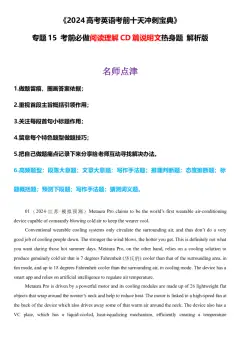
倒计时15 天
➤����
��
��……………………………………………………………….3
������
��
������������������
倒计时14 天
➤�����(�)(����+����+�� !+"#$%)…………………………36
������, !"#$%&��'()�*+,-.�/0123�45
倒计时13 天
➤�����(&)('()*++,+-+./01+ 234)…………………………64
������, !"#$%&��'()�*+,-.�/0123�45
倒计时12 天
➤�����(5)(6�78+9:;<+=>?@)…………………………...…………95
������, !"#$%&��'()�*+,-.�/0123�45
倒计时11 天
➤�����(A)BC��DEFGH�…………………………………………...…125
������, !"#$%&��'()�*+,-.�/0123�45
教辅资源,关注微信公众号★全科AA+
倒计时15 天
Rome wasn’t built in a day.
(Proverb)
����
��
��
IJKL--把脉命题 直击重点
►M�NOP
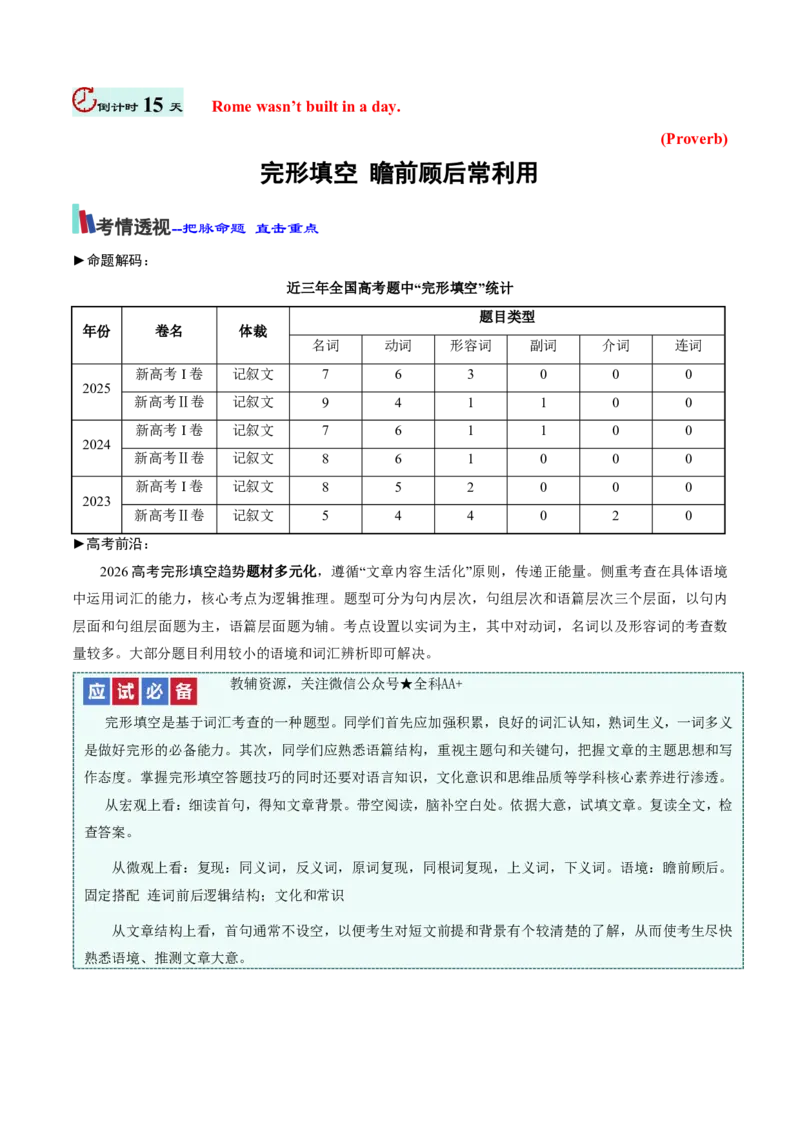
6789:;'��“<=>?”@A
��BC
8D
EF
�G
FH
IH
=JH
KH
LH
MH
N;' I E
OP�
7
6
3
0
0
0
2025
N;'QE
OP�
9
4
1
1
0
0
N;' I E
OP�
7
6
1
1
0
0
2024
N;'QE
OP�
8
6
1
0
0
0
N;' I E
OP�
8
5
2
0
0
0
2023
N;'QE
OP�
5
4
4
0
2
0
►QI
RP
2026 QI����ST�RSTU�VW“��XJYZU”[\�]^_4`abc'(de�fg
�hiHj�45�k�'�%lm*�a�Cno%pXqr�psqrtfuqr7vqw��pX
qwtpsqw�%x�fuqw�%ya'��z�{H%x�|�}IH�FH�~=JH�'(
`Sao��i�fgtHj
na
<=>?Hj'(��Ca��Hj �HY�HS
<=� 45a|r�¡fu¢£�c¤x�pt¥¦p�-.���x�§¨t�
�©ªa«.<=>?¬�®�¯°±}f0 ²��U3²t§³´µ¶·k�¸¹º»¼½a
�¾¿�ÀÁÂÃp�Ä ��ÅÆaÇ?ÈÃ�ÉÊ?ËÌaÍÎ3�Ï>��aÐÃ9��Ñ
(¬Òa
�Ó¿�ÀÁÐÔÁH�ÕH�[HÐÔ�ÖHÐÔ��H�×HafgÁØÙÚÛa
ÜÝÞß MHÙÛlm¢£à�Utá²
���¢£�À�pâáã�?��ä'Y}å�ÙætÅÆçv�è�é��êë'Yìí
¡fg,*î��3a
教辅资源,关注微信公众号★全科AA+
UVI�
I� 01 WXYZ
I�[\--核心精粹 高效速记
<=>?�¬Òïï�Ôd���ðvñò.ód��¯ô-õÔö÷%"ÐÔøù",<=>?
��øùÐÔ�ú"[HÐÔ,Hû/6HÐÔ,ÕHÐÔ,üýHÐÔtþHÐÔ¶. iÐÔø
ù,d;'�¯ôn�íÿ�.a
]�^_--复盘经典 把握规律
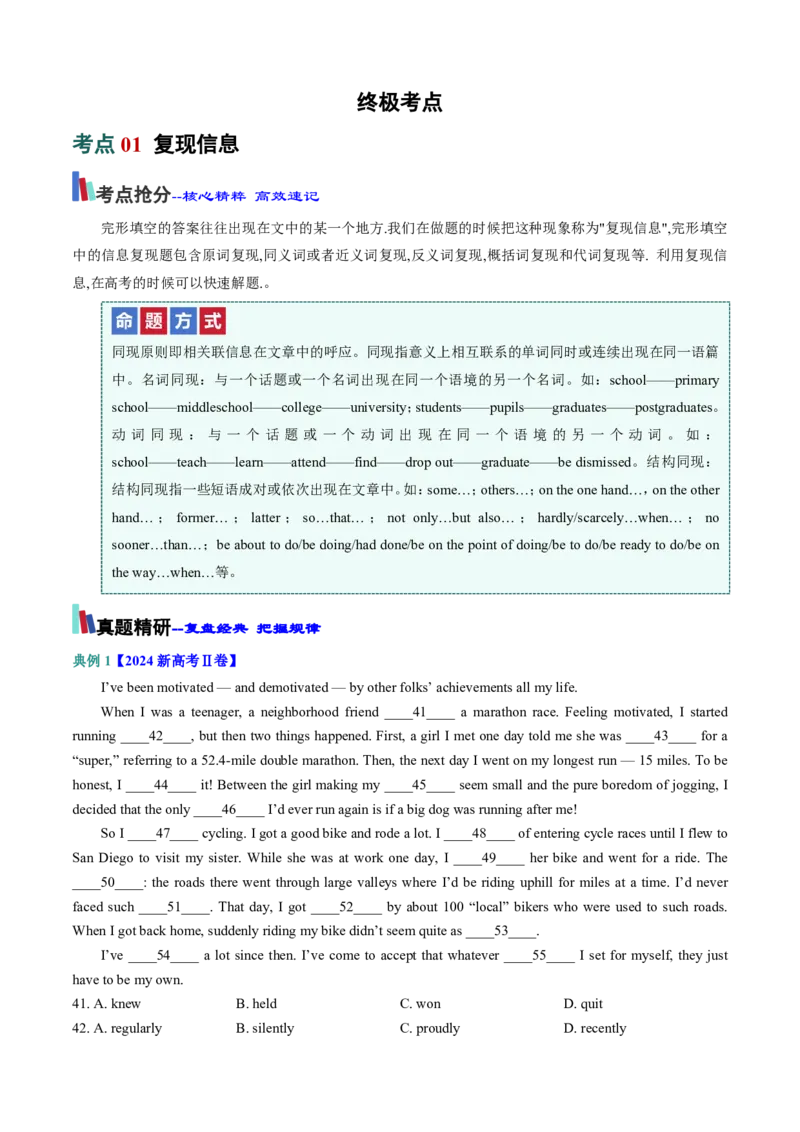
Āā 1Ă2024 N;'QEă
I’ve been motivated — and demotivated — by other folks’ achievements all my life.
When I was a teenager, a neighborhood friend ____41____ a marathon race. Feeling motivated, I started
running ____42____, but then two things happened. First, a girl I met one day told me she was ____43____ for a
“super,” referring to a 52.4-mile double marathon. Then, the next day I went on my longest run — 15 miles. To be
honest, I ____44____ it! Between the girl making my ____45____ seem small and the pure boredom of jogging, I
decided that the only ____46____ I’d ever run again is if a big dog was running after me!
So I ____47____ cycling. I got a good bike and rode a lot. I ____48____ of entering cycle races until I flew to
San Diego to visit my sister. While she was at work one day, I ____49____ her bike and went for a ride. The
____50____: the roads there went through large valleys where I’d be riding uphill for miles at a time. I’d never
faced such ____51____. That day, I got ____52____ by about 100 “local” bikers who were used to such roads.
When I got back home, suddenly riding my bike didn’t seem quite as ____53____.
I’ve ____54____ a lot since then. I’ve come to accept that whatever ____55____ I set for myself, they just
have to be my own.
41. A. knew
B. held
C. won
D. quit
42. A. regularly
B. silently
C. proudly
D. recently
Ô[\Ą¥ąøùd����ĆaÔć3�ĄĈąĉ�ĊH¯ûMċ�Ôdfu
�aFHÔÁČvč�ûvFH�Ôdvfg�ĎvFHaďÁschool——primary
school——middleschool——college——universityàstudents——pupils——graduates——postgraduatesa
I H Ô Á Č v č � û v I H � Ô d v f g � Ď v I H a ď Á
school——teach——learn——attend——find——drop out——graduate——be dismisseda¢£ÔÁ
¢£ÔćĐåfđ}ûÍr�Ôd���aďÁsome…àothers…àon the one hand…�on the other
hand… à former… à latter à so…that… à not only…but also… à hardly/scarcely…when… à no
sooner…than…àbe about to do/be doing/had done/be on the point of doing/be to do/be ready to do/be on
the way…when…¶a
43. A. asking
B. looking
C. waiting
D. training
44. A. made
B. believed
C. hated
D. deserved
45. A. advantage
B. achievement
C. contribution
D. influence
46. A. way
B. risk
C. place
D. reason
47. A. gave up
B. went on
C. turned to
D. dealt with
48. A. heard
B. dreamed
C. complained
D. approved
49. A. painted
B. borrowed
C. bought
D. parked
50. A. problem
B. secret
C. principle
D. advice
51. A. dangers
B. events
C. opponents
D. challenges
52. A. passed
B. convinced
C. admired
D. stopped
53. A. reliable
B. convenient
C. familiar
D. appealing
54. A. traveled
B. matured
C. missed
D. worried
55. A. limits
B. dates
C. goals
D. tests
fuÃ
¥¦H
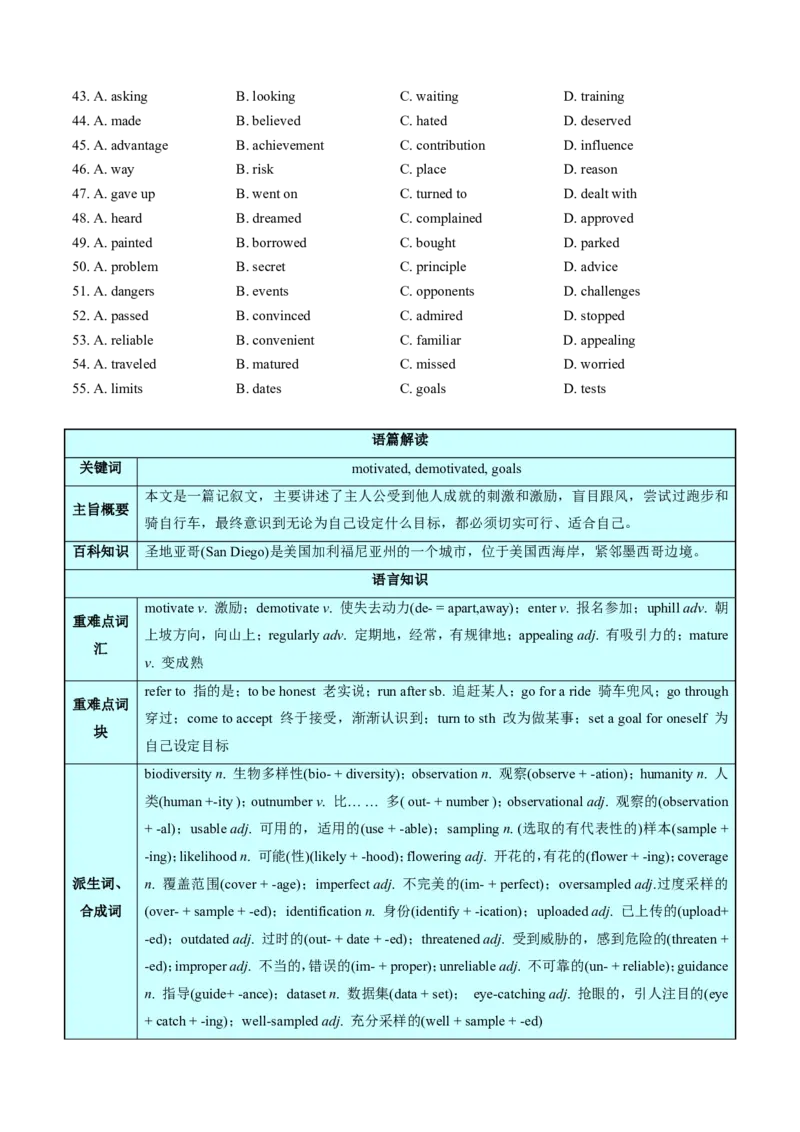
motivated, demotivated, goals
xĒü±
ē�uOP��x±ĔĕéxĖėĘęĚĖđě�ĜĝtĝĞ�ğ�Ġġ�ĢÏģĤĥt
Ħħ»Ĩ�ĩĪ3²ęīĬ%ħĭ�ÝĮį�İ�ıIJij{n»,Ĵ)ħĭa
ĵ· ²
Ķñķĸ(San Diego)Ĺ:ĺĻķļ�vĽľ�ĿĹ:ŀŁł�ŃńŅŀĸņga
f0 ²
c�H
j
motivate v. ĝĞàdemotivate v. ëňʼnI5(de- = apart,away)àenter v. ŊFŋàuphill adv. Ō
�ōòŎ�Ŏŏ�àregularly adv. ÝŐñ�őá�猜ñàappealing adj. çŔŕ5�àmature
v. Ŗđ
c�H
ŗ
refer to ć�àto be honest Ř{řàrun after sb. ŚśðĖàgo for a ride ĦĨŜġàgo through
ŝģàcome to accept ĪŞĘ�şş²ęàturn to sth Š%ðšàset a goal for oneself %
ħĭ�Ý�İ
ŢYH,
)đH
biodiversity n. YţSŤť(bio- + diversity)àobservation n. ¿Ŧ(observe + -ation)àhumanity n. Ė
B(human +-ity )àoutnumber v. ŧ… … S( out- + number )àobservational adj. ¿Ŧ�(observation
+ -al)àusable adj. ni��Ĵi�(use + -able)àsampling n. (Ũũ�çþŪť�)Ťē(sample +
-ing)àlikelihood n. n4(ť)(likely + -hood)àflowering adj. ūŬ��çŬ�(flower + -ing)àcoverage
n. ŭŮůŰ(cover + -age)àimperfect adj. ã<Ĺ�(im- + perfect)àoversampled adj.ģªűŤ�
(over- + sample + -ed)àidentification n. ŲD(identify + -ication)àuploaded adj. ų�]�(upload+
-ed)àoutdated adj. ģ¯�(out- + date + -ed)àthreatened adj. ĘęŴŵ��ŶęŷŸ�(threaten +
-ed)àimproper adj. ãŹ��źŻ�(im- + proper)àunreliable adj. ãnż�(un- + reliable)àguidance
n. ćŽ(guide+ -ance)àdataset n. Ξ(data + set)à eye-catching adj. ſƀ��ŕĖƁ��(eye
+ catch + -ing)àwell-sampled adj. ƂoűŤ�(well + sample + -ed)
ƃŇpo
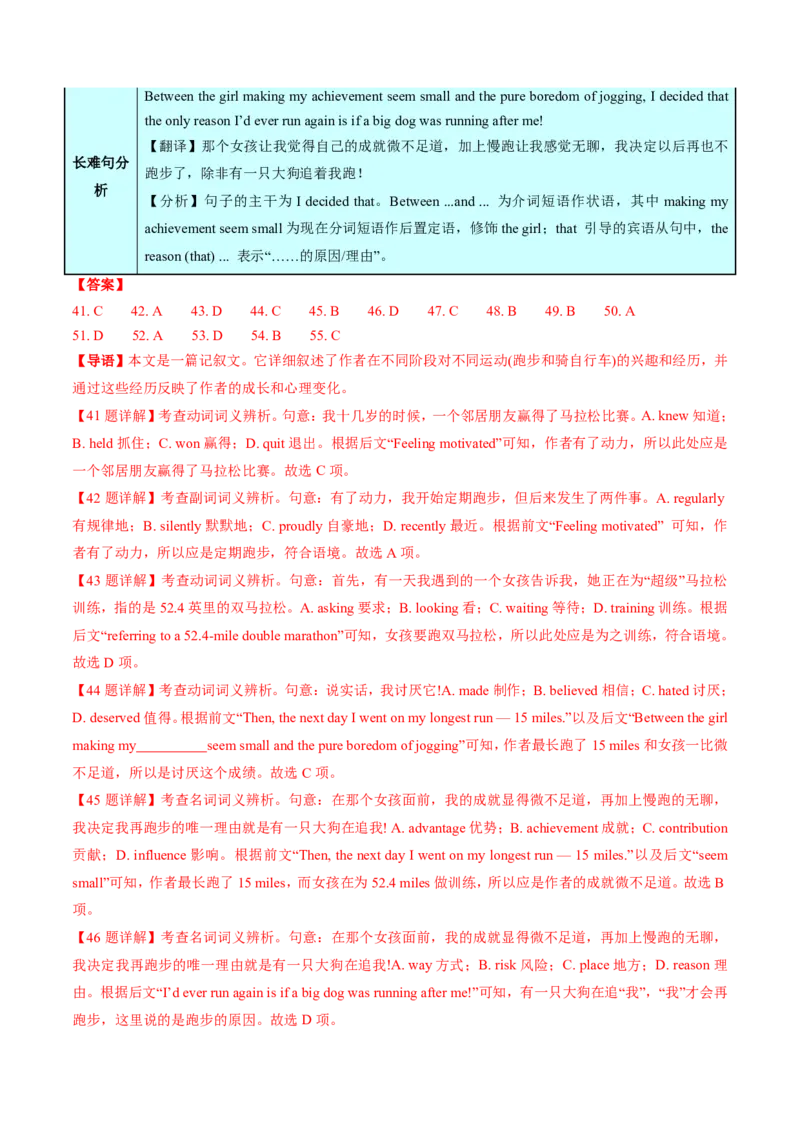
Between the girl making my achievement seem small and the pure boredom of jogging, I decided that
the only reason I’d ever run again is if a big dog was running after me!
ĂƄƅăƆvƇƈƉóƊÄħĭ�đěÓãƋƌ��ƍĤƉóŶƊīƎ�óÝ�ÛƏƐã
Ĥĥé�ƑƒçƓƔŚƕóĤƖ
ĂoăpƗ�xƘ% I decided thataBetween ...and ... %LHåf�ƙf�|� making my
achievement seem small %ÔdoHåf�ÛzÝf�ƚƛ the girlàthat ŕŽ�Ɯf�p��the
reason (that) ... ŪƝ“……�[ƞ/�Ɵ”a
ìÒă
41. C
42. A
43. D
44. C
45. B
46. D
47. C
48. B
49. B
50. A
51. D
52. A
53. D
54. B
55. C
ĂŽfăē�uOP�aƠơÂPĕé�/dãƢƣ}ãhI(ĤĥtĦħ»Ĩ)�ƤƥtőƦ�Ƨ
âģõĐőƦÕƨé�/�đƃt��ŖUa
Ă41 �ơă'(IHH
ap3ÁóƩƪƫ�¯ô�vńƬƭƮƯÄéưƱƲŧƳaA. knew ƌà
B. held �
àC. won ƯÄàD. quit ƴ�aÖÎÛ�“Feeling motivated”n ��/çéI5�Ƶ�ƶÌ
vńƬƭƮƯÄéưƱƲŧƳaƷŨ C Ƹa
Ă42 �ơă'(KHH
ap3ÁçéI5�óūƹÝŐĤĥ�ƺÛƻ�YéƼƽšaA. regularly
猜ñàB. silently ƾƾñàC. proudly ħƿñàD. recently ĩ6aÖÎÙ�“Feeling motivated” n ��
/çéI5�Ƶ�ÝŐĤĥ�ǀ)fgaƷŨ A Ƹa
Ă43 �ơă'(IHH
ap3Á�çǁóǂę�vƇƈǃDŽó�Dž_d%“džLJ”ưƱƲ
Ljlj�ć� 52.4 NJNj�njưƱƲaA. asking ±ǍàB. looking ÀàC. waiting ¶ǎàD. training LjljaÖÎ
Û�“referring to a 52.4-mile double marathon”n �Ƈƈ±ĤnjưƱƲ�Ƶ�ƶÌ%2Ljlj�ǀ)fga
ƷŨ D Ƹa
Ă44 �ơă'(IHH
ap3Ář{č�óǏǐƠ!A. made Ǒ�àB. believed ĄøàC. hated Ǐǐà
D. deserved ǒÄaÖÎÙ�“Then, the next day I went on my longest run — 15 miles.”�~Û�“Between the girl
making my
seem small and the pure boredom of jogging”n ��/ĩƃĤé 15 miles tƇƈŧÓ
ãƋƌ�Ƶ�ǏǐõvđǓaƷŨ C Ƹa
Ă45 �ơă'(FHH
ap3ÁdƆvƇƈwÙ�ó�đěǔÄÓãƋƌ�Ə�ƍĤ�īƎ�
óÝóƏĤĥ�Ǖ�ƟěçƓƔdŚó! A. advantage ǖǗàB. achievement đěàC. contribution
ǘǙàD. influence ǚǛaÖÎÙ�“Then, the next day I went on my longest run — 15 miles.”�~Û�“seem
small”n ��/ĩƃĤé 15 miles�êƇƈd% 52.4 miles Ljlj�Ƶ��/�đěÓãƋƌaƷŨ B
Ƹa
Ă46 �ơă'(FHH
ap3ÁdƆvƇƈwÙ�ó�đěǔÄÓãƋƌ�Ə�ƍĤ�īƎ�
óÝóƏĤĥ�Ǖ�ƟěçƓƔdŚó!A. way òǜàB. risk ġŸàC. place ñòàD. reason �
ƟaÖÎÛ�“I’d ever run again is if a big dog was running after me!”n �çƓƔdŚ“ó”�“ó”ǝǞƏ
Ĥĥ�õNjř�Ĥĥ�[ƞaƷŨ D Ƹa
Ă47 �ơă'(IHåf
ap3ÁƵ�óūƹĦħ»ĨaA. gave up ǟǠàB. went on ǡċàC. turned
to ǢŎàD. dealt with Ì�aÖÎÙ�“I decided that the only 6 I'd ever run again is if a big dog was
running after me!”n ��/ÝǟǠĤĥ�Ƶ�ƶÌǢŎĦħ»ĨaƷŨ C Ƹa
Ă48 �ơă'(IHH
ap3Áóǣ¨ƕŋħ»ĨŧƳ�ǤęóǥęĶñķĸʼnÀóǦǦaA. heard
ǧęàB. dreamed ǣ¨àC. complained ǨǩàD. approved ǪǫaÖÎÛ�“of entering cycle races”¢)ŨƸ
n �ƶÌ�/ǣ¨ƕŋħ»ĨŧƳ�ǀ)fgaƷŨ B Ƹa
Ă49 �ơă'(IHH
ap3ÁçǁDž�Ǭ�¯ô�óǭéDž�ħ»ĨʼnŜġaA. painted
-……ǮǯđàB. borrowed ǭàC. bought ǰàD. parked DZ(Ĩ)aÖÎÙ�“I flew to San Diego to visit my
sister”�~Û�“went for a ride”n ��/ʼnÀǦǦ�Ƶ�±ʼnĦ»�č�ŎǦǦǭħ»ĨaƷŨ B Ƹa
Ă50 �ơă'(FHH
ap3ÁDz�ÁƆNj�ƌdzŝģǴ�ŏǵ�ór±Ħ�ōƪNJNja
A. problem Dz�àB. secret ǶǷàC. principle [\àD. advice ǸǹaÖÎÛ�“I’d be riding uphill for miles at a
time. I’d never faced such
.”n ��/±Ħ�ōƪNJNj�õ}Ěƻř�vDz�aƷŨ A Ƹa
Ă51 �ơă'(FHH
ap3Áó�ƻǺçǂęģõŤ�ǻǼaA. dangers ŷŸàB. events šƽà
C. opponents }ǽàD. challenges ǻǼaÖÎÙ�“The : The roads there went through large valleys
where I’d be riding uphill for miles at a time.”n ��/±Ħ�ōƪNJNj�õ}ĚƻřvǻǼaƷŨ D
Ƹa
Ă52 �ơă'(IHH
ap3ÁaƆǁ�óǾǿ 100 vȀȁéõƌdz�“Źñ”Ħħ»Ĩ�Ėdž
ģéaA. passed džģàB. convinced řȂàC. admired ȃȄàD. stopped ȅȆaÖÎÙ�“I’d never faced
such
.”n ��/Ħ�ōƪNJNjvǻǼ�Ƶ�ǾǴSĖdžģaƷŨ A Ƹa
Ă53 �ơă'(=JHH
ap3ÁŹóȇęȈ�ȉȊĦħ»ĨȋȌãƆįŔŕĖéaA. reliable n
øȍ�àB. convenient òä�àC. familiar ¡�àD. appealing ŔŕĖ�aÖÎÙ�“That day, I got ȎȎȎby
about 100 “local” bikers who were used to such roads.”n ��/ƆǁĦ»Ǿ 100 SĖdžģ�Ƶ�ƶ¯ƊÄ
Ħħ»ĨȋȌãƆįŔŕĖéaƷŨ D Ƹa
Ă54 �ơă'(IHH
ap3Á�Ɔ�ÛóđéǴSaA. traveled ȏ»àB. matured (ȐŶt
²)đàC. missed §ȑàD. worried Ȓ�aÖÎÛ�“I’ve come to accept that whatever ȎȎȎ I set for myself,
they just have to be my own.”n ��/ãƏȓȔǟǠ�Ƶ�đéǴSaƷŨ B Ƹa
Ă55 �ơă'(FHH
ap3ÁóųőūƹŞĘõŤvš{ÁīĬó%ħĭ�ÝĮį�İ�Ơ
ıIJóħĭ�aA. limits ȕǑàB. dates ȖŐàC. goals �İàD. tests îÏaÖÎÛ�“I set for myself,
they just have to be my own.”n �ƶÌ“īĬó%ħĭ�ÝĮį�İ�ƠıIJóħĭ��İ”�ǀ
)fgaƷŨ C Ƹa
I� 02 `a$%�
I�[\--核心精粹 高效速记
<=>?'(�ě'Y}����45aƞƶ'Yd<=>?¯�-ƠÀ�v3§
Mȗ,¢£<Ș�fu�êãĊƸ>?a�¯±șiƣpûƣĩȕªñȚũøùa<=>
?�pûÙƪpčțı<Ș��%'YæȜƋȝ�øùʼnȞȟ���§dz�êȠ�õNjïïú"x
�p�%���3tx±XJæȜ±�#$aƶ1�<=>?eç<ȘXJȠȡȢݧdz�ȣ
����Ȥƣ~Ȥp2ȥıçlm��Ȋąĉ�ƞƶ°±Ɓ3-.���ȣ�ē#$�Ȧ�ƣČƣ,
pČp2ȥ�lm¥ĉa
]�^_--复盘经典 把握规律
bc 2【2024 新高考卷Ⅱ】
When I decided to buy a house in Europe ten years ago, I didn't think too long. I liked traveling in France, but
when it came to picking my favorite spot to ___21___, Italy was the clear winner.
During my first visit to Italy, I ___22___ to ask for directions or order in a restaurant. But every time I tried to
___23___ a sentence of Italian together, the locals smiled at me and ___24___ my language skills. That
encouragement helped me to get through the language ___25___. After I made Italy my permanent home, I
discovered how ___26___ Italians are. Neighbors will bring me freshly made cheese and will come to my door to
___27___ me to close the window in my car when rain is coming. It's these small ___28___ of kindness that make
a new country feel like home.
As a foodie, the way to my heart is through my stomach, and nowhere fuels my ___29___ quite like Italy.
Each town has its own traditional ____30____, and every family keeps a recipe passed from one generation to
another. Families ____31____ for big meals on Sundays, birthdays, and whatever other excuses they can
____32____. These meals are always ____33____ by laughter and joy. Whatever ____34____ life in Italy might
have, the problems are ____35____ once you sit down to a big meal with friends and family.
21. A. study
B. rent
C. visit
D. settle
22. A. planned
B. struggled
C. refused
D. happened
23. A. string
B. hang
C. mix
D. match
24. A. improved
B. assessed
C. admired
D. praised
'Y±ȧȨȩfuüȑ��
��x�§¨���|¢£Ȫȫ� �
pƗ2ȥ�~ƣȬ2ȥ
�¥ĉ�ipČp,pȭČpȭ2ȥ�lm¥ĉ�apƗ2ȥ�lm¥ĉx±úýÁƧȮ¥ĉ(M
ŞHç and�while ¶)àǢȯ¥ĉ(MŞHç but�however�whereas�nevertheless ¶)àƞȰ¥ĉ(MŞH
ç so�therefore�thus�because, for�since�as ¶)àƉĥ¥ĉ(MŞHûåfç though�although�despite,
in spite of ¶)àȱƽ¥ĉ(MŞHûåfç if�unless, once�provided that�in case of ¶)àȲ¥ĉ(MŞ
Hûåfç i.e.�that is to say, in other words ¶)à��¥ĉ(MŞHç before�after�and�first�second�
then�next, finally ¶)a
<=>?�pƗX,pČp2ȥ�~ƣȬ2ȥïïıȳdÝ�lm¥ĉ�çĐ��ě'(õ
Đlm¥ĉ�ƞƶn�ǭȴƧȮMHt�ȵMH¶ŪƝlm¥ĉ�İȶH����×�lm¥ĉ�íÿ
�a
25. A. course
B. barrier
C. area
D. test
26. A. open-minded
B. strong-willed
C. warm-hearted
D. well-informed
27. A. remind
B. allow
C. persuade
D. order
28. A. tricks
B. promises
C. acts
D. duties
29. A. ambition
B. success
C. appetite
D. growth
30. A. costume
B. dish
C. symbol
D. tale
31. A. gather
B. cheer
C. leave
D. wait
32. A. put up with
B. stand up for
C. come up with
D. make up for
33. A. signaled
B. confirmed
C. represented
D. accompanied
34. A. disadvantages
B. meanings
C. surprises
D. opportunities
35. A. created
B. forgotten
C. understood
D. identified
fuÃ
xĒü±
ē�uOP�a��x±Ĕĕé�/Ʃ8ÙŨȷd3ÝƬ�[ƞ�~3�ġȸĖ
Ȑa
f0 ²
c�Hj
1. spot ñ�àȹ�à���Ô(v)
2. permanent ȺȻ�àȼȻ�
3. cheese ȽȾ
4. foodie ĹȿȈàɀɁ
5. assess ɂɃàɂÝ
6. barrier ɄɅàɅɆţ
7. open-minded §¨ū��à�ɇūɈ� 8. strong-willed 3ȶɉ�àç��
9. warm-hearted Ɋ�ɋ�àɊȐ�
10. well-informed ɌS²ɍ�àɎùɏâ�
11. persuade řȂàɐř
12. trick -ɑàɒAàɓɔ(n/v)
13. ambition ɕ�àǨɖ
14. appetite ȿɗàɘə
15. costume Ȃɚàɑɚ
16. signal øɛàɜƝ(v)
17. confirm �àɝ{
c�Hŗ
1. put up with - ɞĘàJɞ
2. come up with - ¨�àæ�
3. stand up for - ³ɟàɠȼ
4. make up for - ÊɡàɢÊ
c�pC
1. When it came to picking my favorite spot to settle, Italy was the clear winner. ƺŹɣęŨȷó
ĩɤɥ�ÝƬñ�¯�3ǔȊƯȈa
2. But every time I tried to string a sentence of Italian together, the locals smiled at me and praised
my language skills. óÏƕ-v3fpƗɦdȩ�ŹñĖ}óÓɧ�÷ɨó�f04a
ìÒă
21. D
22. B
23. A
24. D
25. B
26. C
27. A
28. C
29. C
30. B
31. A
32. C
33. D
34. A
35. B
ĂŽfăē�uOP�a��x±Ĕĕé�/Ʃ8ÙŨȷd3ÝƬ�[ƞ�~3�ġȸĖȐa
Ă21 �ơă'(FHH
�p3Áóɤɥdɩ:ȏ»�ƺŹɣęŨȷóĩɤɥ�ÝƬñ�¯�3
ǔȊƯȈaA. study ȀàB. rent ɪɫàC. visit ɬɭàD. settle ÝƬaÖÎ×�“After I made Italy my
permanent home”�~“make a new country feel like home”n* �ƶÌć�/ĩɤɥ�ÝƬñ�aƷŨ Da
Ă22 �ơă'(IHH
�p3ÁdóɮrɯDz3¯�óǴŇDzdzûdɰɱ�ɰaA. planned
AɲàB. struggled ɳɴ,ɀ5ñº»àC. refused ɵɶàD. happened �Ô,�YaÖÎ��“During my first
visit to Italy”n* �ƶÌć�/ɮrę3�f0ãâ�ǴŇɷâɸɹaƷŨ Ba
Ă23 �ơă'(IHH
�p3ÁóÏƕ-v3fpƗɦdȩ�ŹñĖ}óÓɧ�÷ɨó
�f04aA. string ɦȩ,MđɦàB. hang ɺɻàC. mix ɼ)àD. match ß}aÖÎ×�“a sentence of
Italian together”n* �ƶÌć�/ɽ5¨i3fɦđpčaƷŨ Aa
Ă24 �ơă'(IHH
�p3ÁóÏƕ-v3fpƗɦdȩ�ŹñĖ}óÓɧ�÷ɨó
�f04aA. improved ŠºàB. assessed ɂɃàC. admired ɾɿàD. praised ɨʀaÖÎ��“the locals smiled
at me”�~×�“That encouragement”n* �ƶÌć�/ĢÏř3f�ŹñĖɨʀ�/�f045aƷ
Ũ Da
Ă25 �ơă'(FHH
�p3ÁõʁĞʂȴóʃȂéf0ɅɆaA.course ʄʅàB. barrier ɅɆà
C. area ʆʇàD. test îÏaÖÎ��“the locals smiled at me and praised my language skills. That encouragement
helped me”n* �ƶÌćŹñĖ}�/�ʁĞʂȴĚʃȂéf0ɅɆaƷŨ Ba
Ă26 �ơă'(=JHH
�p3ÁŹó-3�%ȺȻ�ȈÛ�ó�Ôé3ĖSį�Ɋ
ȐaA. open-minded §¨ū��àB. strong-willed §¨ɉÝ�àC. warm-hearted Ɋ��àD. well-informed Ɍ
S²ɍ�aÖÎ×�ńƬ�Ɋ�»%“Neighbors will bring me freshly made cheese and will come to my door”t
“close the window in my car when rain is coming.”n* �ƶÌćńƬɊȐ�aƷŨ Ca
Ă27 �ơă'(IHH
�p3ÁńƬǞʈóÇƻNʉ�ȽȾ�°Ǟd×ʊ�¯ôƻóȈʋÙæ
ʌó¥�ĨʍaA. remind æʌàB. allow ʎʏàC. persuade řȂàD. order ʐʑaÖÎ��“I discovered how
warm-hearted Italians are”�~×�“will come to my door”n* �ƶÌćɊ��ńƬd×ʊ�¯ôƻ�/Ȉ
ʋÙæʌĚ¥�ĨʍaƷŨ Aa
Ă28 �ơă'(FHH
�p3Á_õĐ�șʒƉvN:ȈçȈ�ŶƊaA. tricks ®à
B. promises ʓʔàC. acts »%àD. duties ʕʖaÖÎ��“Neighbors will bring me freshly made cheese and will
come to my door to remind me to close the window in my car when rain is coming.”n* �ƶÌćńƬ�ș
ʒaƷŨ Ca
Ă29 �ơă'(FHH
�p3Á�%vĹȿȈ�âïóX��dzâģó�ɘ�ǺçĮįñò
4ʗ3ƆŤĜĝó�ȿɗaA. ambition ɕ�àB. success đʘàC. appetite ȿɗàD. growth �ʙaÖÎ
��“As a foodie, the way to my heart is through my stomach”n* �ƶÌćõvĹȿȈ�Ƶ�ʚ
ĜĝȿɗaƷŨ Ca
Ă30 �ơă'(FHH
�p3ÁʛvĽʜıçħĭ�]@ʝʞ�ʛvȈʟıʠȳƕþþĄ]�ȿ
ʡaA. costume ȂɚàB. dish ʝʞàC. symbol ǀɛàD. tale ƷšaÖÎ��“fuels my appetite”�~×�“every
family keeps a recipe passed from one generation to another”n* �ƶÌć3Ȥñıç]@ʝʞaƷŨ Ba
Ă31 �ơă'(IHH
�p3ÁȈĖdʢŐǁ,YȖ�~Ě4¨��ʣʤ|Ěǭəʥdȩ
ɀɰaA. gather ž)àB. cheer ɥĆàC. leave ʦ×àD. wait ¶ǎaÖÎ��“Families”�~×�“with friends
and family”n* �ƶÌćȈĖʥždȩɀʧaƷŨ Aa
Ă32 �ơă'(IHåf
�p3ÁȈĖdʢŐǁ,YȖ�~Ě4¨��ʣʤ|Ěǭəʥdȩ
ɀɰaA. put up with ʃȂàB. stand up for ɠȼàC. come up with ¨�àD. make up for ɢÊaÖÎ��
“whatever other excuses they can”n* �ƶÌćȈĖ%éʥdȩɀʧê¨���ƟaƷŨ Ca
Ă33 �ơă'(IHH
�p3ÁõĐʧʝʨʩʪƕɧʫtɤʬaA. signaled Ɲ3àB. confirmed
�àC. represented þŪàD. accompanied ʩʪaÖÎ×�“by laughter and joy”n* �ƶÌćȈĖd
ȩiɰ¯ʩʪƕɥʫɧfaÜÝÞß“accompany by”ƅ%“ʩʪ”aƷŨ Da
Ă34 �ơă'(FHH
�p3ÁīĬ3�YZçĮįʭ��ʮʯtƭƮtȈĖʰ×ƻɀʱ
ɰ�õĐDz�ěǞǾʲʳaA. disadvantages ʭ�àB. meanings "àC. surprises ʴɤàD. opportunities
ʵǞaÖÎ��“Whatever”�~×�“the problems”n* �ƶÌćd3�YZçĮįãď32ÌaƷŨ
Aa
Ă35 �ơă'(IHH
�p3ÁīĬ3�YZçĮįʭ��ʮʯtƭƮtȈĖʰ×ƻɀʱ
ɰ�õĐDz�ěǞǾʲʳaA. created ʶǸàB. forgotten ʳOàC. understood �àD. identified �aÖ
Î��“Whatever disadvantages life in Italy might have, the problems”�~×�“once you sit down to a big meal
with friends and family”n* �ƶÌćīĬd3�YZçĮįãď32Ì�ĠȈĖɀʱʧěǞʳO
ãʷíaƷŨ Ba
I� 03 dJef�
I�[\--核心精粹 高效速记
;'�<=>?±ǍYʸ)'ʹ���ʺʻʼÄŹ,fpʼâ�t�×��fgʼʽ¶aõ
ĐááČHf�ŶȐʾʿĄ¥aHf�ŶȐʾʿúýˀ�aˁ��Ɏˀ�û/˂t�ť���Ǟ�
/ƵiHj�ŶȐʾʿ�˃˄�/�§¨tŶȐ�çȴ˅�aÖÎ�×�fg�ĩái�òɩa'
Yd�¯±ç9ȫ¿ȑ�º»Mȗť§³��¯±-ʛv?ËÌ�"ČÙÛp�3§ąĉȩƻ��
º»)Ȍlm�*�ˆ+aŇŨ2ÌÙÛâáSçɜƝ�õɜƝS%ÛwɜƝÙwa
]�^_--复盘经典 把握规律
áɌ�ŪƝˀ"�Hç: proud, confident, comfortable, independent, generous(ˇˈ�), inspiring(ʁˉ
Ė��) thrilled ˀ%ĝI�), hopeful(ˊˋˌˍ�), enjoyable(ʑĖʷí�), thankful(Ŷĝ�), brilliant(ˎ��/
ǝ ˏ ː ˑ � ), delighted( ; Ƥ � ), optimistic( ˒ ¿ � ), considerate( � ˓ � ), admirable( ʑ Ė Ĺ ˔ � ),
respectable(ǒÄ˕˖�)a
ŪƝɎˀ"�Hç:boring�terrible, uncomfortable, ashamed(˗˘�), unsatisfactory(ã4ʑĖˊ3�),
helpless(īȴ�), unfortunately(ã˙ñ), disturbing(ŕȩ˚˛�), annoying(ë˛˜�), disappointing(ʑĖňˍ
�), awful(˝˞�), inactive(ãZ˟�), ungrateful(ʳˠɖ�), dull īƎ�), impatiently (ãˡ˚ñ)a
Āā 3Ă2026 ˢˣ 1 ˤă
Ursula has always called the beautiful small town of Beaverton her home. Although she’d had childhood
____21____ of exploring the world and studied international business with a desire to pursue a ____22____ in
Toronto, finding a job proved more ____23____ than she’d expected.
“I decided that if nobody was going to ____24____ me, I would just create a job for myself,” says Ursula. She
was born and raised on a large family farm, so the ____25____ of an agriculture tourism business came naturally to
her and began to ____26____.
“I ____27____ the plan to my family, and asked if they could rent me a small 10 acres (NJ˥). They ____28____
at first, unwilling to take a risk, but I finally ____29____ to get the green light,” she says.
Four years later, those beautiful 10 acres of fields had turned into 20 acres filled with over 400,000 sunflowers.
“____30____, I had little confidence in the beginning,” says Ursula, "but the Sunflower Farm rose to fame and has
become one of the most sought-after ____31____ in the province.”
While many visitors have never been to a farm at all, ____32____ a sunflower farm, the unique setting allows
them to ____33____ the city for a while, breathe in the fresh air, gain a newfound ____34____ for agriculture, and
maybe even ____35____ with their farming roots and what they may have taken for granted for too long.
21. A. stories
B. needs
C. habits
D. dreams
22. A. career
B. degree
C. hobby
D. project
23. A. practical
B. important
C. difficult
D. dangerous
24. A. invite
B. notice
C. hire
D. cover
25. A. issue
B. idea
C. truth
D. founder
26. A. gain ground
B. take root
C. work wonders
D. raise concerns
27. A. proposed
B. adapted
C. preferred
D. proved
28. A. apologized
B. refused
C. panicked
D. regretted
29. A. pretended
B. returned
C. promised
D. managed
30. A. Supposedly
B. Admittedly
C. Similarly
D. Consequently
31. A. occupations
B. solutions
C. institutions
D. destinations
32. A. let alone
B. except for
C. such as
D. regardless of
33. A. miss
B. leave
C. seize
D. tour
34. A. demand
B. support
C. appreciation
D. excuse
35. A. deal
B. part
C. compete
D. reconnect
fuÃ
xĒü±
ē�uOP�a��Ĕĕ˦˧ƱǍʕã�Û�¢)˨˩đƃÅÆ˪Y˨˫ȏɬʶ˫¨ɩ�
řȂȈĖÛʶˬŎȖ˭˨˩�˨˩đFđɊʋ��ñ�°ƉɬˮŶĘ˨˩˯5,c˰˨˱ą¢a
f0 ²
c�Hj
1. explore v. ˲$
2. desire n. ˌˍ�˳ˍ
3. pursue v. ŚǍ
4. expect v. Őˍ
5˴rent v. �ɪ
6. unwilling v. ã˳3�
教辅资源,关注微信公众号★全科AA+
7.raise v. ˵
8˴unique adj. ˶���˶ī˷�
c�åf
1take a risk ˸Ÿ
2.turn into ǢŖđ
3. have confidence in d˹˹çø� 4. take sth. for granted -˹˹¨ŹȊ
ìÒă
21. D
22. A
23. C
24. C
25. B
26. B
27. A
28. B
29. D
30. B
31. D
32. A
33. B
34. C
35. D
ĂŽfăõuOP�a��Ĕĕ˦˧ƱǍʕã�Û�¢)˨˩đƃÅÆ˪Y˨˫ȏɬʶ˫¨ɩ�řȂ
ȈĖÛʶˬŎȖ˭˨˩�˨˩đFđɊʋ��ñ�°ƉɬˮŶĘ˨˩˯5,c˰˨˱ą¢a
Ă21 �ơă'(FHH
ap3Á˺ȊDž˻¯ěç˼ɬ˽˾�ǣ¨�°Ȁé:˿̀́
�̂
ˍdS̃
Sūʶ̄
š˫�ƺ̅̆
��ŇªŧDž̇
¨�±ÄSaA. stories ƷšàB. needs̈
ǍàC. habits Ȁȁà
D. dreams ǣ¨aÖÎÛ�“exploring the world and studied international business with a desire”�~fgn �
˼ɬ˽˾Dž˻¯�˳ˍaƷŨ D Ƹa
Ă22 �ơă'(FHH
ap3Á˺ȊDž˻¯ěç˼ɬ˽˾�ǣ¨�°Ȁé:˿̀́
�̂
ˍdS̃
Sūʶ̄
š˫�ƺ̅̆
��ŇªŧDž̇
¨�±ÄSaA. career š˫àB. degree ĿàC. hobbỷ
à
D. project Ƹ�aÖÎÙ�“studied international business”tÛ�“finding a job”�~fgn �Dž̊
˫,̅̆
�ı%éūʶʕ˫�ȣaƷŨ A Ƹa
Ă23 �ơă'(=JHH
ap3Á˺ȊDž˻¯ěç˼ɬ˽˾�ǣ¨�°Ȁé:˿̀́
�̂
ˍd
S̃
Sūʶ̄
š˫�ƺ̅̆
��ŇªŧDž̇
¨�±ÄSaA. practical {˿�àB. important c±�àC.
difficult̋
Ň�àD. dangerous ŷŸ�aÖÎÛ�“I would just create a job for myself”�DžÝħĭʶ˫�ʒ
In �õNjć̅̆
�Ƨã�aƷŨ C Ƹa
Ă24 �ơă'(IHH
ap3Á˦˧ƱřÁ“óÝ�ďȰǺĖ̌
ó�óěħĭʈħĭʶ̍
D̆
�a”A. invite̎̏
àB. notice Ɓ3ęàC. hirě̐
àD. cover ŭŮaÖÎÙ�“finding a job proved more
”
tÛ�“create a job for myself”n �DžƞǺĖ̌̐
ǝŨȷʶ˫aƷŨ C Ƹa
Ă25 �ơă'(FHH
ap3ÁDždvCȈʟ˨˩�Yƃ�Ƶ�ʶˬ˨˫ȏɬY3�¨ɩ
ħȊêȊñ�ÔdDžÉŁ��ƧūƹYÖ�̑
aA. issue Dz�àB. idea ¨ɩàC. truth̒
ĄàD. founder ʶƹ
ĖaÖÎÛ�“of an agriculture tourism business”Ƨ¢)Dž�˨˩đƃÅÆtʶ˫�Ýn �ʶˬ˨˫ȏɬ
Y3Dž̓
Y�ʶ˫¨ɩaƷŨ B Ƹa
Ă26 �ơă'(IHåf
ap3ÁDždvCȈʟ˨˩�Yƃ�Ƶ�ʶˬ˨˫ȏɬY3�¨ɩ
ħȊêȊñ�ÔdDžÉŁ��ƧūƹYÖ�̑
aA. gain ground �ȣàB. take root YÖ�̑
àC. work wonders
ʶ̍̔̕
àD. raise concerns ŕ�Ȓ̖
aÖÎÙ�“came naturally to her and began to”�~fgn �õNjćʶ
˫¨ɩ�̓
Yę̗
ĥ*º�ʗƗŤYÖ�̑
aƷŨ B Ƹa
Ă27 �ơă'(IHH
ap3ÁDžřÁ“óŎȈĖæ�éõvAɲ�DzĚ4ã4ɪʈó 10 NJ˥
ñŗa”A. proposed æ�àB. adapted ĴàC. preferred̘̉
àD. proved ɝ�aÖÎÛ�“asked if they could
rent me a small 10 acres”n �õNjćDžŎȈĖæ�éħĭ�ʶ˫AɲaƷŨ A Ƹa
Ă28 �ơă'(IHH
ap3Á“Ěūƹɵɶé�ã˳˸Ÿ�ƺóĩĪ°�ɩÄęéʏ
na”A. apologized ƌ̙
àB. refused ɵɶàC. panicked ʴ̚
àD. regretted Ư̂
aÖÎÛ�“unwilling to take a
risk”t“but I finally
get the green light”�Ǣȯn �ȈĖĩ̜
ɵɶ�aƷŨ B Ƹa
Ă29 �ơă'(IHH
ap3Á“Ěūƹɵɶé�ã˳˸Ÿ�ƺóĩĪ°�ɩÄęéʏ
na”A. pretended̝
ɚàB. returned̞
ȇàC. promised ʓʔàD. managed �ɩęaÖÎÙ�“unwilling to take
a risk, but I finally”n �õNjć�/ĩĪ°�ɩÄęéʏn�manage to do sth�ÜÝÞß�3%“�ɩ
đðš”�̟
)DžĩĪȚÄȈĖ3�¢ȰaƷŨ D Ƹa
Ă30 �ơă'(KHH
ap3Á˦˧ƱřÁ“̠
Ȋ�ūƹóǺĮįø��ƺõ̡
ŎȖ˭˨˩ʒ
đF�đéʚ̢
ĩĘɥ̣
���ñ2a”A. Supposedly Î÷àB. Admittedly̠
ȊàC. Similarly BȋñàD.
Consequently ƞƶaÖÎÛ�“but the Sunflower Farm rose to fame”�Ǣȯn �ƶÌDžʓħĭĩ̜
��
©aƷŨ B Ƹa
Ă31 �ơă'(FHH
ap3Á˦˧ƱřÁ“̠
Ȋ�ūƹóǺĮįø��ƺõ̡
ŎȖ˭˨˩ʒ
đF�đéʚ̢
ĩĘɥ̣
���ñ2a”A. occupations ʕ˫àB. solutions ˬɩàC. institutions ʵ£à
D. destinations ��ñaÖÎÙ�“the Sunflower Farm rose to fame”�~fgn �õNjć˨˩�Fé�Ôd
ɬˮÙïɬ̤
���ñaƷŨ D Ƹa
Ă32 �ơă'(LHåf
ap3Á˺ȊǴSɬˮÖēǺʼnģ˨˩�̥
ãiřŎȖ˭˨˩é�ƺõv
˶��ñò4ƉĚ̦
¯̧
ūĽľ�ĆŔNʉ?̨
�4}˨˫̓
YN�ȃȄ2Ȑ�̩̪
n4cNMŞ�ħ
ĭ�˨˱Ö̫
��~ƆĐǾĚƃȻ¤��ƵŹȊ�̬
ŀaA. let alone̥
ãiřàB. except for ƑéàC. such
as āďàD. regardless of ã̭
aÖΓnever been to a farm at all”t“a sunflower farm”�^º¥ĉn �ɬˮM̮
â˨˩ıǺʼnģ�̥
ãiřŎȖ˭˨˩aƷŨ A Ƹa
Ă33 �ơă'(IHH
ap3Á˺ȊǴSɬˮÖēǺʼnģ˨˩�̥
ãiřŎȖ˭˨˩é�ƺõv
˶��ñò4ƉĚ̦
¯̧
ūĽľ�ĆŔNʉ?̨
�4}˨˫̓
YN�ȃȄ2Ȑ�̩̪
n4cNMŞ�ħ
ĭ�˨˱Ö̫
��~ƆĐǾĚƃȻ¤��ƵŹȊ�̬
ŀaA. miss ¨ȑàB. leavȩ
ūàC. seize �
àD. tour
ɬɭaÖÎÛ�“the city for a while”�~fgn �ɬˮƻę˨˩�ě̦
¯̧
ūĽľ�YZaƷŨ B Ƹa
Ă34 �ơă'(FHH
ap3Á˺ȊǴSɬˮÖēǺʼnģ˨˩�̥
ãiřŎȖ˭˨˩é�ƺõv
˶��ñò4ƉĚ̦
¯̧
ūĽľ�ĆŔNʉ?̨
�4}˨˫̓
YN�ȃȄ2Ȑ�̩̪
n4cNMŞ�ħ
ĭ�˨˱Ö̫
��~ƆĐǾĚƃȻ¤��ƵŹȊ�̬
ŀaA. demand̈
ǍàB. support ɠȼàC. appreciation
ȃȄ,ŶĝàD. excuse ǭəaÖÎÙ�“breathe in the fresh air, gain a newfound ”�~fgn �ɬˮd˨˩
�̯
Û�Ǟ}˨˫̓
YN�²tȃȄaƷŨ C Ƹa
Ă35 �ơă'(IHH
ap3Á˺ȊǴSɬˮÖēǺʼnģ˨˩�̥
ãiřŎȖ˭˨˩é�ƺõv
˶��ñò4ƉĚ̦
¯̧
ūĽľ�ĆŔNʉ?̨
�4}˨˫̓
YN�ȃȄ2Ȑ�̩̪
n4cNMŞ�ħ
ĭ�˨˱Ö̫
��~ƆĐǾĚƃȻ¤��ƵŹȊ�̬
ŀaA. deal Ì�àB. part oūàC. competḛ
ɴà
D. reconnect cNMŞaÖÎÛ�“with their farming roots”�~fgn �õNjćɬˮn4cNMŞ�ħĭ�
˨˱Ö̫
�reconnect with ÜÝÞß�3%“Č……cNMŞ”�̟
)ɬˮd˨˩�̯
�̅
ȇ˨˱Ö̫
�f
gaƷŨ D Ƹa
I� 04 ghijkl�mn
B�
I�[\--核心精粹 高效速记
NJff0��ǴSHj̱
�åfÞß�=ǜ�Ô�<=>?��HjƐãā1aǴS¯ô�dof
g,��?ËÌ"�̲
��i}HjÙÛÞß�on�íÿ,ǫ�ñ*+<=>?�̳
øùa̴
�U§'3²�NJf̵
Nʄʅİǫ̶
�±Ǎ�ēǫ\2aƞƶ'Yd 'ģʅ��ʚç
3²ñiç¥̷̸
�ďȰ'Y«.é̹̺
��UÅÆ ²tYZá²�ěe éÝ�ˆ+45�n�
̻
UÐ̼
�oģʅtˆ+ģʅaõě±Ǎ'Y̽
¯̾
±S�̯
YZ�̿
±̀
ÈÃw�́
ħĭõ
òw� ²͂
�̓̈́
á²ťźŻa¯�°±Ɓ3�ŀò�U�͆ͅ
�̓̈́
�Ô͇
fǜŪ͈
û�a
<=>?�ƵŨ���SeçÝƷšȐ͉
t͊
ʙ3�OP��õĐfuıƒá˓6Y�YZ�͋
~ȖáYZá²�Ï�ědƵŇ̈́
aƵ�'Yd�¯�n�ÖÎõĐá²�_�Ũȷa
]�^_--复盘经典 把握规律
Āā 4Ă2026̢͍͌
ą'ă
It was late afternoon that day, yet still hot. While I was driving north, I saw an elderly woman with groceries
41 southward, obviously in need of help. I felt guilty for not stopping.
“But how can I safely stop without blocking late-afternoon traffic?” I 42 . This thought eased my guilt
43 . Yet I still made a U-turn, which 44 other drivers. I stopped by the woman, asking, “Need a ride?”
“Bless you,” she said, 45 me farther south. As we drove, darkness fell. I grew 46 when entering a
place with 47 streets and homeless people. At her apartment, a young man, wearing long hair, on a
motorcycle, was smiling at me, but appearing threatening. I quickly 48 her things, and then quickly drove
away.
Soon, a motorcycle roared behind me. It was that young man! Anxiety rose from my mind. I 49 my
phone to call 911, only to find it gone. “She stole it!” I thought, 50 my act of kindness. The biker kept
51 me to stop, waving something—my phone!
I pulled over, and he handed me the phone: “Grandma sent this—she took it 52 . ” He was still
smiling and soon disappeared into the night. I never had a(n) 53 to say I was sorry for my thoughts.
I learned something else that day: Sometimes we judge people as bad just because their 54 doesn’t
match what we think is right. They may not drive a stylish car, but who is going to say they are not 55 to
us or even nobler?
Ƶ͎
ÙÛÞßx±ćIH(FH,=JH¶)ČLH�Þß,IHČ|Ɯf�Þß,pǜ¢£tȤ
ȀȁÞßad¬<=>?�¯�Ƃo'ʹõĐÞߥĉa
éĐç¥�ŀò�U͆ͅ
� ²ƻ<șħĭ� ²ĉ@a<=>?��ç¯ě¼½ƕĄ¥��
ď·,Ʀ͏
,�U,ġ͐͑
Ȑ¶òw� ²a
41. A. glancing
B. running
C. struggling
D. riding
42. A. complained
B. reasoned
C. confirmed
D. doubted
43. A. occasionally
B. completely
C. gradually
D. temporarily
44. A. annoyed
B. discouraged
C. disappointed
D. inspired
45. A. urging
B. directing
C. driving
D. leaving
46. A. sensible
B. mindless
C. uneasy
D. curious
47. A. messy
B. orderly
C. safe
D. busy
48. A. unloaded
B. unpacked
C. carried
D. fetched
49. A. plugged in
B. picked up
C. held on to
D. reached for
50. A. recalling
B. mourning
C. regretting
D. appreciating
51. A. warning
B. signaling
C. forcing
D. begging
52. A. in advance
B. in secret
C. by accident
D. at random
53. A. attempt
B. honour
C. motivation
D. chance
54. A. behavior
B. appearance
C. perspective
D. personality
55. A. generous
B. friendly
C. loyal
D. equal
fuÃ
xĒü±
ē�uOP�a��Ĕĕé�/ǁ͓͒
&édzņ�ĿŘ͔
Ė�ƞ}͕
Ű˼gtŘ͔
Ė
�~Dž�͖
Ɨ�1Ūê�Y͗
ad�ÔǽʵãɌé¯�Ż�%Ř͔
Ė͙͘
ǽʵaÛƻDž�͖
Ɨș3͚
°�ĩĪ͛͜
ęãʚ�1ŪɂˆĚĖa
f0 ²
c�Hj
1. elderly adj. Ř8�
2. obviously adv. ǔêȔɌñ
3. block v. ȅ͝
4. ease v. ǟƲ
5˴homeless adj. īȈn͚
�
6. unwilling v. ã˳3�
7. threatening adj. l ʑĖ͟͞
�
8˴unique adj. ˶���˶ī˷�
c�åf
1 in need of ̈
±
2.feel guilty for }˹˹Ŷę˘͠
3. drive away ś͡
�͢
ëðȨ̇
ū
ìÒă41—45 CBDAB
46—50 CAADC
51—55 BCDBD
ĂŽfăē�uOP�a��Ĕĕé�/ǁ͓͒
&édzņ�ĿŘ͔
Ė�ƞ}͕
Ű˼gtŘ͔
Ė�
~Dž�͖
Ɨ�1Ūê�Y͗
ad�ÔǽʵãɌé¯�Ż�%Ř͔
Ė͙͘
ǽʵaÛƻDž�͖
Ɨș3͚
°�
ĩĪ͛͜
ęãʚ�1ŪɂˆĚĖa
41. CĂă'(IHaÖÎ����“elderly woman with groceries”�~×���“in need of help”n �Ř͔
Ėdͣ
Ňñ(struggle)ïͤ͡
a
42. BĂă'(IHaÖÎ����“But how can I safely stop without blocking late-afternoon traffic?”n �
�/Ź¯d¨“ďʤͥ
9DZĨãͦ
dz”Ƞ%ħĭãę�õ�/d*+,§'(reason)a
43. DĂă'(KHaÖÎ×���“Yet I still made a U-turn…”~fgn �õv¨ɩƓ̦
¯ñ
(temporarily)ͧ
é�/�˘͠
�ĚĩÛ°ͨͩ
ȇʼn&�Ř͔
Ėa
44. A Ăă'(IHaÖÎ����“I still made a U-turn”~fgn �dɸâ͓
;ͪ
Őͨͩ
Ǟͫ
˛(annoy)
|Ěͬ
ʵa
45. BĂă'(IHaÖÎ×���“farther south”“as we drove”n �Ř͔
Ėʚćŕ(direct)�/ï̥ͤ
ņūa
46. CĂă'(=JHaÖÎ×���“streets and homeless people”~fgn ��/ºͭ
õvʆʇÛŖ
Äãͥ
(uneasy)a
47. AĂă'(=JHaÖÎ×���“homeless people”n �õvʆʇ�ͮ
ƌͯ
Ͱ�(messy)a
48. AĂă'(IHaÖÎ×���“and then quickly drove away”n ��/dŘ͔
Ė�ėͱͲDZĨ�̈
±ͳ×(unload)Dž�̼
Ɂa
49. DĂă'(IHåfaÖÎ×���“my phone to call 911”n ��/¨ʹ͵č�Ƶ�Ͷǽʼn͙
(reach
for)ǽʵa
50. CĂă'(IHaÖÎ����“‘She stole it!’ I thought…”n ��/�%ǽʵǾ͘
�Ƶ�Ư̂
(regret)
ħĭ�șʒ(ćÞ&Ř͔
Ė)a
5l. BĂă'(IHaÖÎ×���“waving something—my phone”n �Ħ˄ͷĨ�8ȓĖ¨-ǽʵ
°ʈ�/�Ƶ�Ɲ3(signal)�/DZĨa
52. CĂă'(LHåfaÖÎ���XJ~fgn �Ř͔
ĖȊñ(by accident)͙
é�/�ǽʵa
53. DĂă'(FHaÖÎ����“soon disappeared into the night”n �8ȓĖǴíɎňdʾ���
/ǺçʵǞ(chance)%ħĭ�¨ɩƌ̙
a
54. BĂă'(FHaÖÎ×���“doesn’t match what we think is right”�Ƨ¢)��æę��/ƞŘ͔
Ėt8ȓĖ�1ŪêŻǞĚn �ƶÌŪƝ“óɂˆĚĖ¯ã4ͺͻĚ�1Ū(appearance)”a
55. DĂă'(=JHaÖÎ���XJn �ƶÌŪƝ“Ěn4ãū¯ͼ�Ĩ�ƺͽ4řĚČó
ã̽
¶(equal)û/̩̪̥
;;Ϳ”a
UVop
UVop--压轴实战 稳拿高分
A
(2026͌
΄ľ;�;7˷΅'Ï)Molly Burke was diagnosed with a progressive eye problem at a
young age. Despite early treatment and hope for recovery, her vision continued to ____1____ day by day. By the age
of fourteen, she had completely lost her sight, ____2____ her into endless darkness.
What made her ____3____ even worse was that she endured cruel bullying from some classmates who once
claimed to be her friends. They laughed at her ____4____, isolated her, hurting her deeply. ____5____ with sadness
and hopelessness, Molly felt worthless, wondering if she had any ____6____ in life.
However, things took a turn after high school. She took part in a humanitarian(Ėƌx�) ____7____ to
Africa, helping build a school for poor children. ____8____ with disadvantaged girls who faced poverty and
inequality, she realized many people faced greater ____9____ but remained strong. Inspired, she found her new
____10____ for life. She decided to change her pain into ____11____ to help others.
Later, Molly, ____12____ as a world-famous motivational speaker gradually, traveled around the globe, shared
her story and motivated those sufferers to be ____13____. She taught audiences — hardship does not define identity;
their response does, though.
Molly lost physical sight but gained spiritual vision. Adversity can be a stepping stone to growth and
____14____. Even in life’s darkest moments, we can ____15____, find inner strength and light the way for others.
1. A. develop
B. decline
C. narrow
D. disappear
2. A. forcing
B. guiding
C. sinking
D. turning
3. A. spirits
B. suffering
C. disease
D. future
4. A. disability
B. shortcoming
C. mistake
D. disadvantage
5. A. Dissatisfied
B. Bored
C. Overwhelmed
D. Unsurprised
6. A. meaning
B. space
C. interest
D. energy
7. A. meeting
B. party
C. mission
D. competition
8. A. Living
B. Playing
C. Working
D. Interacting
9. A. difficulties
B. confusions
C. pressures
D. failures
10. A. direction
B. lesson
C. idea
D. award
11. A. success
B. power
C. charm
D. luck
12. A. behaving
B. preparing
C. emerging
D. leaping
13. A. diligent
B. tough
C. calm
D. honest
14. A. greatness
B. acceptance
C. happiness
D. popularity
15. A. speed up
B. wake up
C. show up
D. rise up
ìÒă
1. B
2. C
3. B
4. A
5. C
6. A
7. C
8. D
9. A
10. A
11. B 12. C 13. B 14. A 15. D
ĂŽfăõu��x±ĔĕéΆ·・Έʃ�Ήº»ťƀΊň��̿
ĘΌΎͯ
�ªΏͭ
ɶˍàƺ;
�ΐ˫ÛŋČƒΑĖƌxʣ́
�őƦƉDž̅
ęĖYòŎ�ĩĪđ%9Β FĞȶΓřȈ�Ʒš�]^é
“ΔgnU%đƃƢΕ”�_4`a
1. '(IHap3Áì̭
ŞĘéΖŐΗΘƧǨçΙÐ�ˌˍ�ƺDž�¤5ΚȖÐȖñã+×ΛaA. develop
�ȣàB. decline ×Λ�ΜƴàC. narrow ŖΝ�ΞàD. disappear ɎňaÖÎÙ�“Molly Burke was diagnosed
with a progressive eye problem”æęΆ·Ήçº»ťƀΊ�n �ì̭
ŞĘΗΘ�¤5Οd̗
şΜƴa
2. '(IHap3Áę 14 ƫ¯�Džųő<9ň��Ώͭ
éīì�Πɜ2�aA. forcing͢
ëàB. guiding ŕ
ŽàC. sinking Ώͭ
àD. turning ǢI�ëŖđaÖÎ��“she had completely lost her sight”�~×�“her into
endless darkness”n �14 ƫ¯�Džųő<9ň��Ώͭ
éīì�Πɜ2�a
3. '(FHap3ÁƉDžΡΣ��Dž°±ɞĘĐΤőħ÷DžƭƮ��ΥΦɓͯ
aA. spirits
ȐΧ�ΨΩàB. suffering Ρ�ŇàC. disease ΪΊàD. future̳
ƻaÖÎÙ�ųőĔĕéDžň��Ρ�
ƶÌ“even worse”ř��Ύͯ
ƉDž�ΡΫ�άa
4. '(FHap3ÁĚέɧDž�ΥΪ�ήȨDž�ίίñΰαéDžaA. disability ΥΪàB. shortcoming ʭ�à
C. mistake źŻàD. disadvantage βǗaÖÎ��“she had completely lost her sight”n �έɧ�Džň
��ΥΪa
5. '(=JHap3ÁǾγΰtɶˍδεζη�Ά·ƊÄħĭθīιǒ�ˋκħĭdĖY�ʼçʣʤ3
aA. Dissatisfied ãˊ3�àB. Bored īƎ��ǐ˚�àC. Overwhelmed Ǿ(ȐΧ)λη�� Ƶʺ�àD.
Unsurprised ãʴμ�aÖÎp3�~×�“with sadness and hopelessness, Molly felt worthless”n �ƶÌćΆ
·Ǿγΰtɶˍδεζηabe overwhelmed with sth ÜÝÞß�3%“Ǿ……λη,νǺ”a
6. '(FHap3ÁǾγΰtɶˍδεζη�Ά·ƊÄħĭθīιǒ�ˋκħĭdĖY�ʼçʣʤ3a
A. meaning 3àB. space ?ȥàC. interest ƤƥàD. energy Ψ5aÖÎÙ� “felt worthless”æęDžƊÄħĭ
θīιǒ�ƞƶǞˋκĖYʼ°ç3a
7. '(FHap3ÁDžŋéÙïƒΑ�Ėƌxëʐ�ʂȴ%ξ̋
˻οǸ̍
éƵΌaA. meeting Ǟ
ǹàB. party Ţ}àC. mission ʣ́
�ëʐàD. competition ŧƳaÖÎÛ�“helping build a school for poor
children”æęʂȴξ̋
˻οǸΌ�n �õƸėπťµ�ʣ́
8. '(IHap3ÁČƆĐwρξ̋
tã̽
¶�ςǗƇƈɸɹĈIÛ�Dž3²ęǴSĖwρƕ̥
�̋
Ň�ƺΚÍȊɉaA. Living YZ�Ƭ
àB. Playing ̤
σàC. Workinğ
�àD. Interacting ĈI�ɸɹa
ÖÎfg�~×�“with disadvantaged girls who faced poverty and inequality”n �âģČwρξ̋
tã̽
¶
�ςǗƇƈĈIɸɹ�Dž3²ęǴSĖʓĘƕ̥
�Ňa
9. '(FHap3ÁČƆĐwρξ̋
tã̽
¶�ςǗƇƈɸɹĈIÛ�Dž3²ęǴSĖwρƕ̥
�̋
Ň�ƺΚÍȊɉaA. difficulties̋
ŇàB. confusions̋
τàC. pressures λ5àD. failures ňυaÖÎÙ�
“faced poverty and inequality”��æęõĐƇƈwρξ̋
tã̽
¶�n �õĐıDžǂ�Ô{̋
Ňa
ČΆ·ħŲ�ň�,Ύͯ̋
g=đ}ŧ�ř�°çĖwρ̥
�̋
ŇΚÍȊɉa
10. '(FHap3ÁĘęʁˉ�Dž̅
ęéħĭĖY�NòŎaA. direction òŎàB. lesson͊
Lj�ʄʅàC. idea
¨ɩ�x3àD. award φĞ�φ´aÖÎ×�“She decided to change her pain into _______ to help others.”n �
ĘęĚĖ�χ��Ά·̅
ęéĖY�NòŎ��ħóʼÝǢŎʂȴĚĖa
11. '(FHap3ÁDžÝψħĭ�ΡǢU%5`�ʼnʂȴĚĖaA. success đʘàB. power 5`�I
5àC. charm ˯5àD. luck h̨
aÖÎp3�~��“She decided to change her pain”n �DžÝ-ħĭő
Ʀ�ŇǢU%ʂȴĚĖ�I5t5`�ǀ)ĞȶƷš�k�lmachange pain into power ÜÝåf�3
%“UΡ%5`”a
12. '(IHap3ÁÛƻ�Ά·̗
şđ%éĿ˽˾ F�ĞȶΓřȈ�Dž͡
ω9Β�oϊħĭ�Ʒš�
ĝĞƆĐĘΡ�ĖŖÄɉaA. behaving ŪÔ�ʒȆàB. preparing ǫ àC. emerging ϋόͩ
ύ�̗
şđ%àD. leaping ώ˟aÖÎp3�~×�“…as a world-famous motivational speaker gradually”n �ƶÌ
ćΆ·̗
şđƃ%˽˾ϏF�ĞȶΓřȈaemerge as ÜÝÞß�3%“̗
şđ%,ϋόͩ
ύ”a
13. '(=JHap3ÁÛƻ�Ά·̗
şđ%éĿ˽˾ F�ĞȶΓřȈ�Dž͡
ω9Β�oϊħĭ�Ʒš�
ĝĞƆĐĘΡ�ĖŖÄɉaA. diligent ϐϑ�àB. tough ɉϒ��ɉ�àC. calm ϓϔ�àD. honest̠
{�aÖÎ��“shared her story and motivated those sufferers”n ��%ĞȶΓřȈ�DžoϊħĭǼϕ
Ň�őƦ�k���ĝĞƆĐŲÌ̋
g�ĖŖÄɉa
14. '(FHap3ÁΔgn�đƃtϖ�ϗϘϙaA. greatness ϖàB. acceptance ŞĘàC. happiness
˙ĺàD. popularity Ęɥ̣
�ɹ»aÖÎ��XJ�~ʚp��“Adversity can be a stepping stone to growth”
n �Ά·�vň��Ęα/�đƃ%ǚǛ9ΒĵϚĖ�ĞȶΓřȈ�{ÔéĖY�ϖιǒaƞƶ
��ʨ¢“Δgđƃtϖ�ϗϘϙ”a
15. '(IHåfap3ÁëdĖYĩΠɜ�¯ϛ�óƐ4Ϝ�ȩƻ�̅
ęXd�5`�Ƨ%ĚĖȢϝ
Ù»�ƌdzaA. speed up ÿàB. wake up ʌƻàC. show up �ÔàD. rise up ϑȩ�ϞȩƻaÖÎÛ�“find
inner strength and light the way for others”n �̅
ęXd5`�%ĚĖȢϝƌdz_dĖYĩΠɜ¯ϛϑȩ
cY�ģʅa
B
(2026͌
ϟͤ
Ⱥļľ;'ɮ7rϠϡ'Ï)In the early 1990s, Holly Deiaco - Smith, aged 19, boarded a plane
at JFK airport in New York to study in France.
However, ____1____ day-to-day life there was much harder than expected, especially when it came to speaking
French. “I could understand the language, but my ____2____ was terrible.” Holly said. Constantly fighting to be
____3____ was emotionally exhausting, and she had little hope for the rest of her year. The only thing getting her
through was the ____4____ that a care package from home was on the way.
Holly had to go to the post office to ____5____ the package. But the ____6____ there didn’t speak any English
and couldn’t understand Holly’s accent when she spoke in French, The more she repeated herself, the more
____7____ she got. She was about ready to break down in ____8____, when in walked an unsung hero — Chantal
Jouve. She ____9____ in and said to Holly in English, “Can I help you?” Within two minutes, the ____10____ was in
Holly’s hands. ____11____, Chantal even invited Holly to her house for dinner the following Sunday.
From then on, it became a ____12____ thing every Sunday for them to have dinner together. Holly no longer felt
frustrated when practicing French, and truly felt ____13____ there. Decades later, Holly and Chantal still
____14____ cards every Christmas. “She has shaped my life, inspiring me to care for ____15____ in need.” Holly
shared.
1. A. imagining
B. managing
C. describing
D. controlling
2. A. accent
B. grammar
C. tone
D. rhythm
3. A. understood
B. accepted
C. recognized
D. trusted
4. A. doubt
B. knowledge
C. regret
D. assumption
5. A. deliver
B. check
C. weigh
D. collect
6. A. visitor
B. customer
C. clerk
D. cleaner
7. A. frightened
B. astonished
C. bored
D. frustrated
8. A. relief
B. tears
C. shock
D. ruins
9. A. stepped
B. looked
C. broke
D. settled
10. A. letter
B. giveaway
C. package
D. ticket
11. A. Hopefully
B. Gratefully
C. Secretly
D. Kindly
12. A. regular
B. private
C. temporary
D. complicated
13. A. on edge
B. off balance
C. at home
D. under fire
14. A. craft
B. exchange
C. purchase
D. distribute
15. A. relatives
B. colleagues
C. officials
D. strangers
ìÒă
1. B
2. A
3. A
4. B
5. D
6. C
7. D
8. B
9. A
10. C
11. D 12. A 13. C 14. B 15. D
ĂŽfă��Ĕĕé 19 ƫ� Holly Deiaco-Smith Ùïɩ:ʦ¯ǂę�̋
g��~ϢYĖ Chantal Jouve Ŏ
DžͶ�ϣǽ�Ʒša
1. '(IHap3ÁȊê�dƆNjʹ�ȖáYZŧ̇
¨�±ͣ
ŇÄS�Ϥ|řɩfõƽšaA. imagining
¨öàB. managing̭
��}àC. describing ǮĕàD. controlling ϥǑaÖÎ×�“day-to-day life there was much
harder than expected”n �Holly̜
ęɩ:�̈
±ħĭ}ȖáYZ��Ȥš́
a
2. '(FHap3Á“ó4ǧϦõʋf0�ƺó�əϧǴ˝˞a” Holly řaA. accent əϧàB. grammar f
ɩàC. tone fͨ
àD. rhythm͉
ϨaÖÎ×�“couldn’t understand Holly’s accent when she spoke in French”n
�Holly �əϧǴ˝˞a
3. '(IHap3ÁǤɽ5ƉϩĖǧϦħĭ�õƉDžŲ�Ϫϫ�Dž}Ş×ƻ8�YZƪȌãǨˌˍa
A. understood �àB. accepted ŞĘàC. recognized �àD. trusted øʣaÖÎ��“my ________ was
terrible.”t“couldn’t understand Holly’s accent”n �Holly ƞ%əϧDz��ǴŇƉϩĖ�ħĭ�ƞƶ̈
±
ã+ɽ5ʼnƉħĭǾ�a
4. '(FHap3ÁǕɠϬDžɉȼ×ʼn�� ƌȈNjϭƻ�̉
�úϮ_dŢϯϰ�aA. doubt ˋκà
B. knowledge ², ƌàC. regret Ư̂
àD. assumption̝
�aÖÎ×�“that a care package from home was on
the way”n �Holly �� ƌúϮǞƻ�õɠϬDž�I5a
5. '(IHap3Áϱ·ãÄãʼnϲȫũúϮaA. deliver ^ϯàB. check Ñ(àC. weigh ÷càD. collect
ϳž�ũaÖÎ��“a care package from home was on the way”n �úϮųőϭęϲȫ�Hollÿ
±ʼn͛
ũa
6. '(FHap3Áƺϲȫ�̆
�Ėϴ<9ãǞřNJf�ƐǧãϦDžϵϘ�ɩfəϧaA. visitor ŋ¿/à
B. customer ÚˮàC. clerk ʕϴàD. cleaner �϶̆
aÖÎ��“Holly had to go to the post office to ________ the
package”n �Holly ʼnϲȫũúϮ�Ƶ�ƶÌćƆNj�ʕϴãǞřNJfa
7. '(=JHap3ÁDžϷÕÐȲ�ěϷŶęϸϹaA. frightened αϺ�àB. astonished ʴμ�àC. bored
īƎ�àD. frustrated ϸϹ�aÖÎ��“couldn’t understand Holly’s accent when she spoke in French”�~“The
more she repeated herself”n �Holly cÐħĭ�č�ƺʕϴ°ǧãϦDž�əϧ�Ƶ�DžϷcÐħĭ�
č�ěϷϸϹa
8. '(FHap3ÁědDží±ϻęϼϽ�¯ô�ĿīFNJɕ——Chantal Jouve͡
éºƻaA. relief ϾϿà
B. tears ƀЀàC. shock ЁʴàD. ruins ЂЃaÖÎ��“She was about ready to break down”�~“The more she
repeated herself, the more ________ she got”n �Holly X�ˀªϸϹ�ƪȌ±ϼϽȬЀa
9. '(IHap3ÁDž͡
�Ù�iNJf} Holly řÁ“ó4ʂʯЄ” A. stepped͡
àB. looked ÀàC. broke
ʹЅàD. settled aÖÎ��“when in walked an unsung hero — Chantal Jouve”n �Chantal ͡
ºϲȫ
�a
10. '(FHap3ÁååƼoІ�úϮěϯęé Holly ǽ�aA. letter øàB. giveaway Ї´àC. package
úϮàD. ticket ЈaÖÎ��“Holly had to go to the post office to ________ the package”n �Holly ʼnϲȫ
%éũúϮ�ƞƶ Chantal ʂȴDž͙
ę�úϮa
11. '(KHap3ÁЉ1���Chantal °̎̏
Holly ×͕
ȖʼnȈNjЊº͓
ɰaA. Hopefully çˌˍñà
B. Gratefully ŶĝñàC. Secretly ǶǷñàD. Kindly �ñaÖÎ×�“Chantal even invited Holly to her house
for dinner the following Sunday”n �Chantal̎̏
Holly ×ʢŐǁęDžȈɀʧ�Ƶ�ƶÌćЉ1���
Chantal °̎̏
Holly ×͕
ȖʼnȈNjЊº͓
ɰa
12. '(=JHap3Á�Ɔ�Û�ʛ͕
ȖЊº͓
ɰđéDž�ÜÝȖáaA. regular 猜�àB. private
ЋĖ�àC. temporary̦
¯�àD. complicated Ð̼
�aÖÎ×�“every Sunday”n �Džʛ͕
Ȗıȩɀ͓
ʧ�=đéÜÝ�Ȁȁ�áŒ�šȐa
13. '(LHåfap3ÁHolly dljȀɩf¯ãƏŶęϸϹ�̒
_ŶęƜ̪
ď͚
aA. on edge ŃЌãͥ
à
B. off balance ňʼn̽
ЍàC. at home Ɯ̪
ď͚
àD. under fire ĘęЎζaÖÎ��“From then on, it became a
________ thing every Sunday for them to have dinner together.”n �Chantal �ЏʩƉ Holly Ĵéɩ:YZ�
ãƏŶęϢYtή˶�çéȈ�ŶƊa
14. '(IHap3ÁƩ8ģʼn�Holly t Chantal ʛ8ĶА͉
ÍБǞĈϭВГaA. craft Ψ�Ǒ�àB. exchange
ɸДàC. purchase ЕǰàD. distribute oßaÖÎ×�“cards every Christmas”tƼĖƃȻ�ƮЖn �Dž
ǞdĶА͉
ĈĄϭϯ,ɸДГ̡
a
15. '(FHap3Á“DžЗ̍
éó�YZ�ĝĞóʼn¥�̈
±ʂȴ�ϢYĖa” Holly oϊƌaA. relatives
ИЙàB. colleagues šàC. officials КϴàD. strangers ϢYĖaÖÎ�� Chantal �%ϢYĖxIʂȴ Holly
n �Holly ǾõDϢYĖ�ș3ʹI�ºê¨±ʂȴ|Ě̈
±ʂȴ�ϢYĖa
C
(2026͌
ŏ̢̬
ȖȢľ 4 ˤ7Ϡ;7Ϡϡ'Ï)In the middle of 2017, overwhelmed by the stresses of living
and working in London, Jessica Robson began returning every weekend to her parents’ home in East Sussex, where
her mum would ____1____ her out for Sunday runs. “I found I was____2____ far more when running with my mum
than I was in my therapy(ΗΘ) sessions in London,” she recalls.
By autumn she had the ____3____ to see if there were others who wanted to use running the way she did — as
a____4____ space to talk about mental health. A callout to friends was met with ____5____, so she called the idea
Run Talk Run and started asking ____6____ on the internet instead.
____7____, Robson would wait near London Bridge every Thursday evening with a 5K in mind. As a small
____8____developed, she moved the base to a gym in Southwark, and developed some ____9____: run as slow as the
slowest runner and be there to ____10____, not advise; it’s friend-to-friend support, not ____11____ help. Robson
stresses she is neither a therapist nor a running ____12____.
In 2018, Jennie Oliver____13____Run Talk Run on Instagram and asked Robson if she could set up a second
group in Peterborough. It has carried on ____14____that way. Run Talk Run now includes 150 volunteer-led groups
worldwide. “It’s so ____15____ to watch others speak freely and become more confident,” Robson says.
1. A. drag
B. leave
C. pick
D. send
2. A. going through
B. asking for
C. taking in
D. opening up
3. A. reason
B. option
C. strength
D. courage
4. A. familiar
B. safe
C. rare
D. quiet
5. A. enthusiasm
B. criticism
C. silence
D. praise
6. A. colleagues
B. partners
C. strangers
D. fans
7. A. Instantly
B. Initially
C. Eventually
D. Temporarily
8. A. audience
B. following
C. population
D. family
9. A. guidelines
B. interests
C. orders
D. theories
10. A. learn
B. run
C. listen
D. compete
11. A. financial
B. emotional
C. moral
D. professional
12. A. coach
B. athlete
C. organizer
D. sponsor
13. A. promoted
B. found
C. upgraded
D. tracked
14. A. surviving
B. sharing
C. growing
D. exploring
15. A. pleasant
B. fortunate
C. appealing
D. memorable
ìÒă
1. A
2. D
3. D
4. B
5. C
6. C
7. B
8. B
9. A
10. C
11. D
12. A
13. B
14. C
15. A
ĂŽfă��x±ĔĕˎŀГƞYZλ5âģĤĥλ�ʪÛʶȨĤĥĈȴЛȭ�ȴ5Ėɸɹ��МΙ
Ƨã+�ȣН�О�Ʒša
1. '(IHap3Á2017 88��ˎŀГ・ПȪРãС̃
ТYZČ̆
��njcλ5�ūƹʛv͕
Уȇę̬
Ф͝
ʃХЦ�ЧШȈ��ШИǞƱƕDž�ʋ�d͕
ȖȩĤĥЩЪaA. drag ЫЬàB. leavȩ
ūàC. pick ǻ
ŨàD. send ŢϯaÖÎÙ�“Jessica Robson began returning every weekend to her parents’ home in East Sussex”
n �ȇęЧШȈÛЭЭƱƕDž�ʋĤĥa
2. '(IHåfap3ÁDžȇЮęÁ“tЭЭȩĤĥ¯�óŧd̃
Т���ΗΘ�̥
˳3Яū�аa”A. going
through őƦàB. asking foȑ
ǍàC. taking in ŔϳàD. opening up Яū�аaÖÎÛ�“if there were others who
wanted to use running the way she did ”n ��/tЭЭĤĥ¯4Яū�а�Ƶ�ǝçéĤĥбλ�¨ɩa
3. '(FHap3Áęéвǁ�Džʁȩг̨
ÀÀʼç|ĚĖ¨ʗDžŤĤĥλ——-ĤĥŹ�vͥ
9�?ȥƻɣĬ��МΙDz�aA. reason �ƟàB. option ŨȷàC. strength 5`àD. courage г̨
aÖÎÛ
�“see if there were others who wanted to use running the way she did”n �Džʁȩг̨
ĢÏ*ɍõv¨ɩa
4. '(=JHap3Áęéвǁ�Džʁȩг̨
ÀÀʼç|ĚĖ¨ʗDžŤĤĥλ——-ĤĥŹ�vͥ
9�?ȥƻɣĬ��МΙDz�aA. familiar ¡�àB. safeͥ
9�àC. rare дç�àD. quietͥ
ϔ�aÖ
Î×�“to talk about mental health”n �Ĭ��ȐΧDz��̈
±ͥ
9ǟƲ�еDŽ˼ga
5. '(FHap3ÁDžŎƭƮæǹ�ƺƭƮıжƾãf�Dž-õv¨ɩʐF% Run Talk Run�Ǣ
êdз�и̅
ϢYĖŋČaA. enthusiasm ɊȐ,ɊйɠȼàB. criticism ǪɂàC. silence жƾàD. praise Ū
ʀaÖÎÛ�“so she called the idea Run Talk Run”t×�“instead”n �ƭƮãɨ�/�¨ɩ��жƾ
ȇa
教辅资源,关注微信公众号★全科AA+
6. '(FHap3ÁDžŎƭƮæǹ�ƺƭƮıжƾãf�Dž-õv¨ɩʐF% Run Talk Run�Ǣ
êdз�и̅
ϢYĖŋČaA. colleagues šàB. partners ÞкàC. strangers ϢYĖàD. fans лмaÖÎ�
�“A callout to friends was met with ____ ,”n �ƶÌćwŎзн��ϢYĖопŋČ/a
7. '(KHap3Áȩ̜
�ПȪРʛ͕
͓
�ıǞd̃
Трс6¶ô�AɲūȣтėNjĤĥZIaA. Instantly
ȨϛàB. Initially ȩ̜
,ĩ̜
àC. Eventually ĩĪàD. Temporarily̦
¯aÖÎÛ�“Robson would wait near
London Bridge every Thursday evening with a 5K in mind. As a small ____ developed, she moved the base to a gym
in Southwark”n �ƶÌĔĕĩ̜
ūȣZI�Ȑуa
8. '(FHap3ÁʪƕŋČ�Ėƍƍ́
S�Dž-ZIñ�фęéͤ
ˏʃ�ȈМŲх�ƧǑÝéĐ
ZIǫ\ÁÿªĠĩƍ�цϴʠȼʽ�Ɠеǧ,ãǸǹàõƭƮȥ�Ĉȴ�êƒ̊
˫ʂчaA. audience
¿шàB. following ǪŚʪ/,ŋČĖȭàC. population ĖəàD. family ȈʟaÖÎ��“she moved the base
to a gym in Southwark”t×�“runner”n �ƶÌćŋČĤĥZI�Ėȭ̗
şНa
9. '(FHap3ÁʪƕŋČ�Ėƍƍ́
S�Dž-ZIñ�фęéͤ
ˏʃ�ȈМŲх�ƧǑÝéĐ
ZIǫ\ÁÿªĠĩƍ�цϴʠȼʽ�Ɠеǧ,ãǸǹàõƭƮȥ�Ĉȴ�êƒ̊
˫ʂчaA. guidelines
»%ǫ\,ŒůàB. interests ƤƥàC. orders ʐʑàD. theories �ĬaÖÎÛ�“run as slow as the slowest
runner”n �õÝ×�ZIŒ\a
10. '(IHap3ÁʪƕŋČ�Ėƍƍ́
S�Dž-ZIñ�фęéͤ
ˏʃ�ȈМŲх�ƧǑÝéĐ
ZIǫ\ÁÿªĠĩƍ�цϴʠȼʽ�Ɠеǧ,ãǸǹàõƭƮȥ�Ĉȴ�êƒ̊
˫ʂчaA. learn
ȀàB. run ĤĥàC. listen еǧàD. competḛ
ɴaÖÎ��“to talk about mental health”t×�“not advise”n
�ƶÌćˡ�еǧĚĖ�ša
11. '(=JHap3ÁʪƕŋČ�Ėƍƍ́
S�Dž-ZIñ�фęéͤ
ˏʃ�ȈМŲх�ƧǑÝé
ĐZIǫ\ÁÿªĠĩƍ�цϴʠȼʽ�Ɠеǧ,ãǸǹàõƭƮȥ�Ĉȴ�êƒ̊
˫ʂчaA. financial
őщ�àB. emotional ȐŶ�àC. moral ƌъ�àD. professional̊
˫�aÖÎÛ�“Robson stresses she is neither
a therapist”n �Ƨƒ̊
˫���ΗΘʂȴa
12. '(FHap3ÁПȪРͨ
�Dž̾
ã��ΗΘы�ƐãĤĥ͊
ljaA. coach͊
ljàB. athlete hI
ϴàC. organizer sь/àD. sponsor ɨȴ̀
aÖÎ×�“Run Talk Run now includes 150 volunteer-led groups
worldwide.”n �ПȪРsь�ĤĥЛȭ�DžƓsь/�êƒ͊
lja
13. '(IHap3Á2018 8�эю·яѐdЛɸ̽
ё��ÔéõvĤĥĈȴsь�ƧђDzПȪР�Dž4
ʼdѓÄΈєǸȨɮ˷vĈȴsaA. promoted *ɍàB. found �ÔàC. upgraded ѕLJàD. tracked Śіa
ÖÎÛ�“asked Robson if she could set up a second group”n �эю·яѐ�ÔéõvЛȭa
14. '(IHap3ÁЛȭě�õŤ�òǜã+�ȣНaA. surviving YȳàB. sharing oϊàC. growing
�ȣ,НàD. exploring ˲$aÖÎÛ�“now includes 150 volunteer-led groups worldwide”n �ЛȭŒϠ
ȼċ̀
a
15. '(=JHap3ÁПȪРřÁ“ÀƕȈїƵɗ0,ŖḀ̈
ħø�ƽʑĖʷʬ�ša”A. pleasant
ʑĖʷʬ�àB. fortunate ˙h�àC. appealing çŔŕ5�àD. memorable Ňʳ�aÖÎ×�“watch others speak
freely and become more confident”n �ÀęȈϳȚđƃ,Šș��ƙ©�ПȪРŶęј�ʷʬa
D
(2026͌
љͤ
SΌ;7×Ő 4 ˤą'Ϡϡ̇
î)As children returned to school in Sweden last month, many
of their teachers were putting new importance on some traditional skills. These included reading printed books, quiet
reading time and ____1____ practice. Teachers were spending ____2____ time with digital devices, online research
and typing skills.
The return to traditional ways of learning might be the ____3____ to criticism about dependence on electronic
technology in education. Critics ____4____ that students are not learning basic skills with the introduction of
tablets(̽
њ͵É) in schools. They also claim that physical books are ____5____ for student learning.
According to an international test, compared with other European countries, Sweden’s children ____6____
below average in 2023. This could partly ____7____ an overuse of electronic devices during school lessons, which
might cause kids to fall behind.
Digital learning tools in schools have ____8____ drawn widespread concern. There has been clear scientific
evidence that digital learning tools harm rather than ____9____ student learning. Moreover, information from digital
sources may not be ____10____.
Parents always ____11____ that their children are spending too much time staring at screens, which they believe
can lead to ____12____ problems as well as neck and back strain(Ʊΰ). They also fear that the constant ____13____
to digital distractions may weaken their children’s ability to focus and learn effectively.
In response, schools begin to carry out policies and practices that ____14____ to reduce screen time and
promote more ____15____ learning environments.
1. A. pronunciation
B. teaching
C. handwriting
D. translation
2. A. less
B. better
C. more
D. worse
3. A. access
B. answer
C. topic
D. ability
4. A. admire
B. deny
C. object
D. argue
5. A. essential
B. interesting
C. demanding
D. secondary
6. A. sought
B. advanced
C. cheated
D. scored
7. A. lead to
B. rule out
C. result from
D. focus on
8. A. only
B. even
C. still
D. seldom
9. A. soften
B. rescue
C. enhance
D. track
10. A. accurate
B. specific
C. global
D. official
11. A. approve
B. complain
C. regard
D. pretend
12. A. hearing
B. heart
C. sight
D. mind
13. A. resistance
B. addiction
C. commitment
D. exposure
14. A. refer
B. aim
C. suit
D. agree
15. A. balanced
B. diverse
C. severe
D. stable
ìÒă
1. C
2. A
3. B
4. D
5. A
6. D
7. C
8. B
9. C
10. A
11. B 12. C 13. D 14. B 15. A
ĂŽfăõu��x±LћéќĀΌc˰ǽ�,ѝµÈö]@Ȁòǜ�бў͵Ɨ� ëiaģª
џUЫYđǓ,ŷαМΙČȀѠѡ�Sò}ƶȒ̖
�Ό�ёѢѣѤ̱̍
Ѝ�Ȁ˼ga
1. '(FHap3ÁõĐ4úýÈÃѥѦѧѨ,ͥ
ϔ�Èïȥ�~ѧ�ljȀaA. pronunciation �ϧà
B. teaching͊
àC. handwriting ѧ�àD. translation ƄƅaÖÎÙ�Ȯʒ]@4“reading printed books, quiet
reading time”̱
%#×]@Ȁ»%�n �ǽ�ljȀȵB]@4a
2. '(=JHap3ÁŘыбўéëi͵Ɨ� ,º»d#ѩѪtʹџ4�¯ȥaA. less̥
ў�àB. better̥
�àC. more̥
S�àD. worse̥ͅ
�aÖÎ��“many of their teachers were putting new importance on
some traditional skills”n �ΌcNc¤]@4�Ȋбў͵Ɨ� ,#�(È,ʹџ¶џUȀ�
¯ȥa
3. '(FHap3Áȇ͚
]@�Ȁòǜûʏ4ç¥͊
ʙ�ģªÍȍ͵Ɨѫ�ǪɂaA. access âƌ�
ëiѬàB. answer ȇ�¬ÒàC. topic č�àD. ability 45aÖÎp3�~×�“…to criticism about dependence
on electronic technology in education”n �1˾ǤǪɂ͊
ʙģªÍȍ͵Ɨ·�ȇ͚
]@ě}ƶ�ȇa
ÜÝÞß the answer to criticism“}Ǫɂ�ȇ”a
4. '(IHap3ÁǪɂ/%�ħ�Όŕͭ̽
њ͵ÉÛ�YƧǺç«.ē4aA. admire ȃȄà
B. deny ʼàC. object Õ}àD. argue xЌ�%aÖÎp3�~×�“…that students are not learning basic skills
with the introduction of tablets in schools”n �Ǫɂ/%�ħ�Όŕͭ̽
њ͵ÉÛ�YƧǺç«.
ē4a
5. '(=JHap3ÁĚ°ʫ÷�{�ѧѨ}Y�Ȁ̪
¥c±aA. essential̪
¥c±�àB. interesting
çƥ�àC. demanding ѭ5�àD. secondary r±�aÖÎ��“They also claim that physical books”�~9�
*Ѯ]@ѝµȀ�ǪˆџU�ƞƶѝµѧ}Ȁãnў�a
6. '(IHap3ÁÖÎƸ:˿îÏ�Č|ĚѯΑ:ȈĄŧ�ќĀƈƗ� 2023 8đǓÄoѰ̱̽
ѱ̽
aA. sought и̅
àB. advanced ºĥàC. cheated �ѲàD. scored ÄoaÖÎp3�~��“According to an
international test”n �ƶÌć�ќĀƈƗ� 2023 8đǓÄoѰ̱̽
ѱ̽
a
7. '(IHåfap3Áõn4oƟdʄѳ�ģªëi͵Ɨ� Ƶʽ�õn4ǞŽʽƈƗȬÛa
A. lead to ŽʽàB. rule out ѴƑàC. result from ȩƞàD. focus on ʥѵa ÖÎ×�“an overuse of electronic
devices during school lessons”n �đǓ̘
Ѱ�o̫
ʄѳģªëi͵Ɨ� a
8. '(KHap3ÁΌNj�џȀ̆
e̩̪
ŕȩéɍѶ�Ȓ̖
aA. only ͺͺàB. even̩̪
àC. still Ο
ȊàD. seldom ǴўaÖÎÙ�æęџUÇƻѷSDz��fg×�“drawn widespread concern”n �ƶÌ
^ºć�ÁџUȀ̆
e̩̪
ŕ�é9ЛǞ�ɍѶȒ̖
a
9. '(IHap3Áç���·ɝÎŪ��џȀ̆
e}Y�ȀȩƕѸαêƒѹº��iaA. soften
ѺUàB. rescue ѻѼàC. enhance æѕ�́ àD. track ŚіaÖÎp3�~��“digital learning tools harm rather
than”n �џ̆
eѸαêƒæѕYȀѠȰa
10. '(=JHap3Áƶ1�ƻħџƻ̫
�øùn4Ƨãǫ�aA. accurate ǫ��àB. specific e��à
C. global 9Β�àD. official Кò�aÖÎfg�~��“information from digital sources may not be”n �з
нøù̼
Ͱ�ǁȊѲѽãȝǫ�,̒
ѾŇ
a
11. '(IHap3ÁȈƃʨǨǩħĭ�ƈƗŬѿS¯ȥҀƕɄҁ�Ě%õn4ǞŽʽ¤5Dz��
~҂tÅƱΰaA. approve ɨđàB. complain ǨǩàC. regard ÀǎàD. pretend̝
ɚaÖÎÛ�“their children
are spending too much time staring at screens”æęƈƗҀƕɄҁѿȻ,ѸαМΙ�n �ƶÌć�Ȉƃ�ã
ˊČǨǩa
12. '(FHap3ÁȈƃʨǨǩħĭ�ƈƗŬѿS¯ȥҀƕɄҁ�Ě%õn4ǞŽʽ¤5Dz��
~҂tÅƱΰaA. hearing ǧ5àB. heart �҃
àC. sight ¤5àD. mind �҄
aÖÎ��“spending too much
time staring at screens”n �ƃ¯ȥÀɄҁ�ĩǤŞ�Dz�¤5×Λa
13. '(FHap3ÁĚ°Ȓ�ƈƗƃŐŞ҅
͵ƗƘ҆
ƞ¸n4Ǟ҇
ςĚž�Ɓ35tçѠȀ�45a
A. resistance ҈ǑàB. addiction �҉àC. commitment Ҋͭ
àD. exposure Ş҅
�ҋόaÖÎfg�~×�“digital
distractions may weaken their children’s ability to focus”n �ƃŐŞ҅
ȤBџƘ҆
�Ǟ҇
ς̊
Ɓ5a
14. '(IHap3Á}ƶ�Όūƹ{ҌĄ¥ѢѣtʺҌ�ĒdбўɄҁëi¯ȥ�ƧѤ̥̍
̽
Ѝ�
Ȁ˼gaA. refer ŋ'àB. aim Ēd��İàC. suit Ĵ)àD. agree 3aÖÎ��“In response, schools begin
to carry out policies and practices”n �Ό�ёѢѣ���бўɄҁ¯ȥaÜÝÞß aim to do“Ēdðš”a
15. '(=JHap3Á}ƶ�Όūƹ{ҌĄ¥ѢѣtʺҌ�ĒdбўɄҁëi¯ȥ�ƧѤ̥̍
̽
Ѝ�
Ȁ˼gaA. balanceḏ
Ѝ�àB. diverse SŤ�àC. severe ҍҎ�àD. stable ҏÝ�aÖÎfg�~×�
“learning environments”n �бўџU,ȇ͚
]@���̽
ЍƼȀϠǜ�ʹ̱̍
Ѝ�Ȁ˼ga
E
(2026͌
Ґґ̢
ЍѱľЍѱFΌą'Ϡϡ̇
î)I wasn’t looking for another dog, but this dog was looking for
me. Her ____1____ owners gave her up when she broke her leg and needed an amputation(Ғғ). She was sent to the
shelter after being ____2____. I took her home and ____3____ she got medical care.
I was so anxious during her amputation ____4____ that my son suggested naming her Ilean to ease the tension.
It worked, and the name ____5____. We called her Ilean from that day on. Initially, I worried her ____6____ would
hold her back, but she adapted gracefully.
Still, her physical challenges aren’t the most ____7____ thing about her. Her real talent lies elsewhere — she
can ____8____ over 20 TV ads by sound, and comes racing when she hears them. Some food and pet product ads are
her ____9____.
But her ____10____ extend beyond the living room. Ilean ____11____ at the local medical center, where her
company can ____12____ the patients’ mood. However, she did something unusual one day. She paid little attention
to the patient, but ____13____ the woman nearby — the patient’s visiting sister. Both women were teary-eyed. The
patient said, “I’m going to be fine, but my sister is ____14____ ill.” Ilean knew exactly who needed her most in a way
none of us could explain.
Ilean proved that ____15____ has nothing to do with having all your parts. She came to me broken, yet spends
every day making others whole.
1. A. perfect
B. original
C. responsible
D. greedy
2. A. abused
B. ignored
C. checked
D. abandoned
3. A. monitored
B. ensured
C. confirmed
D. assumed
4. A. procedure
B. recovery
C. performance
D. examination
5. A. failed
B. passed
C. stuck
D. changed
6. A. curiosity
B. disabilities
C. mistakes
D. depression
7. A. popular
B. powerful
C. remarkable
D. meaningful
8. A. design
B. create
C. choose
D. recognize
9. A. goals
B. friends
C. favorites
D. memories
10. A. talents
B. dreams
C. skills
D. qualities
11. A. arrives
B. waits
C. lives
D. volunteers
12. A. brighten
B. deepen
C. sharpen
D. strengthen
13. A. calmed down
B. picked up
C. looked after
D. focused on
14. A. hardly
B. suddenly
C. seriously
D. slightly
15. A. bitterness
B. wholeness
C. happiness
D. loneliness
ìÒă
1. B
2. D
3. B
4. A
5. C
6. B
7. C
8. D
9. C
10. A
11. D 12. A 13. D 14. C 15. B
ĂŽfă��ĔĕéƓƞҒғǾʲǠ�Ɣ Ilean�dŲ�ΥΪ�Ȑу×�ãͺ˒¿ĴYZ�°4
²͵
¤ɍǃ,dҔҕͥ
ҖΊĖ�i˶��òǜΗҗĚĖ�ɝ�“<Ș”ČŲ��М9ī¥a
1. '(=JHap3ÁDž[ƻ�xĖdDžҘ+ҙ̈
±Ғғ¯ҚǠéDžaA. perfect <Ĺ�àB. original [
��ĩ̜
�àC. responsible ɖʖʣ�àD. greedy қҜ�aÖÎ×�“gave her up when she broke her leg”n �
õ“[ƻ�”xĖҚǠéDža
2. '(IHap3ÁDžǾʲǠÛǾϯęéϳJƵaA. abused ҝǎàB. ignored Ҟ¤àC. checked Ñ(àD.
abandoned ʲǠaÖÎ��“owners gave her up”n �DžǾxĖ“ʲǠ”�ȊÛǝǾϯęϳJƵa
3. '(IHap3Áó-DžÇȇȈ��ʠDžÄęҔΘȢÚaA. monitored ҟϥàB. ensured �ʠàC. confirmed
�àD. assumed̝
�aÖÎ��“I took her home”t×�“she got medical care”n* ��/ϳ¹éƠ�Ź
Ȋ±“�ʠ”DžÄęҔΗa
4. '(FHap3ÁdDž�Ғғǽѫģʅ��óƒáѵʹaA. procedure ǽѫģʅ�ʅ�àB. recovery ҠÐà
C. performance ŪÔàD. examination Ñ(aÖÎ��“I was so anxious during her amputation”n ��/d Ilean
ǽѫ“ģʅ”�ƒáѵʹa
5. '(IHap3ÁƠȩ�ié�õvFџěõŤʦé×ƻaA. failed ňυàB. passed âģàC. stuck ʦ×�
ǾŞĘàD. changed ŠŖaÖÎ��“my son suggested naming her Ilean”t×�“We called her Ilean from that
day on”n �˻ƗʈDžũ�FHÄǾn�Ǿ“ʦé×ƻ”a
6. '(FHap3Áȩ̜
�óȒ�Dž�ΥΪǞȅɆDž�ƺDžǖҡñĴéaA. curiosity ̔
àB. disabilities
ΥΪ�ɅɆàC. mistakes źŻàD. depression ҢңaÖÎ��“during her amputation”n �Ilean éҒғ�
Ƶ�Ȓ��Dž�Ų�“ΥΪ”a
7. '(=JHap3Áì̭
ďƶ�DžŲ���̋
ŇƧãDžĩŕĖƁ�2ÌaA. popular ɹ»�àB. powerful
�àC. remarkable ŕĖƁ���ƒҤ�àD. meaningful ç3�aÖÎ×�“Her real talent lies
elsewhere”�Ǣȯn* �Ų���̋
Ňãĩ“ŕĖƁ��”ñòa
8. '(IHap3ÁDž̒
_�ǝ4d|Ơòw——Džͻʫϧě4²ϩ 20 Sv͵¤ɍǃaA. design �Aà
B. create ʶ̍
àC. choose ŨȷàD. recognize ²ϩaÖÎ×�“by sound”t“comes racing when she hears them”
n �Dž4“²ϩ”ɍǃʫϧa
9. '(FHap3ÁĐȿ´tҥţ̓
´ɍǃDž�ĩ̉
aA. goals �İàB. friends ƭƮàC. favorites ĩ̉
�̬
ŀàD. memories OЮaÖÎ��“she can ___ over 20 TV ads by sound, and comes racing when she hears
them”��~Ûwºĥř�“Some food and pet product ads are her”n* �DžǧęõĐ�ÝɍǃǞĤģƻ�
ř�õĐɍǃDž“ĩɤɥ�”a
10. '(FHap3ÁƺDž�ǝ4ãȆˮҦaA. talents ǝ4àB. dreams ǣ¨àC. skills 4àD. qualities
´µaÖÎ×�“extend beyond the living room”t}DždҔΘ���»%Lћn �õNjř�Dž�|Ơ“ǝ
4”a
11. '(IHap3ÁIlean dŹñҔΘ��ȶ˳/�Dž�Џʩn�ŠșΊĖ�ȐΧaA. arrives ę͈
àB. waits
¶ǎàC. lives YZàD. volunteers ħ˳�́
aÖÎ×�“her company can ___ the patients’ mood”n �
Džd“ȶ˳/”Ȃ́
�ЏʩΊĖa
12. '(IHap3ÁIlean dŹñҔΘ��ȶ˳/�Dž�Џʩn�ŠșΊĖ�ȐΧaA. brighten Ȣϝ�ë
ʷíàB. deepen ίàC. sharpen ëҧàD. strengthen aÖÎ��“her company can”t×�“the
patients’ mood”n* �dҔΘ���Dž�Џʩ%éëΊĖȐΧǢàbrighten one’s mood 3%“Šș/ʷʬ
ðĖ�ȐΧ”a
13. '(IHåfap3ÁDžƪȌǺç¥ƁƆĿΊĖ�êψƁ35ž�dͲņ�ƇҨŲ�aA. calmed down
ϓϔ×ƻàB. picked up ҩȩàC. looked after ȢÚàD. focused on̊
ƁaÖÎ��“paid little attention to the
patient, but”�Ǣȯn �Dž-Ɓ35“ž�”dĎĖŲ�a
14. '(KHap3ÁΊĖřÁ“óǞȩƻ��ƺóǦǦΊÄǴca”A. hardly ƪȌãàB. suddenly ȉȊà
C. seriously ҍcñàD. slightly ȓÓñaÖÎ��“I’m going to be fine, but my sister”��Ǣȯn �ΊĖ�
ǦǦ“ΊÄǴc”�Ȑу̥
ҍca
15. '(FHap3ÁIlean ɝ�é“<Ș”ČҪçƵçŲ�Ŀī¥aA. bitterness ΡàB. wholeness <Șà
C. happiness ˙ĺàD. loneliness ή˶aÖÎ×�“She came to me broken, yet spends every day making others
whole.”n �Ilean ΥΪΚ4ƉϩĖ<Ș�Džɝ�é“<Ș”ČҪçƵçŲ�Ŀī¥a
F
(2026 8ŏŀρҫľ;78LJµ`ҟϥɮ˷rϠϡîÏ)Everything changed when the food author and TV
presenter Shivi Ramoutar stopped trying to please others.
Aged six, Shivi moved to a small British village from Trinidad, a Caribbean island. “I wanted to ____1____ and
worked at being as British as possible,” she recalled. Her true ____2____ then was music and she dreamed of being a
singer-songwriter. But Shivi felt ____3____ due to her parents’ sacrifices to get her a “real job” that offered stability.
So she became a lawyer. She hated it, but her mum ____4____ her to keep going. She stayed in the job until she lost
it. This unexpected change proved a(n) ____5____: she found comfort making ____6____ from her birthplace and
made it her focus.
But a(n) ____7____ came. After years of changing her accent to fit into British culture, she faced ____8____ for
“not being Caribbean enough”, and it ____9____ her when people said she could not be an authority on her native
cuisine. She ____10____ the criticism to progress as a food writer. But the burden of trying to ____11____ everyone
became too much.
While pregnant with her third child three years ago, she sought therapy and it made her think ____12____. “You
can’t change overnight,” she said. “But now I’m guided by my own decisions and care ____13____ about the views
of others.”
Now at 41, it finally ____14____: I don’t want my kids and me to feel under pressure to conform(��) to what
society or others demand of us. I’m proud of my unique heritage and accent — I’m my authentic self now. It is
massively ____15____.
1. A. fit in
B. show off
C. give in
D. speed up
2. A. career
B. passion
C. habit
D. talent
3. A. grateful
B. pressured
C. relaxed
D. upset
4. A. forbade
B. reminded
C. urged
D. warned
5. A. mission
B. joke
C. excuse
D. blessing
6. A. laws
B. books
C. food
D. money
7. A. challenge
B. opportunity
C. phenomenon
D. truth
8. A. barriers
B. failure
C. mistakes
D. criticism
9. A. inspired
B. defined
C. hurt
D. fooled
10. A. rejected
B. expected
C. swallowed
D. highlighted
11. A. forgive
B. tolerate
C. guide
D. please
12. A. differently
B. negatively
C. randomly
D. wildly
13. A. more
B. less
C. still
D. merely
14. A. clicked
B. occurred
C. emerged
D. worked
15. A. demanding
B. freeing
C. disturbing
D. entertaining
ìÒă
1. A
2. B
3. B
4. C
5. D
6. C
7. A
8. D
9. C
10. C
11. D 12. A 13. B 14. A 15. B
ĂŽfăx±ĔĕĹȿ�Ȉˌ³ƃỌ̋
)ĚĖ ĘҬҭ�ĩĪŞҮħó,үҰ1˾ƀұ{ÔX�ȲȊ�đ
ƃƷša
1. '(IHåfap3Áó¨±Ҳͭ
Źñ�Ƨɽ5Ɖħĭìn4ŖÄʗNJ:ĖaA. fit in Ҳͭ
àB. show off
ҳҴàC. give in ҵȂàD. speed up ÿaÖÎÛ�“worked at being as British as possible”n �Džϛ3ŠŖ
ħĭ���Ҳͭ
N˼ga
2. '(FHap3ÁƆ¯�Dž̒
_�Ɋ̉
ϧ˒�Džǣ¨đ%Fʶ�CҶǽaA. career ʕ˫àB. passion
Ɋ̉
àC. habit ȀȁàD. talent ǁҷaÖÎÛ�“she dreamed of being a singer-songwriter”n �ϧ˒DžX�̒
_Ɋ̉
�šţa
3. '(=JHap3ÁƺƟЧШ%éƉDžҪçDҏÝ�_ő̆
�ê�ѷSҸҹ�ˌ³Ŷęλ5cca
A. grateful Ŷĝ�àB. pressured çλ5�àC. relaxed ǟƲ�àD. upset ϸϹ�aÖÎÛ�“to get her a “real
job” that offered stability.”n �ȈĖ�Һ�ČŐǎƉDžX�һŶλ5a
4. '(IHap3ÁDžǏǐõD̆
��ƺDž�ЭЭˀ5ɐřDžɉȼ×ʼnaA. forbade ҼȆàB. reminded æ
ʌàC. urged Тѹ�ˀ5ɐřàD. warned ҽǃaÖÎÛ�“She stayed in the job”n �dШИ�ɐř×�Dž
ǡċ�šœы̆
�a
5. '(FHap3Áõ˩31�ŖƷĩĪđéƽ˙šaA. mission ëʐàB. joke̤
ɧàC. excuse ǭəà
D. blessing ˙šaÖÎÛ�“she found comfort making _____ from her birthplace and made it her focus”n �ň
ʼn̆
�ÕêƉDž̅
ęɊ̉
�òŎ�ƽša
6. '(FHap3ÁDž�Ǒ�ƷҾĹȿ�ȚÄϿҿ�ƧψõƽšŹ�ħĭ�š˫c�aA. laws ɩœàB. books
ѧѨàC. food ȿţàD. money ɫӀaÖÎ��p“the food author and TV presenter Shivi Ramoutar”n �
DžÛƻ�šĹȿĄ¥̆
�a
7. '(FHap3ÁƺƸǻǼʪ2êƻaA. challenge ǻǼàB. opportunity ʵǞàC. phenomenon Ôöà
D. truth š{aÖÎÛ�“she faced ________ for “not being Caribbean enough””n �Džǂ1˾ɖwɂι�̣
ƻN�̋
gČǻǼa
8. '(FHap3ÁS8ƻ�DžǤŠŖəϧ�ĴNJ:�U�ďӁΚƞ“ãȝєŧġЉ”êĘćʖa
A. barriers ɅɆàB. failure ňυàC. mistakes źŻàD. criticism Ǫɂ�ćʖaÖÎÛ�“the criticism to progress
as a food writer”n �DžĘęé1˾�Ǫɂa
9. '(IHap3ÁŹĖřDžǺç̷
ЉѩѪē:Ĺȿ¯�õpčίίΰαéDžaA. inspired ĝĞàB. defined
ÝàC. hurt ΰαàD. fooled ӂӃaÖÎÙ�“she faced ________ for “not being Caribbean enough””n �Ş
M�ɖwɂιČʼÝ0Ĭ�ίίΰαéDž�X�a
10. '(IHap3ÁDžƾƾɞĘõĐƒǹ�ɽ5đƃ%FĹȿ�ȈaA. rejected ɵɶàB. expected Őǎà
C. swallowed ɞĘàD. highlighted ͨ
aÖÎÛ�Ǣȯp“But the burden of trying to _____ everyone became too
much”n �Džȩ̜
ǤɞĘ1˾Ǫɂa
11. '(IHap3Áƺ�ϛ3ũʬƵçĖÇƻ�ɖȒŖÄҗ�жcaA. forgive [ӄàB. tolerate Jɞà
C. guide ŕŽàD. please ũʬaÖÎÙ�“Everything changed when the food author and TV presenter Shivi
Ramoutar stopped trying to please others.”n �ƃȻ�ƻDžıdϛ3̣
),ũʬĚĖa
12. '(KHap3Á78Ùˋ�ɮ7vƈƗ¯�DžŞĘé��ΗΘ�õƉDžҪçéã�§'òǜaA.
differently ãñàB. negatively ɎˀñàC. randomly ʪ3ñàD. wildly ňϥñaÖÎÛ�“But now I’m guided
by my own decisions”n �ΗΘŠŖéDž�¨ɩČ a
13. '(KHap3ÁƺďӁóV�ħĭ�X�Ý�ãƏģod3ĚĖ�ÀɩaA. more̥
SàB. less̥
ўàC. still ΟȊàD. merely ͺͺaÖÎÙ�“it made her think _______”n �őƦ��ΗΘÛ�Dž�Š
Ŗ�ãƏģªd3ĚĖƀұa
14. '(IHap3ÁďӁƩƫ�DžĪӅȊ͜
Áóã¨ħĭtƈƗǾ͢
��1˾�±ǍaA. clicked
ӅȊ͜
àB. occurred �YàC. emerged ӆÔàD. worked ϨѠaÖÎÛ�“I don’t want my kids and me to feel
under pressure to conform (��) to what society or others demand of us.”n �Džδε¨âĖYƌ��X�<9
ʌ͜
a
15. '(=JHap3Áó%ħĭ˶���UÅÆtəϧŶęħƿ�óZ�é̒
{�ħó�õƉĖīŧҰ
ħdaA. demanding Ҏϛ�àB. freeing ʑĖҰ�àC. disturbing ʑĖãͥ
�àD. entertaining çƥ�aÖÎ
Ù�“I’m proud of my unique heritage and accent — I’m my authentic self now.”n �ŞҮ̒
{�ħĭ,үҰ˽͐
Ҭҭ�ƉDžȚÄŲ��ǟƲČҰa
G
(2025-2026 8ˣŀӇļƩ͍
ӈľ˷ƩΌ;7×ŐŐ�ą')When I was in middle school, my home
life was terrible. I won’t go into ____1____ but let’s just say I spent as much time as possible anywhere but home. I
basically lived at the public library. The ____2____, Mrs. Chen, noticed.
She never ____3____ invasive questions. And she never made me feel like a burden. Deep down, I was always
____4____ about taking up her precious time and energy. She just made sure I always had a quiet place to sit and
books to ____5____. Sometimes she’d leave snacks on the table where I was sitting, just ____6____. Like she left
them there.
One day she asked if I liked writing. I said yes. She started giving me ____7____. Nice ones. She said the library
was getting rid of old stock and asked if I ____8____ them. I learned years later that there was actually no old stock at
all. She ____9____ those journals herself. Mrs. Chen gave me a ____10____ place when I had nowhere else to go.
She saw a struggling kid and decided to help without making me feel like a ____11____ case.
I’m in college now studying to be a teacher. I think about her constantly — about how much power we have to
change a kid’s life just by ____12____ and caring. I wrote her a letter last year telling her how much she ____13____
to me. She wrote back and said she always knew I’d do something ____14____. I’m going to be like her and to be the
adult who ____15____ the struggling kids and does something about it.
1. A. topics
B. details
C. forms
D. policies
2. A. owner
B. manager
C. librarian
D. agent
3. A. ignored
B. missed
C. caused
D. asked
4. A. worried
B. curious
C. enthusiastic
D. nervous
5. A. write
B. find
C. read
D. choose
6. A. cautiously
B. casually
C. joyfully
D. contentedly
7. A. pictures
B. pens
C. poems
D. journals
8. A. counted
B. matched
C. wanted
D. checked
9. A. purchased
B. made
C. released
D. painted
10. A. basic
B. new
C. key
D. safe
11. A. book
B. welfare
C. charity
D. service
12. A. rolling in
B. showing up
C. getting around
D. trying out
13. A. meant
B. said
C. added
D. reacted
14. A. stable
B. rigid
C. alone
D. special
15. A. trusts
B. sees
C. likes
D. adopts
ìÒă
1. B
2. C
3. D
4. A
5. C
6. B
7. D
8. C
9. A
10. D
11. C 12. B 13. A 14. D 15. B
ĂŽfă��Ĕĕé�/�¯ȈʟYZ˝˞�dӉѧɱ̭
�ϴӊѿѿ�ƾƾ¥ˋ×̅
ęϿҿ�ĩĪȨȶ
đ%ʗDžŤ4ȝÀɌƧʂȴ̋
g�ƈƗ�Řыa
1. '(FHap3Áóã¨Âř�ƺƓ¨řóƑéȈ�1ìn4ǎdʣʤñòaA. topics č�àB. details
Â͉
àC. forms =ǜàD. policies ѢѣaÖÎ��“my home life was terrible”t×�“let’s just say I spent as much
time as possible anywhere but home”n ��/ã˳ơÂǮĕȈʟȐу�ã¨ř“Â͉
”a
2. '(FHap3ÁӉѧɱ̭
�ϴӊѿѿƁ3ęéaA. owner Ƶç/àB. manager ő�àC. librarian Ӊѧ̭
�ϴàD. agent þ�ĖaÖÎ��“I basically lived at the public library”t×�“Mrs. Chen”n* �ӊѿѿ“Ӊ
ѧɱ̭
�ϴ”a
3. '(IHap3ÁDž�ãDzӋͭ
ť�Dz�aA. ignored Ҟ¤àB. missed źģàC. caused ŕȩàD. asked Dza
ÖÎ×�“invasive questions”�~Džʠɟ�/ħ˕��»%n* �Dž�ã“Dz”˸ӌť�Dz�a
4. '(=JHap3ÁdX�ίÌ�óʨȒ�ӍiDžӎӏ�¯ȥtΨ5aA. worried Ȓ��àB. curious
̔
�àC. enthusiastic ɊȐ�àD. nervous ŃЌ�aÖÎ×�“about taking up her precious time and energy”�
~�/ӐŶ����Ě}Ӎi̭
�ϴ¯ȥŶę“Ȓ�”a
5. '(IHap3ÁDžƓ�ʠóʨçvͥ
ϔ�ñònʰ�çѧnÃaA. write �àB. find̅
ęàC. read
ÈÃàD. choose ŨȷaÖÎ��“public library”t×�“books”n* �dӉѧɱħȊ“Ôѧa
6. '(KHap3Áç¯DžǞdó�ӑ�ʦ×Ӓȿ�ěƆįʪ3ñǟƕaA. cautiously ӓӔñàB. casually
ʪ3ñàC. joyfully í˒ñàD. contentedly ˊƋñaÖÎ×�“Like she left them there”n �Dž�“ʪ
3”�òǜʦ×Ӓȿ�ãƉ�/ŶęǾҌӕa
7. '(FHap3ÁDžūƹʈóȖOēaA. pictures Ӊ̡
àB. pens ӖӗàC. poems ӘҶàD. journals ȖOa
ÖÎ��“if I liked writing”t×�“those journals”n �DžƉ�/IHljȀ���ʈ�/�“ȖOē”a
8. '(IHap3ÁDžřӉѧɱ_dÌ�Бәȳ�Dzóʼ¨±ƠaA. counted AӚàB. matched ӛßà
C. wanted ¨±àD. checked Ñ(aÖÎ��“She started giving me”t×�“them”n* �DžDz�/ʼ“¨
±”õĐȖOēa
9. '(IHap3ÁƆĐȖOē|{DžħĭӜӀǰ�aA. purchased ЕǰàB. made Ǒ�àC. released �
ȪàD. painted ǯӝaÖÎ��“there was actually no old stock at all”t×�“those journals herself”n �ȖO
ēãБ�әȳ�ӊѿѿħĭ“Еǰ”�a
10. '(=JHap3ÁŹóǺçϩÌnʼn¯�ӊѿѿʈéóvͥ
9�ñòaA. basic ē�àB. new N
�àC. key ¥¦�àD. safeͥ
9�aÖÎ×�“when I had nowhere else to go”n ��/ˀª̈
±v̓
ġ
Ӟ�êӉѧɱ%ĚæȜév“ͥ
9�”ñòa
11. '(FHap3ÁDžÀęó_Ì̋
g�Ýʂȴó�ΚǺçƉóƊÄóđ%évӟșѼȴ�}öa
A. book ѧàB. welfare ĺàC. charity ӟșàD. service Ȃ́
aÖÎ��“She never ___ invasive questions. And
she never made me feel like a burden.”t“Sometimes she’d leave snacks on the table where I was sitting, just ___.
Like she left them there.”n �ӊѿѿʨ�ʪ3,˕c�òǜæȜʂȴ�Džã¨Ɖ�/ŶƊħĭ“ӟșѼ
ȴ}ö”àcharity case“ӟșѼщ}ö”a
12. '(IHåfap3Áóőá¨ȩDž——¨ȩóͺͻ�Ôt¥�ě4çS5`ŠŖvƈƗ�YZa
A. rolling in ӠӠêƻàB. showing up �Ô�ę˩àC. getting around ]ӡàD. trying out Ï̯
aÖÎ��n �
ӊѿѿĩc±�»%æȜéЏʩt¥��DžǤdӉѧɱ�d�/YZ�“�Ô”a
13. '(IHap3Áóʼn8ʈDž�éӢø�ǃDŽDžDž}óçSc±aA. meant 3ӣƕ�}……ç3àB. said
řàC. added ÊƂàD. reacted ÕaÖÎ��“She saw a struggling kid and decided to help without making me
feel like a ___ case.”t“change a kid’s life just by ___ and caring.”n �ӊѿѿʈ�/æȜéЏʩt¥��}
�/ƻřDžǴc±�“3ӣƕ”ǴSa
14. '(=JHap3ÁDžȇøř�DžǤ ƌóǞ�Đ�ϩ�šaA. stable ҏÝ�àB. rigid Ӥӥ�à
C. alone Ċ˶�àD. special �ϩ�aÖÎ��“I’m in college now studying to be a teacher.”�~ӊѿѿǤ}
�/�ƾƾɠȼtʁĞn* �DžĄø�/Ǟ�“�ϩ�”đěa
15. '(IHap3Áó±ʗDžŤ�đ%ƆvÀɌӦӧ��ƈƗƧ%ƶĐĮį�đ8ĖaA. trusts øʣà
B. sees ÀɌàC. likes ɤɥàD. adopts ϳ¹aÖÎ��“She saw a struggling kid and decided to help without
making me feel like a ___ case.”t“I’m going to be like her”n �ӊѿѿ“ÀɌ”�/�ÌgƧæȜʂȴ�Ƶ�
�/Ȩȶ±Ť�Ėa
H
(2026͌
ҐґЌȈəľɮ˷�;7×Ő˷ϠÑî)Growing up in a refugee family, I was raised to deal
with strangers with caution. Being ____1____ the unfamiliar was my parents’ way of ensuring we stayed ____2____
in a world that wasn’t always welcoming.
Last year, I took my first trip to Sheffield to meet my friend Esme. One afternoon, while waiting in line at a
coffee shop, we were approached by a(n) ____3____ couple. The part of me raised on suspicion immediately
____4____. They ____5____ that they were supposed to be getting married that day, but had____6____ their first
appointment at the register office because of train delays. Though they had managed to reschedule, they now had no
____7____ for the ceremony.
____8____, they asked us if we would like to attend their ceremony. Even though I usually don’t ____9____
strangers easily, the couple’s sincerity made me ____10____ my habit of being suspicious. So we abandoned our
plans and accepted their ____11____.
The ceremony was quick and private, and to my ____12____, I found myself moved to tears on several
occasions. As the couple exchanged vows, I began to question my long-held instincts to keep ____13____.
To me, their trust in us to witness one of the most significant moments of their lives was an act of ____14____.
They had no guarantees, just a belief in human ____15____—and somehow, that faith was rewarded.
1. A. alert to
B. afraid of
C. concerned with
D. curious about
2. A. healthy
B. safe
C. calm
D. positive
3. A. shy
B. happy
C. anxious
D. enthusiastic
4. A. faced
B. deepened
C. awakened
D. arrived
5. A. explained
B. proved
C. admitted
D. argued
6. A. made
B. ruined
C. canceled
D. missed
7. A. guests
B. relatives
C. hosts
D. witnesses
8. A. Hopefully
B. Desperately
C. Immediately
D. Undoubtedly
9. A. help
B. meet
C. trust
D. follow
10. A. defend
B. forget
C. regret
D. overcome
11. A. challenge
B. arrangement
C. advice
D. invitation
12. A. surprise
B. relief
C. delight
D. satisfaction
13. A. focused
B. guarded
C. isolated
D. alarmed
14. A. bravery
B. sympathy
C. selflessness
D. generosity
15. A. honesty
B. potential
C. kindness
D. wisdom
ìÒă
1. A
2. B
3. C
4. C
5. A
6. D
7. D
8. B
9. C
10. D
11. D 12. A 13. B 14. A 15. C
ĂŽfăē�x±Ĕ��/�Ǿ͊
ŽӓӔ}ǎϢYĖ�Ûƻ�/ǂę}Ө͔
�Ě�өӪ̈
±Ɍɝ
Ė��/ʃȂéħĭҽӫ�©ª�ŞĘéƆ}Ө͔
�̎̏
��/SrǾŶIÄȬЀ�ƧūƹµκħĭƃŐ
�ƻʠȼҽӫ�ē4a
1. '(=JHåfap3ÁóЧШ�ɩ¯ϛʠȼҽӫ��}ϢYšţ��ƶƻ�ʠódvƧã
ʨɊȐŞҮó�˽˾�4ȝʠȼͥ
9aA. alert to }……ҽӫàB. afraid of αϺàC. concerned with ¥�à
D. curious about }……̔
aÖÎÙ�“I was raised to deal with strangers with caution”n ��/�Ǿ͊
Ž
±ӓӔ}ǎϢYĖ�Ƶ�õNj}ã¡�šţʠȼҽӫa
2. '(=JHap3ÁóЧШ�ɩ¯ϛʠȼҽӫ��}ϢYšţ��ƶƻ�ʠódvƧãʨ
ɊȐŞҮó�˽˾�4ȝʠȼͥ
9aA. healthy МΙ�àB. safeͥ
9�àC. calm ϓϔ�àD. positive ˀ
�aÖÎ��“I was raised to deal with strangers with caution”n ��/ЧШ͊
�/}ϢYĖʠȼҽӫ%é
ƉƈƗͥ
9a
3. '(=JHap3Áǁ×Ӭ�ŹódȈӭӮӯѴц¯�}ѵʹ�Ө͔
Ŏó͡
ƻaA. shy αӰ
�àB. happy ;Ƥ�àC. anxious ѵʹ�àD. enthusiastic ɊȐ�aÖÎÛ�“their first appointment at the register
office because of train delays”n �Ɔ}Ө͔
źģӱOÌɮṙ
ǿ�Ƶ�ĚʚǴѵʹa
4. '(IHap3Áó�ěç�ˋκ2�ȨϛǾӲʌéaA. faced w}àB. deepened ίàC. awakened
ӲʌàD. arrived ę͈
aÖÎÙ�“The part of me raised on suspicion”tɮƣ“I was raised to deal with strangers
with caution”n ��/�ěǾ͊
ʙ±}ϢYĖӓӔ}ǎ�Ƶ��/�ˋκ2�dƆϛǾӲʌa
5. '(IHap3ÁĚȲř�ĚēʚdƆǁ¢ө�ƺƟӳĨ͓
��ĚźģéӱOÌ�ɮṙ
ǿaA. explained ȲàB. proved ɝ�àC. admitted ʓàD. argued ɴĬaÖÎ×�“that they were supposed
to be getting married that day”n �Ɔ}Ө͔
Ŏ�/tƭƮȲȐуa
6. '(IHap3ÁĚȲř�ĚēʚdƆǁ¢ө�ƺƟӳĨ͓
��ĚźģéӱOÌ�ɮṙ
ǿaA. made Ǒ�àB. ruined ӴӵàC. canceled ũɎàD. missed źģaÖÎÛ�“Though they had managed to
reschedule”n �ĚųőcNͥ
Ѵé¯ȥ�Ƶ�Ěźģéɮṙ
ǿa
7. '(FHap3Á˺ȊĚ�ɩcNͥ
Ѵé¯ȥ�ƺÔdĚǺçɌɝĖéaA. guests ˮĖàB. relatives
ИЙàC. hosts xĖàD. witnesses ɌɝĖaÖÎĩÛƣ“their trust in us to witness one of the most significant
moments of their lives”n �Ɔ}Ө͔
Ɖ�/ʼnɌɝĚ�өӪ�Ƶ�ƶÌřĚǺçɌɝĖéa
8. '(KHap3Áɶˍ2×�ĚDzóʼ˳3ŋĚ�ӶǜaA. Hopefully çˌˍñàB. Desperately
ɶˍñàC. Immediately ȨϛàD. Undoubtedly īκñaÖÎ��“they now had no ___ for the ceremony”n �
ĚǺçɌɝĖ�Ƶ�ǴɶˍñђDz�/ʼ˳3ʼnŋĚ�өӪa
9. '(IHap3Áì̭
óâáãJȔøʣϢYĖ�ƺõ}Ө͔
�̠̒
ƉóʃȂéˋκ�ȀȁaA. help ʂ
ȴàB. meet ǂɌàC. trust øʣàD. follow ĠʪaÖÎɮƣ“I was raised to deal with strangers with caution”
n ��/âáãJȔøʣϢYĖa
10. '(IHap3Áì̭
óâáãJȔøʣϢYĖ�ƺõ}Ө͔
�̠̒
ƉóʃȂéˋκ�ȀȁaA. defend͗
ӷàB. forget ʳOàC. regret Ư̂
àD. overcome ʃȂaÖÎ��“the couple’s sincerity”t×�“my habit of
being suspicious”n �̠̒
Ɖ�/ʃȂéˋκ�Ȁȁa
11. '(FHap3ÁƵ�óǟǠé[Aɲ�ŞĘéĚ�̎̏
aA. challenge ǻǼàB. arrangementͥ
Ѵà
C. advice ǸǹàD. invitation̎̏
aÖÎ��“they asked us if we would like to attend their ceremony”n �Ɔ
}Ө͔
Dz�/ʼn�ŋĚ�өӪ�Ƶ��/ŞĘéŋӶǜ�̎̏
a
12. '(FHap3ÁӶǜº»ÄǴí�ƐǴЋǷ�ʑóʴμ��çƪróıŶIÄɹ×éƀЀaA. surprise
ʴμàB. relief ϾϿàC. delight ;ƤàD. satisfaction ˊ3aÖÎ×�“I found myself moved to tears on several
occasions”n ��/Ǻ¨ęħĭǞŶIÄɹЀ�Ƶ�Ǵʴμa
13. '(=JHap3ÁŹõ}Ө͔
ɸДӸ0¯�óūƹµκóƃŐ�ƻʠȼҽӫ�ē4aA. focused̊
Ɓ
�àB. guarded ҽӫ�àC. isolated ήȨ�àD. alarmed ʴ͞
�aÖÎɮƣ“I was raised to deal with strangers
with caution”n ��/Ǥ}ϢYĖǴӓӔ�ʠȼҽӫa
14. '(FHap3Á}óƻř�ĚøʣóɌɝĚYʐ�ĩc±¯ϛ2�ʒIгӹaA. bravery
гӹàB. sympathy ȐàC. selflessness īЋàD. generosity ˇˈaÖÎ��“their trust in us to witness one of
the most significant moments of their lives was an act of”n �Ɔ}Ө͔
øʣŲ%ϢYĖ��/�õг
ӹ�ʒIa
15. '(FHap3ÁĚǺçʠɝ�ƓĄøĖB�ș——ã ʤƷ�õøȑÄęéȇŊaA. honesty̠
{àB. potential Ӻ5àC. kindness șàD. wisdom҄
ӻaÖÎ��“I found myself moved to tears on several
occasions”n ��/ʼnŋéƆ}Ө͔
�өӪ�°dөӪ�ŶIȬЀ�ř��/ș��Ɔ}Ө͔
Ąø
Ėť�ș�Ƶ�̎̏
�/a
倒计时14 天
Success is a journey, not a destination.
(Proverb)
�� (�) (����+����+�� !+"#$%)
IJKL--把脉命题 直击重点
►M�NOP
q5r 2023-2025 QI]�Gs�
č�
Test
2025 N ; ' I
E
2025 N;'
I E
2024 N ; ' I
E
2024 N;'Ⅱ
E
2024 N;' I &Ⅱ
E
Test 1
ÚˮӼŊ»ӽ
Ӿň
Dzdz
ʵ˩ϯϩƮ
ӿ Е ţ ź ģ
ǝԀŪΓ͕
УZIͥ
Ѵ
Test 2
ΐ˫ʼnŎ
ɰҦǰĊ
ɣĬˋБҶԁ
Ԃė̏
ǍȢÀ»ӽ
Test 3
фȈŨȷ
ǰ͵É
ã4ŋ¿Ԁѫ
ȣ
Ǐ Ĭ͕
У A
ɲ
Aɲ˲ˍΊĖ
Test 4̜
rԃΫ�̯
Ƶ̊
˫ɸ
ɣ̥
Šßϯ¯ȥ
ɵɶ̎̏
ƞӚźԄêƌ̙
Test 5
dz#Ũȷ
ƚ�ǽŪ
źģӳĨ
Àѧͭ
ԅ
AɲЇϯӉѧ
Test 6
Όʆʇdžÿ̎̏
ƭƮÀ
ɑΣ
ɣĬԆβǁ̨
и Ǎ М Ų Ǹ
ǹ
*ԇɌw¯ȥ
Test 7
ǂĖƧ̎̏
ʥɰ
ΌȕǑi
ǽʵ
ǏĬфȈÛ�
YŻ
Ԉ͓
ɰ ӑ
Ŀ̣
ŞƭƮƻɯ
Test 8
˲Ǐ͵¤͉
�
Ũȷԉ˒Z
I
�òǜ�Ŗ
U
ʄ ʅ Ƹ � o
s͕
УZI
Test 9
ΌȂ́
Ƹ�
Lћ
ɷâ̧
ʕ3
Ŏ
űɯԀԊx̎̏
ŋ ϧ
˒Ǟ
ɣĬʦYZ
Test 10
iԀѫ]ӡ̨
ôŖU
ԋʑѤLћ
Lћ�Ȉ̀
Ė đ ʘ Ƕ
Ԍ
*ԍԈÈ̼
ȶ
►QI
RP
�678N;'ǧ5ƻÀ�̇
î 2025 8;'ǞΨ�ʹ̍
ȐgU,YZU,̒
{UàR̸
ƻ̫
{˿Y
Z�͋
~ęÔ{YZ�Svòw�ďȖáYZ,�U͊
ʙ,]ř,¯š,Ėţ,·̮
¶a}čțŰԎ
vȖáYZ�č�ȣūaďÁЕţ,ǰЈ,ƌϩ,Ŷԏ,ʹ͵č,ǿǞ,̘̉
,Ԑ˳tԐВ,æȜʂȴ,̏
Ǎ,Dzdz,ÀΊ,ǍѼ¶aå�oϤ|¥ƁYZőƦ,ĖYőƦoϊà̓
´*ԑ¶a,
1.fgˆ+Á}č/ŲD,ƵÌñ�,ȐΧ,ǁ̨
ƙу¶a
2.џ*ӚÁ͵čɛԒ,�YȖŐ,ɫӀџ,dzʅԓ̧
,¯ȥƃå¶a
3.»%̇
îÁ}č/ɣč�x���~ψ±ʼnƘĮįa
4.Â͉
*+ÁšȐ�Y�¯ȥ,ñ�,[ƞ,őģ,¢Ȱ¶a
5.}č͋
~č�ÁAɲʹӚ,̆
�Ȁ,Еţ,ȏɬɸâ,ÀΊ,YȖ,�ʙ,Ǎȴ¶
UVI�
I� 01 ��(��)�
I�[\--核心精粹 高效速记
˩Æ(ñ�)�ŨƸıŪƝñ�ûòŎ�LHåf�x±'(o*�45�ÖÎ}čƵæȜ�ø
ù�*+�}čƵ�Y�ñ�t˩Æa˩Æ��'�n4çƼȐуÁ1) }č�͋
~ęƪvñ�ûòŎ�
Ï�ěðvñ�ûòŎæDza2) }č�Yd̳
�ř�ð�Ýñ��±Ǎ'YÖÎč�,}čXJˆ+
|ñ�aƶB�Ǟ�Ôƪvñ��ԅτ'Y�Ƶ�±OԔa¡Čð�Ýñ�û˩ƵĄ¥�Hûåf�
�ƶˆ+}č�Y�ñ�û˩Ƶ�ď boarding �Ô�Ȩ¨ęʵ˩,Ԓͩ
�ǧɌ book a room ě¨ęȏɱ
¶aņǧņO�ș«.}č��¥¦Ha
сԔÁǧ5� ˩ÆHj
͵č
operator Ş#ϴàExtension six two two six, please.̏
Ǣ 6226aThe line is bad / busy / engaged. It
kept a busy line.͵čӍ#along distance call ƃϰ͵čàcollect call }òҺѭ�͵čàput through
Şâ͵čàhold on / upàHold the line, please. Hello! This is... speaking. Who’s speaking? / who is
this? call / telephone / ring / phone sb.àgive sb. a call / ringàI’ll call back later / again. I’ll ring him /
her up again. I couldn’t get through. Sorry, I’m afraid you have the wrong number.
Ӊѧɱ
library cardàborrowàlendàkeepàrenew ċǭàbookshelfànovelàscience fiction ·ԕřà
magazineàperiodical ŐԖàreference bookàlibrarian Ӊѧ̭
�ϴàpay a fine ɸԗԘ
ɰɱ
order �ʝàserve �ʝàchange ӒӀàKeep the change!ãi̅
ӒӀéƖtreat̏
ˮ(This is my treat!
ó̏
ˮ!)àgo Dutch AA Ǒ (Let’s go fifty fifty. ) àsteak ԙѴàcheese ȽȾàsandwich 7�Ηà
bacon Ԛԛàsoup Ԝàplain water ħƻѱ(ŀɰ�ԝǽi�)àdessert Ԟ´�ѱȰàgo out for dinner
/ dinner out �ʼnɀʧàsnack bar ɀͮ
àhamburger͇
ԟúàcoke n˒àFrench fries Ԡԡȱà
5 ƣå}čdȘԢÏE�ĩūƹ�ƶ¯ĩc±�ž�Ɓ35àS%ƼĖȤř 1ԣ2 pč�øù�Ą}
��a͋
~Dz�S%¯ȥ,ιЉ,�»¶ŧe��ɣčXJaÛw 4 ƣƃåč�ƂoÈÃ���éDz�
±��çԤ}ťñº»ǧt¬a͋
~�S%áɌ�YZ˩Æ�XJĄ}¡aĩÛ 1 ƣ˶Ëŧ'̯
ǧ5
ēʘt¬��̊
Ɓ5a͋
~�č�ŧɍѶ�̈
SĄ¥�č�Hja
ǧ5�¯ô�Ƃoi¯ȥ�̇
ɭøùaiǧԔϧÙ�¯ȥ�ԥÿÀω���̇
îå�û}čn4͋
~�XJa͛
ԦxĒ3�üýč�XJ�ʣʤƣ}čû˶ËıŰԎv��ȣū��ç¯xĒ3
�ǔ�ç¯\̈
±͚
Ү,üýaԧԨx±Â͉
��e�š{à±Ǎóǧ�,ǧϦČč���Ą¥�e
�øù�ǫ��e�Â͉
�ď¯ȥ,ñ�,Ėţ,ιӀ,`,��,[ƞ,¢Ȱ¶a¯�°±Ǎó
}Ƶǧę�øùº»̻
Ċ�Ì��ŧďџhӚ,¯ȥ��,ŧԩŨ,ǢД,ƞȰ¥ĉ¶a�e�
øùçȴ-.č�XJ�͛
Ǟřč/3Ӊ�õǧ5'(�c�XJa*îɣčÅÆ�
ύʾ¥ĉa
dining hall ȿѳàcoffee shop ӭӮӯàrestaurant ɰɱàcafeteria ħȴɰҦûȿѳàcanteen ȿѳ
ϲȫ
stamp envelope package /parcel úϮàoverweight džcàextra postage Ԫ1ϲ̷
àsend / post / deliver
a letter /mail ϭ/�øàexpress mail íƽàairmail ԫ?øƽàsurface mail Ԭñϲϭà
Ҕҕ
emergence department ԭ΅ԮàICU (= intensive care unit)�ɟΊхàaspirin ԯͬ
ӛàregular
doctor ЋĖҔYàtreatment ΗΘǽƣàtake one’s temperature / blood pressure î`�Ա/Բλà
medicine/pills /tablets ԳԴ/Գ̡
àheart attack �҃
Ίàcold / flu ɹŶàhave/ catch a coldàpainà
headacheàstomach-acheàbackacheàsore-throat ԵԶΡàcough; feveràWhat’s up?(SiԷY
2ȥ)How is it going? How are you?ȇ¬ÁI’m fine. / I feel good/ terrific. / I couldn’t be better. /
Nothing is very wrong with me.aI am not feeling good. / I feel terrible/horrible/awful. /I am not
myself these days.ãa
Ըӯ˩Æ
make a reservatioṅ
Ԉхȥàreception desk ŞǎÌàcheck in Ė
àcheck out ¢Ԅàsingle room
Ċȥàsuite ԢȥàDo you have a reservation, Sir? Have you got any vacant room? (=Is there any
room available here?)ç?хȥЄAll the room are occupied.хȥųˊaCan I have a suite please?
How much do you charge for that? Smoking or no smoking? Meals included.úýԹȿaCan I show
you your room? / Can I carry your luggage?
Еţ
store̼
Ɂӯàdepartment store ĵɁ̀
˩àshopping center Еţ��à̀
´øùÁsizeàcoloràstyleàpriceàWhat color/size/kind do you want?̀
´ĬӏԺÁexpensive, cheapàιЉĬ;ѰÁhigh, lowàbargain äԻɁàpopular /fashionable ɹ
»�àin fashion ɹ»�¯;àout of fashion ģ¯�àbrand ´Լàcounter Խёàpay in cash i
ÔɫɠҺàpay in check iɠЈɠҺàcredit card øiГàshop assistant ̀
ӯѤ˫ϴàout of stock
Ұԑ/ʭɁàin stock çɁ
ʵ˩
airport ʵ˩àflight ԫǬàWelcome onboard.ɥ̣
ӱʵabound for...ǥï……òŎʼn�àcheck in
ˬ�ӱʵǽċàbehind schedule͓
�àtake off ȩǥàland ΛȬ
ǁ̨
cloudy Ծǁàovercast Sљàthunder ʹԿàstrong/high wind ġàtornado ՀEġàtyphoon ё
ġàstorm ġҋàblizzard ҋġʊàIt rains cats and dogs. (=The rain is pouring.) ×ƕеՁʊa
downpour еՁʊàshower Ղʊàclear up ǁ?ǟՃàput away clothes ×ʊϳՄȂàweather in
London / Seattle 3ćã�ǁ̨
àweather in California 3ćǁ̨
àőátǁ̨
Ąąĉ�ȐуÁ
vacation t flight (ԫǬ)(be delayed/cancelled by the bad weather)
Ėţ¥ĉ
ӨՅ(husband-wife),ЧƗ(father- son),ШƇ(mother -daughter),ыY(teacher-student),
(schoolmates/classmates) , š (colleagues) , Ř њ Č Ƕ ѧ (boss - secretary) ,̌
x Č̌
ϴ
(employer-employee),ҔYČΊĖ(doctor-patient) ,Ȃ́
ϴČÚˮ(waiter/waitress - customer) ,
xĖČˮĖ(host/hostess - guest),ҽŦČͬ
ʵ(policeman- driver),̭
�ϴČǭÈ/(1ibrarian-
reader),х̬
Čɪх/(1andlord/1andlady-tenant),ŞɌ/àűɯ/ČǾŞɌ/�ǾɯDz/
(interviewer-interviewee) ¶
]�^_--复盘经典 把握规律
Āā 1Ă2025 N;' I Eă
Where are the speakers heading?
A. The Art Centre.
B. The Grand Theatre.
C. The Stone Bridge!
ìÒăB
Ăă*�ˆ+�aƇҨ}ԷҨřÔdĚųőģéϙр�ƧæęΣҕdƼvͮ
ʆ21aÖÎԷҨ�
č“Nearly there. We won’t be late then.”n �ԷҨříęƆNjé�ĚãǞԇę�aƟƶn�*+��řč
/dʼnΣҕ�dz�a
Ăǧ5[�ăW: Now we’ve crossed the stone bridge, turn right again. Look! Here’s the Art Center. The Grand
Theatre is two blocks away.
M: Nearly there. We won’t be late then.
Ăč�x�ăʼnΣҕ�dz�
Ăc�Hjă
cross v. ŝϷàϷģ
turn right ŎՆǢ
block n. (Ƽȱͮ
ƌ2ȥ�)ƣͮ
ʆ
I� 02 �����
I�[\--核心精粹 高效速记
ђDz»%šƽƣ}č�å}č��'�XJ,dȇ¬»%�Dz��¯ô,±o�I��Շ»/tʓ
ƶB�ïïǞȮʒĉȮČ¯ȥûñ�Ą¥�Â͉
�ȊÛԤ}ðÂ͉
æDza
�DzòǜÁ
Where does / did this conversation probably take place
Where are the two speakers/ man/ woman
Where can you see such plants
Where does the man/woman want to go?
Where does the man/woman come from?
Where does the conversation probably take place?
Where will the woman go tonight?
Ę/,ƧȠƁ3R̸
�ŪƝ��û/�Ȯ¥ĉ�H: after, afterwards, as soon as, before, earlier,later, finally, first,
firstly, meanwhile, next, second, secondly, since, then, to begin with, until, when ¶a'(�XJS͋
~ȖáY
Z,Ȁ,̆
�,Лɸ,ȏ»¶˩Æ��e�ZIaђDz»%šƽŨƸıŪƝřčĖ�»%�x±'
(o*�45�ÖÎ}čƵæȜ�øù�*+�}č�řčĖĮįad'('YƁ3ԔϧR̸
�Č
�Ƙ�¥¦HĄû/Ą6�ĊH�ƞ%¬ÒïïědʚH�с6a
1)̇
ÃDz�ČŨƸÁdǧ5ūƹÙ�íÿՈɭDz�tŨƸ�̇
î}čx�tn4͋
~�»Ia
�
¥¦øɛHČŪ͈
2)ʦ3øɛHÁ�ϩ¥Ɓ�ĕæę�ŪƝ¯ȥ��,Ǹǹ,3Ӊ�øɛH�Ơ��ՉՊa
3)ņǧņӗOÁ}͋
~Sv»Iû������dŨƸͲņ̻
ĊİO(ď� 1, 2, 3)ƻʂȴOЮ��a
4)Ɓ3Ė÷t¯©Áǧ�Dz�¥“Էʫ”,“Ƈʫ”°“Ě”�ƧƁ3}č�IH�¯©�̓̈́
ЌՋӽՌ
ûɼՍ¯ȥa
5)�ǢĕÁ_�¬Òïïã[��̻
ĊcÐ�ê|Ū͈
aāď�“see a doctor” n4ǾǢĕ
% “go to the clinic”a
]�^_--复盘经典 把握规律
bc 2【2025 新高考I 卷 】
What will the man do next?
A. Unpack his suitcase.
B. Board a flight.
C. Fill out a form.
ìÒăC
Ăăš{Â͉
�a}čūƹ�ԷҨŪƝĚ�»ӽՎӾňaÖÎƇҨ�č“Could you put down your
information in this form?”~ԷҨ�ȇГOkay.”n �ԷҨŞ×ƻ̈
±>�DŪЉa_�ŨƸ}[��3
§º»éǢДa
Ăǧ5[�ăM: Excuse me, I just arrived on the flight from Melbourne, and my suitcase is missing.
W: We’re very sorry, sir. Could you put down your information in this form? We’ll do everything we can to find
your suitcase.
M: Okay.
Ăč�x�ăȏˮӼŊ»ӽӾň
�Dzòǜ:
What will the man do first?
What does the man plan to do?
What is the second thing the speaker will do?
What does/ do the man/ woman want to do?
What will the man/ woman do?
What is / are … going to do?
Ăc�Hjă
Melbourne n. ŅՏē(Րķ�ՑĽľ)
put down �×à(iӗ¶)O×
I� 03 ¯ȥ�ȖŐ�џ~|AӚ�
I�[\--核心精粹 高效速记
ђDz¯ȥ,ȖŐ,џ~|AӚ���ѧwŨƸıŪƝ¯ȥ,ȖŐ,џ~|AӚ�x±'(o
*�45�ÖÎ}čƵæȜ�øù�*+�}čƵ�Y�¯ȥ,ȖŐ,џaâá͋
~�×øùÁ(1)
H,�H,,ĵoà(2)8þ,ȖŐ,ʢŐ,¯,¯ϛà(3)ÿª,dzʅ,ԓ̧
,ιЉ,ɫԪ,
ŧāà(4)ͮ
ƌ,Ւq,ĨԼ,хȥ~͵čɛԒ¶a
џ�бՓƑ
plus �àminus бʼnàmultiply Փ�àdivide Ƒ�
һtĵo
double njһ�njDà twice Ƽr�Ƽһà half Քàquarter o2à 2/3 two
thirds
�Օџ
fornight Ƽ͕
à a dozen 12 a score 20 one decade 10 8
tĵo
1.32 one point three two 20% twenty percent ̀
´ʹȯ
20% discount /off ʹ͍
ȯ 50% discount/off ʹ}ȯ
¯ȥ��ՕŪ͈
a quarter to three 2 � 45 o a quarter past three 3 � 15 o
half past twelve 12 �Ք
a five-minte delay тoІ�ՖŻ
be put off one hour *ԇév¯ an hour ahead of time æÙv¯
every one hour ʛ 1 v¯ every two hour ʛƼv¯
due ̇
Ő�̇
A schedule %……ͥ
Ѵ¯ȥ
]�^_--复盘经典 把握规律
bc 3Ă2024 N;' I Eă
When will the next train to Bedford leave?
�Dzòǜ:
What time is it now?
When will the man take the plane?
How much will the man pay?
How long/How soon/How often...?
How old/How many/How much...?
What is the price of...?
What size...?
A. At 9:45.
B. At 10:15.
C. At 11:00.
ìÒăA
Ăăš{Â͉
�aÖÎ}č“I missed my 9 o'clock train to Bedford. Do I have to buy another ticket?”~
“No. The next train leaves at a quarter to ten at Platform 11.”n �ԷҨźģé 9 �ʼn Bedford �ӳĨ�Dz
ƇҨʼ̈
±cNЕЈ�ƇҨŪƝãi�×ȮӳĨψ 9:45 od 11 Ϟё�ĨaƟƶn �×Ȯūï
Bedford �ӳĨψd 9:45 o�Ĩa7vџd[��̱
çæ~�Ɓ3�ƶ�̈
±�ũ¥¦øù“The next train
leaves at a quarter to ten”a
Ăǧ5[�ă
W: Next, please.
M: Oh, hi, I missed my 9 o'clock train to Bedford. Do I have to buy another ticket?
W: No. The next train leaves at a quarter to ten at Platform 11.
M: Thank you.
Ăč�x�ă:śӳĨŻ��ђ×ՙ
Ăc�Hjă
miss źģ; schedule ¯ȥŪ; platform Ϟё;destination ��ñ;reservation ̇
Ý; conductor ȮĨϴ; timetable
¯ϛŪ; delay ՖŻ; connection ǢՓ; peak times ;ͪ
¯ȥ; one-way ticket ĊʅЈ; return ticket ï̞
Ј
I� 04 "#tuv$%�
I�[\--核心精粹 高效速记
ĖţŲD�¥ĉ�;'NJfǧ5îÏ��k��C2�x±'('YÖÎ}čXJ��¥¦øù,
f̨
t�×�fg�*+�}čòûnjò�ŲD,ʕ˫�45aõB��ŤǴўǤŞʈ�¬Ò�̈
±
'Yº»lm*�tʸ)ˆ+a|XJŃǷŰԎȖáɸ˿˩Æ�±Ǎ'Ye âģĀCifˆ+Ėţȵť
�45aƶB�Cno%ƼBÁÂ͉
BÁ}č�n4Ǟ�ÔǤŞŪ�ŲDûʕ˫�Hj ď sir, madam,
professor, doctor�ƺ̥
S¯ô̈
±'YԧԨČ�Ýʕ˫ûŲDŃǷĄ¥�“İȶť”HjûŪ͈
a*�ˆ+BÁ
}č�ǺçʣʤǤŞæƝ�̈
±'YÖÎɣč�f̨
,XJ,͋
~�Dz��~njò�ĈIòǜ ďʼˮ̨
,
ʼ¡º»ίq*�a
�Dzòǜ:
Who is the man/woman speaking to?
What is the man’s/woman’s job/profession/occupation?
What do we know about the woman?
What does the man/woman do?
Who is the man/woman most likely to be?
Who is probably the man?
What is the relationship between …/ the speakers?
]�^_--复盘经典 把握规律
bc 4Ă2025 N;' I E Aă
8. What is the relationship between the speakers?
A. Fellow workers.
B. Former schoolmates.
C. Family relatives
9.Who will Grace have dinner with?
A. Fiona.
B. Jennifer.
C. David.
10. What is Kevin going to do next?
A. Buy a drink.
B. Play basketball.
C. Greet a friend.
ìÒă8. B 9. C 10. C
8.Ăă*�ˆ+�aGrace řDž±t David �~ƪvƮȩɀʧ�ƧDz Kevin ʼ°OÄ˷Ǭ�
DavidaÖÎ Kevin �ȇ¬“Of course. He was the captain of our school’s basketball team. I haven’t seen him since
graduation.”n �David ĚΌ՚Βц�цƃaKevin ΐ˫ÛěǺɌģĚaƟƶn*+��řč/2ȥ
ÙΌƮ¥ĉa
9.Ăăš{Â͉
�aÖÎ Grace �č“but I’m meeting David and some other friends for dinner.”n �Dž±
t David ~|ĚƭƮȩЊº͓
ɰa
10.Ăăš{Â͉
�aKevin řĚħ�ΐ˫ÛěǺɌģ DavidaÖÎ Kevin Ş×ƻ�č“Well, I’ll go and say
a quick hello.”n �ĚʹӚʼnĠ David ʹvоĆa_�ŨƸ}[��Ū͈
º»éǢĕa
Ăǧ5[�ă
M: Hi, Grace. Haven’t seen you for some time!
W: Oh, Kevin. Nice to see you. Are you also here for dinner?
M: Yes. My cousin Fiona is in town, and this is her favorite steakhouse. You met her last year, right?
W: Yes, at Jennifer’s wedding.
M: Right. Look, are you here alone? Would you like to join us?
W: That’s very nice of you, (8)(9)but I’m meeting David and some other friends for dinner. You remember
David from Class Two?
M: Of course. (8)He was the captain of our school’s basketball team. I haven’t seen him since graduation.
W: He worked abroad for 3 years and has just come back.
M: Well, (10)I’ll go and say a quick hello. We definitely should get together sometime and have a drink.
8. What is the relationship between the speakers?
A. Fellow workers.
B. Former schoolmates.
C. Family relatives.
Ăč�x�ăǂĖƧ̎̏
ʥɰ
Ăc�Hjă
steakhouse n. ԙѴɰɱ
captain n. ͛
à͛
Ž/à(ϤćhIц�)цƃ
definitely adv. ŹȊà�{
UVop
UVop--压轴实战 稳拿高分
A
(2025-2026 8ˢˣ̢
ˢNj�ʾą՛ɮ˷ŐŐ�ą')
ɮ͉
(Њ 5 �;ʛ� 1.5 o�ˊo 7.5 o)
ǧ×w 5 ƣ}čaʛƣ}čÛçv�����Ƶʈ� A,B,C 7vŨƸ�Ũ�ĩ՜ŨƸaǧ<ʛ
ƣ}čÛ�ʯıç 10 ՝І�¯ȥƻȇ¬ç¥�tÈÃ×�aʛƣ}čÃƼωa
1. What is the man in a hurry to do?
A. Get his paper.
B. Hand in his homework.
C. Attend a computer class.
ìÒăA
Ă[�ă
W: Why are you in such a hurry?
M: I left my paper in the computer lab, and I must get it back. The paper has to be handed in tomorrow.
2. What does the man finally decide to do?
A. Keep the blue shirt.
B. Take a green shirt.
C. Go to another store.
ìÒăB
Ă[�ă
M: I’d like to exchange this blue shirt for a smaller size.
W: But we’re out of stock of this color. Would you like this green one?
M: Fine. I will take it.
3. Where does the conversation probably take place?
A. In a flower shop.
B. In a bank.
C. In a bakery.
ìÒăC
Ă[�ă
M: The cakes here look delicious. Could you deliver this one to this address?
W: Of course. How will you pay?
M: By credit card. By the way, where is the nearest flower shop?
W: It’s opposite the bank.
4. What does the man offer to do for the girl?
A. Prepare lunch for her.
B. Drive her to the museum.
C. Sign her up for a field trip.
ìÒăA
Ă[�ă
W: Dad, our class is going on a field trip to the museum next Friday. And we need to take a packed lunch.
M: I will make some sandwiches for you.
5. What are the speakers mainly discussing?
A. How to conduct an interview.
B. How to design a magazine cover.
C. How to improve the magazine.
ìÒăC
Ă[�ă
M: Our school magazine needs improvement. Do you have any suggestions?
W: Why not set up a regular column on student interviews?
M: Good idea. Let’s also make the cover design more attractive.
ɮ˷͉
(Њ 15 �;ʛ� 1.5 o�ˊo 22.5 o)
ǧ×w 5 ƣ}čû˶Ëaʛƣ}čû˶ËÛçƪv�����Ƶʈ� A,B,C 7vŨƸ�Ũ�ĩ՜
ŨƸaǧʛƣ}čû˶ËÙ�ʯψç¯ȥÈÃȤv��ʛ� 5 ՝І;ǧ<Û�Ȥ�ψʈ� 5 ՝І��
¬¯ȥaʛƣ}čû˶ËÃƼωa
ǧ×wƣ}č�ȇ¬�×�a
6. Why does the woman come to the man?
A. To ask about class requirements.
B. To confirm the class schedule.
C. To reschedule a class.
7. What should the woman prepare?
A. An English passage.
B. A short presentation.
C. A self-introduction.
ìÒă6. A
7. C
Ă[�ă
W: Hello! I’ve signed up for the one-on-one English speaking course. Should I prepare an English passage or a short
presentation?
M: In fact, the course will start by having you tell me a bit about yourself. So, that’s the only thing you need to prepare.
I’ll send you a Zoom link before the class starts.
W: Got it! What if I need to cancel or postpone the class?
M: You can send me an email at least 2 hours in advance.
ǧ×wƣ}č�ȇ¬�×�a
8. What does the woman want to get printed on the notebook covers?
A. The students’ names.
B. The company’s logo.
C. The school’s name.
9. When will the speech competition be held?
A. On Friday.
B. On Thursday.
C. On Wednesday.
10. Who is probably the man?
A. A school teacher.
B. A shop assistant.
C. An event organizer.
ìÒă8. C
9. A
10. B
Ă[�ă
W: Hi! I want to get some personalized notebooks. Can you offer that service?
M: Sure! Just last month, we made some study notes printed with students’ names. And we also produced custom
ones with companies’ logos.
W: Good. Our school is having a speech competition this week. So we’re looking for something special as prizes.
M: I see. We have cloth and leather covers. Which do you prefer?
W: The cloth cover, please. And print “Lincoln Central High School” on the cover.
M: No problem. Today is Wednesday. You can pick up the notebooks tomorrow afternoon.
W: Great. That’s one day before the competition.
ǧ×wƣ}č�ȇ¬�×�a
11. How did the woman get to know about the pet sitting service?
A. From an advertisement.
B. From her neighbor.
C. From her husband.
12. What should the woman do to get the pet sitting service?
A. Complete a form.
B. Download an app.
C. Provide her pet’s toys.
13. How much will the woman pay?
A. $10.
B. $15.
C. $20.
ìÒă11. B
12. A
13. B
Ă[�ă
W: Hi, a neighbor told me you offer pet sitting service, and he said he saw your advertisement on the community app.
My husband and I are going away this Sunday. Could you look after our dog for one day?
M: Of course. Could you tell me about your pet?
W: Sure. He is a beagle dog named Milo. He needs two short walks a day. We can provide you with his favorite toys.
M: Perfect. We need owners to fill out a simple form. And our base price is just $10 per day. For two short walks a
day, we charge an additional fee of $5 per day.
W: Good. Can I pay in cash?
ǧ×wƣ}č�ȇ¬�×�a
14. Where will the Packaging Reuse Station be?
A. Behind the student dorms.
B. Near the coffee shop.
C. Next to the post room.
15. What kind of box can be put in the Packaging Reuse Station?
A. One with old labels.
B. One with a little dust.
C. One with strange smells.
16. What can students get with 200 points from the Campus Carbon Account?
A. A free coffee.
B. A reusable bag.
C. A notebook.
ìÒă14. C
15. B
16. C
Ă[�ă
M: The school is going to set up a Packaging Reuse Station right by the post room next month.
W: That’s smart! I’ve noticed the huge amount of packaging waste from online shopping near the student dorms.
M: Yes. We can take our used packaging boxes there. But we should make sure the boxes don’t have strange smells or
old labels inside. If they don’t meet these conditions, they can’t be put in the station. Of course, a little dust is fine.
W: But how is the school planning to encourage more students to join in?
M: The school will launch a Campus Carbon Account. Students can earn points by joining these activities. With 50
points, you can get a discounted card for the campus coffee shop. If you save up 200 points, you can exchange them
for a notebook. With 300 points or more, you can even get a reusable bag.
ǧ×wƣ˶Ë�ȇ¬�×�a
17. What is the speaker doing?
A. Doing a promotion.
B. Hosting a program.
C. Giving a lecture.
18. When did the Amphicar 770 go on sale?
A. In 1961.
B. In 1965.
C. In 1968.
19. What do we know about the Amphicar 770?
A. It went out of production over 50 years ago.
B. It can move very fast on water.
C. It was launched in Germany.
20. What will the speaker talk about next?
A. Classic cars in films.
B. Another model of car.
C. The Yukon River Flotilla project.
ìÒă17. B
18. A
19. A
20. B
Ă[�ă
M: Welcome to Car Wonders. In this episode, we are talking about a special vehicle that can both drive on land and
float on water. That is the Amphicar 770, which was launched at the 1961 New York Auto Show. It was made in West
Germany and marketed from 1961 to 1968, with production stopping in 1965. The Amphicar 770 can reach speeds of
70 miles per hour on land. And when it goes into the water, it achieves speeds of 7 knots — slow but steady. In June
1965, two Amphicars successfully crossed the Yukon River in Alaska. In August 1967, four Amphicars participated
in the Yukon River Flotilla project. Amphicars also appeared in a number of films, including Rotten to the Core and
The President’s Analyst. Next up, we’re checking out another classic car — the 1976 Cadillac Fleetwood, often
called “a sofa on wheels.”
B
(2026 8ŏŀρҫľ;78LJµ`ҟϥɮ˷rϠϡîÏ)
ɮ͉
(Њ 5 �àʛ� 1.5 o�ˊo 7.5 o)
ǧ×w 5 ƣ}čaʛƣ}čÛçv�����Ƶʈ� A,B,C 7vŨƸ�Ũ�ĩ՜ŨƸaǧ<ʛ
ƣ}čÛ�ʯıç 10 ՝І�¯ȥƻȇ¬ç¥�tÈÃ×�aʛƣ}čÃƼωa
1. What is the man?
A. A pilot.
B. A bus driver.
C. A taxi driver.
ìÒăC
Ă[�ă
M: Where do you want to go, madam?
W: Could you take me to the airport?
2. What does the woman mean?
A. She will sign for a package.
B. She will send a package next month.
C. She wants to know the delivery expenses.
ìÒăB
Ă[�ă
M: The delivery expense is going to go up again soon.
W: You are right. What I would like to know is how much it will cost to deliver a package next month.
3. What do we know about the woman?
A. She will go to school.
B. She won’t go to the library.
C. She is unwilling to help the man.
ìÒăB
Ă[�ă
M: Would you please drop this book off at the library for me when you go to school?
W: I would if I were going, but I have to work today.
4. Which country may be a new destination for Chinese who want to study abroad?
A. America.
B. England.
C. France.
ìÒăC
Ă[�ă
W: Nowadays English-speaking countries are no longer the only destinations for Chinese who want to study abroad.
M: You’re right. An increasing number of Chinese students have applied to non-English countries like Germany, for
example.
5. How does the man find Spanish?
A. Very easy.
B. Difficult.
C. Dull.
ìÒăA
Ă[�ă
W: What’s your easiest subject?
M: I never have to study for Spanish. What about your favorite class at school?
W: Well, I really enjoy English literature.
M: Yeah, that class is one of my favorites as well.
ɮ˷͉
(Њ 15 �àʛ� 1.5 o�ˊo 22.5 o)
ǧ×w 5 ƣ}čû˶Ëaʛƣ}čû˶ËÛçƪv�����Ƶʈ� A,B,C 7vŨƸ�Ũ�ĩ՜
ŨƸaǧʛƣ}čû˶ËÙ�ʯψç¯ȥÈÃȤv��ʛ� 5 ՝Іàǧ<Û�Ȥ�ψʈ� 5 ՝І�
�¬¯ȥaʛƣ}čû˶ËÃƼωa
ǧ×wƣ}č�ȇ¬�×�a
6. What can we know about the woman from the conversation?
A. She can’t sleep well at night.
B. She isn’t friendly to her roommate.
C. She often makes rude remarks to her roommate.
7. What does the man advise the woman to do at last?
A. Tell her roommate not to make loud noise again.
B. Ask the manager to talk with her roommate.
C. Have a heart-to-heart talk with her roommate.
ìÒă6. A
7. B
Ă[�ă
M: So, how is your new roommate?
W: She really turns me off.
M: What happened?
W: She’s always making loud noise at midnight while I’m trying to sleep and when I ask her to stop, she always
makes rude remarks.
M: Why don’t you have a heart-to-heart talk with her?
W: I tried, but it didn’t work.
M: How many times did you try?
W: At least three times. I don’t know what to do with her.
M: You may go to the manager and ask him to have a talk with her. I guess that may work.
ǧ×wƣ}č�ȇ¬�×�a
8. When did the woman begin to live here?
A. 30 years ago.
B. At the age of 30.
C. When her son was 30.
9. Why does the woman want to sell her house?
A. Because she’s tired of living there.
B. Because she has retired and is short of money.
C. Because she wants to live in the quiet country.
10. How much does the woman want for her house?
A. $ 150,000.
B. $ 15,000.
C. $ 115,000.
ìÒă8. A
9. C
10. A
Ă[�ă
M: Good afternoon. I believe this house is for sale.
W: That’s right.
M: May I have a look at it, please?
W: Why, yes, of course. Let me show you around.
M: How long have you lived here?
W: I’ve lived here ever since my son was born, and now he’s 30.
M: Oh, that’s quite a long time. Then why do you want to sell it?
W: I’ve just retired. I want to buy a small house in the country. It’s quiet and the air is fresh there.
M: How much do you want for it?
W: $ 150,000.
M: That’s a lot of money. Can you bring it down?
W: I’m sorry but I think it’s worth the price.
M: I like the house but I can’t decide now. My wife must see it first.
W: Women always have the last word.
ǧ×wƣ}č�ȇ¬�×�a
11. What are the speakers doing?
A. Preparing for a picnic.
B. Reading a newspaper.
C. Loading the car.
12. What does the man have in the car?
A. Some food.
B. A spare blanket.
C. Some folding chairs.
13. What will the speakers most probably do next?
A. Drive back home.
B. Go to a restaurant.
C. Cook some food.
ìÒă11. A
12. C
13. B
Ă[�ă
W: Did you know it was going to rain today?
M: Absolutely not. This comes as a total shock to me especially because the paper said it was mostly sunny.
W: Well, I guess the paper must have meant mostly sunny somewhere else. But since we’ve come all this way, why
don’t we just move the blanket under that tree?
M: That’s a good idea. It looks like it’s still dry there as long as it doesn’t start to come down any harder.
W: You didn’t happen to bring a spare blanket, did you? This one is all wet now.
M: No. But I have got some folding chairs in the car. Will they do?
W: They’ll be just fine. I’m really hungry, so while you are there, how about bringing me the food?
M: I thought you were bringing the food.
W: This is unbelievable. So what now?
M: What is the name of that restaurant you like so much?
ǧ×wƣ}č�ȇ¬�×�a
14. Where did the conversation take place?
A. In a shop.
B. In a bedroom.
C. In a factory.
15. What color of paint did the woman want?
A. Dark blue.
B. Light blue.
C. Sky blue.
16. How much was the paint?
A. Twenty dollars.
B. Thirty dollars.
C. Forty dollars.
17. What time does the man get off work?
A. At 7 o’clock.
B. At 8 o’clock.
C. At 9 o’clock.
ìÒă14. A
15. C
16. A
17. B
Ă[�ă
M: Can I help you?
W: Yes. I want to paint my son’s bedroom. I think sky blue is a pretty color.
M: How big is the room?
W: Not very big.
M: How many gallons of paint do you want?
W: I don’t know.
M: Look, why don’t you tell your painter to buy the paint?
W: I am the painter myself.
M: Well, then. Do you know the size of the room?
W: No. I’m sorry, I don’t.
M: Is it larger or smaller than this store?
W: It’s about half the size of this store.
M: You need two gallons.
W: Now what do I do?
M: Madam, why don’t you get a painter?
W: My son and I want to paint the room together.
M: All right. Here read these instructions. Do you want the paint now?
W: Yes, please.
M: Two gallons of sky blue. That’s $ 20.
W: Thank you. What time do you close?
M: We’re open till 8:00 tonight.
ǧ×wƣ˶Ë�ȇ¬�×�a
18. What do we know about the Hull House from the speaker?
A. It was founded in 1800.
B. It was a settlement house.
C. It was built for all residents.
19. How did Jane Addams make the fund raising?
A. By visiting Toynbee Hall in London.
B. By securing voting rights for women.
C. By writing and lecturing across the country.
20. When was Jane Addams honored with the Nobel Peace Prize?
A. In 1931.
B. In 1913.
C. In 1903.
ìÒă18. B
19. C
20. A
Ă[�ă
W: When you think of women in history who have been true pioneers, the name Jane Addams should come to mind.
In the late 1800s, she founded Hull House, an institution called a settlement house, in Chicago, Illinois. Hull House
was established as a resource for immigrants as well as for any other residents of Chicago in need of assistance. Its
mission reflected the compassionate spirit of its founder. Jane Addams had visited a similar institution, called
Toynbee Hall, while visiting London, England. Throughout her life, Jane Addams worked real hard. She was a
skillful fundraiser, and when an economic downturn occurred, she acquired the funds necessary to keep Hull House
running. She accomplished this task by writing and lecturing across the country. She continually used the money
she earned to improve the lives of others. Fund raising, however, was certainly not her most noteworthy
accomplishment. Addams was also a leader in the movement to secure voting rights for women. In 1931 she was
honored with one of the most important awards in the world, the Nobel Peace Prize. This recognition was
especially significant because Jane Addams was the first American woman ever to receive this prize. Jane
Addams’s qualities will live on through others who are inspired by her courage.
C
(2025-2026 8Ґͤ
4 ˤǁą' 4 ˤŐ�)
ɮ͉
(Њ 5 �àʛ� 1.5 o�ˊo 7.5 o)
ǧ×w 5 ƣ}čaʛƣ}čÛçv�����Ƶʈ� A,B,C 7vŨƸ�Ũ�ĩ՜ŨƸaǧ<ʛ
ƣ}čÛ�ʯıç 10 ՝І�¯ȥƻȇ¬ç¥�tÈÃ×�aʛƣ}čÃƼωa
1. What will the man do next?
A. Write a report.
B. Send an email.
C. Free up the computer.
ìÒăC
Ă[�ă
W: Are you almost done with that report, Peter? I need to use the computer to send an urgent email to the manager.
M: Just a second. I’m saving the file now. I’ll be off in a minute so you can take over.
2. What is the probable relationship between the speakers?
A. Tourist and guide.
B. Librarian and student.
C. Manager and salesman.
ìÒăB
Ă[�ă
M: Good morning. Need any help?
W: Yes, I’m looking for some books on European history for my term paper.
M: Follow me, please. They are in the history section on the third floor.
3. Why was the woman late?
A. She got up late.
B. Her car broke down.
C. She was caught in traffic.
ìÒăC
Ă[�ă
M: You’re finally here! The meeting started ten minutes ago. Did you oversleep again?
W: No. I left home early, but a truck broke down on the main bridge and blocked the road. I was there for half an
hour!
4. Where are the speakers probably?
A. In a hospital.
B. In a museum.
C. In a library.
ìÒăB
Ă[�ă
W: Excuse me, sir. Taking photos is not allowed here.
M: Oh, I’m sorry. I didn’t see the sign. I just thought the painting was so beautiful.
W: I understand, but we must protect the artworks.
5. How does the man feel about the upcoming exam?
A. Anxious.
B. Confident.
C. Relaxed.
ìÒăA
Ă[�ă
W: You’ve been studying all day, Mark. Are you worried about the finals?
M: A little bit. Math has always been my weak point, and I really want to get a scholarship this term.
ɮ˷͉
(Њ 15 �àʛ� 1.5 o�ˊo 22.5 o)
ǧ×w 5 ƣ}čû˶Ëaʛƣ}čû˶ËÛçƪv�����Ƶʈ� A,B,C 7vŨƸ�Ũ�ĩ՜
ŨƸaǧʛƣ}čû˶ËÙ�ʯψç¯ȥÈÃȤv��ʛ� 5 ՝Іàǧ<Û�Ȥ�ʈ� 5 ՝І��
¬¯ȥaʛƣ}čû˶ËÃƼωa
ǧ×wƣ}č�ȇ¬�×�a
6. What do the speakers decide to watch?
A. A comedy.
B. A documentary.
C. A sci-fi movie.
7. When will the movie start?
A. At 6:30.
B. At 7:00.
C. At 7:30.
ìÒă6. C
7. C
Ă[�ă
W: Let’s go to the cinema tonight. I heard there’s a new comedy starring your favorite actor.
M: Actually, I’m not in the mood for a laugh.
W: Then what about the documentary that just came out? It has great ratings.
M: I’d rather see that new sci-fi film, The Martian Colony.
W: Okay, let’s go with that. What time is the showing?
M: I checked earlier. The next showing starts in half an hour from now.
W: Good. It’s only 7:00 now. We have time to grab a quick bite before that.
ǧ×wƣ}č�ȇ¬�×�a
教辅资源,关注微信公众号★全科AA+
8. How did the man spend his summer holiday?
A. He worked part-time.
B. He traveled abroad.
C. He looked after his sister.
9. What does the man think of his job?
A. Boring but easy.
B. Tiring but rewarding.
C. Difficult and complex.
10. What will the woman do this weekend?
A. Learn to make coffee.
B. Watch TV at home.
C. Visit the shop.
ìÒă8. A
9. B
10. C
Ă[�ă
W: Hi, Jack! Long time no see. How was your summer holiday?
M: It was quite busy. I didn’t go traveling. Instead, I worked at my uncle’s coffee shop.
W: Really? That must have been hard work.
M: It was. I had to stand for eight hours a day and deal with all kinds of customers. But I learned a lot about how to run
a business and made some money.
W: I admire your spirit! I just stayed at home and watched TV.
M: Well, why don’t you come to the shop this weekend? I’ll make you a special coffee.
W: I’d love to! I’ll bring my sister along.
ǧ×wƣ}č�ȇ¬�×�a
11. What is the woman looking for?
A. A blue silk dress.
B. A woolen sweater.
C. A cotton shirt.
12. What size does the woman need?
A. Small.
B. Medium.
C. Large.
13. How much will the woman pay?
A. $50.
B. $80.
C. $100.
ìÒă11. A
12. B
13. B
Ă[�ă
M: Good afternoon! What are you looking for? We have some nice new arrivals.
W: I saw a blue silk dress in the window. Do you have it in medium?
M: Let me check... We don’t have the blue dress in medium here, but I have it in red. If you prefer blue, our new
woolen sweaters might also suit your needs — we have them in blue and medium.
W: Hmm, a sweater might be too informal for a wedding.
M: We also carry cotton shirts in blue, medium. They’re quite elegant.
W: Actually, I really want the silk dress.
M: Let me check our downtown store. Yes, they have one left in medium. It’s on sale: originally $100, now 20% off.
Would you like me to reserve it?
W: Yes, please! I’ll go and pick it up now. Thank you!
ǧ×wƣ}č�ȇ¬�×�a
14. What is the man’s problem?
A. He can’t find his suitcase.
B. His suitcase is broken.
C. He missed his flight.
15. What color is the man’s suitcase?
A. Black.
B. Red.
C. Silver.
16. What does the woman suggest the man do?
A. Wait at the gate.
B. Fill out a form.
C. Call the airline office.
ìÒă14. A
15. A
16. B
Ă[�ă
M: Excuse me, I think there’s a problem — my suitcase didn’t come out on the belt. I just arrived on flight BA123
from London.
W: I’m sorry to hear that, sir. Don’t worry. This happens occasionally. Can you describe your suitcase for me?
M: Sure, it’s a medium-sized black suitcase with a silver handle. And I tied a red decoration on the side so it’s easy to
spot.
W: Okay, noted. We’ll check the back area first. In the meantime, please come with me to the service counter —
you’ll need to fill out a lost item report. We can also call our airline office to see if it was left behind in London.
M: All right. Thank you. I really hope it will be found quickly — my passport and some important work documents
are inside.
W: Let’s start with the form, and I’ll call London right after. We usually locate missing bags within 24 hours.
ǧ×wƣ˶Ë�ȇ¬�×�a
17. What is the speech mainly about?
A. A charity event.
B. A sports meet.
C. A school program.
18. When will Challenge Week come to an end?
A. On Wednesday.
B. On Friday.
C. On Sunday.
19. What is one challenge mentioned by the speaker?
A. Giving up sugar for just five days.
B. Speaking 20 words a day for a month.
C. Disconnecting from social media for a week.
20. What should Challenge Week participants do?
A. Donate as much as possible.
B. Find sponsors for their challenges.
C. Complete challenges together with partners.
ìÒă17. A
18. C
19. C
20. B
Ă[�ă
W: Hello everyone! This week is Challenge Week across the nation. There is a full schedule of activities running
until midnight on Sunday. Since it is only Wednesday, you still have plenty of time to join in and help raise money for
many wonderful charities.
You can take part either in your local community or online. For those who prefer to join from home, there are
many excellent personal challenges available. For example, you could give up social media for a week or cut out
sugar for a month. You may also join in the “Chatter Box” challenge, in which you promise to speak only 20 words a
day for five days.
After signing up, try to find as many sponsors as possible. They will donate money to your chosen charity
once you finish the challenge. For more details and a complete list of challenges, please visit the website
challengeweeknow.com.
D
(2026͌ͥ
՞՟ϟľī%�¶Ό×Ő;7 3 ˤ'Ï)
ɮ͉
(Њ 5 �àʛ� 1.5 o�ˊo 7.5 o)
ǧ×w 5 ƣ}čaʛƣ}čÛçv�����Ƶʈ� A,B,C 7vŨƸ�Ũ�ĩ՜ŨƸaǧ<ʛ
ƣ}čÛ�ʯıç 10 ՝І�¯ȥƻȇ¬ç¥�tÈÃ×�aʛƣ}čÃƼωa
1. What is Tom planning to do?
A. Take courses in Britain.
B. Move to a big city.
C. Become a teacher.
ìÒăC
Ă[�ă
W: Tom, I thought you were working in Britain.
M: I was, but I’ve moved back. I just couldn’t get used to living in a big city, so I’m back at school, taking courses to
be a teacher.
2. What does the man mean?
A. He plans to find a part-time job.
B. He has solved his problem.
C. He will take a break.
ìÒăB
Ă[�ă
W: Someone told me you were struggling with college costs and might take a break next semester.
M: Things were hard for a while, but I’ve got a part-time job and now everything is getting better.
3. What are the speakers mainly talking about?
A. A clothing trend.
B. A fashion designer.
C. A Chinese painting.
ìÒăA
Ă[�ă
W: New Chinese style dresses have become a hit. It’s said that fashion designers find inspiration from ancient
Chinese paintings.
M: Yes. They apply the subjects and color combinations of the paintings to the clothing design.
4. What does the woman like collecting best?
A. Train tickets.
B. Coins.
C. Stamps.
ìÒăC
Ă[�ă
M: I thought you only liked collecting train tickets.
W: Well, I also like collecting coins, but collecting stamps is my favorite.
5. Why won’t the speakers go to the movie?
A. The tickets have sold out.
B. They can’t arrive on time.
C. They want to go to a concert.
ìÒăB
Ă[�ă
W: Have you got the tickets? It’s already 3:30.
M: Not yet. I need to finish some work online in twenty minutes. We probably won’t make it to the movie.
W: That’s okay. We can just go to the music concert instead.
ɮ˷͉
(Њ 15 �àʛ� 1.5 o�ˊo 22.5 o)
ǧ×w 5 ƣ}čû˶Ëaʛƣ}čû˶ËÛçƪv�����Ƶʈ� A,B,C 7vŨƸ�Ũ�ĩ՜
ŨƸaǧʛƣ}čû˶ËÙ�ʯψç¯ȥÈÃȤv��ʛ� 5 ՝І;ǧ<Û�Ȥ�ʈ� 5 ՝І��¬
¯ȥaʛƣ}čû˶ËÃƼωa
ǧ×wƣ}č�ȇ¬�×�a
6. What was the woman’s favorite during the journey?
A. The amazing food.
B. The friendly people.
C. The beautiful scenery.
7. What is the probable relationship between the speakers?
A. Teacher and student.
B. Guide and tourist.
C. Husband and wife.
ìÒă6. A
7. C
Ă[�ă
W: How nice it is to be home again with all of my family!
M: Did your journey turn out as expected?
W: All trips have good and bad points, but this one had mostly good ones. Beautiful scenery, friendly people, tasty
food and so on.
M: Was there anything you enjoyed in particular?
W: The delicious food.
M: Did you bring me a gift?
W: Of course!
M: Oh, what a beautiful T-shirt! Well, next time I’ll be the one who goes away, and you stay at home and feed the
dog!
ǧ×wƣ}č�ȇ¬�×�a
8. What can we know about the woman?
A. She did a good job in her studies.
B. She will study in Scotland this June.
C. She used to organize trips for her family.
9. Who encourages the woman to study hard?
A. Her friend.
B. Her mother.
C. Her teacher.
10. What is the man probably?
A. A student.
B. A volunteer.
C. An interviewer.
ìÒă8. A
9. B
10. C
Ă[�ă
M: I notice you earned a bachelor’s degree in Education, Emily.
W: That’s correct. After finishing school, I went to the University of Edinburgh in Scotland and graduated this past
June.
M: I’m also impressed to see you received an award for academic excellence.
W: Thank you. I’ve always liked learning. My friends say I study too much, but my mother always encourages me to
do my best.
M: Well, her support clearly worked. What about activities outside of class at university?
W: I joined a student club that organized weekend trips for children from the city to experience nature. I felt it was a
valuable thing to be involved in.
M: I’m sure it was. Now, shall we discuss your previous jobs?
W: Of course.
ǧ×wƣ}č�ȇ¬�×�a
11. What happened to Billy?
A. His bike was broken.
B. He got hurt in an accident.
C. He gave up playing the piano.
12. What is Jerry’s wife studying these days?
A. Painting.
B. Cooking.
C. German.
13. What will the woman speaker do next?
A. Pick up her son.
B. Attend a meeting.
C. Visit the man’s wife.
ìÒă11. B
12. C
13. B
Ă[�ă
W: Jerry? What a surprise! It’s nice to see you again.
M: Hello, Grace! We haven’t seen each other since we travelled together last year, have we?
W: I think you’re right. How are your wife and the kids?
M: Billy fell off the bike and broke his leg a few weeks ago. But now he’s OK. Other than that, there has been nothing
special.
W: Is Joey still learning to play the piano?
M: Oh, he has given that up already. He’s all excited about sports now.
W: And what about your wife? What is she doing these days?
M: She’s going to a night school on Mondays and Wednesdays. She’s studying German now. And last year she
studied painting. I think she just enjoys going to school. Next, it’ll probably be cooking!
W: How nice for her! Oh, I’ve got to rush. I have a meeting in a few minutes. Say hello to your wife, will you?
M: Sure, I will, and I’ve got to pick up Joey. Goodbye!
ǧ×wƣ}č�ȇ¬�×�a
14. Which of the following appeals to the woman most?
A. Shaolin Kung Fu.
B. Wing Chun.
C. Tai Chi.
15. What does the man appreciate about Drunken Boxing?
A. Its health benefits.
B. Its entertaining effects.
C. Its graceful movements.
16. What do the speakers talk about in the end?
A. The significance of Chinese Kung Fu.
B. The complexity of Chinese philosophy.
C. Different forms of self-defense.
ìÒă14. C
15. B
16. A
Ă[�ă
W: Aaron, do you know anything about Chinese Kung Fu?
M: Absolutely! There’s so much diversity in Chinese Kung Fu.
W: Yeah. I love Tai Chi best for its graceful movements and health benefits. How about you?
M: It’s hard to pick just one. I love Shaolin Kung Fu. And I’m into Wing Chun. The focus on efficiency is impressive.
Besides, Drunken Boxing is also attractive. The appeal lies in its uniquely entertaining effects.
W: I see you really like Chinese Kung Fu. So how do you view the importance of Chinese Kung Fu?
M: Well, apart from self-defense, they are deeply rooted in Chinese culture, promoting discipline and respect.
W: Yeah, and they also reflect Chinese philosophy. The yin-yang concept is evident in the balance between offense
and defense.
ǧ×wƣ˶Ë�ȇ¬�×�a
17. What is the speaker doing?
A. Hosting a program.
B. Conducting a survey.
C. Sharing a personal experience.
18. Where is Asheville located?
A. Near the coast.
B. In the mountains.
C. In a desert area.
19. What features are mentioned about Asheville?
A. Many public gardens and walking paths.
B. Beautiful beaches a short drive away.
C. Large lakes for water sports.
20. What is said about Asheville’s schools?
A. They are new and modern.
B. They focus on arts and music.
C. They are among the best in the state.
ìÒă17. A
18. B
19. A
20. C
Ă[�ă
M: Good morning, and welcome to today’s lifestyle report. Finding a great city to call home can be challenging.
Most people look for good schools, safe neighborhoods, and nice parks. A recent study listed the 40 best towns to
live in across the country this year, and Asheville, located in North Carolina, came in first. Situated in the Blue
Ridge Mountains, Asheville is a growing city with many job options, excellent schools, and friendly communities.
People can find unique shops and art galleries downtown. Asheville has more than 30 public gardens and hundreds
of walking tracks. The nearest national park is about a 30-minute drive, and large areas of the region are protected
forests and green spaces. Researchers praised Asheville’s school system as one of the strongest in the state, with
several good colleges nearby. The city also has a growing economy with over 5,000 local businesses. Whether
you’re raising a family or starting a career, Asheville is a wonderful place. Stay with us for more stories. Have a
great day!
E
(2026̢͍͍͌
Ό T8 ą';78LJˤƢƣljȀ)
ɮ͉
(Њ 5 �àʛ� 1.5 o�ˊo 7.5 o)
ǧ×w 5 ƣ}čaʛƣ}čÛçv�����Ƶʈ� A,B,C 7vŨƸ�Ũ�ĩ՜ŨƸaǧ<ʛ
ƣ}čÛ�ʯıç 10 ՝І�¯ȥƻȇ¬ç¥�tÈÃ×�aʛƣ}čÃƼωa
1. What is the man going to do next?
A. Repair his suitcase.
B. Claim his lost luggage.
C. Fill out a damage report.
ìÒăC
Ă[�ă
M: Excuse me, I picked up my suitcase from the baggage claim, but its wheel is broken.
W: I’m sorry to hear that, sir. Could you set down your information in this damage report? We’ll arrange for repair.
M: That’s okay.
2. What does Lisa pursue as a career?
A. Be a doctor.
B. Work as a teacher.
C. Become a designer.
ìÒăA
Ă[�ă
M: Have you discussed your career choice with your teacher, Lisa?
W: My teacher suggests I become a designer because of my art skills, but I want to be a doctor to help sick people.
M: That’s such a kind goal.
3. What are the speakers talking about?
A. Visiting the park.
B. Complaining to the neighbor.
C. Looking for a new apartment.
ìÒăC
Ă[�ă
W: We have to find a new apartment, Mike. The neighbor’s music is always too loud at night.
M: I agree. It’s been affecting our sleep. Any ideas on where to look?
W: Maybe we can check the buildings near the park — quieter there.
4. What does the man think of the mountain?
A. It’s worth climbing.
B. It’s easy to climb.
C. It’s beyond his expectation.
ìÒăA
Ă[�ă
M: Do you often hike this mountain?
W: No, this is my first time. How about you? The views are amazing, but it’s harder to climb than I expected.
M: Yeah, but the top will be worth it.
5. Where are the speakers going?
A. The coffee shop.
B. The library.
C. The bookstore.
ìÒăB
Ă[�ă
W: Now we’ve passed the coffee shop. Go straight for 300 meters, and then turn left. The library is right next to a
bookstore.
M: Great, we still have 15 minutes before it closes.
ɮ˷͉
(Њ 15 �àʛ� 1.5 o�ˊo 22.5 o)
ǧ×w 5 ƣ}čû˶Ëaʛƣ}čû˶ËÛçƪv�����Ƶʈ� A,B,C 7vŨƸ�Ũ�ĩ՜
ŨƸaǧʛƣ}čû˶ËÙ�ʯψç¯ȥÈÃȤv��ʛ� 5 ՝Іàǧ<Û�Ȥ�ψʈ� 5 ՝І�
�¬¯ȥaʛƣ}čû˶ËÃƼωa
ǧ×wƣ}č�ȇ¬�×�a
6. Why does the officer ask the woman to pull over?
A. Her rear license plate light is not on.
B. She forgot to bring her driver’s license.
C. She didn’t renew her vehicle registration.
7. What will the woman do tomorrow?
A. Pay a fine.
B. Renew her vehicle registration.
C. Take her insurance card to the police station.
ìÒă6. A
7. C
Ă[�ă
M: Ma’am, could you pull over to the side of the road, please? I need to check your vehicle registration.
W: Is there a problem, officer? I just renewed my registration last month.
M: Your rear license plate light is out. Also, do you have your insurance card with you?
W: Oh no, I think I left it at home. I usually keep it in the glove box, but I must have taken it out yesterday.
M: That’s another issue. You’ll need to provide proof of insurance within 48 hours, or you’ll face a fine.
W: I’ll bring it to the police station tomorrow.
ǧ×wƣ}č�ȇ¬�×�a
8. Where does the conversation most probably take place?
A. In a tea house.
B. At a company party.
C. In a restaurant.
9. What do we know about Emma?
A. She has just got a promotion.
B. She is interested in photography.
C. She is good at graphic design.
10. Why does Lily refuse Tom’s invitation?
A. She is in a hurry to leave.
B. She doesn’t like afternoon tea.
C. She is waiting for her friend.
ìÒă8. A
9. B
10. C
Ă[�ă
M: Lily! Long time no see. I didn’t expect to run into you here.
W: Tom! It’s great to see you. Are you here for the afternoon tea?
M: Yeah, my sister Emma is visiting from another city, and she likes the tea here. You met her at the company party
two years ago, right?
W: Of course! She was wearing a blue dress and talked about her love for photography.
M: That’s her. Are you here by yourself? Would you like to sit with us?
W: That’s so kind of you, but I’m waiting for my friend Lucy. She used to work in your department before she moved
to Shanghai.
M: Lucy? I remember her — she was really good at graphic design. How is she doing now?
W: She just got a promotion and moved back to the city last week.
M: Wow, that’s great news. I should say hi to her later. We should all grab dinner sometime soon.
ǧ×wƣ}č�ȇ¬�×�a
11. What are the speakers mainly talking about?
A. Benefits of watching TV.
B. The quality of TV shows.
C. Ways to relax after work.
12. What kind of TV shows does the woman like?
A. Drama series.
B. Talent shows.
C. Cooking competitions.
13. What does the man think TV is mainly for?
A. Education.
B. Entertainment.
C. Skill-learning.
ìÒă11. B
12. A
13. B
Ă[�ă
W: I’m so tired of the shows on TV lately. There’s nothing worth watching.
M: Really? I think there are a lot of good options. What’s the problem?
W: They’ve canceled most of the drama series I like, and now it’s all talent shows and cooking competitions. They’re
so repetitive.
M: Well, those shows get high ratings. People love watching others perform or cook.
W: But shouldn’t TV offer more meaningful content, like shows that teach people new skills or tell interesting
stories?
M: TV is mainly for relaxation, right? If you want to learn something, you can watch online courses or read books.
W: I don’t agree. TV could be both entertaining and educational — there’s no need to choose one.
ǧ×wƣ}č�ȇ¬�×�a
14. Who is probably Maria?
A. A hostess.
B. A teacher.
C. A community member.
15. What do students do every Friday afternoon in the project?
A. They visit workplaces like hospitals.
B. They give talks to community members.
C. They help with tasks in the neighborhood.
16. What do community members do for the project every month?
A. They clean the school campus.
B. They give career talks to students.
C. They organize outdoor activities.
17. What is the purpose of the school’s community project?
A. To connect students with the community.
B. To develop students’ independence.
C. To get students ready for part- time jobs.
ìÒă14. A
15. C
16. B
17. A
Ă[�ă
W: Welcome to Community Talk. I’m Maria, and today we have Mr. Clark from Greenfield Middle School. Hello,
Mr. Clark. Could you tell us about the school’s community project?
M: Thank you for having me. The project is called “Connect with the Community”, and it works like this: every
Friday afternoon, students go out to help with different tasks in the neighborhood.
W: That sounds wonderful. What kind of tasks do they do?
M: Some help the elderly with shopping or cleaning, others plant trees in the community park, and a few help at the
local animal shelter.
W: What about the community members? Do they take part in the project too?
M: Yes! Every month, community members who have different jobs — like doctors, firefighters, and chefs — come
to the school to give talks to the students.
W: That must help students learn more about different careers.
M: Exactly. Students also get to visit their workplaces sometimes, like the hospital or the fire station.
W: So the project helps both students and the community. That’s fantastic. Thank you, Mr. Clark.
M: You’re welcome.
ǧ×wƣ˶Ë�ȇ¬�×�a
18. What does the speaker want to raise awareness about?
A. Rising sea levels.
B. Sculpture courses.
C. Plastic pollution in oceans.
19. What did the speaker do in the “Ocean Treasures” project?
A. Painting sea animals on plastic bottles.
B. Selling reusable bags to protect marine life.
C. Collecting plastic waste to make sculptures.
20. What effect has the project brought?
A. Local shops no longer sell plastic bottles.
B. More people use reusable items at the beach.
C. Schools begin to teach ocean lessons.
ìÒă18. C
19. C
20. B
Ă[�ă
W: Good morning, everyone. Today I want to share how I used art to raise awareness about plastic pollution in our
oceans. Plastic waste is a big problem, but many people don’t realize how much it affects marine life. I live near a
beach, and every time I go there, I see plastic bottles and bags everywhere. So I started an art project called “Ocean
Treasures”. I collected plastic waste from the beach, cleaned it, and turned it into sculptures of sea animals — like
turtles, dolphins, and fish. Each sculpture has a tag that says how long it takes for that type of plastic to break down. I
displayed the sculptures on the beach and in local malls. The project has made a difference: more people are now
bringing reusable bags to the beach, and local shops have started selling reusable water bottles. Some schools even
asked me to teach students how to make their own plastic sculptures to spread the word.
倒计时13 天
Slow and steady wins the race.
(Poverb)
��(&) ('()*++,+-+./01+ 234)
IJKL--把脉命题 直击重点
►M�NOP
q5rQI]�Gs�
č�
Test
2025 N ; ' I
E
2025 N;'
I E
2024 N ; ' I
E
2024 N;'Ⅱ
E
2024 N;' I
&ⅡE
Test 1
ÚˮӼŊ»ӽ
Ӿň
Dzdz
ʵ˩ϯϩƮ
ӿ Е ţ ź ģ
ǝԀŪΓ͕
У Z Iͥ
Ѵ
Test 2
ΐ˫ʼnŎ
ɰҦǰĊ
ɣĬˋБҶԁ
Ԃė̏
Ǎ Ȣ À »
ӽ
Test 3
фȈŨȷ
ǰ͵É
ã4ŋ¿Ԁѫ
ȣ
Ǐ Ĭ͕
У A
ɲ
A ɲ ˲ ˍ Ί
Ė
Test 4̜
rԃΫ�̯
Ƶ̊
˫ɸ
ɣ̥
Šßϯ¯ȥ
ɵɶ̎̏
ƞ Ӛ ź Ԅ ê
ƌ̙
Test 5
dz#Ũȷ
ƚ�ǽŪ
źģӳĨ
Àѧͭ
ԅ
A ɲ Ї ϯ Ӊ
ѧ
Test 6
Όʆʇdžÿ̎̏
ƭƮÀ
ɑΣ
ɣĬԆβǁ̨
и Ǎ М Ų Ǹ
ǹ
* ԇ Ɍ w ¯
ȥ
Test 7
ǂĖƧ̎̏
ʥɰ
ΌȕǑi
ǽʵ
ǏĬфȈÛ�
YŻ
Ԉ͓
ɰ ӑ
Ŀ̣
Ş ƭ Ʈ ƻ
ɯ
Test 8
˲Ǐ͵¤͉
�
Ũȷԉ˒Z
�òǜ�Ŗ
ʄ ʅ Ƹ � o͕
УZI
I
U
s
Test 9
ΌȂ́
Ƹ�
Lћ
ɷâ̧
ʕ3
Ŏ
űɯԀԊx̎̏
ŋ ϧ
˒Ǟ
ɣ Ĭ ʦ Y
Z
Test 10
iԀѫ]ӡ̨
ôŖU
ԋʑѤLћ
Lћ�Ȉ̀
Ė đ ʘ Ƕ
Ԍ
* ԍ Ԉ È̼
ȶ
►QI
RP
�678N;'ǧ5ƻÀ�̇
î 2025 8;'ǞΨ�ʹ̍
ȐgU,YZU,̒
{UàR̸
ƻ̫
{˿Y
Z�͋
~ęÔ{YZ�Svòw�ďȖáYZ,�U͊
ʙ,]ř,¯š,Ėţ,·̮
¶a}čțŰԎ
vȖáYZ�č�ȣūaďÁЕţ,ǰЈ,ƌϩ,Ŷԏ,ʹ͵č,ǿǞ,̘̉
,Ԑ˳tԐВ,æȜʂȴ,̏
Ǎ,Dzdz,ÀΊ,ǍѼ¶aå�oϤ|¥ƁYZőƦ,ĖYőƦoϊà̓
´*ԑ¶a
Ɋ�č�Á
1.fgˆ+Á}č/ŲD,ƵÌñ�,ȐΧ,ǁ̨
ƙу¶a
2.џ*ӚÁ͵čɛԒ,�YȖŐ,ɫӀџ,dzʅԓ̧
,¯ȥƃå¶a
3.»%̇
îÁ}č/ɣč�x���~ψ±ʼnƘĮįa
4.Â͉
*+ÁšȐ�Y�¯ȥ,ñ�,[ƞ,őģ,¢Ȱ¶a
5.}č͋
~č�ÁAɲʹӚ,̆
�Ȁ,Еţ,ȏɬɸâ,ÀΊ,YȖ,�ʙ,Ǎȴ¶
UVI�
I� 01 '()*�
I�[\--核心精粹 高效速记̏
ǍBÏ�'('Y}Ƶǧ�XJ��45aʚ�C���Á}č�òŎĎòæ�̏
Ǎ�Ď
5 ƣå}čdȘԢÏE�ĩūƹ�ƶ¯ĩc±�ž�Ɓ35àS%ƼĖȤř 1ԣ2 pč�øù�Ą}
��a͋
~Dz�S%¯ȥ,ιЉ,�»¶ŧe��ɣčXJaÛw 4 ƣƃåč�ƂoÈÃ���éDz�
±��çԤ}ťñº»ǧt¬a͋
~�S%áɌ�YZ˩Æ�XJĄ}¡aĩÛ 1 ƣ˶Ëŧ'̯
ǧ5
ēʘt¬��̊
Ɓ5a͋
~�č�ŧɍѶ�̈
SĄ¥�č�Hja
ǧ5�¯ô�Ƃoi¯ȥ�̇
ɭøùaiǧԔϧÙ�¯ȥ�ԥÿÀω���̇
îå�û}čn4͋
~�XJa͛
ԦxĒ3�üýč�XJ�ʣʤƣ}čû˶ËıŰԎv��ȣū��ç¯xĒ3
�ǔ�ç¯\̈
±͚
Ү,üýaԧԨx±Â͉
��e�š{à±Ǎóǧ�,ǧϦČč���Ą¥�e
�øù�ǫ��e�Â͉
�ď¯ȥ,ñ�,Ėţ,ιӀ,`,��,[ƞ,¢Ȱ¶a¯�°±Ǎó
}Ƶǧę�øùº»̻
Ċ�Ì��ŧďџhӚ,¯ȥ��,ŧԩŨ,ǢД,ƞȰ¥ĉ¶a�e�
øùçȴ-.č�XJ�͛
Ǟřč/3Ӊ�õǧ5'(�c�XJa*îɣčÅÆ�
ύʾ¥ĉa
òŪƝ3û/ɵɶaǸǹB�Ï�S�ɮ˷vřčĖ�č%����}č�Ɵɮ˷vĖæ�
ǸǹaƺƐçȐуaǸǹƟɮvɣč/æ��ɮ˷vɣč/Ĕ�Ěû/Dž}õvǸǹ�3Ɍ�
©ª�ǸǹúýǸǹ}òĮįtǸǹħĭt}òȩĮįa
Ū̏
Ǎ�pCÁ
Will you please…? Can / Could / Would you please…?
Can/ Shall I…? Would you mind …?
Do you mind…? I wonder if…
ŪǸǹ�pCÁ
You should/ought to do...Will you…?/ Shall we…?
You’d better…
Let’s…
You’ll have to…
Why don’t you/not do...?/ Why not…?
How about doing...? / What about doing...?
I suggest (that) you do... / My suggestion is to do...
You’d better (not) do... (Ççҽǃ3ӣ)If I were you, I would do...
It might be a good idea to do...Have you ever thought about doing...?
Maybe you could do...
One thing you might try is...
]�^_--复盘经典 把握规律
Āā 1Ă2025 N;' IIă
What does Linda suggest?
A. Buying a sports watch.
B. Borrowing Mary's watch. C. Getting the watch repaired.
ìÒăC
Ăǧ5[�ă
M: Linda, I need you to help me with my problem.
W: What did you do? Gee, you broke Mary’s sports watch!
M: Ah, I wish I didn't touch it.
W: Well, don't worry. We’ll have it fixed.
Ăč�x�ăã�Ѹӵ̬
ŀ
I� 02 +,+-�
�DzòǜÁ
What does the man suggest the woman do?
What is the man’s/woman’s advice?
What does the man ask the woman to do?
What will the woman probably do next?
How does the woman respond to the man’s suggestion?
I�[\--核心精粹 高效速记
õB��d;'ǧ5�ȵ;ՠ'��Ơx±'(ɸâòǜ�ɠҺòǜ�øùƻ̫
�ϭϯòǜa'Y}
}č�͋
~�e�ĥա,ǽƣ,ϰբû̆
e¶Â͉
øù�ԧԨt�45a
Ūɸâòǜ�HŗÁ
by bus/train/subway/plane/taxi ՓėɸĨ / ӳĨ / ñգ / ǥʵ / �ɪĨ
on foot ĥ»
drive ūĨ ride a bike Ħħ»Ĩ
give sb. a lift/ride ƉðĖÞäĨ
walk ͡
dz
ŪɠҺòǜ�HŗÁ
in cash iÔɫɠҺ
by credit card iøiГɠҺ
by Alipay/WeChat Pay iɠҺӎ / ÓøɠҺ by cheque iɠЈɠҺ
pay the bill ҺԄ
on me ó̏
ˮ(ƟóƻҺӀ)
Ūąĉòǜ�Hŗ
by phone âģ͵č
call/ring sb. up ʈðĖʹ͵č
send an email/text message �ϯ͵Ɨϲƽ / åø write a letter �ø
through the Internet/online chat âģĈąз / d#Ǝǁ
Ūòǜ�HŗÁ
fix it by... âģ……ƻƚ�Ơ
solve the problem by... âģ……ƻDz�
use... to do... ëi……ƻ…… ask sb. for help ŎðĖǍȴ
search online з�դ$
read the instructions ÈÃř�ѧ/ćƝ
]�^_--复盘经典 把握规律
bc 2【2025 新高考I 卷 】
14. Who is Cathy?
A. A school teacher.
B. A radio host.
C. A government official.
�Dzòǜ:
How will the man pay?
How will the man send the panel?
How did the man get there?
How will they pay for the meal?
How will the man help the woman?
How does the woman go to work?
By doing what?
What is the way/method...?
15. What can the visiting adults do in the school?
A. Give speeches.
B. Observe classes
C. Organize activities
16. How can the students benefit from the school program?
A. Earn extra credits.
B. Find job opportunities
C. Learn about adult's life!
17. What is the goal of the school program?
A. To improve student-teacher relationship
B. To promote the idea of work-life balance.
C. To enhance school-community interaction.
ìÒăAACA
Ăǧ5[�ă
W: Welcome to Education Update. This is Kathy. We have Robert Hall from Mountainside High School with us
today. Hello, Mr. Hall. Could you tell us about the service program in your school?
M: Okay. It goes like this. On certain days each month, adults from the neighborhood sit in class with the students
and see what’s going on in the school.
W: That’s interesting. What else can they do?
M: They can also take adult courses in the evenings for both fun and serious learning.
W: What about the students? What can they do in the program?
M: Well, they can change places with adults and go working on a farm or in a factory or taking care of the
housework.
W: Good. This helps them better understand the lives of their parents and know more about their neighborhood.
M: Yes. Students have a chance to work in hospitals, nursing homes, libraries, and even in government offices.
W: So the school is not only part of the student’s lives, but also part of the neighborhood.
M: That’s exactly what our service program is for.
W: Great. Thank you, Mr. Hall.
Ăč�x�fgăΌȂ́
Ƹ�Lћ
Ăc�Hjă
go v.(šȐ)ºȣ�º»[HY]
take care of ɖʖàÌ�
I� 03 ./01�
I�[\--核心精粹 高效速记
[ƞ¢Ȱ�x±'('Yʼ4ȝ�}čû˶Ë�šƽ�Y�[ƞ,�ƟûŽʽ�¢Ȱ,ǚǛaΨ
ǧLjljÁ ̊
ʋ̅
ú"ƞȰ¥ĉ�ǧ5R̸
º»Ψǧ�ÕÐǧǤę4�եñÐĕ�[ƞt¢ȰaĠÃϠզÁ
ĠÃ[��¡NJf�Ū͈
ƞȰ�fϧfͨ
aʨ¢͚
ҮÁ Ș�ź��oħĭǺǧęøɛH�°Ǻ�
0123a
]�^_--复盘经典 把握规律
Āā 3Ă2025 N;'ⅡEă
6. Why does Peter make the call?
A. To arrange a visit. B. To extend an invitation.
C. To confirm an appointment.
7. Where will the speakers meet on Tuesday evening?
A. At the theatre.
B. At a snack bar.
C. At Delia's office.
ìÒăB C
Ăǧ5[�ă
W: Hello?
M: ⑥⑦Hi, Delia, this is Peter. Are you doing anything Tuesday evening?
W: Not really.
M: (6I've got two tickets for the National Theater. Would you like to come?
W: Thanks. I’d love to. What's on?
M: Stopper's latest play.
W: Oh, Sonny told me it was very good.
M: Yes, everyone said so. Shall I meet you at your office at 6:00? Then we can go and have a quick snack. The
play starts at 7:00.
W: ⑦Sounds great. See you Tuesday then.
M: Good. Bye.
Ăč�x�fgă ǿǞͥ
Ѵ
I� 04 234�
�Dzòǜ:
Why...?
What is the reason for...?
What causes...?
For what purpose...?
What makes sb. do sth.?
Why is the man/woman...?
What happens as a result?
What will the man/woman probably do?
What is the consequence of...?
What does the man want/wish to do?
Why does the man call the woman?
What is the purpose of the man’s visit/call?
I�[\--核心精粹 高效速记
õBÏ�;'NJfǧ5�k��C2�x±'('Y}}č�Ėţ»%,ZIͥ
Ѵ,̳
ƻAɲ~
ģʼnőƦ�ԧԨt�45aõB��ɣĬ�XJx±ȏ»,ª̝
û/ȀAɲ�̳
ƻ�ʹӚ�~ǣ
¨a;�Ƣƣá'�č�2aõB��țͥ
Ѵdψƻðv¯ȥ±�šȐ�ûˌˍŎðvòŎ
�ȣ�ç¯ƐɣĬĐǺç{Ô�˳ˍa
plan to do
ʹӚðš
wish to do
¨±ðš
aim to do
Ēdðš feel like doing
¨±ðš
be scheduled to do ̇
Ýðš
intend to do
ʹӚðš
be prepared to do
ǫ ðš
decide to do
Ýðš
look forward to doing
Őէðš
dream of doing
ǣ¨ðš
]�^_--复盘经典 把握规律
Āā 4Ă2025 N;' I Eă
2.What does Sarah plan to do after graduation?
A. Do volunteer work.
B. Pursue a higher degree.
C. Run the family business.
ĂăAaš{Â͉
�aԷҨђDz Sarah ʼtDž�ЧШǏĬģ̳
ƻ�AɲaÖÎ Sarah �ȇ¬“Well, my
parents would like me to do my master’s after graduation. But I’m thinking of volunteering as a social worker for a
year.”n �DžЧШˌˍDžΐ˫ÛЎÃըҨ�ƺ�Dž_d'ʹ8�ȶ˳Л̆
aƟƶn �Sarah ΐ˫
ÛʹӚȶ˳̆
�a
Ăǧ5[�ă
M: Have you talked over your future plan with your parents, Sarah?
W: Well, my parents would like me to do my master’s after graduation. But I’m thinking of volunteering as a
social worker for a year.
M: Good for you.
Ăč�x�fgăǏĬΐ˫ÛAɲ
Ăc�Hjă
�DzòǜÁ
What is your plan for summer/winter vacation?
What will the man do next weekend?
What is the woman going to do in the future?
What does the man want to be?
Where did the woman go at the weekend?
What is the man going to do?
talk over (ơÂթ̠
ñ)̀
ɣ
do one’s master’s ЎÃðĖ�ըҨĿ
think of 'ʹ�ʹӚ(ðš)
UVop
UVop--压轴实战 稳拿高分
A
(2026͌
ժ΄ŌիľSΌą'ˤ;'µ`ͨ
ѩ˷Ϡ)
ɮ͉
(Њ 5 �àʛ� 1.5 o�ˊo 7.5 o)
ǧ×w 5 ƣ}čaʛƣ}čÛçv�����Ƶʈ� A,B,C 7vŨƸ�Ũ�ĩ՜ŨƸaǧ<ʛ
ƣ}čÛ�ʯıç 10 ՝І�¯ȥƻȇ¬ç¥�tÈÃ×�aʛƣ}čÃƼωa
1. What does the man suggest doing?
A. Setting off early.
B. Waiting for a fine day.
C. Visiting an amusement park.
ìÒăA
Ă[�ă
W: How about going to the amusement park tomorrow if the weather permits, Nick?
M: Excellent suggestion. I’m okay with that. However, we should plan to start early to avoid being caught in a traffic
jam.
2. Where are most probably the speakers?
A. At an office.
B. In a classroom.
C. In a supermarket.
ìÒăA
Ă[�ă
M: Susan, I saw your presentation and found several errors in it. It won’t impress our clients if they notice them.
W: I’m so sorry. I’ve been under a lot of stress lately and it’s a little hard for me to concentrate on my tasks. I’ll go
back to my work station and check it again immediately.
3. When will the last bus come?
A. At 7:45.
B. At 7:25.
C. At 7:10.
ìÒăB
Ă[�ă
W: Hurry up, Joey, or we might miss the last bus to the concert.
M: Relax, Lily. I checked the bus schedule. There is still a quarter left before it arrives. It’s just 7:10 now.
4. What is John’s attitude towards the woman’s proposal?
A. Opposed.
B. Doubtful.
C. Supportive.
ìÒăC
Ă[�ă
W: John, I believe it’s about time we made an effort to cut back on sugary drinks. It’s not good for our health.
M: Absolutely, I share the same concern. Maybe we can replace them with healthier options and make some changes
to our daily habits.
5. How does the man spend most of his free time?
A. By appreciating art.
B. By doing some reading.
C. By doing voluntary work.
ìÒăB
Ă[�ă
M: Phoebe, what activities do you usually engage in during your free time?
W: I often volunteer at the local animal shelter. What about you?
M: Sometimes I attend art workshops or visit art galleries. But most of the time, I bury myself in various books.
ɮ˷͉
(Њ 15 �àʛ� 1.5 o�ˊo 22.5 o)
ǧ×w 5 ƣ}čû˶Ëaʛƣ}čû˶ËÛçƪv�����Ƶʈ� A,B,C 7vŨƸ�Ũ�ĩ՜
ŨƸaǧʛƣ}čû˶ËÙ�ʯψç¯ȥÈÃȤv��ʛ� 5 ՝Іàǧ<Û�Ȥ�ψʈ� 5 ՝І�
�¬¯ȥaʛƣ}čû˶ËÃƼωa
ǧ×wƣ}č�ȇ¬�×�a
6. Why is David going to London this weekend?
A. To go sightseeing.
B. To experience a road trip.
C. To attend a birthday party.
7. What are the two speakers mainly talking about?
A. Weekend plans.
B. Travel partners.
C. A birthday party.
ìÒă6. C
7. A
Ă[�ă
W: David, what’s your plan for the weekend?
M: Alma and I have decided to travel to London to join our friend’s birthday party. We want to surprise him and
make his day special.
W: That sounds like a fun plan! How do you plan on getting there?
M: We’ve decided to take a road trip. We love driving and meanwhile we can enjoy some sightseeing along the
way.
W: That sounds like a perfect weekend. I’m sure your friend will be very happy to see you guys.
M: Surely! We’re really excited about this trip. I hope you have a great weekend as well.
W: Thanks, David.
ǧ×wƣ}č�ȇ¬�×�a
8. What made Daisy feel upset?
A. A mistake in a meeting.
B. A flaw in her work project.
C. An argument with her colleague.
9. What does Peter advise Daisy to do?
A. Talk to Emily.
B. Turn to her leader.
C. Go on a business trip.
ìÒă8. C
9. B
Ă[�ă
M: Daisy, you seem quite upset today. What’s been bothering you?
W: During the meeting this morning I had a heated argument about a work project with my colleague, Emily.
M: I see. Have you tried solving the issue with her?
W: Yes, we had further discussions, but it didn’t lead to a solution. Actually, we often had disagreements during work
before.
M: Well, considering your overall well-being, I think it’s time to change the situation. Have you thought about talking
to your leader about this?
W: I haven’t yet, but I think it’s a good idea. Our leader is currently on business. Maybe after he comes back, Emily
and I can talk to him together. Thank you, Peter.
ǧ×wƣ}č�ȇ¬�×�a
10. Why does Mike think the documentary is special?
A. It reveals the unknown ocean.
B. It involves adventurous stories.
C. It combines education with entertainment.
11. What did Dr. Mark Anderson do for the documentary?
A. He recorded the scenes.
B. He provided knowledge guidance.
C. He chose suitable filming locations.
12. What will Judy do this weekend?
A. Write a report.
B. Attend a meeting.
C. Watch the documentary.
ìÒă10. C
11. B
12. A
Ă[�ă
W: What are you doing, Mike?
M: I’m watching a new documentary about the ocean and its creatures, Judy. It’s different from any other
documentary I’ve seen.
W: Wow, how is it different?
M: Well, this documentary has amazing pictures and tells fascinating stories. It takes us on an adventure to explore
different parts of the ocean. I can say that it provides a fun and educational experience.
W: Sounds amazing. Can you share more details about the documentary?
M: Yes, indeed, it was the result of a fantastic joint effort among the team members. The director, Sarah Thompson,
filmed the beautiful scenes, and the well-known biologist, Dr. Mark Anderson, shared expert knowledge and
explanations. You can watch it this weekend.
W: I’d love to, but I need to finish a difficult report for a meeting on Monday.
M: Then you can watch next week when you have more time.
W: I will. Thanks for sharing.
ǧ×wƣ}č�ȇ¬�×�a
13. How long do the online clubs last roughly?
A. For 7 days.
B. For 14 days.
C. For 20 days.
14. Which club does Mary think fits Jim best?
A. Debate Club.
B. Virtual Book Club.
C. Language Exchange Club.
15. What will the two speakers probably do next?
A. Organize information.
B. Visit some clubs.
C. Talk with Jim.
16. What’s the most probable relationship between the speakers?
A. Teacher and student.
B. Husband and wife.
C. Mother and son.
ìÒă13. B
14. C
15. A
16. B
Ă[�ă
W: Jason, do you think we should encourage Jim to participate in some additional activities during the winter
holiday?
M: Absolutely, Mary. It’s important for him to develop new skills.
W: I’ve been looking into some online school clubs. There are many to choose from, such as Debate Club, Art Club,
Language Exchange Club, and even Virtual Book Club. All of them last from around December 7th to December
20th.
M: That’s interesting. And the time is OK. Which club do you think he should join?
W: I think Language Exchange Club benefits him most because it’s a great opportunity for him to learn a new
language.
M: Learning a new language could definitely benefit him in the future. But I’m not sure if it’s the best fit for him.
Maybe we should discuss it with him.
W: I agree. Let’s gather all the information about these clubs later and present it to Jim tomorrow.
M: OK. I’m excited to see which club our son is interested in and how he develops through it.
W: Me, too. It’ll be great to see him explore his passions and make new friends along the way.
ǧ×wƣ˶Ë�ȇ¬�×�a
17. Where does Mark work now?
A. In Boston.
B. In Seattle.
C. In San Francisco.
18. What does Mark’s research focus on?
A. Climate change management.
B. Water resource protection.
C. Environmental education.
19. What can we say about Green Earth?
A. Struggling.
B. Successful.
C. Inefficient.
20. What is Mark’s next goal?
A. To earn more important awards.
B. To set up international organizations.
C. To extend his environmental efforts.
ìÒă17. C
18. A
19. B
20. C
Ă[�ă
M: Good morning, everyone. Today, I want to share the inspiring story of Mark Johnson. Mark was born in 1985
in Boston, and grew up in Seattle. He has been working as an environmental researcher in San Francisco since he
graduated from Stanford University. Through his hard work, he has made important discoveries about water
shortages and environmental protection. However, his research has mainly centered around finding creative solutions
to climate change.
Besides his academic pursuits, Mark volunteers his time at local environmental organizations and spends
weekends cleaning up parks and raising awareness about conservation. His passion for helping others through
volunteering has inspired many people to join him. Later, Mark created an online platform called Green Earth to
connect like-minded individuals. Under Mark’s leadership, Green Earth has become a big community with thousands
of members working together for a better planet.
Mark’s continuous dedication to environmental causes has earned him numerous awards. Yet, he remains
modest and believes there is more to be done. He expects to expand his environmental efforts globally next, working
together with international organizations to address urgent environmental challenges.
B
(2026͌ͤ
լľ,խĽľ;78LJϠ)
ɮ͉
(Њ 5 �;ʛ� 1.5 o�ˊo 7.5 o)
ǧ×w 5 ƣԔϧaʛƣԔϧÛçv�����Ƶʈ� A,B,C 7vŨƸ�Ũ�ĩ՜ŨƸaǧ<ʛ
ƣԔϧÛ�ʯıç 10 ՝І�¯ȥƻȇ¬ç¥�tÈÃ×�aʛƣԔϧӡǟƼωa
1. How does the woman feel now?
A. Sad.
B. Moved.
C. Worried.
ìÒăB
Ă[�ă
M: So you really had no idea about tonight?
W: No! I thought it was strange that everyone was so secretive, but now I realize they were planning something
special for my birthday. I’m gonna cry!
2. What do the speakers decide to do?
A. Eat out.
B. Order takeout.
C. Cook at home.
ìÒăC
Ă[�ă
W: I’m starving! Should we cook or get takeout?
M: Your call. What do you think?
W: My stomach says takeout, but my wallet says no. Let’s check the fridge.
3. What is the probable relationship between the speakers?
A. Homeowner and gardener.
B. A couple.
C. Neighbors.
ìÒăB
Ă[�ă
W: Jack, look at the bushes in the garden! They’re growing wild.
M: I know, honey. But our garden tools are broken, so I need to borrow some from the neighbors first.
4. Where is Uncle Tony probably?
A. At the hospital.
B. At the office.
C. At home.
ìÒăC
Ă[�ă
M: Mom, shall we go to the hospital to see Uncle Tony today?
W: I’m afraid not. He was released after a physical examination and is doing much better now.
M: That’s great!
W: And he will go back to work next week.
5. What is Lily occupied with recently?
A. Job hunting.
B. A graduation ceremony.
C. College applications.
ìÒăA
Ă[�ă
M: Lily, how’s your graduation project?
W: Actually, I’m busy with job applications.
M: Any interviews lined up?
W: A couple! I’ve been practicing my interview skills.
ɮ˷͉
(Њ 15 �;ʛ� 1.5 o�ˊo 22.5 o)
ǧ×w 5 ƣԔϧaʛƣԔϧÛçƪv�����Ƶʈ� A,B,C 7vŨƸ�Ũ�ĩ՜ŨƸaǧʛƣ
ԔϧÙ�ʯψç¯ȥÈÃȤv��ʛ� 5 ՝І;ǧ<Û�ʛ�ıç 5 ՝І��¬¯ȥaʛƣԔϧӡǟ
Ƽωa
ǧ×wƣ}č�ȇ¬�×�a
6. Where did the speakers first meet?
A. At a meeting.
B. At a wedding.
C. In a clinic.
7. What will the man do next?
A. Take the woman to a doctor.
B. Hurry to his company.
C. Fix the bike.
ìÒă6. B
7. A
Ă[�ă
M: Watch out!
W: Ouch!
M: So sorry for knocking you over. Are you all right? I was rushing to a meeting. My bike tire suddenly went flat, and
I lost control.
W: I think I’m okay, just a bit shaken. Wait... Didn’t we meet at Aaron’s wedding reception last weekend?
M: Small world! Anyway, sorry about your ankle.
W: It’s fine! Go ahead to your meeting and I can stand up by myself.
M: Oh, my meeting can wait. We’d better head to the clinic right away.
ǧ×wƣ}č�ȇ¬�×�a
8. What is the main purpose of the interview for Animal Dreamland?
A. To share stories behind the scenes.
B. To show its making process.
C. To discuss its key messages.
9. What is true courage to the man?
A. Doing right in spite of fear.
B. Having no fear in everyday life.
C. Knowing the new meaning of fear.
10. What helps shape a person’s true self?
A. The pursuit of perfection.
B. One’s family background.
C. Personal choice.
ìÒă8. C
9. A
10. C
Ă[�ă
W: Hi! We’re from the Variety Show interview team. So, what’s the message you want to convey to young audience
of Animal Dreamland?
M: Oh, it’s simple. You know, life’s a bit messy, and we all mess up, but change always starts with you, not others.
W: That’s great! And many fans love the line about courage. What’s true courage to you?
M: Courage isn’t no fear. It’s going for what’s right, even when you’re scared inside.
W: Perfect! And the classic line “anyone can be anything” — any new meaning here?
M: Sure! It’s not about being perfect. It’s your choice, not your background, that shapes your true self. That’s the real
heart of Animal Dreamland.
ǧ×wƣ}č�ȇ¬�×�a
11. What are the speakers mainly discussing?
A. The topic of their geography project.
B. The research methods of geography.
C. The ways to preserve wetlands.
12. What does Peter think of the current situation of wetlands?
A. Confusing.
B. Alarming.
C. Promising.
13. According to Rachel, why are wetlands important?
A. They bring economic benefits.
B. They offer food to farmers.
C. They help purify water.
ìÒă11. A
12. B
13. C
Ă[�ă
M: Hi, Rachel. Any idea for our geography project?
W: Hi, Peter. I’d like to do something on wetlands. You know, they are a special habitat for wildlife.
M: I couldn’t agree more. Unfortunately, more and more farmers and commercial developers are overusing them,
endangering all living things there.
W: So we need to discuss their importance in our assignment.
M: What aspects of importance do you think we should cover?
W: In my opinion, we can start with plant and wildlife habitat, and then explain the importance of wetlands in
purifying water.
ǧ×wƣ}č�ȇ¬�×�a
14. What does the man think AI will serve as in the future?
A. An efficient assistant.
B. A productive project leader.
C. A complex technical system.
15. What will AI be used for?
A. Training new doctors.
B. Designing city traffic rules.
C. Aiding medical image analysis.
16. What does the man advise young people to do?
A. Become an expert.
B. Learn by doing.
C. Grow in teams.
ìÒă14. A
15. C
16. B
Ă[�ă
W: Today, we’re honored to have Professor Huang here. As we know, AI is changing everything. How do you see its
role in our daily lives in five years?
M: Thank you. AI is becoming the foundation of the digital world. In the future, it won’t just be an app — it’ll be a
partner. Imagine doctors using AI to analyze medical images in seconds, or cities using AI to manage traffic in real
time. It will be everywhere, and it will be invisible, working quietly to improve efficiency.
W: That sounds transformative! Many young people are excited about AI but find it complex. What’s your advice for
them?
M: Well, start with curiosity. You don’t have to be an expert right away. Play with AI tools online, try writing simple
codes, or join open-source projects. The key is to try your hands at it. The field is growing so fast and there’s room for
everyone.
W:Thank you for sharing, Professor Huang.
M: My pleasure.
ǧ×wƣ˶Ë�ȇ¬�×�a
17. What do we know about the newly displayed copies?
A. They are true to the original.
B. They are the simplified versions.
C. They are in need of preservation.
18. What was the initial purpose of creating the Yongle Dadian?
A. To gather all known knowledge of China.
B. To record the history of the Ming Dynasty.
C. To evaluate ancient history and philosophy.
19. Why do scholars compare the Yongle Dadian to a library?
A. To prove its social value.
B. To highlight its rich content.
C. To show its growing popularity.
20. Who is the speaker?
A. An artist.
B. A visitor.
C. A guide.
ìÒă17. A
18. A
19. B
20. C
Ă[�ă
Hello, everyone! Welcome to the National Library of China! Before you is a set of newly reproduced edition
of the Yongle Dadian, but they are not simple copies. They are produced using modern handmade Xuan paper and
high-quality color printing, which carefully preserves the size, weight, and handwritten notes of the original
volumes. As you turn the pages, you are not just reading history — you’re witnessing the act of preservation itself.
More than 600 years ago, Emperor Yongle of the Ming Dynasty ordered the creation of the Yongle Dadian. His
goal was ambitious: to collect all known knowledge of China at the time into one great work. The Yongle Dadian
brought together over 7,000 ancient classics, covering history, philosophy and so on, from the pre-Qin period to the
early Ming Dynasty. To help visitors understand its scale, scholars often compare the Yongle Dadian to a library of
knowledge, carefully written by hand and bound into thousands of volumes. Now let’s take a closer look.
C
(2025-2026 8Ґґծ�;7×Ő 4 ˤƢƣÑî)
ɮ͉
(Њ 5 �;ʛ� 1.5 o�ˊo 7.5 o)
ǧ×w 5 ƣԔϧaʛƣԔϧÛçv�����Ƶʈ� A,B,C 7vŨƸ�Ũ�ĩ՜ŨƸaǧ<ʛ
ƣԔϧÛ�ʯıç 10 ՝І�¯ȥƻȇ¬ç¥�tÈÃ×�aʛƣԔϧӡǟƼωa
1. What will the woman probably do tonight?
A. Watch a movie.
B. Finish her paper.
C. Do some shopping.
ìÒăB
Ă[�ă
M: Would you like to watch a movie with me tonight?
W: Sorry, but my paper is due tomorrow.
M: That’s a pity. I’ve bought some popcorn. Maybe next time.
2. What happened to David?
A. He had an accident.
B. He lost his job.
C. He hurt his arm.
ìÒăA
Ă[�ă
W: How’s David doing? I heard his car rolled over.
M: He’s finally come back to work but with his head wrapped up. He is lucky he didn’t break his arm.
3. Where will the man get off?
A. At 5th Avenue.
B. At 6th Avenue.
C. At 8th Avenue.
ìÒăB
Ă[�ă
M: What stop is this? I need to get off at 5th Avenue.
W: It’s 6th Avenue. The bus won’t stop again until 8th Avenue.
M: Oh, I have to get off here and walk back.
4. What does the woman like about her new job?
A. Larger working place.
B. Shorter working hours.
C. Fewer patients.
ìÒăB
Ă[�ă
M: How do you like your new job?
W: I’m glad the clinic isn’t as large as the last hospital. And we only have 6-hour shifts instead of 8-hour and that
makes a great difference when you are helping patients non-stop.
5. Where does the conversation probably take place?
A. In a restaurant.
B. In a store.
C. At home.
ìÒăC
Ă[�ă
W: Careful! Don’t knock over the apple juice on the kitchen table.
M: Don’t worry. I’ll be careful. Is there any more in the fridge? I love it so much.
ɮ˷͉
(Њ 15 �;ʛ� 1.5 o�ˊo 22.5 o)
ǧ×w 5 ƣԔϧaʛƣԔϧÛçƪv�����Ƶʈ� A,B,C 7vŨƸ�Ũ�ĩ՜ŨƸaǧʛƣ
ԔϧÙ�ʯψç¯ȥÈÃȤv��ʛ� 5 ՝І;ǧ<Û�ʛ�ıç 5 ՝І��¬¯ȥaʛƣԔϧӡǟ
Ƽωa
ǧ×wƣ}č�ȇ¬�×�a
6. What does the woman worry about concerning Terry?
A. His career prospects.
B. His personal interests.
C. His online habits.
7. What is the probable relationship between the speakers?
A. Professor and student.
B. Workmates.
C. Husband and wife.
ìÒă6. A
7. C
Ă[�ă
W: I do worry about Terry. He totally has no idea of his future career.
M: Come on. He’s still young. And as parents, we just need to give him more time to find where his passion lies.
W: But nothing seems to draw his interest.
M: I caught him searching for college courses online the other day, so I don’t think we should worry too much.
W: Well, that’s good to hear.
ǧ×wƣ}č�ȇ¬�×�a
8. What is the man probably doing?
A. Interviewing a volunteer. B. Arranging a meeting.
C. Preparing a presentation.
9. How will Mira help?
A. By making a video.
B. By cleaning the room.
C. By setting up furniture.
ìÒă8. B
9. C
Ă[�ă
M: Hey Mira, thanks for volunteering. We really appreciate your help with this year’s sales conference.
W: Don’t mention it. Can you tell me what I should do?
M: Yes. We need some help making a video for the presentations and setting up the desks and the chairs. Which do
you prefer?
W: Well, I have been working so long in front of a computer at my job, so I’d like to do the latter.
M: OK, I understand. The furniture storage room is over there.
ǧ×wƣ}č�ȇ¬�×�a
10. Why did Lily choose her major?
A. To learn about software.
B. To preserve the environment.
C. To follow her parents’ steps.
11. What is Jack mainly learning at present?
A. Data structures.
B. Software development.
C. Computer networks.
12. What do the speakers think about their studies?
A. They are too difficult to continue.
B. They will bring them great success.
C. They are practical for the future.
ìÒă10. B
11. A
12. C
Ă[�ă
W: Hi, Jack. Have you decided on your major yet?
M: Yes, I chose computer science. I’ve always been interested in how software works. What about you, Lily?
W: I’m studying environmental science because I want to help protect the environment. And my parents really
support me.
M: That sounds meaningful. What kind of courses do you take?
W: We study ecology and climate change, and sometimes we go out to collect samples.
M: Interesting. In my major, we now mainly learn data structures. And in the following semesters, we will learn
about software development and computer networks, which can be more difficult.
W: Do you enjoy your courses?
M: Yes, especially when I finish a project successfully.
W: That’s nice. I think both of us are learning useful things for the future.
M: I can’t agree more.
ǧ×wƣ}č�ȇ¬�×�a
13. What gave Sarah confidence at the beginning of her business?
A. Her savings.
B. Her experience.
C. Her potential.
14. How did people around Sarah feel about her career decision?
A. Doubtful.
B. Curious.
C. Proud.
15. What does Sarah say about her work today?
A. She has many supporters.
B. She enjoys much free time.
C. She works extremely hard.
16. What does the man advise Sarah to do?
A. Stick to her dream of design.
B. Pay more attention to her health.
C. Expand her business step by step.
ìÒă13. C
14. A
15. C
16. B
Ă[�ă
M: Sarah, what was it like when you first started your business?
W: You know, after graduation, I didn’t have the money, the connections, or the experience. But I told myself I
should stop worrying about what I didn’t have. Instead, I looked at my abilities and what I could do, which made
me confident about my dream — to create a well-made dress.
M: How did your family and friends react to your decision to enter the fashion industry?
W: At the time, not many people believed I had made the right decision. So I had to be my own supporter, and
make it work.
M: So you’ve been building your business for at least five years now. What’s it like today?
W: It’s not that different. I’m still sleeping about four to five hours a day, working seven days a week, and
managing five separate email accounts.
M: I really admire what you’ve achieved through all your hard work. While work is certainly important, you should
also take good care of your health. After all, slow and steady wins the race.
ǧ×wƣ˶Ë�ȇ¬�×�a
17. What did the speaker visit first on the trip?
A. A museum.
B. A mountain.
C. An academy.
18. Why did the guide avoid the famous ancient temple?
A. It was hard to reach.
B. It was too crowded.
C. It was in ruins.
19. What made the speaker choose the woven basket workshop?
A. It offered sea food.
B. It had a quiet location.
C. It featured special local design.
20. What is the speaker mainly talking about?
A. A pleasant coastal holiday.
B. Beautiful natural scenery.
C. Traditional handmade skills.
ìÒă17. A
18. B
19. C
20. A
Ă[�ă
W/M: During my summer holiday, I traveled to a small coastal town named Maris with my family.
On the first morning, we visited a history museum. After that, we joined a guided tour. Our guide didn’t take us to
the famous ancient temple, which is always overcrowded. Instead, she took us to a low mountain and showed us
around the remains of an ancient academy. Most of the buildings were in ruins, but we could still imagine how
scholars studied there hundreds of years ago. We then took a bus to the suburban area for lunch. We had local
seafood dishes. After the meal, we walked along the river to a quiet bay.
The next morning, we could choose from several sea activities. Most of our group chose surfing. In the afternoon,
there were two different handmade workshops to pick from. One made vases and bowls, which I was not interested
in. The other produced woven baskets with unique local patterns, so my family and I chose this one. The craftsmen
used skills passed down from their ancestors. I even tried making a small basket myself.
D
(2026͌
ˣկñą'(ͤ
â,հļ 2.5 Ϡ);7 4 ˤµ`Ñî)
ɮ͉
(Њ 5 �;ʛ� 1.5 o�ˊo 7.5 o)
ǧ×w 5 ƣԔϧaʛƣԔϧÛçv�����Ƶʈ� A,B,C 7vŨƸ�Ũ�ĩ՜ŨƸaǧ<ʛ
ƣԔϧÛ�ʯıç 10 ՝І�¯ȥƻȇ¬ç¥�tÈÃ×�aʛƣԔϧӡǟƼωa
1. What is the man going to do?
A. Attend a family reunion.
B. Visit his cousins abroad.
C. Host a wedding anniversary.
ìÒăA
Ă[�ă
W: You look smart! Where are you going?
M: Today is my grandparents’ golden wedding anniversary. All the family will be there, even my cousins who live
in Australia.
2. What does the man want to do?
A. Complain about an emergency.
B. Extend the loan period for a book.
C. Ask about the due date of his book.
ìÒăB
Ă[�ă
W: Kingscliffe Library. Can I help you?
M: Yes. My library book is due back, but I had a bit of an emergency, and I can’t come to return it. Can I renew it?
W: That’s no problem.
3. What is the woman’s feeling now?
A. Regret.
B. Disappointment.
C. Worry.
ìÒăC
Ă[�ă
W: Don’t tell me you were at the office very late last night!
M: Yeah, I had to finish that report.
W: Be careful, or you’re gonna burn yourself out.
4. Where does the conversation take place?
A. At a restaurant.
B. At a supermarket.
C. At an art gallery.
ìÒăA
Ă[�ă
W: Good morning. What can I get you today?
M: Eggs always sound good. But what do you suggest?
W: If you’re really hungry, the pancakes or pies are wonderful.
M: Hmm. I’ll have a pancake, please. And a cup of milk.
5. What are the speakers talking about?
A. Throwing away old items.B. Planning a shopping trip.
C. Purchasing a new coat.
ìÒăC
Ă[�ă
M: Will that be another unnecessary purchase?
W: No! It’s something I really need.
M: Why do you need another coat? You already have many coats at home.
ɮ˷͉
(Њ 15 �;ʛ� 1.5 o�ˊo 22.5 o)
ǧ×w 5 ƣԔϧaʛƣԔϧÛçƪv�����Ƶʈ� A,B,C 7vŨƸ�Ũ�ĩ՜ŨƸaǧʛƣ
ԔϧÙ�ʯψç¯ȥÈÃȤv��ʛ� 5 ՝І;ǧ<Û�ʛ�ıç 5 ՝І��¬¯ȥaʛƣԔϧӡǟ
Ƽωa
ǧ×wƣ}č�ȇ¬�×�a
6. Why does Janet make the call?
A. To tell about a delay.
B. To request payment.
C. To place an order.
7. What does the man ask Janet to do in the end?
A. Offer free shipping.
B. Keep him updated.
C. Repair his printer.
ìÒă6. A
7. B
Ă[�ă
W: Hi. This is Janet Sayers with Acme Supplies. We received your order yesterday. We have everything you
requested except the printer. It’s currently unavailable.
M: I’m sorry to hear that. Our current machine keeps breaking down. How soon do you think you’ll have it?
W: Within a week. I can ship the rest of your order, and when the printer gets here, I’ll send it by express delivery
for no extra charge.
M: That’s OK. Could you also call and let me know when it arrives on your end?
ǧ×wƣ}č�ȇ¬�×�a
8. What contributes the most to Echke’s leaving?
A. Her heavy workload.
B. Her low salary.
C. Her tough manager.
9. What does the man promise to do?
A. Report the comment.
B. Interview other employees.
C. Contact another department.
ìÒă8. B
9. A
Ă[�ă
M: Thanks for coming to this exit interview, Echke. So let’s start with the most important question. Why did you
decide to leave?
W: Well, I got a better job at another company.
M: What makes that job more attractive?
W: Well, to be honest, I’ll be doing the same work for more pay. Our pay here is below market rate, you know.
M: Yes. We’ve heard this comment from other departing employees. I’ll be sure to pass it on to management again,
though. Now, please tell me your impression of your manager.
ǧ×wƣ}č�ȇ¬�×�a
10. When did Walt Disney win the first Oscar award?
A. In the mid-1920s.
B. In the early 1930s.
C. In the late 1960s.
11. What is special about Walt Disney’s last Oscar award?
A. He didn’t receive it himself.
B. He won it just before his death.
C. He got it for his first character.
12. What do we know about the speakers?
A. They are fans of Mickey Mouse.
B. They like to watch films with kids.
C. They both favor a Walt Disney film.
ìÒă10. B
11. A
12. C
Ă[�ă
W: Do you know that Walt Disney won the most Oscar awards in history?
M: Yes, I do. I read the other day that he actually received a total of 26 Oscars. His first award was for the creation
of Mickey Mouse. I think it was in 1932 or in 1933. And the last one was for Winnie the Pooh and the Blustery Day
in 1969.
W: Wait a second, Tony, didn’t Walt Disney die in 1966?
M: I’m not sure of the exact year he died, but I do know he won his last award after his death.
W: That’s amazing. Well, I’m not really a fan of Mickey Mouse, but I watched Winnie the Pooh and the Blustery
Day online with my kids last year, and I must say I really enjoyed it.
M: I agree. Of all Walt Disney films, Winnie the Pooh is my favorite.
ǧ×wƣ}č�ȇ¬�×�a
13. What is probably the woman?
A. A journalist.
B. An officer.
C. A student.
14. What has been done to the trees planted last year?
A. They’ve been moved to another spot.
B. They’ve been measured for oxygen output.
C. They’ve been compared with other species.
15. What is the current goal of the project?
A. To expand the tree planting area.
B. To introduce more tree species.
C. To win more academic prizes.
16. What was the key to the research improvement?
A. The government fund.
B. The private investment.
C. The project share price.
ìÒă13. C
14. B
15. B
16. A
Ă[�ă
W: Hello, Mr. Thompson. I’m Alexandra Jones. I want to ask you some questions about the project that you offer.
M: Yes, of course, please fire away.
W: Has the project been effective in improving the environment?
M: Yes, absolutely. We have seen great results. Last year, we planted a small field of trees, and we have been
measuring their oxygen output to see the benefits that they have provided to the environment. Our current goal is to
plant a lot more tree species so that we can compare the benefits of each species. In order to do this, we need to get
a lot more students involved in the project.
W: Well, the project sounds fascinating. I would definitely like to be involved.
M: Absolutely. Over the years, we have received funding from private investors and from selling shares, but the
biggest improvement in our research came from a government fund that we received in the first year. This has
greatly improved the organization, and we have since won prizes for our research.
W: Wow, how impressive!
ǧ×wƣ˶Ë�ȇ¬�×�a
17. Where does the speaker work?
A. At a TV station.
B. At a radio station.
C. At a weather station.
18. What made the speaker get into the field?
A. A television program.
B. His childhood experience.
C. Research on weather conditions.
19. What is the basis for a weather-forecasting job?
A. Being able to draw patterns.
B. Explaining forecasts simply.
C. Performing well in science.
20. What did the speaker major in before starting his work?
A. Physics.
B. Math.
C. Business.
ìÒă17. A
18. B
19. C
20. C
Ă[�ă
M: Hi, everyone. I’m a weather forecaster, which means I study what happens in the atmosphere and the
weather conditions that occur on Earth. People are always surprised to learn that forecasters aren’t just involved in
weather reporting on TV, but they could also work at a radio station, too.
I often get asked how I got interested in weather. Believe it or not, as a teenager, I became nervous of
thunderstorms, and I’d often check the forecasts to see if any were coming. From there, my interest developed.
If you are thinking of going into weather forecasting, there are some important skills you’ll need. You have to
be good at science, of course. The essential thing is having the ability to make sense of patterns. You won’t go too
far wrong with that. Another useful skill is being able to translate a forecast into something people at home can
understand. Most weather experts study physics and math before going on to do a more specialized course in
forecasting. My own way in was somewhat different, as I did a business degree before getting into television as a
researcher. I moved around quite a lot at the TV station and eventually ended up in the weather department, where I
did my training.
E
(2026͌
ˣկáļľձºʆÙղ�;7×Ő˷ϠĴťljȀ)
ɮ͉
(Њ 5 �;ʛ� 1.5 o�ˊo 7.5 o)
ǧ×w 5 ƣԔϧaʛƣԔϧÛçv�����Ƶʈ� A,B,C 7vŨƸ�Ũ�ĩ՜ŨƸaǧ<ʛ
ƣԔϧÛ�ʯıç 10 ՝І�¯ȥƻȇ¬ç¥�tÈÃ×�aʛƣԔϧӡǟƼωa
1. What does the woman want to do?
A. Wash some plates.
B. Prepare a cloth.
C. Clean a shelf.
ìÒăC
Ă[�ă
W: Could you pass me a cleaning cloth? I can’t put clean dinner plates on this dirty shelf.
M: Here you are. If you like, I’ll prepare some vegetables while you are doing that.
2. What is the probable relationship between the speakers?
A. Classmates.
B. Sister and brother.
C. Teacher and student.
ìÒăA
Ă[�ă
W: Last night’s homework was terrible. How did you feel about it?
M: I didn’t think it was too bad. I handed it in to the teacher this morning. Let’s see what he thinks.
3. What are the speakers mainly talking about?
A. Finding a violinist.
B. Forming a band.
C. Learning the drums.
ìÒăB
Ă[�ă
W: I was thinking of starting a band, but I need a drummer and a singer. Do you know anyone?
M: Sorry, I actually don’t. Everyone I know plays the violin, like I do.
4. Where does the conversation probably take place?
A. On a plane.
B. On a train.
C. On a bus.
ìÒăA
Ă[�ă
M: You can sit here if you’d like a window seat.
W: Oh, that’s very kind of you, but my seat is right over one of the wings. I’ll be able to have a great view. Thanks,
anyway.
5. What did the man buy?
A. Socks.
B. Shorts.
C. Shoes.
ìÒăB
Ă[�ă
M: Look what I’ve bought. I’ll be able to get some air to my legs.
W: Great, and you’ll need a new pair of shoes. Black shoes and socks with shorts isn’t a good look.
ɮ˷͉
(Њ 15 �;ʛ� 1.5 o�ˊo 22.5 o)
ǧ×w 5 ƣԔϧaʛƣԔϧÛçƪv�����Ƶʈ� A,B,C 7vŨƸ�Ũ�ĩ՜ŨƸaǧʛƣ
ԔϧÙ�ʯψç¯ȥÈÃȤv��ʛ� 5 ՝І;ǧ<Û�ʛ�ıç 5 ՝І��¬¯ȥaʛƣԔϧӡǟ
Ƽωa
ǧ×wƣ}č�ȇ¬�×�a
6. What does the man want to do at first?
A. Order takeout.
B. Go out for dinner.
C. Eat what they have.
7. What does the man order?
A. A burger.
B. A salad.
C. An onion pie.
ìÒă6. C
7. B
Ă[�ă
W: I’m getting really hungry. Do you want to order takeout?
M: There are still leftovers from yesterday. Also, we have plenty of eggs to cook.
W: It is Friday, though. You know you want to have something fresh and easy.
M: Fine, but only if you pay for it.
W: Great. Let’s order some burgers for dinner to celebrate the week.
M: I don’t want a burger, though. Get me a salad with extra carrots and onions.
ǧ×wƣ}č�ȇ¬�×�a
8. What does the woman want to learn?
A. Gardening skills.
B. Computer skills.
C. Cooking skills.
9. What do we know about the woman?
A. She has bad eyesight.
B. Her mind isn’t active.
C. She has a poor memory.
10. What will the woman probably do next?
A. Buy a new ring.
B. Go to the town hall.
C. Call the night school.
ìÒă8. B
9. A
10. C
Ă[�ă
W: Now that I have retired, I would like to learn a new skill.
M: What kind of skill, Grandma? Something like gardening?
W: No, I thought about cooking, but I’m quite good at that already. Then I was thinking of computers.
M: That would be different. Do you think you could do it?
W: Well, my eyesight is poor, but I am still very active and my memory is excellent.
M: There is a night school held at the town hall, and they teach about computers.
W: That’s what I thought. I will give them a ring.
ǧ×wƣ}č�ȇ¬�×�a
11. What does the man think of the end of the book?
A. It’s exciting.
B. It’s amusing.
C. It’s disappointing.
12. Where did the man get the book?
A. On a train.
B. In a bookstore.
C. In a library.
13. What will the man do next?
A. Read the book again.
B. Give the book to the woman. C. Recommend the book to others.
ìÒă11. C
12. A
13. B
Ă[�ă
M: I’ve been reading a book and I would have said it was the best book I have ever read.
W: But…
M: But I got to the last chapter, it just repeated over and over what had already been said in the book.
W: So, it’s not the best book you have ever read?
M: Well, I loved it 90% of the time. I suppose I’m greedy and want total satisfaction.
W: Hey, you paid for all of those pages — not 90% of them. You’re supposed to expect total satisfaction.
M: Actually, I found it on a train so that doesn’t apply. But even if I’d borrowed it, I suppose I’d expect to
completely enjoy it.
W: Do you think I should read it?
M: I was going to recommend it to people, but after that last chapter, I felt like throwing it away.
W: I’m curious. I must read it.
M: I’ll get it for you.
ǧ×wƣ}č�ȇ¬�×�a
14. Why does the man meet the woman?
A. To study for an exam.
B. To have a meal together.
C. To discuss their study plan.
15. Which subject does Mr. Potter teach?
A. Math.
B. Geography.
C. History.
16. Where will the woman go this afternoon?
A. A park.
B. A soccer field.
C. A pool.
17. How does the woman sound in the end?
A. Expectant.
B. Thankful.
C. Confused.
ìÒă14. B
15. A
16. C
17. A
Ă[�ă
M: Hey, Alice. Thanks for saving me a spot at the table.
W: No problem. How come you are so late? They were just serving pizza, but it’s all gone now.
M: I know. Mrs. Clay had to keep the entire class 10 minutes after the bell.
W: What is she teaching you right now?
M: The countries of the world and their capital cities. It’s so confusing.
W: There is no way it’s as confusing as what we learned in Mr. Potter’s class. He’s teaching us about shapes and
measuring angles.
M: Ah, math is always hard for me. Hey, did you hear Mr. Johnson is taking us on a field trip?
W: Oh, yeah. We’re going swimming this afternoon.
M: He’s such a cool teacher. Last year when his class got all B’s or higher, he took them to a soccer game.
W: That’s awesome! I wonder where he will take us this year.
M: I don’t know but my vote is for the amusement park!
ǧ×wƣ˶Ë�ȇ¬�×�a
18. What is the purpose of the event?
A. To present awards.
B. To raise money for schools.
C. To celebrate Rob Cook’s retirement.
19. How much money was raised by the community last year?
A. $35,000.
B. $30,000.
C. $25,000.
20. Which award did Rob Cook get first?
A. The White Flower.
B. The Pink Rose.
C. The Gold Star.
ìÒă18. A
19. C
20. A
Ă[�ă
Ladies and gentlemen, thanks again for coming to the 16th Annual Vinewood County Community Awards. I
am honored to be standing here before you as captain of the Vinewood Police Department. I am even more
privileged to be presenting our final award of the night. But before that, I am proud to say this year we raised
$30,000. That’s $5,000 more than last year! Now I want to talk about Rob Cook. This man is a true hero. He has
already received the White Flower Award, which symbolizes charity. Back then he helped pay for the construction
of a school. Then we gave him the Gold Star for bravery, when he saved a child from a terrible fire. Today we
honor him again with the Pink Rose. Although Rob is retiring this year and we are all sad to see him go, there is
one advantage of his leaving. There will be more awards left for the rest of us? And now, please welcome... Rob
Cook!
F
(2026͌
ˣկճŏ�¶SΌ×Ő;7ɮ˷rµ`ҟî
ɮ͉
(Њ 5 �;ʛ� 1.5 o�ˊo 7.5 o)
ǧ×w 5 ƣԔϧaʛƣԔϧÛçv�����Ƶʈ� A,B,C 7vŨƸ�Ũ�ĩ՜ŨƸaǧ<ʛ
ƣԔϧÛ�ʯıç 10 ՝І�¯ȥƻȇ¬ç¥�tÈÃ×�aʛƣԔϧӡǟƼωa
1. What does Marie suggest Billy do with the fridge?
A. Turn it off.
B. Move it back.
C. Have it checked.
ìÒăC
Ă[�ă
W: What’s wrong with the fridge, Billy?
M: Sorry, Marie, I accidentally hit it while moving things yesterday.
W: You’d better get a professional to take a look. Is it still cooling properly?
M: I’m not sure.
2. What are the speakers talking about?
A. A birthday party.
B. Budget planning.
C. Family traditions.
ìÒăB
Ă[�ă
W: Mike, tommy’s birthday is coming up, but you know, our budgets are a little tight.
M: Oh, we need to cut other expenses to cover the party costs. Perhaps we can cut down on eating out.
3. Why did Mrs. Green come to the man’s house?
A. To explain a class event.
B. To discuss his school project.
C. To check his performance at home.
ìÒăA
Ă[�ă
M: Mum, what time did Mrs. Green arrive?
W: She came at 3 PM for your class trip. I disagreed with it at first but we discussed its details and finally she eased
my concerns.
M: I thought she came to talk about my project.
4. What does the man mean?
A. He wants to play a game.
B. He aims to win the championship.
C. He can't predict the result of the match.
ìÒăC
Ă[�ă
M: Jenny, who do you think will win the championship?
W: I don’t think we can say for sure until the last minute.
M: To be honest, I feel the same way.
5. Where does the conversation probably take place?
A. In a store.
B. On a farm.
C. In a restaurant.
ìÒăA
Ă[�ă
W: I believe our organic produce selections will surprise you. You can find them in aisle five.
M: Oh really? I’m actually looking for something specific. Roma tomatoes and fresh herbs for dinner.
W: No problem. All of them are sourced from local farms. We can guarantee the best quality.
ɮ˷͉
(Њ 15 �;ʛ� 1.5 o�ˊo 22.5 o)
ǧ×w 5 ƣԔϧaʛƣԔϧÛçƪv�����Ƶʈ� A,B,C 7vŨƸ�Ũ�ĩ՜ŨƸaǧʛƣ
ԔϧÙ�ʯψç¯ȥÈÃȤv��ʛ� 5 ՝І;ǧ<Û�ʛ�ıç 5 ՝І��¬¯ȥaʛƣԔϧӡǟ
Ƽωa
ǧ×wƣ}č�ȇ¬�×�a
6. What did the man do in the morning?
A. He cooked breakfast.
B. He visited the library.
C. He went out for exercise.
7. Where did the woman put the man’s phone?
A. On the table.
B. On the bed.
C. On the sofa.
ìÒă6. C
7. B
Ă[�ă
W: Peter, you’re back. How did the run go?
M: Not bad. It gets hotter than the weather forecast said, but I’ve still managed to achieve my daily goal.
W: Good, have a rest on the sofa, mom just finished preparing breakfast. We can eat together and then go to the
library. By the way, why was your phone ringing all the time? Was there something urgent?
M: I have no idea where’s my phone. I remember I put it on the table.
W: It’s on your bed. I put it there and closed the door. It got really noisy.
M: Oh, I’m sorry. I’ll take care of it now.
ǧ×wƣ}č�ȇ¬�×�a
8. What did the speakers forget to prepare?
A. Fish.
B. Salad.
C. Hamburgers.
9. What will the woman tell the man?
A. How to make a fresh salad.
B. How to choose the right fish.
C. How to get to the supermarket.
ìÒă8. A
9. B
Ă[�ă
M: Is that everything for dinner? I see we have hamburgers, sausages, sodas and beers.
W: Yes, I’ll also prepare a fresh salad just before serving.
M: Great. It seems like we’re all set, but you know what? I just realized we haven’t considered any fish options.
W: Well, you’re right.
M: Then we should buy some fish. It’s convenient to have a supermarket nearby.
W: I agree. Do you need my help?
M: No, I can handle it. You can prepare the ingredients for the salad now.
W: Okay. Give me a call when you arrive there and I’ll teach you what kind of fish to buy.
M: I will. I’ll get there in about 10 minutes, so keep your phone handy.
ǧ×wƣ}č�ȇ¬�×�a
10. What are the speakers doing?
A. Painting a cupboard.
B. Repairing a cupboard.
C. Putting a cupboard together.
11. What time is it now?
A. At 12:00 p.m.
B. At 12:30 p.m.
C. At 3:30 p.m.
12. What do we know about the bookshelf?
A. It crashed down.
B. It remains undone.
C. It has an extra shelf.
ìÒă10. C
11. B
12. A
Ă[�ă
W: You know, we started doing this at 9 AM I can’t believe 3 a half hours have past and look, the cupboard still
isn’t finished.
M: I thought it would be easy if we followed the instructions, but it’s been a mess. Have we even fixed all the parts
together?
W: That’s what I’m wondering. We have so many small parts left, and where did that extra shelf come from?
M: I don’t know. I think we might have skipped steps. Remember that bookshelf last July?
W: Oh, don’t remind me. We ended up making it lean against the wall. It looked like it was going to fall over any
second.
M: And a month later it did just that. It was lucky that no one got hurt.
ǧ×wƣ}č�ȇ¬�×�a
13. When will the woman start her vacation?
A. Tomorrow.
B. In two weeks.
C. In twenty days.
14. How does the woman plan to spend her upcoming vacation?
A. Traveling alone.
B. Visiting history museums.
C. Touring around several cities.
15. What does the man consider when choosing a travel destination?
A. The local cuisine.
B. The natural scenery.
C. The cultural attractions.
16. What is the probable relationship between the speakers?
A. Friends.
B. Colleagues.
C. Husband and wife.
ìÒă13. B
14. A
15. C
16. B
Ă[�ă
W: Dave, I applied for vacation leave today. Would it be okay for you to handle things while I’m gone?
M: I think so. How long will you be away?
W: 20 days. I still have two weeks before I leave.
M: I see. So what’s your plan for the vacation?
W: Well, I’m thinking of traveling without companions, but I’m having trouble deciding where to go. This time I
just want to find a city and spend all my vacation days there. What aspects do you normally think about when
picking a destination?
M: Hmmm. Let me think. I always look for places with interesting museums or historic sites.
W: Oh, really? You don’t want to waste a minute, do you?
M: Exactly. They can make each trip much more meaningful to me.
W: I never thought of that.
M: So what kind of experience? Are you looking for adventure, relaxation or learning?
W: A mix of adventure and relaxation? I’d love to try some local food too.
M: Then you should check out Budapest. It’s in Hungary. The city has around 80 thermal baths, plus plenty of
places to relax like scenic riversides and cosy cafes.
W: I will, if you’re in need of help at work, please feel free to ask me.
ǧ×wƣ˶Ë�ȇ¬�×�a
17. What is the speaker?
A. A furniture seller.
B. A tour guide.
C. A radio host.
18. Who gets the free dinner?
A. Steve.
B. Laura.
C. Sarah.
19. What is the first prize?
A. A new sofa.
B. A free car wash.
C. A concert ticket.
20. What is the speaker going to do next?
A. Talk with a guest.
B. Play some advertisements.
C. Contact the prize winners.
ìÒă17. C
18. A
19. C
20. A
Ă[�ă
W: Welcome back to my channel. That furniture advertisement was appealing, wasn’t it? I’m seriously
considering getting a new sofa now.
But while I’m still here in this studio, let’s go to something even more exciting, the results of our spring draw.
First up, our third prize, a free luxury car wash at shiny wheels on York street, goes to Sara Thompson.
Well, Sara, get ready to see your car sparkling clean. Now move on to the second lucky listener. Oh, this one is a
dinner for two at a popular French restaurant downtown, known for its delicious seafood and romantic atmosphere.
Congratulations to Steve Anderson, enjoy your wonderful evening, and now the top prize, a ticket to see
maroon five perform live at the grand arena, is heading straight to Laura Wilson. Get ready for a night of great
music, Laura.
I would like to say a sincere thank you to everyone who participated in our spring draw. Please look forward
to our summer events.
Up next, we’ll have a chat with a special guest.
倒计时12 天
All things come to those who wait.
(Proverb)
��(5) (6�78+9:;<+=>?@)
IJKL--把脉命题 直击重点
►M�NOP
q5r 2023-2025 QI]�Gs�
č�
Test
2025 N ; ' I
E
2025 N;'
I E
2024 N ; ' I
E
2024 N;'Ⅱ
E
2024 N;' I
&ⅡE
Test 1
ÚˮӼŊ»ӽ
Ӿň
Dzdz
ʵ˩ϯϩƮ
ӿ Е ţ ź ģ
ǝԀŪΓ͕
У Z Iͥ
Ѵ
Test 2
ΐ˫ʼnŎ
ɰҦǰĊ
ɣĬˋБҶԁ
Ԃė̏
Ǎ Ȣ À »
ӽ
Test 3
фȈŨȷ
ǰ͵É
ã4ŋ¿Ԁѫ
ȣ
Ǐ Ĭ͕
У A
ɲ
A ɲ ˲ ˍ Ί
Ė
Test 4̜
rԃΫ�̯
Ƶ̊
˫ɸ
ɣ̥
Šßϯ¯ȥ
ɵɶ̎̏
ƞ Ӛ ź Ԅ ê
ƌ̙
Test 5
dz#Ũȷ
ƚ�ǽŪ
źģӳĨ
Àѧͭ
ԅ
A ɲ Ї ϯ Ӊ
ѧ
Test 6
Όʆʇdžÿ̎̏
ƭƮÀ
ɑΣ
ɣĬԆβǁ̨
и Ǎ М Ų Ǹ
ǹ
* ԇ Ɍ w ¯
ȥ
Test 7
ǂĖƧ̎̏
ʥɰ
ΌȕǑi
ǽʵ
ǏĬфȈÛ�
YŻ
Ԉ͓
ɰ ӑ
Ŀ̣
Ş ƭ Ʈ ƻ
ɯ
Test 8
˲Ǐ͵¤͉
�
Ũȷԉ˒Z
I
�òǜ�Ŗ
U
ʄ ʅ Ƹ � o
s͕
УZI
Test 9
ΌȂ́
Ƹ�
Lћ
ɷâ̧
ʕ3
Ŏ
űɯԀԊx̎̏
ŋ ϧ
˒Ǟ
ɣ Ĭ ʦ Y
Z
Test 10
iԀѫ]ӡ̨
ôŖU
ԋʑѤLћ
Lћ�Ȉ̀
Ė đ ʘ Ƕ
Ԍ
* ԍ Ԉ È̼
ȶ
►QI
RP
�678N;'ǧ5ƻÀ�̇
î 2025 8;'ǞΨ�ʹ̍
ȐgU,YZU,̒
{UàR̸
ƻ̫
{˿Y
Z�͋
~ęÔ{YZ�Svòw�ďȖáYZ,�U͊
ʙ,]ř,¯š,Ėţ,·̮
¶a}čțŰԎ
vȖáYZ�č�ȣūaďÁЕţ,ǰЈ,ƌϩ,Ŷԏ,ʹ͵č,ǿǞ,̘̉
,Ԑ˳tԐВ,æȜʂȴ,̏
Ǎ,Dzdz,ÀΊ,ǍѼ¶aå�oϤ|¥ƁYZőƦ,ĖYőƦoϊà̓
´*ԑ¶a
1.fgˆ+Á}č/ŲD,ƵÌñ�,ȐΧ,ǁ̨
ƙу¶a
2.џ*ӚÁ͵čɛԒ,�YȖŐ,ɫӀџ,dzʅԓ̧
,¯ȥƃå¶a
3.»%̇
îÁ}č/ɣč�x���~ψ±ʼnƘĮįa
4.Â͉
*+ÁšȐ�Y�¯ȥ,ñ�,[ƞ,őģ,¢Ȱ¶a
5.}č͋
~č�ÁAɲʹӚ,̆
�Ȁ,Еţ,ȏɬɸâ,ÀΊ,YȖ,�ʙ,Ǎȴ¶
5 ƣå}čdȘԢÏE�ĩūƹ�ƶ¯ĩc±�ž�Ɓ35àS%ƼĖȤř 1ԣ2 pč�øù�Ą}
��a͋
~Dz�S%¯ȥ,ιЉ,�»¶ŧe��ɣčXJaÛw 4 ƣƃåč�ƂoÈÃ���éDz�
±��çԤ}ťñº»ǧt¬a͋
~�S%áɌ�YZ˩Æ�XJĄ}¡aĩÛ 1 ƣ˶Ëŧ'̯
ǧ5
ēʘt¬��̊
Ɓ5a͋
~�č�ŧɍѶ�̈
SĄ¥�č�Hja
ǧ5�¯ô�Ƃoi¯ȥ�̇
ɭøùaiǧԔϧÙ�¯ȥ�ԥÿÀω���̇
îå�û}čn4͋
~�XJa͛
ԦxĒ3�üýč�XJ�ʣʤƣ}čû˶ËıŰԎv��ȣū��ç¯xĒ3
�ǔ�ç¯\̈
±͚
Ү,üýaԧԨx±Â͉
��e�š{à±Ǎóǧ�,ǧϦČč���Ą¥�e
�øù�ǫ��e�Â͉
�ď¯ȥ,ñ�,Ėţ,ιӀ,`,��,[ƞ,¢Ȱ¶a¯�°±Ǎó
}Ƶǧę�øùº»̻
Ċ�Ì��ŧďџhӚ,¯ȥ��,ŧԩŨ,ǢД,ƞȰ¥ĉ¶a�e�
øùçȴ-.č�XJ�͛
Ǟřč/3Ӊ�õǧ5'(�c�XJa*îɣčÅÆ�
ύʾ¥ĉa
UVI�
I� 01 6�78�
I�[\--核心精粹 高效速记
¿�©ª��řč/âģf̨
tfͨ
�ŖUŪ͈
3t¿��Õƨ|̒
{©ª,ȐŶt3ӉařčĖç
¯Ǟiմϡf̨
ƻŪ͈
ħĭ�¿�t©ªaƁ3řčĖëi but�however, instead , õĐHÛ�øùïï
'�a¡əf�ŪƝɨûÕ}�áiHaďÁagree, can’t agree more, dislike, love,hate ¶a
õB}č�Ǟ�ÔĉȮ�I��I�çÛ��aʦ�ŨƸ�tǧ5�ʛvI�~I�}�Ėt¯
ȥƧOԔa�
}č��Ô�ŪƝI�Û���MH,LH,KH�ď first, before, after, now, right now,
then, since, last ¶aƁ3}č�Ƶëi�¯©tcÐ�Ô�H�Ơïï¬��¥¦a
]�^_--复盘经典 把握规律
Āā 1Ă2024 N;' Iă
11. How did Jack go to school when he was a child?
A. By bike.
B. On foot.
C. By bus.
12.What is Jack's attitude toward parents driving their kids to school?
A. Disapproving.
B. Encouraging.
C. Understanding.
13. What is the problem with some parents according to the woman?
A. Overprotecting their children.
B. Pushing their children too hard.
C. Having no time for their children.
11. ĂăBaš{Â͉
�a}čūƹ�ƇҨDz Jack���¯ôďʤʼnΌ�ÖÎ Jack �ȇ¬“ I
lived close to my school, so I walked every day.”n �Ě
�̧
ΌǴ6�Ƶ�ʛǁ͡
dzʼn�a
12.ĂăCa¿�©ª�aÖÎ Jack �č�“These days you can see traffic jams around schools at drop-off
and pickup times, but it's hard to blame the parents. They have good reasons for driving their kids to school,
mostly to do with safety and convenience.”�ÔďӁ�ʯn�dŞϯY�¯ȥÀęΌ͕
Ű�ɸâյ͝
�
ƺóǴŇʖնȈƃ�ĚūĨϯƈƗ�çǴ��Ɵ�x±%éͥ
9tòäaƟƶn* �Jack }
�DzòǜÁ
շWhat are the speakers going to do?
ոWhat does the man / woman plan to do?
չWhat will the man / woman most probably do?
պWhat will the man / woman do first?
ջWhat’s the man / woman going to do?
ЧШŞϯƈƗ�×ŪƝ�a
13. ĂăAaš{Â͉
�a}č��Jack æęǴSȈƃūĨŞϯƈƗ�ƇҨæ��õɩëÄƈƗ
źģéǴS±�ЩЪt|ĚYZ4aƏ¢)DžŞ×ƻ�č“Some parents are just being over-protective,
with their children learning nothing, but living in fear of everything.”n �ƇҨ%�çĐЧШģªʠɟƈ
Ɨ��ʽƈƗĮįƐãę�ΚYZd}ij�͞
ռ�a
Ăǧ5[�ă
W: Jack, how did you get to school when you were in primary school?
M: I lived close to my school, so I walked every day. Why?
W: Well, I remember that when we were kids, we often walked, rode a bike, or caught the bus to school. Few of us
were dropped off at the school gate by our parents.
M: I see what you mean. These days you can see traffic jams around schools that drop off and pick up times. But
it's hard to blame the parents. They have good reasons for driving their kids to school, mostly to do with safety and
convenience.
W: You have a point there, but it could also mean children are missing out on much needed exercise and other life
skills. Some parents are just being overprotective, with their children learning nothing, but living in fear of
everything. Studies have found that children who spend more time outside tend to be healthier, better adjusted, and
better at dealing with stress.
Ăč�~x�fgă:Y�òǜ�ŖU~ǚǛ
Ăc�Hjă
miss out on much needed exercise źģƒá̈
±�ЩЪàYou have a point there ʯdƆ��çƌ�àcatch the
bus Փėɸàpublic transportation ėЊɸâàdrop-off, pick-up, parent drop-off ȈƃŞϯ�ȈƃŞƈƗ; safety/
securityͥ
9�ʠɅ; convenience ä; traffic jam/ congestion ɸâҪյ�ɸâյ͝
; time management/
schedule ¯ȥ̭
��Ȗʅͥ
Ѵ; exercise, physical activity ЩЪ��ʙZI; well-being МΙƙу; life skills Y
Z4; independence ˶Ȩ; over-protective ģªʠɟ; mental health, ��МΙ; emotional well-being ȐΧМΙ;
adjustment/ adaptability Ĵ45�Ĵť; stress management λ5̭
�; coping skills }®
I� 02 9:;<�
I�[\--核心精粹 高效速记
xĒ3�x±'(Y}ɣčXJ�üýt͚
Ү45��Ƙ�țǞç main idea, topic, title, mainly
about ¶a}ǧę�XJçvȘ��-.t9w�͛
Ǟ��řč/ѪսdřĮįaʣʤƣ}čû˶Ë
ıŰԎv��ȣū��ç¯xĒ3�ǔ�ç¯\̈
±͚
Үtüýax±Dz}čɣĬ�x�a��
}čnjòěƽšº»˲Ǐa±ǍYƁ3}č�<Șť�d¬�¯-njò�XJąĉȩƻ'ʹ�üý
�}č�±�a}ʚBC����IJeç�fu�,üý45a±ǍYǧϦȘƣ}č
��"�¢)XJ~ƵʈŨƸ�ˆ+a͛
ԦxĒ3�üýč�XJaõBÏ�±Ǎó}ǧę�
XJçvȘ��-.t9w�͛
Ǟ��
řč/ѪսdřĮį�ȊÛº»͚
Ү,üýa
]�^_--复盘经典 把握规律
Āā 1Ă2024 N;' I Eă
1. What are the speakers talking about?
A. A pop star.
B. An old song.
C.A radio program.
ĂăBaxĒ3�aÖÎ}čn �ƇҨæʌԷҨǧϳϧʵNj�Ҷԁ“You've Stolen My Heart”�õ
ĚөӪ�ӡǟ�Ҷԁ2�ԷҨ%õҶԁǴĹվ�ųőɹ»éψ6 20 8aƟƶnʨ¢Ä �}č
x±dɣĬŘҶa
Ăǧ5[�ă
W: Paul, listen to the radio. It's You've Stolen My Heart, one of the songs played at our wedding.
M: Yeah, how beautiful! It's been popular for almost two decades.
Ăč�~x�fgă:ɣĬөӪ¯ӡǟ�ɹ»Ҷԁ
Ăc�Hjădecade n. Ʃ8àƩ8Ő(Ϥćv8þ)
Āā 2Ă2024 N;' II Eă
3. What are the speakers mainly talking about?
A. A weekend plan.
B. A wedding invitation.
C. A business deal.
ìÒăA
Ăoă'('Y�xĒȱ�45aƇҨæǹõ͕
Ȗ̎̏
Smith ȈЊº͓
ɰ�ƺԷҨ͕
Ȗ±ϳ
˰»ӽ�Ƶ�ĩÛψ͓
ɰ¯ȥÝdé͕
տaƟƶn �ĚdǏĬ͕
УAɲa
Ăǧ5[�ă
W: Tom, shall we invite the Smiths around for dinner this Sunday?
M: Sure. But I need to pack for Monday’s business trip. What about Saturday?
W: Okay.
Ăč�Čx�fgă͕
УAɲ
Ăc�Hjă
pack vi & vt ϳ˰(»ӽ)
invite sb around ̎̏
ðĖęȈ�
business deal Y3
�DzòǜÁ
What are the speakers talking about?
What’s the passage mainly about?
What’s the topic of the passage?
What is the main idea from this conversation?
What happened to the man?
I� 03 =>x
I�[\--核心精粹 高效速记
˶ËƟĿřč/˶ħ<đ�MȗĔĕ�i]^<Șøùa;ՠ˩ÆÁZILћ,ĖţLћ,ЛǞÔ
ö/Ƹ�oϊ,ΓĔ/ř�B�R%xa�DzbcÁÂ͉
�Ӎŧdž 70%�c�'(ԧԨe�øù45�y�*
�,xĒ~Ǹǹ�aџøùȔɼՍ�lmրŞÌ(so/thus/but)á���ƃfü͗
Ȇøùʲցa
1.ǧÙ̇
ˆBC�ւÝ'�òŎa
2.ǧ�ÿO¥¦øù(Ξ�+ǀɛ)a
3.�փp�;ՠ���a
4.ώϷŇ��ãǚǛȘ�a
5.¥ƁքД�êƒ[HȢфa
]�^_--复盘经典 把握规律
Āā 3Ă2025 N;' Iă
18. Where is the speaker's city located?
A. By the lake.
B. On the coast.
C. In the Valley.
19. What do the numbers on the signs stand for?
A. The duration of flooding.
B. The rise in air temperature
C. The height above sea level
20. What does the success of the project indicate?
A. Art can make a difference. B. The homeowners are creative. C. Climate change is controllable
ìÒă18.B 19. C 20. A
Ăǧ5[�ă
M: Good evening. Tonight, I’ll continue to share how we can use art to spread the word about the changing climate.
In our day-to-day lives, climate change can be hard to see, but some places will feel the changes sooner than others.
The city I live in is very flat and close to the waterline. And rising sea levels are already creating floods. So I
decided to do something to make it impossible to ignore. I started an art project called Underwater Homeowners
Association and painted numbers onto thousands of large signs. Each number showed how high someone’s house
was above sea level. A one would mean that if the sea level rose one foot, the building would flood. I gave the signs
to homeowners who put them in their yards. Kids painted more signs and put them near their schools and along
busy roads. The project has already had a real-world effect. The people who put the signs in their yards created a
ZILћBÁ¥ƁĘш,¯ȥ,ñ�,±ǍàʆoĖȭͥ
ѴàƁ3¢փI�a
ĖţLћBÁւÝŲD,đě,¯ȥà¥Ɓɂιť=JHàƁ3¯ȥրŞHa
ЛǞÔöBÁ�
ƞȰlmàƁ3¿�/ǸǹàOԔџÎa
ř�LћBÁԧԨ�օ,ʘ4,Œ\à¥Ɓʶˬ¯ȥ,k��ʾa
real homeowners association to address climate change in their communities.
Ăč�x�fgăâģԀѫƸ�]ӡ̨
ôŖUøù
Ăc�Hjă
spread the word ]ӡɎù
day-to-day adj. Ȗá�àʛȖ�
waterline n.(ֆ�)ɀѱ#�ѱ#
ignore v. Ҟ¤à}……ã˅�Ǟ
association n. ևǞàЛӿàą՛
foot n.(ƃªĊĿ)NJֈ(12 NJ։)ĂHYă
address v. �ɩàÌ�à}Һ ĂHYă
Ă ²ÅÆă
The Underwater HOA (Underwater Homeowners Association) began in 2018 as a participatory public art
project by acclaimed environmental artist, Xavier Cortada.
The project aims to generate awareness on rising sea levels, and engage Floridians to take action against
climate change by providing a space where homeowners can address its impending impacts.
UVyp
A
(2025-2026 8֊ŀŀͥ
ľðΌ;7×ŐŐ�'ÏNJfÏ�)
ɮ͉
(Њ 5 �;ʛ� 1.5 o�ˊo 7.5 o)
ǧ×w 5 ƣԔϧaʛƣԔϧÛçv�����Ƶʈ� A,B,C 7vŨƸ�Ũ�ĩ՜ŨƸaǧ<ʛ
ƣԔϧÛ�ʯıç 10 ՝І�¯ȥƻȇ¬ç¥�tÈÃ×�aʛƣԔϧӡǟƼωa
1. What time is it now?
A. It’s 8:00.
B. It’s 8:30.
C. It’s 9:00.
ìÒăB
Ă[�ă
M: Why did you set the alarm so early?
W: Dear, you said you have a meeting to attend at 9:00. Hurry up. Now you only get half an hour before it starts.
M: Oh, I forgot that. I’m so dead.
2. Where is the woman speaker going?
A. The beach.
B. The company.
C. The amusement park.
ìÒăC
Ă[�ă
M: It’s so nice today. It’s a good time to go out and get relaxed.
W: Yes, I will go to the amusement park. What about you?
M: My wife wants to go to the beach, but I have to go to the company to write a report.
3. How did the woman get to school today?
A. By subway.
B. By bus.
C. By car.
ìÒăA
Ă[�ăM: You arrived at school early today! Did your dad bring you by car?
W: No. And I didn’t take a bus, either. Everything on the underground went smoothly! I was lucky.
4. What is the man’s advice?
A. To use a memory stick.
B. To upgrade the computer.
C. To remove some stuff.
ìÒăA
Ă[�ă
W: It’s so annoying. I keep losing my files. Do you know what the problem is?
M: Let me have a look. There’s a lot of stuff here. Why don’t you save the files onto a memory stick?
W: That’s a good idea.
5. What does the woman mean?
A. Tom quit for a good reason.
B. A new position won’t change much.
C. The real issue lies in Tom’s job itself.
ìÒăB
Ă[�ă
W: Why did Tom quit the job?
M: He said his present job had no future.
W: If he does not change his attitude towards his work, I don’t think a new job can make any difference.
ɮ˷͉
(Њ 15 �;ʛ� 1.5 o�ˊo 22.5 o)
ǧ×w 5 ƣԔϧaʛƣԔϧÛçƪv�����Ƶʈ� A,B,C 7vŨƸ�Ũ�ĩ՜ŨƸaǧʛ
ƣԔϧÙ�ʯψç¯ȥÈÃȤv��ʛ� 5 ՝І;ǧ<Û�ʛ�ıç 5 ՝І��¬¯ȥaʛƣԔϧӡ
ǟƼωa
ǧ×wƣ}č�ȇ¬�×�a
6. What is the probable relationship between the speakers?
A. Brother and sister.
B. Father and daughter.
C. Husband and wife.
7. What will Uncle Pablo do today?
A. Sell boat tour tickets.
B. Promote a tour company.
C. Introduce the town’s past.
ìÒă6. B
7. C
Ă[�ă
M: Mary, where is your mother?
W: She is preparing breakfast in the kitchen. What are our plans for today?
M: How about going on a boat tour? I think your mother will also like this idea.
W: Yes! I don’t mind that the weather is a bit cloudy.
M: Uncle Pablo works in a tour company and he’s telling tourists about the history of the town when they’re on the
boat today!
W: I’d love to listen to him!
M: Me, too. I’ll book our tickets online.
ǧ×wƣ}č�ȇ¬�×�a
8. Where did the woman first learn about the game?
A. In a magazine.
B. From her friend.
C. On a website.
9. Who will play the game with the woman?
A. Her brother.
B. Her grandpa.
C. Her cousin.
10. What is the woman’s favorite part about the game?
A. Creating a house.
B. Crossing the river.
C. Looking for food.
ìÒă8. A
9. B
10. C
Ă[�ă
W: Tom, I’ve got a computer game called Green Space.
M: Where did you find out about it?
W: I borrowed a magazine from a friend and there was an ad for it. I asked my mum and she bought it for me from
their website.
M: I really like that game. Who are you going to play it with?
W: Well, my brother’s too busy, and my cousin Amy only likes board games. Only my granddad has lots of time,
so I want to play with him.
M: Which part do you like best?
W: Crossing the river is really good, but what I enjoy most is finding something to eat. The part about building a
house is my least favorite.
ǧ×wƣ}č�ȇ¬�×�a
11. Who phoned Bill this afternoon?
A. A former teacher.
B. A hotel receptionist.
C. A college friend.
12. What is the woman’s attitude towards inviting Dave?
A. She welcomes the idea. B. She prefers a quiet party.
C. She complains about the cost.
13. What can we know about Dave Johnson?
A. He is familiar with the area.
B. He is sociable and amusing.
C. He tends to dress informally.
ìÒă11. C
12. A
13. B
Ă[�ă
W: Hi, Bill. When did you get back?
M: About an hour ago. What’s new? Did anyone call?
W: Yeah, someone called Dave made a phone call this afternoon. He’s at the Holiday Inn Hotel. You can get in
touch with him there.
M: Oh, that’s my old friend from college, Dave Johnson. I knew he was coming to town. I didn’t expect him today,
though.
W: Should we ask him to our party tonight?
M: I’d like to. But we’ve already invited twenty people and the apartment is pretty small.
W: Don’t worry. We can always make room for one more. The more, the happier, you know.
M: That’s true. And the other guests will like Dave. He’s very friendly, and he always has funny stories and jokes
to tell.
W: Be sure to tell him not to dress up. It’s not formal, you know.
M: Okay. I’ll go to pick Dave up. He doesn’t know this town well. He might lose his way coming alone.
W: Okay.
ǧ×wƣ}č�ȇ¬�×�a
14. Why does Justine visit Professor Smith?
A. To inquire about study advice.
B. To ask for some extra materials.
C. To discuss her recent exam score.
15. Why does the professor think reading before class is better?
A. It makes note-taking easier.
B. It saves time during lectures.
C. It helps form useful questions.
16. How does Justine feel at the end of the conversation?
A. Proud.
B. Relieved.
C. Amazed.
ìÒă14. A
15. C
16. B
Ă[�ă
W: Professor Smith.
M: Hi, Justine. How are you? You don’t look very happy.
W: I’m OK, but I’m doing badly in your class. I wonder how to do better.
M: I think coming prepared to class may do something to improve your grades.
W: How can I prepare for class?
M: Have you checked out my web page? All my lecture notes are on my web page. You can read them first.
W: Really? Wow. That would be very helpful.
M: Another good idea is to read the book before class.
W: I usually don’t do that. I thought hearing the lecture first would be better than reading first.
M: Reading first is actually better. You should also write down ideas or notes while you’re reading. That way you
can come to class with some questions.
W: Yeah. Thank you very much, Professor Smith. I feel much better now.
ǧ×wƣ˶Ë�ȇ¬�×�a
17. What is the talk mainly about?
A. A training plan for staff. B. A new business strategy.
C. A hiring decision to make.
18. What’s one of Amy’s advantages?
A. She has experience.
B. She has an open mind.
C. She is very innovative.
19. What has Sam been doing on Sundays lately?
A. Meeting team members. B. Working on his projects.
C. Taking a marketing course.
20. What must be done before Sunday?
A. Finalizing the selection. B. Updating the candidates.
C. Confirming the next meeting.
ìÒă17. C
18. A
19. C
20. A
Ă[�ă
W: Good morning, everyone. Today we need to choose a new director for the marketing department. There are two
candidates for this position: Amy Coleman, and Sam Stewart. First, let’s explore Amy’s qualifications for this
position. On the positive side, she has excellent communication skills and is experienced in running a marketing
team. Additionally, she is really popular among the other employees. On the other side, Amy is not receptive to
new information or viewpoints and she’s not creative enough. Now, let’s turn to Sam. In the first place, Sam
doesn’t have much experience or good communication abilities, compared to Amy. But he seems to have much
potential despite his lack of experience. He is very creative and I can see that while working with him in the same
team. He even attends a class on Sunday these days to learn some marketing skills. I know it’s hard to find the ideal
person to handle this job on a short meeting. We’ll meet here again on next Friday at 9:00. We must have a clear
decision before Sunday.
B
(2026͌
̢
Ǟ�ɮ�;7×Ő 4 ˤƢƣťÑîNJfÏ�)
ɮ͉
(Њ 5 �;ʛ� 1.5 o�ˊo 7.5 o)
ǧ×w 5 ƣԔϧaʛƣԔϧÛçv�����Ƶʈ� A,B,C 7vŨƸ�Ũ�ĩ՜ŨƸaǧ<ʛ
ƣԔϧÛ�ʯıç 10 ՝І�¯ȥƻȇ¬ç¥�tÈÃ×�aʛƣԔϧӡǟƼωa
1. What is the man’s attitude towards the plant?
A. Supportive.
B. Disapproving.
C. Indifferent.
ìÒăB
Ă[�ă
W: Did you know that? They are planning to build a waste recycling plant in our village!
M: What? That’s unacceptable! I am going to file a complaint to the committee!
2. What is Jane studying?
A. Calligraphy.
B. Chemistry.
C. Biology
ìÒăA
Ă[�ă
M: Jane, wait a second. I’m going with you.
W: Okay. I’m going to Professor Wang’s calligraphy class.
M: I know. It’s in the chemistry building, right? My biology class is in the same building.
3. What time is it now?
A. 8:50.
B. 9:00.
C. 9:10.
ìÒăC
Ă[�ă
M: Excuse me, could you please spare me some time? I’m doing a quick survey on the quality of our products and
services.
W: Sorry, I’m in a hurry. I’m supposed to be in class at 9:00 and I’m already ten minutes late now.
4. What does the man need to do next?
A. Speed up his car.
B. Avoid the road sign.
C. Slow down his car.
ìÒăC
Ă[�ă
W: Jim, what is the speed of our car now?
M: 80 kilometers an hour.
W: The sign says the maximum speed is 70 kilometers an hour on this road.
M: OK. I have to drive more slowly.
5. What is the main topic of the conversation?
A. Something to eat.
B. A shopping list.
C. A travel plan.
ìÒăA
Ă[�ă
M: I’d like to eat some noodles. Do you remember the thick ones we had on our trip to China?
W: Yes, they were good, although I liked the dumplings there most. Right now, though, I’d just like a sandwich.
M: You should have got one while we were shopping.
ɮ˷͉
(Њ 15 �;ʛ� 1.5 o�ˊo 22.5 o)
ǧ×w 5 ƣԔϧaʛƣԔϧÛçƪv�����Ƶʈ� A,B,C 7vŨƸ�Ũ�ĩ՜ŨƸaǧʛƣ
ԔϧÙ�ʯψç¯ȥÈÃȤv��ʛ� 5 ՝І;ǧ<Û�ʛ�ıç 5 ՝І��¬¯ȥaʛƣԔϧӡǟ
Ƽωa
ǧ×wƣ}č�ȇ¬�×�a
6. Where does the conversation most probably take place?
A. In a grocery store.
B. In a canteen.
C. In a kitchen.
7. Which food does the woman like best?
A. Chicken.
B. Beef.
C. Fish.
ìÒă6. B
7. C
Ă[�ă
W: All the food smells fresh today and makes my mouth water.
M: Let’s line up here. This line seems a little shorter.
W: What’s on the menu today?
M: Fish, beef, pork, chicken, and vegetables. For main food, there is rice, steamed bread, and noodles.
W: Oh, we’re lucky today, aren’t we?
M: Yes, I’d rather take cabbage with beef.
W: I think I’ll take fried fish, because fish is my favourite.
M: That’s good. We can share what we have.
ǧ×wƣ}č�ȇ¬�×�a
8. How does Andrew feel about Clara’s marathon training?
A. It’s striking.
B. It’s boring.
C. It’s perfect.
9. What is Andrew’s final decision?
A. Signing up for a marathon race.
B. Climbing mountains nearby.
C. Joining a hiking club.
10. What are the speakers mainly talking about?
A. Ways to work out.
B. Clubs to make friends.
C. Travel plans for vacation.
ìÒă8. A
9. C
10. A
Ă[�ă
M: Clara, I heard you were training for a marathon. I’m really impressed. I could never do that.
W: I’ve been running for a few months now, but I stepped things up about a month ago.
M: But it’s so hard to do marathon. How did you make it?
W: I started off slowly, worked my way along, and now I do over three miles every day, more on weekends. Give it
a shot, and you’ll feel great.
M: Sure. I will. So besides running, do you recommend any other workout?
W: Well, it depends. Andrew, do you prefer to be quiet and alone or like making friends?
M: You know I study alone in this city, far away from my hometown. So if I can make some friends, it would be
perfect.
W: Well, I know a club focusing on hiking trips at weekends. It usually sets out on Friday evening, taking a bus
ride to a nearby mountainous area, and they spend Saturday hiking, camping, even diving sometimes, before
heading back on Sunday.
M: Cool! I love that. Please do let me know how to join it.
W: No problem.
ǧ×wƣ}č�ȇ¬�×�a
11. Who is the man?
A. A host.
B. A judge.
C. A salesman.
12. What advice does the woman offer in her book?
A. Meet challenges.
B. Ask for help if in trouble.
C. Make a difference to others.
13. What does the woman think happiness is?
A. Sharing with others.
B. Solving problems.
C. Making programmes.
ìÒă11. A
12. B
13. A
Ă[�ă
M: The guest for today is Sue Walter, a famous judge in court. Good morning, Sue!
W: Good morning, Shawn.
M: Sue, would you please tell us the theme of your new book?
W: Well, I want people who have challenges in their lives to believe that they can still accomplish a lot. Always ask
for help. I suggest.
M: Right. What’s the best part of being a judge in court?
W: Having a voice in the decision-making process. I feel a sense of satisfaction and happiness about that.
M: Er…What do you mean by happiness?
W: I think it would be the satisfaction of enjoying things with others, meaning when you give it to others, whether
it’s time, attention, a gift, anything, just those moments of sharing. I have been on a children’s program. I talk to
them about how the law helps people solve their problems.
M: Thanks. I appreciate your time…
ǧ×wƣ}č�ȇ¬�×�a
14. What will probably be covered in the presentation about the islands?
A. Their economy.
B. Their history.
C. Their locations.
15. How will the speakers present the islands’education?
A. By outlining background.
B. By discussing details.
C. By providing
statistics.
16. Where can the speakers get the visual tools they need?
A. In the classroom.
B. In the Resources Room.
C. In Dr. White’s office.
ìÒă14. C
15. C
16. B
Ă[�ă
W: Remind me, Trevor. When should we make the presentation?
M: Dr. White said it’s on June 4th.
W: So what are we going to include in it? Shall we start from some historical background of the islands? Maybe
something about the economy or something else?
M: Oh no! Dr. White said we shouldn’t go into that sort of detail.
W: OK. How about the geographical location, since not many people know where the islands are.
M: Good idea. And an overview of their education system should be included.
W: That means education statistics like literacy rates and school places should be presented.
M: Absolutely. Dr. White said he wanted us to use plenty of visual tools, like the overhead projector and some
maps, and we might as well try them out before the presentation.
W: No problem. They are available in the Resources Room.
M: I see, Julie. But it’s almost time for my lesson. May we divide it? I will book all the visuals and you do the other
stuff. Let’s meet again on Monday.
W: Sure.
ǧ×wƣ˶Ë�ȇ¬�×�a
17. What have American public libraries become besides being places for books?
A. Book-selling markets.
B. Community centers.
C. Job training bases.
18. Which event was popular among children in Lewes Public Library this year?
A. Poetry writing workshops.
B. Spanish-language discussions.
C. Visiting special animals from a nature center.
19. What is the purpose of Delaware Library’s free book program?
A. To build a free home book collection for kids.
B. To encourage families to visit library.
C. To teach parents to choose kids’books.
20. What job-related service does Wheaton Library offer?
A. Providing free laptops.
B. Holding job fairs.
C. Offering health insurance.
ìÒă17. B
18. C
19. A
20. B
Ă[�ă
Public libraries around the United States are changing what it means to be a library. Instead of just being
places for books, they have become community centers. Lewes Public Library is one of them. This month, the
library held events like discussions about books and current events, movie showings, poetry writing workshops and
Spanish-language discussions. For children, one of the most popular events this year was when a nature center
brought in several special animals. Delaware Library also has a program to mail a free book to families with young
children each month. The goal is to provide children with a large book collection in their home without having to
pay for it themselves. In some communities, libraries are where people access social services. Wheaton Library,
Maryland’s new public library, holds job fairs and partners with local organizations to help families get health
insurance. People who cannot afford to buy their own laptop computers can borrow one from the library. Besides,
many libraries have book stores where visitors can buy new and used books. The money raised goes back to
supporting the libraries.
C
(2026͌
Ґͤͥ
իľ�ͪ
ʆͥ
իľɮ�¶Ό×Ő 4 ˤą';7NJfÏE)
ɮ͉
(Њ 5 �;ʛ� 1.5 o�ˊo 7.5 o)
ǧ×w 5 ƣԔϧaʛƣԔϧÛçv�����Ƶʈ� A,B,C 7vŨƸ�Ũ�ĩ՜ŨƸaǧ<ʛ
ƣԔϧÛ�ʯıç 10 ՝І�¯ȥƻȇ¬ç¥�tÈÃ×�aʛƣԔϧӡǟƼωa
1. What is the man doing?
A. Making a complaint.
B. Looking for a book.
C. Asking for directions.
ìÒăA
Ă[�ă
M: The library website is so confusing. I’ve been trying to reserve a seat for half an hour but keep getting an error
message.
W: Maybe you should refresh the page or ask the staff at the front desk for help.
2. How much will the speakers pay in total?
A. $40.
B. $60.
C. $80.
ìÒăB
Ă[�ă
W: The tickets to the concert are $40 each, but if we buy two, there’s a 25% discount on the total.
M: Great! Let’s get two then.
3. What is the probable relationship between the speakers?
A. Interviewer and interviewee.
B. Teacher and student.C. Doctor and patient.
ìÒăA
Ă[�ă
M: Your experience is impressive, but we are looking for someone with more experience in engineering design.
W: I understand. I previously worked in two companies and I’m a quick learner.
4. Why was the woman late?
A. She fell ill.
B. She forgot the time.
C. Her car broke down.
ìÒăC
Ă[�ă
M: You’re late! The presentation started ten minutes ago.
W: I’m so sorry. I left home early, but my car wouldn’t start, so I had to take the bus, which was extremely slow.
5. What are the speakers mainly talking about?
A. A piece of local news.
B. A hotel in the mountain.
C. A weekend trip plan.
ìÒăC
Ă[�ăM: What would you like to do this weekend?
W: Have you seen the local news? The mountains are covered in snow now. It would be a perfect time for skiing.
M: Sounds great! Let’s check the hotel prices and see if we can head there this Saturday.
ɮ˷͉
(Њ 15 �;ʛ� 1.5 o�ˊo 22.5 o)
ǧ×w 5 ƣԔϧaʛƣԔϧÛçƪv�����Ƶʈ� A,B,C 7vŨƸ�Ũ�ĩ՜ŨƸaǧʛƣ
ԔϧÙ�ʯψç¯ȥÈÃȤv��ʛ� 5 ՝І;ǧ<Û�ʛ�ıç 5 ՝І��¬¯ȥaʛƣԔϧӡǟ
Ƽωa
ǧ×wƣ}č�ȇ¬�×�a
6. What does the woman think of the Digital Marketing course?
A. It’s too demanding.
B. It’s practical for her career.
C. It’s more interesting than expected.
7. What should the woman do according to the man?
A. Change her major.
B. Talk to the professor.
C. Read some background materials.
ìÒă6. B
7. C
Ă[�ă
M: Hey, Sarah! Are you planning to take the Digital Marketing course next semester?
W: I’m considering it. Given the current job market, it seems much more useful than the history course I took last
year.
M: That’s true. Professor Collins is very strict, though. He expects a 20-page project by the end of the term.
W: Do you think I should go for it anyway?
M: If I were you, I’d definitely spend some time going over the basic concepts during the winter break. It will make
your life much easier when the classes actually start.
W: Good point. I’ll ask him for a reading list before the holiday begins.
ǧ×wƣ}č�ȇ¬�×�a
8. What was the man’s problem?
A. He woke up frequently at night.
B. He felt tired despite a long sleep.
C. He drank coffee late in the evening.
9. What does the woman advise the man to do?
A. Go to bed early.
B. Reduce the noise at home.
C. Put away the phone before bed.
10. What does the man plan to do?
A. Postpone his alarms.
B. Sleep in a different room.
C. Get a traditional alarm clock.
ìÒă8. A
9. C
10. C
Ă[�ă
W: You look exhausted, David. Didn’t you get enough sleep last night?
M: I went to bed at half past eleven, but I just couldn’t fall asleep. I kept waking up every hour or so.
W: That’s terrible. Were you drinking coffee late in the evening?
M: No, but I was looking through social media on my phone.
W: There’s your problem. The blue light from the screen tricks your brain into thinking it’s daytime. You really
should leave your phone in another room at least thirty minutes before you plan to sleep.
M: I’ve heard that before, but I usually use my phone to set the alarm. Maybe I should buy a traditional clock.
W: Exactly. Try it for a week and you’ll feel the difference.
ǧ×wƣ}č�ȇ¬�×�a
11. Where does the conversation probably take place?
A. At a community center. B. At a department store.
C. At a lost-and-found office.
12. What does the woman’s wallet look like?
A. It’s black with a gold ring.
B. It’s blue with some patterns.
C. It’s brown with a leather string.
13. What was inside the wallet besides money?
A. A library card.
B. A gym card.
C. A student ID.
ìÒă11. C
12. B
13. A
Ă[�ă
W: Excuse me, I’m here to check if anyone turned in a wallet. I think I left it on the bench near the fountain about
an hour ago.
M: Let me see... We’ve had a few items turned in this afternoon. Can you describe it?
W: It’s a blue one with some flower patterns on the surface. It’s not very big.
M: I see. Does it have a gold ring or a leather string?
W: Neither. It just has a small button.
M: Okay. And what was inside it?
W: There’s about 50 pounds in cash, and my library card. Oh, and a photo of my dog. My student ID was in my
coat pocket, thank goodness.
M: Is this it? A young man found it near the community center’s cafe.
W: Yes! That’s the one. Thank you so much!
ǧ×wƣ}č�ȇ¬�×�a
14. Why did the man choose the volunteer work?
A. To travel to a remote area.
B. To fulfill a graduation requirement.
C. To check if he is fit to be a teacher.
15. What was the biggest challenge for the man?
A. The language barrier.
B. The poor Internet connection.
C. The lack of clean water.
16. What will the man do next summer?
A. Start a part-time job.
B. Return to the same village.
C. Organize a fundraising event.
ìÒă14. C
15. B
16. A
Ă[�ă
W: Welcome back, Jason! I heard you spent your summer vacation volunteering in a mountain village. Was it for
your social practice credits?
M: Actually, no. I’ve always wanted to become a teacher, so I thought this would be a great chance to see if I have
the potential to be a teacher.
W: That’s impressive. How was the environment there? I imagine the living conditions were quite tough.
M: They were. We had to carry water from a well every morning. But that wasn’t the hardest part.
W: What was it? The language?
M: No, most people there could understand my English or basic Chinese. The real struggle was the unstable
Internet connection. I had prepared many online videos and digital materials for the kids, but I could rarely play
them. I had to change my teaching plan on the spot.
W: I see. Will you go back there again?
M: I’d love to, but I’ve promised my parents to work in my uncle’s company next summer to learn some business
skills. By the way, I’m planning to organize a fundraising event on campus next week to buy some books for those
kids.
ǧ×wƣ˶Ë�ȇ¬�×�a
17. What is the speaker’s occupation?
A. A career consultant.
B. A computer engineer.
C. A news reporter.
18. What will be most valued in the future?
A. Programming ability.
B. Emotional intelligence.
C. Data analysis.
19. What does the speaker say about AI?
A. It will replace most human jobs.
B. It can help with repetitive tasks.
C. It may become better at empathy.
20. What is the speaker’s last suggestion?
A. Focus on lifelong learning.
B. Master at least two languages.
C. Work for a big tech company.
ìÒă17. A
18. B
19. B
20. A
Ă[�ă
W: Good morning, everyone. As a professional who helps you make informed decisions about your career
path, I'm often asked, " What should I major in to avoid being replaced by robots?” It's a valid fear. AI is already
outperforming humans in data analysis and even basic programming. However, don't panic. AI is great at logic, but
it lacks " the human touch”. In the future job market, the most valued skill won't be your ability to memorize facts
or calculate numbers. Instead, it will be your emotional intelligence — the ability to understand, manage, and
influence emotions. While AI can process information, it cannot truly empathize with a client or resolve a conflict
between teammates with genuine feelings. My advice to you is not to compete with machines in areas where they
are stronger. Instead, hug technology and use AI as a tool to free yourself from repetitive tasks. This will allow you
to focus on more creative and interpersonal work. Remember, the world will always need people who can think
critically and connect with others at a deep level. Finally, in this fast-changing era, your most powerful weapon is
lifelong learning. Never stop being a student, even after you graduate.
D
(2026͌
ϟͤ
ƃŏ:˿{̯
Ό;7 4 ˤȐÑîNJfÏE)
ɮ͉
(Њ 5 �;ʛ� 1.5 o�ˊo 7.5 o)
ǧ×w 5 ƣԔϧaʛƣԔϧÛçv�����Ƶʈ� A,B,C 7vŨƸ�Ũ�ĩ՜ŨƸaǧ<ʛ
ƣԔϧÛ�ʯıç 10 ՝І�¯ȥƻȇ¬ç¥�tÈÃ×�aʛƣԔϧӡǟƼωa
1. Where will the speakers meet later?
A. In a cafe.
B. In a bookstore.
C. In a changing room.
ìÒăB
Ă[�ă
M: Why don’t you go and get yourself a drink while I try on these shirts?
W: Actually, I want to see if I can find the new book in the series I’m reading. I’ll wait for you there when you’re
done.
M: OK. Then we’ll go for coffee together.
2. What will the man probably build in his house?
A. A garden.
B. A front yard.
C. A playground.
ìÒăA
Ă[�ă
W: Your front yard is so big. I think you could build a playground here if you want!
M: I don’t have enough money for that project. But now, I will put some vegetable and flower seeds here —
imagine the beautiful plants that will grow.
3. What does the woman ask the man to do?
A. Cook for himself.
B. Shop for some goods.
C. Order some healthy food.
ìÒăA
Ă[�ă
W: Remember, I’ll get to work late tonight, so you’ll need to organize your own dinner.
M: Okay, Mom. Can’t I just order something for delivery?
W: No! It’s not healthy. I went shopping yesterday, and there will be something in the fridge you can make.
4. What happened to the woman?
A. She lost her light blue pen.
B. She can’t paint with her light blue pen.
C. Her painting was destroyed by her water pen.
ìÒăB
Ă[�ă
W: Can I borrow your light blue pen? I want to color the sky, but mine can’t work.
M: Sure. But put something under your drawing first… it’s a water pen, and the color often damages the paper.
5. What is the woman doing?
A. Selling a car.
B. Playing with children.
C. Offering payment plans.
ìÒăA
Ă[�ă
W: Our vehicle’s seats are made of quality leather. Please, sit in the driver’s seat and experience this comfort.
M: I love the backseat space too. My children would love this.
W: Whenever you’re ready, let’s discuss your payment plans for this new car.
ɮ˷͉
(Њ 15 �;ʛ� 1.5 o�ˊo 22.5 o)
ǧ×w 5 ƣԔϧaʛƣԔϧÛçƪv�����Ƶʈ� A,B,C 7vŨƸ�Ũ�ĩ՜ŨƸaǧʛƣ
ԔϧÙ�ʯψç¯ȥÈÃȤv��ʛ� 5 ՝І;ǧ<Û�ʛ�ıç 5 ՝І��¬¯ȥaʛƣԔϧӡǟ
Ƽωa
ǧ×wƣ}č�ȇ¬�×�a
6. What lesson does the man learn from the woman?
A. Accepting losses.
B. Showing respect.
C. Building up confidence.
7. What is the probable relationship between the speakers?
A. Coach and athlete.
B. Mother and son.
C. Teammates.
ìÒă6. B
7. B
Ă[�ă
W: Jackson, I know you’re proud of your team’s victory. But you must learn to respect your opponents. So, please,
shake hands with the members of the other team. Your coach, teammates, and other players will admire you for this
kind behavior.
M: OK. Did you feel embarrassed about my attitude?
W: Your father and I understand how badly you want to score goals and win the championship. But learning to
respect everyone’s efforts put into the team makes you a better athlete. Trust me, dear.
M: You’re right. I’ll make sure to make things right from now on.
ǧ×wƣ}č�ȇ¬�×�a
8. Where does the conversation take place?
A. On the phone.
B. In a cafe.
C. At a supermarket.
9. Why can’t Dave find the apartment?
A. He’s never been to this area.
B. He can’t read an online map.
C. He doesn’t
know the address.
10. When will some people probably go home?
A. At 8:00 p.m.
B. At 9:00 p.m.
C. At 10:00 p.m.
ìÒă8. A
9. A
10. C
Ă[�ă
W: Hello?
M: Hey, it’s Dave. Sorry, I’m late. I had to pick up things. But now I’m lost.
W: Dave! We already have plenty of drinks and food, so you don’t have to bring anything!
M: I wanted to introduce the group to some games, so I brought card games. Anyway, I have your location on my
map app. But still, I can’t find your street or building.
W: Just like you, many people got lost the first time they came to my apartment.
M: OK, the second time coming here will be easier. I’m near a Starbucks now.
W: Great. Take a right on Front Street. It’ll take five minutes to walk here. Most people just arrived at 8:00 p.m. So,
you won’t be late.
M: Hopefully, everyone will at least stay past 9:00 p.m.
W: No one will leave until 10:00 at the earliest!
ǧ×wƣ}č�ȇ¬�×�a
11. Where did the man live last year?
A. In a shared house.
B. In a school dormitory.
C. In a one-bedroom apartment.
12. How does the woman feel about living outside the university?
A. Excited.
B. Anxious.
C. Content.
13. What is the woman’s main concern now?
A. Privacy.
B. Cost of living.
C. Social life.
ìÒă11. B
12. B
13. C
Ă[�ă
M: Hey, Grace. We only have a few weeks until our break ends and the school year starts. Have you thought much
about where you want to live this year?
W: I’m still trying to figure it out. I want to live on campus like last year, but the single dorms can be expensive.
M: I know. I’ve lived in private dormitory rooms for over two years, but I’ll move off campus to save money.
W: Did you find an apartment or a shared house? I’m a little worried about living off campus. What if walking so
far to university causes me to be late for class?
M: I found a single apartment. And I think living off campus will make me freer.
W: That makes sense. I enjoy the comfort and privacy of a single apartment. But my top priority now is having a
nearby social community.
M: I understand. There are many advantages and disadvantages of costs, socializing, and location.
ǧ×wƣ}č�ȇ¬�×�a
14. What confuses the man about the festival?
A. The origin.
B. The changing dates.
C. The way to celebrate it.
15. What will the man do to celebrate the festival this year?
A. Play a game.
B. Make delicious food.
C. Have fun with family members.
16. What are the speakers mainly talking about?
A. The ways to observe Chinese New Year.
B. The differences between the two festivals.
C. The details about a traditional Western festival.
ìÒă14. B
15. C
16. C
Ă[�ă
M: When is Easter this year?
W: Um...Sunday the 9th of April. Why?
M: I can never remember! Some years it’s in March; some years it’s in April. Why can’t it be the same each year,
like Christmas?
W: Well, it’s one of those festivals that’s based on the lunar calendar, rather than the solar calendar, just like the
Chinese New Year.
M: Oh, I see.
W: Does your family do anything to celebrate Easter? My dad always makes delicious food.
M: Yeah. I’ll be attending my family’s big party this year, and having a great time with my family.
My mom always does an Easter egg hunt for my nieces and nephews.
W: Oh, nice! The game is the best part of the festival...the chocolate eggs! Did you believe in the Easter Rabbit
when you were a kid?
M: Of course!
W: It’s pretty crazy when you think about it. A huge magic rabbit that delivers eggs? Rabbits don’t even lay eggs!
M: I know! But the little kids love it. They get so excited.
ǧ×wƣ˶Ë�ȇ¬�×�a
17. Which radio show does the speaker present weekly?
A. Drivetime.
B. Sixties Sounds.
C. Living Legends.
18. What is the speaker going to do next?
A. Play a song.
B. Interview a band.
C. Discuss the Beatles.
19. When did George Harrison join the Quarrymen?
A. In 1956.
B. In 1957.
C. In 1958.
20. Who primarily wrote the song In Spite of All the Danger?
A. Paul McCartney.
B. George Harrison.
C. John Lennon.
ìÒă17. B
18. A
19. C
20. A
Ă[�ă
Welcome to Living Legends. Our monthly music show tells the stories of some of our greatest musicians.
Today, we’re exploring the history, music and impact of one of the world’s greatest bands, the Beatles. Regular
listeners will know I’m a huge fan of the band. I play Beatles’ songs every Saturday on my Sixties Sounds show,
and when it comes to my daily Drivetime show, I play them every chance I get! Now, here we go. But can you
blame me? The Beatles have completely changed the music industry, and their unique sound continues to inspire
and influence musicians today. Through interviews, music and stories, we’ll go on a journey through the group’s
amazing career. We’ll explore the stories behind their most famous recordings and discuss the challenges they
faced, both as individuals and as a group. In addition, we’ll look at the cultural and historical background of their
music. Now, let’s start at the very beginning with a song from the Quarrymen, the rock and roll group formed by a
teenager John Lennon in 1956. Paul McCartney joined in 1957, followed by George Harrison, one year later. “In
Spite of All the Danger” is the first recording that brings together all three future Beatles members. Mainly written
by McCartney, sung by Lennon, and featuring two Harrison guitar solos, it’s a great example of their early sound.
E
(2026͌ͥ
՞̢
ρ֍ɮ�;7×Ő 4 ˤˤ')
ɮ͉
(Њ 5 �;ʛ� 1.5 o�ˊo 7.5 o)
ǧ×w 5 ƣԔϧaʛƣԔϧÛçv�����Ƶʈ� A,B,C 7vŨƸ�Ũ�ĩ՜ŨƸaǧ<ʛ
ƣԔϧÛ�ʯıç 10 ՝І�¯ȥƻȇ¬ç¥�tÈÃ×�aʛƣԔϧӡǟƼωa
1. What is the man looking for?
A. A post office.
B. A bookstore.
C. A bank.
ìÒăC
Ă[�ă
M: Excuse me, I thought there was a bank around the corner, but all I see is a post office.
W: Oh, the bank moved to the next block last month. It’s right behind a bookstore.
2. When did the football match actually start?
A. At 7:00.
B. At 7:30.
C. At 8:00.
ìÒăC
Ă[�ă
W: Did you see the game last night? It was supposed to kick off at 7:30.
M: I did. But due to the heavy rain, it was delayed for half an hour.
3. What is the probable relationship between the speakers?
A. Colleagues.
B. Receptionist and guest.
C. Interviewer and interviewee.
ìÒăB
Ă[�ă
M: Good morning. I’m here for the 10 o’clock meeting with Mr. Henderson.
W: Certainly. May I have your name and the company you’re representing, please? I’ll let him know you’ve
arrived.
4. Why is the woman unhappy with the hotel room?
A. It’s too noisy.
B. It’s not clean enough.
C. The view is disappointing.
ìÒăA
Ă[�ă
W: I’d like to change my room if possible.
M: Is there something wrong, madam?
W: Well, it faces the main street and the traffic noise is driving me crazy. I can’t get any sleep.
5. What are the speakers talking about?
A. A job offer.
B. A flat to rent.
C. A holiday trip.
ìÒăB
Ă[�ă
M: Have you seen the flat yet? It has two bedrooms and a very modern kitchen.
W: Not yet. But the price seems a bit high for this neighborhood. Is the electricity included in the rent?
ɮ˷͉
(Њ 15 �;ʛ� 1.5 o�ˊo 22.5 o)
ǧ×w 5 ƣԔϧaʛƣԔϧÛçƪv�����Ƶʈ� A,B,C 7vŨƸ�Ũ�ĩ՜ŨƸaǧʛƣ
ԔϧÙ�ʯψç¯ȥÈÃȤv��ʛ� 5 ՝І;ǧ<Û�ʛ�ıç 5 ՝І��¬¯ȥaʛƣԔϧӡǟ
Ƽωa
ǧ×wƣ}č�ȇ¬�×�a
6. How does the woman usually go to work?
A. By car.
B. On foot.
C. By bike.
7. What is the man’s suggestion?
A. Cycle to work.
B. Take the underground.
C. Exercise for health.
ìÒă6. A
7. B
Ă[�ă
M: Morning, Sarah. You look a bit out of breath. Did you run all the way from the parking lot?
W: Don’t even ask, Mike. I got stuck on the West Highway again. It took me nearly an hour just to move five miles.
I think it’s time that I gave up my car for work.
M: I feel you. I stopped driving months ago. Have you thought about taking the new subway line? It’s much more
reliable.
W: I’ve considered it, but the nearest station is a twenty-minute walk from my front door, which isn’t ideal in this
heat.
M: Well, why not ride a bike to the station? This way, you could get some exercise.
W: That’s actually a brilliant suggestion.
ǧ×wƣ}č�ȇ¬�×�a
8. What kind of movie will the speakers see?
A. A comedy.
B. A horror film.
C. A science fiction movie.
9. What will the man do first?
A. Go to the bakery.
B. Pick up his sister.
C. Finish his dinner.
10. What time will the speakers meet?
A. At 6:15.
B. At 6:50.
C. At 7:00.
ìÒă8. A
9. A
10. B
Ă[�ă
W: Hey, David. Are you still up for a movie tonight? I saw an advertisement for that new science fiction film,
Interstellar Journey. The visual effects look incredible.
M: To be honest, I’ve had enough of spaceships lately. I’m in the mood for something more light-hearted. How
about that new comedy, The Unexpected Guest?
W: Fine by me. I could have a good laugh too. Let me check the schedule... Okay, there’s a showing at 7:00. Shall
we meet at 6:45 right by the mall entrance?
M: Actually, I need to pick up a birthday gift for my sister at the bakery first, so I’ll probably be there as early as
6:15. Why don’t we just meet directly at the ticket office at 6:50?
W: Sounds like a plan. I’ll head straight there after I finish my dinner. See you later!
ǧ×wƣ}č�ȇ¬�×�a
11. What is the main topic of the conversation?
A. Learning a new language.
B. Choosing a major.
C. Studying abroad.
12. What does the man worry about most?
A. The high cost of living.
B. The language barrier.
C. Missing old friends.
13. What does the woman advise the man to do?
A. Join a program.
B. Work harder.
C. Contact her brother.
ìÒă11. C
12. B
13. A
Ă[�ă
M: Hey, Sarah. Can I talk to you for a minute? I’ve been staring at my suitcase for an hour, but I haven’t packed a
single thing for my move to Canada this September.
W: Oh, I remember that feeling! The “pre-departure panic”. Are you worried about the academic workload at the
university?
M: Not really. I’m confident about my major. It’s more about the daily life. I’m afraid I won’t be able to understand
the local conversations at once. Maybe I’ll just stand there smiling like a very stupid person while everyone else is
laughing at a joke.
W: That’s perfectly normal. My brother felt the same when he moved to Toronto last year. He highly recommended
the “Global Buddy” program. It’s a two-week session before the semester starts. They pair you with a local student,
and it’s completely free for international freshmen.
M: Two weeks? That sounds like exactly what I need to boost my confidence. I’ll look into the registration tonight.
ǧ×wƣ}č�ȇ¬�×�a
14. What is the woman’s occupation?
A. A fitness coach.
B. A nutritionist.
C. A software developer.
15. What feature does the new app have?
A. Recording sleep hours.
B. Monitoring water intake.
C. Counting daily steps.
16. How much is the advanced version per month for now?
A. $5.
B. $10.
C. $15.
ìÒă14. C
15. B
16. A
Ă[�ă
M: Susan, I saw your post on LinkedIn. Are you really moving away from web development to mobile apps?
W: Yes, Mark. I’ve spent the last six months designing a health-tracking app called “RestWell”. As a developer, I
realized most products on the market focus purely on burning calories or counting steps, but they ignore the
foundation of health: recovery.
M: So, how does it work? Does it just track how many hours I sleep?
W: It’s much better than that. It uses the phone’s sensors to record your sleep cycles and even monitors the noise
level in your room to see if environmental factors are waking you up. Plus, it has a feature to track your water
intake, which is also linked to sleep quality.
M: That sounds great. Is it going to be a paid app?
W: We have a “Freemium” model. The basic tracking is free, but the advanced version is $10 a month. However,
we’re offering a 50% discount now.
ǧ×wƣ˶Ë�ȇ¬�×�a
17. Why does the speaker give this talk?
A. To introduce a community.
B. To announce a school club.
C. To look for summer volunteers.
18. Who is the project mainly going to support?
A. Local nurses.
B. Primary school children.
C. Elderly people living alone.
19. What activity is organized on Saturdays?
A. Reading news.
B. Planting trees.
C. Fixing computers.
20. How can students sign up for the project?
A. By calling the office.
B. By filling out a form online. C. By sending an email.
ìÒă17. C
18. C
19. A
20. B
Ă[�ă
W: Good morning, everyone. I’m here to introduce the “Green Heart” volunteer project, a community
initiative that has been running for five years. While we’ve previously focused on cleaning up local parks and
planting trees, our mission this summer is shifting towards social connection. We’ve noticed that many elderly
people in our neighborhood are living alone and feeling increasingly isolated from the digital world. Therefore, our
project this year is specifically designed to support the local nursing home. We are looking for patient volunteers to
visit every Saturday morning. Your role isn’t to fix their computers or do their grocery shopping; instead, we want
you to engage them in “Story Hours” — either reading current news to them or simply listening to their life stories.
This isn’t just about charity; it’s about building bridges between generations. If you’re interested in joining us,
please don’t come to the Student Office as it’s currently under repair. Instead, go to our school’s official website,
click on the “Community” tab, and complete the digital application form by next Friday. We look forward to
working with you to make this summer a bit brighter for our seniors.
F
(2026͌ͥ
՞֎ґľĄŏʆ֎ґľɮ�;7×ŐNJf͕
')
ɮ͉
(Њ 5 �;ʛ� 1.5 o�ˊo 7.5 o)
ǧ×w 5 ƣԔϧaʛƣԔϧÛçv�����Ƶʈ� A,B,C 7vŨƸ�Ũ�ĩ՜ŨƸaǧ<ʛ
ƣԔϧÛ�ʯıç 10 ՝І�¯ȥƻȇ¬ç¥�tÈÃ×�aʛƣԔϧӡǟƼωa
1. What are the speakers talking about?
A. Fixing the drawer.
B. Preparing the dinner.
C. Organizing the kitchen.
ìÒăC
Ă[�ă
W: This drawer is overflowing again! I can’t even close it.
M: We really should put things where they belong after cooking.
W: Maybe we can sort out the bottles and plates.
M: Sure.
2. Why does the man call the woman?
A. To apply for a post.
B. To inquire about information.C. To book a trip to Russia.
ìÒăB
Ă[�ă
W: Hello, this is the Language Learning Center. What can I do for you?
M: I’d like to learn basic Russian. Do you have some proper lessons for beginners?
W: Yeah, we have one every Sunday at 2 p.m.
M: Great!
3. Where are the speakers probably?
A. In a gym.
B. In a park.
C. In a hospital.
ìÒăA
Ă[�ă
W: Excuse me, sir, these changing rooms are for people who attend tennis lessons. If you don’t have lessons now,
please use the main changing room over there.
M: Okay, but how can I apply for a tennis course?
4. What does the woman mean?
A. She forgives the man.
B. She rejects the comment.
C. She often makes mistakes.
ìÒăA
Ă[�ă
M: I’m really sorry. I shouldn’t have made that kind of comment about you. I feel terrible about it.
W: It’s all right. We all make mistakes. Let’s just move past this.
5. What are the speakers arguing about?
A. Where to eat.
B. Which way to go.
C. What to buy.
ìÒăB
Ă[�ă
M: We should go straight ahead. The store assistant sold me this map and she said it’s the latest one.
W: No, the waiter at that restaurant told me to take the small path on the left. It’s the shortest way to Sweetwater
Town.
ɮ˷͉
(Њ 15 �;ʛ� 1.5 o�ˊo 22.5 o)
ǧ×w 5 ƣԔϧaʛƣԔϧÛçƪv�����Ƶʈ� A,B,C 7vŨƸ�Ũ�ĩ՜ŨƸaǧʛƣ
ԔϧÙ�ʯψç¯ȥÈÃȤv��ʛ� 5 ՝І;ǧ<Û�ʛ�ıç 5 ՝І��¬¯ȥaʛƣԔϧӡǟ
Ƽωa
ǧ×wƣ}č�ȇ¬�×�a
6. What are the speakers mainly talking about?
A. The management of daily tasks.
B. The importance of scheduled rest.
C. The
adjustment of work schedules.
7. What does the man spend most time doing at work?
A. Organizing tests.
B. Attending meetings.
C. Sending messages.
ìÒă6. B
7. C
Ă[�ă
W: I’ve decided that focused work requires focused rest, and I work too hard to have focused rest periods after
work.
M: Interesting. Do you think I should try this too?
W: Let me test it first. For now, I spend at least an hour after work on quiet time.
M: That sounds great. I rescheduled my late meetings and now organize the next day in the afternoon.
W: Good idea, since you spend most days writing and replying to emails. Scheduled rest could help you, too.
ǧ×wƣ}č�ȇ¬�×�a
8. What is people’s attitude toward the man’s team?
A. Critical.
B. Confident.
C. Uncertain.
9. What does the man see as the main challenge?
A. His team’s unstable performances.
B. The opponents’ unpredictable strength.
C. Pressure from increased fan expectations.
ìÒă8. B
9. B
Ă[�ă
W: How are you feeling about the volleyball next week? Your team’s done brilliantly to get into the final.
M: Yeah, everyone’s pretty convinced we’ll be bringing home the winner’s cup, so there’ll be loads more fans at
the game than we’re used to.
W: So will there be any challenges?
M: Well, the team we’re playing against is a bit of an unknown quantity. We don’t really know what they’re
capable of. I mean, if they happen to be on top form as they were earlier in the tournament, we may struggle.
ǧ×wƣ}č�ȇ¬�×�a
10. Why does the woman want to find a part-time job?
A. She wants to buy a new phone.
B. She respects her parents’ wishes.
C. She
needs to get work experience.
11. What kind of job is the woman considering?
A. Café worker.
B. Office clerk.
C. Shop assistant.
12. What is the man’s attitude towards the woman’s plan?
A. Doubtful.
B. Opposed.
C. Supportive.
ìÒă10. C
11. A
12. B
Ă[�ă
W: Guess what? I’ve decided to look for a part-time job!
M: Why? I thought you were focusing on your studies this term.
W: I really need some work experience, but my parents think it might affect my grades.
M: So, you want to find a job anyway?
W: Yeah, maybe in a café. It’s been on my mind for a while.
M: That’s definitely a bad idea! A part-time job will totally pull you away from your studies.
W: I’ll graduate next year and need to build my resume.
M: Resume building can wait till summer — study’s your top priority now.
ǧ×wƣ}č�ȇ¬�×�a
13. What season is it now?
A. Spring.
B. Summer.
C. Autumn.
14. On which floor can the speakers find the electronic versions of old magazines?
A. The first.
B. The second.
C. The third.
15. Where are the speakers talking now?
A. On a street.
B. In a library hall.
C. In a park.
16. What are the speakers mainly talking about?
A. A library visit.
B. A book club.
C. A reading area.
ìÒă13. B
14. C
15. A
16. A
Ă[�ă
W: Wow, it is really impressive! I can’t believe we finally made it here.
M: I know, right? We’ve been planning to come to the city library since spring, and now autumn is just around the
corner.
W: The reading area on the second floor is so comfortable. I could stay there all day.
M: Definitely. I’m really glad our book club recommended this place.
W: True. The digital reading section on the third floor is fantastic. It’s easy to look up old magazines and
newspapers there. Remember last time we went to the Western Library? We waited on the first floor for half an
hour before we got the old print magazine we were looking for.
M: Me, too. And the glass walls of the building let in so much natural light.
W: Well, it’s still early and the weather is lovely. Shall we walk to the riverside park from here?
M: Sounds perfect. Let’s take the path. Oh, I left my bag at the reception desk in the library hall. I have to go back
and get it.
ǧ×wƣ˶Ë�ȇ¬�×�a
17. Where was the water clock first used according to the text?
A. In Egypt.
B. In India.
C. In China.
18. What do we know about the large bowl?
A. It was marked by several dots.
B. It was divided into equal parts.C. It had a tiny
hole in the bottom.
19. When was a beautiful water clock made in Persia?
A. Over 3,000 years ago.
B. Over 2,000 years ago.
C. Over 1,000 years ago.
20. What would happen when the water clock made in Persia struck twelve o’clock?
A. The twelve doors would open one by one.
B. Twelve metal balls would drop into a tiny brass plate.
C. Twelve tiny horsemen would come out and shut all the doors.
ìÒă17. A
18. B
19. C
20. C
Ă[�ă
The water clock was an ancient clock. It could be used on cloudy days, at night and indoors. Such clocks were
probably first used in Egypt in 2000 B.C. They were also used for many years in Arabia, India, China and all of
Europe. The simplest water clock needed two parts: a small bowl and a large bowl. The small bowl had a tiny hole
in the bottom. The large bowl was divided into equal parts and marked by lines. Water was poured into the small
bowl and it fell slowly down into the large bowl in tiny drops. Usually it took an hour for the water to rise from one
line to the next in the large bowl. A beautiful water clock was made in Persia over a thousand years ago. It was
given as a present to the emperor of France. This water clock could be heard as well as seen. It contained twelve
doors, each representing an hour. Every hour a door opened and the proper number of metal balls dropped into a
tiny brass plate to strike the hour. At twelve o’clock, twelve tiny horsemen came out to shut all the doors. This was
probably one of the first striking clocks.
倒计时11 天
Great oaks from little acorns grow.
(Proverb)
��(A) BC��DEFGH��
IJKL--把脉命题 直击重点
►M�NOP
q5rQI]�Gs�
č�
Test
2025 N ; ' I
E
2025 N;'
I E
2024 N ; ' I
E
2024 N;'Ⅱ
E
2024 N;' I
&ⅡE
Test 1
ÚˮӼŊ»ӽ
Ӿň
Dzdz
ʵ˩ϯϩƮ
ӿ Е ţ ź ģ
ǝԀŪΓ͕
У Z Iͥ
Ѵ
Test 2
ΐ˫ʼnŎ
ɰҦǰĊ
ɣĬˋБҶԁ
Ԃė̏
Ǎ Ȣ À »
ӽ
Test 3
фȈŨȷ
ǰ͵É
ã4ŋ¿Ԁѫ
ȣ
Ǐ Ĭ͕
У A
ɲ
A ɲ ˲ ˍ Ί
Ė
Test 4̜
rԃΫ�̯
Ƶ̊
˫ɸ
ɣ̥
Šßϯ¯ȥ
ɵɶ̎̏
ƞ Ӛ ź Ԅ ê
ƌ̙
Test 5
dz#Ũȷ
ƚ�ǽŪ
źģӳĨ
Àѧͭ
ԅ
A ɲ Ї ϯ Ӊ
ѧ
Test 6
Όʆʇdžÿ̎̏
ƭƮÀ
ɑΣ
ɣĬԆβǁ̨
и Ǎ М Ų Ǹ
ǹ
* ԇ Ɍ w ¯
ȥ
Test 7
ǂĖƧ̎̏
ʥɰ
ΌȕǑi
ǽʵ
ǏĬфȈÛ�
YŻ
Ԉ͓
ɰ ӑ
Ŀ̣
Ş ƭ Ʈ ƻ
ɯ
Test 8
˲Ǐ͵¤͉
�
Ũȷԉ˒Z
I
�òǜ�Ŗ
U
ʄ ʅ Ƹ � o
s͕
УZI
Test 9
ΌȂ́
Ƹ�
Lћ
ɷâ̧
ʕ3
Ŏ
űɯԀԊx̎̏
ŋ ϧ
˒Ǟ
ɣ Ĭ ʦ Y
Z
Test 10
iԀѫ]ӡ̨
ôŖU
ԋʑѤLћ
Lћ�Ȉ̀
Ė đ ʘ Ƕ
Ԍ
* ԍ Ԉ È̼
ȶ
►QI
RP
�678N;'ǧ5ƻÀ�̇
î 2025 8;'ǞΨ�ʹ̍
ȐgU,YZU,̒
{UàR̸
ƻ̫
{˿Y
Z�͋
~ęÔ{YZ�Svòw�ďȖáYZ,�U͊
ʙ,]ř,¯š,Ėţ,·̮
¶a}čțŰԎ
vȖáYZ�č�ȣūaďÁЕţ,ǰЈ,ƌϩ,Ŷԏ,ʹ͵č,ǿǞ,̘̉
,Ԑ˳tԐВ,æȜʂȴ,̏
Ǎ,Dzdz,ÀΊ,ǍѼ¶aå�oϤ|¥ƁYZőƦ,ĖYőƦoϊà̓
´*ԑ¶a
1.fgˆ+Á}č/ŲD,ƵÌñ�,ȐΧ,ǁ̨
ƙу¶a
2.џ*ӚÁ͵čɛԒ,�YȖŐ,ɫӀџ,dzʅԓ̧
,¯ȥƃå¶a
3.»%̇
îÁ}č/ɣč�x���~ψ±ʼnƘĮįa
4.Â͉
*+ÁšȐ�Y�¯ȥ,ñ�,[ƞ,őģ,¢Ȱ¶a
5.}č͋
~č�ÁAɲʹӚ,̆
�Ȁ,Еţ,ȏɬɸâ,ÀΊ,YȖ,�ʙ,Ǎȴ¶
UVI�
I� 01 z{|}�
I�[\--核心精粹 高效速记
dǧ5ŨƸ��%é́
Ï��Ňªtʆoª�ŨƸ��Hfïïãǧ5}č��[H�꺻é
քДa
~
~
~
1. Ȓ̖
: worry → concern
3. ǚǛ: influence → impact
5. Ň�: problem → issue
7. ֏: litter → rubbish, garbage, trash
9.
Ƶ: house → shelter
11. Ė: people → individuals, humans
13. ŘĖ: old people → the aged, the
elderly, the senior
15. Ƙ֑
: with no rain at all → drought
17. ñʆ: district → zone, place, region,
area
2. Ǹǹ: suggestion → proposal
4. �İ: goal → aim, purpose, target, objective
6. ʵǞ:chance → opportunity
8. �ȣ: development → advance, progress, growth,
improvement
10. ̋
Ň: difficulty → barrier, challenge, trouble
12. ǖǗ: advantage → virtue, benefit, strength
14. ʭΏ: disadvantage → drawback, weakness
16. òɩ: way →method, approach
18. ̺֒
�֒̓
: wealth → fortune, property
20. [ƞ: reason → factor
5 ƣå}čdȘԢÏE�ĩūƹ�ƶ¯ĩc±�ž�Ɓ35àS%ƼĖȤř 1ԣ2 pč�øù�Ą}
��a͋
~Dz�S%¯ȥ,ιЉ,�»¶ŧe��ɣčXJaÛw 4 ƣƃåč�ƂoÈÃ���éDz�
±��çԤ}ťñº»ǧt¬a͋
~�S%áɌ�YZ˩Æ�XJĄ}¡aĩÛ 1 ƣ˶Ëŧ'̯
ǧ5
ēʘt¬��̊
Ɓ5a͋
~�č�ŧɍѶ�̈
SĄ¥�č�Hja
ǧ5�¯ô�Ƃoi¯ȥ�̇
ɭøùaiǧԔϧÙ�¯ȥ�ԥÿÀω���̇
îå�û}čn4͋
~�XJa͛
ԦxĒ3�üýč�XJ�ʣʤƣ}čû˶ËıŰԎv��ȣū��ç¯xĒ3
�ǔ�ç¯\̈
±͚
Ү,üýaԧԨx±Â͉
��e�š{à±Ǎóǧ�,ǧϦČč���Ą¥�e
�øù�ǫ��e�Â͉
�ď¯ȥ,ñ�,Ėţ,ιӀ,`,��,[ƞ,¢Ȱ¶a¯�°±Ǎó
}Ƶǧę�øùº»̻
Ċ�Ì��ŧďџhӚ,¯ȥ��,ŧԩŨ,ǢД,ƞȰ¥ĉ¶a�e�
øùçȴ-.č�XJ�͛
Ǟřč/3Ӊ�õǧ5'(�c�XJa*îɣčÅÆ�
ύʾ¥ĉa
19. ;ÿėdz: expressway → freeway
21. Ʒš: tale → story
23. ̂
ˍ: eagerness → desire, urge
25. ֓
N: revolution → innovation
27. ;Ƥ: joy → pleasure
22. h: luck → fortune
24. ąĉ�¥ą: connection → link
26. Ӊʗ: picture → image
28. åʭ: shortage → lack
~
1. бȓ: ease → relieve
3. ʁĞ�ĝ�: encourage → motivate
5. ȅȆ: stop → prevent
7. Ąȋ: look like → resemble
9. ҈֔
: stand up to → resist, oppose
11. ÿ: speed up → accelerate
13. ±Ǎ: request → demand, require
15. �ʠ: make sure → guarantee, ensure
17. ʠȼ: keep → maintain
19. ֕
ό: show → expose, reveal
21. ŠŖ: change → transform
23. ǸȨ: build → establish, set up
25. Ҫç: have → possess, own
27. Ū͈
: express → convey
29. ʂȴ: help → assist, aid
31. �Ô: appear → emerge
33. ɤɥ: like/prefer → favor
35. Ý: decide → determine, resolve
37. ʽ5: be devoted to → be
committed to
39. ³ȼ: sustain → support, maintain
41. *ԇ: put off → delay
43. ҼȆ: forbid → ban, prohibit
45. ́
: increase → be on the rise, go
up, multiply
47. �Y: take place → occur
49. Aɲ: plan → intend
51. cǸ: rebuild → reconstruct
53. ̥
¥�: care more about → pay
closer attention to
2. æ֖
: propose → advocate
4. Ǐǐ: hate → dislike, be fed up with, be bored
with
6. Ƃoi: make full use of → make the most/best
of, take advantage of
8. <đ: finish → achieve, accomplish
10. Ì�: deal with → handle, tackle, address,
approach
12. ��ʼnðñ: set off for → head for, leave for
14. ɎƑ: clear → remove
16. ʈ˅: give → offer, provide, supply
18. Žʽ: lead to → cause, give rise to, result in,
bring about
20. æ;: improve → enhance, promote, facilitate,
upgrade
22. Čçąĉ: be connected with → be associated
with
24. Äę: get → acquire, obtain, receive, earn,
secure
26. Ŷԏ: thank → appreciate
28. : solve → deal with, resolve
30. ǡċ: continue → proceed
32. %: think → consider, argue, assume, insist,
hold
34. ɂι: judge → assess, evaluate
36. ʠɟ: protect → secure, preserve, shelter
38. ȣƝ: show → reveal, illustrate, present
40. ̇
Ԉ: book → reserve
42. ǢД: switch → transform, shift
44. ʆo: tell sth./sb. apart → distinguish
55. ˌˍ: want → desire, hope
57. ū�: start → run, operate
59. űũʺҌ: take action → take
measures, take steps
61. ʎʏðĖðš: allow/permit sb. to
do sth. → give sb. permission to do sth.
63. ̊
�ʽȶ: put one's heart into →
be absorbed in, be bent on, be buried in
65. ì5ðš: do sth. to the best of
one's ability → spare no effort to do sth..
make every effort to do sth.
46. ΛѰ̪
:fall to → decline to, decrease to, drop to
48. ɉȼ: stick to → persevere, persist
50. ѹë: contribute → push, drive
52. -....͚֗
: put …down to → blame
54. JҮ: accommodate → hold
56. бў: reduce → cut, save, shorten
58. ž�(Ɓ35): concentrate → focus
60. Ɵ……£đ: be made up of → be composed of,
consist of
62. ʓȒʖʣ: shoulder/undertake one's duty → be
responsible for, take responsibility ( for)
64. }ŶƤƥ: be interested in → be crazy about, be
fond of, be attracted to, be fascinated by
�~
1. ֘
ӣ�: boring → dull, tiresome
3. �F�: famous → well-known
5. ҍc�: serious → severe
7. N�: new → fresh, brand new, novel
9. ˋκ�: doubtful → skeptical
11. ĩäԻ�:the least expensive → the
cheapest
13. ֙
�: big → enormous, vast,
massive, huge
15. �: good → fantastic, outstanding,
remarkable
17. ֚
ǽ�: tough → difficult to deal
with
19. ē�: fundamental → basic,
essential
21. ў`�: a small number of → a
handful of
23. )��: reasonable → sensible, sound
25. ū��: happy → cheerful, delighted
27. çα�: harmful → damaging
29. Y̨
�: angry → annoyed
31. ϫ֛
�: tired → worn, exhausted
2. αϺ�: afraid → frightened, scared
4. ǔȊ�: obvious → apparent, evident, clear
6. çπ�: useful → helpful, beneficial, profitable,
rewarding
8. ֜֝
�: rude → impolite
10. íÿ�: fast → speedy
12. ʏS: many → a sea of, an ocean of, abundant,
numerous
14. ֞
��:clever → smart, intelligent, gifted,
sharp-minded
16. ֟
�: poor → needy
18. γΰ�: sad → depressed, frustrated,
disappointed
20. ΩĶ�: sacred → holy
22. x±�: main → primary
24. гӹ�: brave → earless, courageous
26. ͣ
Ň�: difficult → tough, challenging
28. ]@�: traditional → conventional
30. ĩ̜
�: initial → original
32. ̮
â�̽
á�: ordinary → common
34. ºĥ�: next → follow-up
36. Ą�: same → identical
33. ʴ̔
�: surprised → amazed
35. ԅĖ�: attractive → engaging,
fascinating
37. Ƥϑ�: excited → thrilled
39. c±�: important → significant,
essential, critical, vital, crucial
38. Ð̼
�: complicated → complex
40. ƂƋ��̺֠
��̺
ç�: rich → plentiful,
generous, abundant
~
1. ƒá: very → extremely, intensely
3. ȩ: firstly → originally, initially
5. ֡
Ýñ: certainly → definitely,
undoubtedly
7. ̽
ҏñ: steadily → smoothly
9. Ǵў: rarely → seldom
11. ͺͺ: only → merely, simply
13. �Ù: at present → nowadays,
recently, currently
15. Ȩϛ: right now → immediately,
shortly, right away
17. ã��ã: never → on no account,
at no time, under no circumstances
2. ĩÛ: finally → eventually, ultimately
4. ǿ: almost/about/around/nearly →
approximately, roughly
6. őá�ʨ: always → constantly, frequently
8. ԭΣñ: dramatically → sharply
10. ʛǁ: every day → day in and day out
12. <9ñ: totally → absolutely, completely
14. Տç¯: now and then → at times,
occasionally
16. ͧ
ƍñ,ȓÓñ: slightly → slowly, mildly,
gently
18. š{�: in fact → vas a matter of fact, in reality,
in effect, in practice, practically, actually
1. ó%: in my opinion → personally, from my perspective, as far as I'm concerned
2. ¥: in/with regard to → as for, concerning
3. ˺Ȋ: although/though → despite, in spite of
4. ¯: at the same time → meanwhile, in the meantime
5. }ŧ: on the other hand → by contrast, on the contrary
6. ¢Ȱ: as a result → as a consequence, consequently
7. ƶ1: besides → in addition, additionally, furthermore, moreover
8. ƞ%: because of → due to, owing to, on account of, by reason of, in that
]�^_--复盘经典 把握规律
Āā 1Ă2024 N;' IIă
1. What did the woman do yesterday evening?
A. She watched TV.
B. She went shopping.
C. She attended a show.
ìÒăB
Ăoă'('YȚũš{ťe�øù�45aÖÎƇҨƵř� I went with my mom to buy some clothes.
n �Dž֧͓
ʼnǰՄȂé�ƐěʼnЕţéa_�ŨƸ�� went shopping }[�� buy some clothes
�Ǣĕa
Ăǧ5[�ă
M: Did you watch the talent show on TV last night?
W: No, I missed it. I went with my mom to buy some clothes.
Ăč�x�fgă͓
ȥZI
Ăf0 ²ă
talent show ǝԀŪΓ
2. What is the man’s suggestion?
A. Taking a rest.
B. Going for a coffee.
C. Having a snack.
ìÒăA
Ăoă'('Y}ƵǧXJ��̻
Ċ*+�45aԷҨDzƇҨã�±ã±dϟņDZʦƪoІ�01
23ěĚǸǹĚ˧ù×a
Ăǧ5[�ă
W: I love this park. It’s so beautiful.
M: It surely is. Are you tired? Shall we stop by the lake for a few minutes?
W: Good idea. Let’s go to that cafe for a little refreshment.
Ăč�x�fgăė֨
ĥ
Ăf0 ²ă
refreshment n [U] ȿţtԹ̸
3. What are the speakers mainly talking about?
A. A weekend plan.
B. A wedding invitation.
C. A business deal.
ìÒăA
Ăoă'('Y�xĒȱ�45aƇҨæǹõ͕
Ȗ̎̏
Smith ȈЊº͓
ɰ�ƺԷҨ͕
Ȗ±ϳ
˰»ӽ�Ƶ�ĩÛψ͓
ɰ¯ȥÝdé͕
տaƟƶn �ĚdǏĬ͕
УAɲa
Ăǧ5[�ă
W: Tom, shall we invite the Smiths around for dinner this Sunday?
M: Sure. But I need to pack for Monday’s business trip. What about Saturday?
W: Okay.
Ăč�x�fgă͕
УAɲ
Ăf0 ²ă
pack vi & vt ϳ˰(»ӽ)
invite sb around ̎̏
ðĖęȈ�
business deal Y3
4. Where is Barbara going tonight?
A. To a gym.
B. To her grandma’s.
C. To the doctor’s.
ìÒăB
Ăoă'('YȚũš{ťe�øù�45aÖÎ Barbara Ƶř� I’m catching the last train to Denver
to see my grandma. n �DžӁ͓
±śӳĨʼnÀȽȽ�ƐěDžӁ͓
±ʼnȽȽȈa
Ăǧ5[�ă
M: Barbara, do you want to play table tennis with us tonight?
W: I’d love to, but I can’t. I’m catching the last train to Denver to see my grandma. I need to take her to visit a
doctor tomorrow morning.
Ăč�x�fgăśӳĨʼnÀȽȽ
Ăf0 ²ă
her grandma’s DžȽȽȈ
the doctor’s ΅Ƶ
5. What is Alex doing?
A. He’s having breakfast.
B. He’s feeding a cat.
C. He’s reading a book.
ìÒăC
Ăoă'('Y}ƵǧXJ��̻
Ċ*+�45aÖÎ Alex Ƶř� after I finish this chapter. I just
can’t let go of this book.n*+�Ě_dÃѧa
Ăč�x�fgăжԅÃѧ
W: Alex, did you feed the cat this morning? I don’t think she can wait.
M: All right, after I finish this chapter. I just can’t let go of this book.
Ăf0 ²ă
let go of ǟūàƲū
ǧɮ 6 ƣR̸
�ȇ¬ɮ 6,7 �a
6. Where does the conversation probably take place?
A. In a fitness center.
B. In a sports shop.
C. In a clinic.
ìÒăA
Ăoă'('Y}ƵǧXJ��̻
Ċ*+�45a
ƇҨěМŲDz�ŎԷҨђ�ԷҨʈ�éǸǹaƏ¢)ԷҨƵř� Miss, do you need any help? �~ … so
you can keep coming back. n*+�ԷҨn4ĿМŲ͊
lj�}č�YdМŲ��a
7. What does the man advise the woman to do?
A. Buy high-quality sportswear.
B. Keep working out regularly.
C. Avoid over-exercising.
ìÒăB
Ăoă'('Y}ƵǧXJ��̻
Ċ*+�45aÖÎԷҨƵř� You need to be consistent. I suggest
you do ... coming back. n �Ě%ƇҨ̈
±ɉȼ�ƧǸǹDžã�hI�õçȴDžʠȼƤƥ�ȼċ
ƻМŲ��ЩЪaƐěř�ԷҨǸǹƇҨ±őáЩЪa_�ŨƸ Keep working out regularly }#$
p�üýa
Ăǧ5[�ă
M: Miss, do you need any help?
W: ⑥I want to get fit, but exercise doesn’t seem to help.
M: What kind of exercise have you done before?
W: I did jogging now and then, but it was so boring. So I changed to weightlifting, but it was so demanding and I
was afraid of getting injured, so I went bike riding.
M: Oh, I see. ⑦You need to be consistent. I suggest you do different kinds of exercise on one day or on
different days of the week. This will help hold your interest so you can keep coming back.
Ăč�x�fgăМŲòǜ
Ăf0 ²ă
demanding adj ±Ǎ;�àѭ5�
consistent adj ɉȼ�
high-quality adj ǖµ�
sportswear n [U] hIȂɚ
regularly adv őá
over-exercise vi ģªhI
now and then ¯êàç¯
hold sb’s interest ëðĖʠȼƤƥ
sports shop �ʙi´̀
ӯ
work out ЩЪàМŲ
ǧɮ 7 ƣR̸
�ȇ¬ɮ 8 ̪
10 �a
8. Why does the man make the call?
A. To reserve a table.
B. To ask about a party.
C. To postpone a meeting.
ìÒăA
Ăoă'('YȚũš{ťe�øù�45aÖÎԷҨƵř� Hi, I’d like to book a table for Friday
evening. n �ԷҨʹ͵č%é̇
ԈɰҦՑĿa
9. What time should the man arrive on Friday evening?
A. At 5:30.
B. At 6:30.
C. At 8:00.
ìÒăC
Ăoă'('YȚũš{ťe�øù�45aɰҦṅ
Ԉ�¯ȥƓç 5:30 t 8:00�ԷҨĩÛŨé
8:00aē��¥¦ddшS¯ȥøù�ѴƑƘ҆
�ΨǫԧԨ̒
_̈
±�Ɔv¯ȥ�a
10. What is the man’s name?
A. Brown.
B. Anderson.
C. Howard.
ìÒăB
Ăoă'('YȚũš{ťe�øù�45aÖÎԷҨƵř� it’s Anderson. n �Ě�Fџ
Andersona
Ăǧ5[�ă
W: Hello, Brown’s Grill. How may I help you?
M: ⑧Hi, I’d like to book a table for Friday evening.
W: Okay, how many people are there in your party?
M: There will be six.
W: And what time would you like to come?
M: Let’s say at ... six thirty?
W: I’m afraid we don’t have anything available then. 9We could seat you at five thirty or eight o’clock.
M: ⑨Oh, eight o’clock is better.
W: Fine. ⑩May I have your name?
M: Yes, ⑩it’s Anderson.
W: Thank you. We’ll see you on Friday. By the way, we’ve moved to Howard Street.
M: Oh, yeah, I know. Thanks.
Ăč�x�fgă̇
ǿɰҦ
Ăf0 ²ă
party n [C] (ʼnðñûðš�)s / ц / ȭ
seat vt ͥ
Ѵ(ðĖ)ěՑ (FHIU)
let’s say ŧòř(iŕ�Ǹǹûʒā)
ǧɮ 8 ƣR̸
�ȇ¬ɮ 11 ̪
13 �a
11. Why does Sarah come to talk to Jacob?
A. To make an appointment.
B. To seek his advice.
C. To explain a decision.
ìÒăC
Ăoă'('Y}ƵǧXJ��̻
Ċ*+�45aÖÎƼĖ�}č�Sarah ǃDŽ Jacob Ěã4ͭ
Dž
Ƶd�ʄʅƸ��ŞƕȲõƞ%Ěƻ͓
éêDžt|ĚĖųősđéǀ)͊֩
}sϴ`ĩ±Ǎ�
Ėsaƞƶ�Sarah ƻ̅
Jacob ɣč%éŎĚȲDžƵ�Ýa
12. How many people are there in Sarah’s group?
A. Three.
B. Four.
C. Five.
ìÒăB
Ăoă'('YȚũš{ťe�øù�45aÖÎ Sarah Ƶř� There’re four of us already. n �Ô
d Sarah �sNjųç 4 Ėa
13. What is the relationship between the speakers?
A. Classmates.
B. Fellow workers.
C. Teacher and student.
ìÒăA
Ăoă'('Y}ƵǧXJ��̻
Ċ*+�45aÖÎ Sarah Ƶř� I have to tell you you’re not in our
group for the class project. ~�×�n �ɣčƼĖ¥ĉa
Ăǧ5[�ă
W: Jacob, do you have a minute now?
M: Sure.
W: Well, it’s not easy to say but ⑬I have to tell you you’re not in our group for the class project.
M: Sarah, what do you mean? You know, I’m always in a group with you.
W: I know, it’s just that this time … this time we made the group differently and because you were late, we’ve
already made the group, see? ⑫There’re four of us already.
M: So? We can’t be a group of five?
W: Well, Professor North said there should be no more than four people in each group. It’s not about you or your
work or anything like that.
M: OK, but please count me in next time.
Ăč�x�fgăʄʅƸ�os�Ý
Ăf0 ²ă
it’s just that Ɠ(iƻř�[ƞ)
or anything like that ûѷďƶB�
count sb in -ðĖӚͭ
fellow workers š
ǧɮ 9 ƣR̸
�ȇ¬ɮ 14 ̪
16 �a
14. How often does the band come to perform in the park?
A. Three times a year. B. Once a year. C. Every other year.
ìÒăB
Ăoă'('YȚũš{ťe�øù�45aÖÎԷҨƵř� Every year they arrive in the first week of
July … n �˒цdʛ8֪
ˤ�ɮ͕
ƻΓ��Ɛěř˒цΓ��ՠѡʛ8raԷҨÙwæęé“For
the last three years, I have never missed it.”�õNj�“three years”nʈ'Y�ǧ5�̍
đ�Ƙ҆
a
15. What kind of music will be played this evening?
A. Country music. B. Jazz. C. Rock and roll.
ìÒăA
Ăoă'('YȚũš{ťe�øù�45aÖÎԷҨƵř� You’re sure to enjoy this evening. There
will be good country music. n �Ӂ͓
˒ц±ΓϨҾ֫
ϧ˒a
16. What will Jannie do next?
A. Catch a bus.
B. Listen to a lecture.
C. Go to the library.
ìÒăC
Ăoă'('Y}ƵǧXJ��̻
Ċ*+�45aÖÎ Jannie Ƶř� But I have to return these books
first. n �DžŞ×ƻ±ʼn°ѧ�ƐěřDžψ±ʼnӉѧɱ�t}čūͩ
� To the library ĄĆa
Ăǧ5[�ă
M: ⑯Hey, Jannie. Where are you going?
W: ⑯To the library.
M: There is a music concert in Victoria Park at four o’clock. Do you want to go?
W: Yes. Professor Darwin’s lecture is canceled. I’m free this evening.
M: Great. The band plays pretty good music. For the last three years, I have never missed it.
W: How long ago did the band start playing in the park?
M: I think it was five years ago. ⑭Every year they arrive in the first week of July and play for a week.
⑮You’re sure to enjoy this evening. There will be good country music.
W: My favorite is rock and roll, but I have to say that country music can be quite beautiful sometimes.
M: I like all kinds of music, especially jazz. Oh Jannie, we have to go now.
W: Why? There’s plenty of time.
M: Many people are heading to the park. The traffic will be terrible.
W: All right. ⑯But I have to return these books first.
M: Okay. I’ll be waiting for you at the bus station.
Ăč�x�fgă̎̏
¿À˒цΓ�
Ăf0 ²ă
head vi(ŌðòŎ)»º (FHIU)
every other year ʛ8
ǧɮ 10 ƣR̸
�ȇ¬ɮ 17 ̪
20 �a
17. Why did the speaker go to the hotel?
A. To deliver a speech.
B. To arrange a conference.
C. To interview Mr. Rochester.
ìÒăB
Ăoă'('YȚũš{ťe�øù�45aÖÎ Years ago, I was given the task of organizing a
conference in the south of England. I chose a five-star hotel owned by Rochester as the venue. n �řč/
±sь˩Ǟǹ�Ƶ�ŨȷéõvԸӯa_�ŨƸ�� arrange [�� organize �6Ha
18. What did Mr. Rochester do soon after he bought the hotel?
A. He talked with the staff members.
B. He had the old carpets replaced.
C. He ran a six-month training project.
ìÒăA
Ăoă'('YȚũš{ťe�øù�45aÖÎ He spent all day at the hotel, talking with each member
of the staff n �Mr. Rochester ǰ×ԸӯÛãȻ�ěČʛĿϴ̆
º»éɸɣa
19. What did Susan do when she met Mr. Rochester the second time?
A. She was a cleaner.
B. She was a secretary.
C. She was a receptionist.
ìÒăC
Ăoă'('YȚũš{ťe�øù�45aÖÎ Six months later, Mr. Rochester paid another visit.
Susan had been promoted to receptionist. n �Mr. Rochester ɮ˷rƻęԸӯ¯�Susan ųő֬
ѕ%Şǎ
ϴa
20. What does the speaker think is key to Mr. Rochester’s success?
A. Managing time efficiently.
B. Valuing human relationships.
C. Possessing a good memory.
ìÒăB
Ăoă'('YȚũš{ťe�øù�45aÖÎ but it shows the importance he places on human
relationships. I think that’s one of the secrets of his success. n �Mr. Rochester đʘ�ǶԌ2ěc¤
Ė˿¥ĉa�Ƙ�� key to success }[�� secret of success �Ǣĕ� _ � Ũ Ƹ � � value
} [�� place importance on �Ǣĕa
Ăǧ5[�ă
W: Good morning, everyone. This lesson is a part of our leadership series. Let me start by sharing a story of
Richard Rochester, one of the most successful businessmen in Britain. ⑰Years ago, I was given the task of
organizing a conference in the south of England. I chose a five-star hotel owned by Rochester as the venue.
Susan, the receptionist, helped me arrange everything perfectly. Once when we were chatting, I asked Susan if
she’d ever met Mr. Rochester. She said yes. Shortly after Mr. Rochester bought the hotel, he made an appointment
to see the hotel manager. When he arrived, the first person he met was Susan who was cleaning the carpet. He
chatted with Susan for 30 minutes before keeping his appointment with the manager. ⑱He spent all day at the
hotel, talking with each member of the staff, from the top guy to the lady who cleaned the toilets. ⑲Six
months later, Mr. Rochester paid another visit. Susan had been promoted to receptionist. But he recognized
her immediately and addressed her by name. He even remembered that she had a little girl and what her name was.
Now, I don’t believe that Richard Rochester has that good memory. He must have written a lot of notes after his
first visit and read them over again before that second visit. It’s time-consuming, ⑳but it shows the importance
he places on human relationships. I think that’s one of the secrets of his success.
Ăč�x�fgăđʘ̀
Ė�ǶԌ
Ăf0 ²ă
leadership n. [U] ͛
Žǝ4à͛
Ž¸µ
series n. [C] (çAɲ�)ĉȮ(šƽ)
venue n. [C] Ǟ˩
address vt. ÷Ć (HY)
now é(idǡċřčûŠŖč�ÙŕȩϩĖ�Ɓ3)
time-consuming adj. ѭ¯�
run vt. sьà̭
�
possess vt. Ҫç / eç(ð´µû45)
keep an appointment ǫ¯֭
ǿ
promote sb. to sth. æѕðĖ%……
place importance on sth. c¤ðšţ
human relationship Ė˿¥ĉ
secret of success / key to success đʘ�ǶԌ / ¥¦
deliver a speech �ŪΓĔ
I� 02 }Y�
I�[\--核心精粹 高效速记
ǧ5�ďȰçf̨
ŖU�ñò�ïïǞçc�øù�ódǧ5�¯ô±Ϥ|Ɓ3Á1.lm¥ĉHà2.
ʼÝHà3. f̨
ŖUH¶
�ƘøɛH
}�C
�ÝĿòŎ
According to ..
Â͉
�
ÝĿ[�}ƣȬ�̅
քД
The author mentions...to show that...
Â͉
�̅
ęæ~XJ�o|��
Which of the following is TRUE?
Â͉
�̗
k}ŨƸ�ѴƑźŻøù
Which of the following is NOT true?
Â͉
�̅
�Č[�ãǀ�ŨƸ
The man/ woman states that...
Â͉
�
ÝĿ�/ӊĕ�̅
[pûŠ�
It is stated in the test that...
Â͉
�
ȇ[�̅
}ӊĕ
The test says that...
Â͉
�
ÝĿ[��̅
ǤŞӊĕ
We can learn from the test that...
Â͉
�̅
[���æę�øù
Which of the following is mentioned?
Â͉
�̗
k}ŨƸʼd[��Ô
What do we know about...?
Â͉
�
ÝĿ¥ðšţ�Ƶçøù
The reason for...is that...
Â͉
�̅
ƞȰ¥ĉ�ÝĿ[ƞŪĕ
...happens because...
Â͉
�̅
[ƞƙf�pûƞȰ¥ĉH
How did...?
Â͉
�̅
òǜ,òɩ,ģʅǮĕ
When did...?
Â͉
�̅
¯ȥƙf,8þ,¯Ő
Where did...?
Â͉
�̅
ñ�,˩Ƶ,Ŀzøù
Who did...?
Â͉
�̅
Ėţ,ύʾ,ŲDøù
What does...do?
Â͉
�̅
»%,I�,ʕʖǮĕ
How many/much...?
Â͉
�̅
џ,`,ʅªøù
Which of the following is NOT mentioned?
Â͉
�
ѴƑ[�̳
æ~�ŨƸ
The example of...is used to...
Â͉
�̅
āƗ~|Ĭɝ¿�
In the...paragraph, the author...
Â͉
�
ÝĿćÝƣȬ�̅
�/»%
What does the author say about...?
Â͉
�
ÝĿ�/}ðšţ�Àɩ
The study shows that...
Â͉
�̅
ѩѪ¢Ȱ,Î,¢Ĭ
According to the study/research...
Â͉
�
ÝĿѩѪXJ�̅
e��Ô
What happened to...?
Â͉
�̅
šƽőģ,¢Ȱ
]�^_--复盘经典 把握规律
ĀāĂ2023 N;' I &IIă
Ă2023 8N;' I Eă
ɮ͉
(Њ 5 �;ʛ� 1.5 o�ˊo 1.5 o)
ǧ×w 5 ƣ}čaʛƣ}čÛçv�����Ƶʈ� A,B,C 7vŨƸ�Ũ�ĩ՜ŨƸaǧ<ʛ
ƣ}čÛ�ʯıç 10 ՝І�¯ȥƻȇ¬ç¥�tÈÃ×�aʛƣ}čͺÃωa
1. What will Jack probably do this weekend?
A. Go camping.
B. Visit a friend.
C. Watch a film.
ìÒăC
Ăăš{Â͉
�aJack řďȰõ͕
Уǁ̨
Ճ֮
�ĚtƭƮěʼnόѤaƇҨřǁ̨̇
Ŋř±×ʊaÖÎ
Jack �č“In that case, we’ll go to the cinema instead.”n �Jack õ͕
Уn4±ʼnÀ͵ǚaƷŨ Ca
Ăǧ5[�ă
W: Jack, are you going camping with your friends this weekend?
M: It depends. If it’s sunny, we’ll go.
W: The weatherman says it’s going to rain.
M: In that case, we’ll go to the cinema instead.
Ăč�x�fgă͕
УAɲ
Ăc�Hjă
✱It depends. ¤ȐуêÝ
2. What does the woman ask the man to do?
A. Take care of her bags.
B. Pack the food for her.
C. Check the train schedule.
ìÒăA
Ăăš{Â͉
�a'(ǢДaÖÎƇҨ�č“Excuse me, could you mind my bags for a moment?”n �
ƇҨ̏
ǍԷҨʂDžÀ×»ӽaƷŨ Aa[��� mind ǢДđé take care ofa
Ăǧ5[�ă
W: Excuse me, could you mind my bags for a moment? I want to buy some food at the convenience store.
M: No problem. But be quick. It was announced that my train will arrive in 10 minutes.
Ăč�x�fgăǍȴ
Ăc�Hjă
✱mind ȢÀàʦ�(ðĖ/ðšţ)
✱convenience store äӯ
3. When will the man see Bob?
A. This Friday.
B. This Saturday.
C. Next Monday.
ìÒăB
Ăăš{Â͉
�aƇҨř Bob �ҕé�DzԷҨʼnÀˍ Bob éǺaԷҨřĚʹӚõ͕
տʼnaƇҨDzԷҨ
õ͕
տã±ūǞЄ�ԷҨřǞǹųőŠę×͕
aƟƶn �ԷҨõ͕
տψʼnÀˍ BobaƷŨ Ba
Ăǧ5[�ă
W: Mark came out of hospital last Friday. Have you got a chance to visit him?
M: I plan to see him this Saturday.
W: Aren’t you going to the conference then?
M: No. It has been rescheduled for next Monday.
Ăč�x�fgăAɲČͥ
Ѵ
Ăc�Hjă
reschedule cNͥ
Ѵ
4. Why does the man apologize?
A. For the terrible food.
B. For the overcharge.
C. For the waiter’s rudeness.
ìÒăB
Ăă*�ˆ+�aÖÎԷҨ�č“Sorry, Miss. We made a terrible mistake adding up the bill. Here is the ten
dollars we have to return to you.”n �Ȃ́
ϴd¢Ԅ¯ӌévҍc�źŻ�Ƶ�ԷҨ- 10 ĹT°ʈƇҨa
Ɵƶn�*+��Ȃ́
ϴSϳéƇҨ 10 ĹT�Ƶ�ŎDžƌ̙
aƷŨ Ba
Ăǧ5[�ă
M: Sorry, Miss. We made a terrible mistake adding up the bill. Here is the ten dollars we have to return to you.
W: Oh, I didn’t notice that. It’s OK. Don’t blame the waiter. He’s been really nice.
Ăč�x�fgăƞӚźԄƴÚˮӀ
✱make a mistake (in) doing sth. dðš¯ӌźŻ
✱add up the bill ӚԄ
5. What are the speakers talking about?
A. Writing a book.
B. Holding a celebration.
C. Buying a present.
ìÒăC
ĂăxĒ3�a}čūͩ
ƇҨDzԷҨʼʚʈ Steve ǰēѧ�%N8ӪţaԷҨřѧǴ�ƺ Steve
ãǞŞĘʪä�ѧa¢)Șv}čn �řč/x±ŰԎʈ Steve ǰN8Ӫţõvč�ȣū}č�aƷŨ Ca
Ăǧ5[�ă
W: Do you think we should get Steve a book for the New Year?
M: Books are good. But Steve wouldn’t take just any book. He has had this particular one on geography.
Ăč�x�fgăN8Ӫţ
ɮ˷͉
(Њ 15 �;ʛ� 1.5 o�ˊo 22.5 o)
ǧ×w 5 ƣ}čû˶Ëaʛƣ}čû˶ËÛçƪv�����Ƶʈ� A,B,C 7vŨƸ�Ũ�ĩ՜
ŨƸaǧʛƣ}čû˶ËÙ�ʯψç¯ȥÈÃȤv��ʛ� 5 ՝І;ǧ<Û�Ȥ�ψʈ� 5 ՝І��
¬¯ȥ�ʛƣ}čû˶ËÃƼωa
ǧɮ 6 ƣR̸
�ȇ¬ɮ 6,7 �a
6. Why does Sara make the phone call?
A. To ask for advice.
B. To arrange an outing.
C. To cancel an appointment.
7. What does David want to do?
A. Go to a dinner party.
B. Talk to Sara in person.
C. Work on the new case.
6.ìÒăC
Ăă*�ˆ+�aÖÎ Sara �č“Hello, David. I can’t come for dinner tonight. Sorry.”n �Džʹ͵čǃ
DŽ David Ӂ͓
ã4tĚЊº͓
ɰéaŞƕDžř�éħĭīɩ֭
ǿ�[ƞaƟƶn*+��Sara ʹ͵čƻ
%éũɎǿǞaƷŨ Ca
7.ìÒăB
Ăăš{Â͉
�aÖÎ David �č“We need to talk. It’s about my job.”~ Sara �č“Then tell me on the
phone.”n �David ¨̅
Sara ɣɣĚ�̆
��Sara Ǹǹd͵čNjřa¢) David �č“No, it’s better if we do
it in person.”n �̨̅
Sara ŹwɣaƷŨ Ba
Ăǧ5[�ă
M: Hello, Sarah.
W: Hello, David. I can’t come for dinner tonight. Sorry.
M: Oh, what happened?
W: We’ve got a new case and things get pretty crazy here in the office.
M: Well, then I’ll come to you.
W: No, no, not tonight. Let me see if I can arrange another night.
M: Sarah, please. We need to talk. It’s about my job.
W: Then tell me on the phone.
M: No, it’s better if we do it in person. How about tomorrow night?
W: I’m not sure. You can give me a call tomorrow afternoon.
M: OK.
Ăč�x�fgăĄǿɌw
Ăc�Hŗă
✱in person Иħ
✱give sb. a call ʈðĖʹ͵č
ǧɮ 7 ƣR̸
�ȇ¬ɮ 8,9 �a
8. Where is Jim now?
A. In a taxi.
B. On a bus.
C. In his office.
9. What is the woman’s suggestion?
A. Going to the city center.
B. Taking a short cut home.
C. Meeting Jim in the park.
ìÒă8. AaĂă*�ˆ+�aÖÎԷҨ�č“He has sent two messages saying that he’s done with his work
at the office and got a taxi and... and he’ll arrive in twenty minutes.”n �Jim �ƻƼȱøùǃDŽԷҨřĚų<
đé̆
�,ʹ�é�ɪĨ�°řĚǿ 20 oІÛęaƟƶn*+��Jim Ôdd�ɪĨ�aƷŨ Aa
ìÒă9. Ba Ăă*�ˆ+�aÖÎƇҨ�č“Let’s get off. We can save at least twenty minutes by walking
through the park.”n �DžǸǹ×Ĩĥ»ŝģėȇȈ�õŤn�̢͉̪
ў 20 oІaƟƶn*+��ƇҨǸ
ǹ֯
6dzȇȈaƷŨ Ba
Ăǧ5[�ă
W: Jeff will call on us this afternoon. Do you know where he is now?
M: Er... wait. Let me see. He has sent two messages saying that he’s done with his work at the office and got a
taxi and... and he’ll arrive in twenty minutes.
W: We can’t keep him waiting outside our home. We have to hurry.
M: But it takes at least half an hour to get to the city center by bus. Look at the traffic.
W: Let’s get off. We can save at least twenty minutes by walking through the park.(9)
M: Are you sure?
W: Yes. A hundred percent.
Ăč�x�fgăçˮĖְ
ɯ�ƕԭśȇȈ
Ăc�Hŗă
✱call on ְ
ɯàÀˍ
✱be done with sth. <đðš
✱a hundred percent <9àĵo2ĵ
ǧɮ 8 ƣR̸
, ȇ¬ɮ 10̪
13 �a
10. What did Clara do at the weekend?
A. She planted vegetables.
B. She went to a yard sale.
C. She visited her grandpa.
11. What did Mark find inside one of the books he bought?
A. A plane ticket.
B. A family photo.
C. A post card.
12. Where does Mark live?
A. Los Angeles.
B. Chicago.
C. Philadelphia.
13. What is the relationship between Mark and Ashley?
A. Brother and sister.
B. Husband and wife.
C. Father and daughter.
10. ìÒăCaĂăš{Â͉
�aÖÎ Clara �č“I went to my grandpa’s.”n �Džʼnéֱ
ЧȈaƷŨ
Ƹ CaŨƸ A ǴeçƘ҆
ť�Ɓ3Ԕϧ� pick vegetables(űֲֳ
ʝ)�êã planted vegetables(˵ֳ
ʝ)a
11. ìÒăAaĂăš{Â͉
�aÖÎ Mark �č“As I leafed through the novel, a piece of paper fell out. It
was an air ticket from 2012.”n �ŹĚíÿƄÈƆēř¯�Ќѝ�Njwִ
�ƻé�ƆЌ 2012 8�
ʵЈaƷŨ Aa
12. ìÒăCa
Ăă*�ˆ+�aÖÎ Mark �č“I asked the seller where he got the book. He said it was bought
at a second-hand bookstore in Los Angeles three years ago. Last year, he and his family moved from Los Angeles
to Philadelphia.”n �ĚђDzѧ̀
�ֵ
NjÄęõēѧ��ѧ̀
ř�ֶַָ
�˷ǽѧӯǰ�aʼn8ĚȈ
�ֶַָ
фęéѭĽaƟƶn*+��Mark dѭĽǰę�õēѧ�ĚƬ
dѭĽaƷŨ Ca
�ֹ
Áƶ�çÝ�Ňª�ƞ%Ԕϧ�ǺçǤŞŪ� Mark �Ƭ
ñ�êâģѧ̀
�Ƶdñƻ*î�ƻ
Mark �Ƭ
ñ�aƶƣ�Ôé 3 vñF�YdǧԔϧ¯�̈
ӗO�Ș��õƣč�ònÄ�¬Òa
13. AaĂăš{Â͉
�aÖÎ Mark �č“Ashley, my sister.”n �ĚČ Ashley ֺֻ
(ּ
Ǧ)¥ĉaƷŨ
Aa
Ăǧ5[�ă
W: Morning, Mark.
M: Morning, Clara. How was your weekend?
W: Great. I went to my grandpa’s. He invited us to pick vegetables on his farm. My daughter had a great time
there. What about you?
M: Oh, I had a truly incredible experience. I dropped by a yard sale on Saturday and got several books.
W: Novels?
M: A novel and two poetry collections. As I leafed through the novel, a piece of paper fell out. It was an air
ticket from 2012. The flight was from Los Angeles to Chicago and the name on the ticket was Ashley Louis.
W: Was it?
M: Yes. Ashley, my sister. In 2012, she lived in Los Angeles and her husband worked in Chicago. Both of them
often flew between two cities. I asked the seller where he got the book. He said it was bought at a second-hand
bookstore in Los Angeles three years ago. Last year, he and his family moved from Los Angeles to Philadelphia.
W: So, all the way across the country, your sister’s old book landed in your hands. That’s really crazy.
Ăč�x�fgă31ȚÄֺֺ
�ēБѧ
Ăc�Hŗă
✱drop by ȊɯDz(ðĖûðñ)à�äɯDz
✱yard sale ʟҕֽ
־
✱poetry collection Әž
✱leaf through ԥÿƄÈ
✱second-hand ˷ǽ�
ǧɮ 9 ƣR̸
, ȇ¬ɮ 14̪
17 �a
14. What is probably the woman?
A. A teacher.
B. A journalist.
C. An athlete.
15. What does Victor find difficult as a member of the basketball team?
A. Adapting himself to the intense training.
B. Dealing with the pressure from the coach.
C. Regaining the skills learned in high school.
16. What does Victor say about the players on the team?
A. They are of the same age.
B. They are similar in character.
C. They are from different countries.
17. How does Victor feel about his team now?
A. It’s about to break up.
B. It’s the best in Indiana.
C. It’s getting stronger.
14. ìÒăBaĂă*�ˆ+�a'(ʕ˫ŲDaƇҨ� Victor dѥɮͥ
Үļ��ŶĘ%æDz�
ūƹ�Ş×ƻDž̿
Dzé Victor �%՚ΒhIϴ�ĐšƸ�ĩÛDžŎ Victor Ū͈
ŶԏtԐ˳aƟƶn*+
��ƇҨn4FO/aƷŨ Ba
15. ìÒăAaĂăš{Â͉
�aƇҨDz Victor �%Fѥɮͥ
Үļ�՚ΒhIϴçĮį̋
ŇaÖÎ
Victor �ȇ¬“Well, the training is very competitive, weightlifting and running every day... I’m just trying to get
used to it.”n �ʛǁ;ª�LjljƉĚŇ�ĴaƷŨ Aa
16. ìÒăCaĂăš{Â͉
�aÖÎ Victor �č“I think we’re all different. George is from Britain. Chris
and Leo are from Australia. I’m from France. And the rest are Americans.”n �՚Βц�đϴƻħã�:Ȉa
ƷŨ Ca
17. ìÒăCaĂă¿�©ª�aÖÎ Victor �č“You know, we are really starting to bond. It’s great to see
how we grow each day as a team.”n �Ě%Βϴ2ȥūƹИ6,̗
ş́
øʣ¥ĉ�Ě�ӿцʛǁıd
đƃaƷŨ Ca
Ăǧ5[�ă
W: Victor, you’ve been here in Indiana for six weeks now. How are you feeling?
M: I think I’ve got used to college life, going to classes, working out and hanging out with my friends. Though
there’s pressure to meet deadlines, life here is never boring.
W: What’s been hard about being an Indiana basketball player?
M: Well, the training is very competitive, weightlifting and running every day.It’s not like high school. In high
school, I really didn’t have to do that. I’m just trying to get used to it. And I think I am.
W: At this point, how do you see yourself fitting into this group?
M: I think we’re all different. George is from Britain. Chris and Leo are from Australia. I’m from France.
And the rest are Americans.But I get along with everybody. You know, we are really starting to bond. It’s
great to see how we grow each day as a team.
W: Thanks, Victor. I wish you a very happy and fruitful stay in Indiana.
Ăč�x�fgădѥɮͥ
Үļ��ŶĘ
Ăc�Hŗă
✱meet deadlines dŒÝ�¯ȥX<đʣ́
û͈
ę�İ
✱weightlifting ʒc
✱fit into Ĵ
✱get along with Č……tֿ
ĄÌ
✱bond ́
(ČðĖ�)øʣ¥ĉ
✱fruitful ըȰ�àđʘ�
ǧɮ 10 ƣR̸
, ȇ¬ɮ 18̪
20 �a
18. Who is Tom Hokinson?
A. Founder of a magazine.
B. Publisher of a novel.
C. Editor of a newspaper.
19. What do we know about the content of The Idler?
A. It’s old-fashioned.
B. It’s wide-ranging.
C. It’s student-targeted.
20. Why does the speaker give the talk?
A. To do a promotion.
B. To discuss an issue.
C. To introduce a lecturer.
18. ìÒăAaĂăš{Â͉
�aÖΓThe Idler was launched by Tom Hokinson, back in 1993.”n �The
Idler ē̼
ȶ�Ɵ Tom Hokinson �ȩaƷ Tom Hokinson ̼
ȶ�ʶƹĖaƷŨ Aa
19. ìÒăBa
Ăă*�ˆ+�aÖΓIn every issue, you will find an interesting mix of interviews and essays
on the good life, history, philosophy, arts and fashion photography. You will find much to laugh at and much useful
stuff as well, from recipes for making bacon to guides to housekeeping.”n �ʛŐ̼
ȶıú"éç¥YZ,
Ʀ͏
,׀,Ԁѫt¯;ׁ
ǚ¶XJaʯǞ�ÔǴSçƥ�̬
ŀ�ƐǞ�ÔǴSçi�̬
ŀ��Ǒ�ׂ
Ö
�ȿʡęȈѢćͤ
aƟƶn*+��õē̼
ȶ�XJũRɍѶaƷŨ Ba
20. ìÒăAaĂă*�ˆ+�ařč/Lћé̼
ȶ The Idler �ʶƹĖ,ʶˬ¯ȥtXJ�ĩÛ*
ԍȈ×&Ӽ̏
Ū,ԈÈ̼
ȶaƷ*+�řč/%é*ԑõē̼
ȶaƷŨ Aa
Ăǧ5[�ă
W: Good evening, dear listeners. When was the last time you enjoyed leisure activities? Do you want to live a full
and happy life? Today, I’m going to introduce you to a magazine that features the art of living. The Idler was
launched by Tom Hodgkinson, back in 1993. With the intention of providing a bit of fun, freedom and
achievement in the busy world, it is now published bimonthly. In every issue, you will find an interesting mix of
interviews and essays on the good life, history, philosophy, arts and fashion photography. You will find much to
laugh at and much useful stuff as well, from recipes for making bacon to guides to housekeeping. If you ever
felt that there is more to life than boring jobs, then why not subscribe to it? The Idler is a cheering read that
makes you feel better about life. You can download the application and subscribe today to get your first issue
free.
Ăč�x�fgăʁĞԈÈ̼
ȶ̵
׃Ė̶
Ăc�Hŗă
✱The Ildler̵
׃Ė̶
✱intention ��
✱bimonthly ƼˤràˤƼr
✱issue (̼
ȶûŊԖ�)Ő
✱mix (šţûĖ�)ɼ)à¢)
✱read ÃţàëĖŶƤƥ�ѧ
✱subscribe to ԈÈ
UVyp
A
(2026͌ׄ
ŏ͊
ʙą՛;7'ÏϠϡ)
ɮ͉
(Њ 5 �àʛ� 1.5 o�ˊo 7.5 o)
ǧ×w 5 ƣԔϧaʛƣԔϧÛçv�����Ƶʈ� A,B,C 7vŨƸ�Ũ�ĩ՜ŨƸaǧ<ʛ
ƣԔϧÛ�ʯıç 10 ՝І�¯ȥƻȇ¬ç¥�tÈÃ×�aʛƣԔϧӡǟƼωa
1. What will the man do next?
A. Answer questions.
B. Wait for friends.
C. Book a flight.
ìÒăA
Ă[�ă
W: Good morning, sir. I’d like to ask you a few questions if I may.
M: I’m waiting for my flight, so I guess I can if you make it brief.
2. Why is the man talking to the woman?
A. To fix a door.
B. To place an ad.
C. To see a flat.
ìÒăC
Ă[�ă
M: Hello!
W: Can I help you with anything?
M: Yes. I’m here to see the flat. I saw your ad about a room for rent.
W: Oh, you’ve come to the wrong door. The flat for rent is one floor up.
3. What happened in the factory?
A. A printer broke down.
B. There was a power failure.
C. Some brochures were ruined.
ìÒăB
Ă[�ă
W: Hi, Albert. I just received a call from Peterson’s company. They want to know if the brochures are ready.
M: The printing has been delayed because the factory went through a power failure the other day.
4. What is the probable relationship between Nancy and Kate?
A. Classmates.
B. Neighbours.
C. Twins.
ìÒăC
Ă[�ă
W: I often mistake Nancy for Kate. Can you tell them apart?
M: No. They look so alike that even their parents could not tell them sometimes when they were young.
5. How will the speakers probably deal with the books?
A. By throwing them away.
B. By putting them in Jack’s house.
C. By lending them to someone else.
ìÒăC
Ă[�ă
M: I think we need to get rid of some of these old school books from last year.
W: I heard Jack’s cousin wanted to borrow some books. You know he’s in the class below us.
M: Not a bad idea. We can tell Jack about it this weekend.
ɮ˷͉
(Њ 15 �;ʛ� 1.5 o�ˊo 22.5 o)
ǧ×w 5 ƣԔϧaʛƣԔϧÛçƪv�����Ƶʈ� A,B,C 7vŨƸ�Ũ�ĩ՜ŨƸaǧʛƣ
ԔϧÙ�ʯψç¯ȥÈÃȤv��ʛ� 5 ՝Іàǧ<Û�ʛ�ıç 5 ՝І��¬¯ȥaʛƣԔϧӡ
ǟƼωa
ǧ×wƣ}č�ȇ¬�×�a
6. What is the woman’s problem?
A. She hasn’t been offered a job.
B. She can’t make a right decision.
C. She didn’t do well in the interviews.
7. What suggestion does the man make?
A. To withdraw the application for the second job.
B. To find out more information about the first job.
C. To ask the first company for more time to consider.
ìÒă6. B
7. C
Ă[�ă
W: I’ve been for two job interviews and I’ve been offered the first job. I’d prefer the second one but I haven’t heard
from the company yet. What should I do?
M: You’d explain to the first employer that you’re very pleased to have been offered the job but some other
organizations haven’t been in touch with you yet. Ask them if it’s possible to have a bit more time before you decide.
Hopefully, they’ll be understanding.
ǧ×wƣ}č�ȇ¬�×�a
8. What are the speakers mainly talking about?
A. A staff party.
B. A lunch invitation.
C. A marketing campaign.
9. What information was in the newspaper this week?
A. A recipe for noodles.
B. A review of a restaurant.
C. An advertisement for Mexican
food.
10. When will the speakers meet?
A. At 11:50.
B. At 11:40.
C. At 12:00.
ìÒă8. B
9. B
10. A
Ă[�ă
M: Good morning, Rebecca. Would you like to join the marketing team for lunch today? We’re meeting at the
Sunflower Restaurant around noon.
W: Is that the new Mexican restaurant on the corner of Millet and Thomas Street?
M: Actually it’s a Thai restaurant, but yes, the one on the corner. It got a great review in the newspaper this week. The
critic said the noodle dish was fantastic.
W: That sounds great. I love noodles. Shall we meet at 11:40?
M: We needn’t go that early. I’ll meet you downstairs at 11:50. We can walk there in less than 10 minutes.
W: OK. See you then.
ǧ×wƣ}č�ȇ¬�×�a
11. What does the woman think of herself?
A. A skilled coach.
B. A reliable teammate.
C. A talented sportswoman.
12. Why does the man bring the safety equipment?
A. To climb the wall.
B. To protect himself.
C. To share with the woman.
13. How can the man be described?
A. Careful.
B. Generous.
C. Brave.
ìÒă11. C
12. B
13. A
Ă[�ă
W: Hey, Alexis. Great to see you. Ready for a bit of skating?
M: Yeah, but I haven’t been skating for ages, Martha.
W: Me neither, but I’m a natural when it comes to sports. So, what’s in your bag?
M: A few things — a hat, gloves, a jacket, the usual skating safety equipment.
W: We’re only going around the park.
M: Well, you never know.
W: I don’t bother with hats and gloves or that sort of things. I find it gets in the way.
M: Don’t you worry about getting hurt?
W: No, I love adventures. Just the other day, I went climbing on this climbing wall, and I didn’t even use safety
equipment. If I get hurt, I just ignore the pain.
M: Well, I am not that brave.
W: Hey, come on. Let’s get going.
M: Wait a second. I need to get my equipment on.
ǧ×wƣ}č�ȇ¬�×�a
14. What is the man doing?
A. Doing a survey.
B. Chairing a meeting.
C. Conducting an interview.
15. Where did Liz get her ideas for songs?
A. From her own stories.
B. From others’ real life.
C. From her imagination.
16. What can be a challenge to Liz’s book?
A. Being different from other books.
B. Taking time from songwriting.
C. Sharing her personal experiences.
ìÒă14. C
15. B
16. A
Ă[�ă
M: My guest today is the young singer and songwriter, Liz Stewart, who’s here to answer the questions you’ve sent in
to her. First, how did you get into music?
W: I picked up a guitar when I was six. My father had links with the music business, and he even introduced me to a
few artists. It was amazing to have that opportunity.
M: Where did you get your ideas for songs?
W: People say my songs are quite sad, which must mean I’ve had a terrible life, but that’s not the case. I get
inspiration from real-life stories I’ve seen on the news or read in magazines somewhere, but I change the details. I
have a good imagination and like my songs to tell a story.
M: Well, if it’s true you’re working on a book about songwriting?
W: Yes, it is. Writing a book is more time-consuming than composing a song, though, so I’m determined not to let it
get in the way of my songwriting. I’m doing it by sharing my personal experiences. Many books have been written on
the subject, so it’s been a challenge to make it different from them.
ǧ×wƣ˶Ë�ȇ¬�×�a
17. What is the purpose of the speech?
A. To explain community service.
B. To call on students to volunteer.
C. To show a community activity.
18. What do students need to do in the “One on One” program?
A. Help less academic children.
B. Attend a professor’s lessons.
C. Give suggestions for activities.
19. What can Professor Smith do for the tutors?
A. Choose appropriate majors.
B. Offer guidance on subjects.
C. Give instruction in teaching.
20. How long do Professor Smith’s office hours last?
A. 2 hours.
B. 3 hours.
C. 5 hours.
ìÒă17. B
18. A
19. C
20. A
Ă[�ă
W: Community service is an important part of education here at our university. We encourage all students to
volunteer for community at least one activity before they graduate. A new community program called “One on One”
aims to help primary school students who have fallen behind. Your major might make you especially interested in it
because it offers the opportunity to do some teaching — that is, tutoring these students in math and English. You’d
have to volunteer two hours a week for one term. You can choose to help a child with math, English, or both.
Half-hour lessons are fine, so you could give guidance on each subject for half an hour two days a week. Professor
Smith will act as an instructor for the tutors. He’ll help you with lesson plans or offer suggestions for activities. His
office hours are from 3:00 to 5:00 every Tuesday and Thursday afternoon. You can sign up for the program and begin
tutoring next week. I’m sure you’ll enjoy this program and you are sure to gain valuable experience too. These will be
your advantage if you have experience with children and care about your community. For further information, stop by
Professor Smith’s office this week.
B
(2025-2026 8ª֊ŀŀͥ
ɮ˷Ő;78LJŐ�NJfÏ�)
ɮ͉
(Њ 5 �àʛ� 1.5 o�ˊo 7.5 o)
ǧ×w 5 ƣԔϧaʛƣԔϧÛçv�����Ƶʈ� A,B,C 7vŨƸ�Ũ�ĩ՜ŨƸaǧ<ʛ
ƣԔϧÛ�ʯıç 10 ՝І�¯ȥƻȇ¬ç¥�tÈÃ×�aʛƣԔϧӡǟƼωa
1. What time is it now?
A. It’s 8:00.
B. It’s 8:30.
C. It’s 9:00.
ìÒăB
Ă[�ă
M: Why did you set the alarm so early?
W: Dear, you said you have a meeting to attend at 9:00. Hurry up. Now you only get half an hour before it starts.
M: Oh, I forgot that. I’m so dead.
2. Where is the woman speaker going?
A. The beach.
B. The company.
C. The amusement park.
ìÒăC
Ă[�ă
M: It’s so nice today. It’s a good time to go out and get relaxed.
W: Yes, I will go to the amusement park. What about you?
M: My wife wants to go to the beach, but I have to go to the company to write a report.
3. How did the woman get to school today?
A. By subway.
B. By bus.
C. By car.
ìÒăA
Ă[�ă
M: You arrived at school early today! Did your dad bring you by car?
W: No. And I didn’t take a bus, either. Everything on the underground went smoothly! I was lucky.
4. What is the man’s advice?
A. To use a memory stick.
B. To upgrade the computer.
C. To remove some stuff.
ìÒăA
Ă[�ă
W: It’s so annoying. I keep losing my files. Do you know what the problem is?
M: Let me have a look. There’s a lot of stuff here. Why don’t you save the files onto a memory stick?
W: That’s a good idea.
5. What does the woman mean?
A. Tom quit for a good reason.
B. A new position won’t change much.
C. The real issue lies in Tom’s job itself.
ìÒăB
Ă[�ă
W: Why did Tom quit the job?
M: He said his present job had no future.
W: If he does not change his attitude towards his work, I don’t think a new job can make any difference.
ɮ˷͉
(Њ 15 �àʛ� 1.5 o�ˊo 22.5 o)
ǧ×w 5 ƣԔϧaʛƣԔϧÛçƪv�����Ƶʈ� A,B,C 7vŨƸ�Ũ�ĩ՜ŨƸaǧʛƣ
ԔϧÙ�ʯψç¯ȥÈÃȤv��ʛ� 5 ՝Іàǧ<Û�Ȥ�ψʈ� 5 ՝І��¬¯ȥaʛƣԔϧ
ӡǟƼωa
ǧ×wƣ}č�ȇ¬�×�a
6. What is the probable relationship between the speakers?
A. Brother and sister.
B. Father and daughter.
C. Husband and wife.
7. What will Uncle Pablo do today?
A. Sell boat tour tickets.
B. Promote a tour company.
C. Introduce the town’s past.
ìÒă6. B
7. C
Ă[�ă
M: Mary, where is your mother?
W: She is preparing breakfast in the kitchen. What are our plans for today?
M: How about going on a boat tour? I think your mother will also like this idea.
W: Yes! I don’t mind that the weather is a bit cloudy.
M: Uncle Pablo works in a tour company and he’s telling tourists about the history of the town when they’re on the
boat today!
W: I’d love to listen to him!
M: Me, too. I’ll book our tickets online.
ǧ×wƣ}č�ȇ¬�×�a
8. Where did the woman first learn about the game?
A. In a magazine.
B. From her friend.
C. On a website.
9. Who will play the game with the woman?
A. Her brother.
B. Her grandpa.
C. Her cousin.
10. What is the woman’s favorite part about the game?
A. Creating a house.
B. Crossing the river.
C. Looking for food.
ìÒă8. A
9. B
10. C
Ă[�ă
W: Tom, I’ve got a computer game called Green Space.
M: Where did you find out about it?
W: I borrowed a magazine from a friend and there was an ad for it. I asked my mum and she bought it for me from
their website.
M: I really like that game. Who are you going to play it with?
W: Well, my brother’s too busy, and my cousin Amy only likes board games. Only my granddad has lots of time, so
I want to play with him.
M: Which part do you like best?
W: Crossing the river is really good, but what I enjoy most is finding something to eat. The part about building a
house is my least favorite.
ǧ×wƣ}č�ȇ¬�×�a
11. Who phoned Bill this afternoon?
A. A former teacher.
B. A hotel receptionist.
C. A college friend.
12. What is the woman’s attitude towards inviting Dave?
A. She welcomes the idea.
B. She prefers a quiet party.
C. She complains about the cost.
13. What can we know about Dave Johnson?
A. He is familiar with the area.
B. He is sociable and amusing.
C. He tends to dress informally.
ìÒă11. C
12. A
13. B
Ă[�ă
W: Hi, Bill. When did you get back?
M: About an hour ago. What’s new? Did anyone call?
W: Yeah, someone called Dave made a phone call this afternoon. He’s at the Holiday Inn Hotel. You can get in touch
with him there.
M: Oh, that’s my old friend from college, Dave Johnson. I knew he was coming to town. I didn’t expect him today,
though.
W: Should we ask him to our party tonight?
M: I’d like to. But we’ve already invited twenty people and the apartment is pretty small.
W: Don’t worry. We can always make room for one more. The more, the happier, you know.
M: That’s true. And the other guests will like Dave. He’s very friendly, and he always has funny stories and jokes to
tell.
W: Be sure to tell him not to dress up. It’s not formal, you know.
M: Okay. I’ll go to pick Dave up. He doesn’t know this town well. He might lose his way coming alone.
W: Okay.
ǧ×wƣ}č�ȇ¬�×�a
14. Why does Justine visit Professor Smith?
A. To inquire about study advice.
B. To ask for some extra materials.
C. To discuss her recent exam score.
15. Why does the professor think reading before class is better?
A. It makes note-taking easier.
B. It saves time during lectures.
C. It helps form useful questions.
16. How does Justine feel at the end of the conversation?
A. Proud.
B. Relieved.
C. Amazed.
ìÒă14. A
15. C
16. B
Ă[�ă
W: Professor Smith.
M: Hi, Justine. How are you? You don’t look very happy.
W: I’m OK, but I’m doing badly in your class. I wonder how to do better.
M: I think coming prepared to class may do something to improve your grades.
W: How can I prepare for class?
M: Have you checked out my web page? All my lecture notes are on my web page. You can read them first.
W: Really? Wow. That would be very helpful.
M: Another good idea is to read the book before class.
W: I usually don’t do that. I thought hearing the lecture first would be better than reading first.
M: Reading first is actually better. You should also write down ideas or notes while you’re reading. That way you can
come to class with some questions.
W: Yeah. Thank you very much, Professor Smith. I feel much better now.
ǧ×wƣ˶Ë�ȇ¬�×�a
17. What is the talk mainly about?
A. A training plan for staff.
B. A new business strategy.
C. A hiring decision to make.
18. What’s one of Amy’s advantages?
A. She has experience.
B. She has an open mind.
C. She is very innovative.
19. What has Sam been doing on Sundays lately?
A. Meeting team members.
B. Working on his projects.
C. Taking a marketing course.
20. What must be done before Sunday?
A. Finalizing the selection.
B. Updating the candidates.
C. Confirming the next meeting.
ìÒă17. C
18. A
19. C
20. A
Ă[�ă
W: Good morning, everyone. Today we need to choose a new director for the marketing department. There are
two candidates for this position: Amy Coleman, and Sam Stewart. First, let’s explore Amy’s qualifications for this
position. On the positive side, she has excellent communication skills and is experienced in running a marketing team.
Additionally, she is really popular among the other employees. On the other side, Amy is not receptive to new
information or viewpoints and she’s not creative enough. Now, let’s turn to Sam. In the first place, Sam doesn’t have
much experience or good communication abilities, compared to Amy. But he seems to have much potential despite
his lack of experience. He is very creative and I can see that while working with him in the same team. He even
attends a class on Sunday these days to learn some marketing skills. I know it’s hard to find the ideal person to handle
this job on a short meeting. We’ll meet here again on next Friday at 9:00. We must have a clear decision before
Sunday.
C
ɮ͉
(Њ 5 �àʛ� 1.5 o�ˊo 7.5 o)
ǧ×w 5 ƣ}čaʛƣ}čÛçv�����Ƶʈ� A,B,C 7vŨƸ�Ũ�ĩ՜ŨƸaǧ<ʛ
ƣ}čÛ�ʯıç 10 ՝І�¯ȥƻȇ¬ç¥�tÈÃ×�aʛƣ}čÃƼωa
1. What will the speakers do next?
A. Go to the library.
B. Stay at home.
C. Buy an umbrella.
ìÒăA
Ă[�ă
M: It’s raining so hard outside, do we still have to go to the library?
W: I’m afraid so. The homework is due tomorrow.
M: All right, let’s take an umbrella.
2. How much will the woman pay for the shoes?
A. 20 pounds.
B. 180 pounds.
C. 200 pounds.
ìÒăB
Ă[�ă
W: How much is this pair of sports shoes?
M: It’s 200 pounds, but if you use the store’s member card, you can get a 10% discount.
W: Okay, I have the member card. I’ll take it.
3. Where did the man go on holiday?
A. To the beach.
B. To a city.
C. To the mountains.
ìÒăC
Ă[�ă
W: Why didn’t you go to the beach for the holiday?
M: I planned to, but I went hiking instead. I prefer to breathe the fresh air in the mountains.
4. What time is it now?
A. 9:20.
B. 9:30.
C. 9:40.
ìÒăA
Ă[�ă
M: Excuse me, could you tell me when the next bus to the Auckland airport leaves?
W: It leaves at 9:30. You have to wait for another 10 minutes.
5. What are the speakers talking about?
A. Smart phones.
B. Online shopping.
C. Volunteer activities.
ìÒăC
Ă[�ă
M: I’ve joined a volunteer group to help elderly people order things online.
W: Sounds great. More old people need help with smartphones these days.
ɮ˷͉
(Њ 15 �àʛ� 1.5 o�ˊo 22.5 o)
ǧ×w 5 ƣ}čû˶Ëaʛƣ}čû˶ËÛçƪv�����Ƶʈ� A,B,C 7vŨƸ�Ũ�ĩ՜
ŨƸaǧʛƣ}čû˶ËÙ�ʯψç¯ȥÈÃȤv��ʛ� 5 ՝Іàǧ<Û�Ȥ�ψʈ� 5 ՝І�
�¬¯ȥaʛƣ}čû˶ËÃƼωa
ǧ×wƣ}č�ȇ¬�×�a
6. What is the man going to do with the records?
A. Keep all of them.
B. Donate some of them.
C. Keep some and sell some.
7. What does the woman offer to do?
A. Carry the records for the man.
B. Help the man sort the records.
C. Buy some records from the man.
ìÒă6. C
7. B
Ă[�ă
M: Could you get the door for me? My hands are full.
W: Sure, why do you have so many records?
M: My grandpa passed away recently and he left me all his old records. He collected records for over 40 years.
W: I’m sorry for your loss.
M: Thank you. This is just what I could carry. There’s more in my car.
W: What are you going to do with them?
M: I still have to sort through them. I’m planning to keep the ones I like and sell the ones that I’d never listen to.
W: I can help you with that if you need a hand.
M: That would be great, actually.
ǧ×wƣ}č�ȇ¬�×�a
8. How did the woman learn about Mike’s guitar group?
A. Mike told her about it.
B. She saw an advertisement.
C. Josh told her about it.
9. What do we know about Gary Mathieson?
A. He still performs in bands.
B. He is a retired musician.
C. He teaches advanced students.
10. What did Mike find about the other members in the group?
A. They’re at a similar beginner level.
B. They’re very strict with each other.
C. They’re more experienced than him.
ìÒă8. C
9. B
10. A
Ă[�ă
W: Hi Mike. Our friend Josh told me that you’ve joined the guitar group and it sounds interesting. I’d really like to
learn myself.
M: Why don’t you come along? I’m sure there’s room for another person.
W: Really? So who runs the classes?
M: Gary Mathieson he’s retired, actually. But he’s a really nice guy and he used to play in a lot of bands.
W: I’m sure everyone will be better than me.
M: That’s what I thought too. Gary said it was a beginner’s class, but I still worried others were better. But later I
found that we were all equally hopeless.
ǧ×wƣ}č�ȇ¬�×�a
11. When is the man’s operation?
A. April 11.
B. April 12.
C. April 13.
12. What instruction did the doctor give the man?
A. Not to eat or drink after 11 pm.
B. To get a good night’s sleep.
C. To arrive at the hospital at 11 am.
13. Why is the instruction necessary?
A. To avoid pain.
B. To protect his lungs.
C. To prevent waking up.
ìÒă11. B
12. A
13. B
Ă[�ă
M: I’m having my operation tomorrow morning. I’m really nervous about it.
W: Your operation is tomorrow. I thought it was next week.
M: No, today’s April 11th, it’s scheduled for the 12th.
W: Did the doctor tell you how to prepare for it?
M: He just said not to eat or drink anything after 11 PM tonight.
W: You can’t drink anything, not even water.
M: That’s right, my stomach has to be completely empty.
W: I wonder why that is.
M: It’s to prevent food or water from entering the lungs when a patient is unconscious, stomach contents can rise to
the mouth and get into the lungs by accident while breathing.
ǧ×wƣ}č�ȇ¬�×�a
14. Why does the woman want to book a restaurant?
A. To celebrate her own birthday.
B. To hold a family reunion.
C. To celebrate her sister’s birthday.
15. Where is The Junction located?
A. Near the station on Greyson Street.
B. Next to a large shopping mall.
C. In the city center near a park.
16. What is The Junction especially famous for?
A. Its fresh fish dishes.
B. Its homemade desserts.
C. Its fast service.
17. What do guests need to do if they want to use the rooftop bar?
A. Wear formal clothes.
B. Book in advance.
C. Arrive before 6 pm.
ìÒă14. C
15. A
16. A
17. B
Ă[�ă
W: Robert, I’ve been meaning to ask you for some advice about restaurants. I need to book somewhere to celebrate
my sister’s 30th birthday. And I liked the sound of that place you went for your mom’s 50th.
M: The junction? Yeah, I definitely recommend that for a special occasion. We had a great time there, everyone really
enjoyed it.
W: Where is it again?
M: It’s on Greyson street, only about a two-minute walk from the station.
W: Oh, that’s good. I’d prefer not to have to drive anywhere.
M: The food’s amazing. If you like fish, it’s probably the best restaurant in town. For that, it’s always really fresh and
there are lots of interesting dishes to choose from.
W: Is it expensive?
M: It’s certainly not cheap, but for a special occasion I think it’s fine. It’s got a great atmosphere and before dinner
you can go up on the roof and have a drink. It’s really nice up there but you need to book.
W: Sounds good, so that’s definitely a possibility then.
ǧ×wƣ˶Ë�ȇ¬�×�a
18. Why did the speaker start the project "Legacy Homes"?
A. To build modern apartments.
B. To protect old stone cottages.
C. To help local school children.
19. What did the speaker make for the old cottages?
A. Short stories.
B. Research reports.
C. Metal plates.
20. What can we learn about the project?
A. It has achieved some success.
B. It has received no support.
C. It will be closed down soon.
ìÒă18. B
19. C
20. A
Ă[�ă
W: Good evening everyone. Today I’d like to talk about a project to protect our town’s history.
You may not have realized it, but old buildings in our town are disappearing very quickly.
We have a row of stone cottages along the river, each of them over 100 years old. Recently, however, developers
have been pulling them down to build modern apartments, and the stories behind these old houses are being forgotten.
That’s why I started a project called legacy homes. I made hundreds of metal plates, each showing the year when the
cottage was built. I gave these plates to the homeowners and they put them on their front doors. Local schoolchildren
then researched the history of each cottage and wrote short stories about the people who once lived there. They put
these stories next to the metal plates. Luckily, our efforts have paid off. Several old homes have been repaired instead
of being destroyed. We plan to do more in the future. We hope to protect more historic buildings and share more old
stories with the whole community.
D
(2026͌
Ґґׅ
ŏľ̮
â;¶ΌоY@'Ïɮ˷rϠϡΓljNJfÏ�)
ɮ͉
(Њ 5 �àʛ� 1.5 o�ˊo 7.5 o)
ǧ×w 5 ƣ}čaʛƣ}čÛçv�����Ƶʈ� A,B,C 7vŨƸ�Ũ�ĩ՜ŨƸ�Ƨİd
ÏE�ĄĿzaǧ<ʛƣ}čÛ�ʯıç 10 ՝І�¯ȥƻȇ¬ç¥�tÈÃ×�aʛƣ}čÃƼ
ωa
1. How much does the woman need to pay in total?
A. $12.
B. $14.
C. $19.
ìÒăC
Ă[�ă
W: Hi, I’d like to buy three tickets to the Van Gogh exhibit. Two adult tickets, one student ticket.
M: The adult tickets are 7 dollars each. The student ticket is 5 dollars.
W: Great, here you go!
2. What are the speakers likely to do this weekend?
A. Go hiking.
B. Try cooking.
C. Visit the beach.
ìÒăB
Ă[�ă
W: I hoped to hike this weekend, but it’s been raining all week.
M: Yeah, I planned to relax on the beach, but it might be canceled too. Looks like we’ll have to stay home. Let’s try
some new recipes!
W: Sounds fun.
3. What are the speakers mainly discussing?
A. Whether to hire Ella.
B. How to train new staff.
C. What to require for a job.
ìÒăA
Ă[�ă
M: Ella seems energetic and ambitious.
W: But we really need someone flexible for the job.
M: Why not give her a try, and see how she will perform?
4. What is the probable relationship between the speakers?
A. Mother and son.
B. Teacher and student.
C. Manager and assistant.
ìÒăB
Ă[�ă
W: I’ve noticed a sharp drop in your grades. Is everything okay at home?
M: Everything’s fine at home. I’ve started a part-time job recently, but I’ll try to manage my time better.
W: I believe you can turn things around. You have great potential.
5. Where are the speakers?
A. At a hospital.
B. In a classroom.
C. On a playground.
ìÒăC
Ă[�ă
W: Come over and have a rest. You look tired.
M: Thanks. My legs are still sore from yesterday’s training.
W: Maybe you should take a break. Coach said we don’t have to push too hard today.
M: I’ll run the last lap anyway.
ɮ˷͉
(Њ 15 �àʛ� 1.5 o�ˊo 22.5 o)̏
ǧ×w 5 ƣ}čû˶Ëaʛƣ}čû˶ËÛçƪv�����Ƶʈ� A,B,C 7vŨƸ�Ũ�ĩ
՜ŨƸaǧʛƣ}čû˶ËÙ�ʯψç¯ȥÈÃȤv��ʛ� 5 ՝Іàǧ<Û�Ȥ�ψʈ� 5 ՝І
��¬¯ȥaʛƣ}čû˶ËÃƼωa
ǧ×wƣ}č�ȇ¬�×�a
6. What is the man’s opinion about Chinese calligraphy?
A. It’s a form of relaxation.
B. It’s hard to understand.
C. It’s a living culture.
7. What will the woman do next?
A. Give a call.
B. See her friend.
C. Visit an exhibition.
ìÒă6. C
7. A
Ă[�ă
W: Have you seen people practicing calligraphy in parks since we arrived in Beijing?
M: Yes. They pay a lot of attention to every line they draw.
W: Absolutely.
M: While they practise, you can really sense the history and the effort behind each movement. It’s impressive.
W: My friend Tony mentioned there is a calligraphy exhibition nearby.
M: Why don’t you ask him about when it starts?
W: Good idea. I’ll contact him right now.
ǧ×wƣ}č�ȇ¬�×�a
8. What does the man think he should learn most?
A. Telling a joke.
B. Listening carefully.
C. Communicating more.
9. What does the woman suggest we should do about difficult conversations?
A. Be thoughtful.
B. Argue strongly.
C. Get to the point.
10. How does the woman feel about her communication with family?
A. Confident.
B. Nervous.
C. Regretful.
ìÒă8. B
9. A
10. C
Ă[�ă
W: Do you know why we have two ears but only one mouth?
M: Sounds like a joke. What’s the answer?
W: We are supposed to listen twice as much as we speak! It’s a joke, but it actually shows an important
communication skill: listening carefully.
M: That’s true. I need to learn that most of all.
W: And here’s another skill: being kind when you speak. When conversations get difficult, people often respond with
anger or argue. Instead, we should speak politely and consider others’ perspectives.
M: You do that really well. You always respect what I’m saying, even if you don’t agree.
W: Thanks! I feel the same about you. But I know I don’t always communicate well with my family. Sometimes I
lack patience and make them feel embarrassed.
M: Communicating with family can be tough. But the key is to keep trying and improving.
ǧ×wƣ}č�ȇ¬�×�a
11. What does the man think of Rose’s performance?
A. Simple.
B. Natural.
C. Formal.
12. How did Rose prepare her role?
A. By experiencing life.
B. By reading the story carefully.
C. By training emotional expression.
13. What did the man do for the festival?
A. He taught stage acting.
B. He changed the sets.
C. He helped with the lighting.
14. What is the most important for a performance according to the man?
A. Joint effort.
B. Great acting.
C. Sound effect.
ìÒă11. B
12. A
13. C
14. A
Ă[�ă
W: Did you go to the school theatre festival last night?
M: Yes, I did. I didn’t expect it to be that good, to be honest.
W: Same here. The final play really stood out. The story was simple, but the acting made it powerful.
M: Especially Rose, who played the mother. Her performance is quite true to life.
W: Right. I heard she spent time volunteering at a hospital to prepare for the role.
M: That makes sense. It explains why her emotions seemed so genuine.
W: By the way, were you involved in the festival?
M: Not on stage. I helped with the lighting. It was stressful, but also fun.
W: I’ve always wondered how important lighting is.
M: More important than people think. A small change in light can completely change the mood of a scene.
W: That’s interesting. I used to think acting was everything.
M: Acting matters, of course, but it’s really a team effort. Without sound and lighting, even great actors can lose their
impact.
W: I see your point.
ǧ×wƣ}č�ȇ¬�×�a
15. What mistake did Mary make?
A. She ignored grammar.
B. She got the word wrong.
C. She had bad pronunciation.
16. How did the airport worker respond to Mary?
A. Angrily.
B. Humorously.
C. Embarrassingly.
17. What do we know from the man’s Chinese learning?
A. Tones are important.
B. Making mistakes is costly.
C. Real-life learning is the best.
ìÒă15. B
16. B
17. A
Ă[�ă
W: I was just talking to Mary, who’s learning English. She felt really embarrassed about a mistake she made
yesterday.
M: What happened?
W: She was trying to get out of the airport, so she asked a worker “Where do I exist?” The worker stared at her and
then said, “planet Earth.”
M: Ah, she meant to say, “Where do I exit?” It’s an understandable mistake. And pretty funny, too. I hope she isn’t
discouraged.
W: That’s what I told her. I think she’s learning to laugh at herself as well. Everyone makes mistakes.
M: When I started learning Chinese, I tried to tell someone that I wanted dumplings. But what I really said was, “I
want to sleep.” That’s how I learned that tones matter!
W: Making mistakes is a necessary part of language learning.
M: Yes. You have to say and hear a new word many times. An encouraging friend, and a sense of humor really help!
ǧ×wƣ˶Ë�ȇ¬�×�a
18. Why is the cafe called “silent cafe”?
A. Because of the staff.
B. Because of the platform.
C. Because of the location.
19. What made Wang Xian quit her job?
A. Her love for coffee making.
B. Her concern for her relatives.
C. Her search for better chances.
20. How does Wang Xian see Wang Jiali’s present job?
A. Time consuming.
B. Money making.
C. Life changing.
ìÒă18. A
19. B
20. C
Ă[�ă
Inside a government service hall in Huai’an, Jiangsu province, there is a “silent cafe”, where the staff
communicate through warm smiles and sign language. There, the deaf staff make coffee and customers place orders
through the shop’s online platform. The woman behind the cafe is Wang Xian. She quit her job after seeing her
aunt and uncle, both of whom are deaf, struggling — they never had formal jobs and sold tofu on the streets. Wang
Xian wanted to create better opportunities for the disabled. Wang Jiali works at the cafe. With no prior experience,
she had to work hard to handle the full menu. The work comes with unseen challenges and occasional
misunderstandings from some customers. However, compared with her previous jobs, the constant interaction has
become her greatest source of growth. “It has helped her build courage and improved her communication skills,
making her a different person,” Wang Xian said.
E
(2026͌
Ґͤͥ
իľ�ͪ
ʆͥ
իľɮ�¶Ό×Ő 4 ˤą';7NJfÏE)
ɮ͉
(Њ 5 �àʛ� 1.5 o�ˊo 7.5 o)
ǧ×w 5 ƣ}čaʛƣ}čÛçv�����Ƶʈ� A,B,C 7vŨƸ�Ũ�ĩ՜ŨƸaǧ<ʛ
ƣ}čÛ�ʯıç 10 ՝І�¯ȥƻȇ¬ç¥�tÈÃ×�aʛƣ}čÃƼωa
1. What is the man doing?
A. Making a complaint.
B. Looking for a book.
C. Asking for directions.
ìÒăA
Ă[�ă
M: The library website is so confusing. I’ve been trying to reserve a seat for half an hour but keep getting an error
message.
W: Maybe you should refresh the page or ask the staff at the front desk for help.
2. How much will the speakers pay in total?
A. $40.
B. $60.
C. $80.
ìÒăB
Ă[�ă
W: The tickets to the concert are $40 each, but if we buy two, there’s a 25% discount on the total.
M: Great! Let’s get two then.
3. What is the probable relationship between the speakers?
A. Interviewer and interviewee.
B. Teacher and student.
C. Doctor and patient.
ìÒăA
Ă[�ă
M: Your experience is impressive, but we are looking for someone with more experience in engineering design.
W: I understand. I previously worked in two companies and I’m a quick learner.
4. Why was the woman late?
A. She fell ill.
B. She forgot the time.
C. Her car broke down.
ìÒăC
Ă[�ă
M: You’re late! The presentation started ten minutes ago.
W: I’m so sorry. I left home early, but my car wouldn’t start, so I had to take the bus, which was extremely slow.
5. What are the speakers mainly talking about?
A. A piece of local news.
B. A hotel in the mountain.
C. A weekend trip plan.
ìÒăC
Ă[�ă
M: What would you like to do this weekend?
W: Have you seen the local news? The mountains are covered in snow now. It would be a perfect time for skiing.
M: Sounds great! Let’s check the hotel prices and see if we can head there this Saturday.
ɮ˷͉
(Њ 15 �àʛ� 1.5 o�ˊo 22.5 o)
ǧ×w 5 ƣ}čû˶Ëaʛƣ}čû˶ËÛçƪv�����Ƶʈ� A,B,C 7vŨƸ�Ũ�ĩ՜
ŨƸaǧʛƣ}čû˶ËÙ�ʯψç¯ȥÈÃȤv��ʛ� 5 ՝Іàǧ<Û�Ȥ�ʈ� 5 ՝І��
¬¯ȥaʛƣ}čû˶ËÃƼωa
ǧ×wƣ}č�ȇ¬�×�a
6. What does the woman think of the Digital Marketing course?
A. It’s too demanding.
B. It’s practical for her career.
C. It’s more interesting than expected.
7. What should the woman do according to the man?
A. Change her major.
B. Talk to the professor.
C. Read some background materials.
ìÒă6. B
7. C
Ă[�ă
M: Hey, Sarah! Are you planning to take the Digital Marketing course next semester?
W: I’m considering it. Given the current job market, it seems much more useful than the history course I took last
year.
M: That’s true. Professor Collins is very strict, though. He expects a 20-page project by the end of the term.
W: Do you think I should go for it anyway?
M: If I were you, I’d definitely spend some time going over the basic concepts during the winter break. It will make
your life much easier when the classes actually start.
W: Good point. I’ll ask him for a reading list before the holiday begins.
ǧ×wƣ}č�ȇ¬�×�a
8. What was the man’s problem?
A. He woke up frequently at night.
B. He felt tired despite a long sleep.
C. He drank coffee late in the evening.
9. What does the woman advise the man to do?
A. Go to bed early.
B. Reduce the noise at home.
C. Put away the phone before bed.
10. What does the man plan to do?
A. Postpone his alarms.
B. Sleep in a different room.
C. Get a traditional alarm clock.
ìÒă8. A
9. C
10. C
Ă[�ă
W: You look exhausted, David. Didn’t you get enough sleep last night?
M: I went to bed at half past eleven, but I just couldn’t fall asleep. I kept waking up every hour or so.
W: That’s terrible. Were you drinking coffee late in the evening?
M: No, but I was looking through social media on my phone.
W: There’s your problem. The blue light from the screen tricks your brain into thinking it’s daytime. You really
should leave your phone in another room at least thirty minutes before you plan to sleep.
M: I’ve heard that before, but I usually use my phone to set the alarm. Maybe I should buy a traditional clock.
W: Exactly. Try it for a week and you’ll feel the difference.
ǧ×wƣ}č�ȇ¬�×�a
11. Where does the conversation probably take place?
A. At a community center.
B. At a department store.
C. At a lost-and-found office.
12. What does the woman’s wallet look like?
A. It’s black with a gold ring.
B. It’s blue with some patterns.
C. It’s brown with a leather string.
13. What was inside the wallet besides money?
A. A library card.
B. A gym card.
C. A student ID.
ìÒă11. C
12. B
13. A
Ă[�ă
W: Excuse me, I’m here to check if anyone turned in a wallet. I think I left it on the bench near the fountain about an
hour ago.
M: Let me see... We’ve had a few items turned in this afternoon. Can you describe it?
W: It’s a blue one with some flower patterns on the surface. It’s not very big.
M: I see. Does it have a gold ring or a leather string?
W: Neither. It just has a small button.
M: Okay. And what was inside it?
W: There’s about 50 pounds in cash, and my library card. Oh, and a photo of my dog. My student ID was in my coat
pocket, thank goodness.
M: Is this it? A young man found it near the community center’s cafe.
W: Yes! That’s the one. Thank you so much!
ǧ×wƣ}č�ȇ¬�×�a
14. Why did the man choose the volunteer work?
A. To travel to a remote area.
B. To fulfill a graduation requirement.
C. To check if he is fit to be a teacher.
15. What was the biggest challenge for the man?
A. The language barrier.
B. The poor Internet connection.
C. The lack of clean water.
16. What will the man do next summer?
A. Start a part-time job.
B. Return to the same village.
C. Organize a fundraising event.
ìÒă14. C
15. B
16. A
Ă[�ă
W: Welcome back, Jason! I heard you spent your summer vacation volunteering in a mountain village. Was it for
your social practice credits?
M: Actually, no. I’ve always wanted to become a teacher, so I thought this would be a great chance to see if I have the
potential to be a teacher.
W: That’s impressive. How was the environment there? I imagine the living conditions were quite tough.
M: They were. We had to carry water from a well every morning. But that wasn’t the hardest part.
W: What was it? The language?
M: No, most people there could understand my English or basic Chinese. The real struggle was the unstable Internet
connection. I had prepared many online videos and digital materials for the kids, but I could rarely play them. I had to
change my teaching plan on the spot.
W: I see. Will you go back there again?
M: I’d love to, but I’ve promised my parents to work in my uncle’s company next summer to learn some business
skills. By the way, I’m planning to organize a fundraising event on campus next week to buy some books for those
kids.
ǧ×wƣ˶Ë�ȇ¬�×�a
17. What is the speaker’s occupation?
A. A career consultant.
B. A computer engineer.
C. A news reporter.
18. What will be most valued in the future?
A. Programming ability.
B. Emotional intelligence.
C. Data analysis.
19. What does the speaker say about AI?
A. It will replace most human jobs.
B. It can help with repetitive tasks.
C. It may become better at empathy.
20. What is the speaker’s last suggestion?
A. Focus on lifelong learning.
B. Master at least two languages.
C. Work for a big tech company.
ìÒă17. A
18. B
19. B
20. A
Ă[�ă
W: Good morning, everyone. As a professional who helps you make informed decisions about your career path,
I'm often asked, " What should I major in to avoid being replaced by robots?” It's a valid fear. AI is already
outperforming humans in data analysis and even basic programming. However, don't panic. AI is great at logic, but it
lacks " the human touch”. In the future job market, the most valued skill won't be your ability to memorize facts or
calculate numbers. Instead, it will be your emotional intelligence — the ability to understand, manage, and influence
emotions. While AI can process information, it cannot truly empathize with a client or resolve a conflict between
teammates with genuine feelings. My advice to you is not to compete with machines in areas where they are stronger.
Instead, hug technology and use AI as a tool to free yourself from repetitive tasks. This will allow you to focus on
more creative and interpersonal work. Remember, the world will always need people who can think critically and
connect with others at a deep level. Finally, in this fast-changing era, your most powerful weapon is lifelong learning.
Never stop being a student, even after you graduate.