Review of Units 1-5
词句精讲精练

词汇精讲
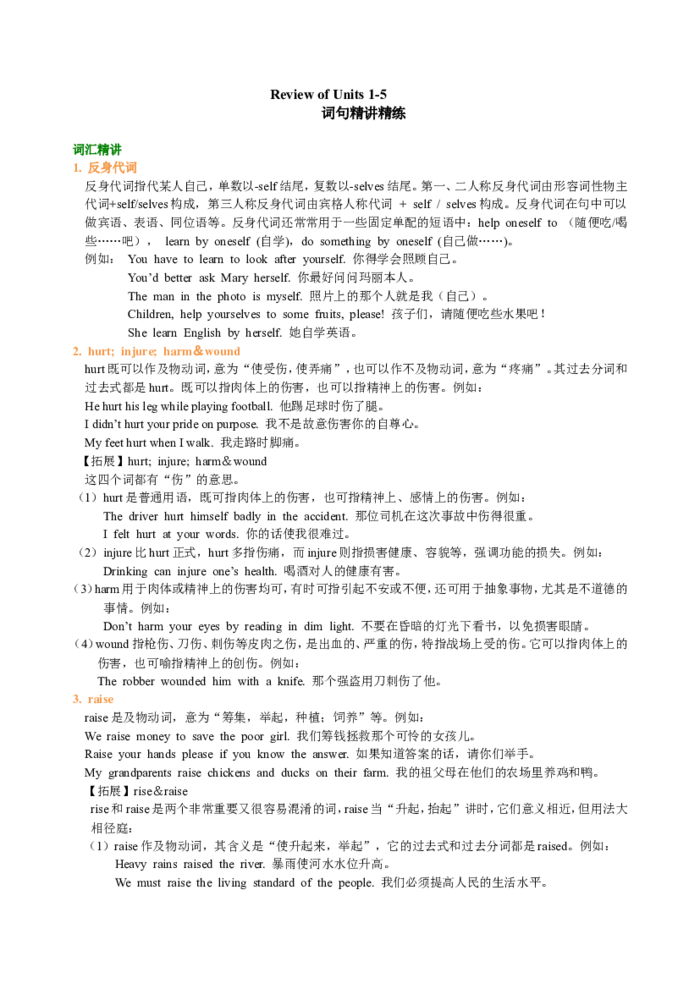
1. 反身代词
反身代词指代某人自己,单数以-self 结尾,复数以-selves 结尾。第一、二人称反身代词由形容词性物主
代词+self/selves 构成,第三人称反身代词由宾格人称代词 + self / selves 构成。反身代词在句中可以
做宾语、表语、同位语等。反身代词还常常用于一些固定单配的短语中:help oneself to (随便吃/喝
些……吧), learn by oneself (自学),do something by oneself (自己做……)。
例如: You have to learn to look after yourself. 你得学会照顾自己。
You’d better ask Mary herself. 你最好问问玛丽本人。
The man in the photo is myself. 照片上的那个人就是我(自己)。
         Children, help yourselves to some fruits, please! 孩子们,请随便吃些水果吧!
         She learn English by herself. 她自学英语。
2. hurt; injure; harm&wound
hurt 既可以作及物动词,意为“使受伤,使弄痛”,也可以作不及物动词,意为“疼痛”。其过去分词和
过去式都是hurt。既可以指肉体上的伤害,也可以指精神上的伤害。例如:
He hurt his leg while playing football. 他踢足球时伤了腿。
I didn’t hurt your pride on purpose. 我不是故意伤害你的自尊心。
My feet hurt when I walk. 我走路时脚痛。
 【拓展】hurt; injure; harm&wound
  这四个词都有“伤”的意思。
(1)hurt 是普通用语,既可指肉体上的伤害,也可指精神上、感情上的伤害。例如:
    The driver hurt himself badly in the accident. 那位司机在这次事故中伤得很重。
    I felt hurt at your words. 你的话使我很难过。
(2)injure 比hurt 正式,hurt 多指伤痛,而injure 则指损害健康、容貌等,强调功能的损失。例如:
    Drinking can injure one’s health. 喝酒对人的健康有害。
(3)harm 用于肉体或精神上的伤害均可,有时可指引起不安或不便,还可用于抽象事物,尤其是不道德的
事情。例如:
    Don’t harm your eyes by reading in dim light. 不要在昏暗的灯光下看书,以免损害眼睛。
(4)wound 指枪伤、刀伤、刺伤等皮肉之伤,是出血的、严重的伤,特指战场上受的伤。它可以指肉体上的
伤害,也可喻指精神上的创伤。例如:
   The robber wounded him with a knife. 那个强盗用刀刺伤了他。
3. raise
  raise 是及物动词,意为“筹集,举起,种植;饲养”等。例如:
  We raise money to save the poor girl. 我们筹钱拯救那个可怜的女孩儿。
  Raise your hands please if you know the answer. 如果知道答案的话,请你们举手。
  My grandparents raise chickens and ducks on their farm. 我的祖父母在他们的农场里养鸡和鸭。
  【拓展】rise&raise
   rise 和raise 是两个非常重要又很容易混淆的词,raise 当“升起,抬起”讲时,它们意义相近,但用法大
相径庭:
      (1)raise 作及物动词,其含义是“使升起来,举起”,它的过去式和过去分词都是raised。例如:
           Heavy rains raised the river. 暴雨使河水水位升高。
           We must raise the living standard of the people. 我们必须提高人民的生活水平。
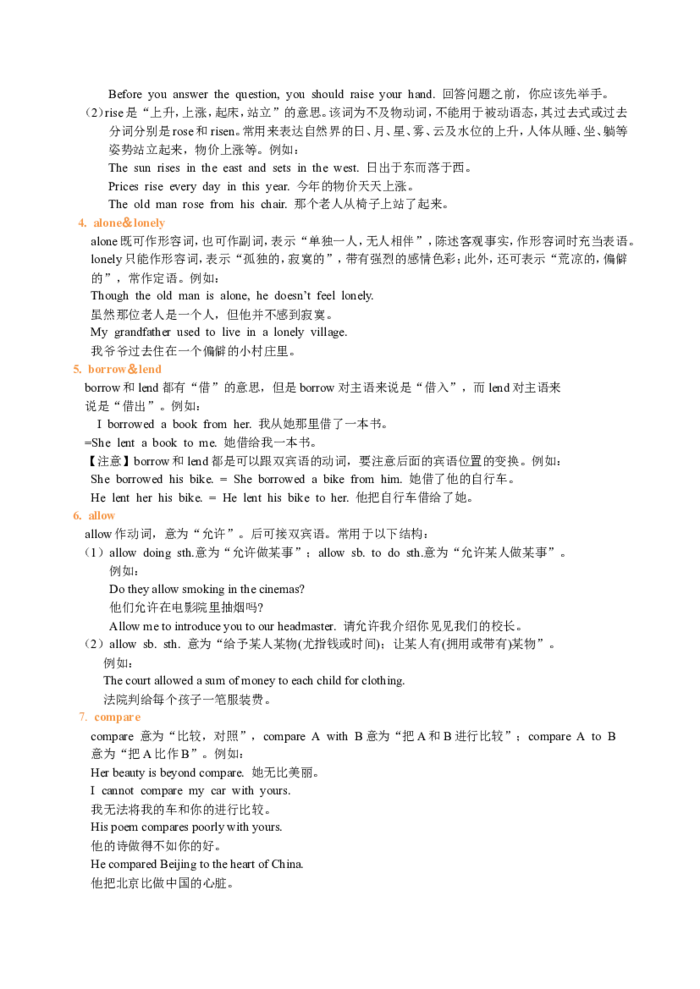
          Before you answer the question, you should raise your hand. 回答问题之前,你应该先举手。
      (2)rise 是“上升,上涨,起床,站立”的意思。该词为不及物动词,不能用于被动语态,其过去式或过去
分词分别是rose 和risen。常用来表达自然界的日、月、星、雾、云及水位的上升,人体从睡、坐、躺等
姿势站立起来,物价上涨等。例如:
          The sun rises in the east and sets in the west. 日出于东而落于西。
          Prices rise every day in this year. 今年的物价天天上涨。
          The old man rose from his chair. 那个老人从椅子上站了起来。
      4. alone&lonely
alone 既可作形容词,也可作副词,表示“单独一人,无人相伴”,陈述客观事实,作形容词时充当表语。
lonely 只能作形容词,表示“孤独的,寂寞的”,带有强烈的感情色彩;此外,还可表示“荒凉的,偏僻
的”,常作定语。例如:
Though the old man is alone, he doesn’t feel lonely.
虽然那位老人是一个人,但他并不感到寂寞。
My grandfather used to live in a lonely village.
我爷爷过去住在一个偏僻的小村庄里。
5. borrow&lend
borrow 和lend 都有“借”的意思,但是borrow 对主语来说是“借入”,而lend 对主语来
说是“借出”。例如:
I borrowed a book from her. 我从她那里借了一本书。
=She lent a book to me. 她借给我一本书。
【注意】borrow 和lend 都是可以跟双宾语的动词,要注意后面的宾语位置的变换。例如:
 She borrowed his bike. = She borrowed a bike from him. 她借了他的自行车。
 He lent her his bike. = He lent his bike to her. 他把自行车借给了她。
6. allow
allow 作动词,意为“允许”。后可接双宾语。常用于以下结构:
(1)allow doing sth.意为“允许做某事”;allow sb. to do sth.意为“允许某人做某事”。
     例如:
    Do they allow smoking in the cinemas?
他们允许在电影院里抽烟吗?
Allow me to introduce you to our headmaster. 请允许我介绍你见见我们的校长。
(2)allow sb. sth. 意为“给予某人某物(尤指钱或时间);让某人有(拥用或带有)某物”。
  例如:
The court allowed a sum of money to each child for clothing.
法院判给每个孩子一笔服装费。
 7. compare
   compare 意为“比较,对照”,compare A with B 意为“把A 和B 进行比较”;compare A to B
   意为“把A 比作B”。例如:
   Her beauty is beyond compare. 她无比美丽。
   I cannot compare my car with yours.
   我无法将我的车和你的进行比较。
   His poem compares poorly with yours.
他的诗做得不如你的好。
He compared Beijing to the heart of China.
他把北京比做中国的心脏。
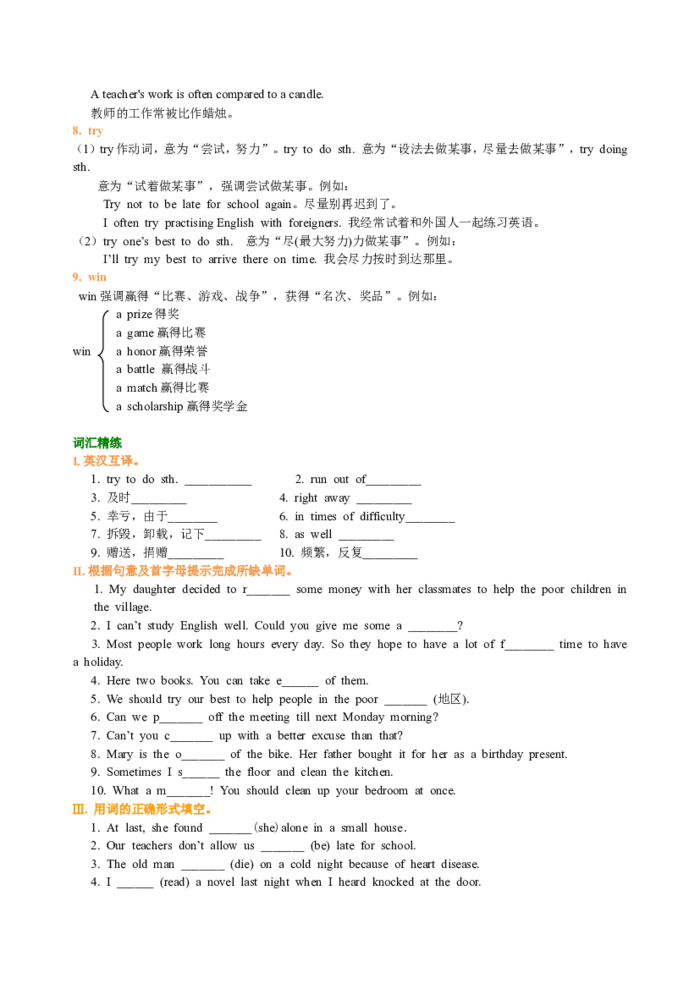
   A teacher's work is often compared to a candle.
教师的工作常被比作蜡烛。
8. try
(1)try 作动词,意为“尝试,努力”。try to do sth. 意为“设法去做某事,尽量去做某事”,try doing
sth.
意为“试着做某事”,强调尝试做某事。例如:
   Try not to be late for school again。尽量别再迟到了。
   I often try practising English with foreigners. 我经常试着和外国人一起练习英语。
(2)try one’s best to do sth.  意为“尽(最大努力)力做某事”。例如:
   I’ll try my best to arrive there on time. 我会尽力按时到达那里。
9. win
win 强调赢得“比赛、游戏、战争”,获得“名次、奖品”。例如:
       a prize 得奖
       a game 赢得比赛
win    a honor 赢得荣誉
       a battle 赢得战斗
       a match 赢得比赛
       a scholarship 赢得奖学金
词汇精练
I. 英汉互译。
   1. try to do sth. ___________       2. run out of_________
   3. 及时_________               4. right away _________
   5. 幸亏,由于________          6. in times of difficulty________
7. 拆毁,卸载,记下_________   8. as well _________
9. 赠送,捐赠_________         10. 频繁,反复_________
II. 根据句意及首字母提示完成所缺单词。
1. My daughter decided to r_______ some money with her classmates to help the poor children in
the village.
   2. I can’t study English well. Could you give me some a ________?
   3. Most people work long hours every day. So they hope to have a lot of f________ time to have
a holiday.
   4. Here two books. You can take e______ of them.
   5. We should try our best to help people in the poor _______ (地区).
6. Can we p_______ off the meeting till next Monday morning?
   7. Can’t you c_______ up with a better excuse than that?
8. Mary is the o_______ of the bike. Her father bought it for her as a birthday present.
9. Sometimes I s______ the floor and clean the kitchen.
10. What a m_______! You should clean up your bedroom at once.
Ⅲ. 用词的正确形式填空。
   1. At last, she found _______(she)alone in a small house.
   2. Our teachers don’t allow us _______ (be) late for school.
   3. The old man _______ (die) on a cold night because of heart disease.
   4. I ______ (read) a novel last night when I heard knocked at the door.
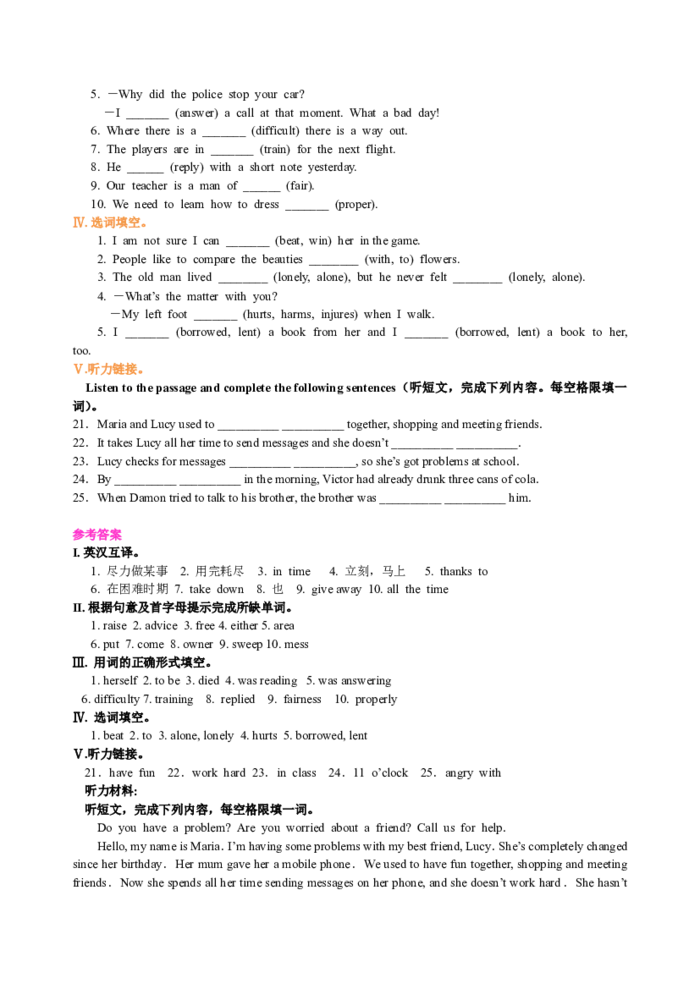
   5. -Why did the police stop your car?
     -I _______ (answer) a call at that moment. What a bad day!
   6. Where there is a _______ (difficult) there is a way out.
   7. The players are in _______ (train) for the next flight.
   8. He ______ (reply) with a short note yesterday.
   9. Our teacher is a man of ______ (fair).
   10. We need to learn how to dress _______ (proper).
Ⅳ. 选词填空。
  1. I am not sure I can _______ (beat, win) her in the game.
2. People like to compare the beauties ________ (with, to) flowers.
3. The old man lived ________ (lonely, alone), but he never felt ________ (lonely, alone).
4. -What’s the matter with you?
  -My left foot _______ (hurts, harms, injures) when I walk.
5. I _______ (borrowed, lent) a book from her and I _______ (borrowed, lent) a book to her,
too.
Ⅴ.听力链接。
  Listen to the passage and complete the following sentences(听短文,完成下列内容。每空格限填一
词)。
21.Maria and Lucy used to __________ __________ together, shopping and meeting friends.
22.It takes Lucy all her time to send messages and she doesn’t __________ __________.
23.Lucy checks for messages __________ __________, so she’s got problems at school.
24.By __________ __________ in the morning, Victor had already drunk three cans of cola.
25.When Damon tried to talk to his brother, the brother was __________ __________ him.
参考答案
I. 英汉互译。
   1. 尽力做某事  2. 用完耗尽  3. in time   4. 立刻,马上   5. thanks to
   6. 在困难时期 7. take down  8. 也  9. give away  10. all the time
II. 根据句意及首字母提示完成所缺单词。
1. raise  2. advice  3. free 4. either 5. area
6. put  7. come  8. owner  9. sweep 10. mess
Ⅲ. 用词的正确形式填空。
   1. herself  2. to be  3. died  4. was reading   5. was answering
   6. difficulty 7. training  8. replied  9. fairness  10. properly
Ⅳ. 选词填空。
   1. beat  2. to  3. alone, lonely  4. hurts  5. borrowed, lent
Ⅴ.听力链接。
21.have fun  22.work hard  23.in class  24.11 o’clock  25.angry with
听力材料:
听短文,完成下列内容,每空格限填一词。
Do you have a problem? Are you worried about a friend? Call us for help.
Hello, my name is Maria.I’m having some problems with my best friend, Lucy.She’s completely changed
since her birthday.Her mum gave her a mobile phone.We used to have fun together, shopping and meeting
friends.Now she spends all her time sending messages on her phone, and she doesn’t work hard .She hasn’t
been out with us for weeks, and she is not interested in doing anything .And she’s had problems in school,
because she checks for messages in class.What should I do?
Hi, I’m Damon.I’m worried about my brother, Victor.He eats a lot of junk food.He’s already eaten three
hamburgers and two packs of French fries today.And it’s only 11 o’clock in the morning, and he has drunk
three cans of Cola .Last night, he told our mum he wasn’t hungry, but he went to the shop and bought
chocolate.He always loses his temper easily.I tried to talk to him about it, but he got angry with me.In fact, he
hasn’t spoken to me at all this week.My parents haven’t noticed yet.Should I say something to them?
句式精讲
1. Aron loves mountain climbing and doesn't mind taking risks.
(1)mind 意为“介意,在乎”,主要用于疑问句和否定句。作不及物动词常用于Do (Would) you mind if...
句型中,用来表示请求对方的许可,即询问对方“是否介意(说话人)做某事”。如果同意、不反对
别人做某事,答语用否定形式; 如果不同意、反对别人做某事,答语用肯定形式。一般多用I am
sorry...或I’m afraid...等以缓和语气。例如:
—Do you mind if I smoke? 你介意我抽烟吗?
—Not at all, please. 一点也不。
—Would you mind me opening that door? 你介意我开门吗?
—I’m sorry, but it’s not allowed. 对不起,这是不允许的。
(2)作及物动词,后面通常接名词、代词、动词-ing 形式、复合结构、从句等。例如:
Would you mind my closing the window? 你介意我关上窗户吗?
【注意】
Would you mind doing sth.? 这一句型通常用来表示请他人做某事,常意为“可否请你做……”或
“劳驾你做……”。答语与前面的Do (Would) you mind if...句型的答语相同。例如:
-Would you mind making some room for the patient?
你介意给这位病人让点地方出来吗?
     -Certainly not. 当然不介意。
2. They told me stories about the past and how things used to be.
  used to do sth 是一个固定句式,意为“过去经常做某事”,后面用动词原形,表示过去的某种经常性、
习惯性的行为或者动作,并意味着这种动作目前已经不存在。含有used to 的句子,其各种句式变化如
下:
肯定句:We used to go camping every summer. 我们过去每年都要去露营.
否定句:I didn’t use to live there when I was a child. 当我是孩子时,我就不常在那里住。
一般疑问句:Did you use to be afraid of snake? = Used you to be afraid of snake? 你过去害怕蛇
吗?
特殊疑问句:What did you use to like eating? = What used you to like eating? 你过去喜欢吃什么?
【注意】含有used 的其他常见词组和used to do 的区别:
 (1)be used to do something 意思是“被用来做某事”,是动词短语use …to do 的被动语态结构。
      例如:Cups are used to drink. 杯子是用来喝水的。
(2)be /get used to doing something 和be /get used to sth.意思是“习惯于做某事”和“习惯于某
事/物”,     to 后接动词-ing 形式。例如:
My sister has got used to getting up early. 我妹妹已经习惯早起了。
I am not used to the weather here. 我不习惯这里的天气。
3. Could you please clean your room?
    Could you please+动词原形?是一个用来表示礼貌的请求的句子,与句型Would you please + 动词
原形?意义相当。句子中的could 虽然是can 的过去式,但是在这里不表示过去时,而表示委婉和客气
的语气。因此回答时,不能用could 回答,要用原形can 回答。此外,很多情况下,答语都不直接用can,
而用其他更加委婉的词。例如:
  -Could you please open the window?
  -Yes, I can. 好的,可以。/ Certainly! 当然可以!
  -No, I can’t. 不,不行。/ I’m afraid not. 恐怕不行。
4. Why don't you talk to your parents?
  (1)Why don’t you…? = Why not …? 意为“为什么不……呢?”,后面都是接动词原形。是常见的提建
议的句式之一。例如:
       Why not go out for a walk? = Why don’t you go out for a walk?
       为什么不出去散步呢?
  (2)why not 用在口语中表示赞同,意为“当然,好啊”。例如:
-Let’s go shopping tomorrow. 我们明天去购物吧。
-Why not? 为什么不呢?
  5. When he woke up, the sun was rising.
    when 引导的时间状语从句,既可指与主句动作同时进行,也可指先后发生,从句中的动作既可是延
续性动词,也可是非延续性动词。若是同时发生且为延续性动词,则可与while 互换;若when 作并列
连词,表示“就在那时,这时候”。例如:
When the alien got out, the girl was shopping.
= While the girl was shopping, the alien got out.
    当外星人出来时,小女孩在购物。
We were watching TV when there was a knock at the door.
    我们在看电视,这时有人敲门。
【拓展】
(1)while 也可以引导时间状语从句,强调动作同时进行,从句常用进行时,其动词必须为延续性动词或
表状态。例如:
Could you look after my dog while I’m away?
我离开时,你能照看我的狗吗?
He came in while I was watching TV.
当我在看电视时,他进来了。
(2)as 引导时间状语从句,多指主句和从句两个动作同时发生,常翻译为“一边……一边……”。例如:
They talked as they walked. 他们边走边谈。
句式精练
I. 根据汉语提示,完成英语句子(每空一词)。
      1. 你介意把车子停到那边吗?
         _______ you _______ _______ your car over there?
      2. 尽管她累了,她还继续工作。
She _______ ________ ________ although she was tired.
      3. 他开始意识到努力学习的重要性。
        He began to ________ the ________ of studying hard.
      4. 她既种菜也种花。
She _______ flowers _______ _______ _______ vegetables.
      5. 他毫不费劲的找到了一份工作。
        He had no _______ ________ a job.
      6. 暴风雨时她在做什么?
        What _______ she ________ at the time of the rainstorm?
      7. Tom 来自英国,我们其余的人来自中国。
        Tom is from England and _______ _______ _______ us are from China.
      8. -这周六我们一起去野餐好吗?
        -为什么不呢?
        -Shall we go to have a picnic on this Saturday?
        -_______ ________?
9. -你能帮我修一下自行车吗?
    -当然可以。
    -_______ _______ ________ mend the bike for me?
    -Certainly!
10. 他过去常常去乡下度假。
    He _______ _______ go on holiday in the countryside.
II. 句型转换,每空一词。
          1. TV, night, I , watching, at, was, 10:00 pm, last (连词成句)
            __________________________________________________
          2. I was cleaning windows at    home

  at that time yesterday. (对划线部分提问)
            _______ ________ you cleaning windows at that time yesterday.
          3. Why not get up early to do some exercise? (改为同义句)
  _______ ________ _______ get up early to do some exercise?
4. He used to be weak in English. (改为一般疑问句)
  ①______ ______ to be weak in English?
  ②_______ _______ _______ to be weak in English?
5. I think math is difficult. (改为否定句)
  ______ _______ _______ math is difficult.
III. 补全对话。
根据对话内容,从方框中选出能填入横线处的最佳选项(其中两项是多余的)。
A. Never mind.
B. What bad luck!
C. Where have you been?
D. What should we do then?
E. Oh, I’m so sorry to hear that.
F. Then let’s go to the cinema by taxi.
G. I hope so, but I guess that someone else stole it.
A: Sorry I’m late, Alice.
B: It’s all right, Rose.     1
A: To the Lost & Found – I lost my mobile phone.
B:
  2       What happened?
A: After I had dinner with a friend, I went out for a walk. I was about ready to call my mother when I
realized I couldn’t find it anywhere.
B:     3       I hope that someone will pick it up and call you.
A:     4         Who know…well…when is the movie going to begin?
B: At 7:00 pm. That’s 15 minutes from now. We don’t have enough time to get there.
A:     5
B: OK. Let’s go.
参考答案
I. 根据汉语提示,完成英语句子(每空一词)。
   1. Would, mind parking  2. kept on working  3. realize, importance
4. grows, as well as  5. trouble finding  6. was, doing  7. the rest of
8. Why not?  9. Could / Would you please  10. used to
II. 句型转换,每空一词。
      1. I was watching TV at 10:00 pm last night.  2. Where were  3. Why don’t you
4. ①Used he ② Did he use  5. I don’t think
III. 补全对话。
   1. C  2. E  3. B  4. G  5. F