文档文本内容
高 中
时 事
批判性思维是 AI 教育的关键
Critical thinking key to AI education
artificial intelligence
人工智能
critical [ˈkrɪtɪkl]
adj.①关键的;至关重要的
②批判性的;挑剔的
③严重的;可能有危险的
thinking [ˈθɪŋkɪŋ]
n.①[U]思考;思维;思想
②[U]想法;见解
adj.③思想的;有理智的;有思考
力的
essential [ɪˈsenʃl]
adj.①必不可少的;极其重要的;
完全必要的
②基本的;本质的;根本的
n.③[C,常用pl.]必不可少的东
西;必需品
④(essentials)[pl.](某学科
的)基础,基本知识;要点
transform [trænsˈfɔːm]
vt.使改变形态;使改变外观(或
性质);使改观
education [ˌedʒuˈkeɪʃn]
n.[C]图书馆;资料室
challenge [ˈtʃælɪndʒ]
n.①[C, U]挑战;艰巨任务
②[C, U]质疑,怀疑
vt.③向(某人)挑战
④对……怀疑(或质疑)
educator [ˈedʒukeɪtə(r)]
n.[C]教育工作者;教师;教育学
家;教育家
language [ˈlæŋɡwɪdʒ]
n.[C]语言[U]言语,说话
think [θɪŋk]
v.①想;思考;想象;试想;猜想
②认为;以为
③打算;想要;计划
单词数:219个
@2025/06/02   ✅每日1篇时事阅读  ✅高效积累高中3500词
DATE:
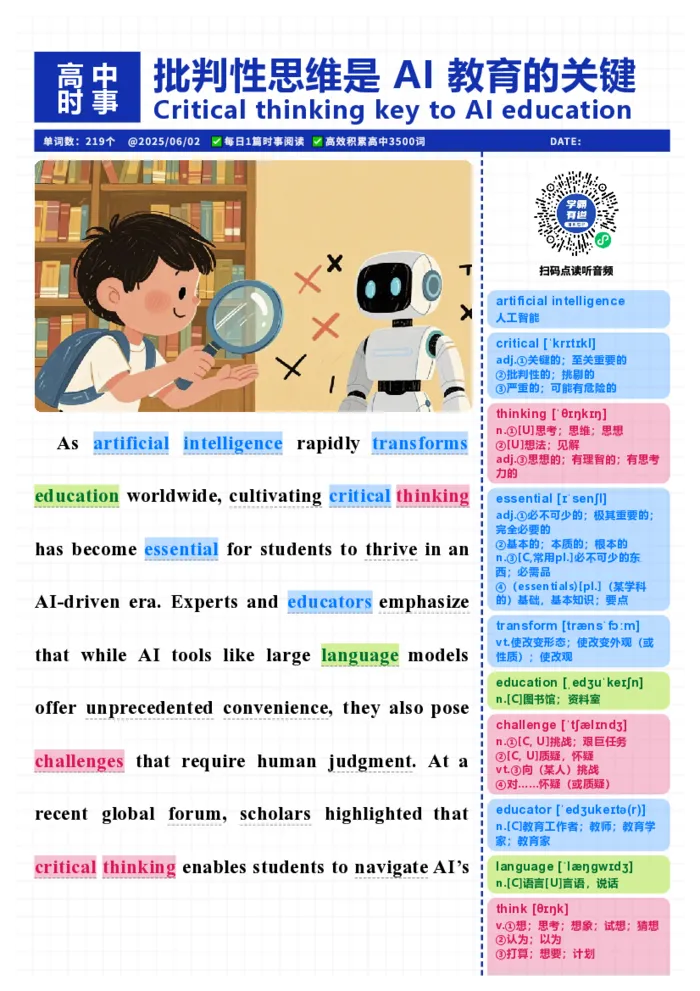
As   artificial   intelligence   rapidly   transforms
education worldwide, cultivating critical thinking
has become essential for students to thrive in an
AI-driven era. Experts and educators emphasize
that   while   AI   tools   like   large   language models
offer unprecedented convenience, they also pose
challenges   that   require   human   judgment. At a
recent   global   forum,   scholars   highlighted   that
critical thinking enables students to navigate AI’s
扫码点读听音频
n.④[sing.]想,思索,思考;反
省
technology [tekˈnɒlədʒi]
n.[U,C]科技;工艺;技术
wise [waɪz]
adj.明智的,智慧的;高明的
blind [blaɪnd]
adj.①瞎的;失明的
②(the~)n.[pl.]盲人
③视而不见的
④无理性的
vt.⑤使变瞎;使失明
⑥使眼花;使目眩
n.⑦[C]窗帘;(尤指)卷帘
output [ˈaʊtpʊt]
n.①[U,sing.]输出
②[U,sing.]产量,输出量
③[U,sing.]输出功率
vt.④输出
ensure [ɪnˈʃʊə(r); ɪnˈʃɔ:
(r)]
vt.保证;确保;担保
lack [læk]
vt.①没有;缺乏;不足;短缺
n.②[U,sing.]缺乏;匮乏;短缺
anticipate [ænˈtɪsɪpeɪt]
vt.①预料;预期
②期盼;期望
③预见,预计(并做准备)
problem [ˈprɒbləm]
n.[C]问题;难题
correct [kəˈrekt]
adj.恰当的;正确的
vt.改正,纠正
evaluate [ɪˈvæljueɪt]
vt.评估;评价;估计
university [ˌjuːnɪˈvɜːsəti]
n.[C,U]大学
critical thinking
批判性思维
integrate [ˈɪntɪɡreɪt]
v.①(使)加入,融入群体
②(使)合并;成为一体
phase [feɪz]
n.n.①[C]阶段;时期
vt.②分阶段进行;逐步做
approach [əˈprəʊtʃ]
n.①[C]方法,方式,态度
②[C]道路;路径;通路
③[C]接洽;建议;要求
④[sing](距离和时间上的)靠
近,接近
v.⑤接近,靠近
complexities, ensuring they use technology wisely
rather   than   blindly   following   its   outputs.
Nobel   Laureate   Philip   H.   Dybvig   noted that
tools like ChatGPT simplify tasks but lack moral
and analytical capabilities. “LLMs need users to
anticipate   problems   and   correct   errors,”   he
explained, stressing that students must learn to
evaluate   AI’s   limitations. Mary   Gorman   from
Baruch   College   added   that   universities should
teach students when not to use AI, emphasizing
ethical   analysis. For   instance,   critical thinking
helps identify biased algorithms or flawed data,
preventing unethical applications of technology.
Educators   propose   a   phased   approach:
building   foundational   skills   in critical thinking
and   ethics   before   integrating   AI   tools.
Southwestern   University   of   Finance   and
Economics President Li Yongqiang underscored
vt.⑥着手处理;对付
⑦找……商量;与……接洽;建
议;要求
balance [ˈbæləns]
n.①[U,sing.]平衡;均匀;均
势
②[u]平衡能力
③[C,常用sing.]结欠;余额
v.④(使)保持平衡;立稳
⑤相抵;抵消
vt.⑥比较(两个相对的事物);
权衡重要性
⑦同等重视(相对的两个事物或
方面)
innovation [ˌɪnəˈveɪʃn]
n.①[U](新事物、思想或方法
的)创造;创新;改革;革新
②[C]新方法;新发明;新思想
the   need   to   prioritize   “future-oriented
adaptability,”   urging   universities   to   balance
technical   literacy   with   analytical   minds. By
fostering   critical thinking,   students   can harness
AI   as   a   tool   for   innovation   while   avoiding its
pitfalls. In essence, critical thinking remains the
compass guiding responsible and effective use of
AI in education.