文档文本内容
高 中
时 事
月全食是怎么形成的?
How Does a Total Lunar Eclipse Form?
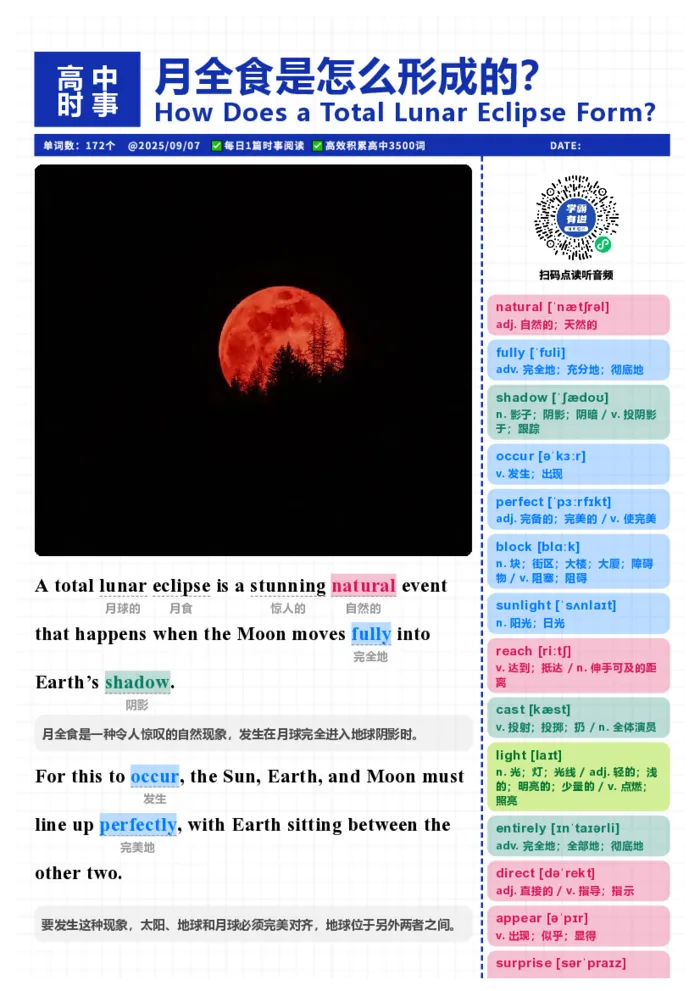
月全食是一种令人惊叹的自然现象,发生在月球完全进入地球阴影时。
要发生这种现象,太阳、地球和月球必须完美对齐,地球位于另外两者之间。
natural [ˈnætʃrəl]
adj. 自然的;天然的
fully [ˈfʊli]
adv. 完全地;充分地;彻底地
shadow [ˈʃædoʊ]
n. 影子;阴影;阴暗 / v. 投阴影
于;跟踪
occur [əˈkɜːr]
v. 发生;出现
perfect [ˈpɜːrfɪkt]
adj. 完备的;完美的 / v. 使完美
block [blɑːk]
n. 块;街区;大楼;大厦;障碍
物 / v. 阻塞;阻碍
sunlight [ˈsʌnlaɪt]
n. 阳光;日光
reach [riːtʃ]
v. 达到;抵达 / n. 伸手可及的距
离
cast [kæst]
v. 投射;投掷;扔 / n. 全体演员
light [laɪt]
n. 光;灯;光线 / adj. 轻的;浅
的;明亮的;少量的 / v. 点燃;
照亮
entirely [ɪnˈtaɪərli]
adv. 完全地;全部地;彻底地
direct [dəˈrekt]
adj. 直接的 / v. 指导;指示
appear [əˈpɪr]
v. 出现;似乎;显得
surprise [sərˈpraɪz]
单词数:172个
@2025/09/07   ✅每日1篇时事阅读  ✅高效积累高中3500词
DATE:
A total lunar
月球的
 eclipse
月食
 is a stunning
惊人的
 natural
自然的
 event
that happens when the Moon moves fully
完全地
 into
Earth’s shadow
阴影
.
For this to occur
发生
, the Sun, Earth, and Moon must
line up perfectly
完美地
, with Earth sitting between the
other two.
扫码点读听音频
这种罕见的对齐方式阻挡了阳光到达月球。
地球会投射两种阴影:一种是黑暗的内部阴影,称为本影;另一种是较浅的外
部阴影,称为半影。
当月球完全滑入本影时,就会发生月全食。
在这里,几乎没有直接的阳光照射到月球,使其显得暗淡。
令人惊讶的是,在月全食期间,月球常常会变成深红色,因此得名“血月”。
v. 使惊奇;使感到意外 / n. 惊
讶;惊喜;意外
deep [diːp]
adj. 深的 / adv. 深深地 / n. 深
处
turn [tɜːrn]
v. 转身;转弯;转动;转变 / n.
轮到的机会;拐弯;转变
total [ˈtoʊt(ə)l]
n. 总额;总计 / v. 共计;总数达
/ adj. 总的;全部的
earn [ɜːrn]
v. 获得;赚得
atmosphere [ˈætməsfɪr]
n. 大气;气氛;氛围
happen [ˈhæpən]
v. 发生
pass [pæs]
v. 路过;(时间)流逝;超过;传
递;通过 / n. (考试)及格;通行
证
bend [bend]
v. (使)弯曲;弯腰 / n. 弯曲处
let [let]
v. 让;允许;放开;出租
relative [ˈrelətɪv]
n. 亲戚 / adj. 比较的;相对的;
相关联的
orbit [ˈɔːrbɪt]
n. 轨道 / v. 绕...轨道而行
watch [wɑːtʃ]
v. 观看;观察;小心 / n. 手表;
监视;注意
This rare alignment
排列;排成直线
 blocks
阻挡
 sunlight
阳光
 from
reaching
到达
 the Moon.
Earth casts
投射
 two types of shadows: a dark inner
内部的

shadow called the umbra
本影
, and a lighter
更明亮的
 outer
shadow, the penumbra
半影
.
A total lunar
月球的
 eclipse
月食
 takes place when the Moon
slides entirely
完全地
 into the umbra
本影
.
Here, almost no direct
直接的
 sunlight
阳光
 hits the Moon,
making it appear
看起来
 dim
昏暗的
.
Surprisingly
惊人地
, the Moon often turns
变成
 a deep
深的
 red
during a total
全食的
 eclipse
月食
, earning
赢得
 it the name "blood
moon."
This happens
发生
 because Earth’s atmosphere
大气;大气层
 bends
使弯曲
 (
refracts
使折射
) sunlight
阳光
—scattering
散射
 blue light and
这是因为地球大气层会弯曲(折射)阳光——散射蓝光,让红光通过,然后照
亮月球。
月全食并非每月都发生,因为月球的轨道相对于地球是倾斜的。
它们每年发生约1-2次,用肉眼观看是安全的,因此成为天文爱好者的最爱。
letting
让
 red light pass through
穿过
, which then lights
up the Moon.
Total lunar
月球的
 eclipses
月食
 don’t happen every month, as
 the Moon’s orbit
轨道
 is tilted
倾斜的
 relative
相对的
 to Earth’s.
They occur
发生
 about 1-2 times a year and are safe to
watch
观看
 with the naked
裸的
 eye, making them a favorite
特别喜爱的事物
 for skywatchers
天文观察者
.