文档文本内容
高 中
时 事
月全食是怎么形成的?
How Does a Total Lunar Eclipse Form?
natural [ˈnætʃrəl]
adj. 自然的;天然的
fully [ˈfʊli]
adv. 完全地;充分地;彻底地
shadow [ˈʃædoʊ]
n. 影子;阴影;阴暗 / v. 投阴影
于;跟踪
occur [əˈkɜːr]
v. 发生;出现
perfect [ˈpɜːrfɪkt]
adj. 完备的;完美的 / v. 使完美
block [blɑːk]
n. 块;街区;大楼;大厦;障碍
物 / v. 阻塞;阻碍
sunlight [ˈsʌnlaɪt]
n. 阳光;日光
reach [riːtʃ]
v. 达到;抵达 / n. 伸手可及的距
离
cast [kæst]
v. 投射;投掷;扔 / n. 全体演员
light [laɪt]
n. 光;灯;光线 / adj. 轻的;浅
的;明亮的;少量的 / v. 点燃;
照亮
entirely [ɪnˈtaɪərli]
adv. 完全地;全部地;彻底地
direct [dəˈrekt]
adj. 直接的 / v. 指导;指示
appear [əˈpɪr]
v. 出现;似乎;显得
surprise [sərˈpraɪz]
单词数:172个
@2025/09/07   ✅每日1篇时事阅读  ✅高效积累高中3500词
DATE:
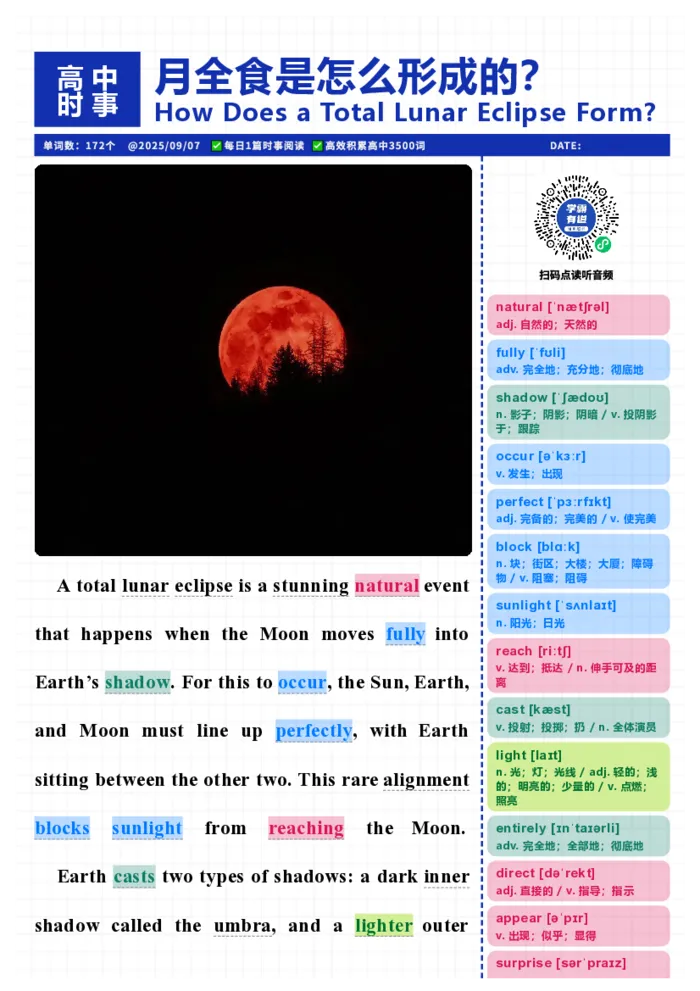
A total lunar eclipse is a stunning natural event
that   happens   when   the   Moon   moves   fully into
Earth’s shadow. For this to occur, the Sun, Earth,
and   Moon   must   line   up   perfectly,   with Earth
sitting between the other two. This rare alignment
blocks   sunlight   from   reaching   the   Moon.
Earth casts two types of shadows: a dark inner
shadow   called   the   umbra,   and   a   lighter outer
扫码点读听音频
v. 使惊奇;使感到意外 / n. 惊
讶;惊喜;意外
deep [diːp]
adj. 深的 / adv. 深深地 / n. 深
处
turn [tɜːrn]
v. 转身;转弯;转动;转变 / n.
轮到的机会;拐弯;转变
total [ˈtoʊt(ə)l]
n. 总额;总计 / v. 共计;总数达
/ adj. 总的;全部的
earn [ɜːrn]
v. 获得;赚得
atmosphere [ˈætməsfɪr]
n. 大气;气氛;氛围
happen [ˈhæpən]
v. 发生
pass [pæs]
v. 路过;(时间)流逝;超过;传
递;通过 / n. (考试)及格;通行
证
bend [bend]
v. (使)弯曲;弯腰 / n. 弯曲处
let [let]
v. 让;允许;放开;出租
relative [ˈrelətɪv]
n. 亲戚 / adj. 比较的;相对的;
相关联的
orbit [ˈɔːrbɪt]
n. 轨道 / v. 绕...轨道而行
watch [wɑːtʃ]
v. 观看;观察;小心 / n. 手表;
监视;注意
shadow, the penumbra. A total lunar eclipse takes
place   when   the   Moon   slides   entirely   into   the
umbra. Here, almost no direct sunlight hits the
Moon, making it appear dim.
Surprisingly, the Moon often turns a deep red
during a total eclipse, earning it the name "blood
moon." This happens because Earth’s atmosphere
bends   (refracts)   sunlight—scattering   blue light
and   letting   red   light   pass through,   which then
lights up the Moon.
Total lunar eclipses don’t happen every month,
as the Moon’s orbit is tilted relative to Earth’s.
They occur about 1-2 times a year and are safe to
watch with the naked eye, making them a favorite
for skywatchers.