语法点1:名词
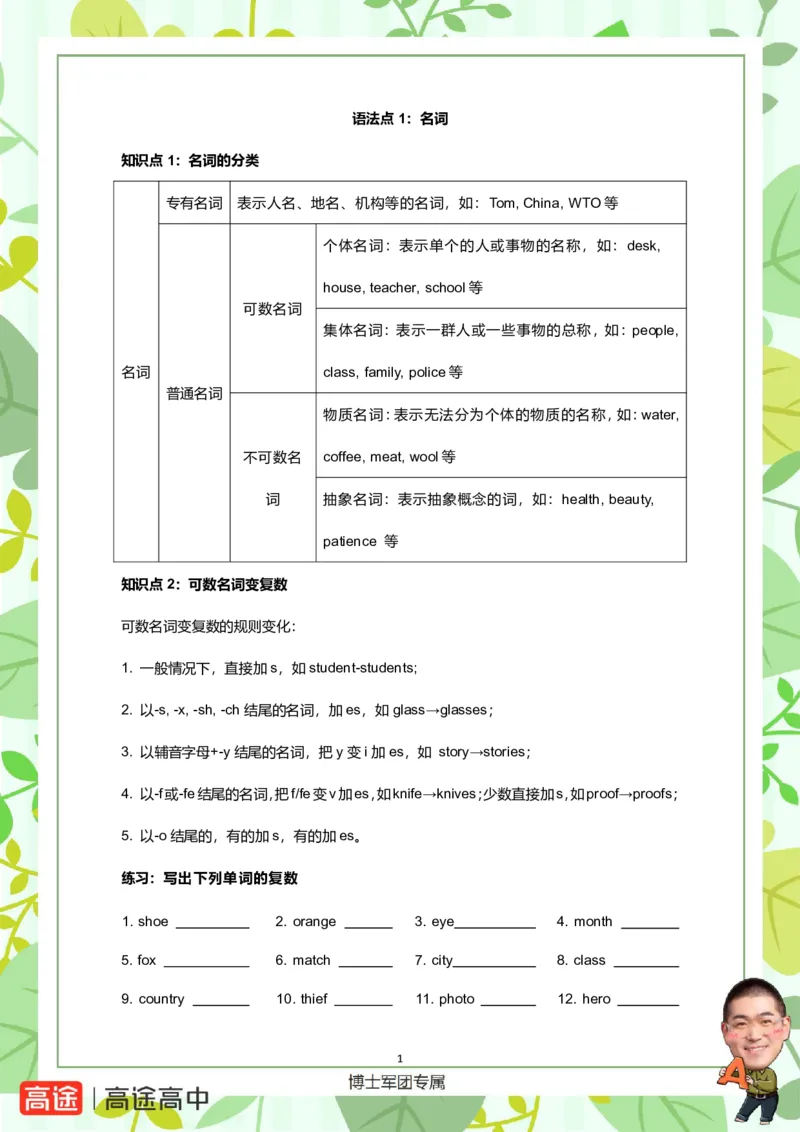
知识点1:名词的分类
专有名词 表示人名、地名、机构等的名词,如:Tom,China, WTO等
个体名词:表示单个的人或事物的名称,如:desk,
house,teacher, school等
可数名词
集体名词:表示一群人或一些事物的总称,如:people,
名词 class, family, police等
普通名词
物质名词:表示无法分为个体的物质的名称,如:water,
不可数名 coffee, meat,wool等
词 抽象名词:表示抽象概念的词,如:health, beauty,
patience 等
知识点2:可数名词变复数
可数名词变复数的规则变化:
1. 一般情况下,直接加s,如student-students;
2. 以-s,-x, -sh,-ch结尾的名词,加es,如glass→glasses;
3. 以辅音字母+-y结尾的名词,把y变i加es,如 story→stories;
4. 以-f或-fe结尾的名词,把f/fe变v加es,如knife→knives;少数直接加s,如proof→proofs;
5. 以-o结尾的,有的加s,有的加es。
练习:写出下列单词的复数
1. shoe 2. orange 3. eye 4. month
5. fox 6. match 7. city 8. class
9. country 10. thief 11. photo 12. hero
1语法点1:名词
答案
知识点2:可数名词变复数
练习:写出下列单词的复数
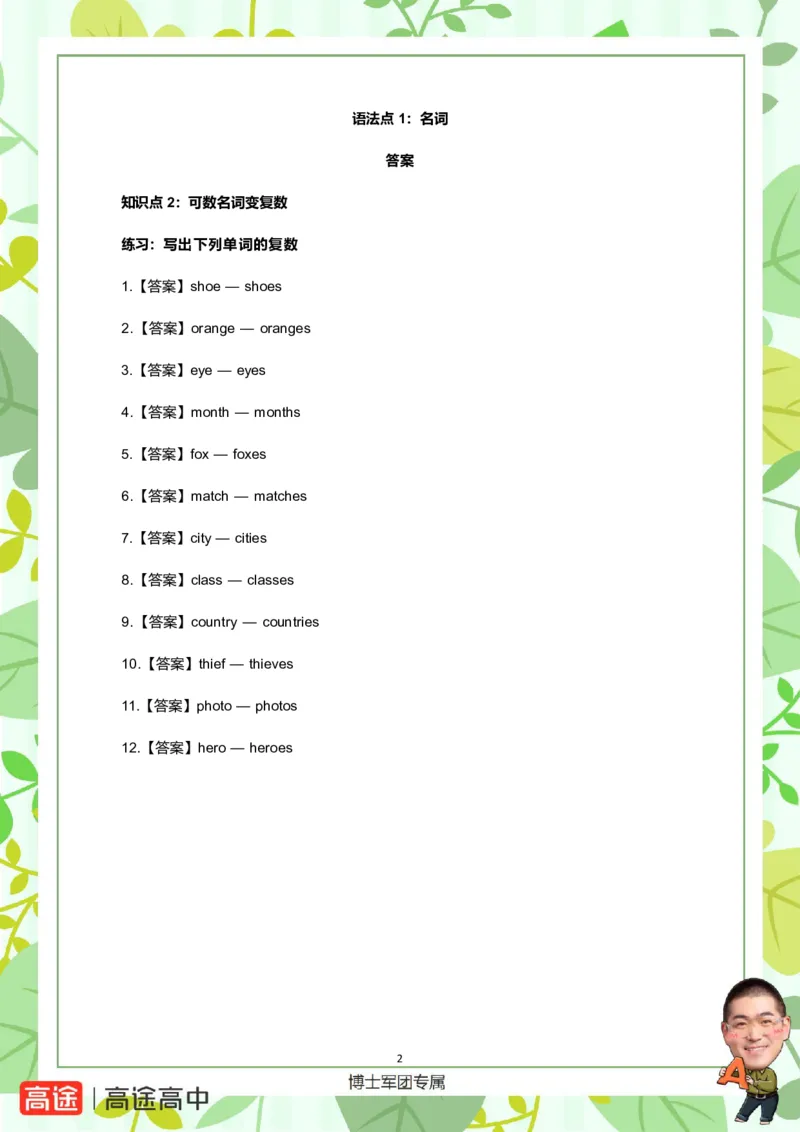
1.【答案】shoe — shoes
2.【答案】orange — oranges
3.【答案】eye — eyes
4.【答案】month — months
5.【答案】fox — foxes
6.【答案】match — matches
7.【答案】city — cities
8.【答案】class — classes
9.【答案】country — countries
10.【答案】thief — thieves
11.【答案】photo — photos
12.【答案】hero — heroes
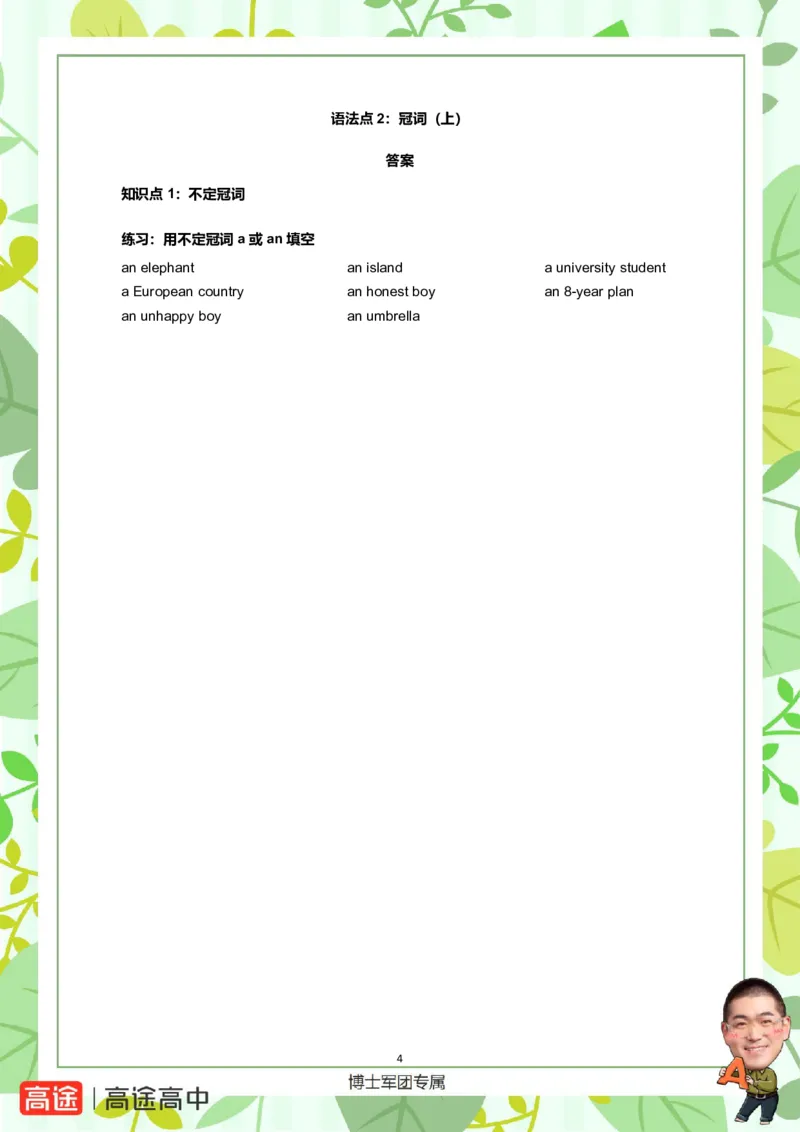
2语法点2:冠词(上)
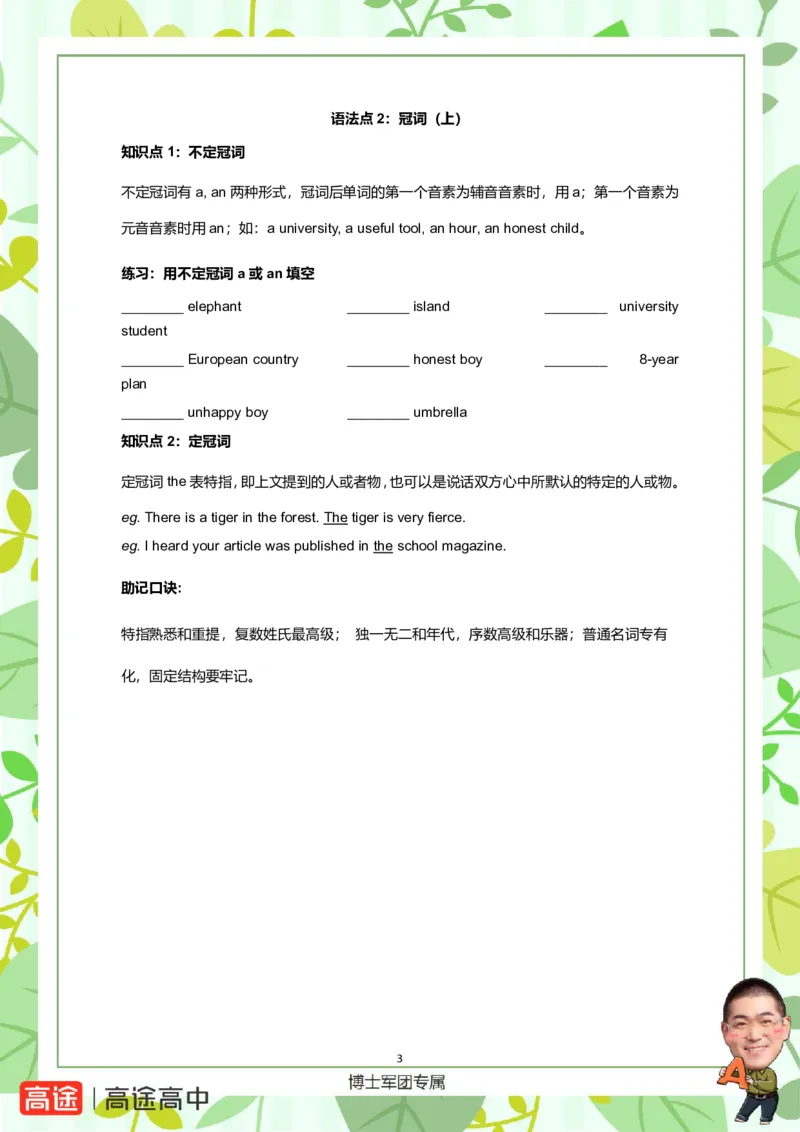
知识点1:不定冠词
不定冠词有a,an两种形式,冠词后单词的第一个音素为辅音音素时,用a;第一个音素为
元音音素时用an;如:auniversity,ausefultool,anhour,an honestchild。
练习:用不定冠词a或an填空
________elephant ________island ________ university
student
________European country ________honestboy ________ 8-year
plan
________unhappy boy ________umbrella
知识点2:定冠词
定冠词the表特指,即上文提到的人或者物,也可以是说话双方心中所默认的特定的人或物。
eg.There is atiger in theforest.Thetiger isvery fierce.
eg.Iheardyour article was publishedin the schoolmagazine.
助记口诀:
特指熟悉和重提,复数姓氏最高级; 独一无二和年代,序数高级和乐器;普通名词专有
化,固定结构要牢记。
3语法点2:冠词(上)
答案
知识点1:不定冠词
练习:用不定冠词a或an填空
anelephant anisland auniversity student
aEuropean country anhonestboy an8-year plan
anunhappy boy anumbrella
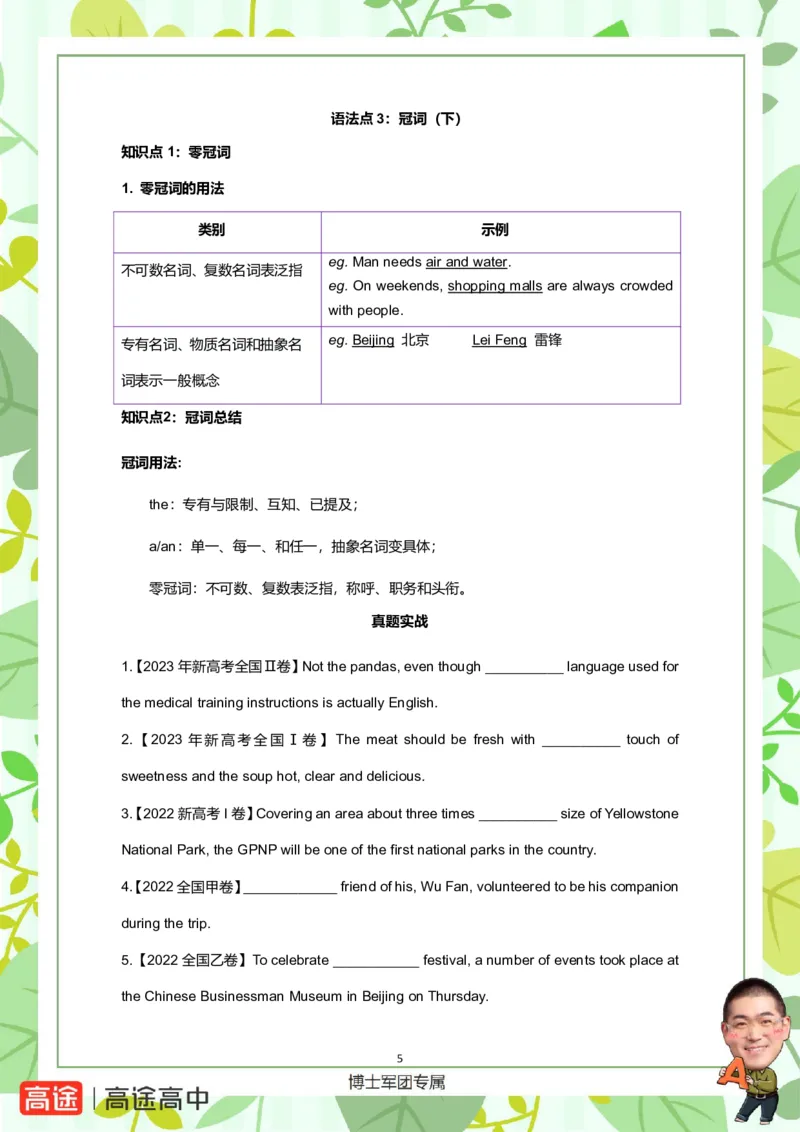
4语法点3:冠词(下)
知识点1:零冠词
1. 零冠词的用法
类别 示例
eg.Manneeds air and water.
不可数名词、复数名词表泛指
eg. On weekends, shopping malls are always crowded
with people.
专有名词、物质名词和抽象名 eg.Beijing 北京 Lei Feng 雷锋
词表示一般概念
知识点2:冠词总结
冠词用法:
the:专有与限制、互知、已提及;
a/an:单一、每一、和任一,抽象名词变具体;
零冠词:不可数、复数表泛指,称呼、职务和头衔。
真题实战
1.【2023年新高考全国Ⅱ卷】Notthepandas,eventhough__________languageusedfor
the medical training instructions isactually English.
2.【2023 年新高考全国Ⅰ卷】The meat should be fresh with __________ touch of
sweetnessand the soup hot,clear anddelicious.
3.【2022新高考I卷】Coveringanareaaboutthreetimes__________sizeofYellowstone
NationalPark,the GPNPwillbe oneofthe firstnationalparks inthe country.
4【. 2022全国甲卷】____________friendofhis,WuFan,volunteeredtobehiscompanion
duringthe trip.
5.【2022全国乙卷】Tocelebrate___________festival,anumber ofeventstook placeat
the ChineseBusinessman Museumin Beijing onThursday.
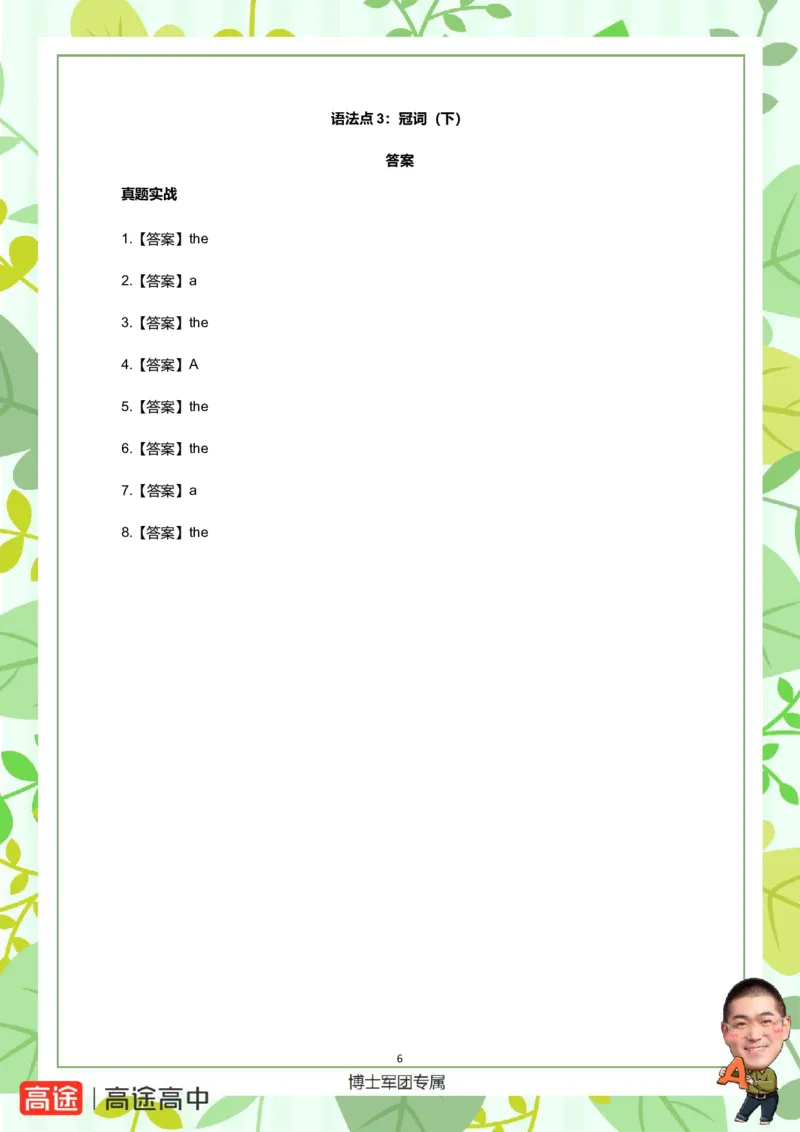
5语法点3:冠词(下)
答案
真题实战
1.【答案】the
2.【答案】a
3.【答案】the
4.【答案】A
5.【答案】the
6.【答案】the
7.【答案】a
8.【答案】the
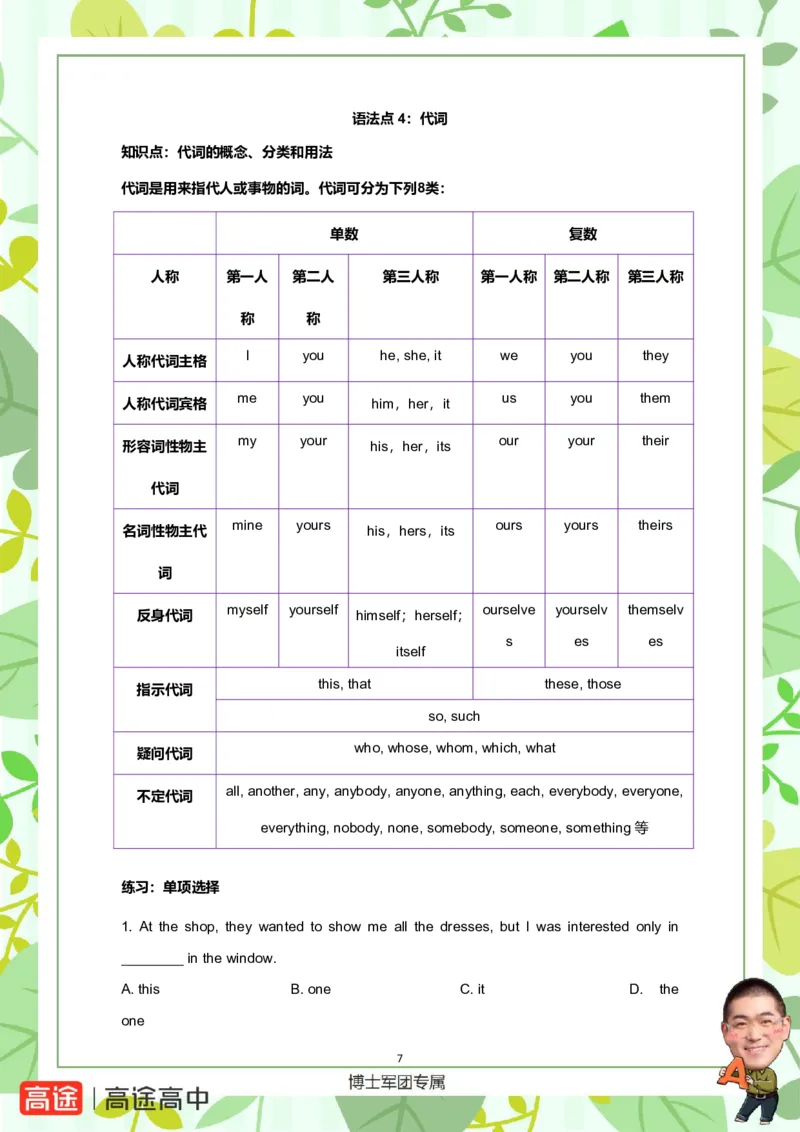
6语法点4:代词
知识点:代词的概念、分类和用法
代词是用来指代人或事物的词。代词可分为下列8类:
单数 复数
人称 第一人 第二人 第三人称 第一人称 第二人称 第三人称
称 称
I you he,she,it we you they
人称代词主格
me you us you them
人称代词宾格 him,her,it
my your our your their
形容词性物主 his,her,its
代词
mine yours ours yours theirs
名词性物主代 his,hers,its
词
myself yourself ourselve yourselv themselv
反身代词 himself;herself;
s es es
itself
this,that these,those
指示代词
so,such
who,whose, whom,which, what
疑问代词
all,another,any, anybody, anyone,anything, each,everybody, everyone,
不定代词
everything,nobody, none,somebody, someone, something等
练习:单项选择
1. At the shop, they wanted to show me all the dresses, but I was interested only in
________in the window.
A.this B.one C.it D. the
one
72.—Whatcan Ido for you?
—I’dlike tobuy abook,________ thatwas written byLu Xun.
A.which B.one C.but D.all
3.Iwon’ttrusthim.He says onethingtoyour facebutdoes ________behindyour back.
A.other B.the other C.theothers D.
another
4.Don’tleaveyour keys inthe car.Someone might steal________.
A.one B.that C.this D.it
8语法点4:代词
答案
练习:单项选择
1.D。句意为“在商店,他们想向我展示所有的连衣裙,但我只对橱窗里的那一件感兴趣”,
这里强调特定的一件连衣裙,应使用“the one”。
2.B。句中有引导定语从句的引导词that,故不用which。分析句子成分可知,从句中缺少
先行词,可用one,指代abook。
3.D。这里表示他在背后说另一套话,使用“another”表示“另一套”。
4.D。这里表示不要把钥匙留在车里,因为有可能有人偷走“它”(指钥匙)。
9语法点5:介词
知识点:介词、介词短语及其用法、辨析和搭配
1. 介词的定义
介词,属于虚词,后面必须接名词、代词或相当于名词或代词的词、短语、句子作宾语。
2. 介词短语的功能
介词和其后的宾语被称为介词短语。介词短语在句中主要充当表语、宾补、定语、状语成分。
eg.Thebookyouwant isonthetable. (表语)
eg.Isawatallmanunderthetree. (定语)
eg.Theycameherebytrain. (状语)
练习:单项选择
1.LookatLucy! Howhappyshelooks________hernewdress.
A.after B.for C.at D.in
2. A steamer was going along ________ full speed, when it suddenly got into shallow water
andranaground.
A.at B.on C.with D.by
3. Tom was gentle and he often talked with others ________ a low voice but this time he
shoutedsuddenly
________thetopofhisvoice.
A.in,at B.at,in C.at,with D.in,with
4.________themid-termexamapproaching, almosteveryoneinour classisdevotedtotheir
studies.
A.As B.Under C.With D.For
5.________lastmonth,Jackhadbeenlateforthreetimes.
A.By B.Since C.In D.For
10语法点5:介词
答案
知识点:介词、介词短语及其用法、辨析和搭配
练习:单项选择
1-5:DAACA
11语法点6:形容词副词(上)
知识点1:形容词副词的概念和构成
1. 形容词:是描述人和事物的性质、特征或状态的词,主要用来修饰名词和代词。
2. 副词:是指在句子中表示行为或状态特征的词,用来修饰形容词、动词、其他副词或者
整个句子等,表示时间、地点、方式、程度等。
知识点2:形容词的句法功能
形容词主要在句中作定语、表语、状语以及宾补等。
练习:语法填空
1. Seated in a comfortable chair, listening to the peaceful music, you’ll be brought into a
_______ (relax) stateofmind.
2.Iam bored with Mr.Wang’s________(bore) talking;Ican’twaitanylonger forits end.
3.King wasa greatspeaker andan ________(inspire) leader.
知识点3:副词的句法功能
副词的句法功能
1. 作状语,修饰动词、形容词、短语或全句
2. 作表语 ,主要指主语的方位、方向、动作、情况等
3. 作定语,主要为表示时间或地点的副词
4. 作补语
练习:用所给词的适当形式填空
1.Theyoung lady dressed ________(elegant) whenshe wenttowork.
2.________ (actual),on secondthoughts,Idon’tthinkIwanttogo outtonight.
12语法点6:形容词副词(上)
答案
知识点2:形容词的句法功能
练习:语法填空
1.relaxed
2.boring
3.inspiring
知识点3:副词的句法功能
练习:用所给词的适当形式填空
1.elegantly
2.Actually
13语法点7:形容词副词(下)
知识点:形容词和副词的比较级和最高级
1. 比较级和最高级的构成:
⑴ 规则变化
构成 原级 比较级 最高级
一般直接加-er, -est strong stronger strongest
以不发音字母-e结尾 加-r/-st large larger largest
以辅音字母+ -y 结尾 变 y 为 i 再加
busy busier busiest
-er/-est
以辅音字母结尾的重读闭音节 双写这
hot hotter hottest
个辅音字母,再加-er/-est
多音节和部分双音节单词 词前加 more most
important
important important
more/most
⑵ 不规则变化
原级 比较级 最高级
good,well(健康的) better best
bad(坏的),badly(坏),ill (有病的) worse worst
little less least
much,many more most
old older/elder oldest/eldest
far 远的/远地 farther/further farthest/furthest
14练习:语法填空
1. A friend of mine owns a ________ (large) collection of coins than anyone else I have
evermet.
2.Ifyou feelstressed byresponsibilities atwork, you shouldtake a stepback andidentify
thoseof________ (great) andlessimportance.
3.Theteenageyearsfrom13to19werethemostdifficulttimeforme.Theywerealsothe
bestand ________ (bad) yearsinmy life.
4. By tracking people’s e-mails and online posts, scientists have found that good news
canspread faster and________ (far) thandisasters andsobstories.
5.Ofthe threemajordrinksoftheworld—tea,coffeeandcocoa—tea isconsumedbythe
________(large) number ofpeople.
15语法点7:形容词副词(下)
答案
知识点:形容词和副词的比较级和最高级
练习:语法填空
1.larger;2.greater;3.worst;4.farther;5.largest
16语法点8:时态语态(上)
知识点1:一般现在时
1. 一般现在时的构成:do/does。
2. 一般现在时的用法
用法 例句
(1) 表经常性或习惯性的动作 eg.Iam gladthat Ioften take partinsome
voluntaryactivities. 我很高兴我经常参加一些志愿活动。
或状态。
eg.Shanghailies inthe eastof China.
(2) 在客观真理、客观存在和科
上海位于中国的东部。
学事实、格言警句中。
eg.Pridegoes before afall. 骄兵必败。
(3)一般 按计划、安排发生。 eg.Themeetingbegins atseven. 会议七点钟开始。
现在表 时间,条件等状语 eg.I'llsende-mail toyou as soonas Igetto Beijing.
我一到北京就给你发电子邮件。
将来 从句中。
练习:语法填空
1.Heoften ________ (sleep)in myclass.
2.He________ (be) mystudentnow.
3.Actions________ (speak) louder thanwords.
4.Thetrain ________ (arrive) at10:30.
5.Iwill tellher when she________ (come)tomorrow.
知识点2:一般过去时
1. 一般过去时的构成:did。
2. 一般过去时的用法
用法 例句
17(1) 表示过去某一段时间发生的动作 eg. We traveled around Europe for a month last
summer. 去年夏天我们在欧洲旅行了一个月。
或状态。
(2) 表示过去一段时间经常性或者习 eg. When I was a child, I always went to that park.
当我还是个孩子的时候,我总是去那个公园。
惯性的动作。
(3) 在时间,条件等状语从句中,若 eg. He would return her bike as soon as he met
her. 他一见到她就会把自行车还给她。
主句用过去将来,从句用一般过去。
练习:语法填空
1.Thewar ________ (break) outin1775.
2.I________(be) ahandsomeboymany years ago.
3.WhenIwasin the countryside,Ioften________ (call) on myold friends there.
4.Wewould notleaveuntilshe ________(come) back.
知识点3:一般将来时
一般将来时的结构与含义
结构形式 含义 例句
eg.He willbe thirty yearsoldnextyear.
主观必然发生的事
他明年就三十岁了。
(1) will/shalldo 情或者临时做出的
eg.Thephone isringing. Iwillanswer it.
决定
电话响了。我来接。
eg.Iam goingtoplay basketball nextweek.
表示打算或计划做
下周我打算去打篮球。
(2) begoing todo 某事,或者根据某种
eg.Look at thedark clouds.Itisgoingto rain.
迹象表明即将发生
看那些乌云。天要下雨了。
18练习:单项选择
1.We________ thework this way nexttime.
A.do B.willdo C.going todo D.willdoing
2.Tomorrow he____ akite inthe open air first,and then____ boating inthe park.
A.willfly; will go B.willfly; goes C.isgoing tofly; will goes D.flies; willgo
3.Theday after tomorrow they ________avolleyball match.
A.willwatching B.watches C.iswatching D.are going towatch
19语法点8:时态语态(上)
答案
知识点1:一般现在时
练习:语法填空
1.【答案】sleeps
2.【答案】is
3.【答案】speak
4.【答案】arrives
5.【答案】comes
知识点2:一般过去时
练习:语法填空
1.【答案】broke
2.【答案】was
3.【答案】called
4.【答案】came
知识点3:一般将来时
练习:单项选择
1.【答案】B
2.【答案】A
3.【答案】D
20语法点9:时态语态(下)
知识点1:现在进行时
1. 现在进行时的构成:be doing。
2. 现在进行时的用法
用法 例句
eg. Tencent Wechat is becoming a must-have
(1) 表示现在正在发生的动作
communication tool.
或状态。
腾讯微信正在成为一个必备的通讯工具。
(2) 与 always,constantly,
continually,forever等连用, eg.Sheis constantly disturbing me.
她总是来打扰我。
表示说话者生气、厌烦、赞美
等感情。
练习:翻译句子
1.They are playing basketballnow.______________________________
2.Thelittle boy isalways making trouble.______________________________
知识点2:过去进行时
1. 过去进行时的构成:was/were doing。
2. 过去进行时的用法
用法 例句
eg.Iwas reading anovel when you called.
表示过去正在发生的动作或 你打电话来的时候我正在看小说。
eg. We were discussing the plan the whole afternoon
状态。
yesterday. 我们昨天整个下午都在讨论这个计划。
21练习:单项选择
1.—Idropped inatyour house ataboutten lastnight,butyou weren'tin.
—Oh,I________ regular exercises atthe club.
A. did B.was doing C.had done D.have been doing
2.Jack________ inthe labwhen the power cutoccurred.
A. works B.has worked C.was working D.would work
知识点3:现在完成时
1. 现在完成时的构成:have/hasdone。
2. 现在完成时的用法
用法 例句
(1)“已完成”意义。过去的动 eg.Somebodyhas cleanedthe sofa.Itlooks soclean.
有人把沙发打扫了,看起来很干净。
作对现在造成的影响。
eg.Ihaveworkedin Beijingforten years.
(2)“未完成”意义。过去的动
我在北京工作了十年。
作一直持续到现在,谓语只
eg.Ihavebeen away frommyhometown for ten years.
能用延续性动词。
我离开家乡已经十年了。
练习:单项选择
1.—Iremember you were atalentedpianist atcollege.Can you play the pianofor me?
—Sorry,I________the piano for years.
A.don'tplay B.wasn'tplaying C.haven'tplayed D.hadn'tplayed
2.Danny________ hardfor longto realize hisdreamand now heis popular.
A.works B.isworking C.hasworked D.worked
知识点4:过去完成时
1. 过去完成时的构成:haddone。
2. 过去完成时的用法
22用法 例句
“过去的过去”,过去某一时间之前发生 eg.Whenthe policearrived,the thiefhad run away.
警察到达时,小偷已经跑掉了。
的动作。
练习:语法填空
1.Theclass ________ already________(begin) when Icameto school.
2.Hewas unhappy whenhe sold hisguitar.After all,he ________(have)it foravery long
time.
23语法点9:时态语态(下)
答案
知识点1:现在进行时
练习:翻译句子
1.【答案】现在,他们正在打篮球。
2.【答案】这个小男孩总是制造麻烦。
知识点2:过去进行时
练习:单项选择
1.【答案】B
2.【答案】C
知识点3:现在完成时
练习:单项选择
1.【答案】C
2.【答案】C
知识点4:过去完成时
练习:语法填空
1.【答案】had...begun
2.【答案】hadhad
24语法点10:时态语态综合
知识点1:时态易错点辨析
1. 一般过去时与现在完成时
辨别办法:如果是发生的动作,看该动作对现在有无影响,有影响就是现在完成时,否
则为一般过去时;如果是持续的状态,用 “到现在为止”5个字代入原文翻译是否符合句意,
符合就是现在完成时,否则为一般过去时。
2. 一般过去时与过去进行时
辨别办法:用 “做完了” 和 “正在做” 代入翻译,做完了就是一般过去时,在做(未知
结果)就是过去进行时。
练习:语法填空
1.I_________(havelived/lived) inLondonfor manyyears.
2. I _________ (have lived/lived) in London for many years, but I've never regretted my
finaldecision tomoveback toChina.
3.—Has Jimfinished hishomework?
—Ihave noidea.He _________(write) itthis morning.
4.—Has Jimfinished hishomework?
—Yes.He_________(write) itthismorning.
知识点2:被动语态的概念和结构
1. 被动语态的概念
主动语态的句子中主语是动作的执行者,宾语是动作的承受者,如果动作的承受者变
成句子的主语,就需要用被动语态。
eg.Weinvited Mr.Wangto makeaspeechin ourschool.
→Mr.Wangwas invitedtomakea speechinour school.
2. 被动语态的结构:助动词be+ 过去分词
主动 被动
do/does am/is/are done
一般时态 did were/was done
will/shalldo willbe done
am/is/are doing am/is/are beingdone
进行时态
was /weredoing were/was beingdone
25have/has done have/hasbeen done
完成时态
haddone hadbeen done
练习:把下列句子变成被动句
1.People useknives for cuttingthings.
_______________________________________________________________________
2.People speak Englishinmany countries.
_______________________________________________________________________
3.They willpaintthe house againnextyear.
_______________________________________________________________________
4.Ihave told the children many timesnot toplay withfire.
_______________________________________________________________________
5.Theworkers are repairing thebridge.
_______________________________________________________________________
26语法点10:时态语态综合
答案
知识点1:时态易错点辨析
练习:语法填空
1.【答案】have lived
2.【答案】lived
3.【答案】waswriting
4.【答案】wrote
知识点2:被动语态的概念和结构
练习:把下列句子变成被动句
1.【答案】Knives areused bypeoplefor cutting things.
2.【答案】Englishis spokenby people inmanycountries.
3.【答案】Thehousewillbe painted againnextyear by them.
4.【答案】Thechildren havebeen toldmanytimes nottoplay with fireby me.
5.【答案】Thebridgeis beingrepaired bythe workers.
27语法点11:非谓语动词(上)
知识点1:非谓语动词作主语
可以作主语的非谓语动词有不定式和动名词。
1. 不定式作主语常用句式:
(1) Itis/was +adj.+ for/of sbtodosth. 对某人来说做某事是……的
*for与of的区分:adj.描述事的时候用for,adj.描述人的时候用of。
eg.Itwas difficultfor her to makeadecision.
eg.Itwas kindof her toofferher help.
(2) Itis +n.+ (forsb.) todo sth. 对某人来说做某事是……
eg.Itisachallenge for workerstoadapt tonew technologies.
(3) Ittakes/took/willtakesb. sometime/moneyto dosth. 某人花费时间/金钱做某事
eg.Ittakespractice andpatiencetoimprove your drawing skills.
2. 动名词作主语常用句式:
(1) Itis/was + nouse/no good doingsth. 做某事没用处/没好处。
eg.Itisno usecrying over spilled milk.
(2) Itis awaste(of ...) doingsth. 做某事是浪费(……)。
eg.Itisawaste oftimearguing with him.
练习:语法填空
1.Itisimpossible ________ him ________ (finish) theprojectwithinone week.
2.Itissilly________ you ________(argue) with your parents.
3.Itisno use ________(wait) forhimanylonger.
4.Itisawaste of resources________ (leave) thelights on whennobodyis inthe room.
知识点2:非谓语动词作动词宾语
可以作动词宾语的非谓语动词有不定式和动名词。一些动词只能接不定式,一些动词只
能接动名词。还有的动词两种都可以接,但含义不同。
281. 只用不定式作宾语的动词
决心学会想希望:decide/determine,learn,want,expect/hope/wish;
拒绝设法愿假装:refuse,manage,care,pretend;
主动答应选计划:offer,promise,choose,plan;
同意请求帮一帮:agree,ask/beg,help。
2. 只用动名词作宾语的动词
避免错过少延期:avoid,miss,delay
建议完成多练习:suggest/advise,finish,practice
喜欢想象禁不住:enjoy,imagine,resist
承认否定与妒忌:admit,deny, envy
逃脱冒险莫原谅:escape,risk,pardon
忍受保持不在意:stand,keep, mind
3. 接不定式和动名词作宾语含义不同的动词
(1) remember todo sth. 记住要做某事 eg.Remember tolock thedoor before leaving.
remember doing sth. 记得做过某事 eg.Iremember seeingher atthe party lastnight.
(2) forgettodo sth. 忘记了要做某事 eg.Sheforgottoturnoffthe oven.
forgetdoing sth. 忘记了做过某事 eg. I'llnever forgetmeeting myfavoritesinger.
(3) regrettodo sth. 对要做的事感到抱歉 eg.Iregretto tellyou thatIcan'tcome.
regretdoing sth. 后悔做过某事 eg.She regrettedsaying hurtfulwords toher friend.
(4) tryto do sth. 尽力做某事,努力做某事 eg.He triedtofixthe tap butfailed.
try doingsth. 试着做某事 eg.Itriedcalling him severaltimes,buthe didn'tanswer.
(5) can'thelp (to) do sth. 不能帮忙做某事 eg.Sorry,Ican'thelp to washthe dishes.
29can'thelpdoing sth. 情不自禁地做某事 eg.Shecouldn't helplaughing atthatjoke.
(6) (sb.) meanto dosth. 打算做 eg. Wemean tovisitour relatives duringthe holiday.
(sth.) meandoingsth. 做某事意味着做 eg. Reading booksmeans enrichingthe mind.
练习:语法填空
1.Sherefused________ (help) the disabledman.
2.Hesoonmanaged ________(save) enough money forthe bicycle thathe always
longedfor.
3.Whenhecamebackhomefromhisnightshift,Jasontriedtoavoid________(waken)
hisfamily.
4.Thesuspectdenied________ (turn) on the computer in theofficethatnight.
5.Remember ________ (put) backthe book when you finish it.
6.These new ordersfor our manufacturers will mean ________ (work) overtime.
30语法点11:非谓语动词(上)
答案
知识点1:非谓语动词作主语
练习:语法填空
1.【答案】for,tofinish
2.【答案】of,to argue
3.【答案】waiting
4.【答案】leaving
知识点2:非谓语动词作动词宾语
练习:语法填空
1.【答案】tohelp
2.【答案】tosave
3.【答案】wakening
4.【答案】turning
5.【答案】toput
6.【答案】working
31语法点12:非谓语动词(下)
知识点:非谓语动词作状语
可以作状语的非谓语动词有不定式和分词。
1. 不定式作状语
(1) 不定式作目的状语
todo =in order todo = soas todo 为了做……
eg.Igotup very earlyto catchthe bus.
=Igotupvery early inorder tocatch thebus.
=Igotupvery early soasto catchthe bus.
(2) 不定式作原因状语
常用于“主+系+表”结构中,表语为glad,sad,sorry, surprised等表示情感的词后,用
不定式todo表原因。
eg.She was gladtomeet her oldfriend againafter somanyyears.
(3) 不定式作结果状语
only/justtodo/to be done 结果却(被)……
too...to... 太……以至于不能……
enough(for sb.) todo 足够……以便于……
so/such...asto... 如此……以至于……
eg.Hehurried tothe station,only tofind the trainhad left.
eg.Hewas too tiredto continue workingon the project.
eg.Theguidancewere clear enough for everyone tounderstand.
eg.Themoviewas soscaryas togive menightmaresfor weeks.
2. 分词作状语
现在分词表主动、伴随,过去分词表被动、完成。
32(1) 分词作时间状语
eg.Arriving atthe cinema,theyfound the film hadbeen over.
eg.Askedabout theincident, he loweredhishead.
(2) 分词作原因状语
eg.Notknowing her address,Ican'twriteto her.
eg.Movedby whatshe said,we couldn'thelp crying.
(3) 分词作结果状语(过去分词一般不作结果状语)
eg.Thefirelasted nearlythree days, leavingnothing valuable.
(4) 分词作条件状语
eg.Workinghard atyour lessons, you willsucceed.
eg.Given moretime,we could doitbetter.
(5) 分词作让步状语
eg.Workingsohard,he stillfailed again.
eg.Remindedseveraltimes,he stillmadequiteafew mistakes.
(6) 分词作伴随状语
eg.Thelittle boy isrunning,following hisfather.
eg.Theactor stoodthere, surrounded bymany reporters.
练习:语法填空
1.Lifeis likeriding abicycle.________ (keep) yourbalance,you mustkeep moving.
2.Janehurried backonly ________(find) thather mother had left.
3.________ (look) outofthe window,Isaw somechildren playing hide-and-seek.
4.________ (see)from space,the earthlooks blue.
33语法点12:非谓语动词(下)
答案
知识点1:非谓语动词作状语
练习:语法填空
1.【答案】Tokeep
2.【答案】tofind
3.【答案】Looking
4.【答案】Seen
34语法点13:情态动词(上)
知识点:can和could的用法
用法 例句
1. 表示能力。can表示现在的能力,could表
eg.Lucy candancewell.
示过去的能力。
2. 表示 “请求” 和 “许可”(could表示 “请
eg.Could you pleasedomeafavor?
求” 时, 是委婉的说法, 回答时一般用can)。
3. 表示客观的可能性,意为 “有时会, 时而
eg.He canbevery carelesssometimes.
可能”。
4. 表示推测,通常用于否定句中,can't表示
eg.That can'tbe Mary, forsheis inhospital.
“不可能”, 用于表示把握比较大的推测。
5. 特殊句式:①can't...too/enough
eg.You cannotbe too carefultocrossthe road.
②cannot, couldnot与比较级连用表示最高
eg.Itcouldn'tbe better.
级的含义。
练习:翻译
1. 我上大学时会说一点日语。
2. 你可以明天再来吗?
3. 冬天的风可能相当冷。
4. 他不可能超过六十岁。
5. 我们对你的帮助感激不尽。
6. 我完全同意你的观点。
35语法点13:情态动词(上)
答案
知识点:can和could的用法
练习:翻译
1.Icouldspeak alittle JapanesewhenIwas atcollege.
2.Could you comeagaintomorrow?
3.Inwinter the windcanbe prettycold.
4.Hecan'tbeover sixty.
5.Wecan'tthank you too muchfor your help.
6.Ican'tagreewith you more.
36语法点14:情态动词(下)
知识点:may和might的用法
用法 例句
eg. — May I go fishing with you
1. 表允许,表请求。may和might在肯定句
tomorrow?
中表示允许, 在疑问句中表示征求意见或请
—Yes,you may./No, you may not.
求允许。(might表示请求时,对其进行肯定
回答用may/can,而不用might)
eg.Shemay/mightbe athometoday.
2. 表推测, 意为“可能, 或许”,表示不确定,
通常不用于疑问句中。
eg.May you be happy forever!
3. 表祝愿, 用于祈使句中。
eg.Wemay as wellstaywhere we are.
4. 固定句式:may/mightaswell 还是……的
好,倒不如
练习:翻译
1. 如果你喜欢可以坐这个位置。
2. 我可以问你要一张你宝宝的照片吗?
3. 彼得今晚可能和我们一起去,但他还不太确定。
4. 愿你安全返回!
5. 如果没有别的事要做,我们倒不如去睡觉。
37语法点14:情态动词(下)
答案
知识点:may和might的用法
练习:翻译
1.Youmay take thisseatifyou like.
2.May Iask foraphotoof your baby?
3.Peter may/mightcomewith ustonight, buthe isn't verysure yet.
4.May you return insafety!
5.Ifthere'snothingmore to do,we mayas wellgo tobed.
38语法点15:定语从句
知识点1:定语从句的基本概念
1. 概念
定语从句:修饰名词或代词的从句。
先行词:被修饰的名词或代词即为该定语从句的先行词。
构成:先行词+关系词+句子。
2. 位置
起:关系词或介词+关系词,止:第二个谓语动词前、结尾、标点处。
3. 从句完整性
判断句子成分的完整性主要看谓语动词的性质,即看从句是否缺少主语、宾语、表语。
练习:判断下面句子是否完整
1.…leavetheir homesforabetter lifein the city.________
2.…mywifelives.________
知识点2:关系代词和关系副词
关系词 先行词 在从句中的成分
关 that 人或物 主语或宾语
系 which 物 主语或宾语
代 who 人 主语或宾语
词 whom 人 宾语
whose 人或物 定语
关 when 时间 时间状语
系 where 地点 地点状语
39副
why 原因 原因状语
词
练习:填入适当的关系代词或关系副词
1.I’llnever forgetthe days ________we workedtogether.
2.I’llnever forgetthe days ________ we spenttogether.
3.Iwenttothe place ________Iworkedten years ago.
4.Iwenttothe place ________Ivisitedten yearsago.
40语法点15:定语从句
答案
知识点1:定语从句的基本概念
练习:判断下面句子是否完整
1. 【答案】不完整;
2. 【答案】不完整;
3. 【答案】完整
知识点2:关系代词和关系副词
练习:填入适当的关系代词或关系副词
1. 【答案】when;
2. 【答案】that/which;
3. 【答案】where;
4. 【答案】that/which
41语法点16:名词性从句
知识点1:名词性从句的基本概念和判定
1. 概念:名词性从句是指在复合句中起名词作用的从句;
分类:宾语从句、主语从句、表语从句、同位语从句四类。
2. 从句类型判定方法:
去掉该从句,句子缺哪种成分,该从句就是哪种从句。
练习:判断下列句子是哪种类型的名词性从句
1.That iswhere Lu Xun used tolive.________ 从句
2.Heunderstoodwhat theywere talkingabout. ________ 从句
3.How he persuaded the manager tochangethe plan isinterestingto usall. ________
从句
知识点2:名词性从句的连接词
1. 从属连词
that,whether/if 在从句中不充当成分,只起连接功能。
that没有实际意义,whether/if 意为 “是否”。
2. 连接代词
连接代词指既具有代词的特点,又能引导从句的词。
主要有what、whatever、who、whoever、whom、whose、which、whichever等,这
些词在从句中充当成分,又有具体的意义,不可省略。
3. 连接副词
连接副词指既具有副词的特点又能引导从句的词。
42主要有when,where,how,why,whenever,wherever等。这些词在从句中作状语,又
有具体的含义,不能省略。
练习:填入适当的连接词
1.________ will winthe match isstill unknown.
2.That is________Iam looking for.
3.________ we canimprove ourEnglish isaproblem.
4.Doyou know________ helooks soangry?
43语法点16:名词性从句
答案
知识点1:名词性从句的基本概念和判定
练习:判断下列句子是哪种类型的名词性从句
1. 【答案】表语从句;
2. 【答案】宾语从句;
3. 【答案】主语从句
知识点2:名词性从句的连接词
1. 【答案】Who;
2. 【答案】what;
3. 【答案】How;
4. 【答案】why
44语法点17:状语从句(上)
知识点1:状语从句的基本概念
1. 什么是状语?
修饰动词、形容词、副词、句子等的句子成分叫做状语。通常由副词、介词短语、名词
短语等充当成分,在句子中表示时间、地点、原因、结果、条件、让步、方式等功能。
2. 什么是状语从句?
状语从句是指在复合句中,充当状语的从句。它可以修饰主句中的动词、形容词和副词
等,并表示时间、地点、原因、目的、结果、条件、让步、方式等意义。
知识点2:状语从句的具体用法
1. 时间状语从句
时间状语从句基本点
when after while before as since
until till as soon as directly instantly immediately
时间状语从句重难点
(1) before句型 Itwillbe/was+时间段+before从句 表示“还需要多少时间才会……”
Itwon’tbe/wasn’t+时间段+before从句 表示“不需要多久就会……”
(2) since句型 Itis/hasbeen +时间段+since...(一般是一般过去时态)
表示“自从……以来已经过去多久了”
练习:用since或者before填空
1.Itisalmost fiveyears________ we saw eachother lasttime.
2.Itwillbesometime________ we realize the truth.
2. 条件状语从句
条件状语从句基本点
if unless once so/as long as in
case
oncondition that supposingthat provided/providing(that)
45练习:
1.________ you love life,lifewilllove you back.
2.You’ll belate ________you hurry.
3. 让步状语从句
让步状语从句基本点
though although evenif/eventhough while whether...or /or not
nomatter+疑问词与疑问词+ever:
nomatter+疑问词既可以引导状语从句还可以引导名词性从句。
Whoever you are,you mustobey the trafficrules. 无论你是谁,你必须遵守交通规则。
练习:
补全句子(wh-+ever)
1.________________,he would notmind.(无论发生什么, 他都不会介意。)
46语法点17:状语从句(上)
答案
知识点2:状语从句的具体用法
1. 时间状语从句
练习:用since或者before填空
1.since
2.before
2. 条件状语从句
练习:
1.If
2.unless
3. 让步状语从句
练习:补全句子(wh-+ever)
1. Whateverhappened
47语法点18:状语从句(下)
知识点:状语从句的具体用法
1. 原因状语从句
原因状语从句基本点
because as since/now that for
练习:
1.________ the roadis soslippery after the heavysnow,why notstay athome?
A.Sincethat B.For C.After that D.Now that
2. 目的状语从句
inorder that位于句首或句中,而sothat只能位于句中。
练习:用inorder that 与so that 填空
1.Youmustspeak louder ________you canbe heardbyall.
2.________ hecould beheard, he shoutedat thetop of his voice.
3. 结果状语从句
结果状语从句基本点
so... that such...that
练习:用so 或such填空
1.Hehad________little education thathewas unfitfor this job.
2.Hewas ________ anhonestman thathe was praised by the teacher.
4. 地点/ 方式/ 比较状语从句
地点状语从句:where wherever
方式状语从句:as as if/as though
比较状语从句:than
as...as和一样……,其中间用形容词或副词的原级。
48练习:
1.Tomraised hishand ________ (好像, 似乎)he was goingtosay something.
2.________ there isawill,there isaway. 有志者,事竟成。
49语法点18:状语从句(下)
答案
知识点:状语从句的具体用法
1. 原因状语从句
练习:
1. 【答案】D
2. 目的状语从句
练习:
1. 【答案】inorder that/ sothat;
2. 【答案】Inorder that
3. 结果状语从句
练习:
1. 【答案】so
2. 【答案】such
4. 地点/方式/比较状语从句
练习:
1. 【答案】as if
2. 【答案】Where
50语法点19:倒装句(上)
知识点1:倒装句的概念和识别
1. 倒装:在实际的语言实践中,由于语法结构的要求,或是由于修饰的需要,往往要改变
句子的自然语序,把一些本应置于主语之后的句子成分提前。
2. 倒装句的分类:
(1)把整个谓语部分放在主语之前的为全部倒装;
(2)把谓语的一部分:助动词、情态动词、系动词置于主语之前的为部分倒装;
(3)只是把被强调的内容提至句首,主谓并不倒装,这样的前置为形式倒装。
练习:判断下列句子为哪种倒装句。
1.Outrushed the boy.________
2.Notasingle mistakedidhe make. ________
3.Tired as/though hewas,he still wentonwith his work.________
知识点2:全部倒装的用法
全部倒装的几种情况如下:
类别 说明 例句
地点副词:here,there等 eg.Look! Herecomesthe bus. 看!公交车来了。
1. 副词在
方位副词:out,in,up, eg.Up jumped the little boy. 小男孩跳起来了。
句首作状
down等
语。
eg.Now comes your turnto recite the text.
时间副词:now, then等
现在轮到你背课文了。
eg.Infront ofmyhouse runsabrook.
2. 介词短 谓语多为be,lie,sit,stand,
我的屋前有一条小溪流过。
语位于句 come 等不及物动词
首。
51练习:
1.Upwentthe priceand________.
A.the livingstandard camedown B.camedown the livingstandard
C.down camethe living standard D.down the living standard came
2.Between the two windows ________alarge map ofChina.
A.hangs B.hanging C.does hang D.hangdoes
52语法点19:倒装句(上)
答案
知识点1:倒装句的概念和识别
练习:判断下列句子为哪种倒装句。
1. 【答案】全部倒装
2. 【答案】部分倒装
3. 【答案】形式倒装
知识点2:全部倒装的用法
1. 【答案】C
2. 【答案】A
53语法点20:倒装句(下)
知识点1:部分倒装的用法
1. 部分倒装的概念:将谓语的一部分,助动词、情态动词、系动词放在主语之前。
2. 部分倒装常考的几种情况如下:
类别 内容
1.“only+状语(从
only+状语置于句首时,句子/主句须部分倒装。(only接主语时不用倒装)
句)”位于句首时 eg.Onlywhen Igotthere didIknowthe truth. 我到了那里才知道真相。
2. 表示 “否定意义 否定词:neither nor never not nowhere hardly scarcely
rarely seldom little
的词, 短语或含否
否定短语:atno time by no means in noway inno case
定词的从句” 位于
under nocircumstances on no account
句首时
否定从句:notuntil... no sooner...than...
hardly...when... notonly...butalso... neither...nor...
练习:
1.Onlywhen the war was over in 1918,________ get backtowork.
A.hewas able to B.hecould beable to
C.was heable to D.couldhe beable to
2.Notuntilrecently ________ thedevelopment oftourist-related activitiesin therural
areas.
A.they had encouraged B.had they encouraged
C.didthey encourage D.theyencouraged
知识点2:形式倒装的用法
1. 复习形式倒装的概念:形式上的倒装在语法上称为前置,其特点是把被强调部分提至句
首,主谓无需倒装。
542. 常见的形式倒装如下:
类别 内容
as, though 引导让步 其句式为 “形容词/副词/名词/动词原形+as (though)+主语+谓语”。
状语从句时的倒装。 eg.Childas he is,he knows alot. 他虽然是个孩子,却懂得很多。
练习:
1.________,we gotup veryearly as usual.
A.Ascold was the weather B.Cold as the weather was
C.Cold aswas the weather D.Asthe weather was cold
55语法点20:倒装句(下)
答案
知识点1:部分倒装的用法
练习:
4. 【答案】C
5. 【答案】C
知识点2:形式倒装的用法
练习:
3. 【答案】B
56语法点21:强调句
知识点1:强调句的概念、结构和判定
1. 强调句的概念:为了对一定语境下的部分内容进行突出而采用的一种修辞手段。强调的
方式有多种,主要是为了突出信息,有时是语法需要。
2. 强调句的基本句型为:Itis/was+ 被强调部分 +that+ 其他部分,其中被强调部分可以
是主语、宾语、状语,不能是定语或谓语。
3. 强调句的判定方法:剔除 "Itis/was"和"that"后,如果剩下的部分可以构成完整的句子并
且意思清楚,则这个句子可能是一个强调句。
练习:判断以下句子是否是强调句
1.Itismeetingthecustomers’needsthathasmadechainstoressopopular inbigcitiesin
China.________
2.Itwasn’tuntilthe 2010 CCTV Spring FestivalGala thatthe former popband LittleTiger
reunited.________
知识点2:强调句的用法
1. 被强调部分是人时,引导词可用that或者who (若强调宾语,也可whom), 强调物时只
能用that。
2. 强调句的一般疑问形式为:Is/was it+ 被强调部分 +that...?
eg.ItisEnglishthat you like.(变成一般疑问句)→Is itEnglishthatyou like?
3.not...until...句型的强调句。其句式为:Itis/was notuntil...that...
eg.They didn’tstartuntil the rain stopped.(对划线部分强调)→Itwas notuntilthe rain
stoppedthat theystarted.
57练习:
1.Itiswhat you do rather thanwhatyou say________ matters.
A.that B.what C.which D.this
2.Itwas notuntil midnight________they reached thecampsite.
A.that B.when C.while D.as
58语法点21:强调句
答案
知识点1:强调句的概念、结构和判定
练习:判断以下句子是否是强调句
1. 【答案】是
2. 【答案】是
知识点2:强调句的用法
练习:
4. 【答案】A
5. 【答案】A
59